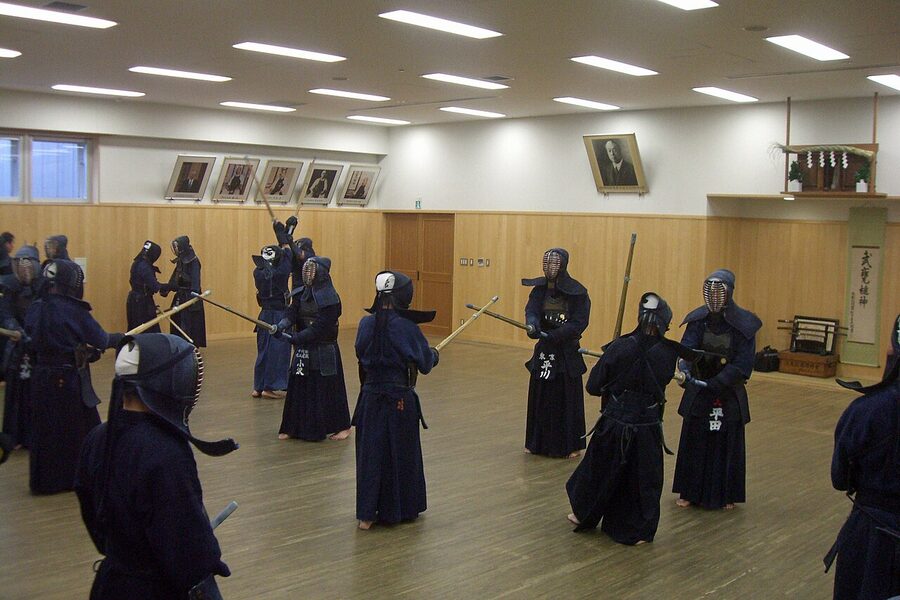
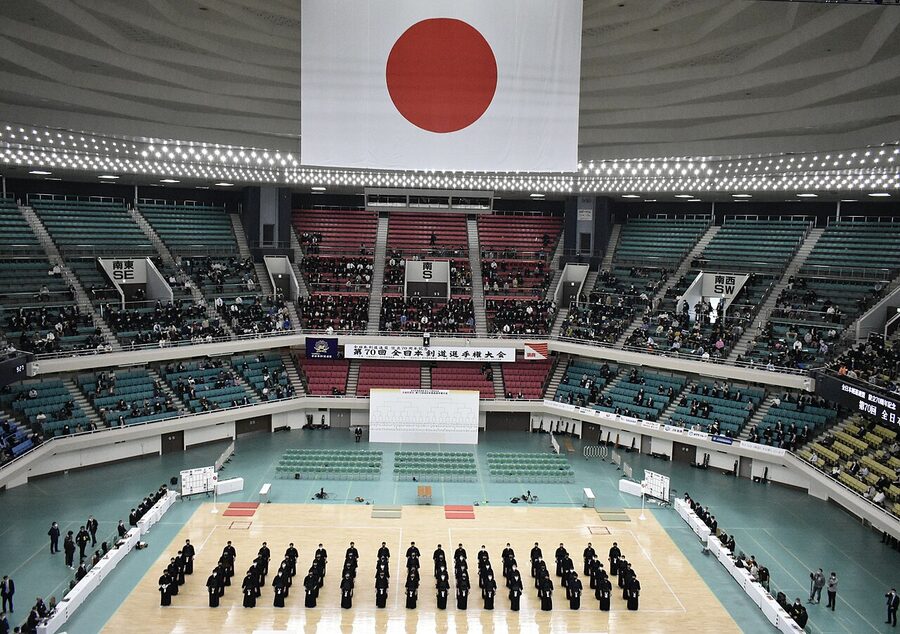
Of the 1,042 kendo players who walked onto the floor of the Kyoto City Gymnasium on the first day of May this year to sit the eighth-dan examination, nine passed; the next day 948 more tried, and nine more passed. Every one of the candidates was at least forty-six years old and had held seventh dan for a decade or more, and each fought short bouts in front of a panel of senior examiners, most of whom had to agree. The other 1,972 candidates of those two days went home to try again in November. One recent successful candidate, the secretary-general of the Kumamoto kendo federation, was reported to have passed on his twenty-second attempt, which at two sittings a year is the better part of eleven years of travelling to be told no.
I find that number more revealing than any amount of talk about the way of the samurai. Kendo (剣道) looks like the oldest thing in Japan: the indigo jackets, the lacquered breastplates, the shouts, the bows. But not one of the people sitting that exam is doing what a samurai did on a battlefield, and the sport they are being graded in is, in most of the ways that matter, younger than the railway. What they are doing is what Edo-period swordsmen did in fencing halls once there were no battlefields left, refined by a Meiji showman, the Tokyo police, a Kyoto patriotic society, an American occupation and a federation founded in 1952, and that story is stranger than the myth and ends somewhere you can go and watch.
In This Article
- Before the bamboo: closed schools and wooden swords
- Naganuma’s armour and Nakanishi’s bamboo
- Rank at Momoi’s, skill at Chiba’s, strength at Saitō’s
- 1873: swordsmanship as a sumo show
- The police save the sword
- Kyoto takes charge: the Butokukai
- Emperors, champions and the war
- Banned, renamed, revived
- What actually wins a point
- Armour, bamboo and manners
- Eighth dan and the one percent
- Kendo and bushido, without the legend
- Where to watch or try kendo today
- The All Japan Championships at the Nippon Budokan
- Kyoto: the Butokuden and the May taikai
- A walk through Edo’s fencing halls
- Butokuden around the country
- Trying it yourself
- Nine out of a thousand
Before the bamboo: closed schools and wooden swords
Japanese swordsmanship became a matter of named schools, ryūha (流派), in the 15th and 16th centuries, when a handful of men turned battlefield experience into teachable systems. Iizasa Chōisai’s Tenshin Shōden Shintō-ryū at Katori, Aisu Ikō’s Kage-ryū and the Chūjō-ryū are usually counted as the three sources, and nearly every later school claims descent from one of them. By the end of the Sengoku era the branches had multiplied into Kamiizumi Nobutsuna’s Shinkage-ryū, the Yagyū line that grew from it, Itō Ittōsai’s Ittō-ryū and dozens more. Japanese reference works put the eventual total at over two hundred.
Peace changed what these schools were for. Under the Tokugawa shogunate the house styles of the shogun’s family were Yagyū Shinkage-ryū and Ono-ha Ittō-ryū, Satsuma had its own ferocious Jigen-ryū, and every daimyo kept a fencing master on the payroll. Teaching was done through kata (形), fixed pairs of moves rehearsed with wooden swords, and a pupil climbed through licences of increasing secrecy, written on paper scrolls that cost money at every step. The great writing of the age came out of this world: Yagyū Munenori’s Heihō Kadensho and Miyamoto Musashi‘s Book of Five Rings are still read by kendo players today.
The trouble was that nobody could find out who was actually any good. Most schools forbade bouts with other schools, and a free bout with wooden swords could kill, so a real contest meant both parties signing a promise not to complain about their injuries. Later critics had a name for the result: kahō kenpō, “flower swordsmanship”, all elegant form and no proof. The Edo era had produced a martial art that, in many halls, had stopped being tested.
There was a soft practice weapon already. The fukuro shinai, a bundle of split bamboo inside a leather bag, is credited to Kamiizumi in the late 16th century, and the Yagyū school still trains with it. It was meant to make kata safe, not to allow full-power hitting, and an early 17th-century military chronicle, the Kōyō Gunkan, has a retainer of one of the Takeda captains running up to a helmet and smashing it with one, which tells you more about chroniclers than about bamboo.
Naganuma’s armour and Nakanishi’s bamboo
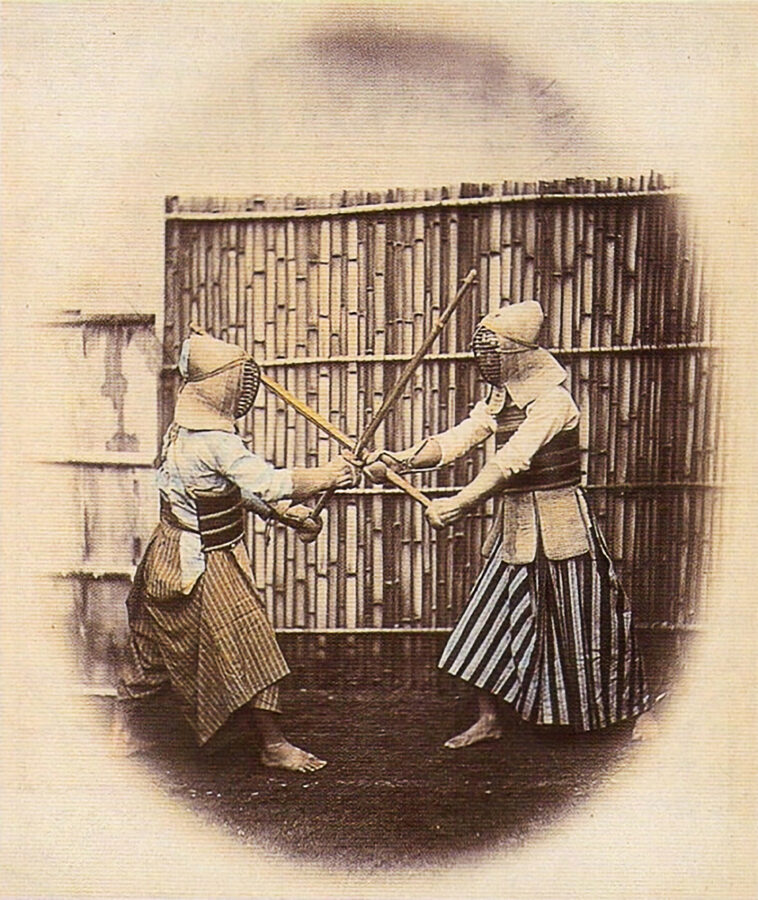
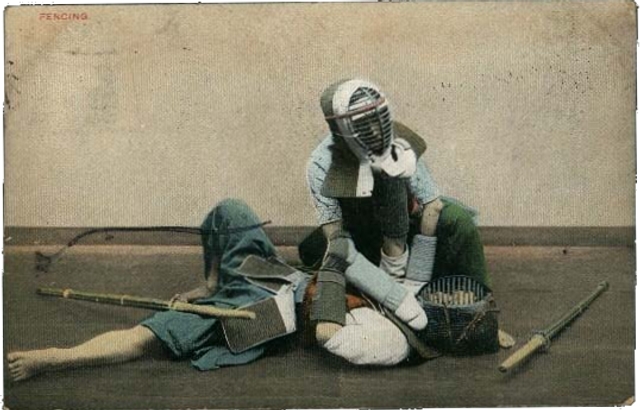
The man most Japanese histories credit with breaking the deadlock is Naganuma Shirōzaemon Kunisato (長沼国郷), born in Shimotsuke province in 1688. He inherited the headship of the Jikishinkage-ryū from his father on the 28th day of the sixth month of 1708, went to Edo, and opened a hall at Nishikubo in Shiba. There, in the Shōtoku era (1711–1716), he completed a set of protective gear, a face mask, gauntlets, a body guard and a skirt, and improved the bamboo sword to go with it. His pupils could now hit each other properly, and they did.
Sources divide the credit differently. English-language accounts often give the key improvements to his father, Yamada Heizaemon Mitsunori, known as Ippūsai, whose gravestone is said to record them, and make the son a collaborator. Japanese reference works name Naganuma himself and add that his new method went down well: four thousand pupils, by one count, and forty-three full licences. Either way the idea came out of one family’s hall in the 1710s.
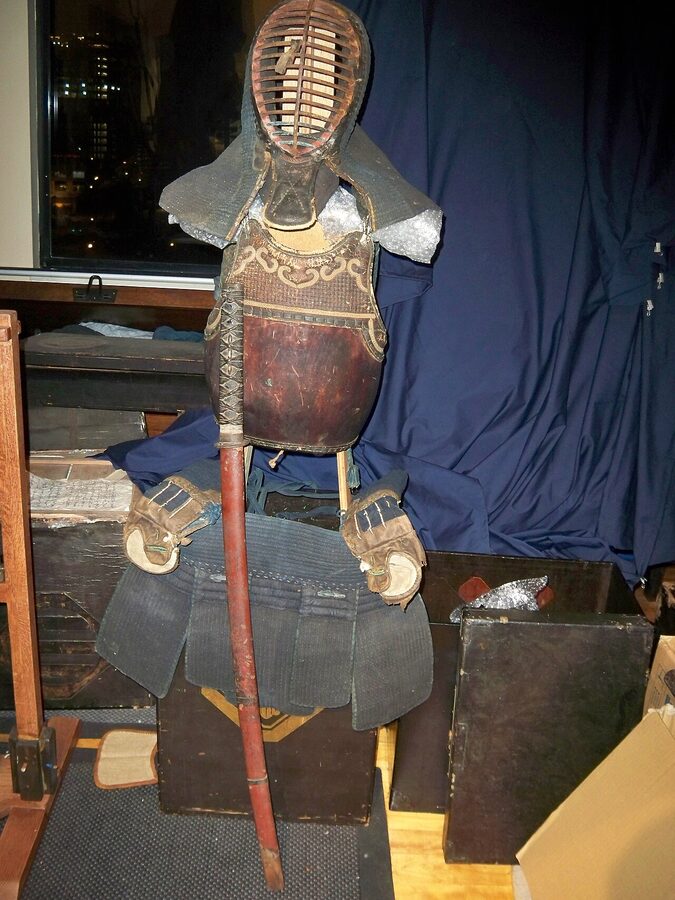
The second name is Nakanishi Chūzō Tsugutake of the Nakanishi branch of Ittō-ryū. His father had opened a town dojo at Neribei-kōji in Shitaya in the late 1730s, and in the Hōreki era (1751–1764) the son gave the mask an iron grille, replaced the old chest pad with something closer to a breastplate and built his teaching round shinai uchikomi geiko, full-speed striking practice with bamboo. Under his successors the Nakanishi hall was called the biggest in Edo, and it trained the teachers of the next century’s stars.
The equipment was nothing like a samurai’s armour, and that is the first thing to say plainly about kendo. Samurai armour was built to stop arrows and spear points on a battlefield; the new gear was built to let two men hit each other a few hundred times a morning and go home to dinner. The targets it protected (the crown of the head, the wrists, the flank, the throat) became the targets of a game, and they are still the only places you can score.
The bamboo kept changing. The stiff four-slat shinai that kendo uses now came in during the late 18th and early 19th centuries, and one account gives it to Ōishi Susumu of Yanagawa in Kyushu, who came up to Edo in the 1830s with a shinai five shaku three sun long, about 161 centimetres, and a guard the size of a pot lid. He beat almost everybody with one-handed thrusts. In one fight his point went through the face grille of a man called Naganuma Musōemon and badly injured his eye, though masks in those days were home-made.
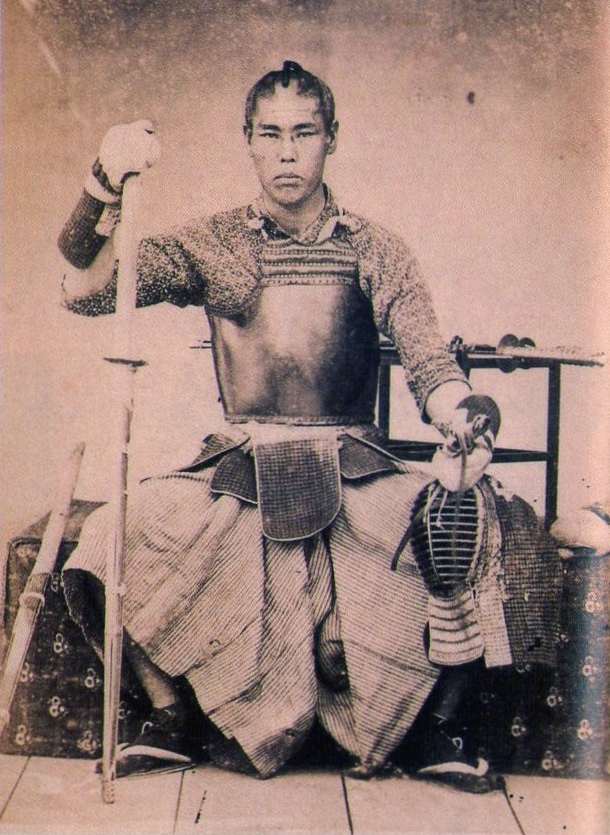
Long shinai became a craze, because in a game, reach wins. The man who stopped it was Otani Seiichirō Nobutomo, the most respected swordsman of the shogun’s own retainers. In 1856 he set the limit at three shaku eight sun, about 115 centimetres including the handle, and modern kendo still uses that length, raised by one sun in the 20th century to allow for taller Japanese.
Rank at Momoi’s, skill at Chiba’s, strength at Saitō’s
By the 1840s fencing with bamboo and armour had become a fashion, and the old rule against bouts with other schools was falling apart. Domains opened their own training halls, travelling swordsmen toured the provinces challenging the local teachers, and in the Kantō countryside village headmen and farmers had been fencing for decades, despite a shogunate ban of 1805. The ban didn’t work. The Shinsengumi would later be built largely from that rural fencing world.
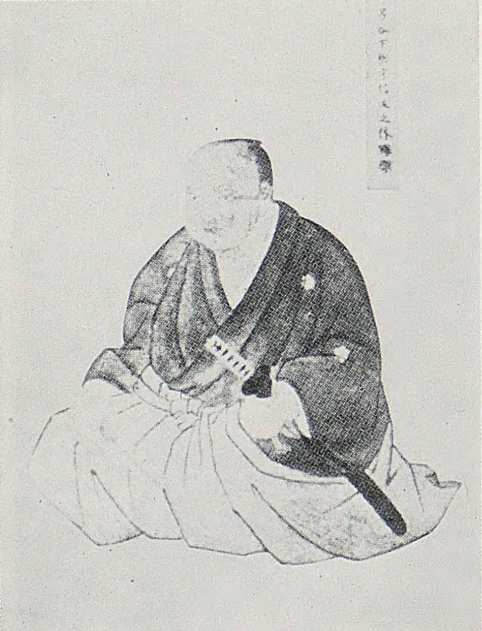
Edo had three great town dojo, and the city summed them up in a phrase: kurai wa Momoi, waza wa Chiba, chikara wa Saitō, rank at Momoi’s, skill at Chiba’s, strength at Saitō’s. Momoi Shunzō’s Shigakukan of the Kyōshin Meichi-ryū stood by the river at Asari-gashi near present Shintomi-chō, and its most famous pupil was the Tosa loyalist Takechi Hanpeita, whom Momoi made head student, along with Takechi’s hired killer Okada Izō. Saitō Yakurō’s Renpeikan of the Shintō Munen-ryū, founded in 1826 near Kudan, took in men from Chōshū: Katsura Kogorō, the future Kido Takayoshi, was its head student, and Takasugi Shinsaku and Itō Hirobumi trained there.
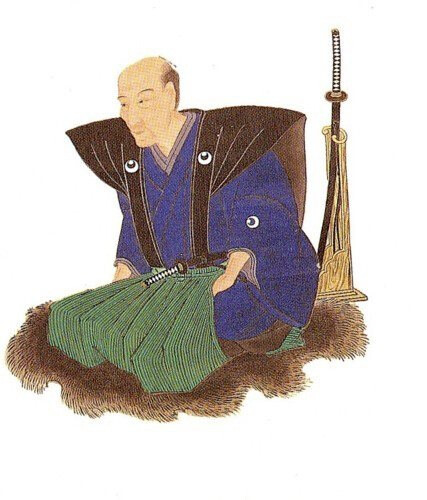
The biggest of the three was Chiba Shūsaku’s Genbukan. Chiba had trained in the Nakanishi hall, combined what he learned with his family’s style, called the result Hokushin Ittō-ryū, and opened in Edo in the autumn of 1822 before moving to Otamagaike in Kanda. He sorted fencing into sixty-eight named techniques that could be taught in plain words, and several modern kendo terms, among them the sweeping counter called suriage-men, are usually traced to him.
The pupil list reads like a cast of the 1860s. Sakamoto Ryōma trained under Chiba’s younger brother Sadakichi at the branch hall on Oke-machi. Yamanami Keisuke and Itō Kashitarō of the Shinsengumi were Hokushin men, and so were the shogunate’s Yamaoka Tesshū and the ronin agitator Kiyokawa Hachirō. Japanese writers like to say that the three dojo produced the Meiji Restoration, which is a slight exaggeration, but only slight.
The shogunate joined in after Perry’s black ships. At Otani’s urging it opened a training school for its own retainers, the Kōbusho (講武所), on a domain mansion site at Tsukiji in the fourth month of 1856; some reference works date its founding a year earlier, and its fencing, under Otani, was bamboo and armour with the form practice dropped. One account of the period has the young shogun Iemochi and the great elder Ii Naosuke watching the demonstration bouts when the school opened its new hall in Kanda on the third day of the second month of 1860. A month later, to the day, Ii was cut down outside the Sakurada Gate by men who had learned their fencing in halls like these.
1873: swordsmanship as a sumo show
The Meiji Restoration nearly finished all of it. The domains were abolished in 1871, the samurai stipends were wound up, men were encouraged to cut off their topknots and set aside their swords, and in March 1876 the government banned the wearing of swords altogether. Fencing teachers lost their pupils and their pay at once. Westernisation was the mood of the Meiji era, and a sword school was about as fashionable as a palanquin.
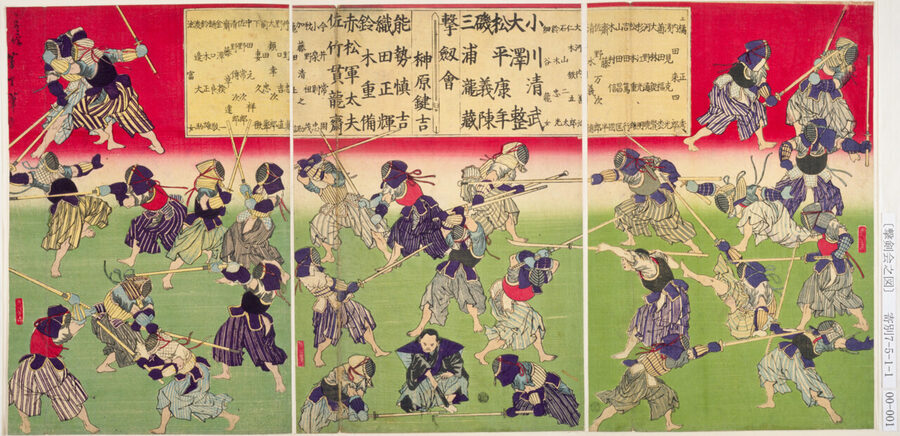
The man who kept it alive was Sakakibara Kenkichi (榊原鍵吉), one of Otani’s best pupils, former fencing master at the Kōbusho and personal instructor to the shogun Iemochi. In April 1873, with the backing of the Tokyo governor Ōkubo Ichiō, he put on a ten-day public show of swordsmanship at Saemon-gashi in Asakusa, just west of present Asakusabashi Station, and charged admission. He modelled it on sumo: a raised ring, fencers in loud costumes split into East and West, callers to announce them, a referee and line judges. There were naginata bouts and sword dances between matches.
The gekiken kōgyō (撃剣興行), “fencing shows”, sold out. Within months rival troupes run by Saitō Yakurō’s son, two Chiba heirs and other teachers were competing for the same audience, and there were thirty-seven of them in Tokyo, with more in Nagoya, Osaka and Kurume. Then the novelty wore off. Amateurs could not tell who had won a point, the quality fell as the troupes multiplied, and some prefectures banned the shows because political agitators were using them to draw a crowd for speeches.
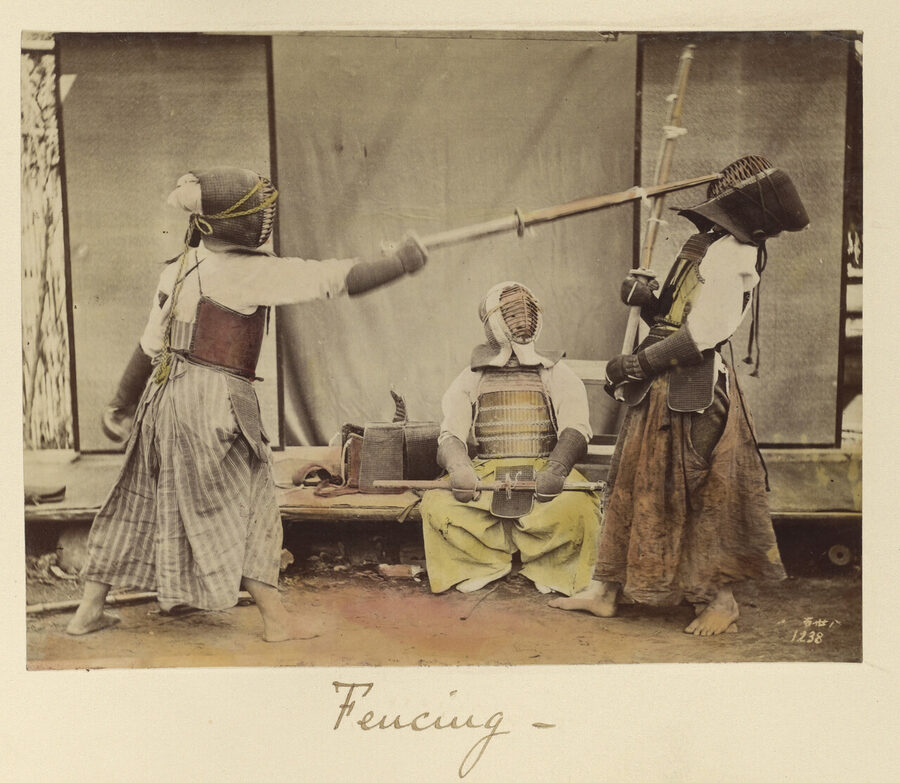
Purists hated the shows, and some kendo writers still blame them for the theatrical habits that crept into the sport, the exaggerated shouts and the showy flourish after a hit. The habit most often blamed on the ring is the swaggering pull-away after a strike, which Takano Sasaburō, the most influential teacher of the next generation, wrote about with some feeling. The modern rulebook takes a view of its own: a strike followed by an unseemly withdrawal is not supposed to count.
But the verdict of Japanese historians is that the shows kept swordsmanship breathing for five or six years when nothing else would. They paid unemployed fencers, they kept the bouts in public view, and when the police came looking for instructors in 1879, the men were there to be hired.
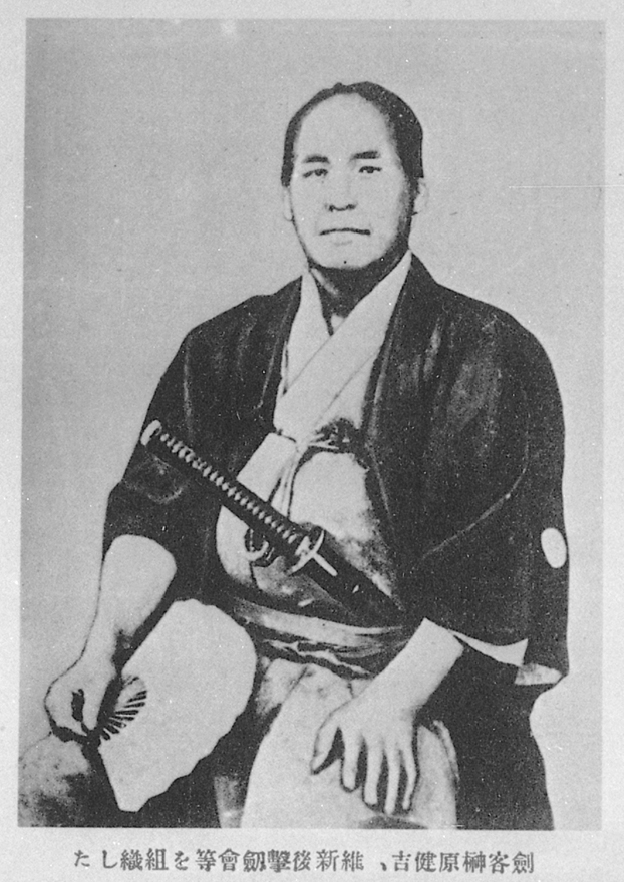
Sakakibara himself is the last great character of the old world. In the fifth month of 1868, during the fighting at Ueno that settled the Boshin War in Edo, he carried the imperial prince-abbot of Kan’ei-ji to safety on his back, turn and turn about with a bathhouse keeper. After the sword ban he walked about with a hooked wooden cudgel he called a yamato-zue, “Japanese walking stick”, so as not to offend the government, and a fan made of solid wood. Among his later pupils was Takeda Sōkaku, the man who taught Ueshiba Morihei, which makes Sakakibara a grandfather of aikido as well.
His most famous moment was a helmet-cutting display before the Meiji Emperor at Prince Fushimi’s mansion in Kioi-chō, Tokyo, held, depending on which Japanese source you read, on 10 November 1886 or 11 November 1887. Two police instructors went first and failed to cut a twelve-plate Myōchin helmet; Sakakibara, using a Dōtanuki blade that a sword dealer is said to have pressed on him that morning, cut it to a depth of five bu over three and a half sun, roughly 1.5 by 10.6 centimetres. One account has him dressed in white, ready to commit seppuku if he failed. The display is still told as proof of what a Japanese sword can do, though what it mostly proves is what Sakakibara could do.
The police save the sword
What actually rescued Japanese fencing was a war. In 1877 Saigō Takamori led the Satsuma Rebellion, and at the long fight for the Tabaruzaka slope in March the government’s conscript infantry was badly cut up by Satsuma swordsmen. The answer was a picked unit of Tokyo policemen, most of them former samurai, armed with swords: the battōtai (抜刀隊), the Drawn Sword Corps. They did well enough to become a legend and a marching song.
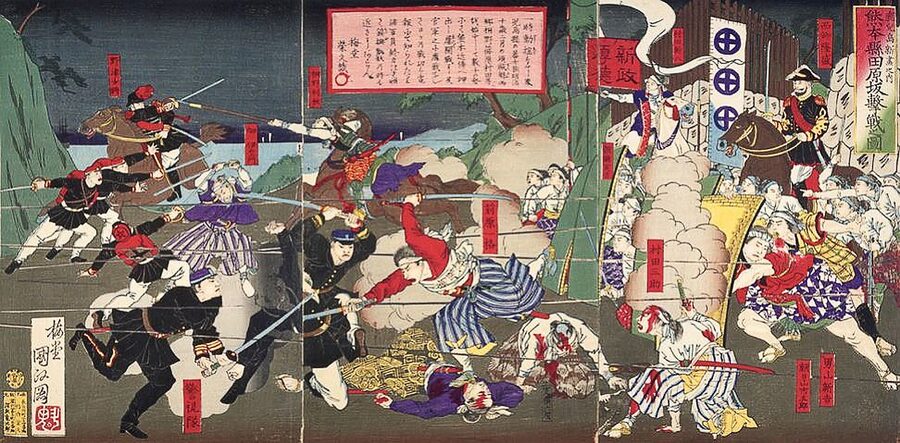
The head of the national police, Kawaji Toshiyoshi, drew the obvious conclusion and wrote an essay arguing for the revival of swordsmanship. In 1879 the police training school got its own dojo, and the first instructors, Ueda Umanosuke, Kajikawa Yoshimasa and Henmi Sōsuke, were chosen after a test judged by Momoi Shunzō and Sakakibara himself. More followed, many straight out of the show troupes. By 1883 the Tokyo police had over two hundred officers good enough to run a dojo of their own.
Because the instructors came from a dozen schools, the police built a common syllabus: the Keishi-ryū, a set of ten forms with one technique taken from each of ten old schools, the first of them from Sakakibara’s Jikishinkage-ryū. It was presented in 1886 at the police martial arts festival held at Mukōgaoka Yayoi in Hongō, where from 1882 the force staged fencing tournaments that drew entrants from all over the country.
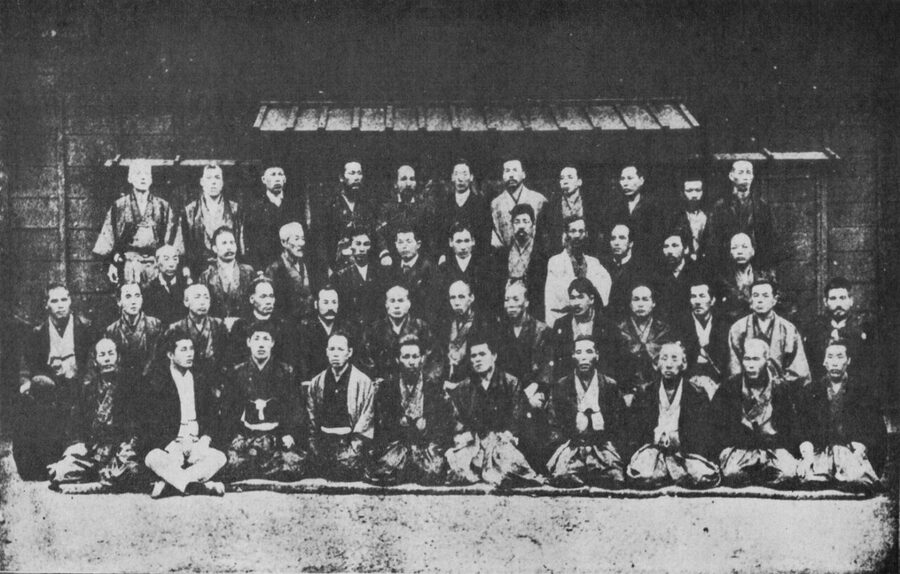
The police also gave kendo its first grades, a ladder of numbered classes set up around 1879. English-language accounts usually date the kyū and dan system to 1883; Japanese reference works treat the police classes as a first step, but date the modern grades to the Butokukai, which created its teaching titles in 1902 and adopted dan grades for kendo in 1917. The old Shinsengumi captain Saitō Hajime, who had become a Tokyo policeman, is said in his last years to have driven a shinai clean through a hanging tin can. I believe it about as much as I believe the helmet in the Kōyō Gunkan.
Kyoto takes charge: the Butokukai
The organisation that turned fencing into a national institution was founded in Kyoto on 17 April 1895, in a mood of patriotic excitement after the victory over China and the 1,100th anniversary of the founding of Heian-kyō. The Dai Nippon Butokukai (大日本武徳会), the Greater Japan Martial Virtue Society, had a prince of the blood as president and the governor of Kyoto as chairman. It raised money through the police, who collected members’ subscriptions, and by 1909 it had 1.51 million members.
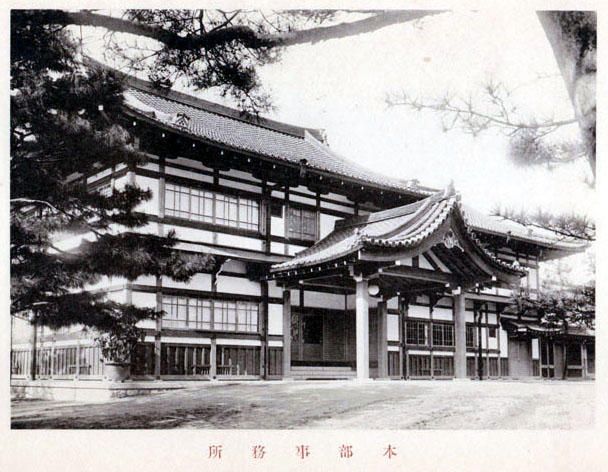
In October 1895 it held its first festival of martial arts and handed fifteen outstanding performers a certificate of proficiency. In 1899 it built its great hall, the Butokuden (武徳殿), beside the new Heian Shrine in Okazaki, named after a pavilion in the old imperial palace where the court once watched horse races. Every May the society’s festival brought swordsmen, archers and jujutsu men from across Japan to perform there, and its successor still does.
Then came the apparatus. In 1902 the Butokukai created the teaching titles of hanshi and kyōshi, with a small pension for hanshi; seven men received the first hanshi titles in 1903, and renshi followed in 1934. In 1905 it opened a college for martial arts teachers in Kyoto, renamed in 1919 the Budō Senmon Gakkō, the Busen. Its fencing professor Naitō Takaharu and Takano Sasaburō of the Tokyo Higher Normal School became the twin powers of the art: people spoke of “Naitō in the west, Takano in the east”.
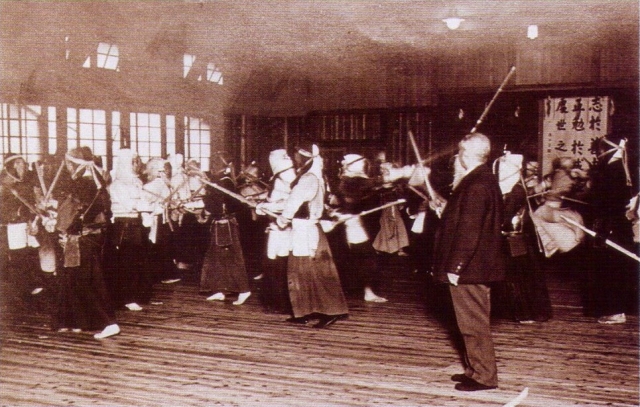
Schools were the prize, and the education ministry had refused for decades to put fencing in the curriculum, arguing it was too violent for growing boys and too hard to teach, until petitions from fencing members of the Diet carried a resolution and in 1911 the middle-school regulations allowed it as part of physical education. To give every school the same material, the Butokukai picked twenty-five masters from across Japan and Taiwan and told them to agree a set of forms. It took a year of shouting. Takano is said to have attended the meetings with a dagger inside his kimono, ready to stab his opponent and himself if his views were ignored.
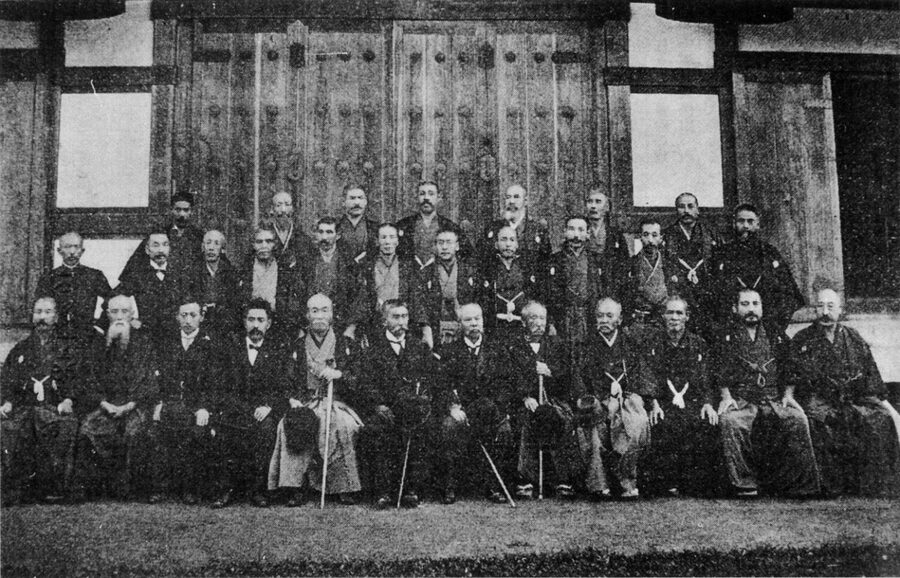
The result, published in October 1912 as the Dai Nippon Teikoku Kendō Kata, is the set every kendo player still learns: seven forms with the long sword and three with the short. The senior partner, the uchidachi, attacks and always loses, so that the junior learns to win correctly. The forms are often treated as a sacred distillation of the old schools, but they were in fact chosen as the most basic movements for teaching schoolboys, and the committee said at the time it would revise them if most people wanted changes.
When did gekiken become kendo? Sources variously give 1911, when some Japanese accounts find the word in the new school regulations; 1919, in the middle of the Taishō era, when the Butokukai’s new vice-president Nishikubo Hiromichi pushed it to rename bujutsu as budō and fencing as kendo; 1920, the date most English accounts use; and 1926, when another Japanese reference work, reading the 1911 rules as still saying gekiken, finds its first official use in the national school syllabus. The word itself is much older and turns up now and then in Edo writing. The point is that it took a generation to stick, and that the change from “technique” (jutsu) to “way” (dō) was a deliberate piece of rebranding.
Emperors, champions and the war
Kendo did not have champions until the 1920s. Contests had been individual matches between invited swordsmen, with no rankings and no winner of anything. The Meiji Shrine games of 1924 introduced leagues and knockout brackets, and the three great imperial tournaments of the early Shōwa era, in 1929, 1934 and 1940, made kendo champions national figures. Naitō Takaharu, who thought a tournament with a winner corrupted the art, opposed the 1929 event fiercely and gave way only because the emperor was involved.
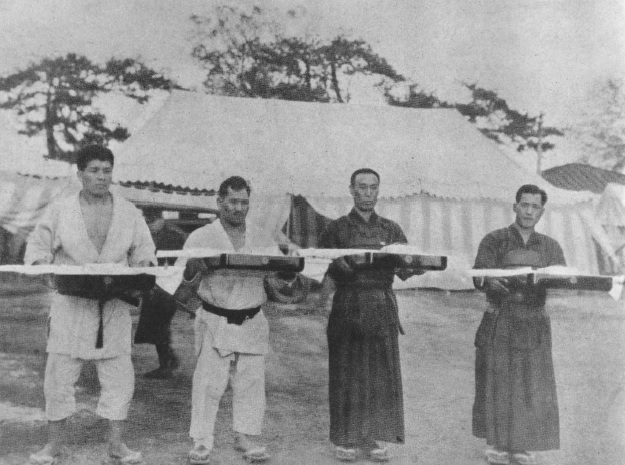
By 1931 kendo or judo was compulsory in middle schools. In 1941 it was compulsory for boys from the fifth year of primary school. And in March 1942 the Butokukai itself was reorganised as a government body under five ministries, with the prime minister, General Tōjō Hideki, as its president. Its headquarters moved from the Butokuden to the Ministry of Health in Tokyo, and the hall in Kyoto lost its point.
Wartime kendo was explicitly training for bayonet and sword fighting, and strikes were renamed zantotsu, “cuts and thrusts”. Light hits and one-handed techniques were no longer allowed to score, the attacking initiative was everything, and one-point matches replaced the best of three. The dan grades were even replaced for a time by a scheme of numbered classes. None of this is a secret in Japan, and anyone who tells you that kendo has always been a gentle path of self-improvement has skipped these years.
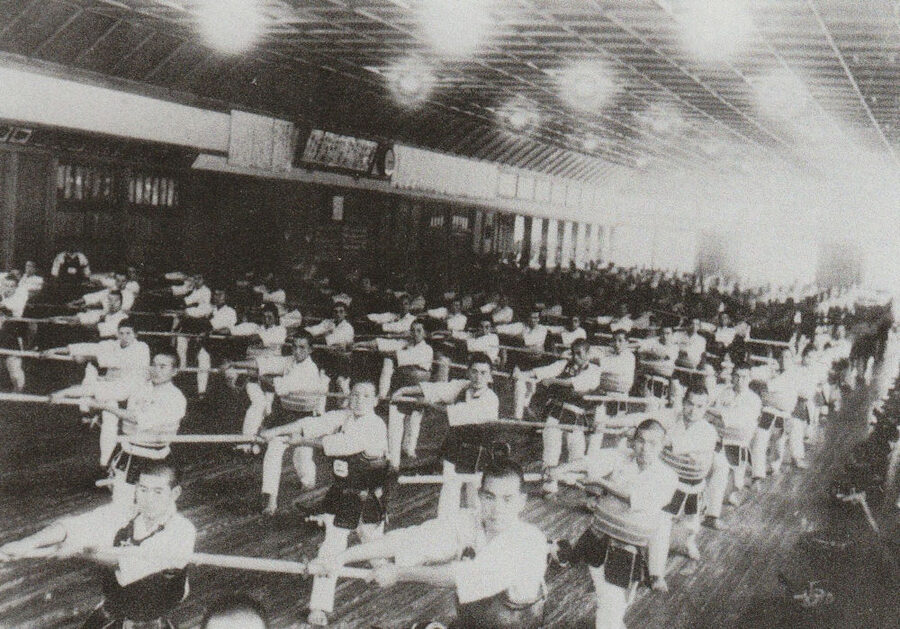
The empire carried kendo with it. The Butokukai spread it through the police and schools of Korea and Taiwan, and Japanese sports historians are frank that this was a very different thing from its spread among Japanese emigrants in Hawaii, California and Brazil, where by 1934 the North American branch alone had forty chapters on the West Coast. Japanese scholars of the subject have described the Korean case as cultural imposition by a colonial power, and the long-running quarrel between Japanese kendo and Korean kumdo over the sport’s origins grows out of that history.
Banned, renamed, revived
After the surrender, the occupation treated kendo as militarist training, which in its recent form it had been. On 6 November 1945 it was banned in schools, and by the end of the year in school facilities for anyone at all. The Butokukai voted to dissolve itself on 31 October 1946 and was formally ordered dissolved by the Home Ministry a few days later, with its property confiscated and some 1,300 officials purged from public life. In 1949 even police kendo was stopped.
The way back was a piece of inspired camouflage. In March 1950 a group led by Sasamori Junzō founded a federation for a new sport called shinai kyōgi (撓競技), “shinai competition”, after the name kendo itself was refused. Players wore shirts, trousers and sports shoes with light padding and fought with the old bag-covered shinai. Leg sweeps, body-checks and even shouting were banned, the court was marked out with boundary lines, and instead of a single judge in formal kimono there were three referees in Western suits, each holding a red flag and a white one.
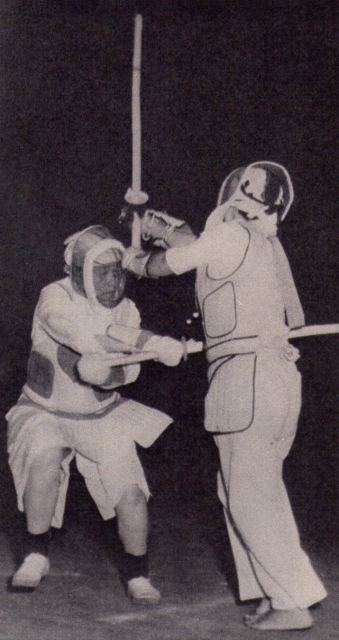
The occupation ended on 28 April 1952, and on 14 October that year the All Japan Kendo Federation was founded. The two federations merged in March 1954. The first All Japan Kendo Championship was fought at the Kuramae sumo hall on 8 November 1953, kendo returned to high schools the same year, and by 1957 shinai kyōgi had been folded into “school kendo”. The flags, the boundary lines and the three referees stayed, and every kendo match you watch today is judged the way the camouflage sport was.
The Nippon Budokan opened in October 1964, the International Kendo Federation was founded in April 1970 with seventeen member countries, and the first World Kendo Championships were fought in the Budokan the next day. In 1975 the federation published “The Concept of Kendo”, which defines it as “a way to discipline the human character through the application of the principles of the katana”. The federation has put the number of kendo players in Japan at around 1.66 million, and it has consistently refused to let it become an Olympic sport.
What actually wins a point
A kendo match looks chaotic to a newcomer and is in fact very narrow. There are four targets: men, the top or upper sides of the head; kote, the right wrist, or the left when it is raised; dō, either side of the breastplate; and tsuki, a thrust to the throat flap of the mask. The thrust is banned in children’s matches because it is the one technique that can do real harm.
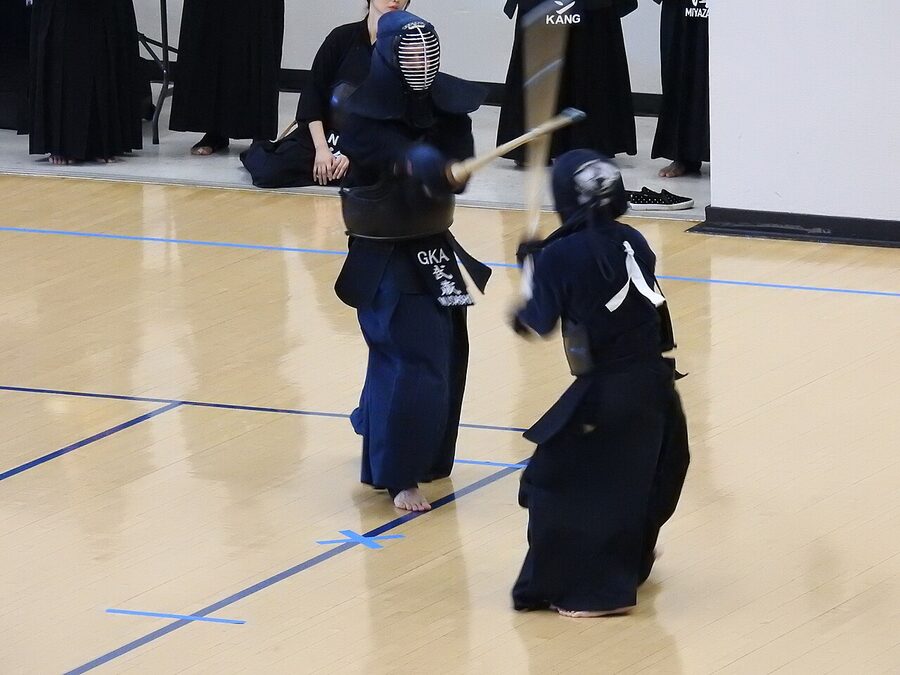
Hitting the target is not enough. A valid point, yūkō-datotsu, has to land with the top third of the shinai on its “cutting” side, the side opposite the cord, with full spirit, correct posture and the blade travelling true. The usual shorthand is ki-ken-tai-ichi, spirit, sword and body as one: the shout, the strike and the stamp of the front foot all at the same instant. And the striker must show zanshin, continued alertness, after the hit; the rules specifically refuse a point to anyone who pulls away in an unseemly fashion, which is the show-ring habit Takano wrote about.
Three referees hold red and white flags. A point is given when two of them raise the flag of the same colour, or when one raises it and the other two signal abstention. Matches are normally best of three points over four or five minutes, depending on the event, and the first to two wins; if only one point has been scored when time runs out, that point wins. A drawn match goes to sudden-death extra time, or in some events to a referees’ decision.
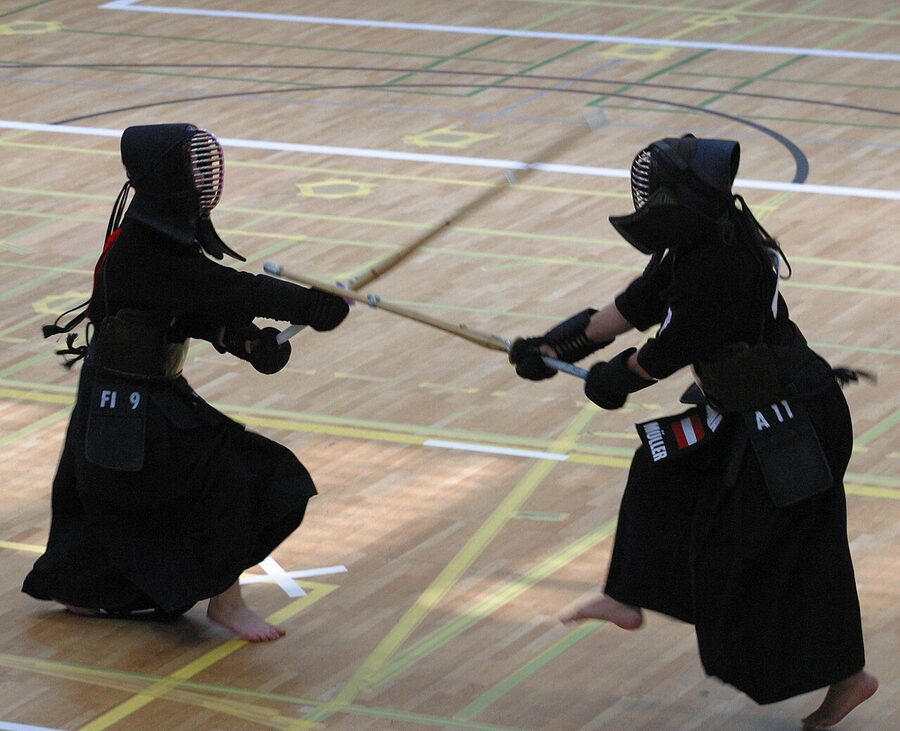
Penalties are minor offences, and two of them give the opponent a point: stepping out of the court, dropping your shinai, tripping, holding, grabbing the other man’s shinai, wasting time. Since 2021 the rules have also cleared up the old habit of locking guards at close quarters, tsubazeriai, and leaning on each other to run down the clock. You now have a single breath to strike as you step back or separate; the change was brought in as a pandemic measure and made permanent in 2024. Two-sword fencing, Musashi’s style, is legal for adults but rare, since students were forbidden it for decades and the short shinai puts its user at a disadvantage.
What you will notice most, watching a top-level match, is how little happens. Two players spend most of their time edging forward and back, tips touching, each trying to break the other’s centre without committing. Then something happens in a fraction of a second, three flags go up, and both players walk back to their starting lines as if nothing had occurred, because celebrating is bad form. It is a sport for people who find stillness exciting.
Armour, bamboo and manners
A full set of bōgu (防具), or kendōgu as the federation prefers to call it, has four parts. The men covers the head, with a grille of one vertical bar and fourteen horizontal ones, and a slightly wider gap between the sixth and seventh bars, the monomi, which is where your eyes are supposed to be. The kote are padded gauntlets with a separate thumb, the dō is a breastplate traditionally made of bamboo strips covered in lacquered leather, and the tare is a skirt of padded flaps that carries a name tag, white letters on a dark ground, with your club across the top and your surname down the middle.
Under it you wear an indigo jacket and the pleated hakama, with a cotton towel, the tenugui, tied round your head under the mask. The kit goes on in a fixed order: tare, dō, towel, men, left kote, right kote. It comes off in reverse, and you will be told off if you get it wrong.
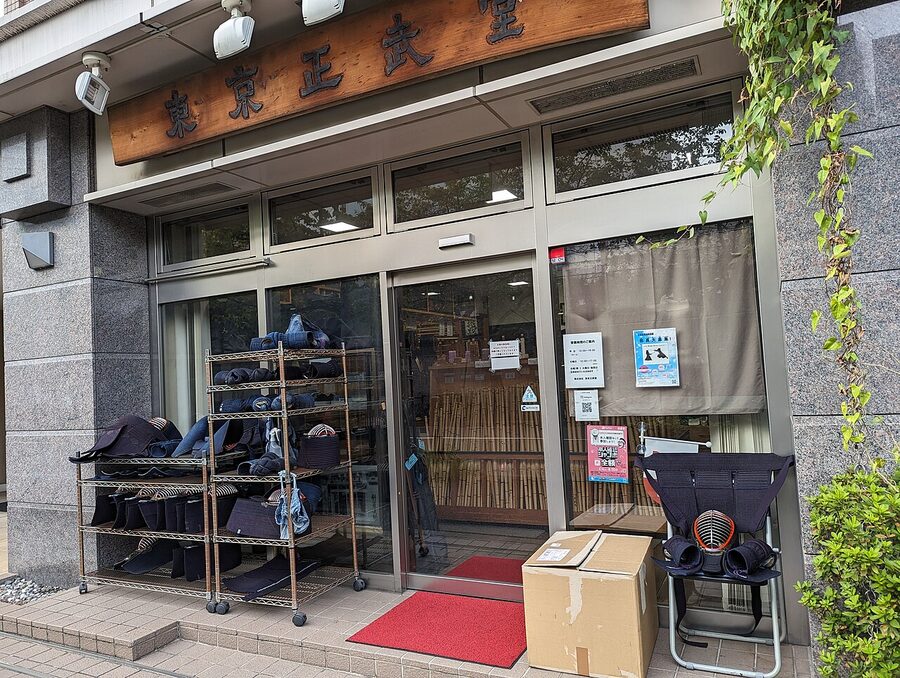
Prices run across a wide range. A machine-stitched set, the kind that spread with the kendo boom of the early 1970s, costs from a few tens of thousands of yen to a few hundred thousand. Hand-stitched armour starts at around ¥100,000 and runs past ¥1,000,000, because the best is made by a dwindling number of craftsmen from indigo cloth, deerskin and lacquer, and is treated in Japan as a traditional craft in its own right. It belongs in the same family as the objects in my survey of Japan’s greatest crafts, even if it smells considerably worse.
The shinai is four staves of split bamboo bound with leather at the handle and tip, with a cord along the back to show which side is the “blade” and a leather tie a third of the way down. Regulation sizes rise with age: an adult man’s shinai may be no longer than 120 centimetres and must weigh at least 510 grams, about half the weight of a real sword. Most are now made from imported Taiwanese bamboo, but shinai-making survives as a recognised traditional craft in Maibara in Shiga, where it was taught around 1897 by a craftsman trained in Fushimi.
The etiquette is what newcomers remember, starting with a bow at the door of the dojo. Before a bout the two players bow at the edge of the court, take three steps in, draw and sink into a crouch, sonkyo, before standing at the referee’s call. Practice begins and ends kneeling in seiza in a line, senior grades at one end, with a minute of silent meditation, mokusō, and a bow to the teachers and to each other.
Eighth dan and the one percent
The modern ladder runs from sixth kyū to first kyū, then from first dan to eighth. Japanese children usually take first kyū as their first exam; adults usually go straight for first dan. Nobody can see your grade on your clothing, since everyone wears the same indigo. On top of the dan grades sit the three teaching titles inherited from the Butokukai, renshi, kyōshi and hanshi, so a senior teacher might be introduced as kyōshi hachidan.
Ninth and tenth dan existed once. The federation adopted a ten-grade scale in 1957, partly because judo had one, and awarded tenth dan to exactly five men, all pupils of Naitō Takaharu at the Busen, before quietly abolishing the top two grades in 2000. That made hanshi hachidan the highest rank in kendo. Exams at every level combine a practical, the Nihon Kendō Kata and a written paper, and the higher the grade, the larger the panel.
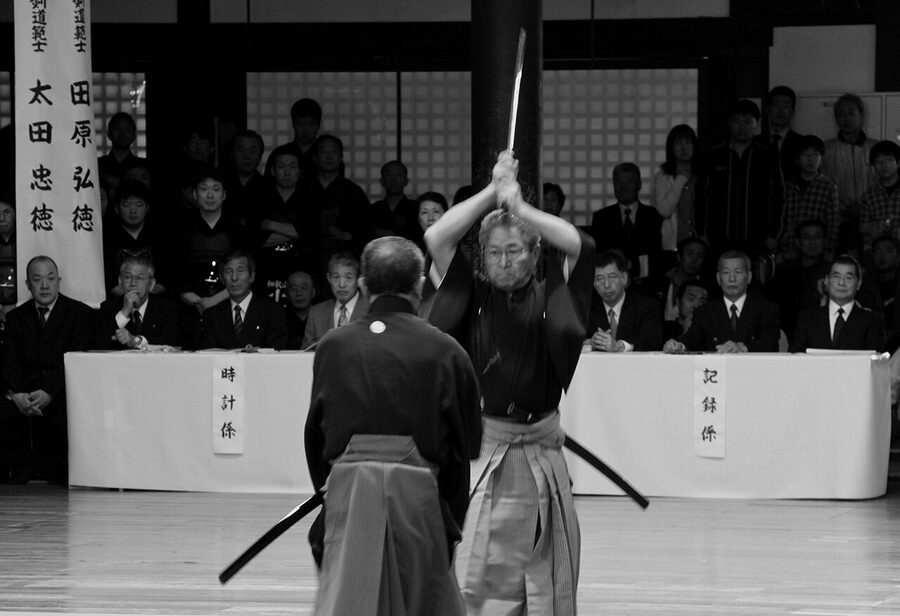
The eighth-dan exam is the famous one. You must be at least forty-six and have held seventh dan for ten years. The practical comes in two rounds: in the first, four of six examiners must agree to pass you; in the second, six of nine. The written paper and the kata come after that, and almost nobody who gets that far fails them.
The federation publishes the numbers, and they are brutal. At the Nippon Budokan in November 2025, 1,099 candidates sat on the first day and 8 passed, then 1,155 on the second day and 6 passed, rates of 0.7 and 0.5 percent. Kyoto in May 2025 was 892 and 9, then 934 and 7, and in May 2026, as I said at the start, 18 out of 1,990. Japanese writers like to describe the exam as harder than the bar, and for once the cliché is an understatement.
What the examiners are looking for is the hardest thing to describe. They are not counting points; they want to see a player take the centre, make the opponent move first and strike at exactly the moment the opponent commits, with the kind of composure that comes only from decades. Speed, at that level, counts for very little.
Kendo and bushido, without the legend
The link to the samurai is real, but it is not the one usually advertised. Kendo descends in a direct line from the sword schools of the Edo samurai, and many of its teachers in the 19th century were of samurai birth. Its targets, its kata and its idea of a decisive cut come from people who expected, at least in principle, to fight with swords. Many of Japan’s greatest samurai would recognise its stances and its vocabulary, if not its armour.
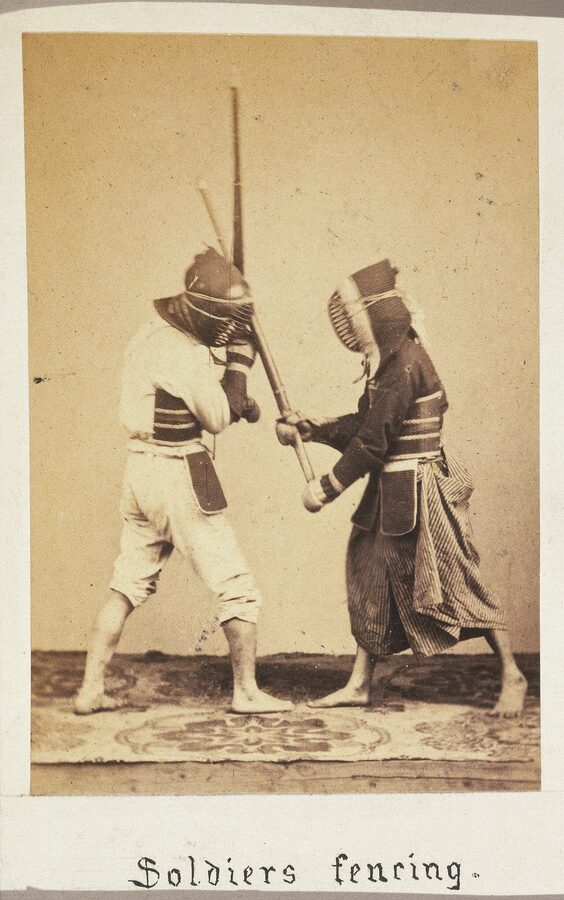
But the armour, the bamboo, the scoring, the referees, the tournaments, the grades and the name were all invented after the age of battles had ended, most of them after the samurai class itself had been abolished. A good share of the people who filled the great dojo of the 1850s were village headmen, farmers’ sons and townsmen. The ideology that now surrounds kendo, of bushido as a moral code and kendo as its living school, owes more to the late Meiji era, when Nitobe Inazō wrote his famous book and the Butokukai was busy turning martial arts into national education, than to anything Musashi wrote.
I don’t think that makes kendo less interesting. If anything it makes it more so. The thing that survives from the Edo dojo is the habit of testing yourself against someone who is trying hard to hit you, and the discovery, made in the 1710s and re-made by every beginner since, that you learn more from being hit than from a hundred elegant kata. That is a samurai inheritance worth having, and it doesn’t need a legend.
Nor should the darker inheritance be smoothed over. The same moral language was used in the 1930s to drill boys for bayonet fighting, and the federation’s insistence since 1952 that kendo is an education of character rather than a combat sport is partly a reaction to that. When a modern teacher tells you kendo is about cultivating yourself, they mean it, and they also mean: not the other thing.
Where to watch or try kendo today
The two great annual events happen in two famous buildings, and the sites of Edo fencing lie within a short subway ride of each other in central Tokyo. But kendo is not a tourist attraction and doesn’t try to be one, so you will have to plan.
The All Japan Championships at the Nippon Budokan
The men’s All Japan Kendo Championship has been held on 3 November, Culture Day, since 1982, and almost always at the Budokan; since 2024 the women’s championship has been fought there on the same day. It is the most prestigious title in kendo, and the men compete for the Emperor’s Cup, a silver cup weighing 2,362 grams, while the women compete for the Empress’s Cup. This year’s men’s title went to Nakada Ryūnosuke of Tokyo and the women’s to Suenaga Mari of Wakayama.
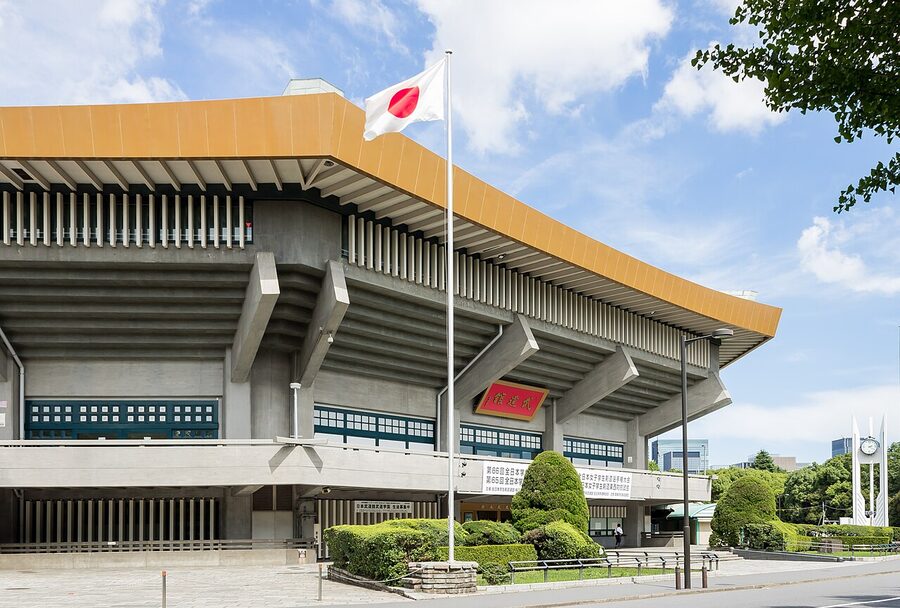
Tickets go on sale on 1 September through Ticket Pia and Lawson Ticket, both of which need a free account; you can also buy at the multi-copy machines in 7-Eleven and the Loppi terminals in Lawson. For 2026 the federation priced arena seats at ¥10,000, first-floor reserved seats at ¥3,000–¥5,000 depending on the row, second-floor front at ¥2,000, and unreserved seats on the upper levels at ¥1,000 (¥500 for junior high pupils). Any seats left on the day are sold at the west entrance. I would take the ¥1,000 seats and bring binoculars; you see the shape of a match better from above, and you can leave for lunch without guilt.
The 20th World Kendo Championships come to the Budokan from 27 to 30 May 2027, the first in Japan for twelve years, and the last time Japan hosted, tickets almost sold out in advance. At the presale held at this year’s championship, single-day seats cost ¥2,500–¥10,000 and a four-day pass ¥27,000; general sale is due to open in January 2027, and if you are planning a trip for late May, buy early.
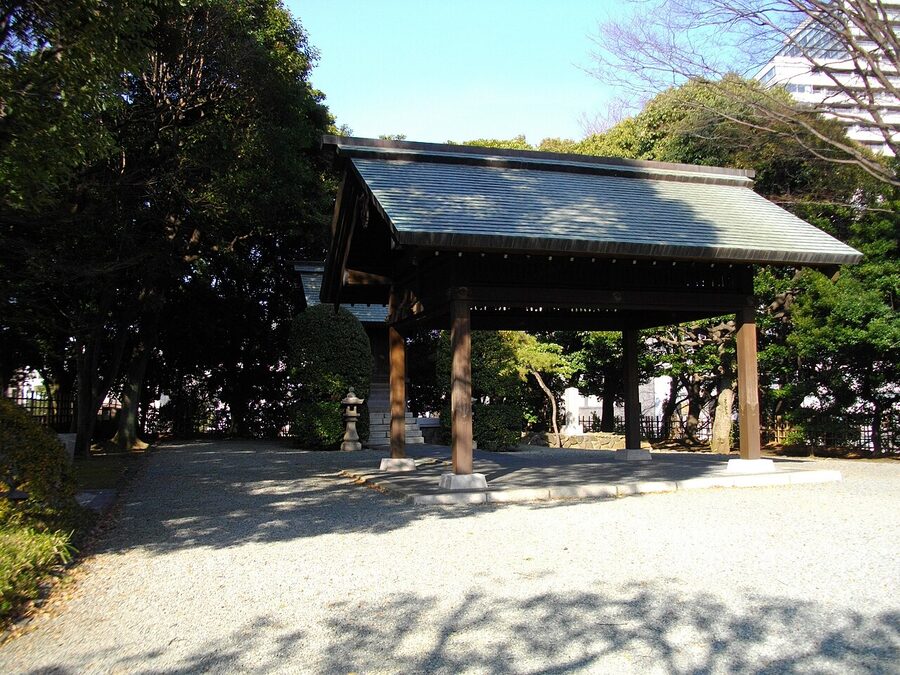
The Budokan is a five-minute walk from exit 2 of Kudanshita Station, through the Tayasu Gate of what was once Edo Castle. Saitō Yakurō’s Renpeikan stood on the Kudan slope a few minutes away, and a short walk from the Budokan, inside the park, is the Yayoi Ireidō, the memorial to Tokyo police and firemen killed on duty, which began life in 1885 as the Yayoi Shrine in Hongō, the neighbourhood where the police held their great fencing tournaments.
Kyoto: the Butokuden and the May taikai
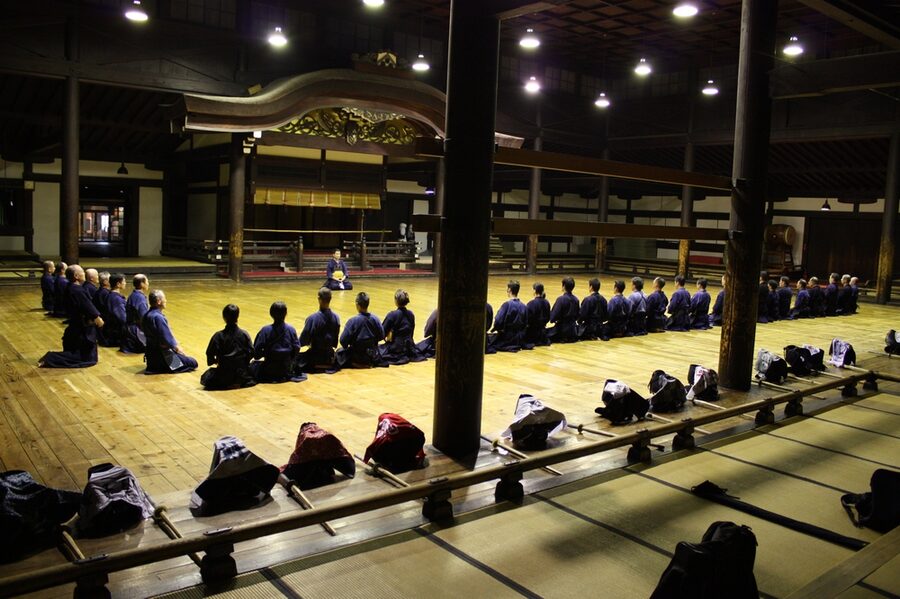
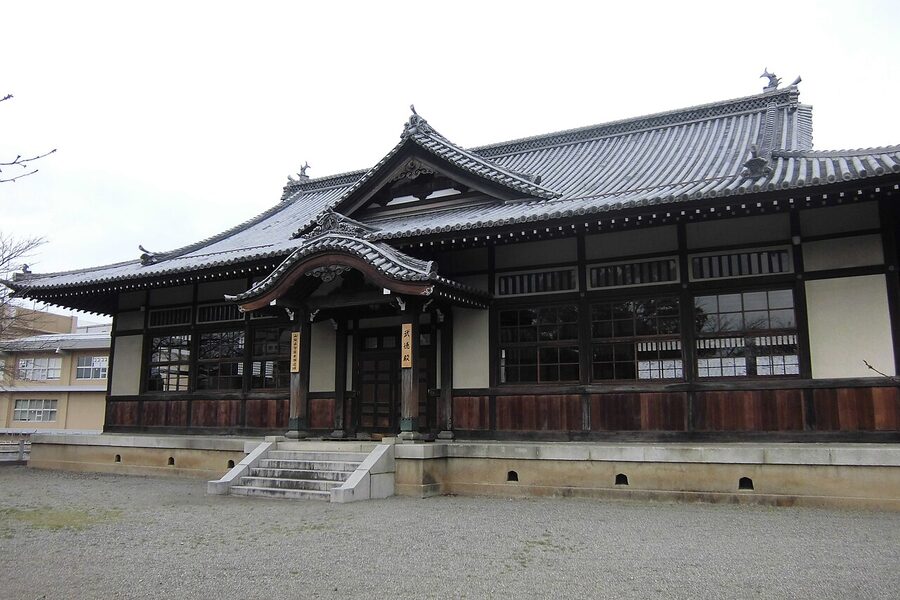
The Butokukai’s hall of 1899 survives in Okazaki, northwest of Heian Shrine, and is now an Important Cultural Property and the centrepiece of the Kyoto City Budō Center. It is the oldest purpose-built martial arts hall in Japan, and its long wooden floor under a high roof is, to my eyes, the finest room in the kendo world. The nearest bus stop is Kumano-jinja-mae on Higashiōji, from which the hall is about three minutes’ walk to the east; the subway at Higashiyama is a longer walk.
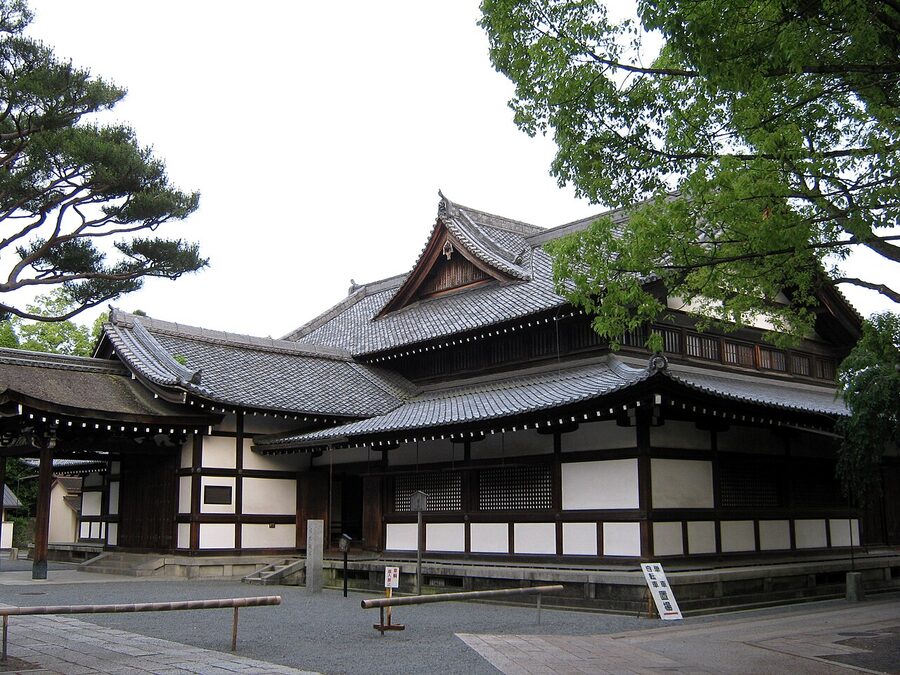
The building comes into its own in the first days of May for the All Japan Kendo Demonstration Tournament, the Kyoto Taikai, the direct descendant of the Butokukai’s annual festival. The 122nd ran from 2 to 5 May 2026. It is not a championship: thousands of senior players from all over Japan each fight a single demonstration bout, from the sixth dans on the early days to the hanshi on the last morning, and there are kata displays, iaidō and jōdō as well. Watching two hanshi in their seventies circle each other in that hall is the closest thing kendo has to a performance of classical music.
The eighth-dan exams are held across town at the Kyoto City Gymnasium in Nishikyōgoku on 1 and 2 May, as the taikai begins, so the first week of May turns the city into a kendo convention, and you will see armour bags on the buses. Spectator arrangements for the taikai change from year to year, so check the federation’s notice before you go.
A walk through Edo’s fencing halls
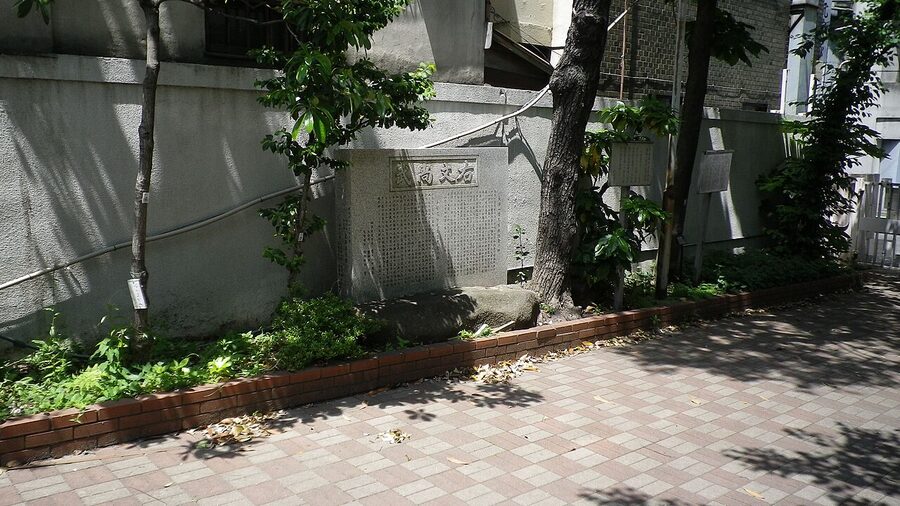
None of the three great dojo survives, but you can find where they stood in a morning. The site of Chiba Shūsaku’s Genbukan is marked in Kanda Higashi-Matsushita-chō, a few minutes from Iwamotochō Station; the stone stands in the grounds of what was a domain mansion, and the dojo itself was a little to the west, near the crossroads. Momoi’s Shigakukan has an explanation board at the old Asari-gashi near Shintomichō Station, which mentions Takechi and Okada, and the Kōbusho’s Kanda site at Misaki-chō is now under the buildings of Nihon University near Suidōbashi.
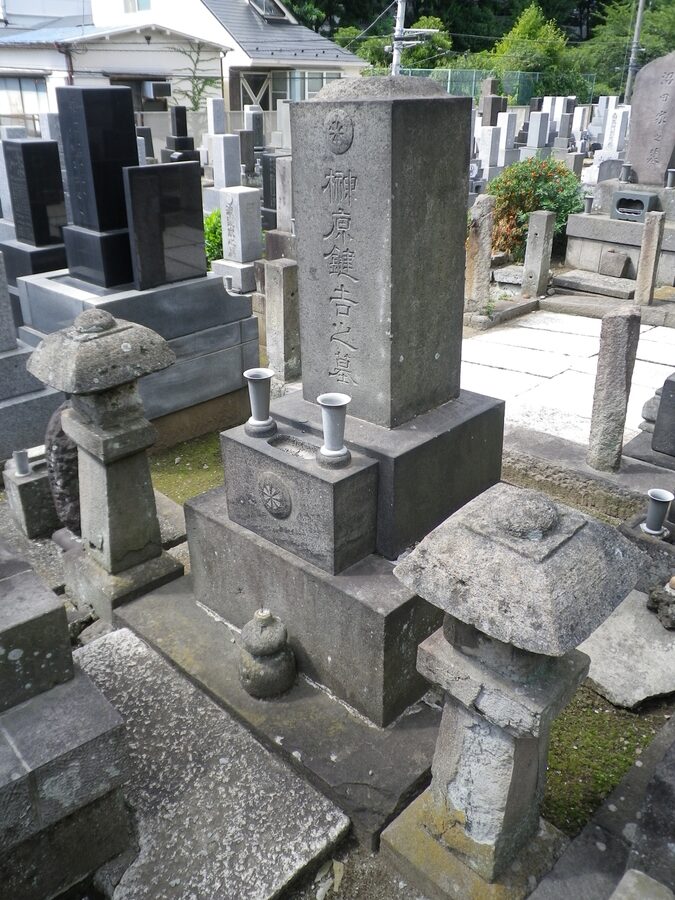
The pilgrimage I would make is to Sakakibara’s grave. He died of beriberi on 11 September 1894 and is buried at Saiō-ji, 11-4 Suga-chō in the temple district of Yotsuya, within walking distance of Yotsuya Station; the grave has been a designated historic site of Shinjuku ward since 1990. His Buddhist name includes the characters for “staff” and “Yamato”, a nod to the wooden cudgel he carried after the sword ban.
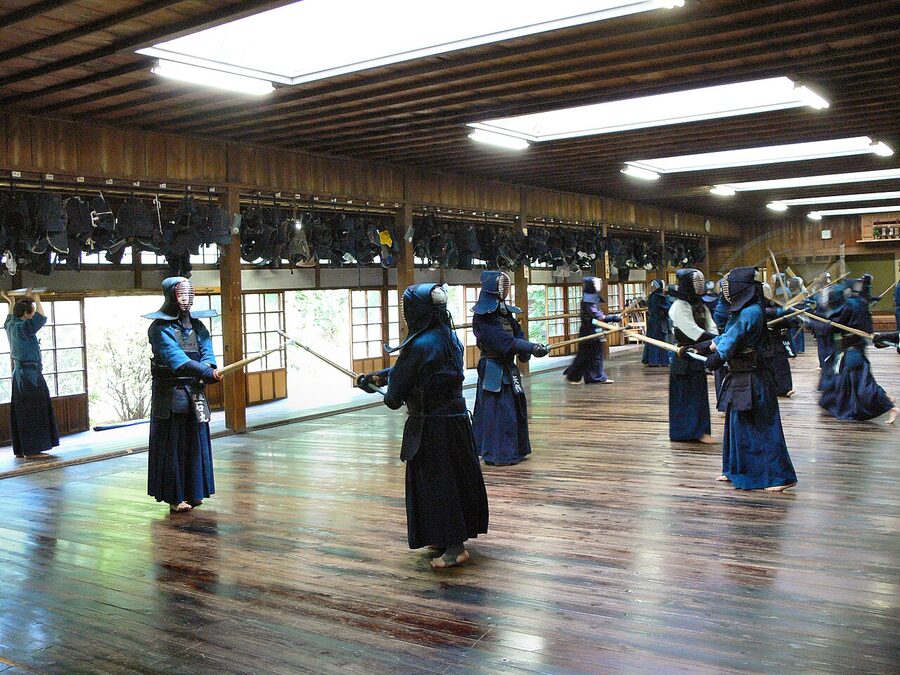
The other lost landmark is the Noma Dojo in Otowa, built in 1925 by Noma Seiji, founder of the publisher Kōdansha and a grandson of a bakumatsu swordsman. Noma had torn an Achilles tendon in practice, so he had springs put under the floor, and the hall became known as the holy ground of kendo, with Mochida Moriji as its teacher. It was pulled down in 2007 to make way for redevelopment, over loud protests, and a new Noma Dojo now occupies the fifth floor of Kōdansha’s first annex.
Butokuden around the country
The Butokukai built branch halls in every prefecture, and the survivors are worth looking out for. At Hirosaki Castle the Butokuden inside the park now serves coffee and sells souvenirs, which is a nicer fate than most. At Nikkō Tōshōgū the shrine has a Butokuden of its own. In Taiwan, more than a dozen former Butokuden survive as historic buildings, a quieter reminder of how far the society reached.
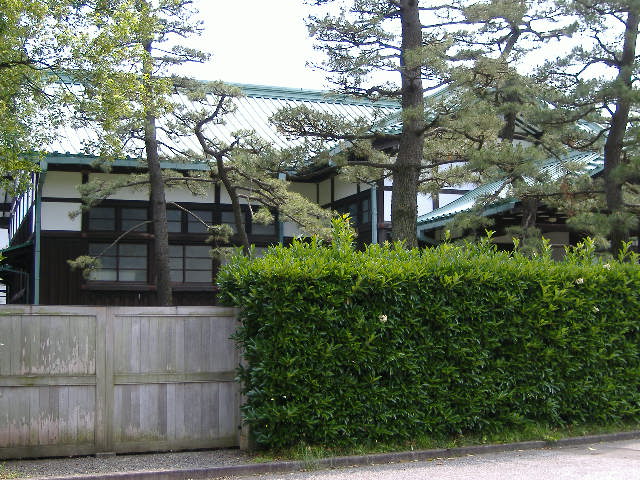
In Tokyo the most exclusive dojo of all is the Saineikan inside the Imperial Palace, the training hall of the Imperial Guard, where Emperor Shōwa watched martial arts displays. It stands inside the palace proper, beyond the parts open to the public, so this is one dojo you will only ever see in photographs.
Trying it yourself
If you have never held a shinai, the realistic option is one of the commercial experience sessions now run in both Tokyo and Kyoto by former competitors and instructors. They last about two hours, include the loan of jacket, hakama and armour, and are sold through the big booking sites at roughly ¥16,000–¥20,000 a head. You will learn to stand, step, swing and hit a padded target, and you will understand within ten minutes why kendo players have such strong calves.
If you already practise, Japan is wonderful and slightly daunting. Many dojo, including police halls that open their doors for children’s classes, will let a visiting player with their own armour join adult practice, but you should arrange it in advance through your own federation or teacher, carry proof of your grade, bring a gift for the teacher and expect to be hit very hard by men twice your age. Morning practice in a cold dojo, then breakfast with the people who hit you, is the best day of kendo you will ever have.
Nine out of a thousand
Kendo has been through five lives in three hundred years of Japanese history: a closed art of wooden-sword forms, an Edo craze for bamboo and armour, a Meiji show business, an imperial instrument of war and a postwar sport camouflaged as fencing. Every one of them left something on the floor. The armour is Naganuma’s, the iron face grille is Nakanishi’s, the shinai length is Otani’s, the kata were written by twenty-five quarrelling masters in 1912, and the three referees with their flags were dreamed up in 1950 to get round an American ban.
What none of them invented, and none of them could abolish, is the thing you see at the eighth-dan exam: a fifty-year-old in borrowed-looking armour, standing very still, waiting for the moment. If you are in Tokyo on the third of November, go to the Budokan and buy a ¥1,000 seat. Watch the players who look slow. They are the ones the examiners are looking for, and there are about nine of them in every thousand.