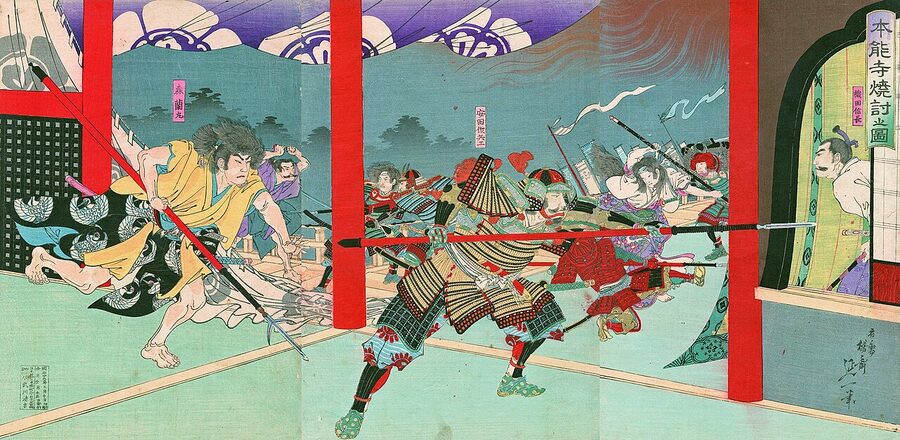
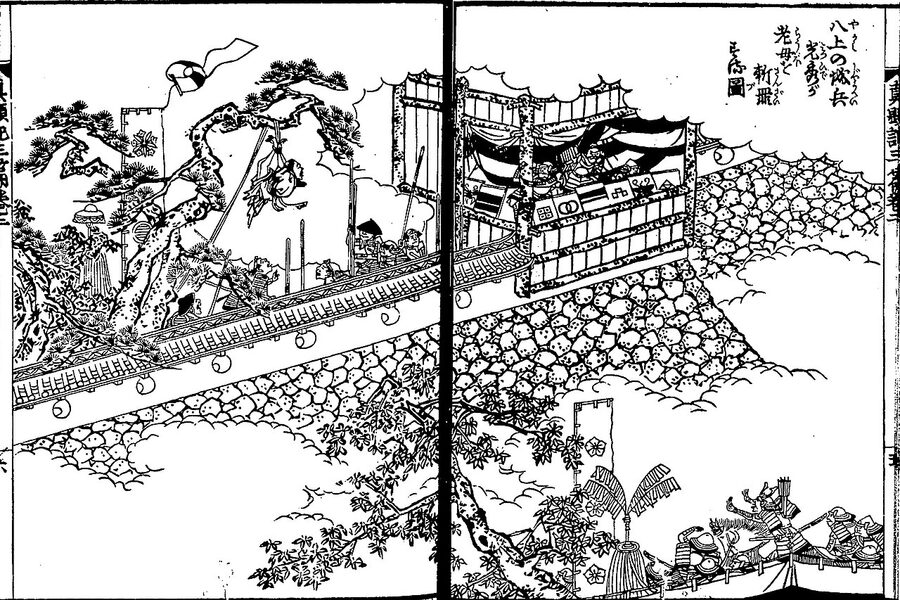
The first man through the gate of Honnō-ji on the morning Oda Nobunaga died thought he had come to kill somebody else. Honjō Sōemon was a foot soldier in Akechi Mitsuhide’s army, and when he wrote down his war record as an old man in 1640, he was blunt about it: he had assumed the target was Tokugawa Ieyasu, he did not know where Honnō-ji was, and the gate was standing open with “not so much as a mouse” inside. He walked into a hall hung with mosquito nets and found nobody. He grabbed a woman in a white robe, who told him that the lord was dressed in white, and he handed her over to an officer without working out which lord she meant.
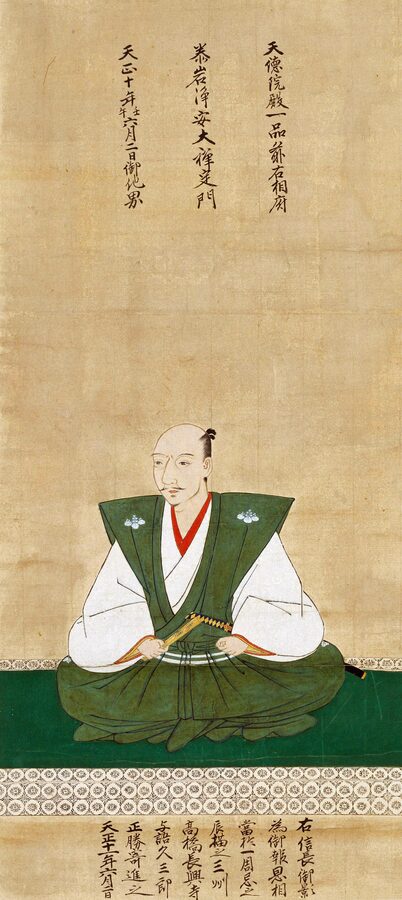
That is the most useful eyewitness line anyone has left us about the death of Oda Nobunaga, and its value is its confusion. Almost everything else people think they know about the Honnō-ji Incident (本能寺の変, Honnō-ji no hen), the battle cry at the river, the kicked head, the murdered mother, the secret plot, was written down later by people who were not there. The core of it, though, is solid: on the 2nd day of the sixth month of Tenshō 10, a date Japanese reference works convert to 21 June 1582 in the Julian calendar Europe was still using, Nobunaga’s most trusted general surrounded him in a Kyoto temple at dawn, and by breakfast the most powerful man in Japan was ash.
I keep coming back to it because the incident is two stories that rarely get told together. One is a coup carried out with almost perfect military precision. The other is eleven days of political failure so complete that the man who did it was dead in a bamboo grove before anyone had decided what to call him.
In This Article
- Where everyone was in the sixth month of 1582
- Hideyoshi’s lake
- The general nearest the capital
- The last night
- Atago, Kameyama and the road east
- Leaving Kameyama
- “The enemy is at Honnō-ji”
- Dawn at Honnō-ji
- No body
- Nobutada at the Nijō palace
- Why did Mitsuhide do it?
- What the record actually holds
- The grudges, and where they come from
- The conspiracies
- Shikoku
- Eleven days
- Ieyasu goes home through Iga
- Hideyoshi comes back from Bitchū
- Yamazaki and Ogurusu
- What came after
- Where to see the Honnō-ji Incident today
- Honnō-ji on Teramachi
- The original site
- Amida-ji and Kenkun Shrine
- Kameoka: Kameyama Castle and the Akechi country
- The Oinosaka pass
Where everyone was in the sixth month of 1582
You have to start with how good things looked for Nobunaga that spring. In the third month of 1582 his armies destroyed the Takeda, the house of Takeda Shingen that had frightened him for twenty years, and Takeda Katsuyori died by his own hand at Tenmokuzan. Nobunaga rode home slowly along the foot of Mount Fuji, sightseeing, while the Hōjō sent him pheasants and horses in the hope of staying on the right side of him. In the east only the Uesugi still openly defied him.
The court was nervous about him in a different way. Nobunaga had resigned his last court office in 1578 and held no title at all, which for the most powerful man in the country was unsettling. In the fourth month of 1582 an imperial envoy arrived at Azuchi Castle and, according to the diary of the courtier Kajūji Harutoyo, offered him a choice of the three highest posts: chancellor, regent or shogun. Nobunaga entertained the envoys twice and never gave an answer.
His generals were spread to every edge of his map. Shibata Katsuie was fighting the Uesugi in Etchū, with Maeda Toshiie under him; Takigawa Kazumasu was in Kōzuke watching the Hōjō; Nobunaga’s third son Kanbe Nobutaka and Niwa Nagahide had an invasion fleet gathering at Osaka and Sakai for Shikoku, due to sail on the 3rd day of the sixth month. And in Bitchū, in what is now Okayama, Hashiba Hideyoshi, the future Toyotomi Hideyoshi, was besieging the Mōri castle of Takamatsu.
Hideyoshi’s lake
Takamatsu sat on low ground with marsh on three sides, and Hideyoshi, unable to storm it, decided to drown it instead. Work on an embankment roughly four kilometres long began on the 8th day of the fifth month and finished on the 19th, and the rainy season did the rest. By the time the main Mōri army under Kikkawa Motoharu and Kobayakawa Takakage came up to relieve the castle, it stood in a lake and nobody could reach it.
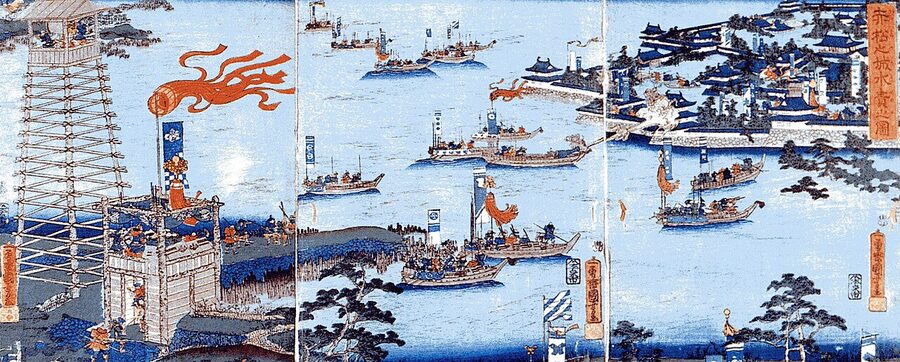
On the 17th day of the fifth month a letter from Hideyoshi reached Azuchi: the Mōri were coming in strength, and he wanted his lord to come too. Nobunaga was delighted, according to the Shinchō Kōki, the chronicle of his life kept by his retainer Ōta Gyūichi. He would go west himself, finish the Mōri and carry on to Kyushu. Akechi Mitsuhide and the lords attached to his command were ordered to go first.
The general nearest the capital
That order matters, because by 1582 Akechi Mitsuhide held a position nobody else had. He owned Sakamoto on Lake Biwa and the whole province of Tanba, and the lords placed under him included the Hosokawa in Tango, Tsutsui Junkei in Yamato, and Ikeda Tsuneoki, Nakagawa Kiyohide and Takayama Ukon in Settsu. The historian Takayanagi Mitsutoshi coined a name for it, the “Kinki governor”, and Japanese historians still use it. Every other senior general was hundreds of kilometres away; Mitsuhide’s army was the only large one within a day’s march of Kyoto.
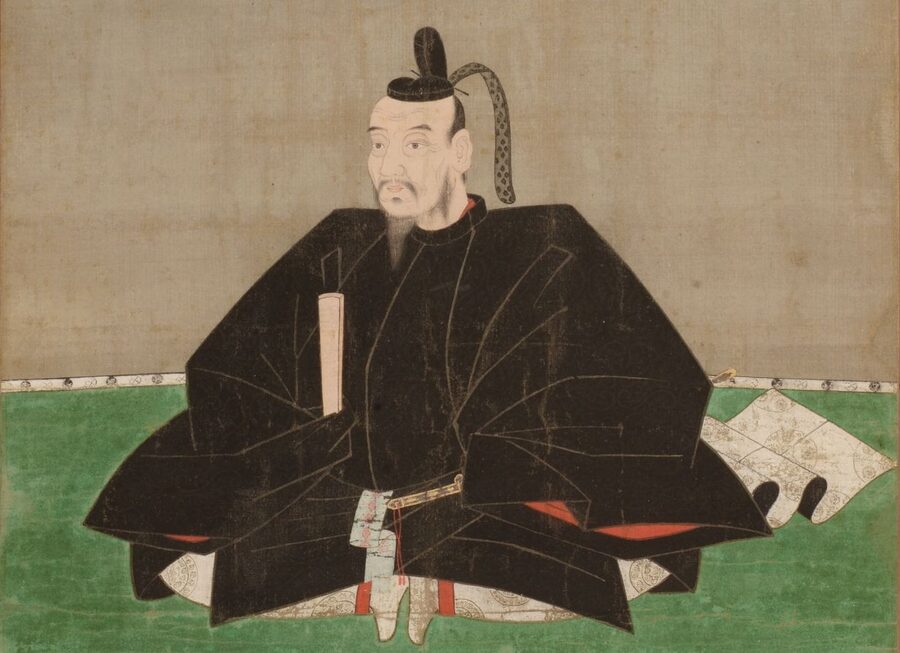
He had also been Nobunaga’s go-between with Chōsokabe Motochika of Tosa. Nobunaga had once told Motochika he could take as much of Shikoku as he could win; then the Miyoshi, whom Motochika was squeezing out of Awa, found a patron in Hideyoshi, and Nobunaga changed his mind. In the first month of 1582 he ordered Motochika, through Mitsuhide, to give back everything except Tosa and two districts of southern Awa, and when Motochika stalled, he ordered the invasion. The family link made it personal: Mitsuhide’s senior retainer Saitō Toshimitsu had a brother married into the Ishigai family, and an Ishigai daughter was Motochika’s wife.
Earlier in the fifth month, Mitsuhide had been in charge of entertaining Tokugawa Ieyasu, Nobunaga’s ally of twenty years, who came to Azuchi to give thanks for the province of Suruga. The Shinchō Kōki says Mitsuhide gathered delicacies from Kyoto and Sakai and hosted Ieyasu for three days from the 15th. Then he was sent home to Sakamoto to prepare for war, and Ieyasu, on Nobunaga’s advice, went off to see the sights of Kyoto, Osaka, Nara and Sakai.
The last night
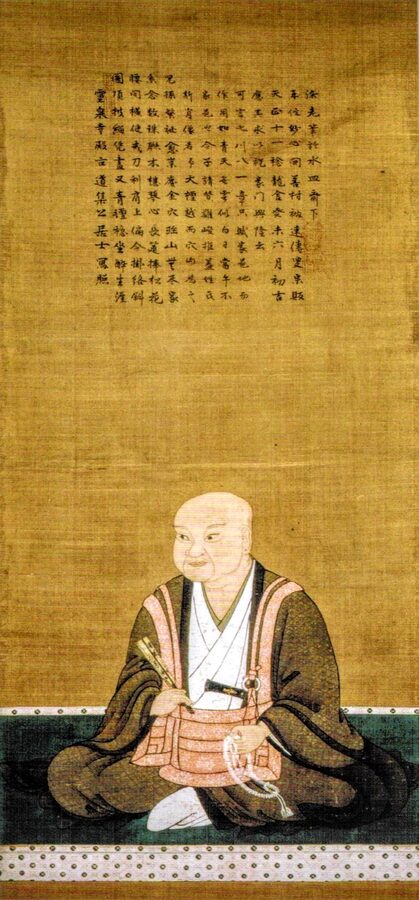
On the 29th day of the fifth month Nobunaga left Azuchi for Kyoto with his pages and almost no guard, and lodged at Honnō-ji, a Hokke-sect temple in Shimogyō, the lower town of Kyoto. His heir Oda Nobutada, master of Gifu Castle and formally head of the Oda house since 1575, was already lodged at Myōkaku-ji, a little over a kilometre to the north. Sources disagree on how many men Nobunaga had with him: Japanese accounts say seventy or eighty pages, others say a hundred or a hundred and fifty. Nobody says more.
On the 1st day of the sixth month he held a tea gathering at Honnō-ji for some forty courtiers and priests, having had thirty-eight famous tea utensils carried from Azuchi for the purpose. The merchants Shimai Sōshitsu and Kamiya Sōtan of Hakata were among his guests, and one story says Nobunaga was after a tea caddy of Sōshitsu’s called Narashiba. Nobutada came over afterwards and father and son drank together, and late that night Nobunaga watched a game of go between Honinbō Sansa and Kashio Rigen before going to bed. Later tradition says the game ended in a rare triple ko, a stalemate that go players have treated as an omen ever since; in 2022 a professional player showed that the surviving record could, in fact, lead there.
Atago, Kameyama and the road east
Mitsuhide, meanwhile, had moved from Sakamoto to his Tanba castle at Kameyama, in modern Kameoka. On the 27th day of the fifth month he climbed Mount Atago, north of Kameyama, spent the night at the shrine, and, the Shinchō Kōki says, drew lots before the image of the deity two or three times. Ōta Gyūichi leaves it there, and you can make of it what you like. I suspect a man about to march against the Mōri also had reason to want a second opinion.
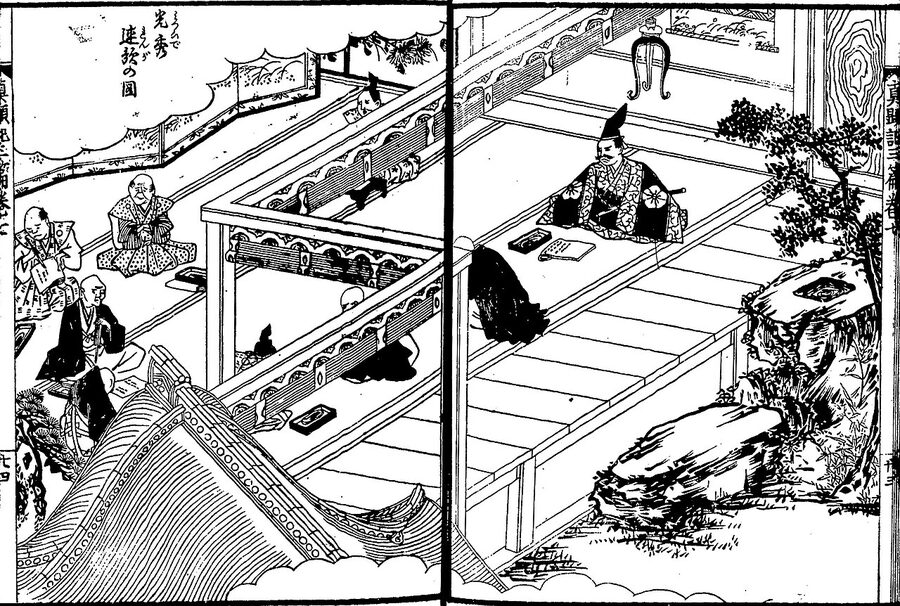
The next day he held a linked-verse session, a hundred verses composed in turn by nine people, including the leading master Satomura Jōha. Mitsuhide wrote the opening verse: toki wa ima / ame ga shita shiru / satsuki kana. Read plainly it is “Now is the time, the fifth month, when the rain falls”; read with a pun on Toki, the Mino family the Akechi claimed to come from, and on ame ga shita shiru as “rules all under heaven”, it becomes a declaration. The Koretō Taiji-ki, the account Hideyoshi commissioned from his scribe Ōmura Yūko within months, was the first to call it an omen.
Sources variously date the session to the 24th, 27th or 28th of the fifth month, and the manuscripts disagree on one word that changes the meaning, shiru or naru. Jōha, questioned later by an angry Hideyoshi, is supposed to have said in tears that the verse had been altered. Kuwata Tadachika called the Toki reading a later contrivance; others think it was obvious to everyone in the room. I am inclined to think that a man planning murder does not usually announce it to eight fellow poets, but I would not bet much either way.
Leaving Kameyama
On the 1st day of the sixth month Mitsuhide paraded his army for departure. The figure every source repeats is 13,000 men. According to the Kawasumi Taikōki, written some forty years later, he told his captains that a messenger had come from Mori Ranmaru in Kyoto, saying Nobunaga wanted to inspect the troops before they went west, and the army began moving off from around four in the afternoon and gathered at Shibano east of the castle by six. Other accounts put the march out as late as ten at night.
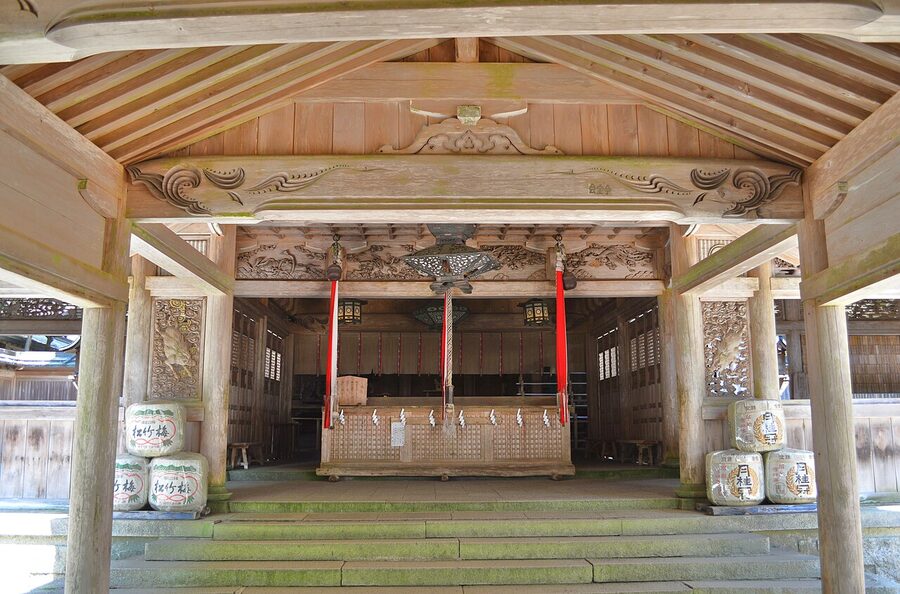
At Shibano, the story goes, Mitsuhide called his five senior men aside: his son-in-law Akechi Hidemitsu, Akechi Mitsutada, Saitō Toshimitsu, Fujita Dengo and Mizoo Shigetomo. Only then did he tell them what he meant to do, and the Tōdaiki adds that he made them swear oaths and give hostages. A local tradition puts the meeting at Shinomura Hachimangū, the shrine where Ashikaga Takauji had raised his banner against the Kamakura regime in 1333, which is exactly the place a man with an eye for precedent would choose.
The road west to the Mōri usually went south over Mikusayama. Mitsuhide told the army they would go east over the Oinosaka pass instead and swing round by Yamazaki into Settsu, which sounded reasonable. They crossed the pass in the dark, rested at Kutsukake where the roads to Kyoto and to the west divided, and ate. The Kawasumi Taikōki adds a horrible detail I would like to disbelieve: that a rider called Amano Gen’emon was sent ahead to kill anyone who might carry word to Kyoto, and cut down twenty or thirty farmers who had come out early to tend their melons.
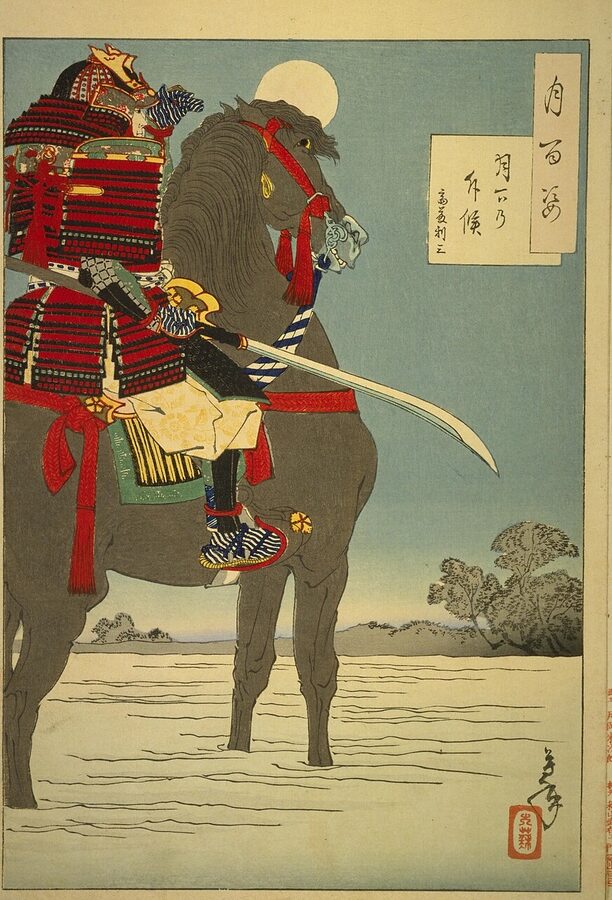
At the Katsura River, at first light, the war chronicles say the horses’ straw shoes were cut away, the foot soldiers changed into short ashinaka sandals for running, and the matchlock cords were cut to a foot and a half and lit, five to a bundle, held downward so the glow would not show. That was an order to prepare for battle. Saitō Toshimitsu took the vanguard into the city, forcing the gates between the city wards and telling the companies to keep their banners furled and head for the trees of Honnō-ji: its grove, a honey locust and a stand of bamboo.
“The enemy is at Honnō-ji”
This is where Mitsuhide is supposed to have said the most famous line in Japanese history, teki wa Honnō-ji ni ari, “the enemy is at Honnō-ji”. No source written in his lifetime records it, or records anything he said that night. The line first appears in the Oda Nobunaga-fu of the Confucian scholar Hayashi Razan, compiled around 1641, which places it on the Ōeyama, the Oinosaka hill; the Akechi Gunki of the 1690s has “the enemy is at Honnō-ji in Shijō and at Nijō Castle”; and it was Rai San’yō’s Nihon Gaishi of 1827 that moved it to the crossing of the Katsura River and gave it its final shape. English-language accounts usually put it at the river, because that is where San’yō put it.
The Kawasumi Taikōki has a different version, in which the troops were told that “from today, your lord becomes lord of the realm” and cheered at the thought of promotion. Honjō Sōemon’s memoir, which is more convincing for being so muddled, says the men in the ranks thought they were going to attack Ieyasu, who was known to be in the capital. Luís Fróis, the Jesuit chronicler of Christianity in Japan, heard the same thing: some soldiers assumed Nobunaga had secretly ordered them to kill his ally.
There is even doubt about whether Mitsuhide went to Honnō-ji at all. The courtier Yoshida Kanemi wrote in his diary that Mitsuhide attacked Nobunaga’s lodging, but he may have been writing down what everyone was saying. In recent years Hagiwara Daisuke of the Toyama City Local History Museum has drawn attention to the Itsuya no Kakimono, a seventeenth-century Kaga text that records the recollections of Saitō Toshimune, Toshimitsu’s son, who was sixteen and present: an advance force of some two thousand under Toshimitsu and Hidemitsu stormed the temple, and “Mitsuhide waited at Toba”, about eight kilometres south.
Dawn at Honnō-ji
The Honnō-ji of 1582 was not where the temple is now. It filled a block of roughly 120 metres square between Nishinotōin and Aburanokōji, Rokkaku and the street now called Takoyakushi, and excavations in 2007 confirmed what the documents suggested: a moat two to four metres wide with a stone-faced bank behind it, and the Nishinotōin stream acting as a second moat on the east. It had been rebuilt in 1580 and was as close to a fort as a temple could be. Against 13,000 men it was a box.
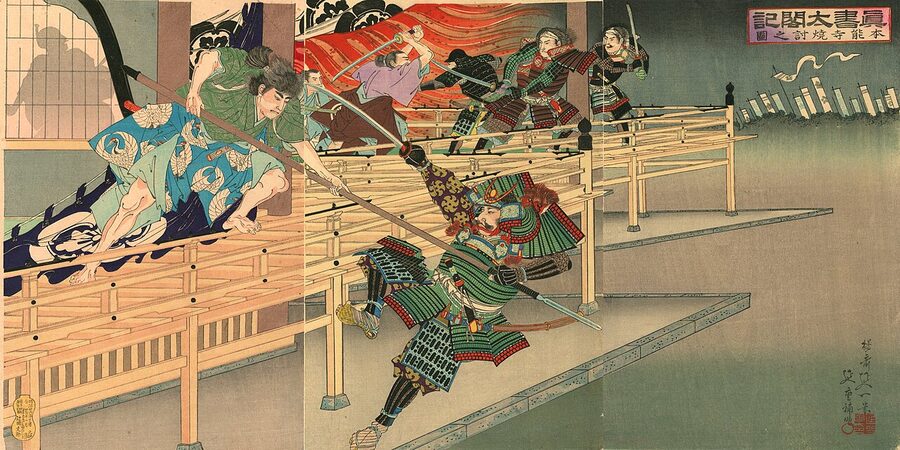
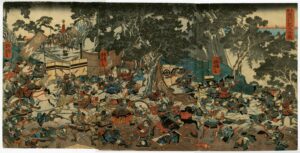
The Shinchō Kōki gives the fullest account, and Ōta Gyūichi seems to have got it from the women who escaped. Nobunaga and his pages first thought the noise was a brawl among servants. Then came the war cries and gunfire into the hall, and Nobunaga asked whose rebellion this was. Mori Ranmaru looked out and said, “It appears to be Akechi’s men,” and Nobunaga said only zehi ni oyobazu: “It cannot be helped.”
The phrase is usually read as recognition: if it was Mitsuhide, there would be no escape. The Mikawa Monogatari has a slightly different exchange, in which Nobunaga first asks whether it is his son Nobutada who has turned on him, and the Spanish merchant Bernardino de Ávila Girón recorded a rumour that he put a finger to his lips and said he had brought this on himself. I would take the first version, which is the earliest, and treat the others as what people wished he had said.
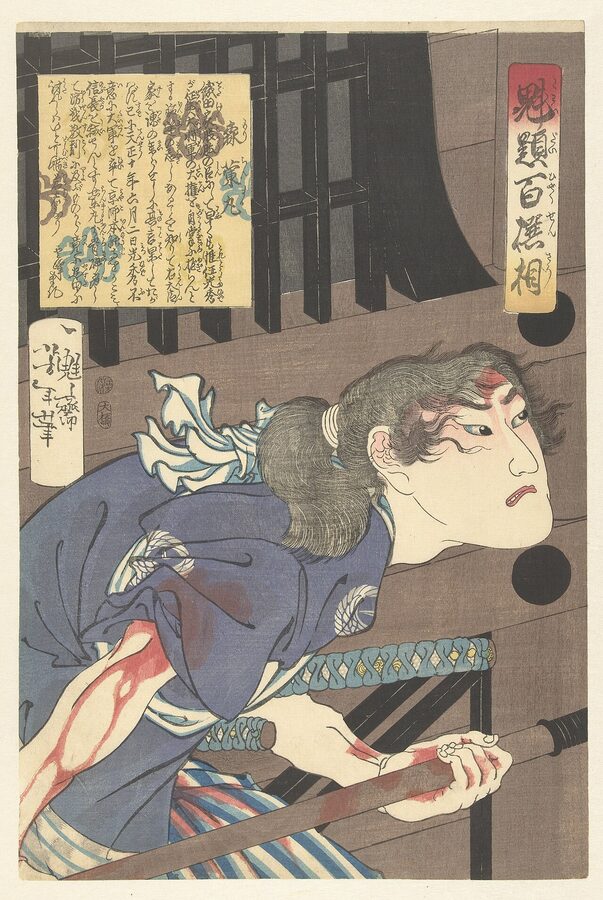
What followed, in Ōta’s telling, is unusually concrete. Nobunaga fought from the edge of the hall with a bow until the strings broke on one bow after another, then took a spear, until a spear wound in the elbow forced him back. He told the women around him to get out (“women do not matter; go quickly”), went deep into the burning building, shut the door of an inner room from the inside, and cut his belly.
The fighting at Honnō-ji was over before eight in the morning. Nobunaga was forty-eight by Western reckoning.
His men died where they stood: the pages in the hall, twenty-four grooms and stablemen at the stables, a few retainers lodging in the town who ran in and were killed at the gate. A Jesuit report sent to Europe within months tells a slightly different story, from a church only a street away where the priest Francisco Carrión was getting ready for early Mass. In that version Nobunaga was washing his face and hands when an arrow struck him in the back; he fought with a naginata until a bullet hit his arm, then shut himself in. The Jesuits admitted they did not know whether he cut himself open or burned alive, and ended with a line about a man whose name alone made people tremble being reduced to dust and ashes.
No body
The Akechi searched the ruins and found nothing they could name. One story in the Sofu Monogatari has Mitsuhide fretting until Saitō Toshimitsu said he had seen Nobunaga walk into the flames with his hands pressed together, which may have been the kindest lie of the day. A big timber building burning down on top of a hundred corpses does not leave much that sixteenth-century eyes could identify, and the Jesuits’ “not a hair remained” may be literally true.
That gap mattered more than the fire. A dead lord with no head could be claimed to be alive, and for days afterwards rumours that Nobunaga had escaped ran around Ōmi. Hideyoshi exploited it shamelessly, as you will see.
Later, a Jōdo-sect priest called Seigyoku claimed to have slipped into the burning compound, found a group of retainers cremating the body in a thicket as Nobunaga had ordered, and carried the ashes away in his robes to his temple, Amida-ji. That account was written down in 1731, by the temple’s own admission from memory, and historians treat it gently and with caution.
Not everyone died. The women were let go, so were the monks, and so were Nobunaga’s merchant guests from the night before. Shimai Sōshitsu walked out with a scroll of the Thousand Character Classic said to be in the hand of Kūkai, and Kamiya Sōtan with Nobunaga’s own ink painting of returning sails by the Chinese master Muqi, now an Important Cultural Property. Whatever else you say about Hakata merchants, they had their priorities in order.
Nobutada at the Nijō palace
At Myōkaku-ji, Nobutada heard the news and set out to rescue his father. He was stopped by Murai Sadakatsu, Nobunaga’s governor of Kyoto, and Murai’s two sons, who told him Honnō-ji had already fallen and that the enemy would come for him next. They advised him to shut himself in the nearby Nijō palace, the Nijō Shin-gosho, a fortified mansion Nobunaga had built in 1577 and given to Crown Prince Sanehito in 1579. It is not the Tokugawa Nijō Castle you visit today, which was built twenty years later a little further west.
Nobutada sent the prince and his family out first. By agreement with the Akechi they were allowed to leave on foot but not in palanquins, and the linked-verse master Satomura Jōha, the same Jōha who had sat with Mitsuhide on Atago a few days before, turned up with a rough cart and took the imperial family to the palace. Some of Nobutada’s men urged him to make a run for Azuchi. He refused, saying a rebel this thorough would never let them through and he would not die at the hands of common soldiers on the road.
The Akechi attacked around midday. Nobutada had perhaps five hundred men, rising to a thousand or more as horsemen of Nobunaga’s guard came in from their lodgings, and they fought well enough to drive the attackers back three times. Then Akechi gunners climbed onto the roof of the neighbouring mansion of Konoe Sakihisa and shot down into the compound, and that was that. Nobutada had the boards of the veranda lifted so his body could be hidden beneath them, and Kamata Shinsuke acted as his second.
Nobunaga’s younger brother Nagamasu, later the tea master Urakusai, was inside and slipped away, and the Kyoto street wits made up a song about it. Nobunaga’s African retainer Yasuke also survived: a Jesuit letter says he went to fight at the heir’s lodging and gave up his sword when Akechi men promised him no harm. He was spared, and after that he disappears from the record.
Why did Mitsuhide do it?
Nobody knows, and it is worth being plain about why. Mitsuhide left no statement of motive that anyone trusts. He was dead in eleven days, his senior retainers were dead within the month, and most of the letters he sent were burned by people who did not want to be found holding them. The motive question is, as the medieval historian Goza Yūichi has pointed out, a field crowded with novelists and amateurs precisely because the professionals have so little to work with.
What the record actually holds
Start with what survives from 1582 itself. A letter Mitsuhide wrote on the day of the coup, copied into a later collection, tells a Mino lord that “the wickedness of Nobunaga and his son was an obstruction to the realm, so I have struck them down”, which is a justification, not a reason. His letter of the 9th day to Hosokawa Fujitaka, which does survive, talks about land and the future and says nothing about why. A letter of the 12th to a Kii warlord, Dobashi Shigeharu, refers to plans for an exalted person’s return to the capital, which some historians read as the exiled shogun Ashikaga Yoshiaki.
Ōta Gyūichi, writing in his own memoranda, thought the answer was simple: Mitsuhide, raised from small beginnings, forgot his debt, was seized by greed and “aimed at the realm”. Two courtiers’ diaries single out Saitō Toshimitsu, one calling him the foremost of the rebels. And that is about all of it. Everything else is reconstruction, and the position you will find in the Japanese encyclopedias is that none of the theories has the evidence to become the accepted one.
The grudges, and where they come from
For three centuries the answer was grudge. The Kawasumi Taikōki, written in the early 1620s, has Mitsuhide list three humiliations to his officers: being shamed in front of the lords at Gifu, being beaten by Nobunaga at Suwa during the Takeda campaign, and being sacked from the Ieyasu banquet because the fish stank. Later books added more. The Ehon Taikōki and the puppet and kabuki plays built on it turned them into a sequence of scenes, each worse than the last.
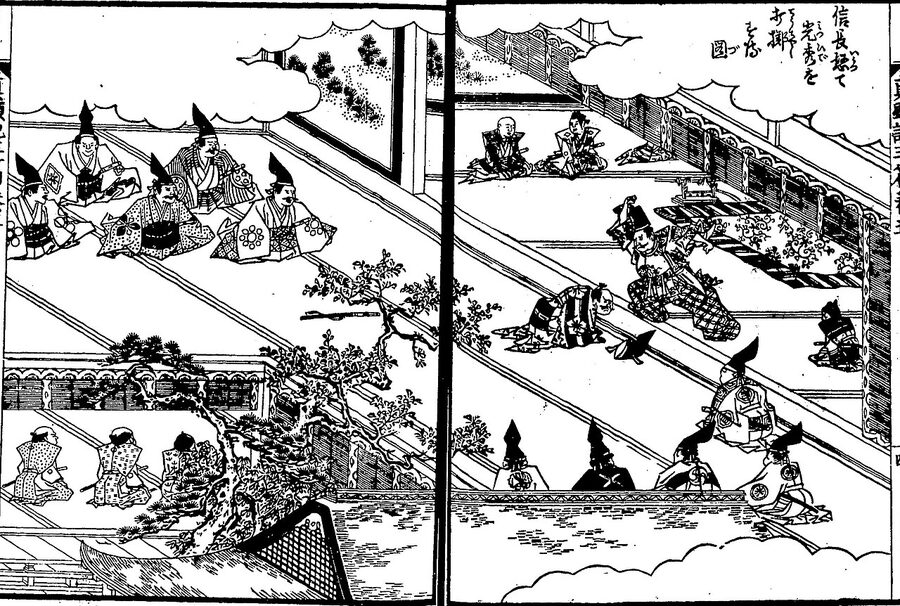
The trouble is the Shinchō Kōki, which says Ieyasu was lodged at the Daihōbō, not at Mitsuhide’s house, and that Mitsuhide served as host for the full three days he was given, with no hint of a sacking. The banquet story is the core of the Kawasumi Taikōki‘s case, and without it the rest looks thin. The tale of Mitsuhide’s mother, given as a hostage at Yakami Castle in Tanba in 1579 and crucified when Nobunaga executed the Hatano brothers, comes from much later books such as the Sōkenki; the Shinchō Kōki says Yakami was starved into surrender and the Hatano were seized by a ruse, which leaves no room for a hostage.
There is one more drinking story, in which a drunken Nobunaga holds a spear to Mitsuhide’s neck, and that one fails on a detail: Fróis and the Jesuit Luís de Almeida both say Nobunaga did not drink. None of this means Nobunaga was a pleasant master. It means the specific insults that fill the plays were invented, or at least collected, long after anyone could check them.
The conspiracies
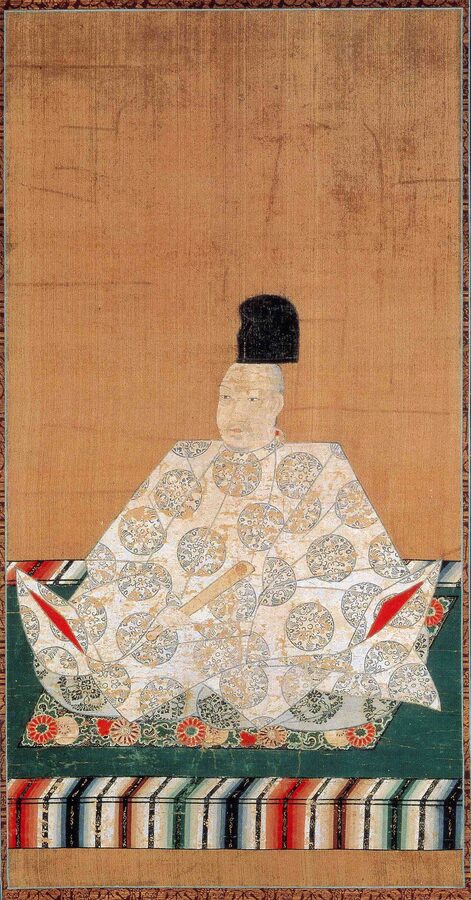
From the 1990s the fashion turned to plots. The historian Imatani Akira wrote about the tension between Nobunaga and Emperor Ōgimachi, over abdication, over the calendar and over those three unanswered posts, and others went much further than he did, naming the emperor, the crown prince, Konoe Sakihisa or Yoshida Kanemi as the hidden hand. Tachibana Kyōko read a line in Kajūji Harutoyo’s diary, describing Toshimitsu as one of those who “conferred about striking Nobunaga”, as evidence that courtiers were in it too.
Fujita Tatsuo of Mie University made the case for Ashikaga Yoshiaki, the last Muromachi shogun, living in exile under Mōri protection, and pointed to that letter of the 12th about a return to the capital. Miyamoto Yoshimi answered that Mitsuhide’s own appeal to the Hosokawa, old Yoshiaki men, did not mention Yoshiaki at all, and that the Mōri plainly had no idea the coup was coming. Then there are the theories that blame Hideyoshi, because his march back was so fast; Ieyasu, because he survived; the Jesuits; the Hokke sect; the merchants of Sakai; and Nobunaga’s own heir.
In 2006 Suzuki Masaya and Fujimoto Masayuki published a short book whose title translates roughly as “Was Nobunaga killed by a plot? Laughing at the conspiracy theories”, and set out five questions every such theory fails.
How did the mastermind contact Mitsuhide, how were the timing and the secret managed, how were Mitsuhide’s own officers won over, why did the supposed backers do nothing to help him before or after, and where is the document? That last question is the one nobody has answered, and the eleven days that followed are the best argument that no one was standing behind him.
Shikoku
The theory with the most new evidence is the one closest to Mitsuhide’s desk. In 2014 the Hayashibara Museum of Art in Okayama made public letters from the Ishigai family papers, among them one from Chōsokabe Motochika to Saitō Toshimitsu dated the 21st day of the fifth month of 1582. In it Motochika agrees to give up several castles in Awa but asks to keep two that guarded the road into Tosa. He was close to backing down; Nobunaga had already decided to invade.
Read with everything else, it gives you a general whose diplomacy had been thrown away, whose rival Hideyoshi had backed the winning side, and whose chief retainer had family on the island about to be attacked. Fujita, Kirino Sakujin and others have built on this, some with Toshimitsu as the driving force. When NHK put seven historians in a room in 2020 and asked them to vote, the Shikoku explanation came out ahead. It is still an inference: no letter says “I did it because of Shikoku.”
My own view is that the Shikoku pressure, the worry of an ageing man (one chronicle gives Mitsuhide’s age as sixty-seven) about his family’s future under an increasingly unpredictable lord, and the sheer opportunity of finding Nobunaga and his heir in Kyoto with a few hundred men while his own army was the only one in reach, are enough. You do not need a hidden hand when the open one is holding 13,000 soldiers. What you do need, to explain what happened next, is a man who had planned the morning and not the month.
Eleven days
Mitsuhide left Kyoto on the afternoon of the 2nd to take Ōmi and found the first problem at once: Yamaoka Kagetaka refused to join him and burned the long bridge at Seta. He went back to Sakamoto, sent letters to every daimyo he thought might listen, and on the 5th took Azuchi Castle, where he handed out Nobunaga’s gold and silver to his men. On the 7th the court sent Yoshida Kanemi to Azuchi as an imperial envoy to congratulate him. English-language accounts often say the court ignored Mitsuhide; Kanemi’s own diary shows it did no such thing, at least for that week.
On the 9th he came to Kyoto, where courtiers and townspeople turned out to greet him, gave 500 pieces of silver to the court and more to the great temples, and remitted the city’s ground rents. It was the behaviour of a new master of the capital. The people he really needed, though, were not in Kyoto.
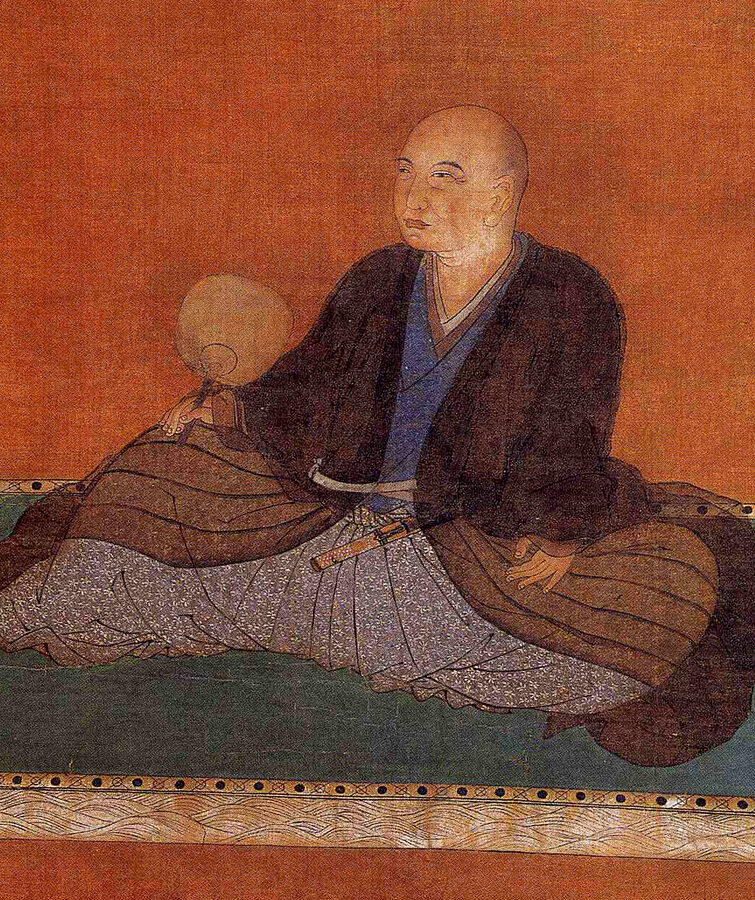
The Hosokawa came first. Fujitaka was his oldest colleague and Fujitaka’s son Tadaoki was married to Mitsuhide’s daughter Tama, the future Hosokawa Gracia.
On the 3rd both men shaved their heads in mourning for Nobunaga, and Tama was sent away to live in seclusion in the mountains. On the 9th Mitsuhide wrote again, offering Settsu and, if they liked, Tajima or Wakasa too, and promising that within fifty or a hundred days he would settle the home provinces and hand everything over to Tadaoki and his own son. The letter survives. The Hosokawa did not move.
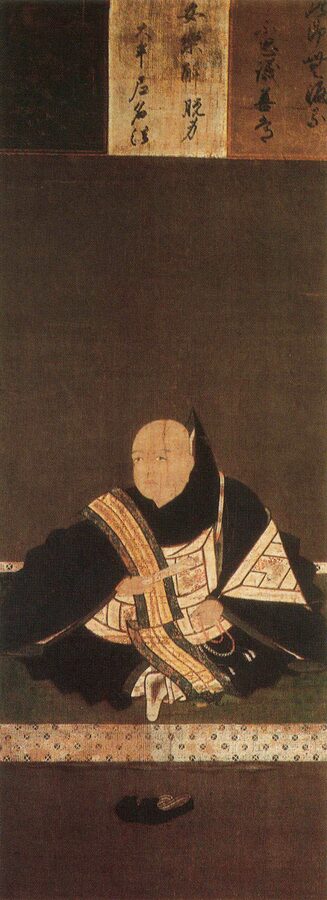
Tsutsui Junkei was his next hope. Junkei sent troops into Ōmi on the 5th, which looked like support, then pulled back to his castle at Kōriyama and started laying in rice and salt for a siege. On the 10th Mitsuhide went out to the Horagatōge pass on the Yamashiro border to lean on him, waited, and got nothing. The Settsu lords who had served under him, Nakagawa Kiyohide, Takayama Ukon and Ikeda Tsuneoki, were making up their own minds, and Hideyoshi was helping them.
Ieyasu goes home through Iga
Tokugawa Ieyasu heard the news on the morning of the 2nd, on his way back from Sakai to Kyoto, from the Kyoto merchant Chaya Shirōjirō, who met him near Iimoriyama in Kawachi. He had a few dozen men with him and the whole Akechi army between him and home. According to Tokugawa tradition, his first impulse was to go to Chion-in in Kyoto and commit seppuku beside his dead ally, and his retainers, Honda Tadakatsu among them, talked him out of it.
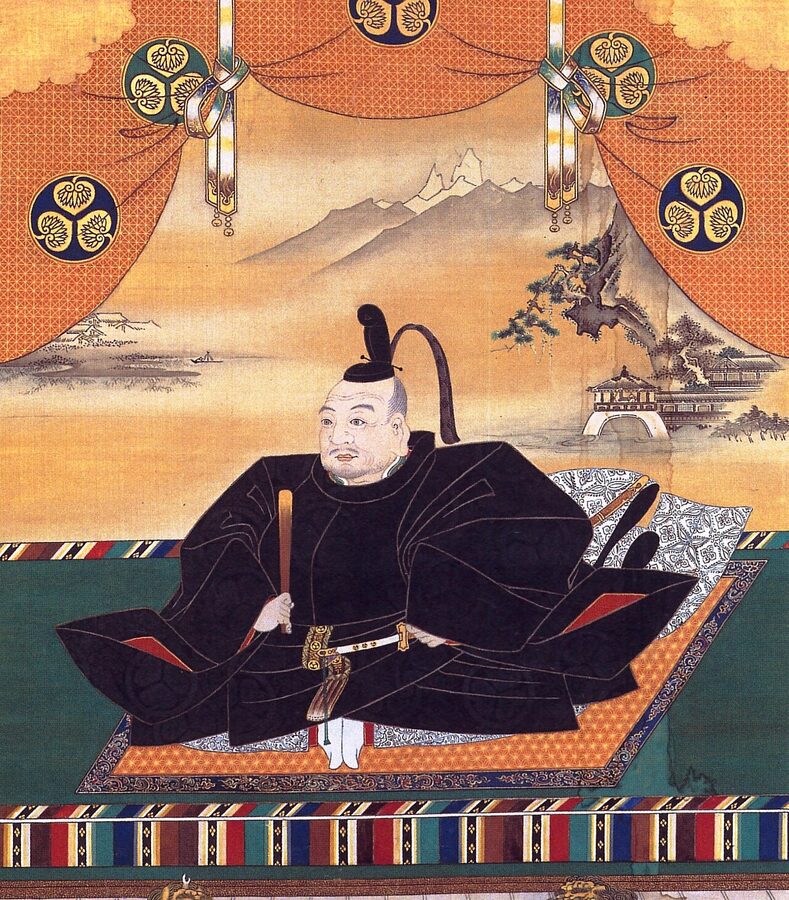
What followed is one of the great survival stories of the period and one of the worst-documented. The best-regarded account, Ishikawa Tadafusa’s memorandum, has the party crossing the Kizu River and spending the first night at Uji-Tawara, the second with the Tarao family at Kōka in Ōmi, and on the 4th going over a pass into Iga, through Tsuge, over the Kabuto pass where an armed band attacked and Kōka men drove it off, and down to the Ise coast. From there a boat took them across the bay to Mikawa, and they reached Okazaki Castle on the 4th or the 5th, depending on the account. Anayama Baisetsu, who had split off from the group, was killed by bandits on the way.
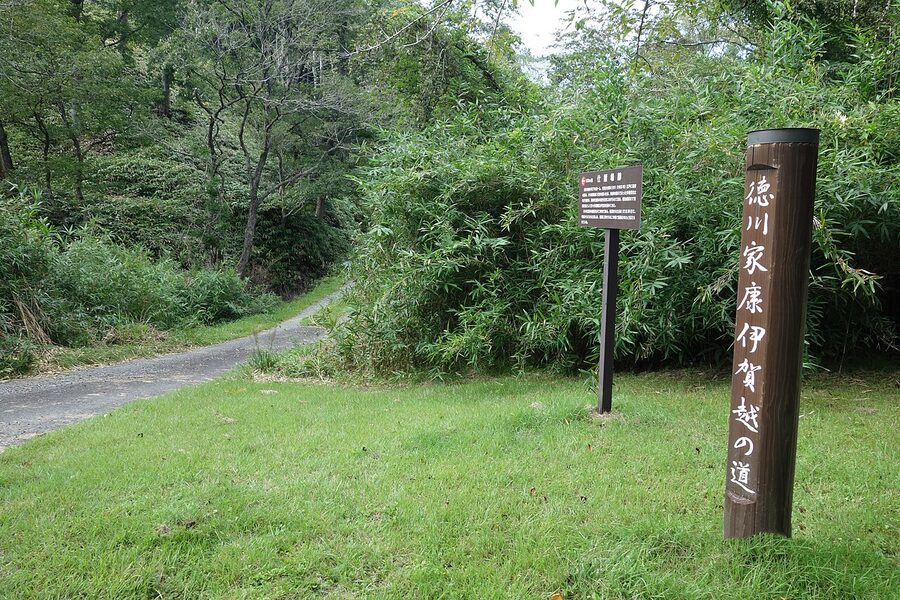
The version you will find in most English books, with Hattori Hanzō raising three hundred Iga ninja to escort his lord, comes from documents that circulated in the eighteenth century, when the Iga families serving the shogunate had good reason to remember their part generously. Hanzō was with Ieyasu and was of Iga stock; the ninja army is later colour. Among the men who certainly made the journey were Tadakatsu, Ii Naomasa, Sakai Tadatsugu and Sakakibara Yasumasa, which is to say most of the future Tokugawa high command.
Hideyoshi comes back from Bitchū
Hideyoshi heard on the night of the 3rd or the early hours of the 4th. The usual story is that his men caught one of Mitsuhide’s messengers on his way to the Mōri; the messenger’s name is remembered as Fujita Denpachirō, and a mound for him survives in Okayama. Hideyoshi closed the roads, said nothing to the enemy, and made peace with the Mōri overnight on terms far gentler than he had been demanding: three provinces instead of five, and the death of the castle’s commander, Shimizu Muneharu.
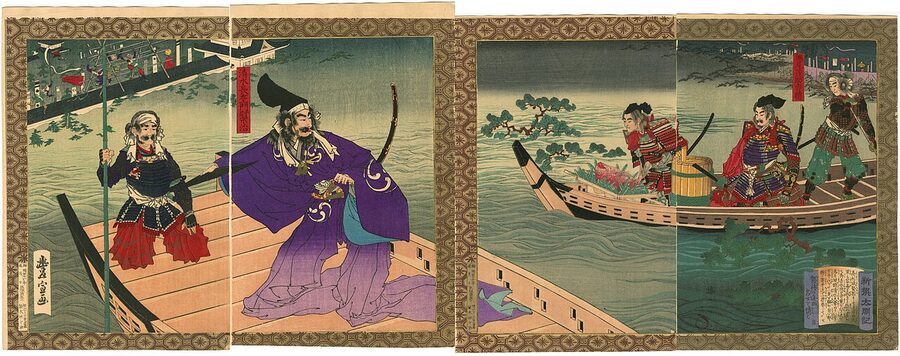
Sources disagree about when he left. Some put the start on the afternoon of the 4th; Takayanagi, Fujita and Taniguchi Katsuhiro, following the Asano family papers, prefer the 6th, after he had watched the Mōri pull back. Either way he reached Himeji, some seventy kilometres on from the castle of Numa near Okayama, by the 7th or 8th, in a storm, with his army strung out for miles behind him. At Himeji he emptied the storehouses and gave everything to his men, which told them there was no going back.
Then he lied, magnificently. On the 5th he wrote to Nakagawa Kiyohide that he had it on good authority from Kyoto that Nobunaga and Nobutada had both escaped and were safe at Zeze, near Ōtsu. Kiyohide was one of the Settsu lords Mitsuhide was counting on.
Hideyoshi left Himeji on the 9th, was at Amagasaki on the 11th and at Tonda on the 12th, where the Settsu lords joined him and Nobutaka and Niwa came up from Osaka. The whole march from Takamatsu to Yamazaki is about 230 kilometres, and Japanese historians call it the Chūgoku ōgaeshi, the great return from the west.
Yamazaki and Ogurusu
The armies met on the 13th at Yamazaki, where the road from the west squeezes between Mount Tennō and the river into the Kyoto basin. Numbers vary with the source: the Taikōki gives Hideyoshi 40,000, Yoshida Kanemi’s diary 20,000-odd, and Mitsuhide had perhaps 15,000 or 16,000. I have told the battle itself in my piece on the Battle of Yamazaki, so I will only say that it began around four in the afternoon in the rain and was over before dark.
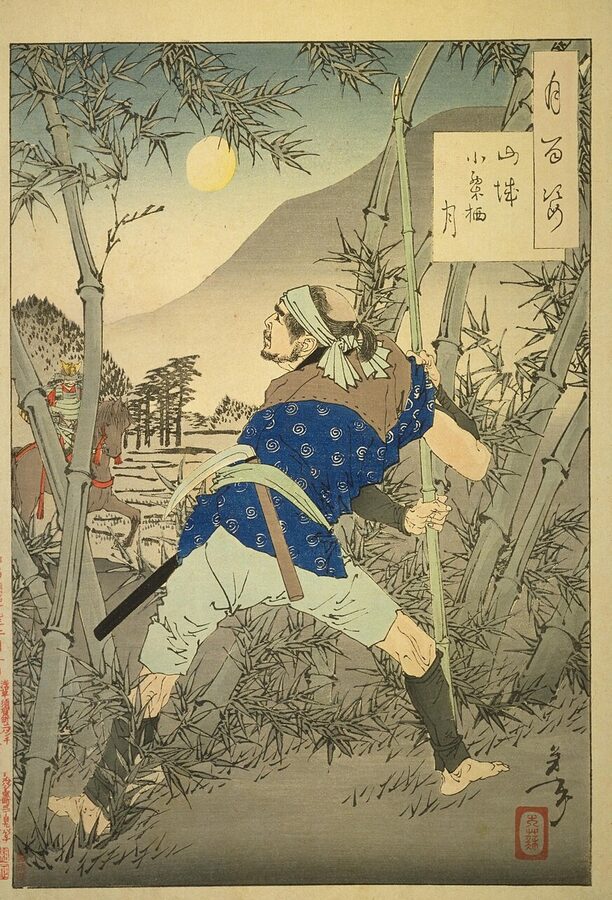
Mitsuhide got out of Shōryūji Castle after dark with a few men and rode for Sakamoto. At Ogurusu, south-east of the city, in the early hours, he was attacked by villagers hunting fleeing soldiers and fatally wounded, and Mizoo Shigetomo is said to have taken his head. His head and body were later found and brought to Hideyoshi. On the 16th, Nobutaka had them displayed with some three thousand heads of Akechi men on the ashes of Honnō-ji, as an offering to his father.
The Japanese call it mikka tenka, a three-day rule. It was eleven days from the 2nd to the 13th, which in some ways is worse.
What came after
On the 27th day of the sixth month the Oda generals met at Kiyosu to settle the succession. Hideyoshi, who had avenged his lord, backed Nobutada’s infant son Sanbōshi against the claims of Nobunaga’s surviving sons, and the meeting went his way; Shibata Katsuie never recovered the ground. Within a year they were at war, and the Battle of Shizugatake in 1583 finished Katsuie, while the Komaki and Nagakute campaign of 1584 brought Hideyoshi and Ieyasu face to face and ended in a deal. In the long view of Japan’s most decisive battles, Honnō-ji was not a battle at all, but it is the hinge between the age of Nobunaga and the age of Hideyoshi.
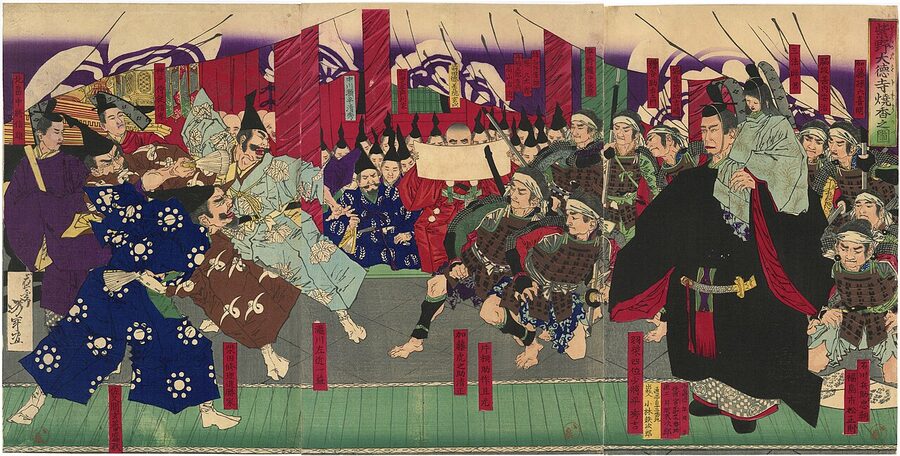
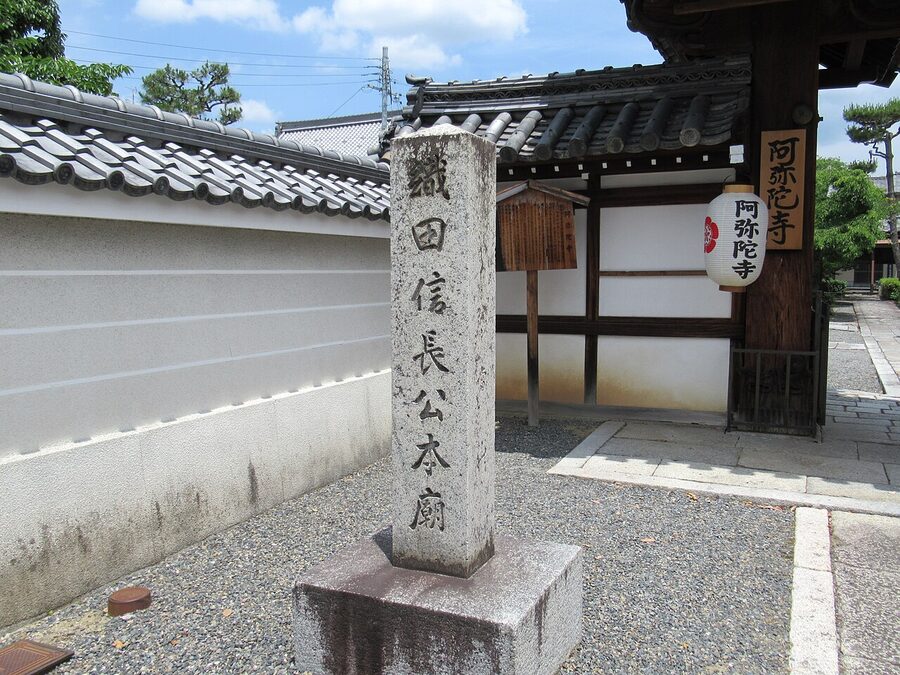
Nobunaga ended up with more graves than most men get, and Hideyoshi’s funeral at Daitoku-ji was the political one. Nobutaka built a memorial at the ruins of Honnō-ji, which moved with the temple. Seigyoku’s Amida-ji kept the ashes it said it had saved, and in 1917 an imperial messenger recognised its grave as Nobunaga’s principal tomb. In Gifu, at Sōfuku-ji, one of his consorts set up memorial tablets for father and son just four days after the coup.
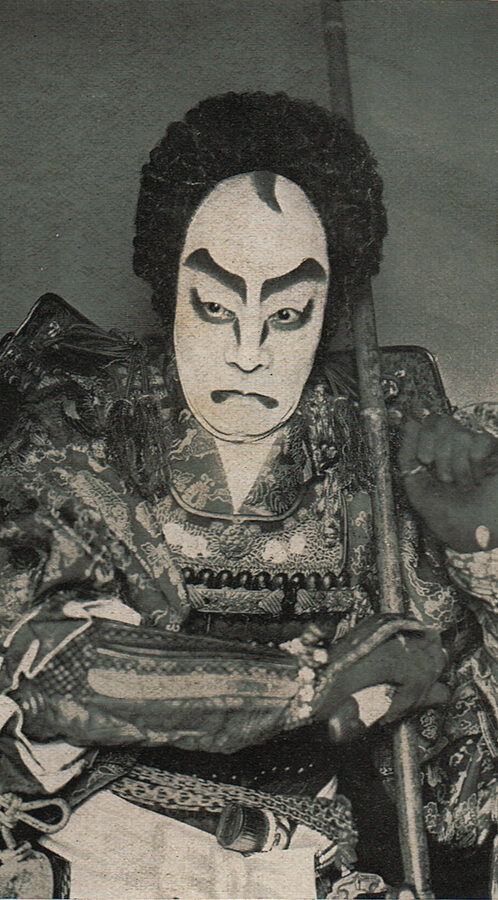
The Edo period, ruled by the house Nobunaga’s ally founded, was careful with the story. Plays could not use real names, so Mitsuhide became Takechi Mitsuhide, Nobunaga became Oda Harunaga and Hideyoshi Mashiba Hisayoshi, and the puppet play Ehon Taikōki of 1799 turned Mitsuhide into a tragic hero driven to it by an insufferable lord. Kabuki took it up the next year and has played it ever since.
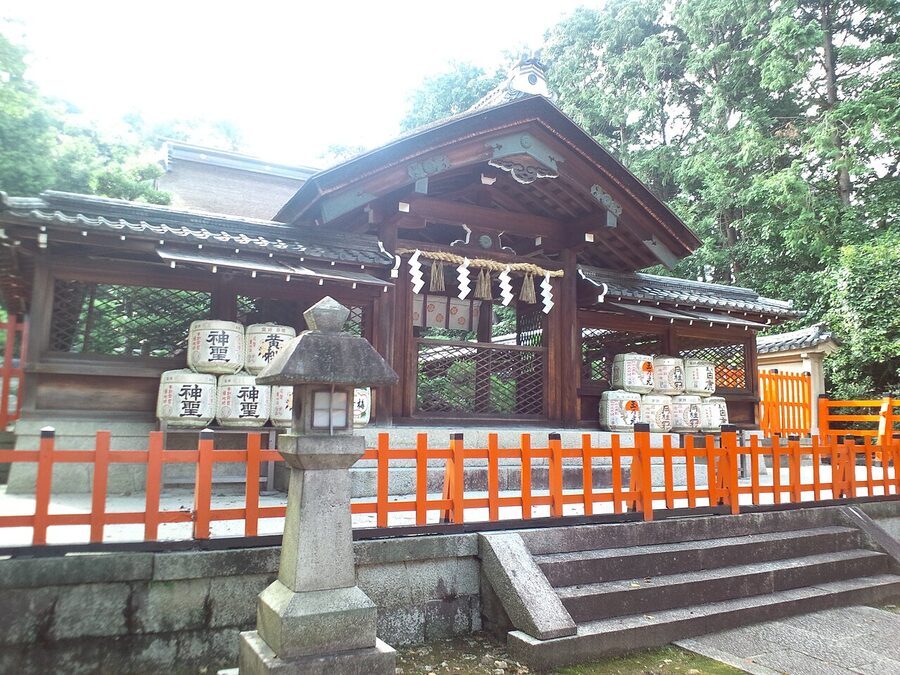
The Meiji government went the other way. In 1869 the new emperor ordered a shrine to Nobunaga as the man who had reunified the country and restored the court, and Kenkun Shrine moved to Funaokayama in Kyoto in 1880, on ground Hideyoshi had once set aside for a Nobunaga memorial temple that was never built. The demon king of Hiei-zan became a national hero, and Mitsuhide, inevitably, the villain again. For the longer sweep of how the Sengoku era turned into the Azuchi-Momoyama era, and then into Tokugawa rule, my walk through Japan through the ages lays it out.
Where to see the Honnō-ji Incident today
You can do almost all of this in Kyoto in a day, and the Kameoka end in a long morning. The thing to understand first is that the temple you will be directed to is not where it happened. Do the real site and the moved temple together and the incident makes sense; do only the famous one and you will come away with a picture of a city-centre temple that Mitsuhide never saw.
Honnō-ji on Teramachi
Hideyoshi moved Honnō-ji in his rebuilding of Kyoto to its present site on Teramachi, by Oike-dōri. Sources variously date the move to 1589, 1591 or 1592; the temple’s own history says the new buildings were completed in 1592. It burned again in the great fire of 1788 and in the fighting of 1864, and the present main hall, designed by the architectural historian Amanuma Shun’ichi, was finished in 1928.
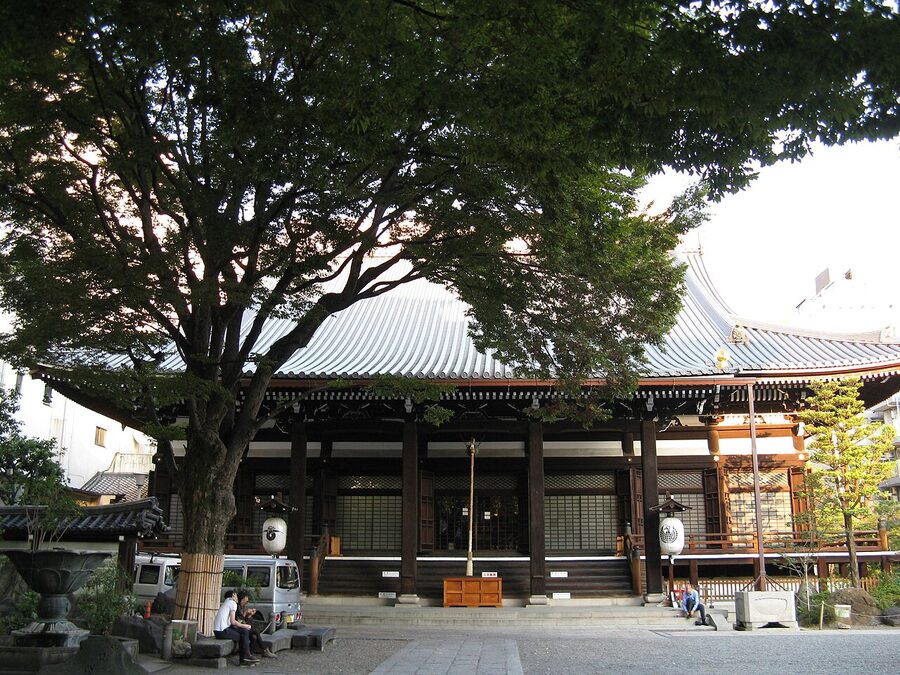
The grounds are open 6:00–17:00 and free. Behind the main hall is the memorial hall to Nobunaga, said to have been raised by Nobutaka, with a communal grave for the men who died with him. The Daihōden treasure hall opens 9:00–17:00 (last entry 16:30), closed over the New Year and when exhibits change, and costs ¥700 for adults, ¥500 for junior and senior high school students and ¥300 for primary pupils. Its best-known exhibit is the bronze incense burner called the Three-Legged Frog, which, the temple says, croaked a warning on the night before the attack.
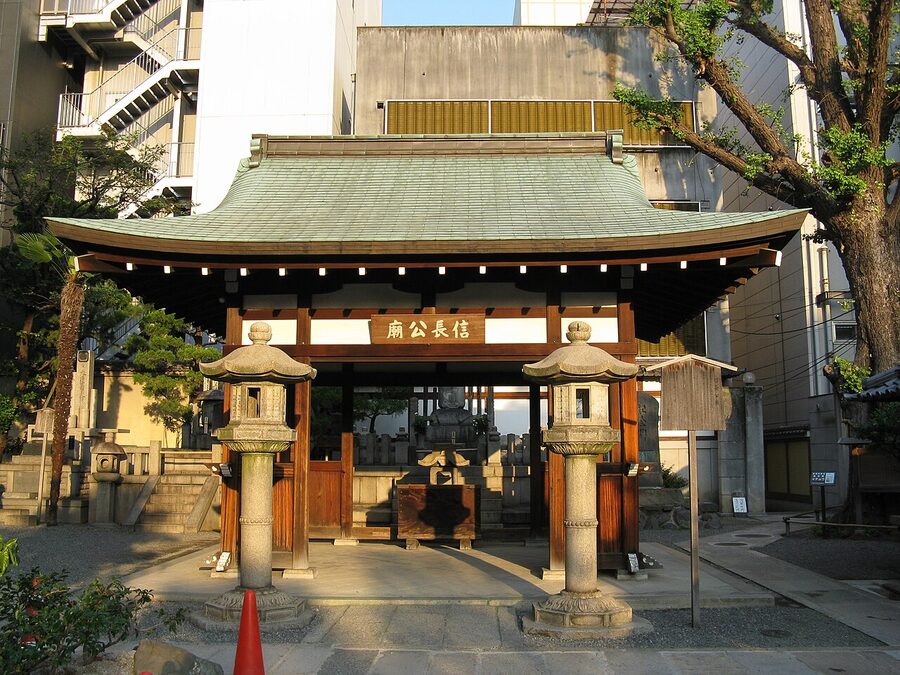
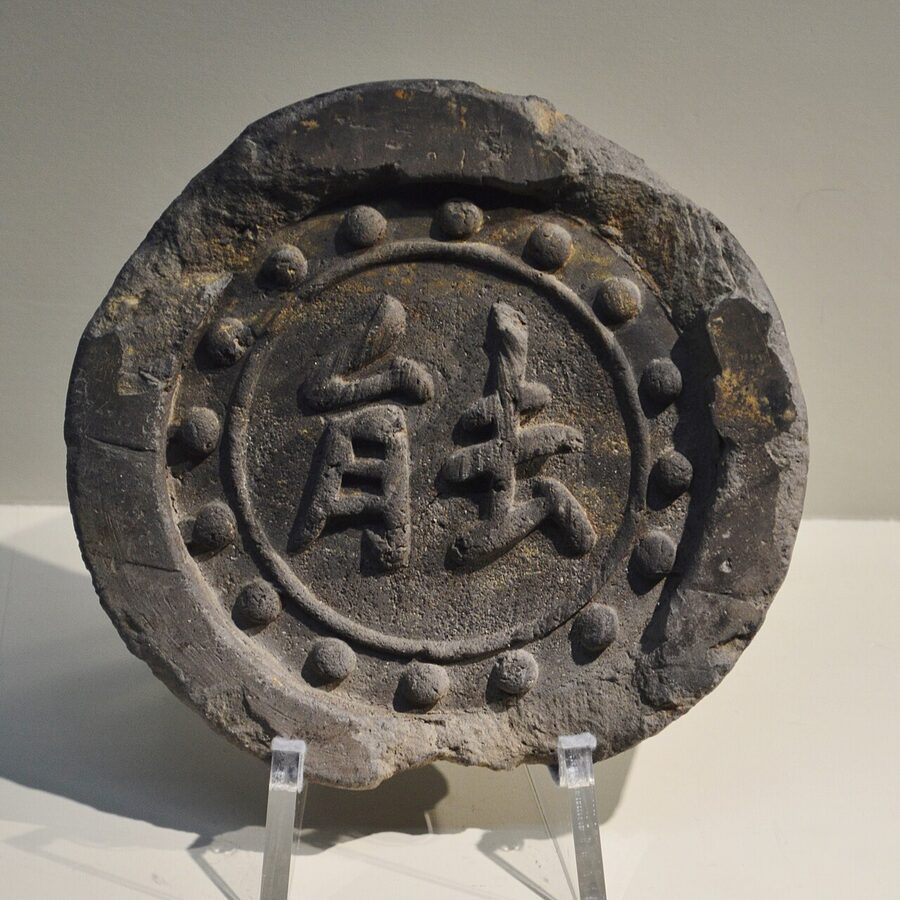
The temple is a minute from Kyoto Shiyakusho-mae station on the Tōzai subway line, five minutes’ walk from Keihan Sanjō and about ten from Hankyū Kawaramachi. Look at the temple’s name on the gate and lanterns: the character nō is written in an old form without the two “spoon” strokes on the right, which the temple explains as avoiding a character that looks like fire. In fact it was a common form at the time and appears on tiles dug up from the original site. The ginkgo in the grounds turns late, at the end of November.
The original site
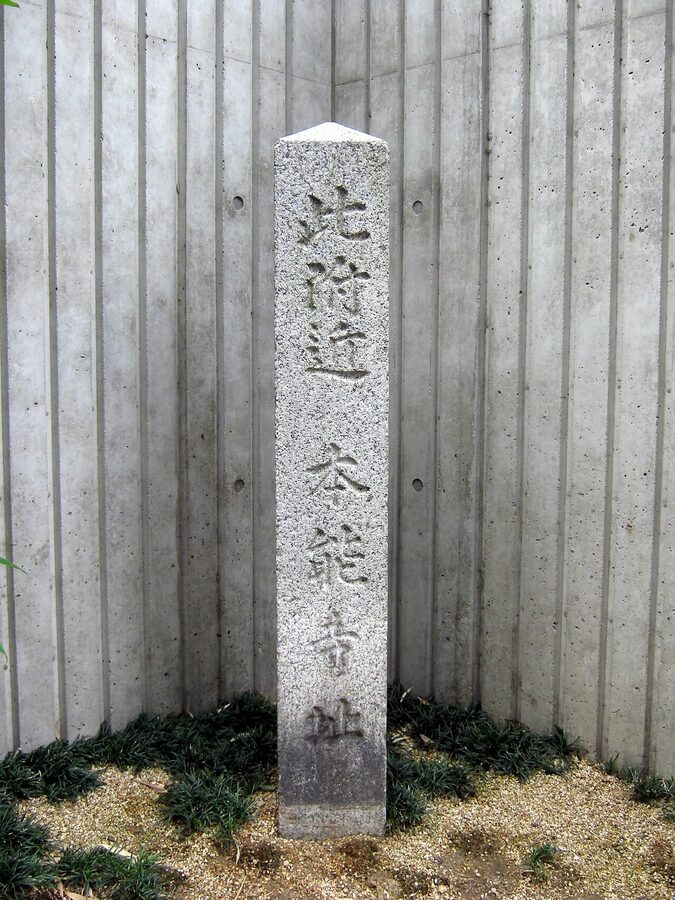
The site of 1582 is in Nakagyō ward, about twenty minutes’ walk south-west, among apartment blocks and offices. The markers stand at the edge of what was the temple’s block, around a care home for the elderly called Honnō, on the site of the old Honnō primary school, which closed in 1992 and was excavated afterwards. On the Aburanokōji side there is a modern granite monument reading “Honnō-ji ato”; on the Takoyakushi side, a plain stone pillar saying “Honnō-ji site in this vicinity”.
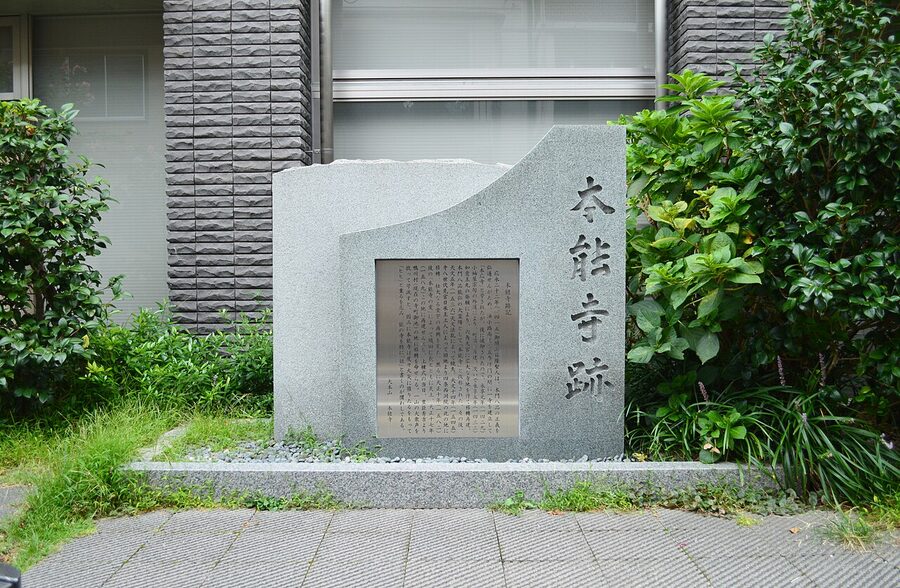
The precinct proper lay mostly in the block to the north, between Nishinotōin and Aburanokōji, Rokkaku and Takoyakushi, and the town names still remember it: Moto-Honnōji-chō and Moto-Honnōji-Minami-chō. Walk round the block. There is nothing to see in the usual sense, which is rather the point: a hundred and twenty metres square, a moat, a few hundred men, and a city waking up to gunfire. The nearest stations are Ōmiya on the Hankyū line and Shijō-Ōmiya on the Randen, both about ten minutes away.
The Nijō palace where Nobutada died is a short walk east, by Karasuma-Oike station: a stone reading “Nijō-dono site in this vicinity” on Ryōgae-machi-dōri just north of Oike, and another marking the palace pond on Muromachi just north of Oike. The town names Kami-Myōkakuji-chō and Shimo-Myōkakuji-chō nearby are all that is left of where Nobutada slept that night. Myōkaku-ji itself was moved, like Honnō-ji, and now stands in Kamigyō ward.
Amida-ji and Kenkun Shrine
Amida-ji, the temple of the priest Seigyoku, stands on Teramachi north of Imadegawa in Kamigyō ward, about seventeen minutes’ walk from Demachiyanagi station. Its graveyard holds the grave recognised in 1917 as Nobunaga’s principal tomb, with Nobutada’s beside it and the graves of Mori Ranmaru and his brothers and other men who died that day. The main hall is normally only opened on the 2nd of June for the memorial; the grounds are quiet and you will probably have them to yourself.
Kenkun Shrine, the Meiji state’s shrine to Nobunaga, sits on top of Funaokayama hill north of Nijō Castle, a climb of a few minutes from the bus stops on Kitaōji. The view across to Hiei-zan, the mountain whose temples Nobunaga burned in 1571, is better than you have any right to expect from a city hill. The worship hall displays paintings of Nobunaga’s thirty-six most loyal retainers, twelve at a time; Mitsuhide, unsurprisingly, is not among them.
Kameoka: Kameyama Castle and the Akechi country
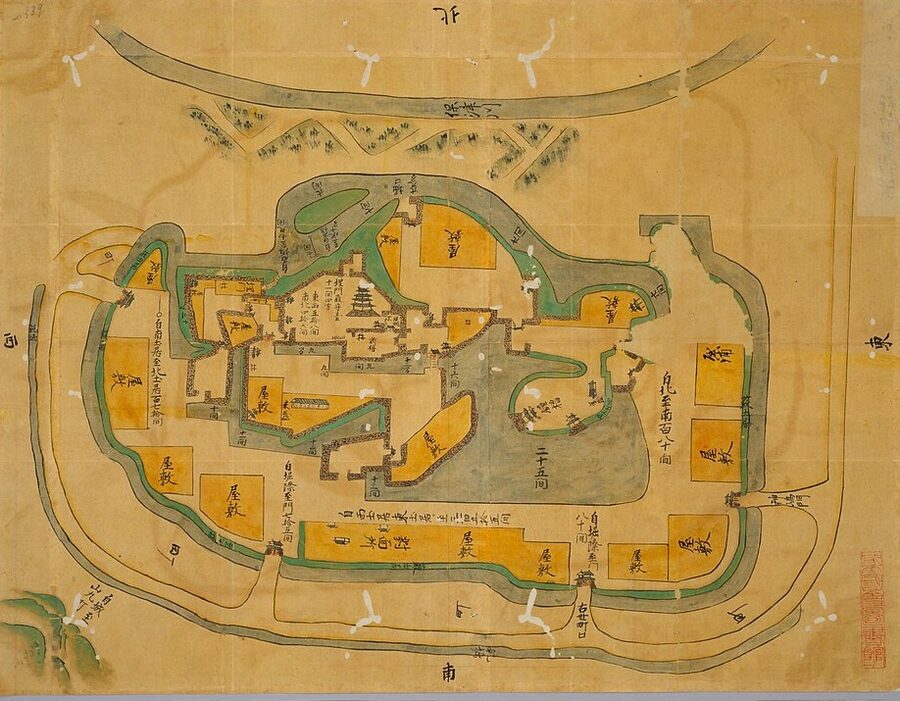
JR Kameoka is on the Sagano line, around half an hour from Kyoto Station, and the castle site is ten minutes’ walk from the station. Mitsuhide’s Kameyama was rebuilt for the Tokugawa in 1610, dismantled after the Meiji Restoration, and bought in 1919 by the new religion Ōmoto, whose founder rebuilt the walls with the help of his followers; the government dynamited his buildings in 1936, and the grounds came back to Ōmoto after the war. It is still their headquarters, so you go in through their reception.
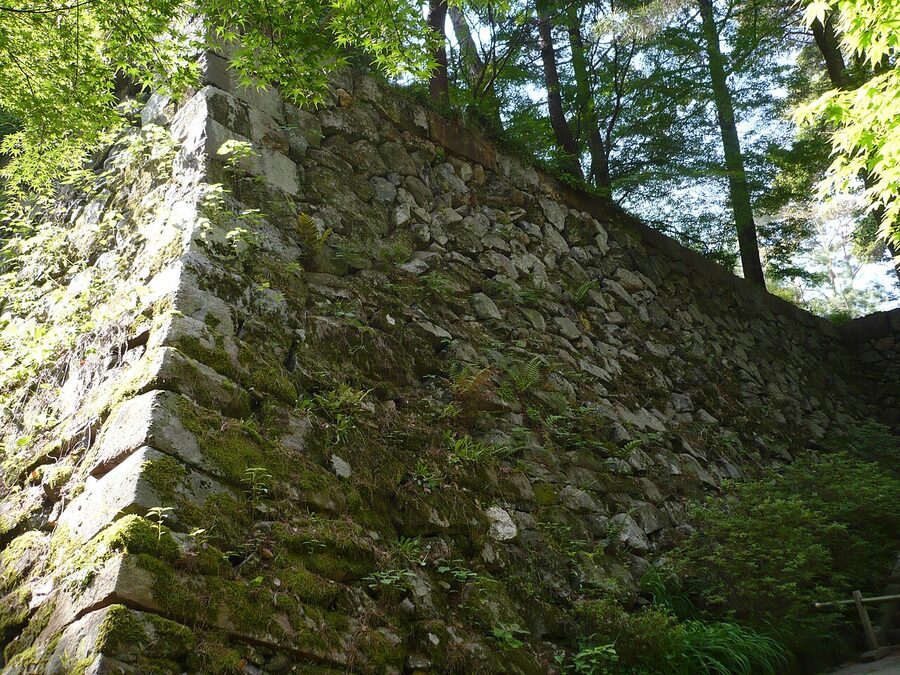
Ōmoto’s own guidance asks visitors to report to the reception at the Miroku Kaikan, between 9:30 and 16:00, with applications to see the castle site closed at 15:30. A garden ticket costs ¥300; junior high school students and younger go free. The ginkgo terrace at the top is off limits to protect a tree over 250 years old, and the stone circle of the sacred precinct beside it may not be entered or photographed. Respect both; this is somebody’s holy ground first and a castle second.
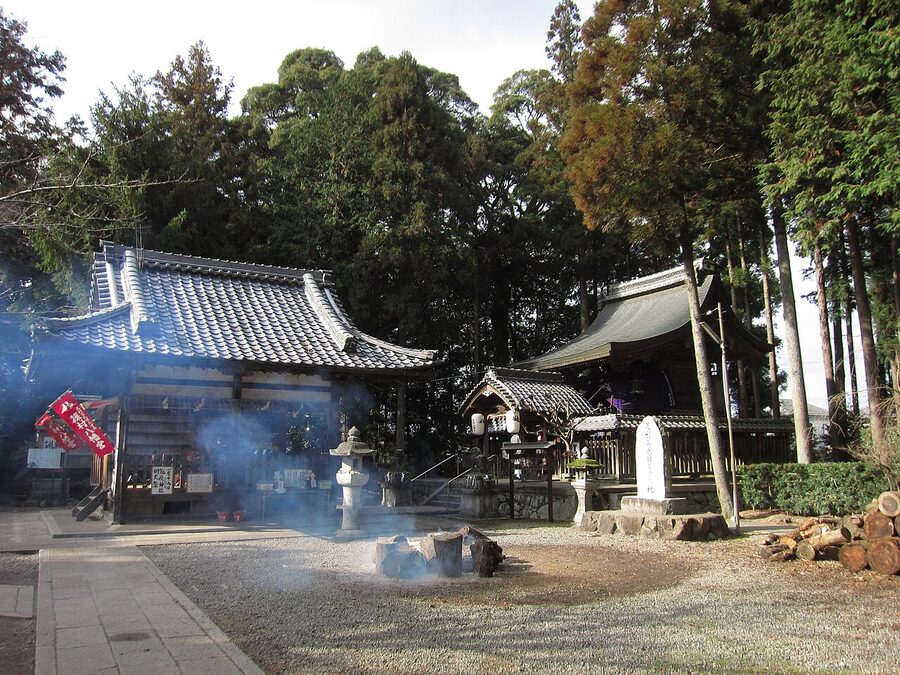
For Mitsuhide the man, as distinct from the incident, Kameoka has more. Kokushō-ji, the “bellflower temple” out in the countryside at Miyamae, five minutes from the Inokura bus stop, keeps a head mound for him and holds a memorial on the 14th of June; the city’s Mitsuhide festival on 3 May includes a service there. Shinomura Hachimangū, five minutes from the Shino bus stop, is where Ashikaga Takauji raised his white banner in 1333, and where local tradition puts Mitsuhide’s council on the evening he marched.
The Oinosaka pass
The pass between Kyoto and Kameoka is about 230 metres up, on the old San’in road. The road went into a tunnel under the pass in 1883, a second tunnel opened in 1933 and is now for walkers and cyclists, and Route 9 roars through a third of 1964. The Keihan Kyoto Kōtsū buses between Kyoto and Kameoka stop at Oinosaka-tōge, and from there a short walk towards Kameoka brings you to the start of the path over the old pass.
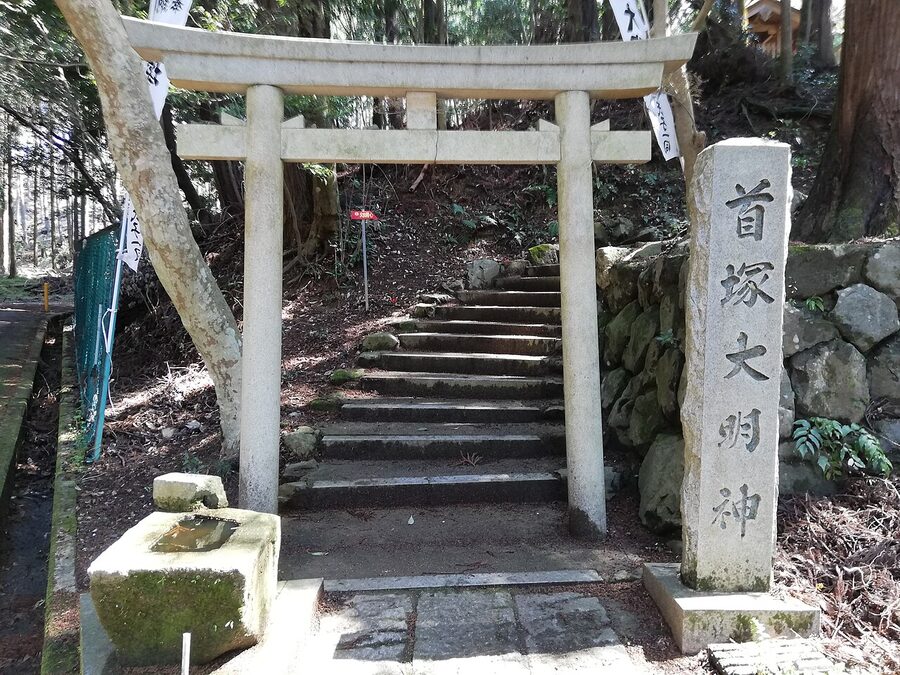
I like it better than any monument. It is a steep, wooded hill with a busy road under it, and if you walk it in the evening, as the army did, you come down into the western suburbs with the lights of the city spread out in front of you exactly as they would have been, minus the electricity. Do not expect signs; take a map.
Honjō Sōemon was rewarded for that morning with a spear, and wrote that anyone who claimed to have been first into Honnō-ji was lying, because none of them had known it was Nobunaga they were there to kill. Go and stand on Aburanokōji by the care home, at the old southern edge of the precinct. It is very quiet. You can believe, for a minute, that it was open and that there was not so much as a mouse inside.