The most important witness to what Kinkaku-ji ought to look like is a flower vase. When carpenters took the Golden Pavilion apart for repair between 1904 and 1906, one of the corner rafters from its second storey was not put back; somebody kept it, and at some point it was cut down and turned into a vase for the temple’s flower arrangements. In the early hours of 2 July 1950 the pavilion burned to its foundations with almost everything inside it, and that vase became the only scrap of the old building’s timber left. It had gold leaf on it.
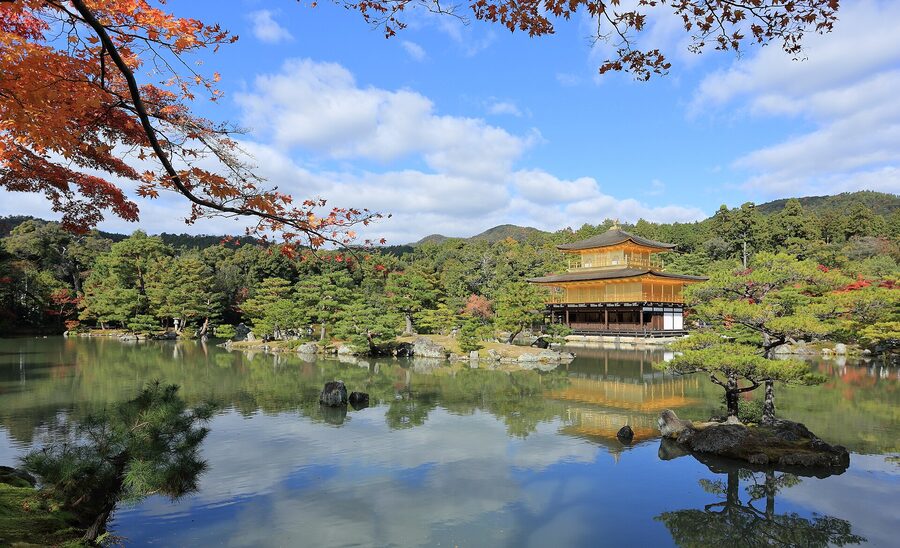
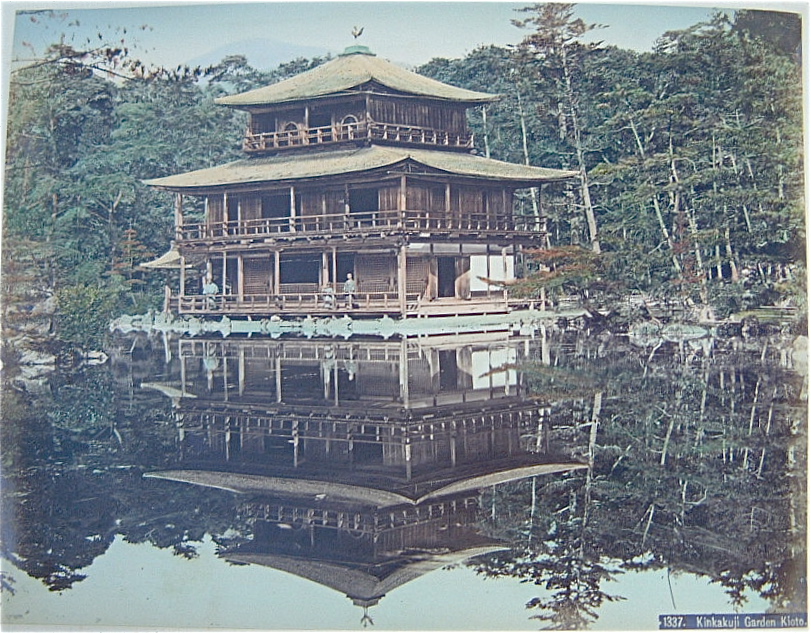
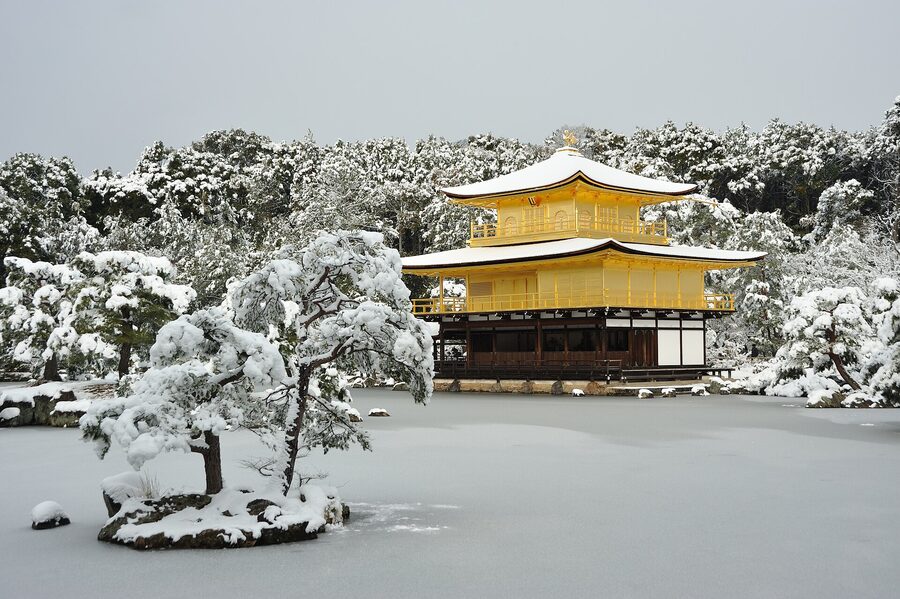
So when the pavilion was rebuilt, the second storey was gilded as well as the third, although in photographs taken before the fire the second storey looks like plain dark wood. That is why the building you queue to see at nine in the morning is golden from the balcony up rather than only at the top, and why at least one respected architectural historian thinks the result is wrong. I like it more for knowing this. What you are looking at is a 1955 copy of a building of about 1399, regilded in 1987, standing in a garden first dug in the 1220s, and it is still a working Zen temple, Rokuon-ji (鹿苑寺), with relics of the Buddha on its top floor.
In This Article
- A courtier’s paradise on the northern hills
- Yoshimitsu buys a hill
- Three floors, three ways of being important
- Noh, Ming envoys and the King of Japan
- Everything burns except the pavilion
- The night of 2 July 1950
- Rebuilding a building from its drawings
- Mishima, Mizukami and the argument over a motive
- Where to see Kinkaku-ji today
- The pond circuit
- Sekka-tei
- Fudō-dō
- Getting there
- Ryōan-ji
- Ninna-ji
- Beyond the northern temples
A courtier’s paradise on the northern hills
The ground was famous long before anyone thought of gilding a pavilion on it. Around 1220 Saionji Kintsune, the most powerful courtier of his generation and the man the Kamakura shogunate relied on to manage the imperial court, took a fancy to a stretch of the northern hills of Kyoto and swapped one of his estates in Owari Province for it. In 1224 he dedicated a family temple there, the Saionji, which gave his branch of the Fujiwara its name, and built around it a villa called Kitayama-dai, the “northern hills residence”.
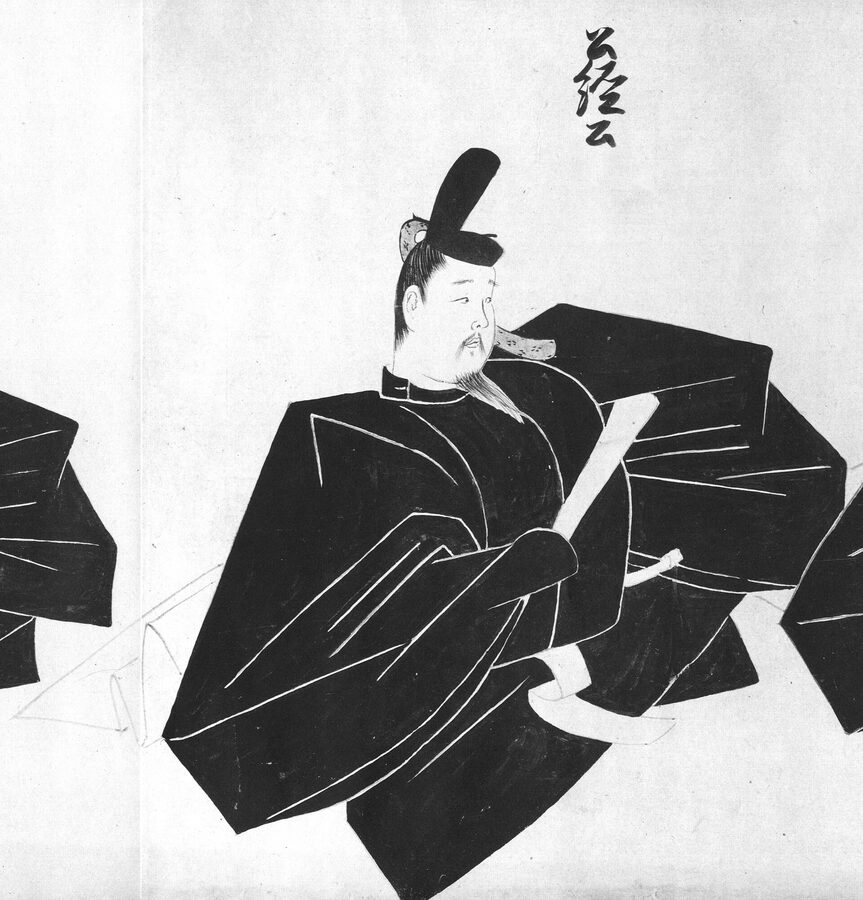
The poet Fujiwara no Teika saw the place in 1225 and was impressed by two things above all: a waterfall forty-five shaku high, about thirteen metres, and a pond the colour of lapis. Kintsune was openly trying to outdo the great Hōjō-ji temple of Fujiwara no Michinaga, the grandest building of the Heian court, and contemporaries called his villa a paradise on this side of death. The Saionji held the estate for a century. Then in 1335 the head of the family, Saionji Kinmune, was caught plotting against Emperor Go-Daigo, and he was executed and the family’s lands confiscated.
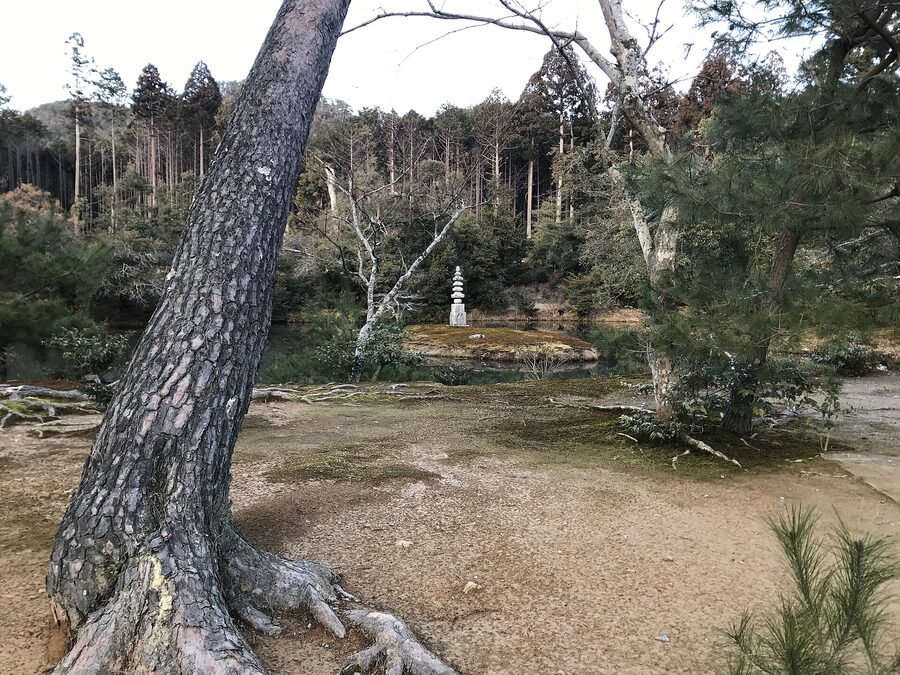
By the 1390s the villa was overgrown, and everything Teika admired had gone except, the temple believes, part of the water. Keep that in mind on the circuit path. The oldest thing you will see at Kinkaku-ji is not the gold; it is the shape of a pond dug for a 13th-century courtier.
Yoshimitsu buys a hill
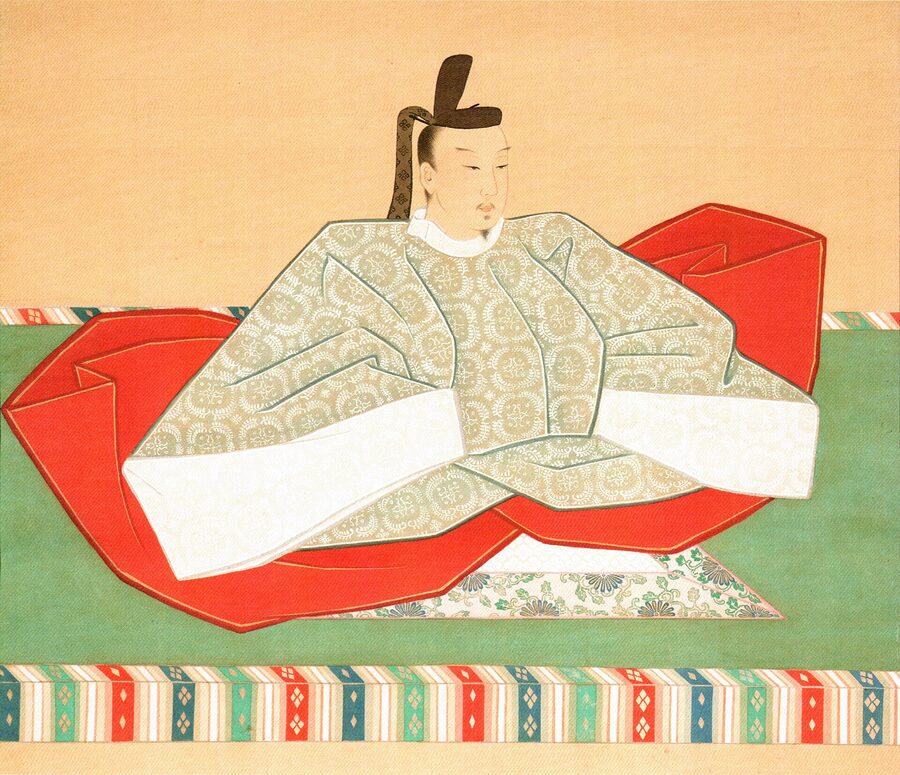
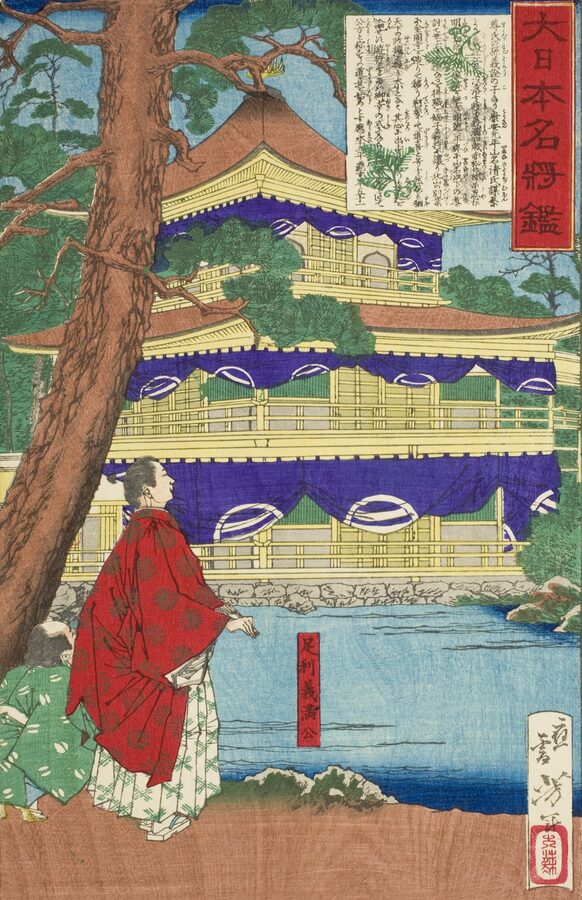
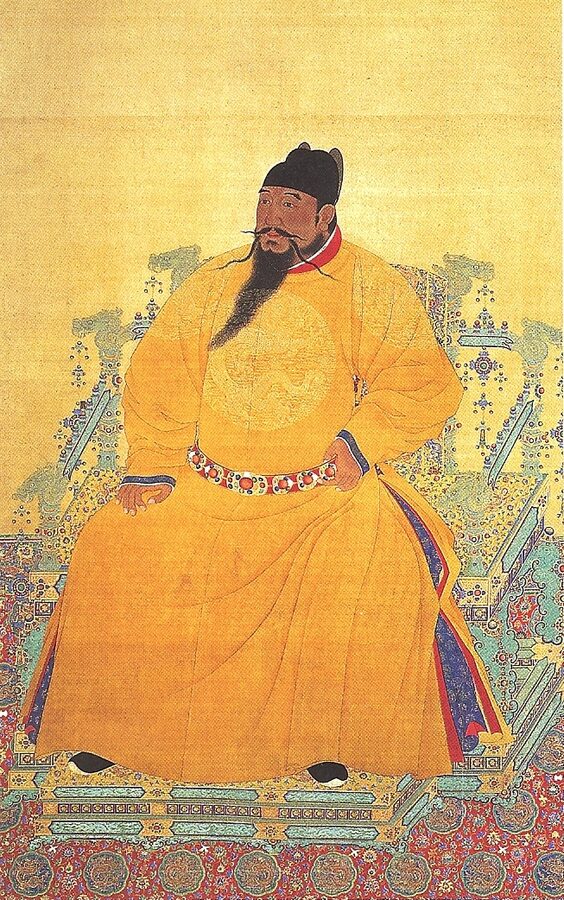
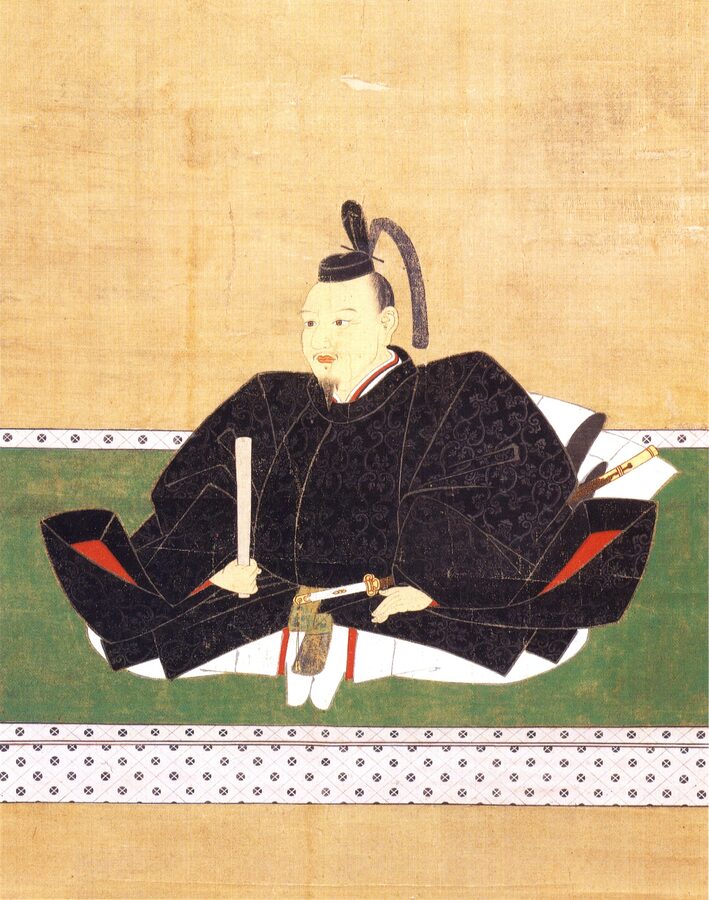
Ashikaga Yoshimitsu was born on the 22nd day of the eighth month of 1358, a hundred days after the death of his grandfather Takauji, who had founded the shogunate. He became head of the house at ten and shogun soon after, and by his thirties he was the most powerful man Japan had seen since the 12th century. His palace on Muromachi-dōri, the Hana no Gosho or “flower palace”, gave its name to the shogunate and to the whole Muromachi era. In 1392 he ended the fifty-six-year schism between the Northern and Southern courts by persuading the southern emperor to hand over the regalia, the three sacred treasures, to the northern line.
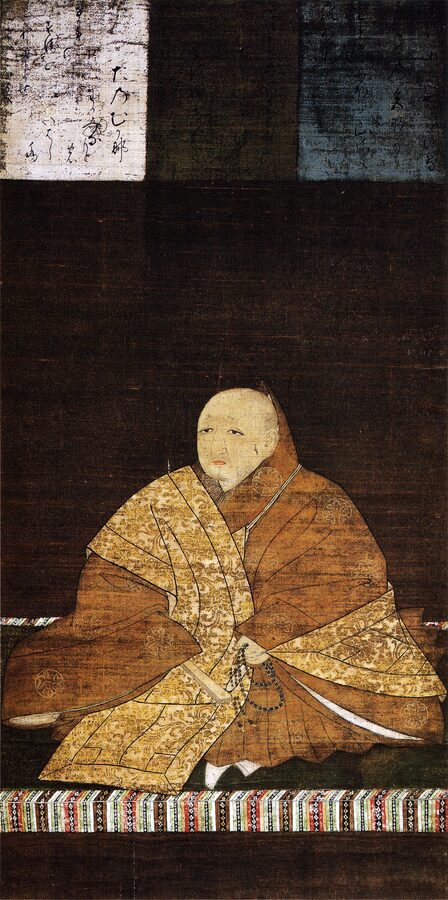
Then he retired, or appeared to. In the twelfth month of 1394, which by the Western calendar had already tipped into January 1395, he passed the title of shogun to his nine-year-old son Yoshimochi and had himself appointed Grand Minister of State, the highest office at court; only one warrior, Taira no Kiyomori, had held it before him. Six months later he resigned that too, shaved his head and took the Buddhist name Dōgi. None of this reduced his power in the slightest, and he ran the country from wherever he happened to be living.
In 1397 he acquired the decayed Saionji estate in exchange for lands in Kawachi Province and began to build. Sources disagree on when he moved in: some Japanese reference works give 1398, others the spring of 1399. The complex was called Kitayama-dono, and it was less a retirement villa than a second capital, with halls for receiving the emperor and courtiers, a residence for his wife Hino Yasuko, and the three-storey reliquary hall now known as the Golden Pavilion, which is thought to have been finished in 1399.
He built big at Kitayama too. When the Shōkoku-ji pagoda burned in 1403, Yoshimitsu raised a second great pagoda of similar size at Kitayama-dono instead, which lightning destroyed again in 1416. In 2016 Kyoto’s municipal archaeologists announced fragments thought to come from its finial, the first physical trace of it to turn up in six hundred years.
The high point came in the third month of 1408, when Emperor Go-Komatsu spent nearly three weeks at Kitayama-dono as Yoshimitsu’s guest, with banquets, poetry, music and sarugaku. Yoshimitsu sat on a mat edged with the patterned ungen-beri border that was reserved for emperors and retired emperors, a detail historians have argued over ever since. If you have read my piece on tatami, you will know how much the border of a mat could say about the rank of the person sitting on it.
Three floors, three ways of being important
The pavilion is a small building. It stands about 12.5 metres high, with a ground floor five bays wide and four deep, a second floor of the same plan and a third floor only three bays square, under a pyramid roof of thin sawara cypress shingles, not the kawara tiles you see on most temples in the city. Each floor is built in a different style, and the usual description, palace below, warrior house in the middle, Zen hall on top, is broadly right. What makes it interesting is that the three styles stack the social order of Yoshimitsu’s Japan into one building, with the shogun’s own class in the middle.
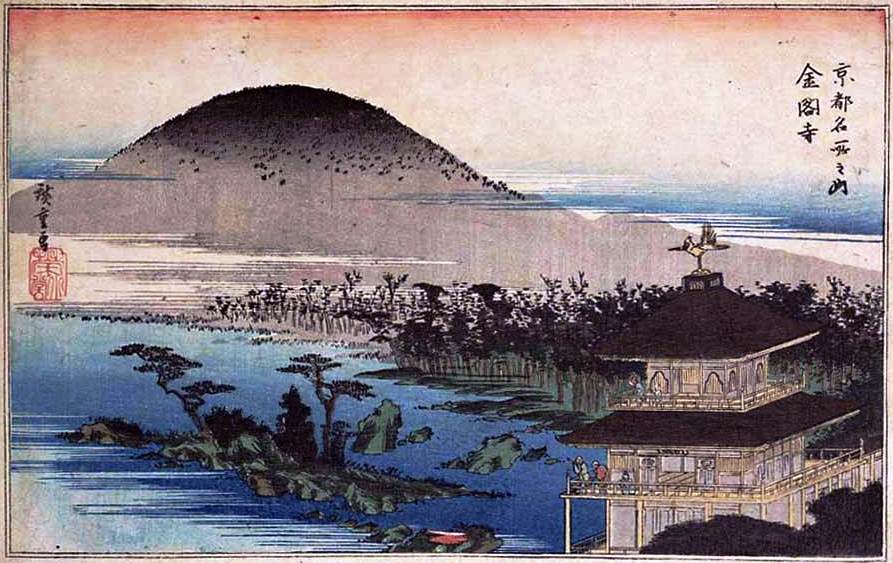
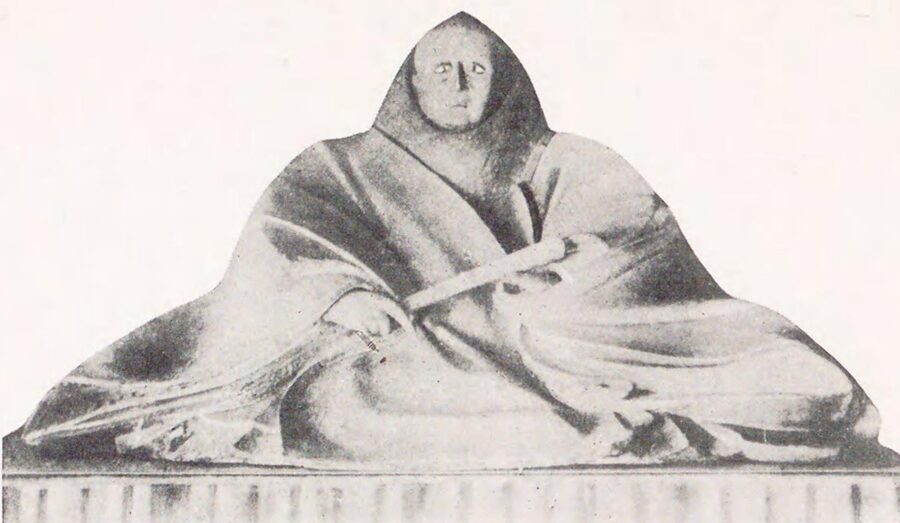
The ground floor, the Hōsui-in or “hall of Dharma waters”, is in shinden-zukuri, the style of the Heian aristocrat’s mansion, with a broad open veranda and hinged lattice shutters that lift up to let in the light. It holds a seated figure of the Buddha Shaka and, to its left, a statue of Yoshimitsu as a monk. On the west side a tiny open pavilion called Sōsei juts out over the water, so that you could step into a boat from the building or simply sit above the pond.
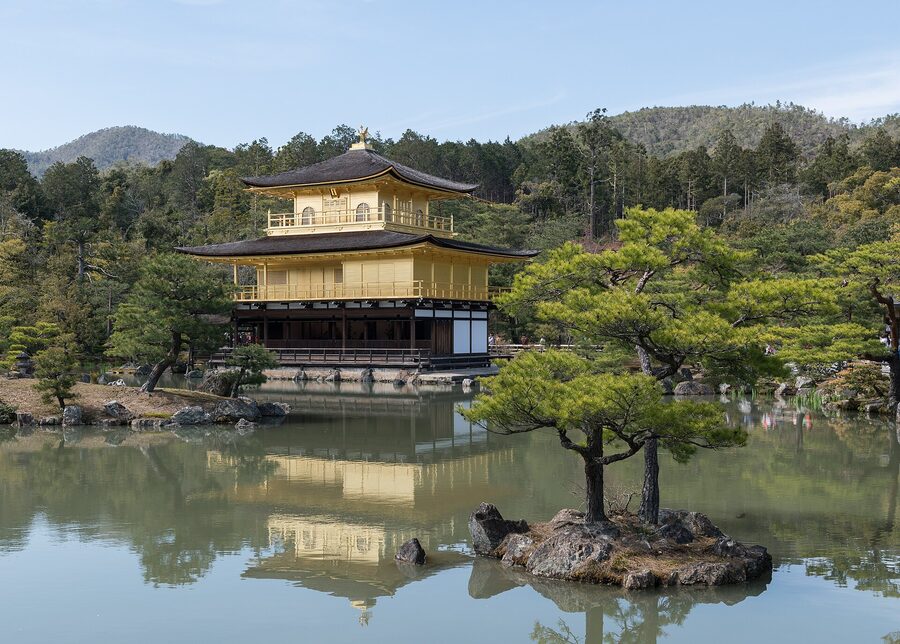
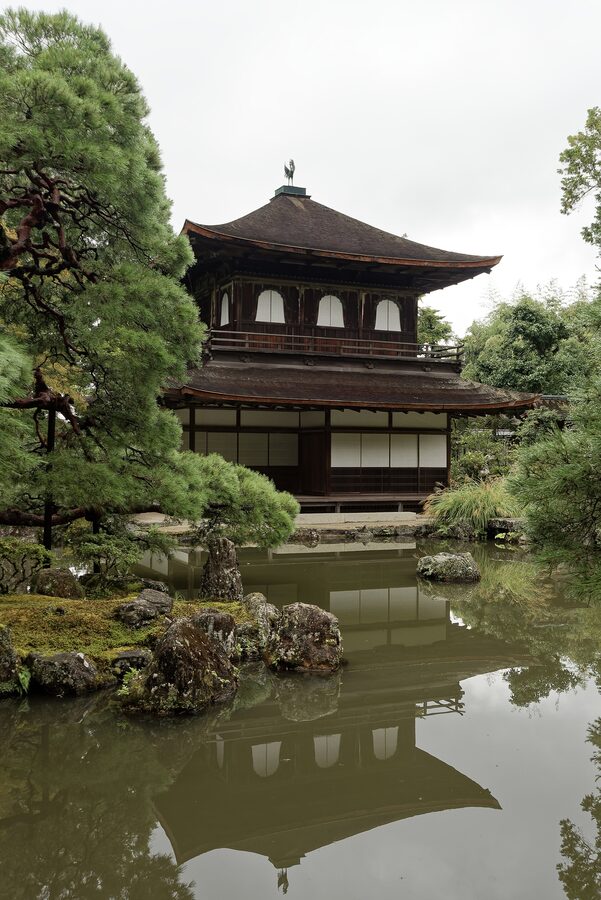
The second floor, the Chōon-dō or “cave of the sound of waves”, is a buke-zukuri hall in the warrior-house manner, with sliding panels and a Buddha room that houses a figure of Kannon seated in a rocky cave, guarded by the Four Heavenly Kings. The top floor, the Kukkyōchō or “summit of the ultimate”, is a Chinese-style Zen Buddha hall with cusped windows and panelled doors, gilded inside as well as out, and it held the relics that give the building its proper name of shariden, reliquary hall. Yoshimasa, Yoshimitsu’s grandson, later borrowed the second floor’s name, Chōon, for the upper floor of his own pavilion in the eastern hills, which tells you how the family regarded this one.
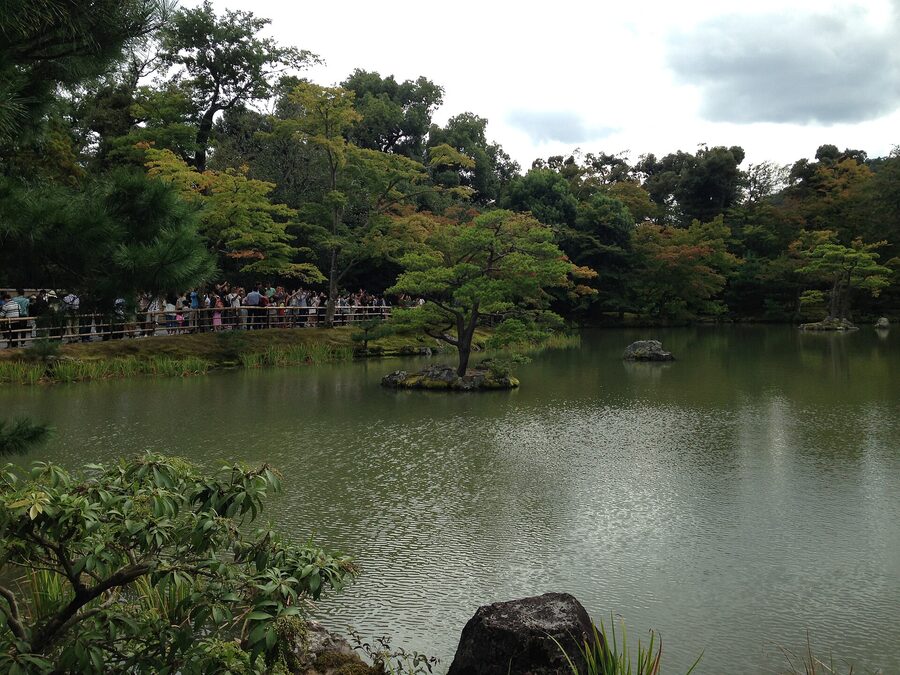
The garden is the other half of the design. Kyōko-chi, the Mirror Pond, covers some 6,600 square metres, with a large island of reeds, the Ashiwara-jima, and smaller crane and turtle islands planted with pines. Scattered through it are named rocks, among them the Hatakeyama, Akamatsu and Hosokawa stones, said by tradition to have been presented by the great warrior houses of those names. Pond, islands and the hills behind were laid out as a single picture, and the temple describes the whole as an image of the Buddhist paradise; I cover the thinking behind that kind of garden in my history of Japanese gardens.
Noh, Ming envoys and the King of Japan
Historians call the culture of Yoshimitsu’s court Kitayama bunka, Kitayama culture, after this villa, and set it against the quieter Higashiyama culture of his grandson. It mixed court refinement, warrior money and Chinese learning brought in by Zen monks, and in practice that meant renga linked verse, tea-tasting contests, Chinese paintings and ceramics hung and displayed in reception halls, and a great deal of Chinese poetry. The Zen poets Zekkai Chūshin and Gidō Shūshin, both close to the shogun, were its stars. Ink painting in the Chinese manner took root with monk-painters such as Josetsu and Minchō.
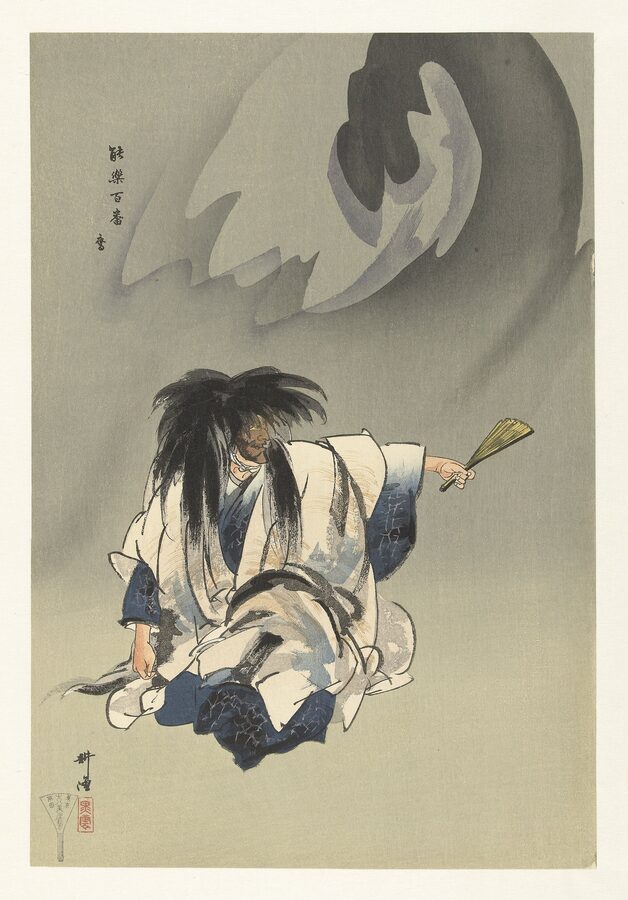
The most famous name it produced came from the theatre. In 1374 or 1375, sources differ on the year, the young Yoshimitsu went to a sarugaku performance at the Imakumano shrine in Kyoto given by the actor Kan’ami and his troupe, and was smitten with Kan’ami’s twelve-year-old son. The boy was Zeami, who with his father turned sarugaku into Noh and wrote much of the repertoire still performed today. At the Gion festival of 1378 Yoshimitsu had the boy sit beside him in his viewing box and passed him his own cup, and the courtier Sanjō Kintada complained in his diary that sarugaku was a beggar’s trade and that the great families were showering the boy with gifts to please the shogun.
Zeami’s fortunes followed the Ashikaga. Yoshimitsu’s son Yoshimochi preferred a rival form, dengaku, and the sixth shogun, Yoshinori, actively persecuted him; in 1434, in his seventies, Zeami was exiled to the island of Sado, and nobody knows for certain where or when he died. His treatise on acting, the Fūshikaden, written around 1400, is still read by actors today.
Yoshimitsu also wanted China. The Ming court had refused his envoys in 1374 and 1380, because it had already recognised a Southern Court prince in Kyushu, Kaneyoshi, as “King of Japan”, and it regarded Yoshimitsu as a mere vassal of a rival emperor. As a retired monk he was no longer anyone’s vassal, and in 1401 he sent a Hakata merchant called Koitomi and a monk called Soa to the Ming court with a letter signed simply as “the Jun-sangō Dōgi of Japan”. The reply that came back in 1402 from the Jianwen emperor, then in the middle of losing a civil war to his uncle, addressed him as “King of Japan, Minamoto Dōgi”.
Yoshimitsu received the Ming envoys at Kitayama-dono, and the accounts say he burned incense before the imperial letter, bowed three times and knelt to read it. That made Japan a tributary of China on paper, and it made a lot of people uneasy. The senior statesman Shiba Yoshimasa thought the shogun’s behaviour “excessive”, and a later Zen scholar, Zuikei Shūhō, attacked him in print for calling himself a king and a subject of the emperor of China at the same time.
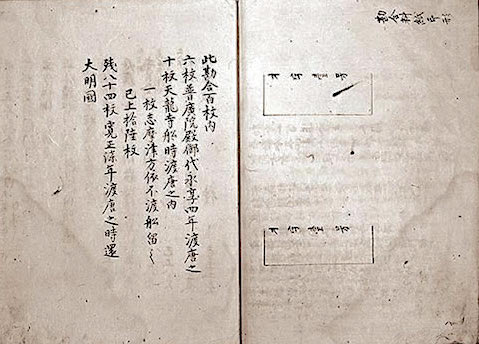
The tally trade began in 1404, and it was enormously profitable. You will often read that its profits paid for the Golden Pavilion. The dates do not allow it: the pavilion was finished by about 1399, two years before the first embassy sailed, so whatever paid for the gold, it was not Chinese copper coin.
Some historians, Imatani Akira most prominently, have argued that Yoshimitsu meant to go further and absorb the imperial house itself, through his favourite son Yoshitsugu, whom he had come of age at court in 1408 with the ceremony of an imperial prince. The theory is attractive and the evidence is thin: no contemporary diary says so, and most recent work treats the “King of Japan” title as a trade passport rather than a claim to the throne. Yoshimitsu fell ill at the end of the fourth month of 1408 and died at Kitayama-dono on the 6th day of the fifth month, aged forty-nine. The court offered him the title of retired emperor after his death, and Yoshimochi turned it down.
Everything burns except the pavilion
Yoshimochi did not like his father, and he did not like his father’s house. He moved into Kitayama-dono briefly and moved out again in the second month of 1409, taking down part of the complex. Hino Yasuko, Yoshimitsu’s widow, lived on there until her death in the eleventh month of 1419, after which the residential halls were dismantled and given away to Zen temples such as Nanzen-ji and Kennin-ji. In 1420, following Yoshimitsu’s instructions, what remained became a Zen temple named Rokuon-ji, from Yoshimitsu’s Buddhist name, with the long-dead Musō Soseki named as honorary founder.
Yoshimasa visited the temple every year on the 15th day of the tenth month, and the diary of the Shōkoku-ji office called the Inryōken records one such visit, in 1485, in some detail. By then the century of civil war that historians call the Sengoku era had begun. Most of the maples had been cut down during the fighting, the pond had dropped, the Kannon on the second floor had been lost and replaced, and on the top floor only the carved clouds remained of a set of Amida and twenty-five bodhisattvas.
The war in question was the Ōnin War, which broke out in Kyoto in 1467 and ran for ten years. Rokuon-ji became a camp of the Western Army, and on the 22nd day of the sixth month of 1467 most of its halls burned. The pavilion did not. Nobody has ever explained satisfactorily why, beyond the obvious point that soldiers camping in a garden need somewhere dry to sleep.
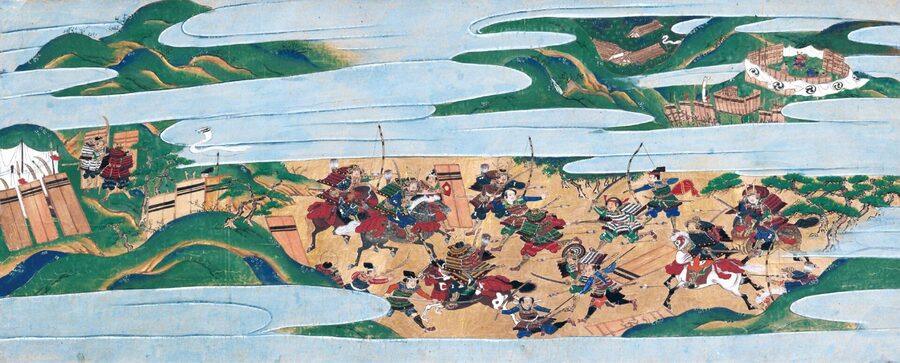
Recovery came with the warlords who rebuilt Kyoto. The Fudō-dō, now the oldest building in the precinct, was rebuilt in the Tenshō era (1573–1592), the heart of the Azuchi-Momoyama years, by Ukita Hideie, one of Toyotomi Hideyoshi‘s great lords, in the years after Oda Nobunaga had finished off the Ashikaga shogunate for good in 1573. Tokugawa Ieyasu made the Zen scholar Saishō Jōtai abbot, and the temple’s finances were put on a sound footing for the first time in a century.
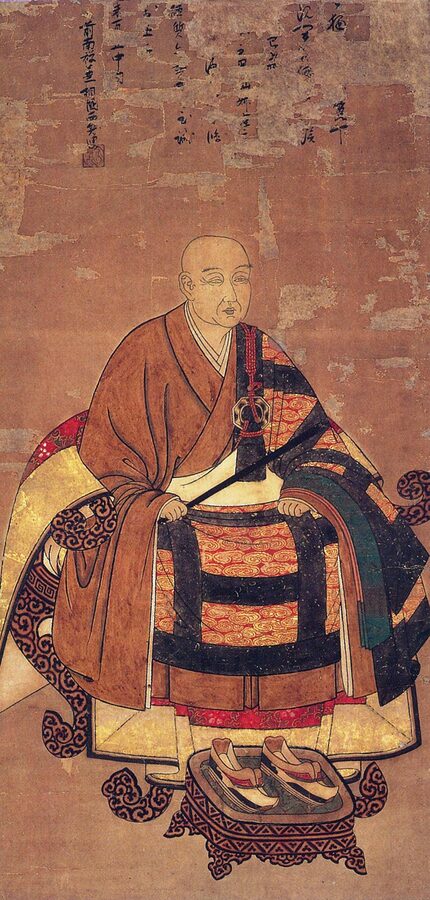
In the 17th century the pavilion was thoroughly repaired in 1649, the abbot Hōrin Jōshō restored the gardens and kept a diary, the Kakumeiki, that is a goldmine for anyone who studies the period, and the retired emperor Go-Mizunoo gave the abbot’s hall that still stands. The Meiji government’s attack on Buddhist institutions after 1868 took away most of the temple’s estates, and in 1894 the abbot Kanshū Shōichi did the thing that has defined Kinkaku-ji ever since: he opened the garden and pavilion to the public and charged admission. You are still paying for his decision.
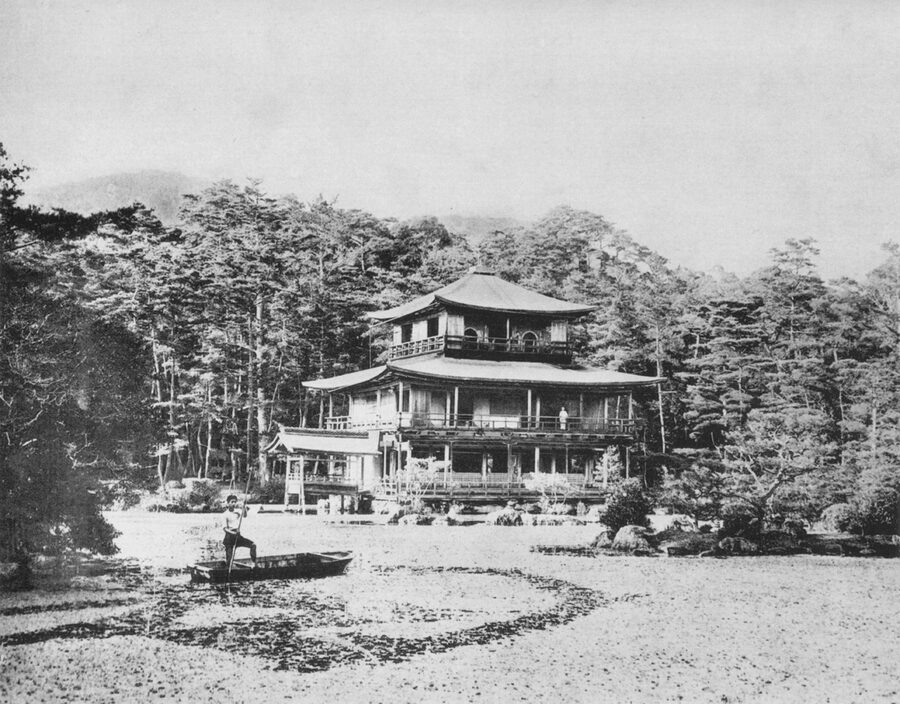
In 1897 the building was listed as a specially protected structure, the forerunner of a National Treasure, and between 1904 and 1906 it was taken apart and repaired, with every timber measured and drawn. A wooden model of it was sent to the Japan-British Exhibition in London in 1910 and did a good deal to make it famous abroad; afterwards the model was kept on the pavilion’s ground floor, and it burned with the building. Puyi, the puppet emperor of Manchukuo, toured it in 1935, and in the autumn of 1945 the temple quietly hid Chen Gongbo, head of the collapsed Japanese-sponsored government in Nanjing, for almost a month.
The night of 2 July 1950
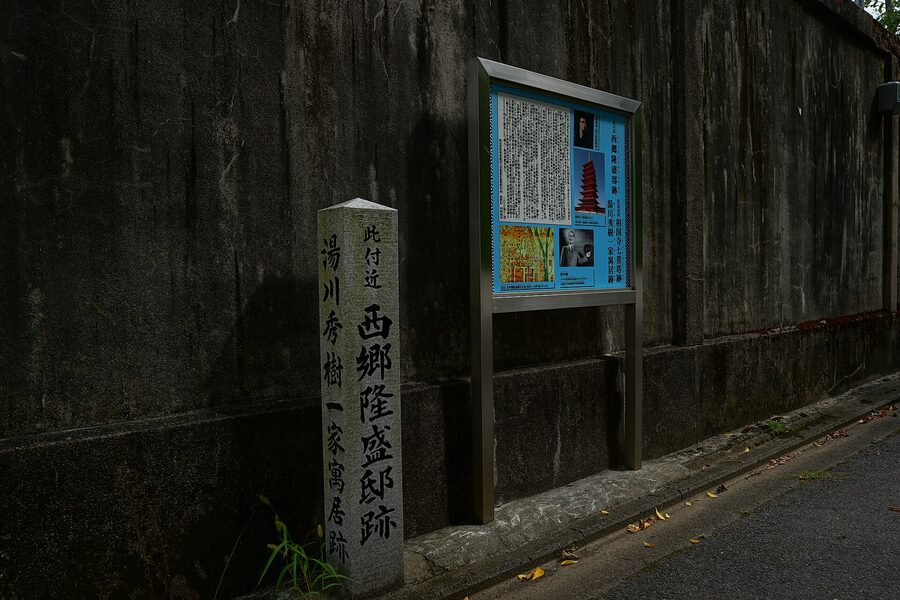
The novice who burned the pavilion was called Hayashi Yōken, and he was twenty-one. English-language accounts usually make him twenty-two and put the fire at half past two in the morning; the Japanese court and fire records give his date of birth as 19 March 1929 and the first sighting of the fire as 3:07. He is often referred to by his Buddhist name, Shōken, and many accounts leave his name out altogether, which I understand but do not follow here: he was a person, not a symbol, and the story makes no sense without him.
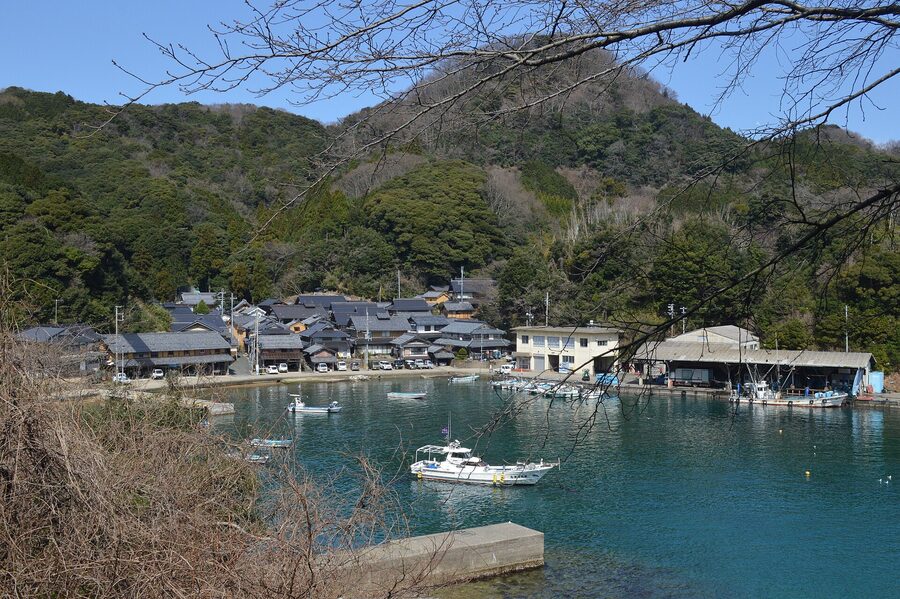
He was born at Nariu, a fishing hamlet on a headland near Maizuru on the Sea of Japan, the only child of the priest of Saitoku-ji, a temple so poor that the villagers had to make up what its parishioners could not pay. His father had tuberculosis and spent much of his life in bed; his mother ran the temple. From the age of about three the boy had a severe stammer and was teased for it, but he was big, quick and near the top of his class, and he looked after the younger children.
His father died in December 1942, having written to the abbot of Rokuon-ji, Murakami Jikai, asking him to take the boy and train him. Hayashi was ordained in 1943 and entered the temple in 1944, studied at a Rinzai middle school and then at Ōtani University, and for a while did well. From 1949 he stopped. He played go instead of going to lectures, his place in his class fell to 79th out of 79, he became withdrawn and sullen, and he came to believe that the abbot had turned against him and would never make him his successor.
He planned it over three weeks. On 10 June he began working loose the nails on a door on the north side of the ground floor. He sold his father’s old winter cape and then his own overcoats to pay for visits to a brothel in the Gobanchō quarter, and told a woman there that he might be in the newspapers soon. On 22 June he bought a hundred tablets of the sedative Calmotin, insisting to a doubtful pharmacist that thirty would not do, and on 29 June the pavilion’s fire alarm broke down, with the repairman due on 2 July.
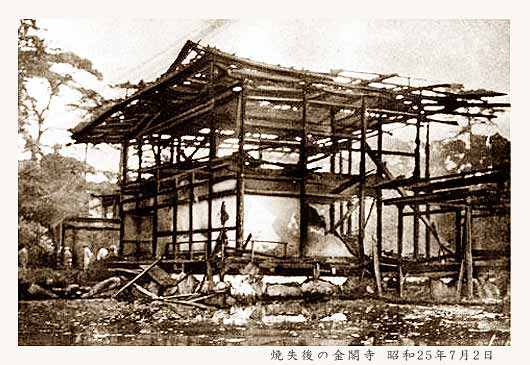
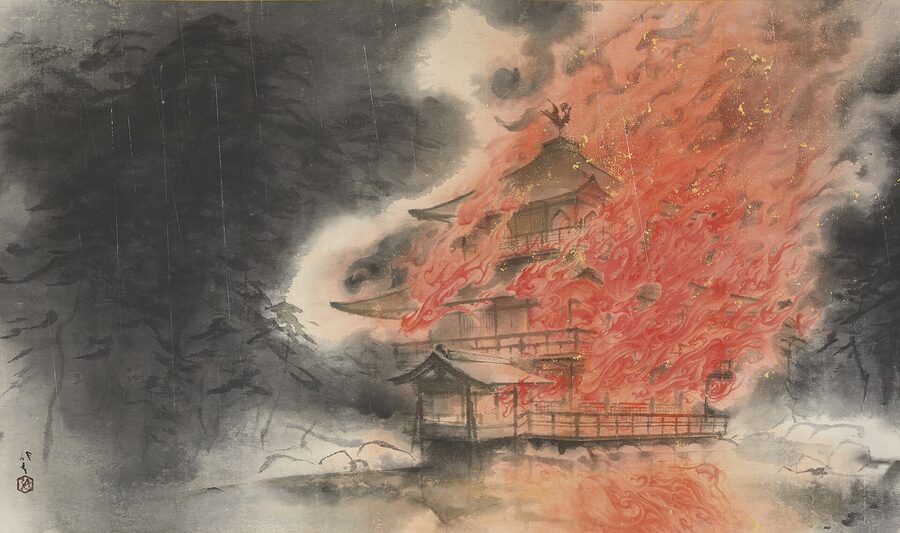
On the evening of 1 July he gave the abbot a moxa treatment and a massage, then played go in his room until midnight with a senior monk, who said afterwards that nothing about him seemed strange. At around three in the morning he carried his futon, mosquito net, clothes and books into the pavilion, piled them in front of Yoshimitsu’s statue, pushed straw underneath and struck a match. A lookout at a fire station some 2.7 kilometres to the east saw the glow through the trees at 3:07. By the time the first engine had found its way up the rough lanes at the foot of Kinugasa-yama the whole building was alight, the roof fell in at about 3:40, and by 3:50 it was over.
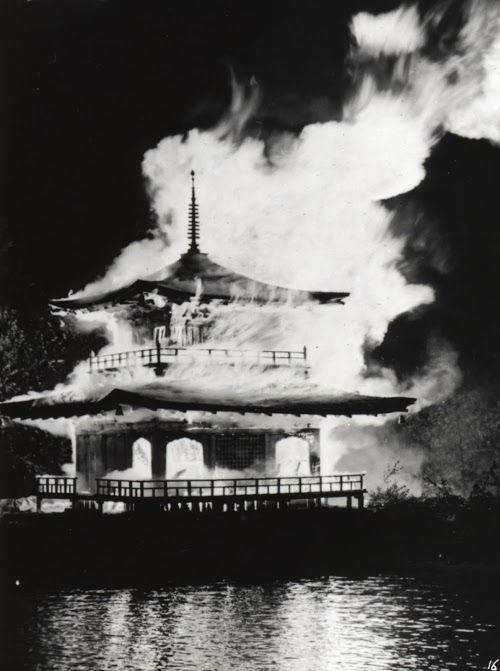
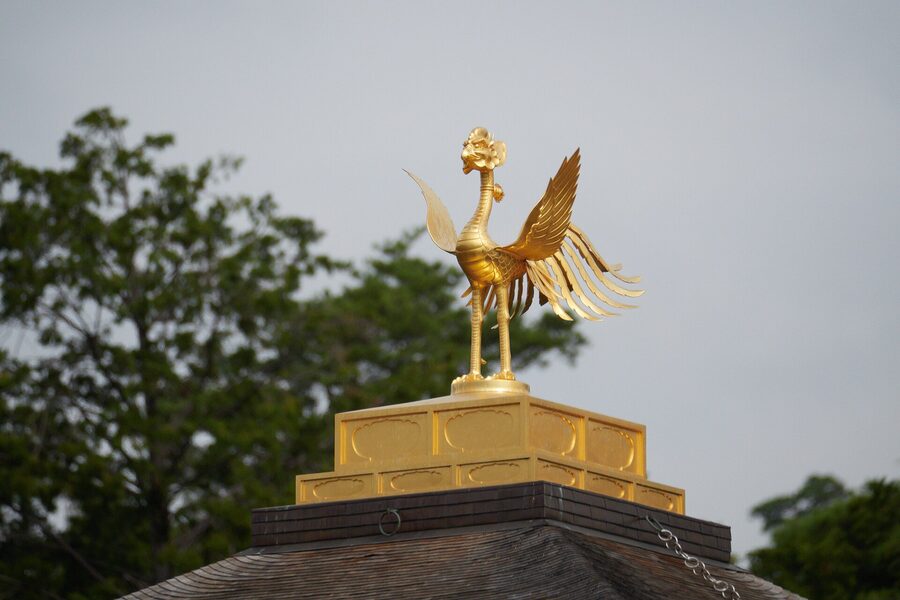
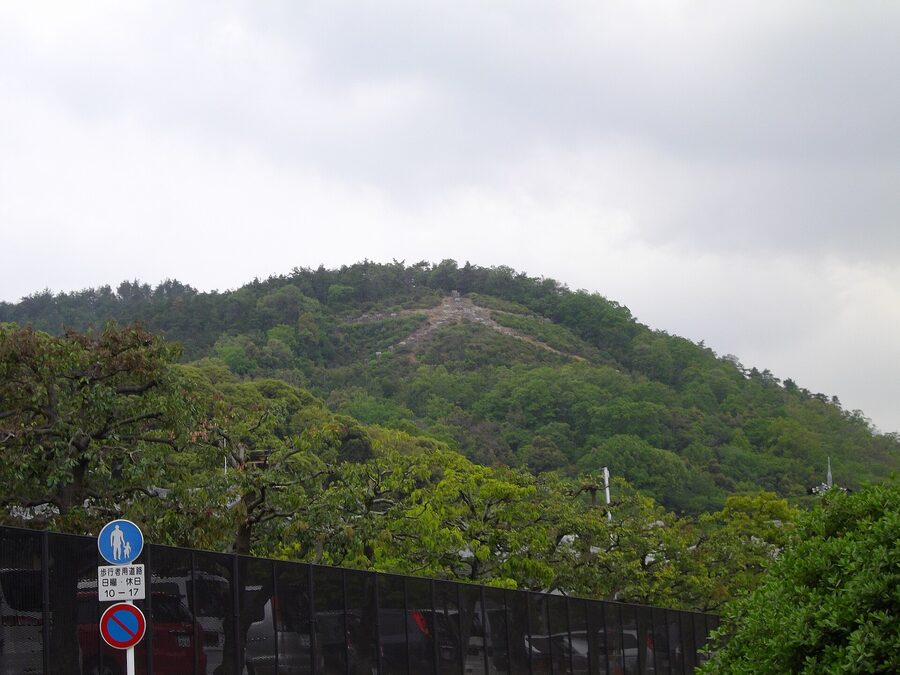
The pavilion was destroyed along with the statue of Yoshimitsu, a Kannon attributed to the sculptor Unkei and several other figures. The phoenix and the Kukkyōchō name board, both taken down before the fire, survived, and so did Hōrin Jōshō’s diary, which was in the temple library. The search for Hayashi ended later that day on the slopes of Ōkitayama behind the temple, where the Hidari Daimonji character is cut into the hillside. He had swallowed the Calmotin and stabbed himself in the chest, and he survived both.
To the police and the newspapers he said he had meant to die with the pavilion but had run away when his trousers began to burn, and that he felt no remorse. The prosecution’s account of his motive was a list: self-hatred, jealousy of beauty, a wish to die with something beautiful, resentment of society and curiosity about what people would say. Asked in court whether that was true, he said it was true if you called it true and not true if you did not. The phrase “jealousy of beauty” was the newspapers’ gift to the novelists.
His mother came to Kyoto on 2 July and learned at the station what her son had done. He refused to see her. On the train home the next afternoon, near Hozukyō, she jumped from the carriage into the river gorge and was killed; English-language accounts often say she threw herself in front of a train, but the Japanese reports describe her leaving the moving train. She had told the police that she wished she could die in his place.
A psychiatrist from Kyoto University found Hayashi schizoid but fully responsible, and on 28 December 1950 he was sentenced to seven years, later reduced by amnesty. In prison he wrote again and again to the abbot asking his forgiveness, and then his letters became disordered as his mental illness and his tuberculosis worsened.
Sources differ on his release: English accounts usually give 29 September 1955, while the Japanese record has him moved to Kyoto Prison that October and freed at the end of his sentence later the same month, straight into a psychiatric hospital. When he was told that the pavilion had been rebuilt, he did not ask to see a photograph, and said it did not matter. He died of tuberculosis on 7 March 1956, aged twenty-six, and he is buried in Maizuru beside his mother.
Rebuilding a building from its drawings
The arson came at the end of a terrible run. In January 1949 fire had destroyed the wall paintings of the Golden Hall at Hōryū-ji, the oldest wooden buildings in the world; in February a fire at Matsuyama Castle had burned three listed gate buildings, and in June Matsumae Castle in Hokkaidō had gone too. The Law for the Protection of Cultural Properties, prompted by the Hōryū-ji fire, had been passed only that May, and the government decided within the month to rebuild the pavilion.
Not everyone wanted a wooden copy. The historian Akamatsu Toshihide later recalled public calls to rebuild it in reinforced concrete so that it could never burn again, the solution that gave Japan its post-war concrete keeps at Hiroshima, Nagoya and elsewhere.
The money was the hard part. Prices were soaring with the Korean War boom, and Murakami Jikai, the abbot who had lost the pavilion, went on takuhatsu, the begging round of a Zen monk, around the country to raise funds and to apologise. Public donations and state aid together came to about ¥30 million, ¥28,254,200 if you want the accountant’s figure. Ground was broken on 22 March 1952, and the architectural historian Murata Jirō supervised a reconstruction based on the drawings and photographs made during the Meiji repair, on the surviving charred timbers and on the old documents.
The new pavilion was consecrated on 10 October 1955, and it is not a copy of the building that burned. The restorers took the chance to undo changes made over five centuries: a stair added in the Meiji period was left out, a doorway on the north side was walled up, and the latticed windows on the second floor became plain board walls, because they were judged to be later additions. Then there was the vase. On the evidence of that one corner rafter the second floor was gilded inside and out like the third, and the architectural historian Miyakami Shigetaka has argued that this is wrong: a corner rafter is the part of a building most exposed to rain, so if gold had once covered the whole floor it is the last place you would expect to find it surviving alone.
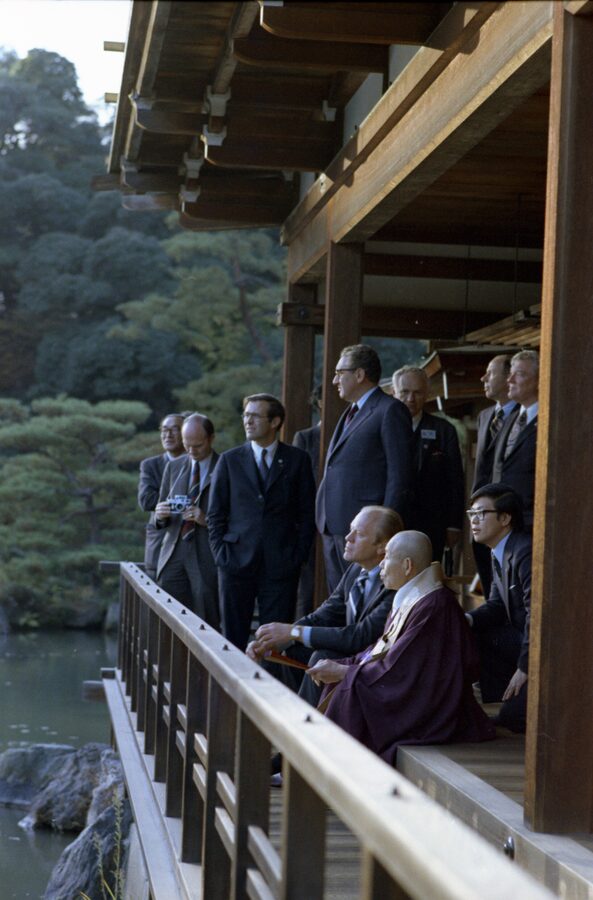
The gold did not last. Within about ten years the thin leaf of 1955 had begun to flake and the black lacquer beneath was cracking in the sun, so from February 1986 to October 1987 the pavilion was restored again at a cost of about ¥740 million. The new leaf is five times the usual thickness, about half a micron, and some 200,000 sheets, about 20 kilograms of gold, were laid over roughly 1.5 tonnes of lacquer from Jōbōji in Iwate, Japan’s best-known source of domestic lacquer. The ceiling paintings and the statue of Yoshimitsu were remade, the phoenix was replaced and the shingle roof was renewed in 2003.
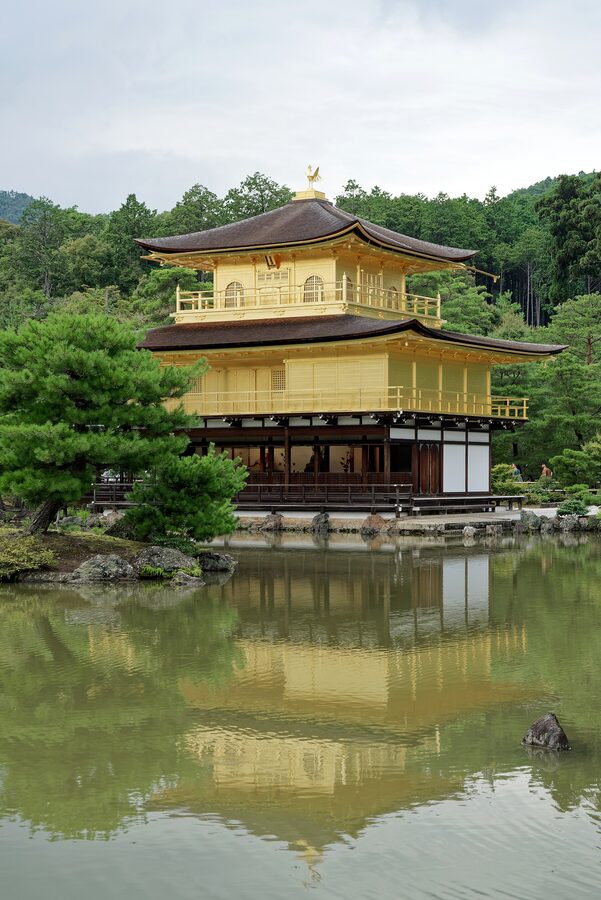
Is it still the real thing? In 1994 the temple became part of the World Heritage listing of historic Kyoto, which covers the temple and its garden as a whole; the garden is a Special Historic Site and Special Place of Scenic Beauty, while the 1955 pavilion is not listed as a cultural property at all. Japan has always been more relaxed than Europe about rebuilding sacred buildings, and the Ise shrines are rebuilt every twenty years on purpose. I would put it like this: the building is new, the design is old, the garden is older, and the place, which is what a temple really is, has been continuously in use since 1420.
Mishima, Mizukami and the argument over a motive
The fire made a better story than almost anything else in post-war Japan, because nobody could agree why it had happened. The critic Kobayashi Hideo called it a truly symbolic event of the age. Others blamed the post-war loss of values, the new freedom of the young or, in one professor’s case, bad heredity. Very few people at the time asked about Hayashi himself.
Mishima Yukio’s Kinkaku-ji was serialised in the magazine Shinchō from January to October 1956 and came out as a book that October; it sold 150,000 copies, won the Yomiuri Prize and is still the novel most people outside Japan have read by him. Ivan Morris’s English translation, The Temple of the Golden Pavilion, followed in 1959. Its narrator, Mizoguchi, is a stammering priest’s son from the Sea of Japan coast who has been told from childhood that the pavilion is the most beautiful thing in the world, and the book is about beauty as something you cannot live beside. It is a superb novel, and it is not about Hayashi.
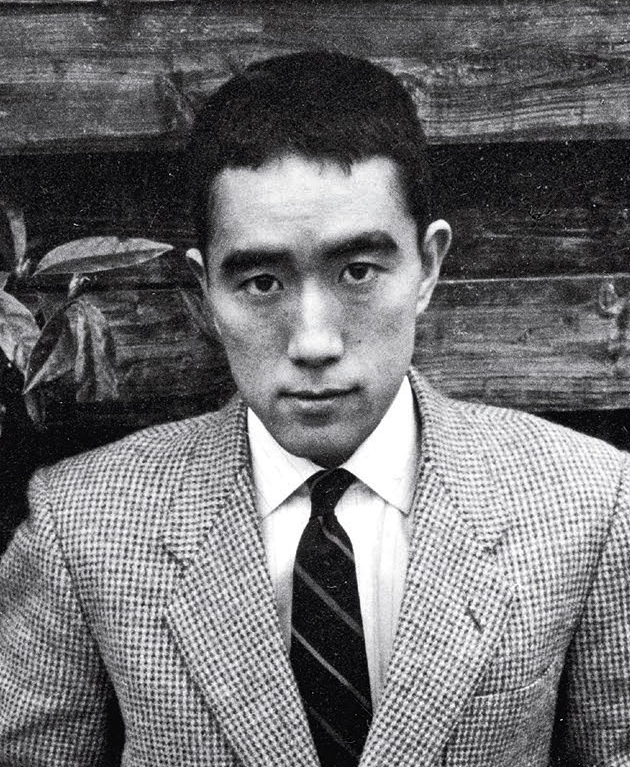
Some English-language accounts say Mishima visited Hayashi in prison. I have found no sign of that in the Japanese record, which instead stresses how little interest he showed in the real arsonist; his working notes call Hayashi “an artist who did not write”. The novel’s events and its psychology are Mishima’s. Kon Ichikawa filmed it in 1958 as Enjō (“Conflagration”), with Ichikawa Raizō as the acolyte, and gave the temple a fictional name.
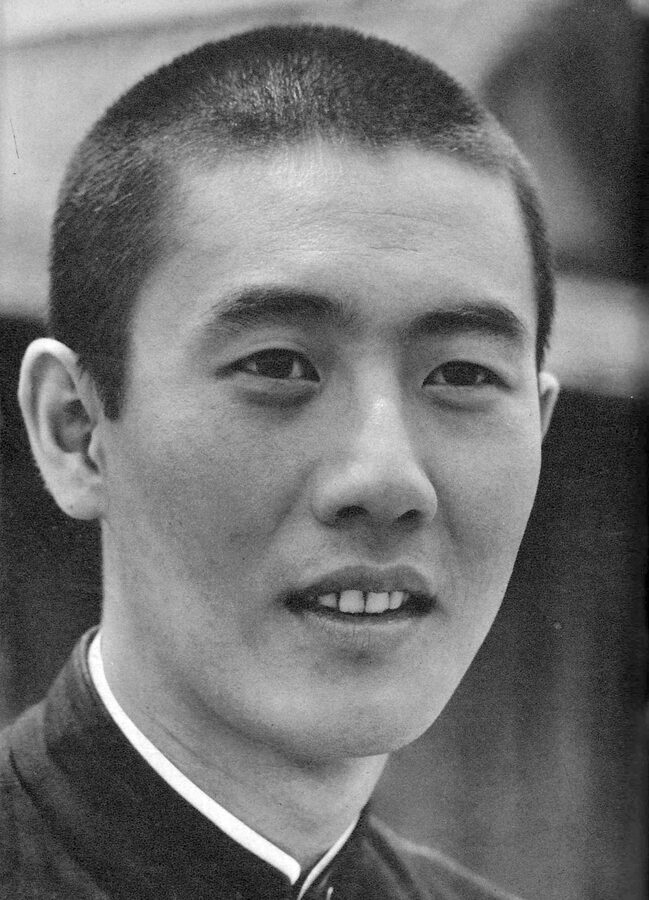
The writer who did care about Hayashi was Mizukami Tsutomu. He had been a Rinzai novice himself, had been to the same Zen middle school in Kyoto, and in August 1944, while working as a substitute teacher just across the prefectural border in Fukui, had met the fifteen-year-old Hayashi by chance on a pass near Nariu. His novel Gobanchō Yūgiri-rō (1962), set in the brothel quarter Hayashi visited, was written partly as an answer to Mishima. Then in 1979 he published Kinkaku Enjō, a book close to non-fiction, built on years of interviews with people who had known Hayashi and his mother.
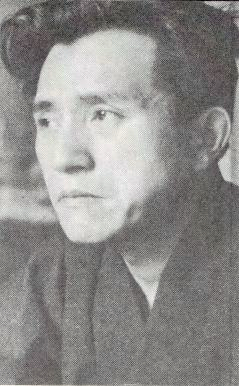
Mizukami also found something about the fire that Mishima had not. The one journalist the abbot agreed to see, on the afternoon of 3 July 1950, was a young religious-affairs reporter for the Sankei newspaper called Fukuda Teiichi, who knew him from the temple beat. Fukuda later became Japan’s most popular historical novelist under the pen name Shiba Ryōtarō, and when Mizukami asked him about it in 1978, he said he thought he had been given special treatment. More recently the essayist Sakai Junko compared the two novelists in How to Burn the Golden Pavilion (2010), and the psychiatrist Utsumi Takeshi’s study of Hayashi and Mishima won the Osaragi Jirō Prize in 2020.
The temple, for its part, says as little as possible. As recently as 2010 its visitor leaflet did not mention the fire at all, which some writers have found strange. I do not. It is a place of worship whose novice burned its main hall and whose abbot spent five years making amends; the history is told in the books, and the monks are entitled to leave it there.
Where to see Kinkaku-ji today
Kinkaku-ji is open every day of the year from 9:00 to 17:00, and admission is ¥500 for adults and high-school students and ¥300 for primary and junior-high pupils, payable in cash or by cashless payment at the gate. Your ticket is not a receipt but a paper talisman, an ofuda, printed with a prayer for the protection of your household; keep it and put it somewhere high at home, which is what it is for. Check the temple’s own website for any changes before you go.
The pond circuit
The route is one way and takes thirty to forty minutes at a normal pace. You come out on the south bank of the pond and get the famous view first, which is the right order: it is the best angle on the building, and everything after it is a walk round the back of a stage set. Go at 9:00 sharp, or in the last hour before closing, when the coach groups have gone.
You cannot enter the pavilion, and the temple asks that photographs be for personal use only and not posted publicly, a request about as widely observed as any in Kyoto. There are no lockers and nowhere to eat a packed lunch.
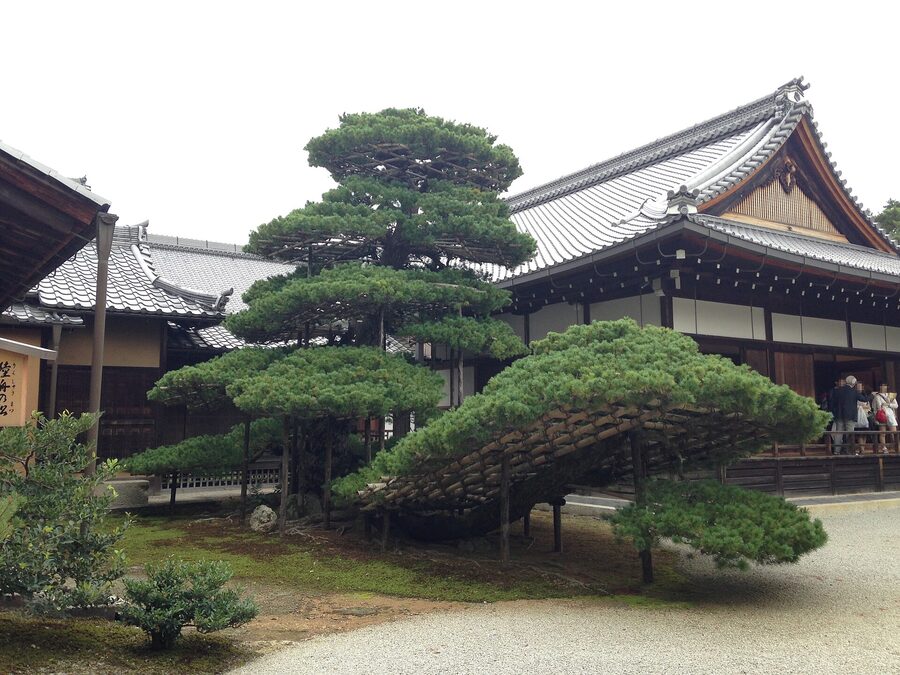
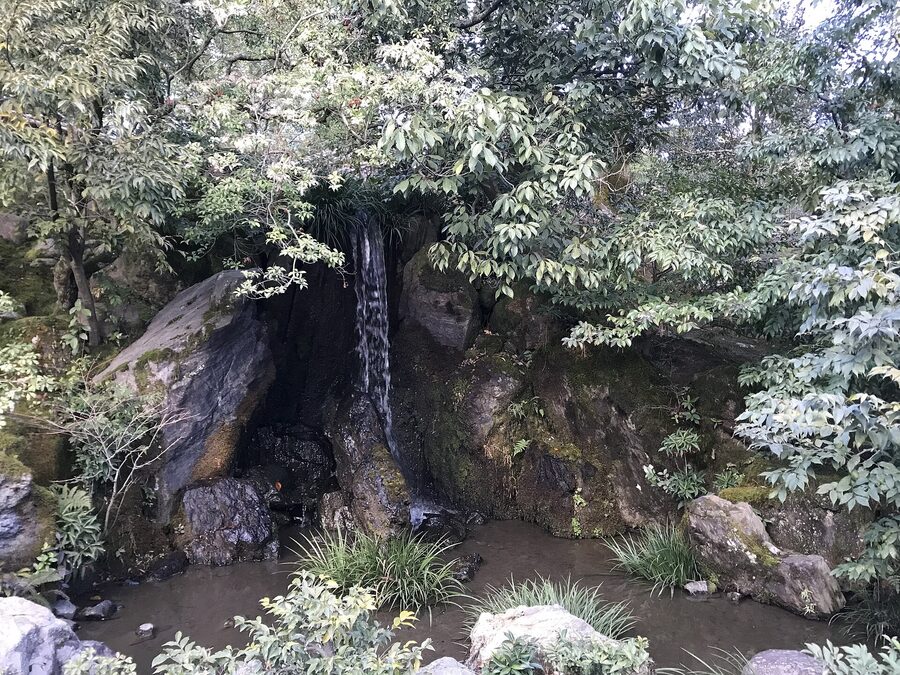
Behind the pavilion the path climbs past the Ginga-sen, a spring Yoshimitsu is said to have used for his tea water, and the Gankasui, where he is said to have washed his hands. Then comes the Ryūmon waterfall, a single 2.3-metre drop with a slanted stone at its foot called the carp stone, a reference to the Chinese legend of the carp that climbs the Dragon Gate falls and becomes a dragon. Above it is Ammintaku, the pond the temple believes is a survival of the Saionji villa, with its White Snake mound. If you have seen the dry gardens elsewhere in this city, the contrast is worth noticing: this is a strolling garden, made to be walked through and seen in sequence, and I rank it among Japan’s greatest gardens for the view from the south bank alone.
Sekka-tei
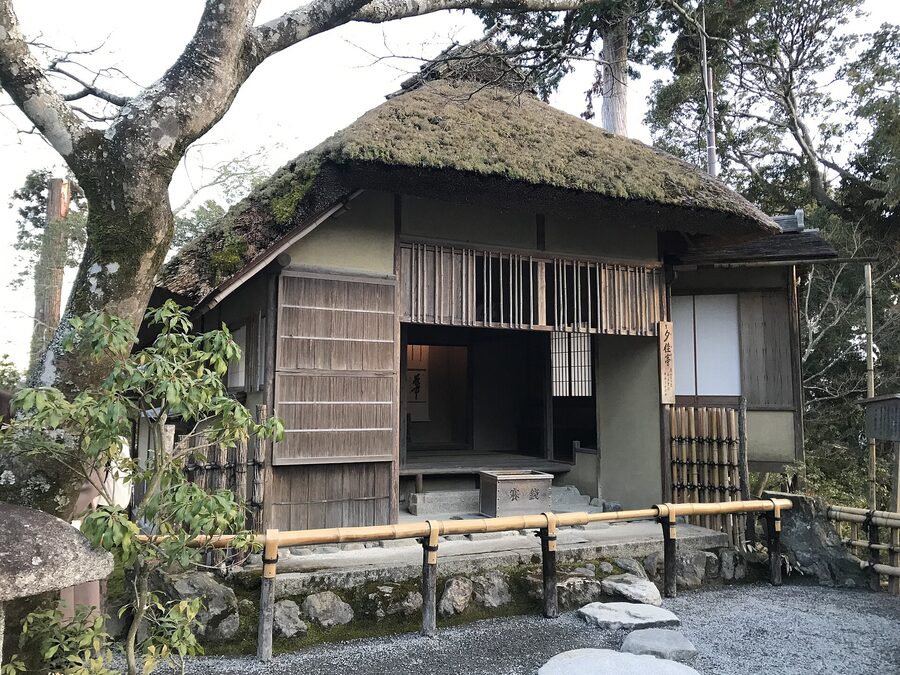
Near the top of the circuit stands Sekka-tei, a thatched tea house built for the retired emperor Go-Mizunoo in the 17th century to the taste of the tea master Kanamori Sōwa, who belonged to the generation after Sen no Rikyū. The name means “beautiful in the evening”, because the pavilion looks best from here at sunset. The main room is only three mats, with an alcove post of nandina wood, a very unusual choice, and shelves of bush clover. The house burned early in the Meiji period and was rebuilt in 1874, so the one you see is a faithful successor rather than the original.
Fudō-dō
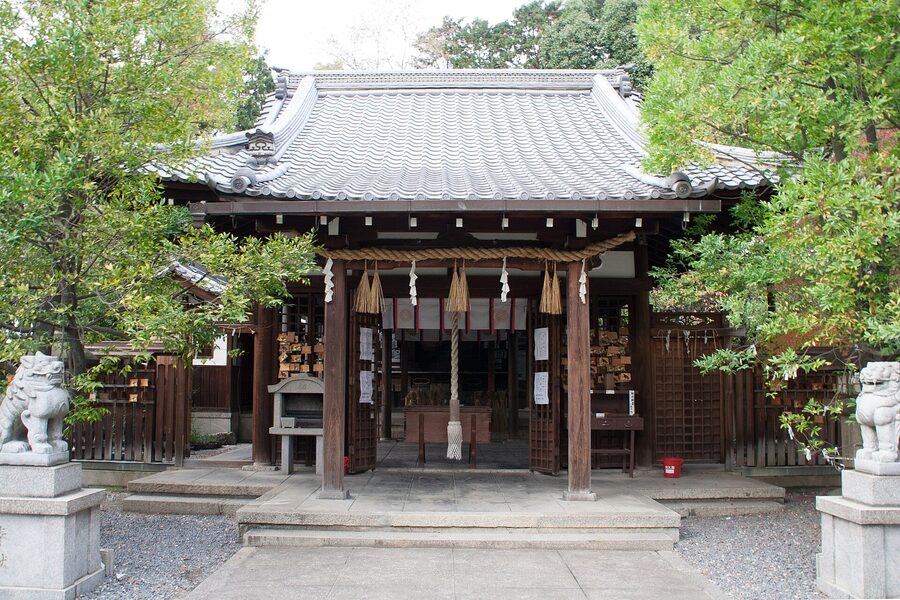
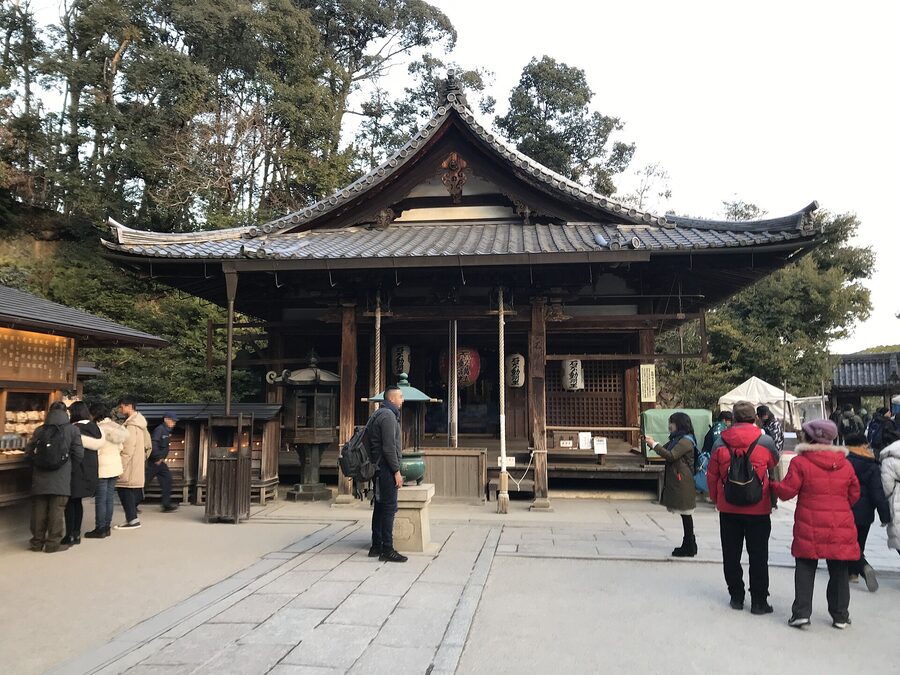
The last building before the exit is the Fudō-dō, Ukita Hideie’s rebuilding of the late 16th century and the oldest structure at Kinkaku-ji. It enshrines a stone figure of Fudō Myōō that tradition attributes to Kūkai, the founder of Shingon Buddhism. This is the part of the temple where local people come to pray rather than to look, and the image is kept hidden except on 3 February and 16 August, when the doors are opened for a service. If you are here on the night of 16 August, stay in the area after dark: the Hidari Daimonji fire is lit on the hill behind the temple at about eight.
Getting there
Take Kyoto City Bus 12, 59, 205 or M1 to the Kinkakuji-michi stop, which is about two minutes’ walk from the gate. From Kyoto Station the 205 takes around forty minutes, more in traffic, and from Ginkaku-ji the 204 runs across the north of the city to the same stop. If you are coming from Shōkoku-ji, where the temple’s treasures are shown in rotation at the Jōtenkaku Museum, the 59 from Karasuma-Imadegawa is the direct bus.
Ryōan-ji
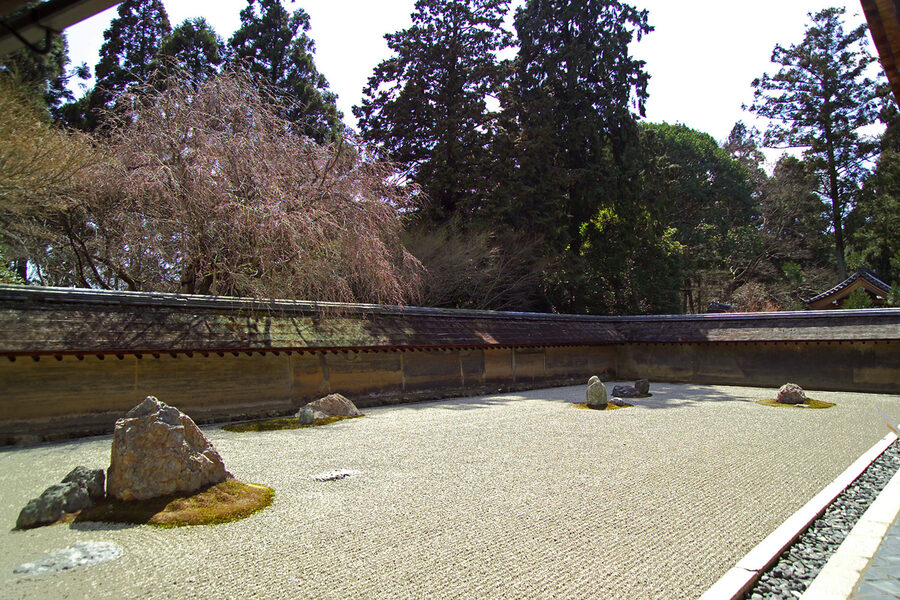
From Kinkaku-ji it is about twenty minutes on foot west along Kinukake-no-michi to Ryōan-ji, or a short ride on the 59 bus to Ryōanji-mae. The temple was founded in 1450 by Hosokawa Katsumoto, commander of the Eastern Army in the Ōnin War, and the Western Army, the same side that camped at Rokuon-ji, burned it in 1468. His son Hosokawa Masamoto rebuilt it from 1488, and the famous rock garden is generally dated to around the rebuilding of the abbot’s hall in 1499, although nobody knows who made it.
The garden is a rectangle of raked white gravel about 25 metres by 10, with fifteen stones in groups of five, two, three, two and three, and the common claim is that you cannot see all fifteen from any one point on the veranda. Admission is ¥600 for adults, ¥500 for high-school students and ¥300 for younger children, and the temple opens from 8:00 to 17:00 from March to November and from 8:30 to 16:30 from December to February. Go early, sit down and stay at least a quarter of an hour; and then walk round the Kyōyō-chi pond below, which was the famous sight here in the 18th century, when guidebooks praised its mandarin ducks and barely mentioned the stones.
Ninna-ji
Ten minutes further west on foot is Ninna-ji, founded in 888 by Emperor Uda, who retired here as a monk; for a thousand years its abbots were imperial princes. There were two exceptions, and one of them was Yoshimitsu’s son Hōson. The temple burned in the Ōnin War, and most of what you see was rebuilt in the 1640s with the support of the Tokugawa shogun Iemitsu, including the five-storey pagoda of 1644, which stands 36 metres high.
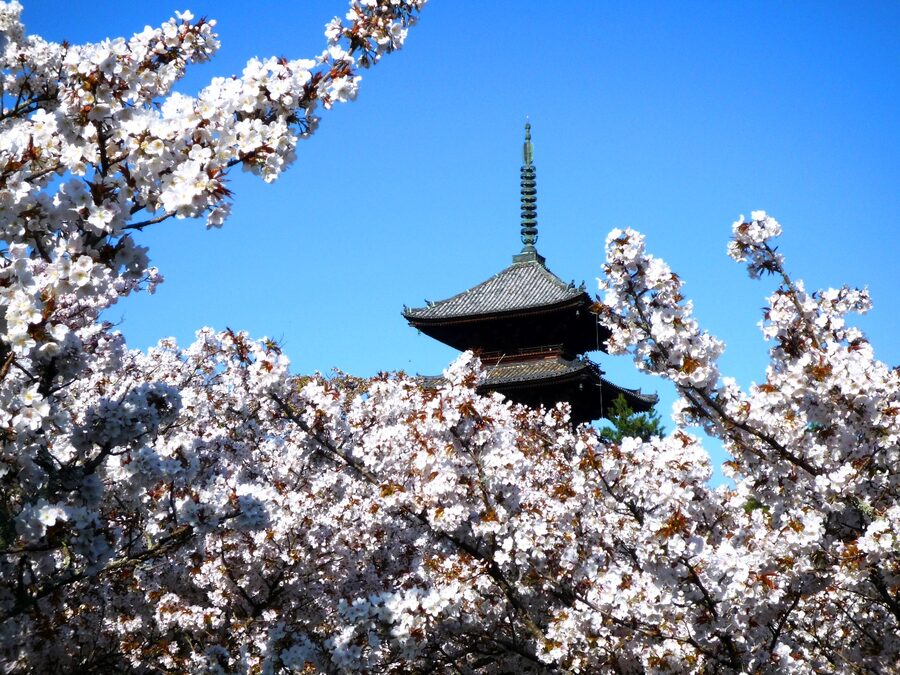
The main precinct is free to enter for most of the year. The palace garden costs ¥800 for adults and is free for anyone of high-school age or younger; it opens from 9:00 to 17:00 from March to November and to 16:30 from December to February, with last entry half an hour before closing. During the cherry festival in April a special entry charge applies to the whole precinct, and I would still go: of all the cherry blossom sights in Kyoto it is the one that rewards a visit at the very end of the season. The Randen tram stops at Omuro-Ninnaji Station, three minutes from the gate.
Beyond the northern temples
If you have more days in the city, Ginkaku-ji in the eastern hills is the natural counterpart to Kinkaku-ji and the place to see what Yoshimitsu’s grandson made of the idea. Kiyomizu-dera and Fushimi Inari complete the usual Kyoto circuit, and if you want gold on a grander scale, Nikkō Tōshō-gū is where the Tokugawa took it in the 17th century. For a temple that was also rebuilt after a catastrophe, compare Tokyo’s Sensō-ji, burned in the air raids of 1945 and rebuilt in concrete, or the forest and shrine of Meiji Jingū, rebuilt by public subscription in 1958. For the longer story of how all of this fits together, start with Japan through the ages and the Shōwa era in which the pavilion burned.
When you are back on the south bank, before you leave, look once more at the second floor. Under the gold is a decision the restorers made in the early 1950s on the strength of a flower vase. You may decide, as Miyakami Shigetaka did, that it is the wrong decision. I have stood there often enough to have come round to it: whatever Yoshimitsu intended, the gold now covers the floor where Kannon sits, and the building that burned in 1950 had already spent five hundred years being repaired, repainted and argued over.