The surgeon Kurisaki Dōyū treated Kira Yoshinaka twice. The first time, in April 1701, he put a few stitches into a cut above the old man’s eyebrow, made by a lord who had lost his temper in a corridor of Edo Castle. The second time was twenty-one months later, on a winter morning in 1703, and on that occasion Kurisaki’s job was to sew Kira’s head back onto his body.
Between those two appointments sits the most retold story in Japanese history. Forty-seven men from a small salt-rich domain on the Inland Sea lost their lord, their stipends and their status in a single afternoon, spent almost two years arguing about what to do, then crossed Edo before dawn, killed the man they blamed, and carried his head ten kilometres to a temple graveyard. The temple still keeps the receipt it was given when the head went back to Kira’s household. The first item on it reads “one head”.
I find the receipt more persuasive than any play. Everything else about the 47 Rōnin has been polished for three hundred years by playwrights, print-makers, moralists and film studios, and most people who know the story know the stage version. The record is stranger, messier and in places funnier, and almost all of its locations can still be visited in a day in Tokyo and a day in Akō.
In This Article
- What a rōnin was, and why nobody wanted to be one
- Akō: salt, a new castle and a borrowed philosopher
- The fourteenth day of the third month
- Handing over a castle without losing face
- Twenty-one months of arguing
- The night of the fourteenth
- The walk to Sengaku-ji, and the forty-seventh man
- What do you do with forty-six heroes?
- From a crime to Chūshingura
- Where to see the 47 Rōnin today
- Sengaku-ji, Takanawa
- Kira’s mansion, Ryōgoku
- The Matsu no Ōrōka, Imperial East Garden
- The seppuku sites in Minato
- Akō Castle
- Akō Ōishi Shrine
- Kagaku-ji and the Akō City Museum of History
- The Akō Gishisai, 14 December
- Kira’s side of the story, Nishio
- The receipt and the stitches
What a rōnin was, and why nobody wanted to be one
The word rōnin (浪人) is written with the characters for “wave” and “person”, a man adrift. In the Nara and Heian centuries it meant a peasant who had fled the land he was registered to, and it never quite lost the smell of desertion. By the Edo period a rōnin was a samurai with no lord: no stipend, no household and no defined place in a society that defined everybody.
In the Sengoku wars this had not mattered much. A capable fighter whose lord died simply found another; Tōdō Takatora changed masters again and again and finished as one of the richest daimyo in Japan. Yasuke learned in 1582 how fast a man’s position could vanish with his master, and Miyamoto Musashi spent most of his life as a rōnin by choice, selling his reputation one duel at a time.
Peace changed the arithmetic. After Sekigahara the victors confiscated or cut the fiefs of the losing side, and enough of the men turned loose were still unemployed in 1614 that a large share of the army defending Osaka Castle for Toyotomi Hideyori, alongside Sanada Yukimura, was rōnin. The usual figure is around a hundred thousand. They lost, and the survivors had nowhere to go.
The early Tokugawa shoguns made it worse by confiscating domains on any pretext, especially when a lord died without an heir. Estimates under the third shogun, Iemitsu, run as high as half a million masterless samurai, which I would treat as a figure of speech rather than a census. In 1651, weeks after Iemitsu’s death, the military teacher Yui Shōsetsu was caught plotting to burn Edo with a band of rōnin, and the shogunate finally relaxed the rules on deathbed adoption so that fewer houses died out.
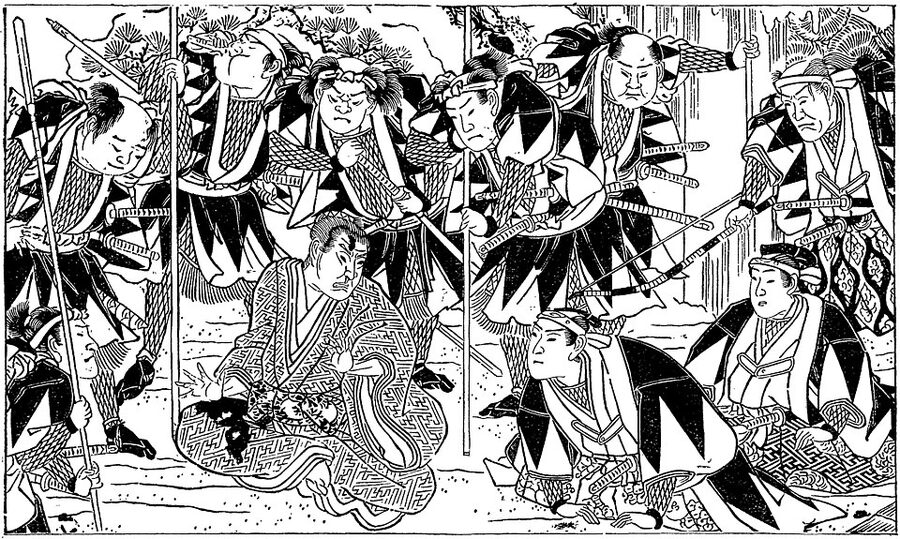
By 1700 a rōnin was not a romantic figure. He was a former official with a sword and a grievance, drifting into teaching, bodyguard work or gambling dens. That is the status the retainers of Akō were handed in 1701, and it is worth holding on to. The plays made them heroes; their contemporaries saw a few hundred unemployed men whom the state would rather were quiet.
Akō: salt, a new castle and a borrowed philosopher
Akō sits at the mouth of the Chikusa River on the Harima coast, about 30 kilometres west of Himeji. It had already been confiscated once in living memory: in 1645 its lord, Ikeda Teruoki, was removed for what the record calls madness, and the domain went to Asano Naganao, transferred from Kasama with 53,500 koku.
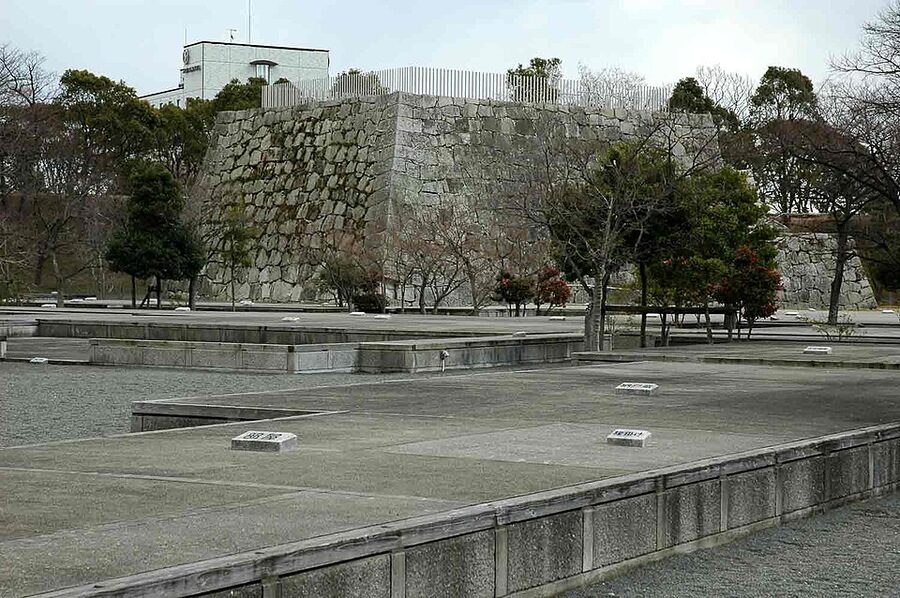
Naganao was a builder. He asked permission for a new castle in 1648, and when the Yui Shōsetsu plot broke he prudently asked again, in case anyone in Edo was wondering why a western daimyo wanted fresh walls. Work ran from 1649 to 1661 to a design by his retainer Kondō Masazumi, a student of the Kōshū school of military science that traced itself back to Takeda Shingen, and the walls zigzag in a way that tells you the men who drew them still expected to be attacked.
The money came from salt. Akō’s shallow bay suited irihama salt pans flooded by the tide, and by the 1670s Osaka had wholesalers specialising in Akō salt, half of which went on to Edo. When Sendai asked for salt technicians in 1683, Akō sent them, which disposes of a later theory that the feud began because Kira was trying to steal Akō’s salt secrets for his own estate.
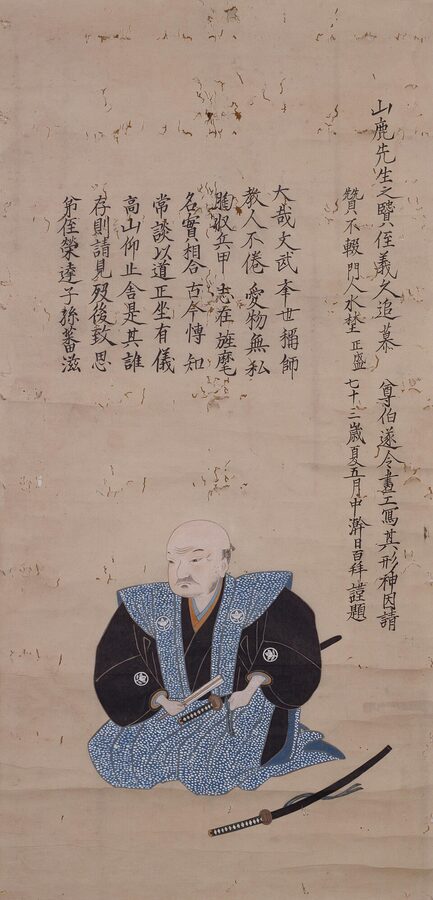
Naganao also hired a philosopher. In 1652 he took on Yamaga Sokō, a scholar of military science and Confucian ethics, at a startling 1,000 koku. Sokō left his service, but in 1666 he was back as an exile, banished from Edo for a book the shogunate considered heretical, and he spent nine years in Akō.
One of the children in that household was Ōishi Yoshio, born in 1659 into the family that held Akō’s chief councillorship by inheritance. He became karō young, on 1,500 koku, and was by most accounts an able administrator with a fondness for pleasure that troubled nobody until it became politically useful.
His lord, Asano Naganori, was born in 1667 in the family’s Edo mansion at Teppōzu, where St Luke’s International Hospital now stands, and inherited the domain at seven. A survey of daimyo written in 1690 called him intelligent and well liked by his people, then added that he was devoted to women and left the government to his councillors. It blamed Ōishi for not telling him off.
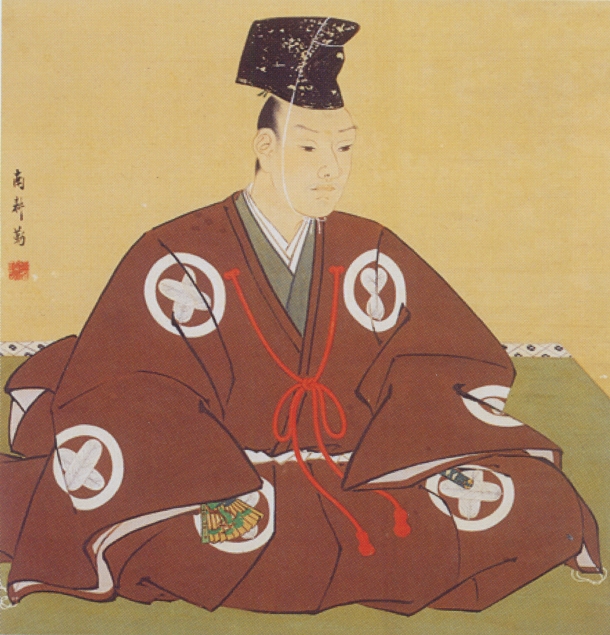
The fourteenth day of the third month
Every spring the imperial court sent envoys to Edo to return the shogun’s New Year greetings, and two daimyo were made responsible for entertaining them. The job was expensive, the etiquette fiendish, and the hosts were coached by the shogunate’s ceremonial specialists, the kōke. In 1701 the senior kōke was Kira Yoshinaka, fifty-nine years old and holding a modest 4,200 koku.
His pedigree was anything but modest. The Kira were a branch of the Ashikaga, the house of the Muromachi shoguns, and Tokugawa Ieyasu is said to have borrowed their family tree when he needed a Minamoto ancestry of his own. Kira’s eldest son had been adopted as head of the Uesugi of Yonezawa, the house descended from Uesugi Kenshin, and that son’s boy was now Kira’s own heir.
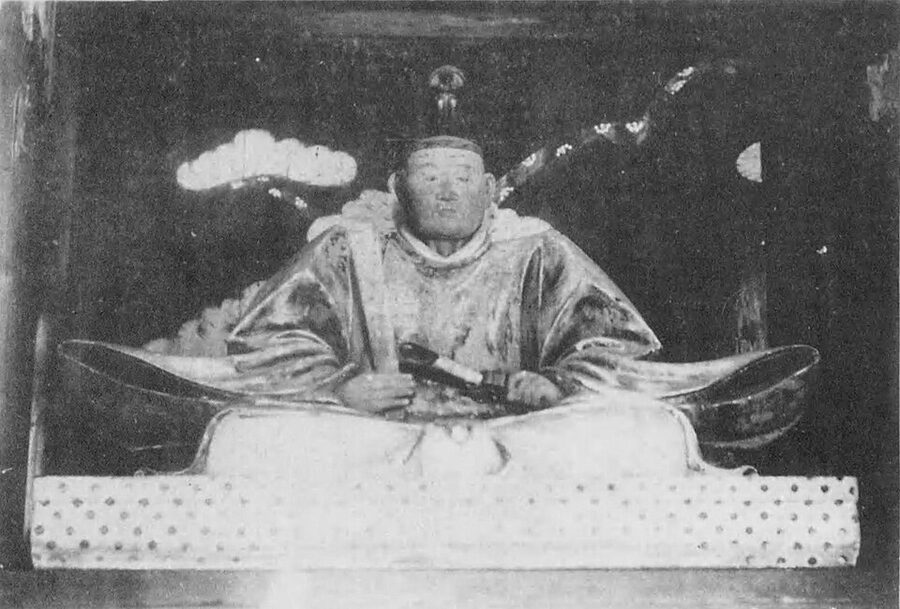
Asano had done the job once before, in 1683, and that may have been the trouble. Prices had risen sharply since, so the budget he remembered no longer covered the work and the customary gifts to the instructing kōke would have looked thin. A retainer’s account written soon afterwards says Kira was a greedy man whom earlier hosts had plied with presents in advance, and that Asano said he would give whatever was proper once the duty was over, and not before.
The year added pressure of its own. Tokugawa Tsunayoshi was lobbying the court to give his mother, Keishōin, the Junior First Rank, and Kira was the man managing the court. Asano, according to his family’s chronicle, had been suffering since the envoys arrived from an illness called tsukae, which modern writers have read as anything from migraine to a nervous stomach.
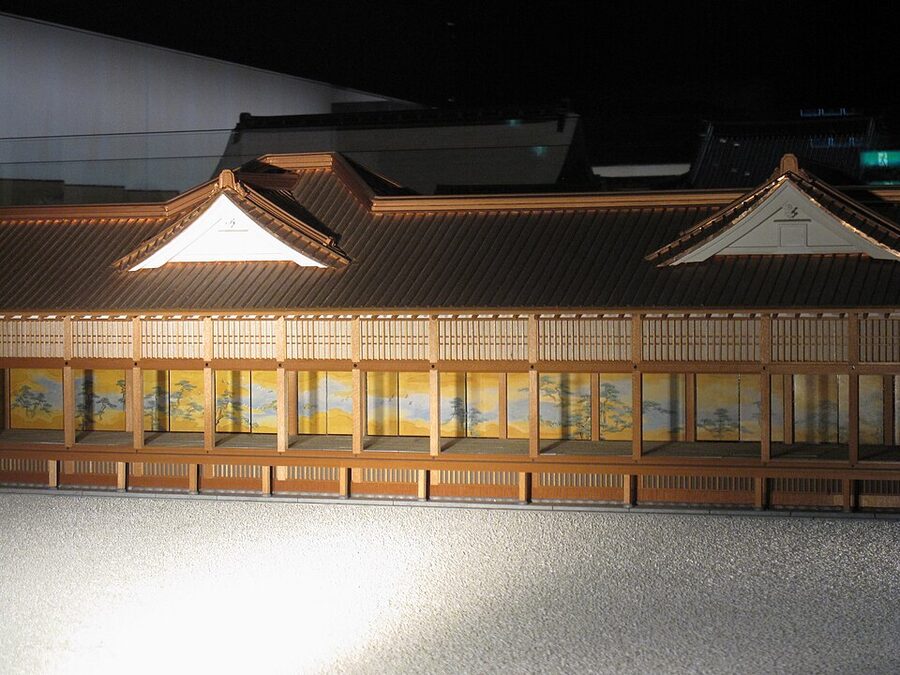
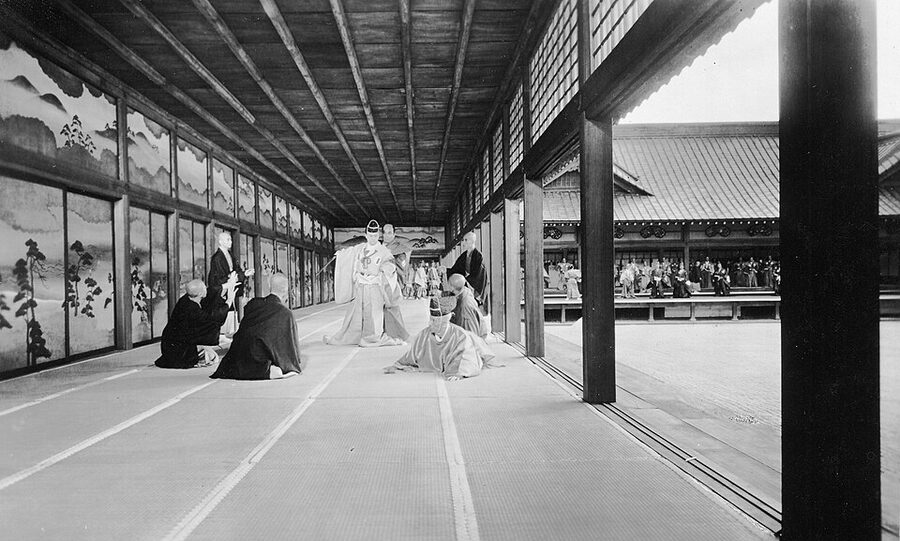
On the fourteenth day of the third month of Genroku 14, 21 April 1701 by the Western calendar, the final ceremony was due. A little after half past eleven, Asano came up behind Kira in the Matsu no Ōrōka, the long corridor of painted pines between the great audience hall and the white study of the honmaru palace, and slashed at him with his short sword.
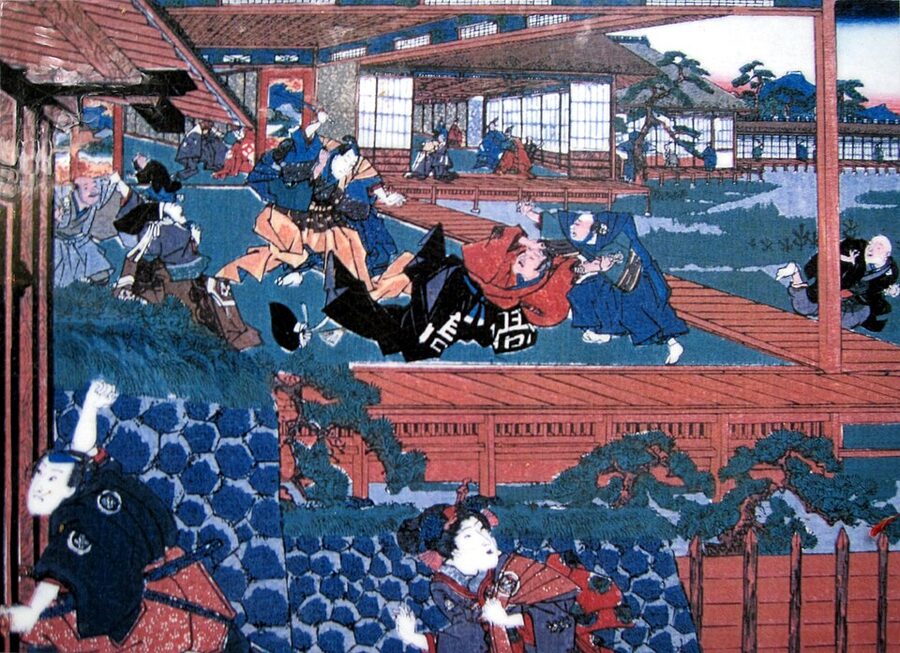
What he said is disputed even in the best source. One copy of the notes kept by Kajikawa Yosobei, the official talking to Kira at that moment, has Asano shouting “Do you remember my grudge of these last days?”; another copy says only that he called out. The first blow caught Kira above the eyebrow and rang off the metal fitting of his court hat, Asano struck twice more as Kira fled, and Kajikawa grabbed him from behind.
It was a botched job. Earlier killings inside the castle had been done with a thrust, and a cut from behind with a short blade rarely kills a man in layered court robes. Kurisaki closed the wound. Kira said he had no idea what any of it was about.
Drawing a blade in the castle was a capital offence whatever the reason, and Tsunayoshi, whose reception had been ruined on the day it mattered most, ordered Asano to kill himself that afternoon. He was carried out through the Hirakawa Gate, the one used for corpses and criminals, to the mansion of the daimyo Tamura Takeaki. His seppuku was performed in the garden on a mat spread over the gravel rather than in a room, a humiliation for a lord of his rank that the senior councillors seem to have insisted on.
Kira, meanwhile, received sympathy. The shogun sent word that he should rest, being an old man, and come back to work once he had healed. Under the custom that both parties to a quarrel were punished alike he should have suffered too, but Kajikawa testified that he never touched his sword, which made it an assault rather than a fight.
Asano, questioned before his death, refused the obvious defence. He said he had not been out of his mind, that he had acted on a private grudge, and that his only regret was failing to kill the man. Nobody wrote down what the grudge was.
Handing over a castle without losing face
The news reached Akō by fast palanquin, carried in relays day and night over roughly 620 kilometres in four and a half days, against a normal week. The first said there had been an incident; the second brought the rest. The lord was dead, the house abolished and the castle forfeit.
Ōishi’s first problem was money. The domain had issued its own paper notes since 1680, and the moment the news spread the merchants of Akō besieged the exchange office, because a confiscated domain’s notes were worthless. He redeemed them in silver at six-tenths of face value, generous by the standards of other confiscations, paid out the year’s rice stipends, and sold the arms and horse tack to Osaka dealers. About 700 ryō was left at the end, and it became the war chest.
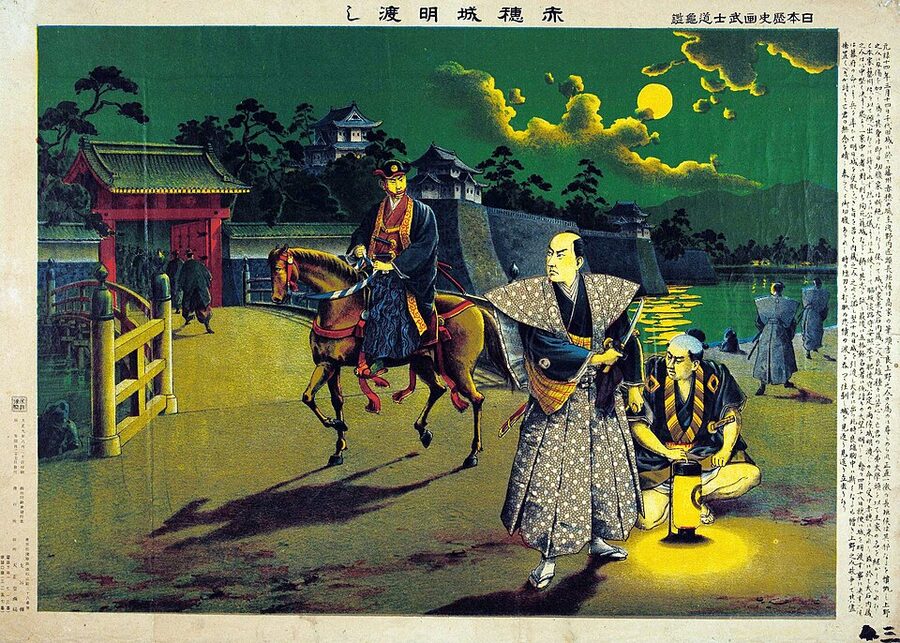
Then came the argument. For three days the whole retinue met in the castle hall, most wanting to hold the castle in protest or die in front of it, while envoys from the senior Asano house in Hiroshima begged them to do neither. When the second councillor, Ōno Kurobei, argued for a quiet handover, Hara Sōemon told the room that anyone who disagreed should leave, and Ōno walked out with about ten others. Hara later said he would have cut Ōno down if he had stayed.
Ōishi’s answer was to promise a mass seppuku before the gate, which more than sixty men signed oaths to join, and then never hold it. Some historians think the promise was a test of who could be relied on. What he wanted was the restoration of the house under Asano’s younger brother, Asano Nagahiro, known as Daigaku, and a fortified protest would have destroyed that hope at once.
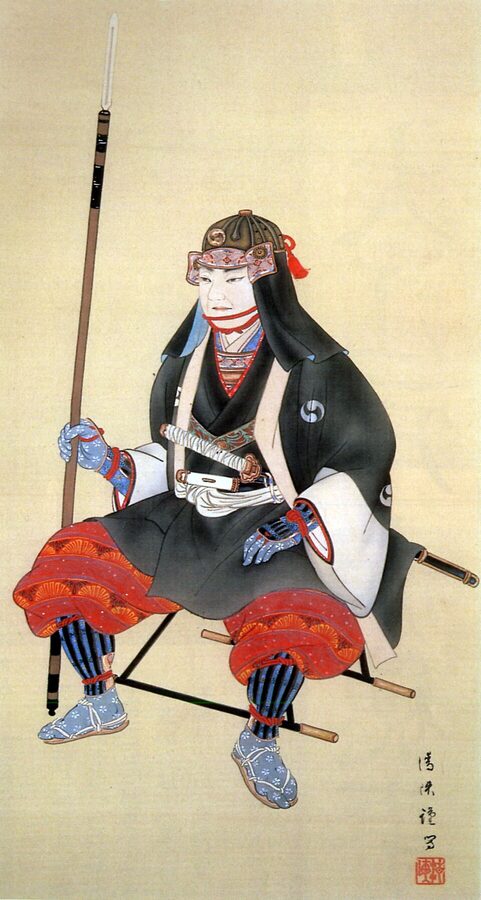
In the fourth month the castle went to Wakizaka Yasuteru, who brought 4,550 men and several hundred boats in case Akō changed its mind. Ōishi petitioned for the house to be restored, received a polite promise that the request would be passed on, and by summer had moved with his family to Yamashina outside Kyoto, with about ninety former retainers signed to his oath.
Twenty-one months of arguing
The popular version has Ōishi plotting revenge from the first night and drinking himself into the gutter as cover. The documents show something closer to a committee that met for a year and a half. On one side was Ōishi and the Kyoto group, who wanted the Asano house restored with its honour intact; on the other were the men who had served in Edo, led by Horibe Yasubei, who wanted Kira dead and cared less what became of the house.
The split had roots. Ōishi’s family had served the Asano for generations and were related to them, so his loyalty ran to the house. Horibe and many radicals had been hired by Naganori himself, and restoring his brother would do nothing to clear Naganori’s name.
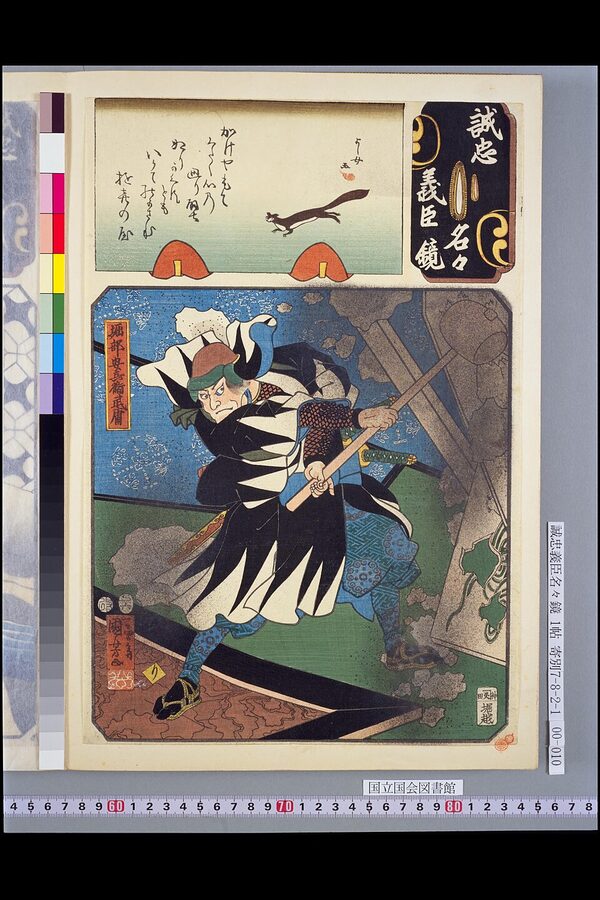
In the eighth month of 1701 the shogunate moved Kira out of his mansion among the great daimyo houses near the castle to an estate at Honjo, across the Sumida River. Edo rumour said the government wanted him somewhere easier to attack. The duller truth may be that his new neighbour, the Hachisuka, had complained that guarding against rōnin was costing a fortune.
Ōishi sent envoys to calm the Edo radicals, and the radicals converted them. When he went himself he lost the argument and promised a decision by the first anniversary of Asano’s death. Then Kira retired in favour of his grandson, which told the radicals the government would never punish him and raised the fear that he would vanish to Yonezawa for good.
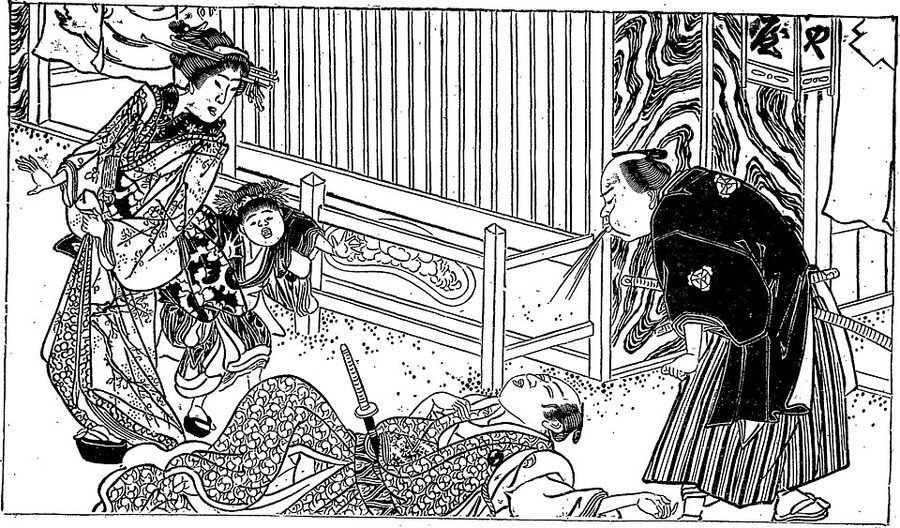
At a meeting in Yamashina early in 1702 Ōishi held out for waiting until the third anniversary, when Daigaku’s house arrest might be lifted. He also divorced his wife Riku and sent her home, which looks like a man putting his affairs in order. The radicals talked about going ahead without him with fourteen or fifteen men.
The government settled it for them. On the eighteenth day of the seventh month of 1702, 11 August by the Western calendar, Daigaku was handed into the keeping of the Hiroshima Asano, which meant there would be no restoration. Ōishi wrote that it was better to have the house destroyed than kept alive under a soiled name, and ten days later, at a meeting of nineteen men in the Maruyama district of Kyoto, he announced that they would kill Kira.
What followed is the most revealing detail in the affair, and the plays leave it out. Ōishi sent two men round to everyone who had signed the oath to hand back the blood seals cut from the pledge, and accepted only those who refused to take them. Roughly 120 names became about fifty, and among those who took their seals back were his own senior relatives, a defection the sources say he was ashamed of to the end.
The night of the fourteenth
The survivors drifted to Edo in small groups and lived under false names as merchants, doctors and teachers. Ōishi followed in the tenth month and sent his fifteen-year-old son Chikara ahead, partly to lead and partly, one source says bluntly, as a hostage to the others. By winter the youngest men were destitute and living on the last of the domain’s cash.
They needed to know when Kira would be at Honjo, because since retiring he spent much of his time at the guarded Uesugi mansion. The answer came through tea. Ōishi’s kinsman Ōishi Sanpei studied under the tea master Yamada Sōhen, of the line of Sen no Rikyū, who moved in Kira’s circle, and through Sōhen’s pupils they learned of a tea gathering at Honjo on the fourteenth day of the twelfth month. One more man quit on the eleventh, and the number stood at forty-seven.
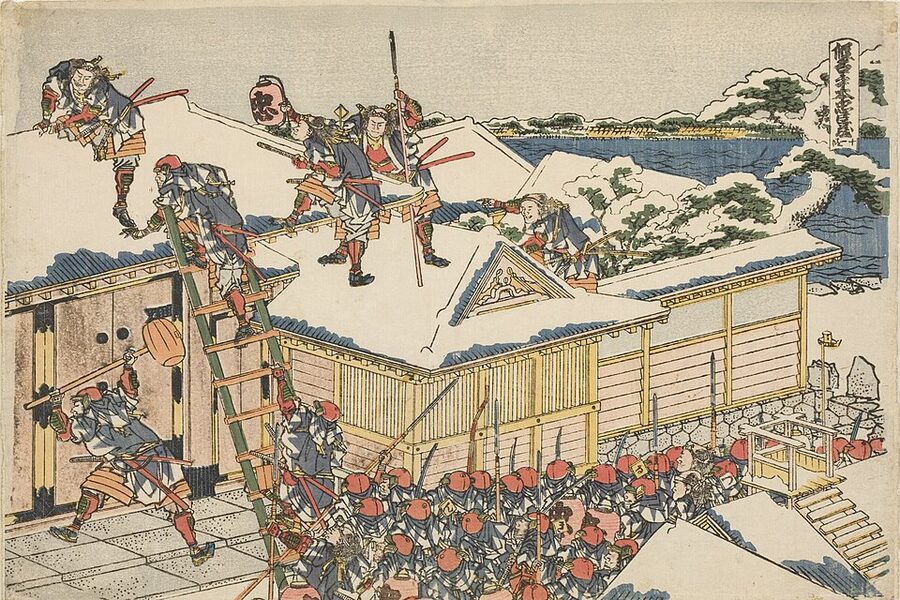
The date is a small trap. In the reckoning of the time the fourteenth lasted until dawn, so an attack in the small hours still belonged to it, and by the Western calendar the raid began early on 31 January 1703. Sources variously give 30 or 31 January, depending on whether you count from midnight or sunrise.
They changed at rented rooms dressed much like a fire brigade, a trick borrowed from a vendetta at Jōruri-zaka in 1672, and set out at the hour of the tiger, around four. Ōishi led the front party and his son the rear. At the entrance they planted a bamboo pole with a box tied to it holding their written statement, so that nobody could call them burglars.
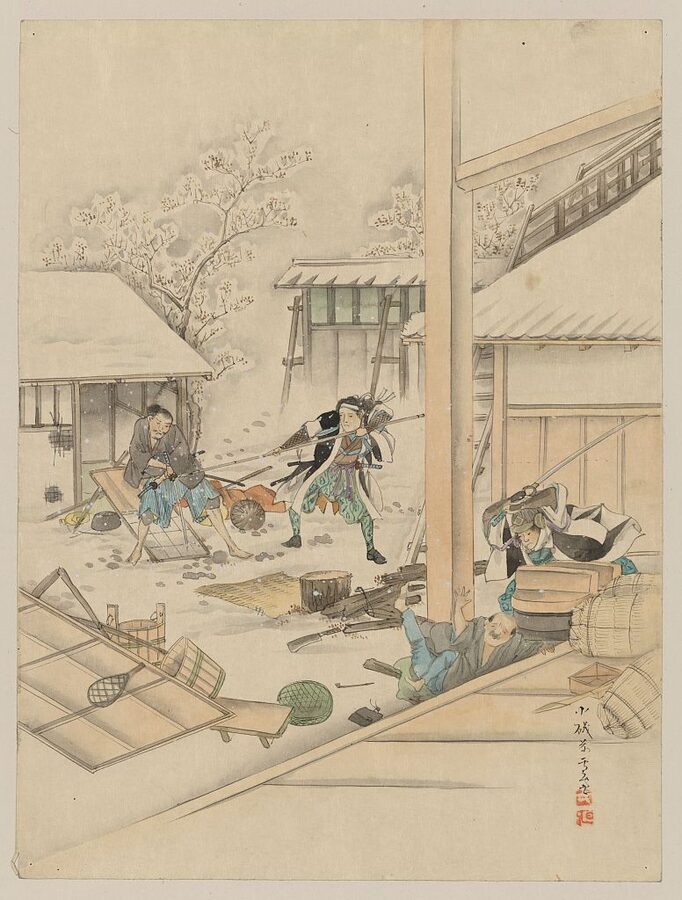
The rear party shouted “Fire!” and nailed shut the doors of the barracks where Kira’s retainers slept, using carpenter’s staples. Of roughly a hundred men on the estate, fewer than forty seem to have fought. When neighbours appeared on a roof, two of the rōnin called up to explain that this was a vendetta, and the neighbours hung out more lanterns, which is about as close to applause as the situation allowed.
Kira’s bed was empty, but Kayano Wasuke found the bedding still warm. In a storeroom behind the kitchen two retainers burst out and were killed, and in the dark behind them something moved. Hazama Jūjirō drove a spear into it, the old man in white drew a short sword, and Takebayashi Tadashichi cut him down.
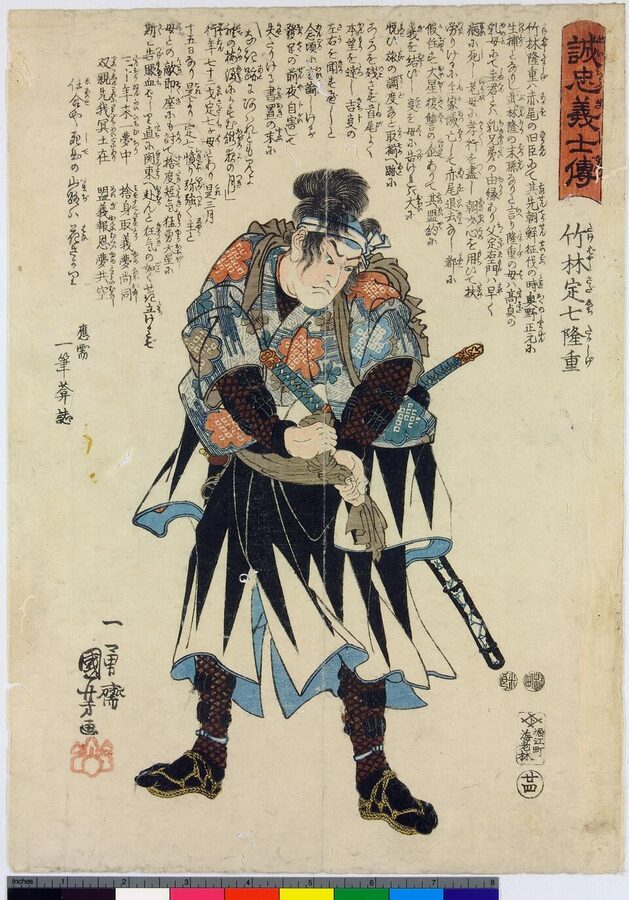
Who killed Kira is one of those facts where the sources split. Mitford and most English accounts have Ōishi invite Kira to commit seppuku and then behead him with the dagger Asano had used. The Japanese records mostly credit Takebayashi and Hazama, and a letter by the rōnin Fuwa Kazuemon says plainly that Kira did not fight back and was beaten to death. They identified him by Asano’s scar, which sources variously place on his forehead or his back.
A whistle called them together. The whole thing had taken an hour, perhaps two. Kira’s household lost between fifteen and eighteen dead and nineteen to twenty-three wounded, depending on whose count you trust, which the English accounts round to sixteen and twenty-two.
Not one of the forty-seven died. Hara Sōemon sprained an ankle jumping down from the gate, and Chikamatsu Kanroku fell into the pond during a sword fight and took a bad wound to the thigh.
The walk to Sengaku-ji, and the forty-seventh man
They put out every lamp and brazier before leaving, so that no fire would spread to the neighbours, which tells you who they thought their audience was. Ekō-in, the first temple they reached, refused to let them rest inside. They crossed the Sumida at Eitai Bridge and walked south along the bay towards Takanawa with the head wrapped in a cloth.
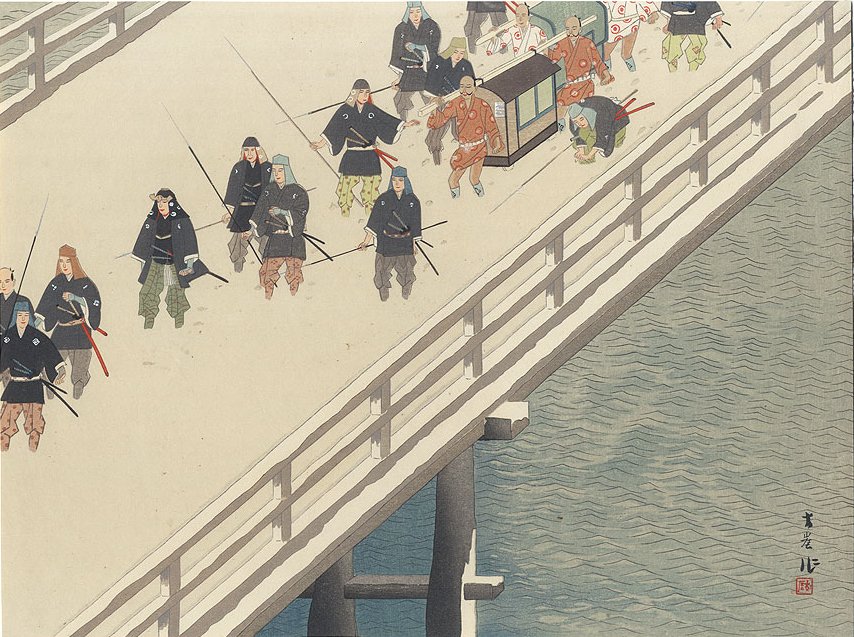
At Sengaku-ji, the Sōtō Zen temple where Asano had been buried, they washed the head at the well and laid it on his grave. Two of them went to report to the inspector-general, which is how men behave who expect a trial. The temple sent the head back in a box with two monks, and Kira’s retainers Sayada Magobei and Saitō Kunai signed for it.
Somewhere between Honjo and the temple, one man disappeared. Terasaka Kichiemon was the only foot soldier among the forty-seven, a servant of the rōnin Yoshida Chūzaemon since he was eight. His absence is the reason the group is called the 47 Rōnin while only forty-six were sentenced, and why it is the most argued question in the whole affair.
The theories run from desertion to a secret mission. Ōishi wrote that Terasaka had been with them until dawn but never came to the mansion, adding “a man of low rank; nothing to be done”, which reads as contempt or as a smoke screen. Yoshida called him a scoundrel whose name should not be mentioned, then wrote privately asking his family to be careful what they said, and Terasaka’s own memoir says he took part and left afterwards “for a reason”.
His grandson later claimed he was sent to Hiroshima to report to Daigaku, which most Japanese historians doubt. The most persuasive reading I have seen is the plainest: Terasaka’s master was Yoshida, not Asano, and Yoshida let him go so that a man who was not really a samurai would not have to die like one. It was the Confucian scholar Muro Kyūsō, writing a history of the “righteous men” that same year, who counted Terasaka in, and the number forty-seven stuck.
What do you do with forty-six heroes?
The shogunate split the men among four daimyo houses. Hosokawa Tsunatoshi of Kumamoto took seventeen, including Ōishi; Matsudaira Sadanao took ten, including Chikara; Mōri Tsunamoto took ten and Mizuno Tadayuki nine. The Hosokawa, descendants of Hosokawa Tadaoki, treated them as heroes, while the Mōri nailed their doors shut, refused them baths and forbade them to talk.
Edo was delighted. Crowds came out to watch the raiders pass, and one record written within two days already calls it “the triumph of all Edo”. The difficulty was legal: a vendetta was recognised when a son avenged a father or a younger brother an elder, and nobody had ever claimed the right to avenge a lord.
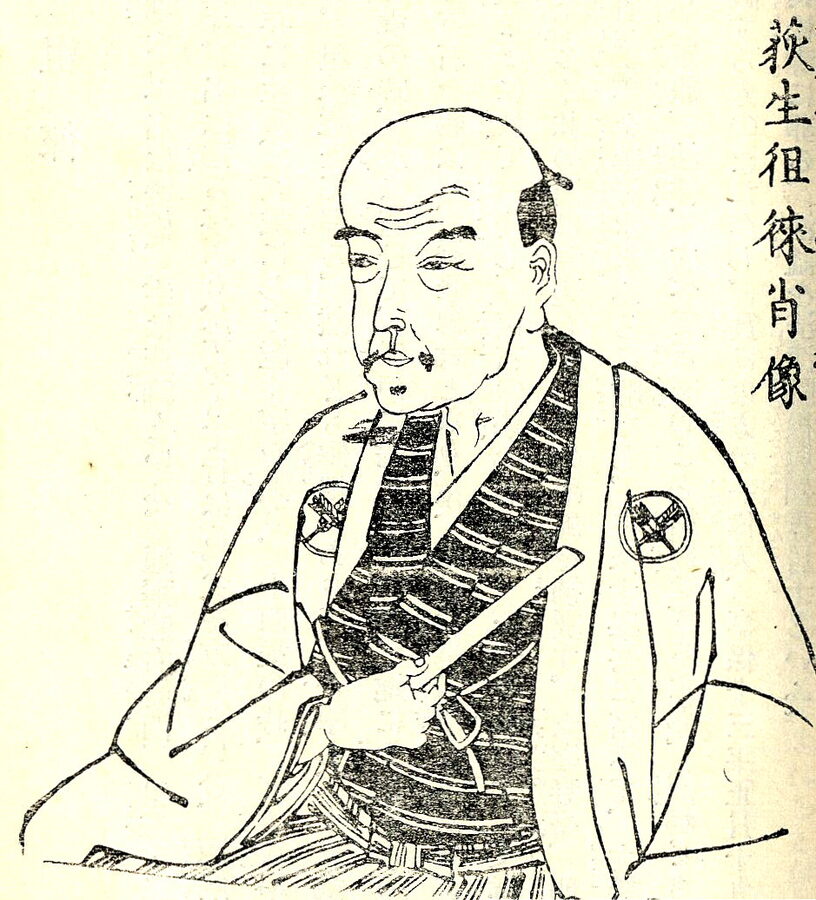
The scholars took sides and stayed there until the end of the Edo period. Hayashi Hōkō praised the rōnin and approved their punishment in the same essay, without explaining how both could be true. Satō Naokata argued that the shogunate, not Kira, had killed Asano, so Kira was nobody’s lawful enemy. Dazai Shundai went furthest: if they had a grievance it was against the government, and they should have fought its troops and burned Akō Castle with themselves inside.
The decision came on the fourth day of the second month of Genroku 16, 20 March 1703. The rōnin were sentenced for forming a faction and breaking into a house while “claiming” to avenge their lord, the government declining to call it a vendetta at all. But the sentence was seppuku, not the beheading of common criminals.
When the order was read the men are recorded as weeping. I suspect it was relief.
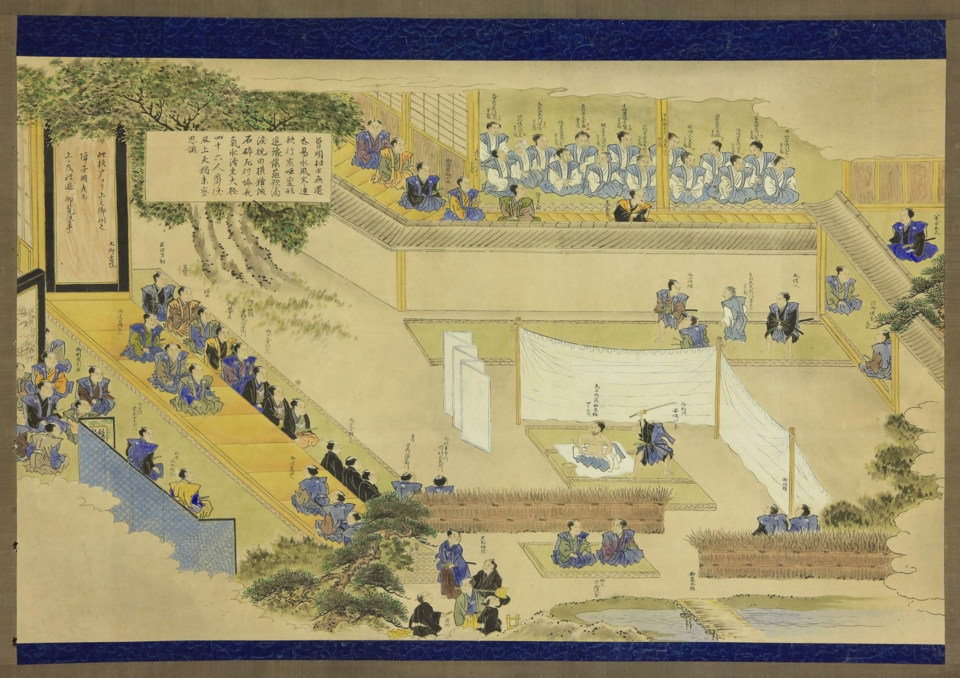
They died that afternoon. Hosokawa Tsunatoshi told his retainers not to wash the blood from his garden, because the men were now guardian spirits of his house. Ōishi was in his mid-forties, and Chikara, at the Matsudaira mansion, was barely sixteen.
The same day, Kira’s grandson Yoshichika, who had been wounded fighting the raiders, was stripped of his estate and handed into the custody of the Suwa lord of Takashima. The stated grounds were that his grandfather had behaved like a coward towards Asano in 1701 and disgracefully on the night of the raid. The shogunate had quietly reversed its own verdict, and Yoshichika died in custody at about twenty, the last of his line.
The rōnin’s sons over fifteen were exiled to Izu Ōshima, and the rest were pardoned in the amnesty after Tsunayoshi’s death in 1709. The same amnesty restored Asano Daigaku as a bannerman on 500 koku, and the Hiroshima Asano gave Ōishi’s youngest son the 1,500 koku his father had held. The house survived after all. It took seven years and forty-six deaths.
From a crime to Chūshingura
Two weeks after the seppuku an Edo theatre staged The Night Attack at Dawn by the Soga, a disguise that fooled nobody, and the authorities shut it down. Plays about recent samurai scandals were banned, so for forty-five years the story migrated into other periods and other names, in Osaka and Kyoto more than Edo.
The version that swallowed the rest opened at the Takemoto-za puppet theatre in Osaka in 1748: Kanadehon Chūshingura, in eleven acts by Takeda Izumo II, Miyoshi Shōraku and Namiki Senryū. The “copybook” of the title is the iroha syllabary, forty-seven characters, one for each rōnin. Kabuki had it on stage within months, and it became the theatre’s dokujintō, its ginseng tonic: when a house was losing money, it put on Chūshingura.
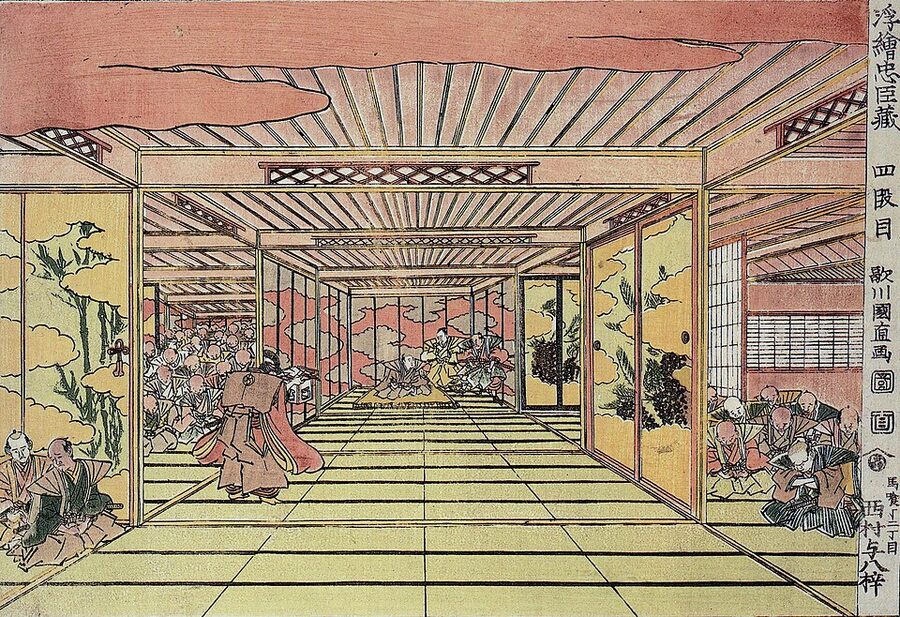
The play moves everything to the 14th century and the world of the Taiheiki, the war chronicle the rōnin themselves quoted in their letters. Asano becomes En’ya Hangan, Kira becomes Kō no Moronao, and Ōishi becomes Ōboshi Yuranosuke, a pun a child could decode. Then the motive changes: Moronao attacks En’ya because En’ya’s wife, Kaoyo, has turned down his advances, a scandal lifted straight from the Taiheiki.
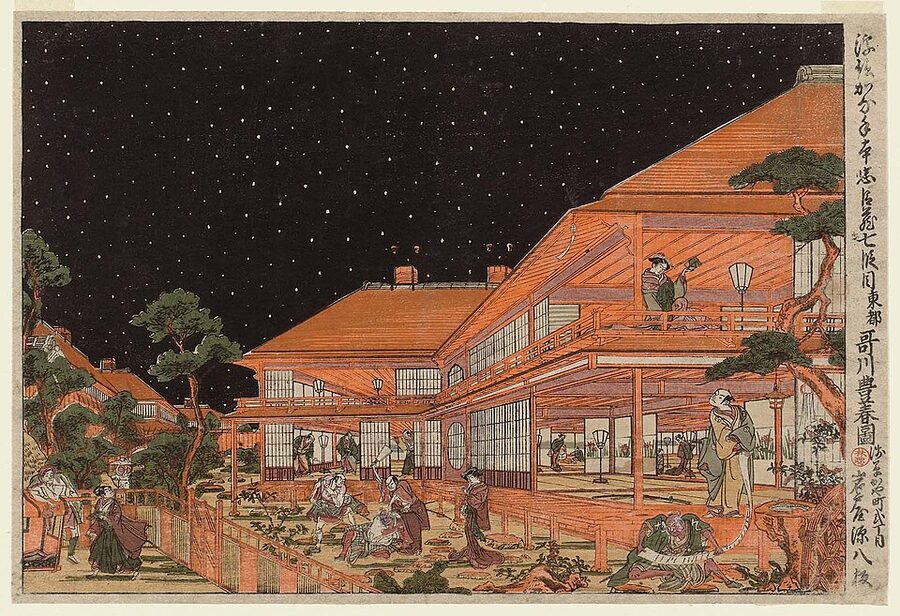
Act 7 sends Yuranosuke to the Ichiriki teahouse in Gion to drink and play the fool while spies watch, and it is the source of the drunken-Ōishi legend. The Ichiriki is still on Hanamikōji, still one of the grandest houses of the geiko world, and still not somewhere you can walk into. Acts 5 and 6 belong to Kanpei, a retainer who missed the attack because he was with his lover, loosely based on the real Kayano Sanpei, who killed himself in 1702 because he could not reconcile his father’s wishes with his oath.
The stage also invented Kira’s petty cruelties, which Japanese historians have spent a century dismantling: lying that the envoys’ temple quarters did not need new tatami, telling Asano to wear the long nagabakama when the day called for court hat and robes, sneering at the ink-painted screens so gold ones had to be found overnight. Asano had done the job before and would have known all of it, and the gold screens seem to have been there all along. One of the best-known incidents first appears in print in the Meiji era.
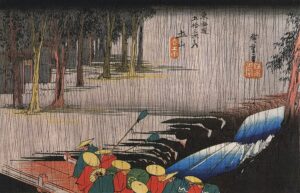
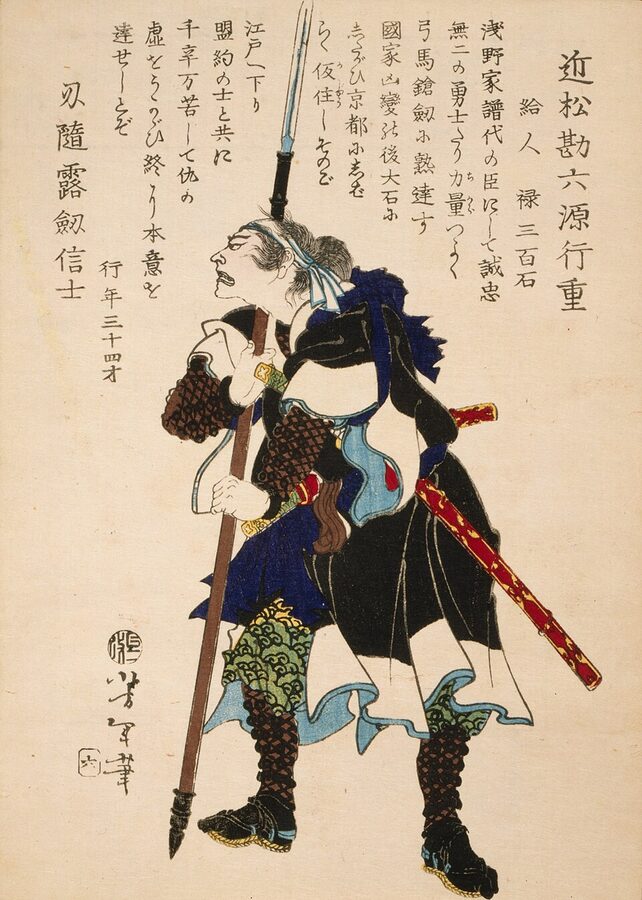
The print-makers followed the theatre. Utamaro, Hokusai, Hiroshige and Yoshitoshi all produced Chūshingura sets, and Kuniyoshi made at least eleven complete series. Mitford brought the story to English readers in 1871, from storytellers’ versions as much as records, and shaped the Western picture for a century.
The modern state’s relationship with the story surprises people. The Meiji Emperor sent an envoy to Sengaku-ji within weeks of reaching Tokyo in 1868, but the new government was otherwise cool. Fukuzawa Yukichi mocked the cult, and the Tokyo Imperial University professor Mikami Sanji argued that men who had abandoned an imperial reception were no model for schoolchildren, which helped keep the story out of the national ethics textbooks.
The stage and the press, not the classroom, made the forty-seven national property. The term Akō rōshi was popularised by Osaragi Jirō’s 1927 newspaper serial of that name, which deliberately recast the “righteous samurai” as unemployed men. In the Shōwa war years the militarists claimed the story, after 1945 the occupation briefly kept it off the stage, and television has never let it go.
Where to see the 47 Rōnin today
Almost every location in the story can still be visited, the Tokyo sites fit into one long day, and most of them are free. Start at Sengaku-ji in the morning, cross to Ryōgoku for Kira’s mansion, and finish at the castle, which is the rōnin’s route in reverse.
Sengaku-ji, Takanawa
Sengaku-ji (泉岳寺) is at Takanawa 2-11-1 in Minato. From Sengakuji Station on the Toei Asakusa and Keikyū lines take Exit A2 and walk three minutes uphill; from JR Takanawa Gateway the north exit gets you there in about five. The grounds are open daily from 7:00 to 16:00 and free.
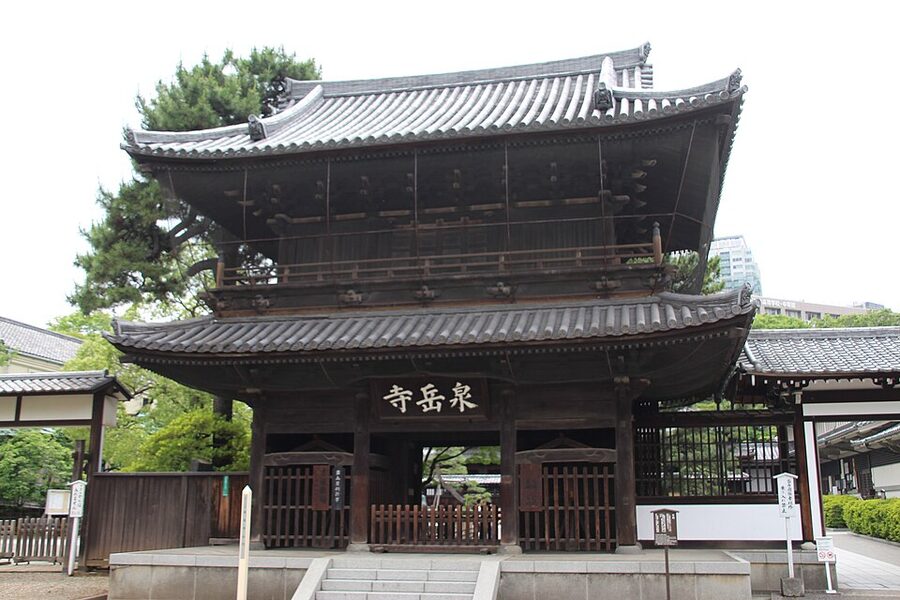
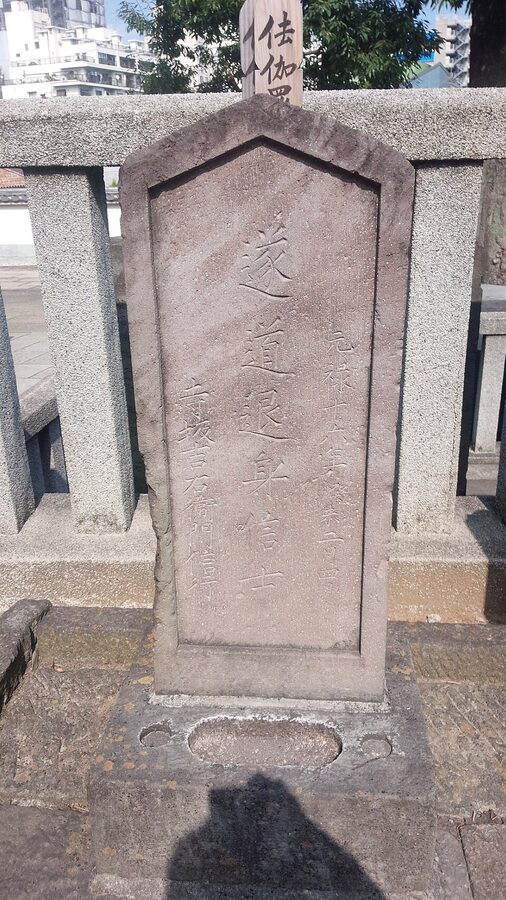
The graves are up a flight of steps behind the main hall, through a gate that was once the back gate of the Asano mansion at Teppōzu. There are forty-eight stones: the forty-seven, counting Terasaka’s memorial, and one for Kayano Sanpei. Asano’s own grave and his widow’s sit in a separate enclosure. The temple asks ¥500 for a bundle of incense, and on a busy day the smoke is thick enough that it is easier to accept than to resist.
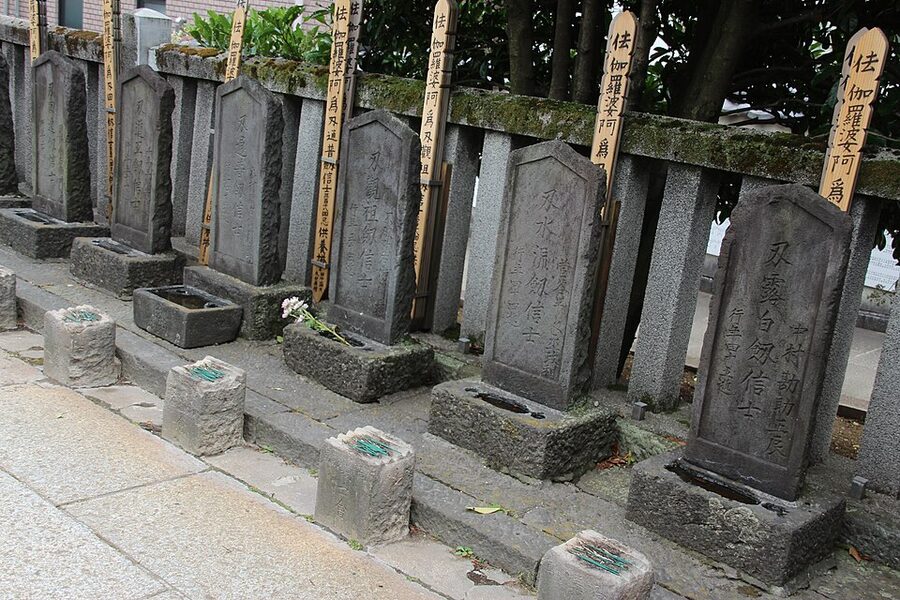
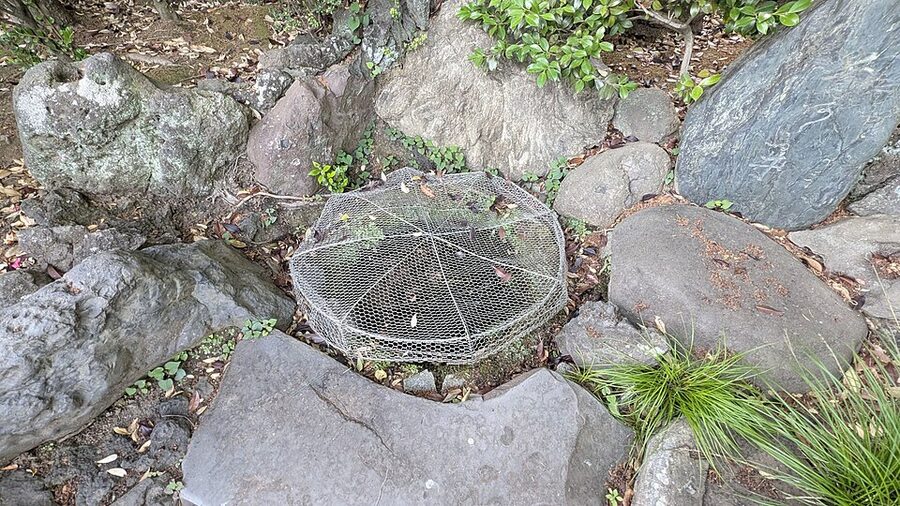
Beside the steps is the head-washing well, and nearby are a plum tree and a stone said to have been splashed with Asano’s blood in the Tamura garden. The Akō Gishi Kinenkan museum, built for the 300th anniversary of the raid, is open 9:00 to 15:30 (it can close for about 45 minutes around lunch) and costs ¥500 for adults, ¥400 for secondary school students and ¥250 for children over ten. The ticket also covers the wooden statues of all forty-seven upstairs in the lecture hall, carved between the late Edo period and 1869.
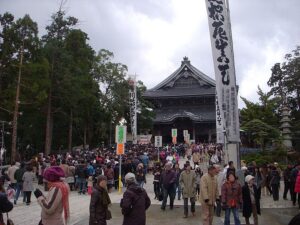
The museum is small and labelled mostly in Japanese, but the objects justify the fee: letters, weapons and the homemade armour the men wore, since buying armour in Edo would have given them away. The receipt for the head is among the temple’s treasures, though whether it is on show depends on the rotation. The Gishisai festival on 14 December brings crowds and costumed processions (in 2026 it runs from Saturday 12 to Monday 14 December), and a smaller spring festival in April coincides with the cherry blossom.
Kira’s mansion, Ryōgoku
The site of Kira’s mansion is a small walled plot called Honjo Matsuzaka-chō Park (本所松坂町公園), at Ryōgoku 3-13-9 in Sumida, seven minutes from the west exit of JR Ryōgoku Station. The original estate was huge; the park keeps a corner of it, usually given as one eighty-sixth of the whole. Admission is free.
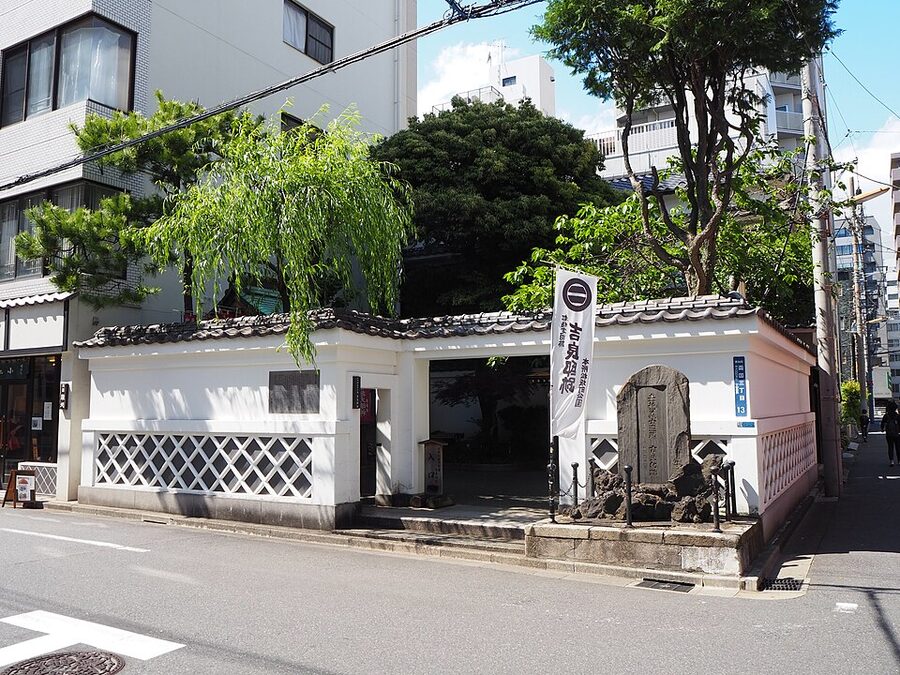
I like this place more than Sengaku-ji, because it is the one site where somebody remembers the dead on the other side. The neighbourhood holds a Kira Matsuri and a Genroku market on 13 and 14 December, the same days the temple across town celebrates his killers. Ekō-in is a few minutes’ walk west, and the Edo-Tokyo Museum, with its model of the corridor, is beyond the sumo hall; it spent several years closed for renovation, so check before you go.
The Matsu no Ōrōka, Imperial East Garden
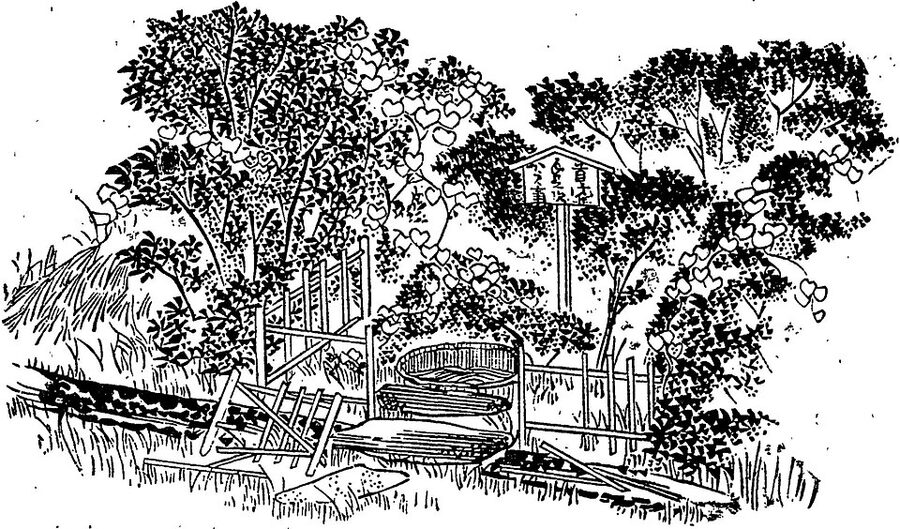
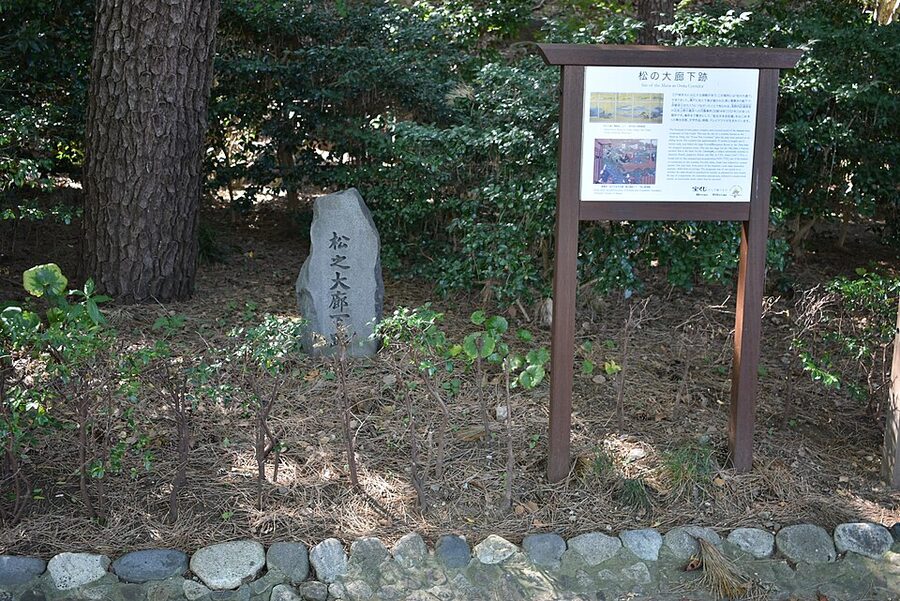
The corridor burned with the rest of the honmaru palace. Its site is marked by a stone and a small signboard among the trees in the Imperial Palace East Garden, the old heart of Edo Castle. Enter through the Ōtemon gate; the garden is free, closed on Mondays, Fridays and over the New Year, and shuts between 16:00 in winter and 18:00 in summer.
Leave by the Hirakawa Gate on the north-east side, one of the garden’s three entrances and the gate Asano was carried out through on his way to die. It is one of the castle’s surviving gates. Few of the people walking through it know what it was for.
The seppuku sites in Minato
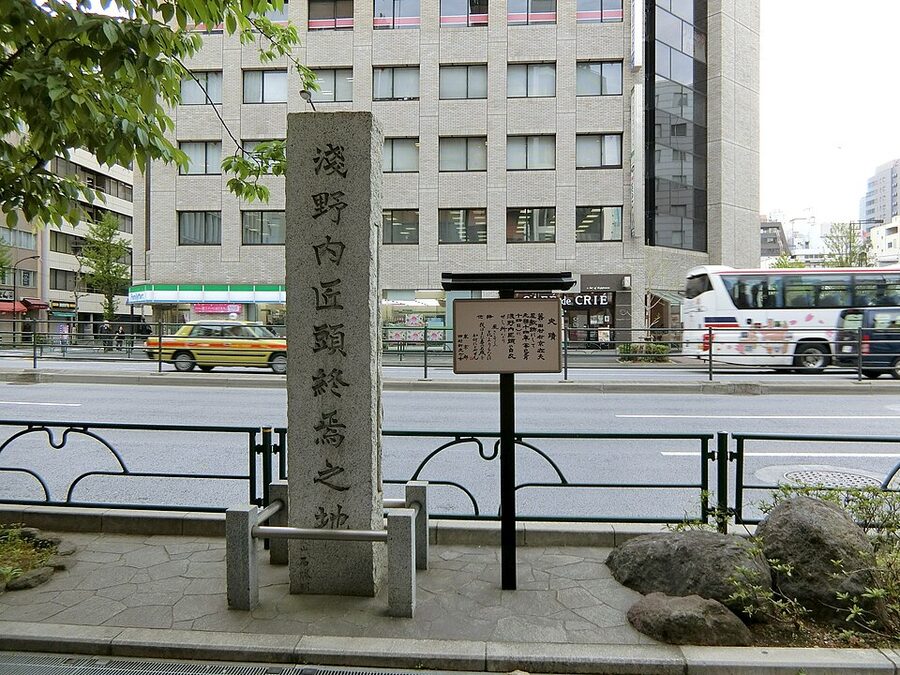
Asano’s death is marked by a stone reading “Asano Takumi-no-kami shūen no chi”, the place where Asano met his end, on a street corner in Shinbashi close to where the Tamura mansion stood. It has been moved about fifty metres in its lifetime, and for some years, for reasons nobody has explained, it stood facing the wrong way.
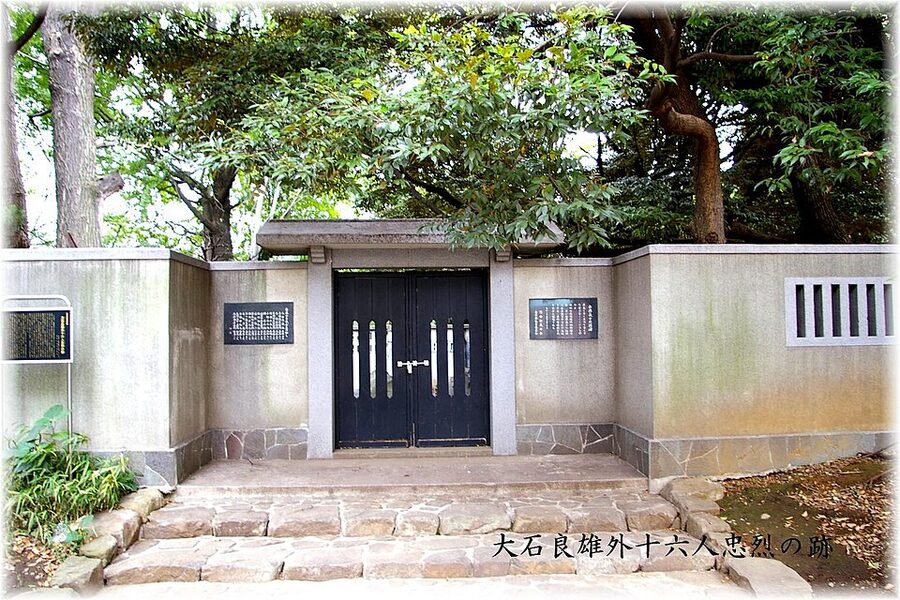
The site where Ōishi and sixteen others died at the Hosokawa mansion is in Takanawa 1-chōme, a short walk north of Sengaku-ji: a fenced patch of ground with a monument beside the gate of a public housing block, built in the style of the mansion’s old “impure gate”. The Matsudaira site, where Chikara died, is inside the Italian embassy in Mita and is not open.
The Mōri mansion, where ten more died after weeks of being treated as criminals, stood in what is now Roppongi Hills. Its garden survives as the Mōri Garden behind the tower, and it is the strangest of the death sites: a pond, office workers on their lunch break, and very little to tell you what happened here.
Akō Castle
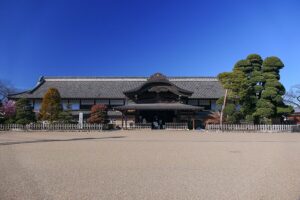
Akō is about half an hour from Himeji by JR to Banshū-Akō, or a change at Aioi from the Sanyō Shinkansen. The castle is a twenty-minute walk south of the station. Most of the grounds are open at all hours and free; the walled honmaru and the Ninomaru garden open 9:00 to 16:30 with last entry at 16:00, and close from 28 December to 4 January.
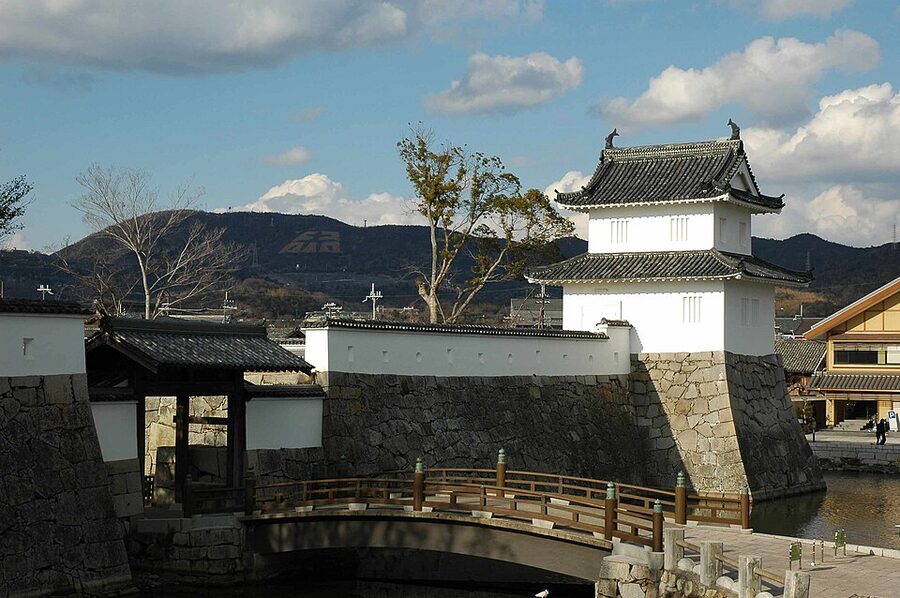
Inside the honmaru are the outlines of Naganori’s palace laid out in stone and the empty keep base you can climb, and the room above the honmaru gate opens as a small display at weekends outside the hottest and coldest months. The reconstructed gate of Ōishi’s own house stands in the grounds of the Ōishi Shrine. Go in the morning, before the coach groups doing Himeji Castle in the same day have arrived.
Akō Ōishi Shrine
Akō Ōishi Shrine (赤穂大石神社) stands inside the castle on the site of the Ōishi house. Permission to found it came in 1900 and it was finished in 1912, at the start of the Taishō era, after a decade in which donations came in slowly and some nationalists objected. It enshrines the forty-seven and Kayano Sanpei.
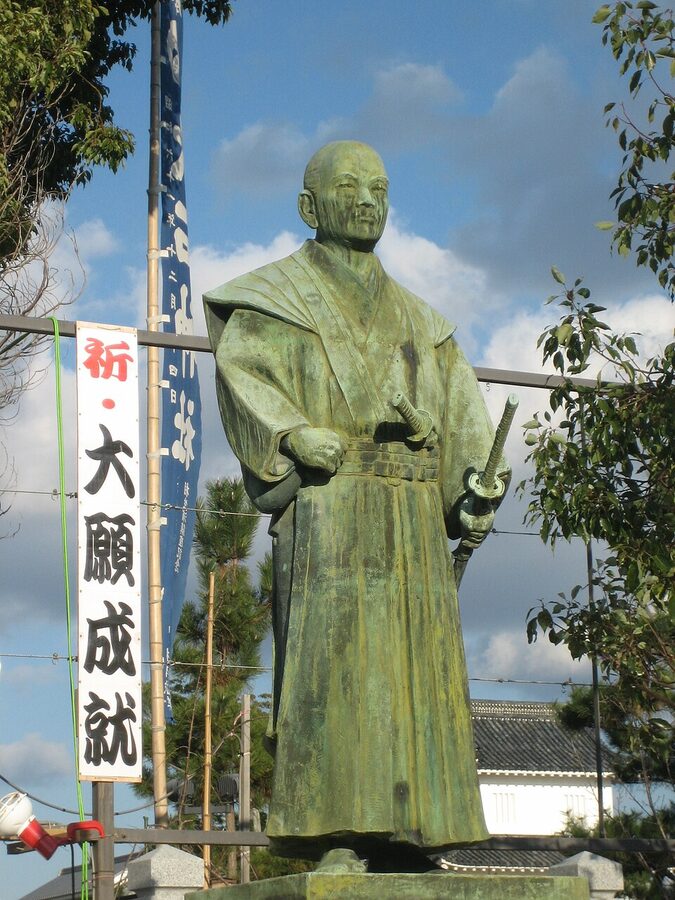
The grounds are open 8:00 to 17:00 and free. The shrine museum, with a treasure hall, a hall of wooden statues and the garden of Ōishi’s house, opens 8:30 to 17:00; recent sources give the combined ticket as ¥450 or ¥500 for adults, with children of junior high age and under free. The charms on sale are for the fulfilment of a great wish, which given what the forty-seven had to do to fulfil theirs seems a lot to ask of a talisman.
Kagaku-ji and the Akō City Museum of History
Kagaku-ji (花岳寺), ten minutes’ walk from Banshū-Akō Station, was founded in 1645 by Asano Naganao as the domain’s family temple. Its graves of the forty-seven were put up in 1739 for the 37th anniversary of their deaths and are said to hold locks of their hair. There is a hall of wooden statues and a small treasure house, and the temple is open daily from 9:00 to 16:00.
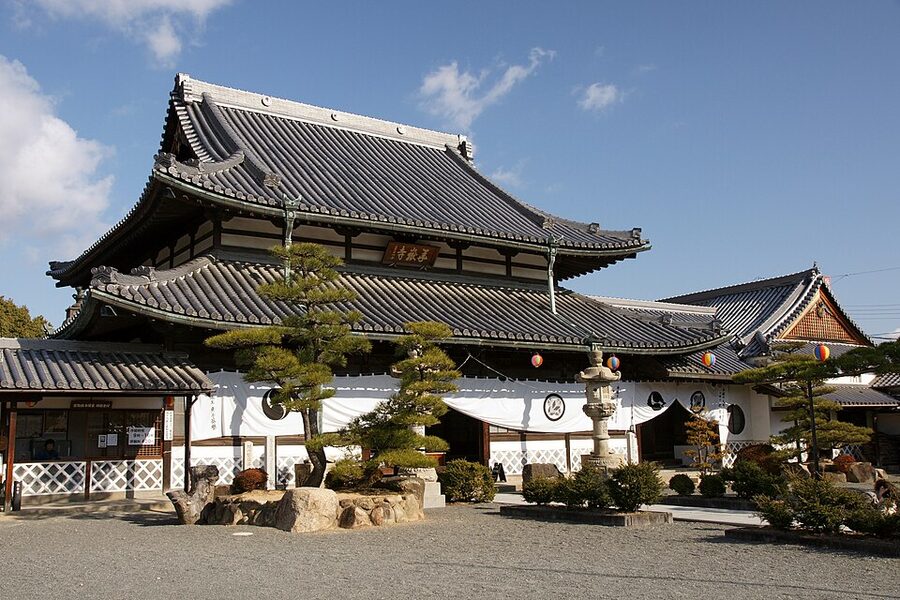
The Akō City Museum of History, at Kamikariya 916-1 on the site of the castle rice granaries, opens 9:00 to 17:00 (last entry 16:30) and closes on Wednesdays, or the following day when Wednesday is a holiday. Adults pay ¥200 and children ¥100. Its nickname is the House of Salt and Gishi, salt first, which is the correct order; the salt paid for everything.
The Akō Gishisai, 14 December
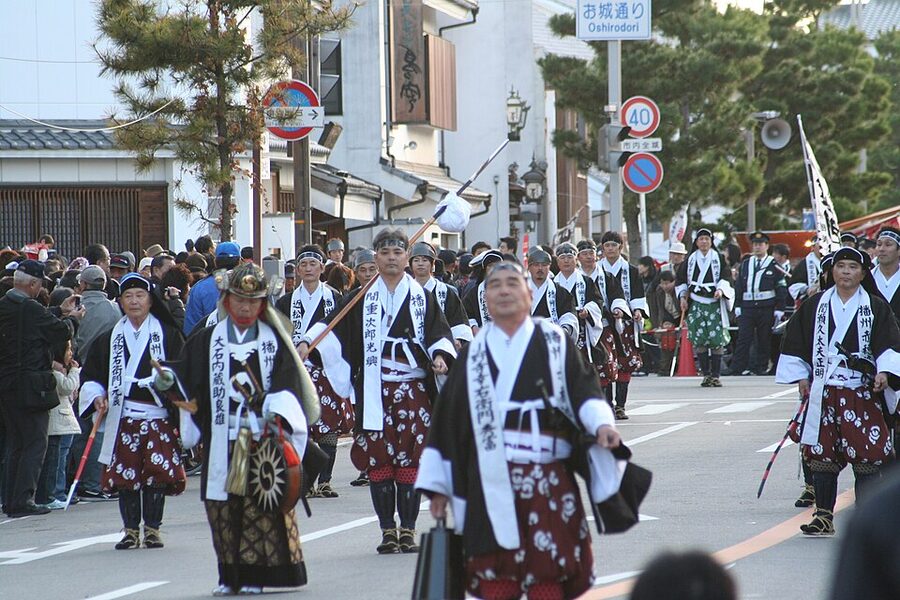
On 14 December the town holds its biggest festival, with a costumed parade of the forty-seven through the streets to the castle. The 123rd Gishisai in 2026 falls on Monday 14 December, with the procession running from about 10:00 to 15:00 and the actor Matsudaira Ken as Ōishi. Book a room months ahead, or stay in Himeji.
Kira’s side of the story, Nishio
If you have time, go and see where Kira is remembered as something other than a villain. His old estate at Kira in Mikawa is now part of Nishio in Aichi, an easy trip from Nagoya and home to Nishio Castle. The family temple, Kezō-ji, keeps his grave and the wooden statue, and the town credits him with the Ōgon embankment that held back the floods.
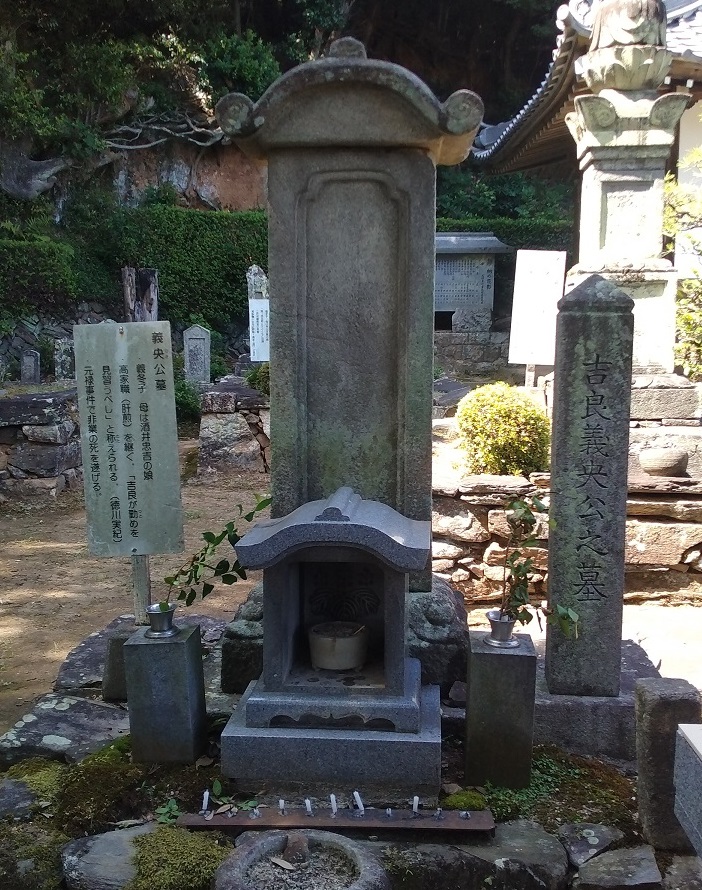
His body is in Tokyo, at Banshō-in Kōun-ji in Nakano, where it was reburied when the temple moved from Ichigaya in the Taishō era. It is a quiet graveyard, and nobody burns incense there by the bundle.
The receipt and the stitches
The story of the 47 Rōnin has been used to sell loyalty to the shogun, to the emperor, to the company and, in one American film, to Keanu Reeves. It works because it is a clean tale of wrong and retribution once the awkward parts are removed, and the playwrights of 1748 were very good at removing them.
What I keep coming back to is everything they cut. A lord with a headache and a temper; a councillor who spent a year and a half trying to save the family business; a league that shrank from 120 to 47 when the blood seals came back; a foot soldier who walked away and was quietly protected; a government that executed the raiders and, the same day, punished the victim’s grandson for his grandfather’s cowardice. All of it is in the record, and it makes the men more human, not less.
Most of the warriors in my field guide to Japan’s greatest samurai earned their fame on battlefields. These men earned theirs with patience, paperwork and one cold night’s work in the most peaceful century the country had yet known, which is why they read so oddly against the rest of Japanese history and so naturally against the Edo era. It was alternate attendance that put Asano in Edo that spring, and the same highways carried his retainers’ story to every corner of the country.
If you go to Sengaku-ji, go early, before the incense smoke settles over the graves, and stand for a minute by the well. Then take the train to Ryōgoku and find the little walled park where Kira’s people put up their own monument. Somewhere between the two is a slip of paper acknowledging receipt of one head, and the memory of a surgeon who was called out twice for the same patient. The rest is theatre.