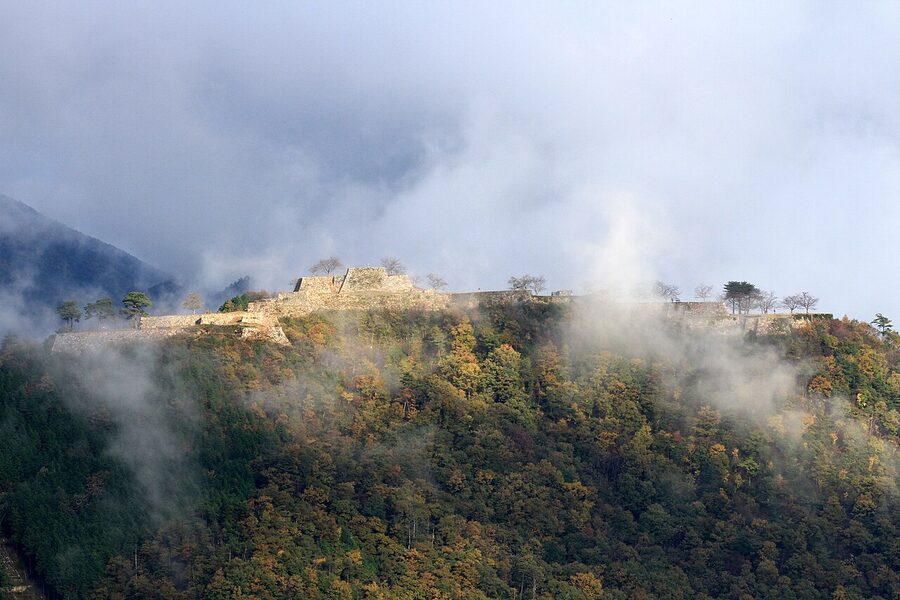
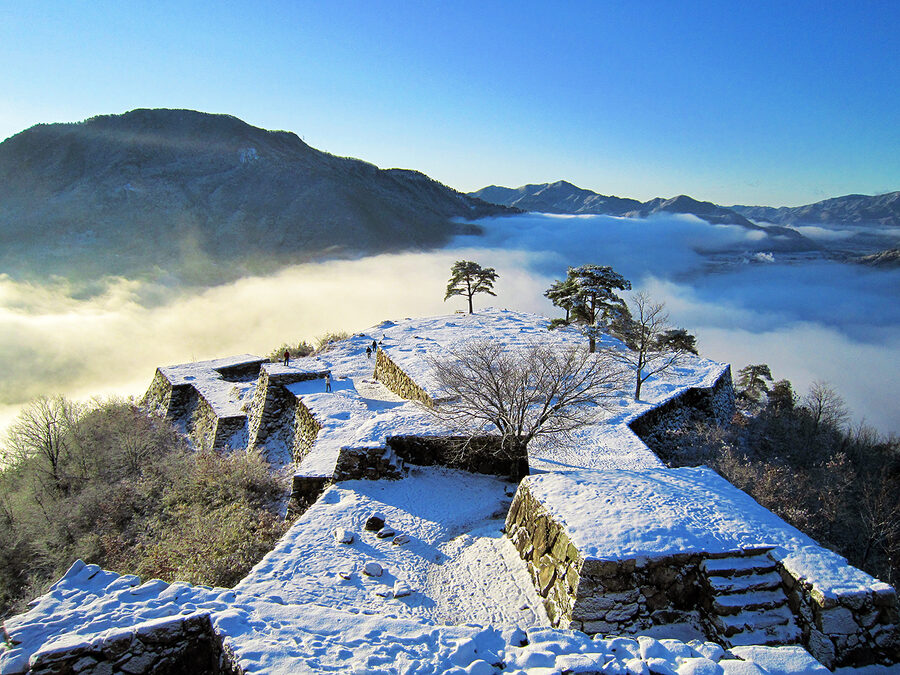
On a still morning in late autumn, cold air slides off the hills of northern Hyōgo and settles in the valley of the Maruyama River until the whole valley fills with cloud. Out of the top of it rises a ridge 353.7 metres high, and along the ridge, for about 400 metres, run terraces of dry-laid stone: gate ramps, corner bastions, the square base of a keep. There is no keep. There has not been one since 1600, and nothing on the mountain made of wood is older than the ticket booth.
That picture, of a castle that is not there, did more for the town of Takeda in fifteen years than the previous five centuries had. A decade before it went national, something like 20,000 people a year walked up the hill; after a search engine put it in a television advertisement in December 2013, more than half a million did, and the walls began to come apart under their shoes. I have stood up there in the cloud with a few hundred strangers and their tripods, and it is still worth the four o’clock alarm.
But the reason I keep going back is not the weather. It is the man who built the walls, whom a Korean prisoner of war described as the only Japanese general with a human heart, and who was ordered to kill himself in a temple in Tottori at the age of thirty-nine, for a fire he may not have lit.
In This Article
- A tiger asleep on the ridge
- The Yamana’s border post
- Silver, and Hideyoshi’s brother
- The boy who gave up Tatsuno
- Building in stone
- The only general with a human heart
- The wrong side, then the wrong fire
- Four quiet centuries
- The photograph, and the shoes
- Where to see Takeda Castle today
- Getting to Takeda
- The climb
- Inside the walls
- Ritsuunkyō for the cloud sea
- Takeda town
- Ikuno Silver Mine
A tiger asleep on the ridge
First, the name, because it confuses people. Takeda Castle has nothing to do with Takeda Shingen or his clan, who lived in Kai, several hundred kilometres east, and wrote their name with different characters. This Takeda is 竹田, “bamboo field”, the village at the foot of the hill, now part of Asago City. The castle’s older nickname is better: Torafusu-jō (虎臥城), the castle of the crouching tiger, because from the right angle the hill and its walls look like a big cat lying down with its paws out.
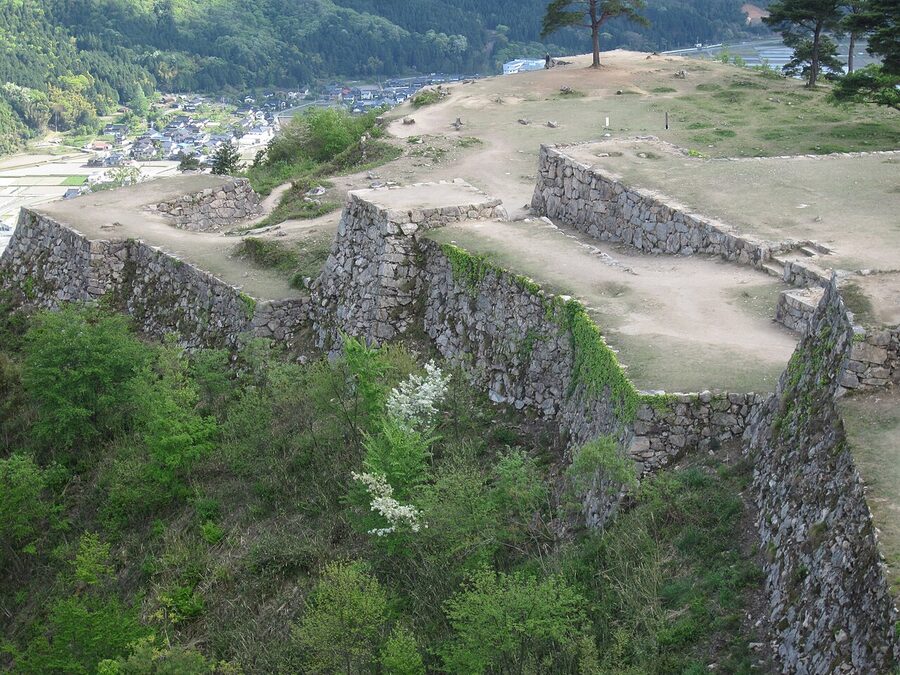
The tiger is the plan. The main enclosure, the honmaru, sits on the summit around the keep base, and three long arms of terraces run out from it: north to the Kita-senjō (the “thousand-mat” enclosure), south to the Minami-senjō, and south-west to a smaller wing called the Hanayashiki. One Japanese gazetteer prefers to see a crane spreading its wings, which tells you that people find in a castle plan whatever they brought with them. The whole walled area measures roughly 400 metres north to south and 100 metres east to west.
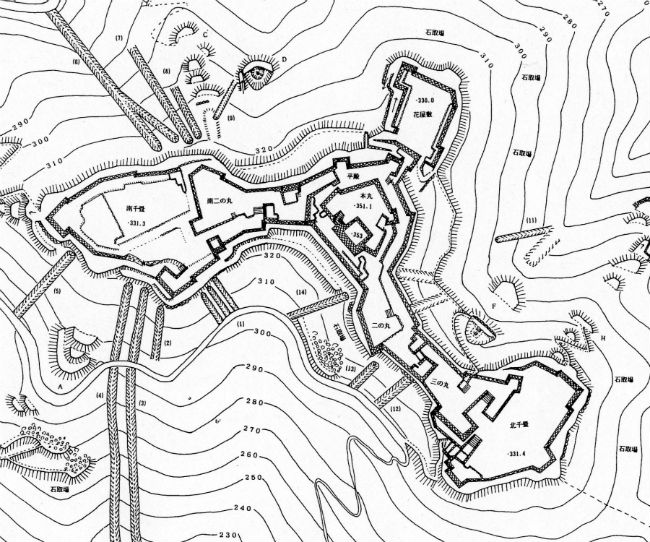
What makes the plan clever is height. The three wings were built at almost exactly the same level, about 331 metres, with the honmaru twenty metres above them, so a commander at the summit could look down into all three at once and send men to whichever was in trouble. Somebody got those levels right to within a few metres four centuries before anyone here owned a theodolite, which I find more impressive than the clouds.
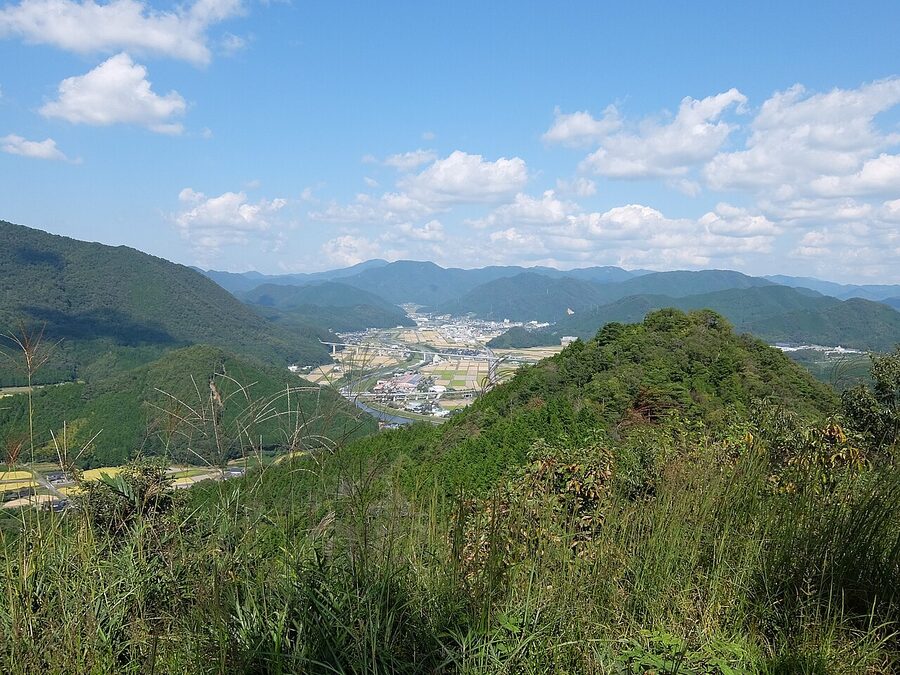
The hill was chosen for what it looks down on. Below it the Maruyama River runs north to the Sea of Japan, and at its foot the road from Tanba and Kyoto meets the road south over the watershed to Harima and the Inland Sea. A short way south, at Ikuno, lay one of the richest silver mines Japan ever had. Whoever held the hill held the junction, and whoever held the junction could tax the silver, or stop it.
The Yamana’s border post
Nobody knows exactly when the first fort went up here, and the best answer is “in the 1440s, probably”. The tradition repeated on every sign in town is that Yamana Sōzen (山名宗全), military governor of Tajima, ordered it built and that it was finished in 1443, with his retainer Ōtagaki Mitsukage as its first lord. One Japanese reference work has the work starting in 1431; English-language accounts usually say Mitsukage built it himself in 1441. The only written source for any of it is a family diary put together at the very end of the Edo period, so treat all three dates as folklore with a good pedigree.
Sōzen, born Yamana Mochitoyo, was one of the two or three most powerful men in Muromachi Japan. His family had once held eleven of the country’s sixty-six provinces, which earned them the nickname “lords of one-sixth of Japan”, and from his base in Tajima he spent his life trying to get back to that. People called him the Red Monk, for his complexion and his temper.
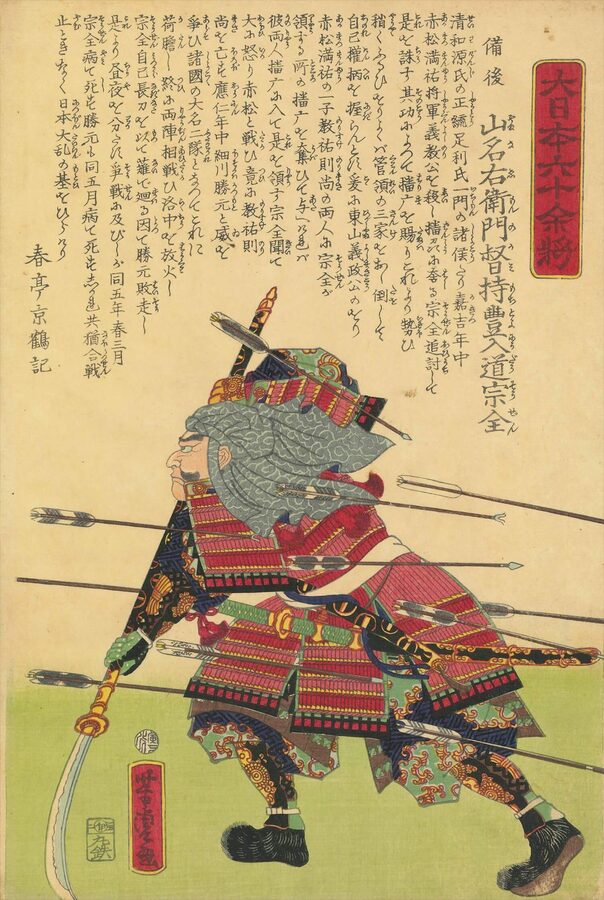
The castle needed a reason, and in 1441 it got one. On the 24th day of the sixth month, the shogun Ashikaga Yoshinori went to a party at the Kyoto mansion of Akamatsu Mitsusuke, lord of Harima, and was murdered at the table. Sōzen volunteered to punish the Akamatsu, marched his army out of Tajima and over the pass at Ikuno, and by the ninth month had cornered Mitsusuke in his mountain castle and destroyed him. Harima was handed to the Yamana as a reward, and Ōtagaki Mitsukage went south to run it as deputy governor.
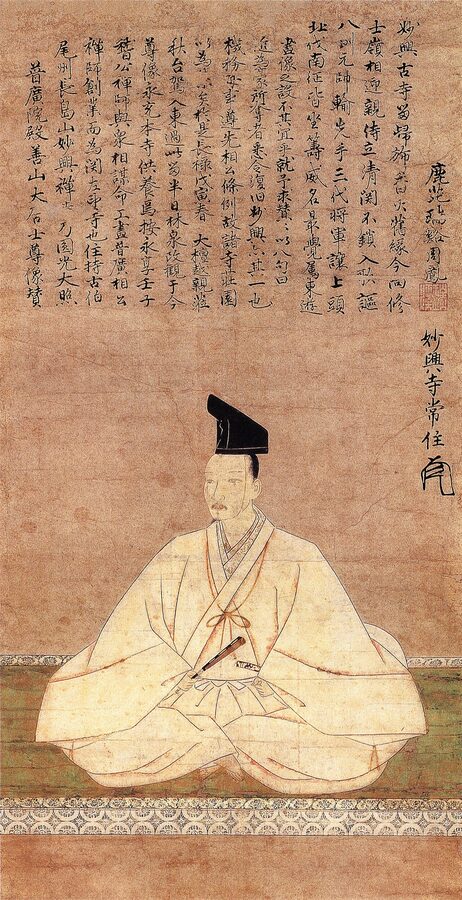
So Takeda began life as a border post at the Tajima end of the road into Harima. The Akamatsu tried to come back in 1443, 1444 and 1455, and each time the Yamana threw them out, with Mitsukage in the vanguard against the last attempt.
When the Ōnin War broke out in 1467, with Sōzen leading one side and Hosokawa Katsumoto the other, Tajima became a front line. In the third month of 1468 a Hosokawa army came over the hills from Tanba at Yakuno, west of Takeda, and the Ōtagaki garrison went out to meet it. They were badly outnumbered and won anyway, killing two of the enemy commanders, and a memorial mound for the dead still stands on the Yakuno plateau. It is the castle’s one clean victory, and it was fought somewhere else.
For the next century the Ōtagaki held Takeda for the Yamana through seven generations, and slowly stopped holding it for anyone but themselves. They counted among the Yamana’s “four heavenly kings”, the four great retainer families of Tajima, and in 1512 those four families deposed one Yamana lord and put his brother in his place. When a Yamana army marched on Harima again in 1522, the Ōtagaki simply did not turn up. That is the Sengoku era in miniature: the great lord kept the title, and his deputies kept the castles.
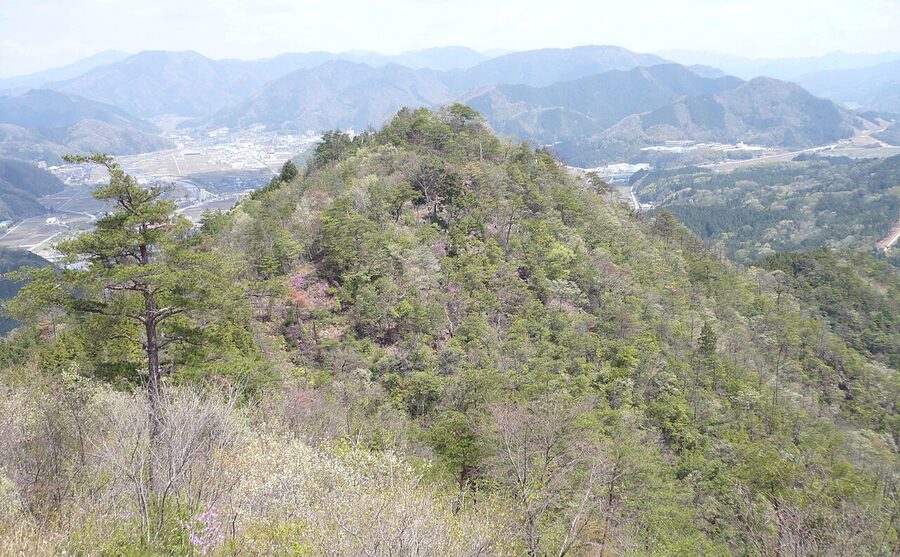
Their castle did not look like the one you see. The Ōtagaki fortress was earth and timber, terraces cut into the slopes and ditches across the ridges, with a second fort on the spur called Kannonjiyama a short way north-east. Archaeologists have mapped what survives under and around the later stonework: more than twenty small earthen terraces, two cross-ditches and seventeen trenches running straight down the slopes, some of them in the ploughed-field pattern called unejō tatebori (畝状竪堀) that stops attackers working sideways across a hillside. Taken together, the Ōtagaki castle covered something like 750 metres by 300, bigger than the stone one that replaced it.
Silver, and Hideyoshi’s brother
The silver changed everything. Legend says Ikuno was first worked in 807, but in 1542 Yamana Suketoyo brought in a new smelting method from the Iwami mine and production took off, and in 1567 the miners struck a vein so rich that the old mine records say the silver came out like earth and sand. The Ōtagaki of Takeda were the nearest armed men, and in 1556 they took control of the mine away from their own Yamana lord. A castle built to guard a road was now guarding a bank.
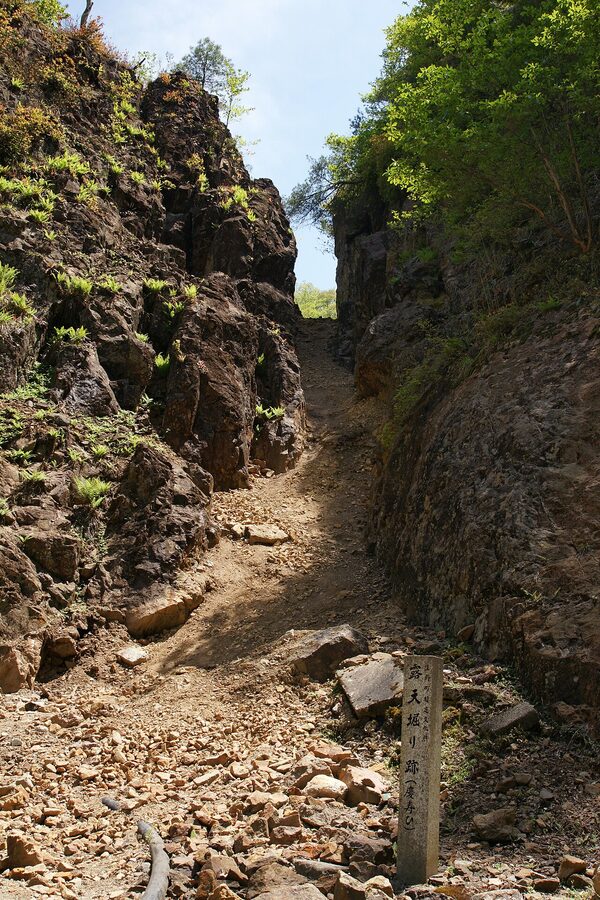
That made Takeda interesting to people a long way off. In 1569, when Suketoyo backed a rising against the Mōri, the Mōri asked their new ally Oda Nobunaga to distract him, and Nobunaga sent Kinoshita Tōkichirō, whom the world would later know as Toyotomi Hideyoshi, with 20,000 men. In about ten days of the eighth month he took eighteen castles in Tajima, Takeda very probably among them, and was back in Kyoto by the 13th. Suketoyo fled to Sakai, paid Nobunaga a thousand kan of coin to be allowed home, and the Ōtagaki carried on in their castle as if nothing had happened.
Over the next decade Tajima changed sides so often that you need a chart. The Ōtagaki submitted to the Mōri in 1573; in 1575 Ogino Naomasa, the “Red Demon of Tanba”, seized Takeda outright, and Nobunaga sent Akechi Mitsuhide to deal with him. By 1577 Nobunaga and the Mōri were openly at war, and Hideyoshi was at Himeji with orders to take the west.
The job of taking Tajima went to his younger brother. Hashiba Hidenaga, at that time signing himself Koichirō Nagahide, crossed into Tajima by the Mayumi pass in the eleventh month of 1577 with 3,000 men, took Iwasu Castle and then Takeda. One later chronicle, the Bukō Yawa, describes three days of hard fighting at the castle; Japanese military historians treat that book with deep suspicion and doubt there was much of a fight at all. What is certain, because Nobunaga’s biographer Ōta Gyūichi says so in the Shinchō Kōki, is that Hidenaga was left in charge of the castle afterwards.
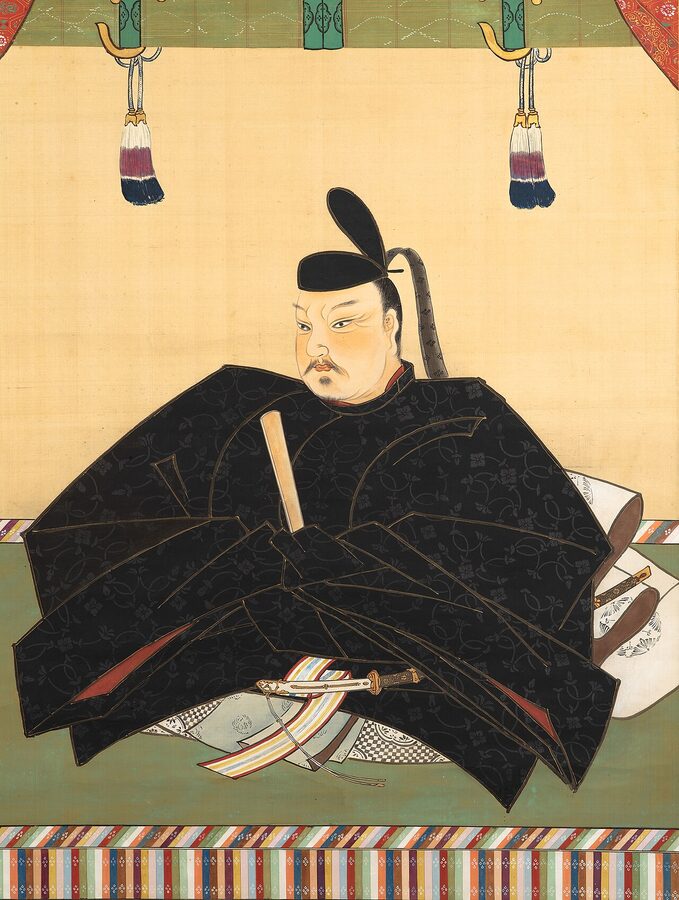
It did not stick the first time. In the fifth month of 1579 Hidenaga took his men off to help Mitsuhide in Tanba, and the Ōtagaki slipped back into Takeda behind him. In the fourth month of 1580 he returned with 6,400 men, and this time Takeda and Arikoyama, the Yamana’s last seat at Izushi, gave up without much of a struggle. The Yamana, governors of Tajima for two centuries, were finished, and the Ōtagaki went with them; one of the last of them is said to have hidden in the hills under a new surname.
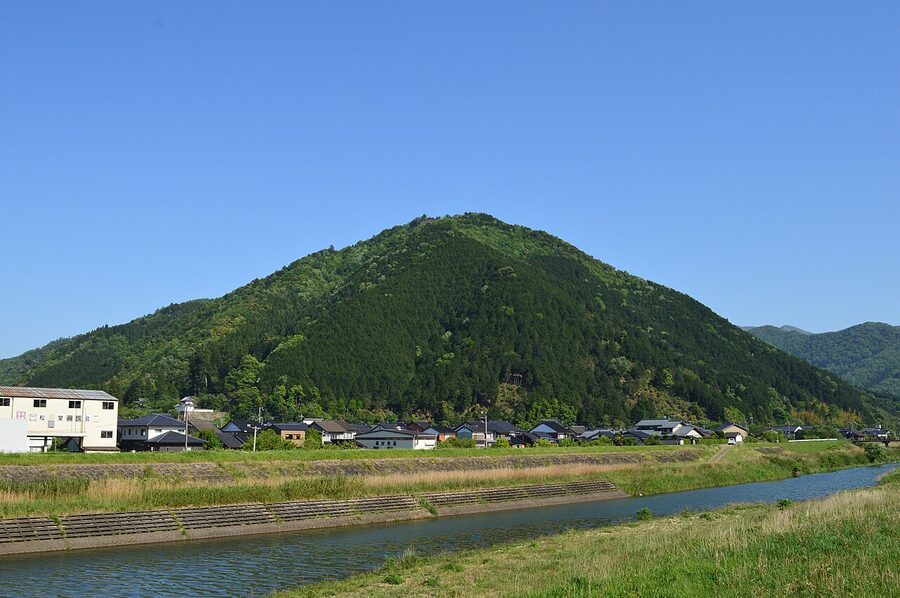
Who ran Takeda next is one of those questions on which the sources quietly disagree. The older account, still on the city’s website, says Hideyoshi gave the castle to Hidenaga’s general Kuwayama Shigeharu with 10,000 koku. More recent Japanese scholarship, going back to the Shinchō Kōki, has Hidenaga himself at Takeda as castle-keeper, running Tajima from here until 1583, when the victory at Shizugatake moved Hideyoshi’s centre of gravity east and Hidenaga to Himeji; only then did Kuwayama take over. Kuwayama, who had learned his tea from Sen no Rikyū, held it for two years and then followed Hidenaga to Wakayama.
The boy who gave up Tatsuno
In 1585 the castle went to a man from the very family it had been built against. Akamatsu Hirohide (赤松広秀) was born in 1562 into the Tatsuno branch of the Akamatsu, the clan Yamana Sōzen had crushed in 1441, and by blood his branch had arguably a better claim to the old headship than the one that held it. His father died in 1570, then his elder brother, and he became lord of Tatsuno Castle in western Harima as a child.
He is awkward to look up, because he kept changing his name. As a teenager he signed himself Hirohide with one set of characters (広英), around 1582 he switched to another that sounds the same (広秀), around 1595 he became Hiromichi (広通), and late in life he took the surname Saimura, which is why the newest Japanese reference works file him as Saimura Masahiro. English-language accounts call him Akamatsu Hirohide, and so will I.
He met Nobunaga in Kyoto on the 20th day of the tenth month of 1575, aged fifteen by the Japanese count, and the next year went over to the Mōri when they came into Harima. When Hideyoshi arrived in 1577, Hirohide handed over Tatsuno without a fight and asked to keep his lands. He did not get them. Tatsuno went to one of Hideyoshi’s men, and Hirohide was left with a scrap of territory and a place as a junior commander under Hachisuka Masakatsu, Hideyoshi’s oldest companion.
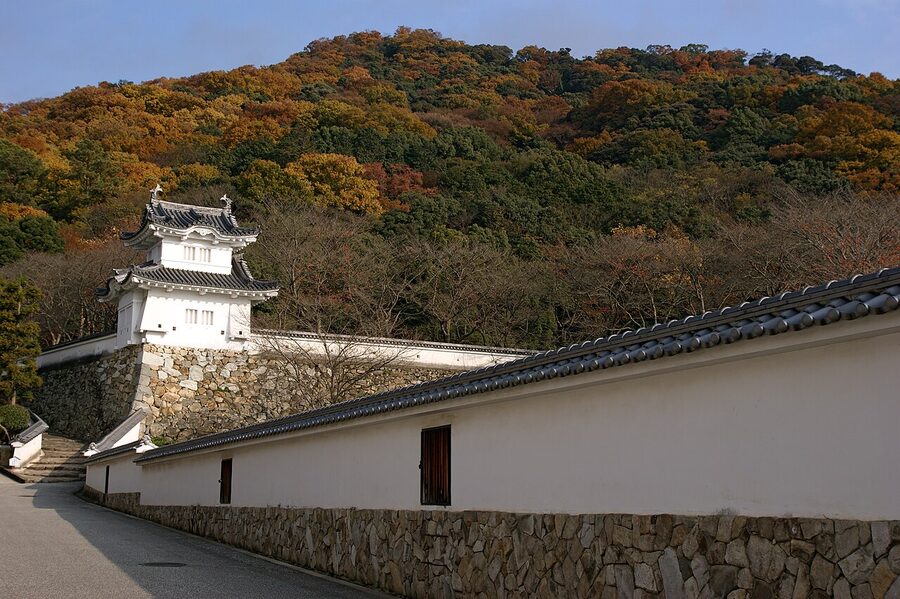
He did the work anyway. He fought at Takamatsu in Bitchū in 1582, led the Hachisuka vanguard at Shizugatake in 1583, and served at Komaki-Nagakute in 1584 and in the Shikoku campaign of 1585. When that campaign was over the Hachisuka got the province of Awa, Tatsuno went to Fukushima Masanori, and Hirohide, still without his birthright, was given Takeda and 20,000 koku in Tajima. From then on he answered to Hideyoshi directly.
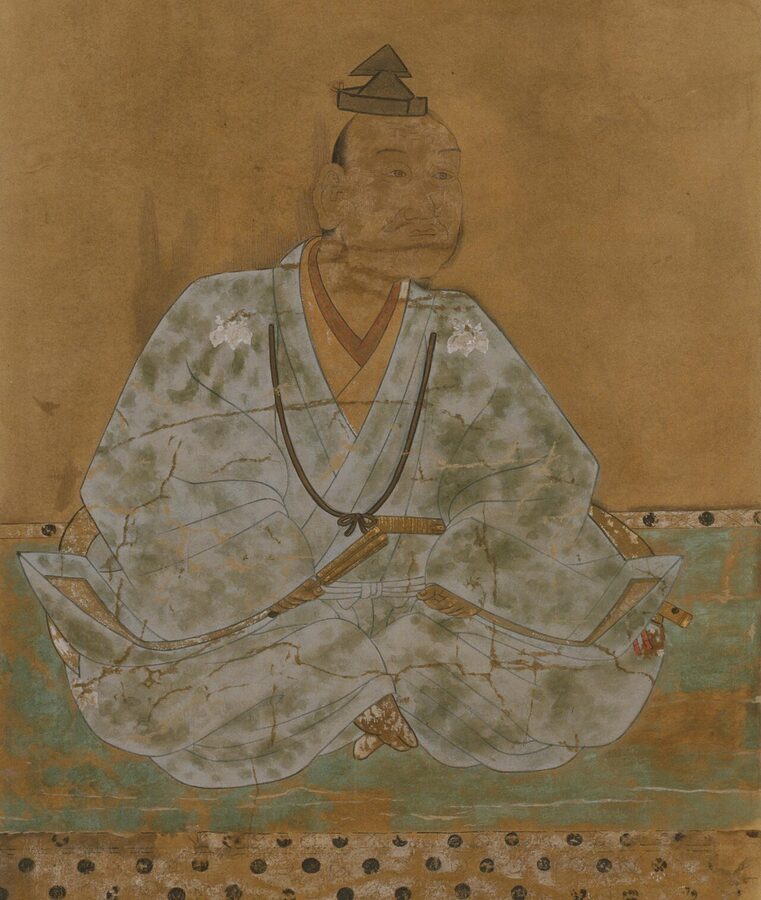
Building in stone
Almost everything you walk on at Takeda is Hirohide’s. Whatever Hidenaga laid out, it was Hirohide, through the 1590s and with Hideyoshi’s backing, who turned an earth-and-timber Ōtagaki fort into a castle walled in stone from end to end. It was the last of its kind: Japanese castle scholars call Takeda the last early-modern castle built on a mountaintop, finished just as the fashion was moving down to the plains and the castle towns of the Azuchi-Momoyama era. The stone facing covers about 8,649 square metres in all, and the tallest stretch, on the south side of the keep base, stands 10.6 metres.
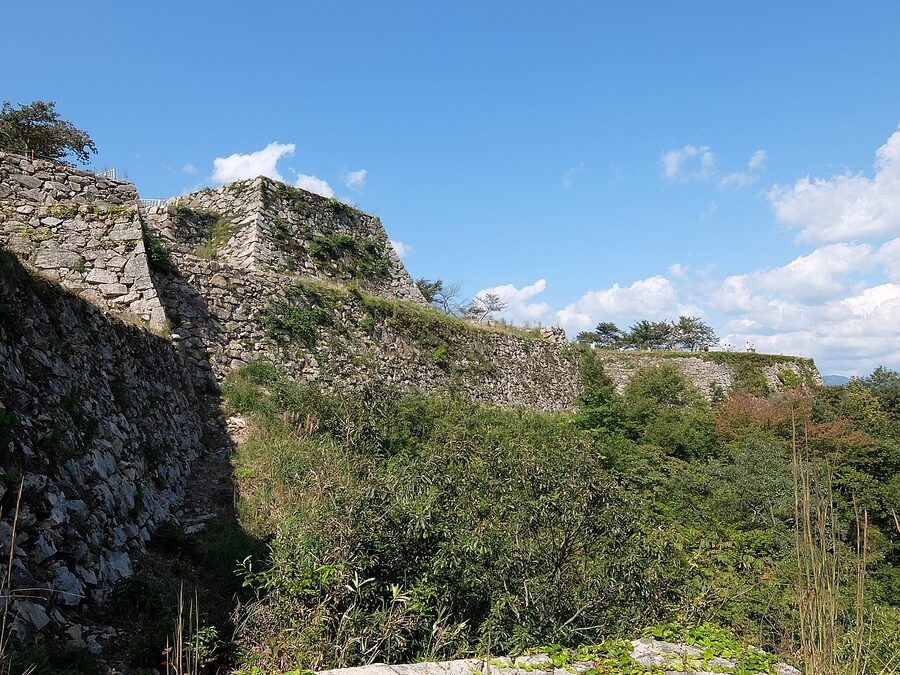
The technique is the one called nozura-zumi (野面積み), “natural-face stacking”: boulders left unworked or barely worked, fitted together dry, with small wedge stones packed into the gaps. Tradition gives the walls to the Anō-shū (穴太衆), the guild of masons from Anō at the foot of Mount Hiei who built the walls of Azuchi Castle for Nobunaga, and so the style is often called anō-zumi. Strictly, the guild could build in any style, and nobody has found a document naming them at Takeda. But the city says it, the walls look exactly like Azuchi’s, and the guild’s descendants, the Awata family of Sakamoto, were the firm hired to repair Takeda’s walls after the war, so at the very least the right hands have been on them since.
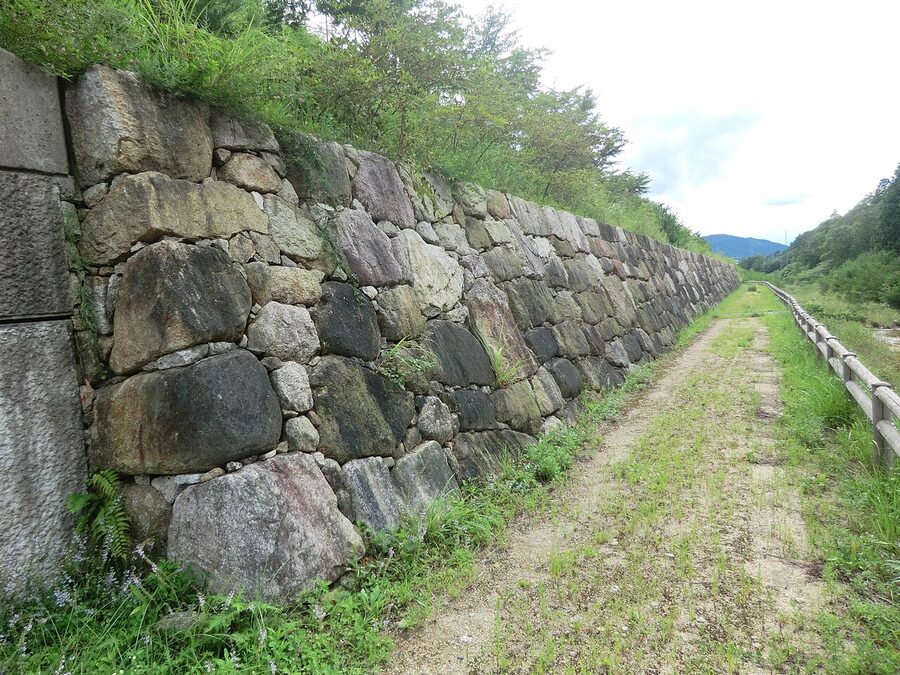
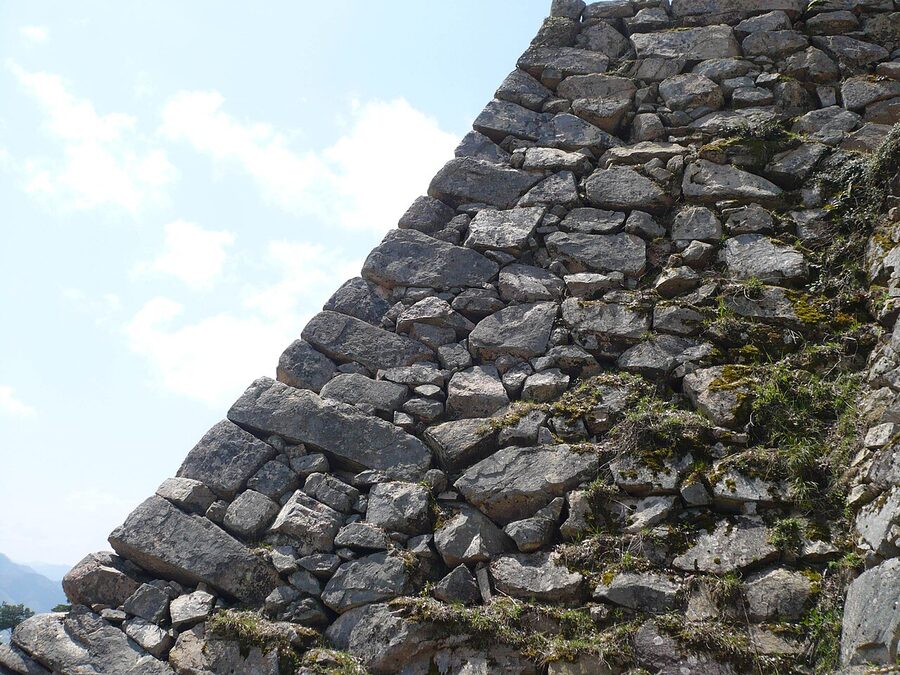
Look closely and the walls are not quite uniform: Japanese surveyors think each face went to a different master mason, and the stone came from six quarries, four of them near the summit. At the corners the long stones are laid alternately end-on and side-on, a method called sangi-zumi (算木積み) that locks the angle together, and on several blocks you can still see the row of chisel holes where a boulder was split.
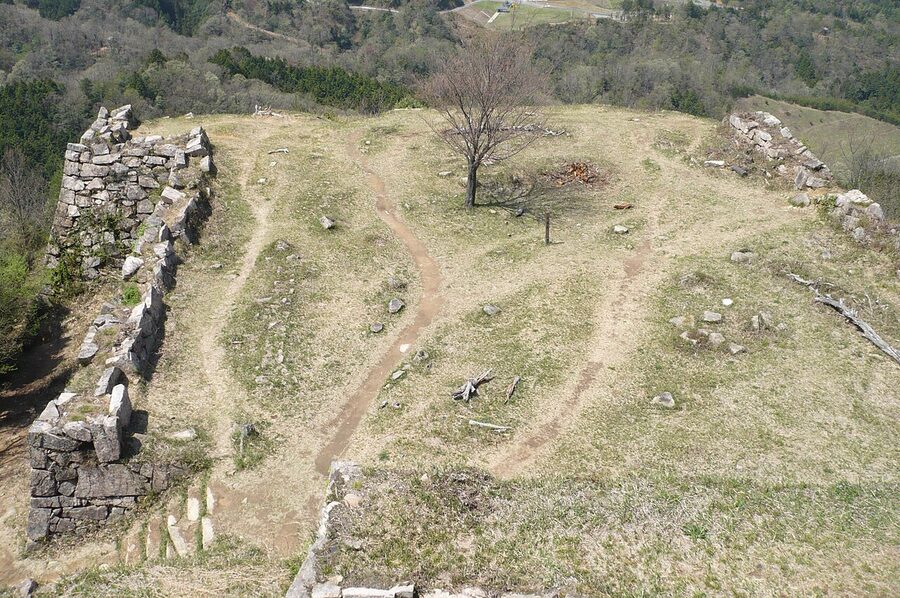
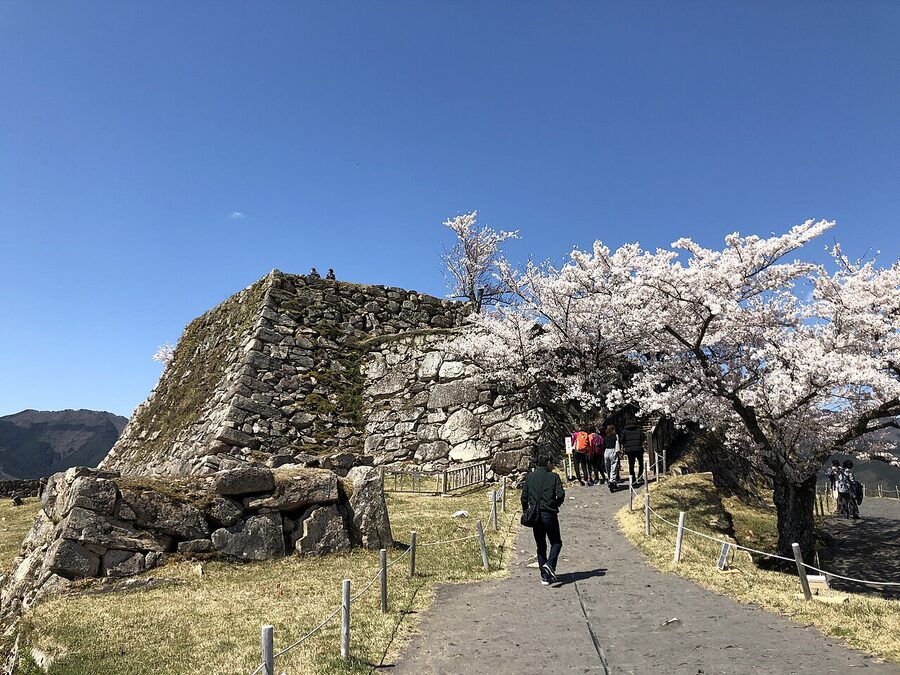
In the middle of it all is the keep base, a slightly lopsided 10.7 by 12.7 metres, set at the front of the honmaru facing east, square on to the town below. The foundation stones show a building laid out on the Kyoto measure, and Japanese surveys reconstruct a three-storey keep with no stone stair and no basement, entered through a turret alongside. A keep at this date was as much a billboard as a strongpoint, and Hirohide pointed his at the people who paid the taxes. The castle probably carried around twenty turrets in all, and not one of them survives, nor any drawing of one.
More roof tiles have come out of the ground at Takeda than at any other castle in Tajima, including devil-face tiles and fragments of shachi fish, and two finds stand out. One is a Korean-style round tile, a type that only reached Japan with the invasions of Korea in the 1590s. The other is an eave tile struck from the same design as tiles dug up in the third bailey of Himeji Castle, which suggests that Himeji tile-makers worked here, sent by whoever held Himeji. A castle that could borrow Himeji’s kawara makers had friends in high places.
The Hanayashiki has a puzzle of its own. Its outline is almost identical to the Yūgekimaru, a bailey of Nagoya Castle in Hizen, the base Hideyoshi built on the coast of Kyushu to launch the invasion of Korea, through which Hirohide himself shipped out in 1592. Whether one designer drew both or Takeda copied the Kyushu plan, the Hanayashiki has never been excavated. Since August 2026 a new walkway down from the Hiradono lets you look into it closely without walking on it, which is the right compromise.
There is a local story about what all this cost. The building work is said to have gone on for thirteen years, with the farmers pressed into hauling stone until “pines grew in the rice fields”, the fields left untended long enough for seedlings to take root. I have never been able to find out how old the saying is. It is usually told alongside a second story, that Hirohide made it up to them afterwards with remitted taxes and flood works, and Takeda has remembered him fondly ever since.
The only general with a human heart
Hirohide does not fit the usual picture of a Sengoku lord. The city’s own history calls him a benevolent ruler who encouraged silk farming and lacquerware, said to be the root of the furniture-making Takeda still does. He also read, seriously, and the reading is what makes him interesting.
His teacher was Fujiwara Seika (藤原惺窩), a Zen monk from Harima who had become convinced that the Neo-Confucian philosophers of Song China had answers Buddhism lacked. In 1596 Seika tried to sail to China to find a real master, and storms turned his ship back. The master came to him instead, in chains.
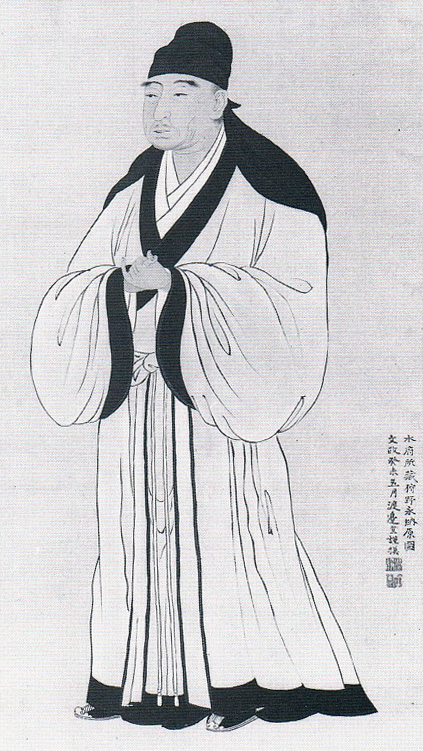
Kang Hang (姜沆) was a junior minister at the Korean court, and in 1597, during Hideyoshi’s second invasion, he was taken at sea by the fleet of Tōdō Takatora as he fled with his family; two of his children died. He was held at Takatora’s castle at Ōzu in Iyo, tried to escape, was caught and nearly beheaded, and was then moved to Fushimi, outside Kyoto. There he met Seika, and through Seika, Hirohide.
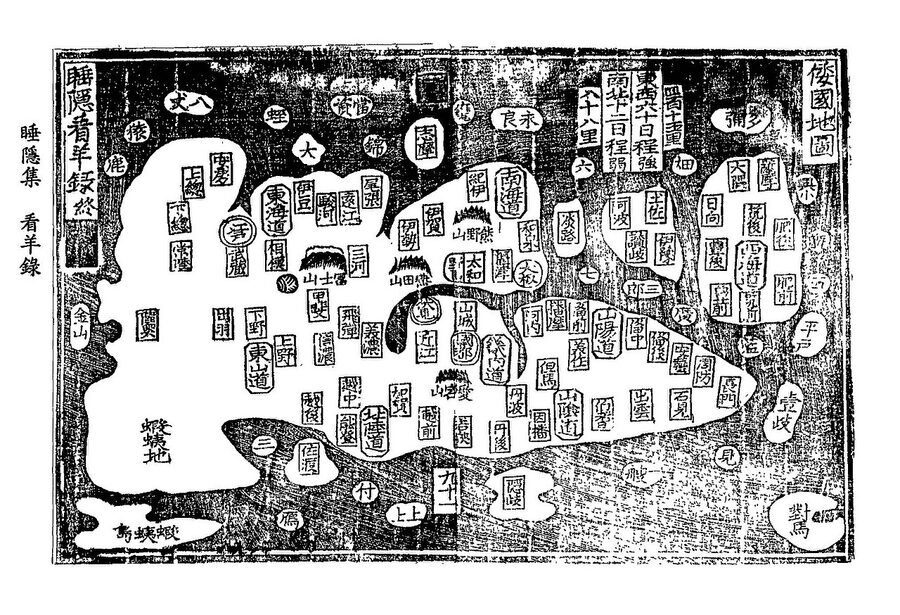
What the three of them did in 1599 matters to the history of Japanese thought. With Hirohide paying and Kang Hang advising, Seika marked up the Four Books and Five Classics, the core texts of Confucianism, with Japanese reading marks that followed the Song commentaries, which nobody in Japan had done before. Hirohide also gave Kang Hang money towards getting home. The marked edition was never printed, because within eighteen months its patron was dead.
Kang Hang left Fushimi in the spring of 1600, reached Korea that summer and wrote up everything he had seen for the king. He did not like Japan; he called its army the vilest of barbarians and the sworn enemy of his people. And yet he made one exception. Japan’s generals, he wrote, are all of them thieves; only Hiromichi has a human heart.
There is one more detail in the Kanyangnok that I treasure. Hirohide asked Kang to keep their friendship quiet around Tōdō’s household, because he was on bad terms with Takatora and with Katō Kiyomasa.
He served in Korea himself, which is worth remembering before anyone makes a saint of him. In 1592 he crossed with 800 men and garrisoned Busan, and he went back for the second invasion in 1597. In 1587 Hideyoshi had married him to a sister of Ukita Hideie, lord of Okayama, which put him one handshake away from the council of great lords that would run Japan for Hideyoshi’s infant son. When Hideyoshi died in 1598, he left Hirohide five pieces of gold.
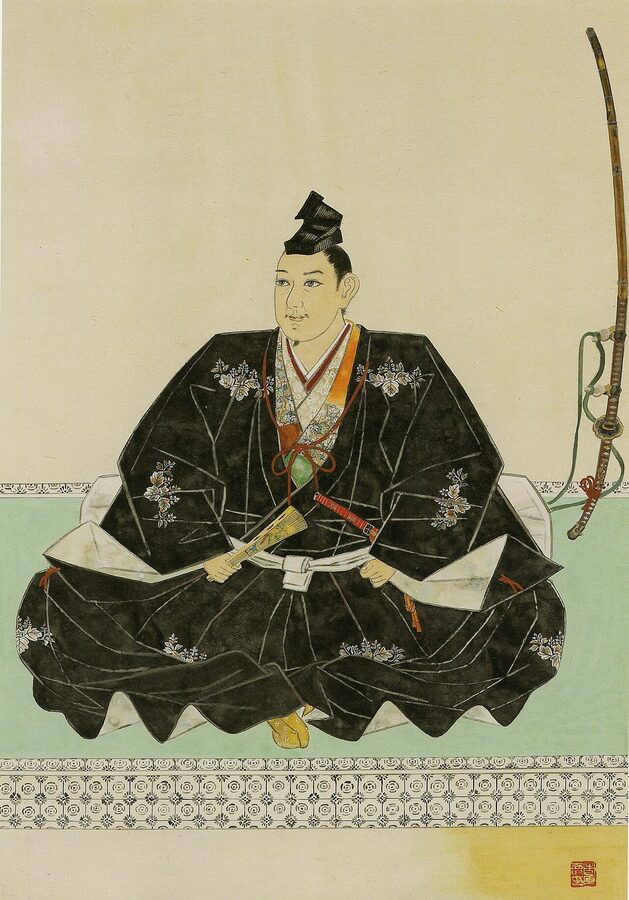
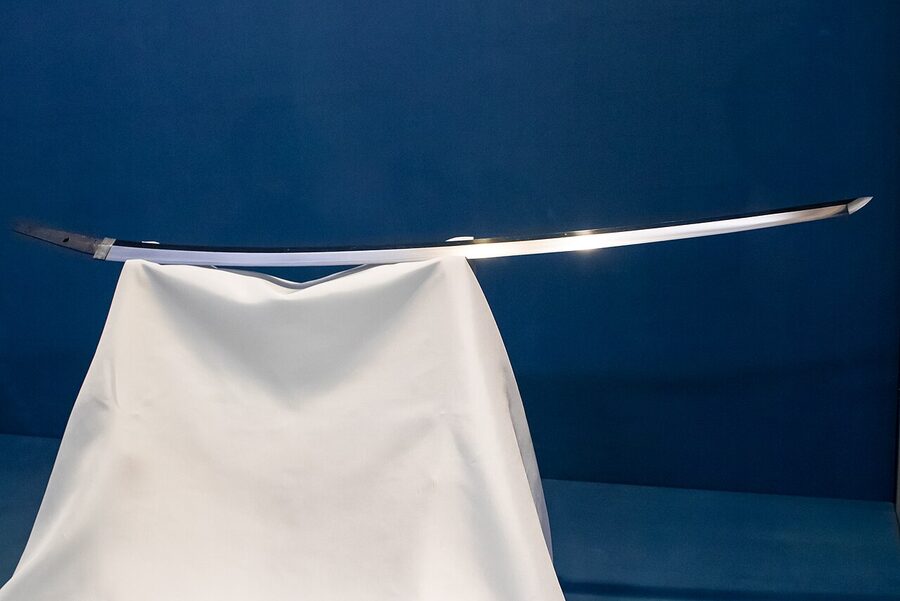
He also owned one of the most famous swords in Japan. Shishiō (獅子王), “Lion King”, is a Heian-period tachi said to be the blade an emperor gave Minamoto no Yorimasa for shooting the nue, the monkey-headed chimera that haunted the palace, and by a route nobody has fully explained it came down, in Asago’s telling, to Hirohide. After his death Ieyasu confiscated it. It passed to the Toki family, then to the imperial household in the Meiji era, and it now belongs to the Tokyo National Museum, one of the finest tachi anywhere.
The wrong side, then the wrong fire
When Ishida Mitsunari raised the Western Army against Tokugawa Ieyasu in the summer of 1600, Hirohide went with him, as most of Hideyoshi’s men in the west did. His job was a long way from the main event. He joined the force of some 15,000 that besieged Tanabe Castle in Tango, held by the elderly poet-general Hosokawa Yūsai, father of Hosokawa Tadaoki, with a few hundred men.
Yūsai held out for the best part of two months, helped, the story goes, by the number of besiegers who had studied poetry with him and were in no hurry. It ended only when the emperor ordered a truce, because Yūsai was the last man alive who held the secret teachings on the Kokinshū anthology and the court could not afford to lose them. The castle opened its gates on the 13th day of the ninth month.
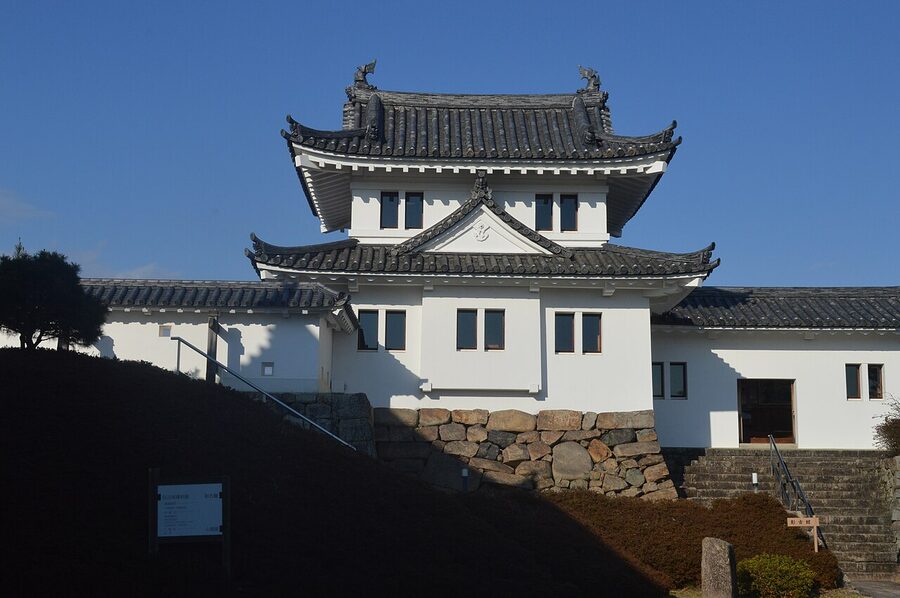
The main armies met at Sekigahara on the 15th day of the ninth month, and by the afternoon the Western Army had ceased to exist. Hirohide pulled back to Takeda. Kamei Korenori, lord of Shikano in Inaba and an old acquaintance, had joined the Eastern side and was stuck in front of Tottori Castle, held for the West by the men of Miyabe Nagafusa, and he invited Hirohide to change sides and help. Hirohide did, and Tottori fell, but only after the attackers set fire to the town beneath it.
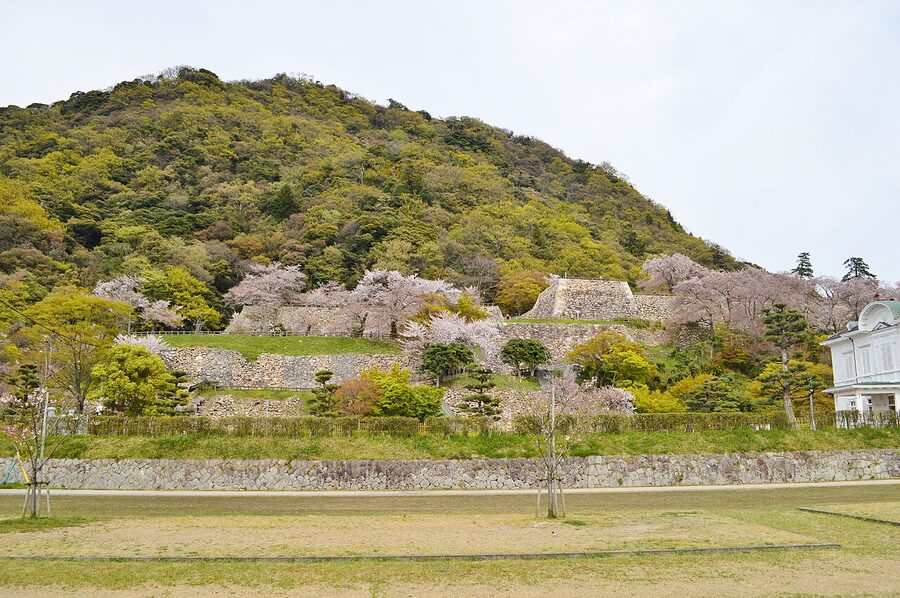
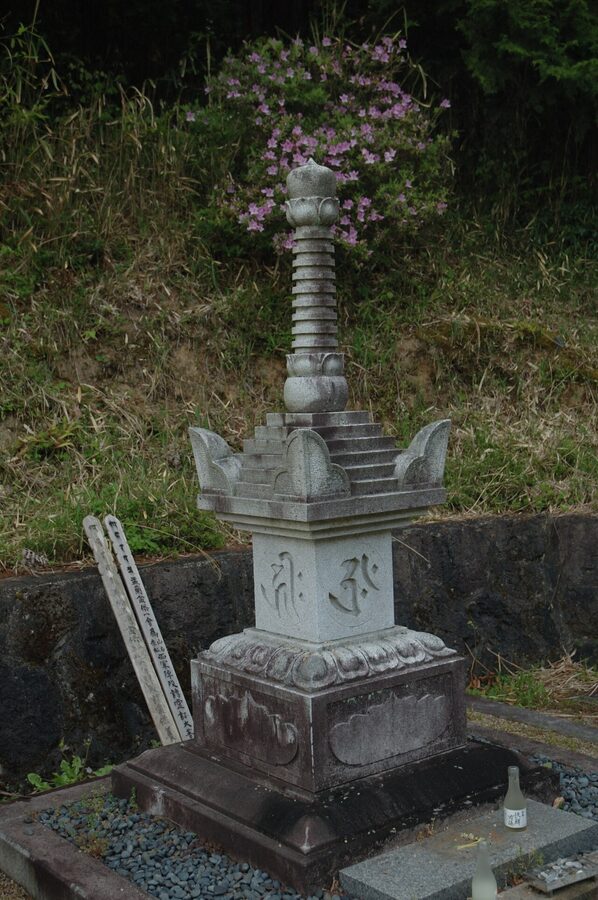
Ieyasu was angry about the burning, and somebody had to answer for it. Kamei, who was in charge of the attack, has long been suspected of making sure his new ally carried the whole blame. Hirohide was ordered to commit seppuku, and on the 28th day of the tenth month of 1600 (3 December by the Western calendar) he did so at Shinkyō-ji, a temple in Tottori. He was thirty-nine by the Japanese count.
There is a final twist. On Ieyasu’s orders, Takeda was handed over to Yamana Toyokuni, a member of the family that had built it and a man who had himself lost Tottori to Hideyoshi’s armies twenty years before. He did not keep it. The castle was abandoned, the Tatsuno Akamatsu ended with Hirohide, and the Yamana got their old castle back just long enough to switch off the lights.
Four quiet centuries
The Tokugawa had no use for a mountain castle in a province with nobody left to fight, and a great deal of use for the silver. Ikuno became shogunal land under a magistrate, Takeda came under the Ikuno office from 1615, and the walls were left to the trees through the whole of the Edo era, two and a half centuries that count as the longest peace in Japanese history. That neglect is what saved them. Nobody had a reason to pull the walls down, nobody had a reason to build on them, and so they stayed very much as Hirohide’s masons left them.
The summit passed into the ownership of Takeda town in 1939, and the walls became a national historic site on 8 September 1943, with the protected area widened in 2009. Before that, in 1932, Deguchi Onisaburō, the flamboyant leader of the new religion Ōmoto, decided to climb to the castle as part of a preaching tour; his followers paid for a proper path up the south side, and he made the ascent on 18 October. It is still the gentlest way up.
Film crews found Takeda before the tourists did. Kurosawa used the hill in Kagemusha in 1980, and in 1989 the Kadokawa studio spent ¥300 million building a full-size keep, gate and walls on top of the real ones, with official permission, to stand in for Uesugi Kenshin‘s Kasugayama in Ten to Chi to. Later productions borrowed the hill as Hara Castle, as Odawara and as Hideyoshi’s camp at Ishigakiyama. People drove out to see the film keep while it stood, and stopped as soon as it came down.
In 1988 descendants of the Yamana and the Akamatsu, whose ancestors had fought over this border for a century and a half, put up a joint memorial to the dead of both sides beside the car park. The idea came from the head of the national Yamana family association, an Ōtagaki by name, and the priest of the Yamana family temple. Five hundred and forty-seven years after the dinner party in Kyoto, it seems a decent interval.
The photograph, and the shoes
In 2006 the Japan Castle Foundation marked its fortieth anniversary with a list of Japan’s 100 Fine Castles, and Takeda was number 56. The next year the official guidebook printed a double-page photograph by an amateur, Yoshida Toshihisa, of the ruins floating on cloud, and in November 2007 the Asahi Shimbun put another of his cloud pictures on its national front page. Tour companies started running trips around 2009. In 2012 the Takakura Ken film Anata e closed on the castle above the clouds, and Asago set up a dedicated Takeda Castle department at the city office to cope.
Then the numbers went vertical. By one local newspaper’s estimate the hill had about 20,000 visitors a year in the mid-2000s; the count for the year to March 2013 was 238,000, and the first six months of the next year brought 220,000 more. In December 2013 Google used the castle in a television advertisement about winter outings. For the next two years the figure was somewhere between half a million and 600,000 a year, depending on who was counting and how, and for some of that time the counting was done by watching the car parks and the toilets.
A dry-stone wall on a hilltop is held together by friction and drainage, and both suffer when people stand on it. Soil washed out of the terraces, paths wore down to bare rock, and stretches of wall began to bulge and shed stones. Asago introduced an entry fee of ¥300 in October 2013 and closed the castle completely in winter from 2014.
In November 2014 the prefectural board of education discovered that the city had been widening and rerouting paths on a national historic site without permission, and ordered the work stopped. By 2015 visitors were confined to a roped route laid over protective matting, with the honmaru, the keep base and the Hanayashiki fenced off; the keep base reopened in March 2016. To its credit, the city has run the place carefully since.
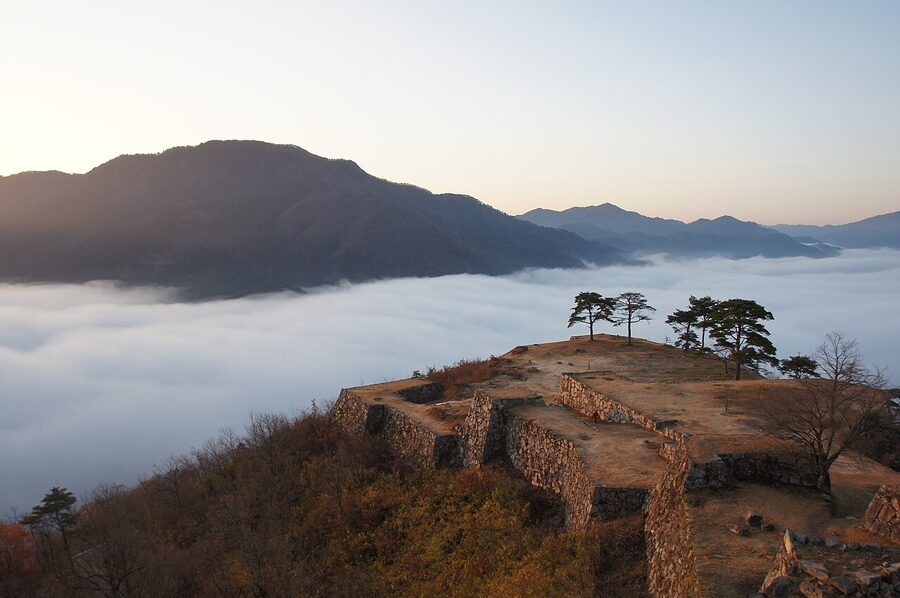
The boom has settled. Visitor numbers fell by a fifth to a third a year for four years after the peak, and the count for the year to March 2020 was 173,801, still about eight times what it was before the photographs. That feels about right to me for a hill with nothing on it. If you want the same trick with a roof on, Bitchū Matsuyama in Okayama is the surviving original keep that floats on cloud in the same way, and the only true mountain castle among Japan’s twelve original castles; my piece on Bitchū Matsuyama covers it, cat and all.
Where to see Takeda Castle today
Takeda is in the hills of northern Hyōgo, about two and a half hours from Osaka and an hour or so from Himeji on the fastest train. It works as a day trip, but if you want the cloud, you have to sleep in the valley the night before, because the best of it is usually gone by eight.
Getting to Takeda
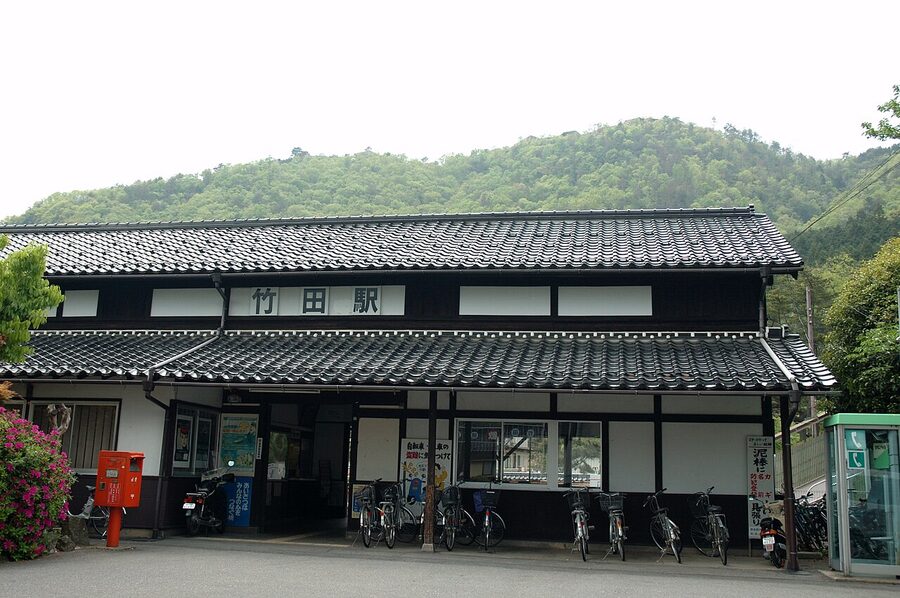
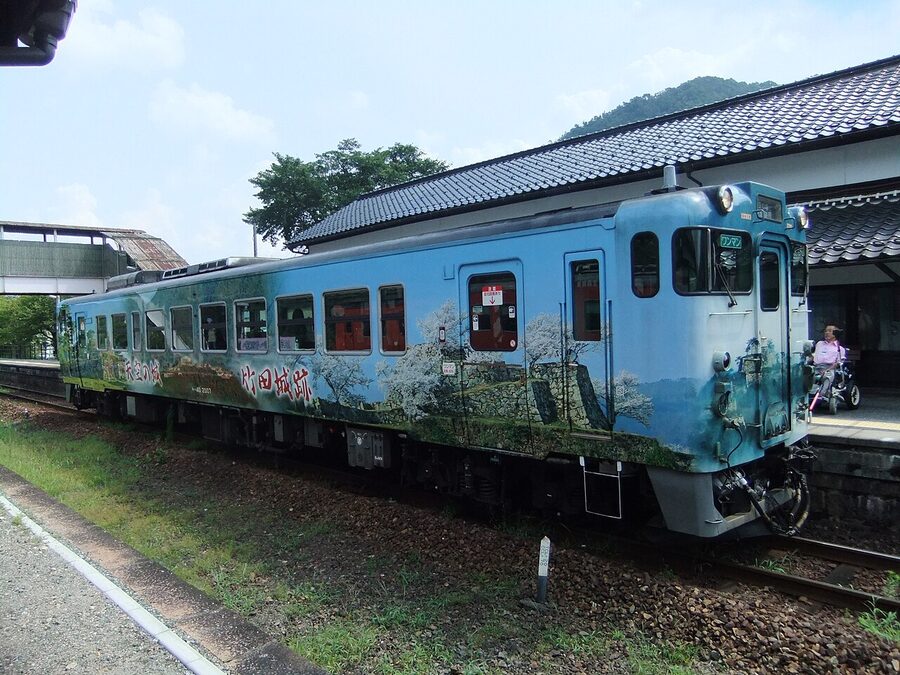
JR Takeda Station is on the Bantan Line, the single-track railway that runs north from Himeji over the watershed to Wadayama. A few of the Hamakaze limited expresses from Osaka and Himeji stop at Takeda, and from Himeji they take a little over an hour; otherwise the local trains take about two, with a change at Teramae. From Kyoto, take the San’in Line to Wadayama and go one stop back down the Bantan Line. Beside the station is the Jōhōkan Tenkū no Shiro, the town’s information centre, with a large model of the castle that is worth ten minutes before you climb.
The climb
The castle keeps seasonal hours. From 1 March to the end of May it is open 8:00–17:00; from 1 June until early December (in 2026, until 6 December) it opens at 5:00 for the cloud season and closes at 17:00; from early December to 3 January it is open 10:00–15:00; and from 4 January to the end of February it is closed altogether. The last entry is half an hour before closing, or an hour before if you come up the south path. Entry is ¥500 for adults, free for junior high school pupils and younger, and the ticket booth takes cash, cards and most transport IC cards.
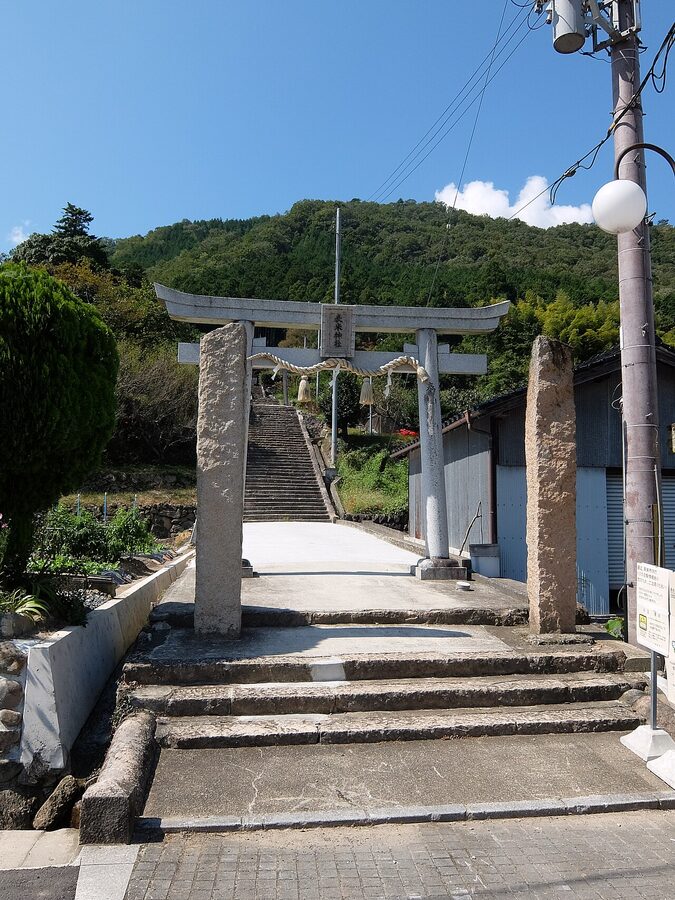
There are four ways up, and they are not equal. The west path is a paved road from the Yamajiro no Sato rest area, about 40 minutes on foot, and it is the only route open in winter. Two steep woodland paths start near the station: one behind the station itself, about 700 metres, which passes the site of Hirohide’s residence, and one from Hyōmai Shrine, which includes 460 stone steps; both were closed in the autumn of 2026 because bears had been seen around Asago, so check before you rely on them. The paved south path, Onisaburō’s road, takes about 50 to 60 minutes from the town.
The Tenkū Bus runs from Takeda Station via Yamajiro no Sato to a stop on the upper slopes, roughly eight times a day from March to November (not in December), with a one-day pass for ¥500. On weekends and holidays in November an early “cloud-sea bus” starts at 4:20 from the town car parks, but only as far as Yamajiro no Sato, for ¥500. Taxis can also take you to the upper stop. However you arrive, the last 900 metres from the stop to the ticket booth are on foot, about 20 minutes, and nobody is excused.
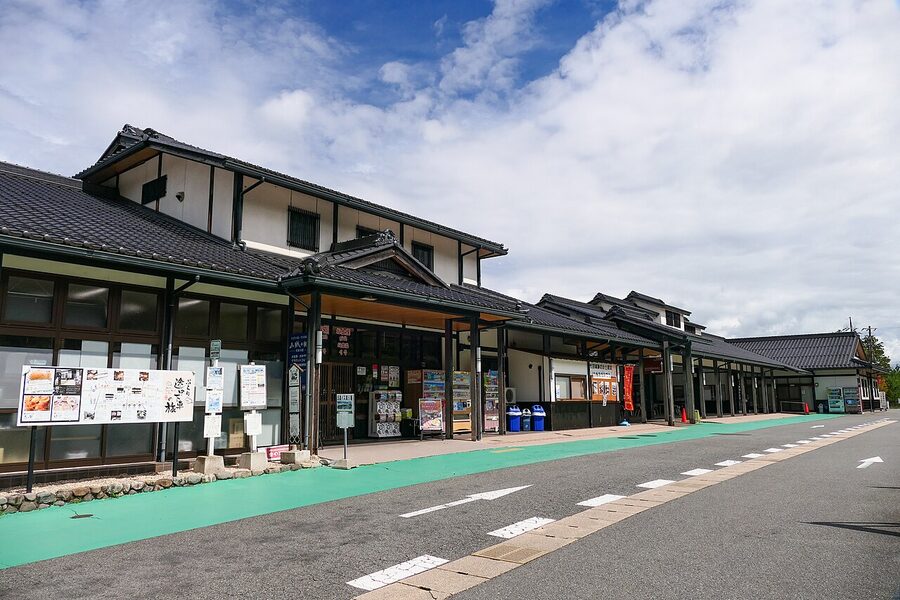
Bring a torch (there are no lights on any path), warm layers, a rain jacket and a drink. The cloud is water, and at dawn in late autumn the summit can drop below freezing. There are no toilets, cafés or shelters inside the walls, so use the facilities at the bottom.
Inside the walls
The route inside is one-way, and you should allow 30 to 60 minutes. You come in through the Ōtemon, the main gate, whose stone passage turns sharply to stop a rush, and out onto the Kita-senjō, the only place you are allowed to eat. From there the route climbs through the third and second baileys, past a staggered gate and up a steep stair built to slow attackers down, to the honmaru and the keep base, then down the southern arm to the Minami-senjō, where the walls bend to give defenders a flanking shot along their faces.
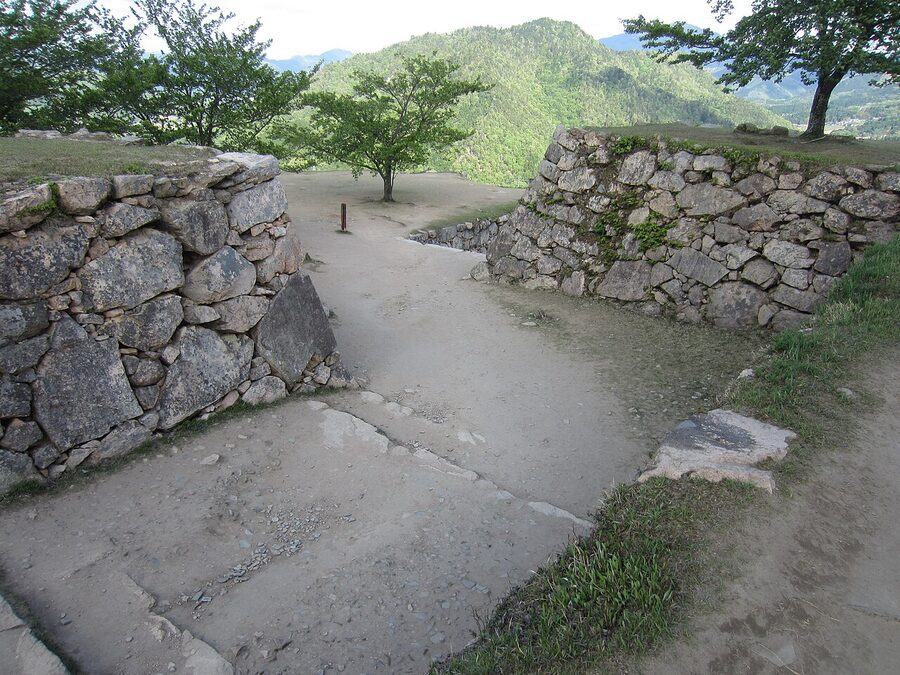
Look for the chisel holes on the split boulders and the wedge stones packed into every joint, and look down: from the honmaru you can see the station, the town and the whole junction the castle was built to watch. And stay on the route. The ropes are there because half a million visitors once found out what happens without them.
Ritsuunkyō for the cloud sea
The famous photograph is not taken from the castle but from Ritsuunkyō (立雲峡), a gorge on the slopes of Asagoyama across the valley to the east. Inside the castle on a cloud morning you are standing in the cloud; from Ritsuunkyō you see the whole ridge sitting on top of it. If you only have one dawn, I would spend it here.
There are three viewpoints, numbered backwards: the third is about five minutes’ walk from the car park, the second about twenty and the first about forty, steep and rough, and the Ritsuunkyō Terrace, opened in 2021, sits a minute above the first. The car park is open round the clock and asks a few hundred yen per adult as an environmental contribution. On foot from Takeda Station it is about 45 minutes, or ten by taxi, and again there are no lights, so bring a torch.
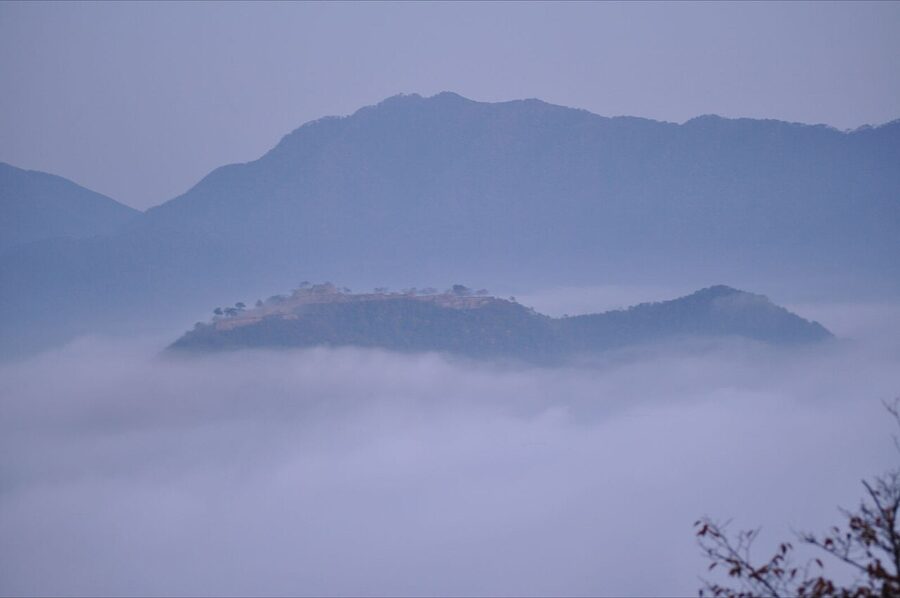
The cloud forms most reliably from September to November, from just before dawn until about eight, on days when the night has been cold, the sky clear and the air still, and when the day will warm by ten degrees or more. Asago’s tourism portal publishes a cheerfully named unofficial cloud-sea forecast, which is a guide rather than a promise. In early April the same slopes fill with mountain cherries, which is why the place is also called the Yoshino of Tajima.
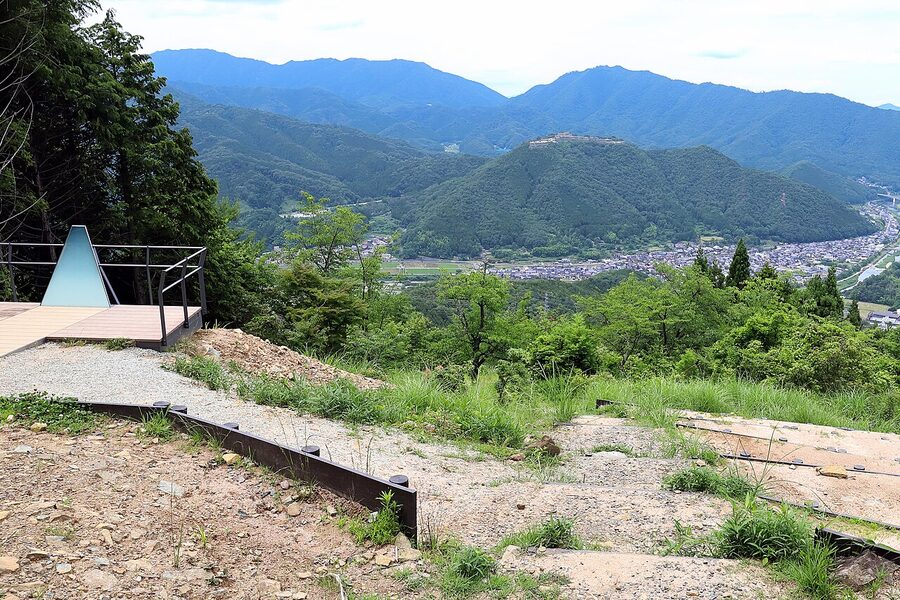
Takeda town
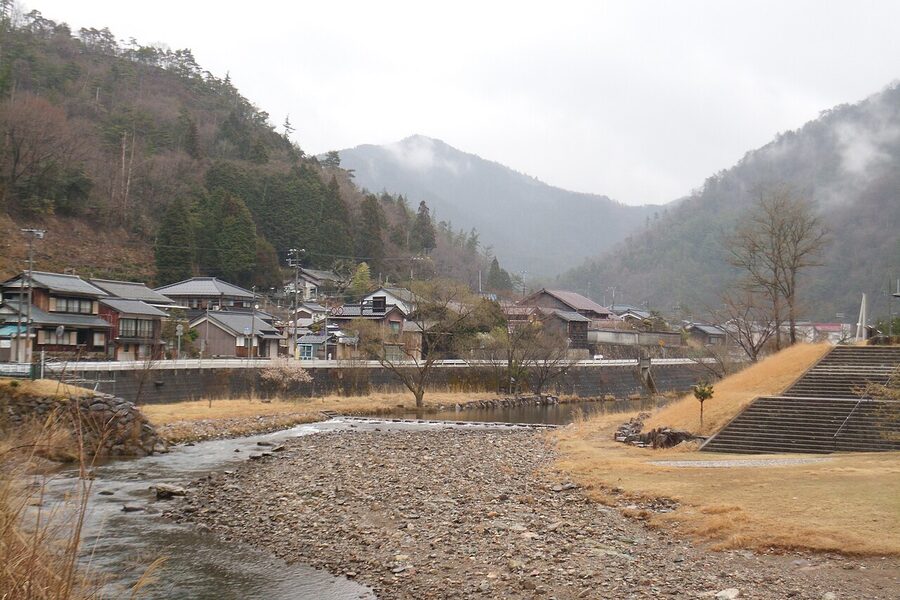
Most people come down the hill and miss the town. The old castle-town street still runs below the ridge, with its temples along the foot of the hill. Hōju-ji was given Hirohide’s land and buildings after his death and keeps a memorial to him, and Jōkō-ji, the Ōtagaki family temple, keeps a stone said to mark Mitsukage, with a date of 1465 cut into it. Between them, two neighbouring temples remember the first lord and the last.
Ikuno Silver Mine
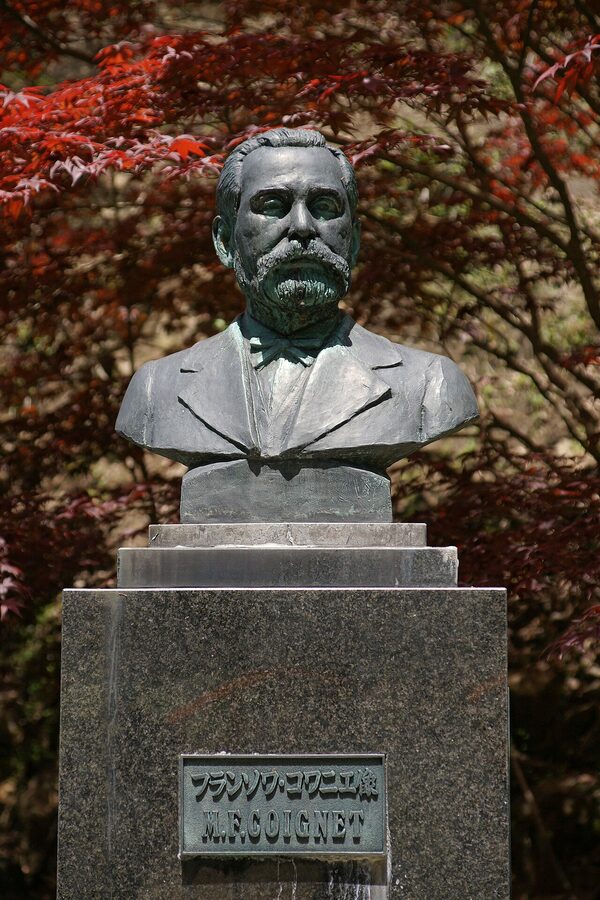
The silver that made Takeda worth fighting for is a short train ride south, at Ikuno, a few stops down the Bantan Line. The mine was taken over by the shogunate after 1600 and was among the richest in the country in the early 17th century; in 1868 it became Japan’s first government-run mine under the new Meiji state, modernised by the French engineer Jean-Francisque Coignet. Mitsubishi bought it in 1896 and closed it on 22 March 1973, by which time the tunnels ran to more than 350 kilometres and 880 metres deep.
Part of it is now open as Shiseki Ikuno Ginzan, a walk through the old tunnels at a steady 13°C all year, so bring a layer even in August. Adult entry is ¥1,200 (¥600 for school pupils), including the mineral museum, and it opens 9:10–17:20 from April to October, with shorter winter hours, Tuesday closures from December to February and last tunnel entry 40 minutes before closing. Ikuno Station is about five kilometres away by taxi.
One thing to know: the operating company is due to wind up after the 2026 financial year and the city plans to run the site itself from April 2027, so check the official site before you go.
Go back up to the walls at the end of the day if you can, when the tour buses have gone and the light is low. The cloud will not be there, but what will be there is the stonework, laid on a hill in the 1590s by the last lord of a beaten family for a ruler who never gave him back his home, and admired four centuries later by people who mostly came for the weather. Kang Hang, who had every reason to hate everyone he met in Japan, found one man here worth a sentence of praise. Stand on the keep base and look east over the town, and give him another.