Somewhere among the gilt plum blossoms on a suit of armour at Kasuga Taisha in Nara, there is a horsefly. There is a bagworm as well, and a spider, chased in high relief in metal and tucked in among the branches and the warblers, so small that you have to be told they are there before you can find them. Nobody who wore this armour into battle would ever have noticed them. Nobody did wear it into battle: it was made in the 14th century as a gift for a god.
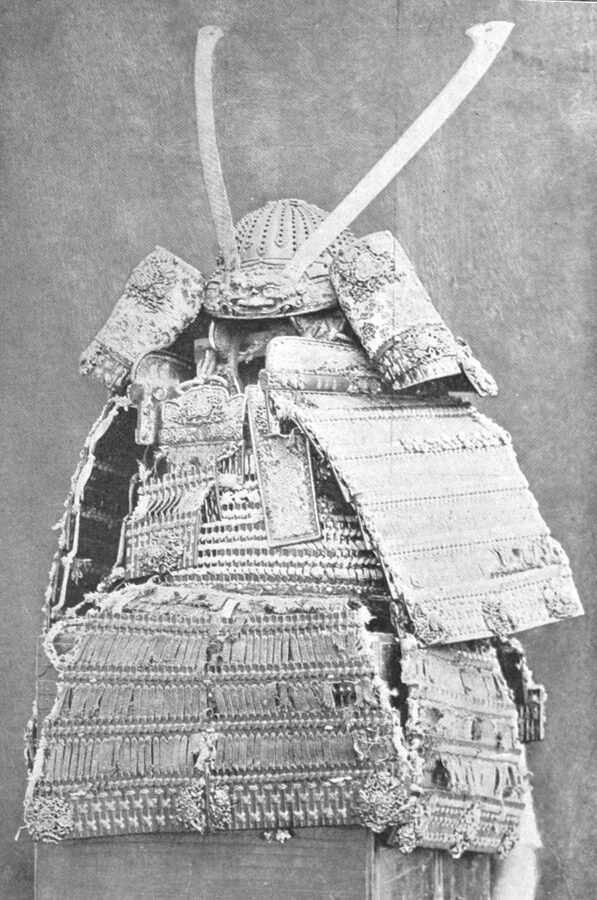
I keep coming back to that horsefly because it settles an argument that runs through the whole history of Japanese armour. The suits people queue to see were very often made for shrines, for display or for the dead, and the suits that stopped bullets tend to be the plain ones at the back of the room. Every piece of Japanese armour designated a National Treasure is one of the old lamellar types, the ō-yoroi (大鎧), the dōmaru (胴丸) and their relatives. Not one is a tōsei gusoku (当世具足), the “modern armour” that most samurai fought and died in through the 16th century.
Some of that is a quirk of the way Japan ranks its cultural properties, which rewards age. But it is also a fair summary of what kacchū (甲冑), armour and helmet, became: a craft that started as engineering and ended close to sculpture, with smiths, lacquerers, silk-braiders and metal-chasers all pulling in slightly different directions. It belongs among Japan’s greatest crafts, though most people have seen it without ever looking closely. Here is how it changed, how a set was made, whose famous sets survive, and where you can stand in front of the real things, or climb into a copy.
In This Article
- Iron in the tombs
- The great armour of the mounted archers
- The foot soldier’s armour wins
- How a set was made
- Guns, spears and the modern armour
- Crests, and the men inside them
- Armour in the long peace
- Afterwards: dolls, films and kendō
- Where to see samurai armour in Japan today
- Ōyamazumi Shrine, Ōmishima
- Kasuga Taisha Museum, Nara
- Musashi Mitake Shrine, western Tokyo
- Tokyo National Museum, Ueno
- Hikone Castle Museum
- Sendai City Museum
- Kacchū Kōbō Marutake, Satsumasendai: watching it made, and trying it on
- The horsefly, again
Iron in the tombs
The first armour in Japan was buried. The great mounded tombs of the 4th to 6th centuries, the kofun that gave the period its name, have given up dozens of iron cuirasses built from bands and triangles of plate, laced with leather at first and riveted from the middle of the 5th century. Archaeologists call them tankō (短甲), “short armour”, because they stop at the waist. They were rigid, heavy and very good at keeping out a blade.
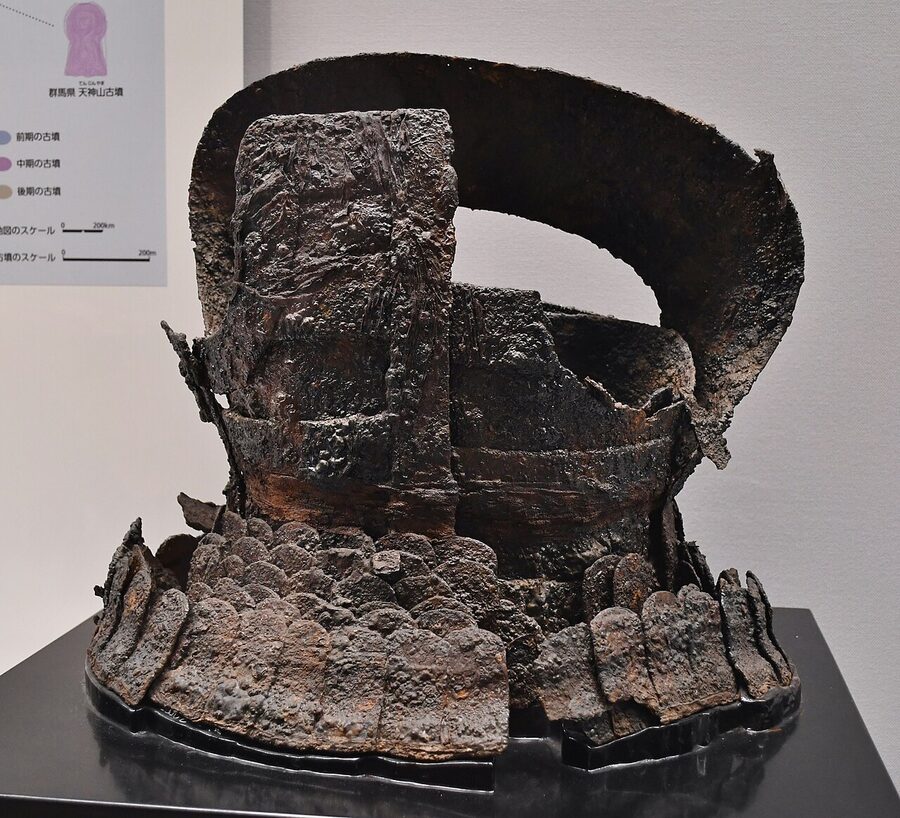
The other early style was made of hundreds of small iron scales tied together in rows, and it came with horse-riding in the 5th century. It flexed. A man could sit a horse in it, and the clay haniwa figures set up round the later tombs show warriors wearing it from cap to shin.
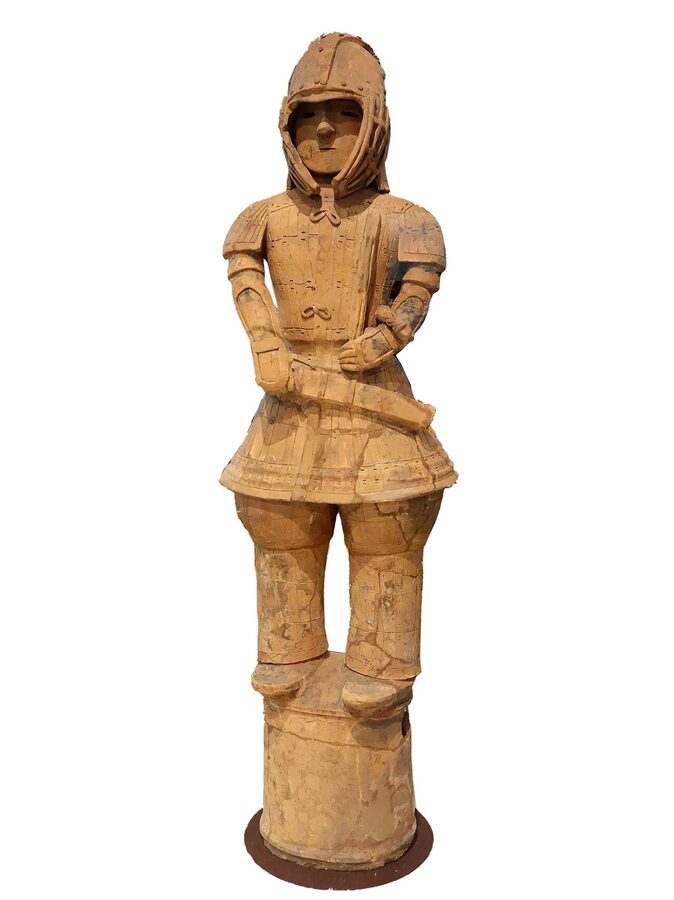
The names are a mess, and Japanese archaeologists know it. “Tankō” and “keikō” (挂甲) are words lifted from 8th-century documents and applied, for convenience, to excavated armour that does not match what those documents describe, and a strong body of Japanese research now prefers plain “plate armour” and “scale armour” for the tomb finds. When the widowed Empress Kōmyō gave her late husband’s possessions to Tōdai-ji in 756, the inventory listed ten tankō and ninety keikō, and not one of them survives.
What does survive is the paperwork. The Engishiki, a 10th-century book of court procedures, sets out exactly what one keikō cost the state: 800 scales and 192 days of work. Of those, 178 days went on the scales alone, forging them, rough-grinding, punching the holes, trimming, chamfering the edges and polishing, and just fourteen were left for lacing, edging and finishing the whole thing.
That ratio is the single most useful fact I know about Japanese armour. For the next six centuries, almost all of the labour in a set sat in the little plates, and almost every change in design was, underneath, an attempt to make fewer of them.
The great armour of the mounted archers
What the warrior of the Heian era wore was something new, and it was his own. The state armouries of the 8th century made kit for conscripts and kept it under lock; the ō-yoroi, which took its basic shape around the 10th century, was private property, made for provincial strongmen who fought from the saddle with a bow. People at the time simply called it yoroi, or by the old honorific kisenaga. “Great armour” is a later name, coined to tell it apart from the lighter types that replaced it.
It was built for one job, which was shooting arrows from a moving horse with your enemy on your left. The body hangs from the shoulders like a box. On foot that is miserable, because the whole weight drags on your collarbones, but in the saddle it settles onto the horse and the rider barely feels it.
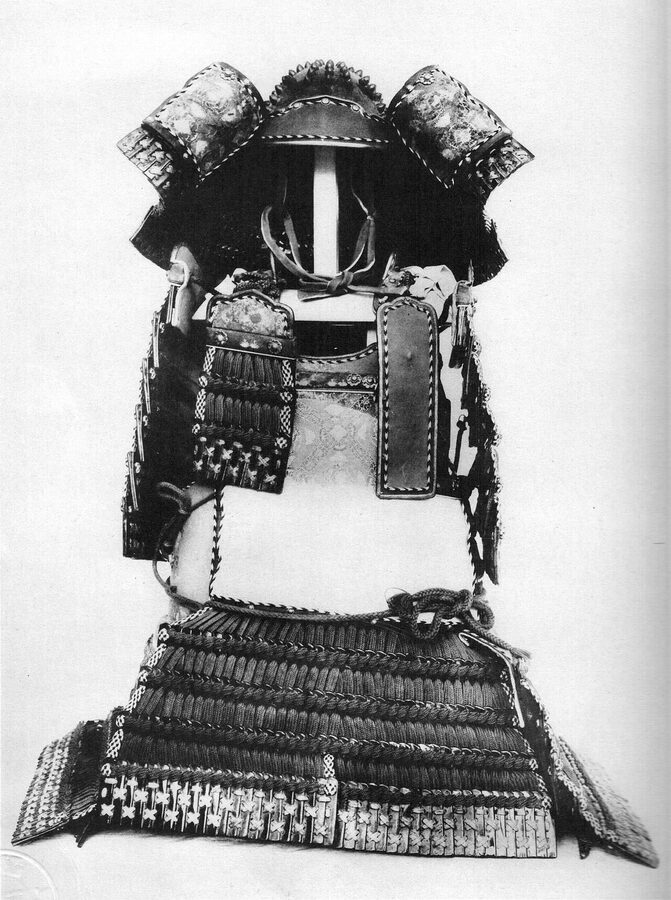
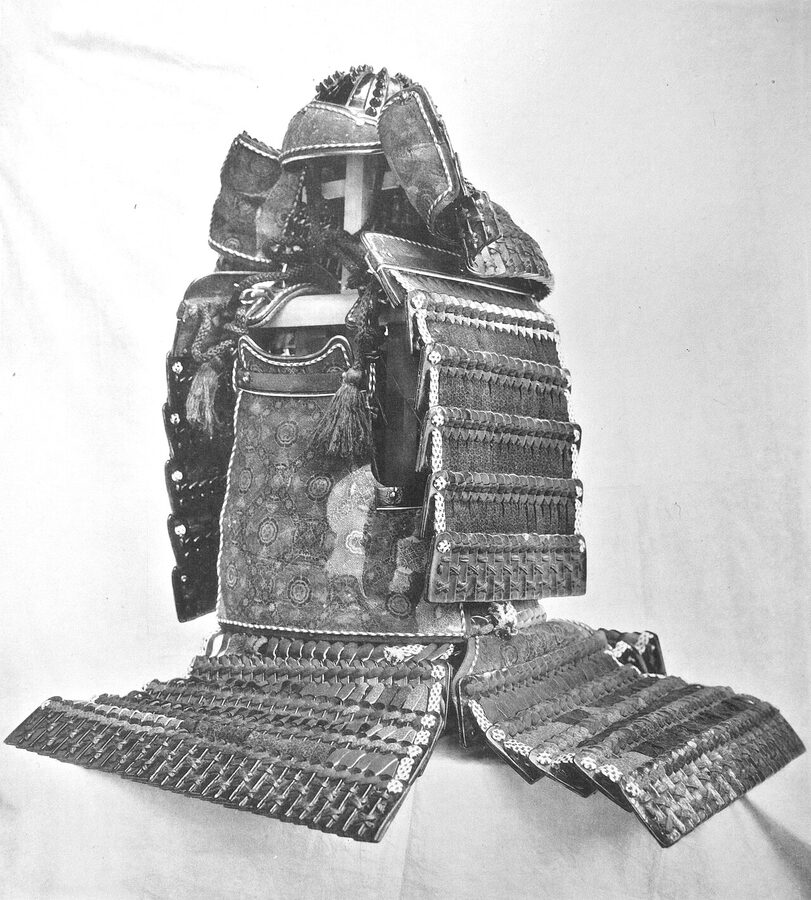
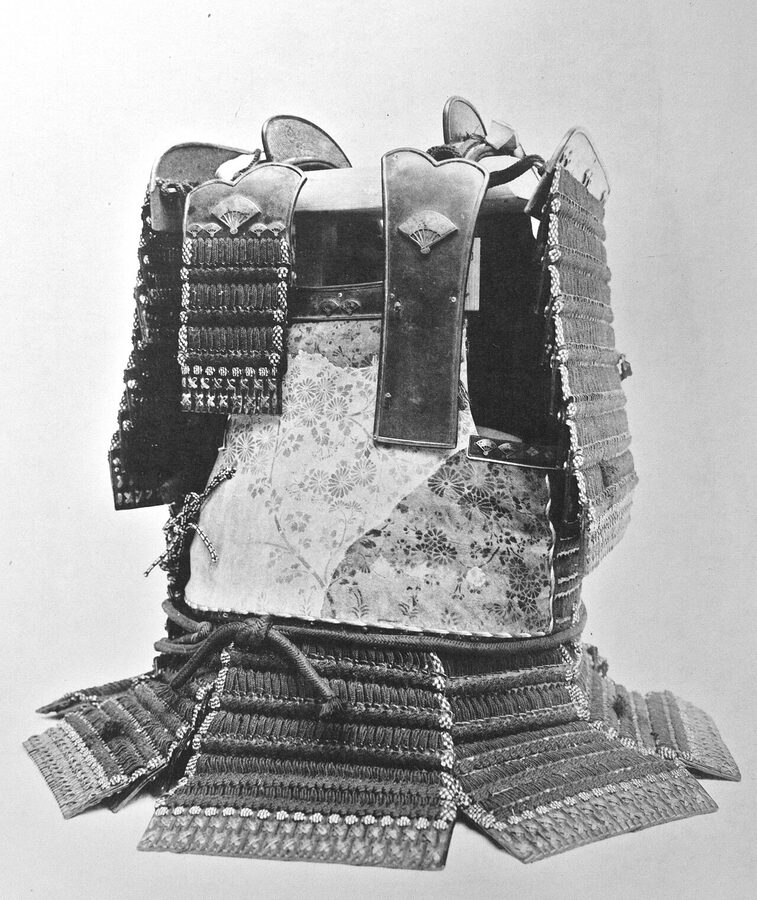
The body wraps the front, the left side and the back in a single piece, and a separate panel, the waidate (脇楯), closes the right. Two big shoulder shields, the ōsode (大袖), hang free so that an arrow sticks in them and goes no further. The left sleeve, which faced the enemy when you drew, was built tougher than the right, and two small boards hang over the armpits, a flexible one on the right that let you bend and draw, and a solid iron one on the left, close to the heart.
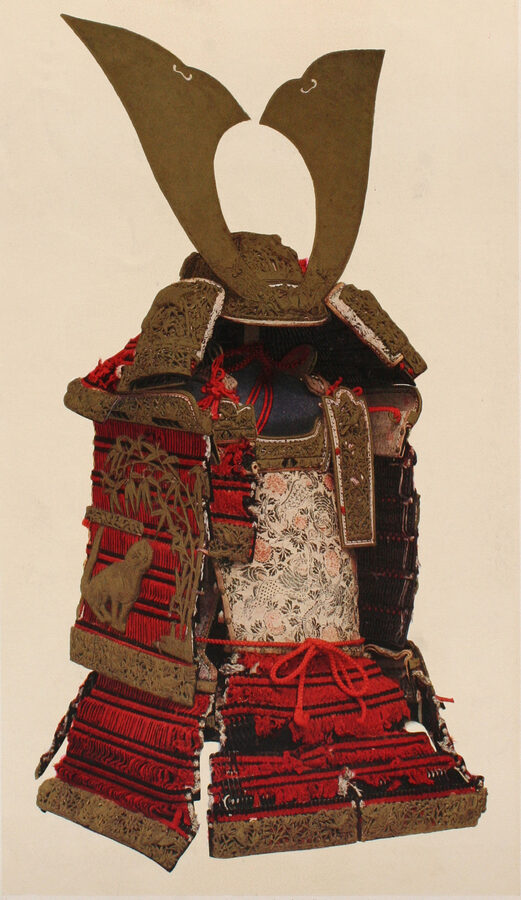
The numbers are what make it real. An ō-yoroi took something like 2,000 scales, more than twice the count of an old keikō, and weighed somewhere between 20 and 30 kg; the 14th-century red-laced ō-yoroi with bamboo, tiger and sparrow fittings at Kasuga Taisha weighs 28.95 kg. Somebody has counted the sparrows on it. There are 98.
To save weight, the makers mixed their scales: iron over the vitals, rawhide everywhere else, a practice Japanese armourers called kanamaze. English-language sources sometimes describe ō-yoroi as iron armour. It was usually more leather than iron, and the leather, boiled, glued and lacquered, was harder than you would think.
The front was faced with a sheet of stencilled deerskin called the tsurubashiri, the “bowstring run”, which is supposed to have kept the bowstring from catching on the scales. Japanese armour scholars have pointed out, a little unkindly, that when you loose an arrow the string passes outside your body and never touches the armour at all. The leather probably kept the front flat and in shape, and it certainly looked good.
The helmet of the period was the hoshi kabuto (星兜), the “star helmet”, a bowl of iron plates riveted together with the rivet heads left proud like a field of stars. At its crown was a hole four or five centimetres across, the tehen, through which a warrior pulled his topknot along with the soft cap he wore under the bowl. The Heike Monogatari warns its readers not to let anyone shoot an arrow through it.
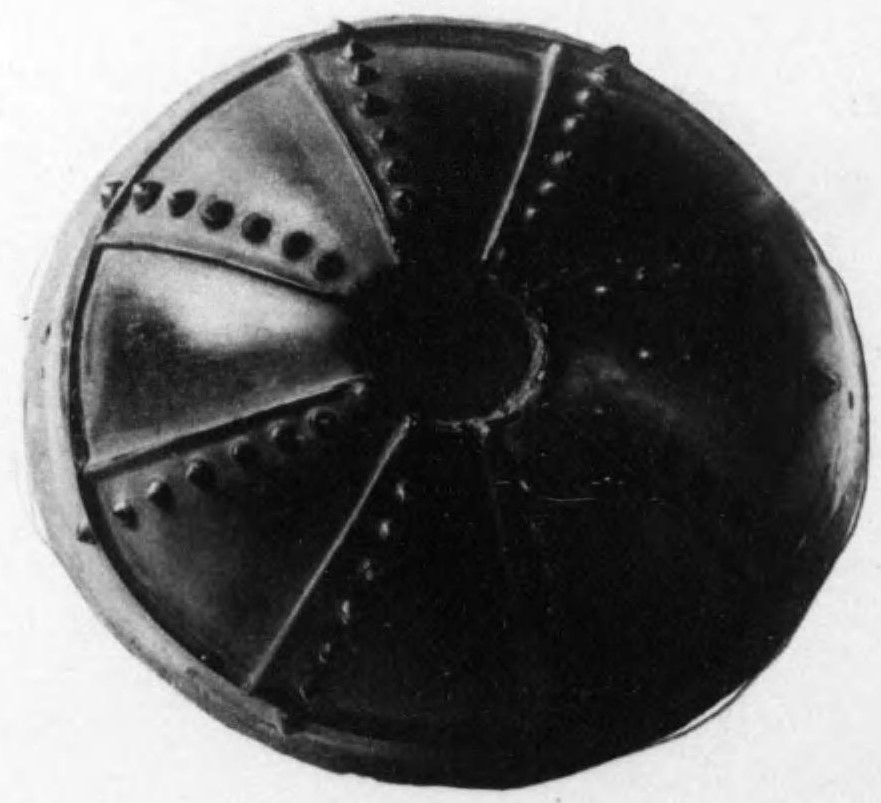
The flaps that turn back on either side of the face, the fukigaeshi, were there to deflect arrows aimed at the face, the open “inner helmet” that archers were taught to aim for. The pair of gilt horns on the brow, the kuwagata, gave their name to the stag beetle, kuwagatamushi, and not the other way round.
This is the armour of the Genpei War of 1180 to 1185, and Japanese scholars generally agree that it was then, at the end of the Heian, that the craft reached its peak. It is also the armour of the war tales, which are very interested in clothes. The Heike Monogatari tells you the colour of a man’s lacing before it tells you whether he survived, and it dresses Minamoto no Yoshitsune in lacing of purple deepening towards the hem.
The same tales carry Tomoe Gozen into battle in kit of this kind. With it went a long curved tachi slung edge-down from the belt, a weapon with its own story, which I have told in the piece on Japanese swords.
There is a word in modern Japanese that may come from the sound of all this. Bibiru, to lose your nerve, is said to derive from the noise made by masses of armoured men on the move in the late Heian, the scales rattling together, though the big Japanese historical dictionary cannot find the “losing your nerve” sense in writing before 1680. I would like it to be true.
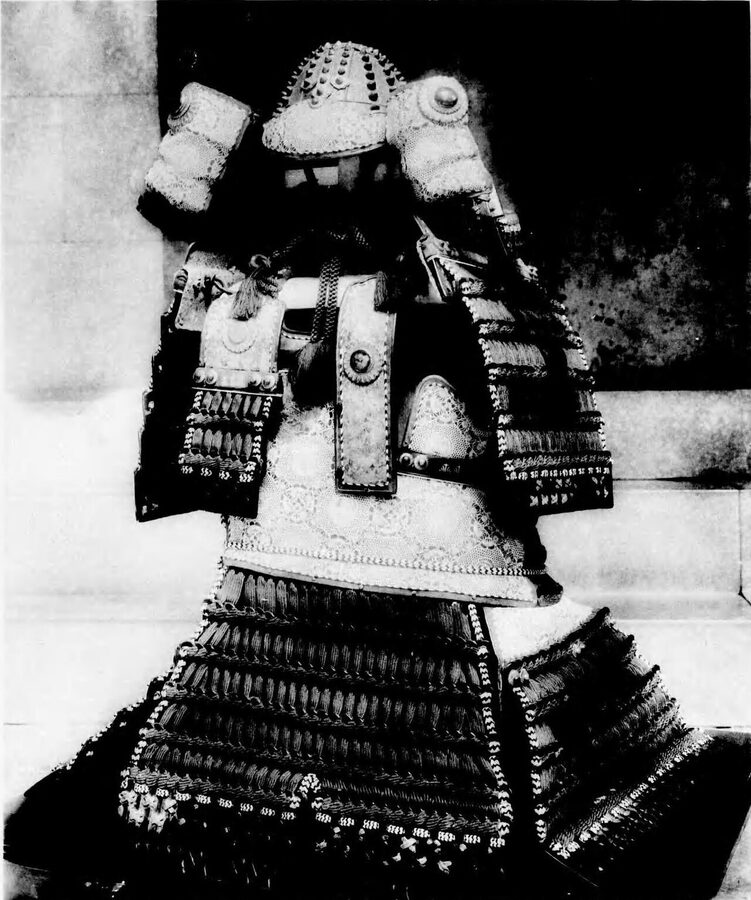
The survivors tell you something about survival. Most of the ō-yoroi left in Japan were gifts to shrines, made or dedicated to thank a god for a victory or to ask for one, and kept in shrine storehouses ever since. Both the Taira and the Minamoto gave armour to Ōyamazumi Shrine on its island in the Inland Sea, and it is because of that habit that the shrine holds the largest collection of old armour in the country. The suits that went to war were mostly re-laced, cut down, cannibalised for parts or lost.
The foot soldier’s armour wins
The men who ran alongside the horses wore something lighter. The dōmaru appeared around the middle of the Heian era as armour for men on foot: it wraps round the body and closes under the right arm, and its skirt is cut into eight panels so that you can walk, where the ō-yoroi had four. There are no big shoulder shields, only a pair of small iron leaves at the shoulders. In the Kamakura era an even simpler haraate appeared, which covered the front of the body and nothing else, and later the haramaki, which closed at the back.
Here the vocabulary goes wrong in a way I find rather delightful. The armour now called a dōmaru was, in its own time, called a haramaki, and the reverse, and somewhere between the late Muromachi and the early Edo the two names swapped. Sources variously treat this as settled fact or as a strong theory, and museum labels all follow the modern, swapped usage, so there is nothing to be done about it except know.
What changed the balance was the Mongols. After the invasions of 1274 and 1281, fighting in Japan moved away from duels between mounted archers and towards close combat, and the ō-yoroi began to change shape, pulling in at the waist so that the hips could take some of the load. By the end of the Kamakura era, senior warriors increasingly wore a dōmaru with a helmet and sleeves added, and the great armour was becoming what it would remain: the most formal thing a samurai could own, and something to give to a shrine.
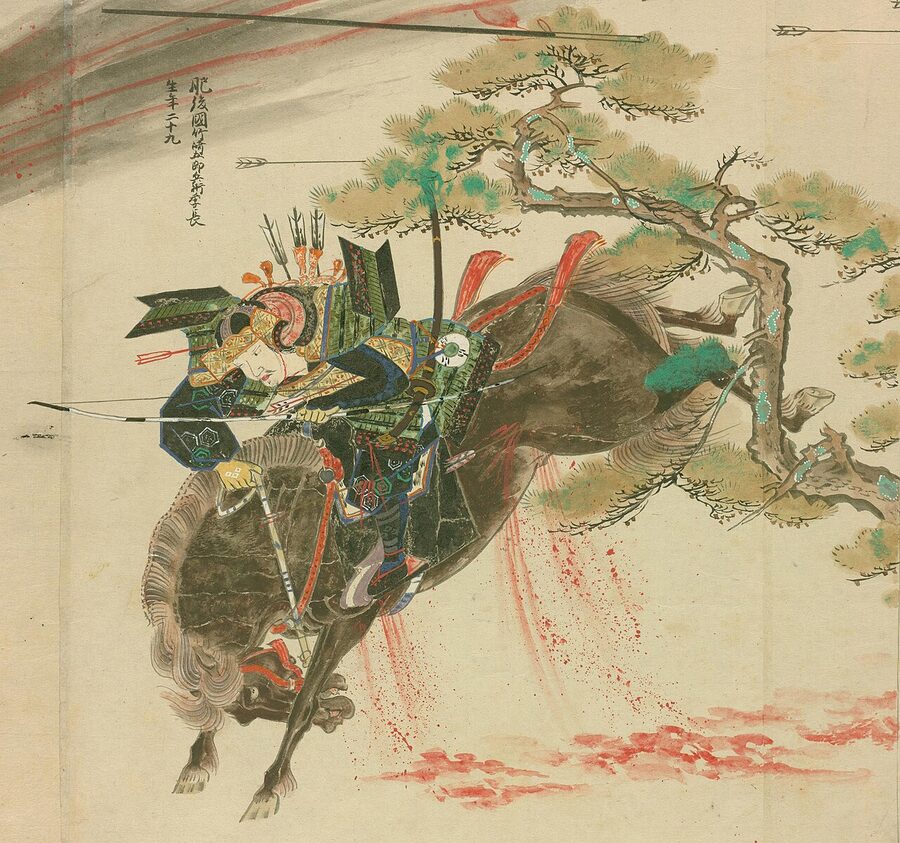

The wars between the two imperial courts in the 14th century were often fought in the mountains, on foot, by large numbers of men, and the haramaki spread with them. Senior samurai took it up too and bolted on everything the old armour had lacked: helmet, face mask, armoured sleeves, thigh guards and a back plate. The Muromachi era that followed is sometimes called, by Japanese specialists, the age of the dōmaru and the haramaki.
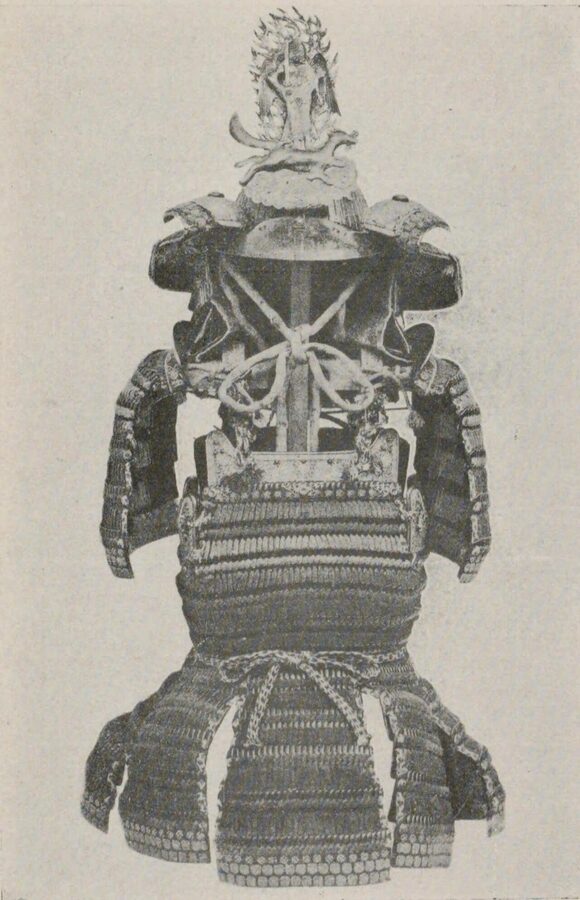
The great change of the Muromachi period was in production. The traditional scale, the honkozane (本小札), overlapped its neighbour by half, and the lacing, called kebiki, was packed so tightly that it hid the scales completely. The new iyozane (伊予札) overlapped by only a quarter, and the new sugake (素懸) lacing ran two cords at intervals with bare lacquer between them. Both meant far fewer scales and far less silk.
The scales themselves shrank. In the late Heian they were three to five centimetres wide, and by the Muromachi era about one and a half. Armourers worked to their own private measuring stick, the takabakari, about 15 per cent longer than the carpenter’s foot, which tells you that the trade had settled into standard parts and a division of labour. And towards the end of the Muromachi period, for the first time, armourers began to sign their work, cutting their names into the iron of the helmet bowl.
How a set was made
In the mid-1930s an armourer called Onoda Mitsuhiko made a copy of the navy-laced ō-yoroi at Ōyamazumi, and somebody photographed him at work, sitting on the floor. I like the picture because it shows that the method had barely moved in eight centuries.
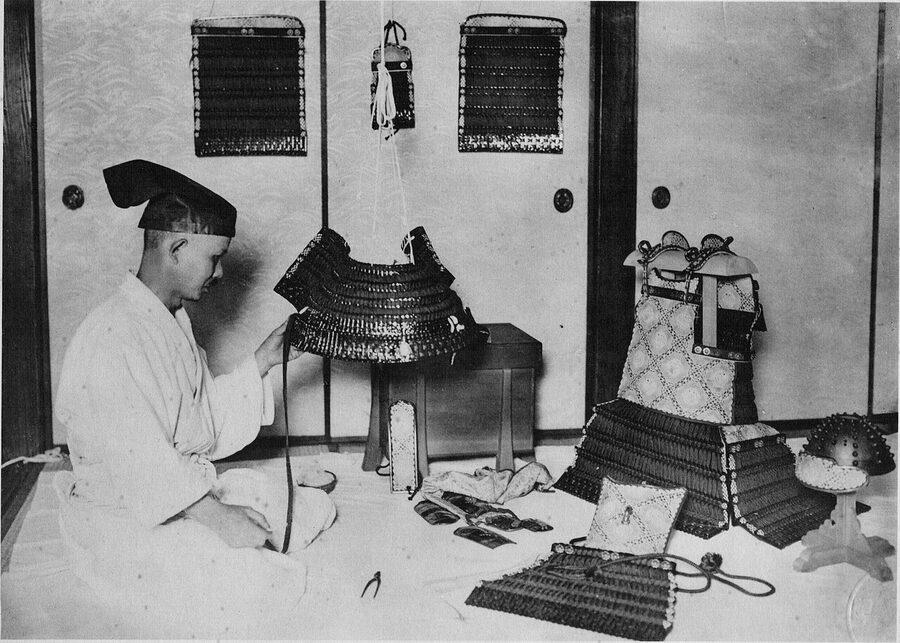
You start with the scales. Each kozane (小札) is a narrow strip of iron or hardened rawhide, punched with two or three columns of holes. In the classic method, a row of scales was laced together sideways, the row was then lacquered into a single stiff strip, and the strips were hung one below another on coloured cords. The lacquer mattered more than most people realise.
Japanese lacquer, made from the sap of the urushi tree, only hardens in warm, humid air. That is why lacquerware grew up in Japan and the Ryukyus and not in the dry West, and why Japanese writers argue that this armour could only have developed where it did. In a wet climate, the lacquer was also all that stood between the iron and rust.
The lacing is called odoshi, a word usually derived from o-tōsu, “to pass the cord through”, and it is where the colour and the names come from. A navy silk lacing gives you a kon’ito-odoshi, red gives akaito-odoshi, and a gradation from pale to dark gives nioi-odoshi. An ō-yoroi could take up to 300 metres of braid.
The braid was kumihimo, plaited silk, and noble families had their own patterns and colours made to order, sometimes from well over a hundred strands per cord. Making enough for one set could take months.
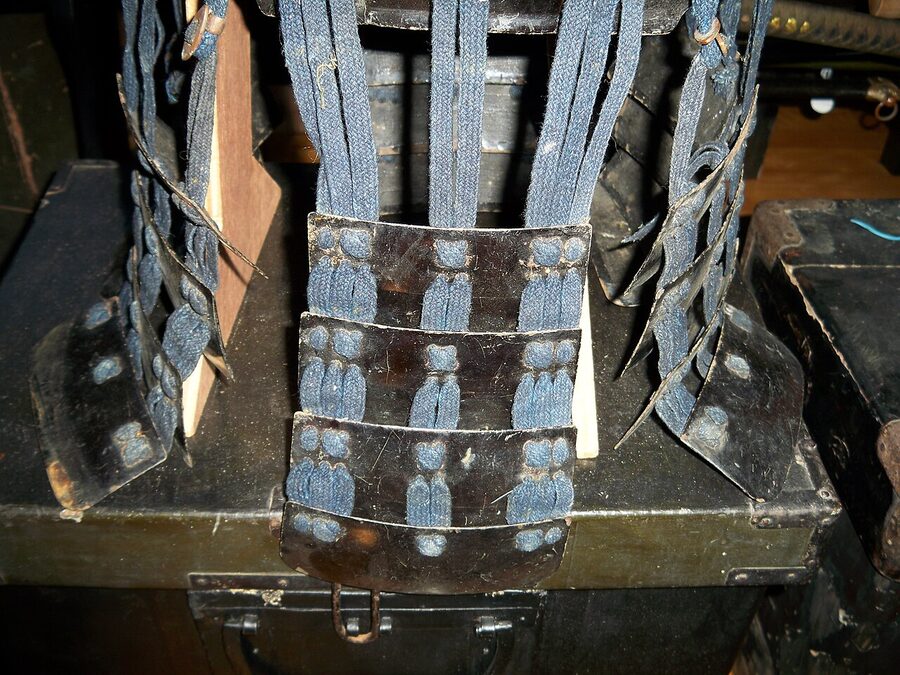
The leather facings were egawa (絵韋), deerskin with a stencilled pattern: diagonal lattices, lions, sometimes the fierce Buddhist guardian Fudō Myōō. The old way of making them was to lay a cut-paper stencil on the hide, tread it in with your feet so that the pattern stood up, and brush dye onto the raised parts. Then came the metalwork: gilt copper fittings worked as chrysanthemums, butterflies, fans and wheels, and on the very best armour, horseflies among the plum blossom.
Who did all this changed over time. In the late Heian, Japanese archaeologists think, scales were often forged in ordinary village smithies that also turned out farm tools, and then carried somewhere else to be punched, polished, lacquered and laced. Twelve scales of the late 11th or early 12th century turned up at the Nishinoya smithy site in what is now Yokohama, made from iron ore rather than iron sand. Until then, the scales of the great armour had been assumed to come from workshops around Kyoto; eastern Japan, it turned out, was making them too.
By the Kamakura era there was a cluster of armourers in Kyoto near Rokuhara, the shogunate’s Kyoto office. A picture-scroll of poetry contests between artisans, made around 1500, calls the armourer a yoroi zaiku and shows him hanging up a left sleeve and binding it with leather cord. Later the trade split in two: the shitaji no ie, descended from the smiths who made horses’ bits, forged the iron parts, and the shitate no ie assembled and laced the finished armour.
The most famous name in the trade belonged at first to the iron side. The Myōchin family’s own legend says that their founder presented armour and a horse’s bit to Emperor Konoe in the middle of the 12th century and was told it was “bright as a jewel, a rare thing”, myō and chin. The story is a family legend. The family itself is real, and in the 16th century its seventeenth master, Myōchin Nobuie, was called the finest armourer in Japan.
Nobuie was best known for ridged helmets of many plates, and tradition says he took the “Nobu” in his name from Takeda Harunobu, better known as Takeda Shingen. The white yak-hair Suwa Hosshō helmet that Shingen is supposed to have worn is attributed to him as well. Several helmets claim to be the one; the version handed down in the Moriya family, hereditary priests at Suwa Taisha, is on show at the Suwa Lake museum in Shimosuwa.
Guns, spears and the modern armour
The Portuguese matchlock reached Tanegashima in 1543, and within a generation Japanese smiths were making it in thousands. At the same time, armies grew from hundreds to tens of thousands of men, most of them foot soldiers with long spears. The Sengoku era needed armour that could stop a ball, could be made fast and cheaply, and could be worn by an ashigaru who would never sit on a horse.
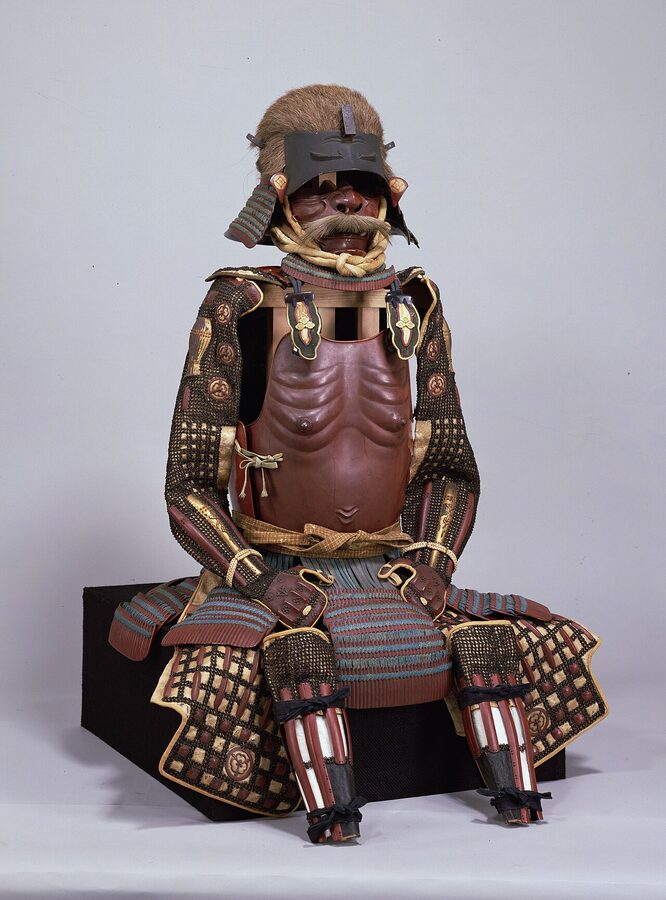
The answer was the tōsei gusoku. Tōsei means “of the present day”, and gusoku means something like “fully equipped”, a matching set of body, helmet and all the smaller pieces made to go together. The old styles became, by contrast, mukashi gusoku: the gear of the old days.
The key change was the itazane (板札), a single plate the width of a whole row of scales. Make the body of plates and you can make it of iron, which stops a ball far better, and you can make it quickly. But a body of plates cannot flex, so it had to open, and the gusoku body was cut into two to six sections joined with hinges, most often two or five, closing on the right like the old dōmaru.
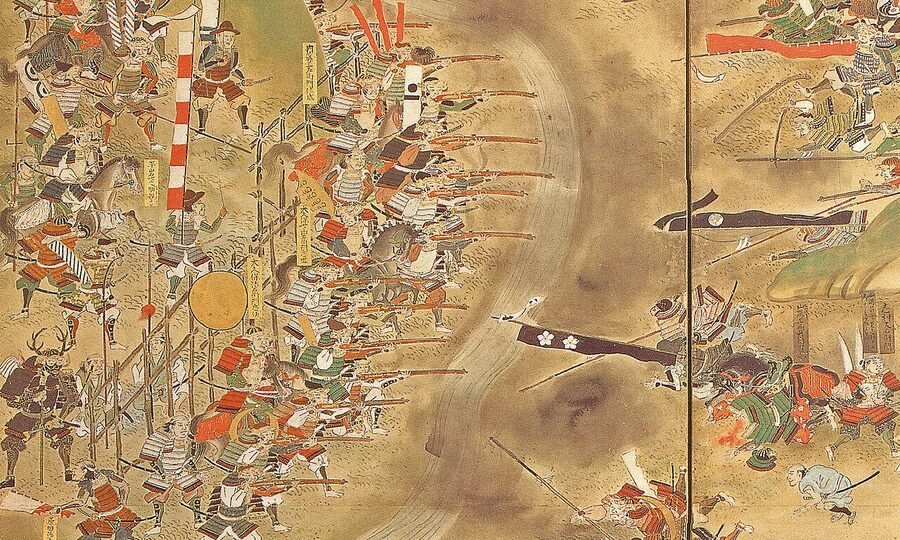
The battle that is supposed to have shown what guns could do is Nagashino in 1575, where the matchlocks of Oda Nobunaga and Tokugawa Ieyasu, firing from behind a wooden palisade, broke the Takeda. The armourers’ answer was to test their work. A tameshi gusoku, a “tested” armour, was one that had been shot at to prove it, and the dent was left in the iron as a guarantee. On some later breastplates, made under less pressure, the makers simply chiselled fake bullet marks into the iron for the look of the thing.
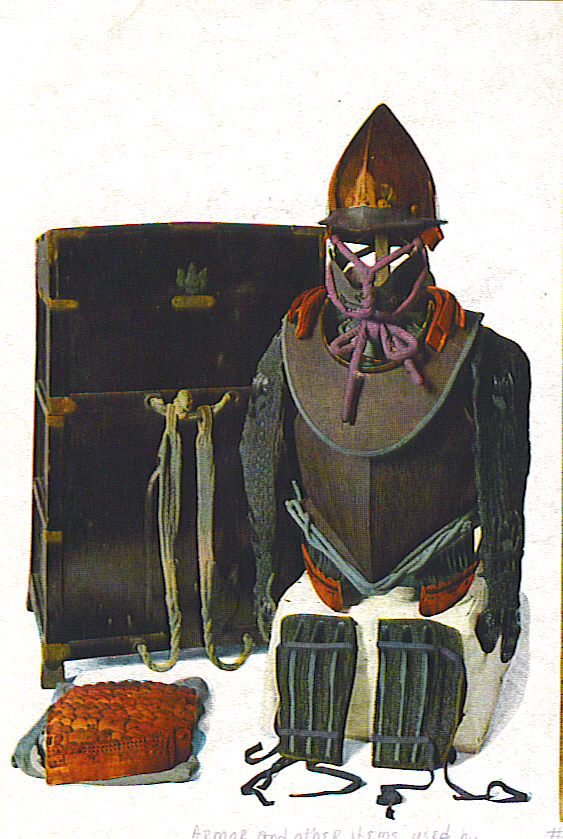
Some armours were partly European. The nanban-dō (南蛮胴), “southern barbarian cuirass”, was a European breastplate converted for Japanese use, with a Japanese skirt, sleeves and smaller pieces added. The imported cuirasses were mostly ships’ armour, made without arm and leg defences, and they had been made to measure for European bodies, which meant nobody in Japan could wear the whole suit as it came.
Sources variously give the first nanban armour in Japan. English-language accounts often start with a set Ieyasu gave to Sakakibara Yasumasa just before Sekigahara in 1600. Japanese scholarship points to armour listed among gifts sent to Toyotomi Hideyoshi by the Portuguese viceroy at Goa in 1588, the first documented arrival, while agreeing that the first recorded use is the armour salvaged from the Dutch ship Liefde, which drifted ashore in 1600 with William Adams aboard.
Ieyasu kept some of the Liefde armour, gave pieces to Sakakibara and other retainers, and gave a European helmet to Kuroda Nagamasa, and it was worn at the Battle of Sekigahara later that year. The picture you may have of Nobunaga in a European breastplate and a red cape is a different matter. As far as anyone can tell, it comes from Kurosawa Akira’s film Kagemusha of 1980, and there is no record of Nobunaga wearing anything of the kind.
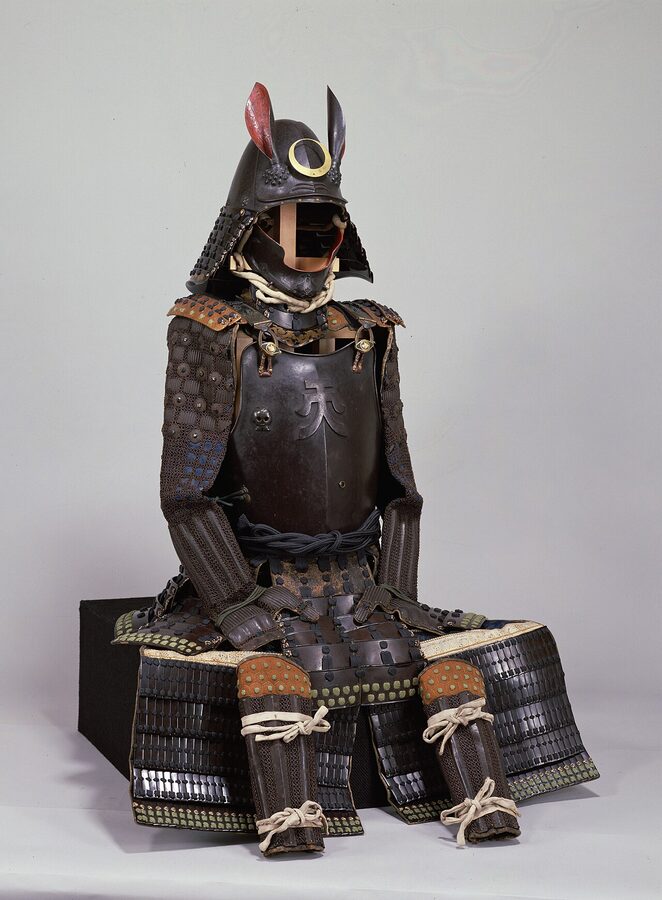
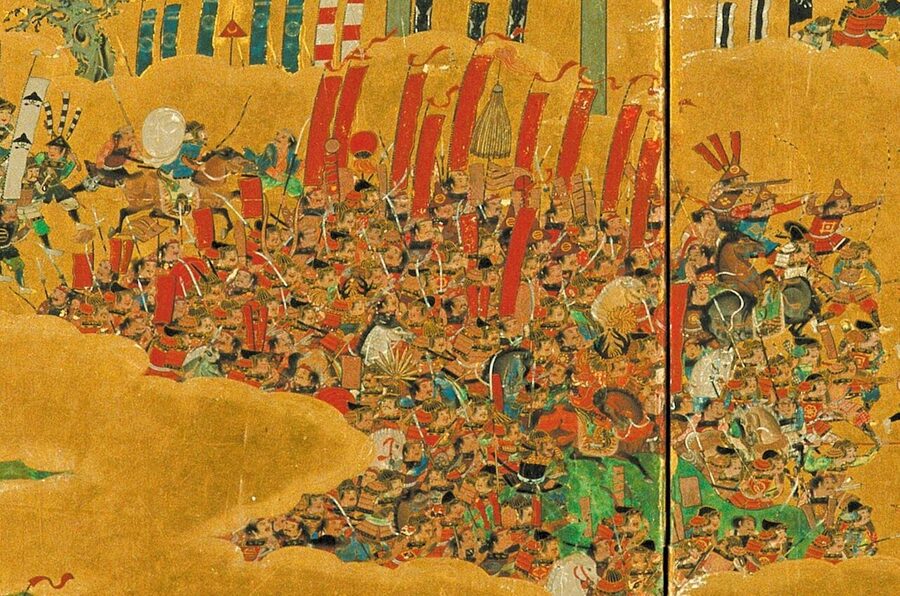
With the body simplified, armies could put whole units into matching kit. Date Masamune dressed his army, from himself down to the foot soldiers, in black-lacquered five-plate bodies of the type called Sendai-dō. The Takeda, and after them the Ii and the Sanada, dressed their best troops entirely in red. On a battlefield of tens of thousands, the colour of a unit’s armour told you whose men they were from a kilometre away.
Crests, and the men inside them
Once the body was plain and quick to make, in the Azuchi-Momoyama years above all, the effort, the money and the vanity went into the helmet. In the medieval period the only crest that mattered was the pair of horns, but in the 16th century crests became names that could be read across a field: characters, family badges, moons, suns, antlers, fans of spikes. Some of the strangest helmets were built up on an iron bowl in lacquered paper, wood and leather, and crests were made to snap off under a heavy blow so that the force did not travel down into the wearer’s neck.
The Japanese word for these is kawari kabuto (変わり兜), “unusual helmets”, and they are where you can most easily see the personalities of the men on any list of Japan’s greatest samurai. The Japanese phrase kabuto o nugu, “to take off your helmet”, still means to admit defeat.
Date Masamune wore a black-lacquered five-plate body under a helmet with a gold crescent moon. The crescent is not symmetrical. Its right horn is shorter than its left, Japanese sources say so that it would not foul his sword arm, and his successors as lords of Sendai went on wearing armour of exactly the same pattern for generations.
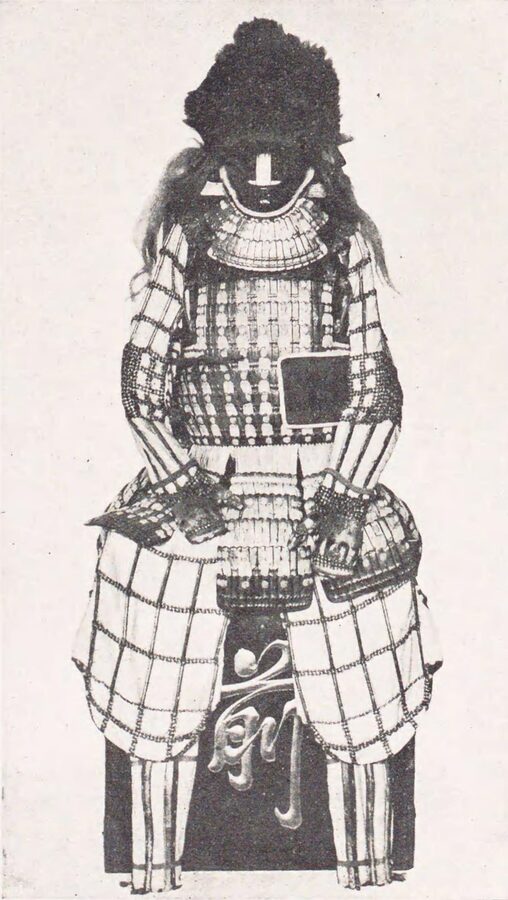
Ii Naomasa got his red armour as a gift of men. When the Takeda fell in 1582, Ieyasu assigned him around 120 former Takeda retainers, some of them veterans of Yamagata Masakage’s red-armoured unit, and told him to put his whole command into red. They first fought as a unit at Komaki and Nagakute in 1584, and the “red devils of Ii” were feared from then on. Naomasa himself was slightly built and, by one account, had the face of a boy, and he went to war under a helmet with towering gilt horns.
The red came from cinnabar, which was expensive, and that was part of the point. The Ii kept the red as their uniform until the end of the Edo period. It worked against them in 1866, when Hikone troops in red armour carrying matchlocks met Chōshū riflemen with Minié rifles during the second expedition against Chōshū: the red made them easy targets even at night, and they threw off their armour and ran.
Sanada Yukimura, properly Sanada Nobushige, put his men into red for the last stand of the Toyotomi at Osaka in 1615. They broke into Ieyasu’s own headquarters, and the Shimazu records called him the finest warrior in Japan. The Sanada were not new to red: in 1593 his elder brother had told his retainers to turn out “in red as always”.
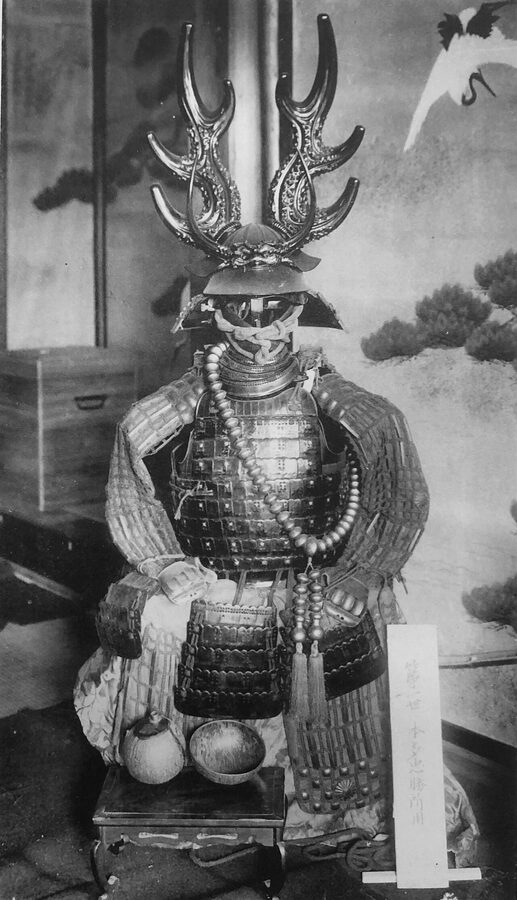
Honda Tadakatsu wore a black-laced gusoku and a helmet with deer antlers, and the antlers were not antler at all but layers of washi paper glued together and lacquered black. He liked light armour he could move in, and he is said to have worn a great Buddhist rosary over it to pray for the men he had killed. After the fighting at Hitokotozaka in 1572, a prelude to Mikatagahara, a Takeda officer posted a verse saying that Ieyasu had two things too good for him: a Chinese yak-tail crest, and Honda Heihachi.
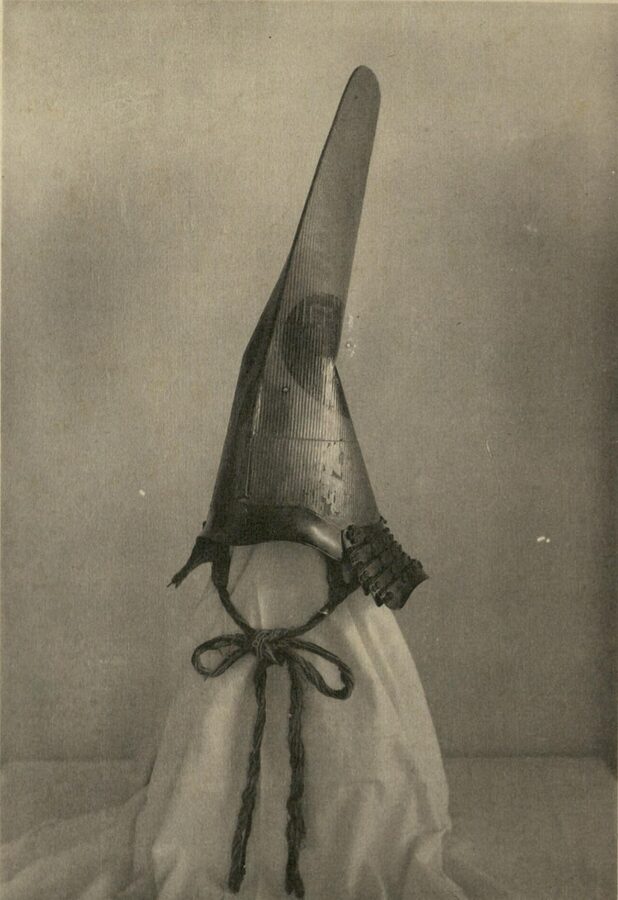
Katō Kiyomasa is said to have stood six shaku three sun, around 190 cm, and he wore a tall helmet in the shape of a court official’s hat which made him look taller still. It is supposed to be the one he wore at the siege of Ulsan in Korea. When he died in 1611 he is said to have been buried in his armour, in a stone coffin packed with cinnabar.
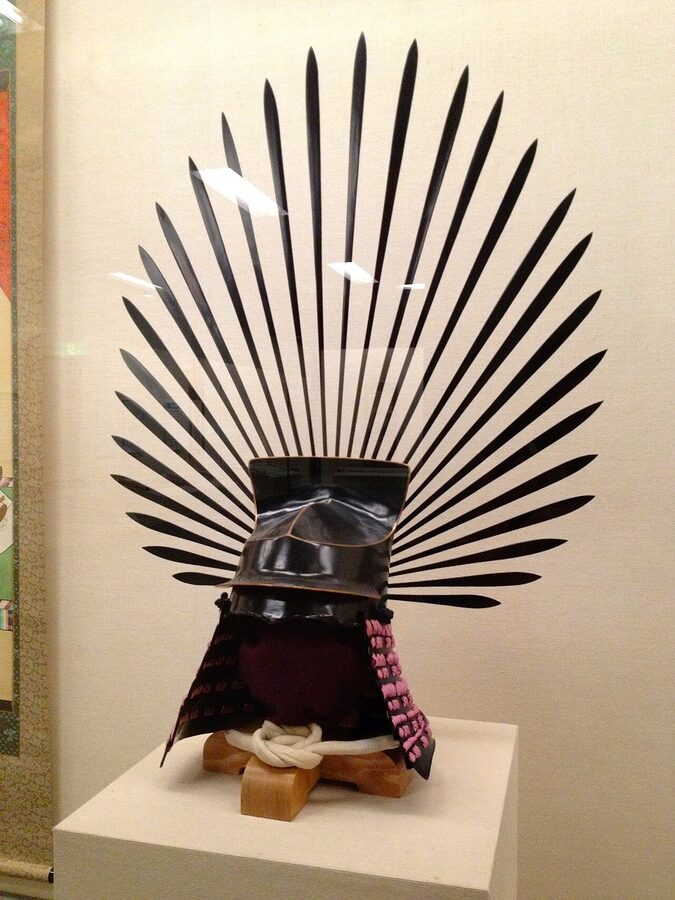
Toyotomi Hideyoshi, who had started with nothing and dressed accordingly once he had everything, went for the theatrical. His best-known helmets are one shaped like a Chinese official’s cap and one with a great sunburst of spikes rising from the back like iris leaves. He gave the latter away in 1587, during his campaign in Kyushu, to a retainer of Gamō Ujisato.
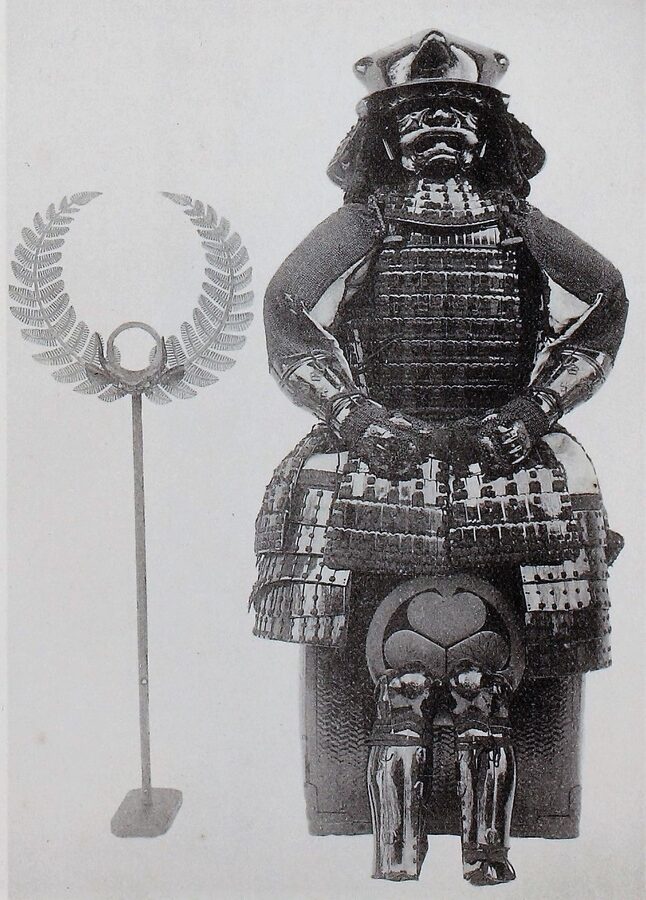
Ieyasu owned dozens of suits, and they are now spread between Kunōzan Tōshō-gū, Nikkō Tōshō-gū, Kishū Tōshō-gū, the Tokugawa Art Museum, the Tokugawa Museum in Mito and the Tokyo National Museum. The most famous is the “fern armour”, which a legend says he had made after dreaming of the god Daikokuten on the eve of Sekigahara. He is said to have worn it at Osaka.
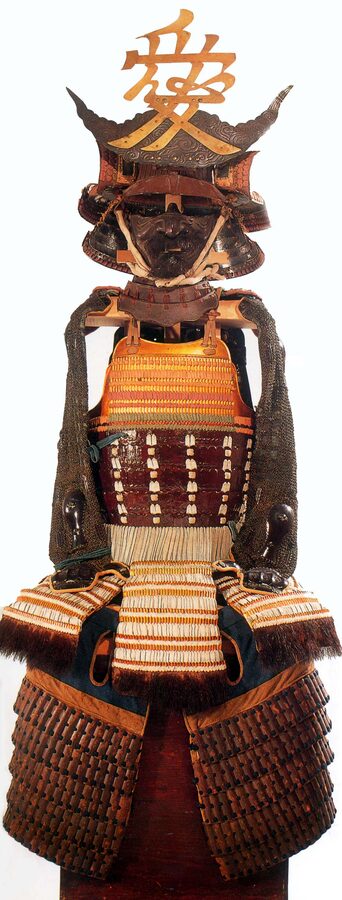
Naoe Kanetsugu, chief retainer to Kenshin’s heir Uesugi Kagekatsu, wore a helmet with a single character as its crest: 愛, ai. In modern Japanese it means love, which has made the helmet very popular with tourists. Sources variously connect it with Aizen Myōō, a Buddhist deity often prayed to by warriors, or with the war god of Mount Atago. The modern reading is almost certainly wrong.
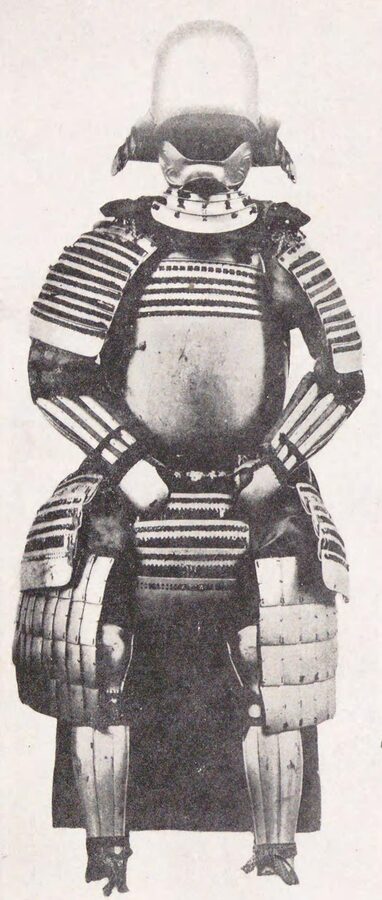
Two more are worth knowing. Maeda Toshiie is said to have worn a gold-scaled, white-laced dōmaru gusoku at the defence of Suemori in 1584, a set that shows the old armour turning into the new, and Japanese sources note that his battle helmet was a scaled-down version of the one he wore on the march. Hosokawa Tadaoki went the other way, with a deliberately plain, practical style that became the Hosokawa house pattern.
Armour in the long peace
After the fall of Osaka in 1615, the Tokugawa declared the end of war, and they meant it. Demand for armour peaked in the Keichō years around 1600 and then fell off a cliff. In 1634 the third shogun, Tokugawa Iemitsu, banned the export of Japanese arms and armour from Nagasaki, so even the foreign market was closed.
The armour that went on being made through the Edo era was for display: for the family’s dignity, for processions, for the alcove. In the Genroku years around 1700 it picked up pieces nobody needed and lacquer pictures nobody would have taken into a fight. Then, from the middle of the 18th century, fashion swung back to the medieval, after scholars such as Arai Hakuseki and Ise Sadatake studied the old styles, and armourers began making ō-yoroi again.
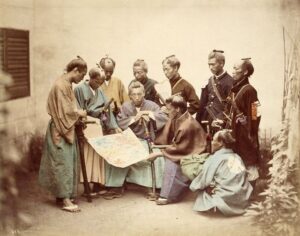
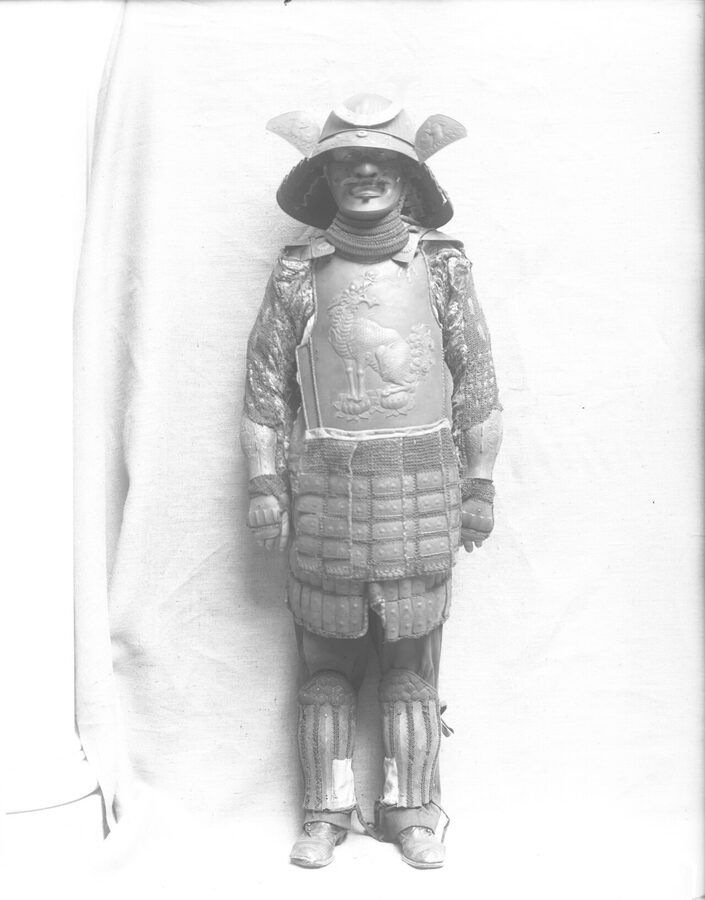
They did not quite manage it. Most Edo “ō-yoroi” have gusoku construction hiding under the old shapes, and the Japanese classification usually files them as gusoku in revival style. Old photographs of samurai in armour show a great many of them, because they were brighter and more photogenic than the real thing.
Armourers survived the peace by other means. A popular Edo essay collection, the Mimibukuro, tells a story from 1794 about the Myōchin shop, in which a samurai ordering a new set of armour is treated as an oddity and a properly made one costs a hundred ryō. The armourer in the story misjudges his customer by his clothes, which is perhaps forgivable in a trade with so few customers left.
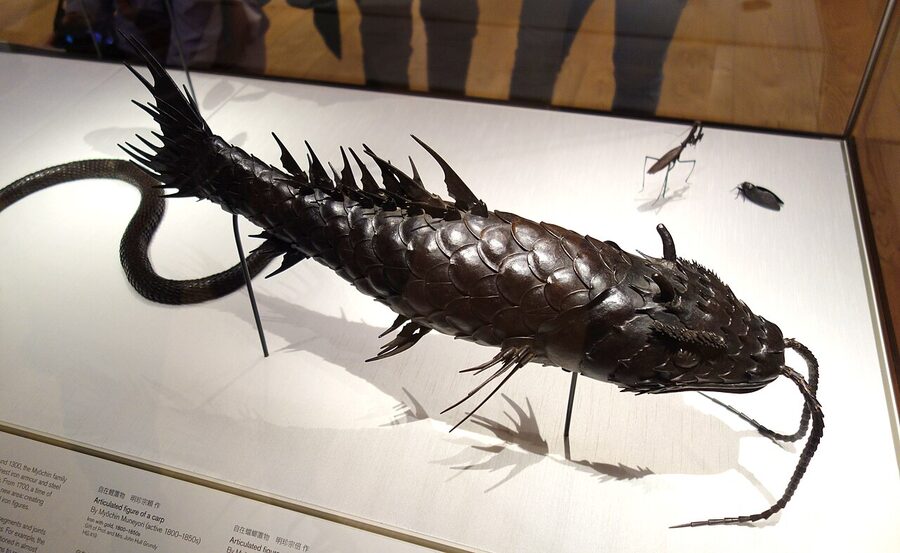
Armourers took court-style titles, as the swordsmiths did, and some of the best turned their iron skills to other things. The Myōchin made fire tongs and horse bits. And somewhere around 1700 they started making articulated iron animals, jizai okimono (自在置物), dragons and carp and lobsters and insects whose every joint and segment moves.
Lower in the trade, armour became a side job. From the middle of the Edo period, poorer samurai earned money by making it at home, and by the last years of the shogunate one writer complained that “even the clog-makers” were helping to make armour. Then, briefly, demand came back. After Perry’s warships arrived in 1853, a travelling swordsman noted in his diary that the price of arms had shot up, and met an officer of the shogun’s Kyoto deputy who boasted that his own armour would now fetch around fifty ryō.
The last time armour was worn in war was the Satsuma Rebellion of 1877, the rising of Saigō Takamori against the new government. By then the Meiji state had a conscript army in European uniform, and the Meiji era armourers who survived turned to metalwork for export, where the jizai okimono found buyers in Europe and America long before they found any at home.
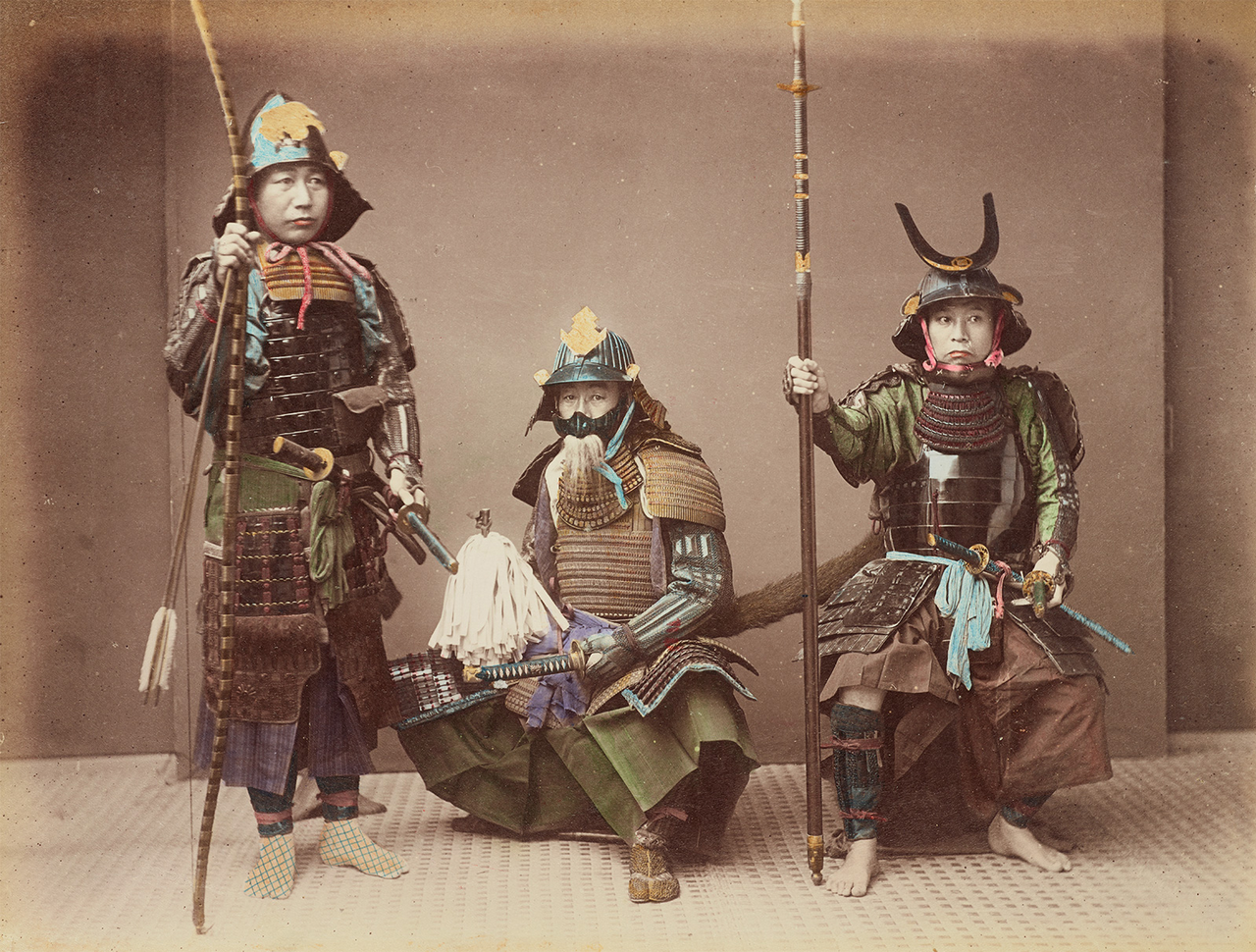
The samurai who never fought kept armour anyway, often in a lacquered box in the storehouse, much as the Edo writers on bushidō went on writing about battles none of them had seen. Under armour, a samurai wore the yoroi hitatare, a narrow-cut version of the formal outfit described in the piece on hakama and samurai formal dress, over a kosode, the garment that became the modern kimono. Even at the very end, a sort of armour survived in daily use: the iron forehead plate tied into a headband, the hachigane, was famously worn by the Shinsengumi in Kyoto in the 1860s.
Afterwards: dolls, films and kendō
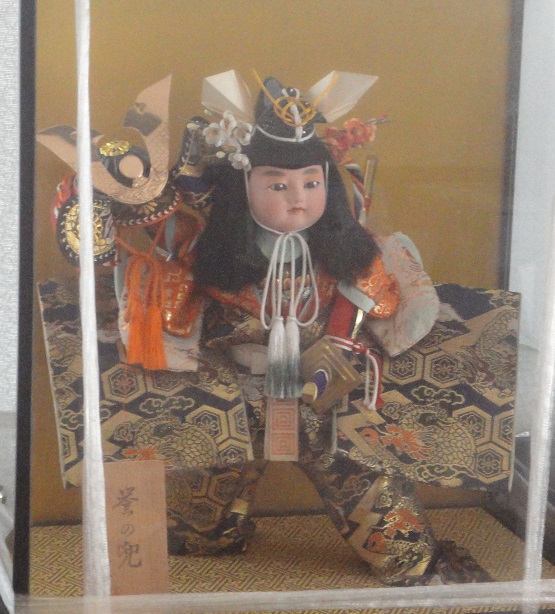
Armour did not disappear; it moved indoors. Children’s Day on 5 May grew out of the Tango festival, which from the Kamakura era became a boys’ festival, supposedly because the iris, shōbu, sounds like the word for martial spirit. An Edo encyclopedia records households displaying banners and armour for the day. Another, from the late Edo period, describes festival armour made not of iron or leather at all but of layered thick paper, painted with lacquer and iron powder and gilded.
The rest of the afterlife is scattered about the culture. The protective gear of kendō was developed from armour, and its helmet descends from the kabuto. A spiny lobster is still a gusoku-ebi, an armoured prawn, and was a lucky dish for warriors because it looked like a man in armour. The giant lanterns of the Aomori Nebuta Matsuri are, more often than not, enormous glowing men in armour.
And film keeps the trade alive. Kurosawa’s period films were advised by an armourer of the Myōchin line, and today a good deal of the armour you see in Japanese historical dramas comes out of a single workshop in Kagoshima, which also lets you put some on. I will come to it below.
Where to see samurai armour in Japan today
One caution first. Old armour is fragile and light-sensitive, so museums rotate it, and the set you came for may be in storage on the day you arrive. Check the museum’s own site before you travel, and treat what follows as where to look, not a promise.
Ōyamazumi Shrine, Ōmishima
If you see one collection, make it this one. Ōyamazumi Shrine stands on Ōmishima, an island in the middle of the Shimanami Kaidō bridge chain between Hiroshima and Ehime, in a grove of old camphor trees. The god here is a god of mountains, sea and war, and for eight centuries warriors gave him their armour and swords.
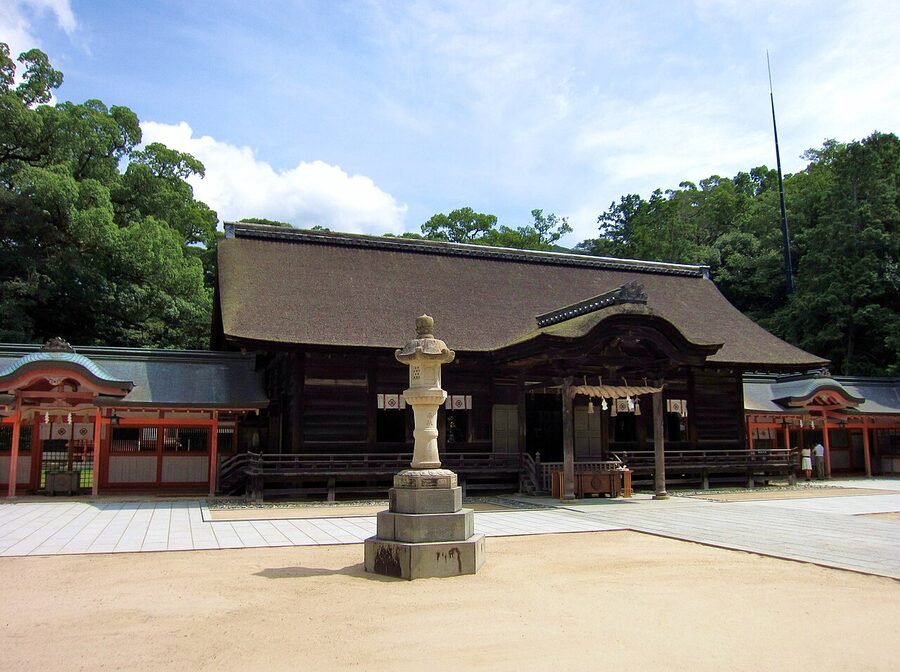
How much it holds depends on whom you ask. The figure usually quoted is about 40 per cent of all the armour Japan has designated National Treasures and Important Cultural Properties; the shrine’s own figure is about 80 per cent of the designated arms and armour; and published counts of its Important Cultural Properties run from 76 to several hundred, depending on whether you count designations or individual pieces. Sources variously give all of these, and I would not lean on any of them. It is the largest collection of old armour in Japan, by a wide margin.
The highlights include the navy-laced ō-yoroi of Kōno Michinobu, the red-laced armour said to have been dedicated by Yoshitsune, a purple-laced ō-yoroi traditionally linked to his brother Minamoto no Yoritomo, and what the shrine describes as the oldest armour in Japan, from the middle of the Heian era. There is also a narrow-waisted Muromachi dōmaru which local legend gives to Tsuruhime, a priest’s daughter said to have fought invaders in 1541. The legend is better known than the evidence, but the armour is real.
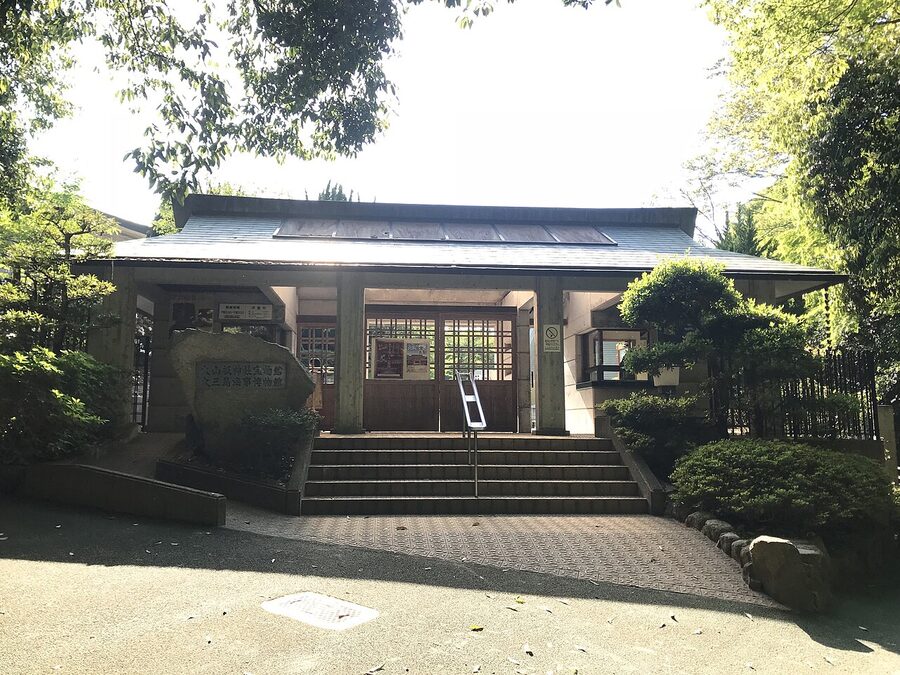
The treasure hall is open 9:00–16:30, with last entry at 16:00, according to the shrine’s latest notice. Admission was ¥1,000 for adults when I last checked; confirm with the shrine (the number is on its website) before you go, and take cash. From JR Imabari Station, the Setouchi Bus and Setouchi Kaiun express buses take about 65 minutes to the Ōyamazumi Jinja-mae stop; from the Honshu side, the Shimanami Liner from Fukuyama runs to the Ōmishima bus stop, where a local bus bound for Miyaura Port takes about 12 minutes more.
If you are cycling the Shimanami Kaidō, the shrine is on the far side of the island from the bridges, about seven kilometres from the Ōmishima interchange, and I think it is the best detour on the whole ride. Go on a weekday morning, before the tour coaches.
Kasuga Taisha Museum, Nara
Kasuga Taisha holds two of the finest ō-yoroi in existence, the plum-and-warbler armour from the opening of this piece and the red-laced armour with bamboo, tigers and sparrows, which the shrine traditionally links to Yoshitsune. Japanese writers call Kasuga “the Shōsōin of the Heian era”, after the imperial storehouse in Nara, and its museum holds 354 National Treasures in all.
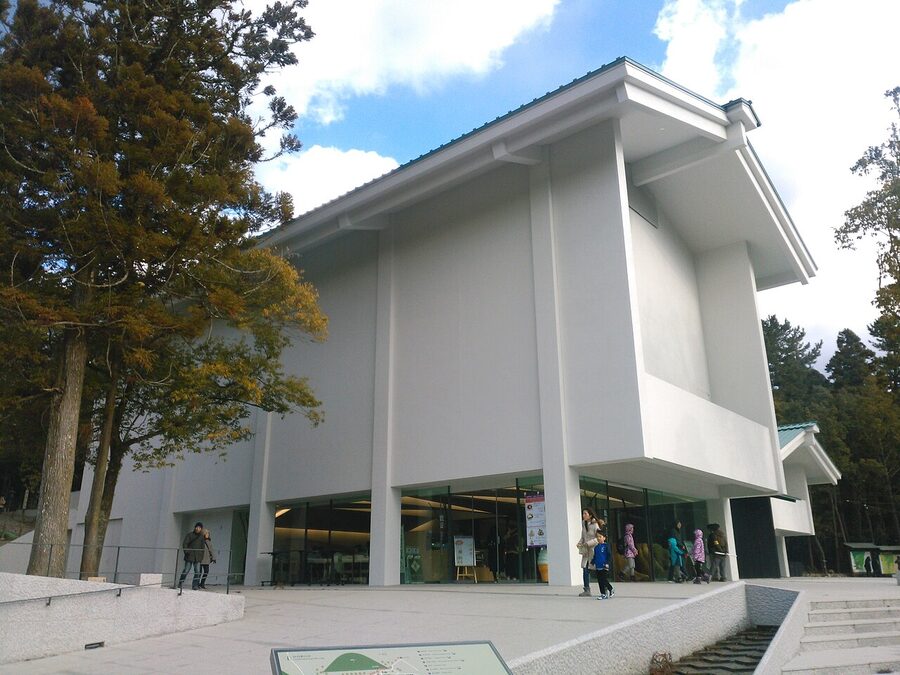
The museum is open 10:00–17:00 with last entry at 16:30, and admission is ¥700 for adults, though special exhibitions cost more (the 2025 armour exhibition was ¥1,500). It is about half an hour’s walk from Kintetsu Nara Station through Nara Park, deer included.
Musashi Mitake Shrine, western Tokyo
You can see a National Treasure ō-yoroi on a day trip from central Tokyo, if you do not mind a mountain. The red-laced armour that Hatakeyama Shigetada is believed to have dedicated in 1191 belongs to Musashi Mitake Shrine, on the top of Mount Mitake at 929 metres.
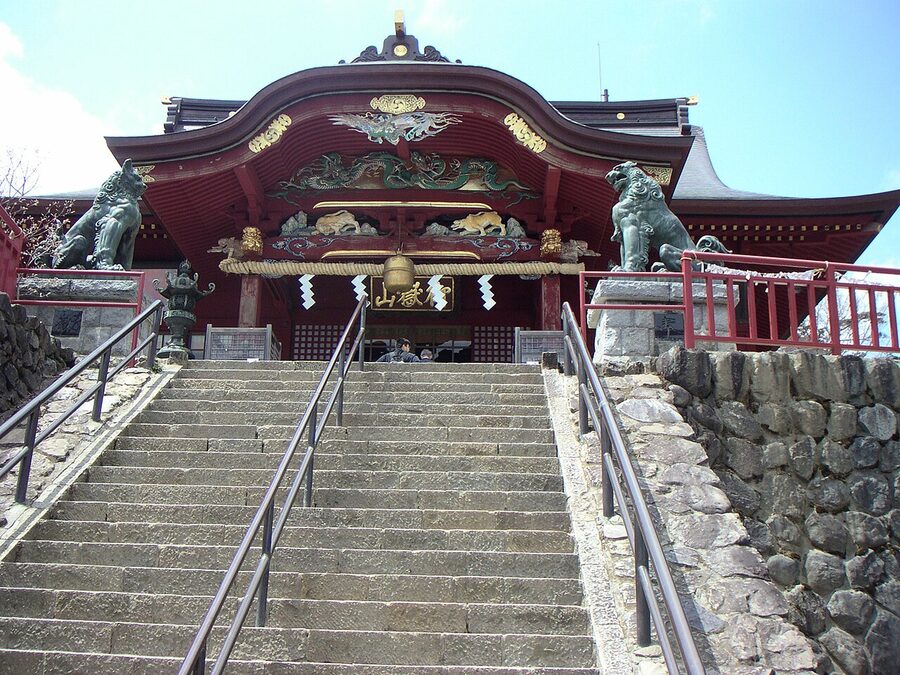
The treasure hall is open on Saturdays, Sundays and public holidays only, 9:30–16:00, and admission is ¥500 for adults and ¥300 for children. The shrine is a long way up: JR Ōme Line to Mitake Station, a bus to the cable car, the cable car up, and then twenty-five minutes or so on foot, uphill, through the old pilgrim lodgings. The shrine has posted notices about suspensions of the cable car and the JR line in December and January, so check before you set off in winter.
Tokyo National Museum, Ueno
The easiest place in Japan to see good armour of every period is the Tokyo National Museum. The swords and armour of the samurai are shown in rooms 5 and 6 of the Honkan, the main building, and the displays change several times a year. The museum also owns the haniwa warrior in keikō armour, the nanban-dō and nio-dō gusoku above, and the earliest dated jizai okimono, though none of them is guaranteed to be out on a given day.
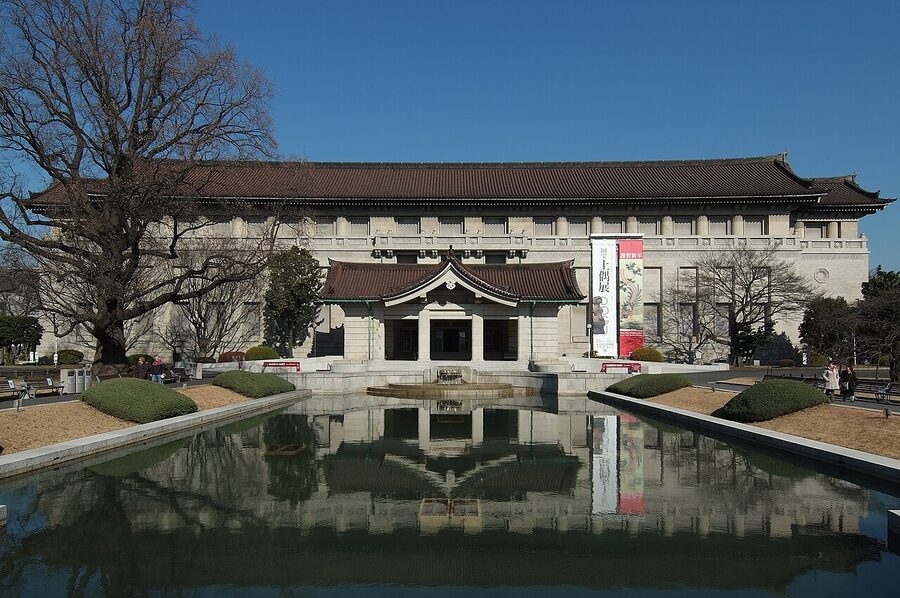
The museum is open 9:30–17:00, and until 20:00 on Fridays and Saturdays, with last entry thirty minutes before closing. It is closed on Mondays (or the following day when Monday is a public holiday), and also on 15 December 2026 and from 26 to 31 December 2026. Admission to the collection galleries is ¥1,000 for adults and free for anyone under 18 or over 70; special exhibitions are ticketed separately. It is about ten minutes’ walk from the Park Exit of JR Ueno Station.
Hikone Castle Museum
The Ii family armour lives in Hikone, under the castle that the family held from the start of the Edo period to the end. The Hikone Castle Museum is built on the site of the castle’s front palace and holds the Ii collection, including red-lacquered armour of the akazonae, shown in rotation with everything else the family kept.
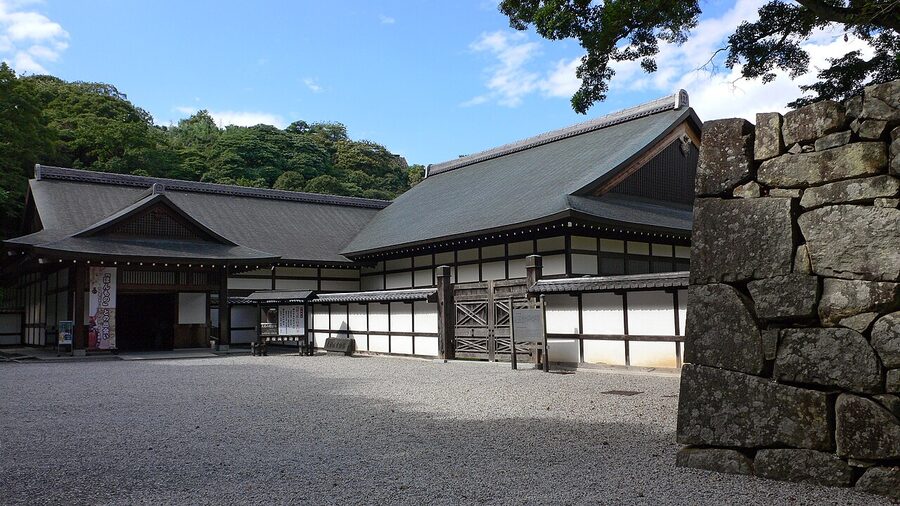
Opening hours change with the season: 9:00–17:00 in October and November, 9:00–16:30 from December to February (last entry 16:00), and 9:00–17:00 from March. Admission to the museum alone is ¥700 for adults; the combined ticket for the castle, Genkyū-en garden and the museum is ¥1,500. The museum closes on scattered days through the year, including 17 and 18 November and 8, 9 and 17 December 2026, so check its calendar first. There is more on the castle itself in my piece on Hikone Castle.
Sendai City Museum
Date Masamune’s black armour with its lopsided crescent is the star of the Sendai City Museum, which stands on the site of the third bailey of Sendai Castle. It is an Important Cultural Property and it is shown with the armour of later lords of Sendai, in cases rebuilt during a long renovation that ended with the museum’s reopening in April 2024.
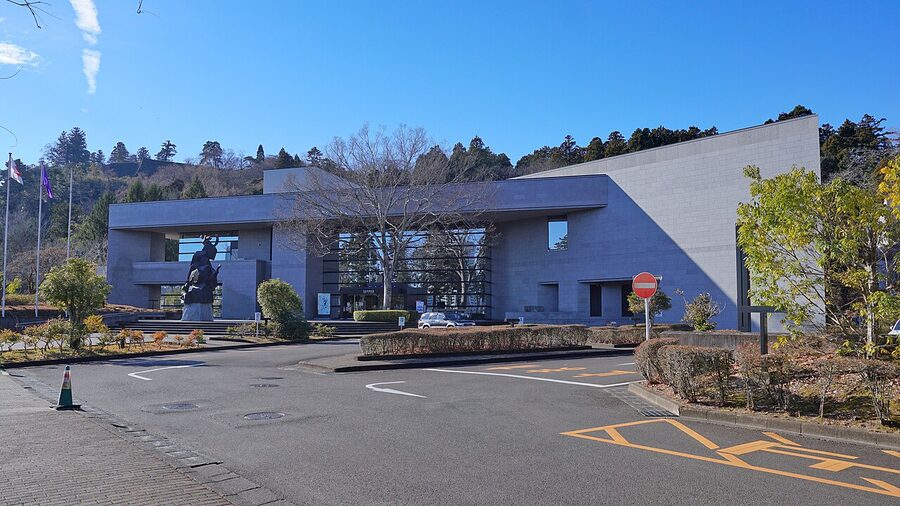
The museum is open 9:00–16:45 with last entry at 16:15, and is closed on Mondays (open on public holidays, closed the next weekday instead) and over the New Year. Admission to the permanent galleries is ¥460 for adults and university students, with special exhibitions charged separately.
Kacchū Kōbō Marutake, Satsumasendai: watching it made, and trying it on
If you want to see armour being made rather than displayed, go to Kagoshima. Kacchū Kōbō Marutake, the armour workshop of the Marutake company in Satsumasendai, has been making reproduction armour since the 1980s, by its own account, for films, television dramas, museums and private buyers, and its staff of about forty includes metalworkers, lacquerers, gilders and lacers. Its replicas stand in the Sendai City Museum, among other places, which is a pleasing coincidence given the name of the town.
You can walk round the workshop and see the craftsmen at work, though photography inside the workshop is not allowed. There is a gallery of finished sets, and you can be dressed in a suit of armour, which takes anything from a minute to a quarter of an hour depending on how complete a set you choose. Try-on prices ran from ¥500 to ¥8,000 in 2022. Admission to the workshop is free, and the local tourist association gives its hours as 9:00–17:00 (last entry 16:30), open every day.
Mind the name: Satsumasendai is at the southern end of Kyushu and has nothing to do with Sendai in Miyagi. The workshop is at 3535-7 Yunoshima-chō, about twenty minutes by taxi from Sendai Station on the Kyushu Shinkansen; buses are infrequent, so ring ahead (the number is on the workshop’s website).
The horsefly, again
When you do get to Kasuga, and the plum-and-warbler armour is out, take your time with it. The guardian lion with the crystal eyes will be the first thing you see, and the lacing, faded over the centuries from its original crimson, the second.
Then look among the blossoms for the horsefly. It was put there by someone who knew that nobody would ever see it, on an armour that was never meant to stop an arrow, for a god who would not mind either way. That, more than any bullet-dented breastplate, is what Japanese armour was for.