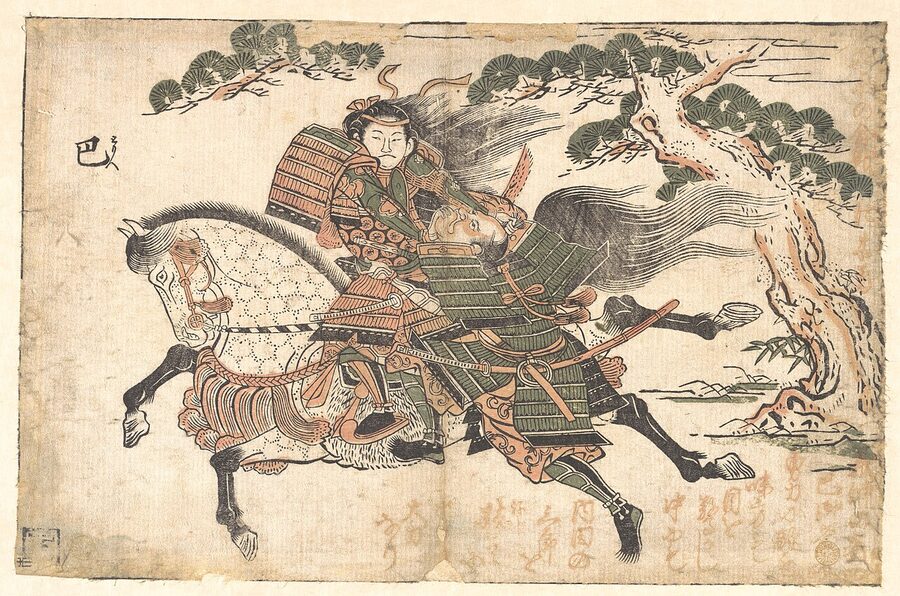
The last thing Tomoe does in the best-known version of The Tale of the Heike is take her armour off. A moment earlier she had ridden alongside a famously strong warrior from Musashi, dragged him against the front of her saddle, and twisted his head from his body. Then she threw down her helmet and her armour and rode away to the east, and the book never mentions her again.
That is the whole of her war in the version most Japanese schoolchildren read. One chapter, a few lines of description, one kill, one exit. Everything else people believe about Tomoe Gozen, the nun who lived to ninety-one, the second husband, the son, the graves scattered across five prefectures, the naginata in every woodblock print, arrived later, from other books and other centuries.
I am not going to tell you she was a myth, and I am not going to tell you she was a medieval superhero. I want to lay the texts side by side, say what each one says and what it leaves out, and then send you to the temple in Otsu and the valley in Kiso where people have kept her memory for eight hundred years without much caring which version is true.
In This Article
- One scene, many manuscripts
- What the record does not say
- Lord Kiso’s three years
- Awazu, the twentieth day of the first month
- The widow of Wada Yoshimori
- A ghost with a naginata
- The women who did fight
- Where to visit Tomoe and Yoshinaka today
- Gichū-ji, Otsu
- Imai Kanehira’s grave and the Awazu shore
- Kiso-machi: Yoshinaka-kan and Tokuon-ji
- Kōzen-ji, Kiso-Fukushima
- Kurikara Pass and Fukumitsu
One scene, many manuscripts
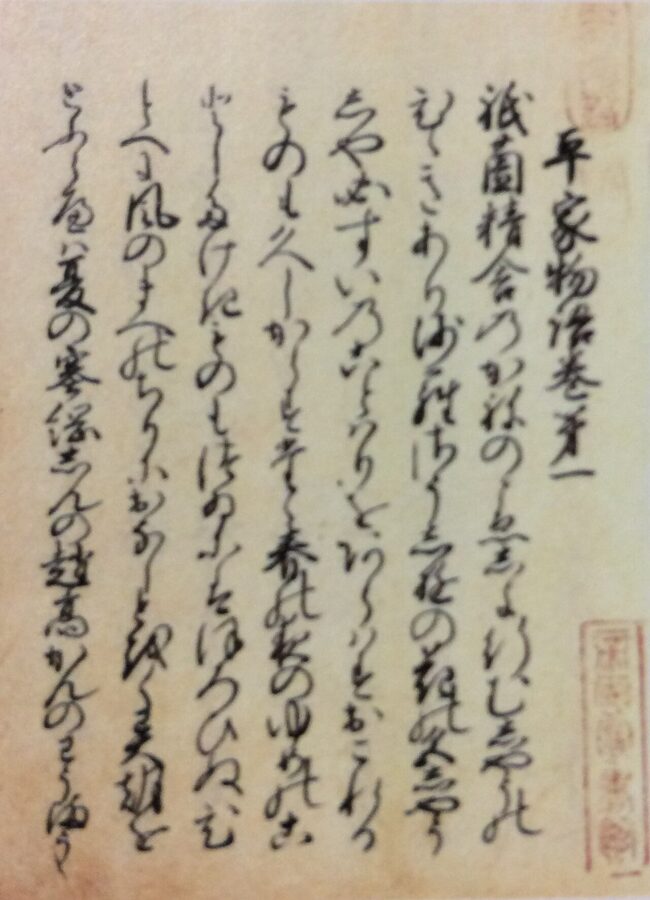
You need to know first that there is no single Tale of the Heike. There is a family of texts, broadly split into the versions recited by blind biwa players (the kataribon, 語り本) and the longer versions meant to be read (yomihon, 読み本). The one translated into English, and the one in Japanese school textbooks, is the Kakuichi-bon (覚一本), fixed by the reciter Kakuichi in 1371, nearly two centuries after the events it describes.
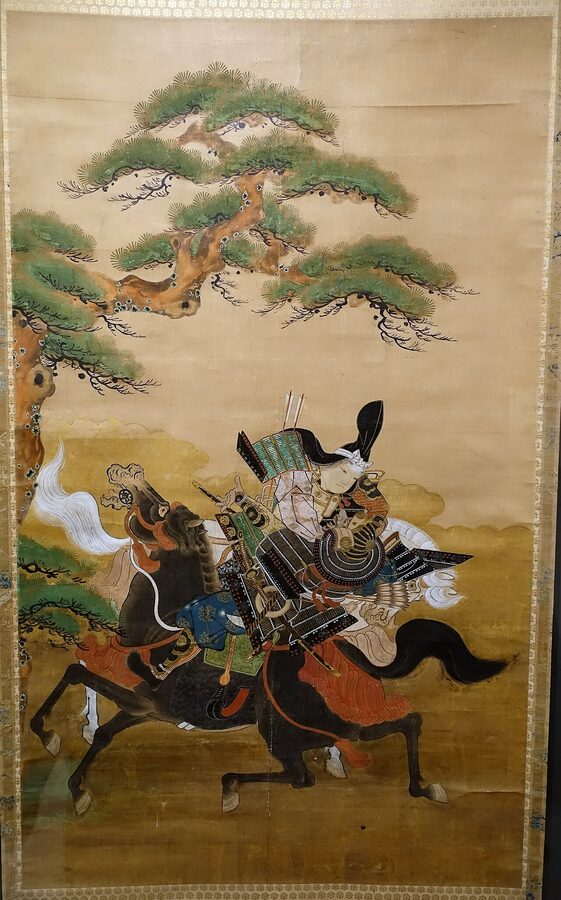
In the Kakuichi text Tomoe appears only in the chapter called “The Death of Kiso” (Kiso no saigo). Lord Kiso, it says, had brought two binjo (便女) from Shinano, Tomoe and Yamabuki; Yamabuki was ill and stayed behind in the capital. Tomoe was fair-skinned with long hair, of striking looks, a strong archer and a soldier worth a thousand ordinary ones: sword in hand, mounted or on foot, a match for gods or demons. She could ride an unbroken horse down a cliff, and when there was a battle Yoshinaka put good armour on her, gave her a great sword and a strong bow, and sent her out first as the captain of one wing.
Notice what that passage does not say. It never calls her Yoshinaka’s wife, lover, sister or foster-sister, and it gives her no family, no age and no home village. The word binjo itself is a puzzle: dictionaries gloss it both as a serving woman and as a beauty, and it turns up almost nowhere in medieval writing outside this passage and the line about Yamabuki.
Then the Kakuichi text gets to the end. At Awazu, with Yoshinaka’s company cut down to five riders, he tells her to go: she is a woman, she should get away, and it would not do for people to say Lord Kiso brought a woman to his last fight. She refuses until he insists. Then, saying she would like to show him one last good fight, she waits for a band of thirty riders under Onda no Hachirō Moroshige (御田八郎師重), seizes him, pins his head to her saddle-bow, twists it off, throws off her armour and makes for the eastern provinces.
The older texts tell it differently. The Engyō-bon (延慶本), copied in 1309–1310 and generally thought to preserve the earliest shape of the story, says she grew up with Yoshinaka as his wrestling partner, which is how he found out about her strength. In its version of the retreat she is attacked from both sides, clamps one man under each arm and squeezes until their heads come off. She then disappears, comes back to be praised by him, and disappears again, this time for good.
The Nagato-bon has her leave Yoshinaka at the Ōsaka barrier before the last fight and end her days as a nun at Tomosugi in Echigo. The Hyakunijikku-bon, one of the recited texts, has Yoshinaka tell her that praying for him after his death will be her last service, and she rides east and vanishes. The Genpei Tōjōroku makes her the daughter of Higuchi Kanemitsu, one of Yoshinaka’s four chief retainers, rather than his sister.
Even her age moves. The Kakuichi text gives none. The Hyakunijikku-bon makes her twenty-two or twenty-three at Awazu, the Genpei Jōsuiki twenty-eight, the Engyō-bon about thirty, the Nagato-bon thirty-two. Sources variously give a girl barely out of her teens or a veteran in her thirties, and they cannot all be right.
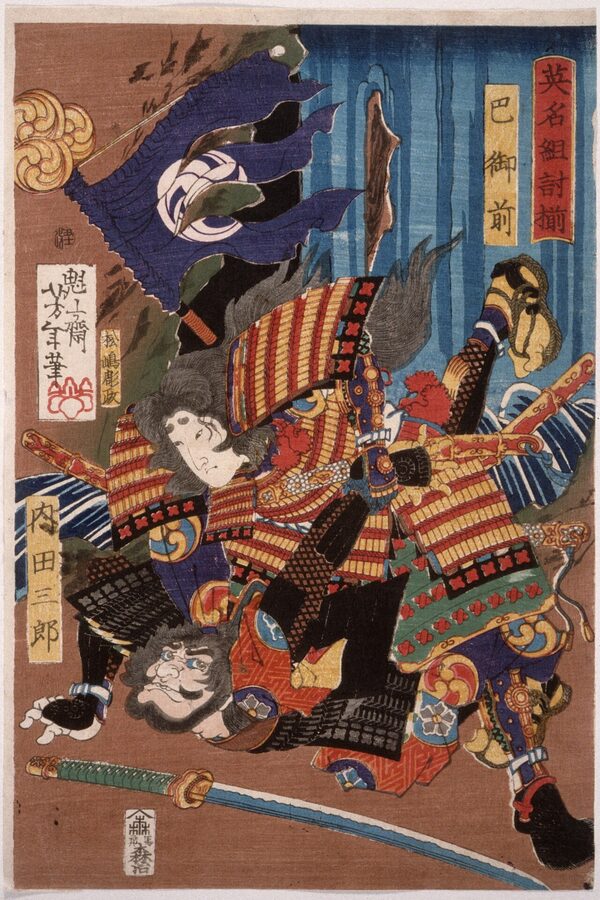
The Genpei Jōsuiki (源平盛衰記), a sprawling forty-eight-book reading version probably put together in the 14th century, is where Tomoe becomes a full character. It makes her the daughter of Nakahara Kanetō, the man who raised Yoshinaka, and so sister to his two best captains, Imai Kanehira and Higuchi Kanemitsu. It calls her his nurse’s daughter and his concubine, a maid at home and a general in the field, and gives her a battle record: a commander at Kurikara, seven riders taken at Yokotagawara, a clash with Hatakeyama Shigetada at the Uji River, and at the end Uchida Saburō Ieyoshi of Tōtōmi rather than Onda Moroshige.
It also gives her a companion. Uchida, before he dies, remarks that Lord Kiso had two women generals, Aoi and Tomoe, and Aoi was killed the previous spring at Tonamiyama. And it gives Yoshinaka a different reason for sending her away. He has left a wife and children in Shinano without saying goodbye, he tells her, and he wants someone to go home, tell them how he died, and pray for him.
What the record does not say
Here is the problem, stated plainly. No diary, letter or government document from the 1180s mentions Tomoe. The courtier Kujō Kanezane, whose diary Gyokuyō follows Yoshinaka’s months in Kyoto closely and with distaste, does not mention her. Nor does the Azuma Kagami (吾妻鏡), the Kamakura shogunate’s own chronicle, which lists the men who fought Yoshinaka and is not shy of recording a woman warrior when it meets one, as you will see.
Yoshinaka himself is in the documents. He issued land grants, he took court rank, his entry into the capital and his death are recorded by people who were there. The Heike names the men at his side, and several of them, Higuchi Kanemitsu for one, turn up in other records. Tomoe cannot, and Yamabuki and Aoi cannot either.
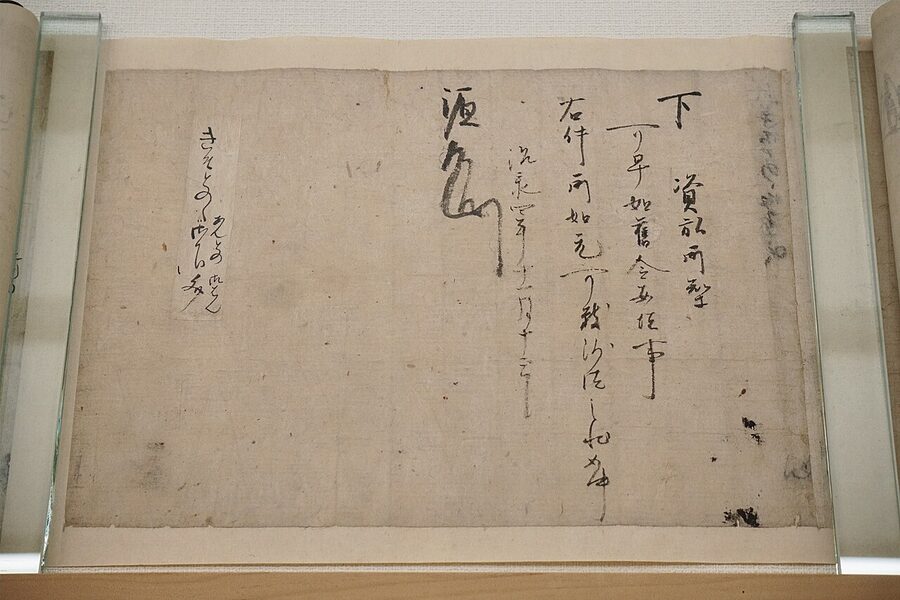
Japanese scholars have taken this in several directions. The sceptics are blunt: since she appears in no primary source, she should be treated as a literary creation. The standard Japanese encyclopedias are far less sceptical and simply narrate her life, usually from the Jōsuiki, with an “it is said” on the end. Kōdansha’s biographical dictionary does at least point out that one of the Jōsuiki’s best-known claims cannot be true, which I will come to.
The more interesting arguments are about what kind of fiction she might be. The scholar Mizuhara Hajime noticed that Tomoe legends turn up all over Japan and suggested they were left by travelling women performers who called themselves Tomoe, and that “Tomoe Gozen” may echo goze, the blind women singers of the provinces. Others have pointed to the Jōsuiki detail that she wore a tenkan, a ritual crown, on her forehead, and to Yanagita Kunio’s idea of the “power of the sister”, the spiritual protection a woman of the household was thought to give a fighting man.
There is also a simpler suspicion, which I find persuasive for the Jōsuiki layer at least. The one woman warrior of the period whom the Azuma Kagami records by name, Hangaku Gozen, fought the shogunate in 1201, was taken prisoner, and was married off to a Kamakura vassal who asked for her. The Jōsuiki gives Tomoe almost exactly the same afterlife. A story-teller with a famous real case in front of him would not need much imagination.
My own view, for what it is worth, is that the absence of evidence here is real but narrow. A woman riding with a provincial lord’s household guard would not have generated paperwork, and the Heike’s other minor figures are often just as untraceable. What I do not believe is any of the detail the later texts add, because you can watch it being added, version by version, like coats of lacquer.
Lord Kiso’s three years
Whatever Tomoe was, Kiso Yoshinaka was real, and his story is the frame every version hangs her on. His career is the Genpei War in miniature, the five-year civil war that ended the old court order (my walk through Japan’s eras puts it in context). He was born in 1154, the second son of Minamoto no Yoshikata, a member of the same Kawachi Genji line as his cousins Yoritomo and Yoshitsune. When he was two his father was killed at Ōkura in Musashi by Yoshikata’s own nephew, Yoshitomo’s eldest son Yoshihira, in a family quarrel over the eastern provinces.
The infant, then called Komaōmaru, was smuggled out. The Azuma Kagami says his foster-father, Nakahara Kanetō, carried him in his arms to the Kiso valley and brought him up there, which is why he became Kiso no Jirō. Kanetō’s sons, Imai Kanehira and Higuchi Kanemitsu, were his foster-brothers. If the Jōsuiki is right, so was Tomoe.
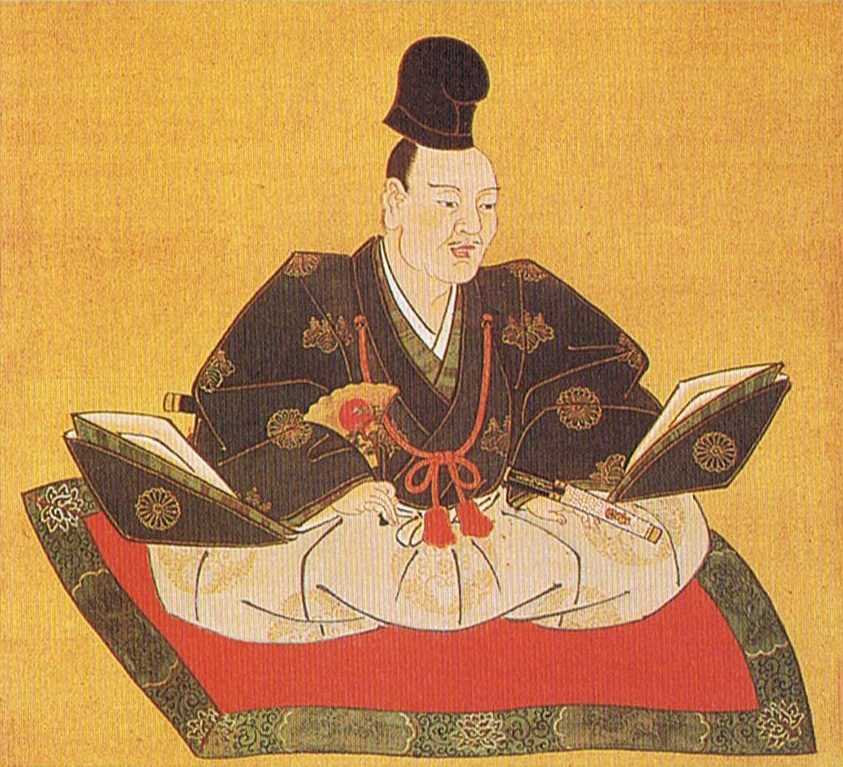
Even the valley is argued over. In Yoshinaka’s day the upper Kiso belonged to Mino, not Shinano, and one theory puts his childhood home in what is now Asahi village in Higashichikuma, where an old Kiso place name survives. Kiso-machi, unsurprisingly, does not entertain this theory.
In 1180 Prince Mochihito called on the Minamoto to rise against the Taira, and Yoshinaka did, gathering men at Yoda Castle in Chiisagata near modern Ueda (the same country that later bred Sanada Yukimura). Kiso-machi has its own claim: a shrine called Hata-age Hachimangū, “the shrine of the raising of the banner”, where local tradition says he prayed for victory before setting out.
In the sixth month of 1181 he beat the Echigo warlord Jō Sukemoto at Yokotagawara, near modern Nagano city, and pushed north into the Hokuriku. Keep that name in your head. Jō Sukemoto, who later called himself Nagamochi, had a sister, and she is the one woman of this period whose fighting is on record.
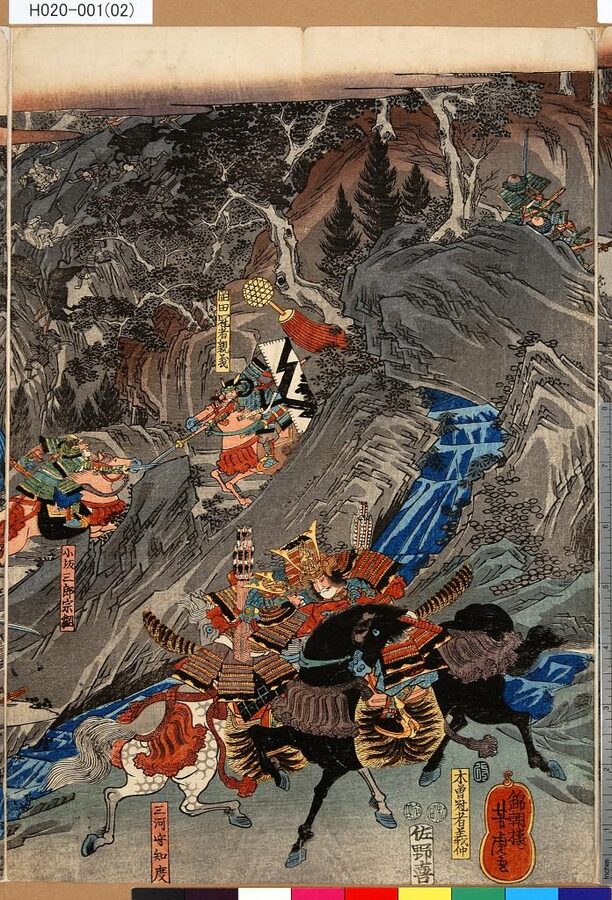
The battle that made him was Kurikara Pass, on Mount Tonami between Etchū and Kaga, on the eleventh day of the fifth month of 1183. The Taira had sent a huge army north under Taira no Koremori, the Heike says a hundred thousand men, and Yoshinaka drove it at night into the Kurikara ravine. The famous detail, herds of oxen with burning torches tied to their horns stampeding into the Taira camp, comes from the Jōsuiki, the same book that puts Tomoe in command of one of the divisions that night.
Two months later the Taira abandoned Kyoto, taking the child emperor Antoku and the three sacred treasures with them. On the 28th day of the seventh month Yoshinaka rode into the capital (the Heike notes that the white Minamoto banners had not been seen there for more than twenty years), and the courtiers recorded with horror how shabby he and his uncle Yukiie looked. The Heike calls him the Asahi Shōgun, the Rising Sun General.
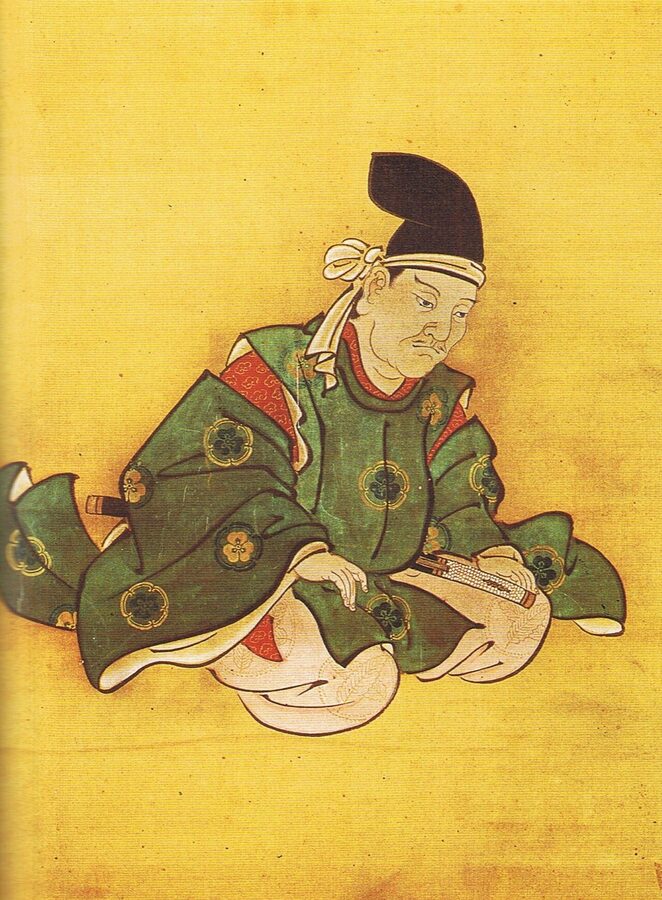
The capital was the end of him. Kyoto was starving after two years of famine, his army was a coalition of provincial bands he could not control, and he made himself impossible at court by demanding that Mochihito’s son be made emperor. In the eleventh month he attacked the retired emperor Go-Shirakawa’s Hōjūji palace, and early in 1184 he had himself named shogun, though recent research suggests the title was seitō taishōgun, “great general who subdues the east”, not the later and more famous seii.
Awazu, the twentieth day of the first month
Yoritomo sent his brothers Noriyori and Yoshitsune west with the eastern armies. On the 20th day of the first month of 1184 they broke Yoshinaka’s lines at Uji and Seta, south of the capital, and he fled east along the shore of Lake Biwa towards the provinces he had come from. Sources variously convert the date to 21 February or 4 March 1184, depending on which calendar they convert into; the Japanese date is the one nobody disputes.
At Awazu, on the lake shore just south of modern Otsu, he ran into the Kai Genji under Ichijō Tadayori, a family he had been quarrelling with over Shinano for years. What was left of his force broke up. In the Kakuichi text he is down to five riders: Imai Kanehira, Tomoe, Tezuka Mitsumori, his kinsman the Tezuka Bettō, and himself. This is the moment he sends Tomoe away, and she takes her head and her leave.
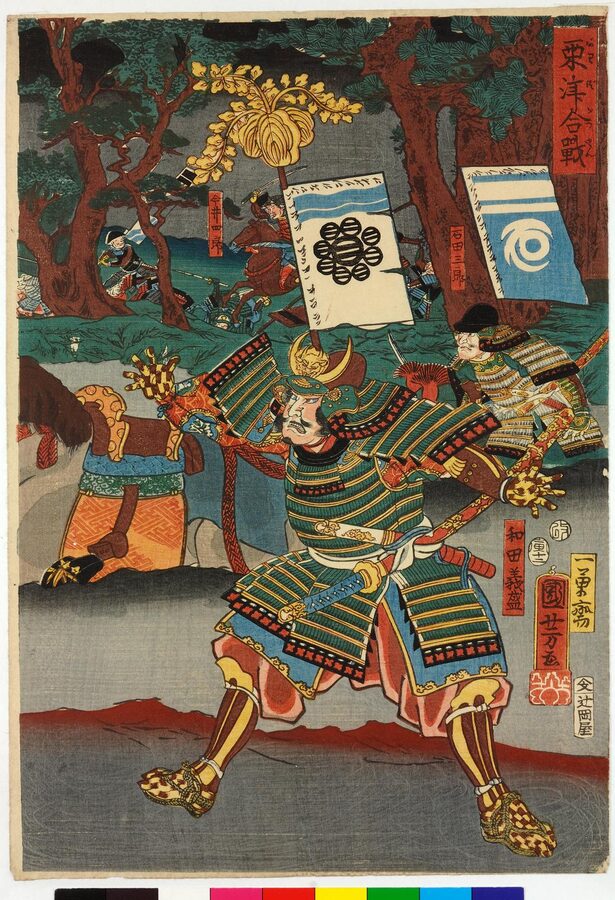
What follows is one of the best-known passages in Japanese literature, and it is not about Tomoe at all. Yoshinaka and Kanehira are alone. Kanehira, who has been fighting all day, persuades his lord to ride into the pine wood at Awazu and kill himself in peace while he holds the road. Yoshinaka’s horse goes through the thin ice into a deep rice paddy, he turns to look back for Kanehira, and an arrow from Ishida Tamehisa of the Miura hits him in the face under the helmet.
Kanehira hears his lord’s head being announced, puts the point of his sword in his mouth and throws himself head first from his horse. It is the grimmest suicide in the Heike and it is often cited as a forerunner of the ritual described in my piece on seppuku, though nothing about it is ritual. Yoshinaka was thirty-one by Japanese count. The Gukanshō, a history written by the monk Jien within forty years, gives the killing to Ise Yoshimori, one of Yoshitsune’s men, rather than Ishida, so even this death has two versions.
The widow of Wada Yoshimori
If the Heike lets Tomoe go, the Jōsuiki will not. After Awazu, it says, she was summoned to Kamakura by Yoritomo and was going to be executed. Wada Yoshimori, the head of the shogunate’s board of retainers, asked for her instead, on the grounds that a woman that strong would give him strong sons, and she bore him Asahina Saburō Yoshihide, the most famous strongman of the early Kamakura period.
When the Wada were destroyed in the fighting of 1213, the Jōsuiki goes on, she went north to the Ishiguro family at Fukumitsu in Tonami, Etchū, shaved her head, prayed for her lord, her parents and her son, and died at ninety-one. It is a satisfying ending. It is also impossible.
Asahina Yoshihide was a grown man in the 1210s, and the usual reckoning of his age puts his birth around 1176, eight years before Awazu. A son born to Tomoe after 1184 cannot be him. Kōdansha’s dictionary says flatly that his birth year makes the story untenable, and once that goes, the Kamakura marriage looks like what it probably is: Hangaku’s real capture and marriage, transplanted.
Later writers fixed the arithmetic by making Yoshihide Yoshinaka’s son, conceived before Awazu and passed off as Wada’s. Kyokutei Bakin used the idea in a novel, and an 1812 local history of the Miura peninsula claimed the name Asahina came from his true father’s title, Asahi Shōgun.
The same Miura history printed something stranger: a letter supposedly written by Tomoe on the 11th day of the first month of 1184, nine days before Awazu, to a maid in Ise, sending her a kosode (the robe that became the kimono) as a keepsake and expecting to die in the coming battle. It was said to be kept at a temple in Matsusaka. The novelist Higuchi Ichiyō reprinted it in 1896 in her letter-writing manual, the only book of hers published in her lifetime, and left it to her readers to decide whether it was genuine. I think you can decide quite quickly.
The graves multiplied with the stories. Fukumitsu has its Tomoe mound under a big pine. The Kurikara battlefield has a Tomoe mound beside a mound for Aoi, with a legend that Tomoe asked to be buried next to her friend.
There is a grave at Tokuon-ji in Kiso, another at Gichū-ji in Otsu, a memorial at Demaru Inari in Jōetsu, five-ringed stones at Odawara and Yokosuka. A woman with no documented life has more graves than most shoguns.
A ghost with a naginata
The Noh theatre took Tomoe up in the Muromachi period. The play Tomoe, sometimes credited to Kanze Kojirō Nobumitsu though nobody knows for certain, is the only warrior play in the repertoire with a woman as the lead. A monk from Kiso stops at the Awazu shrine, meets a village woman weeping, and learns at night that she is Tomoe’s ghost, kept from rest by her grievance at not being allowed to die beside her lord.
The playwright changed the story to sharpen that grievance. In the Noh, Yoshinaka is wounded and kills himself, and he sends Tomoe away not because a woman would shame him but to carry his kosode back to Kiso. She fights her way out, returns to find him dead under a pine, takes off her armour on the lake shore, and goes home with the robe. It is the Heike’s exit turned into an act of devotion.
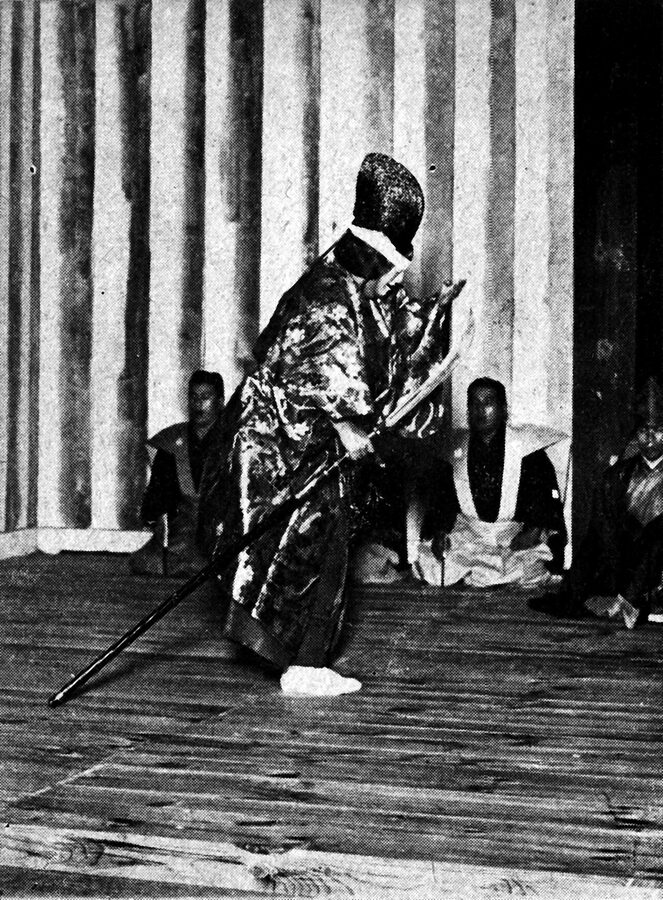
That is worth dwelling on, because the naginata is now Tomoe’s emblem. A naginata with a wide, deeply curved blade is still called a tomoe-gata after her, and from the Edo period the naginata became the weapon samurai daughters were trained in, which made her a natural patron. In the Kakuichi text she fights with the ōdachi, the oversized sword of the mounted warrior that you can read about in my piece on katana and tachi, and kills with her bare hands.
Kabuki made her loud. In Shibaraku, the Ichikawa family’s showpiece, a hero bursts in shouting “Wait a moment!” to save the innocent from a villain, and in the women’s version, Onna Shibaraku, the hero was almost always Tomoe. The reason given in Japanese theatre histories is practical: there were only about two famous women in Japanese history you could put in those vast sleeves with a giant sword and have the audience accept it, and they were Tomoe and Hangaku.
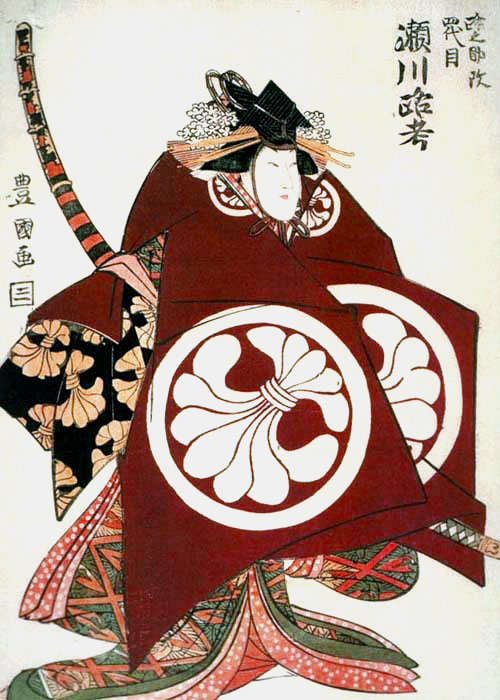
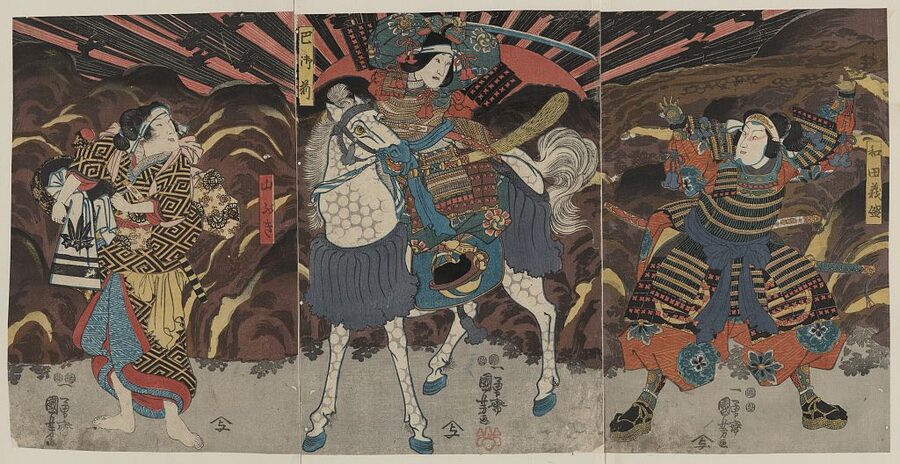
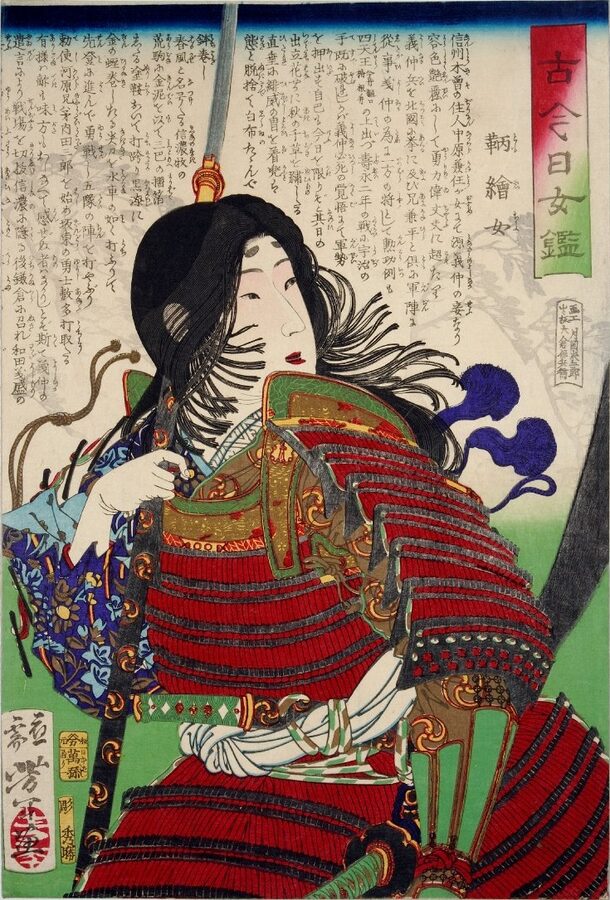
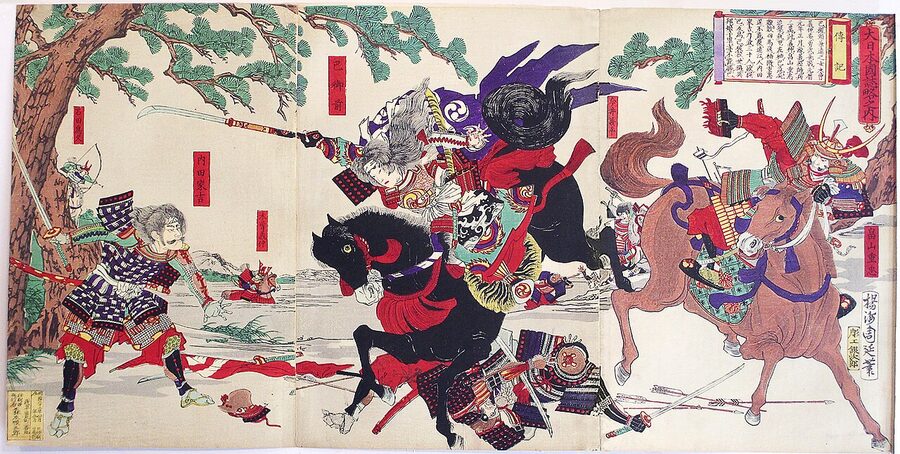
The print makers loved her because she let them draw a beautiful woman and a fight on the same sheet. Kuniyoshi drew her again and again in the 1840s and 1850s. Yoshitoshi put her in grappling series and in a series of beauties, and Toyohara Chikanobu drew her in the Meiji era charging with her naginata across a triptych.
The 20th century added the rest. Kyō Machiko played her for Daiei in 1956, and NHK has cast her in four historical dramas, three of them year-long Taiga dramas, most recently in 2022. She is a character in a popular mobile game, an asteroid, and the name of a wide-field camera on the Kiso Observatory’s Schmidt telescope, which seems right for someone who has been watched from a distance for eight centuries.
The women who did fight
None of this means women did not fight in medieval Japan. It means you have to look in different books.
The sceptics also make a more sweeping claim: no reliable record exists of a Heian-period woman arming herself and going to war, and the documents show women travelling with armies only as fugitives, escorts or in processions. That is a fair reading for the Heian era. It stops being true almost immediately afterwards.
The case that matters is Hangaku Gozen (坂額御前), Jō Sukemoto’s sister. In 1201, early in the Kamakura era, her nephew Jō Sukemori rose against the shogunate in Echigo, the province Uesugi Kenshin would rule three and a half centuries later, and held Torisaka Castle against a shogunal army. The Azuma Kagami, a source with no reason to flatter her, says that although she was a woman her archery all but surpassed her father’s and brothers’, that she bound her hair up like a boy, wore a corselet and shot from the tower, and that no man she hit survived.
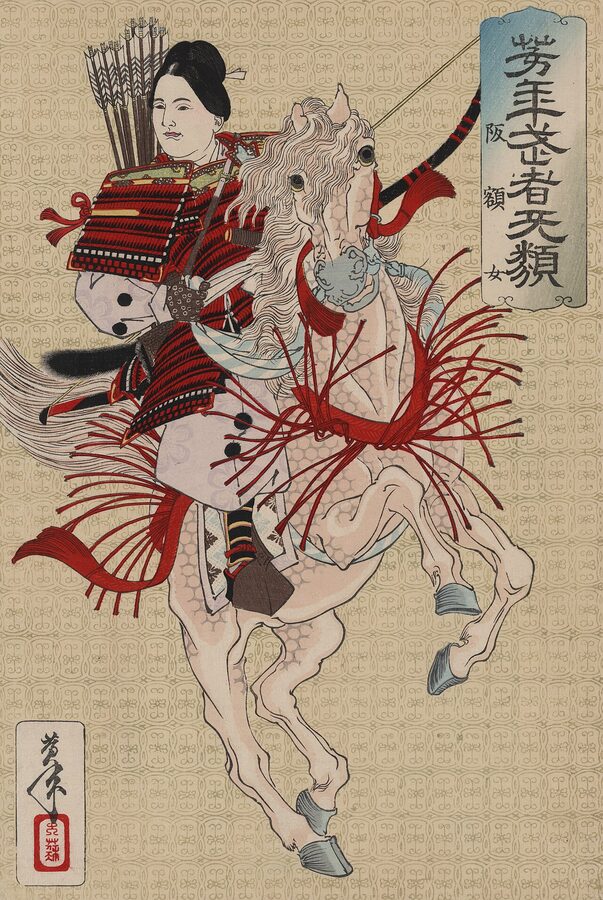
She was brought down by Fujisawa Kiyochika of Shinano, who climbed the hill behind the castle and shot her through both thighs. Taken to Kamakura with her wounds unhealed, she was brought before the shogun Minamoto no Yoriie, who watched from behind a blind while the vassals crowded round. The chronicle says she walked through the middle of them without a trace of fear, the equal of any warrior there, and with a face like a beauty out of a Tang poem.
Wada Yoshimori was in that room. So was Hatakeyama Shigetada. The next day Asari Yoshitō of the Kai Genji asked Yoriie for permission to marry her, and she went with him to Kai and is said to have had a child. If you want to know where the Jōsuiki got Tomoe’s Kamakura chapter, that audience is the obvious place to start.
After Hangaku the record fills in slowly. In 1353 the courtier Tōin Kinkata noted in his diary that the army of Yamana Tokiuji marching on Kyoto included a good many women riders, though his point was that the force was weaker than rumoured. By the Sengoku era women defending castles in their husbands’ absence turn up often enough to look like a normal duty rather than a marvel.
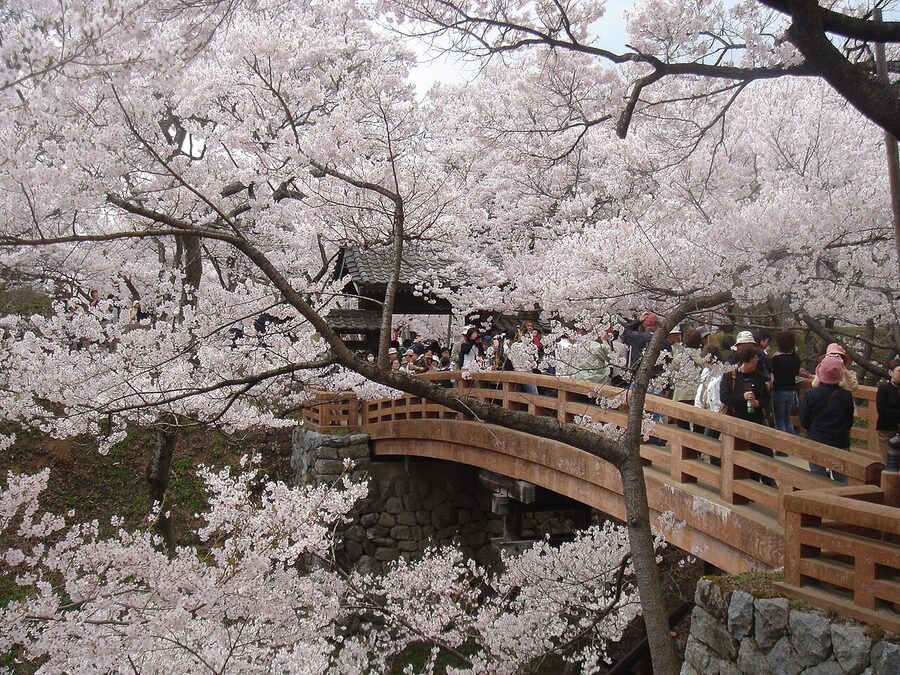
The best of these records is also the most matter-of-fact. In 1582, when Oda Nobutada stormed Takatō Castle during the destruction of the Takeda (the house of Takeda Shingen, by then led by his son Katsuyori), the wife of the defender Suwa Katsuemon drew her sword and cut her way about the castle. Ōta Gyūichi’s Shinchō Kōki, the chronicle of Oda Nobunaga‘s reign and the same text that records the arrival of Yasuke the year before, calls it unrivalled work, unheard of in any earlier age.
There are more, with varying evidence behind them. Myōrin-ni, a widowed nun of the Ōtomo, held Tsurusaki Castle in Bungo against the Shimazu (the clan of Shimazu Yoshihiro) through the winter of 1586 with pits and snares. At the siege of Tanabe in 1600, a sideshow of Sekigahara, later accounts put Numata Jakō, the mother of Hosokawa Tadaoki and mother-in-law of Gracia, in armour on the walls. In the winter siege of Osaka Castle in 1614, the near-contemporary Tōdaiki has Yodo-dono touring the guard posts in armour with three or four armed women behind her.
Some of the famous names are thinner than they look. English-language lists credit Ikeda Sen with a unit of two hundred women musketeers at Shizugatake and Komaki-Nagakute, and I have not found that in any period source. A claim that 35 of 105 skeletons from the 1580 battlefield of Senbon Matsubaru were women is repeated in nearly every English book on the subject; I have not been able to find the excavation report it rests on, and Japanese writing on the battle rarely mentions it. Treat both as unconfirmed.
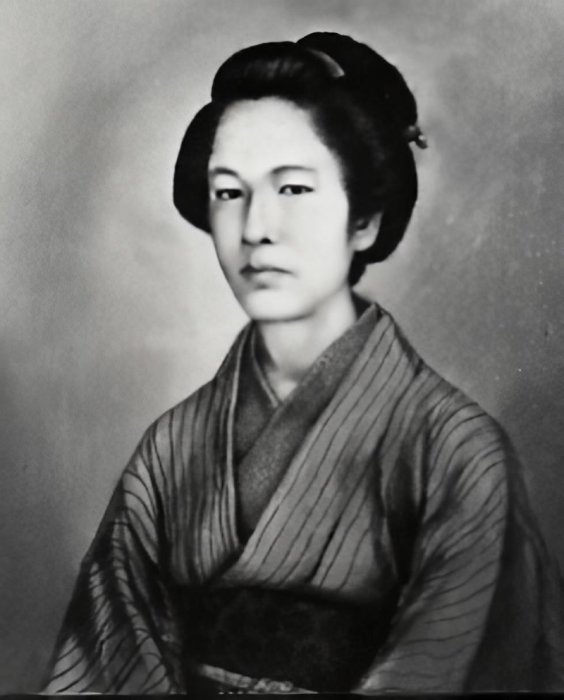
The last stand is the best documented. In the Aizu war of 1868, women of the Aizu domain fought the new government’s army in and around Tsuruga Castle. Nakano Takeko led a band of women with naginata outside the walls and was shot dead at twenty-one, and Yamamoto Yaeko, later Niijima Yae, cut her hair short and fought from the castle with a Spencer rifle. In Edo the swordswoman Nakazawa Koto, dressed as a man, served in the Shinchōgumi, which grew out of the same Rōshigumi as the Shinsengumi.
If you want a summary, it is this. Women fighting in pre-modern Japan were real, mostly in sieges, mostly with the bow, the naginata or later the gun, and mostly when the men were absent or dead.
Tomoe is the exception in the other direction: a field commander riding in the van, a role no document gives any woman. Whether that makes her impossible or simply unrecorded is the question at the bottom of all of this, and I do not think it can be answered. You will find more on the men’s side of the same culture in my piece on bushidō and in the ranked guide to Japan’s greatest samurai.
Where to visit Tomoe and Yoshinaka today
Her story sits in two places: Otsu, on Lake Biwa, where it ends, and the Kiso valley in Nagano, where it starts. They are on different railway lines, so treat them as two separate trips unless you have a car. Kurikara Pass and Fukumitsu, in Toyama and Ishikawa, are for completists.
Gichū-ji, Otsu
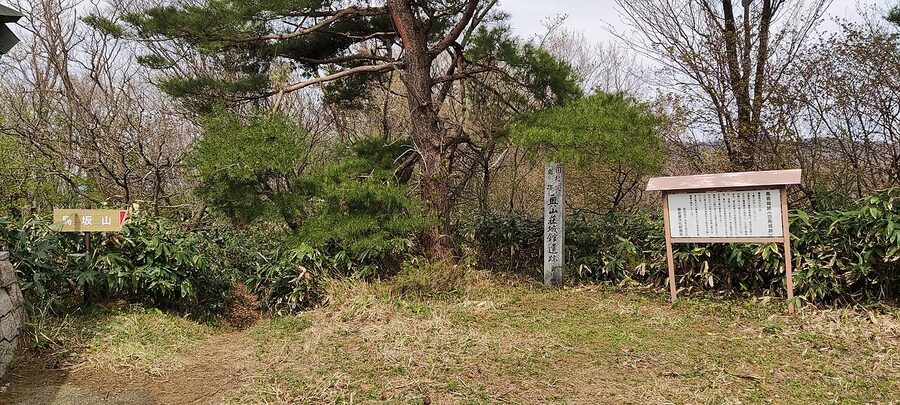
Gichū-ji (義仲寺) is one of the smallest temples I know that is also a national historic site. It sits in the Baba district of Otsu, a five-minute walk north of Keihan Zeze Station by the railway’s own guide, or about ten minutes from JR Zeze. Temple tradition says Tomoe built a hut beside Yoshinaka’s grave after Awazu and prayed for him, calling herself only “a woman with no name”, which is where the temple’s older names, Mumyō-an and Tomoe-dera, come from. A document of the late Kamakura period is said to use those names already, which is as close as Tomoe comes to a contemporary witness.
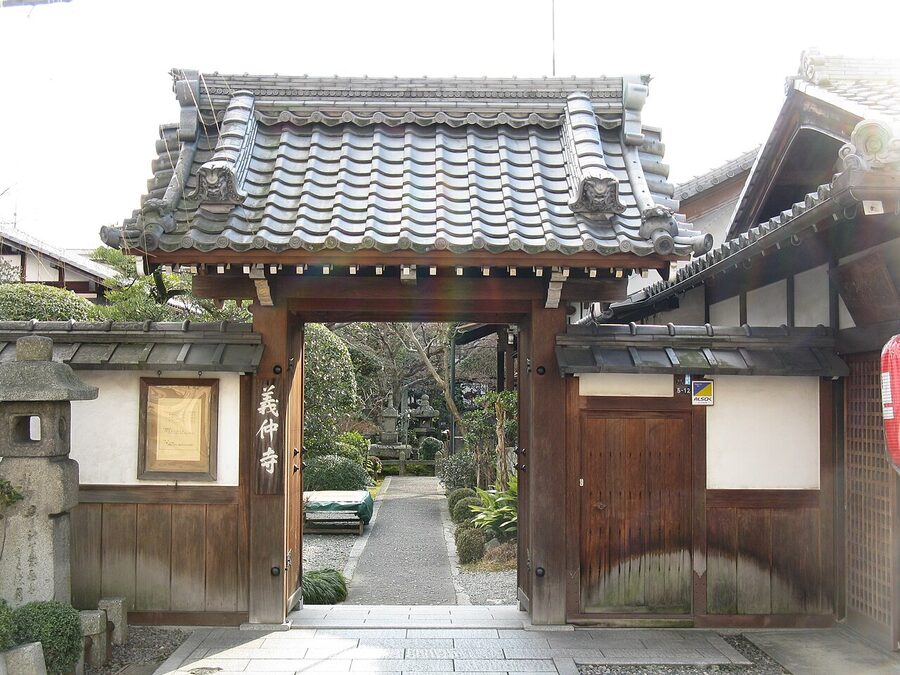
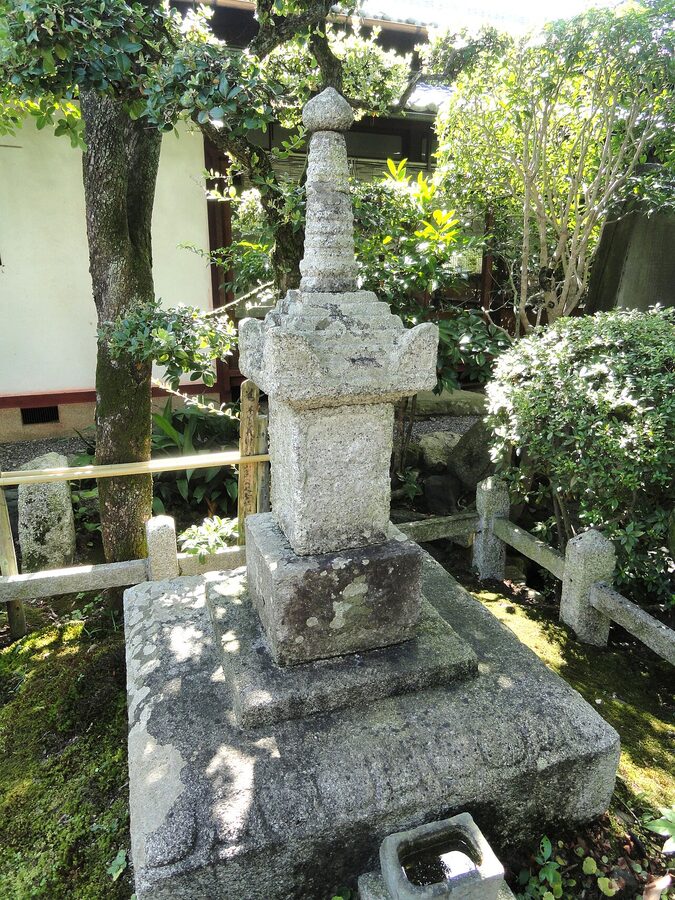
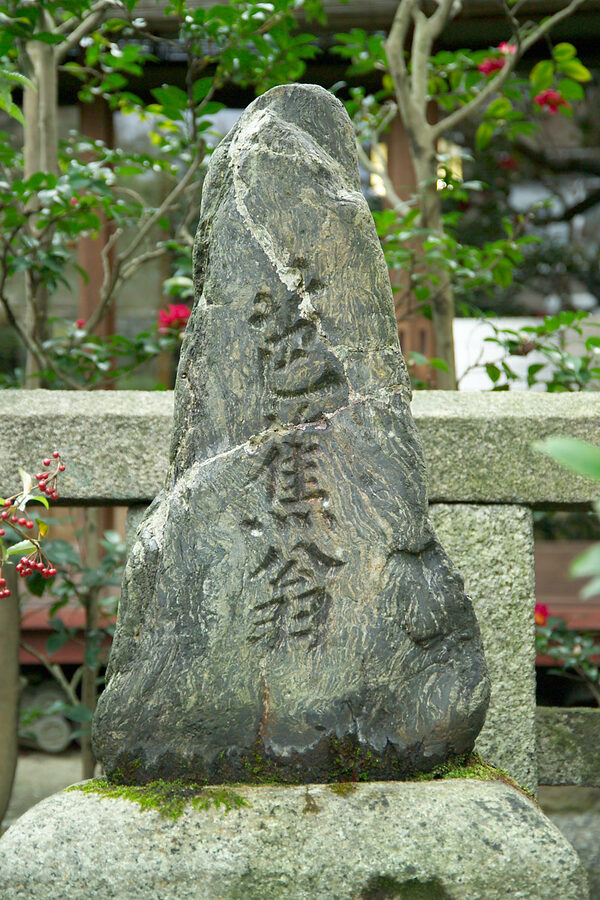
Inside, Yoshinaka’s grave is a stone hōkyōintō put up in the 1680s by a monk who restored the ruined site. Next to it is the grave of the poet Matsuo Bashō, who stayed here often, admired Yoshinaka, and asked to be buried beside him when he died in Osaka in 1694. His follower Yūgen wrote the haiku everyone quotes here: Kiso-dono to senaka awase no samusa kana, “back to back with Lord Kiso, how cold it is”.
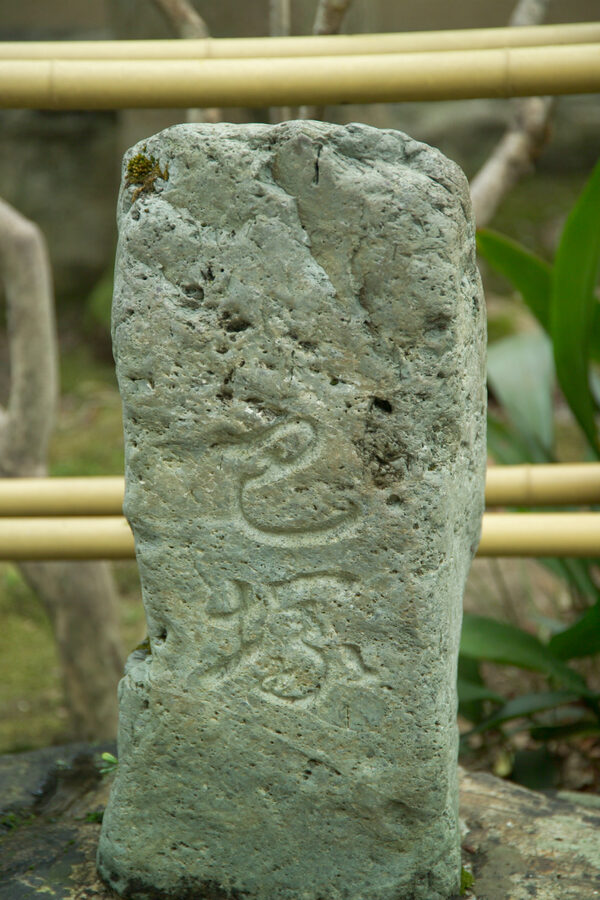
The Okinadō hall, dedicated to Bashō, has a ceiling of fifteen flower paintings by Itō Jakuchū, given in 1859; what you see now are careful digital reproductions. There is also a small museum and a mound for Yamabuki, moved here in 1973 from beside Otsu Station, where local tradition said she was cut down while following Yoshinaka. The Keihan railway’s guide gives opening hours of 9:00–17:00 (16:00 from November to February), closed on Mondays except public holidays, and admission of ¥500; older guides say ¥300, so check the board at the gate. Allow forty minutes.
Imai Kanehira’s grave and the Awazu shore
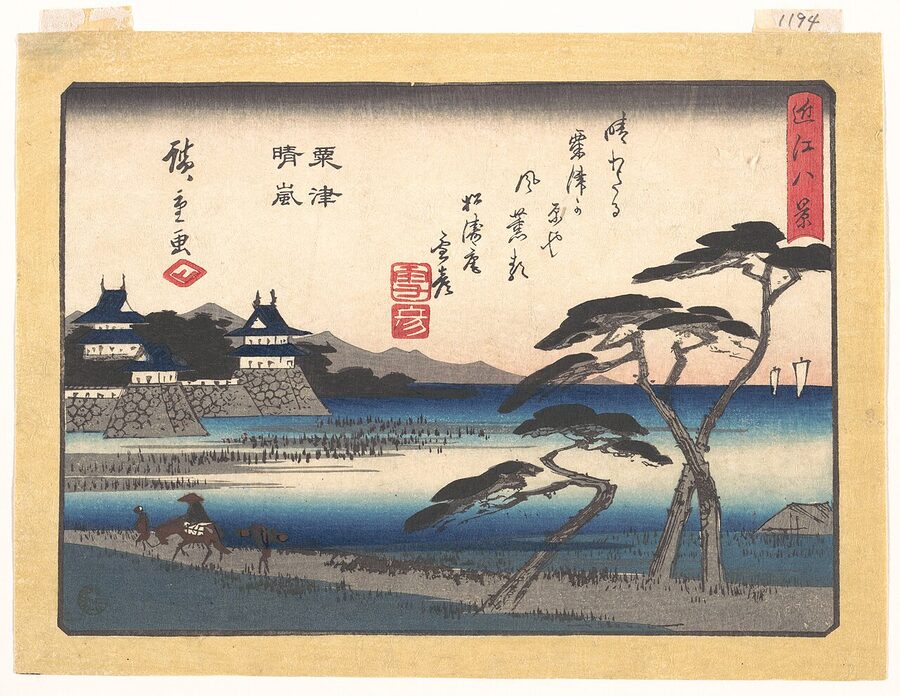
Kanehira’s grave is not at Gichū-ji, which surprises people. It stands in a small fenced plot in a residential street in the Seiran district, a couple of kilometres south-east, a name that comes from Awazu Seiran, the “clearing weather at Awazu” of the Eight Views of Ōmi.
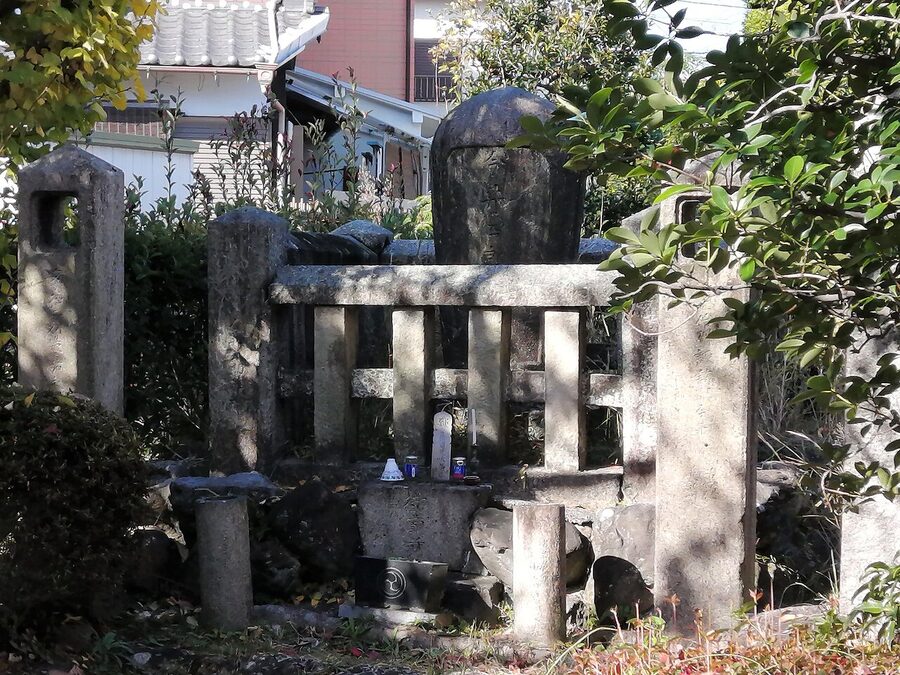
Do not go looking for the pine wood. The lake shore has been pushed out by reclamation and the Awazu of 1184 is now streets, a railway and lakeside parks. I would walk from Gichū-ji down towards the lake and along the shore path for an hour, and accept that the battlefield is somewhere under your feet.
Kiso-machi: Yoshinaka-kan and Tokuon-ji
The other end of the story is in the Hiyoshi district of Kiso-machi, around Miyanokoshi Station on the JR Chūō Line, roughly an hour south of Matsumoto by local train, changing at Shiojiri (worth combining with Matsumoto Castle). Miyanokoshi was a post town on the Nakasendō, and a few of the old inn buildings are still standing on the road beside the river.
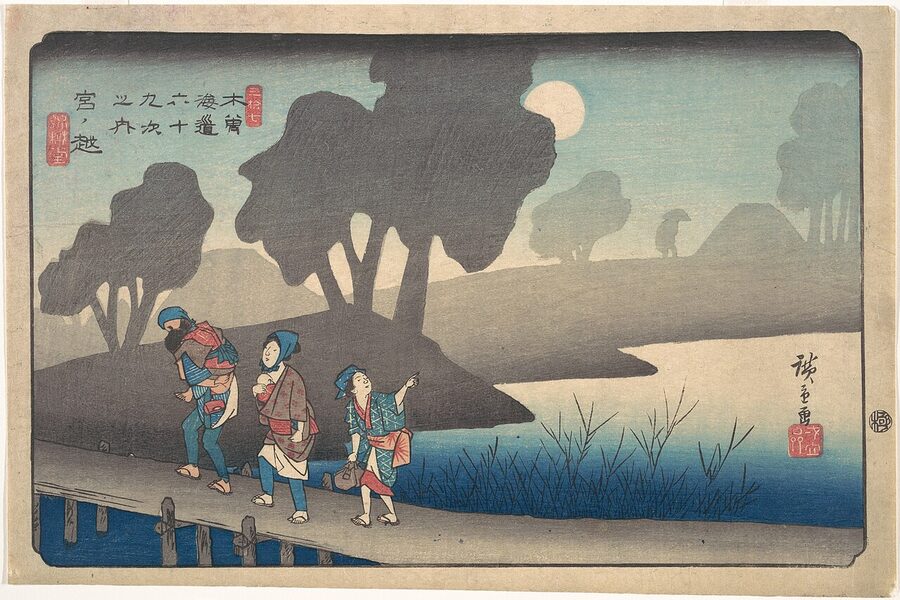
Yoshinaka-kan (義仲館), five minutes’ walk from the station, is the town’s museum to Yoshinaka and Tomoe, opened in 1992 and remade in 2021 around contemporary artworks. I like it more than I expected, partly because the museum says openly on its website that the period sources say very little about either of them and that it wants you to imagine their unrecorded lives. Hours are 10:00–17:00 and admission ¥300; the website gives Monday as the closing day in one place and Tuesday in another, so ring before making a special trip.
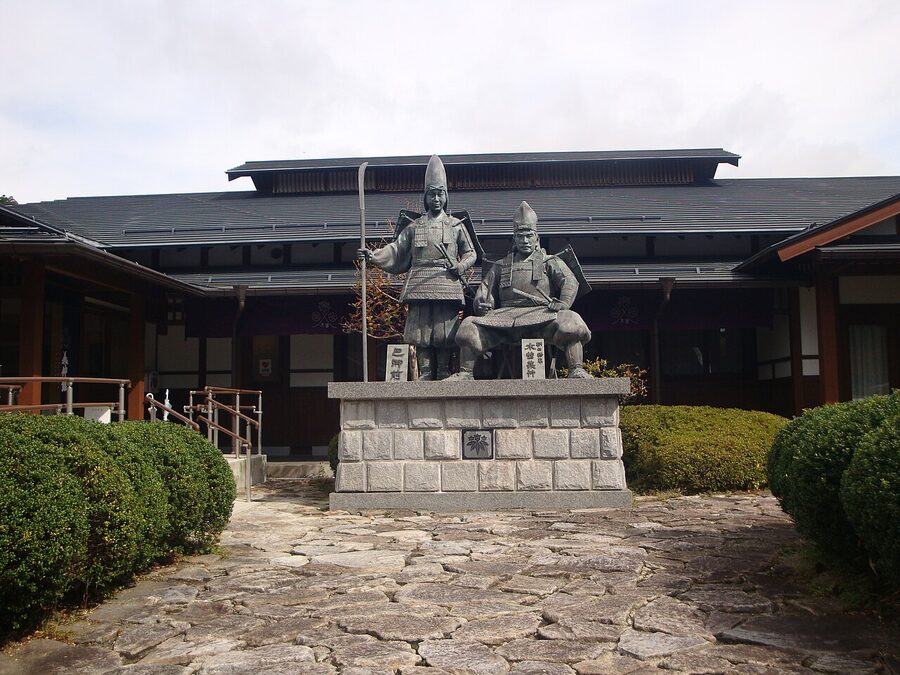
Tokuon-ji (徳音寺), a Rinzai temple a short walk away, is the Kiso family’s temple. Its origin is said to be a chapel built in 1166 by Nakahara Kanetō for Yoshinaka’s mother, Sae Gozen, and it has graves for Yoshinaka, his mother, Tomoe, Imai Kanehira and Higuchi Kanemitsu. The treasure hall is said to hold letters in the hands of Kanehira, Kanemitsu and Tomoe, a naginata of hers, and a small Kannon Yoshinaka is supposed to have worn in his helmet; I have not been able to confirm current opening times or a fee, so ask at Yoshinaka-kan first.
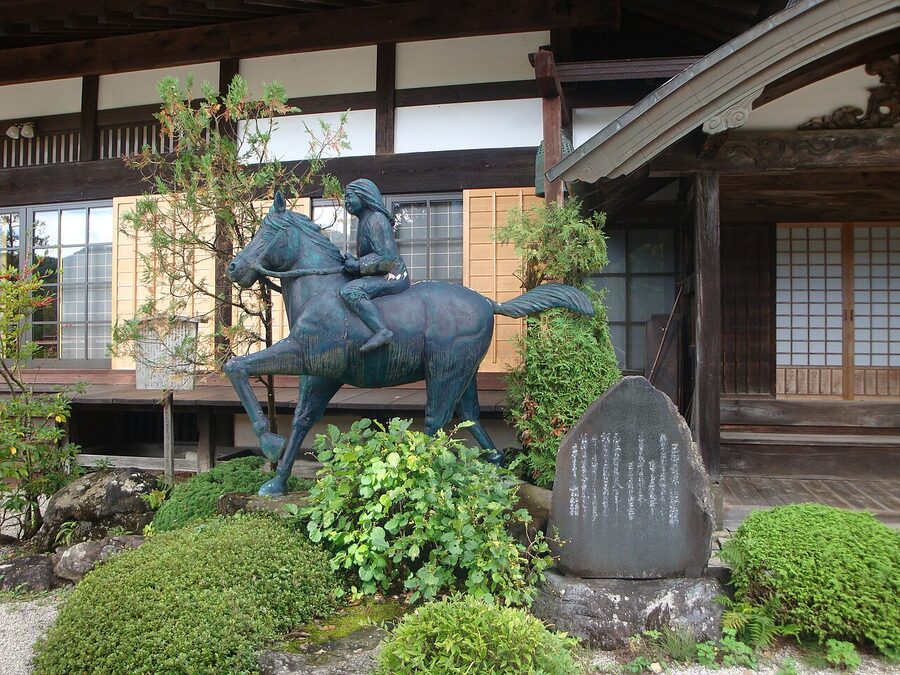
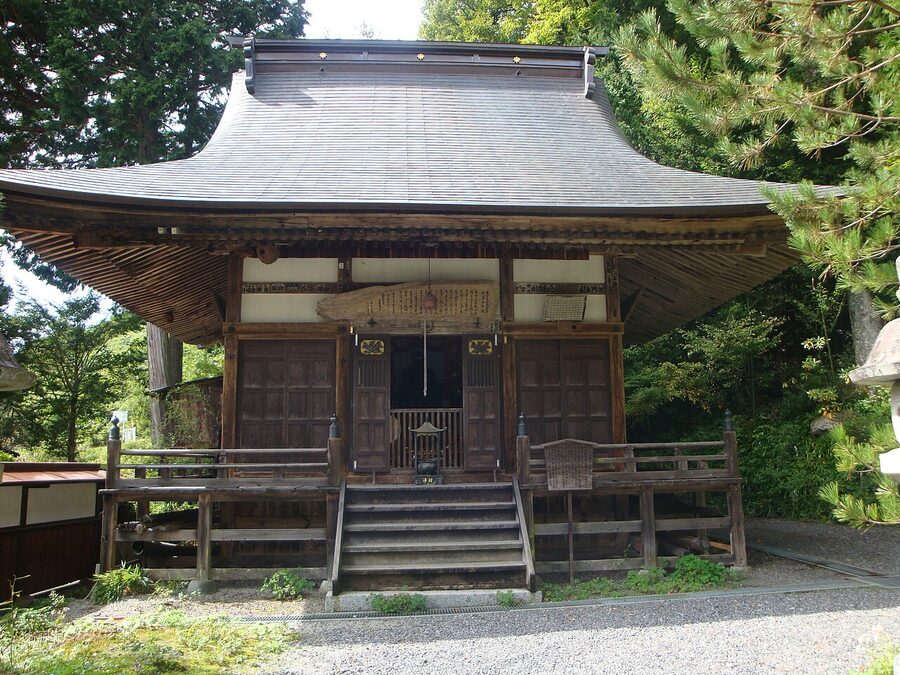
From Tokuon-ji you can walk up the Nakasendō along the river to Tomoe-ga-fuchi (巴淵), a deep pool where the Kiso River bends under Mount Yamabuki, about fifteen minutes from the station. The local legend is that a dragon lived in the pool and took Tomoe’s form to protect Yoshinaka, which is why it carries her name. Go in late October, when the maples over the water turn, and bring something warmer than you think you need. Hata-age Hachimangū, where the banner was supposedly raised, is on the same walk.
Kōzen-ji, Kiso-Fukushima
Two stops further down the line, in Kiso-Fukushima, Kōzen-ji (興禅寺) has a third Yoshinaka grave, said to hold a lock of his hair brought back by Tomoe. The temple is better known for its 20th-century rock garden by Shigemori Mirei, and you can do both in an hour before going on to the old checkpoint at Fukushima.
Kurikara Pass and Fukumitsu
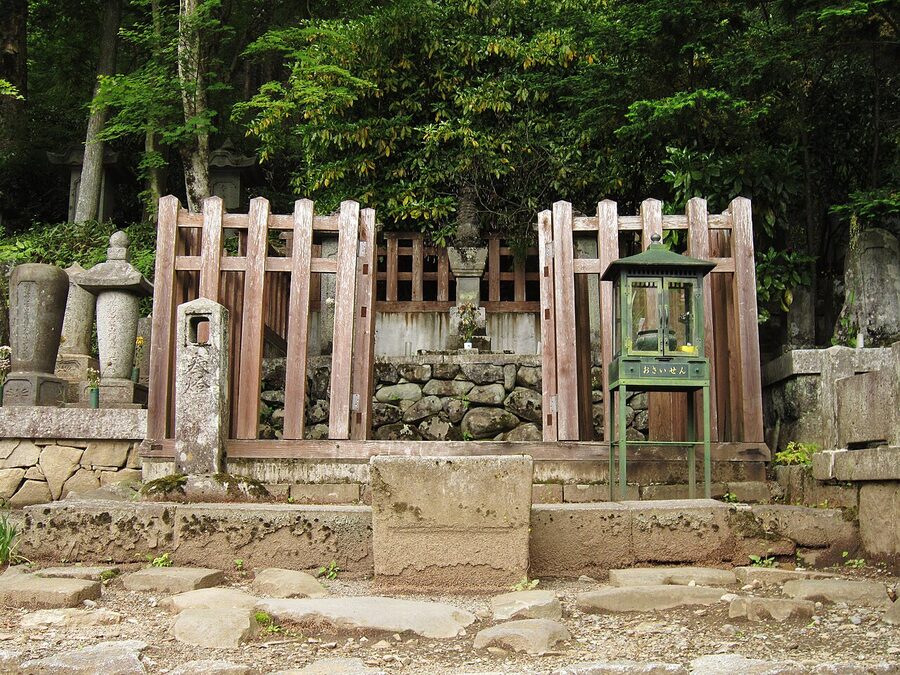
Kurikara Pass sits on the border of Toyama and Ishikawa, reached from Kurikara Station in Tsubata or by car from Oyabe. The old road over the ridge is now a prefectural park with a memorial stupa to the dead of 1183, put up in 1974, and the pair of mounds for Aoi and Tomoe that the local legend makes into a friendship. A statue of the fire-ox stratagem stands at the station for anyone who wants to believe the Jōsuiki. The pass is in the old province of Etchū, the same country that Sassa Narimasa would rule four centuries later.
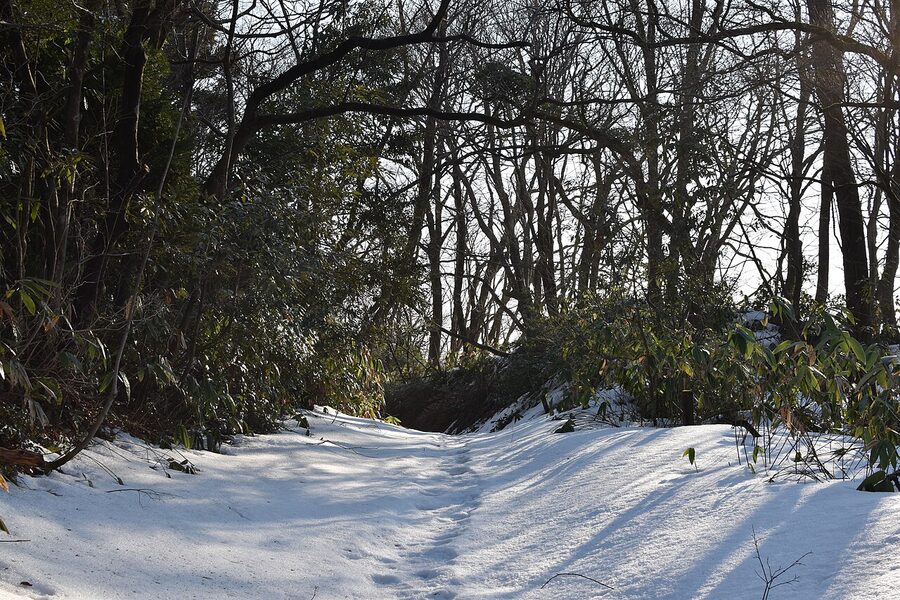
Fukumitsu, now part of Nanto city in Toyama, is where the Jōsuiki sends Tomoe to die at ninety-one. Her mound is in a small park under a pine about twelve metres tall, a city natural monument, and the town holds a memorial for her, the Tomoe-ki, on 22 October, the day local tradition gives as her death. It is free and takes ten minutes, and it is the place that most completely belongs to the later legend.
If you go to only one of these places, make it Gichū-ji in late autumn, in the last hour before it closes. Stand by the stone with her name on it and remember that the oldest version of her story ends with a woman taking her armour off on this shore and riding away. Everything on the gravestones came afterwards.