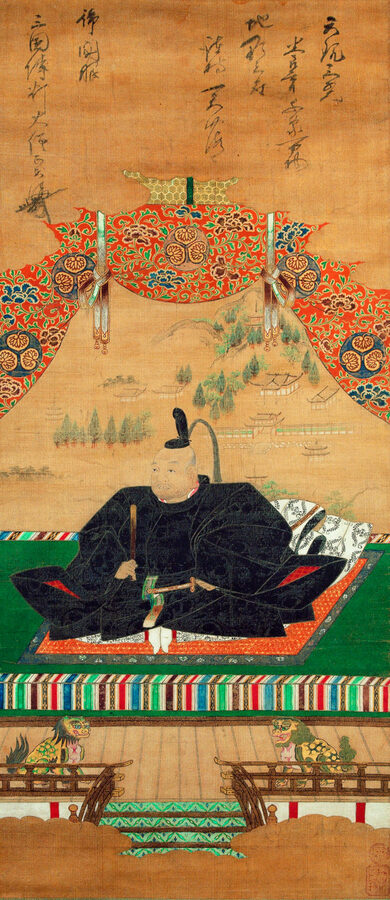
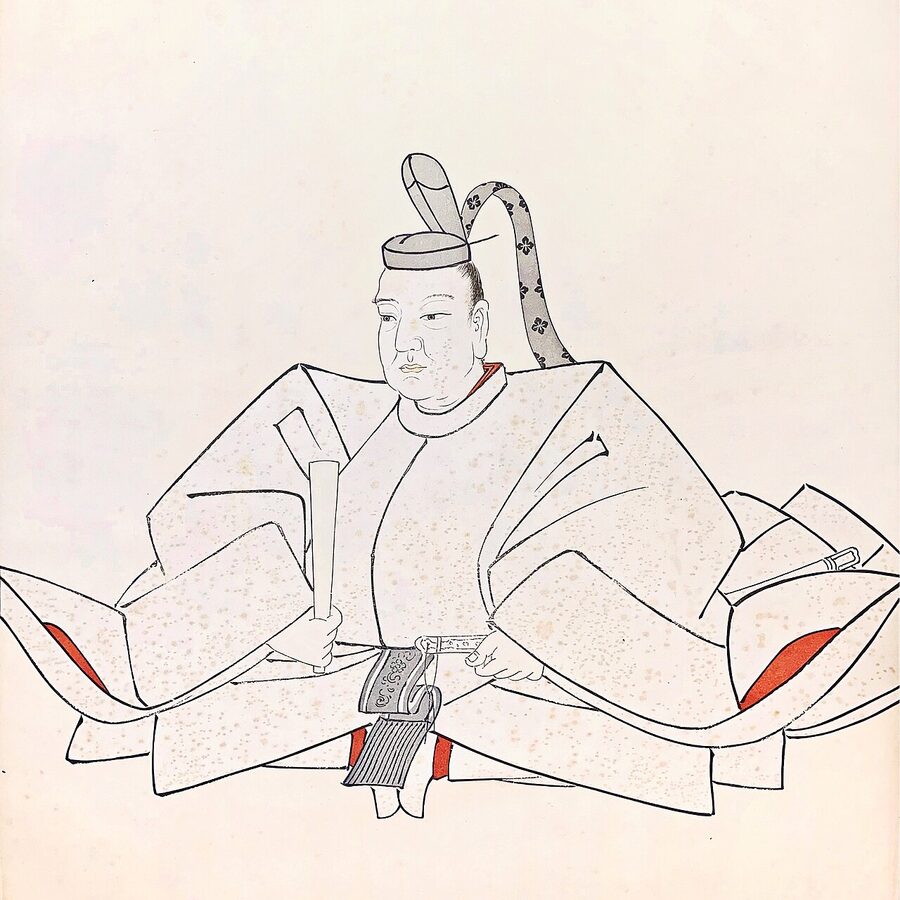
Tokugawa Ieyasu was precise about most things, and his instructions for his own afterlife were no exception. Bury the body at Kunōzan, he told the men around his sickbed in the spring of 1616; hold the funeral at Zōjō-ji, put the memorial tablet at Daiju-ji in Mikawa, and when a year has passed, build a small hall on the mountain at Nikkō and invite me there as a god. The words in the diary of the monk who wrote them down are chiisaki dō, a small hall. Twenty years later his grandson spent 568,000 ryō of gold on it.
What you walk into at Nikkō today is the result: 55 buildings, more than 5,000 carvings, a reported two and a half million sheets of gold leaf, and a gate that people have been staring at since 1636 without, by tradition, ever reaching the end of it. I have been climbing the hill for fifteen years and the gap between the instruction and the outcome still makes me smile. It is also the key to the whole place. Nikkō Tōshōgū (日光東照宮) is a working shrine where priests make offerings to a god every morning, and it is also an argument about who the Tokugawa were and why everyone else should keep doing what they said, carved into wood and painted in lacquer on a mountain that had been holy for eight hundred years before Ieyasu arrived.
In This Article
- A death at Sunpu
- Gongen or myōjin: the argument over a god-name
- North to Nikkō, 1617
- Iemitsu’s rebuild of 1636
- The gate you never finish looking at
- Monkeys, a cat and a dragon that cries
- Embassies, processions and a lantern from the Dutch
- 1868: the war comes to the mountain
- Two shrines, one temple, and a long repair
- Where to visit Nikkō Tōshōgū today
- Tōshōgū and the Okusha
- Rinnō-ji, the Sanbutsudō and Taiyūin
- Futarasan Shrine
- The Shinkyō bridge
- The Cedar Avenue of Nikkō
- Getting there
- Kunōzan, and the god’s other homes
- The small hall
A death at Sunpu
Ieyasu died at Sunpu Castle on the 17th day of the fourth month of 1616, which Japanese reference works convert to 1 June by the Western calendar. He was seventy-five by the Japanese count and seventy-three by ours. The story that a dish of sea bream fried in oil finished him off is old and probably half true; the illness lasted months, and most modern historians suspect a cancer of the stomach. I have written about his life in my piece on Tokugawa Ieyasu; this one is about his afterlife.
He had destroyed the Toyotomi at Osaka the summer before, and the Tokugawa shogunate his son Hidetada now ran was as safe as any regime in Japanese history had been. So he spent his last weeks on the one thing still unsettled, which was what would happen to him next. Around the second day of the fourth month he called three men to his bedside: Honda Masazumi, his political fixer, and two monks, the Zen prelate Ishin Sūden and the Tendai abbot Nankōbō Tenkai.
Sūden kept a diary, and the instructions survive in it. The body to Kunōzan, the funeral at Zōjō-ji in Edo, the tablet at the family temple in Mikawa, and after the first anniversary the small hall at Nikkō, where, he said, he would become the guardian of the eight provinces of the Kantō. Historians still argue over how much of what followed he planned and how much was improvised by the men he left behind.
They moved quickly. The body went up to Kunōzan, the steep hill over the Pacific south of Sunpu, on the night he died, and it was buried in a temporary hall there two days later with rites in the Yoshida Shintō manner. A Buddhist funeral followed at Zōjō-ji in the fifth month, kept deliberately small, because the man being mourned was, officially, on his way to becoming a god.
There was a reason a dying man fussed over this. His old master Toyotomi Hideyoshi had also been made a god, as Toyokuni Daimyōjin, with a great shrine on a hill in Kyoto, and within seventeen years of his death his family was extinct. Ieyasu had seen to that personally, and after Osaka fell he had Hideyoshi’s god-name withdrawn and let the shrine decay. A deity who failed his descendants that badly was not a precedent anybody wanted to follow.
Gongen or myōjin: the argument over a god-name
The quarrel started almost at once. On the 20th day of the fourth month, three days after the death, Tenkai and Sūden argued in front of Hidetada at Sunpu about what kind of god Ieyasu should be. Sūden, who had the weight of convention behind him, wanted the title myōjin, “bright deity”, with rites in the Yoshida Shintō tradition that had made Hideyoshi a god. Tenkai wanted gongen, a Buddhist term for a buddha who appears in the form of a Japanese god, with rites in his own Tendai school’s Sannō Ichijitsu Shintō and the healing buddha Yakushi as Ieyasu’s true form.
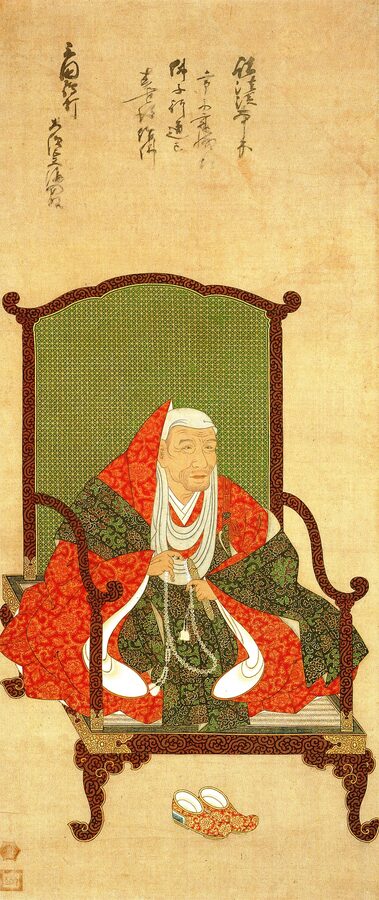
Tenkai’s best argument was a nasty one. Hideyoshi had been a myōjin, he pointed out, and Hideyoshi’s house had lasted two generations. Sūden countered that gongen was the wrong category for a statesman, and a Yoshida priest consulted by Hidetada’s men said, reasonably enough, that the two titles were of equal rank and myōjin suited a former chancellor of the realm. On the 26th day of the fifth month Hidetada decided for Tenkai, who had been running Nikkō’s temples since 1613 and had rebuilt the monasteries of Mount Hiei; he looked like a man who could invent a new kind of cult and make it hold.
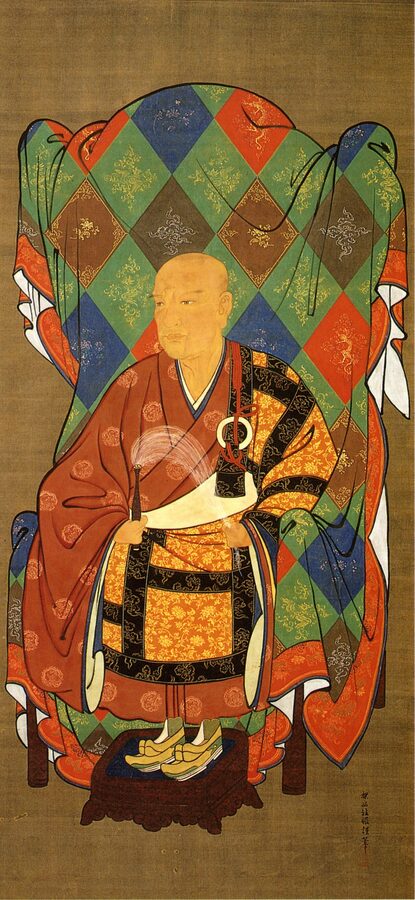
Then the imperial court had to be persuaded, which took months. Senior nobles grumbled that a Buddhist monk had no business making gods, and the retired emperor Go-Yōzei, who had given Hideyoshi his title, made his doubts known. On the 13th day of the seventh month Emperor Go-Mizunoo approved a gongen title in principle, and the court sent Edo four candidates: Nihon Daigongen and Tōkō Daigongen from the regent Nijō Akizane, Tōshō Daigongen and Irei Daigongen from the former minister Imadegawa Harusue.
Hidetada chose the third, “Great Gongen Shining over the East”, on the fifth day of the ninth month. The name was formally conferred on the 21st day of the second month of 1617, with the highest court rank for gods following on the ninth day of the third month. The imperial edict praised the dead man for spreading his might to foreign lands and asked him to guard the throne by night and day, which, given that his family had spent thirty years pushing the throne around, has a certain dry humour of its own.
North to Nikkō, 1617
Nikkō was not an obvious place for the founder of a regime based in Edo, and that was the point. The mountain had been a sacred site since the monk Shōdō climbed Mount Nantai at the end of the eighth century, and its temples had enjoyed the patronage of Minamoto no Yoritomo, founder of the first warrior government, and of every power in eastern Japan since. Ieyasu admired Yoritomo and read his chronicle; a cult at Nikkō plugged the Tokugawa into five centuries of warrior piety. People also like to point out that Nikkō lies almost due north of Edo Castle, under the pole star, though that observation is modern and nobody in 1616 wrote it down.
Tenkai, Honda Masazumi and the castle-builder Tōdō Takatora chose the site in the tenth month of 1616. English-language accounts often say Takatora built the first shrine; Japanese sources make him the commissioner and give the design and construction to the shogunate’s master carpenter, Nakai Masakiyo, who had already built a castle or two for Ieyasu. The buildings were ready by the spring of 1617.
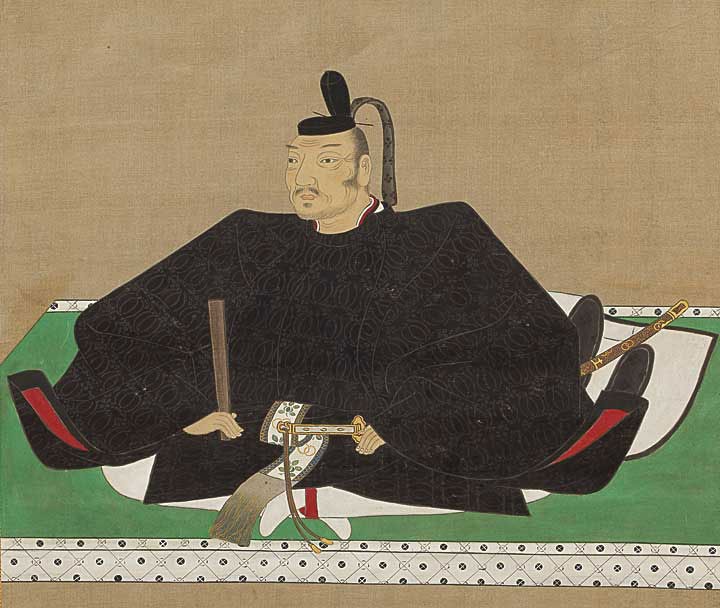
The coffin left Kunōzan in the third month with an escort that the records put at 300 horsemen and a thousand foot, and reached Nikkō on the fourth day of the fourth month. On the eighth it was placed in the inner sanctuary on the hill behind the shrine; on the night of the 16th the god was installed, and on the 17th, the first anniversary of the death, the great rites were held with Hidetada present. The shrine’s own account dates the arrival to the 15th, and the sources variously give the dates in between; the Japanese reference works convert the burial on the eighth to 12 May by the Western calendar.
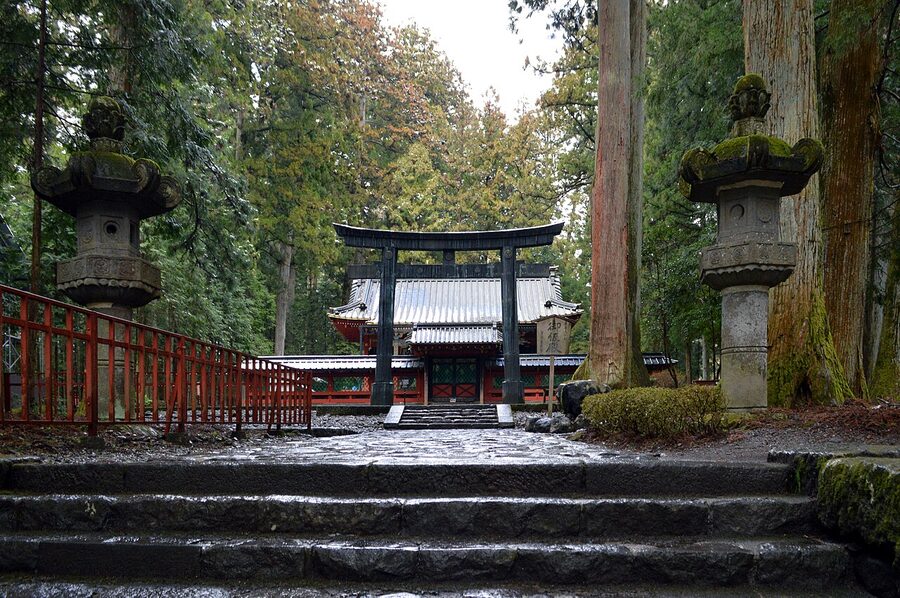
The great lords queued to contribute, because a gift to Ieyasu’s shrine was a gift that the shogun would see. In 1618 Kuroda Nagamasa of Fukuoka sent the stone torii that still stands at the top of the main approach, quarried in his own domain, shipped in fifteen pieces by sea and river to Oyama and dragged the rest of the way. Nabeshima Katsushige of Saga gave the stone water basin. A wooden pagoda-tomb went up over the grave in 1622.
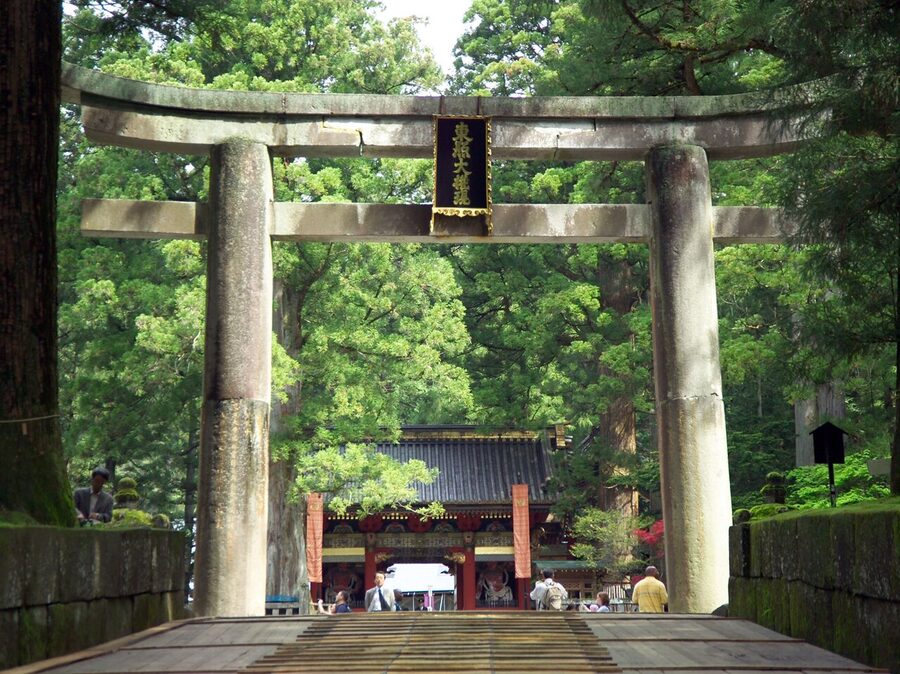
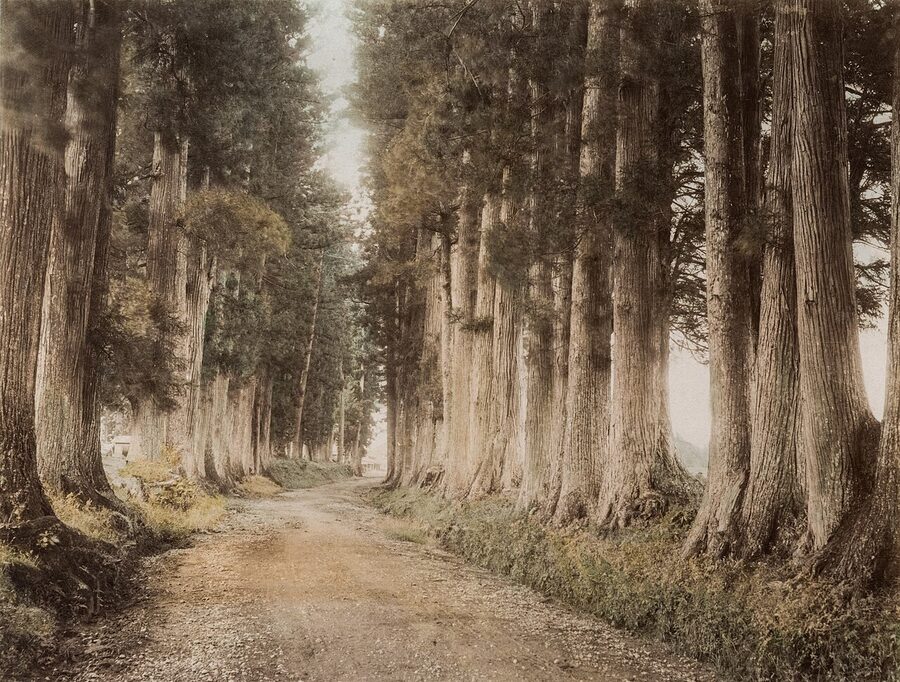
Then a man called Matsudaira Masatsuna started planting cedars. A Tokugawa retainer since childhood, he was too poor, the story goes, to offer a stone lantern like the great lords, so from around 1625 he spent about twenty years lining the three roads into Nikkō with seedlings, and dedicated them to the god on the 33rd anniversary of the death in 1648. Something like 12,000 of those trees still stand, which makes his the most successful gift of the lot.
Iemitsu’s rebuild of 1636
Hidetada’s shrine lasted less than twenty years. His son Iemitsu, the third shogun, had an attachment to his grandfather that went well past ordinary piety. A note kept in his personal amulet bag, now at Rinnō-ji, is often quoted as saying that his living and his dying both depended on the Great Gongen, and he called himself, in effect, a second Gongen and a second shogun, the god’s own heir rather than his father’s.
He visited Nikkō in the ninth month of 1634 and decided to rebuild almost everything in time for the 21st anniversary of the death, in 1636. The model, a shrine record says, was the periodic rebuilding of Ise. Work began on the 17th day of the eleventh month of 1634, the ridgepoles went up on the eighth day of the fourth month of 1636, and the god moved into the new sanctuary two days later, in time for the anniversary rites on the 17th.
That is roughly seventeen months, though you will also read fifteen, and the shrine itself says a year and five months. The bill, recorded in the official account of the works, was 568,000 ryō of gold, 100 kanme of silver and 1,000 koku of rice, every coin of it from the shogunate’s own treasury rather than squeezed out of the daimyō, which was the point of the exercise. One standard reference gives 2,485,500 sheets of gold leaf, 140,076 pieces of timber and 4,541,230 man-days of labour; another, citing the papers of the chief commissioner’s family, makes it 4,533,648. Either way, on busy days several thousand carpenters and carvers were at work on the hillside at once.
The chief commissioner was Akimoto Yasutomo, a trusted bannerman. The master builder was Kōra Munehiro, born in 1574 in the village of Kōra in Ōmi, a carpenter of the Zen-style school who had just finished the mausoleum of Hidetada at Zōjō-ji, and whose family held the shogunate’s chief carpenter’s post for the rest of the period. Painting and colour were in the hands of Kanō Tan’yū and his studio. Iemitsu was not paying for restraint and he did not get it; if you have seen Kinkaku-ji, you know what gold does in a garden, and Nikkō is what gold does when it is told to win an argument.
What was it all for? Partly devotion, plainly, but the timing tells you more. Iemitsu had just turned the alternate-attendance system of sankin-kōtai into law for the outside lords, was tightening the country’s doors against foreigners and was about to face the Shimabara Rebellion; he needed every daimyō to understand that the house in Edo rested on something more than force. Ieyasu, who had asked for a small hall, became the visible proof that the Tokugawa had a god on their side, and Iemitsu was the god’s grandson.
Iemitsu was busy elsewhere too. He paid for the rebuilding of the main hall of Kiyomizu-dera in Kyoto, completed in 1633, the same years he was planning Nikkō. A ruler who builds a wooden stage over a cliff in the old capital and a gilded mountain in the east is making a statement about where the money now lives.
The gate you never finish looking at
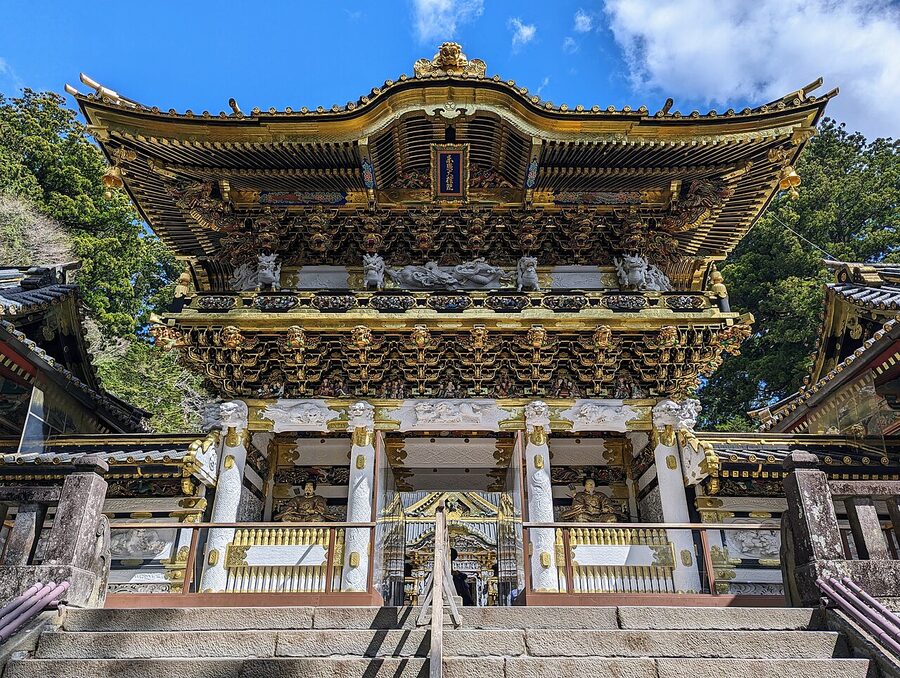
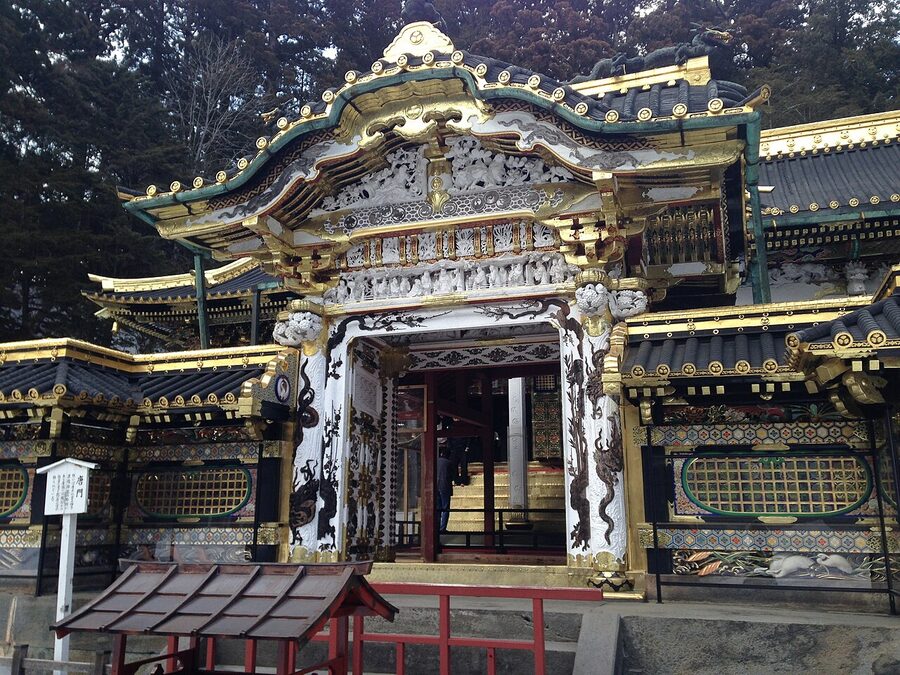
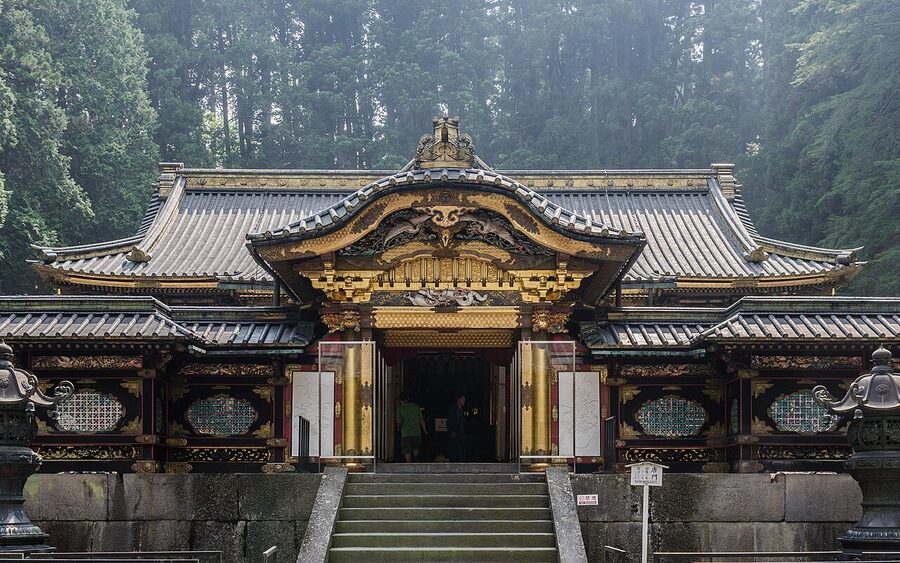
The Yōmeimon (陽明門) takes its name from one of the gates of the imperial palace in Heian Kyoto, which tells you the level of ambition. It is a two-storey gate, about 7 metres wide, 4 deep and 11 high, and one count gives 508 carvings on it out of 5,173 across the shrine. Its nickname is the Higurashi-no-mon, the gate where you lose track of the day, because you could stand in front of it until sunset and still not have seen everything.
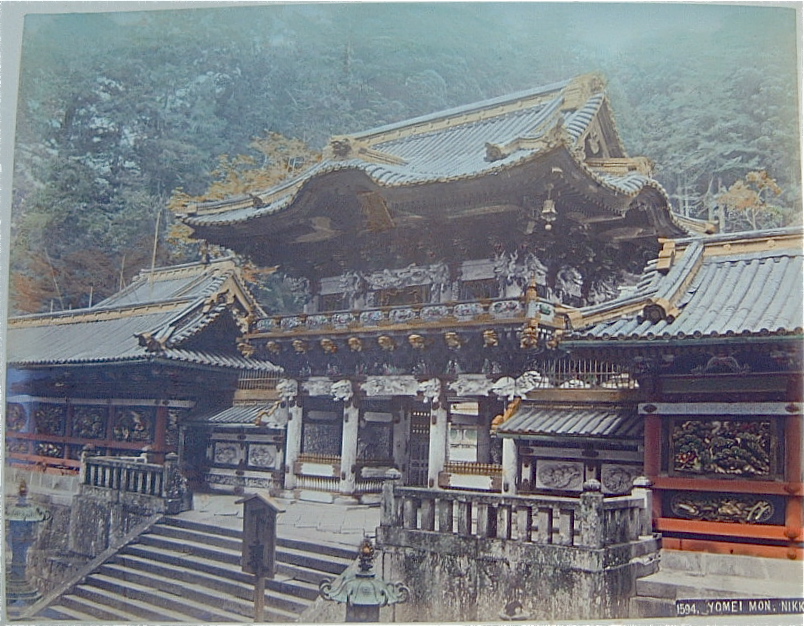
The carvings are not random. Along the lower storey, on the panels between the brackets, are figures from Chinese history and legend. On the front, at the centre, sits the Duke of Zhou, the regent who would interrupt washing his hair to receive anyone with a petition, the model of a ruler who listens, and on either side gentlemen play the zither and Go and look at painting and calligraphy. Most scholars read the Duke as Ieyasu himself, which is either flattering or cheeky depending on how you feel about Ieyasu.
On the back are Taoist immortals riding a carp, a crane, a dragon and a phoenix, read as a statement that the god’s spirit lives on. Up on the balustrade of the upper storey, twenty panels show Chinese children at play: building a snowman, playing tag, riding hobby horses, quarrelling. These are usually taken to mean the long peace the Tokugawa had delivered, and they are the panels I would save in a fire.
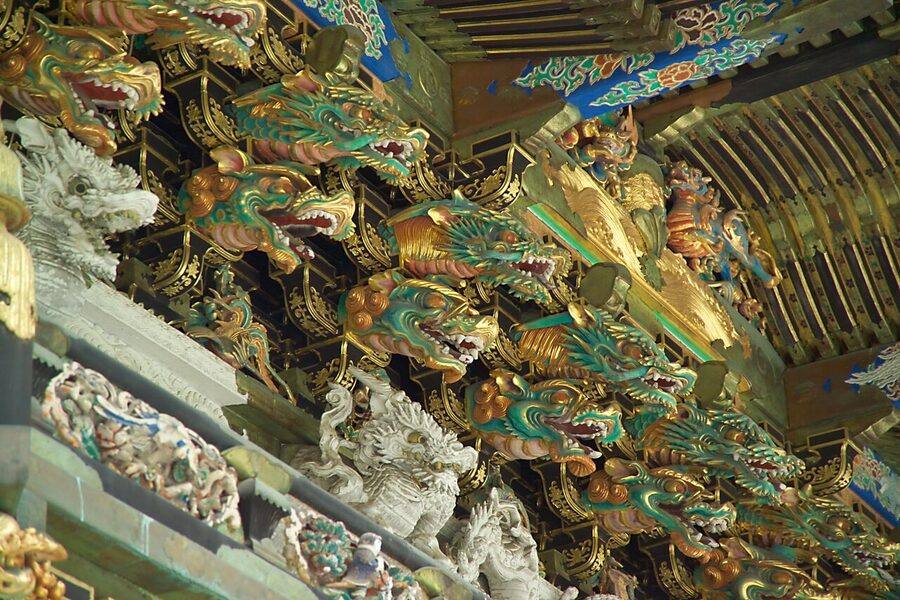
There are deliberate imperfections. One of the twelve white pillars on the lower storey, the second from the west at the back, has its carved pattern upside down. It is known as the mayoke no sakabashira, the reversed pillar that wards off evil, and the usual explanation is the old builders’ belief that a perfect building starts to decay the moment it is finished. Whether the carvers intended it or simply made a mistake and talked their way out of it is not recorded.
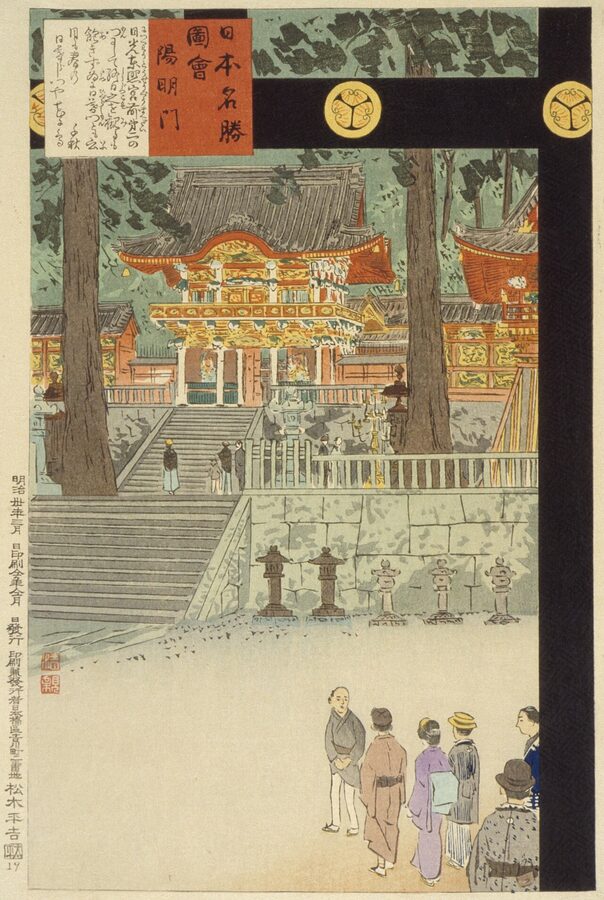
Even the gate’s painted surfaces have a history. The peony carvings on the side walls of the lower storey are not originals but replacements from the repairs of 1749 to 1753, and in 1974 restorers found an older painting of cranes and flowers beneath them, done in an oil-based technique. The work at Nikkō has never really stopped; major repairs have come roughly every twenty years since the Edo period, beginning with the great overhaul of the Genroku era.
Monkeys, a cat and a dragon that cries
Before the Yōmeimon you pass a plain building with no lacquer at all, and that is deliberate. The Shinkyūsha is the stable for the god’s sacred horse, built of bare wood, and along its upper beam runs a frieze of eight carved panels of monkeys. Monkeys were believed to protect horses from disease, which is why medieval warriors kept them in their stables.
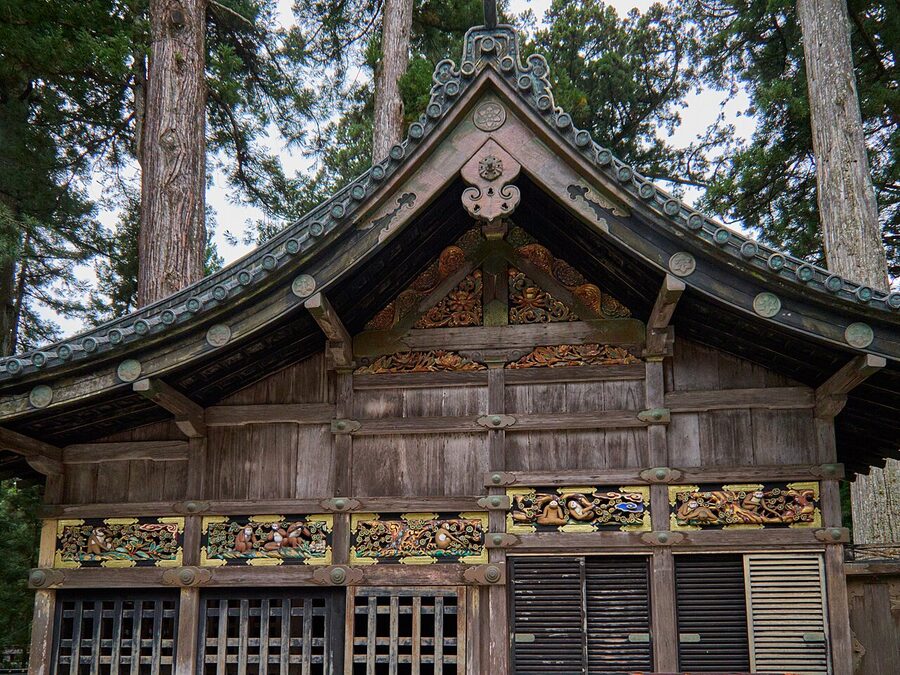
The eight panels tell the life of a monkey, and by extension of a person: a mother with her baby, a youngster looking up at the sky with ambition, a monkey brooding over love, and at the end a pregnant mother, which brings the story round to the beginning. “See no evil, hear no evil, speak no evil” is the second panel, the advice for childhood. The motto itself comes from a line of the Analects, and three monkeys were already common in Japan on stones of the Kōshin cult, but Nikkō made the image famous enough to end up on fridge magnets in Ohio.
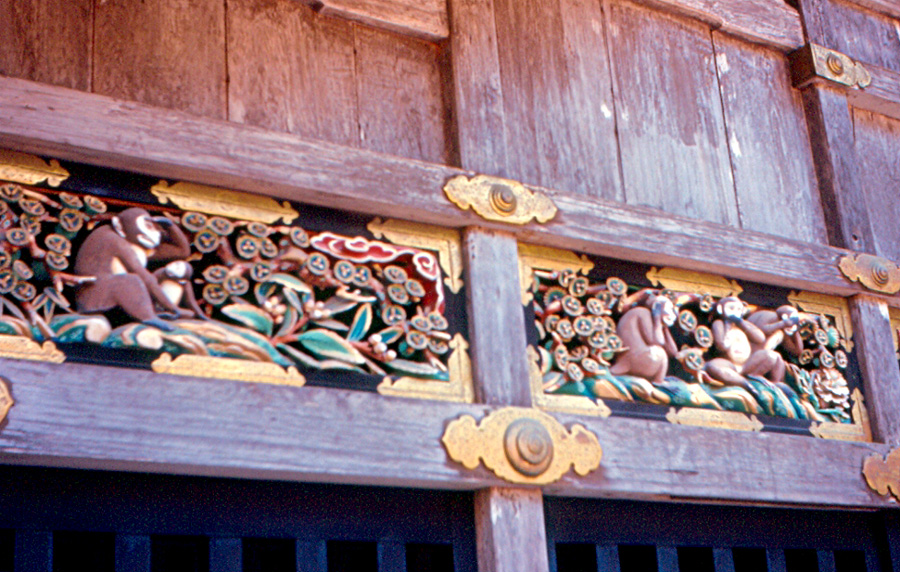
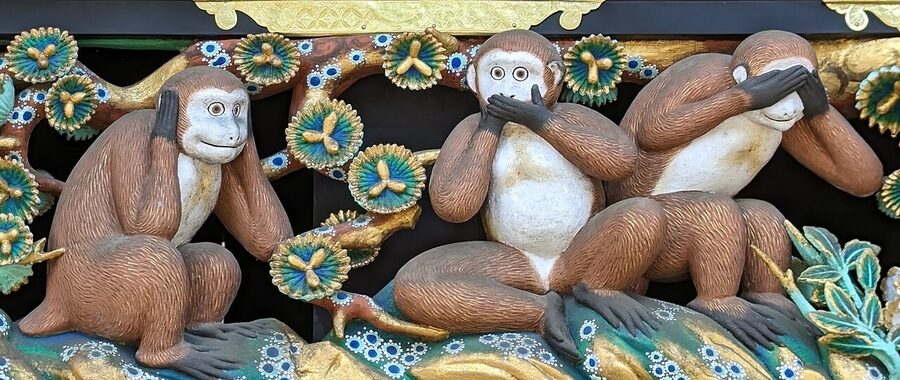
The sleeping cat, the nemuri-neko (眠り猫), is the other celebrity, and it is much smaller than people expect: about 15 centimetres by 20, set over the passage in the east corridor that leads up to the tomb. It is the only cat among 652 animal carvings of 26 species in the shrine. Tradition gives it to the carver Hidari Jingorō, and the shrine repeats that attribution politely; scholars point out that nobody can show Jingorō was at Nikkō, or, with certainty, that he existed at all.
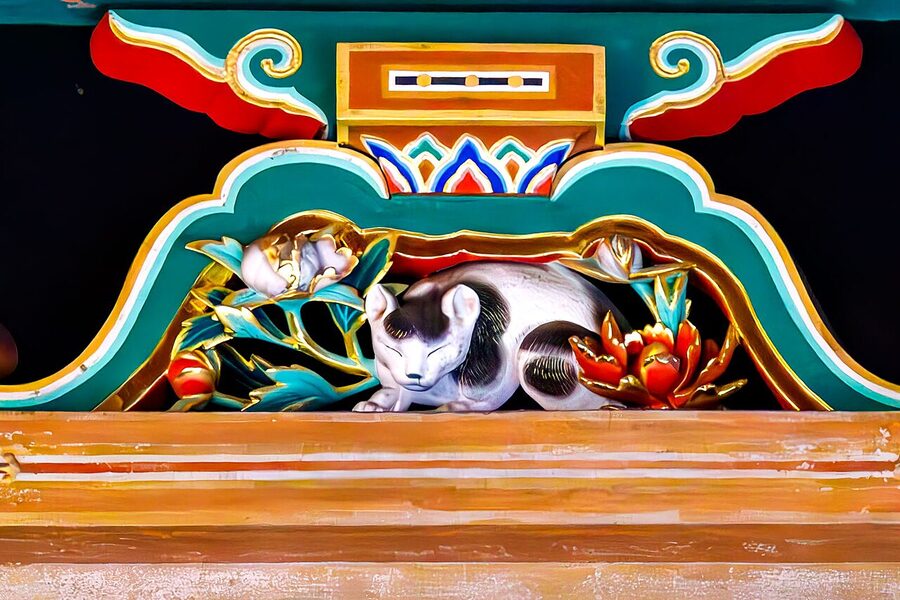
What does the cat mean? Interpretations run from a guard keeping rats off the tomb, to a pun on the sun (nikkō means sunlight, and the cat is dozing in it), to a picture of peace: on one side a cat asleep, on the other side sparrows unafraid. A Zen riddle about a cat sleeping under a peony also gets quoted, in which the cat only looks asleep and is ready to pounce. That last reading, that the god is never as relaxed as he looks, suits Ieyasu best.
The cat travelled. When the shrine was overhauled in the Genroku era, the work was led by Ii Naooki, lord of Hikone Castle, and the team built a small temple at Hikone in 1695 that people still call the Hikone Nikkō, with its own copy of the sleeping cat. And Nikkō’s style spread through the Tōshōgū network: Ieyasu’s son Yoshinao put up a Tōshōgū at Nagoya Castle in 1619, and by the end of the Edo period there were something like 700 of them across the country.
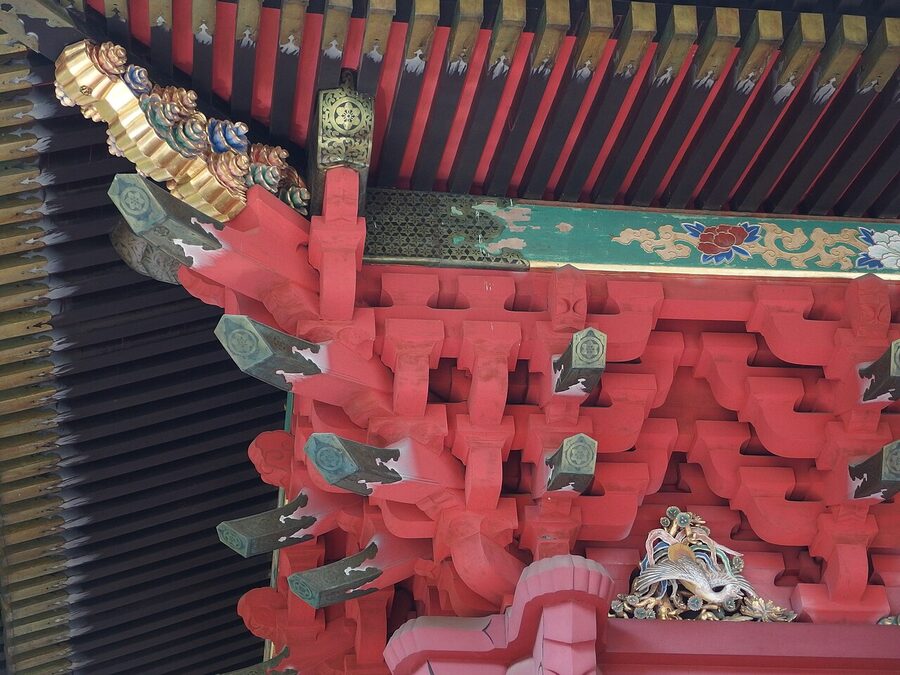
The crying dragon, the nakiryū, is in the Honjidō. A monk claps two wooden blocks under the dragon’s head and the sound rings back off the ceiling in a long buzzing shiver, which is said to be the dragon’s cry; a step to the side and there is nothing. It is a demonstration, given every few minutes by the hall’s attendants, and a well-rehearsed one, but the effect is real and I have never seen anyone fail to smile at it.
Embassies, processions and a lantern from the Dutch
A shrine like this needs an audience, and the shogunate supplied one. In the last month of 1636, according to Japanese sources, the first Korean embassy to visit Japan since the Imjin War was taken on from Edo to Nikkō at the urging of the Sō family of Tsushima, who managed relations with Korea; English-language accounts sometimes place the visit in the spring of 1637. Korea had been invaded twice by Hideyoshi forty years earlier, and the embassies were a hard-won normalisation, so there was a certain nerve in parading the envoys before the god of the family that had replaced him.
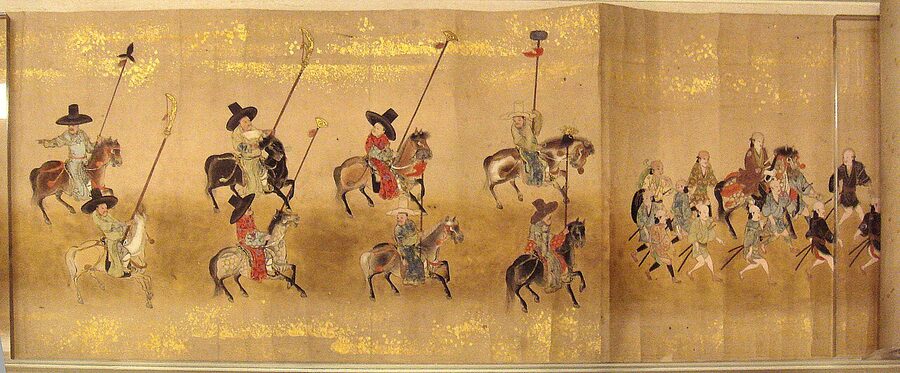
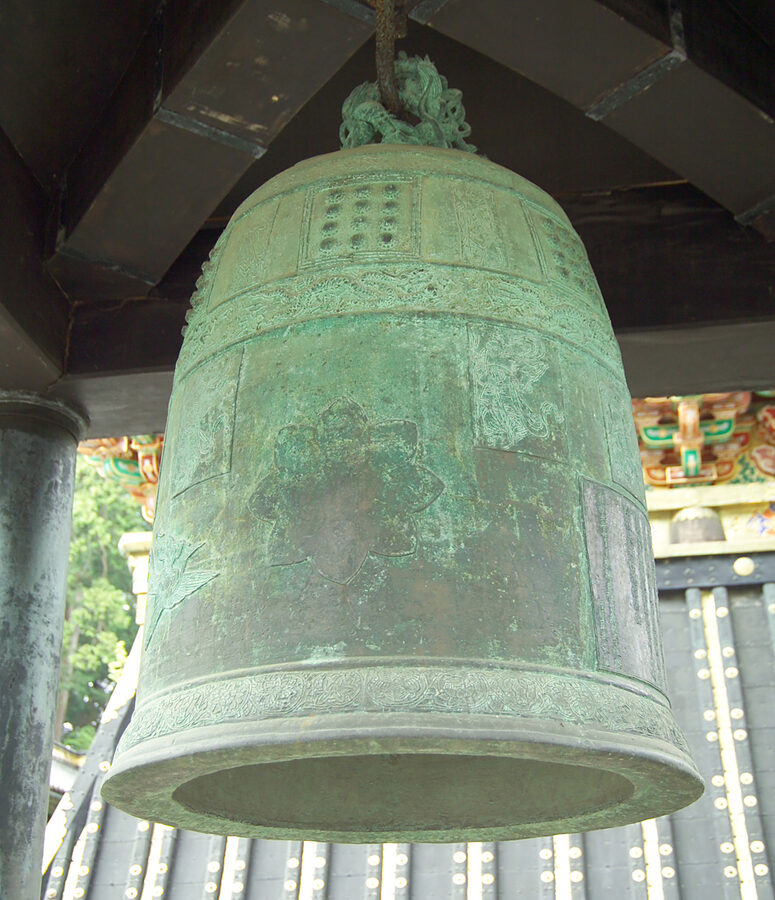
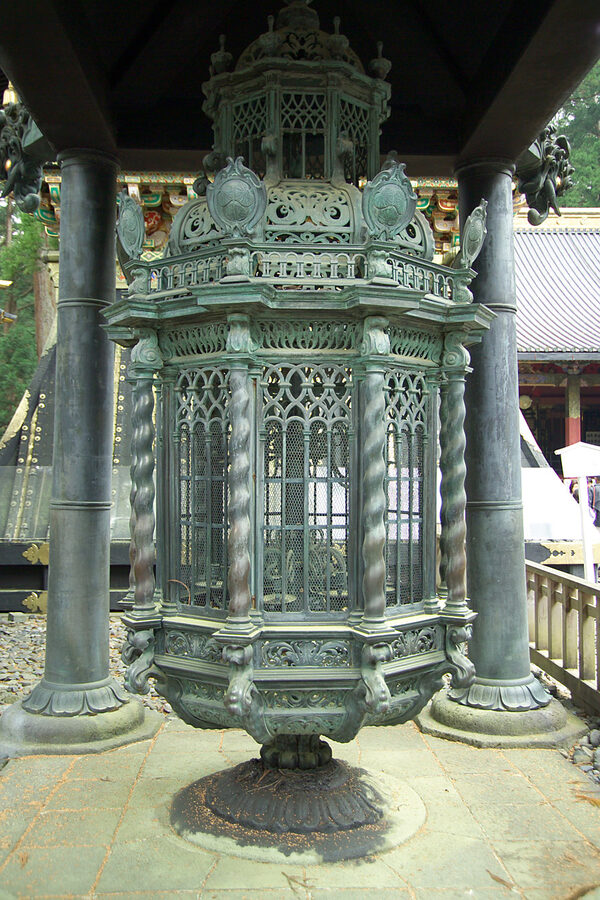
The envoys of 1643 and 1655 went too. The 1643 mission brought a bronze bell and calligraphy from King Injo, and the Dutch, newly confined to their island at Dejima under the rules of sakoku, sent a revolving bronze lantern the same year. The point, for the Tokugawa, was that foreign kings and foreign merchants paid their respects to the Gongen. What the envoys themselves made of being used this way is another matter.
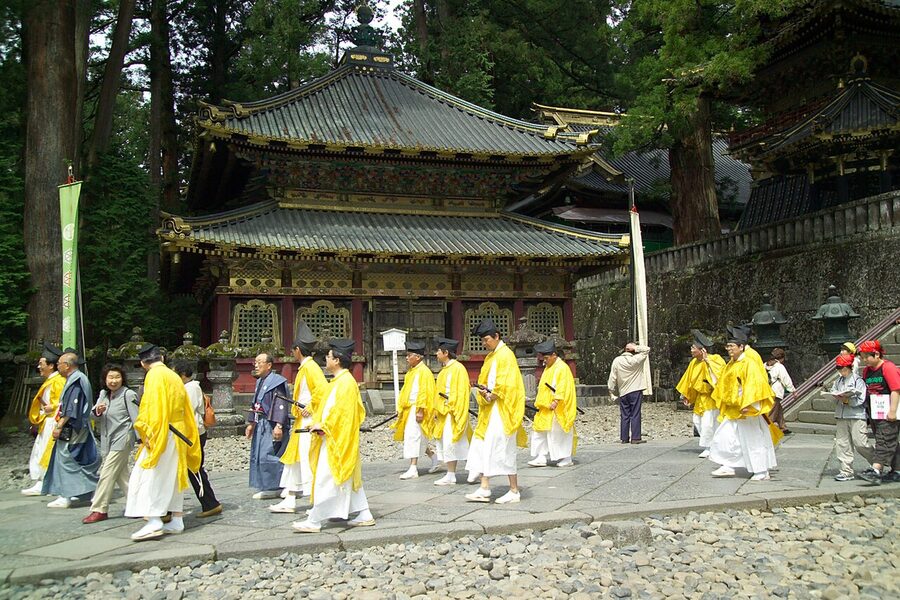
Then came the court. In 1645 the shrine was granted the title of gū, the rank reserved for shrines to imperial ancestors and a few others, and became Tōshōgū instead of Tōshōsha. From the next year until 1867 an imperial envoy, the reiheishi, came every spring with offerings for the anniversary on the 17th day of the fourth month, travelling with about fifty people along the Nakasendō and a road built for him, the Reiheishi Kaidō. Only one other shrine in the country, Ise, received an imperial envoy every year.
And there were the shoguns themselves. The great pilgrimages, the Nikkō shasan, happened sixteen times in the Edo period by one standard count, mostly under Iemitsu. After him they were too expensive: Yoshimune, Ieharu and Ieyoshi went once each, and Tsunayoshi never went at all, though the Genroku repairs were done on his watch. The 1776 pilgrimage of Ieharu is reported to have used 4 million man-days of labour, 300,000 horses and 220,000 ryō, about a seventh of the shogunate’s yearly income.
Commoners came too, in surprising numbers. In about 1841 the Nikkō magistrate counted some 35,000 people a year who were not on official business, nearly a third of them pilgrims of the old mountain cult and the rest sightseers. Only bannermen and above could actually worship at the shrine; everyone else was allowed to look, steered round the buildings by licensed guides whose trade was recorded as early as 1655. The daimyō, for whom the trip was a form of attendance on the god much like attendance on the shogun in Edo, came in their castle robes.
1868: the war comes to the mountain
The Tokugawa god was about to have a bad year. After the last shogun, Tokugawa Yoshinobu, surrendered Edo in the spring of 1868, the army commander Ōtori Keisuke took about 2,000 shogunate infantry north, along with men from the Shinsengumi, intending to fight the new government’s forces at Nikkō, the holy ground of the house they served. The Boshin War was coming to the shrine.
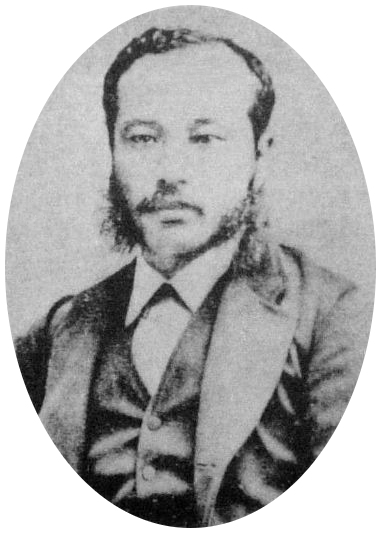
Ōtori took Utsunomiya Castle, lost it again, and fell back on Nikkō on the 25th day of the fourth month. By the story as Japanese histories tell it, the monks of Nikkō begged the government side not to fight on the mountain, and the commander of the Tosa troops, Itagaki Taisuke, sent word to Ōtori to come down. Ōtori’s men were exhausted, short of ammunition and carrying wounded, and they left the mountain for Aizu without a fight. One account gives a share of the credit to a local priest, Genryō, who acted as a go-between.
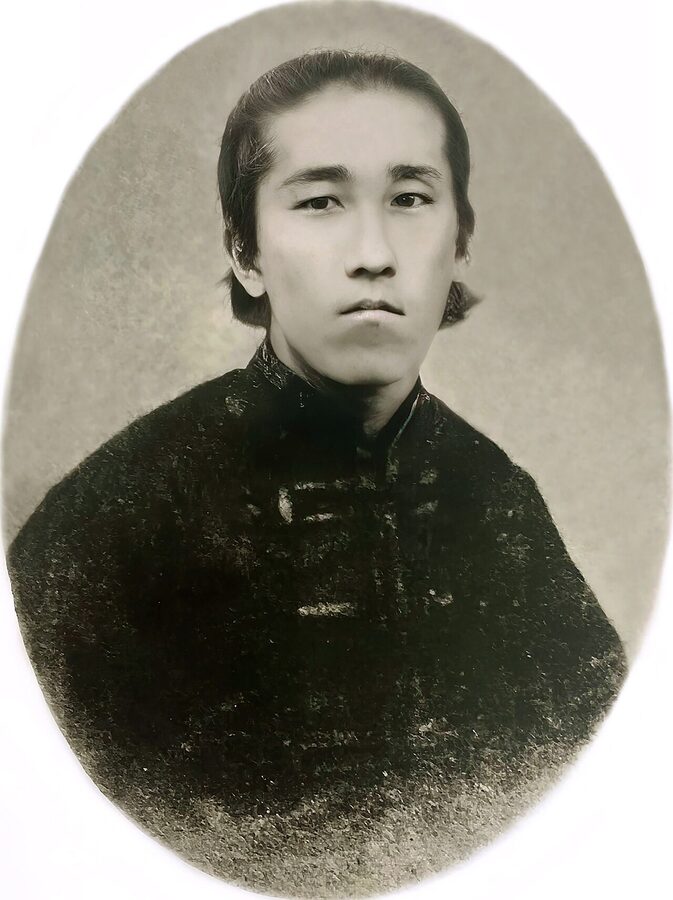
The speeches came later. Itagaki is credited with telling the shogunate men that hiding behind their ancestors’ tablets and letting the shrine burn would make the Tokugawa a joke for ever, and with telling the hawks of Tottori, who wanted to burn it, that the plaques in the emperor’s hand on the Yōmeimon made arson an insult to the throne. Both speeches are tidier than battlefield talk usually is, and I treat them as tradition. The shrine survived, and in 1929 a bronze statue of Itagaki went up by the Shinkyō bridge, with lettering by Tokugawa Iesato, the head of the Tokugawa house.
The statue went for scrap metal in the war, and the one you see is a 1967 recast. Meanwhile the abbot of Nikkō’s temples, a prince of the imperial house who lived at Kan’ei-ji in Edo, had fled north after the battle at Ueno and briefly became the figurehead of the northern alliance against the government. The Meiji Restoration was not kind to Nikkō’s institutions, even if it spared the buildings.
Two shrines, one temple, and a long repair
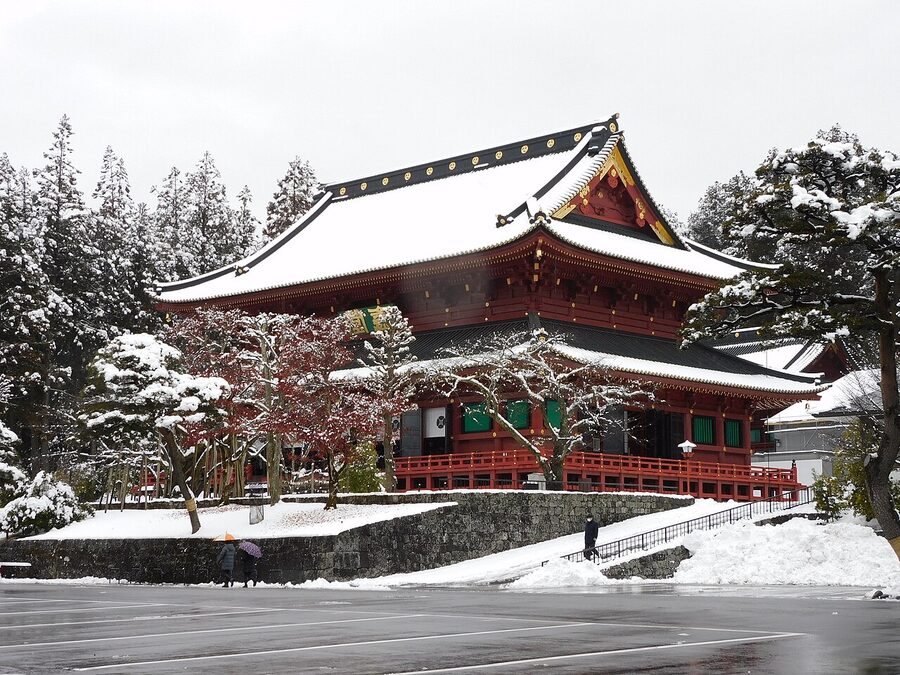
For two and a half centuries there had been one Nikkō: a single mountain of temples, shrines and mausoleums in which buddhas and gods were two faces of the same powers, run by the Tendai monks. The new government’s orders of 1868 to separate Shinto from Buddhism broke it up. In Nikkō the split was carried out in 1871, and the result is the arrangement you see today, the nisha ichiji: two shrines, Tōshōgū and Futarasan, and one temple, Rinnō-ji.
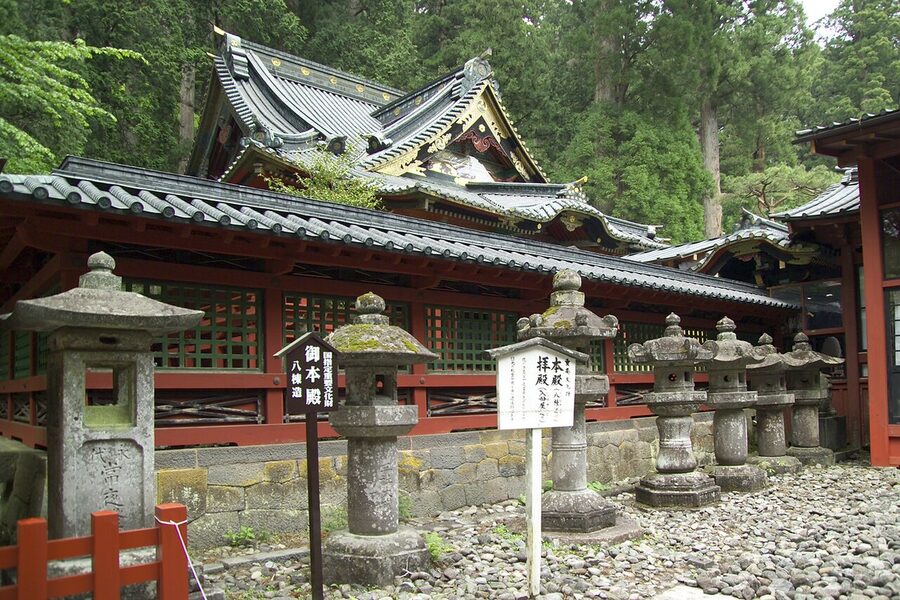
It was a messy divorce. The temple lost its imperial name in 1869 and became Mangan-ji again, and its great hall, the Sanbutsudō, which stood up among the shrine buildings, was ordered taken down; after protests it was moved instead, piece by piece, to its present site. Buddhist treasures went from the shrine to the temple, and the Gongen became a plain god. A few buildings, the Honjidō with the dragon and the sutra library among them, are still claimed by both sides, which is why a Tōshōgū ticket gets you into a hall that houses a buddha.
The new state needed its own gods and found them. In 1868 it restored Hideyoshi’s shrine, and in 1869 gave Oda Nobunaga the god-name Kenkun, which quietly reduced Ieyasu from founder of the realm to one unifier among three. Tōshōgū became a shrine of special government rank in 1873, alongside the shrines of those rivals, and in the Meiji era it turned into what it has been ever since, a monument to be admired. The modern state built its own great shrine to a dead ruler in Tokyo half a century later, and my piece on Meiji Shrine tells that story; the contrast between the two, gold on a mountain and bare cypress in a planted forest, is the best short lesson in modern Japanese history I know.
Repairs have been continuous. The great postwar campaign of the Shōwa era ran through the 1950s and 1960s; the Honjidō burned in 1961 because of a faulty electric heater. The shrine and temple were inscribed together as the World Heritage site Shrines and Temples of Nikkō in December 1999, covering 103 buildings, nine of them National Treasures. In the Heisei era the Yōmeimon got its turn, from 2013 to 2017, along with the monkeys and the cat.
The restoration was not trouble-free. Within months of the gate’s unveiling, mould and flaking appeared on parts of the new white shell-powder coat, and in 2020 the roof was found to be leaking, so the gate went back under repair from December 2021 to April 2022. I mention this not to complain but because it is how the place has always worked: there is no finished Nikkō, only the current state of the repairs.
Where to visit Nikkō Tōshōgū today
Nikkō is an easy day trip from Tokyo and a better overnight one. The shrine and temple area is compact, about a kilometre from the Shinkyō bridge at the bottom to the tomb at the top, but it is all uphill, much of it on stone steps, and the crowds between ten and three on a weekend in autumn are serious. If you can, go on a weekday, arrive for the first opening, and do the Tōshōgū first and the temples after lunch. The shrine is a place of worship, so bow at the gates if you like, keep your voice down in the inner precinct and your shoes off where the signs say.
Tōshōgū and the Okusha
Tōshōgū is open 9:00–17:00 from April to October and 9:00–16:00 from November to March, with the last admission thirty minutes before closing. A ticket is ¥1,600 for adults and high-school students and ¥550 for younger children, and it covers everything from the Omotemon gate through the Yōmeimon, the worship hall, the east corridor with the cat, the Honjidō dragon and the tomb itself. The Treasure Museum is ¥1,000 on its own or ¥2,400 with the shrine ticket, and the shrine rents an English audio guide for ¥500.
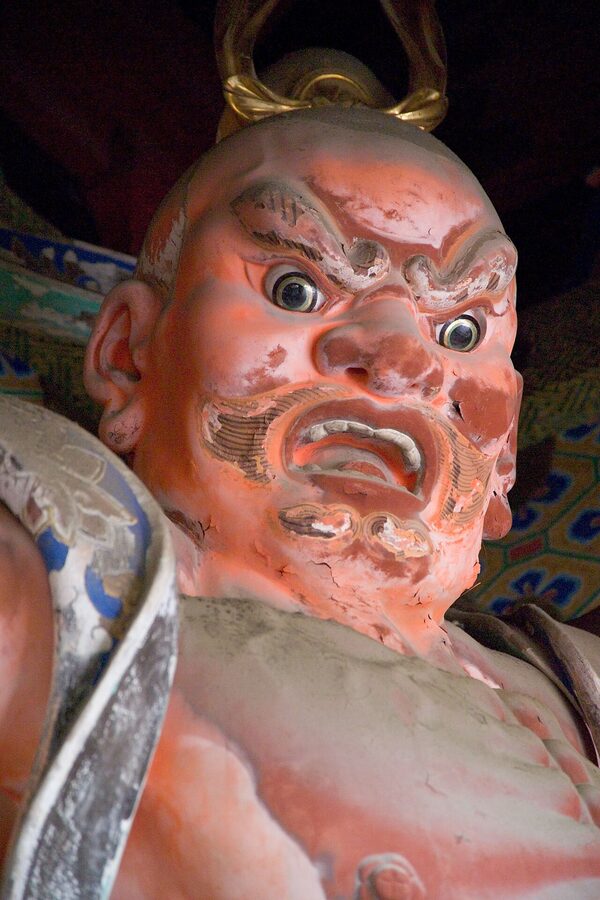
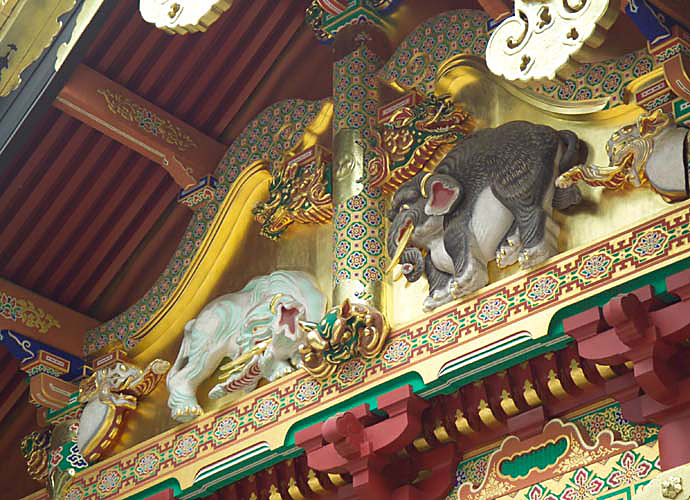
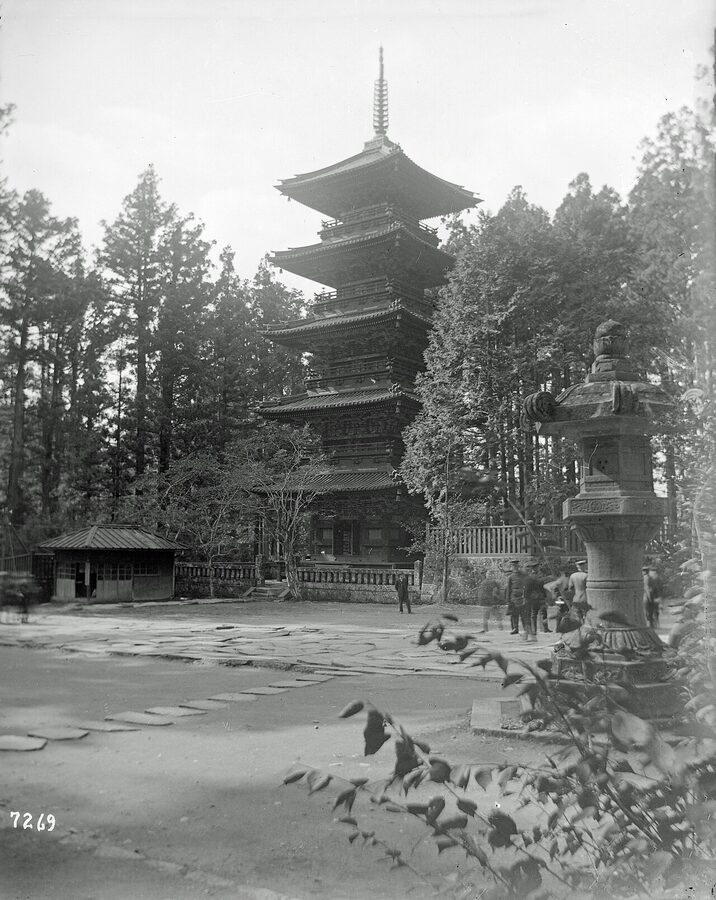
The order of things matters. Pass under Kuroda’s torii and the five-storey pagoda on your left, through the Omotemon, past the storehouses with the elephants and the stable with the monkeys, and up to the Yōmeimon. Through the gate, the worship hall is open to everyone on the shrine ticket; you take your shoes off and go into a lacquered room where prayers are said every day, and I would ask you to behave as you would in any church. If Fushimi Inari shows you what a shrine looks like when thousands of private donors each add a gate, Tōshōgū shows you what one looks like when a single family pays for everything.
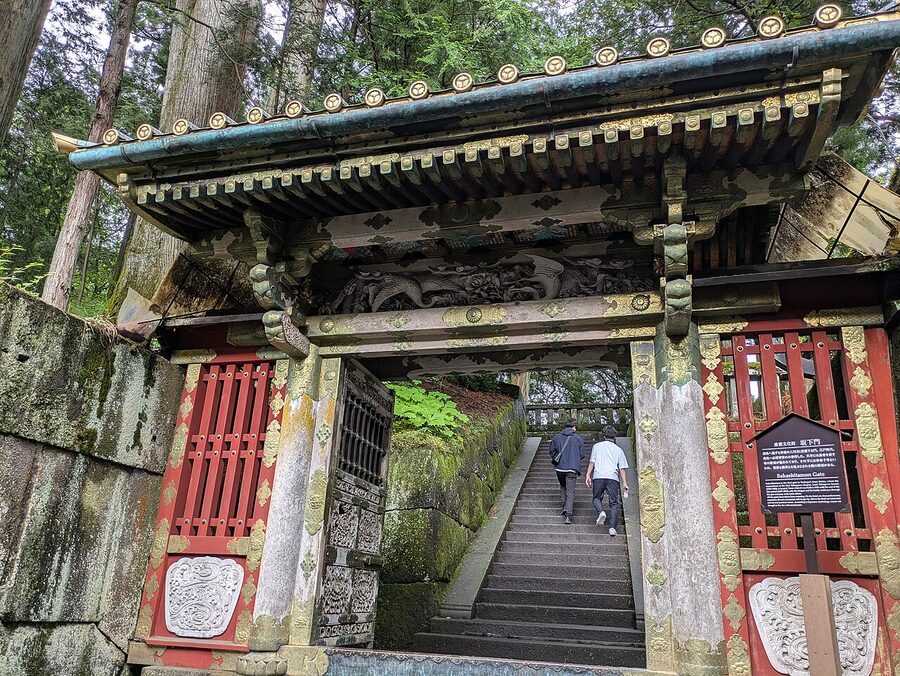
Then go up. From the east corridor, under the sleeping cat, the Sakashitamon gate opens onto a long stone staircase up through the cedars, 207 steps by the usual count, to the Okusha, the inner precinct, where the god’s tomb stands behind a bronze gate. The climb takes ten or fifteen minutes and the crowd thins by half on the way.
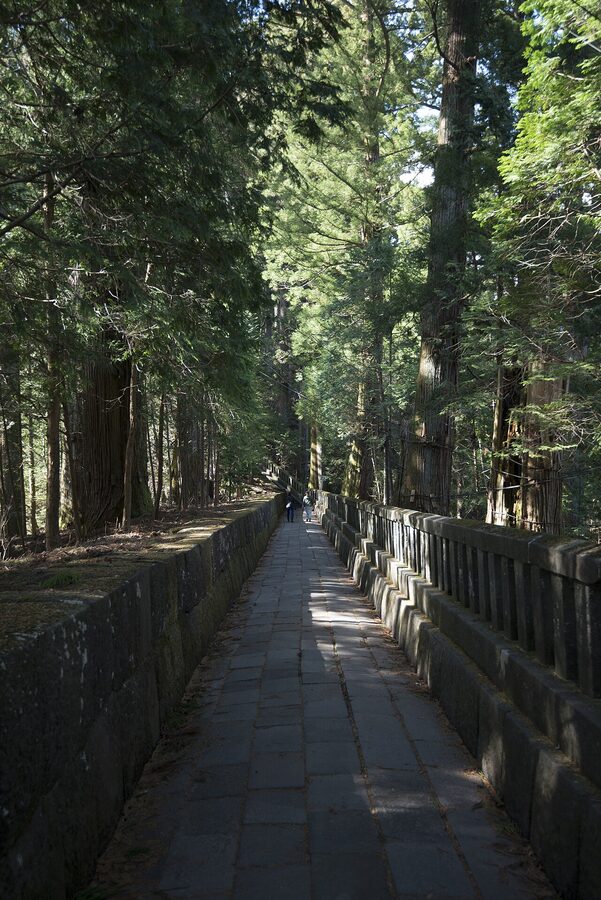
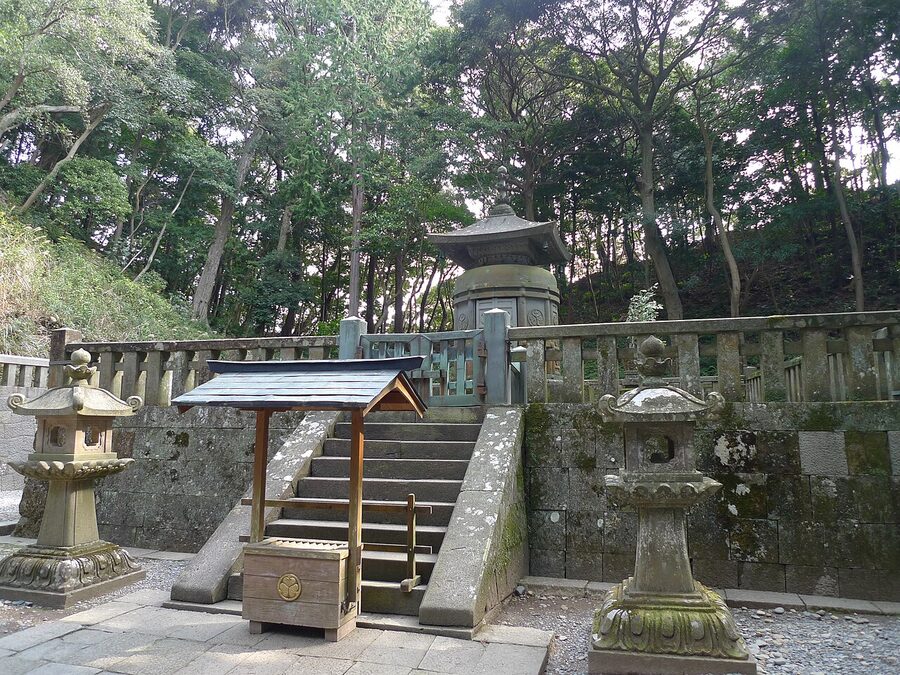
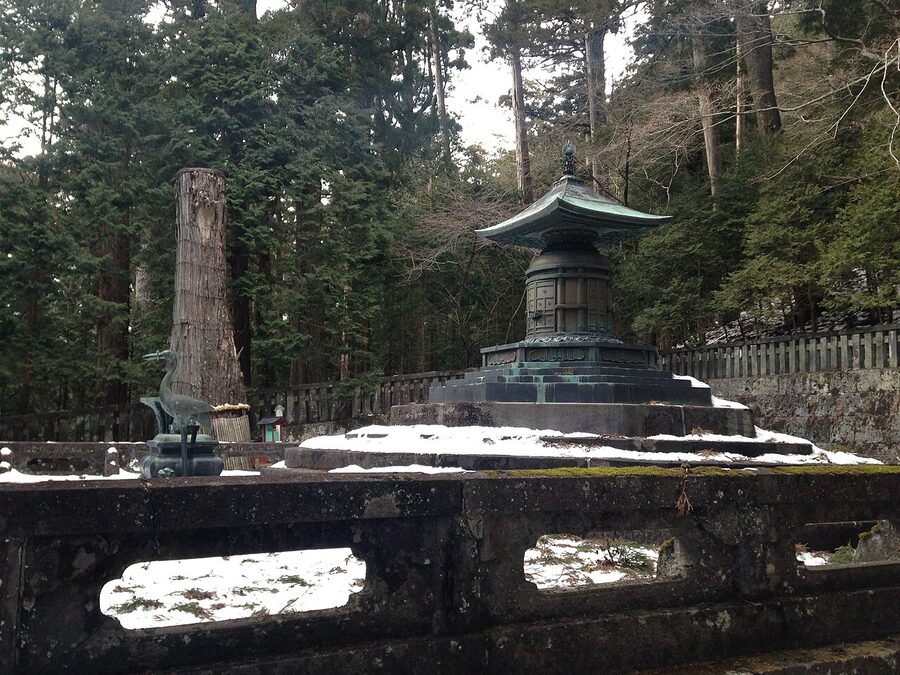
The tomb is a hōtō, a small round pagoda of bronze on a stone platform, with a bronze crane-and-turtle candlestand, vase and incense burner in front. It is the third version: the wooden one of 1622 was replaced in stone in 1641, an earthquake in 1683 brought that down, and the shogunate switched to cast metal, which is what you see. There is no gold up here and no carving to speak of, and of everything at Nikkō, this is the closest thing to the small hall that Ieyasu asked for.
The Treasure Museum near the entrance is worth an hour if you like objects. It holds Ieyasu’s swords, armour and personal things, along with gifts from daimyō and from the court; two of the shrine’s blades are National Treasures, and if Japanese swords interest you, the tachi called the Nikkō Sukezane is the one to look for, though the displays rotate. The painted scrolls of the shrine’s founding legend are also among its Important Cultural Properties, and are shown only occasionally.
Rinnō-ji, the Sanbutsudō and Taiyūin
Rinnō-ji is Nikkō’s temple, and its buildings are scattered across the mountain because of the separation. The Sanbutsudō stands on the main approach below Tōshōgū; the temple opens at 8:00, an hour earlier than the shrine, and closes at 17:00 from April to October and 16:00 from November to March. A Sanbutsudō ticket is ¥400, Taiyūin alone is ¥550, the two together are ¥900, and a set ticket adding the temple’s treasure hall and Shōyōen garden costs ¥1,000 at the Sanbutsudō ticket office.
Taiyūin is the mausoleum of Iemitsu, who died on the 20th day of the fourth month of 1651 and asked to be buried near his grandfather. It was finished in 1653 and it is, in the opinion of many people including me, the better building: more gold and less colour, fewer Chinese stories, a sequence of gates climbing a darker part of the forest, and far fewer people. The story that Iemitsu ordered it kept a little humbler than his grandfather’s shrine, and turned to face it, is told everywhere and documented nowhere I have found.
Tenkai is buried at Rinnō-ji too, at the Jigendō, up a long flight of stone steps from the Jōgyōdō hall near Taiyūin. He died in 1643, at 107 by the usual count, and his grave is a plain stone tomb with six stone guardian figures around it. Hardly anybody climbs to it, and it is a good place to think about the man who invented the god you have just been looking at.
Tenkai attracts legends the way the cat attracts crowds. The most persistent says he was Akechi Mitsuhide, the general who killed Nobunaga in 1582, who supposedly survived his defeat at Yamazaki and reappeared as a monk; people point to a viewpoint on the road above Nikkō called Akechidaira as evidence. No historian takes it seriously. Tenkai was already a senior Tendai monk in the Kantō by then, and by tradition it was he who steered Ieyasu towards Sensō-ji in Asakusa as the family’s prayer temple, a long career at the Tokugawa side rather than a second life.
Futarasan Shrine
Futarasan is the original holy place of the mountain, older than all the Tokugawa building by eight centuries, and it is the shrine of Mount Nantai, the volcano that stands over Lake Chūzenji. The grounds are free; the inner garden, with a sacred spring and some of the oldest buildings on the mountain, is ¥300 for adults, and open 8:00–16:30 from April to October and 9:00–15:30 from November to March. It is a few minutes’ walk west of Tōshōgū along a stone-flagged lane between lanterns.
Every year on 17 May, the evening of the Tōshōgū festival, the three portable shrines of the Tōshōgū gods are carried down to Futarasan and spend the night there, then process on the 18th to the resting place below. It is one of the few moments in the year when the two shrines act as they did before 1871, and the most moving thing I have seen at Nikkō.
The Shinkyō bridge
The vermilion bridge over the Daiya river at the entrance to the sacred area belongs to Futarasan, and you will see it before anything else. It is 28 metres long and 10.6 metres above the water, and its unusual construction, with the main beams anchored in the rock of the banks and cantilevered out, is the only one of its kind among the protected bridges of Japan. Legend says the monk Shōdō crossed the torrent here on a bridge of two snakes laid down by a river god.
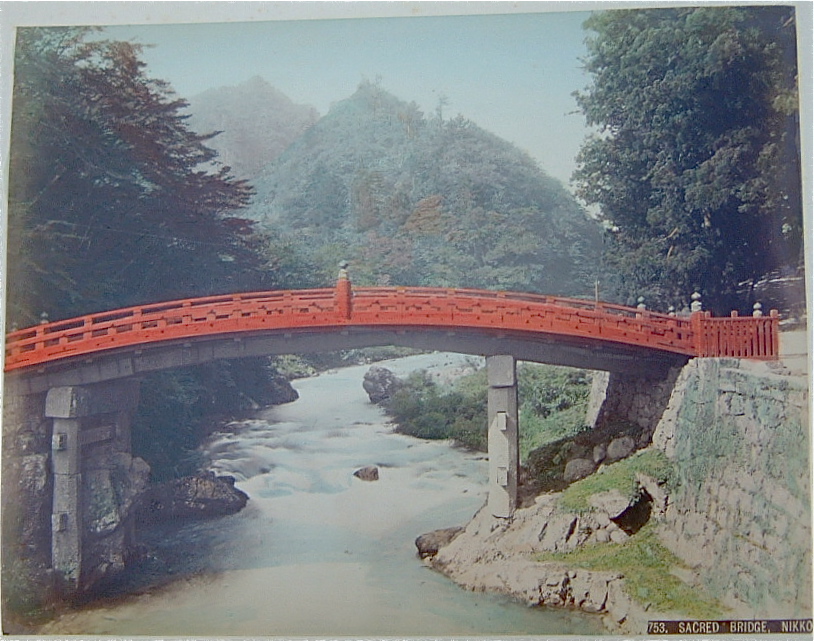
You can walk onto it now for a fee, about ¥300 for adults by most reports, though you cannot cross to the far bank and must come back the way you came. I would spend the money once, for the view up the river, and otherwise admire it free from the road bridge next to it. The bridge was thoroughly repaired between 1997 and 2005 at a cost of around 800 million yen.
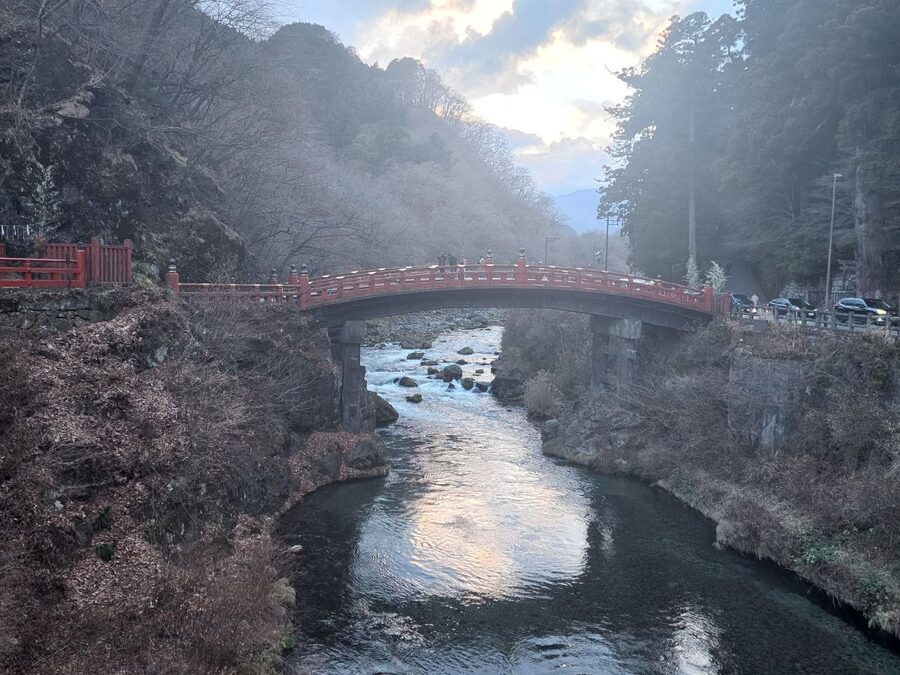
Itagaki’s statue stands at the town end of the bridge, looking up toward the shrines he is credited with saving. Most people walk past him on the way to the photographs.
The Cedar Avenue of Nikkō
Matsudaira Masatsuna’s avenues still line the three old roads into Nikkō, the Nikkō Kaidō, the Reiheishi Kaidō and the Aizu Nishi Kaidō, for a total of about 37 kilometres between his inscribed dedication stones, or 35.41 kilometres of surviving trees by the measure Guinness World Records accepted. The avenue is the only property in Japan designated both a Special Historic Site and a Special Natural Monument. It is not in good health: exhaust and roadside development kill dozens of trees a year, and the shrine runs an ownership scheme in which you can sponsor a tree to fund the care of the rest.
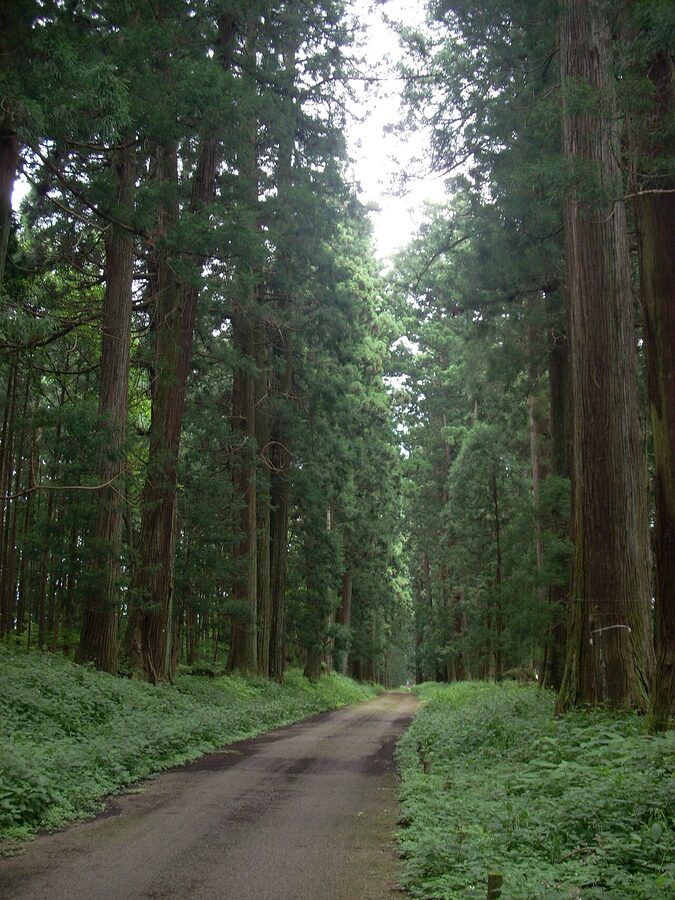
The easiest stretch to walk is along the old road near Kami-Imaichi on the Tobu line, where a park has been laid out among the trees with water wheels and an old farmhouse; you can walk on through the cedars toward Nikkō for as long as your legs hold. In summer the avenue is several degrees cooler than the open road, which is the other reason it was planted.
Getting there
The fastest route from Tokyo is the Tobu line from Asakusa, a few minutes’ walk from Sensō-ji, where the limited express Kegon or the SPACIA X runs to Tobu-Nikkō in about 1 hour 50 minutes; from Shinjuku a through JR-Tobu limited express, the Nikkō, takes about two hours. Seats are reserved and there is a limited-express charge on top of the fare, so check Tobu’s site and buy ahead on autumn weekends. From the Tōhoku Shinkansen, change at Utsunomiya for the JR Nikkō Line, about 45 minutes.
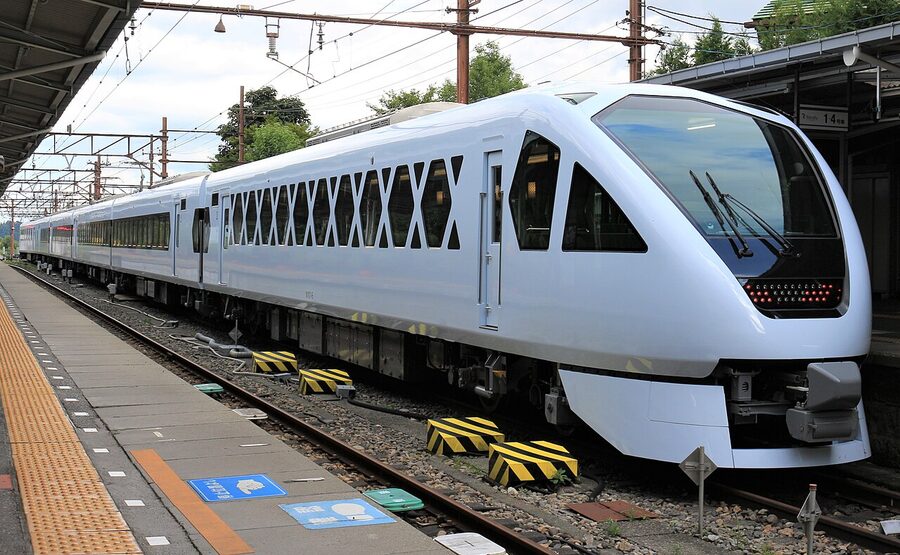
The JR and Tobu stations sit next to each other at the bottom of the town. From there buses run up the main street to the Shinkyō stop or round to Nishi-sandō by the shrines, but the walk is about 2 kilometres, gently uphill past old shops, and takes half an hour. If you drive, the shrine’s car park charges ¥600 a day for a car.
For the festival, go on 17 and 18 May, when there is horseback archery on the approach in the afternoon of the 17th and the Procession of a Thousand Warriors from 11:00 on the 18th; the autumn festival repeats both on 16 and 17 October. For a quiet visit, go on a weekday in winter, when the cedars carry snow and there is nobody on the steps to the tomb. And if you want the wider context, the Edo story that produced all this is told in my overview of the Edo era, which sits in the larger history in Japan Through the Ages.
Kunōzan, and the god’s other homes
If you have time, see the first tomb as well. Kunōzan Tōshōgū stands on its hill above the coast near Shizuoka, and its shrine buildings of 1617, smaller and earlier than Nikkō’s, show what Ieyasu’s cult looked like before his grandson got hold of it. You can climb the 1,159 steps from the coast road or take the ropeway from Nihondaira; I recommend walking up and riding down.
Ieyasu is honoured in other places he lived. In Hamamatsu, where he spent his hardest years, a small Tōshōgū stands on the site of the old Hikuma Castle, and the Edo Castle precinct had its own shrine to him on Momijiyama until the Meiji government ordered it removed. Of all the Tōshōgū he still has, Nikkō is the one that takes its job seriously.
The small hall
Nikkō is one of Japan’s great craft sites as much as a holy one, and every lacquerer, carver, metalworker and painter in Edo seems to have been put to work on it. You can spend a day here counting gilded dragons and come away dazzled and a little tired, which is what Iemitsu wanted.
But I always end the day at the top of the 207 steps, in front of the bronze pagoda, where none of that reaches. The god is said to be in residence, the cedars are older than most of the buildings below, and there is nothing to look at but a small, dark, rounded tomb. It is not quite a hall, but it is small, and I like to think Ieyasu would have approved.