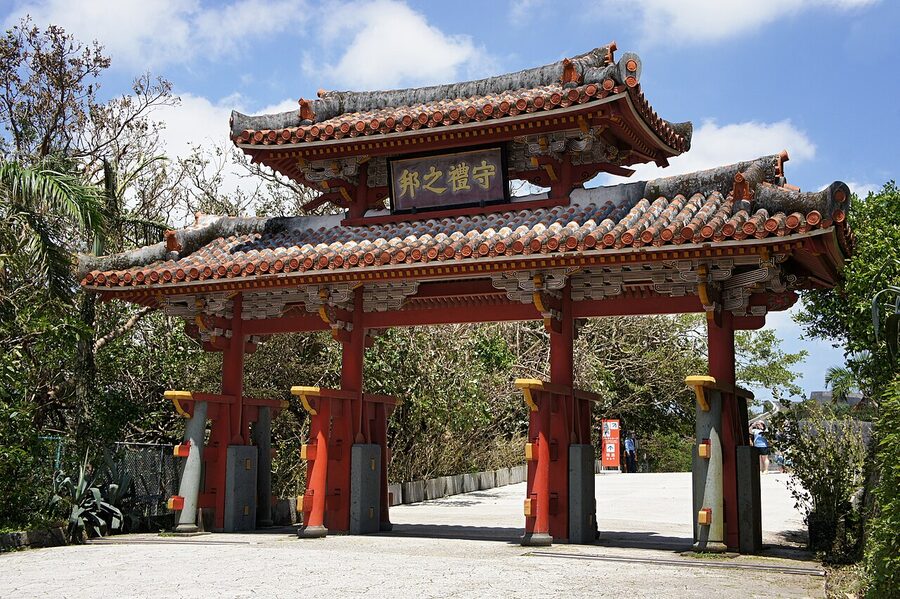
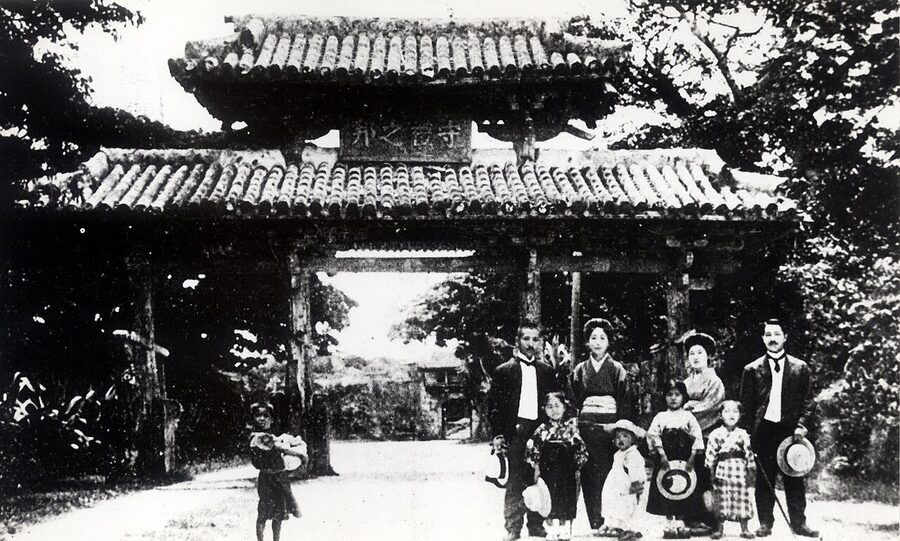
The most revealing object at Shuri Castle is a wooden sign. It hangs under the upper roof of Shureimon, the red gate on the road up to the palace, and its four characters, 守禮之邦, call Ryukyu “a land of propriety”. For roughly eighty years after it was made, in the reign of King Shō Ei in the late 16th century, the kingdom put it up only while envoys of the Chinese emperor were in town and took it down again when they sailed home. Only in the 1660s, in 1663 or 1664 depending on which Japanese reference you open, did someone decide it might as well stay up.
I like that sign more than any building on the hill, because it tells you how the place worked. For 450 years Shuri was the capital of a small island kingdom that survived by being whatever its larger neighbours needed it to be, while staying quietly itself. It flattered Beijing, it was invaded by Satsuma and then had to flatter Edo as well, it was annexed by Tokyo, and in 1945 it was flattened by an American battleship. Most of what you see today was built after 1992, and much of that burned down again in 2019, which is why the hall at the top of the hill is newer than your phone.
In This Article
- Three kings on one island
- A bridge for ten thousand countries
- 1609
- Two masters, one throne
- Commodore Perry is given tea
- From kingdom to domain to prefecture
- Barracks, a girls’ school and a shrine
- May 1945
- Building it back from memory
- 31 October 2019
- The red from Kushi
- Where to see Shuri Castle and the Ryukyu Kingdom today
- Shuri Castle Park
- Sonohyan-utaki stone gate
- Tamaudun
- The Kinjō-chō stone path
- Shikinaen
- Okinawa Prefectural Museum and Art Museum
- Further afield: Nakijin and Yomitan
- Back to the sign
Three kings on one island
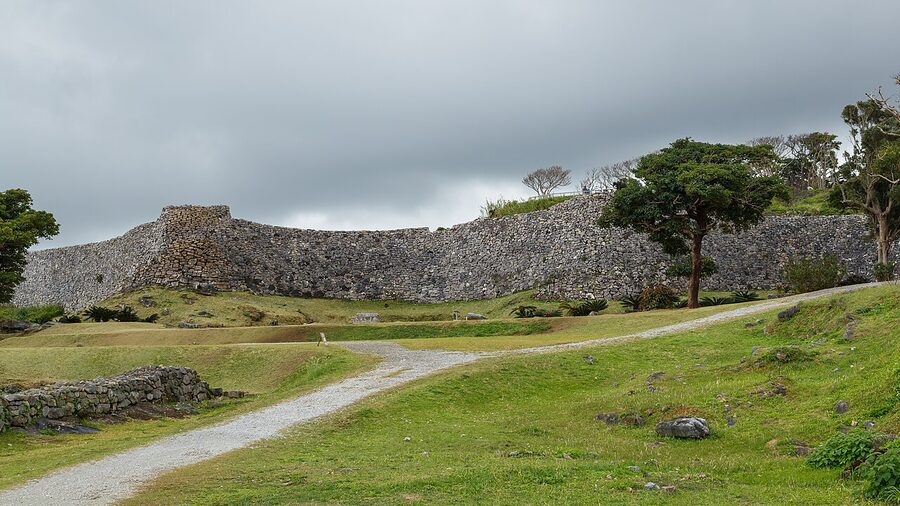
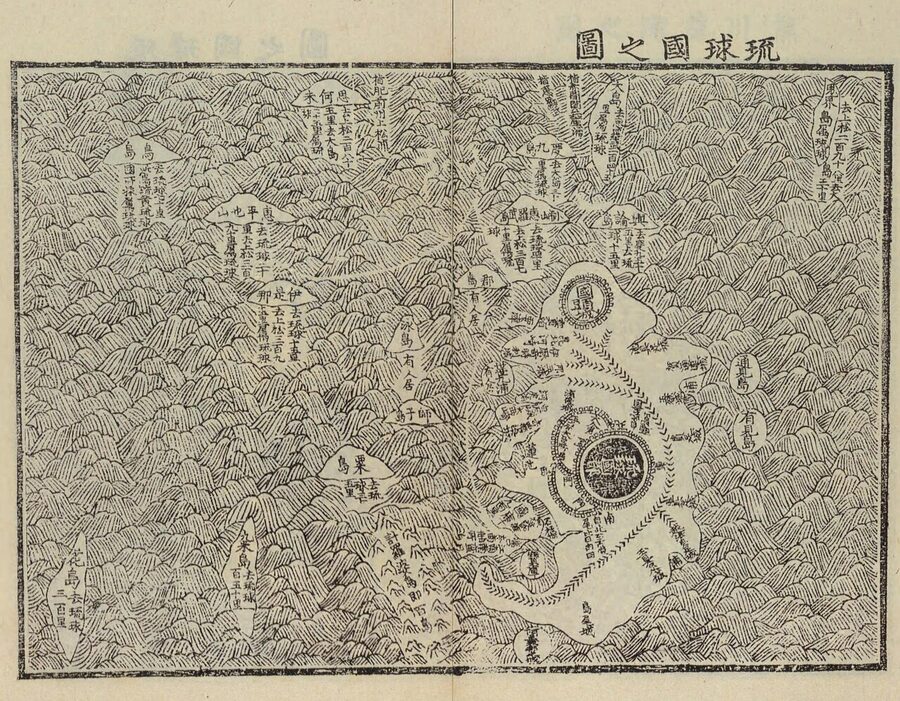
Shuri Castle is a gusuku (グスク), the Okinawan word for the walled hilltop strongholds that local lords, the aji, built across the islands from about the 12th century. Okinawans call it Sui gusuku. It looks nothing like the keeps you will know from Himeji or Kumamoto: there is no tower, the walls are coral limestone laid in long curving lines that follow the bedrock, and the gates are stone arches. It made the national list of 100 fine castles as number 100, the southernmost entry and the odd one out, and it has nothing in common with the dozen keeps in my guide to Japan’s 12 original castles except a roof and a hill.
In the 14th century the aji of Okinawa Island sorted themselves into three rival kingdoms, a period known as Sanzan (三山), the Three Mountains. Hokuzan ruled the big, poor north from Nakijin. Nanzan held the south. Chūzan, in the middle, had the harbour at Naha, and in 1372 its king, Satto, answered an invitation from the new Ming emperor and sent tribute to China, which turned out to be the most important decision anyone on the island ever made.
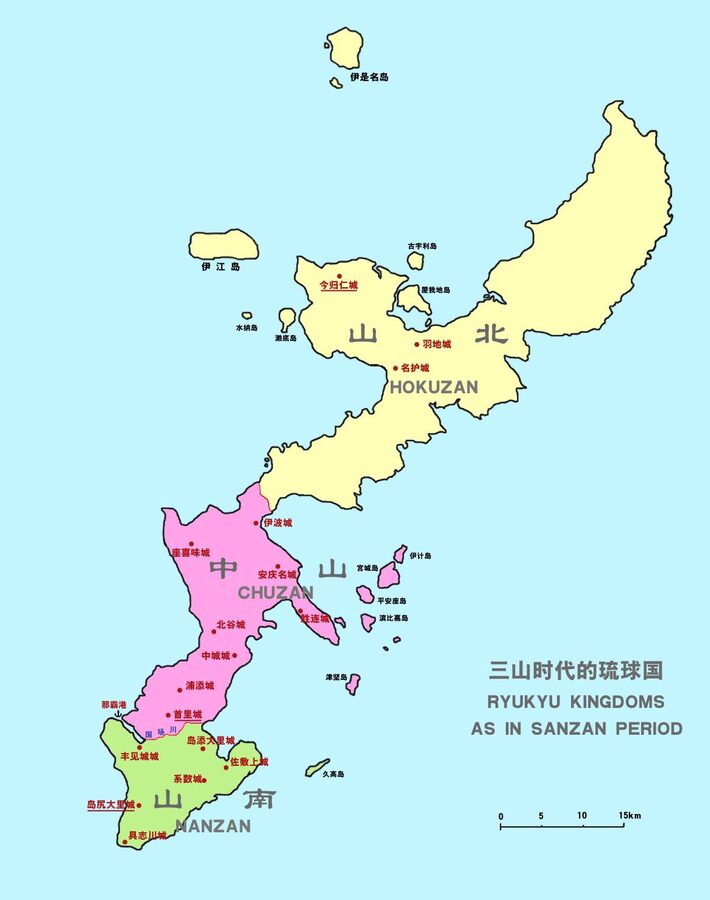
The man who ended the three-way contest started as a minor lord in the south. Shō Hashi was born in 1372 and became aji of Sashiki, on the east coast below Shuri, while still young. He took the castle of Shimasoe-Ōzato from its lord, then in 1406 overthrew Bunei, the king of Chūzan, and put his own father, Shishō, on the throne. Japanese reference works give 1406 for the coup; Ming records, which only noticed when Shishō sent an envoy announcing a new king, put it in 1407.
Hokuzan fell in 1416, when Shō Hashi’s army took Nakijin and its king, Hananchi, died there. His father died in 1421 and Hashi became king of Chūzan the next year, and in 1429 he destroyed Nanzan and its king, Taromai. That is the date the textbooks give for the founding of the Ryukyu Kingdom, with Shuri as its capital.
You should know that historians argue about almost all of this. Some, Wada Hisanori first among them, point out that the Ming sources never actually say the three kingdoms were united; Nanzan simply stops sending envoys. Takara Kurayoshi, the most quoted historian of Ryukyu, prefers to say that Chūzan’s king took over the role of senior partner that the three kings had shared, not that he controlled the whole island. Even Shō Hashi’s name is a puzzle, since the characters are almost certainly a later rendering of a Ryukyuan name whose reading nobody agrees on.
What is clear is that he made Shuri a capital. In 1427 he had the pond of Ryūtan dug below the castle in imitation of the lakes of the Ming capital, and the stone recording the planting of the hill beside it is the oldest inscribed stele in Okinawa. A later legend has him tearing down the walls of Ōzato and passing the stones hand to hand all the way to Shuri, which is the sort of story people tell about a man who moved the centre of gravity of a whole island.
A bridge for ten thousand countries
Ryukyu had almost nothing to sell. What it had was position, halfway between Japan and China and a few days’ sailing from the ports of South-East Asia, and a privileged place in the Ming tribute system at a time when the Ming had banned private Chinese trade abroad. The emperor gave the kingdom ocean-going ships and, in 1392, a colony of Fujianese families at Kume, outside Naha, who supplied the pilots, interpreters and scribes. Ryukyuan junks carried Japanese swords, copper and fans, Chinese silk and porcelain, and South-East Asian pepper and sappanwood, and took a cut every way.
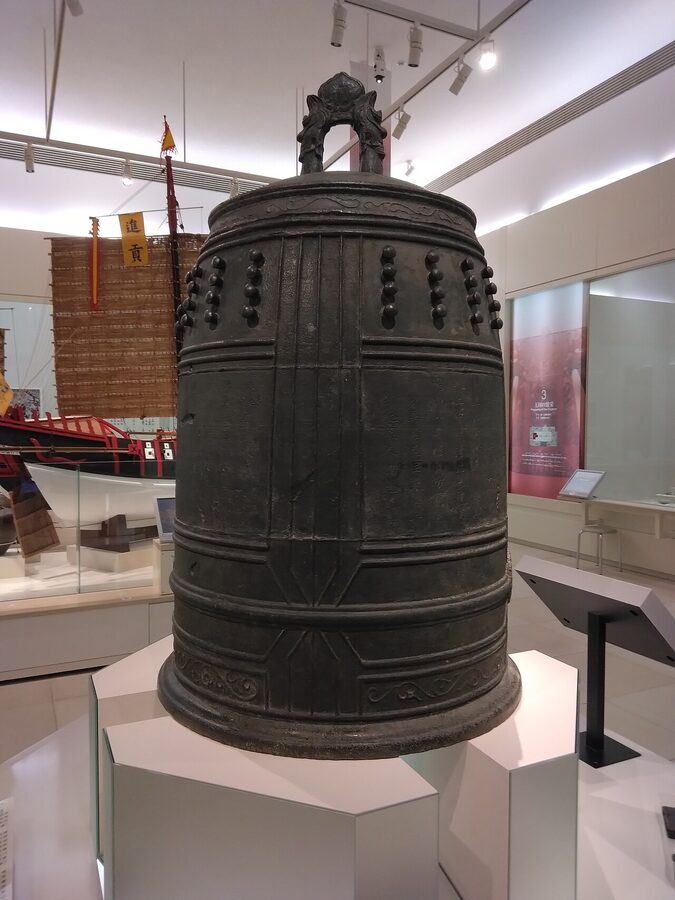
The kingdom said so on a bell. In 1458 King Shō Taikyū had a large bronze bell cast for the Seiden, the main hall, and the Zen monk who wrote the inscription described Ryukyu as a fortunate land in the southern sea that treated Ming China and Japan as its two closest neighbours, “and with its ships makes a bridge for ten thousand countries”. Okinawans call it the Bankoku Shinryō no Kane (万国津梁の鐘), the Bridge of Nations Bell, and the phrase now turns up on everything from conference halls to the screen behind the governor’s desk.
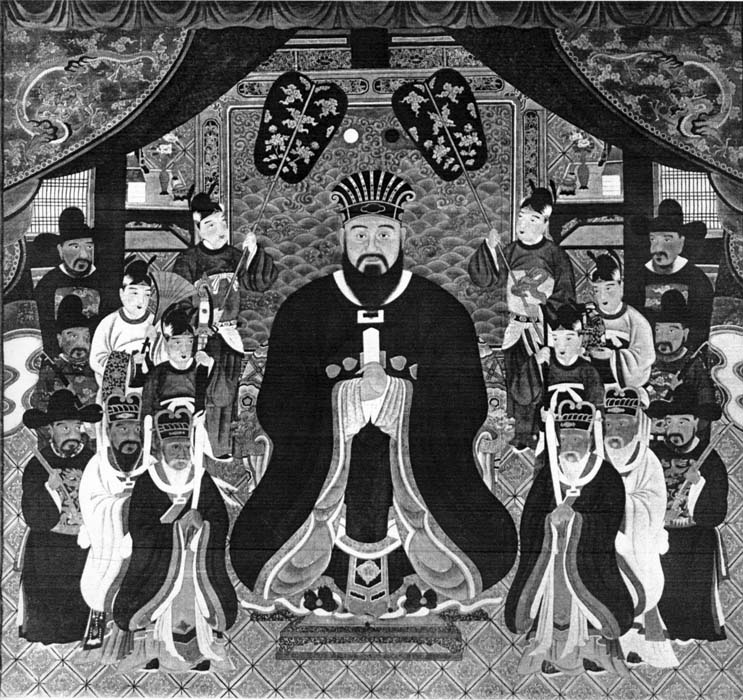
Shō Taikyū’s line did not last. In 1469 his grandson Shō Toku died, and a senior official named Kanemaru took the throne as Shō En and founded what is called the Second Shō dynasty, though the two families were not related. The official histories say the court chose him; the dead king’s heir was killed, and most modern historians call it a coup.
Shō En’s son, Shō Shin, became king at twelve in 1477 and reigned for fifty years, longer than any other king of Ryukyu, and his reign is the golden age. He sent an average of about five ships a year to China, traded with Siam, Malacca, Java, Sumatra and Annam, and made the regional aji leave their own gusuku and live at Shuri, where he could watch them. He built the royal temple of Enkaku-ji below the castle, extended the castle walls, and in 1501 built a new royal tomb, Tamaudun, for his father’s bones.
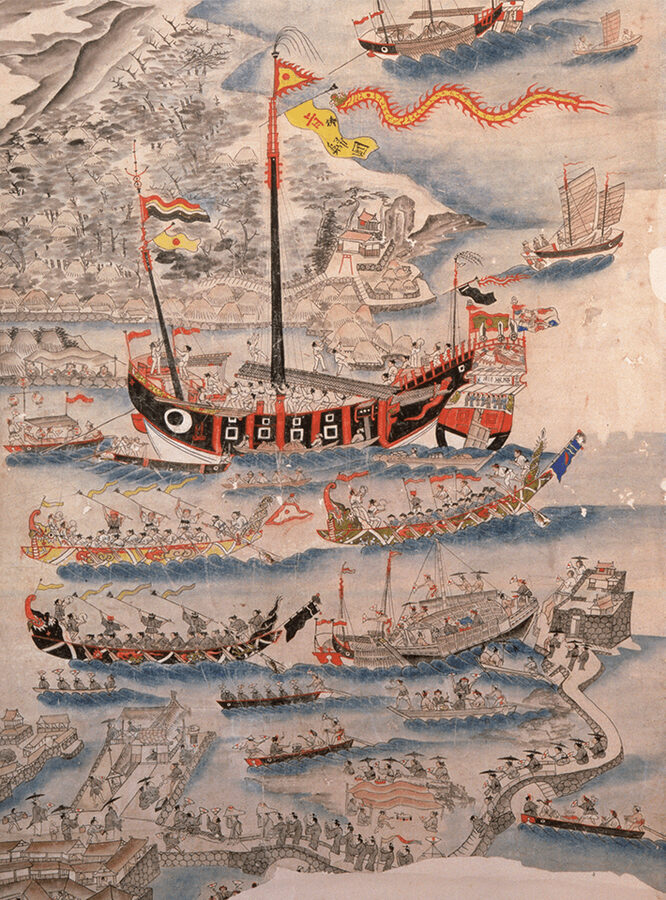
The Portuguese apothecary Tomé Pires, writing at Malacca in about 1515, described the people he called the Lequeos as straight dealers who would not lie to a merchant, which is a better reference than most governments get. By then Ryukyuan ships were among the most familiar in the harbours of the region. It did not last much past the middle of the 16th century, as Chinese smugglers, Japanese pirates and the Portuguese took over the routes Ryukyu had carried, but for a hundred years the bell had it about right.
The other half of the system came to Shuri. Every new king had to be invested by the Chinese emperor, and the investiture envoys, the sappōshi, arrived from Fuzhou with a party of four or five hundred people who stayed for months at the kingdom’s expense. Japanese reference works count fourteen or fifteen such missions under the Ming and eight under the Qing, the last in 1866 for Shō Tai. They were greeted at Shureimon, the investiture was read in the courtyard in front of the Seiden, and the banquets that followed were the biggest events in the court calendar.
The entertainment was planned years ahead. For the investiture of King Shō Kei in 1719, the official in charge of dances, Tamagusuku Chōkun, threw out the usual programme and wrote a new kind of musical play, kumiodori (組踊), which is now on UNESCO’s intangible heritage list. A Ryukyuan art form was invented, in other words, to impress a Chinese guest, which is as good a summary of Shuri as I can give you.
1609
The trouble came from the north. The Shimazu clan of Satsuma, in southern Kyushu, had long claimed the right to control Japanese trade with Ryukyu, and by the end of the Sengoku wars they were deep in debt. In 1591 Toyotomi Hideyoshi ordered Ryukyu, through Satsuma, to provide men and supplies for his invasion of Korea; the kingdom, a tributary of the Ming he was proposing to conquer, sent about half the rice demanded and nothing else, and Satsuma covered the rest and kept the bill.
After Sekigahara, where the Shimazu had fought on the losing side and been forgiven, the pressure grew. Tokugawa Ieyasu wanted Ryukyu to send an embassy of thanks for the return of a shipwrecked crew, and to help him reopen trade with China; the court at Shuri, led by the minister Jana Ueekata, kept declining. In early 1609, with the permission of the new Tokugawa shogunate, Satsuma sent an army.
There were about 3,000 men in some eighty ships under Kabayama Hisataka, armed with muskets, the clan’s speciality since the days of Shimazu Yoshihiro. They left Yamagawa on the 4th day of the 3rd month, took the Amami islands with little resistance except on Tokunoshima, and landed at Unten, near Nakijin, on the 25th. The kingdom had no army worth the name: Shō Shin had brought the regional lords to Shuri a century before, by some accounts with their weapons, and its soldiers had fought nobody since. A party of about a hundred men tried to hold the Taihei bridge on the road to Shuri and broke under musket fire.
Satsuma troops were in Shuri by the 1st day of the 4th month, burning as they came, and within days King Shō Nei surrendered the castle. Japanese accounts put the formal surrender on the 4th or 5th day of that month; English sources, converting to the Western calendar, usually say early May. The castle’s treasures were inventoried by the invaders over twelve days, and in the 5th month the king was taken to Kagoshima.
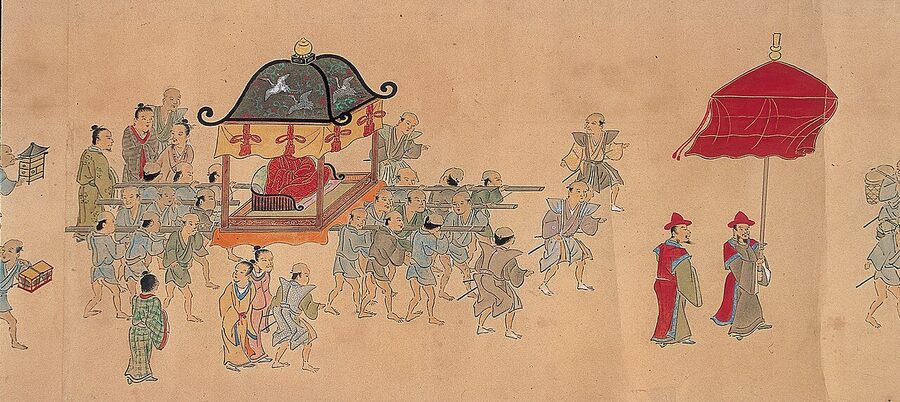
In 1611 the king and his three senior ministers were made to sign an oath stating that Ryukyu had been a dependency of the Shimazu since ancient times, and to accept fifteen articles that put the kingdom’s trade under Satsuma control. Jana Ueekata refused to sign and was beheaded. The Amami islands were taken into Satsuma’s direct rule, and Shō Nei went home to Shuri in 1611 to a reduced kingdom; Okinawan tradition holds that he felt he had shamed his ancestors and asked not to be buried with them.
Two masters, one throne
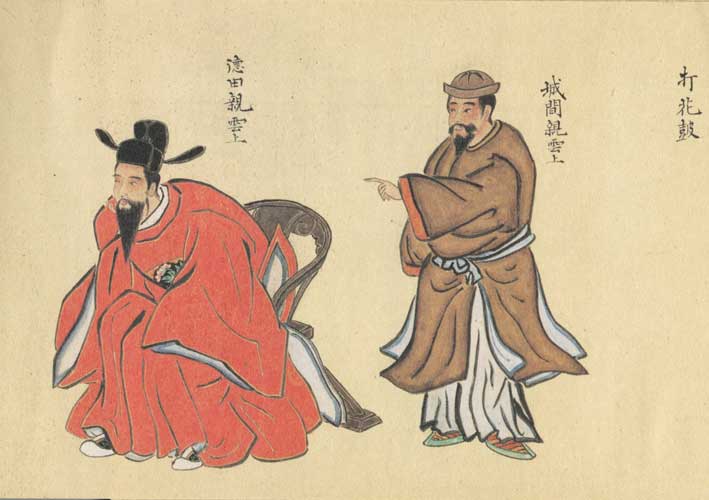
What followed was the strangest arrangement in East Asia. Satsuma did not annex Ryukyu, because a foreign Ryukyu could go on sending tribute to China, and the tribute trade was the whole point. So the kingdom kept its king, its court and its Chinese investitures, while a Satsuma office in Naha skimmed the profits, collected a fixed tax in rice and goods, and watched the court. Japanese historians call it Nisshi ryōzoku, subordination to both Japan and China, though Takara Kurayoshi and others now argue that the Japanese tie was the real one and the Chinese tie largely a form, “a foreign country inside the Tokugawa order”.
Both sides played along. When the Chinese envoys came, Satsuma’s officials in Naha withdrew out of sight and anything Japanese was put away. When Ryukyuan missions went up to Edo, eighteen of them between 1634 and 1850, travelling with Satsuma’s own alternate attendance trains, they were told to wear Chinese dress, carry Chinese banners and play Chinese music, because the Shimazu gained more prestige from parading a foreign king’s envoys through Japan than a province’s. Ryukyu was one of the four doors Tokugawa Japan kept open to the world, alongside Nagasaki, where the Dutch were kept on Dejima, Tsushima for Korea and Matsumae for the Ainu, and I have written about how the system worked in my piece on sakoku.
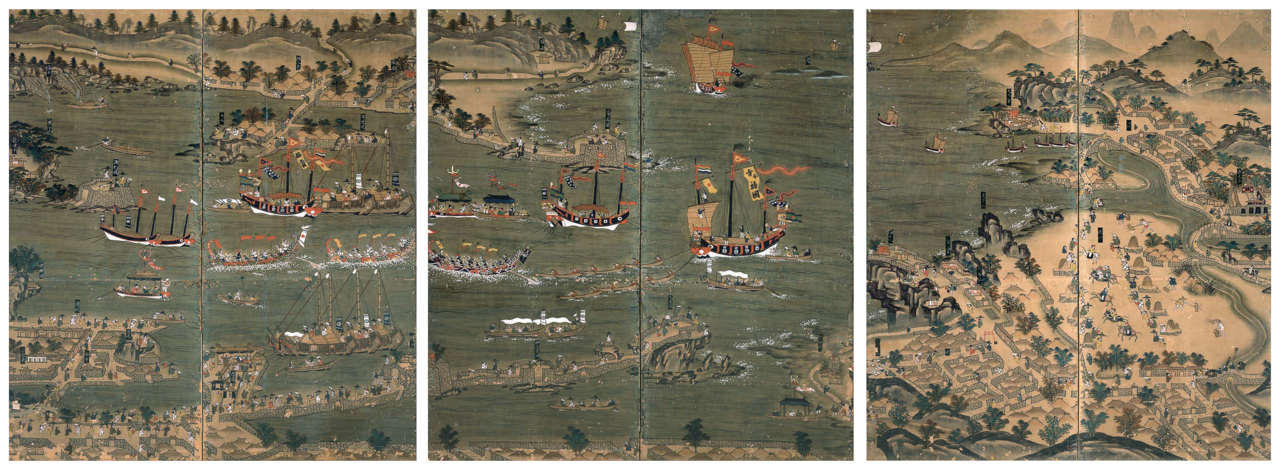
The castle shows the double life in its architecture. The Seiden faced west, towards China, and its courtyard was arranged for Chinese ceremony, with the North Hall, the Hokuden, used to receive the investiture envoys. The South Hall, the Nanden, built in the 1620s just after the invasion, was where Satsuma’s officials were received, and it was the only building at Shuri done in a Japanese style. You can stand in the courtyard today and look from one hall to the other, which is the clearest picture of the Edo era in Ryukyu I know.
Inside the system, Okinawan culture did well. The court music, the bingata dyed textiles, the lacquerware and the unarmed fighting arts that became karate all grew up in these two centuries. The red roof tiles you now think of as typically Okinawan came in late in the 17th century; after a fire in 1660, the Seiden was rebuilt in 1672 with tiles for the first time, and in that period the kingdom’s kilns shifted from grey Chinese-style tiles to the red kawara of the islands.
Commodore Perry is given tea
The Americans reached Shuri before they reached Edo. Matthew Perry’s squadron anchored at Naha on 26 May 1853, and his instructions from President Fillmore allowed him to occupy the islands if the Ryukyuans resisted. The court said he could not visit the castle. On 6 June he marched up anyway with marines, two field guns and a band, and as I describe in my piece on the Black Ships, he treated the whole thing as a rehearsal for Japan in front of an audience that would report everything to Satsuma.
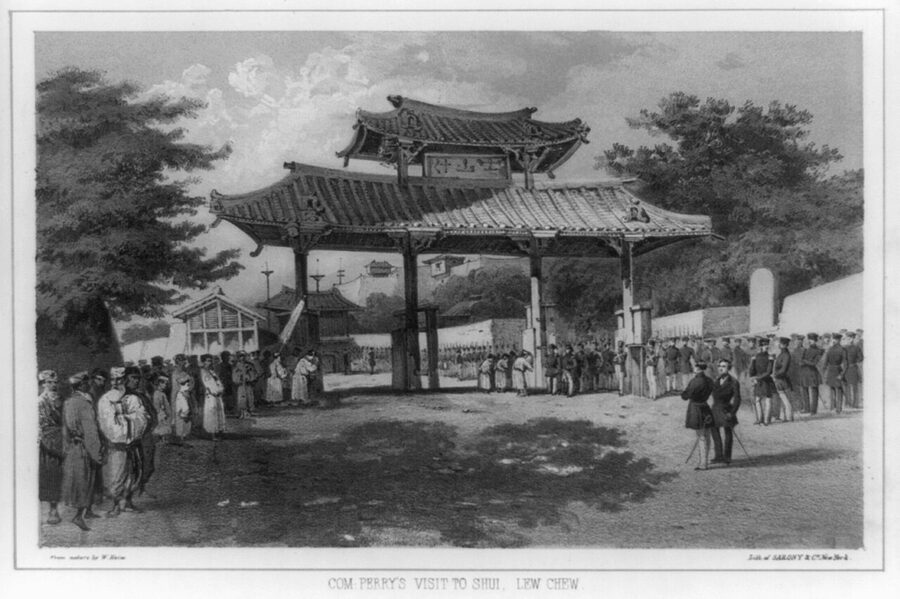
The Ryukyuans handled him beautifully. They let Perry and a few officers into the castle but not the troops or the weapons, refused him the boy king, Shō Tai, then nine years old, and gave him tea and sweets in the Hokuden. Then the party was taken to the regent’s residence outside the castle for a proper meal, and according to the court’s own records the menu was deliberately pitched below what was served to Chinese envoys, a polite answer to the president’s letter that Perry seems never to have noticed.
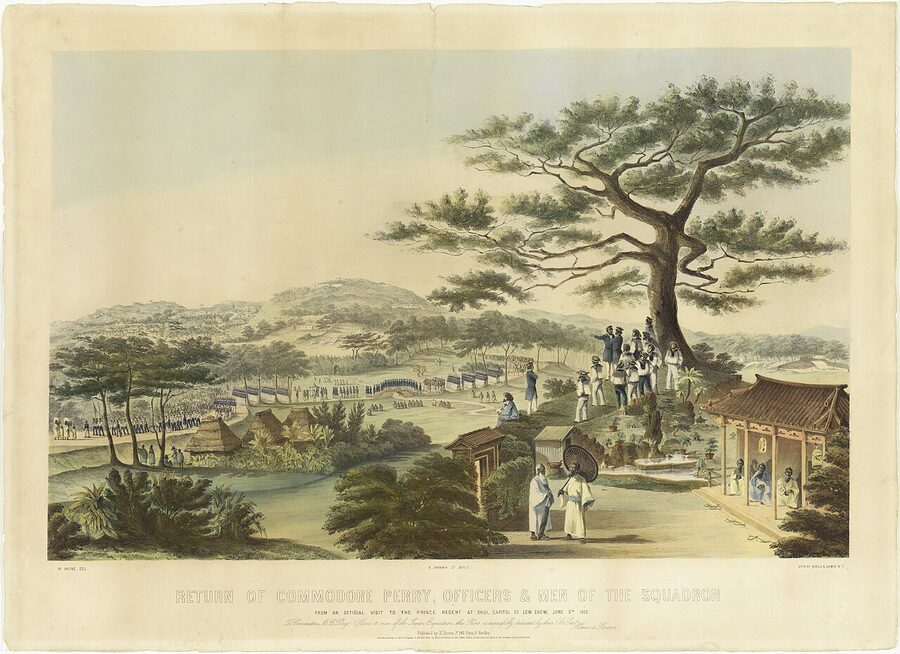
Perry used Naha as a base for the rest of the expedition, and on his way home from the treaty at Kanagawa he came back and signed a compact with the kingdom on 11 July 1854. France followed in 1855 and the Netherlands in 1859. These were the first and last treaties Ryukyu ever signed as a state, and within twenty years Tokyo would announce that it had inherited them.
From kingdom to domain to prefecture
The Meiji Restoration, settled on the battlefields of the Boshin War, had no place for a kingdom that belonged to two empires. In 1871, while the government was abolishing the domains, a boat from Miyako was wrecked on the coast of Taiwan and fifty-four of its crew were killed by local people, and Tokyo seized on the incident to assert that the Ryukyuans were Japanese subjects. In 1872, with half the cabinet away on the Iwakura Mission, envoys from Shuri who had come to Tokyo to congratulate the new government were handed a proclamation from Emperor Meiji making Shō Tai “king of Ryukyu domain”, a feudal lord under the emperor.
In 1874 Japan sent a punitive expedition to Taiwan, and the settlement with the Qing called the murdered sailors “people belonging to Japan”. In 1875 the Home Ministry sent the official Matsuda Michiyuki to Shuri with a list of demands: stop sending tribute to China, stop receiving Chinese envoys, use the Japanese era name, and send the king to Tokyo. The court refused nearly all of it, pleaded the king’s illness, and sent secret appeals to Beijing and to the American, French and Dutch legations.
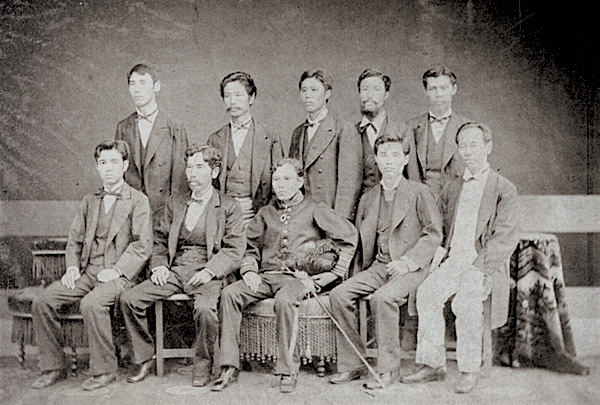
Ryukyuan petitioners in Tokyo put the old position in a phrase, “Japan is our father and China our mother,” and asked to keep both. The answer came back that serving two emperors was like a wife serving two husbands. In March 1879 Matsuda returned with about 160 police and between 300 and 400 soldiers of the Kumamoto garrison, and on 27 March, at Shuri Castle, he read the order abolishing the domain and gave the king until the end of the month to leave.
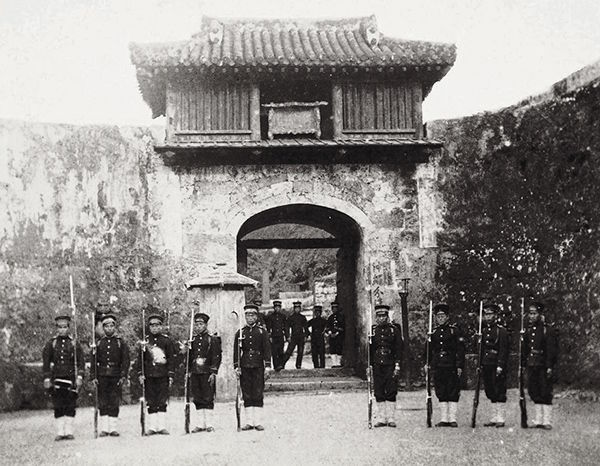
Shō Tai left the palace on 29 or 30 March 1879; Japanese and English accounts disagree by a day. Okinawa Prefecture was proclaimed in the first week of April, and the king, after weeks of delay that may have been illness or may have been hope of help from China, sailed for Tokyo in late May. Japanese historians call the whole process the Ryūkyū shobun (琉球処分), the Ryukyu Disposition, and argue over whether it was national unification, annexation or both; I will only say that “disposition” was the government’s own word.
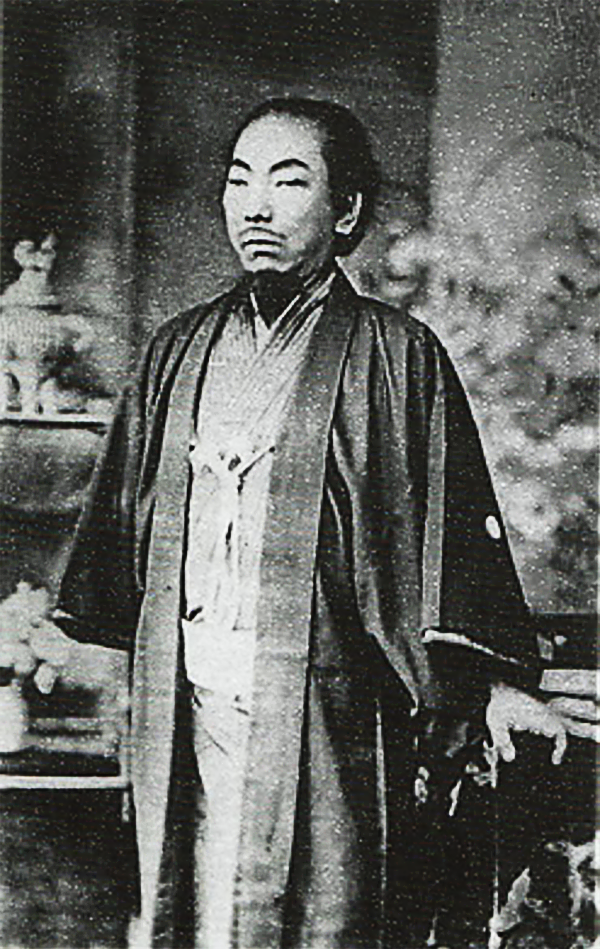
China did not accept it. Former US president Ulysses Grant, visiting in 1879, was asked to mediate, and in 1880 the two governments came close to dividing the islands, with Miyako and Yaeyama going to the Qing in exchange for trading rights, before Beijing declined to sign. In Okinawa, a party loyal to the old kingdom held out for a restoration and some of its members slipped away to Fujian to ask for help. The question was only closed by the First Sino-Japanese War in 1895.
Barracks, a girls’ school and a shrine
The palace became a barracks for the Kumamoto garrison, the same garrison that held Kumamoto Castle against Saigō Takamori two years before, and the soldiers stayed until 1896. Shuri, a capital for 450 years, became a district town of the Meiji era; the prefectural offices went to Naha. In 1908 the castle grounds passed to the town of Shuri, which had no money to keep them up, and the buildings were used for schools, including a girls’ school, while the Seiden quietly rotted.
By 1923 the Seiden was in such a state that the town proposed to pull it down. It was saved by the Tokyo architectural historian Itō Chūta and his former student Kamakura Yoshitarō, then an art teacher in Okinawa, who found a loophole: a Shinto shrine, Okinawa Jinja, was built behind the Seiden, and the Seiden was registered as the shrine’s worship hall, which made it eligible for national funds. It was designated a protected building in 1925 and restored between 1927 and 1932, and the measured drawings made during that work would turn out, sixty years later, to be the most important documents the castle ever produced.
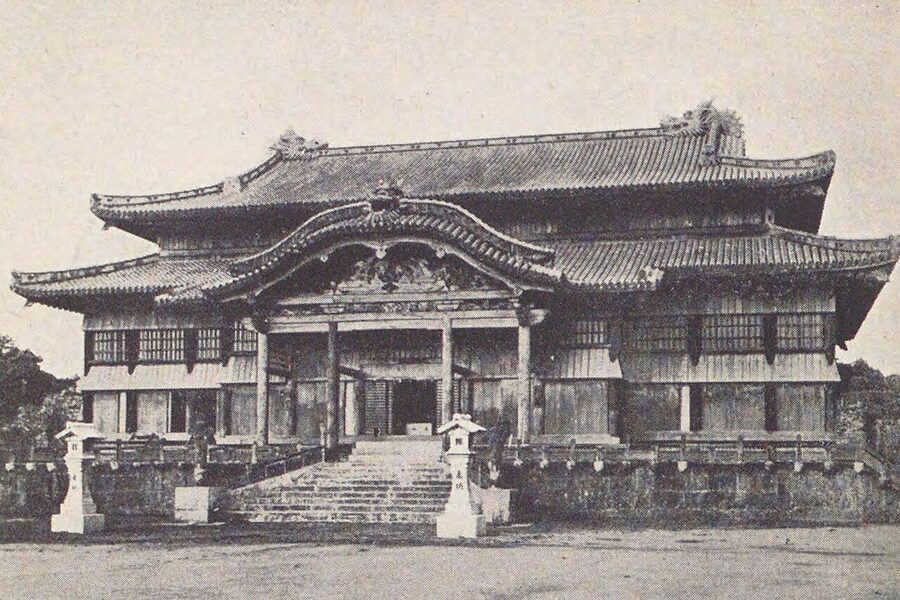
Kamakura also photographed nearly everything in Shuri in two surveys in the 1920s, from the palace to the royal portraits to the patterns on court textiles, and took more than 1,200 glass plates and 81 notebooks home to Tokyo. He later became a Living National Treasure as a dyer, but his photographs are the main reason the rebuilders of the 1980s knew what most of the palace looked like. If you ever wonder how a building can be reconstructed “from photographs”, the answer at Shuri is one patient man with a camera.
May 1945
From late 1944 the Japanese 32nd Army dug its headquarters into the rock under the castle, a tunnel complex for more than a thousand people, and Shuri became the centre of the main defensive line across southern Okinawa. The Americans landed on 1 April 1945. Through April and May they fought their way south ridge by ridge, and the Shuri line held them for almost two months.
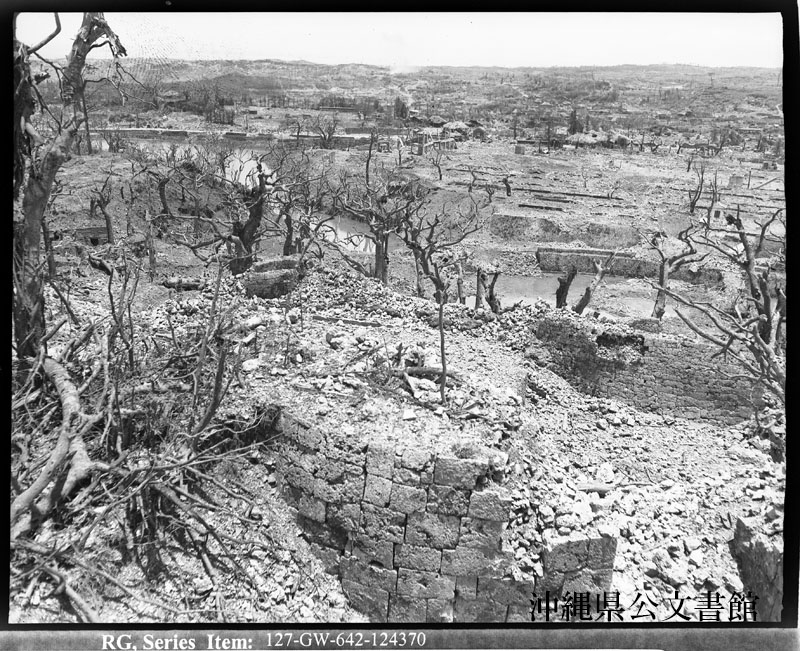
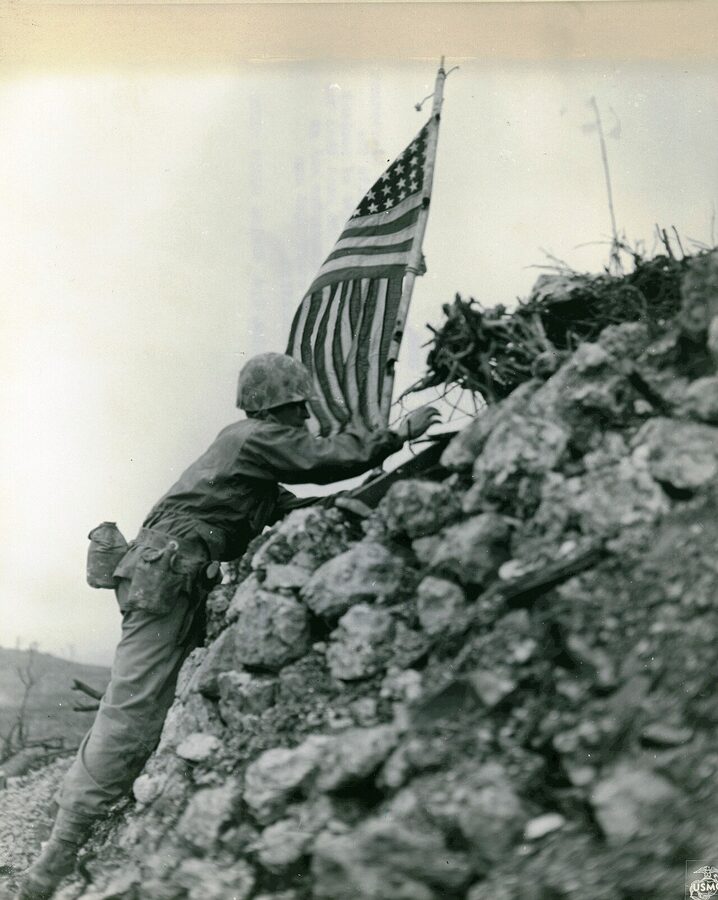
From 25 May the battleship USS Mississippi shelled the castle for three days, and by 27 May it was burning. That night the 32nd Army withdrew south, and Japanese sources record that about 5,000 seriously wounded soldiers who could not walk killed themselves, or were killed, in the tunnels below. On 29 May a company of the 5th Marines walked into the ruins against almost no opposition.
The first flag raised over Shuri on 29 May was a Confederate one, put up by a company commander from South Carolina; General Buckner, himself the son of a Confederate general, had it replaced with the Stars and Stripes a few days later. The castle’s treasure house had survived the shelling, and its contents were then looted by American troops. Some pieces came back after the war, and the search for others continues.
Every building at Shuri was gone, along with the royal temple, the town and most of the kingdom’s documents. The battle went on to the south for another three weeks. Okinawa Prefecture puts its civilian dead at more than 100,000, around a quarter of the population, and the dead of the Shōwa era‘s worst battle are listed at the Cornerstone of Peace at Mabuni, which I would put on any Okinawa itinerary alongside Shuri.
Building it back from memory
Under American occupation, the University of the Ryukyus was founded on the castle site in 1950, and many of the surviving foundations were cleared or buried to make room for it. The first thing Okinawans rebuilt was the sign’s gate: a citizens’ association for Shureimon was formed in 1956, and the new gate, in wood, was finished in October 1958. For years it stood on its own beside a campus, and Japanese guidebooks listed it among the country’s great disappointments, the sort of famous sight you travel to and find is just a gate.
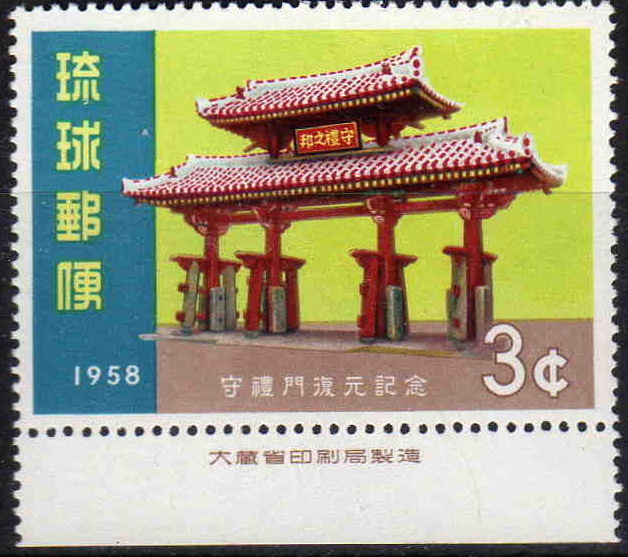
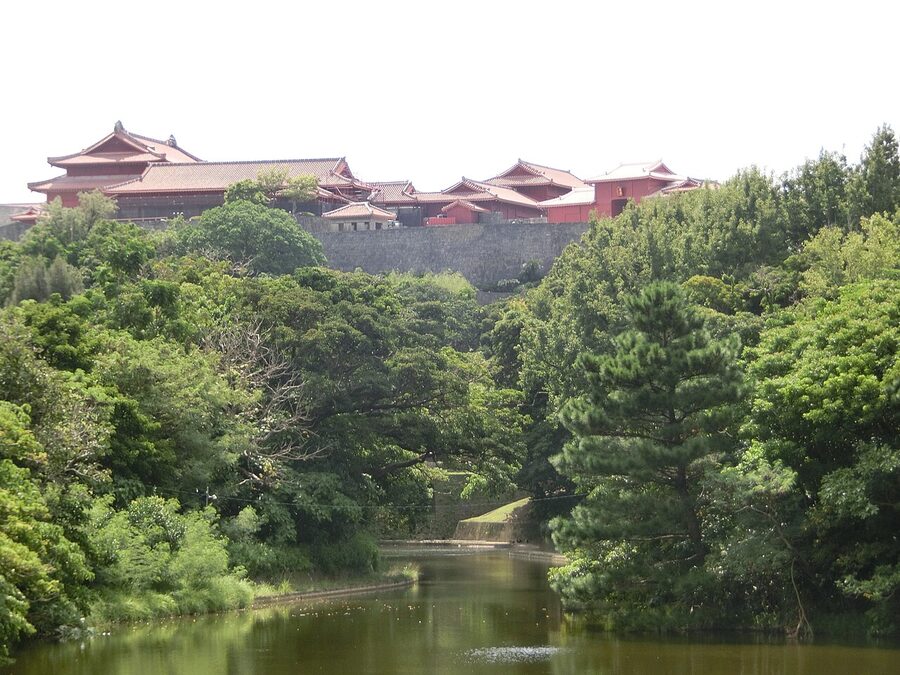
Okinawa reverted to Japan on 15 May 1972, and the castle site became a national historic site the same day. The university began moving out to Nishihara at the end of the 1970s; Japanese reference works give the campus years as 1950 to 1982, though English accounts often say it left in 1975. Work on the Seiden began in November 1989, and on 2 November 1992, the twentieth anniversary of reversion, Shuri Castle Park opened in the Heisei era with the Seiden, its courtyard halls and the main gates rebuilt on the old foundations.
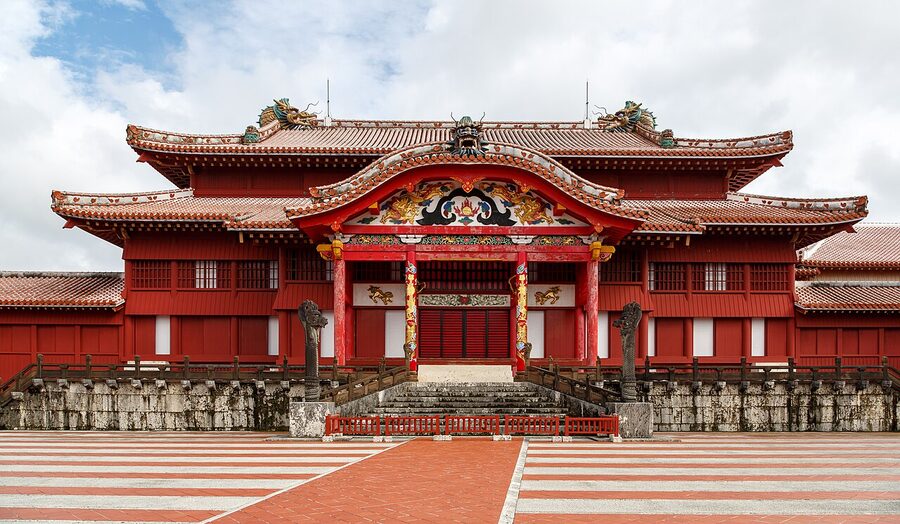
The rebuilders had the Shōwa drawings, Kamakura’s photographs, the excavated foundations and the memories of old people, and even then they were guessing about a good deal. Nobody could agree on the colour of the roof tiles; elderly witnesses remembered anything from red to black. Only one kiln in Okinawa, Okuhara Seitō, was still making traditional Ryukyuan tiles, and its fourth-generation head worked out the red tiles that went on the roof.
The main structural timber was mostly Taiwanese cypress and Japanese hinoki, because the Okinawan woods the kings had used were no longer available in quantity. The side halls, the Hokuden and Nanden, were rebuilt as facades over steel and concrete, and served as museums and a shop. My view, for what it is worth: the 1992 Seiden was a careful, well-argued reconstruction that pretended to be nothing else, which is more than you can say for some of the concrete keeps on the mainland, Osaka‘s and Aizu’s Tsuruga Castle among them.
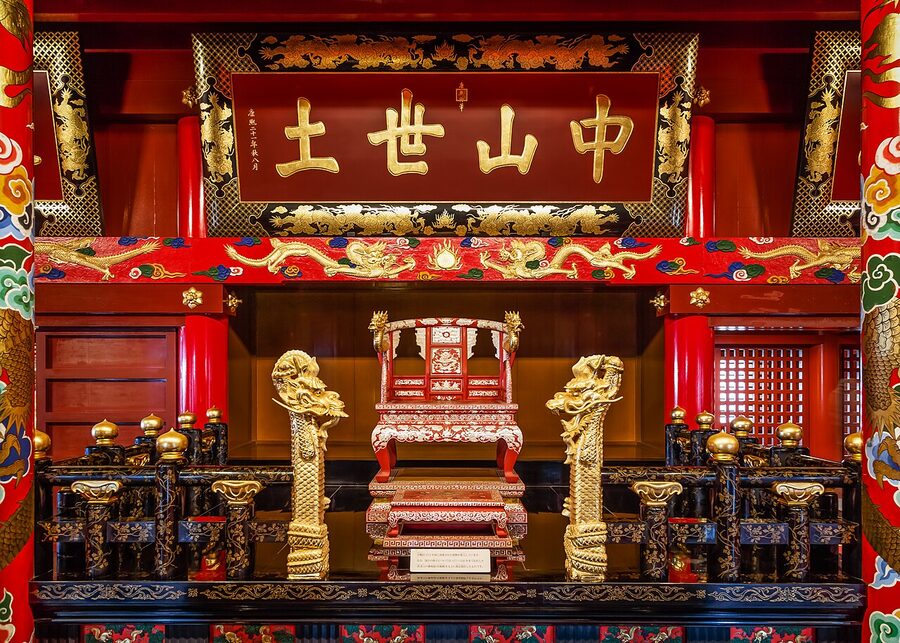
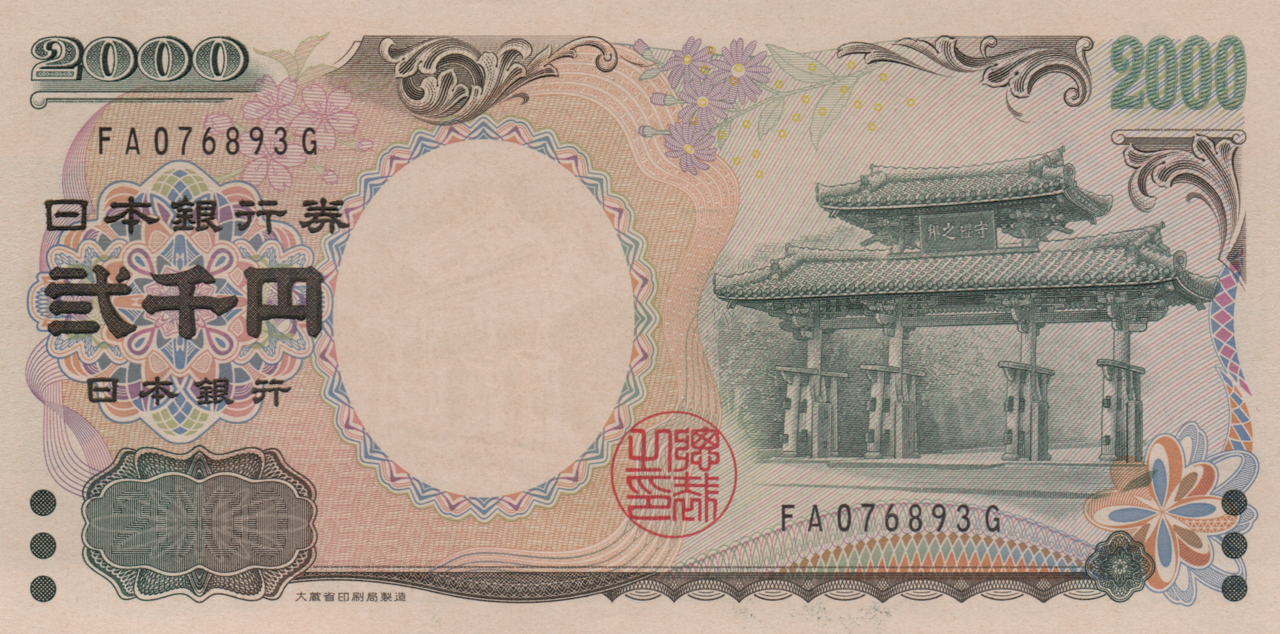
In December 2000 the castle site became part of the World Heritage listing for the gusuku sites of the kingdom, along with Tamaudun, Sonohyan-utaki, Shikinaen and five other sites. Read the listing carefully: what is inscribed is the archaeological site, the old walls and foundations, and none of the rebuilt buildings. The same year the castle hosted the leaders’ dinner at the Okinawa G8 summit, and Shureimon went onto the new ¥2,000 note.
31 October 2019
At 02:34 on 31 October 2019, a heat sensor inside the Seiden detected something wrong. A few minutes later the fire alarm went off and a security guard saw smoke; the first fire engines arrived at 02:50. By about 04:00 the Seiden was collapsing, by 05:35 it was gone, and the fire was not declared out until 13:30, eleven hours after it started.
The investigations found that the fire began at the north-east corner of the Seiden’s ground floor, where an electrical distribution board and extension leads had been installed, but neither the police nor the fire service could fix a cause. There were no sprinklers inside, the ground floor had no smoke detector, and the 79 tonnes of water in the castle’s tank ran out in little more than ten minutes. Sources give anything from six to nine buildings destroyed or damaged, depending on whether they count halls that burned out completely or in part, and about 400 objects were lost, including the replica plaques and throne.
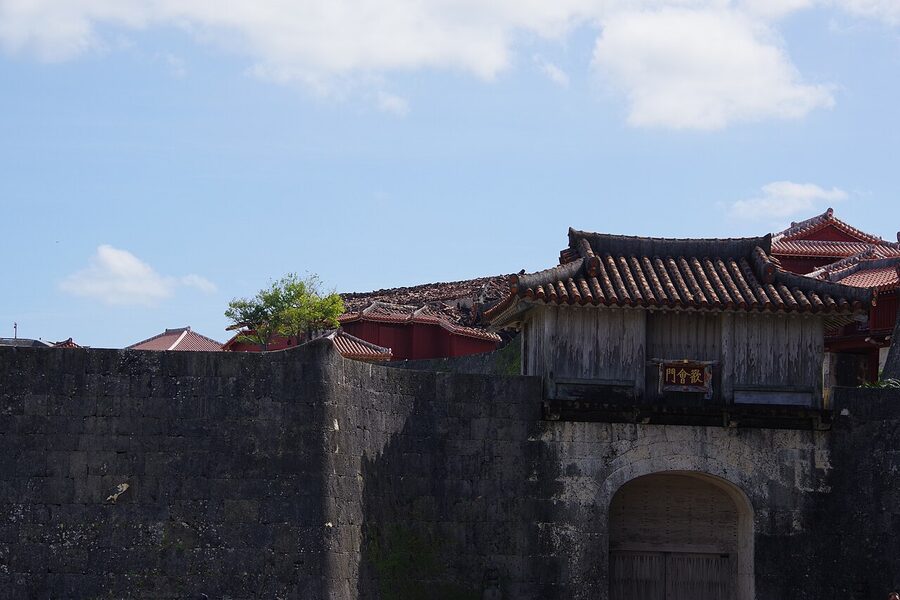
Some of the collection was saved by the fireproof storerooms in the Nanden and the kitchen wing, where about a thousand objects survived behind steel doors. The reaction beyond Okinawa was immediate. Fire services inspected heritage buildings across Japan, and Kyoto held an emergency fire-safety meeting at Nijō Castle; Naha’s crowdfunding appeal passed ¥570 million within three weeks.
For Okinawans, many of whom had grown up with the 1992 Seiden as the one building that showed the kingdom had existed, it was a second loss within living memory. I was struck by how many people said they felt it as a death in the family. The governor, Tamaki Denny, promised that it would be rebuilt.
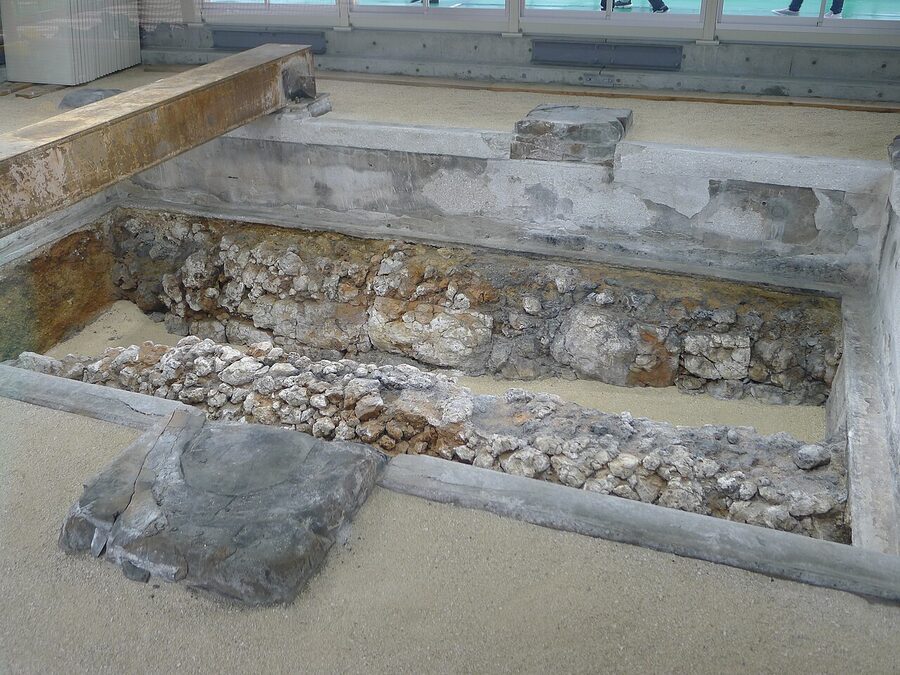
The red from Kushi
The government settled its basic plan in December 2019, and the debris was cleared from February 2020. Work began on the new Seiden with a ceremony on 3 November 2022, in a temporary hall built over the site, and the whole process was run as what the planners called mieru fukkō, a reconstruction you can watch. Broken tiles from the old roof were ground down and reused, and the new building is in wood, built with traditional joinery and lacquer.
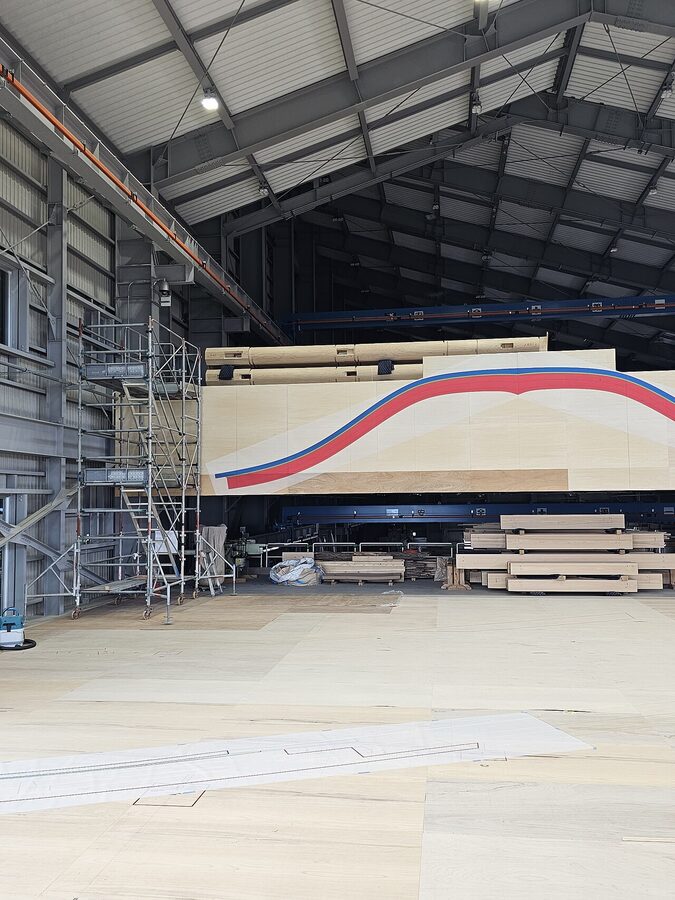
The detail I like best is the paint. The red of the new Seiden is Kushi-magiri bengara (久志間切弁柄), a natural iron oxide pigment named in the kingdom’s old building records, made from the deposits left by iron bacteria in streams around Kushi, in what is now Nago. The 1992 rebuilders could not work out how to make it; the Reiwa team could, and the lacquer work on the Seiden and its corridors was finished on 17 September 2026.
Not every question has an answer. The two great dragon pillars in front of the Seiden were restored facing each other, as in 1992, on the strength of a building manual of 1768 and a document of 1846. A photograph taken by the French navy in 1877 shows them facing forward, and a group of researchers has been campaigning for years to have them turned. The committee says it will change its mind if new evidence appears, and I would not bet on this being the last word.
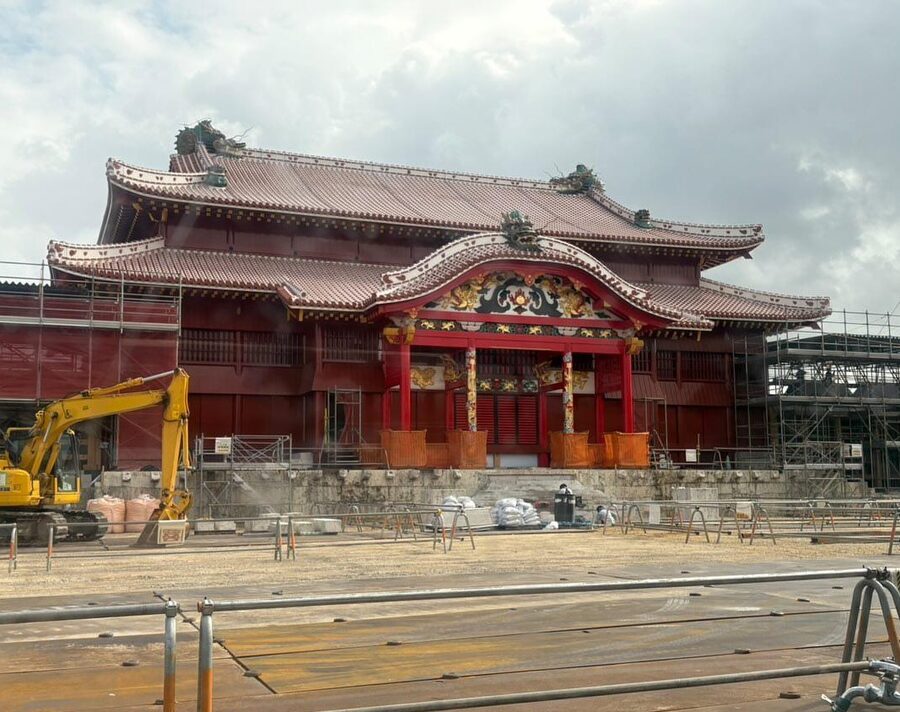
The Seiden’s completion ceremony is on 22 November 2026, and the building opens to the public at noon on 23 November. It is the sixth main hall on this site that anyone can document, after the fires of 1453, 1660 and 1709, the shells of 1945 and the fire of 2019. The plan is to rebuild the Nanden, Hokuden, the royal living quarters and other halls in wood over the coming years, so the castle you visit will keep changing.
Where to see Shuri Castle and the Ryukyu Kingdom today
Everything below except Shikinaen and the museum is within walking distance of Shuri Castle, and you can do the castle, Tamaudun and the stone path in a long morning. Give Shikinaen an afternoon, and the museum a separate half-day. For the wider frame, my walk through Japan’s eras places Ryukyu’s centuries against the mainland’s, and my guides to Japanese gardens and Japan’s greatest gardens are useful background for Shikinaen.
Shuri Castle Park
Take the Yui Rail monorail to Shuri Station, about 27 minutes from Naha Airport for ¥360, and walk about fifteen minutes to Shureimon, or take Naha Bus 7 or 8 from outside the station to the Shuri-jō-mae stop, a minute from the gate. Parking fills up early, so leave the car at the hotel. The free areas are open 08:00–19:30 from April to November and 08:00–18:30 from December to March; the paid area inside Hōshinmon is open 08:30–19:00 (last entry 18:30) and 08:30–18:00 (last entry 17:30) respectively.
Prices rise from 23 November 2026, when the Seiden opens: ¥1,000 for adults, ¥760 for high school students and ¥370 for primary and junior high school pupils, with under-sixes free (until 21 November they are ¥400, ¥300 and ¥160). To go inside the Seiden you need a ticket with a timed reservation, bought in advance on the park’s official ticketing site, at no extra cost; slots go on sale at 13:00 on the first day of the month two months ahead. Without one, you can see the Seiden from the courtyard and visit the rest of the paid area. The park is closed all day on 22 November 2026 and until late morning on the 23rd, so check the official Shuri Castle Park site before you go.
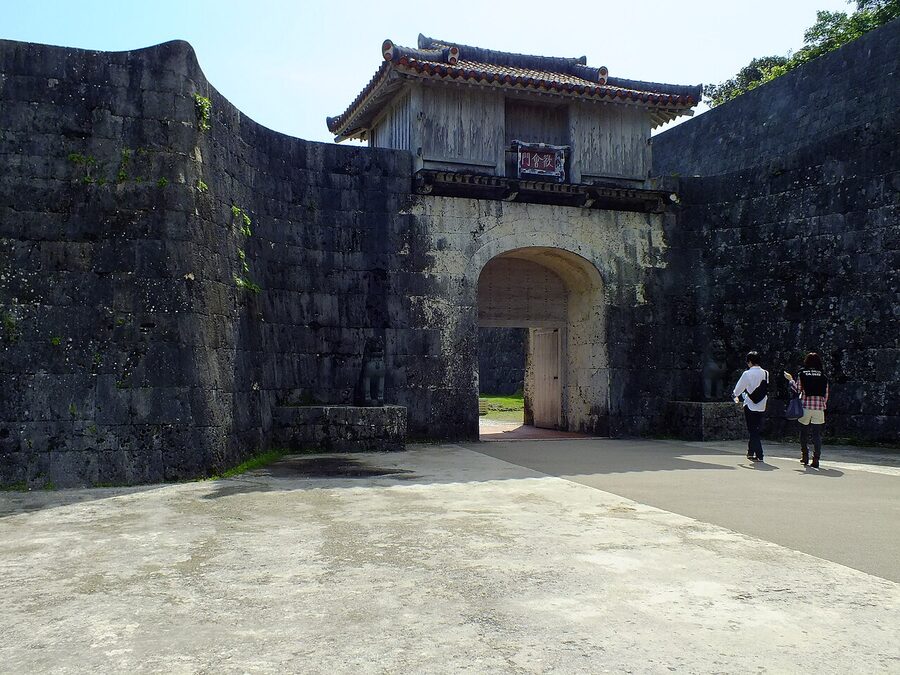
Walk in the way the envoys did: Shureimon, Kankaimon, then up the stairs to Zuisenmon, the “auspicious spring” gate, with the Ryūhi spring below it. Past Rōkokumon, where the water clock was kept and where officials had to get down from their horses and palanquins, you reach Kōfukumon and the ticket office, and the lower courtyard with the walled grove of Suimui-utaki, one of the castle’s ten sacred places. Hōshinmon then opens onto the una and the Seiden.
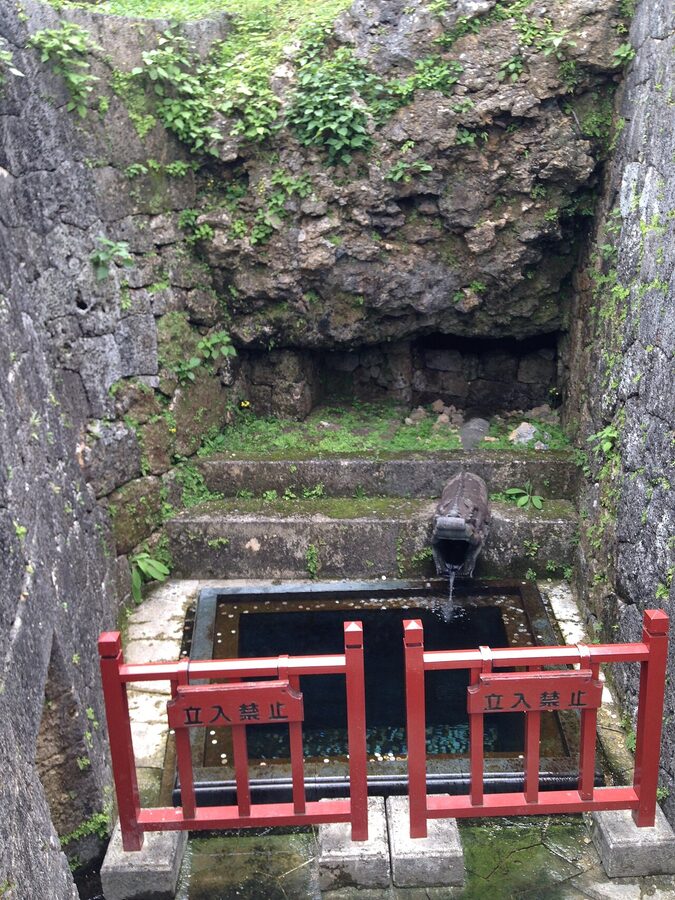
Allow 90 to 120 minutes in all, and about fifteen minutes inside the Seiden itself. Go to Agari-no-azana, the eastern lookout at the highest point of the walls, about 140 metres up, where on a clear day you can see both the East China Sea and the Pacific. The bell that hangs in the little Tomoya pavilion by Rōkokumon is a replica; the original is in the prefectural museum.
On the way down, walk round Ryūtan, Shō Hashi’s pond of 1427, where the envoys watched dragon-boat races at their autumn banquet. Somewhere in the woods between the castle and the pond are the entrances to the 32nd Army’s tunnels, which the prefecture considers too unstable to open to the public. You will not see much, but the contrast with the restored palace above is something to think about.
Sonohyan-utaki stone gate
Between Shureimon and Kankaimon, on the left as you walk up, is a small carved limestone gate that most people photograph without stopping. It is the prayer gate of Sonohyan-utaki, the sacred grove behind it, where the king prayed before every journey and where each new high priestess, the kikoe-ōgimi, began her installation. It was built in 1519 under Shō Shin, reportedly by a stonemason named Nishitō from Taketomi island.
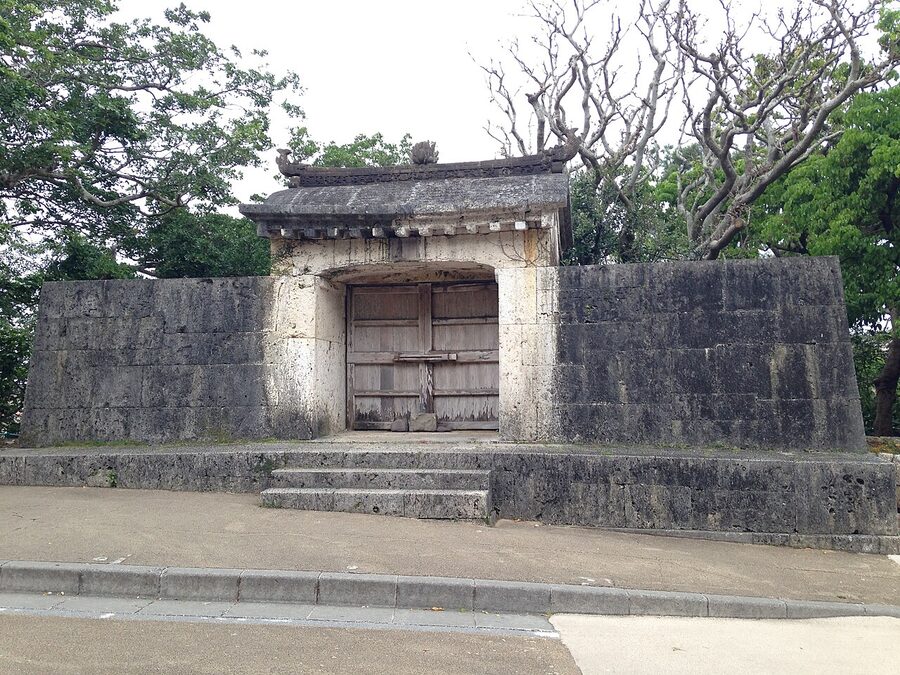
The original plaque, now lost, recorded that the gate was put up in the reign of “the king of Shuri, Okiyaka-moi”, Shō Shin’s sacred name, and it is the oldest surviving text in the Japanese epistolary style in Ryukyu. Free, always open, and five minutes of your time well spent.
Tamaudun
The royal mausoleum of the Second Shō dynasty is a few minutes’ walk west of Shureimon at Shuri Kinjō-chō 1-chōme. Shō Shin built it in 1501 for his father, Shō En, and it holds the kings and queens of the dynasty down to Shō Tai; the last burial was in 1931. It has three chambers: the central one, where bodies were left until only bones remained, and the east and west chambers, where the washed bones of kings and queens and of other royals were placed in urns.
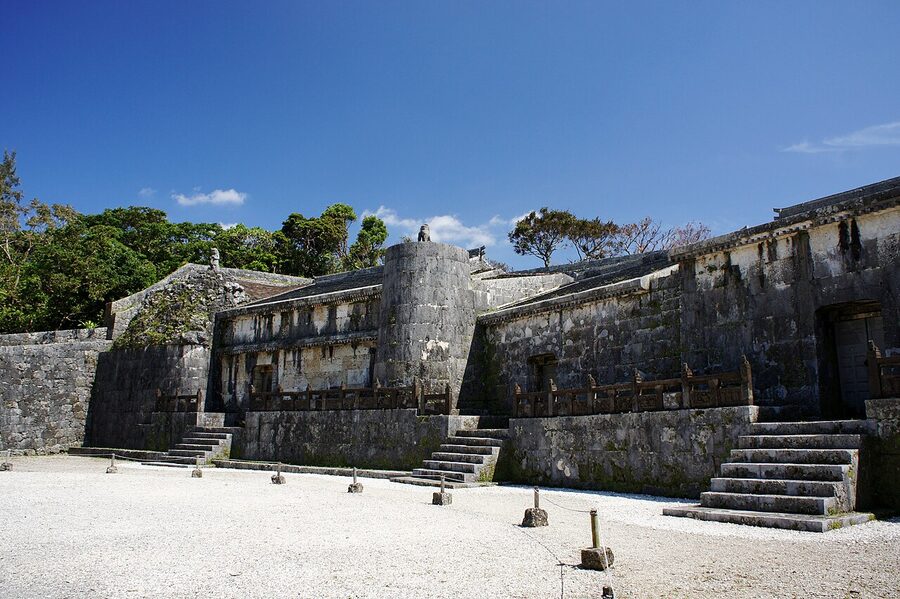
Read the stele in the outer courtyard, or its translation in the small museum by the entrance. Shō Shin had it carved in 1501 naming exactly who might be buried here, and he left out his own eldest son; his successor broke the rule almost at once and moved his disinherited brother in. Two kings are missing anyway, Shō Sen’i and Shō Nei, who lies at Urasoe. Entry is about ¥300 for adults and the site is open daily, roughly 09:00–18:00 with last entry at 17:30; the city of Naha runs it, so check its site for current hours.
The Kinjō-chō stone path
From the south side of the castle, the Shuri Kinjō-chō stone path runs steeply downhill for about 238 metres, the surviving piece of the Madama-michi, the royal road that Shō Shin began in 1522 to link Shuri with the southern harbour. Most of it was destroyed in 1945 and paved over, and this section was relaid in limestone in 1983. The houses beside it still have their old stone walls and red-tiled roofs.
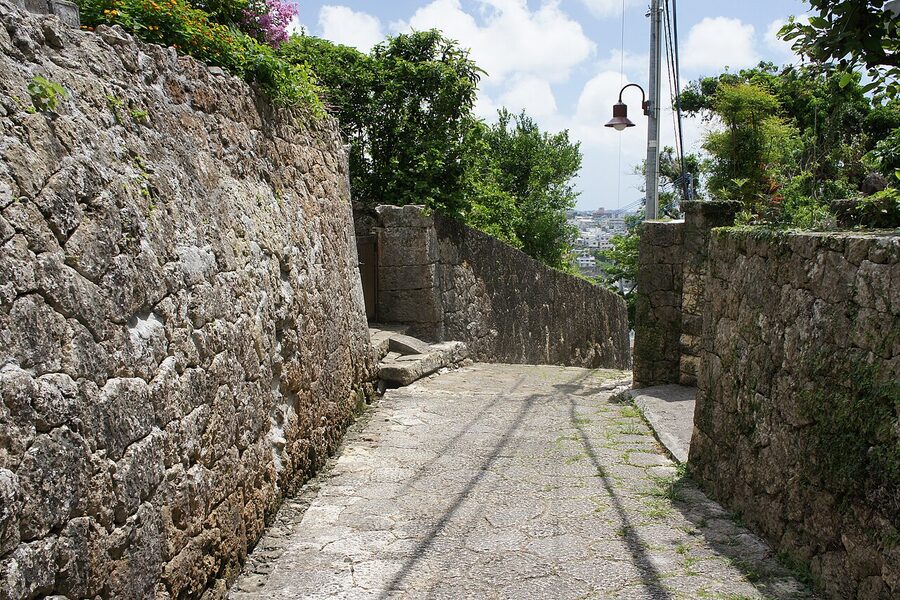
Walk it downhill and get a bus or taxi back up; the climb in July is not something I would wish on anyone. It is free, and early morning is the time to go, before the tour buses arrive.
Shikinaen
The royal garden and villa of Shikinaen, about 4 kilometres south of the castle at Maaji 421-7, was completed in 1799 under King Shō On, and the next year it was used to entertain the envoys who came to invest him. It mixes a Japanese-style stroll garden around a pond with Chinese elements, a hexagonal pavilion and stone bridges, and the large wooden villa, rebuilt between 1975 and 1996 after the war, is Ryukyuan through and through.
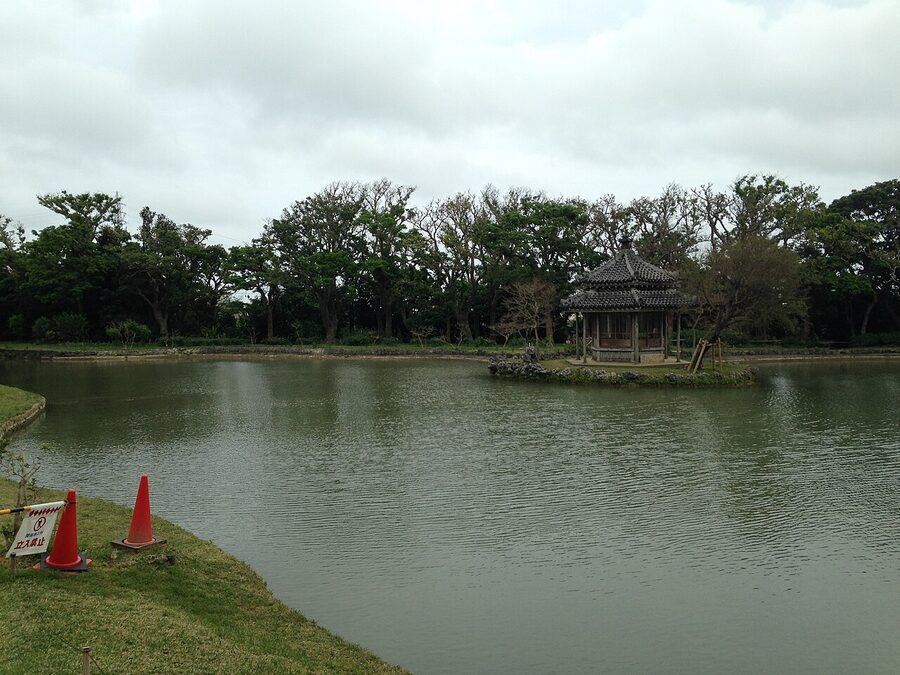
It is my favourite place in Naha, quieter than the castle and far less rebuilt-looking, and you can sit on the villa’s veranda for as long as you like. Admission is ¥400 for adults and ¥200 for children; it is open 09:00–18:00 from April to September and 09:00–17:30 from October to March, last entry thirty minutes before closing, and closed on Wednesdays. Naha Bus routes 2, 3, 5 and 14 stop at Shikinaen-mae, or take a taxi from Shuri.
Okinawa Prefectural Museum and Art Museum
The prefectural museum at Omoromachi, ten minutes’ walk from the Yui Rail station of the same name, is where many of the kingdom’s surviving objects are, including the Bankoku Shinryō bell and the scroll of the 1832 mission, and its history galleries give the clearest account of the kingdom I know in a single building. The museum recorded the bell’s sound in 2016 and has been playing it in the galleries on the hour and half-hour, so time your visit accordingly.
Hours are 09:00–18:00 (last entry 17:30), extended to 20:00 on Fridays and Saturdays, and it is closed on Mondays (or the next weekday if Monday is a holiday). The permanent history exhibition is ¥530 for adults. Go before Shuri if you can, because the castle makes much more sense once you have seen what used to be in it.
Further afield: Nakijin and Yomitan
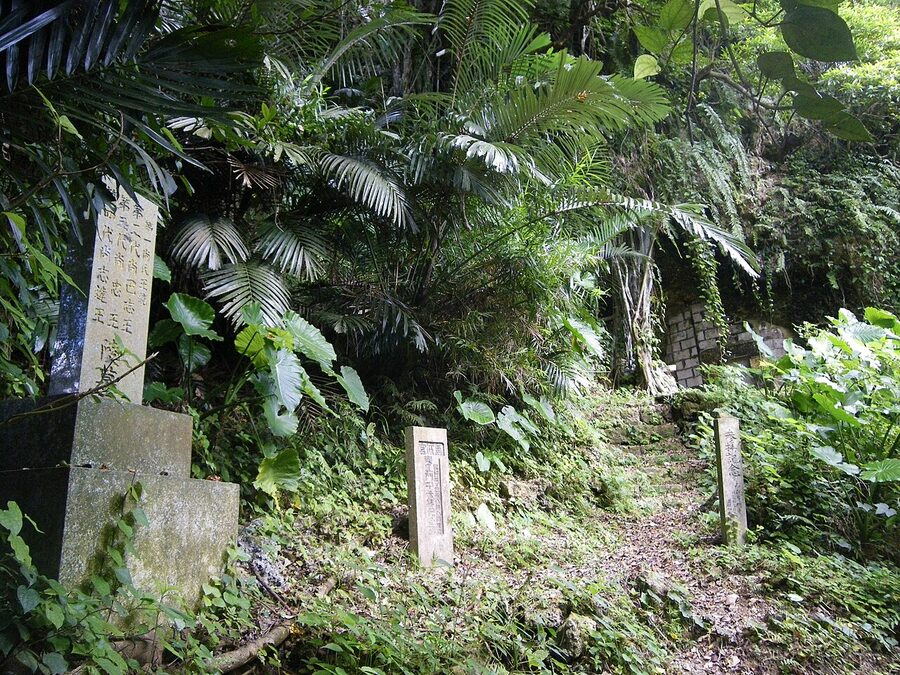
If you have a car and a day, drive north to the walls of Nakijin, Hokuzan’s old capital and another of the World Heritage sites, and on the way stop in Yomitan to find Shō Hashi’s tomb, a few stones and a stele in the trees. Nobody else will be there. It is a good antidote to the red lacquer, and a reminder of how small and contested this kingdom was before Shuri made it look inevitable.
Back to the sign
The new Seiden is the most carefully researched building ever put on that hill, down to the iron bacteria in its paint, and I am glad it exists. But it is the newest thing at Shuri, and the kingdom it stands for has been gone since 1879. What survives from the kingdom itself is lower down and easier to miss: the foundations under the hall, the walls, the stone gate of Sonohyan-utaki, the bones at Tamaudun, the paving on the Kinjō-chō path.
So when you walk up from the station, stop at Shureimon before you get your ticket out. Look up at the four characters that a small kingdom once hung out for its guests and took down again when they left. The gate is a 1958 copy, and the sign is a copy of a copy, but the courtesy it describes was real, and it is the one thing on the hill that nobody has ever managed to burn.