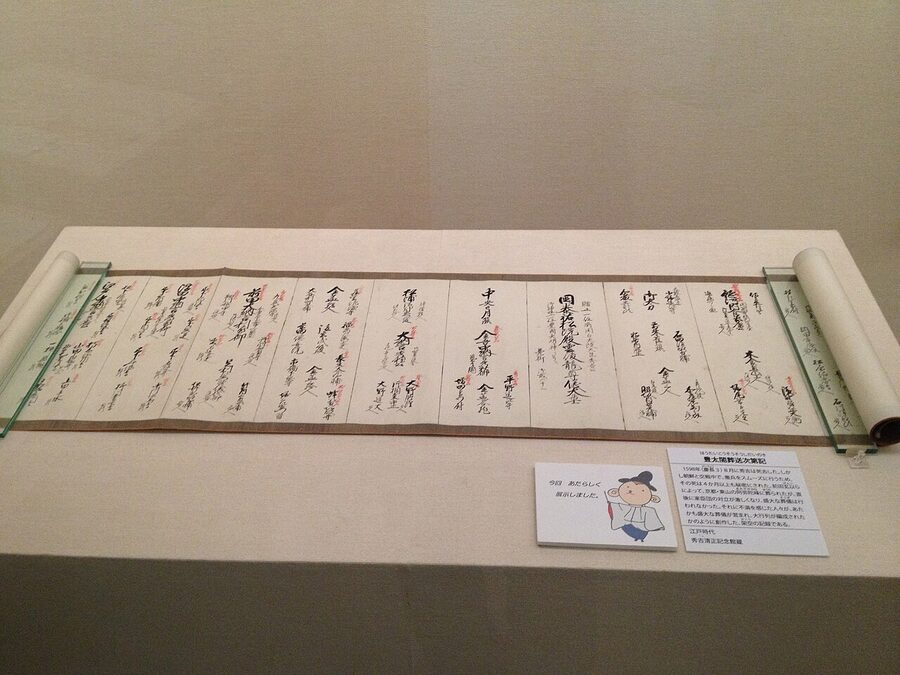
The receipts are what I cannot get past. In the autumn of 1597 the inspectors attached to Toyotomi Hideyoshi’s army in southern Korea were issuing signed receipts for human noses, lord by lord, so that each contingent’s tally could be credited back in Kyoto. The receipts that survive in just two family archives, the Nabeshima and the Kikkawa, account for 29,251 noses over about two months. Katō Kiyomasa set his own retainers a quota of three each.
Hideyoshi’s orders for that campaign told his commanders to cut down everyone, men and women, young and old, monks and laypeople, down to the poorest hill farmers. The noses were salted, packed into barrels and shipped to Kyoto, where they were buried in a mound in front of the Great Buddha that Hideyoshi had built at Hōkō-ji. On the 28th day of the ninth month of 1597 a senior Zen monk read a memorial service there for “the dead of Ming and Korea who fell in battle”. Most of the people in that mound had never held a weapon.
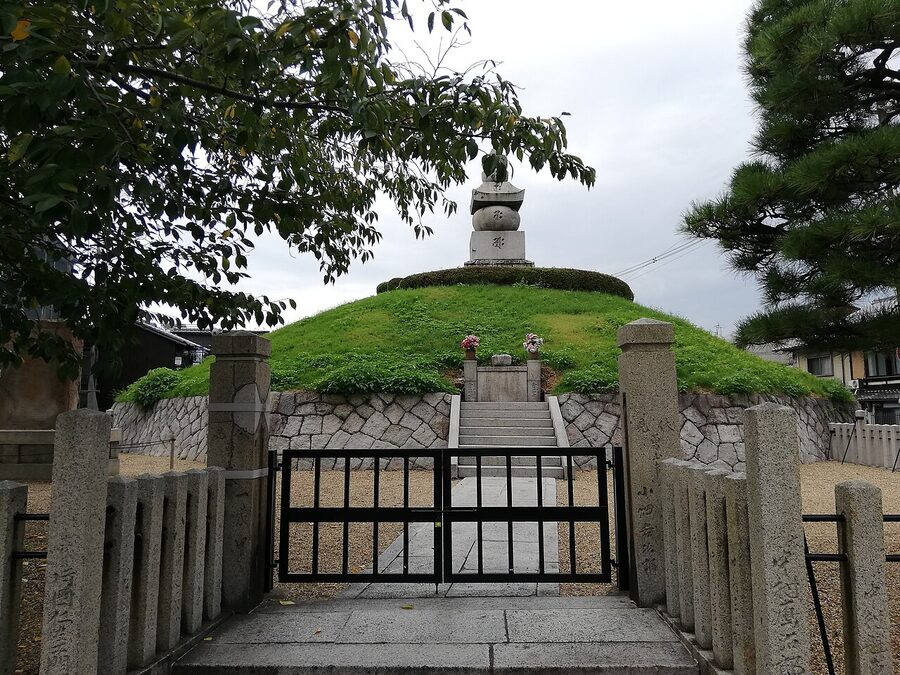
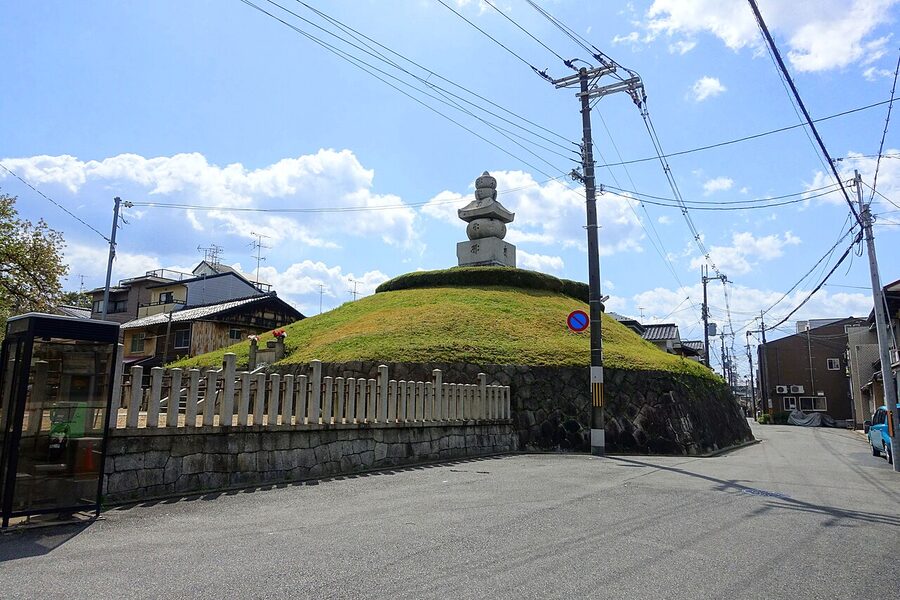
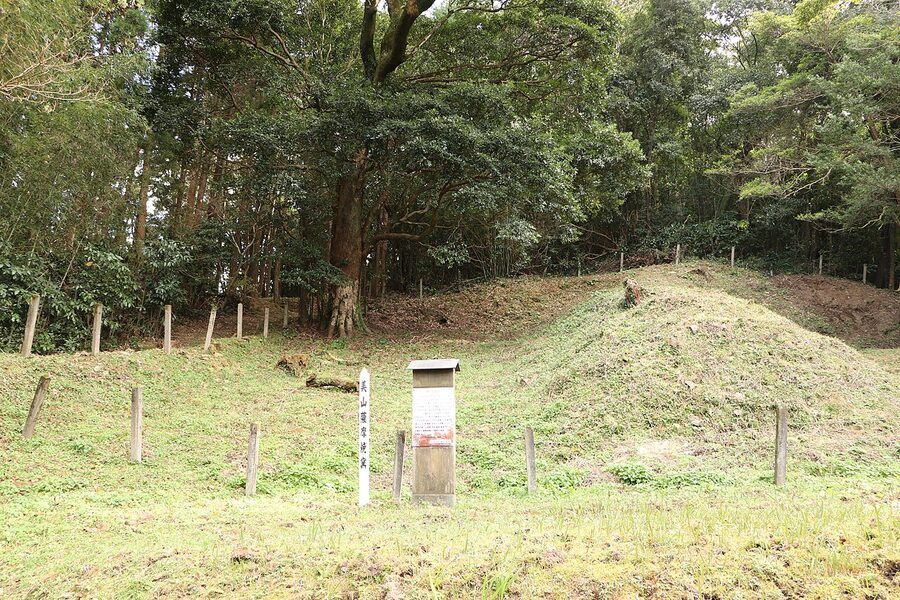
The mound is still there, in Kyoto’s Higashiyama ward, across a quiet road from a shrine to the man who ordered it. It is called the Mimizuka, the Mound of Ears, which is itself a small act of tidying up. Most people walking past are on their way to Sanjūsangen-dō and do not stop. I think you should.
Where to see it today means a ruined castle on the Saga coast, a mound in Kyoto, porcelain towns in the hills of Kyushu and, if you are willing to cross the strait, half the coastline of South Korea. It also means being clear from the start about what kind of war this was. Hideyoshi’s two invasions of Korea, in 1592 and 1597, were wars of conquest fought on other people’s land, and the people of that land paid for them as no Japanese participant did.
If you have come here from my run-down of Japan’s most decisive battles, this is the war that sits behind several of them. In the long run of Japanese history it is also the only time between the Mongol invasions of the 13th century and the 1890s that the armies of Japan, Korea and China met in war. It lasted seven years. Korea is still counting the cost.
In This Article
- Imjin, Bunroku, kara-iri: what to call it
- Why Hideyoshi went
- Nagoya: a city built for an invasion
- Busan to Pyongyang in sixty days
- Yi Sun-sin and the sea
- Righteous armies, monks and the walls of Jinju
- The Ming arrive
- Four years of forged letters
- The second invasion, 1597
- Sacheon, Noryang and a death kept secret
- What the war carried home
- Embassies and the long memory
- Where to see the Imjin War today
- Nagoya Castle ruins and the Nagoya Castle Museum, Karatsu
- The Mimizuka, Toyokuni Shrine and Hōkō-ji, Kyoto
- Arita: Tozan Shrine, the Yi Sam-pyeong monument and Izumiyama
- Miyama, Kagoshima
- Across the strait
Imjin, Bunroku, kara-iri: what to call it
Koreans name the war after the year it began, imjin in the sixty-year cycle, and call it the Imjin Waeran (임진왜란), roughly “the disturbance made by the Japanese in the imjin year”. The second invasion is the Jeongyu Jaeran, the second disturbance, of 1597. In China it is the Wanli Korean campaign, after the emperor who paid for most of it.
Japanese usage has shifted more, and the shifts tell a story. Hideyoshi called the project kara-iri, “going into China”, which is a fair summary of how little Korea figured in his thinking. Edo-period writers preferred Chōsen seibatsu, “the punitive expedition against Korea”, which casts the invaded as the offenders. In the 20th century the era names took over: Bunroku no eki and Keichō no eki (文禄・慶長の役), the campaigns of Bunroku and Keichō.
The everyday Japanese term now is Chōsen shuppei, “sending troops to Korea”. Some Japanese historians, Kitajima Manji most forcefully, argue that the only accurate name is Chōsen shinryaku, the invasion of Korea, and I think they are right. I use “the Imjin War” because it is the name English has settled on, and the one the people who lived through it chose.
Why Hideyoshi went
Nobody has found a document that explains it, and Japanese historians have argued about Hideyoshi’s motives since the 17th century. The earliest firm evidence is a letter of the ninth month of 1585, written by one of his retainers weeks after Hideyoshi became kampaku: the new regent, it says, means to take not only Japan but China. The next spring he told the Jesuit Gaspar Coelho that once Japan was settled he would hand it to his brother and go and conquer China, and asked whether the Portuguese could sell him two large warships.
The old story that he was carrying out Oda Nobunaga‘s plan to conquer China rests on very little. Edo Confucians blamed vanity, and Hideyoshi’s own letter to the Korean king does say he wanted only to make his name known in the three countries. Hayashi Razan, writing for the Tokugawa, blamed grief and madness after the death of his infant son Tsurumatsu in 1591, which is a suspiciously convenient diagnosis for the dynasty that replaced him.
The explanation most Japanese specialists now favour is duller and more convincing. A regime that had just conquered the whole country ran on rewarding its generals with land, and there was no more land to hand out at home. The Korean campaigns were the unification wars carried on overseas, with the same surveys and the same quotas of men per hundred koku, and Hideyoshi treated the kings of Korea and China exactly as he had treated the lords of Kyushu: submit and be confirmed, or be conquered.
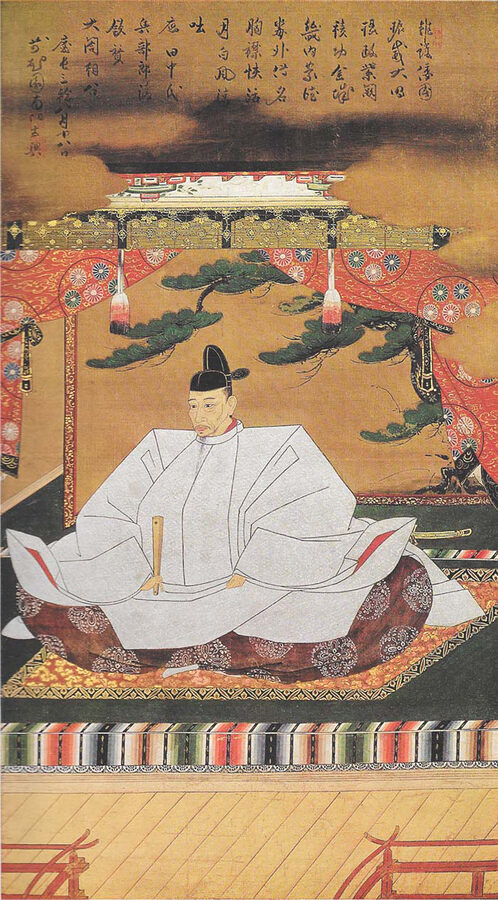
The full arc of his career, from Owari peasant to master of Japan, is in my piece on Toyotomi Hideyoshi. What matters here is that by 1590 he believed Korea had already submitted, and the reason he believed it is one of the great diplomatic frauds of the Azuchi-Momoyama era.
The go-between was the Sō family of Tsushima, the island halfway across the strait, which lived on Korean trade and had every reason to keep the peace. Ordered to bring the Korean king to Kyoto to pay homage, Sō Yoshitoshi instead asked Seoul for a goodwill embassy to congratulate Japan’s new ruler. When the envoys Hwang Yun-gil and Kim Seong-il were received at the Jurakudai palace late in 1590, Hideyoshi took them for the envoys of a vassal and handed them a letter ordering Korea to lead his army into China.
The two men went home and reported in opposite directions. Hwang, as the chief minister Yu Seong-ryong later told it, said Hideyoshi’s eyes were bright and that he meant war; Kim said the man had eyes like a rat and was nothing to fear. The court, split along faction lines, preferred Kim’s version. Meanwhile Sō Yoshitoshi and Konishi Yukinaga quietly rewrote Hideyoshi’s demand as a polite request to “lend us the road to the Ming”, which Seoul refused anyway.
Nagoya: a city built for an invasion
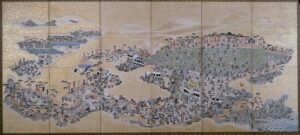
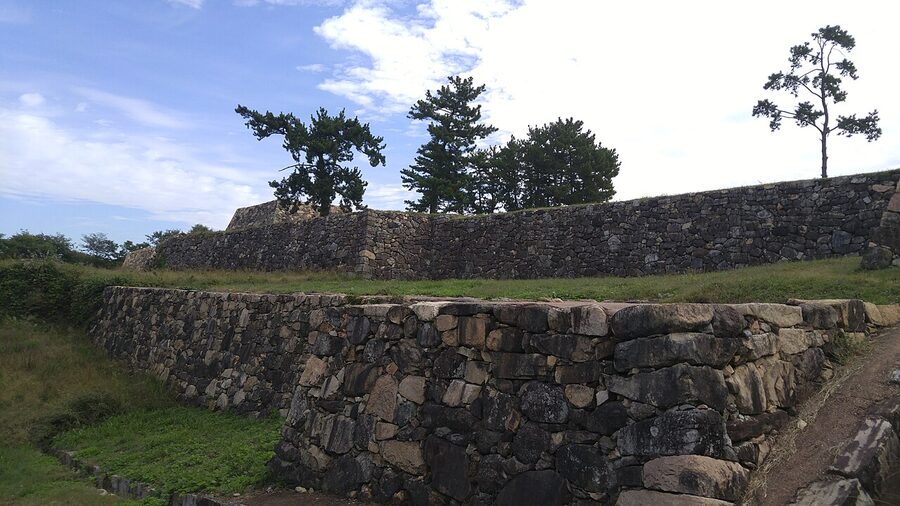
Hideyoshi announced the expedition to his lords in the eighth month of 1591 and chose as his base the tip of the Higashi-Matsuura peninsula in Hizen, the point of Kyushu closest to Korea. The site belonged to a minor family of the Matsura sea lords; Luis Frois called it a wilderness lacking every human resource. Kuroda Kanbei laid out the new castle, the Kyushu lords were each given sections to build, and the main works went up in a few months.
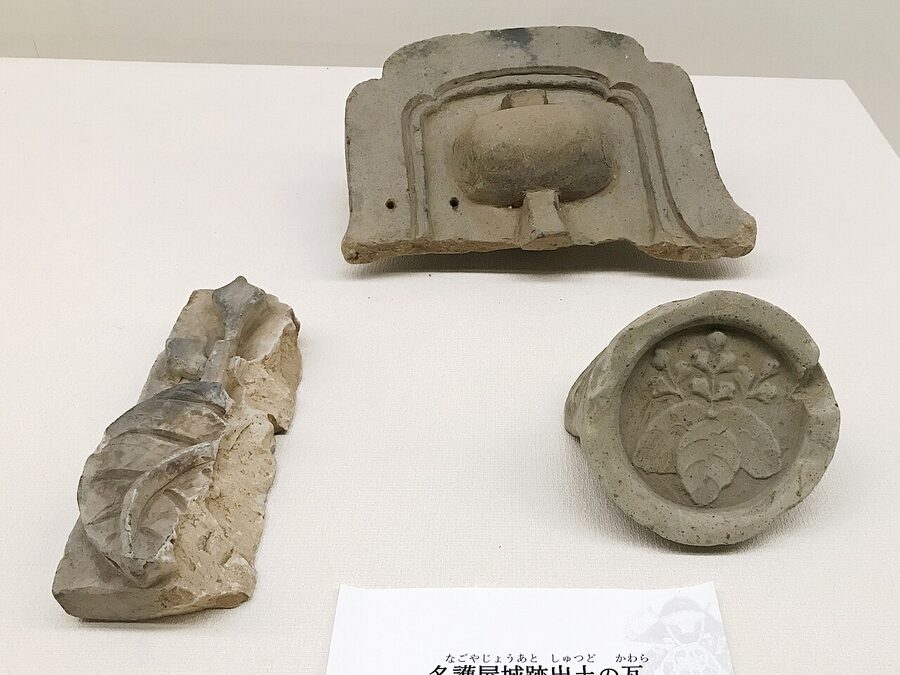
The name has nothing to do with the city in Aichi. It is written 名護屋, not 名古屋, and the pair still confuse anyone booking trains. The castle had a five-storey keep on the scale of the one at Osaka Castle, gold-leaf roof tiles and a circuit of well over a kilometre and a half, and around it some 130 to 160 lords built camps of their own. The museum on the site estimates that more than 200,000 people lived here at its peak.
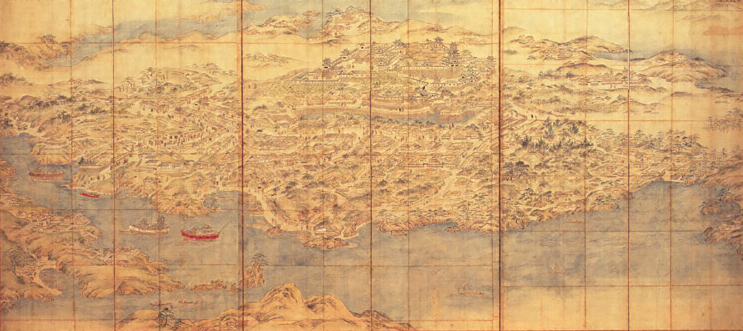
Every great lord in Japan was summoned, including the eastern ones who never crossed. Tokugawa Ieyasu and Maeda Toshiie both camped at Nagoya and kept their armies whole, a fact worth holding on to when you reach Sekigahara eight years later. Date Masamune marched in from the far north and did cross, in 1593; one of his letters home that summer reports that nine in ten of his men who caught the swelling sickness died of it.
Even the kingdom of Ryukyu was squeezed. Ordered through the Shimazu of Satsuma to send men and supplies, it sent part of what was demanded and, as a vassal of the Ming, secretly warned Beijing of what was coming. Satsuma remembered the shortfall when it invaded the kingdom in 1609, which is where the later story of Shuri Castle begins.
Hideyoshi himself arrived on the 25th day of the fourth month of 1592, after a leisurely progress that included a visit to Itsukushima Shrine. The war had been going for nearly two weeks. He brought his portable golden tea room, three mats laid out in gold with red gauze in the paper screens, and used it at Nagoya to entertain lords and receive foreign envoys; the Hakata merchant Kamiya Sōtan drank tea in it and left a description.
Sen no Rikyū, the tea master who had shaped so much of Hideyoshi’s taste, was not there to see it. He had been ordered to kill himself in the second month of 1591, months before the Nagoya works began, for reasons still argued over; disapproval of the Korean plan is one of the theories, and only one. If you know what a three-mat room was meant to stand for in the tea ceremony, the gold version is very nearly the opposite of the point.
Busan to Pyongyang in sixty days
The army that crossed numbered about 158,000 on paper, in nine divisions, with another hundred thousand held at Nagoya and on the islands of Iki and Tsushima. Perhaps a third were fighting men, a professional force of arquebusiers, spearmen and mounted samurai in lacquered armour, hardened by a century of Sengoku war. The rest were porters, boatmen and labourers, conscripted from villages across western Japan at five men for every hundred koku. The war began emptying Kyushu’s farms before a shot was fired.
Konishi Yukinaga’s First Division, with Sō Yoshitoshi and about 18,700 men, crossed from Tsushima and attacked the harbour fort at Busanjin. Japanese records put the landing on the 12th day of the fourth month; English-language accounts, converting to the Western calendar, usually give 23 or 24 May 1592. It is the same morning. Korean and Japanese records both use the lunar calendar and most English histories do not, so anyone comparing sources on this war has to keep two diaries open at once.
The commander at Busanjin, Jeong Bal, died on the walls and the fort fell in a day. The next morning the First Division reached Dongnae, a few kilometres inland, and Konishi set up a board demanding passage: fight if you will, or lend us the road. The magistrate, Song Sang-hyeon, sent back six characters every Korean schoolchild learns, roughly “to die fighting is easy, to lend you the road is hard”. The town was stormed that day, and Korean accounts record that the garrison and townspeople were killed almost to the last.
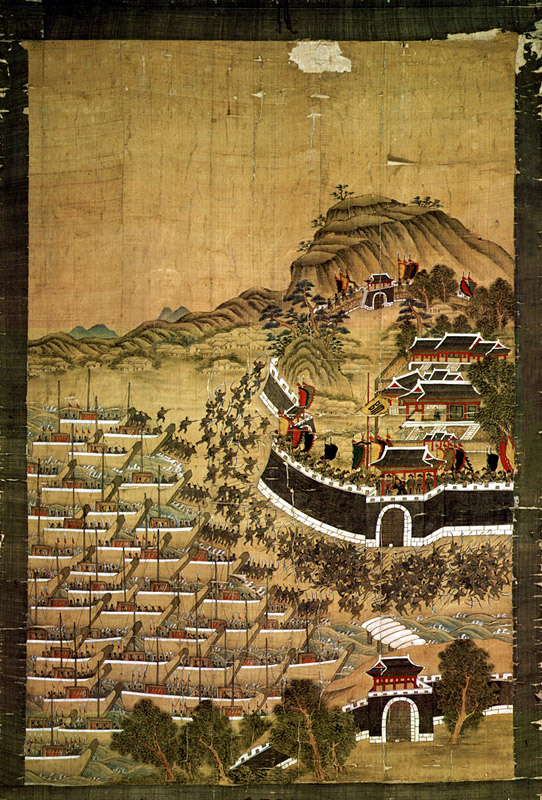
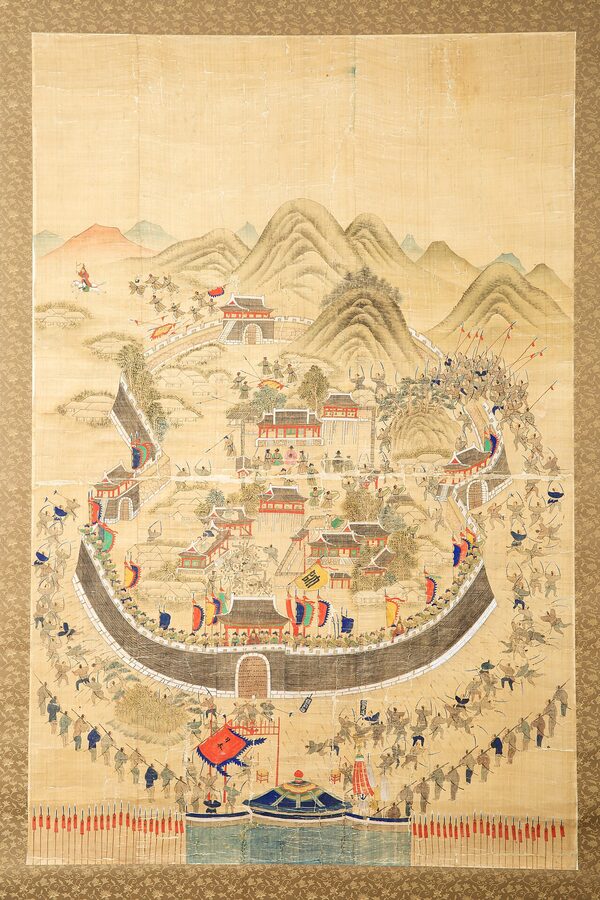
Speed was the whole Japanese plan. Sangju fell on the 25th day of the fourth month, and at Chungju three days later Sin Rip, Korea’s most celebrated cavalry general, drew up his horsemen on the open ground at Tangeumdae with a river at their backs. The arquebusiers shot the charge to pieces in an afternoon and Sin Rip drowned himself in the river. When the news reached the capital, King Seonjo left Hanseong, now Seoul, in the rain before dawn on the last day of the month.
The Korean records of what came next are painfully candid. Before the Japanese arrived, parts of the capital were burned by its own people, starting with the offices that kept the slave registers, and the royal palaces, Gyeongbokgung among them, went up in the same days. Yu Seong-ryong wrote the war’s great memoir, the Jingbirok (懲毖録, “a record of reflection and caution”), and did not spare his own government.
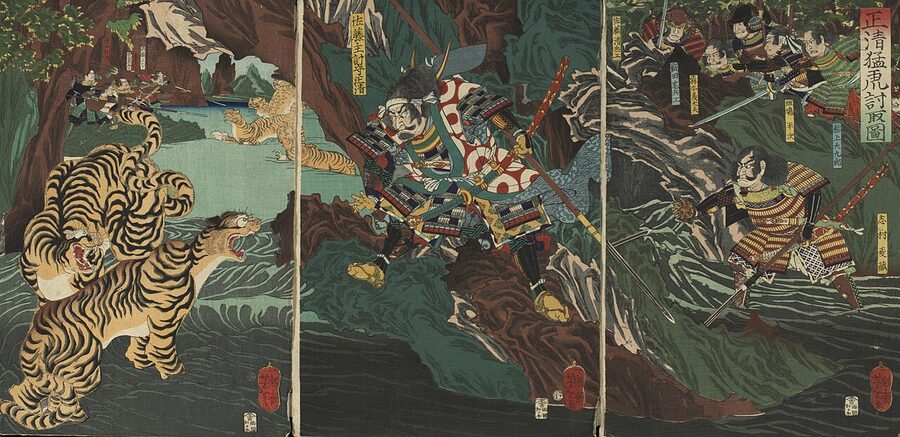
Konishi entered the capital early in the fifth month, a few hours or a day ahead of Katō Kiyomasa depending on whose chronicle you read. Their rivalry, a Christian merchant’s son from Sakai against a Nichiren zealot from Owari, shaped the rest of the campaign. They split: Konishi pushed north-west and took Pyongyang in the sixth month, while Kiyomasa went north-east into Hamgyong, took two Korean princes handed over by rebellious locals and crossed the Tumen River into Jurchen country for a raid that achieved nothing.
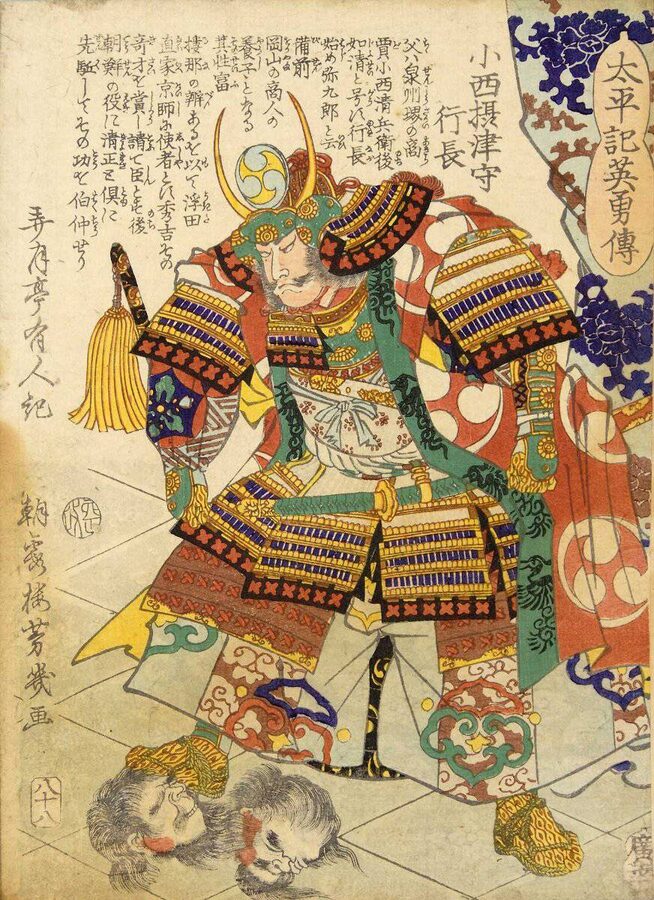
Kiyomasa also hunted tigers in the Hamgyong mountains that winter, the legend that later made his name, and a less comfortable one once you remember how his men were getting their grain.
By the summer Hideyoshi was drafting the government of Asia. In a memorandum of the 18th day of the fifth month he moved Emperor Go-Yōzei to Beijing, made his nephew Hidetsugu regent of China, assigned Korea to an adopted son and reserved for himself the port of Ningbo, the old gateway of the China trade. Japanese historians treat the plan as a fantasy, which it was, though a revealing one: a peasant’s son who had reorganised Japan by paperwork saw no reason the same paperwork would not work on the Ming.
Yi Sun-sin and the sea
The plan depended on the sea, and the sea belonged to Yi Sun-sin. He was forty-seven, a career officer who had served on the Jurchen frontier and been stripped of rank once already, and he had been given the Left Navy of Jeolla Province fourteen months before the invasion on Yu Seong-ryong’s recommendation. He spent those months building ships and drilling crews. By his diary’s reckoning, he was test-firing the cannon of his new turtle ship the day before the Japanese fleet appeared off Busan.
The Gyeongsang fleets nearest Busan scuttled themselves or fled, so the first Japanese ships to meet serious Korean warships met his. At Okpo in the fifth month he destroyed twenty-six transports without losing a ship, and at Sacheon, Dangpo and Danghangpo over the following weeks he did it again. At Sacheon a Japanese bullet went into his shoulder; he kept command and had the ball dug out afterwards.
Hideyoshi ordered his admirals to finish him. On the 8th day of the seventh month, 14 August 1592 by the Western calendar, Wakisaka Yasuharu, impatient for glory and unwilling to wait for his colleagues, chased a few Korean decoy ships out of the narrow strait of Gyeonnaeryang into open water off Hansan Island. There Yi’s fleet closed round him in a crescent, the crane-wing formation, and battered his ships with cannon at a range the Japanese could not answer. Fifty-nine Japanese ships were sunk or taken, and Wakisaka got away only because his flagship was fast.
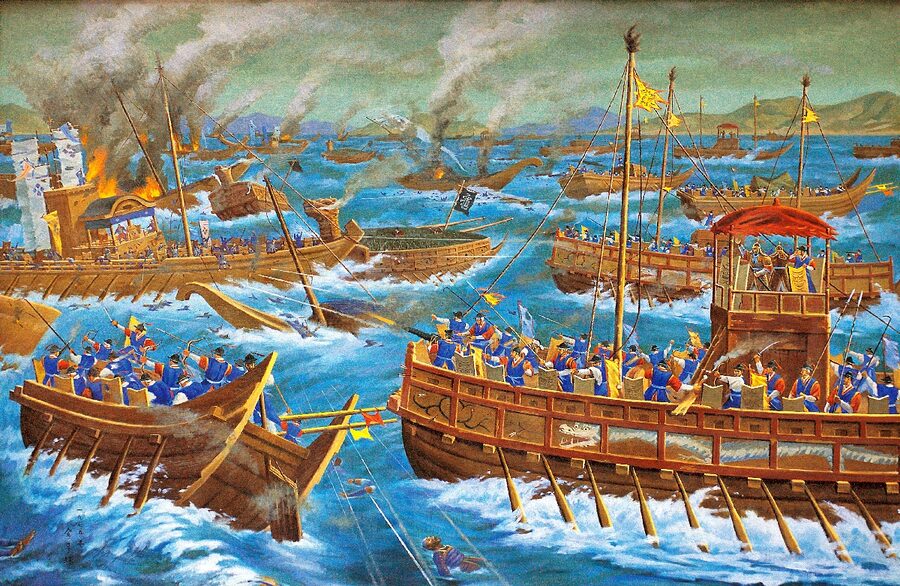
Hansan was the moment the invasion stopped being a march on China. With the western sea lanes closed, Konishi could not be supplied by water at Pyongyang, and Hideyoshi forbade further naval battles.
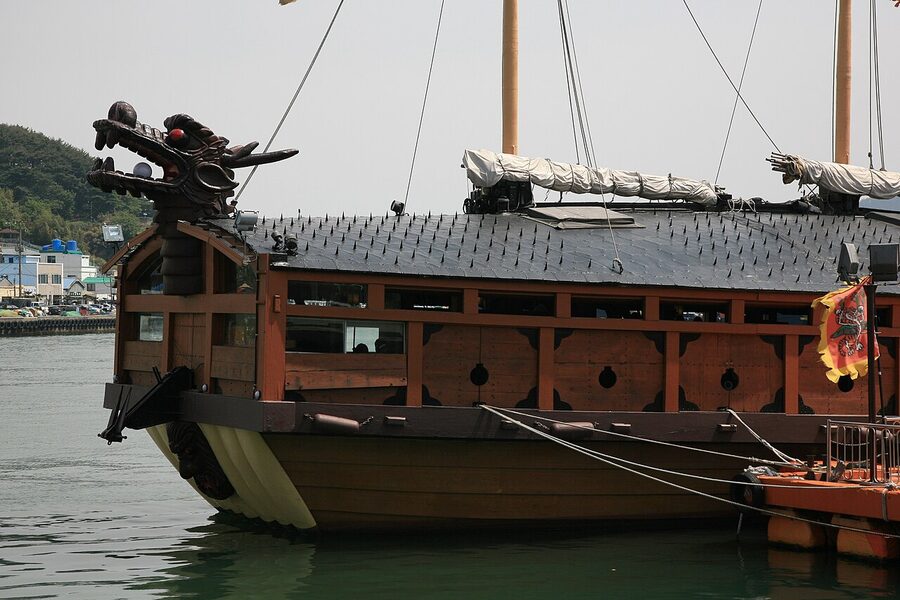
The turtle ship, geobukseon, has become a national emblem, and its details are argued over more than almost anything else in the war. Yi’s own reports describe a covered deck studded with spikes against boarders, a dragon’s head at the bow and guns on every side. Whether the roof was plated with iron is disputed, and the replicas in Korean harbours are informed guesses; there were only ever a few, and the workhorses of his fleet were the panokseon.
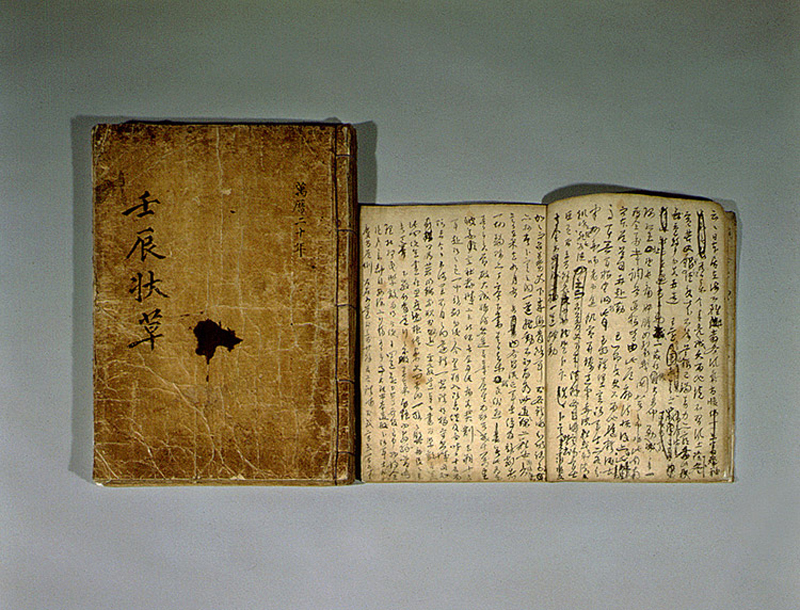
Yi kept a war diary, the Nanjung Ilgi, from the first month of 1592 almost to the day he died. It is the most human document of the whole conflict: headaches, sleepless nights, worry about his mother, fury at colleagues, the weather. It is also unsparing about his own court, which arrested him in 1597 and very nearly had him executed.
Righteous armies, monks and the walls of Jinju
On land the Korean regular army had collapsed, and what replaced it came from below. Within weeks of the landing, local gentry were raising uibyeong, righteous armies, from their own households and tenants. The first was Gwak Jae-u, a landowner at Uiryeong on the Nam River who spent his family’s wealth arming a few dozen men and fought in a red robe, so that he became the Red-Robed General; his ambushes along the Nakdong kept the Japanese from moving freely into Jeolla.
In Jeolla the retired official Go Gyeong-myeong raised six thousand and died fighting at Geumsan with one of his sons. The scholar Jo Heon and the monk Yeonggyu attacked the same Japanese division there weeks later with about seven hundred men, and all of them were killed; their shared grave, the Chilbaek Uichong, the Tomb of the Seven Hundred, is still there. At the king’s request the Zen master Hyujeong, then past seventy, called the monasteries to arms, and his disciple Yujeong, known as Samyeong, led the monk soldiers in the field.
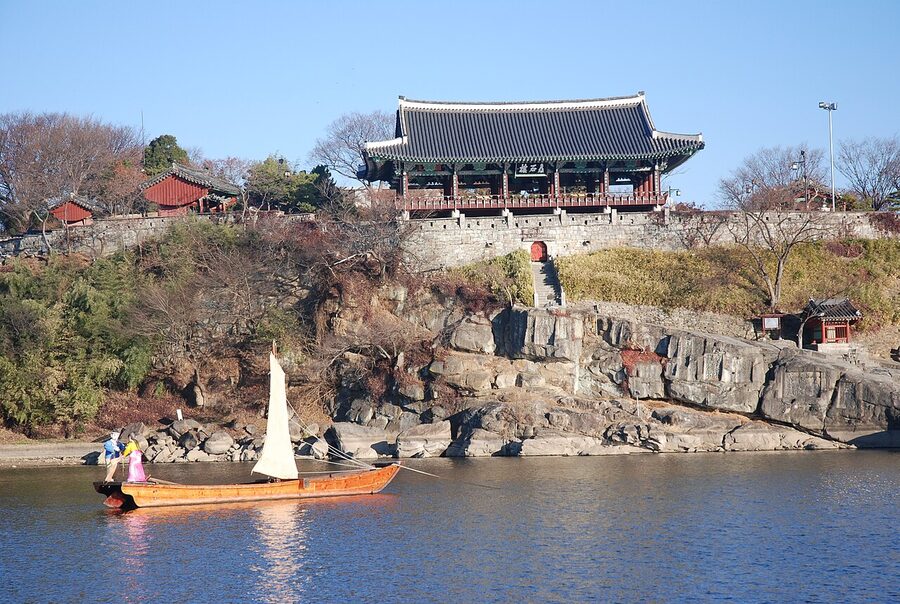
The Japanese were first stopped at a fortress at Jinju, the walled city above the Nam River that guarded the road into Jeolla. In the tenth month of 1592 an army under Hosokawa Tadaoki and other commanders besieged it for six days. The governor, Kim Si-min, had between three and four thousand men, about 170 newly made arquebuses and a population that dropped stones and fire on the ladders, while Gwak Jae-u’s men lit fires on the hills around to suggest a larger relief force. Kim was killed by a bullet on the last day, and the Japanese withdrew.
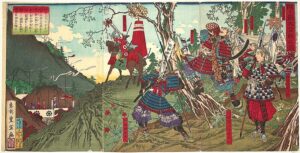
The following spring Kwon Yul held the hill fort of Haengju above the Han River with about 2,300 regulars, monks and volunteers against some thirty thousand attackers. English accounts sometimes put Katō Kiyomasa at their head; the Japanese records name Ukita Hideie, Ishida Mitsunari, Kobayakawa Takakage, Kuroda Nagamasa and others, attacking the stockade in relays from dawn to late afternoon. The defenders used hwacha, carts that fired a hundred rocket-arrows at once, and women carried stones up to the walls in their skirts. Koreans will tell you that is why an apron is called a haengjuchima, a folk etymology linguists reject, which has not slowed it down at all.
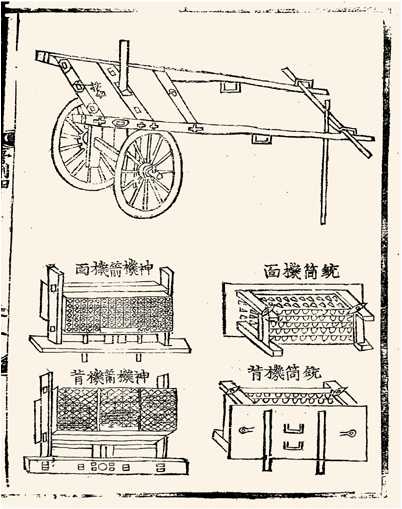
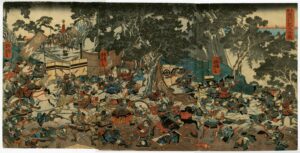
In the sixth month of 1593 Hideyoshi had his revenge on Jinju. The largest Japanese force assembled for any single operation in the war, perhaps ninety thousand men, surrounded the city, which had filled with soldiers, volunteers and refugees from the countryside. It fell after about eight days, and the killing that followed was the worst single massacre of the war. Korean records put the dead at about sixty thousand, and the Nam River was choked with bodies.
Korean memory keeps one more name from that day. Nongae, a gisaeng (a woman of the official entertainers), is said to have led a Japanese officer out onto a rock above the river during the victory celebrations, locked her arms around him and thrown herself into the water. The story was first written down about thirty years later and the officer’s identity is uncertain, but the rock, Uiam, the Righteous Rock, has been honoured since the 18th century and there is a shrine to her inside the walls.
The Ming arrive
Korea’s appeals to Beijing produced, in the seventh month of 1592, a cavalry force of five thousand under Zu Chengxun, who had beaten Mongols and expected little of the Japanese. He rode into Pyongyang in a rainstorm, his men were shot down in the narrow streets and he barely got out. The Ming court, still finishing a rebellion in Ningxia, sent a talker, Shen Weijing, to buy time while it assembled something bigger.
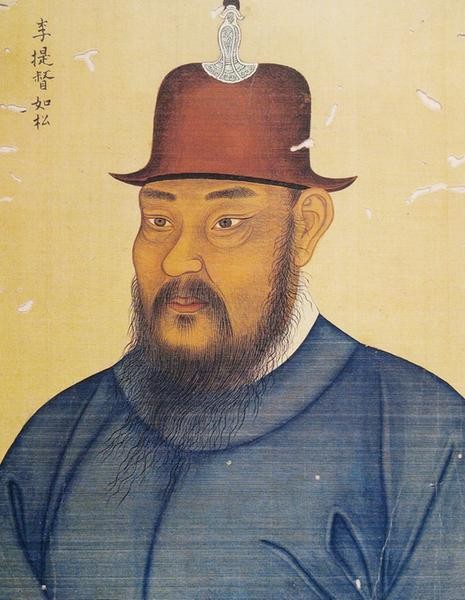
The bigger thing was Li Rusong, the general who had just crushed Ningxia, with about 43,000 men and a heavy artillery train. On the 8th day of the first month of 1593 his army, with Korean troops and Hyujeong’s monks, stormed Pyongyang. Konishi’s garrison broke out at night across the frozen Taedong River and fell back down the peninsula, losing men all the way. It was the first time the Japanese army in Korea had been beaten in a set battle, and it was beaten by guns.
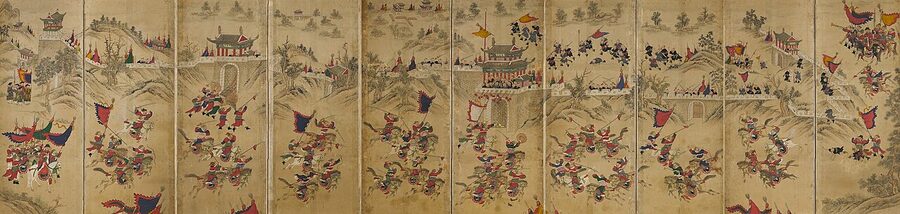
Li pushed south too fast. At Byeokjegwan, north of Hanseong, late in the first month, his advance guard ran into the main Japanese army under Kobayakawa Takakage and Tachibana Muneshige and was mauled. He lost many of his own household cavalry and, by most accounts, his appetite for battle; after Haengju a month later, neither side had the strength to finish the other.
By spring the Japanese were starving. A Ming raiding party burned the great grain stores at Yongsan outside the capital, and in the fourth month the army abandoned Hanseong and fell back to the south coast. Luis Frois reckoned that of roughly 150,000 men who had crossed, a third were dead, and few of them had been killed by the enemy. Hunger, cold and disease had done most of it.
Four years of forged letters
Peace was negotiated by men who had every reason to lie to their masters, and they did. Konishi Yukinaga and Shen Weijing between them invented a settlement neither government had agreed to. In the sixth month of 1593 Hideyoshi presented Ming envoys at Nagoya with seven conditions, among them a Ming princess as consort for the Japanese emperor, the cession of four southern Korean provinces, a Korean prince as hostage and the revival of the official trade. The Ming had been told he wanted to submit.
Konishi’s retainer Naitō Joan, another Christian, spent more than a year travelling to Beijing with a letter of submission in Hideyoshi’s name that Hideyoshi had never seen. The Wanli Emperor, satisfied, issued a patent investing Hideyoshi as King of Japan, and in the ninth month of 1596 a Ming embassy presented it to him at Osaka Castle.
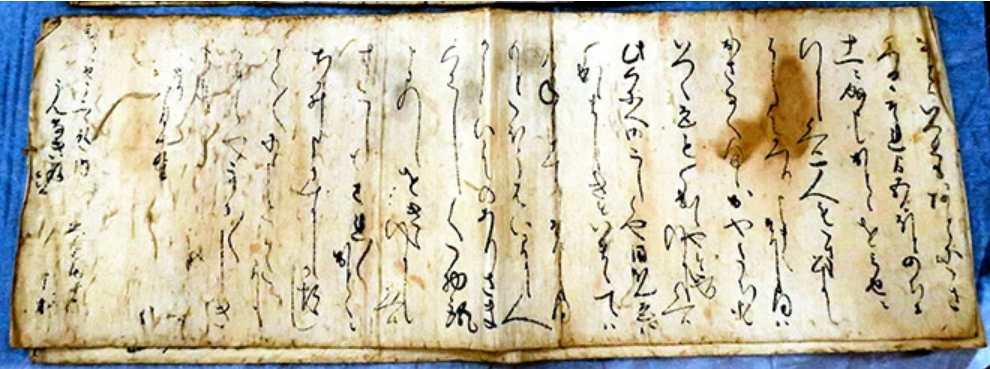
The famous story has Hideyoshi reading the words “we hereby make you King of Japan”, tearing the patent to pieces and ordering a second invasion. The patent is not torn. He handed it to the lord Horio Yoshiharu, it passed down through Horio’s descendants, and it is now an Important Cultural Property in the Osaka Museum of History. What enraged Hideyoshi was what the envoys had not brought: no princess, no provinces, and a request that he pull his garrisons out of Korea.
The same summer an earthquake had brought down his new castle at Fushimi and the Great Buddha at Hōkō-ji, and the era name was changed to Keichō to shake off the bad luck. It did not work. Shen Weijing was later executed by the Ming for his part in the fraud. Konishi, who had done exactly the same thing in Japanese, was sent back to Korea with the first wave of the second invasion.
The second invasion, 1597
The second invasion had smaller aims and crueller methods. China was no longer the target: the orders of the second month of 1597 aimed to take the southern provinces by force, and an army of about 141,000 was sent to clear the countryside. This is the campaign of the order to cut down everyone, of the nose receipts and the Mimizuka, and of the burning of Jeolla, the province that had largely escaped in 1592.
It began with a Korean disaster of the court’s own making. Yi Sun-sin, caught between court factions and a Japanese double agent’s bait, refused an order to attack on false intelligence, was arrested, nearly executed and sent to serve as a common soldier. His rival Won Gyun took the fleet out and lost almost all of it at Chilcheollyang in the seventh month, the only decisive Japanese naval victory of the war. A junior officer, Bae Seol, slipped away before the end with a handful of ships.
The Japanese poured into Jeolla. Namwon fell in the eighth month after a four-day siege, and Ōkōchi Hidemoto, whose memoir is one of the main Japanese accounts of the campaign, recorded 3,726 heads taken there and the noses cut off and sent to Japan. Traders followed the army. Keinen, a Jōdo Shinshū priest serving as a doctor to the lord of Usuki, kept a diary in which he wrote of people bought and led away roped together, and of scenes he said he could not bear to keep his eyes open for.
Recalled in a hurry, Yi Sun-sin found twelve ships. He wrote to the king that while he still had twelve the enemy would not have the sea, and on the 16th day of the ninth month he took them, with one more that joined him, into the Myeongnyang strait between Jindo island and the mainland, where the tide runs like a river. Against a Japanese fleet of more than a hundred and thirty warships he held the narrows until the current turned, and sank or wrecked about thirty without losing a ship. Myeongnyang did not end the war, but it ended the idea that the Japanese navy could carry the army up the west coast.
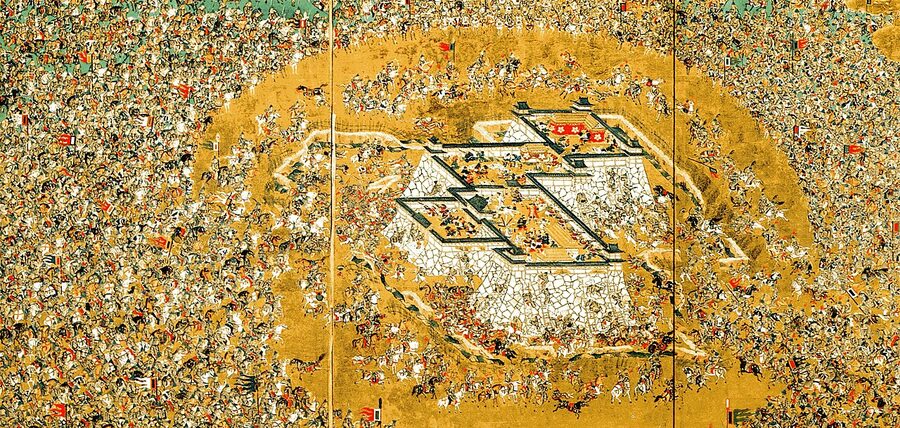
On land the advance stalled at Jiksan, south of the capital, against Ming cavalry, and the Japanese fell back to a chain of castles along the south coast: the wajō (倭城, waeseong to Koreans), Japanese-style stone fortresses built in large part by Korean labour. At Ulsan, still unfinished in the twelfth month of 1597, a Ming and Korean army caught Kiyomasa’s garrison and besieged it through the coldest weeks of the winter. The defenders had no wells; they ate their horses and drank melted snow until a relief army arrived in the first month of 1598.
Sacheon, Noryang and a death kept secret
Hideyoshi died at Fushimi on the 18th day of the eighth month of 1598, having begged his regents to look after his five-year-old son, Hideyori. The Council of Five Elders kept the death secret, even from the armies, and quietly ordered a withdrawal. The last Japanese positions in Korea were not abandoned for another three months.
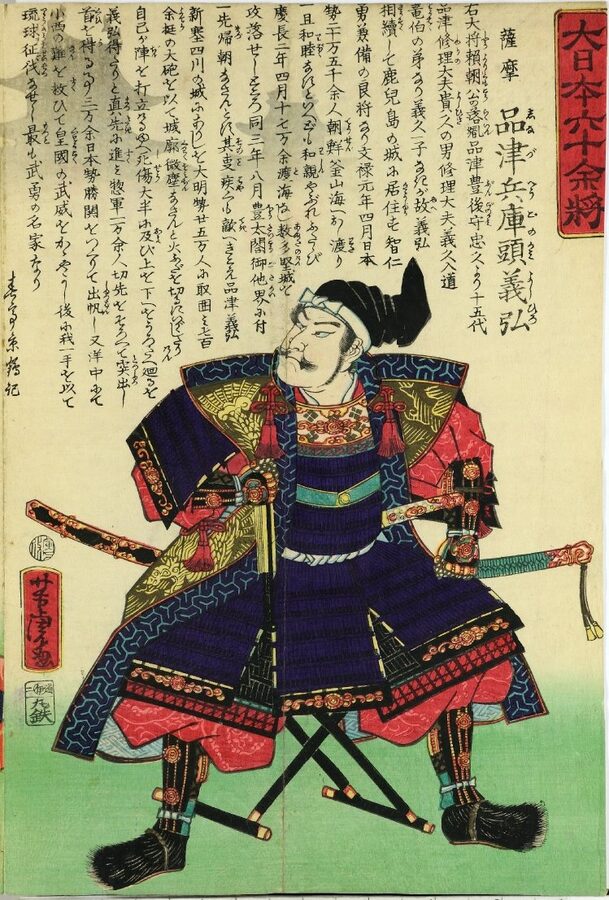
The allies, now more than a hundred thousand strong, attacked the coastal castles that autumn. At Ulsan Kiyomasa held again, and at Suncheon Konishi held. At Sacheon, on the 1st day of the tenth month, a Ming army under Dong Yiyuan broke into the outer works before an explosion in its own lines threw it into confusion, and Shimazu Yoshihiro‘s men came out and cut it down as it fled.
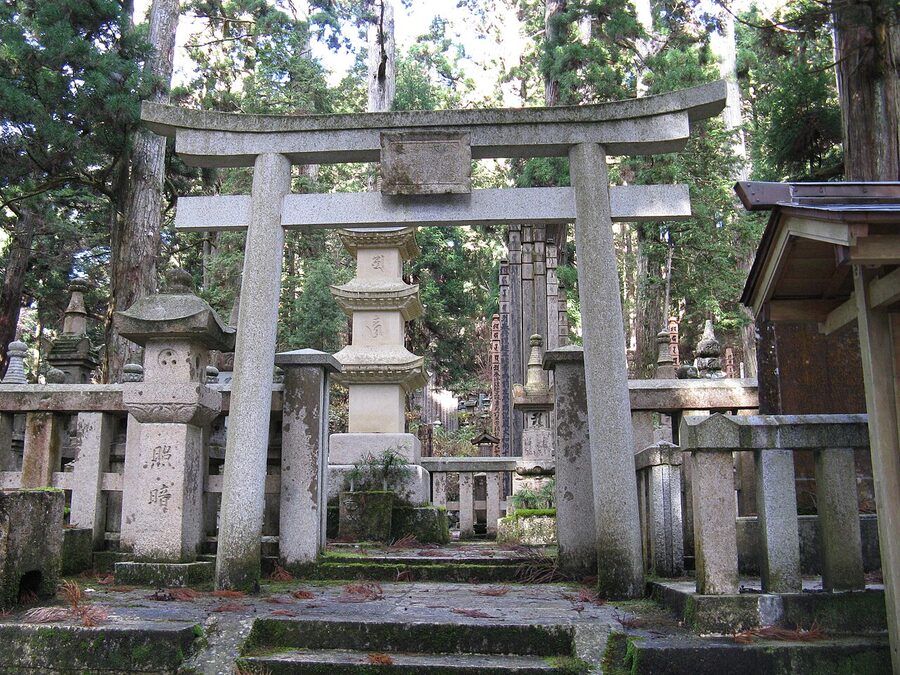
The Shimazu records claim more than 38,000 enemy dead at Sacheon. Korean and Chinese accounts give lower figures, and the gap has never been closed. A year later he and his son put up a stone on Kōyasan for the dead of both sides.
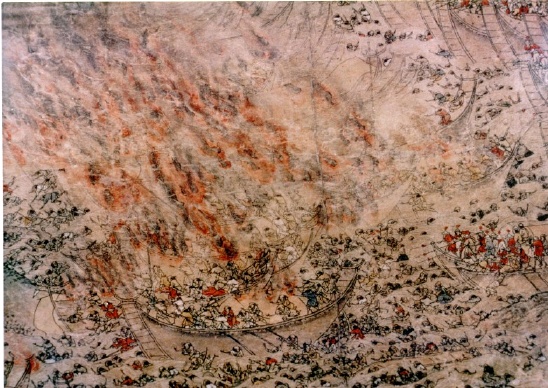
Konishi, blockaded at Suncheon by Chen Lin’s Ming fleet and Yi Sun-sin, tried to bribe his way out and nearly managed it. Shimazu and Tachibana Muneshige gathered a relief fleet of some five hundred ships and sailed for him, and on the night of the 18th day of the eleventh month (16 December 1598) the allied fleets met them in the Noryang strait off Namhae island. The fighting ran until morning. By Japanese reckoning about two hundred of Shimazu’s ships got back to Busan; Korean sources say fifty.
Near dawn, pursuing the retreating Japanese, Yi Sun-sin was hit by a bullet. Korean tradition gives his last words as “the battle is at its height; do not announce my death”, and his nephew Yi Wan kept the drums going on the flagship until it was over. Chen Lin, told only afterwards, is said to have thrown himself to the deck three times in grief. Konishi, meanwhile, slipped out of Suncheon by another channel while his rescuers were fighting for him, and was in Busan in time to sail home.
Kiyomasa sailed from Busan on the 23rd day of the eleventh month, Konishi and Shimazu two days later. Six and a half years after the first landing, the conquest of China was over. It had never got there.
What the war carried home
The armies came home with plunder that is still in Japanese collections: books by the thousand, including Korean editions of Confucian and medical texts, Buddhist sutras, bells and paintings. They brought Korean bronze movable type too, and within a few years the imperial court was using the technique to print the first Japanese movable-type editions. They also came home with people.
How many is one of the war’s sharpest disagreements. Japanese researchers have estimated twenty to thirty thousand Korean captives; Korean researchers put it between a hundred thousand and four hundred thousand. Repatriation brought home somewhere between six and seven and a half thousand, depending on whose count you use. Some of the rest were sold to Portuguese traders at Nagasaki and ended as slaves in Macau and beyond, to the loud and ineffective distress of the Jesuit bishop.
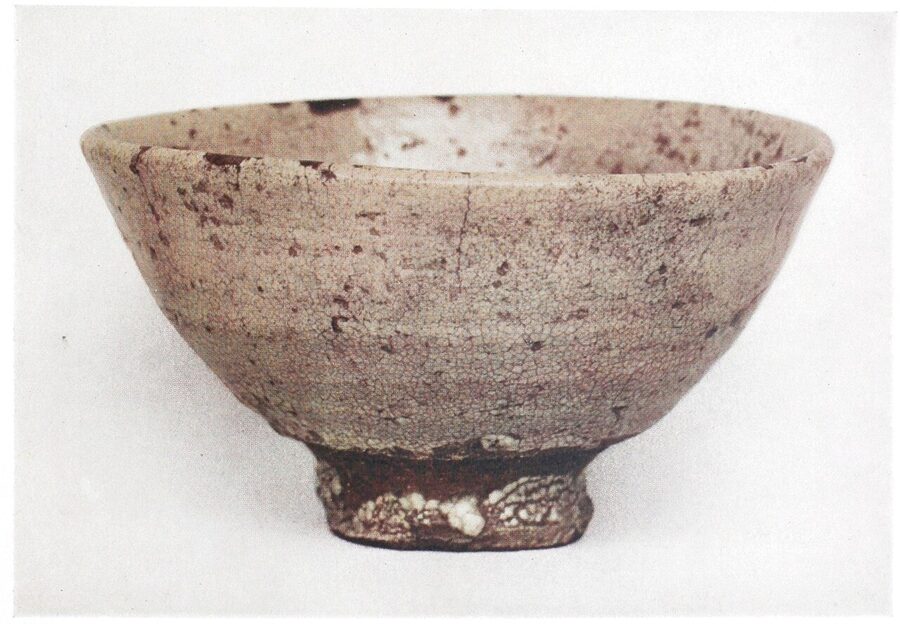
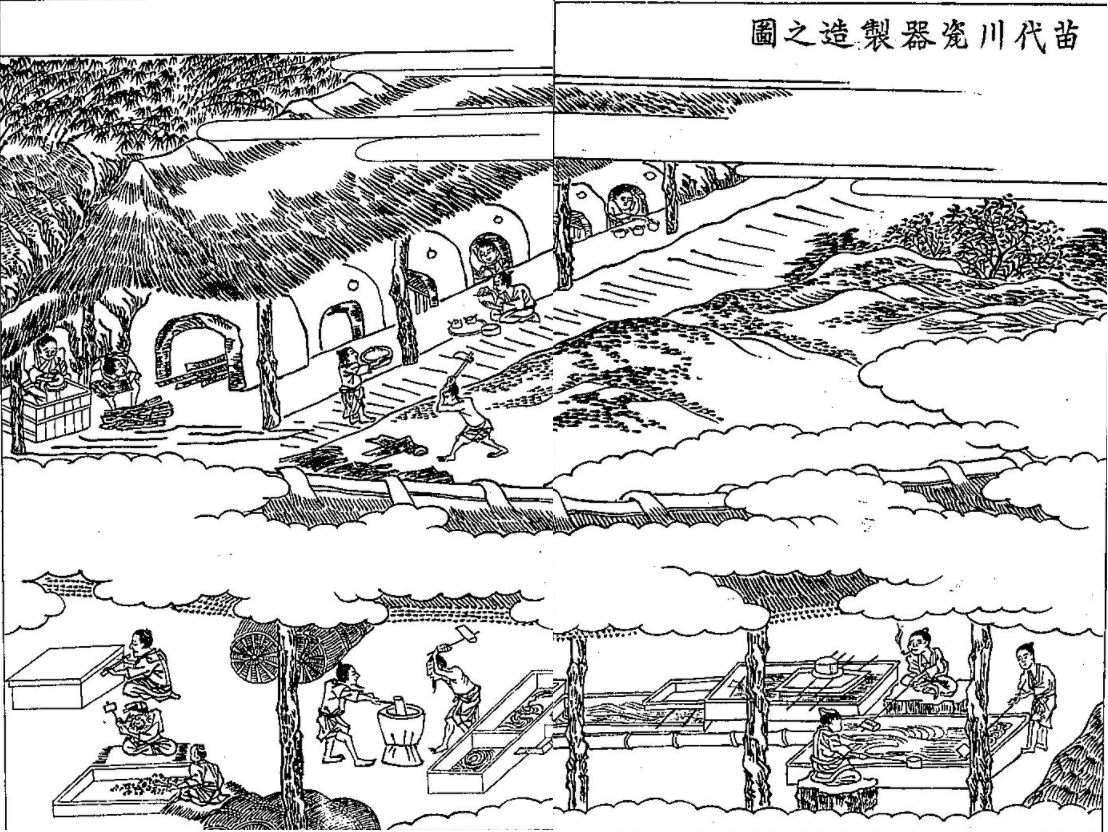
The captives the lords wanted most were potters. Tea had made Korean bowls worth more than land in some circles, the rough Ido bowls above all, and every lord with a stake in tea saw a chance to make his own. Kyushu and western Honshu are still dotted with kilns founded by Korean craftsmen taken in these years: Satsuma ware under the Shimazu, Hagi under the Mōri, Takatori under the Kuroda, Agano under Hosokawa Tadaoki, a transformed Karatsu, and the porcelain of Arita under the Nabeshima. Japanese writers have a name for it, the yakimono sensō, the pottery war.
When you read about Japanese ceramics in my round-up of Japan’s greatest crafts, remember how many of those kilns began. Arita’s story is the best documented and the most contested. Its founder in local tradition is Yi Sam-pyeong, a potter from Chungcheong brought back by a retainer of Nabeshima Naoshige, who took the Japanese name Kanegae Sanbei, found the white porcelain stone at Izumiyama in 1616 and fired Japan’s first porcelain.
A temple death register of 1655 and a stone found near the old kilns in 1966 prove that a Kanegae Sanbei lived and died in Arita. Excavations at the Tengudani kilns, though, suggest porcelain was being fired in the area some years before 1616, so the tidy story has been simplified. Whether its hero did everything credited to him is an open question; that a Korean captive stands at the root of it is not.
In Satsuma, Korean families landed in 1598 and were settled at Naeshirogawa, now Miyama, where the domain required them to keep their Korean names, dress and language for two and a half centuries, partly as a showpiece. The village’s best-known son, Tōgō Shigenori, was born there in 1882 into a family of Korean descent and became Japan’s foreign minister both at Pearl Harbor and at the surrender. The family kiln of Chin Jukan is now in its fifteenth generation.
Ideas crossed too. Kang Hang, a Korean official captured by Tōdō Takatora’s ships in 1597, spent nearly three years at Fushimi, where he befriended the Zen monk Fujiwara Seika and taught him the Neo-Confucian scholarship of Korea’s great teachers. Seika left the monastery to become the founder of Japanese Neo-Confucianism, his pupil Hayashi Razan became the Tokugawa house philosopher, and the official thought of the Edo era owes a share to a prisoner of war. Kang went home in 1600 and wrote a report on Japan for his king, the Kanyangnok, named after a Han envoy who spent nineteen years herding sheep as a captive.
Not every captive’s story is about craft. Konishi’s household took in a Korean girl, probably from the Pyongyang campaign, who was baptised Julia and later served in the women’s quarters of Ieyasu’s court at Sunpu. When the shogunate banned Christianity in 1612 she refused to recant and was exiled to the Izu islands, finally to Kōzushima, which still holds a festival in her name. Her faith belongs to the longer story I tell in Christianity in Japan, and the timing is no accident: the twenty-six martyrs were crucified at Nagasaki in the same winter that Hideyoshi’s second army began crossing to Korea.
At home, the war did the Toyotomi more harm than good. The western lords who had borne the costs came back exhausted and divided, and the men who had fought in Korea, Kiyomasa, Fukushima Masanori, Kuroda Nagamasa and Hosokawa Tadaoki among them, came back hating the administrators who had judged their conduct, above all Ishida Mitsunari. Ieyasu, who had sat out the war at Nagoya with his army whole, was the obvious beneficiary. Within two years the factions met at Sekigahara, the Korea veterans fought for Ieyasu, and the Tokugawa shogunate followed.
The fighting also moved military technology. Korean armies adopted the arquebus they had once dismissed, and Korean smiths studied the curved, single-edged blades taken from Japanese dead, the swords described in my piece on Japanese swords. The chili pepper, by most accounts, reached Korea in the same years, which is the one import from this war that nobody regrets.
Embassies and the long memory
Peace with Korea was made by Tsushima, which could not live without it, and by Ieyasu, who had not fought. The Sō family sent envoy after envoy from 1599, and Samyeong, the monk general, came to Fushimi in 1605 and took home more than a thousand captives. When Seoul demanded a letter from the shogun and the men who had desecrated the royal tombs near Hanseong, the Sō supplied a forged letter and a pair of convicts from Tsushima’s own jail. The first Korean embassy reached Edo in 1607.
There were twelve embassies between 1607 and 1811, the first three formally titled embassies “of reply and repatriation”. Their processions of three to five hundred people, with musicians and pages, drew crowds all the way from Tsushima to Edo, and they continued through the age of sakoku, when Korea was one of very few countries Japan dealt with at all. The shogunate presented them to its own people as tribute missions, which they were not.
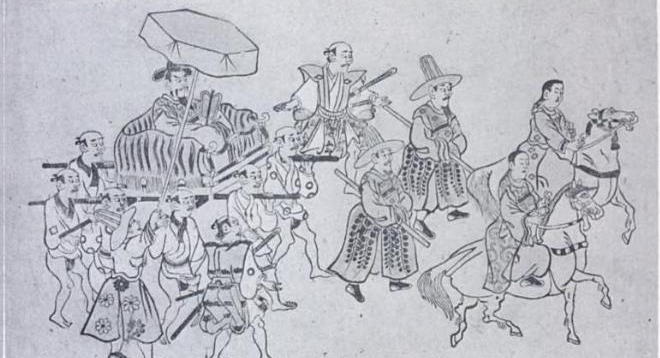
The war never left the embassies alone. In 1719 the shogunate’s itinerary for the ninth mission included a banquet at Hōkō-ji, Hideyoshi’s temple, in sight of the Mimizuka, and the Korean envoys refused to go. Amenomori Hōshū, the Tsushima scholar-diplomat who spoke Korean and travelled with them, argued that the temple had been rebuilt under the Tokugawa and had nothing to do with Hideyoshi, and was dismissed as a sophist. In the end the senior envoys attended, the mound was screened off for the occasion, and Amenomori later wrote that the whole plan had been a mistake.
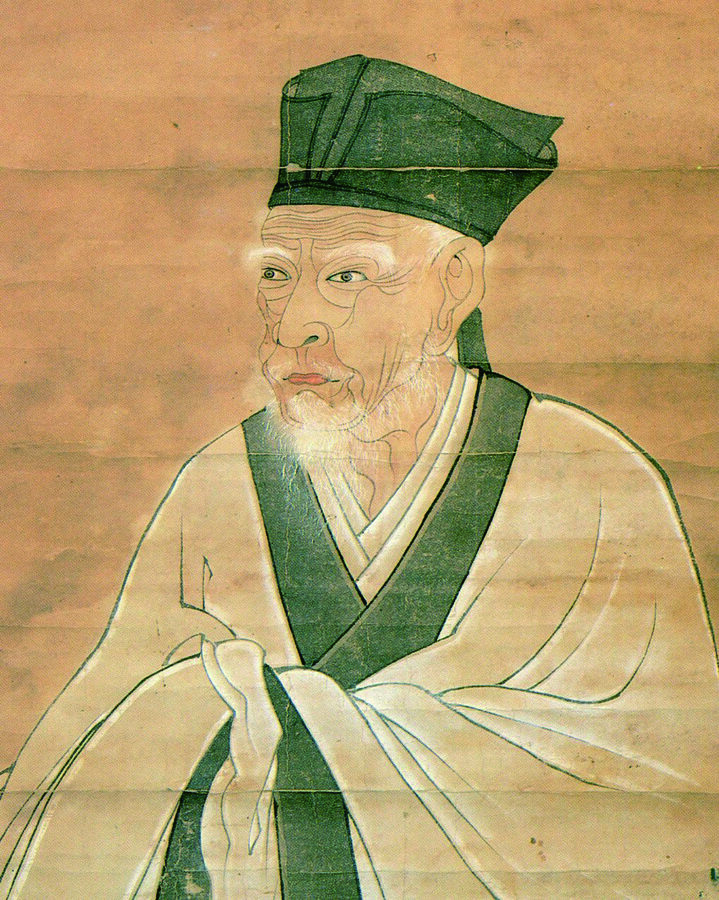
The longer memory was darker. Early Edo scholars condemned the war as vanity; by the late 18th century nativists such as Motoori Norinaga and the coastal-defence writer Hayashi Shihei were recasting it as a glorious feat of arms. In the early Meiji era the argument for “chastising Korea” split the new government, a quarrel the returning Iwakura Mission settled for the moment. When Japan annexed Korea in 1910, the first governor-general, Terauchi Masatake, wrote a poem wondering how Kobayakawa, Katō and Konishi would feel if they could see that night’s moon.
In Korea the war has shaped every view of Japan since, and its memory was folded into the resistance to Japanese rule in the 20th century. The First Sino-Japanese War was fought over the same peninsula and, at Pyongyang, over some of the same ground, and the Russo-Japanese War settled who would own it. In October 2025, at a peace event at Gasan Temple in Okcheon, descendants of one of the Japanese commanders met descendants of Yi Sun-sin and apologised for the invasion.
Where to see the Imjin War today
The Japanese sites cluster in two places, the north coast of Saga and Kyoto’s Higashiyama ward, with the kiln towns of Kyushu as the natural third leg. Nagoya and Arita make a comfortable two-day trip from Fukuoka. If you can add a day or two across the strait, do; the Korean sites are where the war actually happened.
Nagoya Castle ruins and the Nagoya Castle Museum, Karatsu
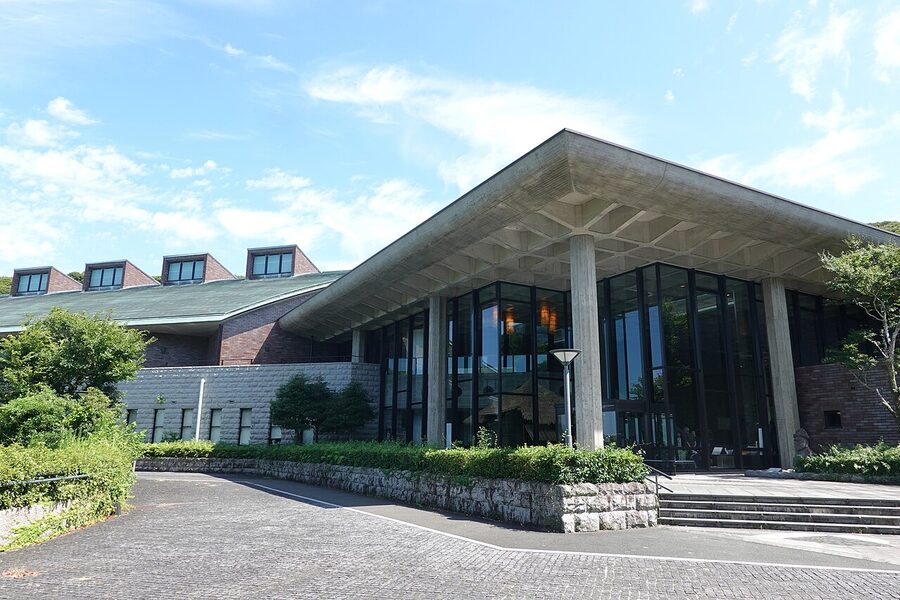
Start at the Saga Prefectural Nagoya Castle Museum, at the foot of the castle hill, which describes the war in its own displays as Hideyoshi’s invasion of Korea. The permanent gallery runs from prehistoric contacts across the strait to the Korean embassies and Amenomori Hōshū, with the war at its centre. Since 2022 it has also shown a full-size reconstruction of the golden tea room, built from Kamiya Sōtan’s description.
Admission is free (special exhibitions are charged), and the museum is open 9:00–17:00, closed on Mondays (the following weekday when Monday is a holiday) and over New Year. The basic loop of the ruins, museum to San-no-maru to Honmaru and back, takes thirty to forty minutes, longer if you add the Ni-no-maru and the camps. The site asks a cleaning contribution of ¥100 from adults of university age and over.
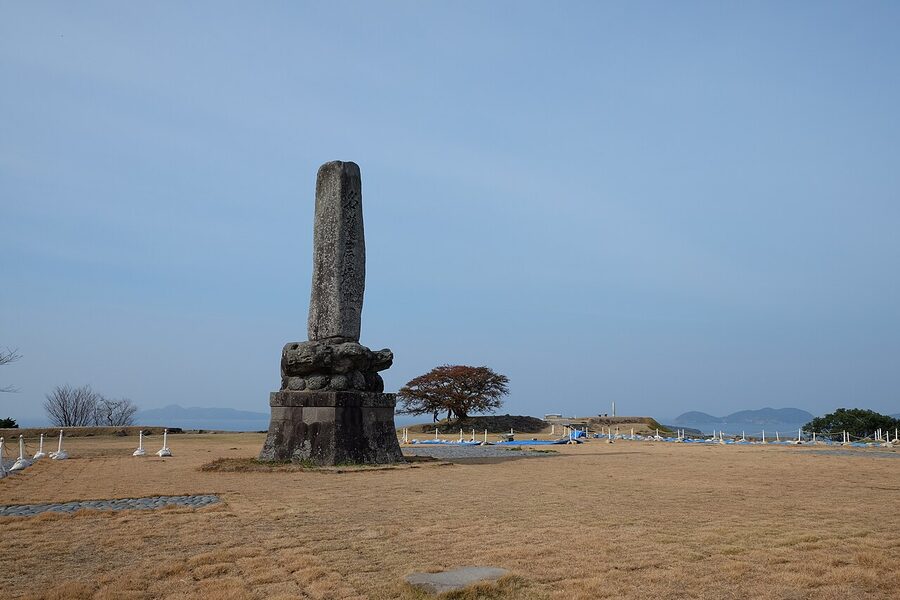
The stone walls were pulled down on purpose when the castle was decommissioned, early in the Edo period or after the Shimabara Rebellion of 1637–38, depending on the source, and the broken corners are part of the point: this is a castle that was deliberately killed. From the keep base you look north over the sea toward Iki and, in early winter, Tsushima. About 150 lords’ camp sites have been identified around it, and 23 are part of the Special Historic Site; Hori Hideharu’s is the best restored, with the outlines of its halls and a nō stage, and Ieyasu’s camp is marked too.
Getting there takes planning. Showa Bus runs from the Ōteguchi Bus Centre in central Karatsu, about eight minutes’ walk from JR Karatsu Station, to the Nagoya-jō Hakubutsukan Iriguchi stop, five minutes’ walk from the museum. Services are thin and some routes need a change at Yobuko, so check the timetable on the bus company’s site before you set out; by car it is about thirty minutes from Karatsu along the coast road.
The Mimizuka, Toyokuni Shrine and Hōkō-ji, Kyoto
The three sit within a few hundred metres of one another just north of Sanjūsangen-dō, about ten minutes’ walk east of Keihan Shichijō Station, or by city bus to Hakubutsukan Sanjūsangendō-mae. The Mimizuka is on Shōmen-dōri in front of Toyokuni Shrine, behind a stone fence. There is no charge, and most days you see it from the fence.
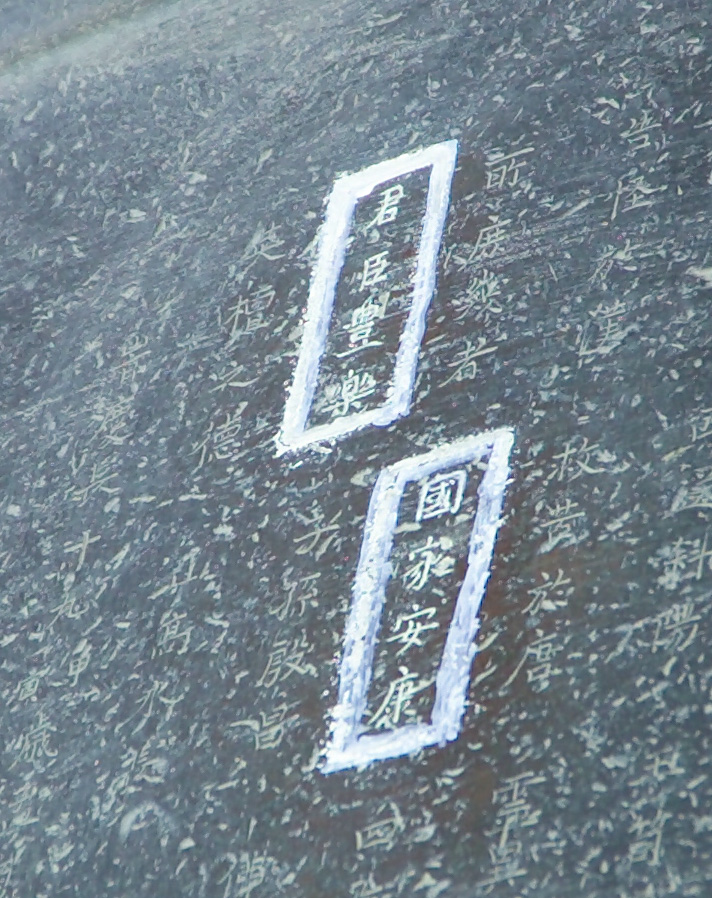
The name is a correction. It was first called the hanazuka, the nose mound; Hayashi Razan wrote “ear mound” instead, by tradition because noses sounded too barbaric, and the softer name stuck. The stone fence was paid for in the 1910s by Kabuki actors and storytellers, and in recent decades Korean and Japanese groups have held memorial rites here.
Toyokuni Shrine, across the road, enshrines Hideyoshi as a god. The Tokugawa suppressed his cult, and the shrine was revived on the Meiji emperor’s orders, with the present buildings completed in 1880, just as Hideyoshi was being refashioned as a national hero. Its great Chinese-style gate, a National Treasure, is said to have come from Fushimi Castle. The grounds are free, and the treasure house of Hideyoshi relics is open 9:00–17:00 (last entry 16:30) for ¥500.
Next door, Hōkō-ji is all that is left of Hideyoshi’s Great Buddha temple; the giant statue fell in the 1596 earthquake, was rebuilt and burned more than once, and its last successor was lost to fire in 1973. What remains is the great bell of 1614, whose inscription wishing peace on the state was read by Ieyasu’s advisers as a curse that split his name in two, giving him his pretext for the sieges of Osaka. The mound and the bell, a few steps apart, bracket the whole rise and fall of the Toyotomi house.
Arita: Tozan Shrine, the Yi Sam-pyeong monument and Izumiyama
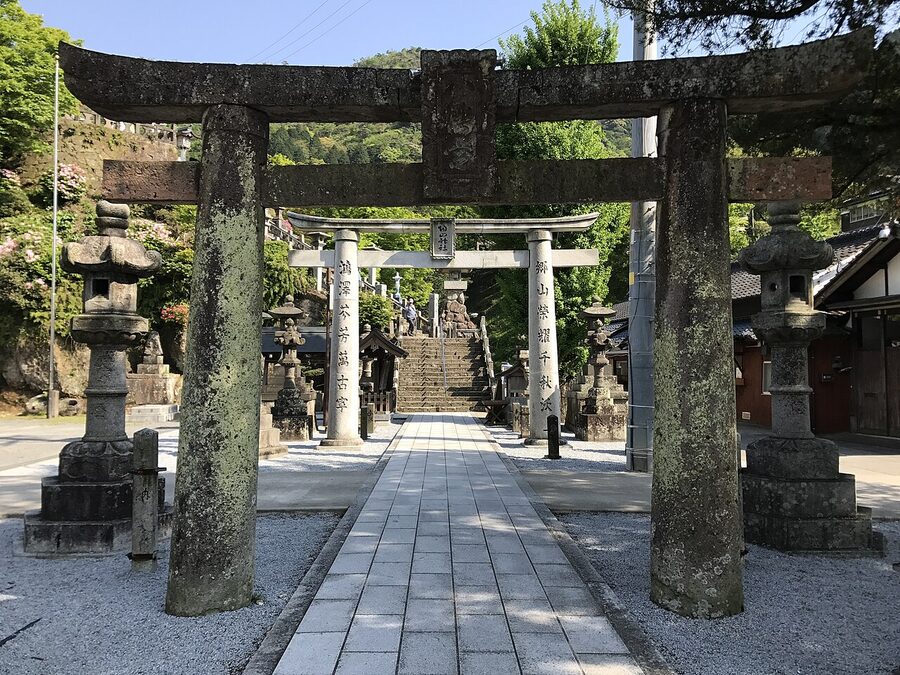
Arita is about an hour and twenty minutes from Hakata by limited express, a narrow valley town that still lives on porcelain. Tozan Shrine (陶山神社, also read Sueyama) enshrines Yi Sam-pyeong as the ancestor of the craft, alongside Nabeshima Naoshige. The torii, guardian lions and lanterns are porcelain, and the JR Sasebo Line runs straight across the approach, so look both ways on the steps.
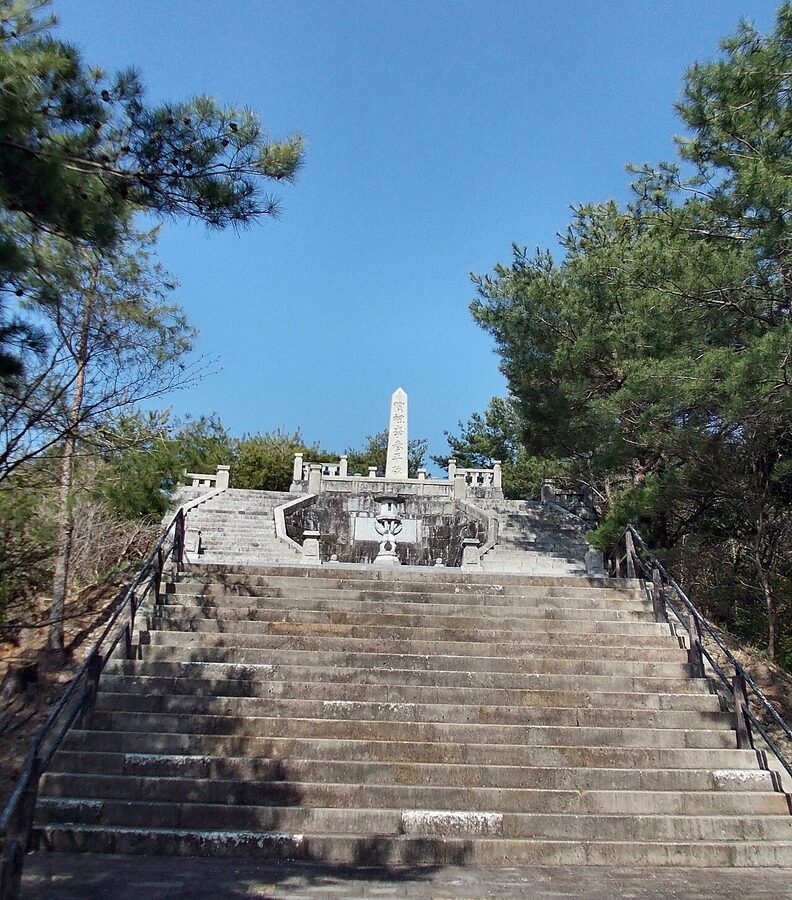
Climb the path behind the shrine to the monument to Yi Sam-pyeong, put up in 1917, three centuries after the traditional date of the first firing, on a hill that looks over the town. Izumiyama, the quarry where the porcelain stone was found, is a short walk from Kami-Arita Station: a hillside cut away over four centuries into a cliff of white rock. The Kyushu Ceramic Museum, twelve minutes’ walk from JR Arita Station, is free (special exhibitions are charged), open 9:00–17:00 with last entry at 16:30 and closed on Mondays, and it makes the Korean origins of the craft plain.
Miyama, Kagoshima
If you are going as far as Kagoshima, Miyama, the old Naeshirogawa, is a short taxi ride from JR Higashi-Ichiki Station and still a village of kilns. The Chin Jukan kiln has a shop and gallery; there is a small shrine, Tamayama, where the first settlers worshipped Korea’s legendary founder Dangun; and the restored domain kiln is a prefectural historic site. I would not cross the country for Miyama alone, but combined with Kagoshima it makes a quiet and affecting half-day.
Across the strait
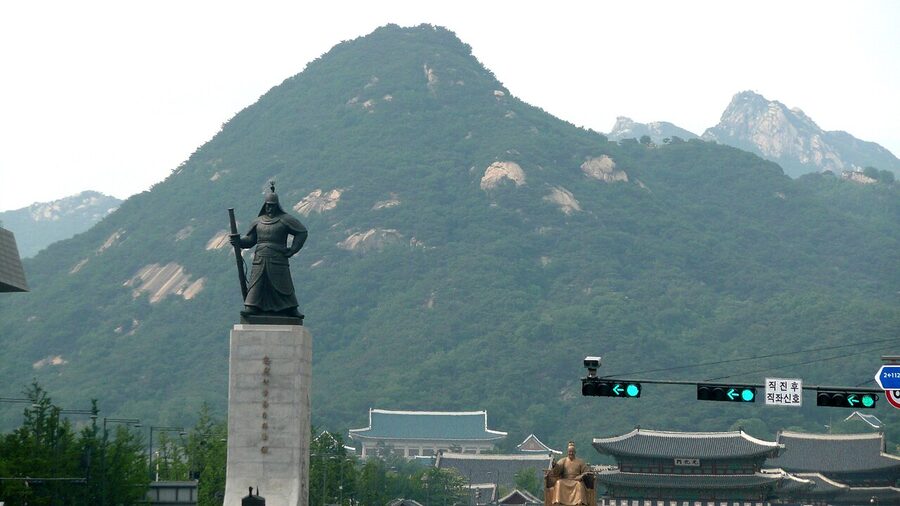
The war’s real battlefields are in Korea, and Busan is a short flight or a ferry ride from Fukuoka. In Busan, Chungnyeolsa shrine honours Song Sang-hyeon and the dead of Dongnae and Busanjin. Jinju’s walls, the Uiam rock and the Jinju National Museum are a couple of hours west; Tongyeong has a turtle-ship replica and the boat to Hansan Island, where Yi’s headquarters shrine, the Jeseungdang, looks over the water of the 1592 battle.
Asan, south of Seoul, has Hyeonchungsa, his shrine, and his grave nearby. Several of the Japanese wajō, Suncheon and Seosaengpo among them, survive as walls in the woods, and they are worth seeing for what they are: Japanese castles, built in Korea, by an army that should never have been there.
I said at the start that I cannot get past the receipts. What stays with me, standing at the Mimizuka, is how ordinary the machinery was: inspectors, tallies, barrels, a shipping schedule, a memorial service with the right wording. None of it needed monsters, only people doing the job in front of them, which is how a great many of history’s worst things get done.
So go to Nagoya and look at the scale of what Hideyoshi built to launch his war, and go to Arita and see what its captives made of their exile. Then go to Higashiyama, find the mound across the road from his shrine, and stand there long enough to read the sign. It is the least that is owed.