According to the most famous book in Japanese literature, the war that ended the Heian court began with a horse. It was a fine one called Konoshita, and it belonged to Minamoto no Nakatsuna, son of an elderly court poet and soldier named Yorimasa. Taira no Munemori, the son of the most powerful man in Japan, wanted it, pestered until he got it, and then renamed it Nakatsuna, had the name branded on its flank and walked it about in front of guests, shouting “Nakatsuna! Whip Nakatsuna!”
That, says The Tale of the Heike, is why a 77-year-old poet who had spent his career keeping his head down joined a prince in rebellion in the spring of 1180, and why within six years the house of Taira had gone into the sea off Shimonoseki with a child emperor and one of the three sacred treasures of the throne. It is a perfect story. It is also very nearly the only reason the book gives, and no diary of the period mentions the horse at all.
I keep coming back to the Genpei War because it is the clearest case I know of a war won by one side and written by another. The fighting ran from Uji to the Kanmon Strait and put the first warrior government in Kamakura, but almost everything people think they know about it, the fire-oxen, the cliff charge, the fan on the pole, the drowning boy, comes from a book shaped by storytellers and blind lute players over the following two centuries. What follows is the war as the record has it, the war as the Heike tells it, and the places where you can stand on both today.
In This Article
- A coup, a prince and a branded horse
- Uji, the 26th day of the fifth month
- The east rises
- The waterfowl of the Fuji River
- Nara burns and Kiyomori dies
- Kiso’s two summers
- Yoshitsune’s year
- Ichi-no-tani, the seventh day of the second month of 1184
- The long middle
- Yashima, the 19th day of the second month of 1185
- Dan-no-ura, the 24th day of the third month of 1185
- The end of the Taira
- Not Genji against Heike
- How the Heike wrote the war
- Where to see the Genpei War today
- Uji: the Byōdō-in and the bridge
- Kurikara pass
- Suma and Ichi-no-tani, Kobe
- Yashima, Takamatsu
- Shimonoseki: Akama Shrine and Dan-no-ura
A coup, a prince and a branded horse
You need to start in the eleventh month of 1179, when Taira no Kiyomori marched his troops into Kyoto and took the government away from the retired emperor Go-Shirakawa. Kiyomori had been chancellor, the highest office a subject could hold, in 1167, and had married his daughter Tokuko to the reigning emperor, Takakura. Now he shut Go-Shirakawa up in the Toba palace, sacked and exiled the regent, and dismissed 39 courtiers in one stroke. The number of provinces under Taira control jumped from 17 to 32.
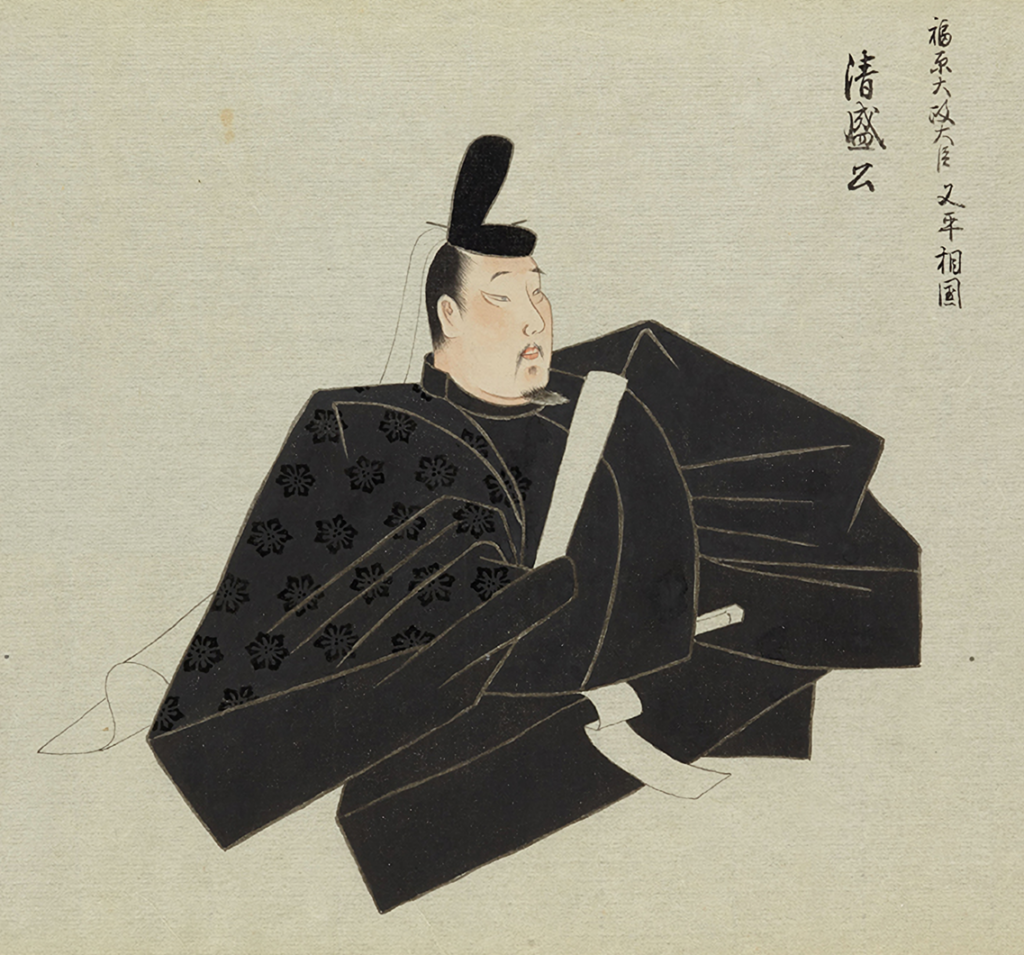
That last figure is the one that matters. A province under a new proprietor meant new deputies, new tax collectors and new favourites among the local warrior families, and in the east the families pushed aside in 1179 had long memories and plenty of horses. When people later called the war “Genji against Heike”, Minamoto against Taira, they were looking at the surface of a thousand local quarrels over rice fields.
In the second month of 1180 Kiyomori had Takakura abdicate in favour of Tokuko’s son, who became Emperor Antoku at a little over a year old, three by the Japanese count. That closed the throne for good to Prince Mochihito, a 30-year-old son of Go-Shirakawa who had never even been made an imperial prince and had just lost some of his estates in the coup.
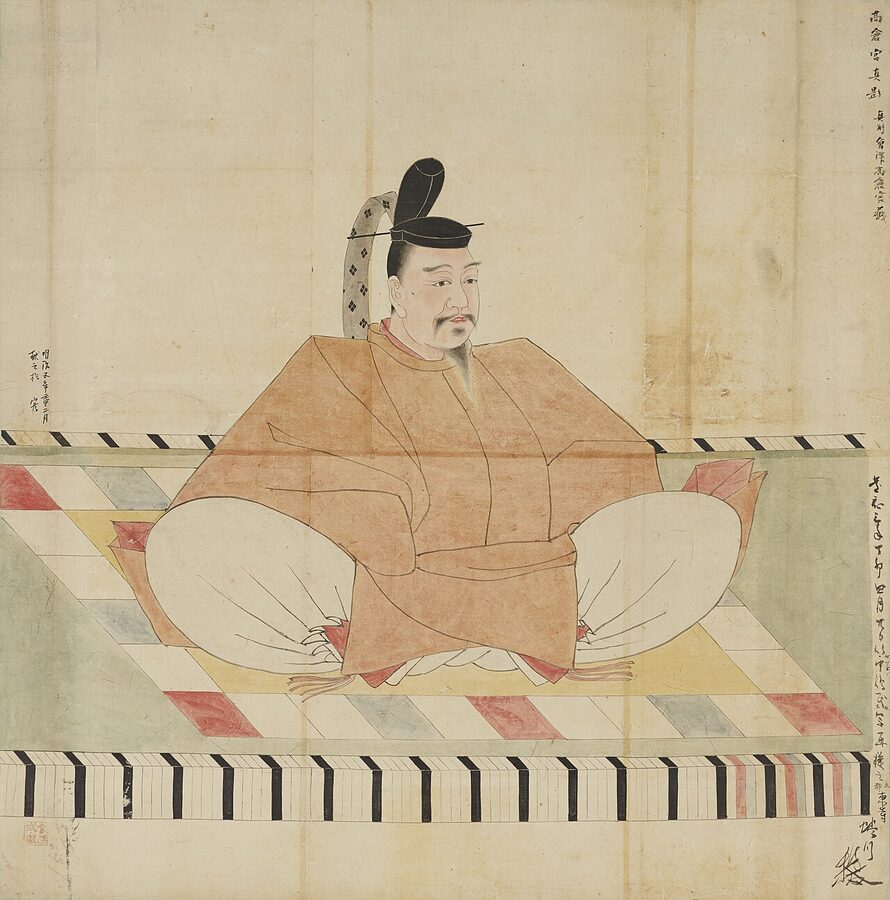
On the ninth day of the fourth month of 1180 Mochihito issued an order calling on the Minamoto of every province, and on the great temples, to destroy the Taira. He compared himself to Emperor Tenmu, who had won the throne in a civil war five centuries earlier. The text survives in the Azuma Kagami, the Kamakura shogunate’s own chronicle, and in the longer versions of the Heike, in wordings that do not quite match, and historians argue over whether it is genuine or a later tidying-up of a rougher document.
The messenger was Minamoto no Yukiie, an uncle of the exiled Yoritomo, who reached Yoritomo in Izu on the 27th dressed as a mountain ascetic. Word leaked almost at once. The Heike blames Tanzō, head of the Kumano shrines, whose people had split over the order.
Uji, the 26th day of the fifth month
On the 15th day of the fifth month the court turned Mochihito into a commoner and ordered him exiled to Tosa. He slipped out of his mansion (the Heike says dressed as a woman) and took refuge at Mii-dera above Lake Biwa. The detail I like best comes from the diary of the courtier Kujō Kanezane: when the Taira drew up the list of commanders to attack the temple on the 21st, Minamoto no Yorimasa was on it.
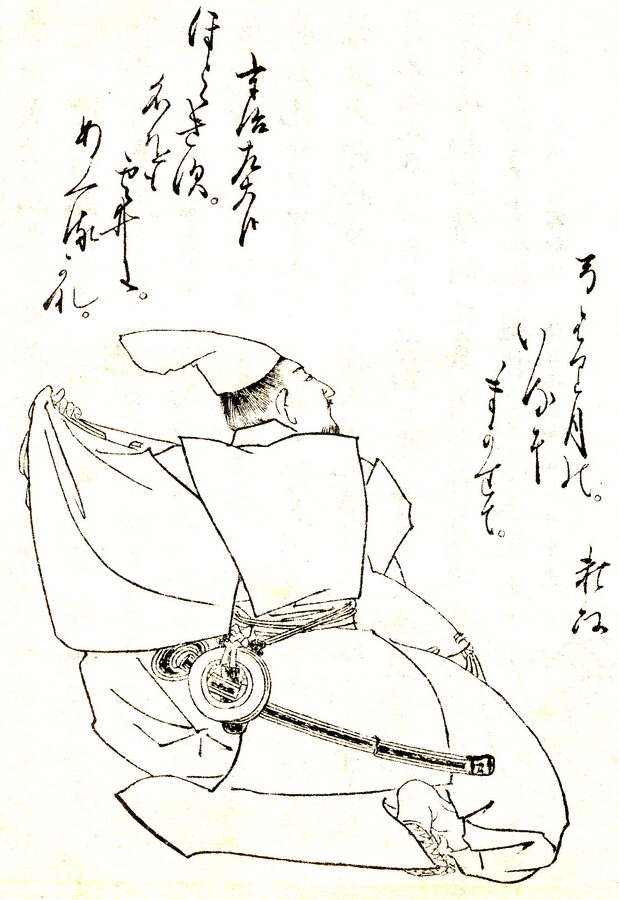
That night Yorimasa burned his own house and rode into Mii-dera with about fifty men. Why is the real puzzle of the war’s opening. The Heike has the horse; some Japanese historians think Mochihito recruited Yorimasa, while others note that no diary links them before the rising and suggest a devout old man, ordered to attack a temple, simply refused and found himself a rebel by default. I find the last version the most believable, and the least useful for storytellers.
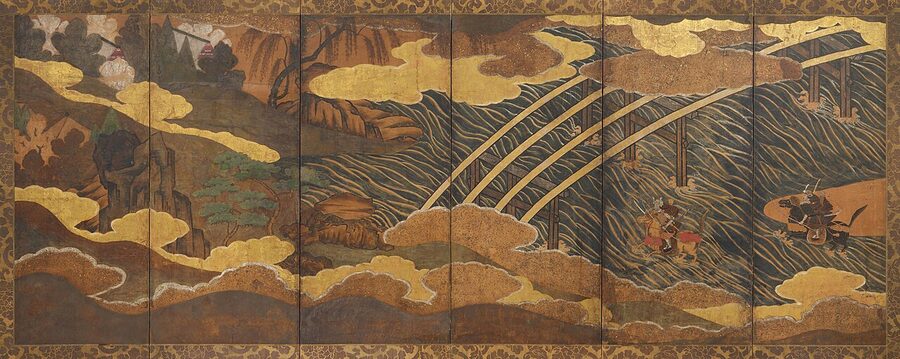
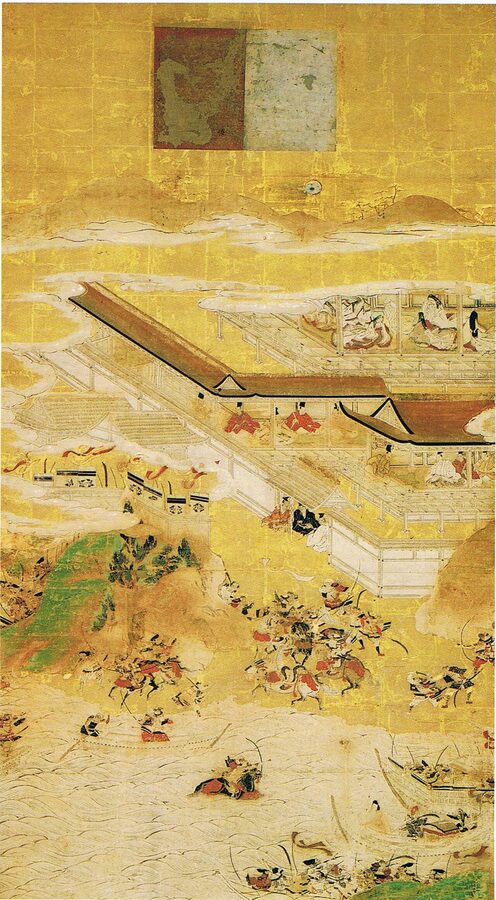
Mii-dera could not hold. On the night of the 25th the prince and Yorimasa set out for Nara, where the monks of Kōfuku-ji had promised support, but Mochihito kept falling off his horse, so they stopped at the Byōdō-in in Uji, pulled up the planks of the Uji Bridge, and waited.
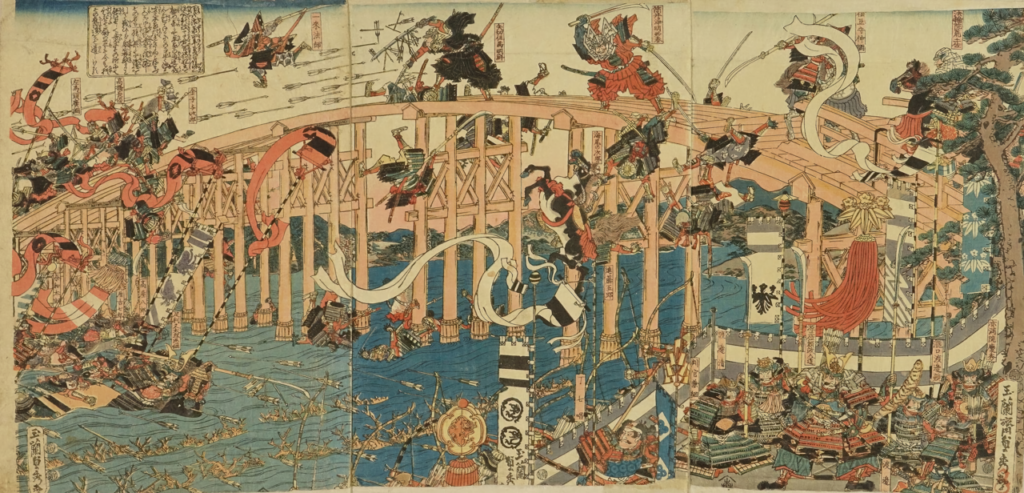
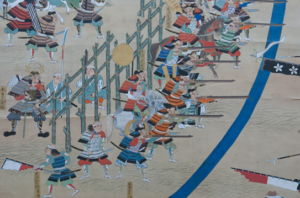
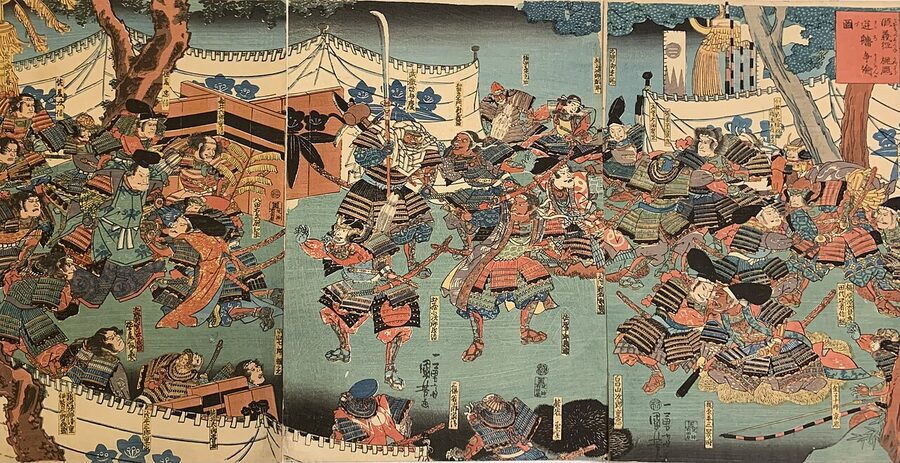
The Heike gives the Taira 28,000 riders; Kanezane says the first pursuers were an advance party of 300. In the Heike‘s telling, the battle across the broken bridge on the morning of the 26th stalled until Ashikaga Tadatsuna, a seventeen-year-old from Shimotsuke in the east, rode into the flood and some three hundred eastern riders followed him across. Remember that he was an easterner fighting for the Taira.
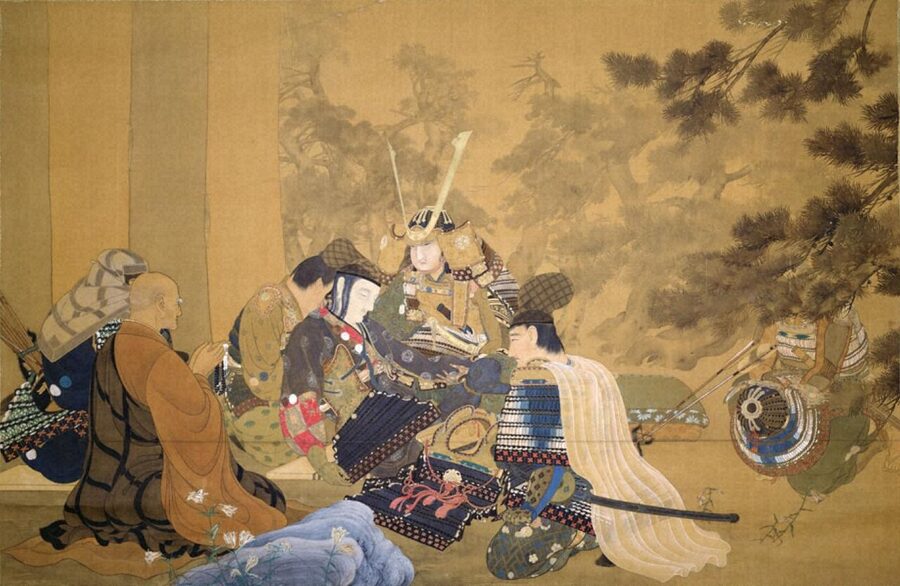
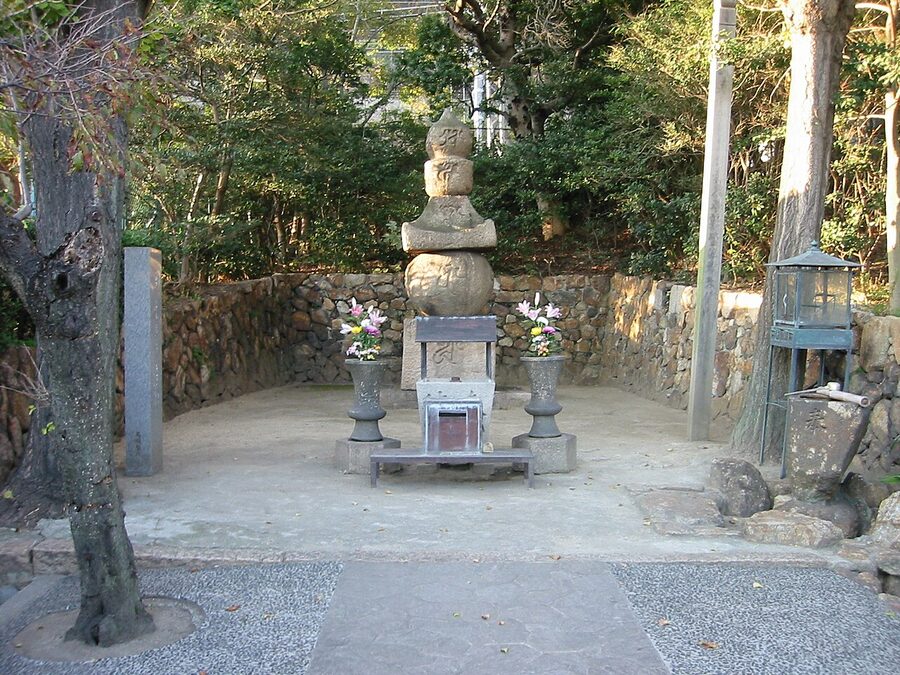
Yorimasa fell back into the Byōdō-in to cover the prince’s escape. His sons died; he recited the name of the Buddha, wrote a last poem about a buried log that had never flowered, and cut himself open on a patch of lawn. It is often said to be the first seppuku in the war tales with a death poem attached. Mochihito got as far as the torii of a shrine at Kōmyōzan, on the road to Nara, where an arrow knocked him from his saddle.
The rising had lasted eleven days. For months Kyoto was full of rumours that the prince was alive, and documents in his name kept circulating. That, more than anything the old poet did at Uji, turned a failed palace plot into a national war.
The east rises
Minamoto no Yoritomo had been an exile in Izu for twenty years. He was thirteen when his father Yoshitomo was killed after the Heiji disturbance of 1160, and Kiyomori spared him, on the urging of his own stepmother, the Heike says. He had married Masako of the local Hōjō family and spent a good deal of his time reciting sutras, which is not, on paper, anybody’s idea of a war leader.
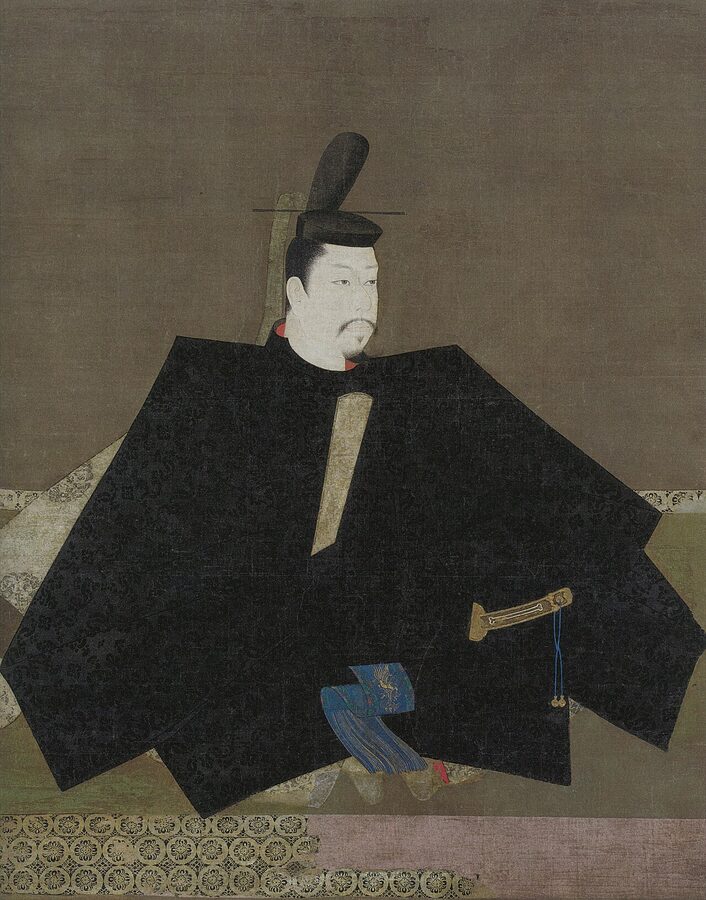
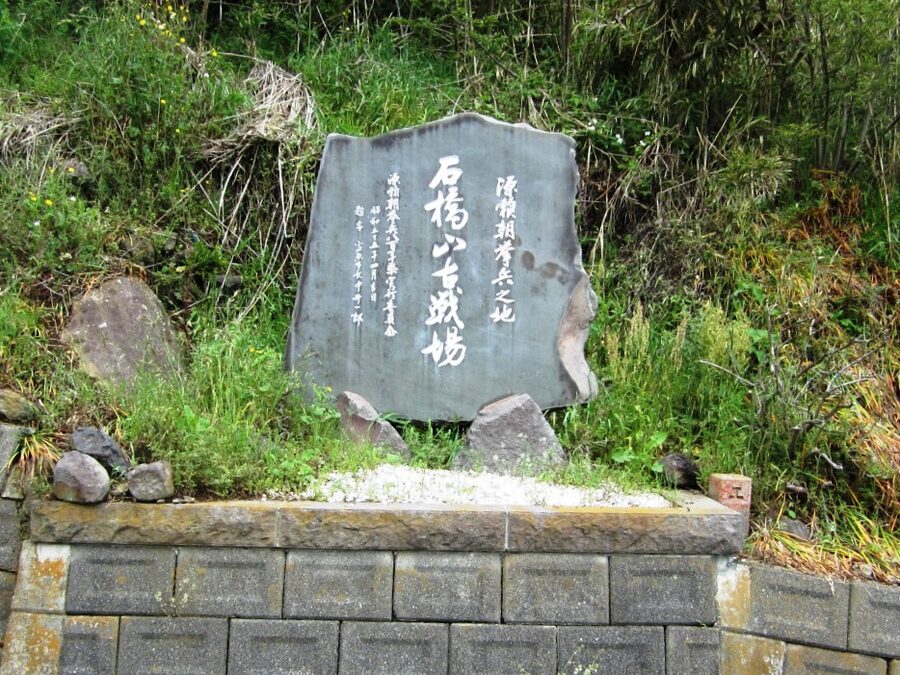
On the 17th day of the eighth month of 1180, the night of the Mishima shrine festival, his handful of followers raided the house of the Taira deputy governor of Izu and killed him. Six days later, at Ishibashiyama in the hills behind what is now Odawara, about 300 of them met some 3,000 men under Ōba Kagechika and were cut to pieces. Yoritomo hid in the Hakone hills, and later accounts say one of the searchers, Kajiwara Kagetoki, found him in a hollow and led the hunt elsewhere.
He got away by boat from Manazuru to the Bōsō peninsula, and what happened next is the real story of the war. Within a month the beaten exile had picked up the Chiba, the Kazusa and the Miura and was crossing into Musashi with, by the Azuma Kagami‘s count, tens of thousands of men. On the sixth day of the tenth month he rode into Kamakura, and he stayed there for the rest of his life.
Look at the names of the men who joined him: Chiba, Kazusa, Miura, Hatakeyama, Kajiwara, Hōjō. Almost all were Taira by descent, eastern branches of the line Kiyomori came from, squeezed by the new Taira governors and looking for a lord who, unlike the court, could confirm their lands on his own say-so. Ōba Kagechika, who beat Yoritomo at Ishibashiyama, was a Taira too. And the boy who swam the Uji for Kiyomori, Ashikaga Tadatsuna, came from an eastern family of Fujiwara descent that fought Yoritomo into 1183.
The waterfowl of the Fuji River
Kiyomori sent his grandson Koremori east with an army that took weeks to assemble and squabbled over lucky days on the road. By the time it reached the Fuji River the local Taira forces had already been destroyed by the Kai Genji, the Minamoto of Kai under Takeda Nobuyoshi, who had risen on Mochihito’s order quite independently of Yoritomo. On the night of the 20th day of the tenth month, as every Japanese schoolchild learns, a great flock of waterfowl rose off the marshes, the Taira took the roar of wings for a night attack, and the whole army fled without fighting.
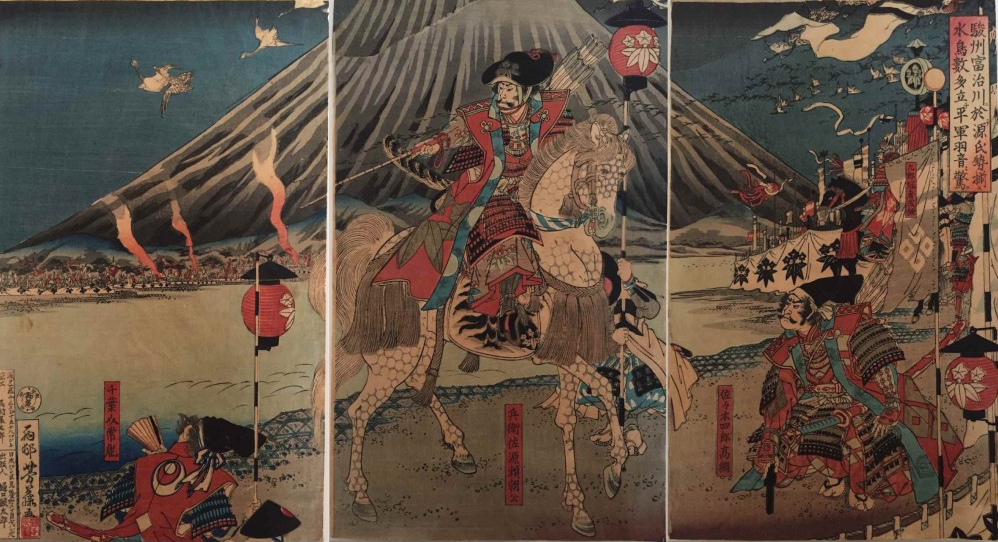
The Azuma Kagami writes the Kai Genji as though they were following Yoritomo’s orders, which Japanese historians generally treat as a later invention: the Takeda had their own copy of Mochihito’s order and their own reasons. Yoritomo wanted to march straight on Kyoto. His new allies told him to deal first with the Satake, their neighbours and rivals, and he did as they said. That tells you who was running whom in the autumn of 1180.
Nara burns and Kiyomori dies
In the sixth month of 1180 Kiyomori had moved the court to Fukuhara, his port on the site of modern Kobe, and the monk Kamo no Chōmei watched houses in Kyoto being pulled down and floated downriver to rebuild there. Within six months he brought everyone back and went after the temples that had backed Mochihito. On the 28th day of the twelfth month his son Shigehira burned Nara.
The fire took the Great Buddha hall of Tōdai-ji and most of Kōfuku-ji, and the Heike counts its dead in thousands. Japanese historians now lean towards the view that it was an accident, torches lit for a night attack and caught by a gale, rather than an order. Nobody in Nara drew that distinction: Shigehira was handed to the monks at the end of the war, and they killed him.
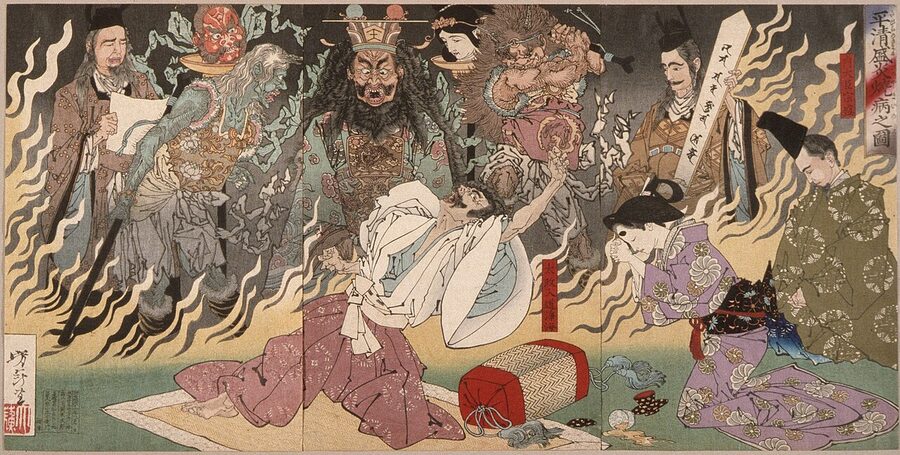
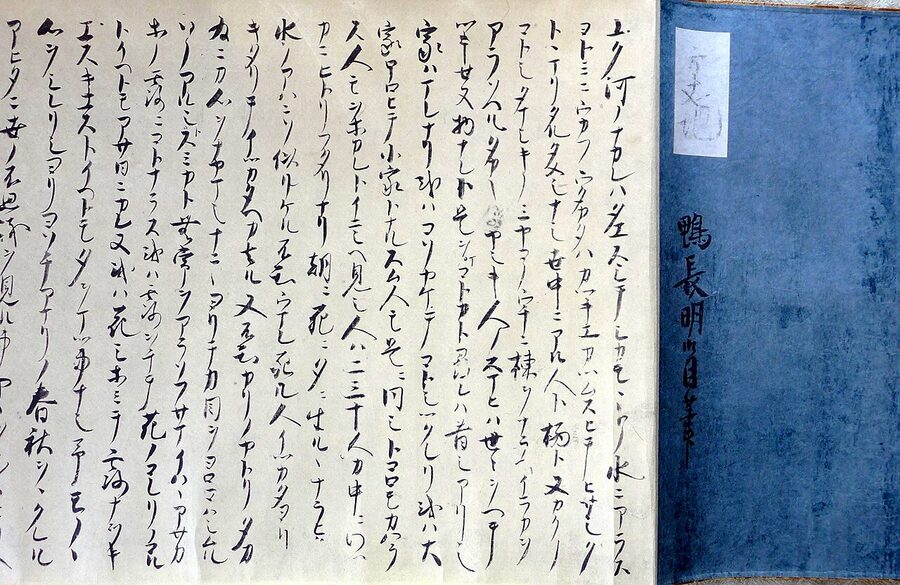
Kiyomori died on the fourth day of the intercalated second month of 1181, aged 64, and Munemori, the man with the branded horse, inherited a war. In the third month the Taira beat Yukiie on the Sunomata River, and then everyone stopped, because there was nothing to eat. Kamo no Chōmei, in his Hōjōki, says a monk of Ninna-ji went round marking the foreheads of the dead with a Sanskrit letter and counted 42,300 bodies in the capital’s streets in two months.
The calendar fought too. The court changed the era name to Yōwa in 1181 and then to Juei, and Yoritomo refused to recognise either, dating his documents Jishō, the era of Mochihito’s order, until the court made its peace with him in 1183. That is why Japanese historians call the whole thing the Jishō–Juei war: the name itself records two governments that could not agree what year it was.
Kiso’s two summers
The man who actually drove the Taira out of Kyoto was neither Yoritomo nor Yoshitsune. Kiso Yoshinaka, a cousin of Yoritomo’s raised in the Kiso valley of Shinano (later the mountain stretch of the Nakasendō), rose in 1180, beat the Taira’s ally Jō Sukemoto at Yokotagawara in 1181 and spread north into the Hokuriku, where the local warriors were already in revolt. I have told his story, and that of the woman who may or may not have ridden with him, in the article on Tomoe Gozen, so I will stick to the battle that decided the war.
In the fourth month of 1183 the Taira sent a great army north under Koremori; the Heike says 100,000 riders. On the 11th day of the fifth month Yoshinaka caught the main body camped on Tonamiyama at the Kurikara pass, on the border of Etchū and Kaga, attacked at night and drove it into the ravine. The court diaries say only that the government army was beaten and more than half of it killed.
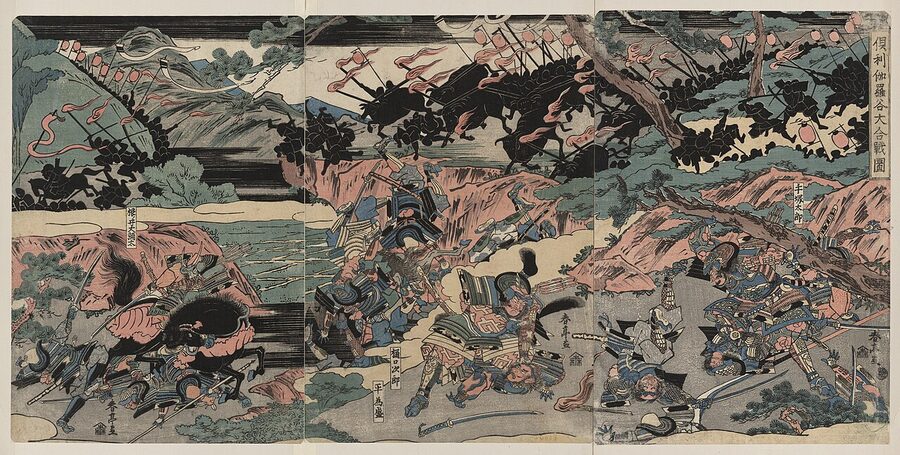
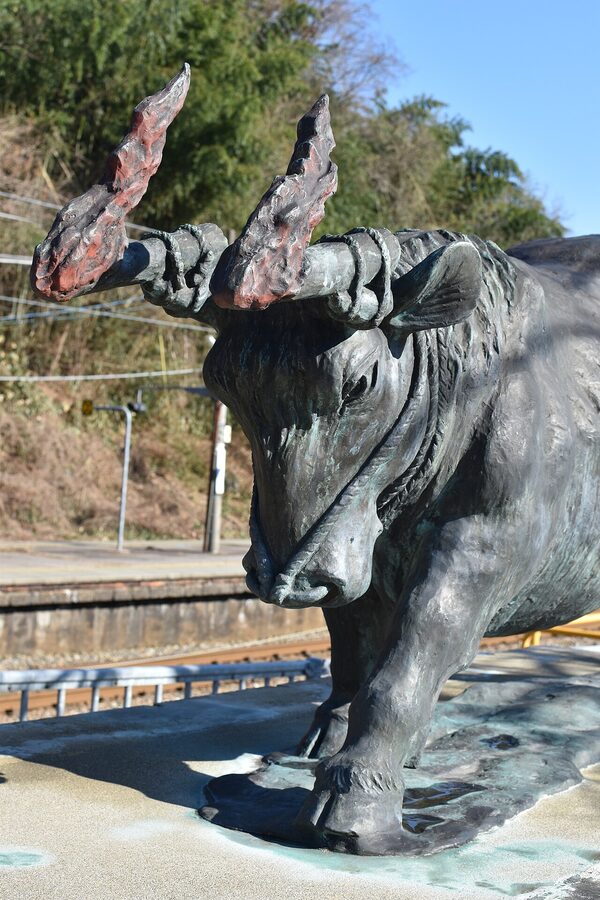
The famous detail is the oxen: 400 or 500 cattle with burning torches tied to their horns, stampeded into the Taira camp. That comes only from the Genpei Jōsuiki, a sprawling forty-eight-book retelling put together long afterwards, and Japanese scholars point out that it is lifted almost whole from the Shiji, the Chinese history in which the general Tian Dan routed a besieging army with a thousand burning oxen in the third century BC. A well-read compiler could do a great deal for Yoshinaka.
What is not in doubt is the result. On the 25th day of the seventh month of 1183 Munemori abandoned the capital and fled west with the boy emperor, his grandmother and the three sacred treasures, burning the Taira mansions at Rokuhara behind him. Go-Shirakawa, whom he had meant to take too, had slipped away to Mount Hiei the night before, and Yoshinaka rode in on the 28th.
In the eighth month the court enthroned Antoku’s three-year-old half-brother as Go-Toba, without the regalia, which had never been done. For nearly two years Japan had two emperors, one in Kyoto and one on a boat.
Yoshinaka lasted six months in the capital. His army was a coalition he could not feed in a starving city, he insisted Mochihito’s son should be emperor, and the courtiers mocked his manners. Sent west, he lost a sea battle at Mizushima on the first day of the intercalated tenth month, during which, the Jōsuiki records, the sun went almost dark; astronomers confirm an annular eclipse that day, and the Taira, who had a hand in making the court’s calendar, may well have known it was coming.
Meanwhile Go-Shirakawa did a deal with Kamakura. In the tenth month of 1183 he restored Yoritomo’s old court rank and gave him the right to see that rents from the eastern provinces reached their owners, so that Yoritomo had won the east without leaving it. On the 19th day of the eleventh month Yoshinaka attacked Go-Shirakawa’s palace and held him prisoner. On the 20th day of the first month of 1184 Yoritomo’s brothers Noriyori and Yoshitsune broke through at Seta and Uji, and Yoshinaka died at Awazu the same day.
Yoshitsune’s year
Minamoto no Yoshitsune, Yoritomo’s half-brother, was about 25, had been brought up partly in a temple and partly by the Fujiwara lords of distant Hiraizumi, and had never commanded anything. In thirteen months he won three of the most famous battles in Japanese history. He is also the war’s great problem for historians, because nearly everything that makes him brilliant comes from the Heike, a book that loved him. The full life is in my piece on Yoshitsune; here I want the battles, and what the diaries say about them.
Ichi-no-tani, the seventh day of the second month of 1184
While the Minamoto fought each other, the Taira had come back. By early 1184 they held the Inland Sea and Fukuhara itself, with the child emperor on a ship in the bay and plans to retake Kyoto. Their fortified line ran along the coast, with gates at Ikuta in the east and Ichi-no-tani in the west, backed by the mountains.
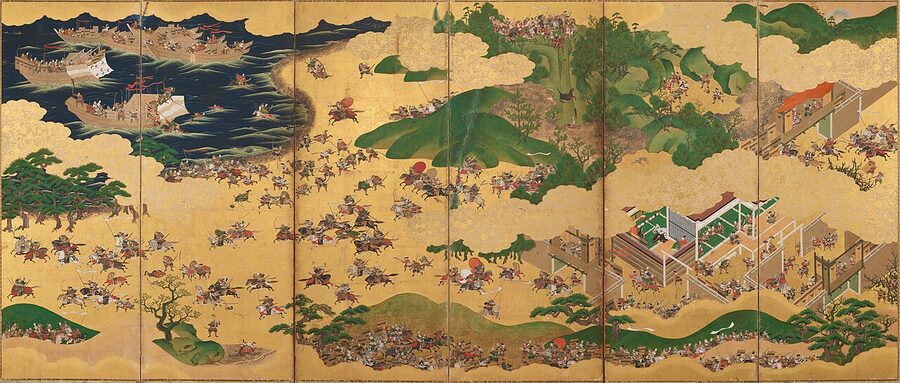
On the sixth, while the Taira leaders held a memorial service for Kiyomori, a messenger arrived from Go-Shirakawa ordering both sides to stand down for peace talks. The Taira believed it. The next morning Noriyori attacked Ikuta, Yoshitsune’s force hit Ichi-no-tani, and a third force came down from the hills on the camp in the middle.
The Heike gives Yoshitsune a cliff. An old hunter tells him the slope at Hiyodorigoe is too steep for horses; Yoshitsune asks whether deer use it, and says that where a deer can go a horse can go. He leads seventy men down, and the Taira camp, with no guard to the rear, collapses into the sea.
Kujō Kanezane’s diary does not. On the fourth he records that the Taira had tens of thousands of men and the government forces “only one or two thousand riders”; on the battle, he says Yoshitsune took Ichi-no-tani, Noriyori attacked along the beach, and the camp in the hills was taken by Tada Yukitsuna, a Minamoto lord of Settsu who knew the ground, all in about two hours. There is no cliff charge, and Hiyodorigoe lies some eight kilometres east of Ichi-no-tani.
Japanese historians generally treat the charge as a Heike creation, and point out that Tada Yukitsuna, who appears in none of the Kamakura accounts, had his lands confiscated by Yoritomo in 1185. A man in disgrace is easily written out of a victory.
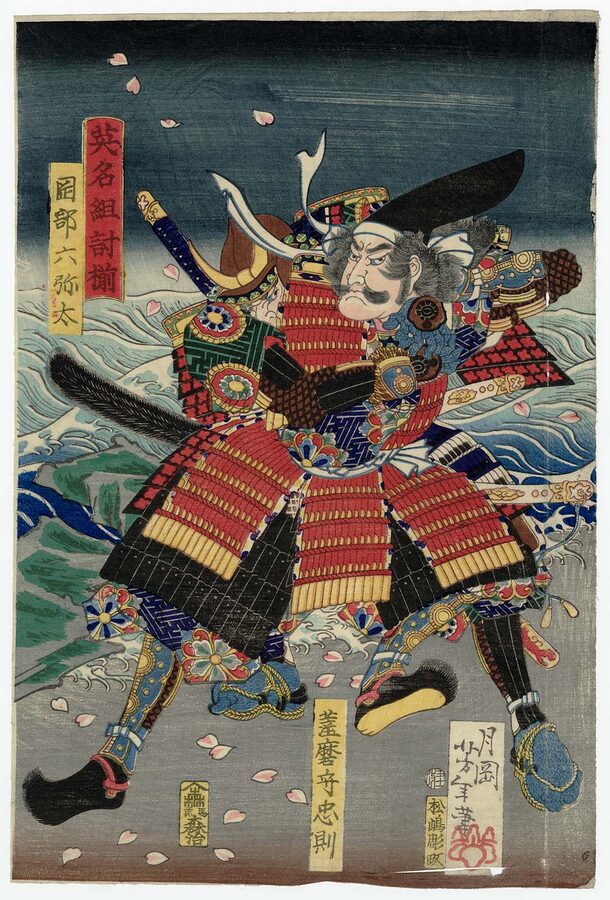
The best-known scene of the battle has nothing to do with tactics. Kumagai Naozane, an eastern warrior hunting for a worthwhile head, calls a richly armoured rider back from the ships, throws him down and finds a boy of about sixteen with his face powdered and his teeth blackened, the age of his own son. With other Minamoto riders coming up behind, he kills the boy rather than leave him to someone crueller, and later becomes a monk. The real Naozane did take vows, though the Azuma Kagami says he did it in a temper after losing a boundary lawsuit in 1192.
That poem is one reason the cherry blossom became the warrior’s flower (more in the piece on sakura). Atsumori, Tadanori and some ten other Taira commanders were dead and Shigehira was a prisoner. Go-Shirakawa offered to exchange him for the regalia, and Munemori refused, writing back angrily that his people had been attacked while obeying the retired emperor’s own order to stand down.
The long middle
The war then stalled for a year, and this is the part the storytellers skip. Noriyori marched west along the San’yō road with an army that ran out of food, could not cross to Kyushu without ships, and wrote home a catalogue of complaints; at one point even Wada Yoshimori, chief of Yoritomo’s own retainers, tried to slip off home. In the first month of 1185 Noriyori finally scraped together enough boats to cross, and on the first day of the second month he beat the Taira’s Kyushu allies at Ashiyaura. The Taira were being boxed in, slowly, by a man nobody wrote ballads about.
Yashima, the 19th day of the second month of 1185
Yoshitsune went to Watanabe, at the mouth of the Yodo River, to gather a fleet, and ignored a messenger from Go-Shirakawa telling him that a general does not lead from the front. The Heike adds a quarrel with Kajiwara Kagetoki, who wanted the ships fitted with reverse oars so they could back away, and Yoshitsune’s answer that a man who plans his retreat has already lost. It is probably invented: by the diaries and the Azuma Kagami, Kagetoki was away with Noriyori’s army at the time.
He sailed by night into a gale with five boats and about 150 riders, and crossed to Awa on Shikoku in a few hours instead of the usual three days. Sources variously put the departure on the night of the 16th or in the small hours of the 18th. A local warrior told him most of the Taira’s men were away in Iyo and only about a thousand were left, so he crossed the hills and came down on Yashima from the land side.
Yashima was then a true island, separated from the shore by a channel that could be forded at low tide. Yoshitsune set fire to the houses along the shore to make his little force look like an army, and the Taira, who had expected an attack from the sea, ran for their boats. When they saw how few the attackers were, they came back inshore and shot at them, and Satō Tsuginobu, one of Yoshitsune’s retainers, was killed shielding his lord from an arrow by Taira no Noritsune.
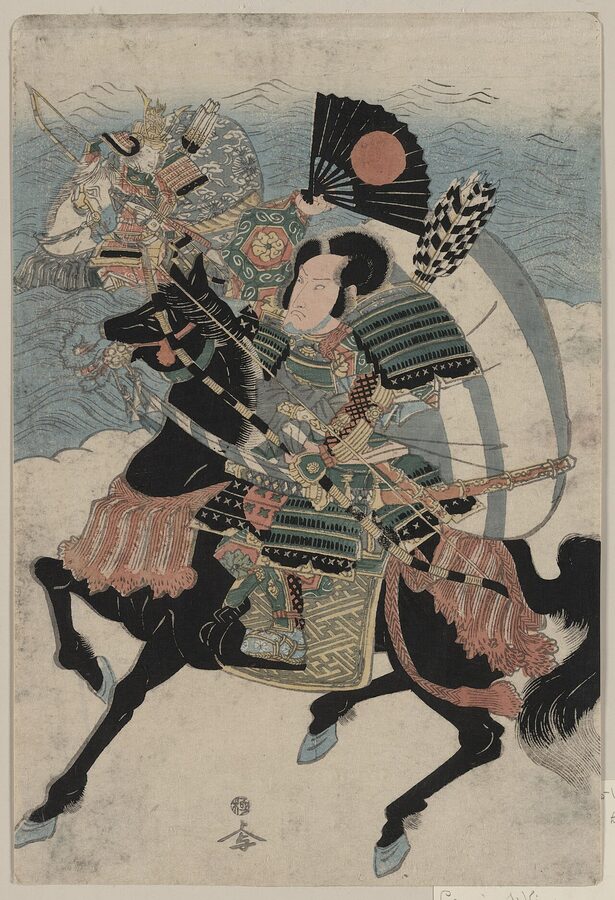
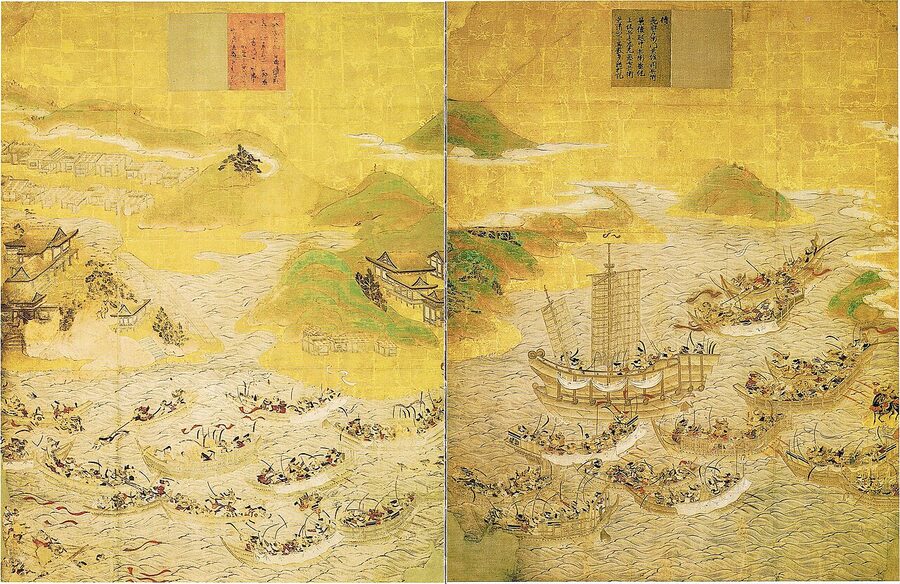
Then comes the most famous scene in the Heike. Towards evening a boat rows out from the Taira line with a court lady beside a pole, and on the pole is a crimson fan with a golden sun. Yoshitsune picks an archer, Nasu no Yoichi, a young man from Shimotsuke, who rides into the sea, prays to Hachiman that if he misses he will kill himself, and splits the rivet of the fan with his first arrow. The fan goes up, twists twice in the spring wind and falls on the waves, while the Taira beat on the sides of their boats in applause and the Minamoto drum on their quivers.
The Heike does not stop there, and this is why I trust its author more than its admirers. A Taira warrior of about fifty climbs onto a boat and starts to dance where the fan had been, and on Yoshitsune’s order Yoichi shoots him too. On the shore some men shout “Good shot!” and others say “That was heartless”, and the book records both and leaves it there.
The book also has its own date: the 18th day of the second month, about the hour of the Cock, where the Azuma Kagami, which modern accounts follow, puts the attack on the 19th. Over the next two days Yoshitsune risked his life fishing a dropped bow out of the sea so the Taira would not see how weak it was, and beat off a landing at Shido. When Kagetoki’s main fleet of some 140 boats turned up on the 22nd, the Heike‘s Minamoto laughed and called them “irises on the sixth”, flowers delivered the day after the festival.
Dan-no-ura, the 24th day of the third month of 1185
The Taira fell back to Hikoshima, the island at the western mouth of the Kanmon Strait, where Kiyomori’s son Tomomori held their last base. Behind them Noriyori held northern Kyushu, and in front of them the sea families of the Inland Sea changed sides one after another, among them the Kumano fleet under the same Tanzō whose report had blown Mochihito’s plot. The Heike says Tanzō decided by setting seven red roosters against seven white ones at his shrine at Tanabe, and the white won every bout.
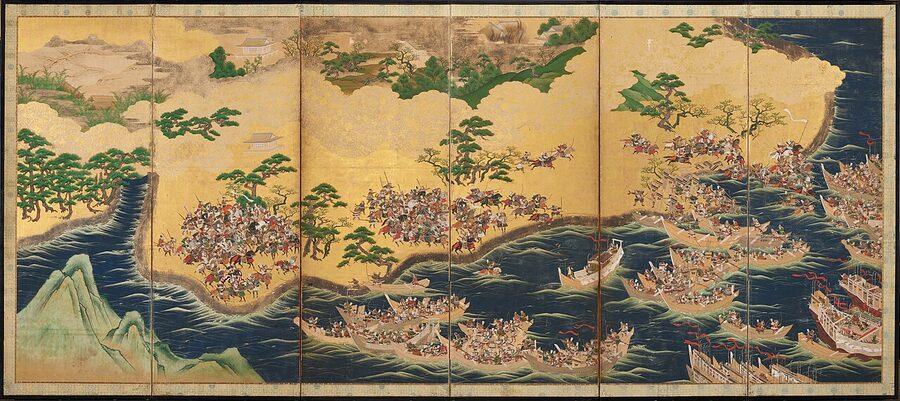
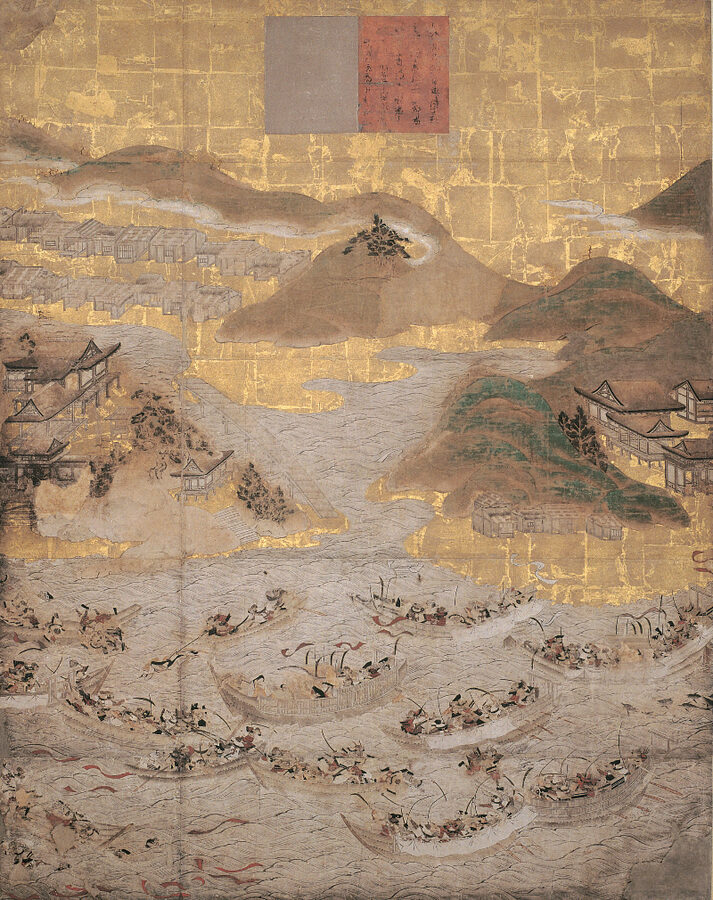
Japanese reference works convert the date to 25 April 1185 on the Julian calendar. The record of the fight is thin: the Azuma Kagami gives it a few lines, in which the fleets close to about 300 metres off Dan-no-ura, the Taira put out 500 boats in three divisions against the Minamoto’s 840, and by noon the Taira have lost. The Heike gives 3,000 boats against 1,000. Kujō Kanezane’s diary says the fighting began at noon and ended at about four in the afternoon.
The shape of the battle you will read on every information board in Shimonoseki comes from the Heike and from a professor of the Tokyo Imperial University named Kuroita Katsumi. In 1914 Kuroita had the navy’s hydrographic office work out the tides in the strait for the day (using the Gregorian equivalent, 2 May), and the answer was that the current ran east until mid-afternoon at up to eight knots and then turned west. So, he argued, the Taira rode the tide early, the tide turned, and the Minamoto rode it back.
It is a good theory and it has been in every book and television drama since. It has also taken a beating. The maritime historian Kanazashi Shōzō found that the battle fell during weak neap tides, and that the eight-knot current applied only to the narrowest point of the strait, the Hayatomo channel, where a thousand boats could never have fought; in the wider water by Manju and Kanju islands, he and the coastguard’s own survey put it under one knot. Ishii Kenji, a historian of Japanese ships, added the simplest objection of all: boats drifting on the same current move relative to each other exactly as they would in still water.
What does seem clear is what killed the Taira. They shot hard early, ran short of arrows, and then sat in the strait between Yoshitsune’s ships in front and Noriyori’s archers on the Kyushu shore. The unarmoured rowers and helmsmen went down and the boats stopped moving; television dramas like to have Yoshitsune order the oarsmen shot, a shocking breach of the rules of war, but the Heike has the rowers killed only once the battle was already lost. It also says a Shikoku lord, Awa no Shigeyoshi, changed sides in mid-battle and told the Minamoto which ship carried the emperor, though the Azuma Kagami lists him among the prisoners.
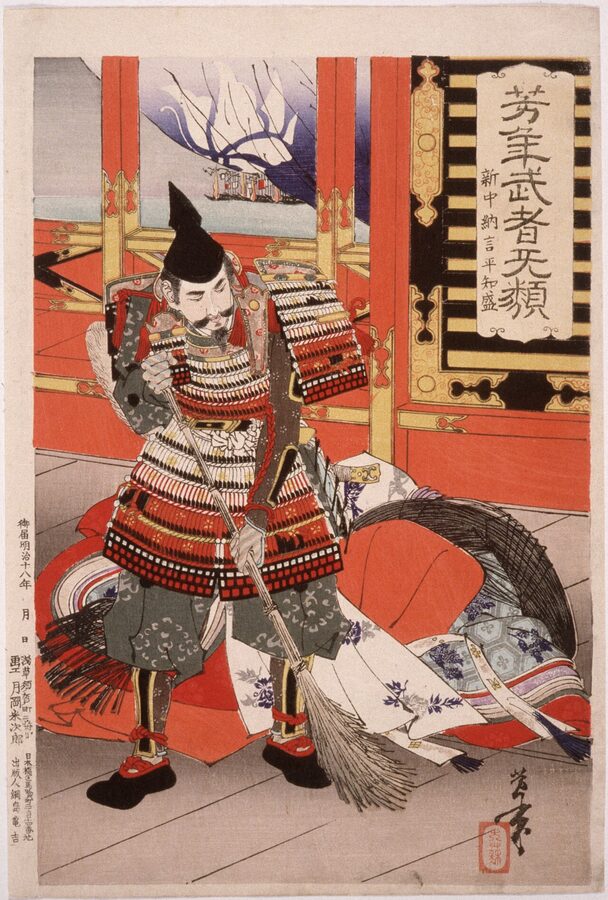
The end of the Taira
In the Heike, Tomomori sweeps the emperor’s boat himself so the enemy will find nothing unseemly, and makes his joke. Kiyomori’s widow Tokiko, the Nun of the Second Rank, understands. She tucks the sacred sword through her sash and the jewel under her arm, and takes the boy in her arms; he asks where she is taking him, and she tells him to say goodbye to the goddess at Ise and pray to the Buddha, and that there is a capital beneath the waves as well.
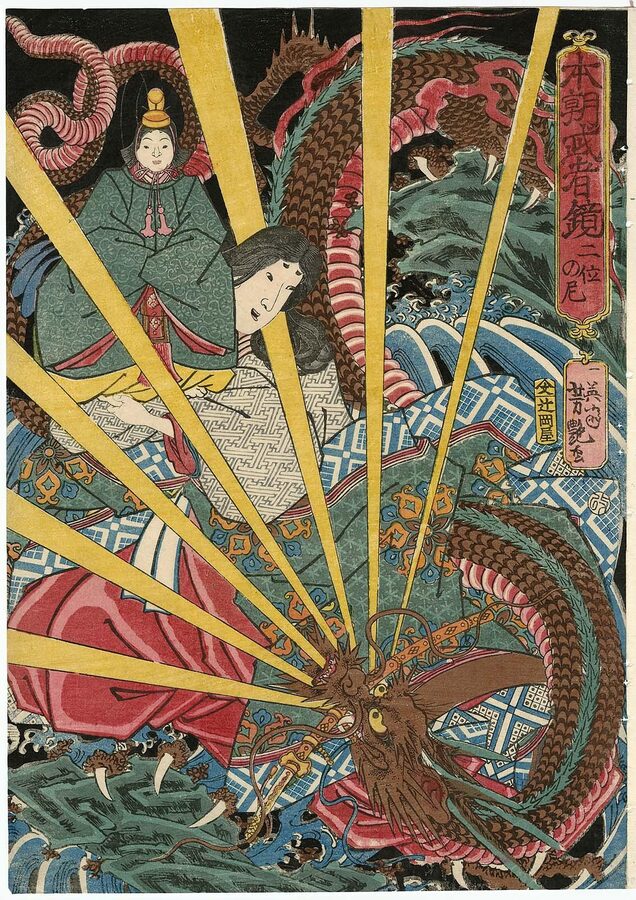
The Azuma Kagami has the scene in one plain sentence: the Nun went into the sea with the sword and the jewel, and a lady called Azechi no Tsubone went in holding the emperor. He was in his eighth year by the Japanese count, six by ours. His mother, Kenreimon-in, jumped too and was pulled out by her hair with a rake, and Munemori and his son, too frightened to jump, were pushed in by their own men, swam about in their armour and were fished out alive, to be beheaded in Ōmi that summer.
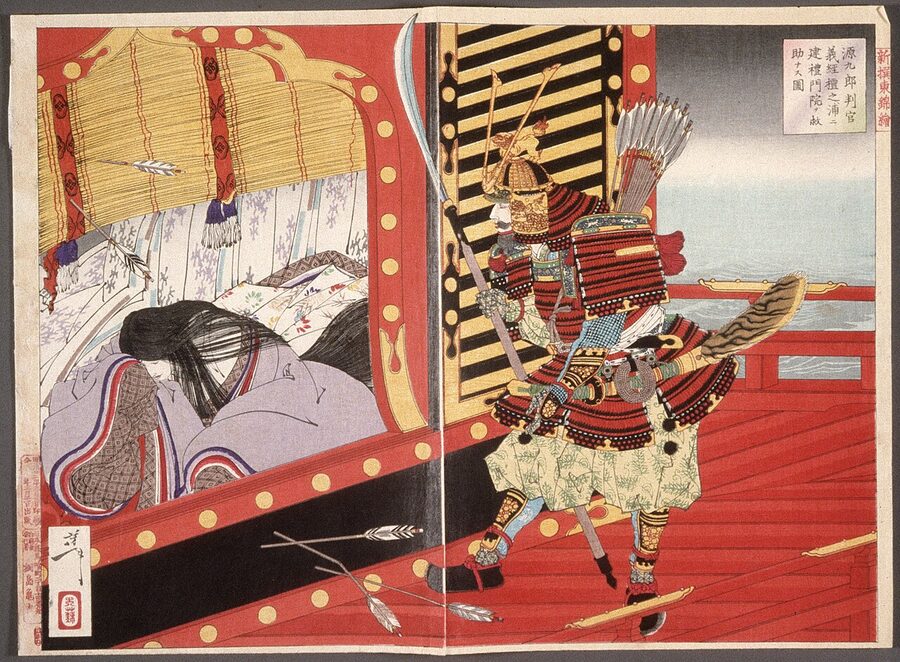
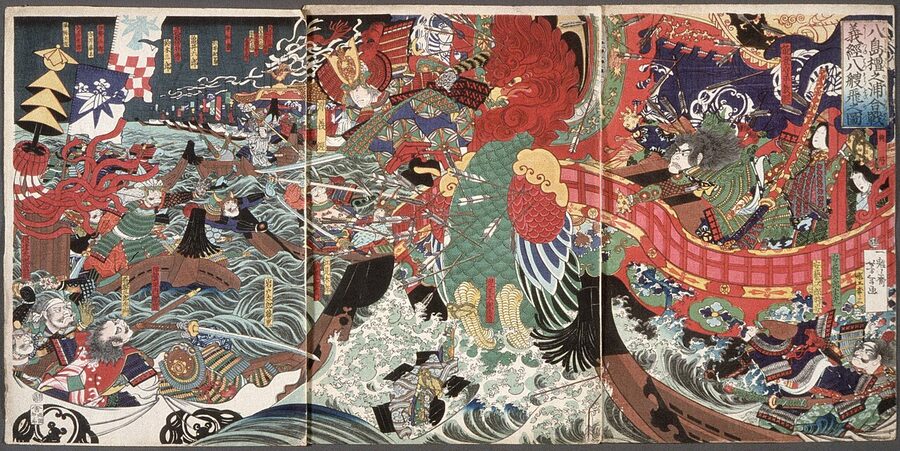
Tomomori said, in the line every Japanese reader knows, that he had seen all there was to see. He put on two suits of armour (a set of great ō-yoroi could weigh 25 kilograms) and went over the side with his foster brother. The anchor he carries in statues and prints comes from Yoshitsune Senbon Zakura, a puppet play of 1747 in which he survives the battle in disguise.
The court had wanted one thing from the whole campaign, the regalia, and got two of the three. The mirror was rescued, and the box holding the jewel floated, but on the 11th day of the fourth month the report reached Kamakura that the sword was lost. Whether the sword in the sea was the original or a copy is an old argument, which I have gone into in the article on the three sacred treasures; for what a blade meant to the men fighting here, see the piece on Japanese swords.
Not Genji against Heike
You can now see why Japanese historians prefer the clumsier name. Yoritomo’s army was largely eastern Taira, some Minamoto held back or fought on the Taira side, and Minamoto killed Minamoto throughout: Yoritomo against his cousin Yoshinaka, Yoshinaka against his uncle Yukiie, Yoritomo against the Kai Genji, whose Ichijō Tadayori he had murdered at a banquet in 1184. The great temples fought for themselves, and the north-east, under the Ōshū Fujiwara at Hiraizumi, sat the whole thing out. Even the head of the Minamoto as a family was a court noble who took no part.
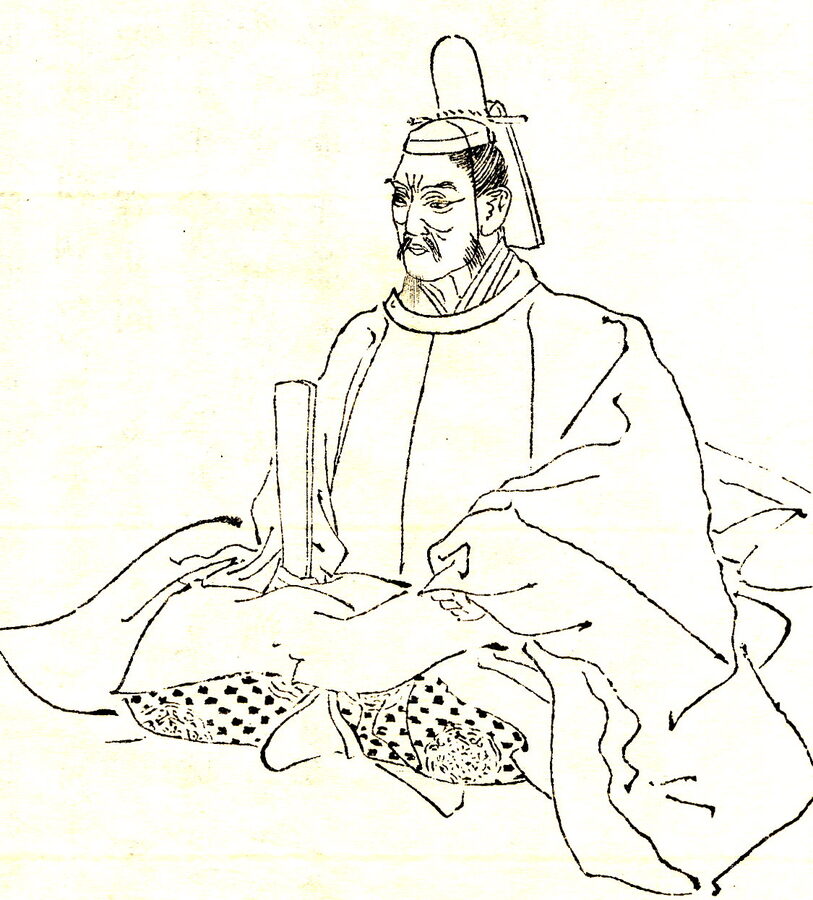
What the war actually did was put a new kind of government in the east. Yoritomo never fought in the west; his power was that he could confirm a warrior’s lands and grant him new ones, and the court, which needed his armies, had to let him. In the eleventh month of 1185 it gave him the right to appoint constables and land stewards across the country. The title of shogun only came in 1192, which is why many Japanese textbooks have moved the start of the Kamakura era back to 1185, to the irritation of a generation that learned the old date by rote.
It also changed fighting. The old warrior’s battle had rules, a named challenge, mounted archery, the sword only when the arrows ran out, and nobody shot horses. Five years of war on this scale drew in men who could not ride or shoot to that standard, and Japanese historians trace from it the turn to shooting horses and fighting with the sword from the saddle. The code later called bushidō owes more to the Heike‘s version of these men than to anything they did.
As for Yoshitsune, the victor of Dan-no-ura was barred from Kamakura within two months and hunted across Japan by the autumn. He died at Hiraizumi in 1189, when the Fujiwara lord who had sheltered him gave him up, and Yoritomo then destroyed the Ōshū Fujiwara anyway, a campaign many Japanese historians treat as the real last battle of the war. Yoritomo had won a civil war in which his main contribution was to stay at home and hand out land. Nobody has ever set that to music.
How the Heike wrote the war
The book everybody remembers was not written by anyone who fought. The essayist Yoshida Kenkō said in the 1330s that a former provincial governor called Yukinaga composed it and taught it to a blind man called Shōbutsu, who learned the warriors’ parts from warriors and recited it to the lute. Whatever the truth, the Heike grew for more than a century in the hands of blind performers, the biwa hōshi, and of readers who expanded it. The oldest surviving form, the Engyō text, was copied in 1309 and 1310, and the version in Japanese schoolbooks was fixed by a reciter called Kakuichi in 1371, in the early Muromachi era.
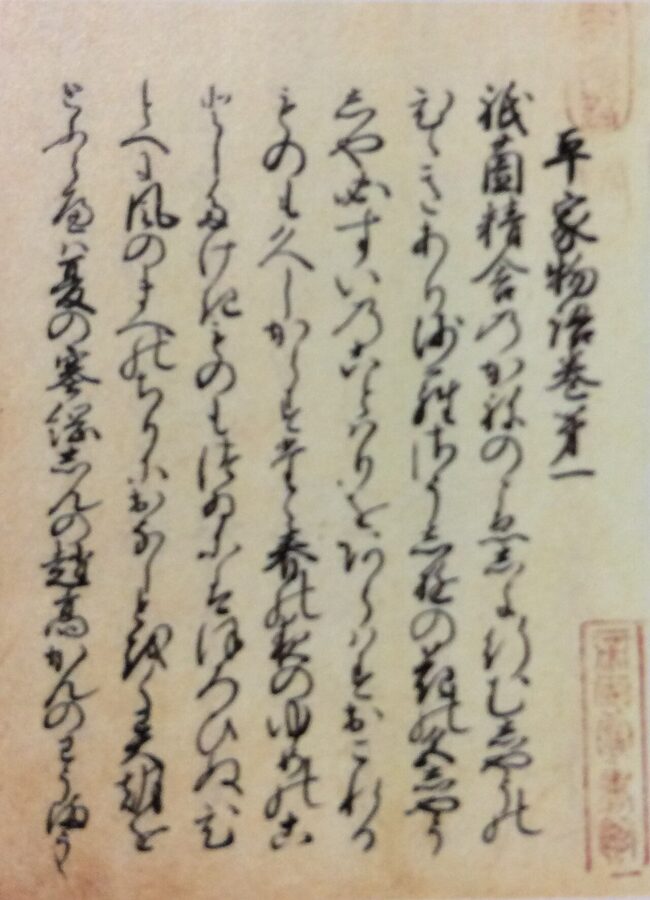
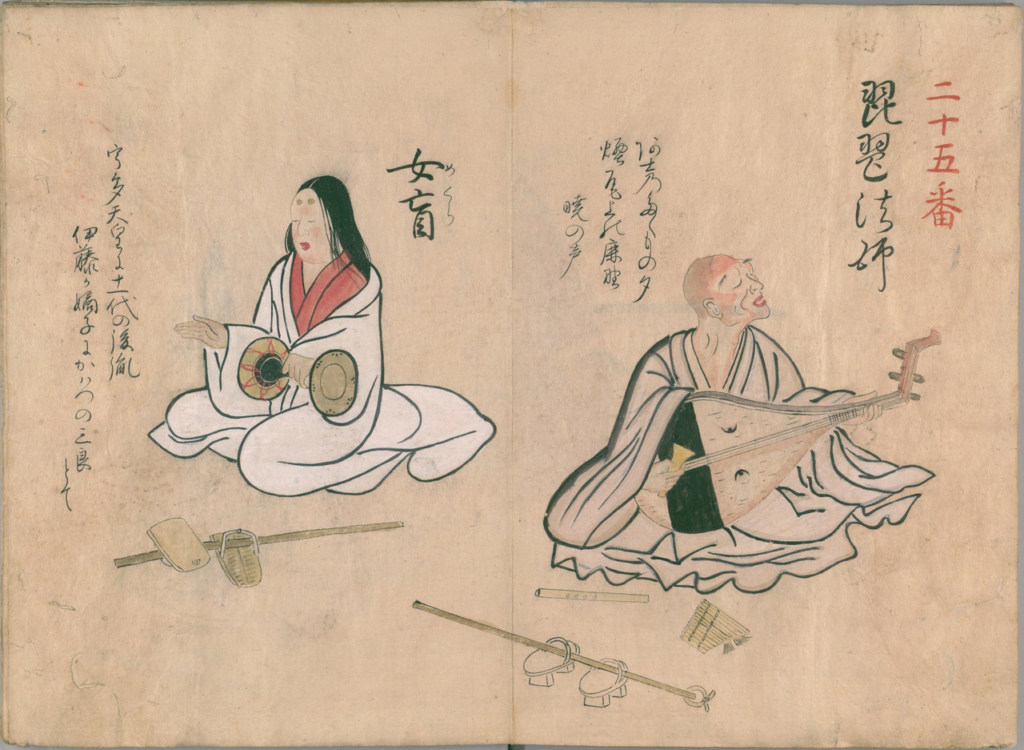
The Heike is a Buddhist sermon in the form of a war story. Its theme is that the proud do not last, and it shapes the war to fit: the Taira arrogant in their rise and dignified in their fall, the Minamoto brave but crude, nearly every death a lesson. It is far kinder to the losers than the winners, which may be why the losers are the ones people remember.
The other big source has its own slant. The Azuma Kagami was compiled around 1300 by the Kamakura shogunate under the Hōjō regents, and it writes the war backwards from Kamakura’s victory: Yoritomo always in charge, awkward allies written out, and in places, Japanese scholars think, borrowing from the Heike when its own records ran thin. Tokugawa Ieyasu was so fond of it that he had it printed in 1605.
That is not a coincidence. Once warriors ruled Japan, the war became a family tree: Oda Nobunaga claimed Taira descent, Ieyasu had himself registered as a Minamoto, and the idea spread that power passed back and forth between the two houses, which made the Sengoku warlords sound like a sequel. The Tokugawa shogunate ruled for two and a half centuries as heirs of Yoritomo.
Noh made ghosts of Atsumori, Tadanori and Tomomori, and the puppet and kabuki stage of the Edo era turned the war into melodrama; in Ichinotani Futaba Gunki of 1751 Kumagai kills his own son in Atsumori’s place. Mountain villages in Shikoku and Kyushu call themselves the descendants of Taira refugees, and a dozen remote places have graves for an Antoku who, they say, never drowned. In 1904 Lafcadio Hearn told the world about Hōichi, the blind lute player summoned at night to recite the battle to the dead of Dan-no-ura, who lost his ears to them.
Where to see the Genpei War today
The war’s sites run the length of western Japan, and none of them is quite what it was. Coastlines have moved, Yashima is no longer an island, and several “sites” mark where a story was set rather than where anything was found. You are, after all, standing where the Heike‘s audiences imagined it, which is how most of Japan has known this war for 800 years. For the broader frame, my guide to Japan’s most decisive battles, my walk through Japan’s eras and the Heian era article cover the world the war ended.
Uji: the Byōdō-in and the bridge
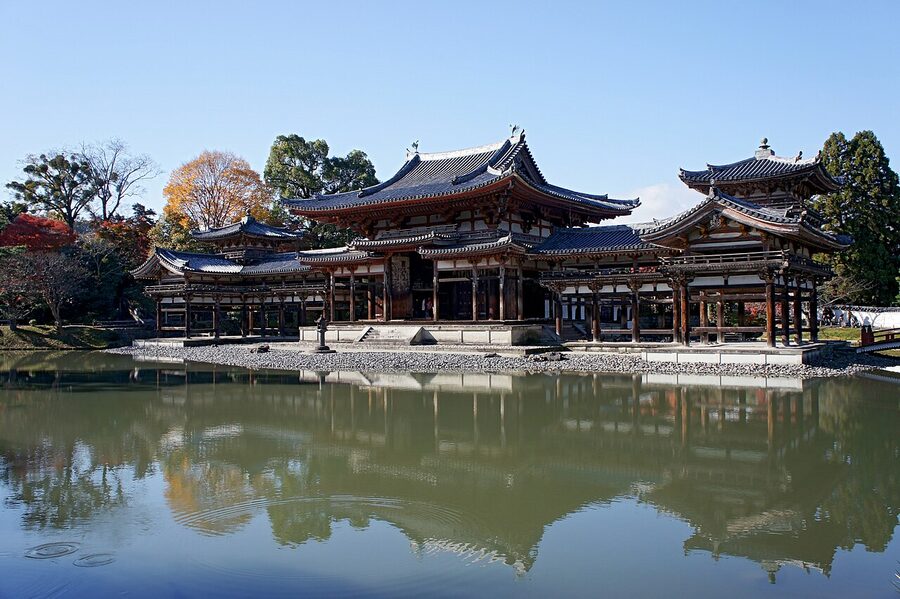
The Byōdō-in is a short walk along the river from either JR Uji or Keihan Uji station. The garden opens 8:45–17:30 (last entry 17:15) and the Hōshōkan museum 9:00–17:00, on one ticket of ¥700. Going inside the Phoenix Hall costs a further ¥300, with tickets sold inside the garden from 9:10, first come first served, for guided groups of 35 every 20 minutes from 9:30 to 16:10. On a spring weekend they go fast, so buy yours as soon as you arrive.
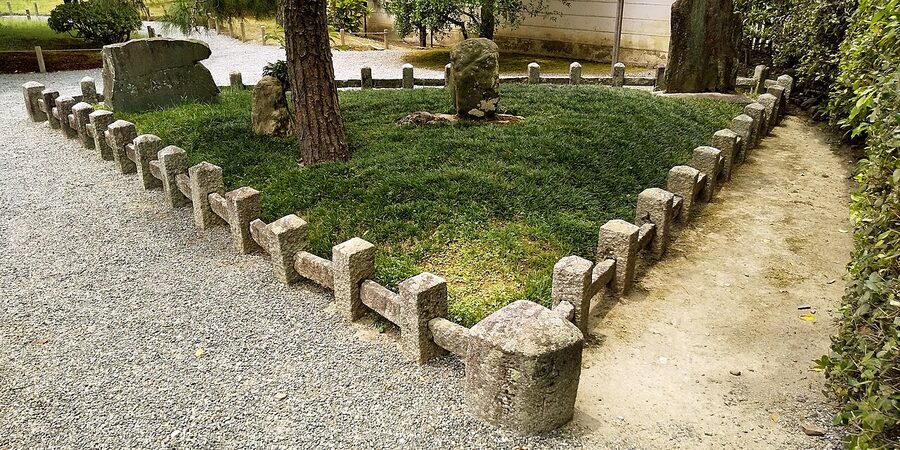
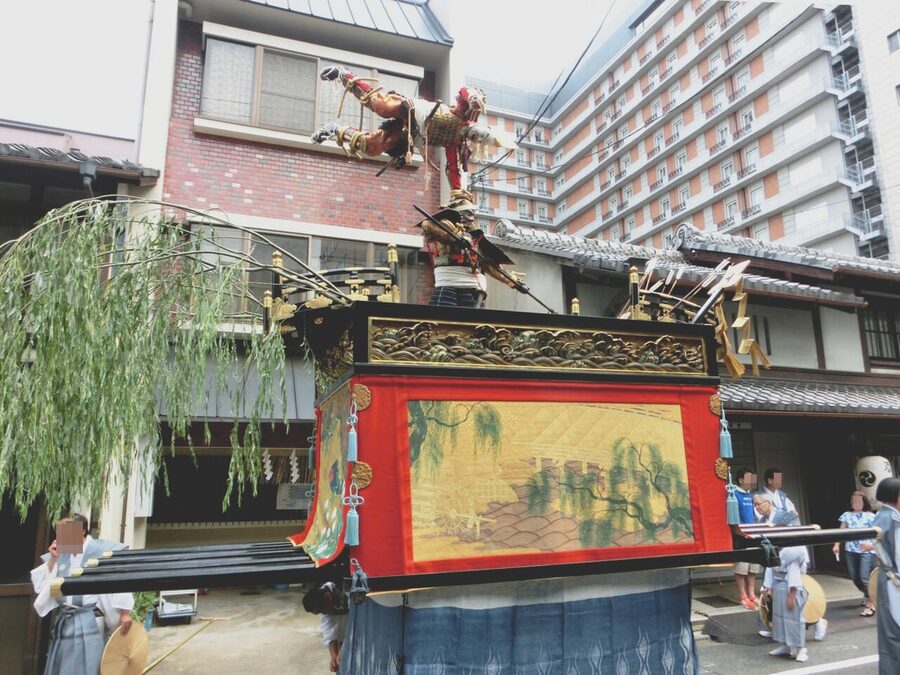
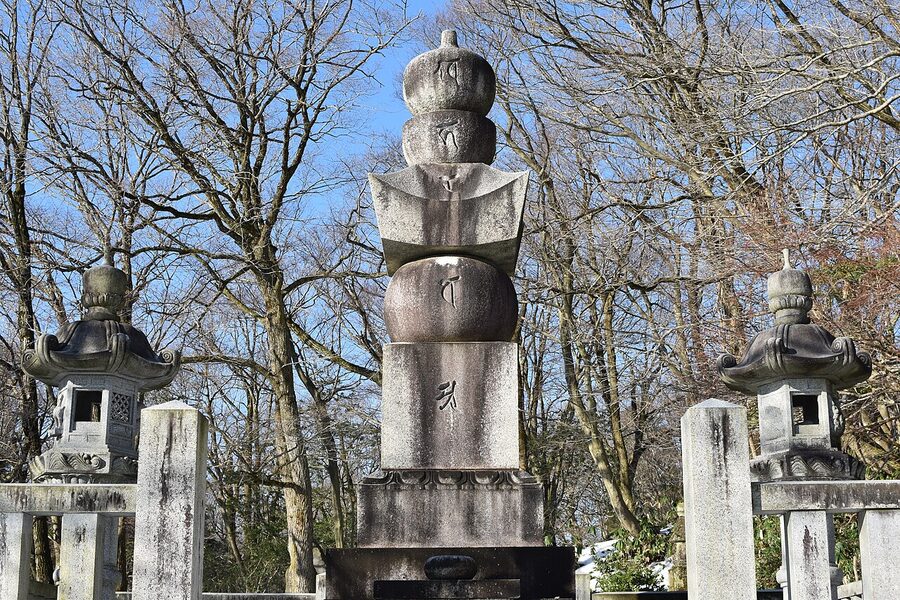
Yorimasa’s grave, a small stone pagoda, is in the grounds of the subtemple Saishō-in close by. The Uji Bridge is modern, but the river is wide and fast enough that you will understand why the Taira stalled on the bank. If you are in Kyoto on 24 July, watch for the Jōmyō-yama float in the second procession of the Gion Matsuri, which carries the warrior-monks of the bridge battle.
Kurikara pass
The pass is on the border of Ishikawa and Toyama, and the old road over it is now the Hokurikudō historic trail, about 12.8 kilometres from Tsubata to Oyabe through cedar woods. Near the top is Kurikara Fudō-ji, whose summit hall is open 9:00–17:00; the larger Hōōden hall lower down asks a voluntary ¥200. Take the IR Ishikawa Railway to Tsubata and then a taxi, about 20 minutes, or drive about 20 minutes from Oyabe IC on the Hokuriku Expressway.
On the Toyama side, Hanyū Gokoku Hachimangū, where Yoshinaka is said to have prayed before the battle, is about five minutes by taxi from Isurugi station on the Ainokaze Toyama Railway. Oyabe used to stage a fire-ox festival every year; it has been dropped for want of volunteers, which is probably kinder to the oxen.
Suma and Ichi-no-tani, Kobe
Sumadera (Fukushō-ji) is the Ichi-no-tani temple, free to enter and open 8:30–17:00, five minutes’ walk north of Sumadera station on the Sanyo line or twelve from JR Suma. In the grounds are the mound where Atsumori’s head is said to be buried, the pond where it was washed, and a pine Yoshitsune supposedly sat under. The treasure hall shows the Aoba flute, the thicker of the two flutes the temple links to Atsumori.
For the battlefield, take the Sanyo line two stops west to Sumaura-kōen, where a ropeway climbs the hill behind the beach. It runs 10:00–17:00, closed on Tuesdays except public holidays, for ¥500 one way or ¥920 return, and from the top a path leads along the ridge to Mount Tekkai, which many historians and every tourist board take for the slope Yoshitsune came down.
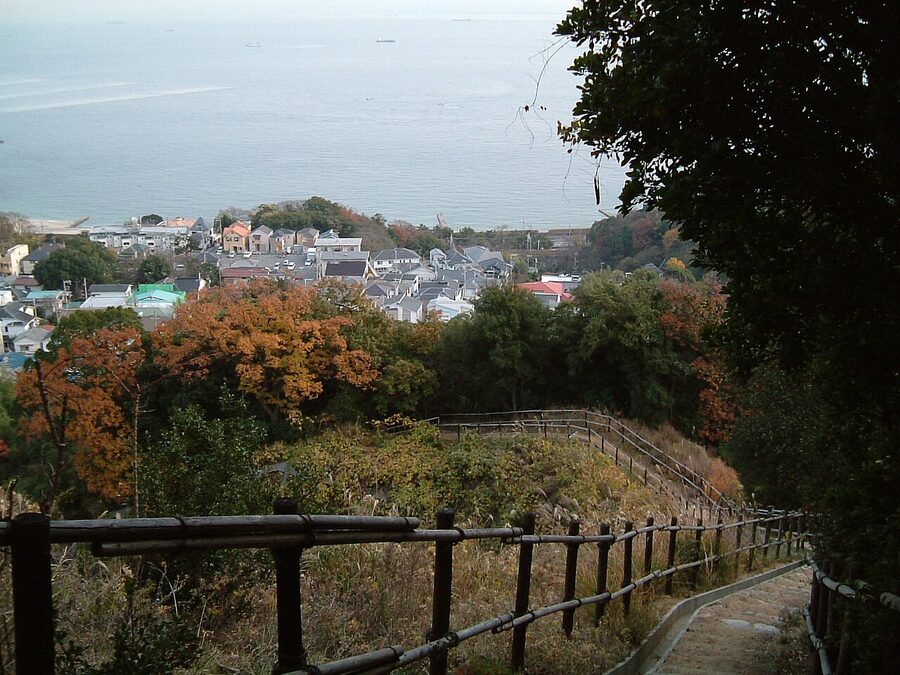
The Hiyodorigoe of the Heike also exists, eight kilometres east in the hills of Hyōgo ward, with its own station on the Kobe Electric Railway. Seeing all of it in a day is easy; deciding which slope the riders came down is not.
Yashima, Takamatsu
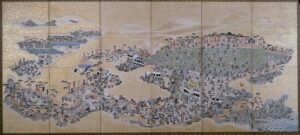
Yashima is a flat-topped plateau on the east side of Takamatsu, joined to Shikoku by Edo-period land reclamation except for a narrow river channel. A shuttle bus runs to the top from JR Yashima and Kotoden Yashima stations. At the summit is Yashima-ji, number 84 of the 88 temples of the Shikoku pilgrimage, whose treasure hall (9:00–16:30, ¥500, junior-high age and under free) has a battle screen, an illustrated scroll of the Genpei Jōsuiki and a white banner said to be the Minamoto’s.
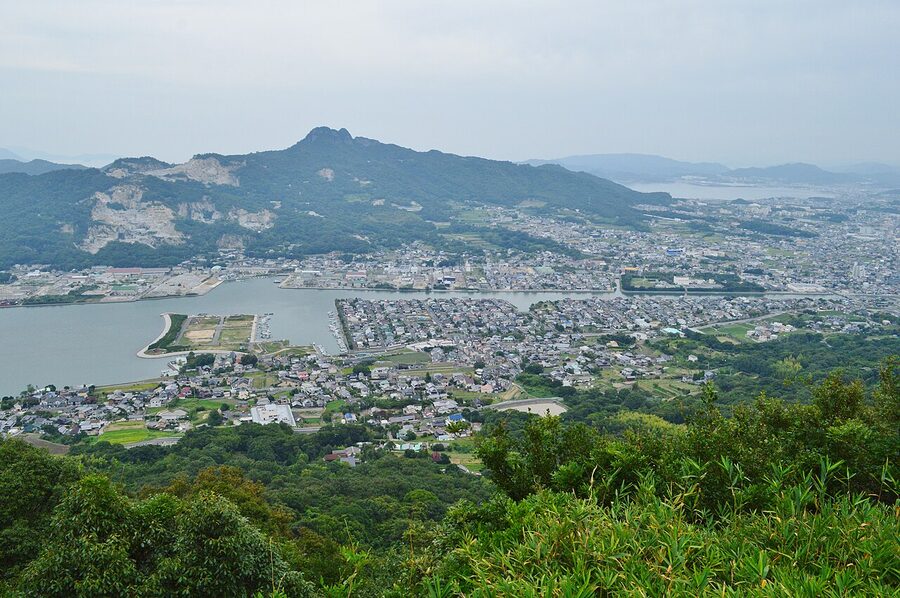
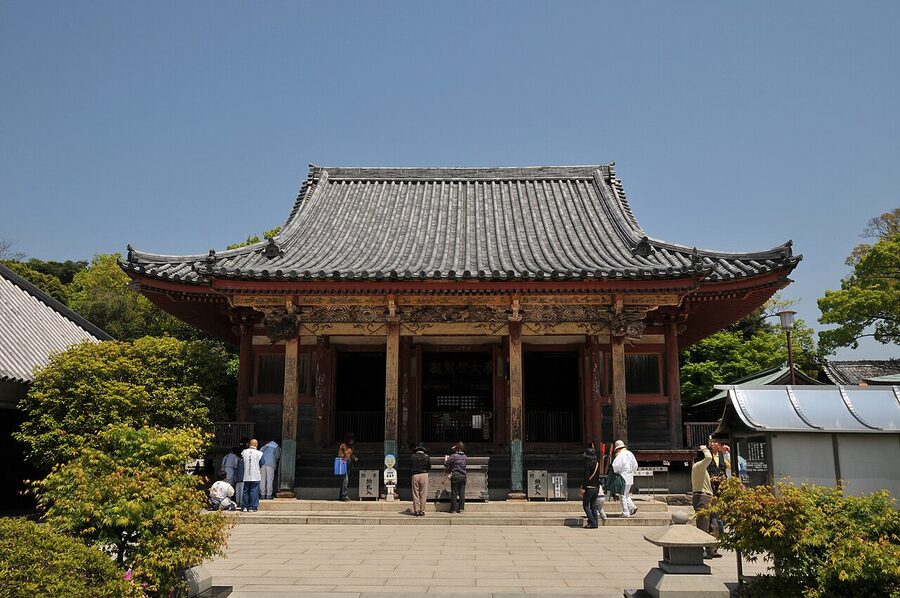
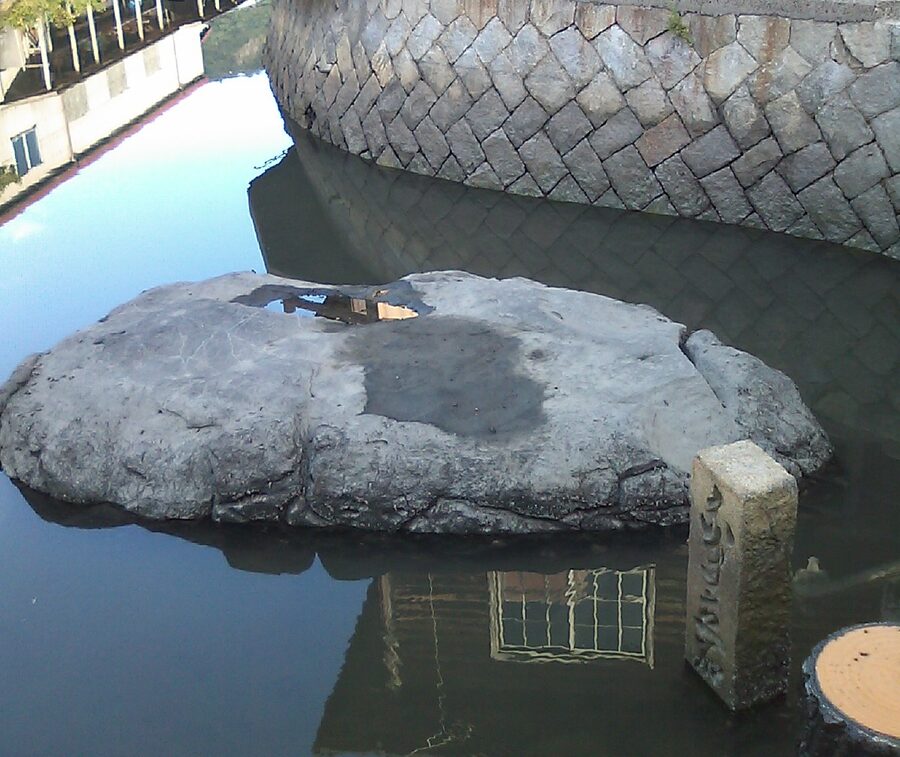
The sites of the fighting are at the foot of the hill around Mure, best done on foot from Kotoden’s Shido line. Takamatsu’s guided walks cover about three kilometres: the field where Tsuginobu fell, his grave (rebuilt in 1643 by Matsudaira Yorishige, the first lord of Takamatsu), the site of the Taira palace gate, the spot where Yoshitsune dropped his bow, and Suzaki-ji, which owns a Genpei battle screen.
Shimonoseki: Akama Shrine and Dan-no-ura
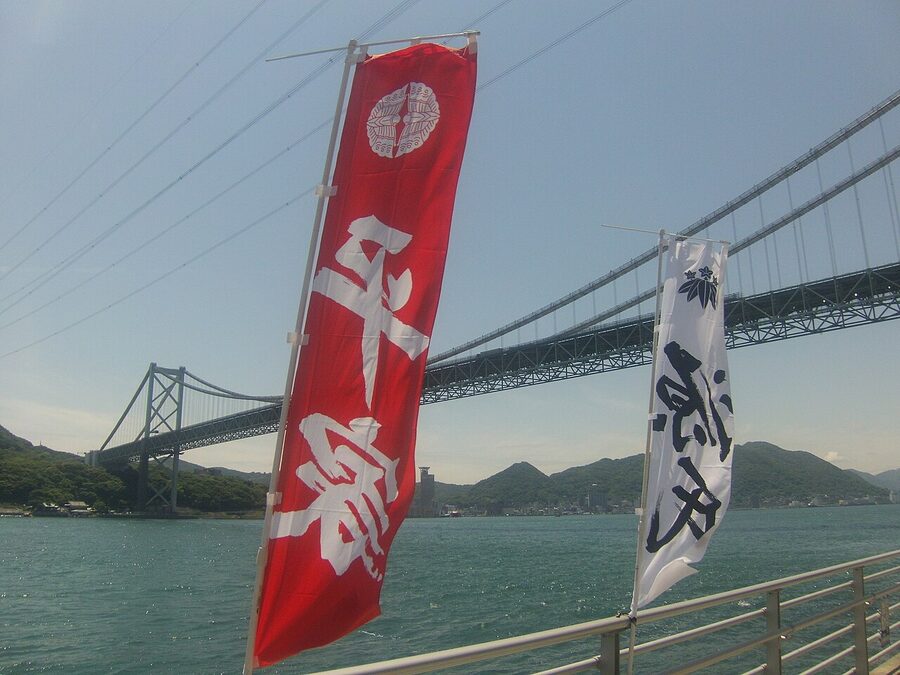
Akama Jingū stands on the site of Amida-ji, the temple where Antoku was buried, and where in 1191, the courtier diaries record, the court ordered a hall built to calm his spirit. During the Meiji separation of Shinto from Buddhism the temple was abolished and the hall became a shrine, one small case of the Meiji Restoration rewriting old religion. The grounds are free; the treasure hall, which holds the Nagato text of the Heike, opens 9:00–16:30 for ¥100. Buses from JR Shimonoseki take about nine minutes to the Akama-jingū-mae stop.
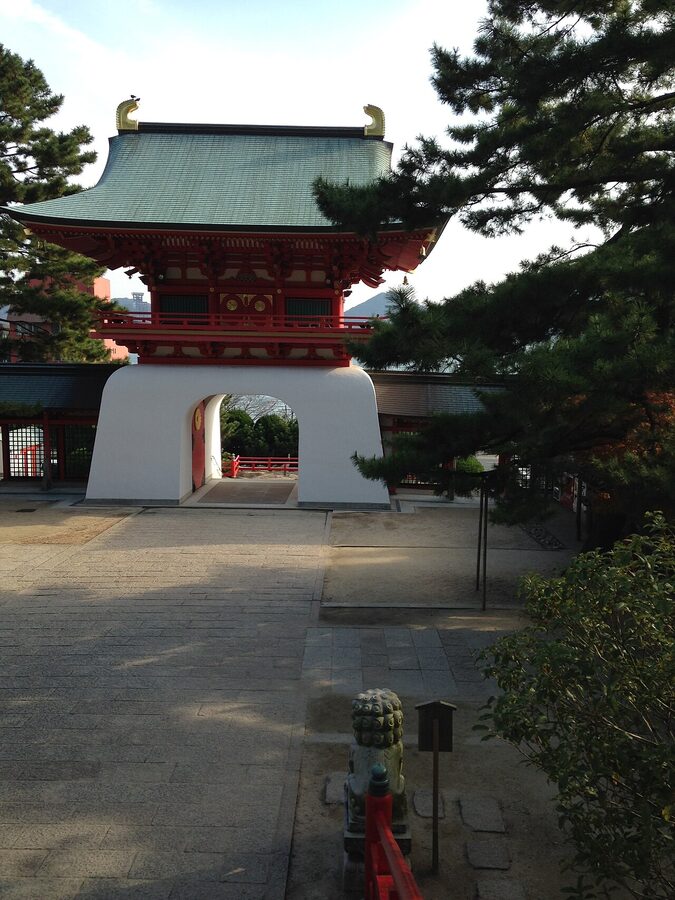
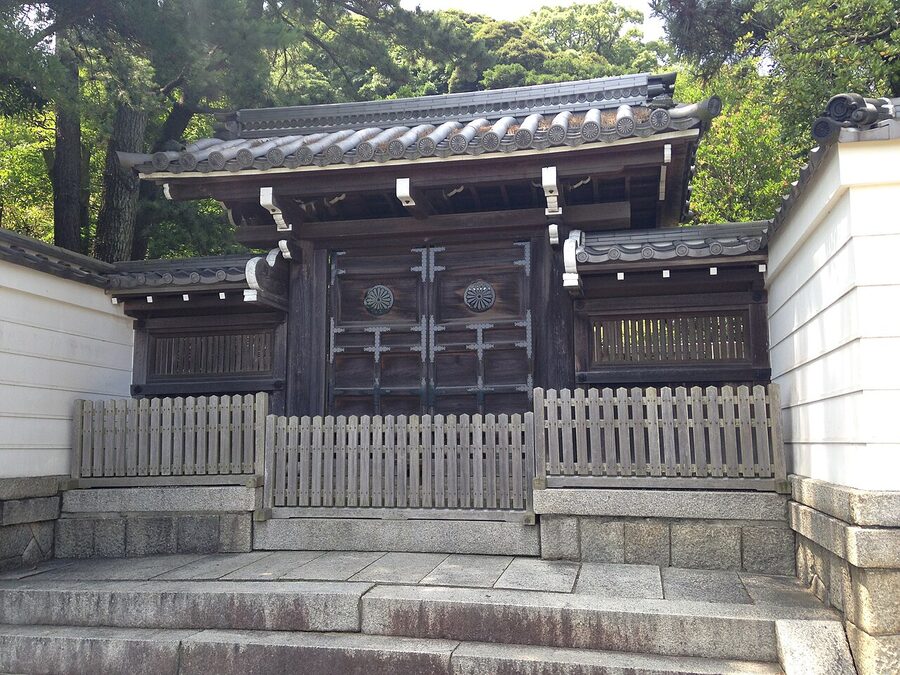
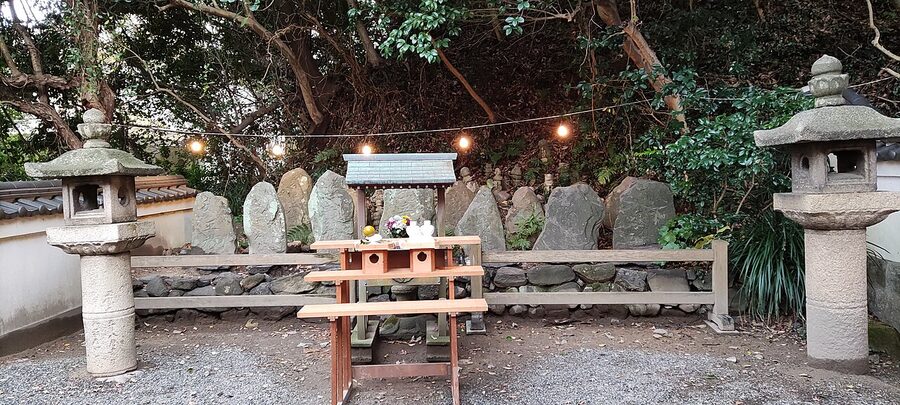
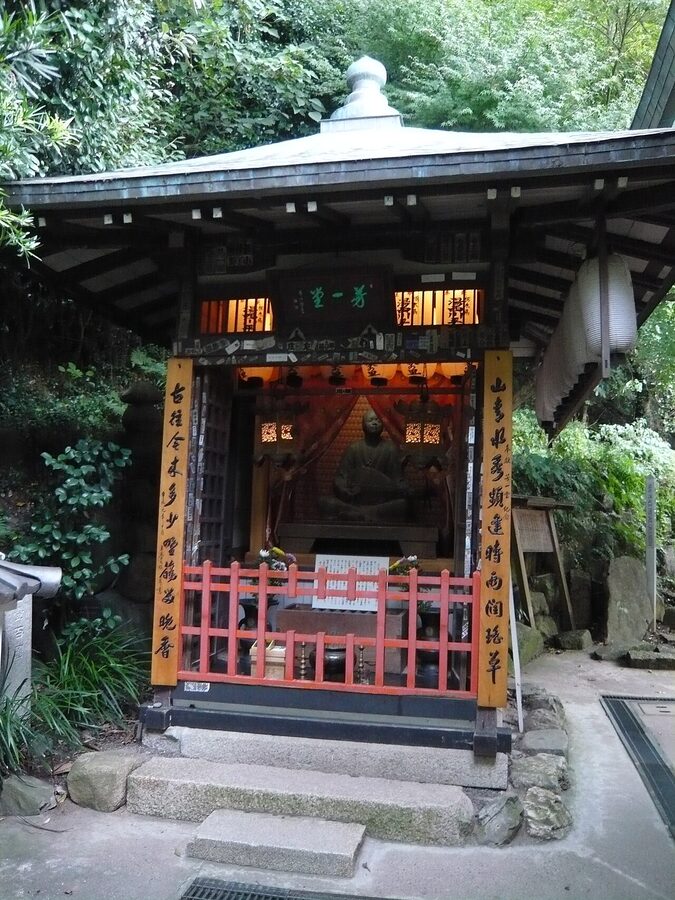
In the grounds are the Nanamori-zuka, a row of stones to the Taira dead put up after a run of shipwrecks in the strait was blamed on their ghosts, and the little Hōichi-dō, with a seated statue of Hearn’s earless lute player. Come on 2–4 May for the Senteisai, the festival for Antoku, when on the 3rd women dressed as Heian court ladies process to the shrine, in memory, the tradition says, of Taira women who survived in the port’s pleasure quarter and came every year to pray at the tomb. Next door is Shunpanrō, where the treaty ending the First Sino-Japanese War was signed in 1895, so you can do two wars in one afternoon.
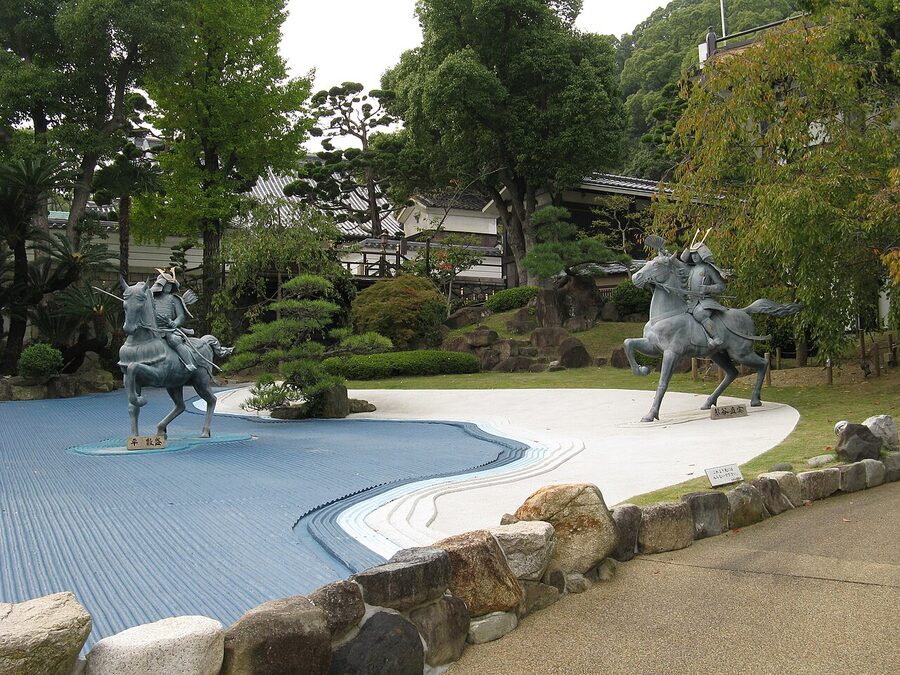
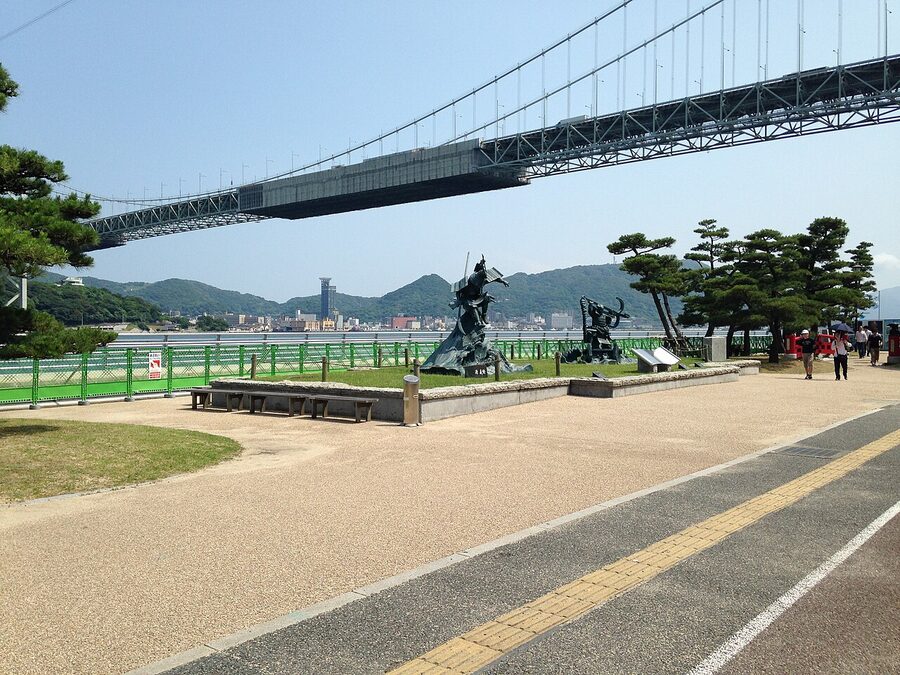
Mimosusogawa Park, about twelve minutes by bus from Shimonoseki station, faces the Hayatomo channel, the narrowest part of the strait, where the current really does run fast. It is free and always open, with statues of Yoshitsune and Tomomori, a stone marking the battlefield and the entrance to the Kanmon pedestrian tunnel, which takes you under the sea to Kyushu in about fifteen minutes’ walk. Stand there when a tide is running and watch the container ships fight it, then remember that the battle was probably fought further out, in slacker water.
You will not find the horse anywhere, and I have looked. Konoshita appears in no diary and has no shrine, no grave and no statue, while the war he supposedly started has hundreds. If you go to Uji, stand for a minute on the fan-shaped lawn where Yorimasa sat down, and think about how much of this war was decided by people who were not there, writing for audiences who wanted to cry. Then buy a ticket for the Phoenix Hall, which was there before any of them and has outlasted every one.