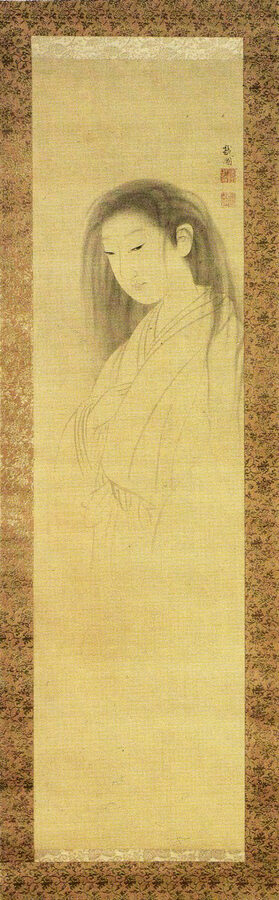
Every August a small Zen temple in Yanaka takes fifty ghosts out of their boxes and hangs them on the walls for a month. Part of the reason is so that you can come and look at them. The other part is that a hanging scroll left rolled up through a Tokyo summer gets eaten by insects, and the display has always doubled as mushiboshi, the annual airing that keeps the bugs off.
The oldest scroll in the room is attributed to Maruyama Ōkyo, the 18th-century Kyoto painter who, every guidebook will tell you, invented the Japanese ghost without feet. He didn’t. A Kyoto puppet-play book printed sixty years before Ōkyo was born already shows a ghost trailing away to nothing below the waist, and a hundred years before that the ghosts of Japan walked about on two perfectly good legs, dressed like the living, looking like the living, and very often mistaken for them. This is the story of how they lost the legs, and of the angry dead who came before them: the exiled minister who became a thunder god, the rebel whose head is still the most feared piece of real estate in Tokyo, and the three Edo women who have been coming back every summer for three hundred years.
In This Article
- A faint spirit: what the word actually means
- The types, and why the categories leak
- Ghosts that looked like the living: the old texts
- Thunder over the palace: Michizane and the vengeful dead
- Sugawara no Michizane
- From onryō to god of exams
- The other two: Sutoku’s curse and Masakado’s head
- Taira no Masakado
- Sixty years before Ōkyo: how the ghost lost its feet
- The burial clothes
- Oiwa, Okiku and Otsuyu: the three great Edo ghosts
- Oiwa and the Yotsuya Kaidan
- Okiku and the plate mansion
- Otsuyu and the peony lantern
- Why ghosts come out in August
- A hundred candles
- San’yūtei Enchō’s party, 1875
- Lafcadio Hearn’s Kwaidan
- From the well to the television
- Where to see Japan’s ghosts today
- Zenshō-an, Yanaka: the ghost paintings in August
- Okiku’s Well, Himeji Castle
- Oiwa Inari, Yotsuya
- Masakado’s Kubizuka, Ōtemachi
- Kitano Tenmangū, Kyoto
- Fifty ghosts in a summer temple
A faint spirit: what the word actually means
Yūrei (幽霊) is two characters: 幽, faint, dim, or deep in shadow, and 霊, spirit. The earliest dictionary citation for the compound comes from the Chūyūki, the diary of a Heian courtier, in an entry for the 4th day of the twelfth month of 1089, where it means nothing more frightening than “the soul of the dead”, the kind of soul you say prayers for. By around 1500 it had taken on its second meaning. In the noh play Funa Benkei, a figure rises out of a storm at sea and announces itself: “I am the yūrei of Taira no Tomomori, ninth-generation descendant of Emperor Kanmu.”
That is a useful line to keep in your head, because it shows what a yūrei originally was. It was a particular dead person, with a name and a grievance, who came back to a particular living person to say something.
Folklorists from Yanagita Kunio onwards have used exactly this to separate yūrei from obake and the wider world of yōkai. A monster haunts a place, appears to whoever happens along, and is frightening because you do not know what it is. A yūrei is frightening because you know exactly who it is, and so, usually, do they.
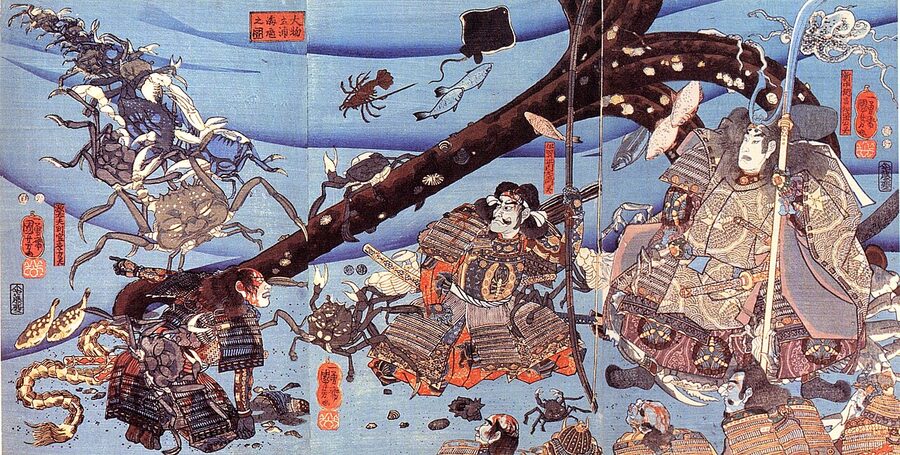
There is an old saying, “ikusa-jini wa bakete denai“, men killed in battle do not come back. Japanese ghost literature ignores it completely. The drowned Taira of the Genpei War, the clan of Taira no Kiyomori, are the most persistent ghosts in the canon, and they turn up in noh plays, picture scrolls, and Lafcadio Hearn, and on the backs of crabs in the Straits of Shimonoseki.
The types, and why the categories leak
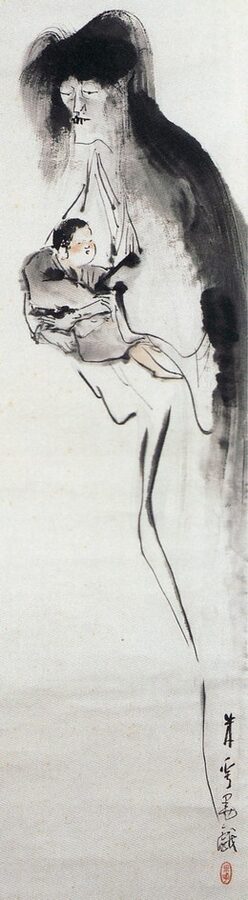
Modern books like to sort yūrei into neat kinds, and the kinds are worth knowing even if the ghosts themselves never respected them. An onryō (怨霊) is a spirit with a grudge, and a goryō (御霊) is the same thing once the state has given it a shrine and a title to calm it down. An ubume is a woman who died in childbirth. A funayūrei is a ghost of the drowned that rises beside a boat and asks for a ladle, and the fishermen’s rule is that you hand one over with the bottom knocked out, or the ghost will use it to fill your boat with seawater.
The ikiryō (生霊) breaks the rule that you have to be dead. In the Tale of Genji, written around 1000, Lady Rokujō’s jealousy leaves her body while she sleeps and kills Genji’s wife Aoi in childbirth. Rokujō wakes up smelling of the poppy-seed incense the exorcists were burning at Aoi’s bedside, and cannot wash it off. It is still the most unsettling thing in the book, and it is the reason a Heian courtier never entirely trusted his own dreams.
Ghosts that looked like the living: the old texts
Before the white robe and the missing feet, the ghosts in Japanese writing were hard to tell from anyone else. In the Nihon ryōiki, a collection of Buddhist tales put together by the monk Kyōkai in the early ninth century, a man called Makihito sets off from Bingo province to buy things for the New Year, sleeps out in a bamboo grove, and is kept awake all night by a voice saying “my eye hurts”. In the morning he finds a skull with a bamboo shoot growing through its eye socket. He pulls the shoot out, leaves an offering of food, and goes on to market, where his shopping goes suspiciously well.
In the full version of the tale the dead man later appears in person, thanks him, and reveals that he was murdered on the road by his own uncle. He looks, in other words, like a man.
The Konjaku monogatari, a huge collection compiled around the 1120s, devotes its whole 27th book to “spirits and demons” of Japan, and its ghosts behave the same way. The most famous is the old minister Minamoto no Tōru, dead for a generation, who appears in full court dress in his former mansion, the Kawara-no-in, to complain to the retired Emperor Uda, who had moved in, that it is still his house. Uda tells him off. Tōru, who has kept his manners, withdraws.
That politeness did not last. The Japanese sources describe a slow change, from ghosts who came back to announce or ask for something to ghosts who came back for revenge, and the change ran in step with something else: the discovery, at the Heian court, that the dead could be dangerous to the state.
Thunder over the palace: Michizane and the vengeful dead
The idea that an unhappy death could poison a whole country first shows up in the record as policy. On the 20th day of the fifth month of 863, during an epidemic, the court held a goryōe, a “rite for honoured spirits”, in the Shinsen-en garden beside the imperial palace in Kyoto. Six people were honoured, all of them losers in politics: chief among them Prince Sawara, the brother of Emperor Kanmu, who had been accused of plotting the assassination of Fujiwara no Tanetsugu in 785 and had starved to death on his way into exile. Monks read sutras, musicians played, there was dancing and archery, and the gates were opened so that ordinary people could come in and join the placating.
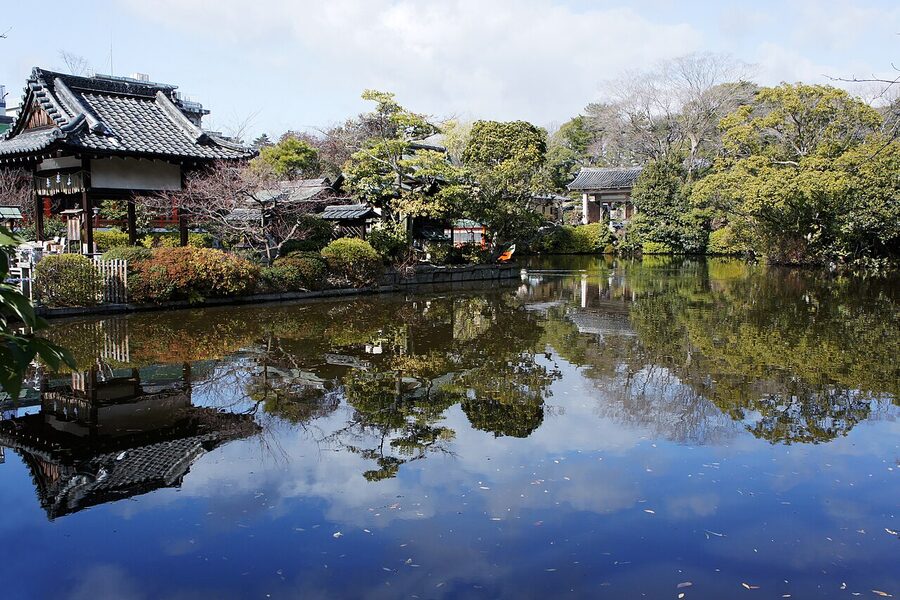
The rite caught on. Within decades there were goryōe all over the capital, and the one held for the plague god of the Gion shrine grew, over the next millennium, into the Gion Matsuri. Kanmu himself had already given Sawara the posthumous title of emperor, and historians have long suspected that the haunting played some part in Kanmu’s decision to abandon his new capital at Nagaoka for the one that would become Kyoto and give its name to the Heian era.
Sugawara no Michizane
Then came the case that turned the theory into the country’s best-known ghost story. Sugawara no Michizane was a scholar from a family of scholars, which in the Heian court made him something of an upstart, and he rose to Minister of the Right under the patronage of the retired Emperor Uda. In the first month of 901 his rival Fujiwara no Tokihira, head of the Fujiwara clan‘s main line, had him charged with plotting to put Uda’s son-in-law on the throne, and he was sent to Dazaifu in Kyushu with an empty title, no salary, no staff and a derelict house to live in.
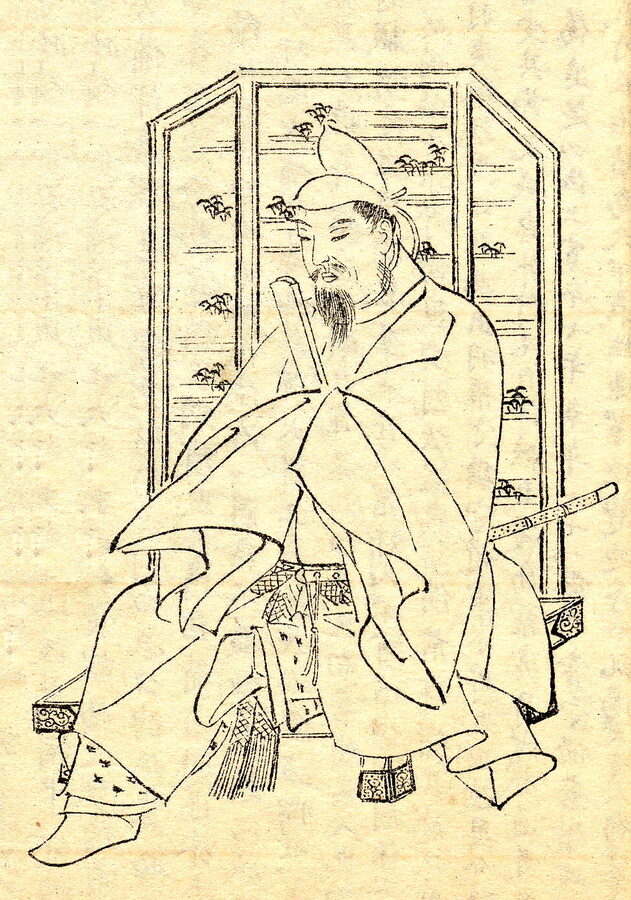
He died there on the 25th day of the second month of 903, aged fifty-nine by the Japanese count. Six years later Tokihira died at thirty-nine, by the same count.
In 913 Minamoto no Hikaru, one of the men who had backed the charge, drowned in a marsh while out hunting. When the crown prince Yasuakira, Tokihira’s nephew, died in 923, the official chronicle Nihon kiryaku stated plainly that it was the work of Michizane’s resentment. The court restored his rank, destroyed the order that had exiled him, and even changed the name of the era.
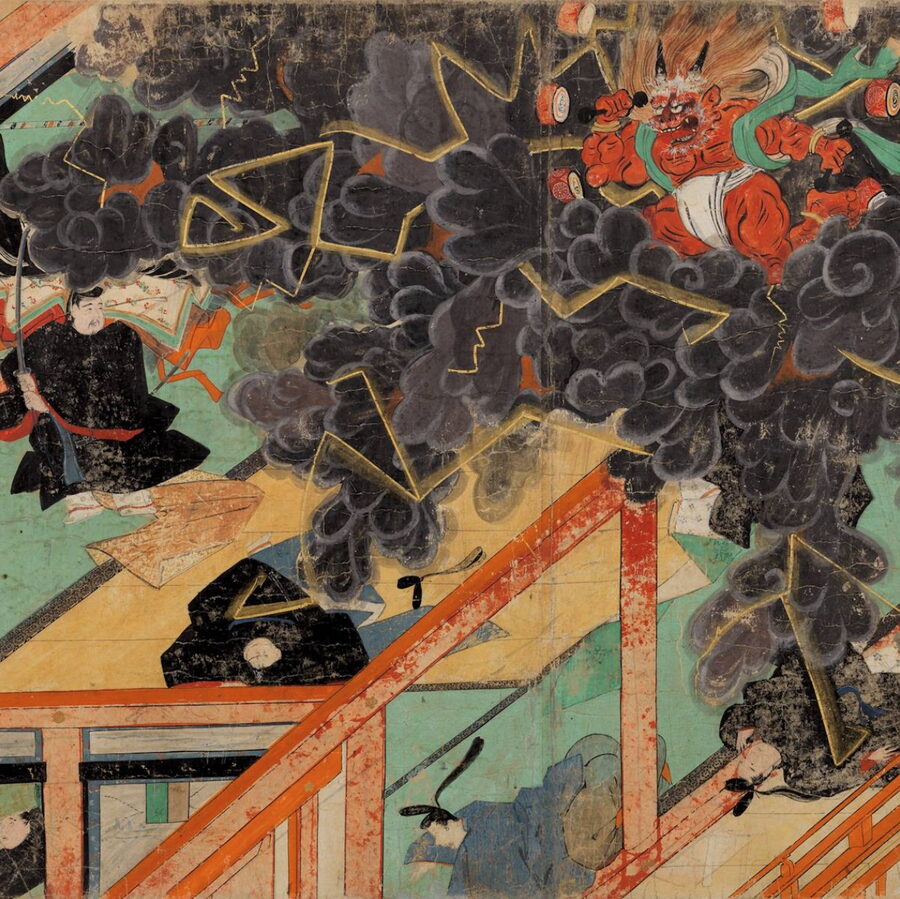
None of it worked. On the 26th day of the sixth month of 930 lightning struck the Seiryōden, the emperor’s own hall, during a meeting of the council. The courtier Fujiwara no Kiyotsura was killed, and so was Taira no Mareyo; Emperor Daigo, who had watched it happen, fell ill and died three months later. From then on Michizane was a thunder god, and thunder gods have to be housed.
From onryō to god of exams
In 942 a girl in the west of Kyoto called Tajihi no Ayako reported that Michizane had spoken to her and asked for a shrine at Kitano. Five years later a priest’s small son, Tarōmaru, said the same, and in 947 the shrine was built at the north-west corner of the city, where a thunder god had already been worshipped. Tokihira’s nephew Fujiwara no Morosuke paid to enlarge it in 959, which tells you something about how the Fujiwara felt. By 993 the court had made the dead man Chancellor of the Realm.
Over the following centuries the anger wore off and the scholarship stayed. Michizane became Tenjin, patron of learning and calligraphy, and Edo-period schoolrooms hung his portrait on the wall. About twelve thousand shrines in Japan now claim a share of his spirit, and every February they fill with students buying charms for university entrance exams. I find it hard to think of a better revenge: the man the Fujiwara drove out for being too clever now decides who gets into Tokyo University.
The other two: Sutoku’s curse and Masakado’s head
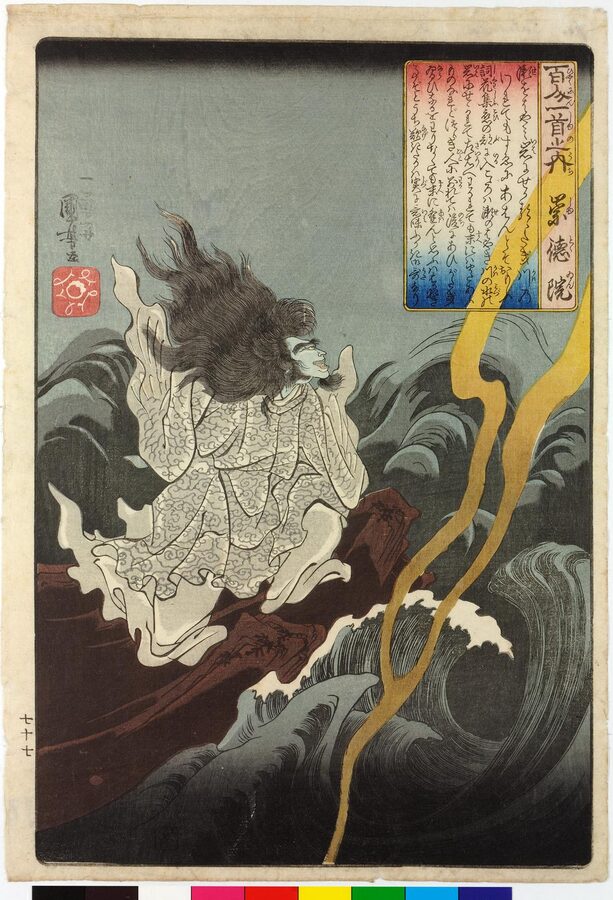
Japanese writers count three great onryō, and Michizane is the most respectable of them. The second is Retired Emperor Sutoku, who lost the Hōgen Disturbance of 1156 and was exiled to Sanuki on Shikoku. According to the war tale Hōgen monogatari, he spent his exile copying out five Mahayana sutras as penance and sent them to Kyoto to be placed in a temple. The court sent them back.
Sutoku, the tale says, then bit his tongue, wrote a vow in his own blood that he would become the great demon of Japan and “make the emperor a commoner and the commoners emperor”, and let his hair and nails grow until he looked like a tengu, which later legend says he became. (The various manuscripts disagree over whether the sutras themselves were written in blood or in ink.) He died in Sanuki on the 26th day of the eighth month of 1164. Twenty years later the court was ruled by warriors, which to a medieval reader proved the curse had worked.
Taira no Masakado
The third is the only one who was a rebel in fact as well as in accusation. Taira no Masakado was a warrior from the Kantō who, in 939, took over the provincial offices of the east, declared himself the “New Emperor”, and lasted about two months before he was killed in battle on the 14th day of the second month of 940. His head was taken to Kyoto and hung up by the river, the earliest recorded case of a gibbeted head in Japan.
The Taiheiki, a 14th-century war chronicle, says it did not rot. For months its eyes stayed open and every night it shouted for its body: “Where are the rest of me? Come here, join me to my head, and I will fight once more!”
A passing poet, Tōroku Sakon, made a joke about it in verse, at which the head laughed out loud and finally decayed. Other versions, much better known in Tokyo, have it flying east one night in a white light to look for its body, and coming down in a fishing village called Shibasaki, on a site that is now Ōtemachi. There is a shrine in Ōgaki that claims a god shot it down on the way.
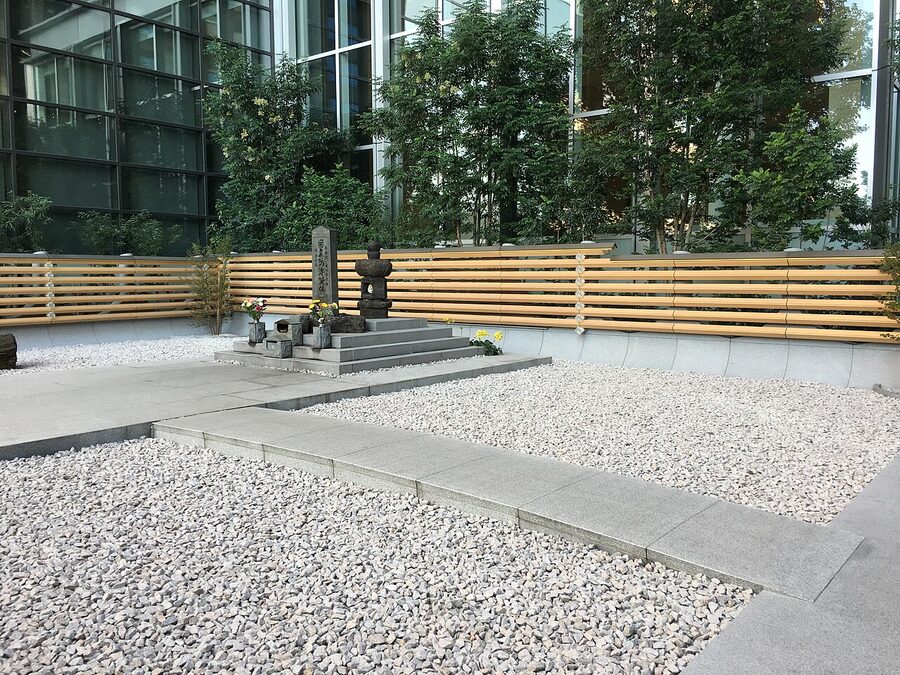
The mound has been looked after ever since. In 1307 a wandering priest of the Ji sect, Taa Shinkyō, gave Masakado a Buddhist name and put up a stone to calm him, and the temple beside it became the guardian of Kanda Myōjin, the shrine where Masakado is still a god.
In the Edo era the ground became part of the mansion of the Sakai family, who from 1749 were lords of Himeji Castle, a coincidence I will come back to. After the 1923 earthquake the Ministry of Finance built temporary offices on the mound, and a run of deaths among the staff persuaded the ministry to pull them down and hold a requiem in 1928. Japanese researchers have since pointed out that the most famous of those deaths, the finance minister Hayami Seiji, came in 1926 and had nothing to do with the building, but nobody in Ōtemachi has ever wanted to test the point.
Sixty years before Ōkyo: how the ghost lost its feet
The yūrei you would draw today (white robe, long loose black hair, a small white triangle on the forehead, hands dangling from the wrists, nothing below the knees) is an Edo invention, and Japanese researchers have done a careful job of dating it. Ghost-story books from the Genroku era, around 1700, still draw their ghosts with two feet. The Taihei hyaku monogatari of 1732 shows them thinning away below the waist. Through the 1720s and 1730s the lower body goes misty, and later the elbows bend and the hands begin to hang.
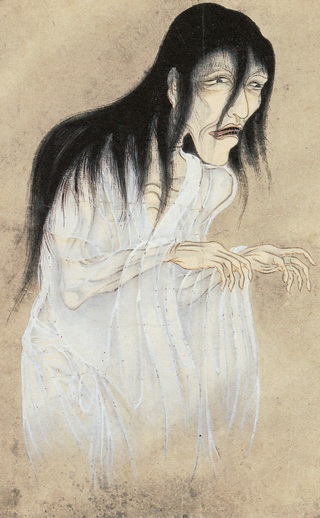
It took a long time to settle. The haiku poet Yokoi Yayū, in a collection of prose pieces published in the 1780s, remarks that some ghosts have a lower half and some don’t, as if this were one of those questions like whether to put the milk in first. And the claim that Ōkyo started it is, Japanese art historians agree, either a popular myth or simply wrong: a jōruri puppet-play book printed in Kyoto in 1673, sixty years before Ōkyo’s birth, already has a legless ghost among its illustrations. What Ōkyo did was paint ghosts so well that every later legless ghost got attached to his name, and a rakugo story still has one of his ghosts climbing out of its scroll at night, like the carved dragon of the sculptor Hidari Jingorō going down to the river for a drink.
The burial clothes
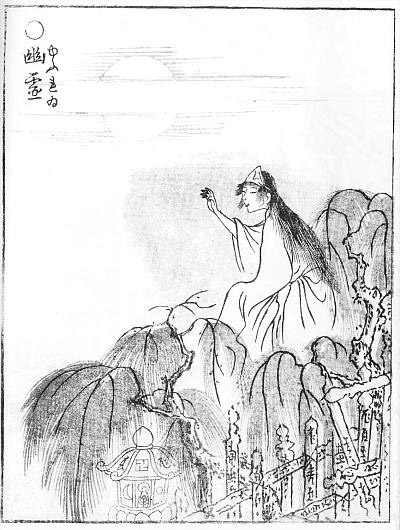
Every part of the costume comes from the funeral. The white robe is the kyōkatabira, the plain unlined kimono that the dead were dressed in for the coffin, often written over with sutras.
The hair is loose because women’s hair, worn up throughout life, was let down for burial. The white triangle is the hitai-eboshi or tenkan, a piece of white paper or cloth tied around a corpse’s forehead, and in the Edo period it was marked with a Buddhist swastika or the character シ. In other words, a yūrei is dressed exactly as her family sent her off, and the costume says what she has come back about.
The rest of the vocabulary filled in around the costume. Ghosts come at ushimitsu, the third quarter of the hour of the Ox, about two in the morning, whereas older monsters had preferred dusk and the crossroads at the edge of town.
They are often accompanied by hitodama, floating blue-white balls of flame. Kabuki gave them their entrances: the trapdoor, the long kimono that hid the actor’s feet, the drum that rolled underneath, and a technique of flying the actor across the stage on wires. Some regions still call the red spider lily, which grows thick in graveyards at the autumn equinox, the yūrei-bana, ghost flower.
Oiwa, Okiku and Otsuyu: the three great Edo ghosts
By the 19th century everyone in Edo knew three ghosts by name, and they are still known as the san dai yūrei, the three great yūrei. All three are women, and two of the three had been wronged by a samurai household. That pattern is not an accident. The ukiyo-e and theatre audiences who made them famous were townspeople, and their ghost stories had a habit of putting the samurai class on trial.
Oiwa and the Yotsuya Kaidan
The most famous ghost story in Japan began as a local scandal in Yotsuya. The Yotsuya zōdanshū, a manuscript with a colophon dated 1727, tells of Oiwa, the plain only daughter of a low-ranking Tamiya family, whose husband Iemon, a rōnin married into the house, joins his superior in a scheme to drive her out so that he can take on the superior’s pregnant mistress. Oiwa learns how she has been deceived, goes out of her mind, and vanishes. Afterwards everyone connected with the deception dies, the Tamiya line comes to an end, and strange things happen on the empty plot until a later owner builds an Inari shrine there.
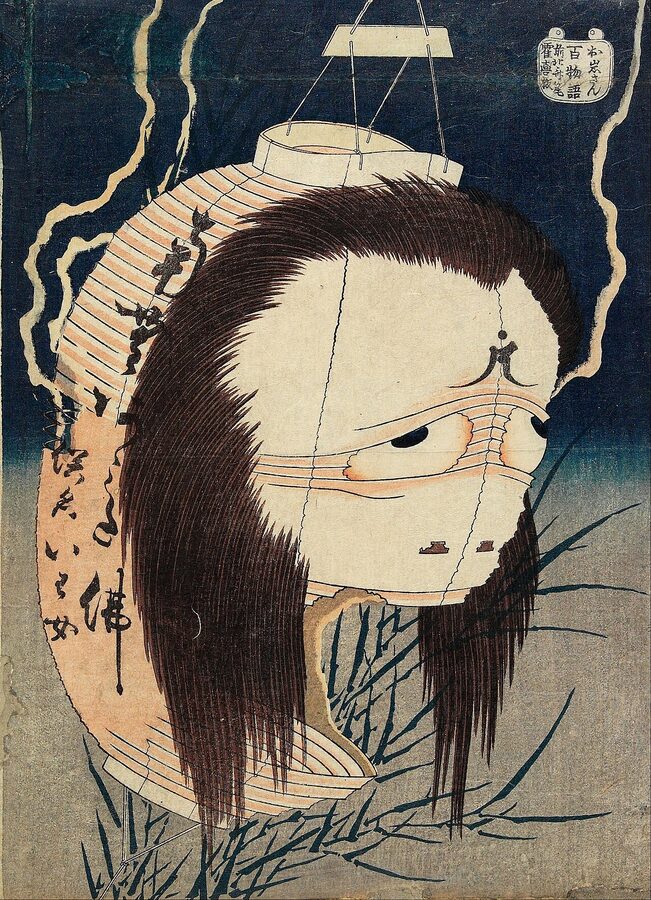
A report sent to the shogunate by Yotsuya’s town elders in 1827 gives a slightly different version: Oiwa disappeared in the 1680s, eighteen people died, and when a later resident was troubled by strange happenings on the site, they stopped only after he had an Inari shrine set up and held services for the dead. That report was filed two years after the play opened, which led the kabuki scholar Gunji Masakatsu to suspect that Nanboku had paid for it as publicity. The Tamiya family itself, which still exists, has always said that Oiwa was a devoted wife in a happy marriage, and the writer Okamoto Kidō noticed a century ago that the townspeople of Edo told the story as a horror and the samurai families of the hills told it as a tale of virtue. Her grave, at Myōgyō-ji in Sugamo, gives her death as the 22nd day of the second month of 1636, earlier than either version allows.
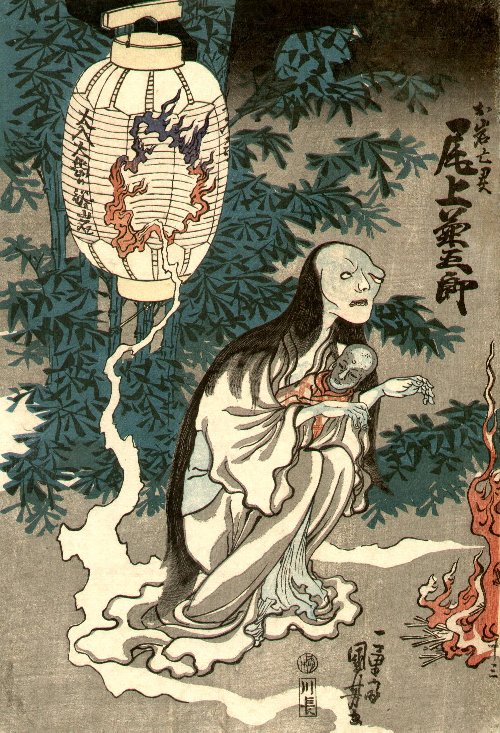
Tsuruya Nanboku IV turned all this into Tōkaidō Yotsuya Kaidan, which opened at the Nakamura-za in Edo in the seventh month of 1825. It was a summer show, and Nanboku set it inside the world of the 47 Rōnin: the two plays were performed interleaved over two days, so that the audience got a ghost story spliced into the most patriotic play in the repertoire, and the same young samurai who kills Iemon at the end goes off to join the night raid. In Nanboku’s version Iemon’s new in-laws send Oiwa a “medicine” that disfigures her; she combs her hair, which comes out in bloody handfuls, and dies on a blade. Her body and a murdered servant’s are nailed to either side of a door and thrown into a canal, where Iemon, fishing, turns the door over and gets one corpse and then the other.
I will leave the stagecraft to the article on kabuki, which covers it properly.
Two details matter here. Japan now marks 26 July as Yūrei no Hi, Ghost Day, in honour of the premiere, which takes an old-calendar date and pins it to the modern one, and Japanese sources cannot agree on the opening day in any case. And the habit started early of the lead actors paying their respects to Oiwa before a production, at her grave or at the Yotsuya shrine, because productions that didn’t were said to suffer accidents. Every cast I have heard about still goes.
Okiku and the plate mansion
Okiku’s story, Sarayashiki, “the plate mansion”, is older and much harder to pin down. A maid is entrusted with a set of ten precious plates. One is lost or broken (in some versions hidden by a man whose advances she has refused), she is killed for it and thrown into a well, and every night her voice comes up out of the well counting: “one, two, three”, up to nine, and then a scream.
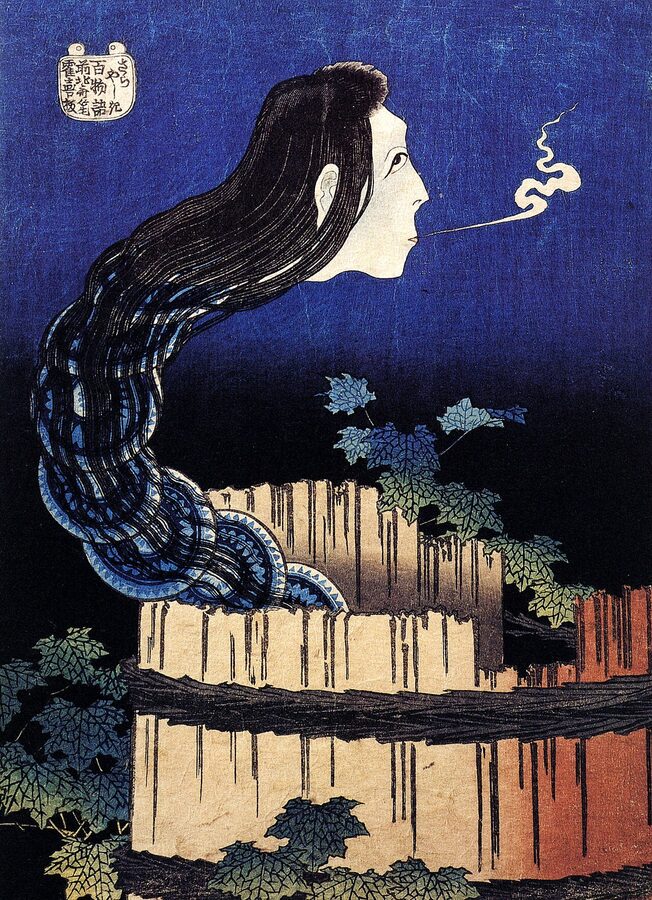
The earliest version anyone has found, in the Chikusō yawa of 1577, is set near Himeji after 1441 and has a mistress called Hanano, a missing abalone-shell cup and a pine tree rather than a well. Plates and wells turn up in Edo anecdotes of the early 18th century. A kabuki play on the subject was staged in Kyoto in 1720, and in 1741 a puppet play, Banshū Sarayashiki, set it firmly in Himeji in the Muromachi period, with a wicked retainer called Aoyama Tetsuzan and a maid called Okiku who overhears his plot to poison their lord.
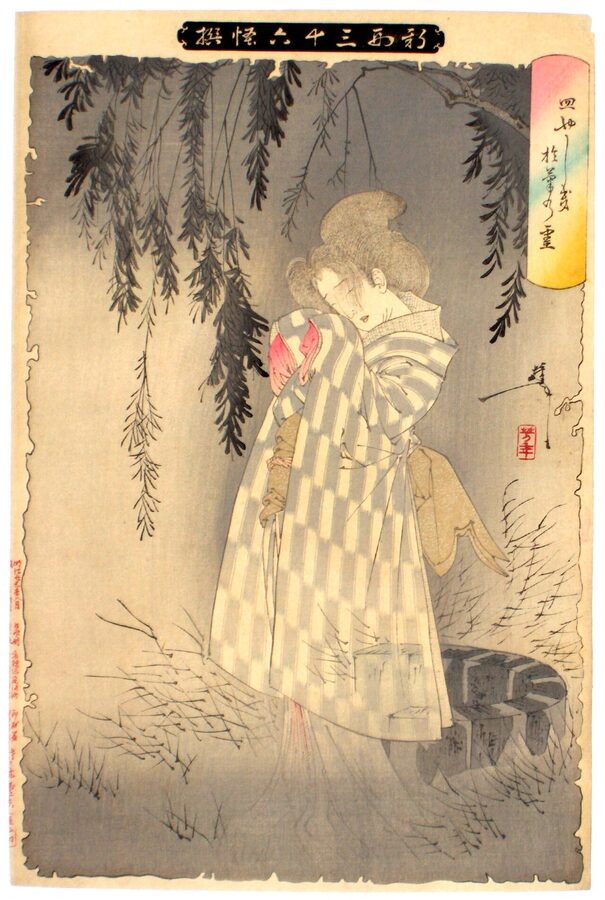
Then in 1758 the storyteller Baba Bunkō moved the whole thing to Edo. In his version, the one Tokyo still tells, the house is in Banchō, the date is the 2nd day of the first month of 1653, and the master, Aoyama Shuzen, cuts off Okiku’s middle finger before she escapes and throws herself down the well. In the end a famous priest is called in, waits for the voice to reach “nine”, and calls out “ten!”, at which the ghost says “Ah, how happy” and is never heard again. The trouble, as Japanese commentators have enjoyed pointing out, is that no Aoyama Shuzen ever held the office the story gives him, and the priest it names had been dead for more than two hundred years.
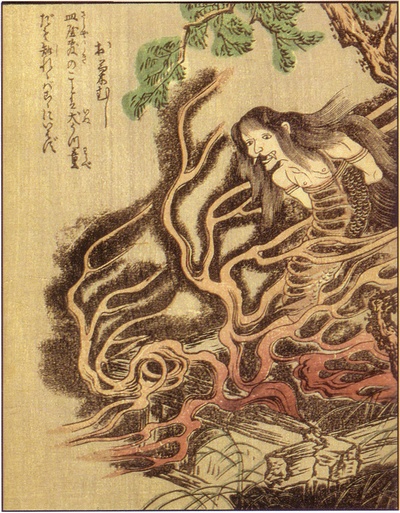
The Himeji version has the better relics. The castle contains a well that has been called Okiku’s since the castle opened to the public in the Taishō era; before that it was known by the dull name of the “bucket well”. In the Edo period the well people pointed to was out in the castle’s Kiri-no-baba district. I tell you this not to spoil it but because I think the shift is the best part of the story: a castle that had never had a ghost of its own adopted one the moment the public started coming through the gates.
Otsuyu and the peony lantern
The third great ghost is a different creature altogether, and she arrived by way of China. In a Ming-dynasty collection of tales, the Jiandeng xinhua of about 1378, a young scholar takes up with a beautiful woman who comes to his door every night with a maid carrying a lantern decorated with peonies. She turns out to be a corpse. Asai Ryōi moved the story to Japan in his collection Otogibōko of 1666, and two centuries later San’yūtei Enchō, the greatest rakugo storyteller of the 19th century, rebuilt it as Kaidan Botan Dōrō, a sprawling saga of murder and revenge that he composed in his twenties in the early 1860s.
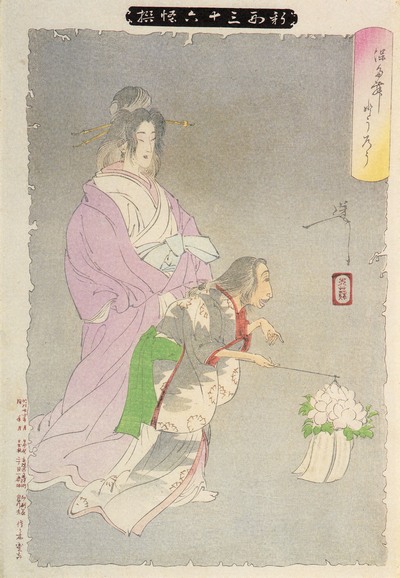
The part everyone knows is only a fragment of Enchō’s story. The samurai’s daughter Otsuyu dies for love of the young rōnin Hagiwara Shinsaburō and comes back to him night after night. A fortune teller sees death in his face; a priest gives him a Buddhist statue and paper charms to seal the doors; and Otsuyu, unable to get in, circles the house calling to him until the servants next door, offered a hundred gold pieces by the ghost, peel the charms off. Shinsaburō is found dead in the morning, in most tellings with a skeleton in his arms.
Enchō’s version mattered well beyond ghost stories. A stenographic transcript of his telling was published in 1884, and the novelist Futabatei Shimei, trying to write fiction in the language people actually spoke, used Enchō’s transcripts as his model. So one strand of modern written Japanese goes back to a man telling a ghost story to a room in Edo.
Why ghosts come out in August
If you ask people in Japan why ghost stories belong to summer, they will usually give you two answers at once. The first is Obon: for a few days in August the dead are invited home, fires are lit to guide them in and see them off, and the whole country is thinking about its dead anyway. The ghosts who have nobody to welcome them, or who died with something unfinished, are the ones who wander. Buddhist temples hold segaki services in the same season to feed exactly those spirits, the hungry dead who would otherwise make trouble.
The second answer is that a good fright cools you down. People say the shiver of a ghost story takes the edge off a summer night, and the kabuki theatres took this seriously.
In the hot months the stars went on holiday and the theatres put on natsu kyōgen, summer plays with lesser actors, real water on stage and plenty of special effects, and ghost plays became a summer speciality. Yotsuya Kaidan was one of them. The idea of ghost stories as summer entertainment has never really gone away; every August Japanese television still runs its kaidan specials.
A hundred candles
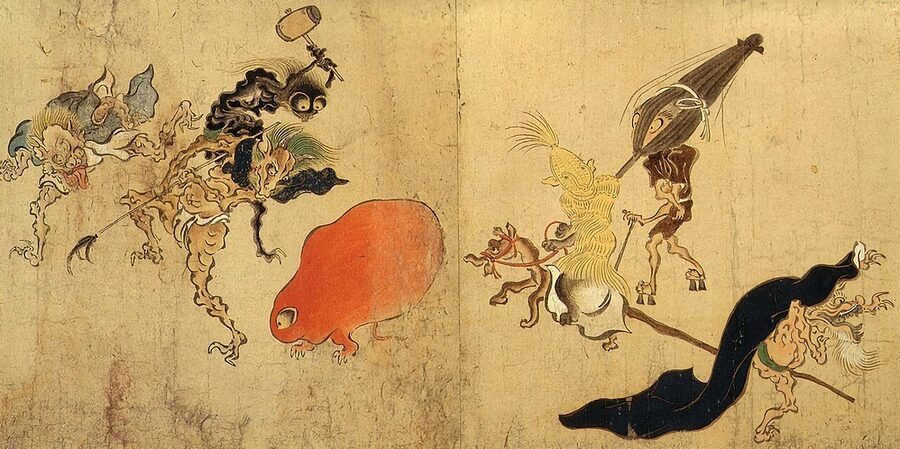
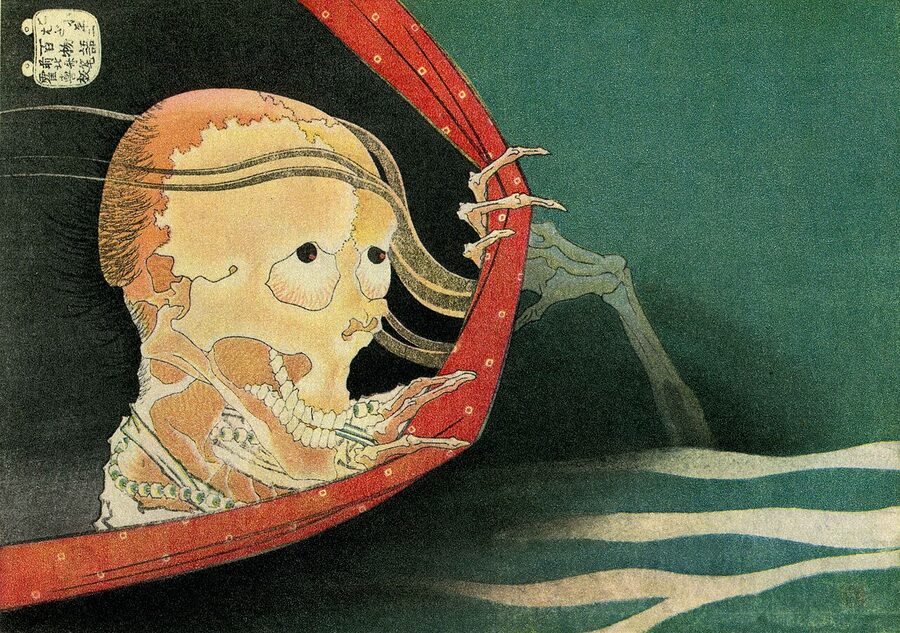
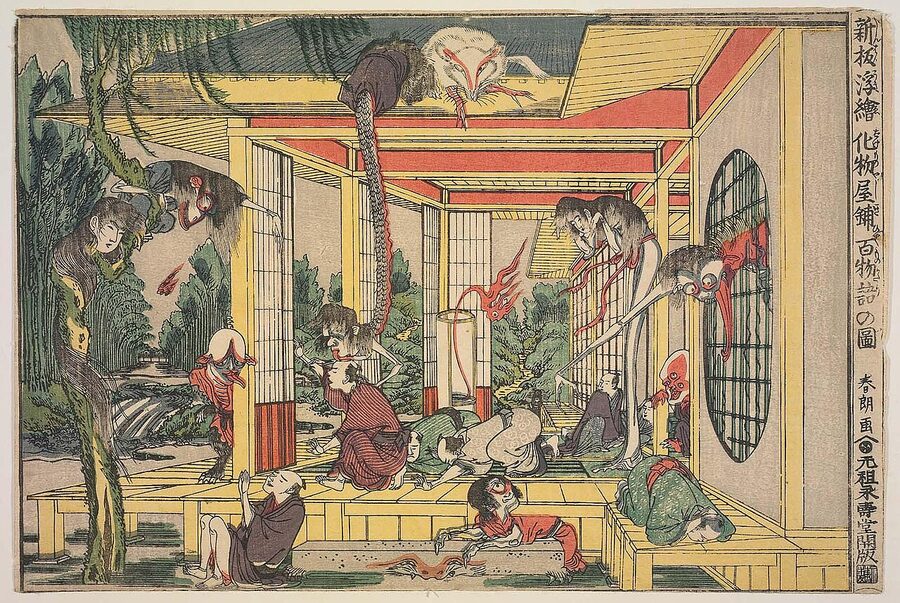
The party game behind that early Hokusai print is hyakumonogatari kaidankai, the gathering of a hundred tales. You light a hundred wicks in a room (one Edo source says you cover the lamps in blue paper and lock away everyone’s swords), and you take turns to tell a frightening story, putting out a light after each one. When the hundredth goes out in total darkness, something will appear. It probably began as a test of nerve for young samurai, and by the late 17th century it had turned into a craze.
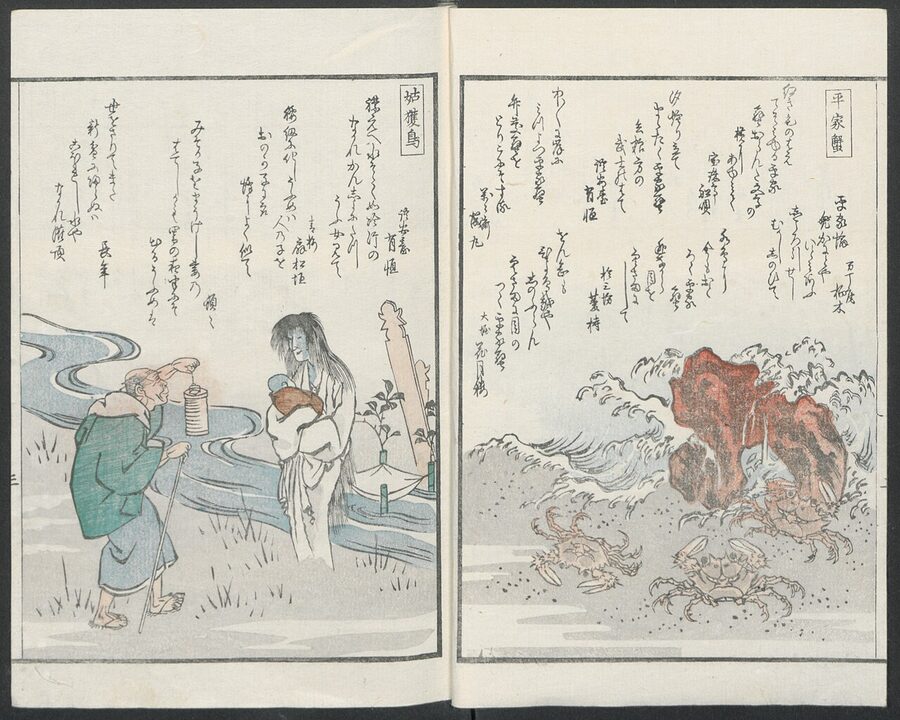
The craze produced the first great boom in ghost books. The Shokoku hyaku monogatari, “a hundred tales from the provinces”, came out in 1677, followed by a long line of imitators. Some of the earliest are knowingly cheerful about it: one joke-book of 1659 opens with a party that tells a hundred stories, puts out the last light, finds nothing has happened, and laughs at the idea that anything frightening could appear in such a peaceful reign. A popular version of the game is still played today, and most groups stop at ninety-nine.
San’yūtei Enchō’s party, 1875
The single most useful ghost night in history, for my purposes, happened on 11 February 1875 at a restaurant in Yanagibashi, Tokyo. San’yūtei Enchō, by then the most famous storyteller in the city, held a kaidan party and hung the room with ghost paintings he had been collecting. The scholar Yoda Gakkai went along and wrote in his diary that the painting by Kikuchi Yōsai was the best of them, and that the evening was so packed and noisy it did not feel like a ghost party at all.
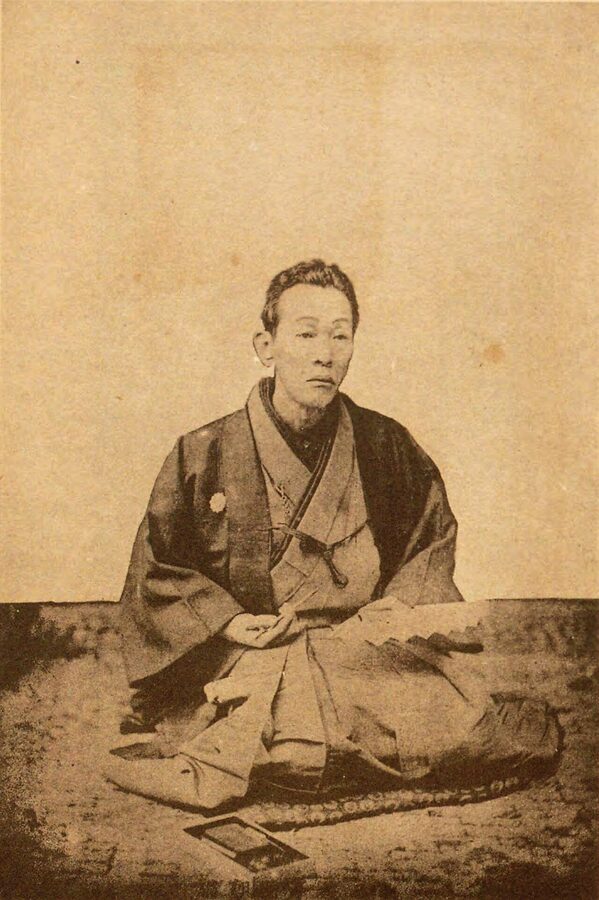
Tradition says Enchō went on to collect a hundred ghost paintings, one for each tale. Fifty now belong to Zenshō-an, given to the temple by the family who inherited Enchō’s name. The art historian who catalogued them for the temple found the story a little too tidy: an earlier biography counts forty scrolls in the original gift, and two of the paintings carry dates from the summer of 1906, six years after Enchō died. So the collection is part Enchō and part memorial, which seems to me entirely in the spirit of the thing.
Lafcadio Hearn’s Kwaidan
The Meiji era sent the Japanese ghost abroad. Lafcadio Hearn was a Greek-Irish journalist who arrived in Japan in 1890, taught in Matsue, married a samurai’s daughter, Koizumi Setsu, and became a Japanese citizen as Koizumi Yakumo. He spent his last years in Tokyo turning the stories Setsu found for him into English. Kwaidan: Stories and Studies of Strange Things was published in 1904, with an introduction dated 20 January, and Hearn died on 26 September the same year.
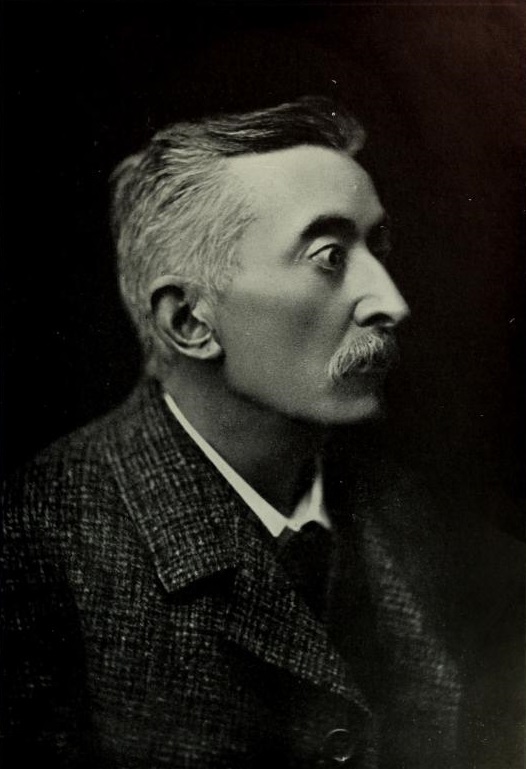
Kwaidan is an odd and lovely book, and it is not really a collection of the Edo classics. Hearn left Oiwa and Okiku alone and went for older, stranger material, much of it found and told to him by Setsu. Its best-known story is the one about Hōichi, a blind player of the biwa at the temple of Amida-ji in Shimonoseki, who is summoned night after night to perform the tale of the Heike for an invisible audience of noble listeners. They are the drowned Taira of Dan-no-ura, and they are coming for him.
Kwaidan was turned into a film by Kobayashi Masaki in 1964 (Japanese sources often give 1965, the year it went on general release in Japan), and for most of the 20th century Hearn was how the English-speaking world met a Japanese ghost at all. Then it met one coming out of a television.
From the well to the television
Suzuki Kōji’s novel Ring came out in 1991, and Nakata Hideo’s film in 1998. Its ghost, Sadako, is a psychic girl murdered and thrown down a well, and she climbs out of the videotape and then out of the television set in a long white dress, with her black hair hanging over her face and one eye, when you finally see it, ruined in the way Oiwa’s was. Every element is two hundred years old: Okiku’s well, the burial white, the loose hair, the grudge. The Western remakes simply copied the costume, and the Edo ghost became a global horror cliché in about five years.
The odd thing is that real Japanese ghosts, in the sense of the ones people report, have gone back to looking like the living. After the 2011 tsunami a sociology seminar at Tohoku Gakuin University collected stories from taxi drivers in Ishinomaki.
One picked up a woman in her thirties in a heavy winter coat on a summer night; she asked to go to a district the wave had flattened and, when he told her there was nothing there, said “Have I died?” and was gone from the back seat. Nobody in those stories wears a white robe. They wear what they were wearing in March.
Where to see Japan’s ghosts today
You can go looking for every one of these ghosts. My advice is to start with the paintings, then the graves, and to leave the “haunted spots” to the late-night television crews. The places below are the real ones, the ones with a documented connection, and every one of them is in a city you are probably visiting anyway.
Zenshō-an, Yanaka: the ghost paintings in August
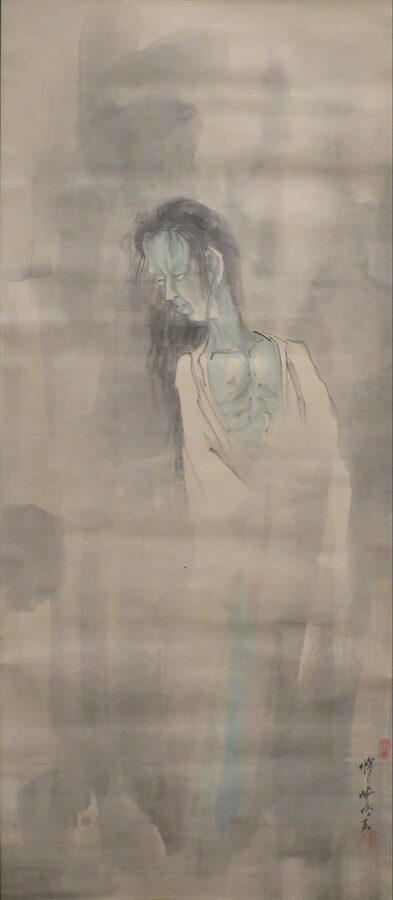
Zenshō-an is a Rinzai Zen temple founded in 1883 by Yamaoka Tesshū, the swordsman and statesman, to pray for those who died in the upheavals around the Meiji Restoration. Tesshū was Enchō’s Zen teacher, and Enchō is buried in the cemetery behind. For the whole of August the temple hangs all fifty of the ghost scrolls, from the one attributed to Ōkyo through works by Shibata Zeshin, Kawanabe Kyōsai, Tsukioka Yoshitoshi and Kikuchi Yōsai.
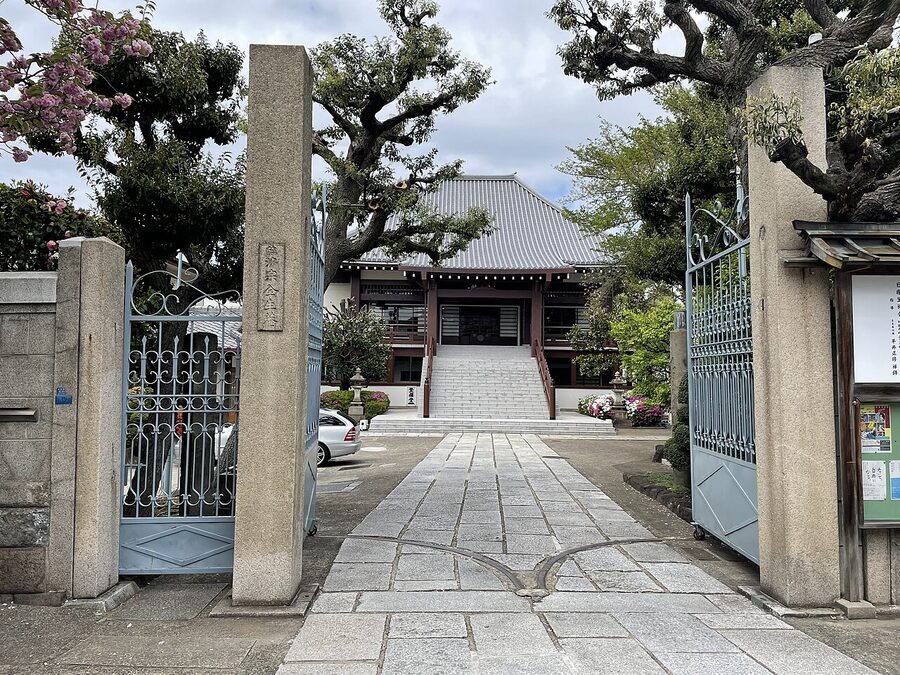
The exhibition runs from 1 to 31 August, every day including weekends and holidays, from 10:00 to 17:00 with last entry at 16:30, and costs ¥500. The address is Yanaka 5-4-7, Taitō-ku, and it is about five minutes’ walk from Sendagi Station on the Tokyo Metro Chiyoda Line. Around the 11th, the anniversary of Enchō’s death, rakugo performers hold a memorial for him, and the temple fills up. Go on a weekday morning early in the month if you want to stand in front of the paintings without someone’s phone in the way.
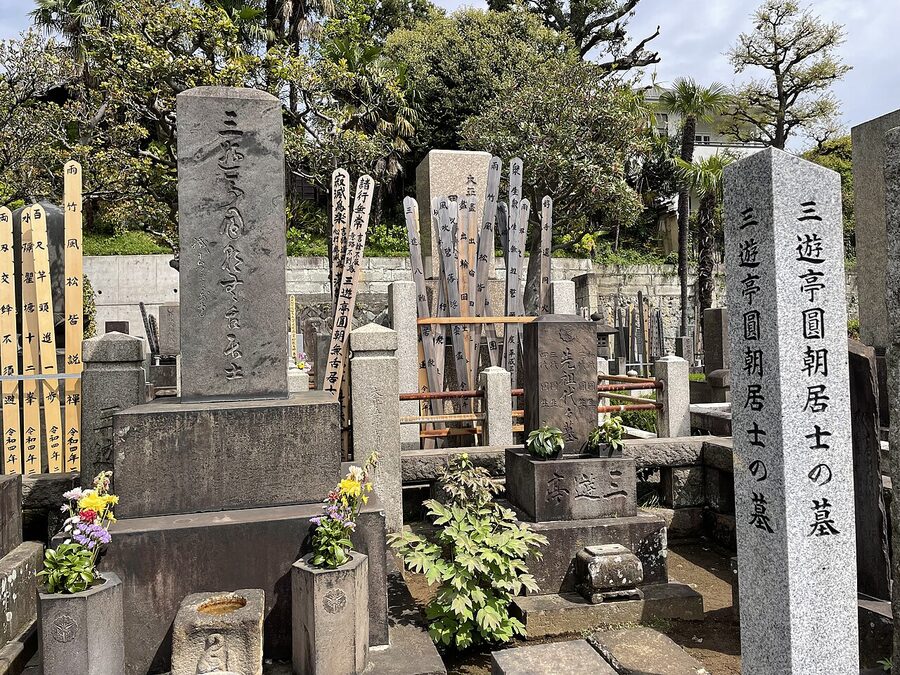
Allow an hour, then walk south through Yanaka Cemetery, where the last shogun Tokugawa Yoshinobu is buried, to Nippori Station. It is the right walk for the afternoon, and in August it is about the only shade you’ll get.
Okiku’s Well, Himeji Castle
The well is inside the castle grounds, close to the main route up to the keep, in the area called the Kami-yamazato, and a grille keeps you from leaning in too far. You will see it with the main keep standing above it; that view is, I suspect, the reason it acquired Okiku in the first place.
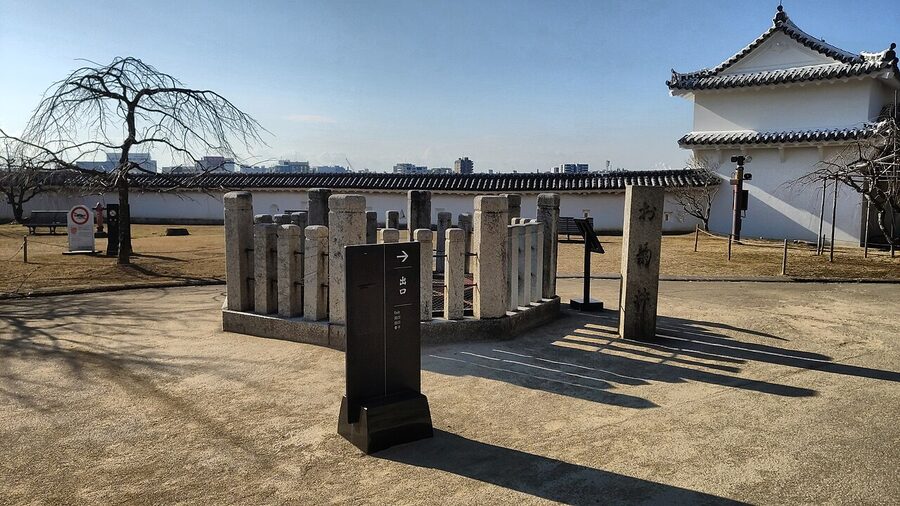
Himeji Castle opens from 9:00 to 17:00 with last entry at 16:00, and closes only on 29 and 30 December. Since 2026 adult admission (18 and over) is ¥2,500, ¥1,000 for residents of Himeji, and free for anyone under eighteen; a combined ticket with the Kōko-en garden is ¥2,600. The castle is a fifteen-minute walk up Ōtemae-dōri from JR Himeji Station. There is much more to say about the castle itself in the Himeji Castle article, and you should give it a full morning.
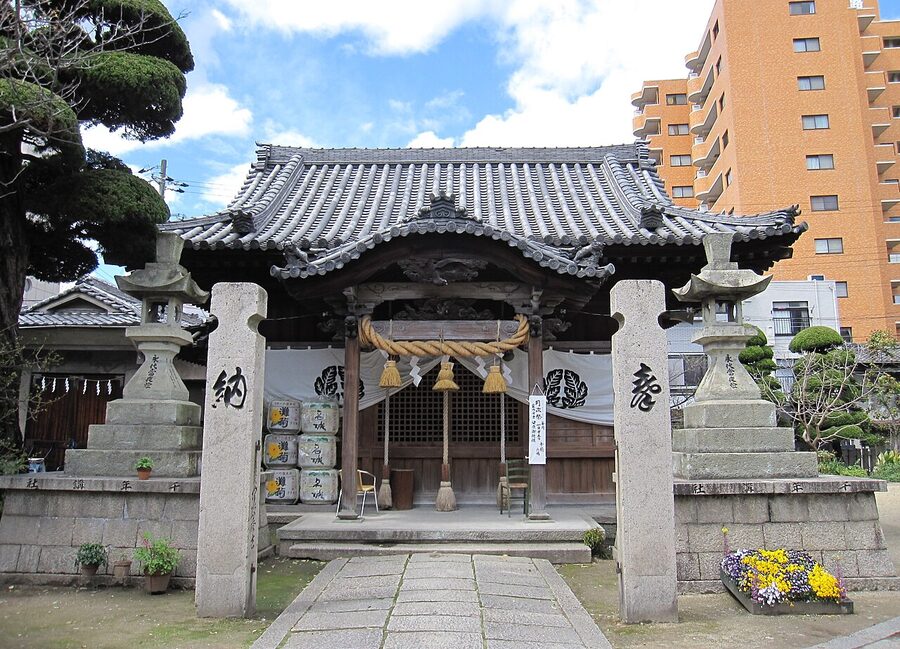
On your way back to the station, make the short detour to Jūnisho Shrine, which keeps a little shrine to Okiku as “Princess Kiku” and was already doing so by the mid-18th century, when the puppet play mentions it. It is at Jūnishomae-chō 120, about 400 metres west of the Shirogane crossing on Ōtemae-dōri. Remember also that the Sakai family who owned Masakado’s mound in Edo were Himeji’s lords. You can tie Okiku’s well and Masakado’s head together with a single clan crest, which is the kind of thing I enjoy far more than I should.
Oiwa Inari, Yotsuya
The site of the Tamiya house is in Yotsuya Samon-chō, and it has two Oiwa shrines facing each other across a narrow lane. Oiwa Inari Tamiya Shrine began as the Tamiya family’s household Inari shrine. It burned in 1879 and moved to Shinkawa in Chūō-ku (where a second Tamiya shrine still stands), and the Yotsuya one was rebuilt on the old site in 1952.
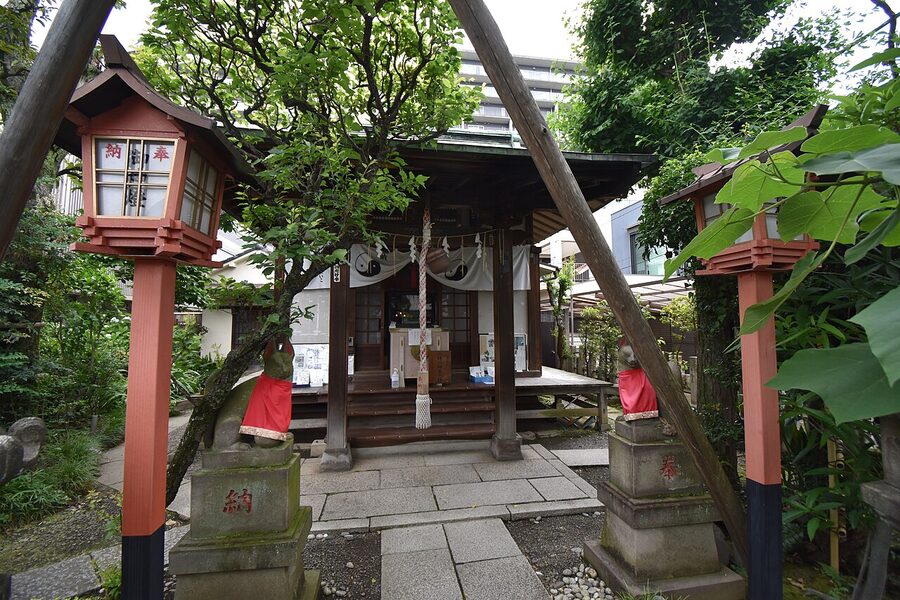
Across the lane is Yōun-ji, a Nichiren temple founded in the early Shōwa period when the locals, having lost their Oiwa shrine to Chūō-ku, started a society to keep a piece of her in Yotsuya. It has a well associated with her and a good deal more theatre about it. Both are free and both are about four minutes from Exit 3 of Yotsuya-sanchōme Station on the Marunouchi Line, or eight minutes from JR Shinanomachi.
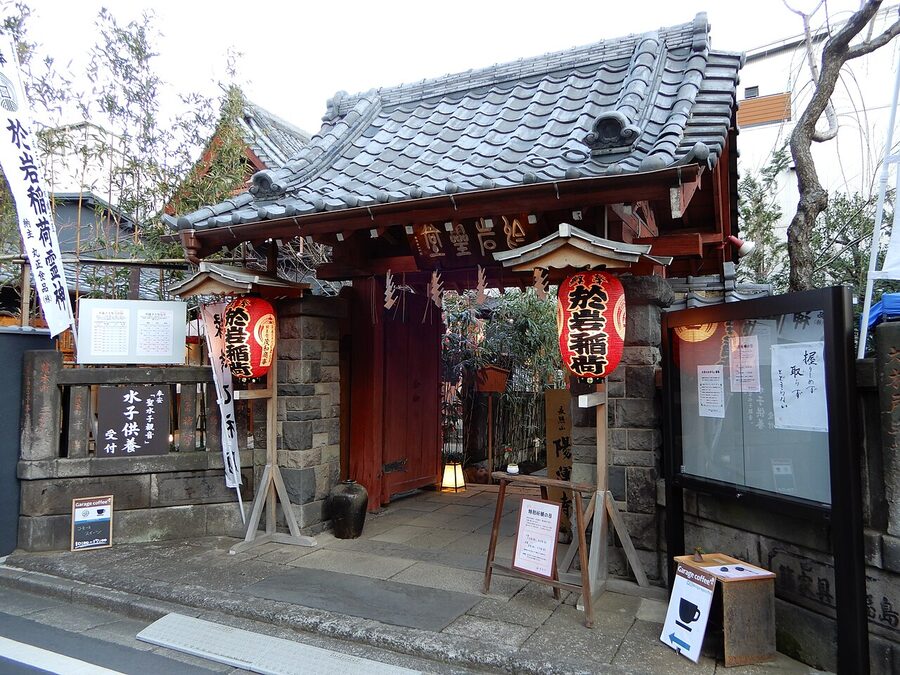
If you want her grave, it is at Myōgyō-ji in Nishi-Sugamo, Toshima-ku, where the Tamiya family’s temple moved in 1909. It is a working temple, not a sight, so be quiet about it.
Masakado’s Kubizuka, Ōtemachi
The Kubizuka sits at Ōtemachi 1-chōme, a minute from Exit C6a of Ōtemachi Station, wedged between office towers in what is now some of the most expensive land in Japan. There is no fee. Since the 2021 renovation you may not leave offerings other than coins in the box with Masakado’s nine-star crest; the stone frogs that used to crowd the mound (kaeru, frog, also means “return”, and salarymen sent to the provinces left them here hoping to come back) have been cleared away.
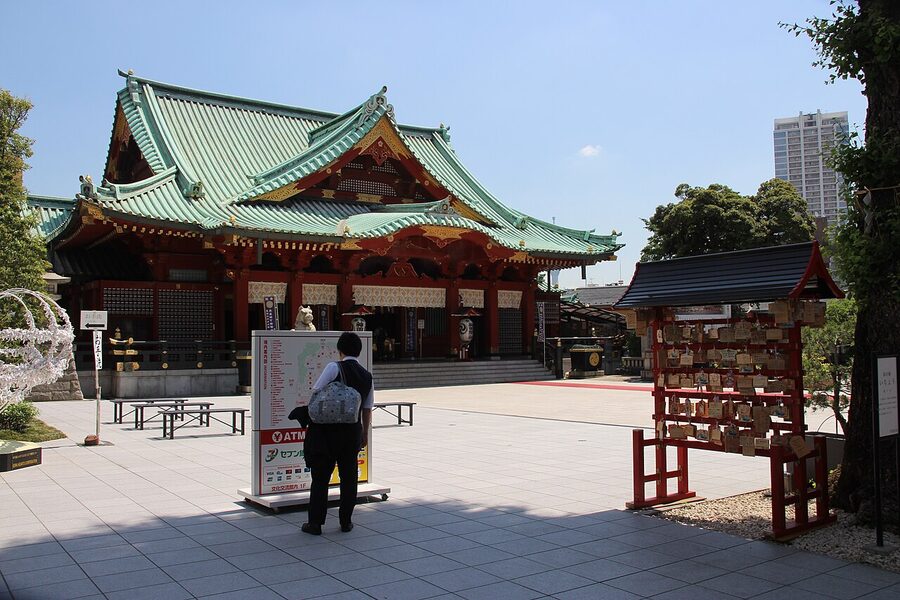
Bow, put in a coin, and do not climb on anything: in August 2026 a man live-streamed himself shouting from the top of the mound, central Tokyo had days of violent thunderstorms straight afterwards, and the newspapers duly made the connection. From the Kubizuka it is a 20-minute walk, or two stops on the subway, to Kanda Myōjin, where you can see his shrine and, in May of odd-numbered years, the Kanda Matsuri. The moats and walls of Edo Castle are a few minutes west of the mound, which makes it easy to fit into a morning.
Kitano Tenmangū, Kyoto
Kitano Tenmangū is the head shrine of the Tenjin cult, and the present main hall, built in 1607 by Toyotomi Hideyori, the son of Toyotomi Hideyoshi, is a National Treasure and the oldest building of its type, the type later used at Nikkō Tōshōgū. The gates open at 7:00 and close at 17:00 or later depending on the season, and the grounds are free. The Treasure Hall, which holds the 1219 Kitano Tenjin Engi scroll among thousands of other offerings, opens on the 25th of every month and during special exhibitions, from 10:00 to 16:30 (last entry 16:00), for ¥1,000.
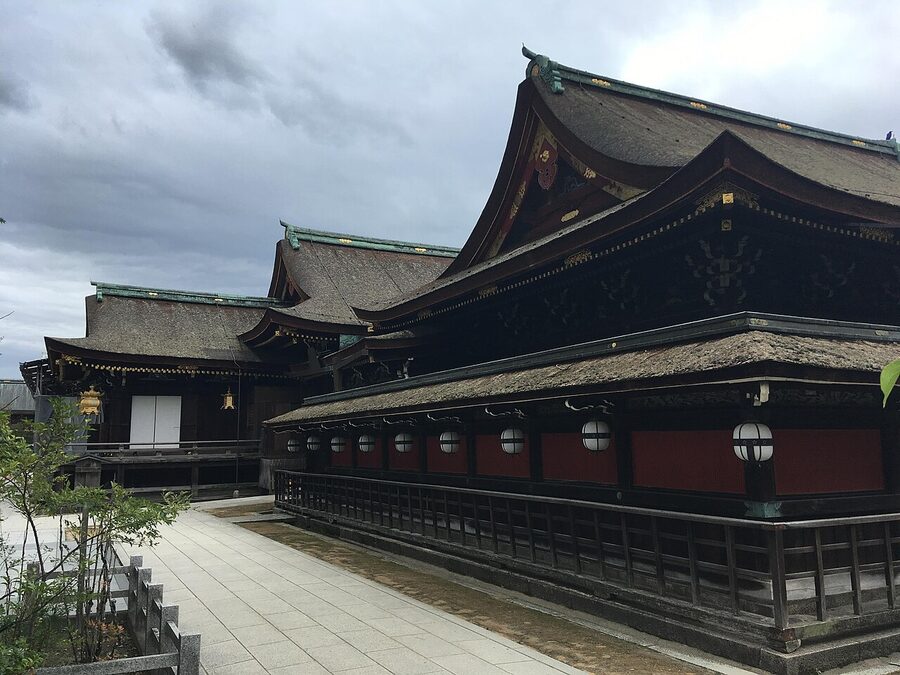
Go on the 25th if you can. That is Michizane’s day, from the 25th day on which he was born and the 25th day on which he died, and a flea market fills the approach from early morning.
The plum festival on 25 February, the anniversary of his death, is the best time of all. City bus 50 runs from Kyoto Station to the Kitano Tenmangū-mae stop; from the Randen tram it is ten minutes on foot from Kitano-Hakubaichō. While you’re in the area, the Kamigoryō Shrine, a few kilometres east near Kuramaguchi, keeps the eight goryō of the Heian court, and its forest is where the Ōnin War began in 1467. Japan’s angry dead and its civil wars have a habit of sharing addresses.
If you want the whole sweep of the eras that produced these ghosts, the Japan through the ages guide sets them in order, and the sibling articles on oni and yōkai cover the monsters that the yūrei, with their names and their grievances, have always been so careful to set themselves apart from.
Fifty ghosts in a summer temple
I come back to Zenshō-an most Augusts, and what strikes me every time is how unfrightening the room is. There are fifty dead women and men on the walls, some of them with their faces half gone, and a crowd of people in summer clothes moving slowly along in front of them, fanning themselves, as if they were looking at a family album. In a sense they are. Every ghost in that room came back for a reason, and the reason was almost always that somebody had done them wrong and the living had not set it right.
That is the thread from Prince Sawara to Sadako. The Heian court built shrines because it was frightened of the people it had ruined; the Edo theatres staged Oiwa because the people in the cheap seats knew who usually did the ruining. If you go in August, take a fan and go early. And when you get to the end of the room and the scroll attributed to Ōkyo, look down at where the feet should be, and remember that Japan’s ghosts had started losing theirs sixty years before he was born.