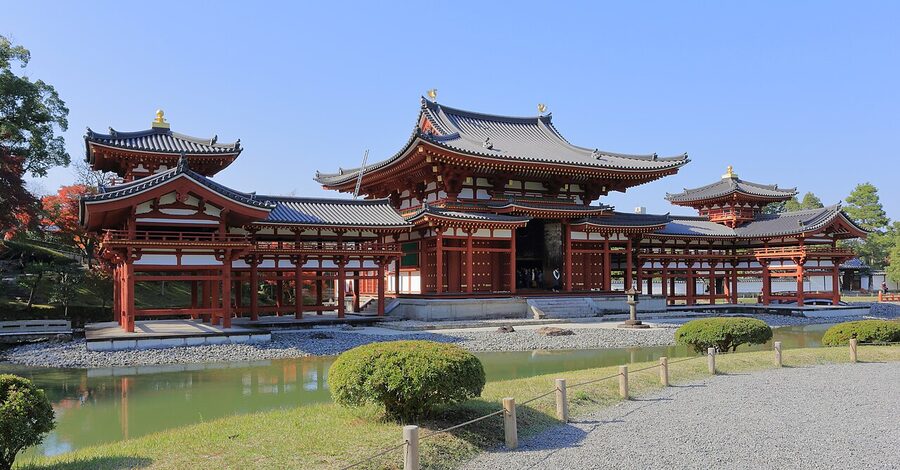
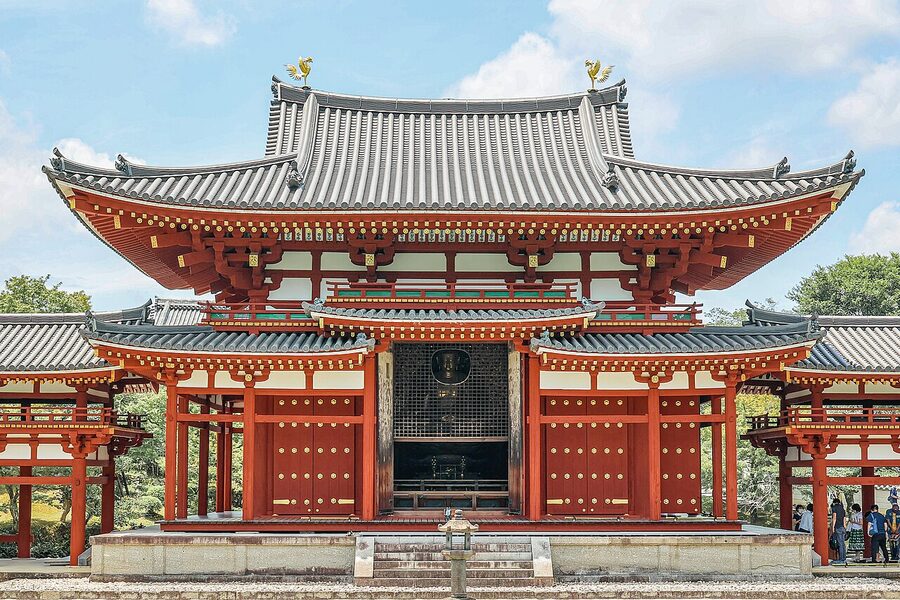
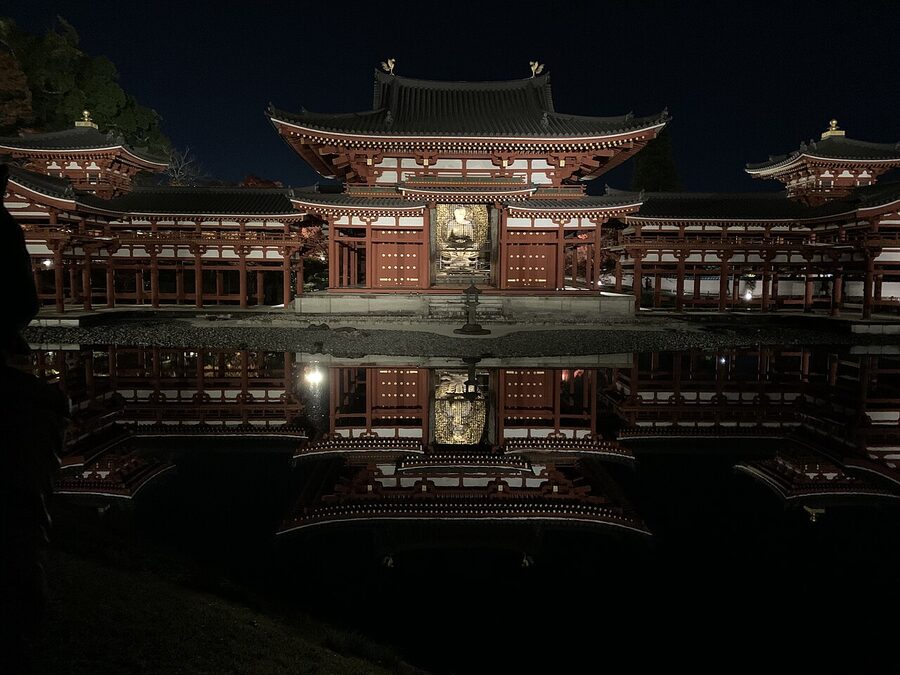
Behind the front doors of the Phoenix Hall at Byōdō-in (平等院) stands a wooden lattice, and cut into the lattice, at the height of a seated giant’s face, is a small round window. It has one job. When the doors are open and you stand on the far bank of the pond, the window frames a gilded face with heavy-lidded eyes, looking back at you across the water.
The man who arranged this was Fujiwara no Yorimichi, the most powerful official in Japan, and he did it because he and most of the court believed the world had started to end the year before. A sutra told him what to do about it: whoever wished to be reborn in the Western Paradise should first fix their mind on a golden Buddha sixteen feet tall, sitting on the water of a pond. He took the instruction literally. Then he put a small pavilion on the opposite bank, so that the grandest of his guests could sit in it and do exactly that.
Almost everything else he built at Uji has gone: the main hall, the pagoda, the sutra repository that held his family’s heirlooms, the fishing pavilion that hung over the river. The Amida hall came through fire, war and five centuries of neglect, picked up the name Phoenix Hall somewhere in the 17th century, and ended up on the ten-yen coin. I think it is the best-preserved idea in Japan, less a building you go into than a picture you were meant to stand in front of, and this is the story of who painted it, who nearly lost it, and where to stand.
In This Article
- A villa on the road south
- 1052, the first year of the end
- A name borrowed from Kyoto
- Not only a Pure Land temple
- The hall of 1053
- Why it looks like a bird
- Wooden tiles, then clay
- The bronze phoenixes
- Jōchō, the man who fixed the face of the Buddha
- Joined wood
- How big is it?
- Fifty-two on clouds
- Amida descends: the painted doors
- A paradise across the water
- The garden that wrote the manual
- The towers behind the hall
- Red again: the repainting of 2012–2014
- The estates that outlived the regency
- Yorimasa’s fan
- Fire, neglect and a ten-yen coin
- Ten yen and ten thousand
- Visiting Byōdō-in today
- Getting there
- Tickets, hours and the Phoenix Hall interior
- The Hōshōkan museum
- Around the grounds
- Omotesandō, tea and the river
- Ujigami Shrine and Uji Shrine
- The Tale of Genji Museum
- Further afield
- Where to stand
A villa on the road south
Uji sits where the road from the capital to Nara crosses the only big river in the way, and it was a place of bridges, toll posts and battles long before it was a place of temples. The first Uji Bridge is said to have gone up in 646; the inscription on a famous stone fragment at a temple by the river credits a monk called Dōtō, while the official chronicle Shoku Nihongi gives the honour to the better-known Dōshō. By the 9th century its banks were country-house land for the court, with mist on the water and fishing weirs in the shallows.
The villa that became Byōdō-in has a pedigree most English-language accounts cut short. They usually say it was built in 998 for the minister Minamoto no Shigenobu and bought from his widow. Japanese sources take it back a century further, to Minamoto no Tōru, the 9th-century Minister of the Left who is often named as a model for the Shining Prince of The Tale of Genji; from him it passed to Emperor Yōzei, then to Emperor Uda, became the Uji-in retreat of Emperor Suzaku, and only reached Shigenobu, Uda’s grandson, after that. In 998 it came to Fujiwara no Michinaga, who called it Uji-dono and used it for parties.
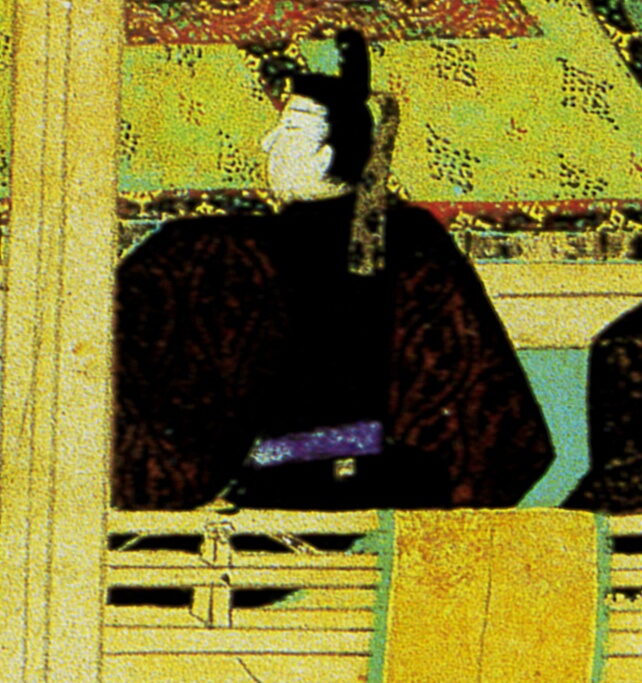
A few years later Murasaki Shikibu, who served Michinaga’s daughter, set the last ten chapters of her novel at Uji, the so-called Uji chapters, full of river noise and indecision. You can see why. Uji was the court’s idea of somewhere melancholy and beautiful within easy reach of a decent dinner.
Michinaga’s son Yorimichi inherited the villa when his father died in 1027. I will not retell Yorimichi’s career here; my piece on the Fujiwara clan covers the fifty years he spent as regent or chancellor, and why a family that ruled through its daughters ran into trouble when he had almost none. For Uji, the point is that by 1052 he was sixty, rich beyond any courtier before him, and frightened.
1052, the first year of the end
Buddhist teaching held that the Buddha’s Dharma would decay in three stages after his death. First came a thousand years of the True Dharma, when people practised and reached enlightenment; then a thousand years of the Semblance Dharma, when they went through the motions; then mappō (末法), the Latter Dharma, ten thousand years in which nobody could reach enlightenment by their own effort at all. Japanese monks dated the Buddha’s death to 949 BC, following a Chinese text called the Zhoushu yiji, so the arithmetic put the first year of mappō in 1052.
The world seemed to agree with the arithmetic. War had broken out in the far north in 1051, the capital had suffered fires and epidemics, and armed monks were marching on the court. Not every historian thinks the date frightened people as much as the textbooks say: Mori Shinnosuke has argued that the gloom owed more to a Chinese-derived sense of a degenerate “latter age” than to Buddhist mappō as such.
Yorimichi, at any rate, acted on it, and the late Heian era filled up with Amida halls; my timeline of Japan through the ages puts the century in sequence. The chronicle Fusō ryakuki records under the 28th day of the third month of 1052 that the Minister of the Left abandoned his Uji villa to make it a temple, installed Buddhist images, began a Lotus Sutra meditation and named it Byōdō-in, the Temple of Equality. The old sleeping hall of the villa became the main hall, and its main image, a later dictionary records, was not Amida at all but Dainichi, the cosmic Buddha of esoteric teaching, facing east towards the river.
A name borrowed from Kyoto
The name came second-hand. Yorimichi’s founding abbot was Myōson, a grandson of the calligrapher Ono no Michikaze and a senior monk of Onjō-ji (Mii-dera), the Jimon branch of the Tendai school that had been feuding with the monks of Enryaku-ji for more than half a century. Myōson already ran a temple called Byōdō-in at Okazaki in Kyoto. Yorimichi wanted the name, so Myōson gave it to him, and the Okazaki temple was renamed Enman-in.
Not only a Pure Land temple
English accounts present Byōdō-in as pure Pure Land faith, but the Heian temple was mostly esoteric. Within a few decades the grounds held a Lotus hall, a pagoda, a hall of the Five Wisdom Kings, a hall of the fire-god Fudō, a hall for Aizen and a sutra repository, filled by Yorimichi and his heirs, and the Amida hall was one building among many.
Even the Amida hall has an esoteric layer. The statue’s hands make the meditation seal used by the Amida of the esoteric mandalas, the hollow inside of the statue is painted red with iron oxide (red being the colour of the western Buddha in that system), and sealed inside it were wooden discs inscribed with Amida’s long and short spells in Sanskrit letters. At the very top of the halo sits a small Dainichi. The architectural historian Tomishima Yoshiyuki reads the whole hall as an Amida mandala; I find that convincing, and it makes the building more interesting rather than less.
The hall of 1053
Jōchō’s statue arrived first. A courtier’s diary of the time, the Sadaie ason ki, records that on the 19th day of the second month of 1053 the sixteen-foot Amida left the capital at the hour of the ox, in the small hours, and was seated on its altar by noon, and that the sculptor was given a willow-green robe for his trouble. The hall was dedicated on the 4th day of the third month with a hundred monks in attendance, in a ceremony modelled on the great palace rites, and the Fusō ryakuki says its images and decoration had no equal in past or present.
Heian documents never call it the Phoenix Hall. They call it the Amida hall, or simply the Midō, the hall. The first written “Phoenix Hall” is an inscription of 1680 on a gilt-bronze plate set into the altar, and by 1711 the name was in a printed gazetteer, so it seems to have come in during the early Edo period, around the big repair of 1670, when the front doors were replaced.
Why it looks like a bird
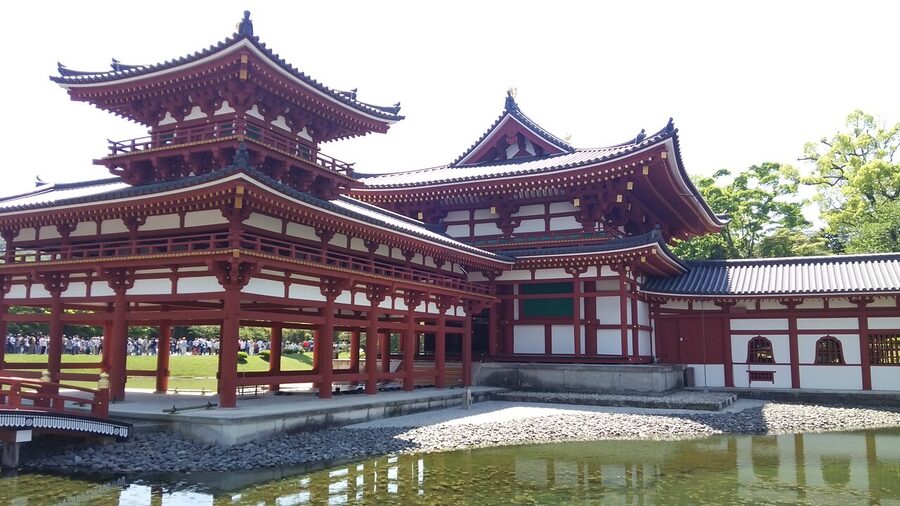
The building is four structures joined into one: a central hall, a north and a south wing that run out sideways and then turn forward, and a tail corridor that runs straight back. Seen from the front, the wings are the outspread wings and the tail is the tail, and two bronze phoenixes stand on the ridge of the roof.
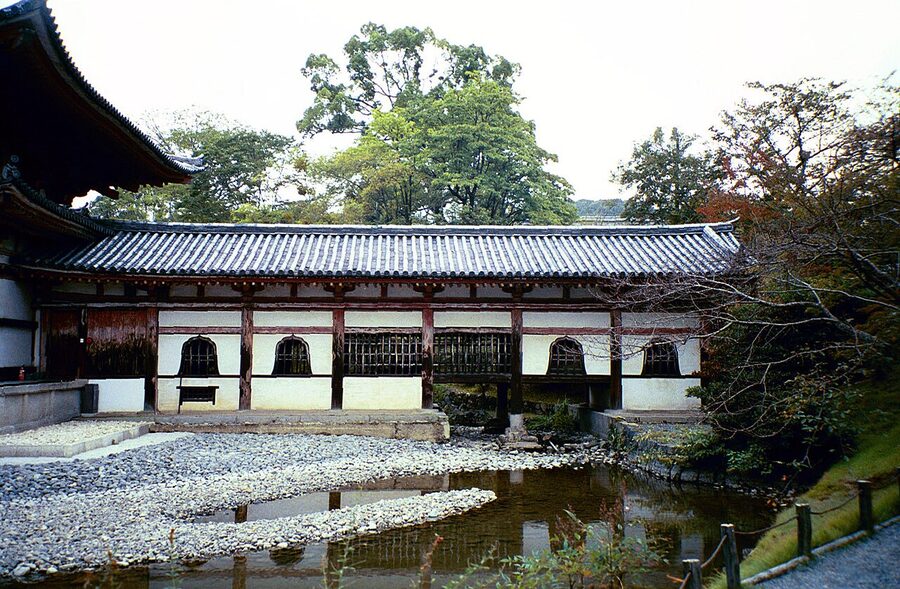
The central hall is a single storey dressed up as two. Its core is three bays by two under a hip-and-gable roof, and around it runs a mokoshi, a skirt of lower roof on slender pillars, so that from outside you read two roofs and think two floors. The skirt is lifted in the middle bay at the front, the bay with the window, so that nothing interrupts the line from the far bank to the Buddha’s face. There is no aisle between core and skirt, as Japanese halls usually have, and the deep eaves with nothing to carry them made the building unstable; old photographs show props under them like crutches.
Wooden tiles, then clay
The roof you see is clay tile, but it probably started as wood. Hardly any tiles from the 1050s turn up in excavations, and the frame seems too light for a heavy clay roof, so the usual reading is that the first roof was kogawarabuki, boards shaped to look like tiles, the kind that survives from the Heian period only on the Golden Hall at Chūson-ji. Around 1101, under Yorimichi’s great-grandson Fujiwara no Tadazane, it was re-roofed in real tiles fired at the Mukaiyama kiln on the temple’s estate at Tamakushi, in what is now Yao in Osaka. If tiles interest you, my piece on kawara roof tiles explains what a clay roof weighs and what that does to a frame.
The roof today carries some 52,000 tiles. When it was stripped in 2012, the restorers found 1,560 Heian-period tiles still doing their job after nine hundred years, and they put them back together on the left-hand slope of the central roof as you face it. That slope looks slightly paler than the rest. Most people assume it is weathering.
The bronze phoenixes
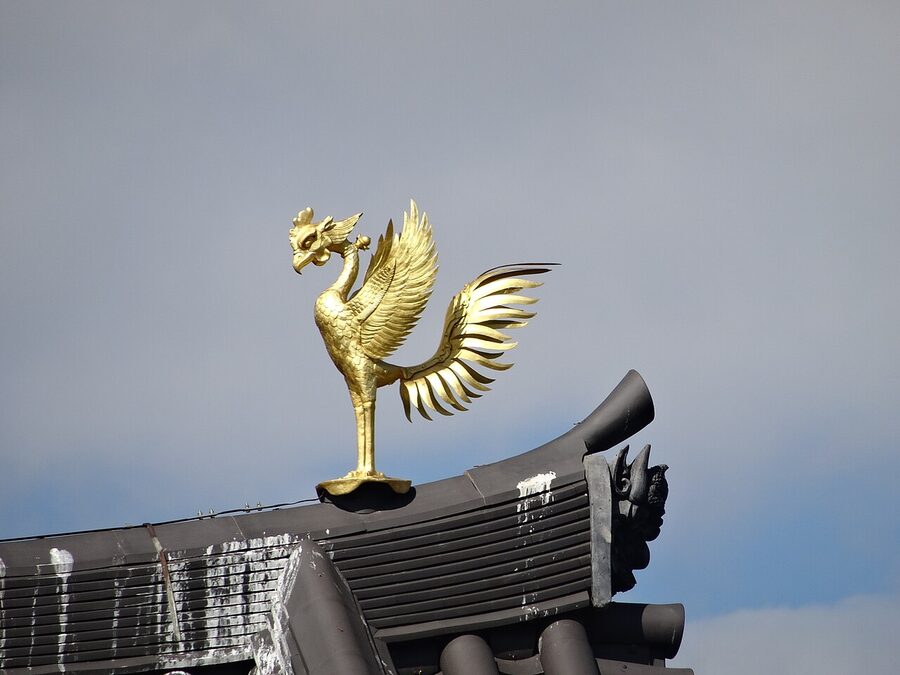
The phoenixes are cast and hammered bronze, gilt, a pair about a metre high from head to feet, standing on discs at the two ends of the ridge. The diary of Fujiwara no Sukefusa records that in the second month of 1041 Jōchō was commissioned to make dragon heads, which has led some scholars to suggest that he made the models for the phoenixes too. Another diary of 1134 hints that bronze-founders from Toba, south of Kyoto, did the casting. Neither is proof.
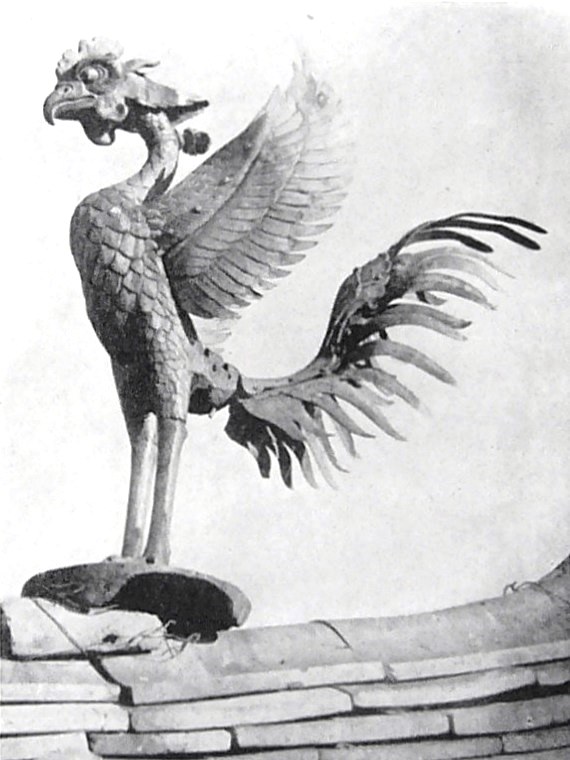
Air pollution did what nine centuries of weather had not, and by the 1960s the bronze was corroding fast. The replicas that replaced the originals were gilded in the restoration of 2012 to 2014, so the birds on the roof today are brighter than at any time since the 11th century, and the real ones are in a glass case a few hundred metres away.
Jōchō, the man who fixed the face of the Buddha
The statue is the only work certainly by Jōchō, the most influential sculptor in Japanese history, which is frustrating. Almost everything else he made, including the dozens of figures he carved for Michinaga’s vast temple of Hōjō-ji in Kyoto, has burned.
He was the son, or by some accounts the pupil, of a sculptor called Kōjō (also read Kōshō), and in 1022, for his work at Hōjō-ji, he became the first Buddhist sculptor ever given an ecclesiastical rank, hokkyō. The diaries say Michinaga hesitated over a promotion with no precedent and had to be talked into it. In 1026 his workshop turned out twenty-seven life-size figures for the empress’s safe delivery using 125 sculptors, and in 1048 he rose to hōgen. He died on the 1st day of the eighth month of 1057.
Joined wood
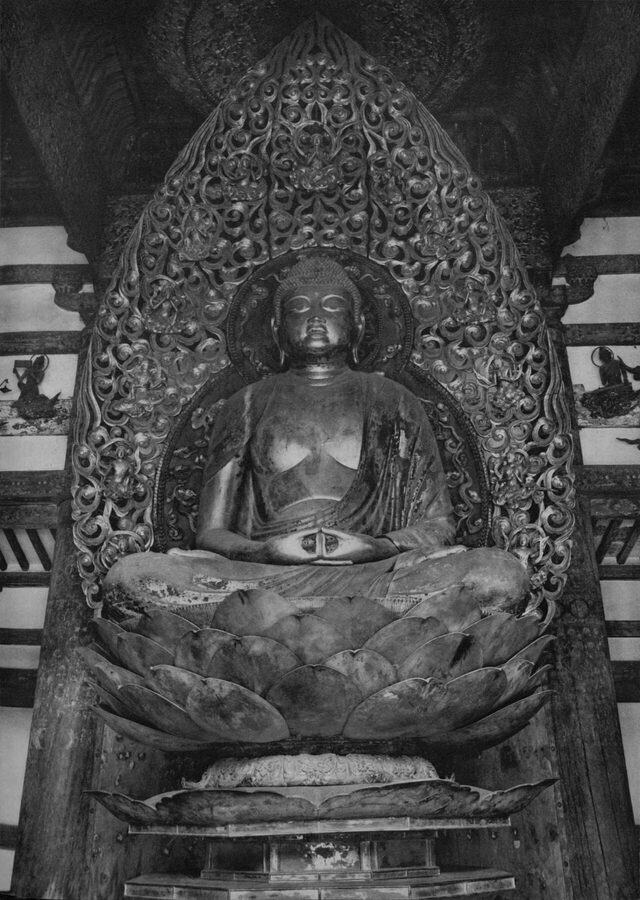
The technique he perfected is yosegi-zukuri, joined-wood construction. Earlier large statues were carved mostly from one trunk, which limited their size, cracked as they dried and weighed a great deal. Jōchō’s Amida is built from blocks of hinoki cypress: the head and body are four main pieces arranged, seen from above, like the four squares of the character 田, each hollowed out like a shell before being joined. The joints were nailed and clamped, covered with hemp cloth, lacquered and gilded, so that nothing shows.
The method let a workshop split a commission among many hands and still produce one face. It is the foundation of the whole later tradition: Jōchō’s son Kakujo and his pupil Chōsei founded the lines that became the In, En and Kei schools, and Unkei, whose guardian kings stand in the gate of Tōdai-ji, belonged to a school that traced itself back to him. I would put this statue near the top of any list of Japan’s greatest crafts, as a piece of joinery as much as of sculpture.
How big is it?
The temple gives the height as 277.2 centimetres. Japanese encyclopaedias variously say 279 or 284; the differences come down to where you start the tape and whether the figure has been measured since its last repair. It is a jōroku, the canonical sixteen-foot Buddha, scaled for sitting, and on its nine-tiered lotus pedestal under the canopy it looks much bigger.
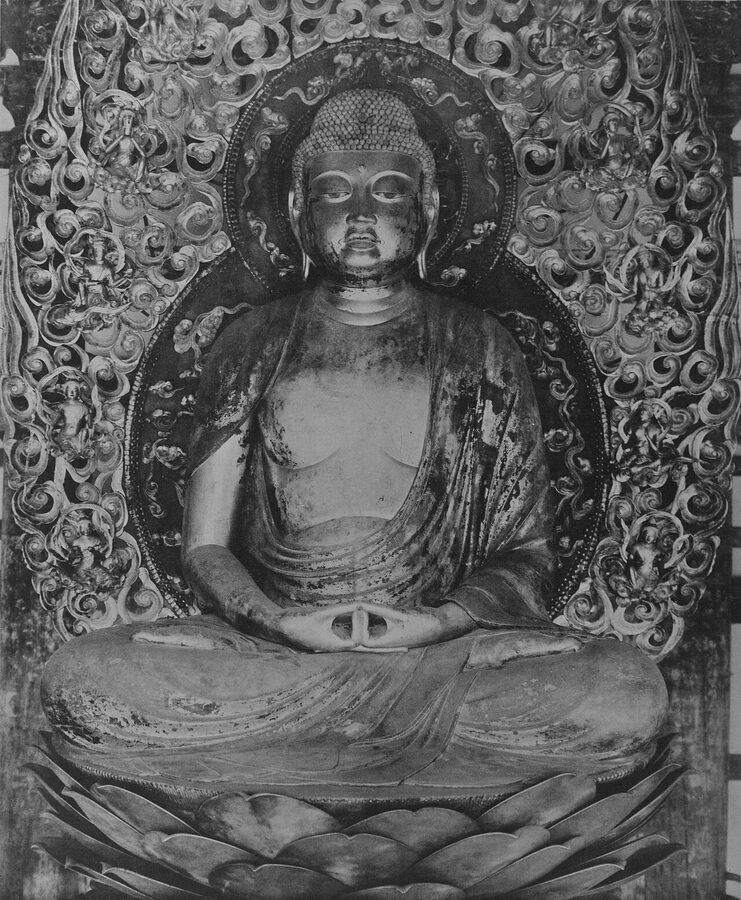
What contemporaries loved was the face. Jōchō’s later Amida for a courtier’s chapel in western Kyoto, made around 1054 and long lost, was described as like the full moon and as the very model of a Buddha, and in 1134 the sculptor Inchō spent a whole day taking some seventy measurements of it so that he could make a copy. For a century and a half, patrons compared every new statue to a Jōchō. The courtier Minamoto no Morotoki’s diary, Chōshūki, records some of that fussiness, and I find it oddly touching: a whole aristocracy agreeing on what the Buddha’s face looked like.
Fifty-two on clouds
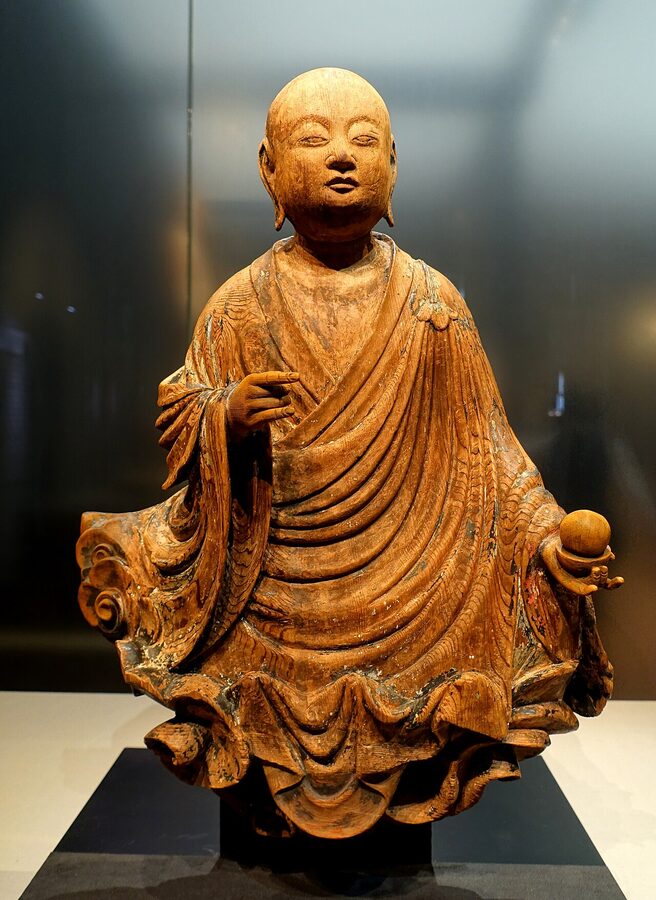
Look up from the statue and the walls are crowded. On the plaster panels high up between the beams, all round the room, small wooden bodhisattvas ride on wisps of cloud, playing music, dancing, holding banners and lotus flowers, or simply pressing their palms together. They are the unchū kuyō bosatsu (雲中供養菩薩), the bodhisattvas making offerings among the clouds, and they are the host that comes down with Amida to fetch a dying believer.
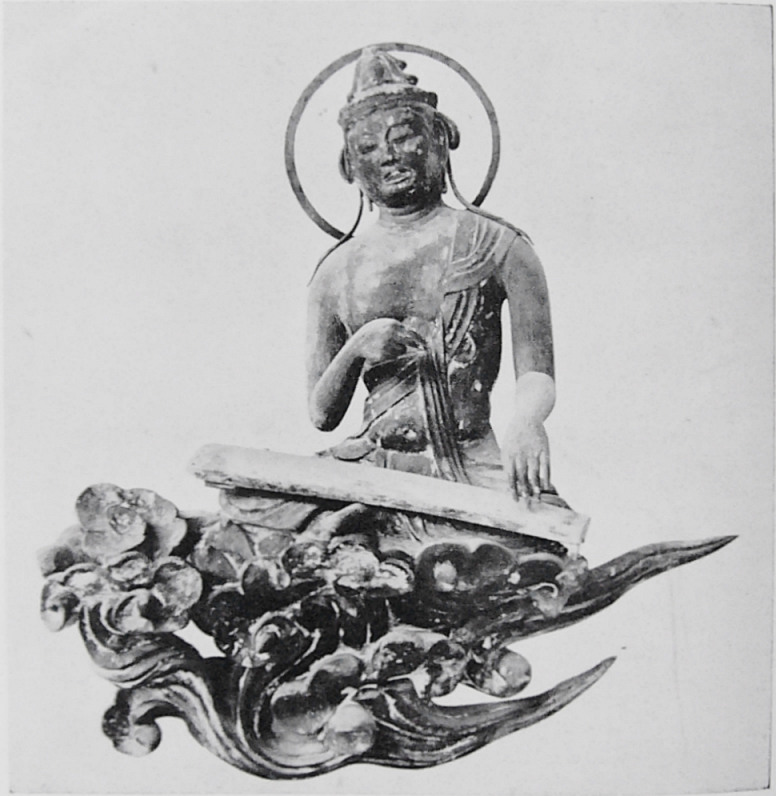
There are fifty-two of them now, though there may once have been more. Older Japanese reference works give fifty-one, which is the figure you will still find in many printed sources, while the temple and the current national-treasure listing count fifty-two. The temple numbers them North 1 to 26 and South 1 to 26, after the two walls they hang on, and five are carved as monks rather than as crowned bodhisattvas.
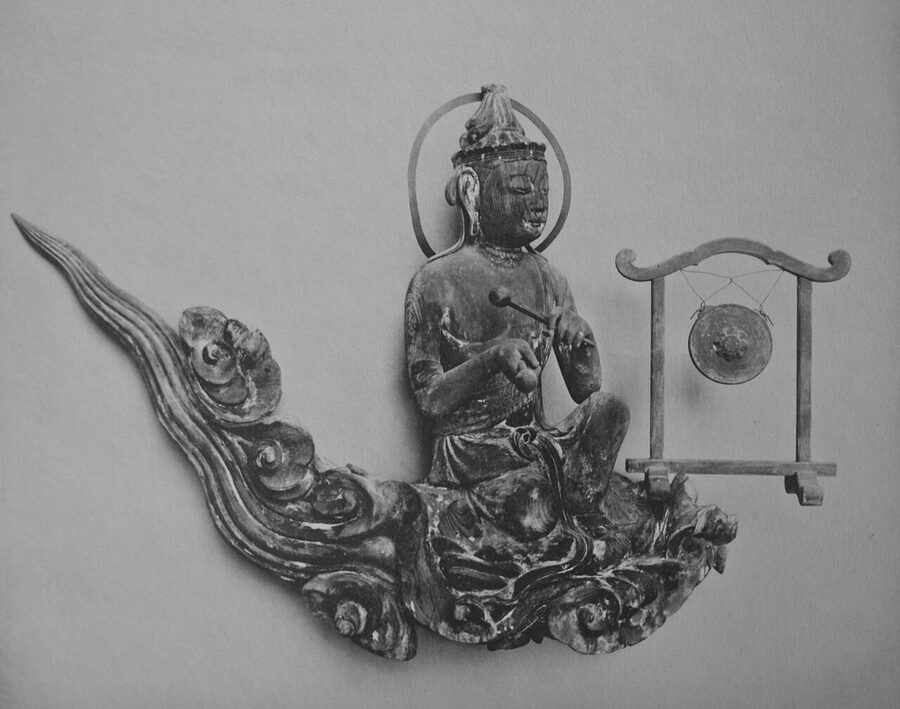
About half of them play instruments, and the orchestra is specific: zithers, biwa lutes, the shō mouth organ, transverse and vertical flutes, drums, a gong and a set of small cymbals. It is the gagaku court orchestra of Yorimichi’s day, sent into heaven. South 20 dances with one foot lifted and has the words “full moon” written in ink on its back, and North 25 is the only one still holding its original lotus pedestal, carved from the same block.
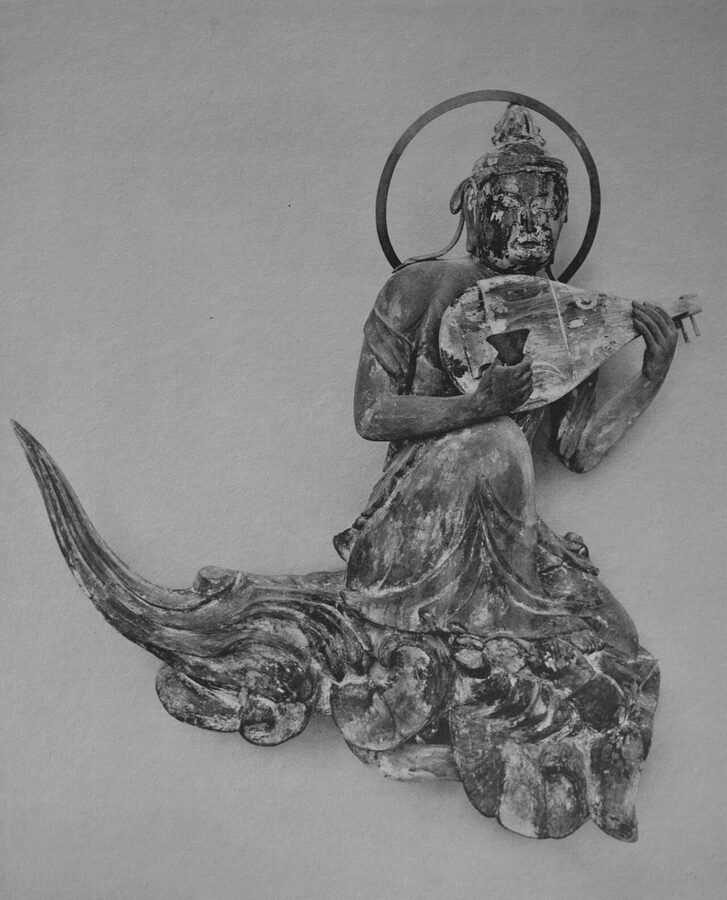
Half the originals now live in the temple museum, which opened in 2001, and replicas hang in their places in the hall. I understand the purists’ objection and do not share it. In the hall they are high above you in a dim room; in the museum you can stand a metre from a thousand-year-old drummer and see the chisel marks.
Amida descends: the painted doors
The doors and walls of the central hall carry the oldest surviving paintings of Amida’s descent in the Japanese manner. Their subject is the kuhon raigō, the nine grades of welcome: the Contemplation Sutra teaches that people will be reborn in paradise at one of nine levels, from highest-of-the-high to lowest-of-the-low, according to their conduct and faith, and that Amida comes to collect each of them differently. The best people get the full orchestra and a golden lotus throne. The worst get a lotus bud, and a long wait inside it.
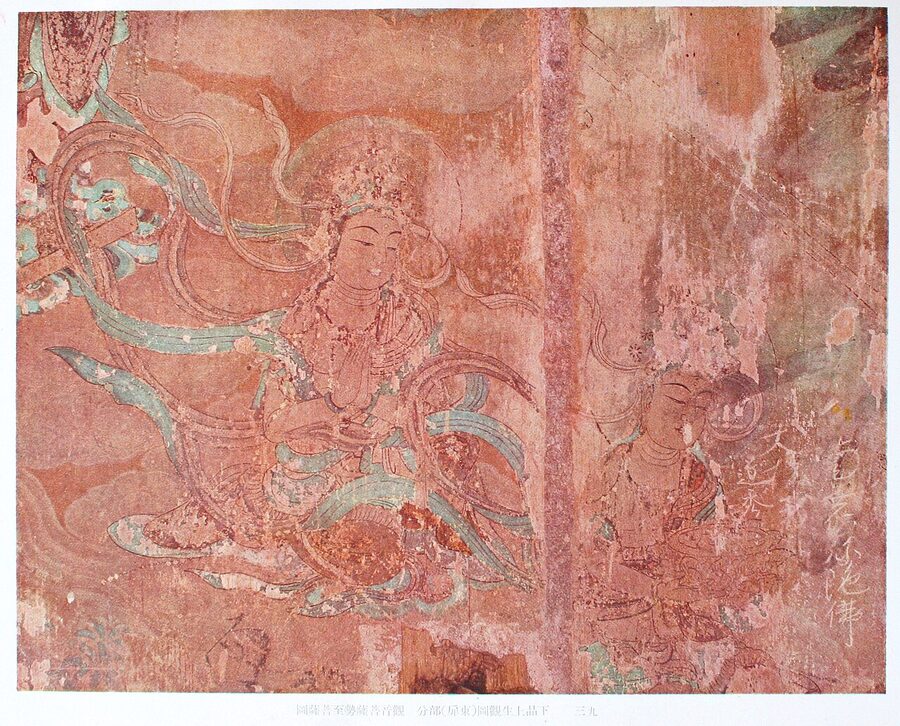
What makes them extraordinary is the background. Behind the descending host the painters put the hills and rivers around Uji, the low rounded mountains, the river, villages, trees, all in the soft style later called yamato-e, and they gave each wall a season, so that the room as a whole is also a cycle of the four seasons. They are among the earliest large landscapes in the Japanese manner to survive from the Heian court, and they survive because they were painted behind something holy.
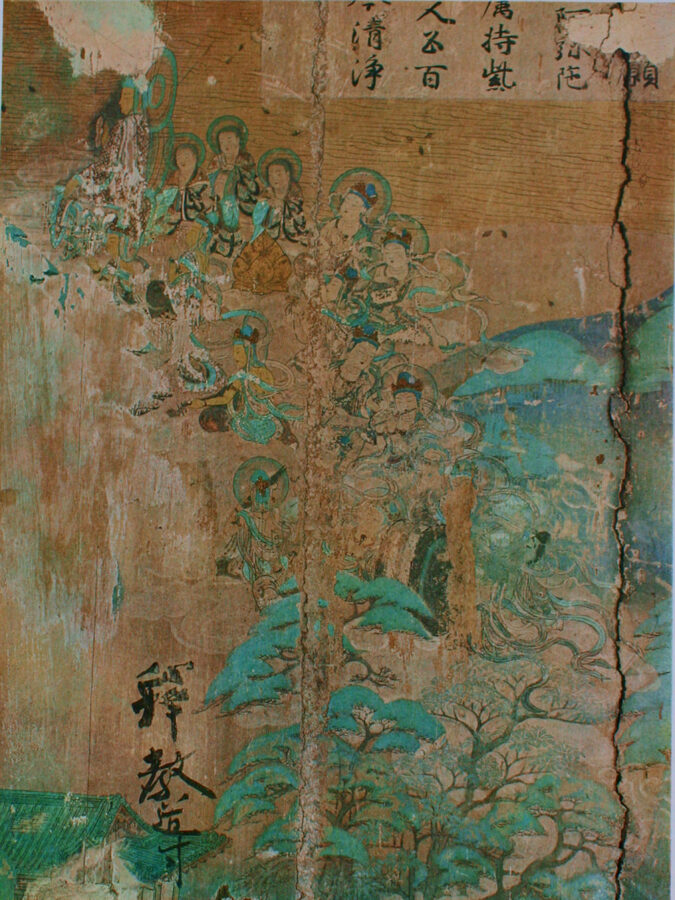
On the doors at the back of the hall, facing the west, the painters showed the first of the sixteen contemplations of the sutra: a woman watching the sun set over the sea. Behind the statue is a separate wall painting whose subject nobody can agree on. When the statue was moved out for repair in 2004 and the wall could be studied properly, it was dated to Yorimichi’s own lifetime, and scholars have since read it as a scene from the Buddha’s life, as the past life of Amida, as the coming of the future Buddha Maitreya, and as one of the nine grades.
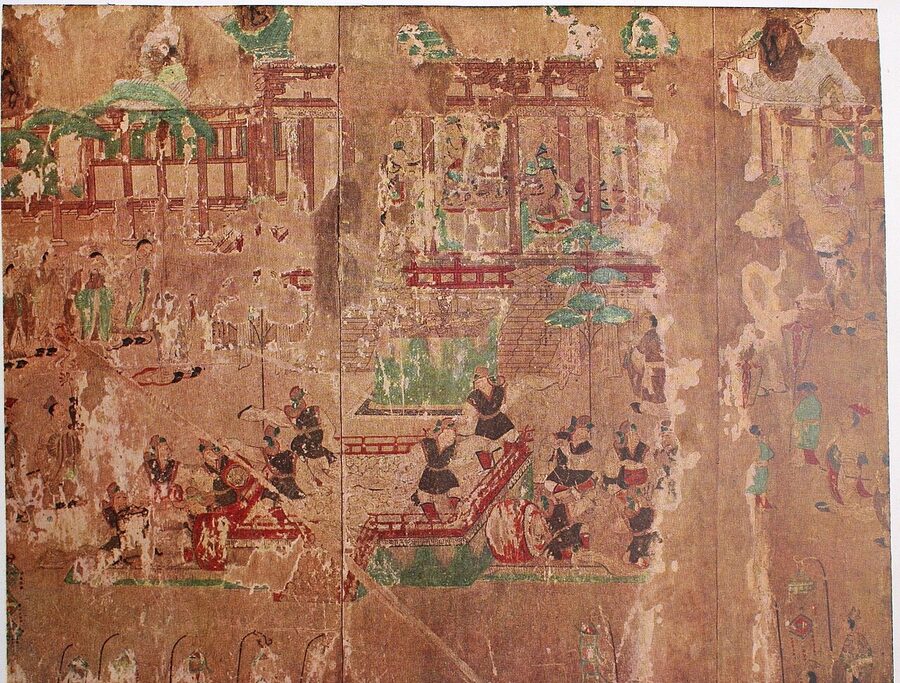
The paintings have had a hard life. The two central doors at the front wore out and were replaced in the repair of 1670, with new paintings. After the great fire of Uji in 1698 the temple was too poor to keep people out, and visitors scratched their names into the pictures, which is why the original doors carry Edo-period graffiti across paradise. I have a soft spot for it: for many of those people, it is the only record they left.
A paradise across the water
The garden is half the building. The Phoenix Hall sits on an island in a pond called Aji-ike, the A-character pond, after the Sanskrit letter a, and it faces east across it. You were meant to stand on the east bank, look west over the water towards the setting sun and the paradise beyond it, and see the hall and its reflection as one floating palace. My history of Japanese gardens follows what came after the Heian pond gardens; this is the finest survivor of their Pure Land form anywhere.
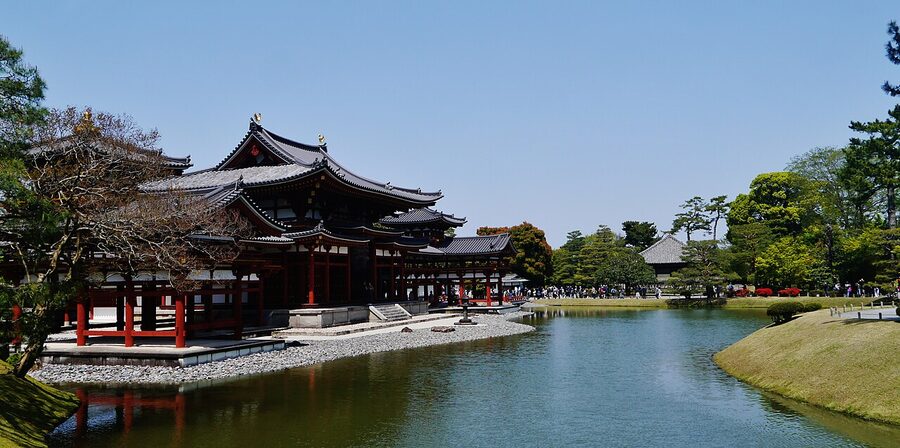
People in Yorimichi’s day understood the effect at once. A rhyme of the time, quoted in Japanese reference works, ran: if you doubt that paradise exists, go and pay your respects at the temple in Uji. The temple still uses a version of it as its motto, and for once the marketing is a thousand years old.
Excavations that began in 1990 found the Heian pond edge, the suhama, a gently sloping beach of pebbles, under centuries of later banking, and showed that the island had been enlarged in modern times. Between 1990 and 2003 the temple restored the Heian edge, relaid the pebble shore and, in 2000, rebuilt the two small bridges, one flat and one arched, by which the Heian approach reached the hall from the north bank by way of a tiny islet.
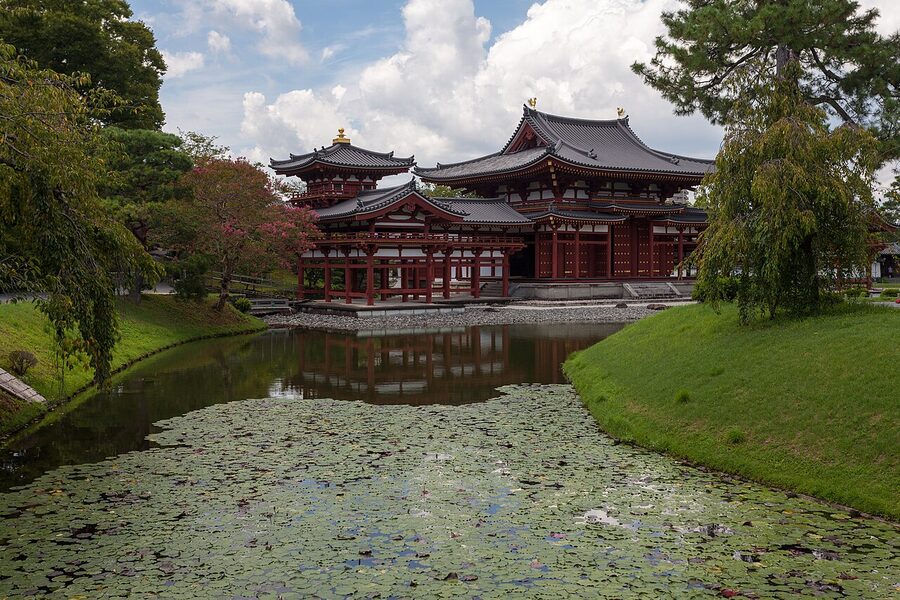
The excavations also found the remains of the Kogosho, the little pavilion on the east bank where an emperor or retired emperor would sit to worship the Amida across the water. The architectural historian Fukuyama Toshio had argued from the documents decades earlier that it existed; the spade proved him right. The Uji River and the hills on its far side were part of the design too, taken into the view as borrowed scenery.
The garden that wrote the manual
The oldest garden-making manual in Japan, the Sakuteiki, is usually attributed to Tachibana no Toshitsuna, a son of Yorimichi brought up as the adopted heir of the Tachibana family. The attribution is not proven, but it is widely accepted, and if it is right, the boy grew up in the household that built this garden. I think about that whenever I read the Sakuteiki‘s instruction to base a garden on the memory of famous landscapes you have seen.
The Pure Land garden became a fashion. Retired emperors built Amida halls on ponds in eastern Kyoto, and in the far north the Ōshū Fujiwara at Hiraizumi copied Uji directly; Ashikaga Yoshimitsu’s golden pavilion of the 1390s, now Kinkaku-ji, is a later and Zen-flavoured descendant of the same idea of a holy building at the water’s edge. Of all of them, only Byōdō-in still has its hall, its statue, its paintings and its pond together. It is not on my list of Japan’s greatest gardens, which is about gardens you go to for the garden, but if you want to know where those gardens began, start here.
The towers behind the hall
In the 1990s two tall apartment blocks went up behind the hall to the right, and from some angles they still appear in the background of the most famous view in Japan. Nothing in the planning rules of the day stopped them, and the row that followed pushed Uji into tightening its townscape rules. Stand slightly to the left on the east bank and you can leave them out of the picture.
Red again: the repainting of 2012–2014
From 3 September 2012 the hall was under scaffolding for its first major repair in fifty-six years. The roof was re-tiled with tiles copied from the temple’s Heian designs, the pillars, beams and doors were repainted, and the replica phoenixes and the jewel on the roof were gilded. The work finished at the end of March 2014, and the interior reopened in early April.
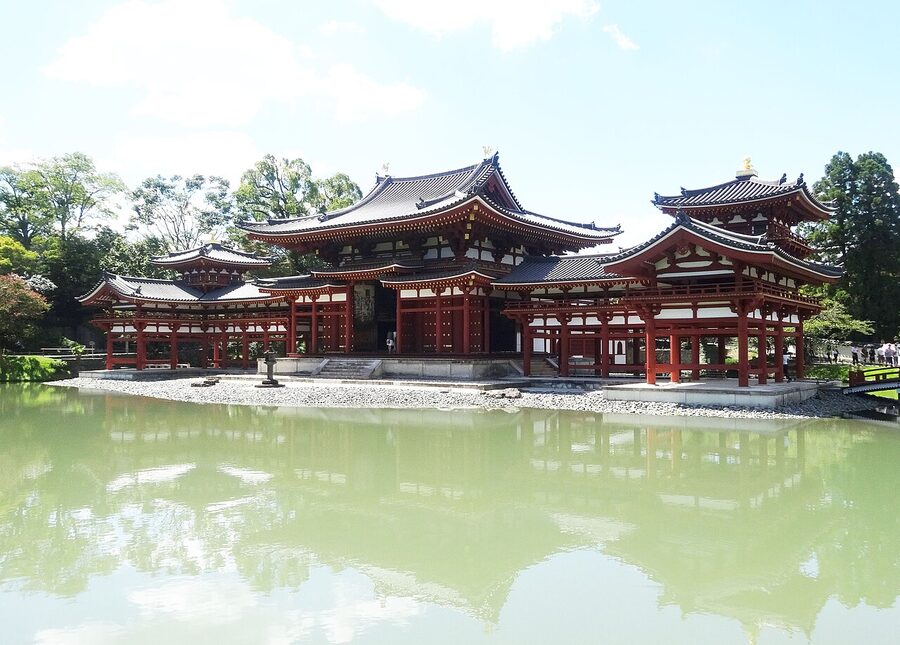
The colour caused the argument. For as long as anyone alive could remember, the hall had been a soft weathered brown, and that was the hall on the coin, the postcards and the school trip. The new red, with gold birds on top, struck some people as a theme park. In 2013, while the work was going on, the commentator Reizei Akihiko wrote a sharp column arguing that the patina was the point: that the faded hall expressed the Japanese feeling for impermanence, and that a building put up as a regent’s display of power had been softened by age into something better.
The temple’s case is that the red is what Yorimichi built, and I side, on balance, with the temple. A building raised to look like paradise was never meant to look old, and the shock of the colour gives you a glimpse of how outrageous it must have been in 1053; at the Ise Grand Shrine nobody complains when the buildings come back new. But I miss the brown, and I do not think the people who loved it were wrong.
The estates that outlived the regency
Yorimichi made sure his temple had an income. In 1067 he obtained tax exemption for nine of its estates, and in the third month of 1068, as Emperor Go-Reizei lay dying, he hurried through documents barring government inspectors from them. When the next emperor, Go-Sanjō, no friend of the Fujiwara, went after aristocratic estates without proper title in 1069, Byōdō-in’s paperwork was in order.
A later anecdote collection, the Kojidan, tells a better story: that Go-Sanjō ordered officials to go and survey the Byōdō-in lands, and that none of them dared go to Uji to face the old man. Treat that as legend. The documents tell the duller and more Fujiwara truth, which is that he had already filed the right forms.
Yorimichi died at Uji on the 2nd day of the second month of 1074, aged eighty-three by Japanese count. The estates, which had grown to eighteen in twelve provinces by 1305, passed with the headship of the Fujiwara, and from 1106 each new head made a formal visit to Uji within a year or two of taking office. On the visit he inspected the sutra repository, which held relics of the Buddha, the family’s heirlooms and an image of Aizen Myōō believed to have been brought from China by Kūkai. The repository is long gone, and nobody knows exactly where it stood.
Yorimasa’s fan
On the 26th day of the fifth month of 1180, Byōdō-in became a battlefield. Prince Mochihito and the old poet-warrior Minamoto no Yorimasa, fleeing towards Nara after their plot against the Taira had leaked, stopped at the temple because the exhausted prince kept falling off his horse. Their men pulled up the planks of the Uji Bridge and held the river until the Taira forced a crossing. My account of the Genpei War tells the battle and what it set off; what happened at the temple is shorter.
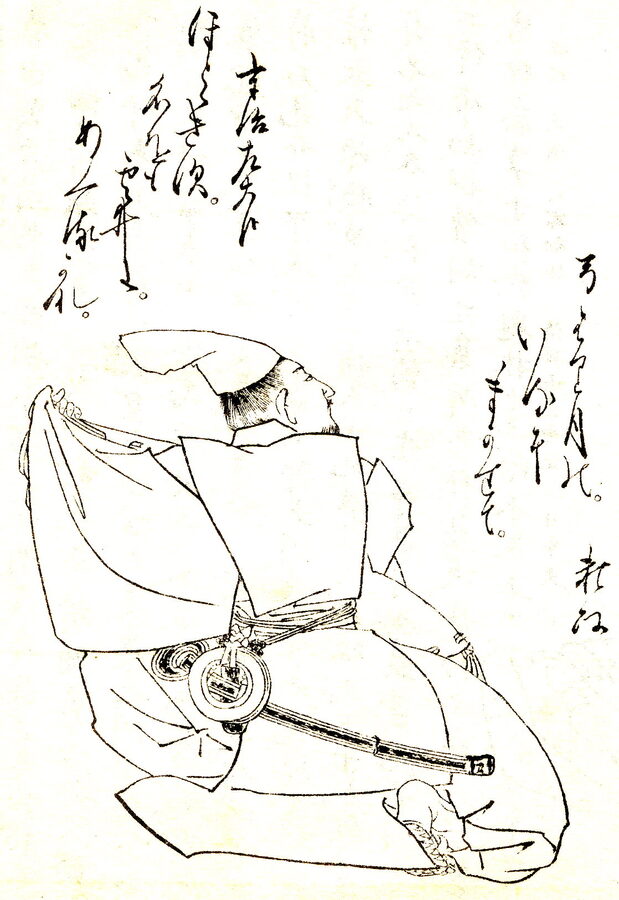
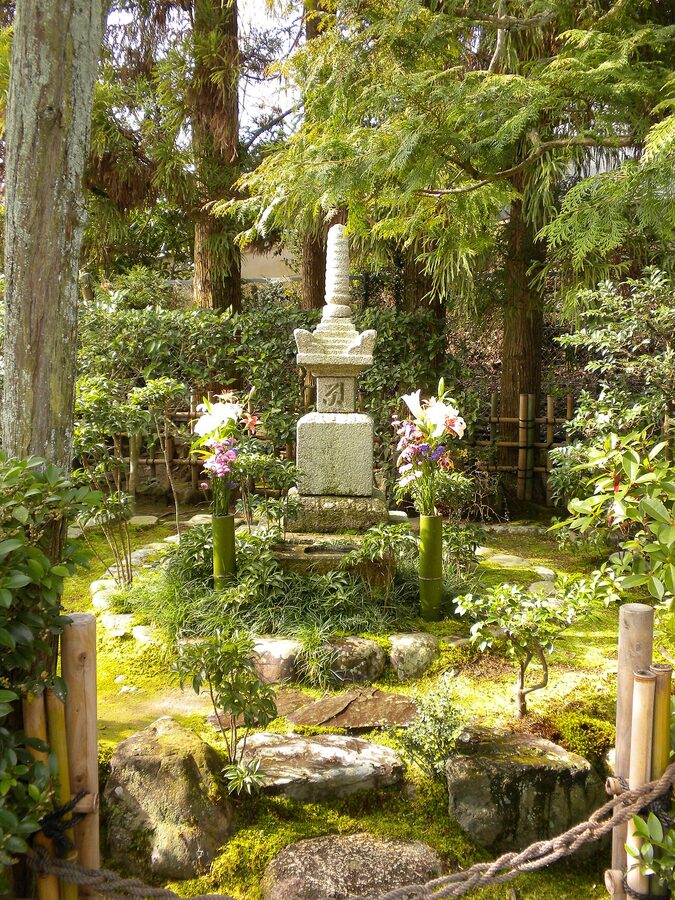
With his sons dying around him, Yorimasa withdrew into the grounds, spread a war fan on the grass and composed a poem: a buried log that never had a chance to flower, and the sad end it came to. Then he cut himself open, and his retainer Watanabe Tonau took his head. Many accounts call it the first ritual suicide by a named warrior; my article on seppuku explains why that claim is shakier than it sounds. The prince was caught and killed on the road to Nara, but his call to arms against the family of Taira no Kiyomori had already gone out to the Minamoto in the provinces, among them Minamoto no Yoritomo, in exile in Izu.
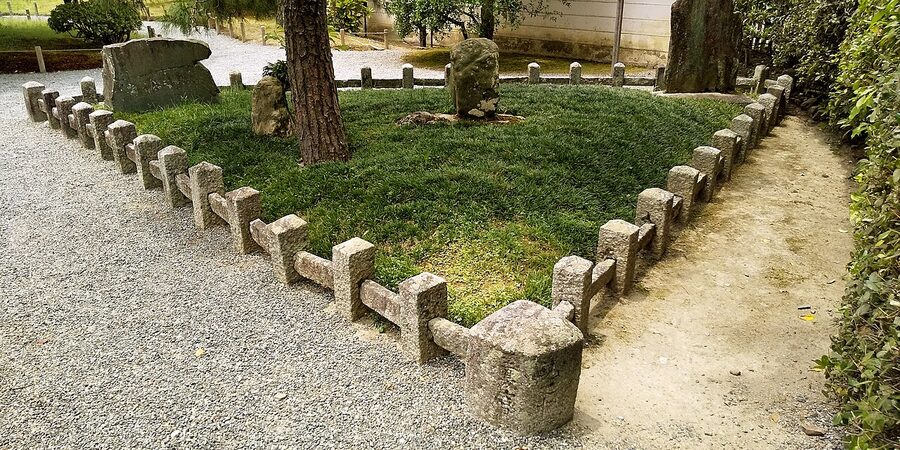
The Noh play Yorimasa, attributed to Zeami, brings the old man’s ghost back to show a travelling monk the lawn, which is one reason the spot was never forgotten. It also inspired one of the best parodies in Japanese theatre, which belongs in the travel section with the tea.
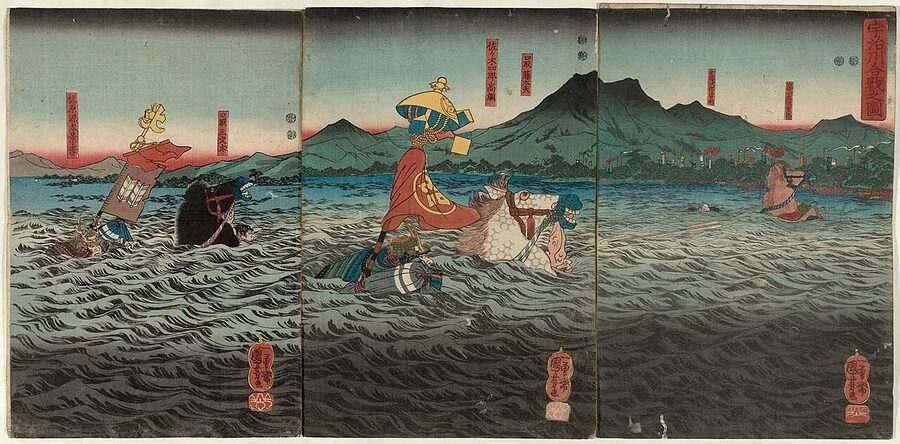
Uji went on being where armies met. In the first month of 1184, Minamoto no Yoshitsune forced the Uji River against Kiso Yoshinaka’s men, and two of his riders, Sasaki Takatsuna and Kajiwara Kagesue, raced each other across the flood to be first, a scene the print-makers loved. In 1221, in the Jōkyū War, the generals of the Kamakura shogunate, Hōjō Yasutoki and Hōjō Tokifusa, made their headquarters at Byōdō-in before crossing the river and taking Kyoto, a turning point I come back to in my overview of the Kamakura era.
Fire, neglect and a ten-yen coin
The temple’s worst day came in the first month of 1336. In the wars between Ashikaga Takauji and the loyalists of Emperor Go-Daigo, Kusunoki Masashige set fire to the area around Uji to slow Takauji’s advance, and most of Byōdō-in burned. The Amida hall survived, along with the belfry and the Kannon-dō, which had been rebuilt in the early 13th century on the site of Yorimichi’s main hall.
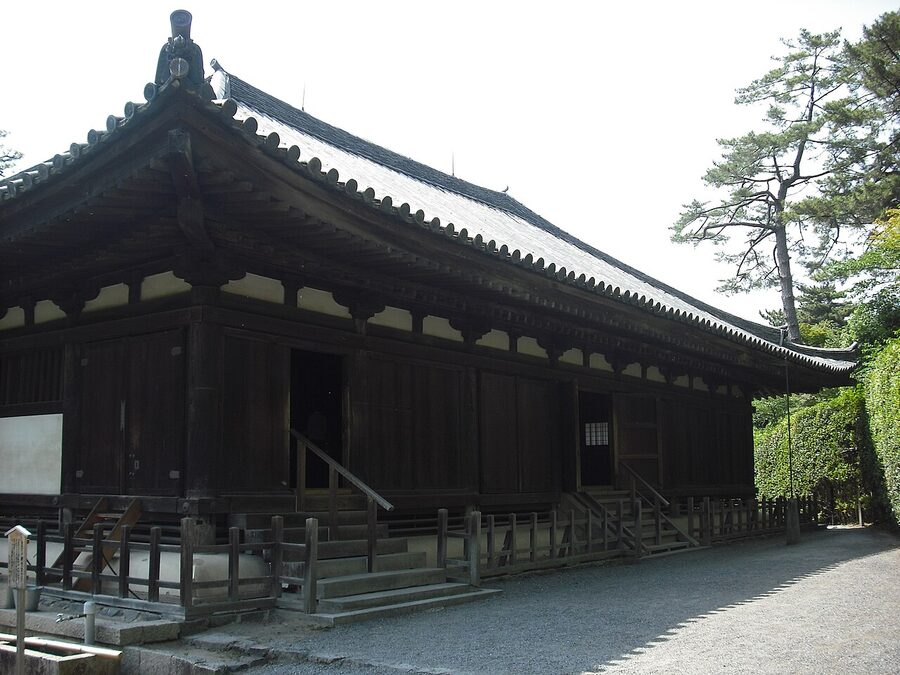
The Muromachi and Sengoku centuries were thin. The abbots of Enman-in at Mii-dera held the temple as a sideline, and it slowly decayed. In 1485, or 1486 by another reckoning, after the Ōnin War had wrecked the capital, the landholders and farmers of southern Yamashiro met in the grounds to agree rules for running the province without the warring armies, the short-lived league known as the Yamashiro ikki. It is one of the more surprising things to have happened in a Pure Land garden.
A Pure Land monk called Eikyū founded the subtemple Jōdo-in in the 1490s to look after the hall. In 1610 Mii-dera gave the temple up altogether, a Tendai subtemple, Saishō-in, was founded in 1654, and the two houses fought over who was in charge until the shogunate’s magistrates of temples and shrines ordered them to share it in 1681. They still do, taking turns, which is why Byōdō-in belongs to no single sect today.
Then in 1698 a great fire swept Uji and the temple sank further. In the early Meiji years the separation of Shinto and Buddhism took away its guardian shrine, Agata Jinja, which became independent. The rescue began with the half-dismantling repair of 1902 to 1907, the “Meiji repair”, when the bodhisattvas were restored and the hall stopped leaning on props; it continued with a full dismantling and rebuilding between 1950 and 1957, and in 1951 the hall and its Amida were named national treasures.
Ten yen and ten thousand
The hall went onto the coinage almost by accident. The bronze ten-yen coin of 1951 was one of the first coins of postwar Japan, and its picture of the hall is far fussier than so small a coin needs; the detail was meant to make it harder to counterfeit.
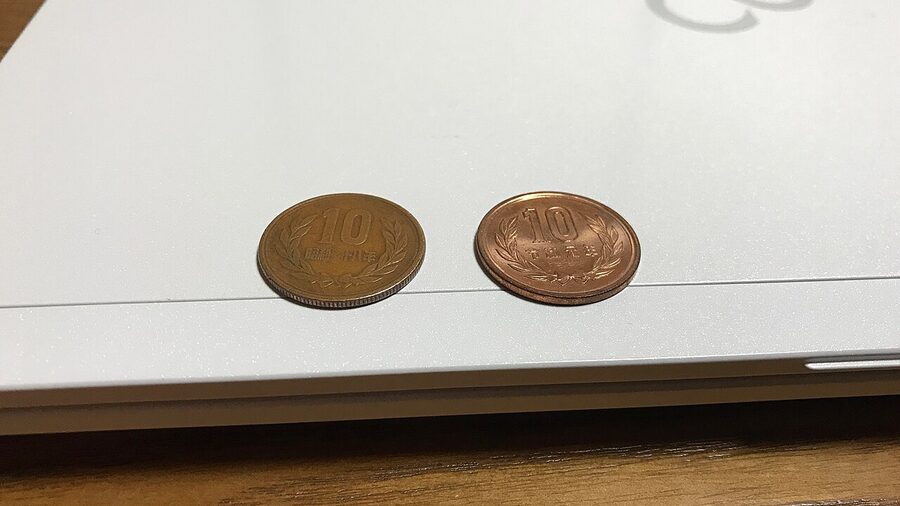
English-language sources usually date the coin to 1951. That is the year minting began and the date on the earliest coins, but by the Japanese record they did not go into circulation until the 5th of January 1953. The ridged edge earned these coins the nickname gizajū, and some people in Japan still check their change for them.
The phoenixes have a parallel career on banknotes. The ten-thousand-yen note introduced in 1958 carried a pair of phoenixes copied from the paintings on the hall’s pillars, and the 2004 note had the south phoenix statue itself on the back. Since July 2024 the new note shows Tokyo Station instead, so the bird is slowly leaving circulation; the 2004 notes remain legal tender, and a great many are still about.
Visiting Byōdō-in today
Byōdō-in makes an easy half-day from Kyoto, or a full one if you add the shrines and the tea. Go early: for the first hour after the garden opens, before the coach groups arrive, you can have the east bank nearly to yourself. Prices and hours are as the venues list them in November 2026; check their own sites before you go.
Getting there
From Kyoto Station, take the JR Nara Line to Uji, about 17 minutes on a rapid train and around half an hour on a local. From the Gion and Sanjō end of town, take the Keihan Main Line south and change at Chūshojima for the Keihan Uji Line, which ends at Keihan Uji station on the east bank of the river. Either station is about ten minutes’ walk from the temple: from JR Uji you walk down the old shopping street, and from Keihan Uji you cross the Uji Bridge.
From Nara, the JR Nara Line runs straight up to Uji in roughly 30 to 50 minutes depending on the train. That makes Uji a natural stop between the two old capitals, and if you are coming from the great temples of the Nara period, the contrast is worth having on the same day. There is no temple car park and the roads are badly congested in autumn, so come by train.
Tickets, hours and the Phoenix Hall interior
The garden is open daily from 08:45 to 17:30, with last entry at 17:15. Admission, which covers the garden and the Hōshōkan museum and is not sold separately, is ¥700 for adults, ¥400 for junior-high and high-school students and ¥300 for elementary pupils. The gate takes cards and electronic payment. There is no re-entry once you leave, except as noted below.
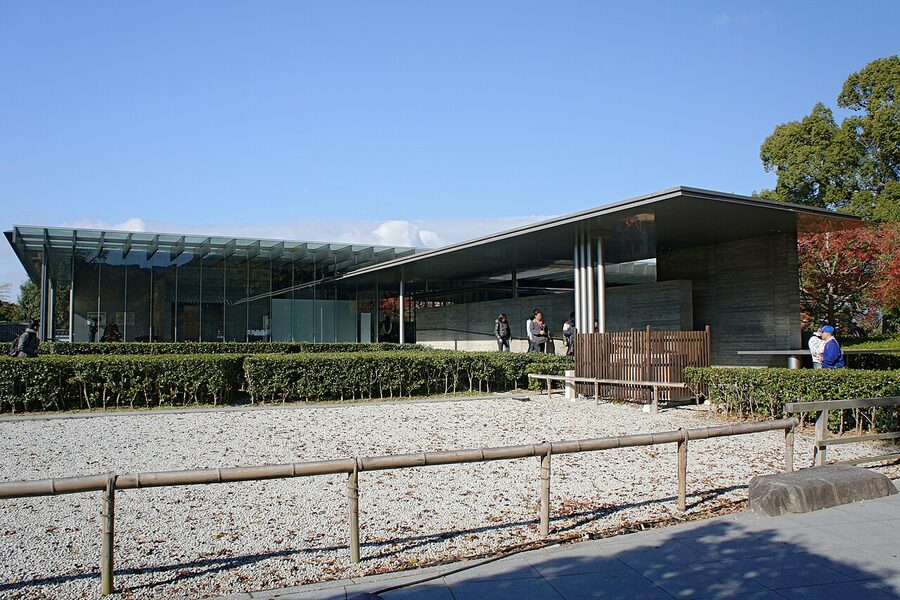
The interior of the Phoenix Hall is a separate visit, and it is the one people miss. Timed tickets cost ¥300, cash only, from a desk inside the garden that opens at 09:10, and they sell out. Groups go in every twenty minutes from 09:30, with the last at 16:10, for a fifteen-minute talk in Japanese; printed explanations are available in English and several other languages.
Since 16 October 2026 each group is limited to thirty-five people rather than fifty, and in spring and autumn the temple warns of waits of up to two hours. Buy the interior ticket first, as soon as you arrive, and see the museum and garden while you wait; with an interior ticket in hand you are allowed back in through the gate if you want to fill the time in town.
Inside, you may not photograph, touch or lean on anything. You stand at the foot of the altar with the Amida above you, the bodhisattvas on the walls and the faded paintings on the doors, and for fifteen minutes you are inside the picture instead of looking at it. It is worth every yen of the ¥300 and every minute of the queue.
The Hōshōkan museum
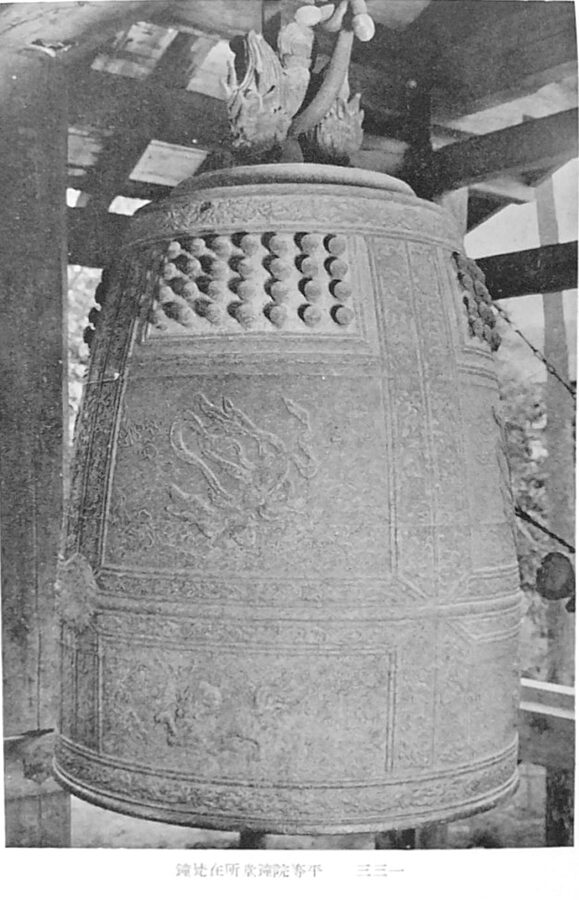
The museum is open 09:00 to 17:00, with last entry at 16:45, and it is where the originals live: twenty-six of the cloud bodhisattvas, the two bronze phoenixes, the bell, and the eleven-headed Kannon from the Kannon-dō. A room recreating the painted doors and interior colour of 1053 is the best way to understand what the faded originals were; it is shut on weekdays until 27 November 2026 for conservation work.
Until 13 December 2026 the museum also has the third part of a year-long special exhibition on warriors and Uji, covering the temple in the Edo period and the warlords’ connection with Uji tea. If you have read this far, that is your exhibition.
Around the grounds
Inside the main gate, on the left, is Ōgi no Shiba, Yorimasa’s fan lawn, and beyond it the Kannon-dō, closed for restoration at the time of writing. Walk round the pond anticlockwise and you pass the belfry with its replica bell and come to the two subtemples behind the hall: Saishō-in, with Yorimasa’s grave, and Jōdo-in, with its Rakan-dō of 1640, built by the Uji tea merchant Hoshino Dōsai and his sons. The Yōrin-an study at Jōdo-in, with paintings from the workshop of Kanō Sansetsu, is not usually open.
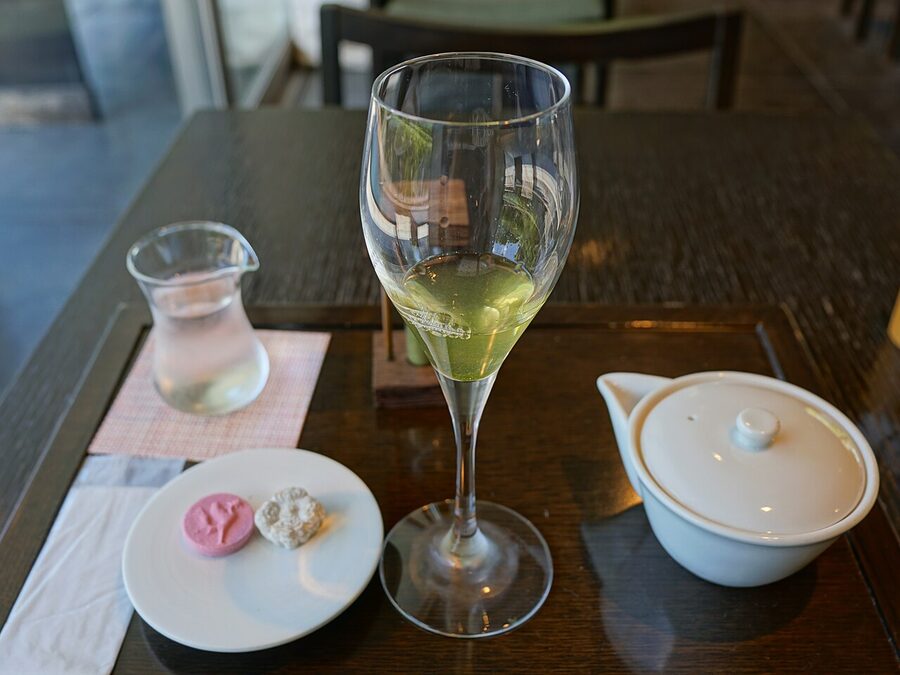
The temple’s tea room, Tōka, is opposite the museum and open 10:00 to 16:30, with last orders at 16:00, from Thursday to Sunday and on public holidays. A cup of Uji sencha, matcha or gyokuro with a sweet costs ¥800 to ¥1,200. It is an expensive cup of tea by Uji standards and a reasonable one by Kyoto’s.
Omotesandō, tea and the river
The street that runs from JR Uji to the temple gate, the Byōdō-in Omotesandō, is lined with tea merchants. The best known is Nakamura Tōkichi, founded in 1854, whose main shop near the JR station keeps its old tea-merchant’s buildings and courtyard. Uji has been Japan’s prestige tea district since the 14th century, and if the tea ceremony interests you at all, this is where much of its matcha came from.
At the end of the street the river opens out, fast and green, and the Uji Bridge crosses it. The present bridge is a 1996 concrete rebuild dressed in wood and bronze, with a little projecting balcony, the san-no-ma, from which, the story goes, water was drawn for Hideyoshi’s tea. Upstream lie Tachibana island and the Ukishima pagoda, and on summer evenings the river has cormorant fishing.
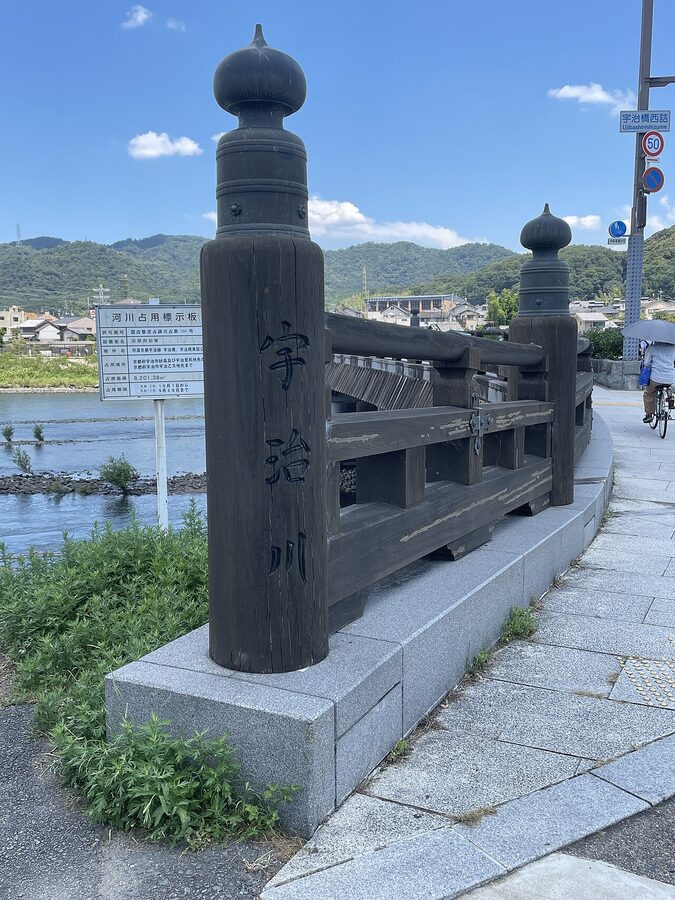
On the east end of the bridge, beside Keihan Uji station, stands Tsūen, a tea shop that claims a founding date of 1160 and is counted among Japan’s oldest businesses. Its tradition is that the first master was a retainer of Yorimasa called Furukawa Unai, who took the name Tsūen. The building dates from 1672, survived a wartime demolition order because the war ended on the day the ropes went on its pillars, and inside it you can see an old well bucket associated with the tea of Toyotomi Hideyoshi, which tradition says was made by Sen no Rikyū.
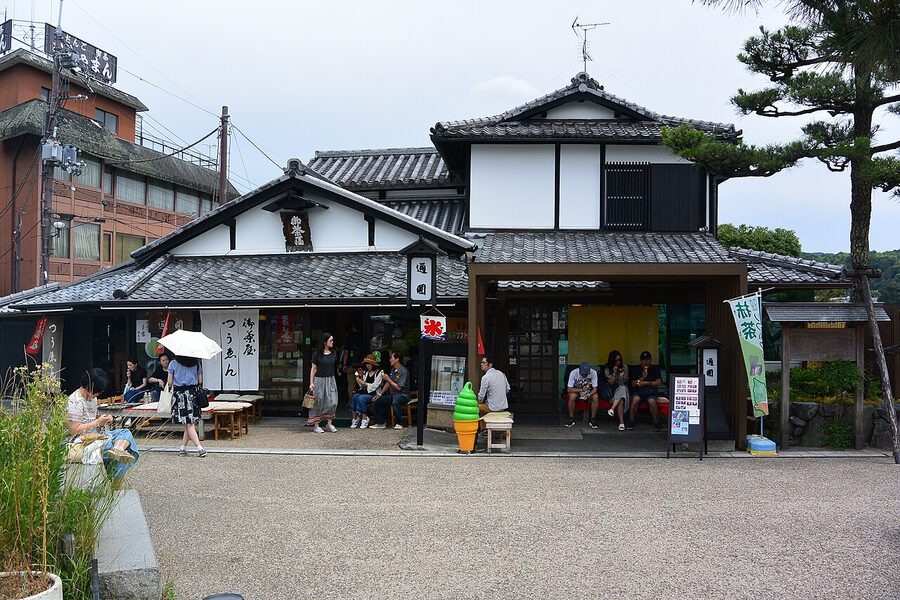
Tsūen also gave its name to a kyōgen play that parodies the Noh Yorimasa almost line by line. A travelling monk meets the ghost of the tea master, who tells how three hundred pilgrims arrived at once for the dedication of the bridge, and how he whisked tea for them all until he died there, nobly, of tea-serving. It is the funniest thing ever written about Byōdō-in, and as far as I know the only comedy about a heroic death by tea.
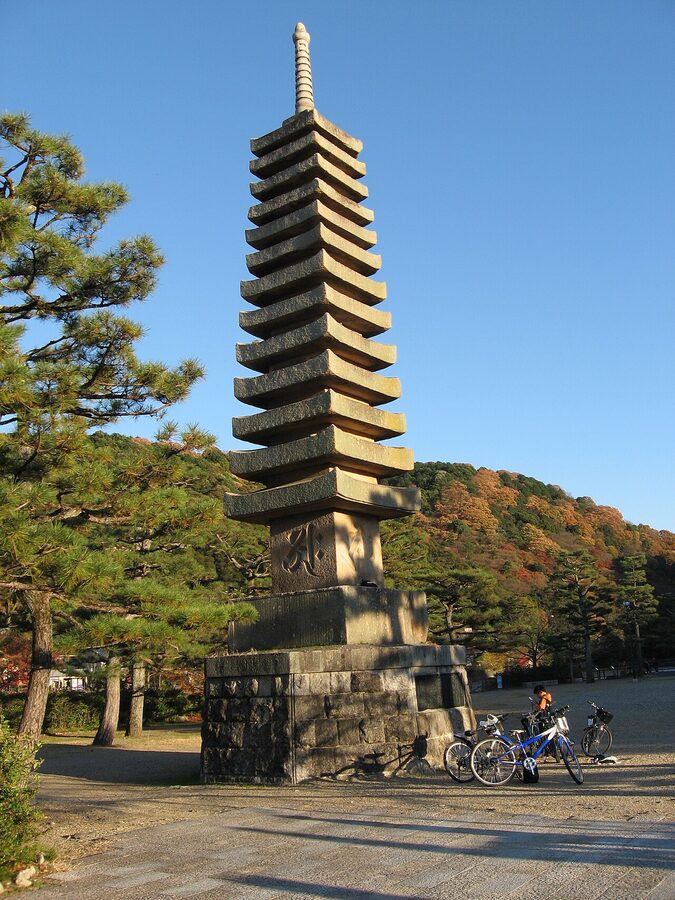
The islands are a short walk from the temple’s south gate along the riverside path, the Ajirogi no Michi. The pagoda was knocked down by floods in the 18th century, lay buried in the riverbed and was dug out and re-erected in 1908, which is a very Uji history for a monument.
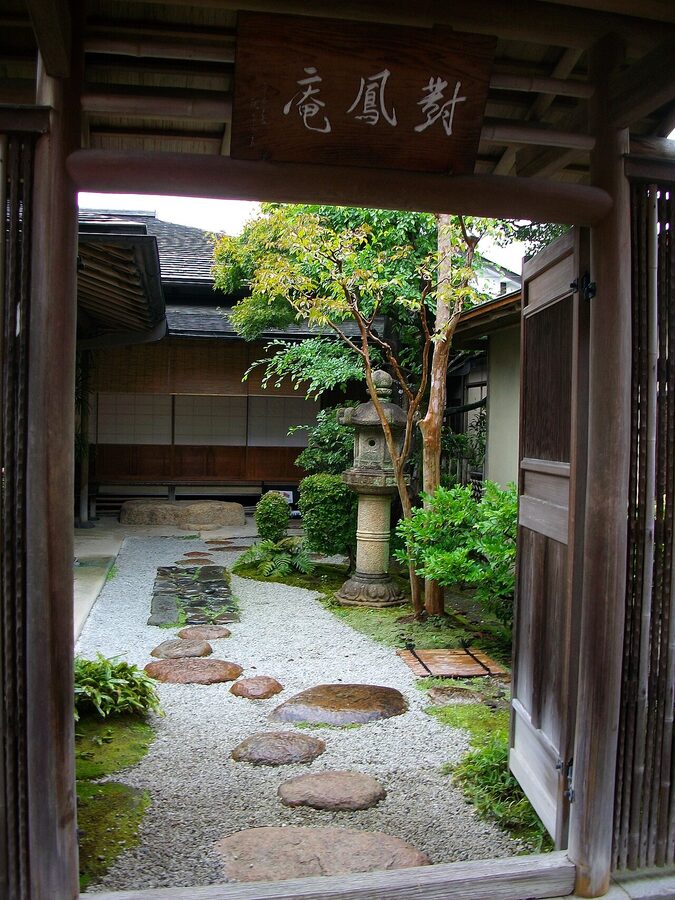
For a proper bowl of tea in a proper tea room, Taihōan, run by the city, is a few minutes along the riverside path from the temple’s south gate, facing the city’s tourist centre, where you collect your ticket. It is open 10:00 to 16:00 from 10 January to 20 December, closed at the end of each month for maintenance, and a bowl of thin matcha with a seasonal sweet costs ¥1,500, with same-day places usually available; book through the Uji tourism association’s site in busy seasons. I would do this before Tōka if you only have time for one.
Ujigami Shrine and Uji Shrine
Cross the river by the vermilion Asagiri Bridge from Tachibana island and climb a few minutes to Uji Shrine and, above it, Ujigami Shrine. Tradition makes them guardians of Byōdō-in as well, and Ujigami is the reason to come. Tree-ring dating in 2004 placed its main sanctuary at around 1060, which makes it the oldest surviving shrine building in Japan, seven years younger than the Phoenix Hall across the river.
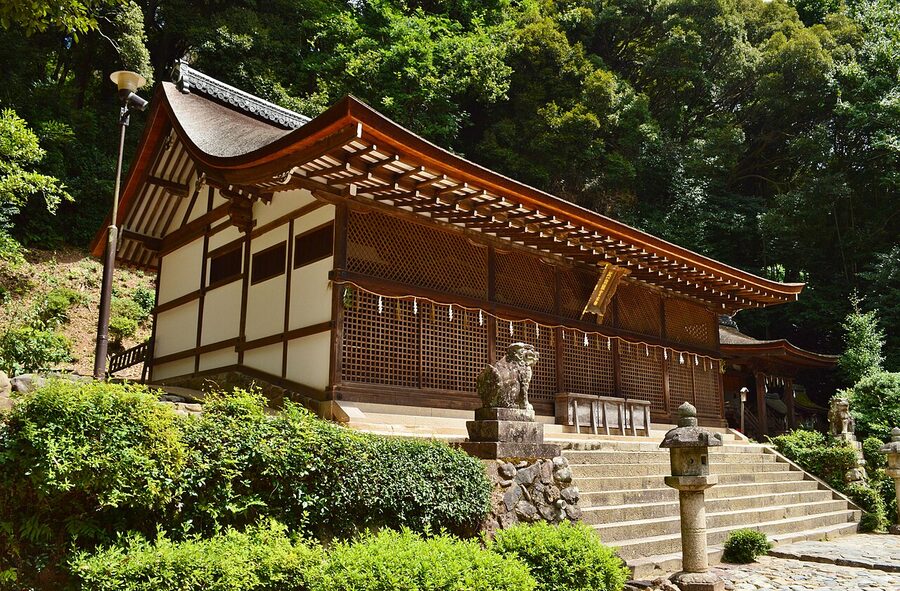
It is a modest place, a gravel courtyard, a Kamakura-period worship hall built like a small aristocratic house and the old sanctuary behind, and almost nobody comes. After the queue at the Phoenix Hall it is a relief to find a national treasure you can stand in front of on your own.
The Tale of Genji Museum
Five minutes’ walk from Ujigami, the city’s Tale of Genji Museum tells the story of the novel and especially its Uji chapters, with reconstructed rooms, a full-size ox-carriage and short films. It is open 09:00 to 17:00, last entry 16:30, closed on Mondays (or the day after a Monday holiday) and over the New Year, and entry is ¥600 for adults. It is aimed at school groups and parts of it are mildly twee, but if you have read the novel, walking out afterwards along the river the Uji chapters describe is hard to beat.
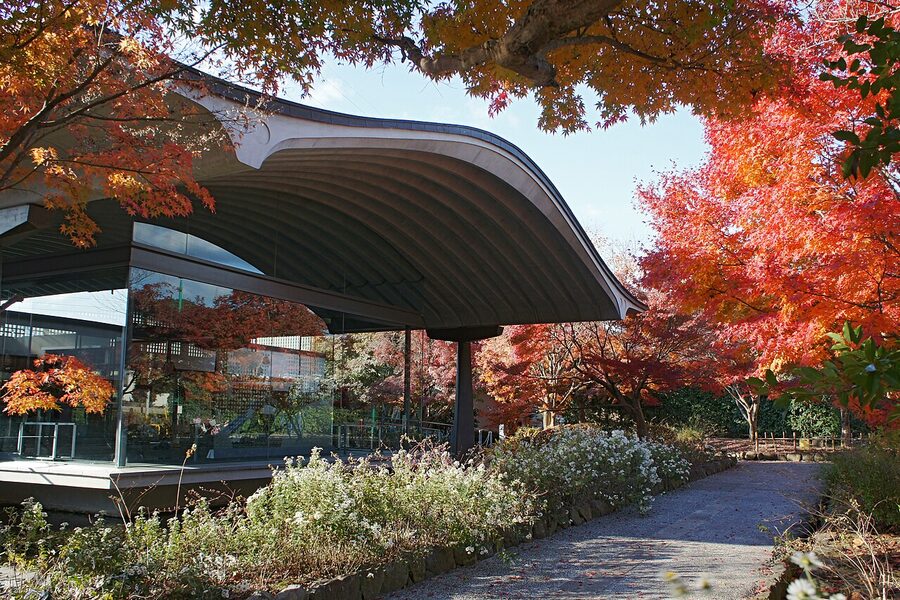
Back on the temple side, Agata Shrine, the temple’s old guardian shrine, holds its festival on the night of 5 to 6 June, known as the dark festival because its procession once went through streets with every light put out.
Further afield
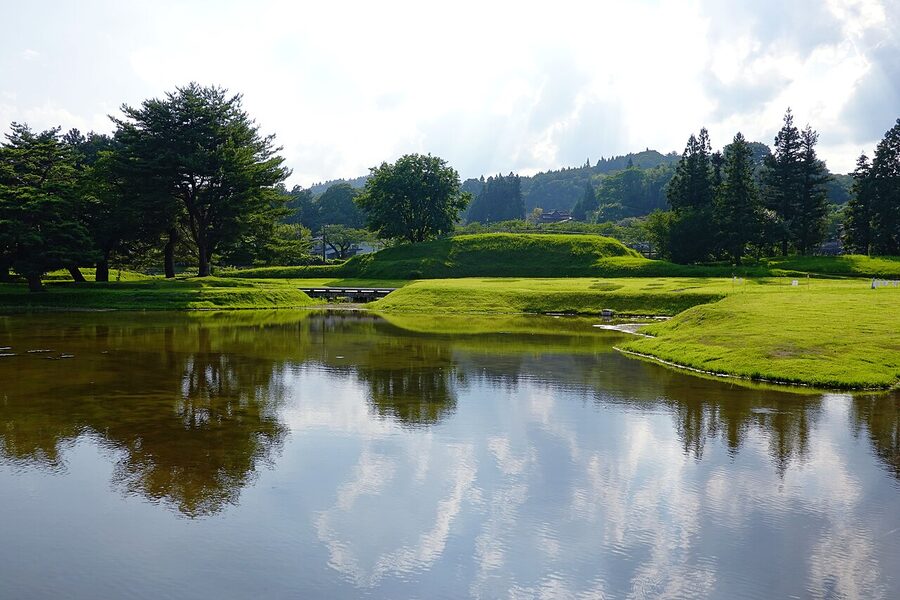
Two other places complete the story. At Hiraizumi in Iwate, the Ōshū Fujiwara lord Hidehira built Muryōkō-in in the late 12th century, which the shogunate’s chronicle Azuma kagami says was modelled on Byōdō-in; excavation has shown it was larger. Nothing stands there now but the islands, the foundation stones and a restored pond, but in the evening the sun still goes down behind Mount Kinkei to the west, as Hidehira planned.
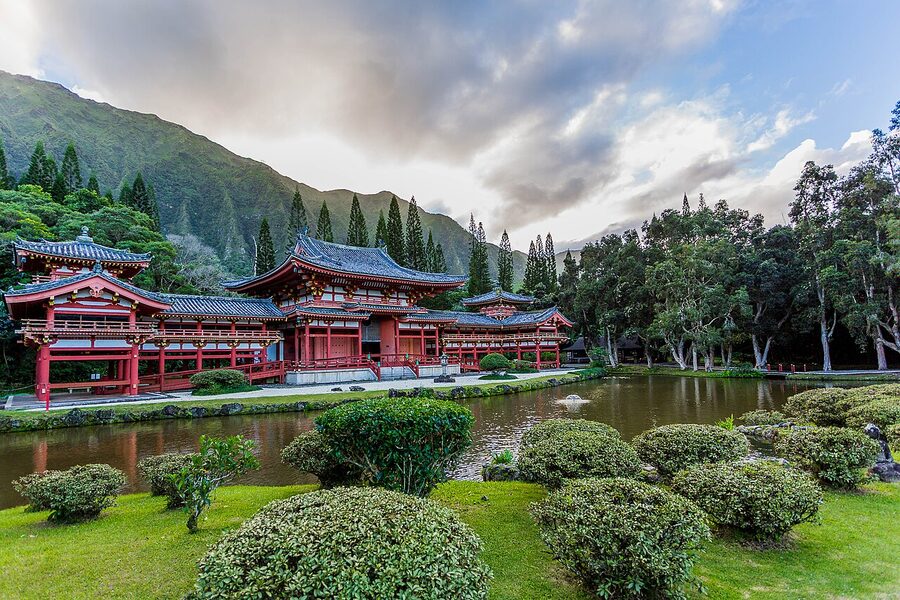
And then there is the copy you can drive to. In the Valley of the Temples on O’ahu, a half-size replica of the Phoenix Hall in concrete was completed in 1968 to mark a hundred years of Japanese immigration to Hawaii. It is a pleasant place with peacocks and a large bell, it has no Jōchō and no Heian paintings, and it is the reason a surprising number of people ask me whether Byōdō-in is in Hawaii.
Where to stand
For the greater part of a thousand years, the point of the Phoenix Hall has been the view from the east bank: a gilded face in a round window, across a strip of water, with the sun going down behind it. Yorimichi built a pavilion for that view, and the excavators found where it stood. After you have queued for the interior and walked the museum, go back to the east bank of the pond, find a spot near where the Kogosho was, and wait until the crowd in front of you thins.
You will need a little luck, and the doors need to be open. But when the face comes clear in its window, you will be standing roughly where the grandest guests of a frightened chancellor stood in 1053, doing what his sutra told them to do, and I have never found a better use for ten minutes in Japan.