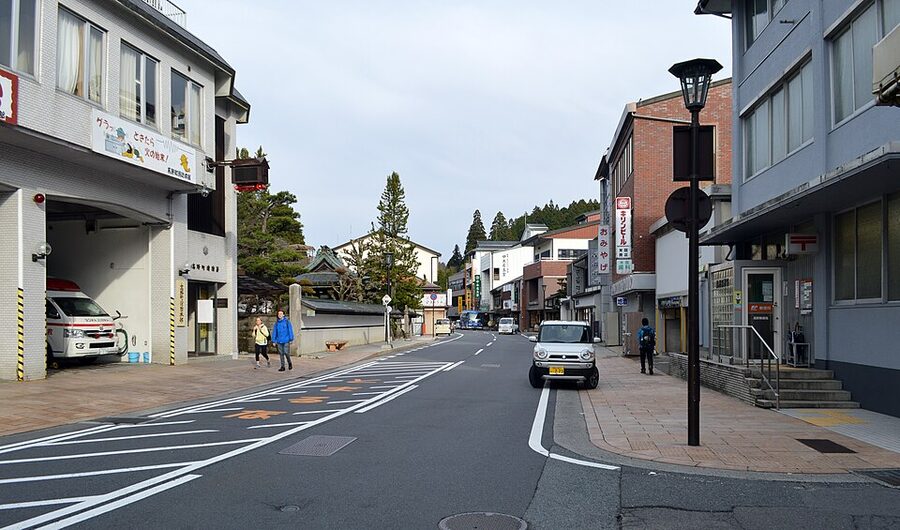
Kōyasan got its first 24-hour convenience store in July 2013. It sells beer and cigarettes, the way convenience stores do, but when it opened it would not sell you raw meat or sashimi, because nobody has been allowed to bring meat or fish onto this mountain since the 9th century. I can think of no better summary of the place.
About 3,000 people live up here, 800 metres above sea level in a bowl of cedar-covered peaks in the north of Wakayama Prefecture, among 117 temples, and the entire town is legally the precinct of one of them. The modern world gets in, but on the mountain’s terms, and Kōyasan (高野山) has been haggling over those terms for twelve centuries: with emperors, with a rival temple in Kyoto, with its own reformers, with the army of Oda Nobunaga, and with Toyotomi Hideyoshi, who was talked out of burning it by a former samurai who did not eat grain.
The founder, Kūkai, has his own long article on this site, so I will not retell his life, the founding of the monastery, the meals carried to his tomb or the belief that he is still meditating inside it. This piece starts after he went quiet: the centuries when the mountain nearly died, the salesmen-saints who saved it, the warlords who wanted it, the women kept off it and the 200,000 graves of people who wanted to be near it. Then it tells you how to get up there, where to sleep and what you will be given for dinner.
In This Article
- A town inside a temple
- Twenty years with nobody home
- Kiyomori’s blood and Masako’s son
- Kakuban and the riot of the awls
- Saints, salesmen and the Kōya hijiri
- Nobunaga at the gate
- The monk who talked Hideyoshi down
- The fifteenth day of the seventh month, 1595
- A mountain on the shogun’s payroll
- Two hundred thousand neighbours
- The companies
- The Tōrōdō and the poor woman’s lamp
- No women past this point
- Mothers at the bottom of the mountain
- Karukaya and Ishidōmaru
- 1872 and after
- Fire, Meiji and the modern mountain
- Where to visit Kōyasan today
- Getting there
- The Daimon and the Danjō Garan
- Kongōbu-ji
- The Reihōkan and the Tokugawa Reidai
- Okunoin
- The Nyonindō and the women’s path
- Shukubō and shōjin ryōri
- The Chōishi-michi from Kudoyama
- On the mountain’s terms
A town inside a temple
The first thing to understand is that Kōyasan is not a mountain. There is no peak of that name; the word means a high basin, longer from east to west than from north to south, enclosed by eight low summits that Kūkai read as the petals of a lotus. The Japanese term for the arrangement is issan keidaichi (一山境内地), “one mountain, one precinct”: everything inside the old boundary, the shops, the school, the police box and the FamilyMart, stands on the grounds of Kongōbu-ji (金剛峯寺).
For most of its history Kongōbu-ji meant the whole mountain, the way “Oxford” can mean the university; only since 1869 has it been the name of one temple, the headquarters of the Kōyasan Shingon school, on the main street with a car park in front.
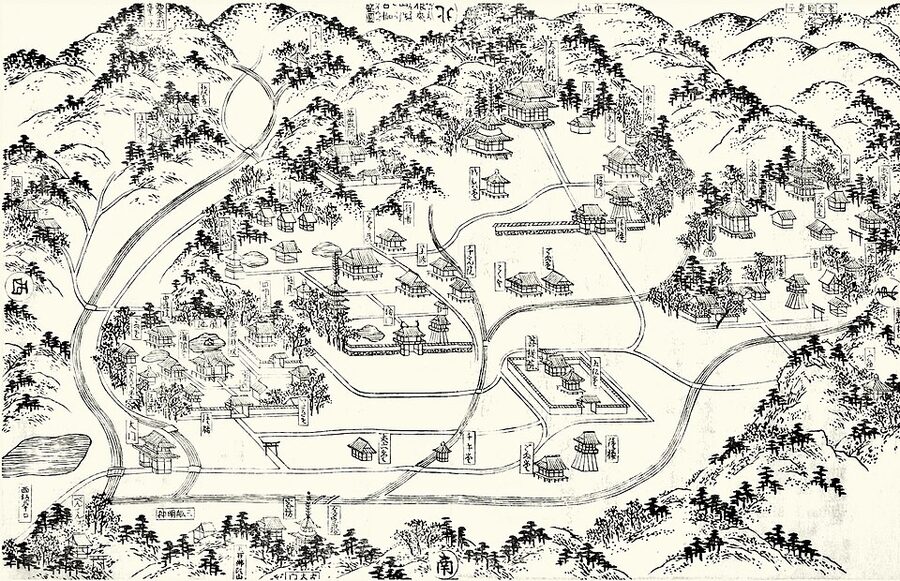
The town has two poles. At the western end is the Danjō Garan (壇上伽藍), the ceremonial centre with the great pagoda and the main hall; at the eastern end, two kilometres of cedars and gravestones lead to the Okunoin (奥之院) and Kūkai’s tomb. Everything else lies in the valleys between them, which tradition counts as ten, each with its own cluster of sub-temples, its own bath house and, once, its own politics.
Of the 117 temples, 52 are shukubō (宿坊), temples that take paying guests, and that is the main reason most people stay the night. The other is that Kōyasan is cold. The average annual temperature is 11.1°C, it freezes on more than a hundred days a year, which surprises people who think of Wakayama as a prefecture of oranges and beaches.
Twenty years with nobody home
The mountain’s first crisis came within a lifetime of the founder, and it was about books. Kūkai had brought home from China a set of thirty notebooks, the Sanjūjō sasshi (三十帖策子), and whoever held them could claim the authentic tradition. His nephew and successor Shinzen borrowed them from Tō-ji in Kyoto and did not give them back.
When Tō-ji asked again, the next head of the mountain, Mukū, took the notebooks, gathered the monks and walked off the mountain altogether, and for about twenty years, Japanese reference works say, there was hardly anyone on Kōyasan at all. The dispute was settled by Kangen, the head of Tō-ji, who returned the books to Kyoto, made himself head of the mountain as well, and turned Kōyasan into a branch of Tō-ji, which on paper it remained until the 19th century.
Kangen also won Kūkai the title Kōbō Daishi in 921, and the faith that grew out of that is told in the Kūkai article. It did not save the mountain at once. On the 6th day of the seventh month of 994 lightning struck the great pagoda, nearly every building in the Garan burned, and the monks moved down to Amano in the valley, leaving the plateau to the cedars a second time.
The revival began around 1016 with Jōyo, better known as Kishin Shōnin, a professional fundraiser from Kōfuku-ji in Nara. The temple’s story says he planted wisteria upside down as a vow and it grew anyway, and that he lit a lamp at Kūkai’s tomb that has burned ever since. He worked the court in Kyoto until the most powerful man in the country agreed to come.
That was Fujiwara no Michinaga, patron of Murasaki Shikibu and, many readers think, one of the models for the shining prince of The Tale of Genji, who climbed the mountain in 1023. After him came his son Yorimichi, builder of the Byōdō-in, in 1048, and then the retired emperors: Shirakawa in the second month of 1088, again in 1091 and 1103, and Toba in 1124. The Fujiwara had made the mountain fashionable, and fashion in the late Heian era came with estates attached.
Kiyomori’s blood and Masako’s son
The most notorious donor of the age was Taira no Kiyomori, put in charge of rebuilding the great pagoda after it burned again in 1149. The Heike monogatari says that when the work was done he went to pray at the Okunoin, where an old monk warned him that if he did evil his descendants would never get what they wanted; Kiyomori decided the old man had been Kūkai. The temple’s own tradition moves the meeting to a cherry tree in the Garan, still called the Taimen-zakura, the “meeting cherry”.
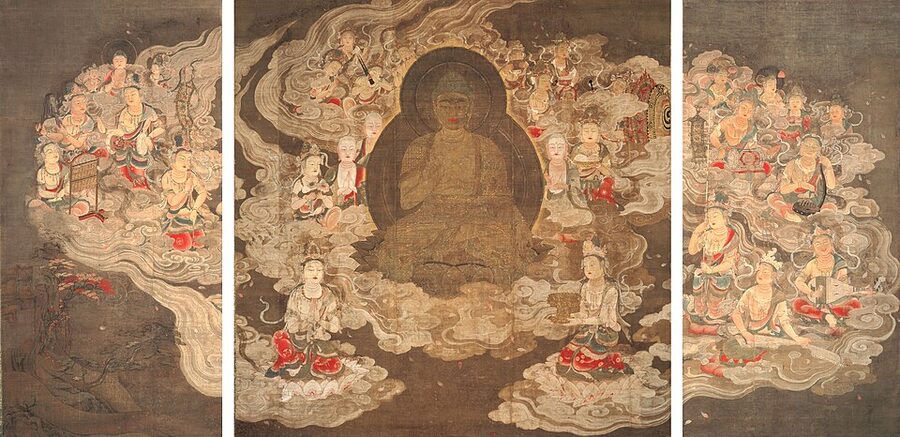
The same chronicle says Kiyomori then had a pair of great mandalas painted for the main hall and coloured the crown of the central Buddha with blood from his own head. The Chi-mandara, the Blood Mandala, dated 1156, survives in the Reihōkan.
After the Genpei War the mountain filled with losers: defeated Taira, warriors unhappy with their rewards and men who had simply had enough, along with the poet Saigyō, who spent about thirty years in and around Kōyasan. The Kamakura regime, rather than suspecting the place, paid for it.
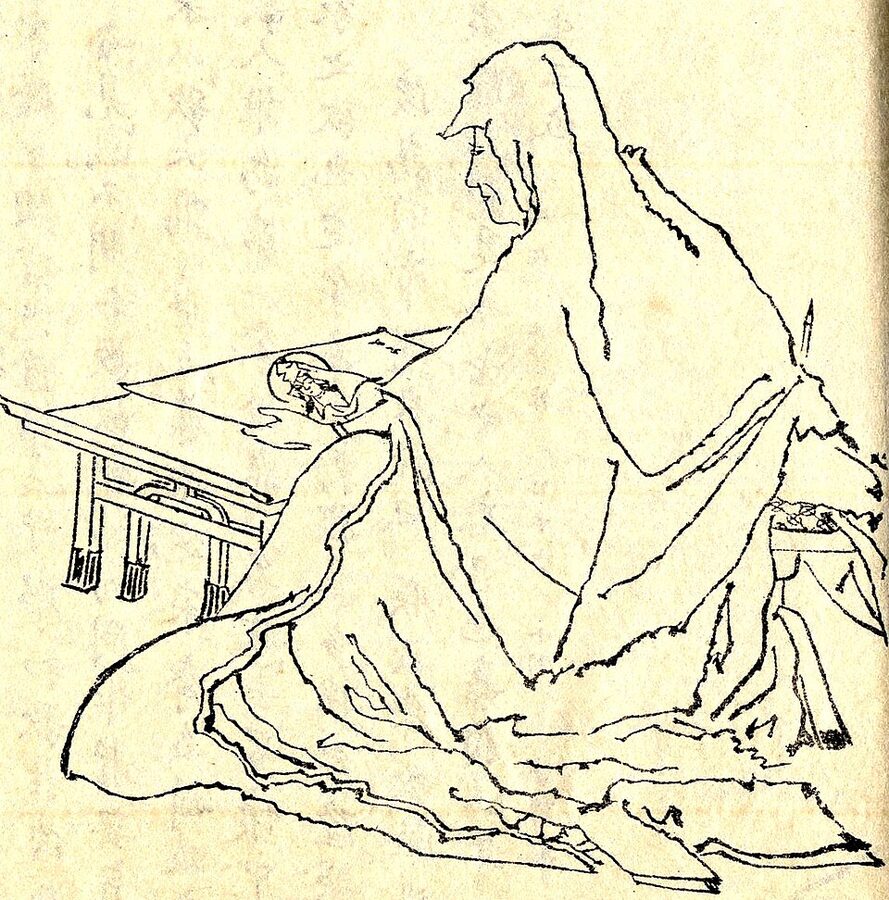
Hōjō Masako, widow of Minamoto no Yoritomo, founded a chapel here for her husband in 1211 and, after her son the shogun Sanetomo was murdered in 1219, rebuilt it as Kongō Sanmai-in. An Edo-period chronicle of the mountain, the Kōya shunjū, adds a story I half believe. Masako came to ask Sadaaki, Yoritomo’s son by another woman and by then a monk on Kōyasan, whether he wanted to be shogun; because of the ban on women they met at Amano, and Sadaaki answered by gouging out his own left eye with a dagger.
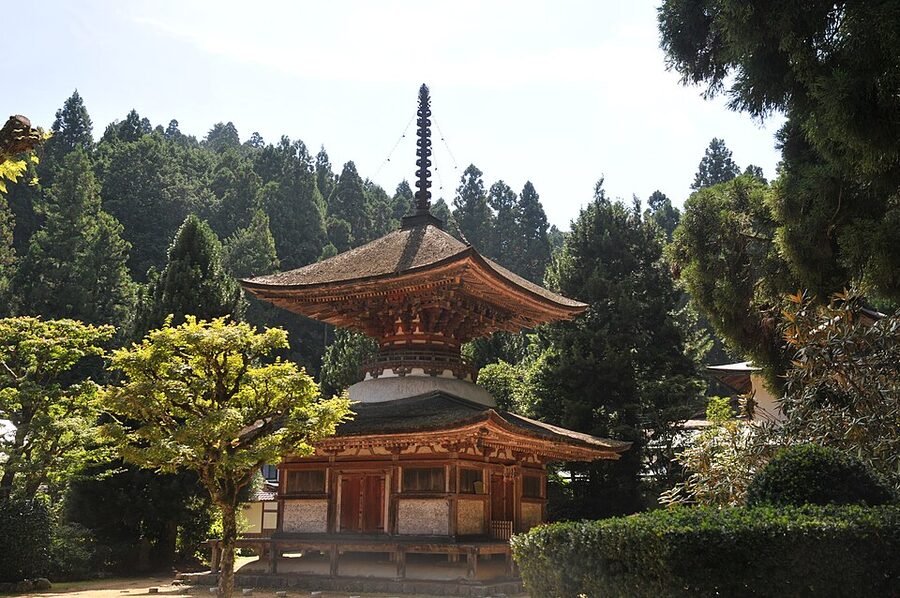
The shogunate’s grandest gift was the path up. In 1265 a monk called Kakukyō began replacing the wooden waymarkers on the main pilgrim route with granite ones, and over twenty years, with money from the shogun’s regents, retired emperors and ordinary believers, he set up 216 of them; I come back to them at the end.
Kakuban and the riot of the awls
The best reformer in the mountain’s middle history was thrown off it. Kakuban (覚鑁) was born in 1095 in Hizen, in northern Kyushu, trained at Ninna-ji and on Kōyasan, and was called the finest mind in the school since Kūkai. He also had a powerful patron in the retired emperor Toba, who credited Kakuban’s prayers with curing an illness.
In 1132 Kakuban built a large new teaching hall, the Daidenpō-in (大伝法院), with his residence, the Mitsugon-in, beside it, and in 1134 he was made head of Kongōbu-ji as well. He wanted real scholarship back on a mountain he thought had gone lazy. More dangerously, he taught that the esoteric Buddha Mahāvairocana and Amida were one Buddha under two names, so that Amida’s Pure Land and the esoteric Pure Land were the same place.
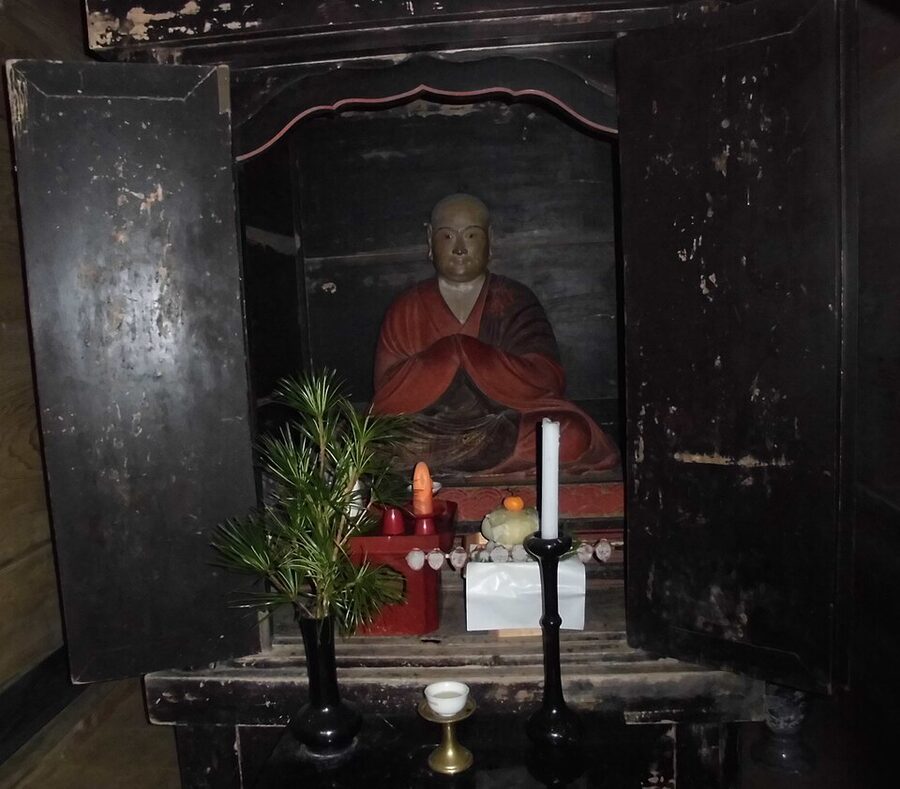
The scholar monks did not care for any of it. In 1140 a crowd of them attacked the Mitsugon-in and burned it, and the legend of what happened inside named the episode the Kirimomi no ran (錐もみの乱), the riot of the awls. The attackers found two identical statues of Fudō on the altar, one presumably Kakuban in disguise, and stabbed both in the knee with awls to see which would bleed; both did, the carved flames behind them burst into real fire, and the attackers fled.
Kakuban fled too, to an estate called Negoro in the hills to the south, and died there on the 12th day of the twelfth month of Kōji 2. English reference works give that as 1143; Japanese ones convert it to January 1144 by the Western calendar. In 1288 his successor Raiyu moved the Daidenpō-in to Negoro altogether, founding Shingi Shingon, “New Shingon”, the parent of the schools that run Hase-dera and Kawasaki Daishi today.
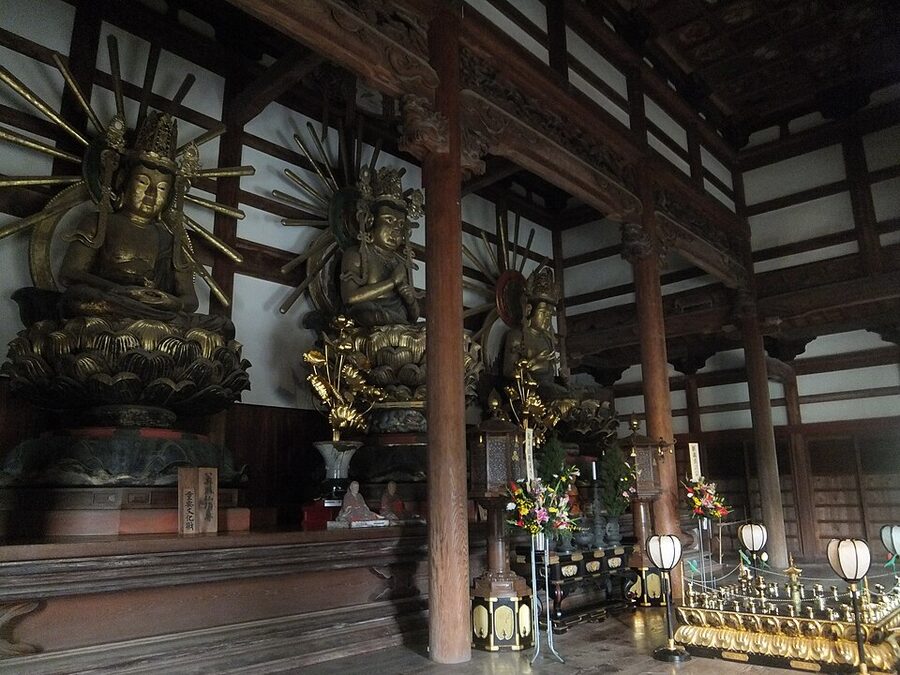
Kōyasan forgave him in time: the Mitsugon-dō and a flight of steps on the Okunoin path, the Kakuban-zaka, keep his name on the mountain.
Saints, salesmen and the Kōya hijiri
From the late Heian period until the 19th century the mountain’s monks came in three kinds, who mostly disliked each other. The gakuryo (学侶) were the scholars, often the sons of nobles. The gyōnin (行人) lit the lamps, guarded the halls, ran the estates and, when necessary, fought; and at the bottom of the ladder, by far the most useful, were the hijiri.
The Kōya hijiri (高野聖) were holy men who came from everywhere, many of them devotees of Amida rather than strict esoteric monks, and lived in settlements on the mountain’s edges. Their early leaders included Kyōkai, who founded the Odawara settlement in the late 11th century, and Chōgen, who would later raise the money to rebuild the Great Buddha of Tōdai-ji. The folklorist Gorai Shigeru, whose book on them is still the standard work, sorted them into three big groups named after their valleys: Rengedani, Kayandō and Senjuin.
What they did was travel. They walked the provinces in short black robes and huge cypress hats with boxes on their backs, preaching that Kōyasan was a Pure Land on earth, raising money, selling charms and medicine, and collecting bones. A family that could never make the journey gave a hijiri a piece of a relative’s bone or a lock of hair, and he carried it up and buried it near the Daishi, and that trade in the dead is why the Okunoin cemetery exists.
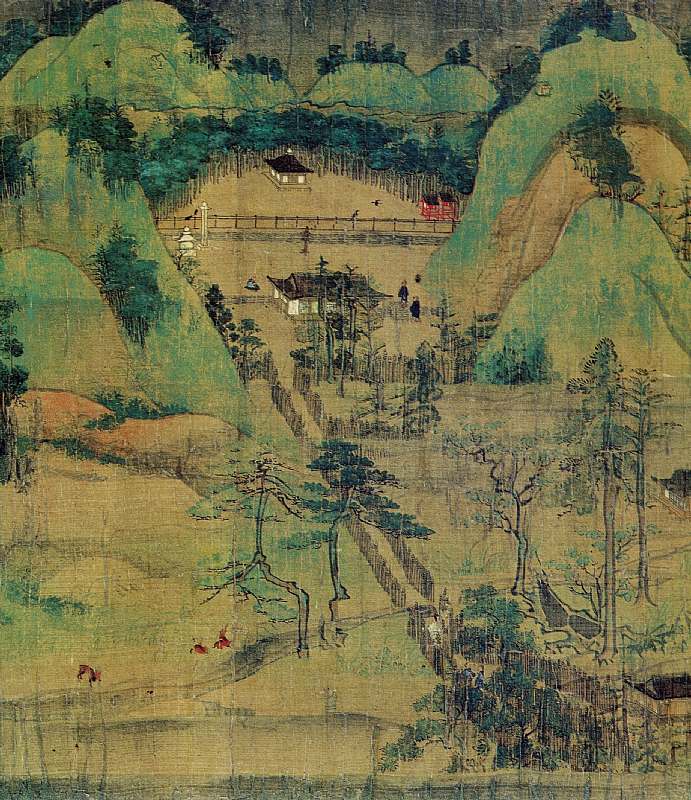
They were storytellers too, and their best story was the tale of Karukaya, which the Kayandō hijiri told from their hall on the road to the Okunoin. Japanese scholars agree that men like these spread most of the 5,000-odd legends of Kūkai striking springs from rocks in places he never visited. The scholar monks found them vulgar, and in the fifth month of 1413 the mountain banned their loud chanting, their gongs and their dancing nembutsu.
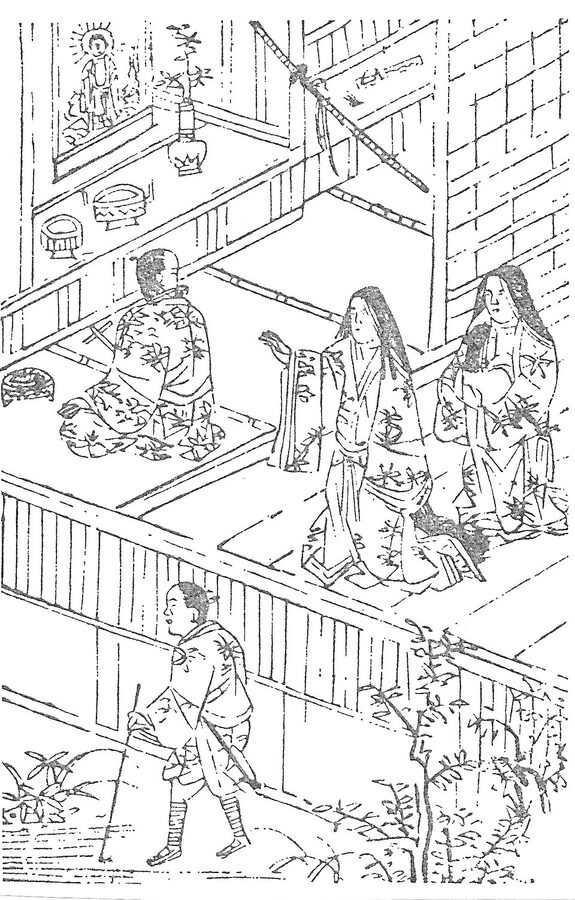
They were not always holy. By the late Middle Ages some used their right to ask for lodging as cover for theft and seduction, and people punned on their trade: instead of yadokari, “lodging-seekers”, they were yadōkai, “night-road goblins”. A rhyme of the time ran “Kōya hijiri ni yado kasu na, musume torarete haji kaku na”: never give a Kōya hijiri a bed, or you will lose your daughter and your good name.
Izumi Kyōka made a ghost story of that reputation in his novella Kōya Hijiri of 1900, in which a monk from the mountain meets a beautiful woman in the forests of Hida who turns the men she tires of into animals. The hijiri themselves did not last so well, and the reason was the warlords.
Nobunaga at the gate
By the 16th century the mountain was a power in its own right, credited by Japanese histories with estates of about 170,000 koku and, by some counts, 30,000 armed monks. It was one of several in the Kii Peninsula. Negoro-ji, Kakuban’s refuge, had grown into a city of some 450 cloisters with a famous corps of musketeers, and the coast at Saika was held by a league of gunners who answered to nobody.
Oda Nobunaga had shown what he did to armed temples when he burned Enryaku-ji in 1571. Kōyasan gave him a reason in 1580, when five former retainers of Araki Murashige, who had rebelled against him, took refuge on the mountain. Nobunaga sent more than thirty men to search for them, and the gyōnin killed them, on the grounds, the mountain later said, that they had come to loot rather than search.
Nobunaga’s answer fell first on the hijiri. He had those travelling around the capital rounded up, 1,383 of them by the count every source repeats, and executed, according to one chronology on the riverbed at Shichijō in Kyoto. Most Japanese chronologies put it in the first month of 1581, but one account dates the round-up to 1578, and Gorai Shigeru adds that some hijiri really were spies, which may be why Nobunaga took them first.
Then he sent an army. Japanese sources disagree about its size, from “several tens of thousands” to a precise and probably inflated 137,000, and even about who led it: one reference work names his son Nobutaka, another his kinsman Oda Nobuharu. The mountain held out, and nobody knows what would have happened next, because on the 2nd day of the sixth month of 1582 Nobunaga died at the Honnō-ji and the army went home.
The monk who talked Hideyoshi down
The next man to come for Kōyasan was smarter than Nobunaga, and the mountain was luckier in its negotiator. Toyotomi Hideyoshi settled accounts with the Kii Peninsula in the spring of 1585. Negoro and its musketeers had fought for Tokugawa Ieyasu against him the year before at Komaki and Nagakute, and in the third month his army took Negoro and burned it, along with the Saika gunners and the temple of Kokawa-dera.
Kōyasan was next, and it knew it. Hideyoshi’s envoys brought his terms: give back the estates the mountain had taken, and disarm. The man the mountain chose to carry its reply had been on Kōyasan for only twelve years and belonged to none of its three orders.
He was Ōgo (応其), known to everyone as Mokujiki Ōgo, because he had taken the mokujiki vow of the “tree-eaters”, giving up cereals for nuts, fruit and plants. He came from Ōmi, had been a samurai, perhaps of the Sasaki or a vassal of the Ochi of Yamato, and had shaved his head on Kōyasan in 1573 at thirty-eight. Historians still argue about why he got the job: he may have known Hideyoshi already, or Ishida Mitsunari, a fellow Ōmi man, or he may simply have been the mountain’s best poet in an age when renga linked verse opened doors that swords did not.
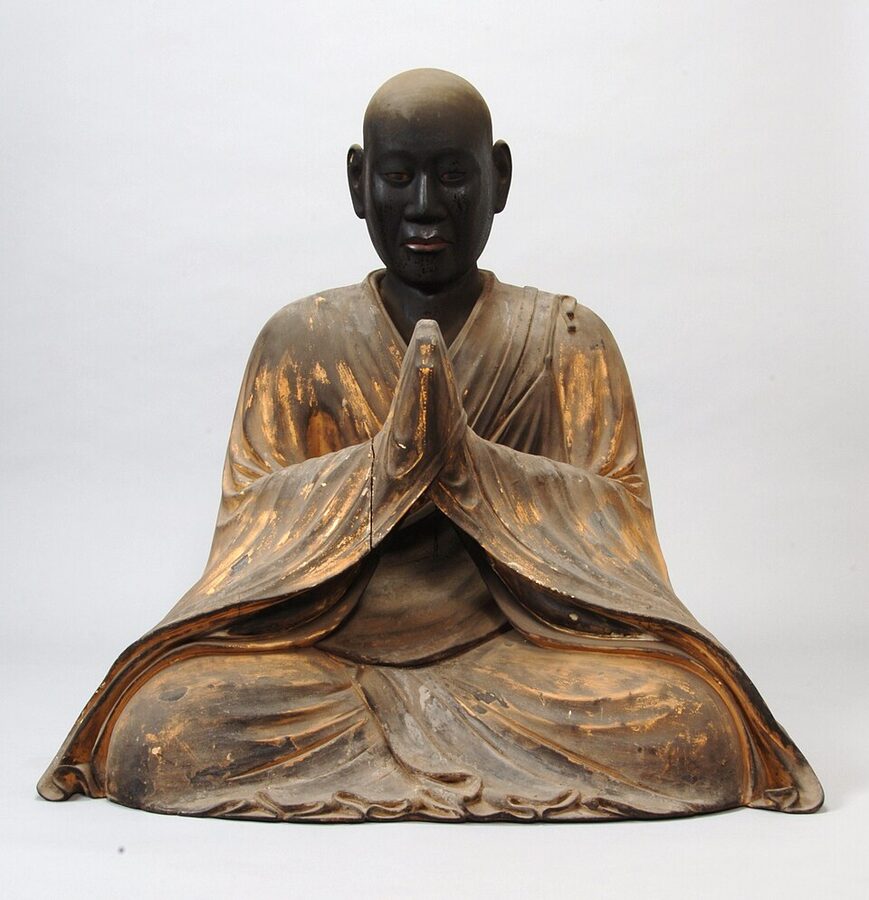
It worked. Kōyasan accepted the terms and surrendered its weapons and most of its lands, and Hideyoshi, who could have burned it, decided to adopt it instead. When Ōgo came to Osaka Castle in the seventh month of 1586, Hideyoshi told the assembled lords, in a line the mountain has repeated ever since, “Do not think of him as Kōya’s Mokujiki. Think of Kōya as Mokujiki’s.”
Hideyoshi confirmed estates of 21,000 koku and paid to rebuild about twenty-five buildings lost in the great fire of the second month of 1521, the great pagoda and the main hall among them. He made Ōgo, in effect, his master of works for temples across the country, and Japanese sources count 97 temples and halls Ōgo built or repaired, from Kyoto’s Great Buddha at Hōkō-ji to Tō-ji, Daigo-ji and the Byōdō-in.
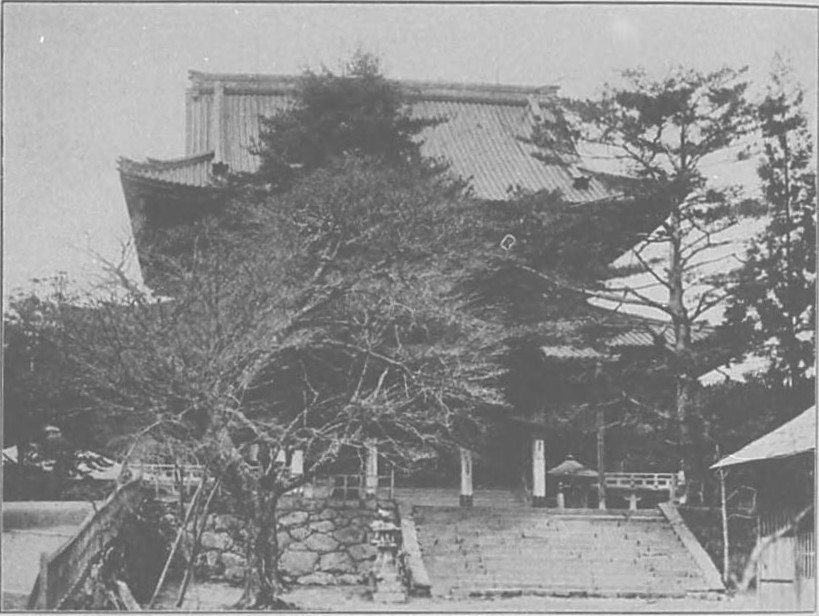
In 1590 Ōgo founded a temple of his own, Kōzan-ji, and the emperor gave him the title Kōzan Shōnin. Hideyoshi then had him build a temple to the memory of his mother, Ōmandokoro, whose shaved hair was enshrined there, so it was first called Teihatsu-ji, the “temple of the shorn hair”. Japanese sources date it to 1592 or 1593, and by 1594, when Hideyoshi came up for his mother’s memorial service with Tokugawa Ieyasu in attendance, it had a new name: Seigan-ji (青巌寺).
The fifteenth day of the seventh month, 1595
Seigan-ji’s first famous guest arrived in disgrace. Toyotomi Hidetsugu (豊臣秀次) was Hideyoshi’s nephew, his adopted son and, since 1591, his successor as imperial regent, on paper the second man in Japan. Then in 1593 Hideyoshi’s concubine Yodo-dono gave birth to a son, Hideyori, and Hidetsugu became a problem.
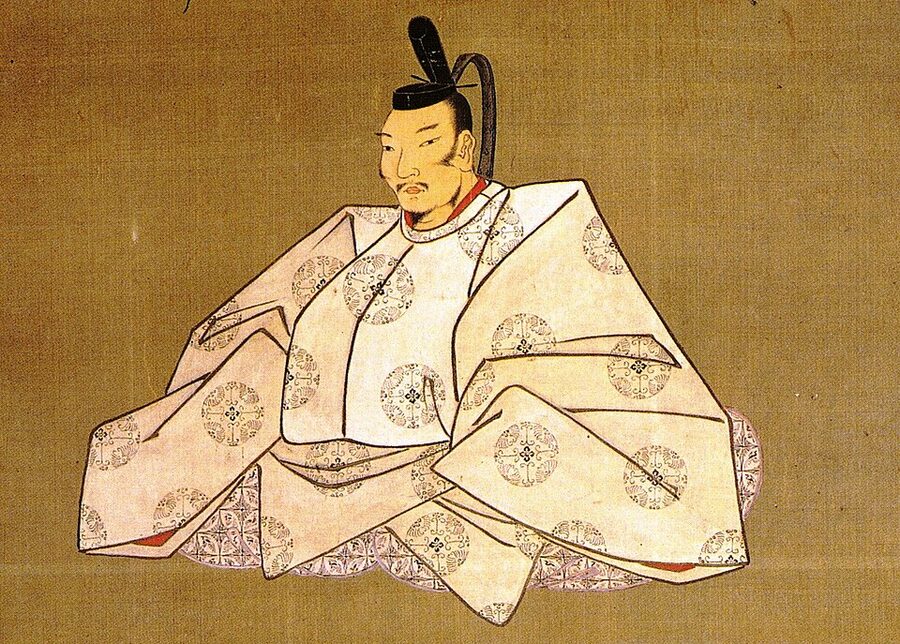
In the seventh month of 1595 he was summoned to Hideyoshi’s castle at Fushimi, refused an audience, and told to go to Kōyasan. He shaved his head, left on the 8th day escorted by, among others, Mokujiki Ōgo, and reached Seigan-ji on the 10th with eleven pages and a Zen monk from Tōfuku-ji. Hideyoshi’s orders followed him, fixing how many attendants he could keep and who could visit, which amounted to house arrest in his own grandmother’s memorial temple.
On the 15th three of Hideyoshi’s men arrived with soldiers, Fukushima Masanori, Ikeda Hideo and Fukuhara Nagataka, bringing the order for Hidetsugu to die. According to the Hoan Taikōki, written a generation later, Ōgo protested that by long temple law a man who took refuge in a monastery was beyond secular punishment, and stalled for time, until Fukushima made it plain that if the mountain defied Hideyoshi there would be no mountain.
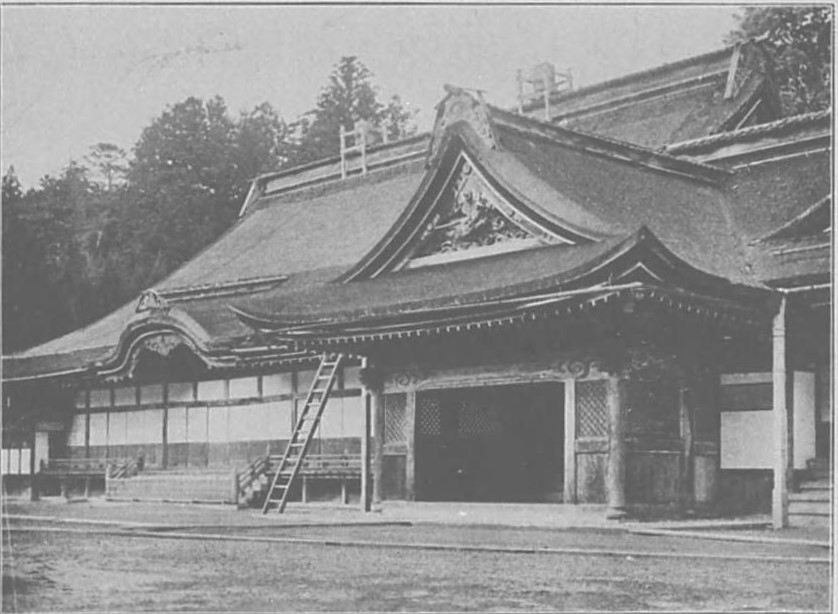
What followed was done properly. Three of his pages, Yamamoto Tonomonosuke, Yamada Sanjūrō and Fuwa Bansaku, cut their bellies first, with Hidetsugu acting as second for each, and the Zen monk Kogan Genryū went next. Then Hidetsugu died by seppuku, with his retainer Sasabe Shigemasa as second, and Sasabe killed himself immediately afterwards.
Hidetsugu was buried on the hillside behind Kōdai-in (光台院) in the Senjuin valley, and Fukushima carried the head to Fushimi. The room where it happened, the Yanagi no ma or Willow Room of Kongōbu-ji, is still shown, a pleasant room painted with willows through the four seasons, which somehow makes it worse.
Hideyoshi had not finished. On the 2nd day of the eighth month, 5 September by the Western calendar as Japanese sources convert it, Hidetsugu’s children, wives, concubines and maids, thirty-nine people, were beheaded on the riverbed at Sanjō in Kyoto beneath his displayed head. Among them was the young daughter of Mogami Yoshiaki, who had reached the capital so recently that she had never met Hidetsugu, and her father’s grief helped push him onto the Tokugawa side at Sekigahara five years later.
The bodies went into a single pit under a stone carved “Hidetsugu the traitor”. In 1611 the merchant Suminokura Ryōi found it in the riverbed while cutting a canal, had the insult chiselled off and founded a temple, Zuisen-ji, to pray for the dead; it still stands beside the Takase canal in Kyoto.
Why it happened is still argued over. The Edo-period chroniclers blamed Ishida Mitsunari’s slanders and Hidetsugu’s own cruelty, while the courtier Yamashina Tokitsune wrote in his diary at the time that the talk of rebellion was mere rumour and the punishment “beyond words”. More recently the historian Yabe Kentarō has proposed that Hideyoshi only exiled his nephew, that Hidetsugu cut himself open to prove his innocence, and that Hideyoshi’s fury at a death in his mother’s memorial temple explains the massacre.
I find Yabe’s version more persuasive, because it explains the strangest fact in the story, which is the place. Whichever you prefer, a regent of Japan died in Seigan-ji, and Ōgo, who had saved the mountain from one Toyotomi, had to watch it.
A mountain on the shogun’s payroll
Ōgo’s own end was quieter, though not by much. In 1600 his Toyotomi ties put him at the gates of two castles held for the Tokugawa, Anotsu and Ōtsu, negotiating their surrender to the western army; after Sekigahara he was suspected of being on the wrong side and retired to Handō-ji in Ōmi. There, on the 1st day of the tenth month of 1608, he “entered meditation”, the phrase Kūkai’s followers use for their founder, at seventy-three.
The Tokugawa had staked their own claim early. In 1594, when Ieyasu came up with Hideyoshi, he renamed the family’s old lodging temple Daitoku-in and made it the Tokugawa temple on Kōyasan. In 1601 the new shogunate confirmed the mountain’s 21,000 koku and divided them: 9,500 to the scholar monks, 11,500 to the gyōnin, and nothing at all to the hijiri.
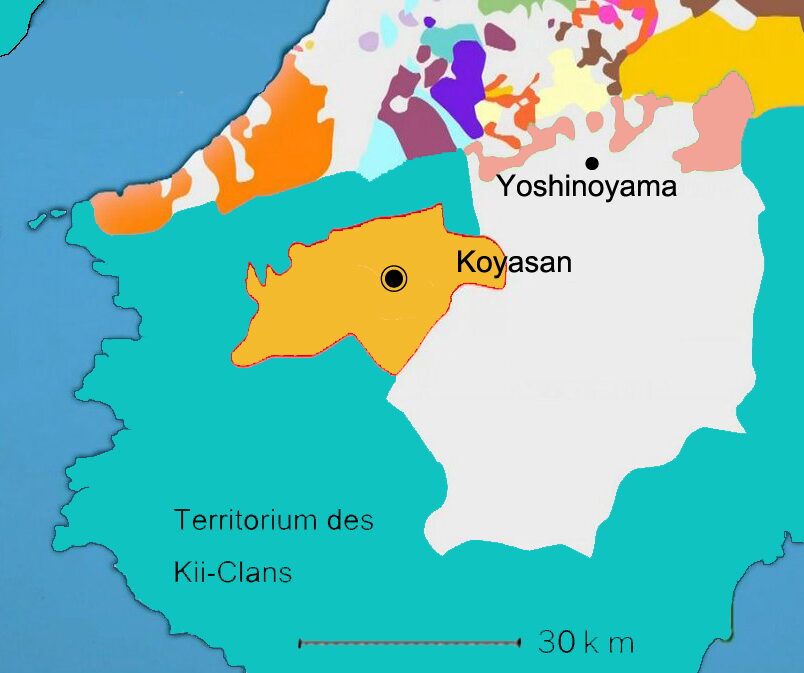
Protection came with a place in the system. The heads of the two great scholar temples, Hōshō-in and Muryōju-in, ranked with lords of 100,000 koku and had to make the alternate attendance journey to Edo like any daimyo under sankin-kōtai. The hijiri lost what was left of their independence in 1606, when the gyōnin attacked Daitoku-in over a latticed gable the hijiri had no right to, and the shogunate ruled that they must stop following Ippen and become proper Shingon monks.
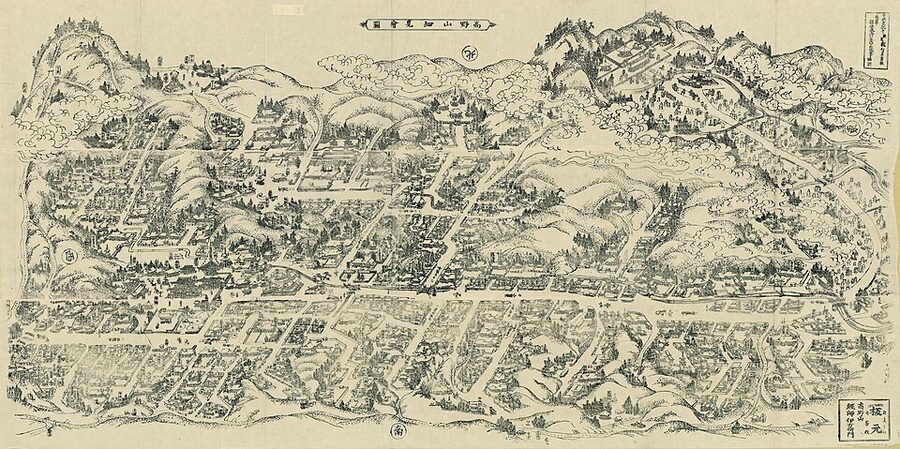
After that the travelling holy men settled in village chapels around the country or became pedlars of kimono cloth, and the Kōya hijiri as Nobunaga had known them were finished. The scholars and gyōnin went on fighting until the shogunate lost patience in 1692 and sent 627 gyōnin into exile, a reminder of whose mountain it now was. It was still a big one: a survey of 1646 counted 1,865 cloisters, and as ordinary pilgrims came up in numbers from the 1690s, the carpenters, cooks and innkeepers of the long Edo peace filled the town in the 1813 map.
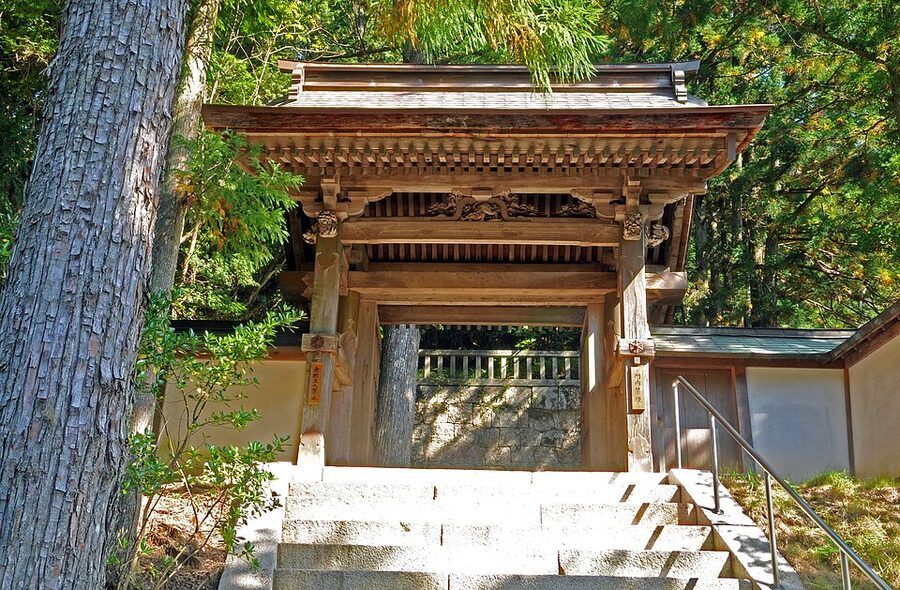
The shogunate set the example, and about 300 daimyo houses followed, each signing up with a sub-temple to say masses for its dead and lodge its retainers. The Takeda had been doing it since 1560 at Seikei-in, which still owns Hasegawa Tōhaku’s famous portrait of Shingen, and Jimyō-in keeps portraits of Asai Nagamasa and his wife Oichi that their daughter Yodo-dono gave in their memory, a long way from the field of Anegawa.
The Sanada are the story everyone tells. After Sekigahara, Sanada Masayuki and his son Nobushige, the man posterity calls Sanada Yukimura, were first confined at their family temple, Rengejō-in, before moving down to Kudoyama at the foot of the mountain, where their wives could live with them. Rengejō-in still uses their six-coin crest on its lanterns and keeps a letter in which Yukimura asks somebody to send him shōchū.
Two hundred thousand neighbours
All of that is why the Okunoin looks the way it does. The two kilometres from Ichi-no-hashi to Kūkai’s tomb are lined, depending on who is counting, with 100,000 or 200,000 gravestones, memorials and stupas under the cedars. Most are not graves in the Western sense but kuyōtō, memorial towers, and whatever lies beneath them is a token.
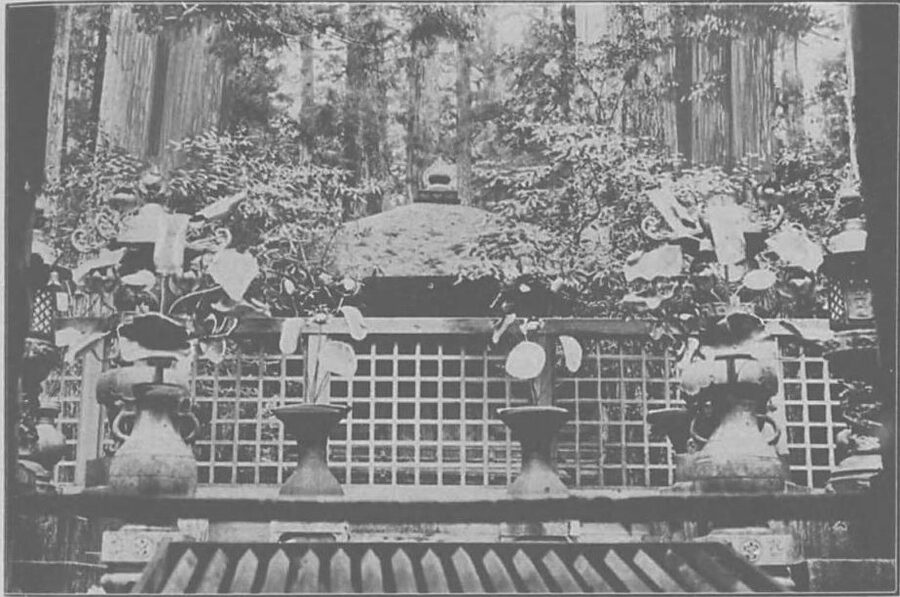
The custom is older than the Daishi’s cult. In Japan’s old mountain religion the high forest was where the dead went, and families around Kōyasan practised kotsunobose, sending bones up the mountain: a piece of bone if the body was cremated, a lock of hair from beside each ear if it was buried. The hijiri turned a local habit into a national one, and when the medieval estates collapsed in the civil wars the temples started signing up warlords instead.
Japanese sources reckon more than 40 percent of all daimyo houses, 110 domains, have memorials here, with about 2,000 daimyo stones alone, and the path is a roll call of the Sengoku wars with enemies standing politely side by side. Until Meiji only men of rank could raise a full-size gorintō, the five-tiered stupa, while commoners put up miniature ones about twenty centimetres high. None of the stone came from the mountain, and a painting at Jimyō-in shows teams of men hauling boats loaded with it up the river.
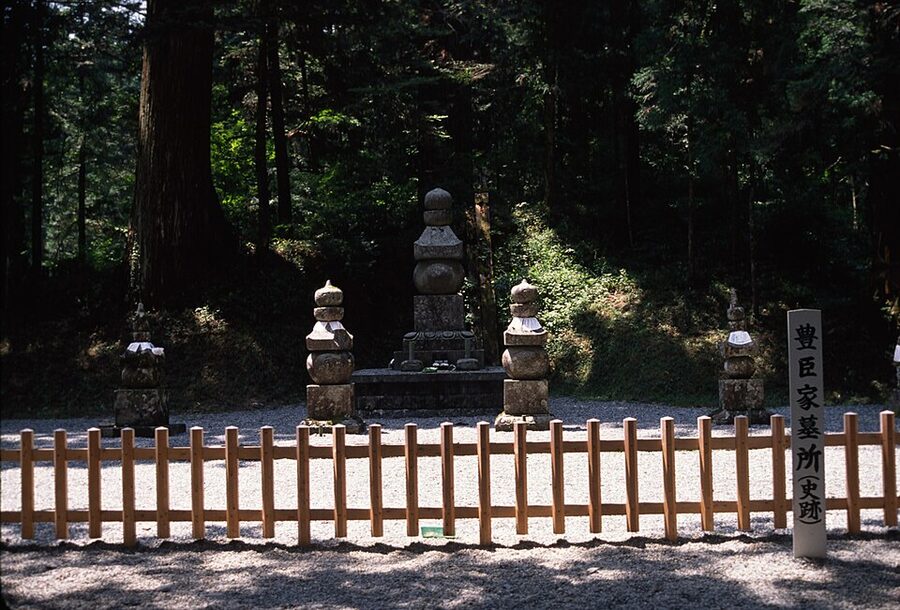
The Uesugi have a whole wooden mausoleum for Uesugi Kenshin and his heir Kagekatsu, listed as an Important Cultural Property. So are the memorial hall raised in 1599 for Satake Yoshishige while he was still alive, and the stone mausoleum of Yūki Hideyasu, Ieyasu’s second son. Ishida Mitsunari is here, and so is the sutra hall he gave in the third month of 1599 to pray for his mother, its name board signed on the back by Mokujiki Ōgo.
Takeda Shingen and his son Katsuyori lie in a plot belonging to the sub-temple Yōchi-in, which makes the path the one place where Shingen and Kenshin, who fought each other five times at Kawanakajima, can be visited on the same walk.
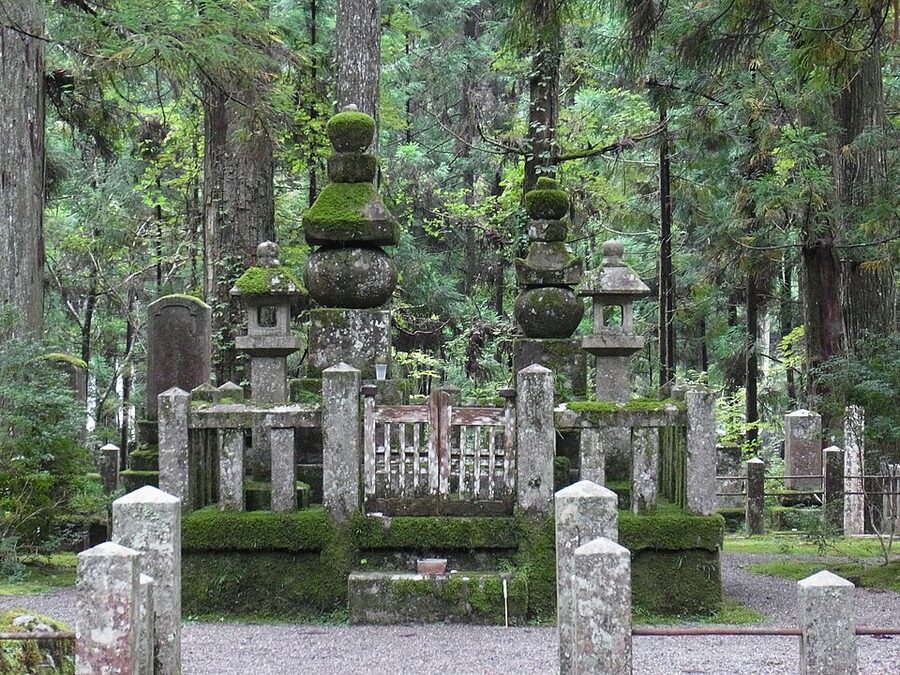
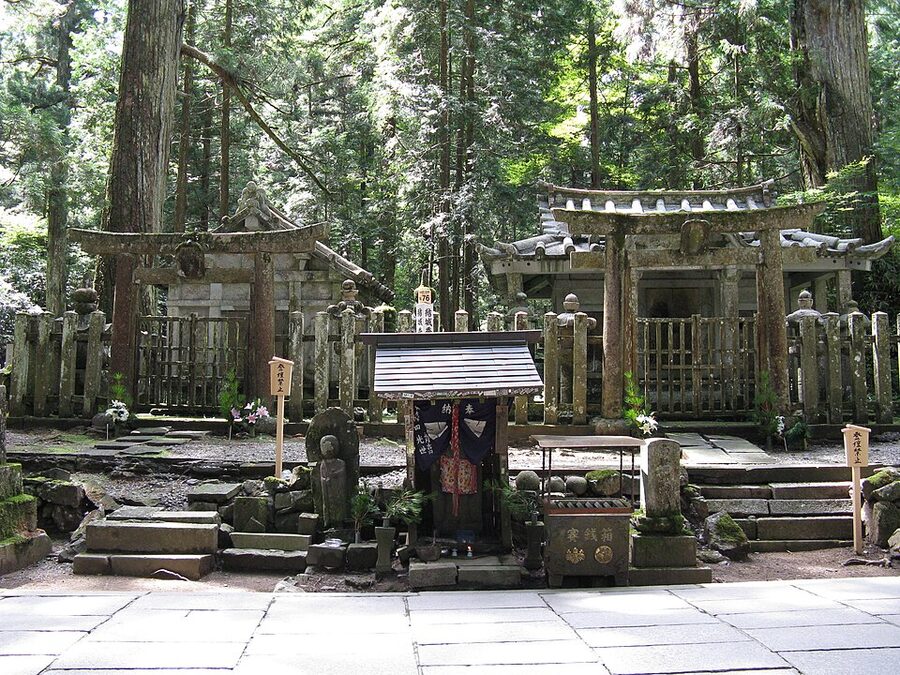
Not every name is a warlord. Hōnen and Shinran, founders of the two great Pure Land schools, have memorials, which tells you how far the hijiri carried Amida into this esoteric mountain. So do Taira no Atsumori and Kumagai Naozane, the boy killed at Ichi-no-tani and the warrior who killed him and became a monk out of remorse, along with Ichikawa Danjūrō I, founder of the great kabuki line, and the haiku poet Bashō.
The companies
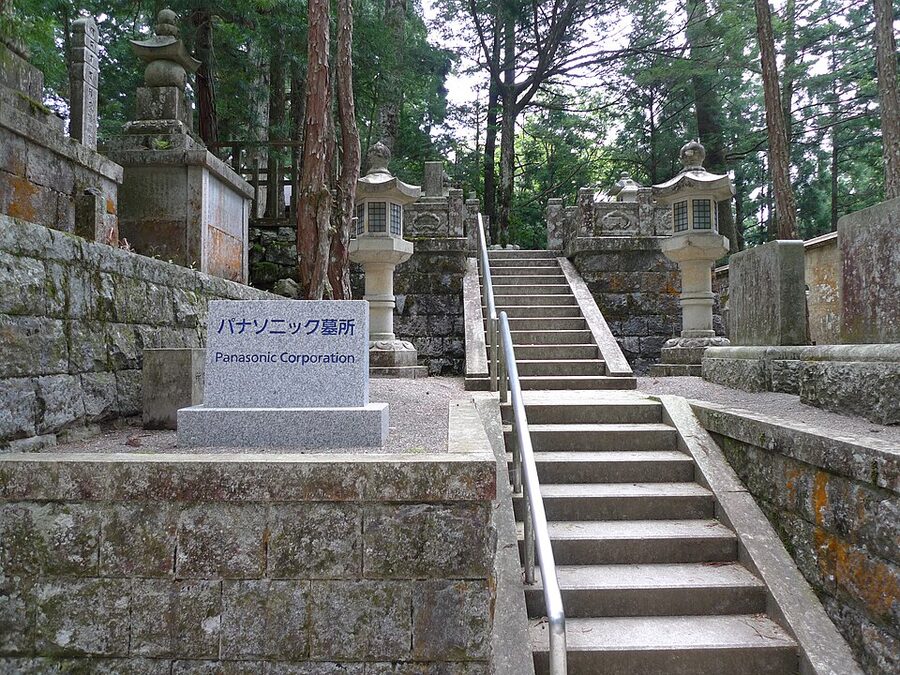
Past the Naka-no-hashi, and especially in the newer section near the Okunoin-mae bus stop, the dead start to wear logos. The first company memorial was raised in 1938 by Matsushita Kōnosuke, founder of Panasonic, for his employees, and today dozens of firms keep one, Nissan and Yakult among them, most for staff who died in service and some, I suspect, for the brand.
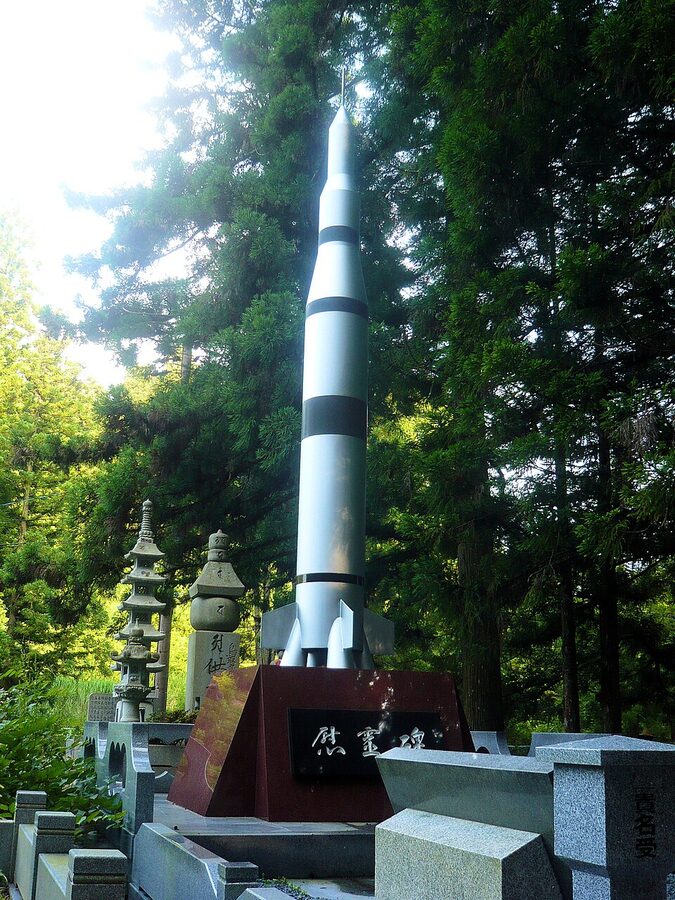
The one everybody photographs is ShinMaywa Industries’ model of a Saturn V rocket. The company makes aircraft and had nothing to do with the moon landings, but a rocket says “the future” in any language and, as the hijiri would have told you, the dead need to be near the Daishi when he wakes. I find it ridiculous and rather moving at the same time, which is my feeling about most of the Okunoin.
There are darker memorials too, for the dead of the earthquakes of 1923 and 1995 and the tsunami of 2011, and many for the soldiers of the Second World War. One, which you will find only if you look for it, honours Japanese executed as war criminals after 1945. I would not tell you to skip it; I would tell you to read it, and think about who chose the words.
Just past the Naka-no-hashi is the Asekaki Jizō, the “sweating Jizō”, said to sweat because he takes on the sufferings of people in hell (the stone is cold and the forest humid, so on damp days he does). Beside him is the Sugatami no ido, a small well: look in, and if you cannot see your reflection, you will die within three years.
The Tōrōdō and the poor woman’s lamp
The path ends at the Tōrōdō (燈籠堂), the lantern hall in front of the mausoleum, where most people pray. Shinzen built the first, Fujiwara no Michinaga enlarged it to about its present size in 1023, and its predecessor was crushed by a falling cedar in the Muroto typhoon of 21 September 1934; the present building dates from 1964. Inside hang more than ten thousand lanterns given by the faithful, and the hall’s fame rests on the handful that are never put out.
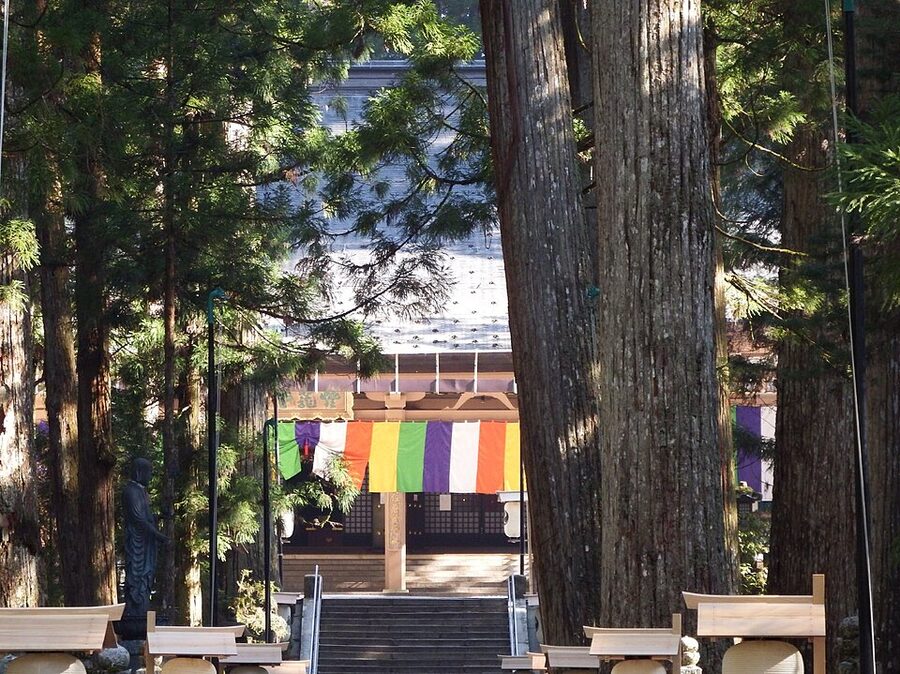
One is the Kishin-tō, the lamp of Jōyo, who revived the mountain in the 11th century; another is the Shirakawa-tō, lit by the retired emperor. The third is the one Kongōbu-ji tells the story of: the hinnyo no ittō, the “poor woman’s lamp”, given long ago by a woman who, on Jōyo’s advice, cut off her long black hair and sold it to pay for a single light. The fourth was given by the imperial family in the Shōwa era.
I like the arithmetic: a monk, an emperor, a pauper and a dynasty, each with one flame. I like even more that the pauper was a woman, on a mountain where she could not have set foot.
No women past this point
Kōyasan kept four rules from its founding until Meiji: no meat or fish, no musical instruments played for pleasure, no chickens or cats, and no women. The ban on women, nyonin kinsei (女人禁制), was the one that redrew the map, because it created a second geography around the rim of the plateau where half the population of Japan was allowed to go.
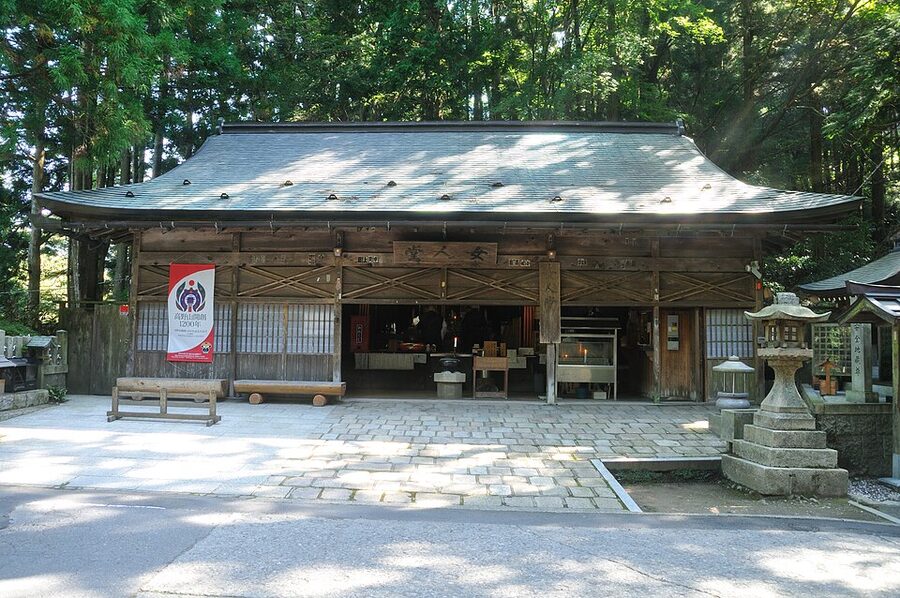
There were seven roads up, the Kōya nanakuchi, and where each crossed the sacred boundary stood a nyonindō, a women’s hall; one standard Japanese encyclopedia says only six had one. Women walked up the same roads as men, stopped at the hall, slept there, and worshipped the Daishi’s tomb and the Garan from a distance.
Their meals, according to one detailed account, were cooked by the sub-temples in rotation and carried out to the halls, a service called kayoi-zen. Each hall had a lodge for the yamayakko, half-monk, half-servant men who looked after the guests and watched for intruders, and they had reason to: records complain that women kept slipping past the boundary to hide in bell towers and sutra stores, which suggests the ban was leakier in practice than in principle.
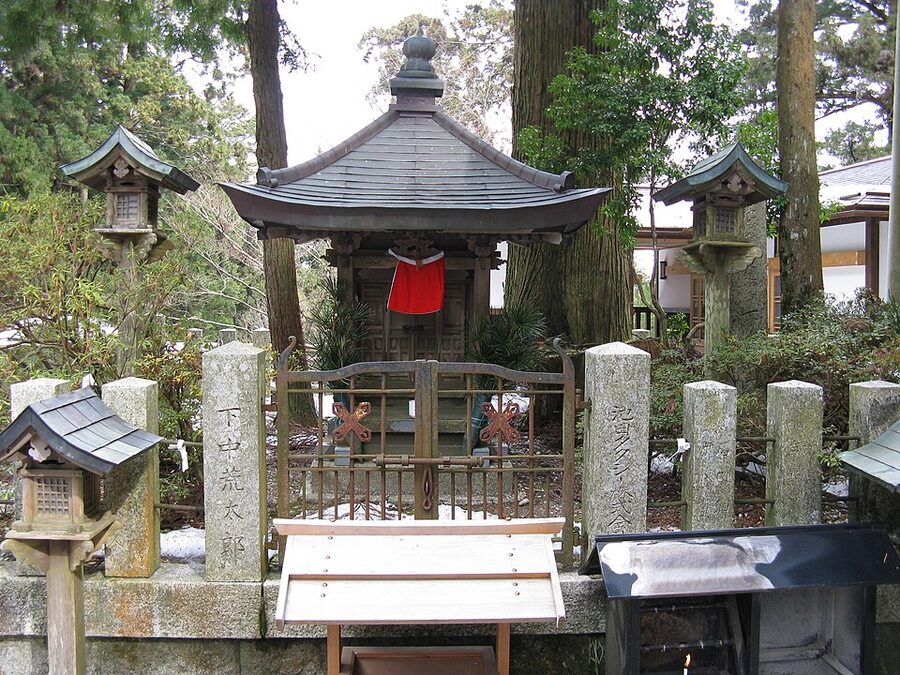
The halls were linked by the nyonin-michi (女人道), the women’s path, which runs about seventeen kilometres around the rim of the bowl. It climbs Bentendake, the highest point of the rim at 984.5 metres, and the three peaks behind the Okunoin, from which women could look down into the forest where the Daishi lay, and walking it came to be treated as a share in Kūkai’s own austerities.
Mothers at the bottom of the mountain
The rule’s most famous casualty was the founder’s own mother. Tradition says that when she came from Shikoku in old age to see her son’s mountain, the ban stopped her at the bottom, at Jison-in in the Kinokawa valley, where the monastery kept its administrative office. She lived there until she died on the 5th day of the second month of 835, a few weeks before her son.
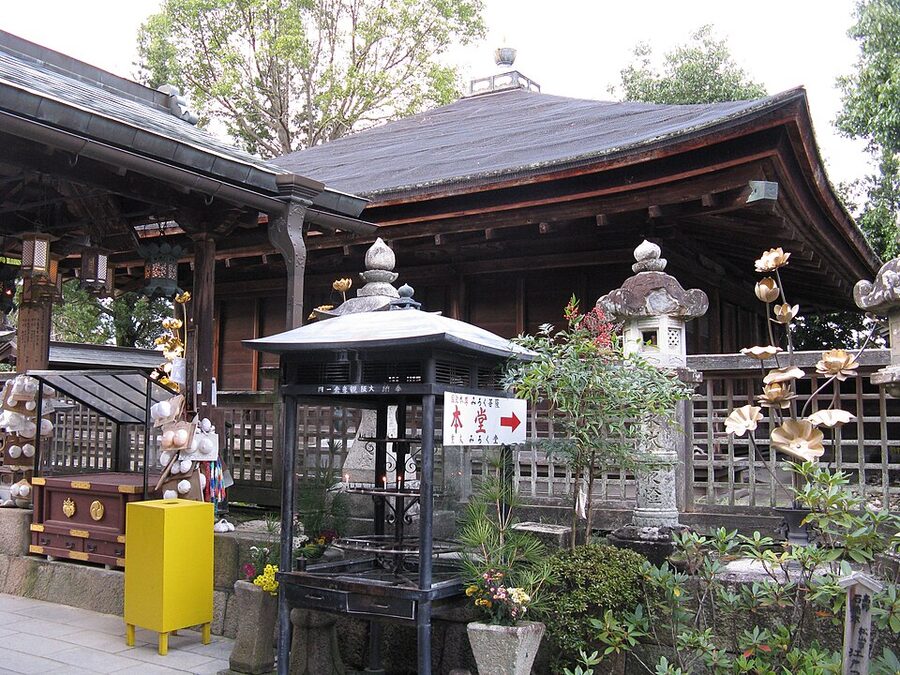
The story goes that Kūkai walked the twenty-odd kilometres down to see her nine times a month, so the town has been called Kudoyama, “nine-times mountain”, ever since. It is almost certainly a folk etymology, as Japanese sources say gently, but it made Jison-in a temple of women, one of the nyonin Kōya, the “women’s Kōyas”, along with Murō-ji in Nara and Amanosan Kongō-ji in Osaka. Women still hang breast-shaped votive cushions here to pray for safe childbirth and plenty of milk.
Karukaya and Ishidōmaru
The story that made the ban famous across Japan is the tale of Karukaya. A Kyushu lord, Katō Shigeuji, sees his wife and his concubine smiling at each other while their hair, in his vision, turns to snakes and fights; disgusted with the world, he abandons his family, becomes the monk Karukaya Dōshin and goes to Kōyasan, swearing never to see them again. Years later his son Ishidōmaru, who has never met him, comes looking for him with his mother.
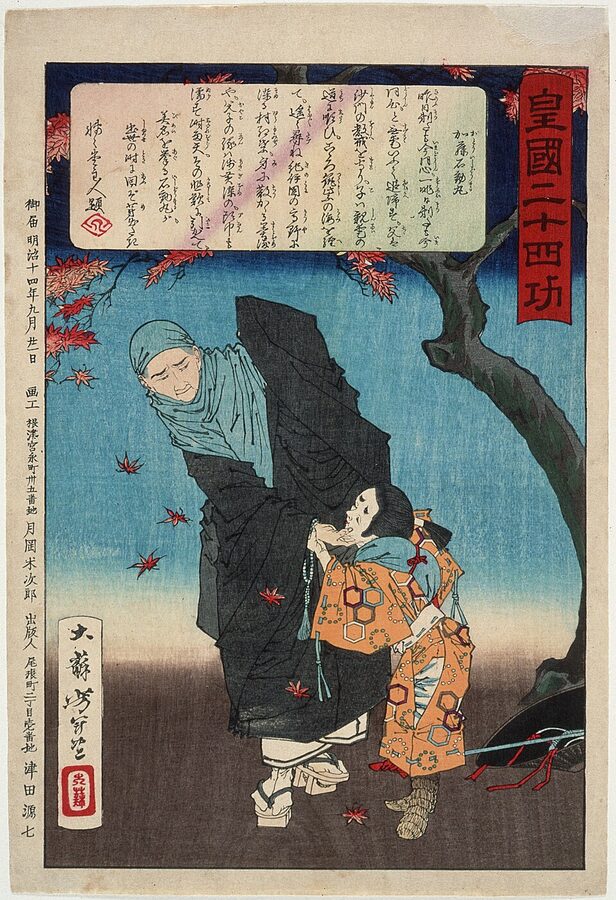
The ban stops the mother at an inn at Kamuro, and the boy climbs alone and asks the first monk he meets about his father. It is his father, who keeps his vow and says the man is dead; when Ishidōmaru comes back down, his mother has died at the inn. He returns, becomes Karukaya’s disciple, and the two live and pray together for the rest of their lives without the father ever admitting who he is, and the Karukaya-dō on the road to the Okunoin keeps a pair of statues called the parent-and-child Jizō.
1872 and after
The Meiji government had no patience with any of this. On the 27th day of the third month of Meiji 5, 4 May 1872 by the Western calendar as Japanese sources convert it, it issued a proclamation abolishing the women’s boundaries at shrines and temples, partly because a country trying to look modern to the Western powers could not keep half its people off its holy places.
Kōyasan complied slowly. Japanese sources say the mountain formally lifted the last of its boundaries only in 1906 (one list gives 1904), and within a generation there were families, schools and shops where there had been cloisters. The Shinbessho, a strict training temple in the forest outside the town, still keeps the ban, and opens its gate to women only once a year.
In 2020 the Agency for Cultural Affairs recognised the “women’s Kōyas” as a Japan Heritage story under a slogan about holy places that have watched over women through the ages. The religious scholar Kobayashi Naoko objected in print that this romanticises a history of exclusion, turning the women who could only pray outside the gate into a tourist attraction. I think she is right, and I also think you should walk the women’s path, because it is the best walk on the mountain and the women who made it deserve the traffic.
Fire, Meiji and the modern mountain
The Meiji Restoration nearly finished what Nobunaga had started. In 1869 the three orders were abolished, Seigan-ji and Ōgo’s Kōzan-ji were merged under the name Kongōbu-ji, and in 1871 the mountain surrendered its 21,000 koku to the state, followed in 1873 by 3,000 hectares of forest. With no income, monks left, temples closed, and the mountain’s habit of burning did the rest, above all on 23 and 24 March 1888, when two days of fire destroyed more than fifty temples.
In 1891 the mountain saved itself by consolidation, merging the 680-odd temples it had at the start of Meiji into about 130, close to today’s number. In 1921 it opened a museum for its treasures, the Reihōkan, and in 1926 Kōyasan University followed, the same year the Kondō burned with statues that had survived since the Heian period.
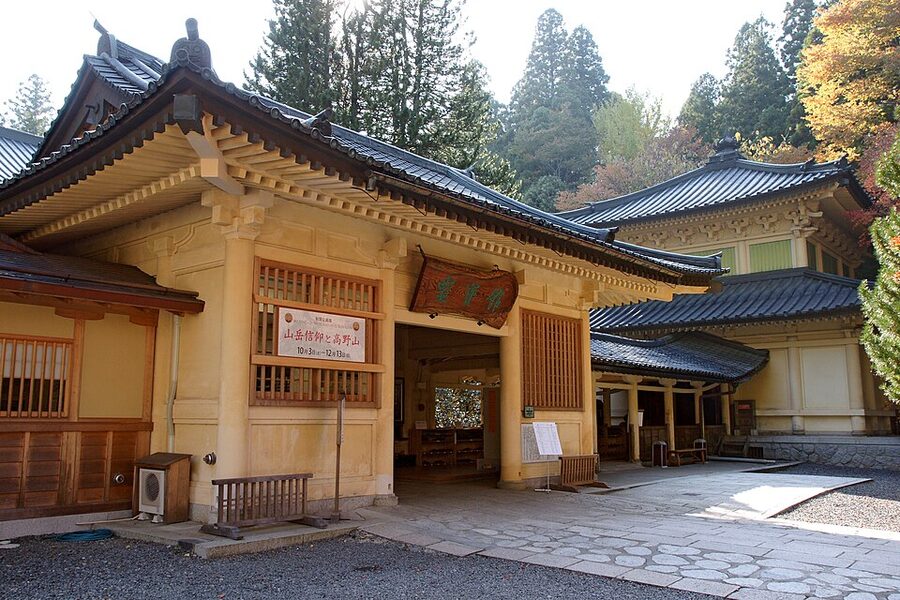
The trains came in the same years. A railway reached Hashimoto from Osaka in 1915 and Gokurakubashi at the foot of the last climb in 1929, the cable car opened in 1930, and by 1932 you could ride from Osaka to Kōyasan without changing companies, and the old pilgrim roads emptied. The Kondō was rebuilt in reinforced concrete in 1932 and the great pagoda in 1937, both fireproof at last.
On 7 July 2004 Kongōbu-ji and the Chōishi-michi were listed by UNESCO as part of the Sacred Sites and Pilgrimage Routes in the Kii Mountain Range, alongside Yoshino, Ōmine and the Kumano Kodō. In October 2016 the listing was extended to four more pilgrim paths, among them the women’s path.
Where to visit Kōyasan today
Kōyasan can be done as a day trip from Osaka, and I would not. The point of the place is the evening and the early morning, when the day visitors have gone, the temples ring their bells and the Okunoin is lit by stone lanterns, so book a night in a temple and give yourself two days.
Getting there
Take the Nankai Kōya Line from Namba in Osaka to Gokurakubashi, then the cable car up. The Kōyasan Shukubō Association says the limited express takes about an hour and forty minutes to Kōyasan Station and the express about two hours; the limited express Kōya runs only four round trips a day and needs a reserved seat. Between Hashimoto and Gokurakubashi the slow sightseeing train Tenkū has open-air viewing seats on the mountain section, which is worth doing once.
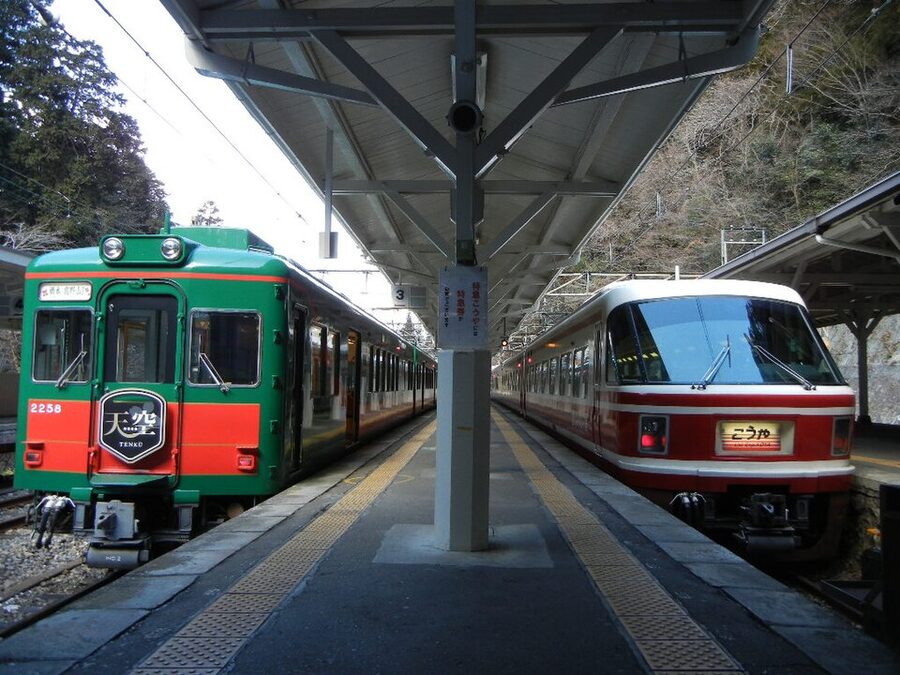
The cable car is 0.8 kilometres long, climbs 328 metres at a gradient of up to 568 per thousand, and takes five minutes. At the top you must take a Nankai Rinkan bus into town, because the road from Kōyasan Station is a private bus road closed to walkers. Nankai sells a Kōyasan World Heritage ticket from Namba bundling the return train, two days of buses on the mountain and small discounts at the main sites, for a little over ¥3,000; Nankai’s own site has the current price.
The Daimon and the Danjō Garan
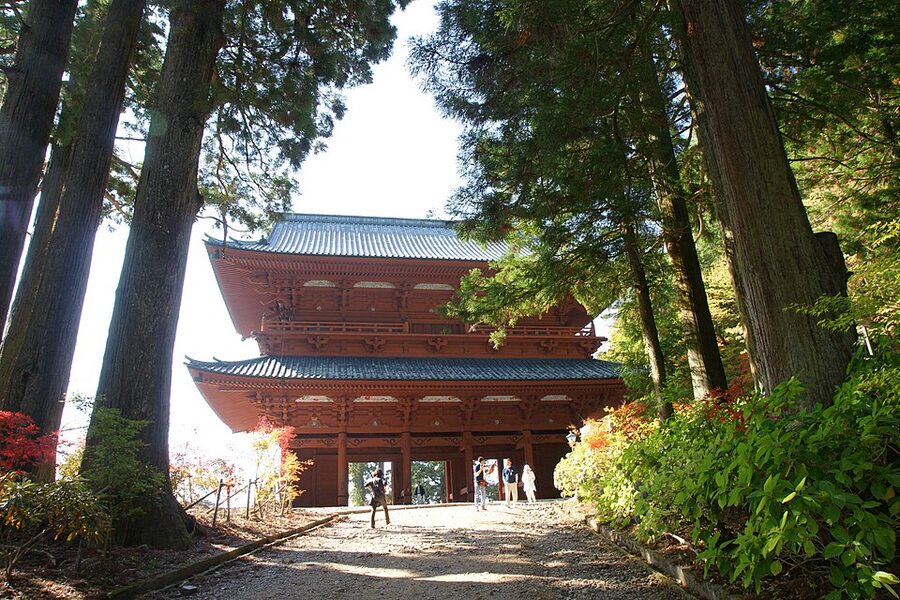
If you come by road, or on foot, you arrive at the Daimon (大門), the great gate at the western end of town, rebuilt in 1705. It is 25.1 metres high, faces west towards Amida’s Pure Land, and its guardian kings are said to be the second biggest in Japan after those at Tōdai-ji. At sunset the view from its steps over ridge after ridge of the Kii Mountains is the best on the mountain.
Ten minutes east is the Danjō Garan, laid out by Kūkai to a mandala plan. The grounds are free; the Kondō and the Konpon Daitō, the great pagoda, cost ¥500 each and open 8:30 to 17:00, with last entry at 16:30. Kongōbu-ji recommends walking the halls in a fixed order, starting at the Chūmon, the middle gate rebuilt in 2015 after 172 years without one.
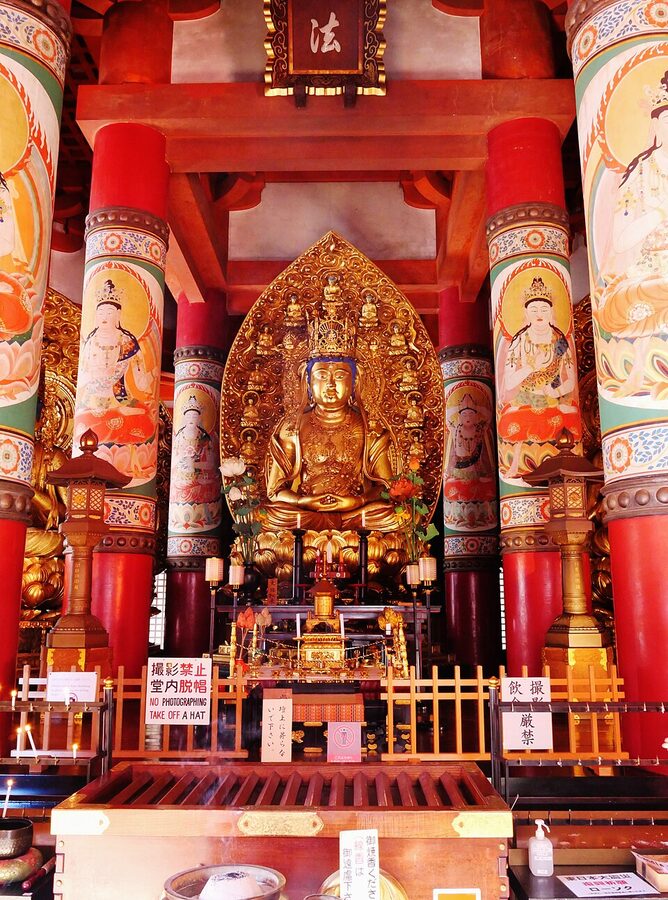
Look for the Fudōdō, a National Treasure of the early 14th century and the second-oldest building on the mountain, whose four corners do not match because, tradition says, four carpenters each built one. The Miedō, the founder’s hall, opens its outer room only on one night a year, the eve of the 21st day of the third month by the old calendar. The hexagonal sutra store has handles at its base, and one full turn earns you the merit of reading the entire canon, which is the best deal on the mountain.
Kongōbu-ji
The head temple, the former Seigan-ji, is open 8:30 to 17:00, last entry 16:30, and costs ¥1,000. Its main hall was rebuilt in 1863, measures 54 metres by 63 and is roofed in cypress bark with the rain tubs still on the ridge. Inside are the Willow Room where Hidetsugu died, a gilded audience chamber kept for emperors and screen paintings attributed to the Kanō school.
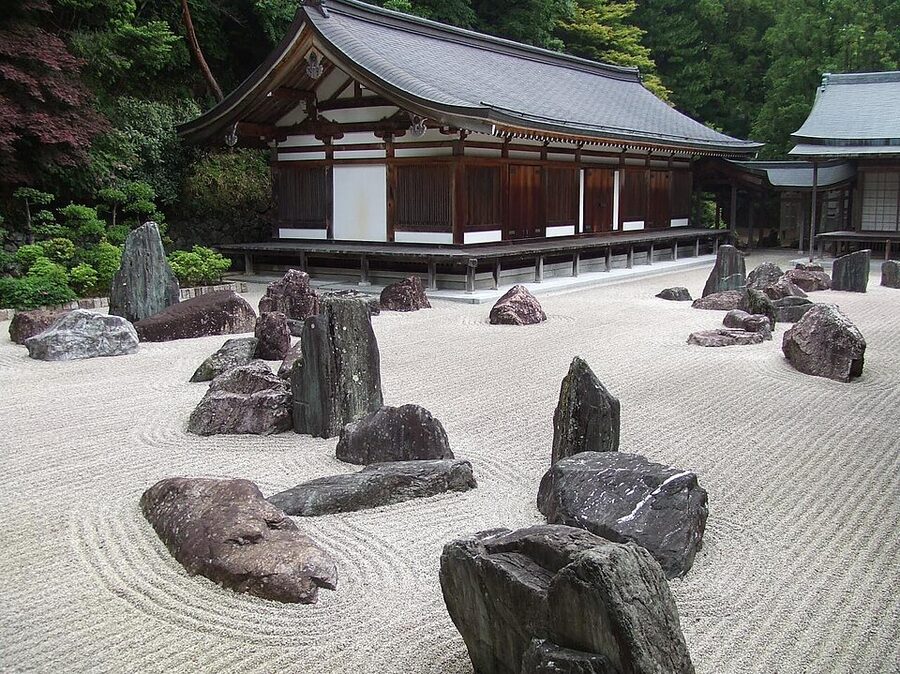
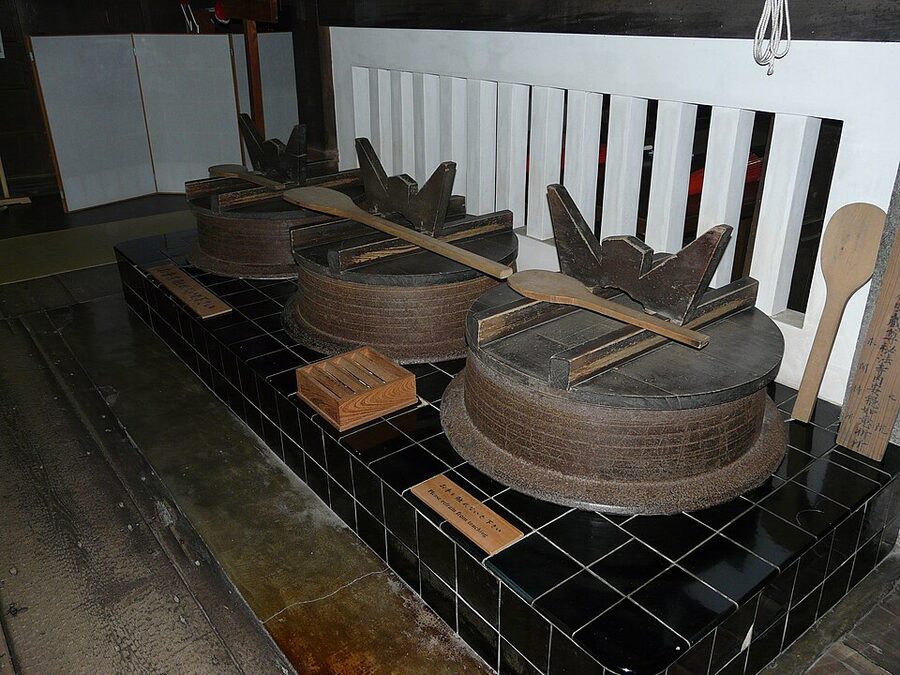
The old kitchen is the part I would not miss: three great cauldrons, each holding about 98 kilograms of rice, enough between them for 2,000 monks. On the way out you are given tea and a small sweet, and from spring to autumn you can join a session of ajikan, Shingon breathing meditation, for the price of the entry ticket; sessions are in Japanese, and the temple’s site has the season’s schedule.
At the Daishi Kyōkai in the middle of town you can copy the Heart Sutra for ¥1,500 any day from 8:30 to 15:00, or receive the ten precepts from a senior monk for ¥1,000 in a thirty-minute ceremony held on the hour from 9:00. The precepts ceremony takes place in near darkness and in Japanese, and I found it more affecting than I expected.
The Reihōkan and the Tokugawa Reidai
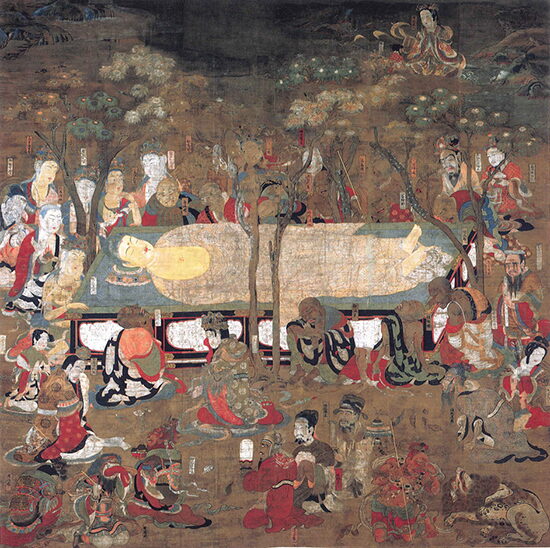
The Reihōkan, just south of the Garan, is open 9:00 to 17:00, with last entry thirty minutes before closing, for ¥1,300. Kōyasan holds about 2 percent of all Japan’s National Treasures, and most of those you can see are shown here in rotation: the eight boy attendants of Fudō from Unkei’s workshop, the Nirvana of 1086, the Descent of Amida and, when it is out, the Blood Mandala. In the autumn of 2026 it is running an exhibition on Kōyasan and the Toyotomi, which covers half of this piece in one building.
The Tokugawa Reidai, a short walk north of the main street, is open 9:00 to 16:30 for ¥200, and the carving and lacquer are worth a good deal more. Kongōbu-ji also sells a combined ticket for ¥2,500 covering Kongōbu-ji, the Kondō, the Daitō, the Reidai and the Reihōkan.
Okunoin
The Okunoin is free and always open. Walk it from Ichi-no-hashi at the town end rather than from the Naka-no-hashi car park halfway along, which saves you a kilometre and loses you the old graves; go once in the morning and again after dark, when several temples run guided night walks. The famous graves are signposted.
The 43 steps of the Kakuban-zaka are just past the Naka-no-hashi. The number was chosen to step over 42, which can be read shi-ni, “to die”, and tradition says that if you fall on them you will be dead within three years, so take them slowly. The Tōrōdō opens 6:00 to 17:00, and beyond the Gobyō bridge there is no photography, no eating and no talking above a murmur.
The Nyonindō and the women’s path
The Nyonindō is the first stop on the bus route from Kōyasan Station, which makes it the easiest site to reach and the one most visitors ride straight past. It is free and open 9:00 to 16:30. Get off, go in, and decide whether you have the legs for the path that starts behind it.
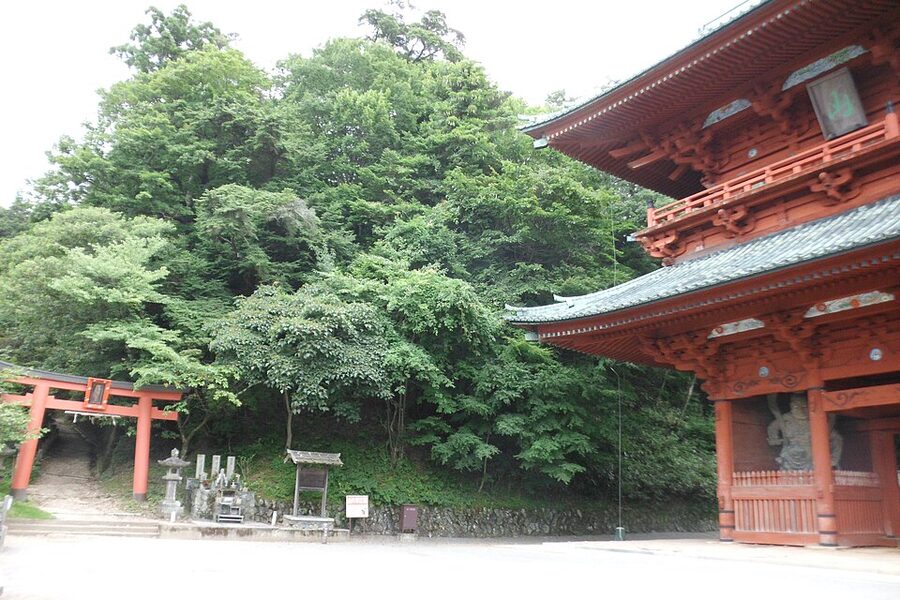
The section from the Nyonindō over Bentendake and the Daimon and round the south side of the bowl to the Naka-no-hashi is about seven kilometres and four hours; the three peaks behind the Okunoin make a separate loop of about eleven kilometres and three and a half hours. In places the path runs under power lines, which the builders found convenient for hauling equipment and which do nothing for the view. Carry water and a bell: the Shukubō Association now posts warnings about bears.
Shukubō and shōjin ryōri
The Kōyasan Shukubō Association lists the temple lodgings and takes bookings in English on its official site. Recent bookings shown there run from about ¥25,000 to well over ¥100,000 a room, depending on the temple, the room and how many of you there are, always with dinner and breakfast. A night includes the morning service in the main hall, usually around 6:00, and many temples add a fire ritual, meditation or sutra copying.
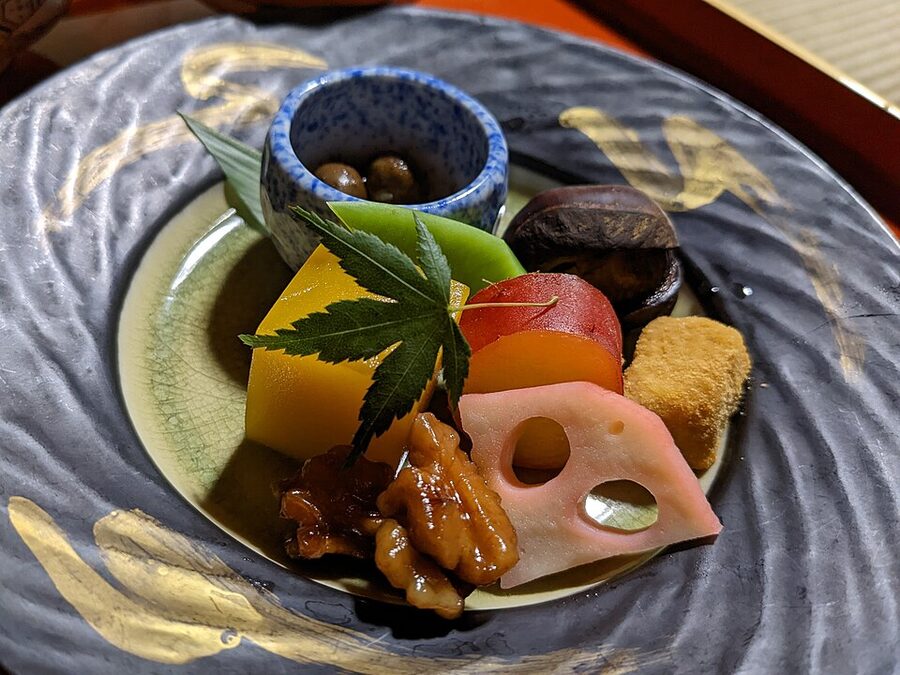
The food is shōjin ryōri, Buddhist vegetarian cooking, and on Kōyasan it is very good. The local specialities are goma-dōfu, a wobbly custard of ground sesame and kudzu starch, and kōya-dōfu, tofu freeze-dried in the mountain’s cold and simmered in stock. If you ask for beer you may be offered hannyatō, “wisdom water”, the mountain’s old euphemism for alcohol, which was never quite as forbidden as fish.
For the history in this piece, a few lodgings stand out. Kongō Sanmai-in has Hōjō Masako’s pagoda of 1223 in its garden, Rengejō-in has the Sanada crest on its lanterns, and Tentoku-in has a garden laid out by Kobori Enshū in 1622, a nationally designated place of scenic beauty and one of the better Japanese gardens you can wake up next to. Rooms with private bathrooms are the exception, and the corridors are cold in winter.
The Chōishi-michi from Kudoyama
The way I would most like you to arrive is on foot. The Kōyasan Chōishi-michi (高野山町石道) starts at Jison-in, a short walk from Kudoyama Station on the Nankai line, and climbs to the Daimon past the granite markers set up between 1265 and 1285. Each chōishi stands about three metres tall and one chō, roughly 109 metres, from the next, a small five-tiered stupa carved with a Sanskrit letter for one of the Buddhas of the mandala.
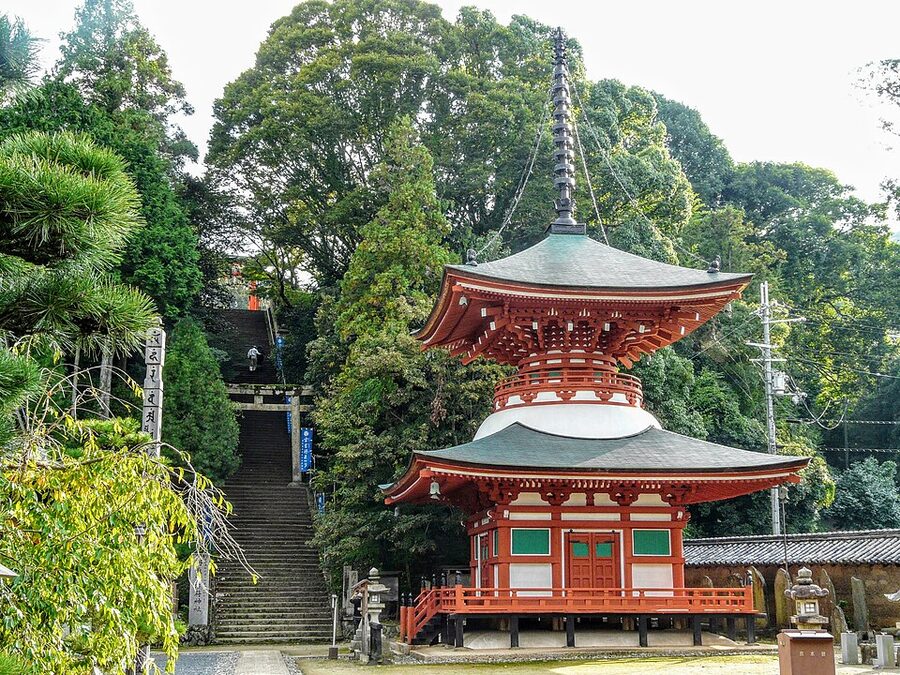
There are 180 stones from Jison-in to the Garan, for the 180 deities of the Womb Realm, and 36 more from the Garan to the Okunoin, with the tomb itself as the 37th, for the 37 of the Diamond Realm; Japanese sources say 174 of the 216 are Kamakura originals. From Kudoyama Station to Kūkai’s tomb is about 24 kilometres and seven hours of walking. Starting at Niutsuhime Shrine at Amano saves about four kilometres, and leaving the path at Kamikosawa Station after about eleven makes a gentler half day.
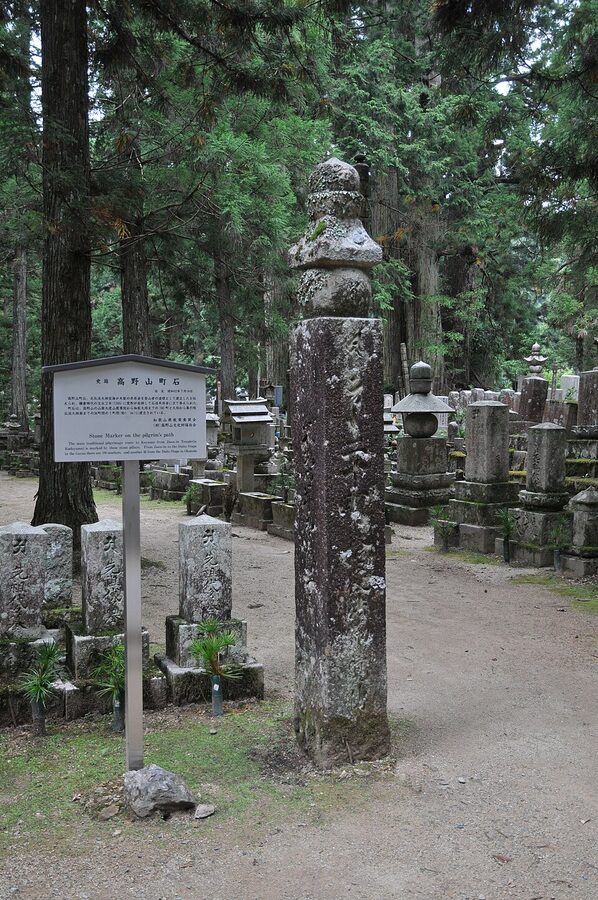
The path is well marked, forested for most of its length and steep in places, and in the Edo period most pilgrims abandoned it for the gentler road up from Kamuro to the Nyonindō. That is a reason to walk it now. Start early, take food, and count.
On the mountain’s terms
Kōyasan has outlived every one of the people who wanted to own it: the abbots of Tō-ji, the Fujiwara, the Taira, Nobunaga, Hideyoshi, the Tokugawa and the Meiji state, which makes its story a short course in Japanese history all by itself. It did it by bending, borrowing aristocrats’ money, sending salesmen-saints round the country, surrendering to Hideyoshi before he could burn it and putting the shogun’s men at the top of its hierarchy. In 1872 it bent on women, slowly, and in 2013 on convenience stores.
It never bent on everything. The meat still stays at the bottom of the hill, the monks still carry the founder his breakfast, and the Daishi is still, as far as the mountain is concerned, at home.
So sleep up there, get up for the morning service, and on the way home stop at the Nyonindō and think about the women who came this far and no further. Then go to the FamilyMart. You will not find any sashimi.