Farmers on the slopes of Tabaruzaka, a low ridge eighteen kilometres north of Kumamoto, still turn up bullets when they dig. Every so often they find two jammed together nose to nose, where a government round and a Satsuma round met in the air and stopped each other dead. Japanese has a word for these, ikiai-dan (行合弾), “bullets that met on the way”, and it is not a word you need for most battlefields.
In March 1877 the government army on this ridge fired an average of 320,000 rounds a day, and on its worst days nearly twice that. One Japanese reckoning of the whole war comes to something like 35 million rounds, or about two thousand for every Satsuma soldier killed or wounded. That says less about marksmanship than about what it took to stop men who would not stop.
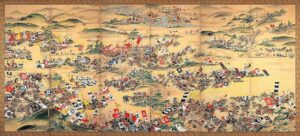
The war those bullets belong to is the one English calls the Satsuma Rebellion and Japanese calls the Seinan War (西南戦争), the war of the south-west. It lasted eight months, it was the last civil war Japan has fought, and when it ended the samurai were finished as anything except a memory. Japan had moved to the Western calendar on 1 January 1873, so every date from 1873 onwards in what follows is a Western one.
In This Article
- Six hundred officers and a school
- What 1876 took away
- Gunpowder at Somuta
- Kumamoto: the castle that burned first
- Tabaruzaka: seventeen days of rain
- The sword police
- 20 March
- Behind the lines: the sea, the hospitals and Kagoshima
- Five months of retreat
- Shiroyama, 24 September 1877
- The bill
- Where to see the Satsuma Rebellion today
- Kumamoto Castle
- Tabaruzaka
- Shiroyama and the cave, Kagoshima
- Nanshū cemetery, shrine and museum, Kagoshima
- Two bullets
Six hundred officers and a school
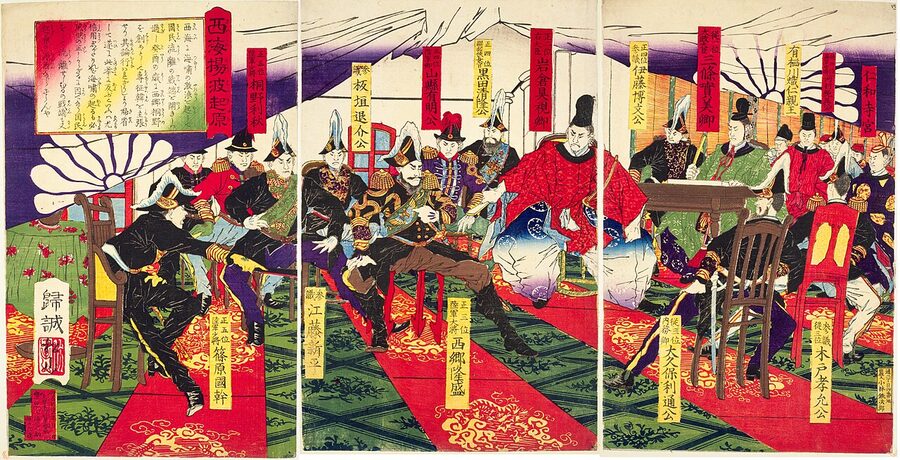
The quarrel behind all those bullets started at a cabinet table in Tokyo in October 1873. The government had split over whether to send Saigō Takamori to Korea as an envoy, on a mission he expected to end with his own murder and a war, and the ministers back from the Iwakura Mission blocked it. Saigō resigned every post he held and went home to Kagoshima. His life has its own page on this site; this one is about the war.
He did not go alone. Itagaki Taisuke and Etō Shinpei left the government with him, and about six hundred Satsuma officers, guardsmen and police followed him south, among them Kirino Toshiaki, Shinohara Kunimoto and Beppu Shinsuke. Satsuma had been the strongest of the domains that brought down the Tokugawa shogunate in the Meiji Restoration, and its men had filled the new army and the new police. By 1874 a good part of that talent was back in Kagoshima with no work, a famous leader and a great deal of resentment.
In June 1874 the returned men opened the Shigakkō (私学校), the “private school”, on the site of the old stables of Kagoshima Castle. It was a school in the way a barracks is a school. The rifle school, under Shinohara, took five or six hundred former Imperial Guardsmen; the artillery school, under Murata Shinpachi, about two hundred; and the Chinese classics were read in the mornings between drills, with attendance from nine until noon.
A third school for boys was paid for out of the award stipends the new government had handed the heroes of 1868. Saigō put in 2,000 koku a year, the prefectural governor Ōyama Tsunayoshi 800 and Kirino 200. The largest outside contribution, 1,800 koku, came from Ōkubo Toshimichi, Saigō’s oldest friend and the man the school would later accuse of plotting to have him killed.
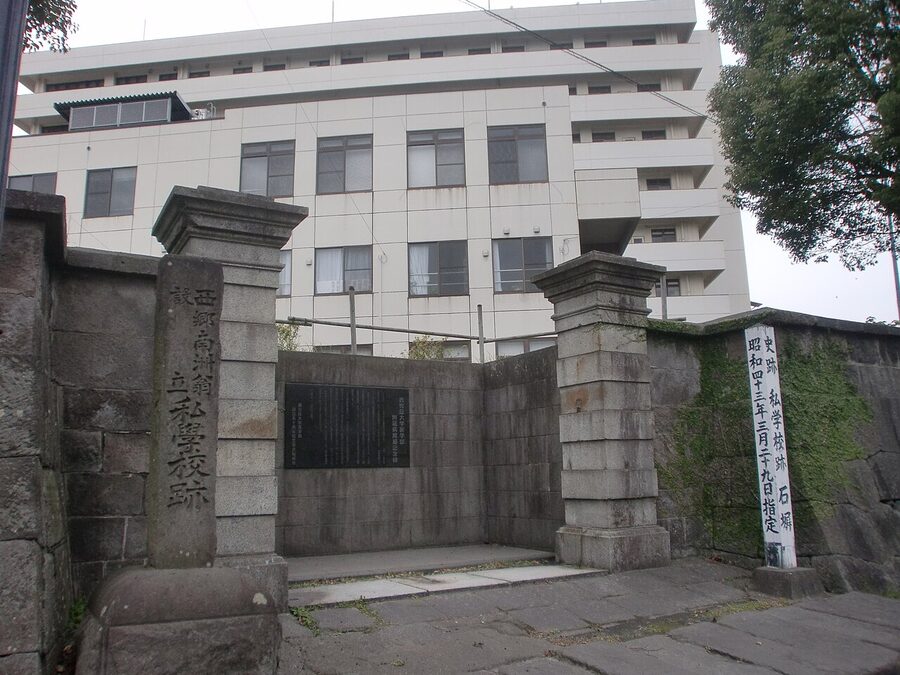
Branch schools spread across the prefecture, 132 of them by the usual English count and 136 by some Japanese reference works. Saigō wrote the charter himself in two articles, and the second says that revering the emperor and pitying the people is the whole purpose of learning. Governor Ōyama filled district offices and police posts with Shigakkō men, Tokyo’s orders stopped at the prefectural border, and by the end of 1876 Kagoshima was, for practical purposes, a state inside the state.
What 1876 took away
Two laws in 1876 told every former samurai in Japan what the new state thought of him. On 28 March the government banned the wearing of swords in public by anyone but soldiers, police and officials in court dress. Owning a katana stayed legal, and some men made the point by carrying theirs in a cloth bag or slung over the shoulder like a hoe, but the two swords at the hip had been the badge of the class for three centuries.
On 5 August the hereditary stipends went. Every samurai family’s rice income was converted into government bonds worth between five and fourteen years of it, with interest that for a low-ranking man worked out at about a third of a Tokyo labourer’s minimum daily wage. Most sold their bonds within a few years, and a whole class became, in effect, rōnin with paperwork. Japanese historians point out that few of the rebels named the stipends as their grievance; they did not need to.
The first rising had come early, in February 1874, when Etō Shinpei led the Saga Rebellion and was beheaded for it. Then in the autumn of 1876 three more went off in a week. On 24 October about 170 men of the Shinpūren in Kumamoto, armed almost entirely with swords and spears, killed the garrison commander Taneda Masaaki at home and fatally wounded the prefectural governor; Taneda’s mistress, wounded, got to the telegraph office and sent her family in Tokyo a message that was later held up as a model of the form, telling them in a handful of syllables that the master was dead and she was hurt.
The Akizuki rising followed on 27 October and Maebara Issei’s at Hagi on 28 October. Each was crushed within days by conscript troops moved by steamer and directed by telegraph. Through all of it Saigō sat in Kagoshima, hunted boar and said nothing, and Tokyo assumed, correctly, that Satsuma would be next and worst.
Gunpowder at Somuta
The spark was ammunition. The army’s main rifle in 1877 was the British Snider, a breechloader whose brass cartridge cases needed hydraulic presses to make, and the only cartridge works in Japan was in Kagoshima. Satsuma had bought the machinery through a Dutch trading house before the national army even existed, and the Shigakkō men regarded everything in the Kagoshima arsenal as Satsuma property, paid for by Satsuma samurai.
At the end of January 1877 the army sent the steamer Sekiryū Maru to move the machinery and the stock to Osaka, quietly and at night. On the night of the 29th (some accounts say the 30th), Shigakkō students broke into the magazine at Somuta and carried off what they could. The raids on the town’s magazines went on for several nights, and on 2 February the ship left with four hundred cases and the students kept about 84,000 rounds and a pile of rifles.
Saigō was across the bay on the Ōsumi peninsula, hunting at Konejime. When his youngest brother Kohei and Henmi Jūrōta reached him with the news, the remark recorded is “Chosshimota!”, Satsuma dialect for something like “That’s done it.” He went back to Kagoshima, and men came out along the road to escort him as if he were already at war.
What made it a war was a police officer named Nakahara Hisao. He was a Satsuma man from Ijūin who had come home in January on leave, with about two dozen colleagues and the permission of the national police chief, Kawaji Toshiyoshi, himself a Satsuma man who had stayed in Tokyo. Nakahara had told an old friend that he would stop Saigō if he had to die together with him to do it.
On 3 February the Shigakkō men arrested him and sixty-odd others and tortured him until he signed a confession that Kawaji had sent him to kill Saigō. English accounts usually give “Nakahara and fifty-seven men”; the Japanese record has a couple of dozen travelling with him and over sixty seized in all.
The trouble with the confession is a pun. In Japanese, “to inspect” (視察) and “to stab to death” (刺殺) are both pronounced shisatsu, and on his deathbed in 1914, asked which he had meant, Nakahara said inspect.
On 5 February more than two hundred Shigakkō leaders met to decide what to do. Some wanted Saigō, Kirino and Shinohara to travel to Tokyo with a small escort and question the government; Nomura Oshisuke wanted to sail to Kyoto and petition the emperor in person. Shinohara silenced the room with the Satsuma phrase for “no arguing”, and Kirino closed it: there was one word left, decision, and no road but the whole army marching.
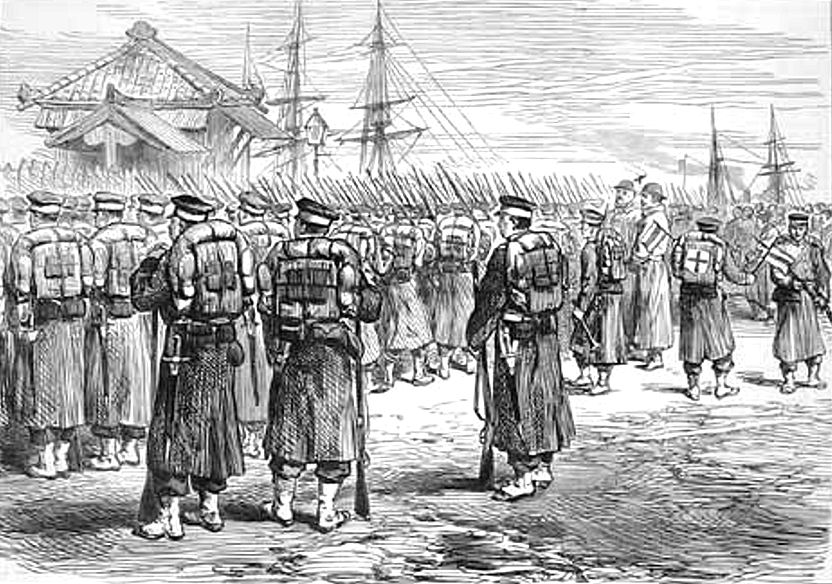
Saigō’s stated purpose was to go to Tokyo because he had “questions to put to the government”. The vanguard left on 14 February and the main army on the 15th, about 13,000 men marching north through the heaviest snow Kagoshima had seen in fifty years by one count and sixty by another. Saigō himself followed on the 17th, wearing the uniform of an army general, a rank the government stripped from him within weeks.
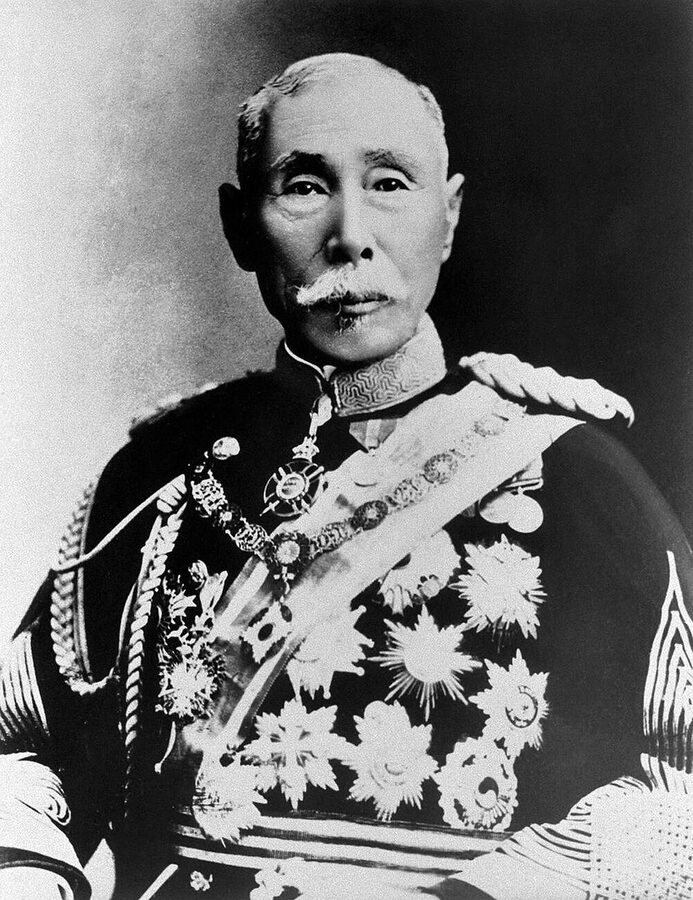
The government already knew. There was no telegraph line to Kagoshima, but there was one from Kumamoto to Tokyo, and on 19 February Emperor Meiji, then in Kyoto, issued an edict ordering the rebels put down. Prince Arisugawa Taruhito was named commander, with Yamagata Aritomo for the army and Kawamura Sumiyoshi, Saigō’s own relative by marriage, for the navy as his deputies. Before it was over the government would put 58,558 soldiers and 2,280 sailors into the field; Saigō’s side, with the units that joined him in Kyushu, came to about 30,000.
Kumamoto: the castle that burned first
The road north ran past Kumamoto Castle, the great fortress Katō Kiyomasa built at the turn of the 17th century and, since 1871, the headquarters of the army’s Kyushu garrison. Its commander was Tani Tateki, a Tosa man sent in after the Shinpūren killed his predecessor, partly because a Tosa man descended from a famous Confucian scholar was thought certain not to go over to Satsuma. In 1868 Tani had pressed hard for the execution of Kondō Isami of the Shinsengumi, convinced he was behind the murder of Sakamoto Ryōma; he was not a man who changed sides.
His staff reads like a list of the generals of 1904. The chief of staff, Kabayama Sukenori, was Satsuma-born; under him were Kodama Gentarō, Kawakami Sōroku and Oku Yasukata. On 14 February they decided that the whole garrison, about 3,800 soldiers and 600 police by the English count and around 4,000 by the Japanese one, would shut itself up in the castle against something like 14,000 Satsuma men.
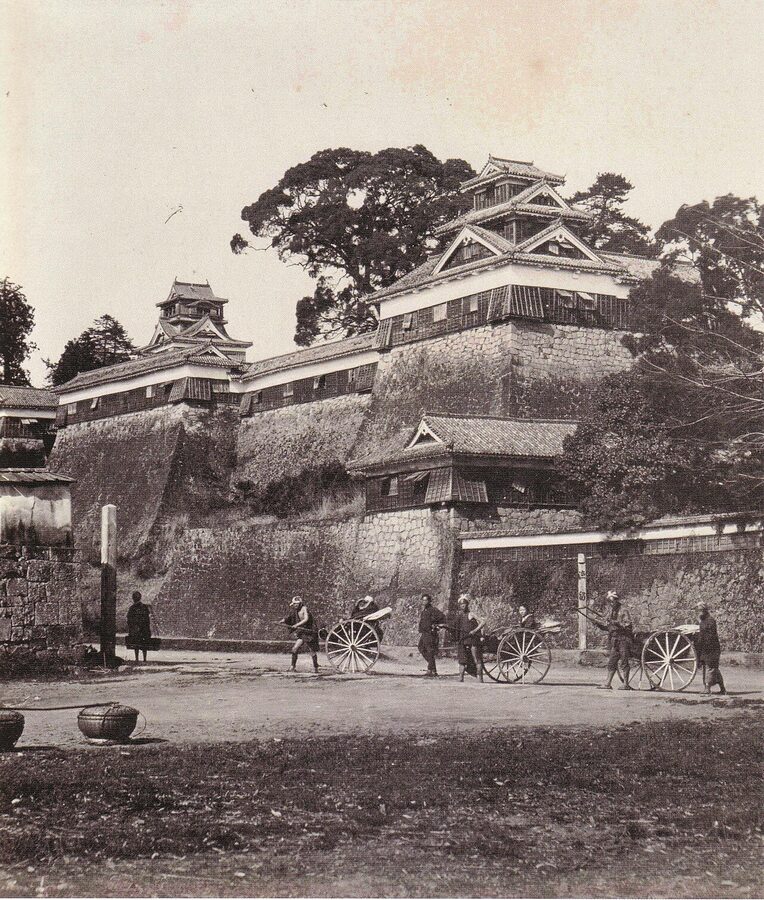
At 11.40 on the morning of 19 February a fire broke out inside the castle and, driven by a hard wind, burned until three in the afternoon. It took both keeps, the main palace and a string of turrets and gates, along with the rice store, and spread into the town, where about a thousand houses went. Explanations range from an accident to Satsuma sympathisers to the garrison deciding to clear its own field of fire; the town fires were almost certainly deliberate, the castle fire is still a mystery.
How much food went up with it depends on whom you believe. The Tabaruzaka museum’s view is that the garrison lost thirty days’ rations, bought twenty days’ worth in the town in the next forty-eight hours, and only went hungry from late March. Tani later wrote that there had only been two weeks’ food in store in the first place, and called the fire a stroke of luck. Kodama said the worst problems of the siege were, in order, the sewage, burying the dead and keeping the powder safe.
The first shots of the war were fired on the night of 20 February, when a scouting party sent out on Kabayama’s suggestion fired into the Satsuma vanguard at Kawashiri. The next night the Satsuma commanders argued over whether to leave a screen at Kumamoto and march on, as Ikegami Shirō proposed, or storm the castle, as Shinohara wanted. Shinohara won.
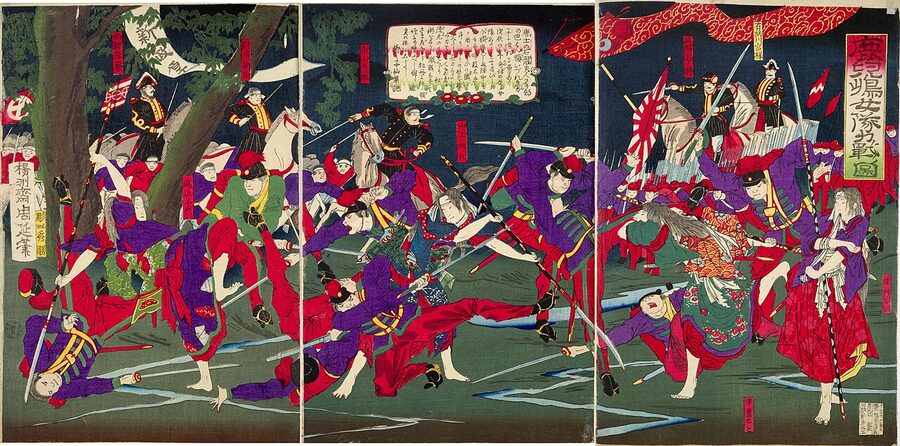
The assault went in before dawn on 22 February. Ikegami’s two thousand men attacked the redoubts and gates on the north and east and were stopped by artillery; Kirino’s eight hundred got as far as the prefectural office and were thrown back. On the west, three thousand men under Shinohara, Murata and Beppu took the hill of Danyama by about ten in the morning and shot down into the castle, mortally wounding the 13th Regiment’s commander, Yokura Tomozane, but by nightfall Satsuma had not got a foothold anywhere on the walls.
That night Saigō called the assault off. A line is often put in his mouth here, that he had been beaten not by the government army but by Lord Kiyomasa. It turns up in Kumamoto far more often than in anything written in 1877, but it is fair to Kiyomasa.
Out at Ueki, north of the city, the same night produced the war’s most famous embarrassment. Major Nogi Maresuke had come down from Kokura with an advance party of the 14th Regiment, ran into a larger Satsuma force in the dark, and in the scramble of the withdrawal a Satsuma soldier named Iwakiri Shōkurō carried off the regimental colour. Nogi asked to be punished, tried more than once to kill himself, and had a sword taken out of his hands by Kodama. When he finally did it in 1912, after the death of Emperor Meiji and long after Port Arthur in the Russo-Japanese War, his will said it was for the flag.
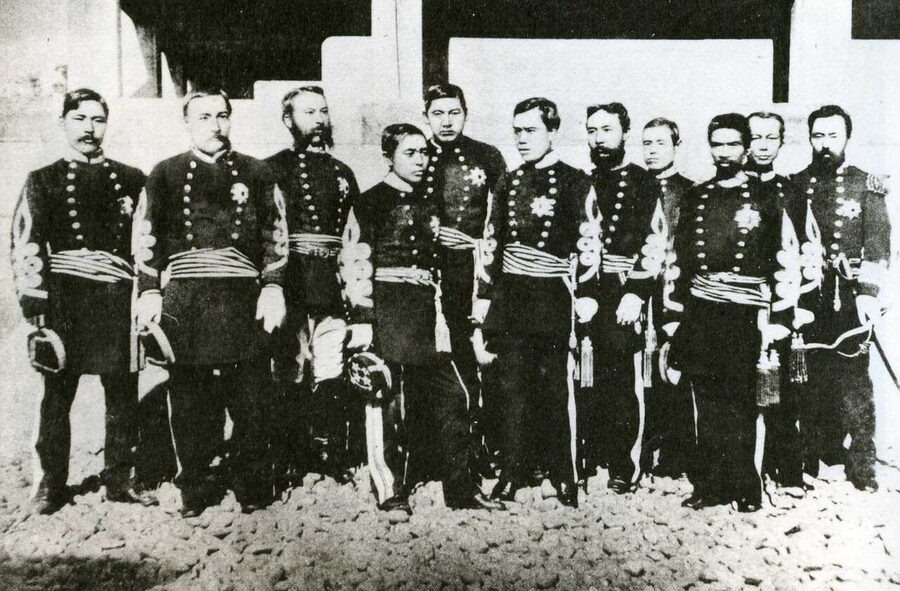
The siege lasted about fifty days. The Satsuma ring thinned as men were pulled north to the fighting on the roads, and on 26 March, short of troops, Kirino took a suggestion from the Kumamoto volunteers and dammed the Tsuboi and Iseri rivers. The fields north-east and west of the castle became a lake, which saved Satsuma a few hundred men and saved the garrison more, since it no longer had to guard that side either.
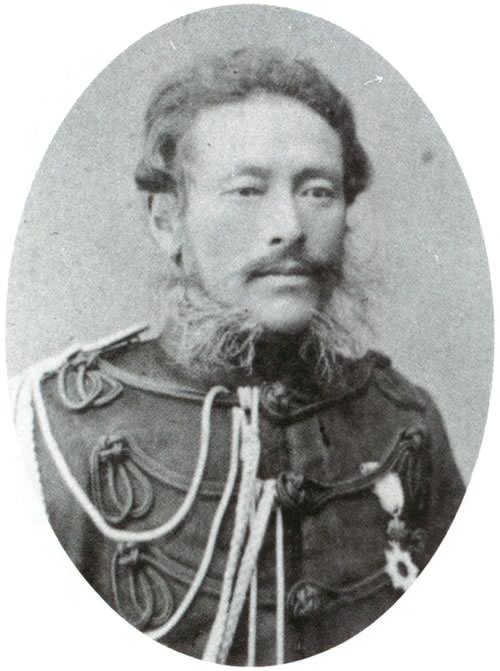
On 8 April Major Oku broke out to the south with a column that got through to the government army landing at Uto, while a raiding party came back with about seven hundred bales of rice. Tani was shot and wounded on the 11th. At about four in the afternoon of 14 April Lieutenant Colonel Yamakawa Hiroshi of the southern army reached the castle with a picked detachment, well ahead of his orders, and the siege was over.
English accounts usually date the relief to 12 April and credit Kuroda Kiyotaka, who commanded the southern army; the first troops through the gate were Yamakawa’s, and they arrived two days later. Yamakawa was an Aizu man who had defended his own castle against Satsuma and Tosa troops in the Boshin War, and he was reportedly reprimanded for racing ahead. You can imagine how much that troubled him.
Tabaruzaka: seventeen days of rain
The relief army came south from the ports of Hakata and Kokura, and there were three roads it could take into the Kumamoto plain. Only one, the Miike road through Tabaruzaka, was really fit for its four-pounder mountain guns, each weighing over two hundred kilograms. Kiyomasa had laid that road along the top of a ridge for defence, in a sunken cutting about 1.4 kilometres long that climbs in three slopes, and any army walking up the valleys on either side was in plain view from the top.
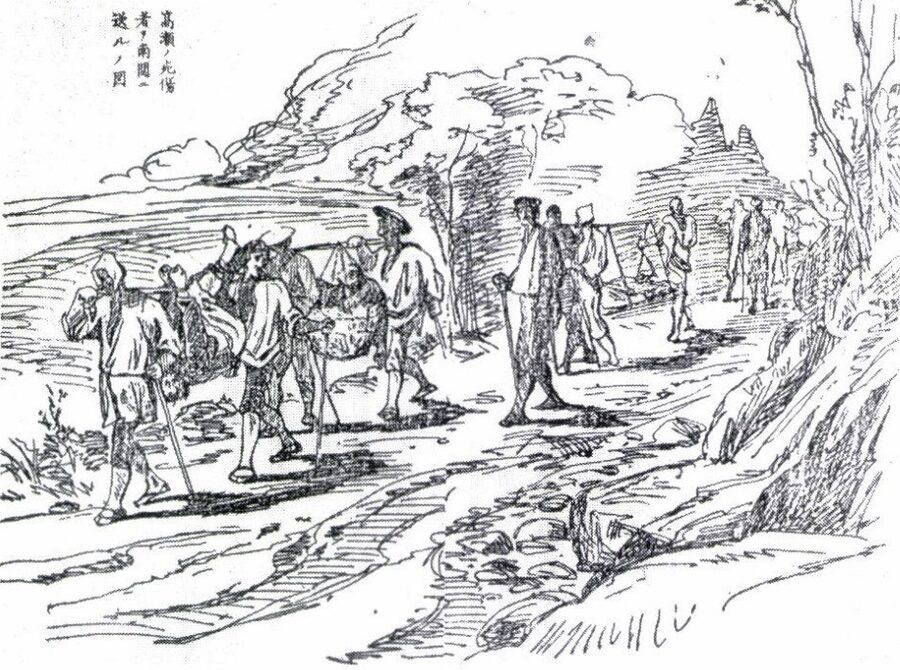
Before the ridge there was Takase. From 25 to 27 February the Satsuma army attacked the government line on the Kikuchi river with Kirino, Shinohara, Murata and Beppu all in the field, the only time in the war Satsuma tried a big offensive in open country. It failed when Shinohara’s centre ran short of ammunition at two in the afternoon and pulled back without telling anyone, and Saigō’s youngest brother Kohei was shot dead on the river embankment.
On 26 February, the day before that main attack, Nogi had pushed his men as far as the top of Tabaruzaka and asked his brigade commander, Major General Miyoshi Shigeomi, for permission to hold it. Miyoshi ordered him back. The Satsuma army walked in behind him and spent the next week digging, and that decision cost the government most of March.
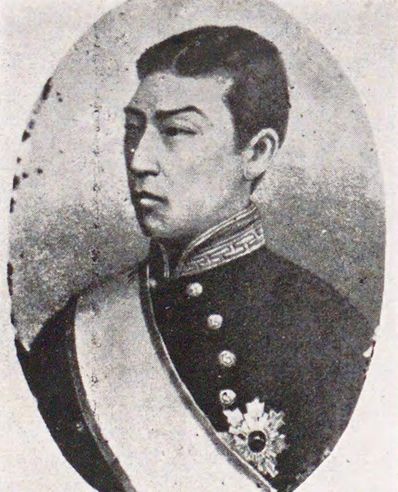
The general assault began on 4 March, with Tabaruzaka as the main effort and the Kichiji pass, a few kilometres south-west, as the second. At Kichiji a government battalion commander, Major Eda Kunimichi, picked out a Satsuma officer directing his men in a cloak with a silver-mounted sword and had him shot. It was Shinohara, who had run the rifle school; Eda was killed in the counter-attack.
Japanese sources put about seven thousand Satsuma and allied troops on the line from Ajitori in the north to the Node pass in the south. English accounts usually give fifteen thousand rebels against a government brigade of nine thousand. Either way the defenders had the ground: the cutting was too deep for the government’s rifles to reach into, and infantry who charged up the slopes were shot from the trenches or met at the top by men with drawn swords.
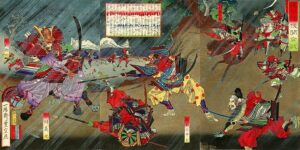
The government put eight guns in three batteries on the Futamata plateau across the Konoha river and shelled the ridge until, by local accounts, the hillside changed shape. Satsuma men said afterwards that they feared three things: rain, red caps and artillery. Rain soaked the powder of their muzzle-loading Enfields while the government’s Sniders, with metal cartridges, kept firing; the red caps were the Imperial Guard, many of them former samurai, and the conscripts in ordinary caps worried them much less.
It rained for most of the month. The government spent ammunition faster than it could make it: the stock of five million Snider rounds was gone by March, eighteen million more were needed, and older German needle guns came out of the Tokyo and Osaka depots because there were cartridges for those. The army tried to buy empty cases from foreign merchants and to borrow ammunition from Qing China, and for a few weeks it was winning a war of supply that it was also close to losing.
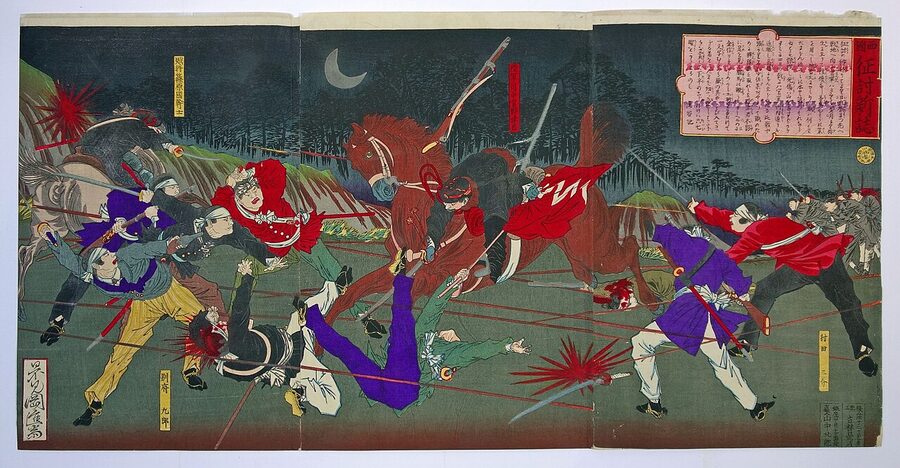
The sword police
What the conscripts could not handle was the Satsuma sword charge. Most of them were farmers’ sons with a few months of bayonet drill, facing men raised from boyhood in Satsuma’s own fencing school, Jigen-ryū, whose first cut was meant to be the only one. Officers of the police brigade, three of them Satsuma men, proposed picking the best swordsmen out of the 354 police on the Ueki front and sending them in with blades.
Yamagata, who had written the conscription law to make the samurai unnecessary, did not like it. He agreed anyway, chose the name Battōtai (抜刀隊), “drawn-sword unit”, himself, and about 110 men were formed into the first unit around 11 to 13 March. At dawn on the 14th they went in on the Futamata side and took three Satsuma redoubts in a rush, then had to fall back because no one followed them, but the point had been made: these men could fight Satsuma on Satsuma’s terms.
On 15 March a second unit of fifty went up Yokohirayama, a spur forty metres higher than the Tabaruzaka ridge, to retake it from a Satsuma counter-attack. Two came back unhurt. The hill was the only place from which the government could see the whole Satsuma position, and Japanese historians count that day as the hardest of the whole battle.
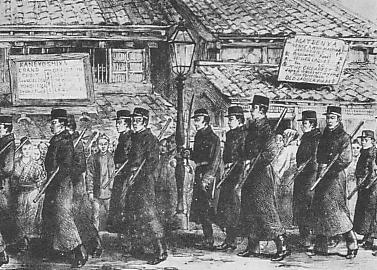
There is a story that the sword police were mostly Aizu men, charging with the cry “Revenge for Boshin!” It was reported at the time by a young newspaper correspondent named Inukai Tsuyoshi, who went on to become prime minister, and it suited later generations brought up on bushido. The rosters say otherwise: most were Satsuma country samurai, under a Satsuma police chief, cutting down Satsuma men. The most famous Aizu policeman in the war, Sagawa Kanbei, was not one of them at all; he served with a different police column and was killed in the Aso hills that March.
The unit outlived its war. Kawaji wrote an essay arguing for reviving fencing, from 1879 the Tokyo police hired fencing masters, and police swordsmen are still the strongest force in kendo. A poem about the Battōtai by the Tokyo professor Toyama Masakazu, set to music in 1885 by the French bandmaster Charles Leroux, became the basis of the army’s march past, which the Ground Self-Defense Force and the police still play.
In 1894, at the start of the First Sino-Japanese War, the head of the Tokyo police, Sonoda Yasukata, one of the officers who had proposed the original unit, offered to raise a new Battōtai for China. The proposal went to Kawakami Sōroku, who had been inside Kumamoto Castle through the siege of 1877. He sent the messenger home to tell Sonoda that the Japanese army was not that childish any more.
20 March
On 18 March the government commanders met and agreed to rest the troops for a day and attack at dawn on the 20th on two fronts. That morning, in heavy rain and fog, nineteen companies crossed the valley under the biggest bombardment yet from Futamata and Yokohirayama, and when the guns stopped they charged one point only: Nanamoto, the Satsuma field headquarters behind the ridge.
Nanamoto was held by the Takanabe contingent, which had arrived the night before and had no idea where anything was. It broke, the Kijima, Sadowara and Kumamoto units beside it broke too, and the whole line ran for Ueki. On that one day the government lost 495 dead, and 2,401 in the Tabaruzaka sector since 4 March; the Satsuma dead were never counted, but eleven of the thirty Satsuma platoon commanders on the line were killed.
English accounts usually call Tabaruzaka an eight-day battle. Japanese reference works give seventeen days, from 4 to 20 March, and the fighting at Kichiji went on until it fell on 1 April. I side with the Japanese count, because the people who still dig bullets out of the slopes live there.
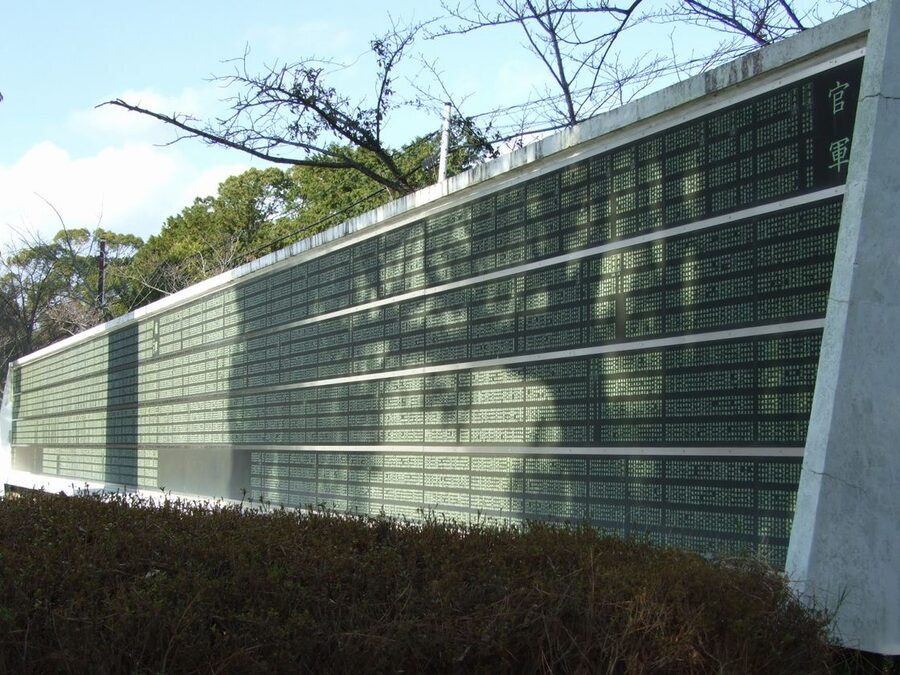
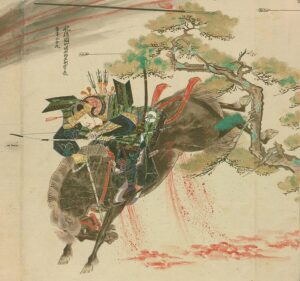
Kumamoto remembers it in a folk song, written around 1904 and 1905, during the war with Russia, by a local newspaper reporter and a Kumamoto geisha. It is about rain soaking men and horses on a slope that no one can get over, and a beautiful young rider with a bloodied sword in one hand and the reins in the other. There is a bronze of him in the park now, which is more than most of the real dead got.
Behind the lines: the sea, the hospitals and Kagoshima
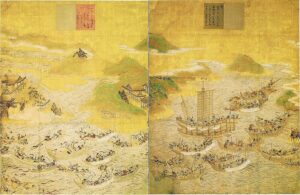
The government owned the sea, and used it. On 7 and 8 March an imperial envoy, Yanagihara Sakimitsu, sailed into Kagoshima Bay with warships and over a thousand troops, released Nakahara and the other prisoners, wrecked the powder works and carried off what powder there was. He also called on Shimazu Hisamitsu, the father of Satsuma’s last daimyo and the real power in the old domain, who declined to help either side.
On 19 March the first troops of a southern army, under the overall command of Kuroda Kiyotaka, landed on the beach at Suguchi, three kilometres south of the planned spot at Hinagu, and had Yatsushiro by two in the afternoon. Within a week it was eight thousand strong, Kawaji’s police brigade included, and pushing north towards Kumamoto behind the Satsuma army’s back.
The man sent to stop it was Nagayama Yaichirō, who had argued against the whole war at the February council and then marched anyway. At Mifune on 12 April, wounded and carried to the front in a rickshaw, he sat on a sake barrel shouting at his men to stand; when they would not, he bought a farmhouse from its owner, set fire to it and killed himself inside by seppuku.
After Kumamoto was relieved, the Satsuma army drew up on a twenty-kilometre line east of the city, about 8,000 men against something like 30,000. The battle there on 20 April is called the Jōtō battle in Japanese, and it was the biggest field battle in Japan since Sekigahara. Satsuma men knew all about Sekigahara, where in 1600 Shimazu Yoshihiro had cut his way out through the victorious army, and this one also ended in a retreat: Kirino wanted to die where he stood and had to be talked out of it.
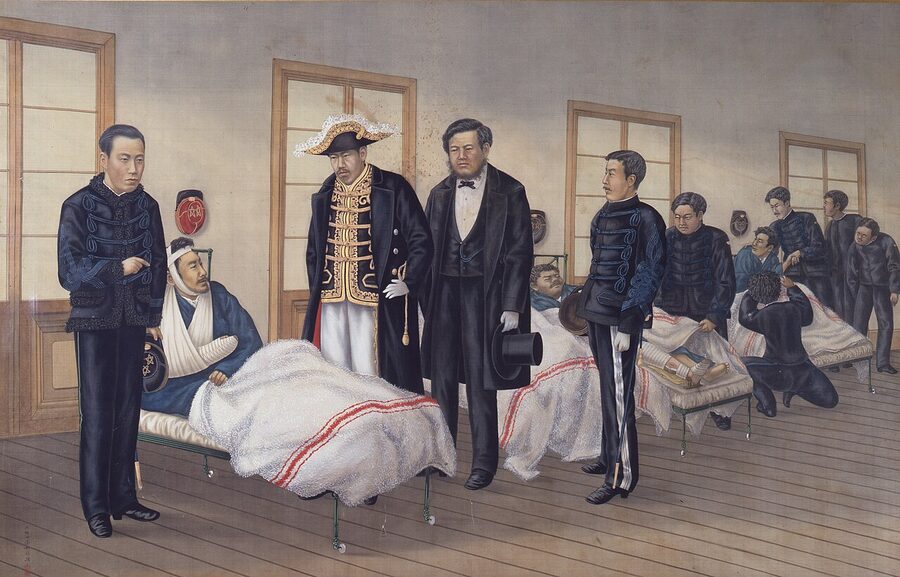
The wounded were the war’s other new story. In May two officials, Sano Tsunetami and Ōgyū Yuzuru, founded the Hakuaisha, a relief society for the wounded of both sides, with the approval of the commander, Prince Arisugawa; in 1887 it became the Japanese Red Cross. A Kumamoto doctor, Hatono Sōha, ordered by Satsuma to treat its wounded, insisted on treating both sides, was put on trial afterwards for helping the enemy and was acquitted.
In Kagoshima itself the government landed for good on 27 April under Kawamura, and spent two months holding the town against new Satsuma recruits in the hills around it. The heaviest fighting there, at Murasakibaru on 24 June, cost the government 211 casualties and Satsuma 66, the kind of ratio that runs right through this war.
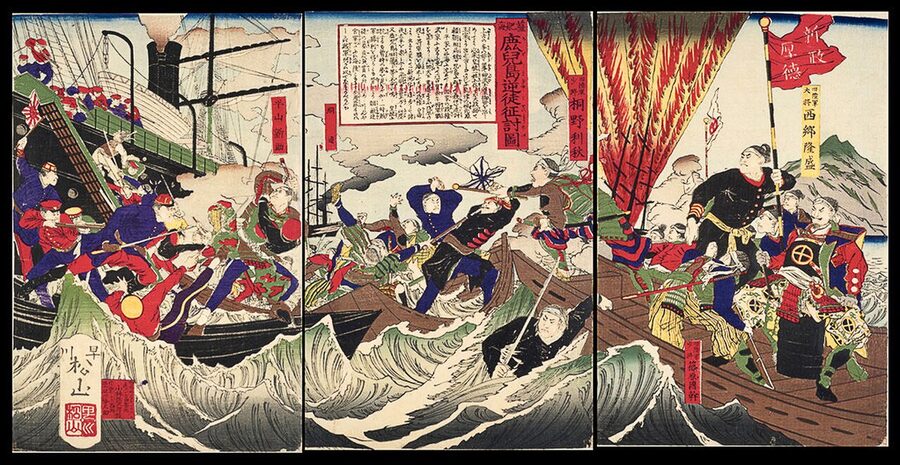
Five months of retreat
At Hamamachi in the mountains east of Kumamoto, on 21 April, the Satsuma commanders reorganised what was left into named companies and settled on a new plan: hold the three old provinces of Satsuma, Ōsumi and Hyūga, with Hitoyoshi as the base. Hitoyoshi fell on 1 June after three days of shelling, during which the shorter-ranged Satsuma guns on the old castle burned much of their own town. Henmi held the Ōkuchi front so stubbornly that it was called a second Tabaruzaka, and when he finally had to leave it he is said to have stood weeping by an old pine, remembered locally as Jūrōta’s weeping pine.
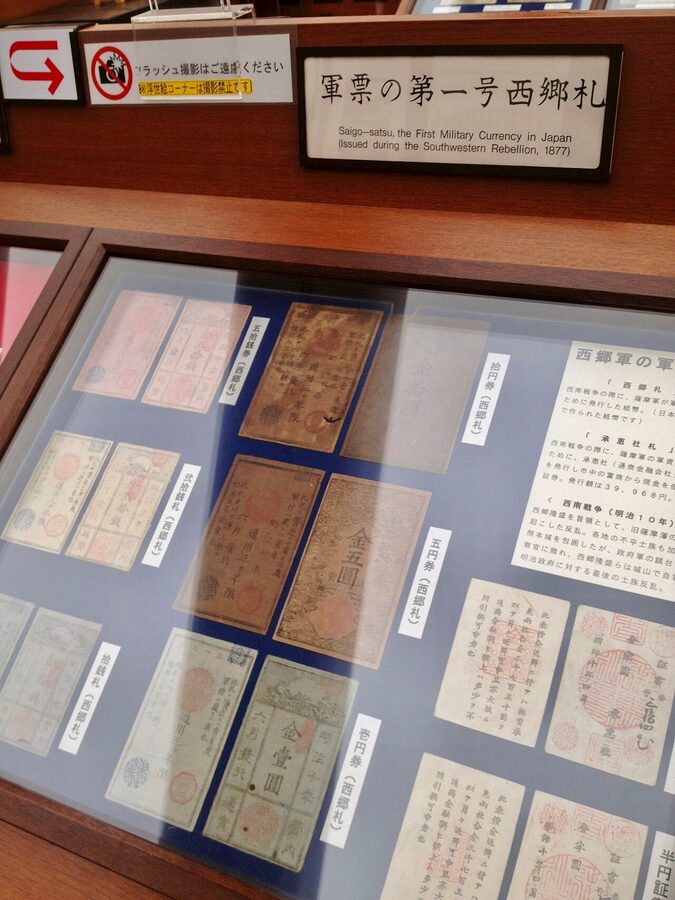
Saigō moved his headquarters to Miyazaki. Money had run out long before, and in July the Satsuma army began printing its own: the Saigō-satsu, notes of ten sen to ten yen on paper backed with cloth because there was not enough of the right paper, about 140,000 to 170,000 yen of them in all. In Miyazaki they were sometimes accepted only under threat.
Miyakonojō fell on 24 July, Miyazaki on the 31st, Nobeoka on 14 August. On 15 August at Wada-goe, north of Nobeoka, about 3,000 Satsuma men faced government forces that by now numbered around 50,000, and Saigō stood on the hilltop and directed the fighting himself, for the first time in the whole war. They lost. On the 16th, at the farmhouse in Nagai village where he was staying, Saigō ordered the army disbanded, and units began walking down the hill to surrender.
About a thousand of the hardest stayed. In the farmhouse Saigō burned his papers and, by the usual account, his general’s uniform. At ten at night on 17 August somewhere between three and five hundred of them, Saigō among them, started up the steep face of Enodake, a 728-metre peak the government had thought nobody would try in the dark.
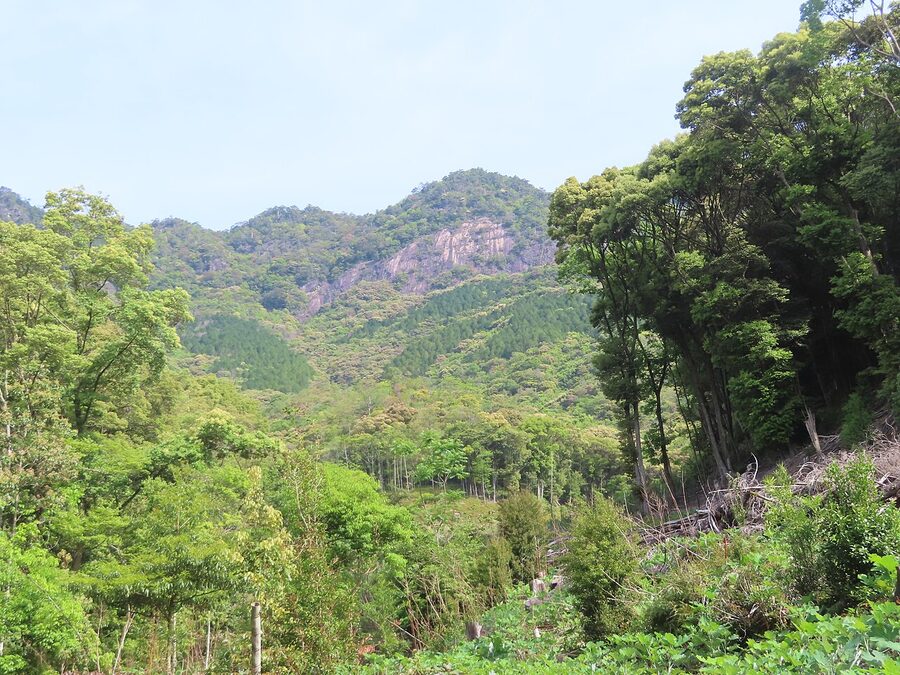
They reached the top at first light, saw that the government camps on the far side were barely guarded, and came down on them with Henmi in front. The brigades there broke and ran. Not everyone made it over: one officer fell into a ravine in the dark, another who could not catch up killed himself, and Saigō’s son Kikujirō, wounded in the leg back at Takase, had to be left behind.
What followed was two weeks of walking through the mountains of central Kyushu, by Mitai, Mikado, Murasho and Kobayashi, with the government never quite sure where the column was going, partly because for most of the way the Satsuma leaders were not sure either. At Mitai Kirino proposed turning on Kumamoto again. Saigō said no, and they went home.
Shiroyama, 24 September 1877
On 1 September the column broke through into Kagoshima, Henmi retook the Shigakkō from the two hundred government troops holding it, and for a day or two the town was theirs. By 4 September the government had pushed them back up the slopes of Shiroyama, the wooded hill behind the castle site, and a last-ditch raid on its headquarters at Yonekura had been wiped out. By the 6th the ring round the hill was closed.
Japanese sources give the defenders as about 350 fighting men, 370 with porters, reorganised into platoons of twenty or thirty and posted round the Shigakkō, the castle site and the Iwasakidani valley. English accounts usually say five hundred. Against them were five brigades, the police and the warships in the bay.
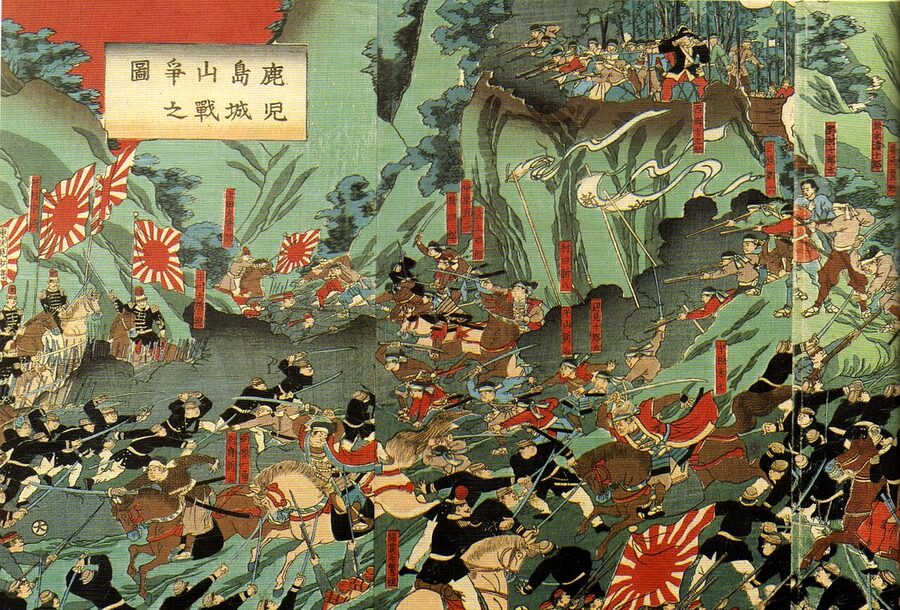
Yamagata reached Kagoshima on 8 September, and having been made a fool of at Enodake, he ruled that the siege would be “encirclement first, attack second”. His engineers dug trenches and put up fences and palisades all round the hill, and the guns of the ships in the bay and the batteries in the town shelled it daily.
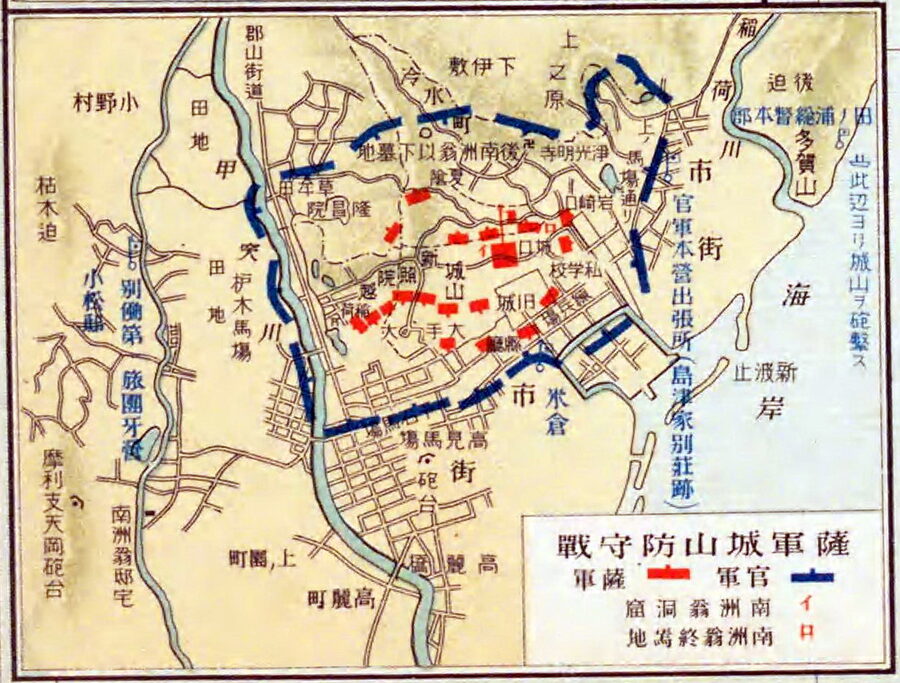
On 19 September two Satsuma officers, Yamanoda Ippo and Kōno Shuichirō, went down to the government lines under a flag of truce to see Kawamura, telling Saigō they meant to explain the cause and keeping to themselves that they were trying to save his life. On the 22nd Saigō issued a written call to his men to die on Shiroyama. On the 23rd Yamanoda came back with Kawamura’s terms, surrender by five that afternoon, and a letter from Yamagata, who had once served under Saigō, urging him to end it; Saigō said there was no need to reply.
At four in the morning of 24 September three guns fired from the government batteries, and the assault began. Saigō and about forty of his officers formed up in front of the cave he had been sheltering in and set off down the valley towards the government positions at Iwasaki-guchi. Two of them killed themselves before they started; Katsura Hisatake, who had gone out in February only to see the army off and ended up running its baggage train, was shot early.
Near the gate of a Shimazu family house Saigō was hit in the thigh and the belly and went down. He turned to Beppu Shinsuke, himself wounded and being carried, and said, in the words most often quoted, “Shin-don, Shin-don, this will do.” He knelt, straightened his collar and bowed towards the emperor in the east, and Beppu, shouting an apology in Satsuma dialect, cut off his head.
English accounts often say he committed seppuku. The examination of his body is reported to have found no wound to the belly that a blade would have made, and the likeliest reading is that he was too badly hurt to do it and Beppu did what a second does. Japanese accounts have Beppu killing himself on the spot; English ones have him leading the last charge. Kirino, Murata, Ikegami and Henmi died in that charge, or fighting at the redoubt at Iwasaki-guchi.
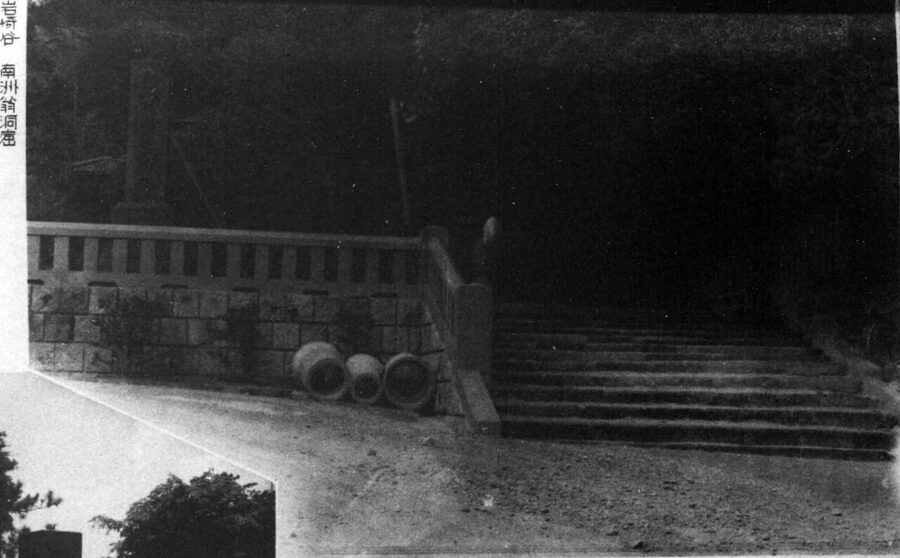
The firing stopped at around nine by the Japanese account, seven by the English, and about 160 Satsuma men died that morning. Saigō’s head was hidden nearby and found later that day. A few officers, Nomura Oshisuke among them, chose to surrender because they wanted to argue their case in court; Nakajima Takehiko, who had said he would neither surrender nor die, was never seen again.
Saigō was forty-nine by Western reckoning. One Japanese encyclopedia gives fifty-one, counting the old Japanese way, and you will see both. The officer whose men killed him, Yamagata, had been his subordinate in the army Saigō built; the admiral who offered him terms, Kawamura, was a relative by marriage; and the war was over.
The bill
The numbers depend on the counter. One widely used count gives 6,403 government dead and 6,765 on Saigō’s side. The Army Ministry’s own annual report gave 6,527 government soldiers killed or died of wounds out of 16,195 casualties, and one standard encyclopedia puts Satsuma casualties at about 15,000; another gives government dead at over 6,800 and Satsuma dead at around 6,000. Close to nine hundred of the government dead were police.
The war cost the government about 41.6 million yen, against a national tax take of around 48 million. It paid by printing money, the inflation that followed was cured from 1881 by the finance minister Matsukata Masayoshi with a deflation so savage that small farmers lost their land in droves, and the share of farmland worked by tenants rose from 38 to 47 per cent. English-language accounts sometimes give a figure ten times larger for the cost of the war; no government in Japan in 1877 had that kind of money.
Special courts sat at Fukuoka and in Nagasaki. By the Nagasaki figures about 2,764 people were punished, 22 of them beheaded, and well over 40,000 were let go. The most senior official among the condemned was the governor, Ōyama Tsunayoshi, who had handed prefectural funds to Saigō’s army; he was beheaded at Nagasaki that autumn.
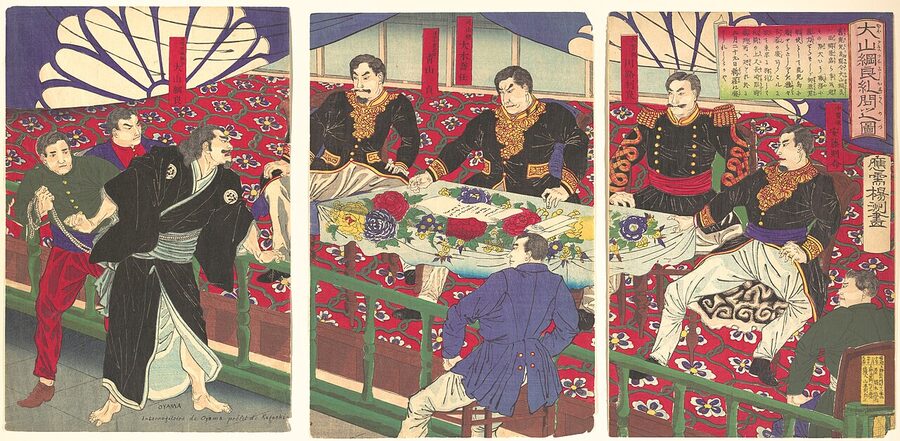
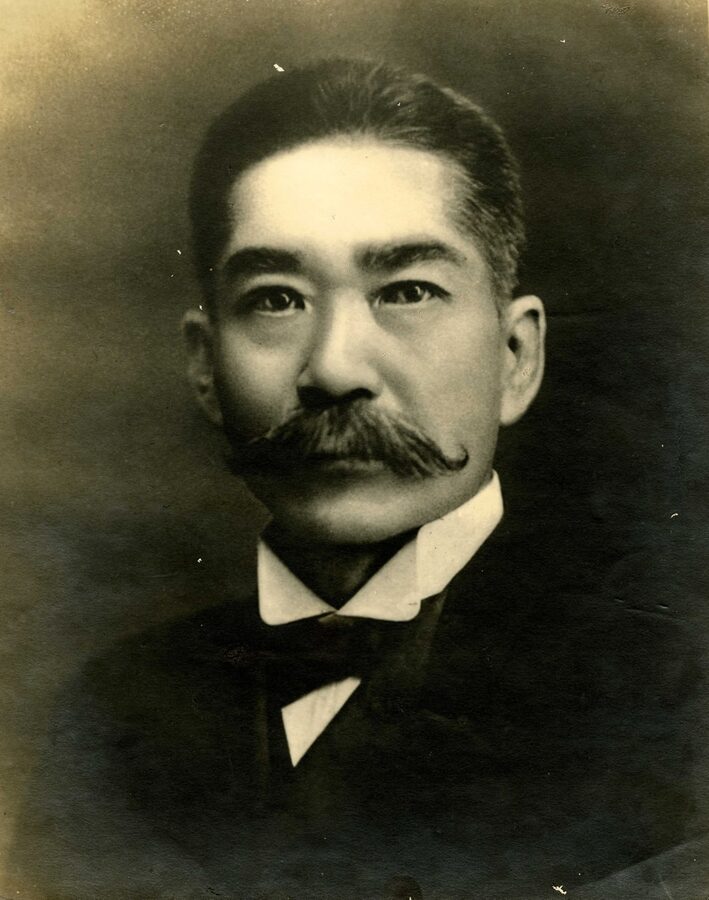
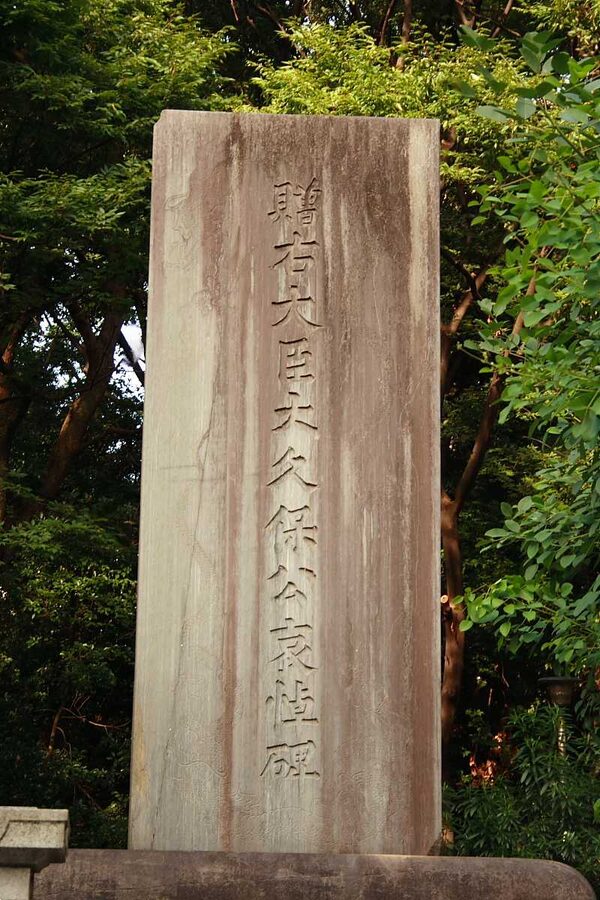
Ōkubo outlived his friend by less than eight months. At about half past eight on the morning of 14 May 1878 his carriage was stopped near Kioizaka in Tokyo by six former samurai, five from Ishikawa and one from Shimane, who killed him and his driver. Their leader, Shimada Ichirō, a former foot soldier of Kaga, had backed Saigō’s Korea policy since 1873 and never forgiven the men who blocked it.
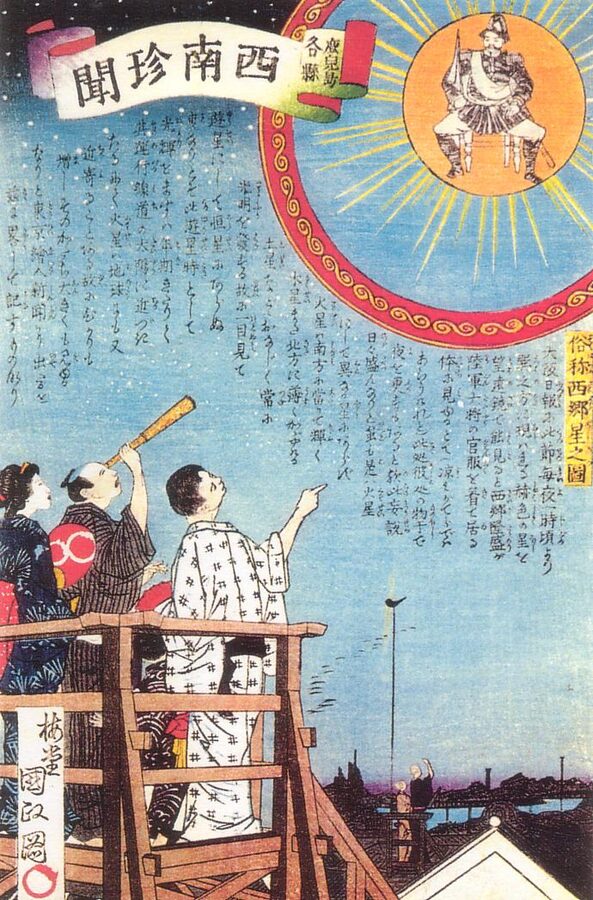
The public forgave Saigō long before the state did. In the late summer of 1877 Mars came unusually close to the Earth and blazed red over Japan, and the rumour went round that if you looked through a telescope you could see Saigō in it, in uniform. The printmakers sold the “Saigō star” by the thousand, and within months of his death Kawatake Mokuami’s play about the war ran for more than eighty days in Tokyo, with Western fireworks for the battle scenes.
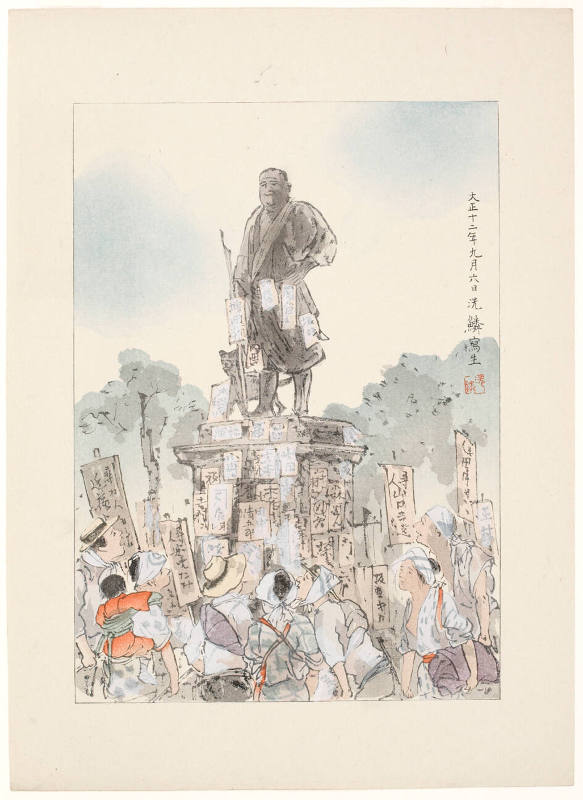
On 22 February 1889, in the amnesty that came with the new constitution, the emperor pardoned Saigō and restored his court rank. Nine years later, on 18 December 1898, his statue went up in Ueno Park in Tokyo, paid for by about 25,000 subscribers and 500 yen from the Imperial Household: Takamura Kōun’s figure of a stout man in a summer kimono walking his dog, with not a uniform in sight. His widow’s reaction at the unveiling is on his own page.
Then there is The Last Samurai. Edward Zwick’s 2003 film borrows Saigō and Shiroyama for its rebel lord Katsumoto, takes its American hero partly from the French officer Jules Brunet, who fought for the shogun’s side in the Boshin War, and stages its last battle in a valley that looks very like Tabaruzaka, though it was filmed in New Zealand. Its samurai fight in armour with bows. The real Satsuma army wore Western-style uniforms, carried Enfield rifles, hauled sixty guns and still charged with swords, which is stranger than anything in the film, and it lost to an army whose most effective swordsmen were policemen.
What the war settled was that a conscript army of farmers’ sons could beat the best samurai in Japan, provided it had enough rounds, steamships and telegraph wire. The government also drew another lesson, that its soldiers needed something to believe in as fiercely as Satsuma had believed in Saigō, and it put the emperor at the head of the army and set about giving them that. Its consequences run straight through the Meiji era that followed, and for a good while after.
Where to see the Satsuma Rebellion today
Kumamoto and Kagoshima are well under an hour apart on the Kyushu Shinkansen, so you can do the war in two days, in the order it happened. Start at the castle the Satsuma army could not take, spend a morning on the ridge where it was broken, and finish in Kagoshima at the hill where it ended and the cemetery where it is buried.
Kumamoto Castle
The castle opens from 9.00 to 17.00 from September to June and until 19.00 in July and August, with last entry an hour before closing and last climb up the keep half an hour before. Tickets are ¥800 for adults and ¥300 for primary and junior high school children, or ¥850 for an adult ticket that includes the Wakuwakuza history centre at Sakuranobaba Josaien; the castle closes on 29 December. The tram from Kumamoto Station takes about fifteen minutes to the Kumamotojo-Shiyakushomae stop.
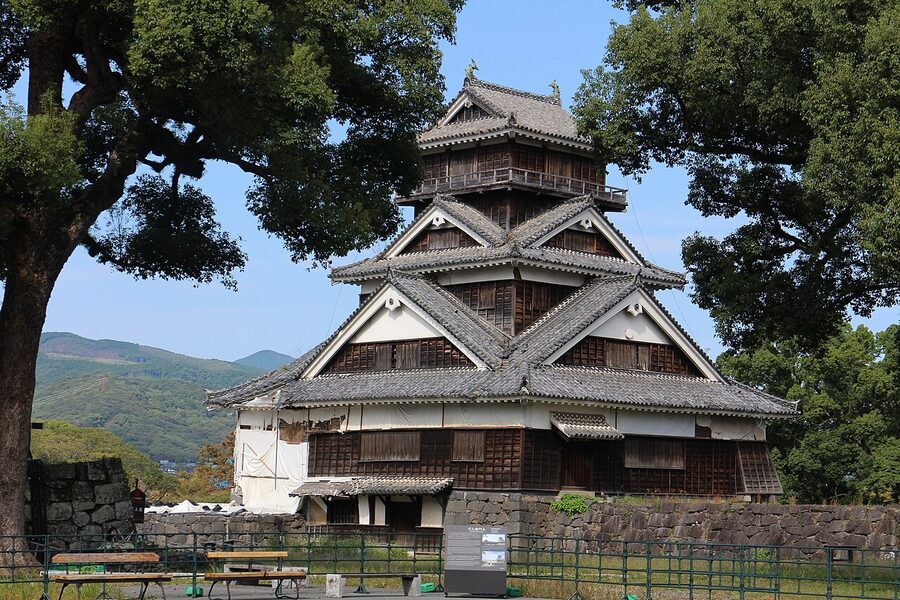
The keeps you see are a concrete rebuild of 1960, repaired after the 2016 earthquake and reopened in 2021, and the displays inside run from Kiyomasa to the earthquake, the 1877 siege included. The building to look at for this war is the Uto turret, the largest that survived the fire of 19 February. Walk round to the west side too, where the hill of Danyama, now a district of houses, rises close to the walls; the Satsuma riflemen who took it on 22 February were firing down into the castle at short range.
Tani Tateki’s statue, by Asakura Fumio, stands in Takahashi Park below the castle. It is a 1969 recasting of a 1937 original melted down for metal in the war, and it used to stand inside the castle until the palace reconstruction moved it out. It is a rare monument in Kyushu to a man on the winning side of this war.
Tabaruzaka
The Kumamoto City Tabaruzaka Seinan War Museum stands at the top of the ridge in Ueki-machi Toyooka, in the north of the city. It opens from 9.00 to 17.00 with last entry at 16.30, closes only from 29 December to 3 January, and costs ¥300 for adults (high school age and over) and ¥100 for primary and junior high school children. Parking is free.
Getting there without a car takes some effort. From JR Tabaruzaka Station on the Kagoshima Main Line it is about thirty minutes on foot, uphill; a taxi from Konoha Station, the next stop north, takes about ten minutes. By car it is about eight kilometres from the Ueki interchange on the Kyushu Expressway.
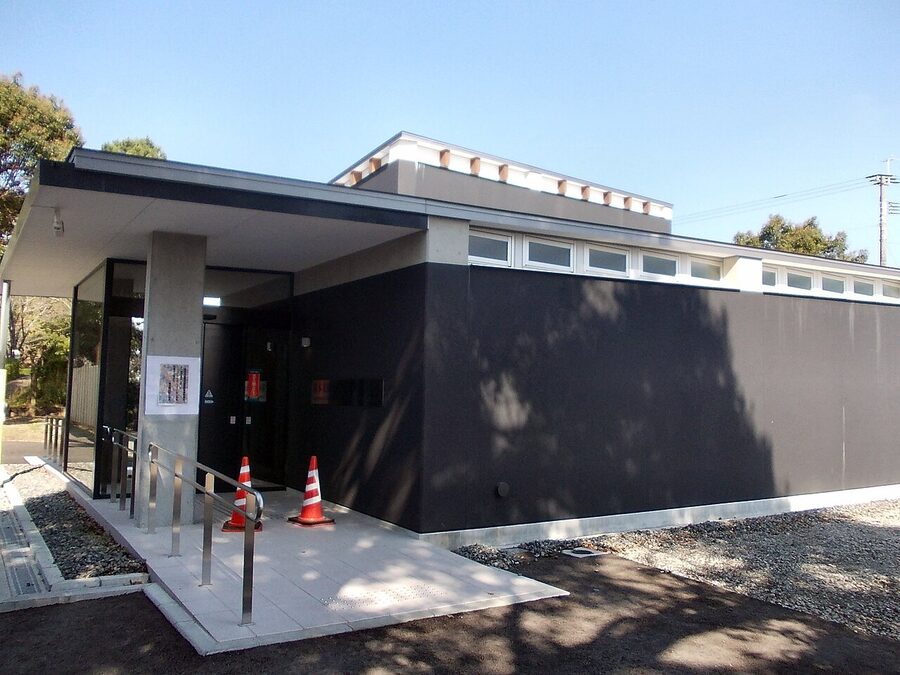
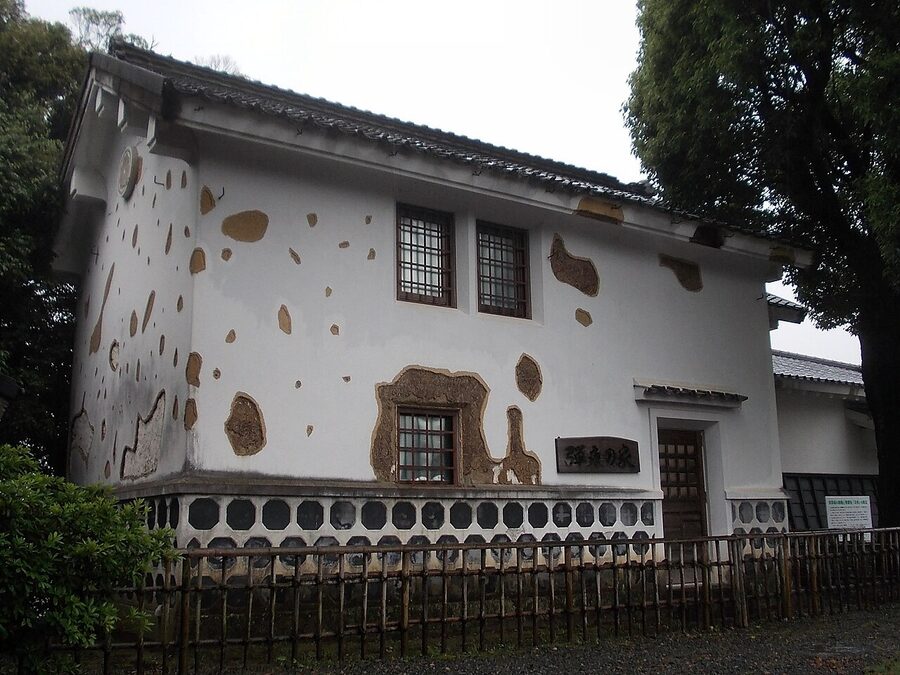
Inside are Saigō-satsu notes, weapons, gun fittings, the prints and a room of three short films, and the bugle call played on the battlefield runs as background music. Across the path is Dankon-no-ie, the “house of bullet holes”, which is free.
Then walk. The old road drops from the park through the three slopes in a cutting between banks of trees, and it is the reason to come: you understand in about two minutes why a column marching up it was helpless, and why the people in the valleys either side were in plain view. I would go early, before the coaches, and if it is raining, so much the better. Watch for cars, which use the road too.
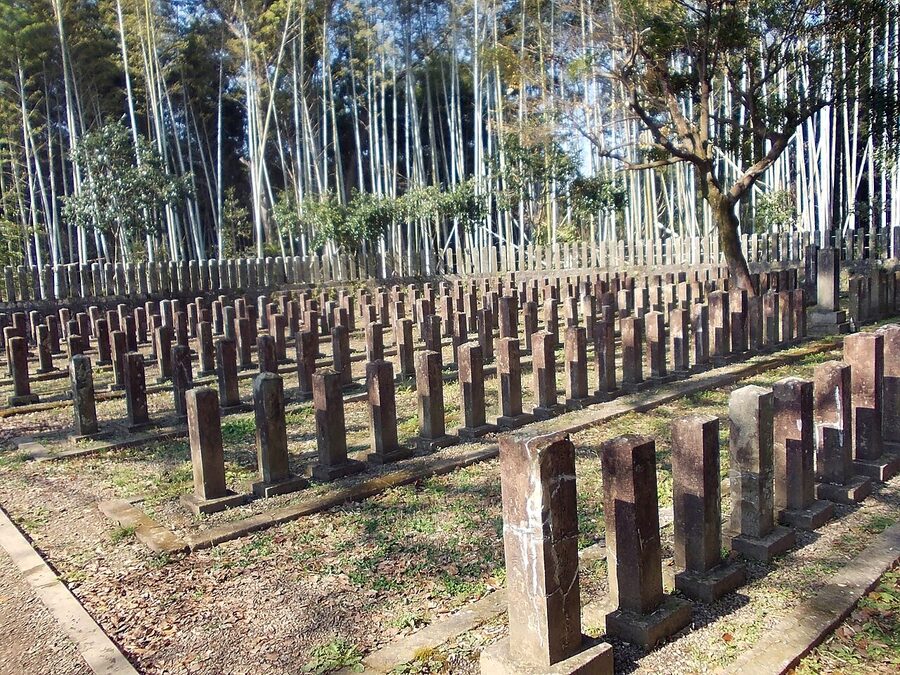
The government army cemetery at Nanamoto is a short drive away, on the spot where the Satsuma line broke on 20 March, and there is a Satsuma cemetery near it. The memorial wall with the names, and the bronze of the folk song’s young horseman, are in the park by the museum.
Shiroyama and the cave, Kagoshima
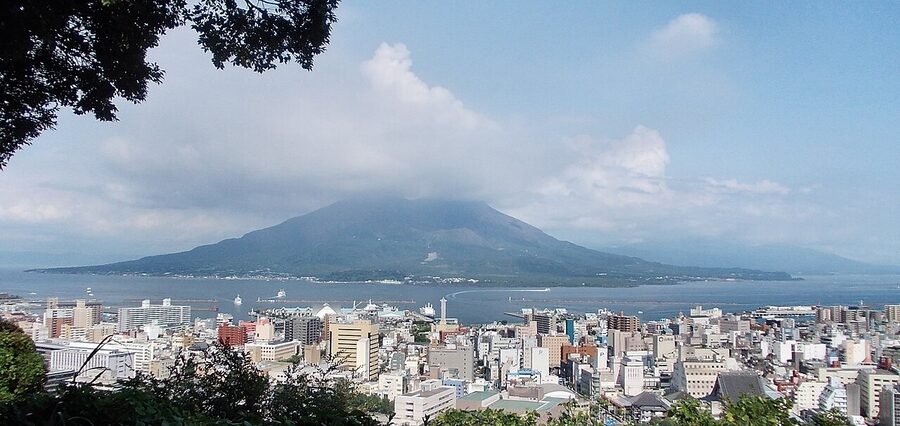
From Kagoshima-Chuo Station, the City View loop bus is the easy way to reach everything on Shiroyama, and a one-day pass, valid on the trams and city buses too, costs ¥600. Get off at Shiroyama for the observation point near the top, about 107 metres up, which is free and open at all hours.
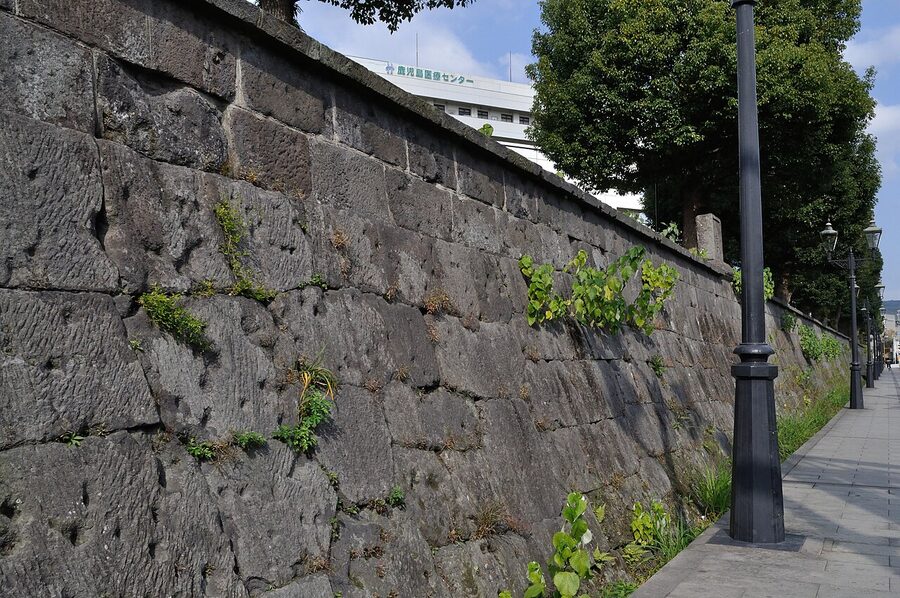
On the way, look at the Shigakkō itself. The gateposts and the long stone wall stand on National Route 10 across from the old castle site, and the wall is still pocked with bullet marks from September 1877; so are the stone walls of Tsurumaru Castle a few steps away. The prefectural museum, the Reimeikan, stands inside those walls, but check its site before you go; part of its permanent galleries was closed when I last looked.
The Saigō cave is at the foot of the hill on the Iwasakidani side, behind a fence beside the road, and the stone marking the spot where he died, put up in 1899, is a few minutes’ walk down the valley, about five minutes from the Satsuma Gishi-hi-mae bus stop. Both are free. Walk from one to the other: it is the route the forty officers took on the last morning, and it is shorter than you would think.
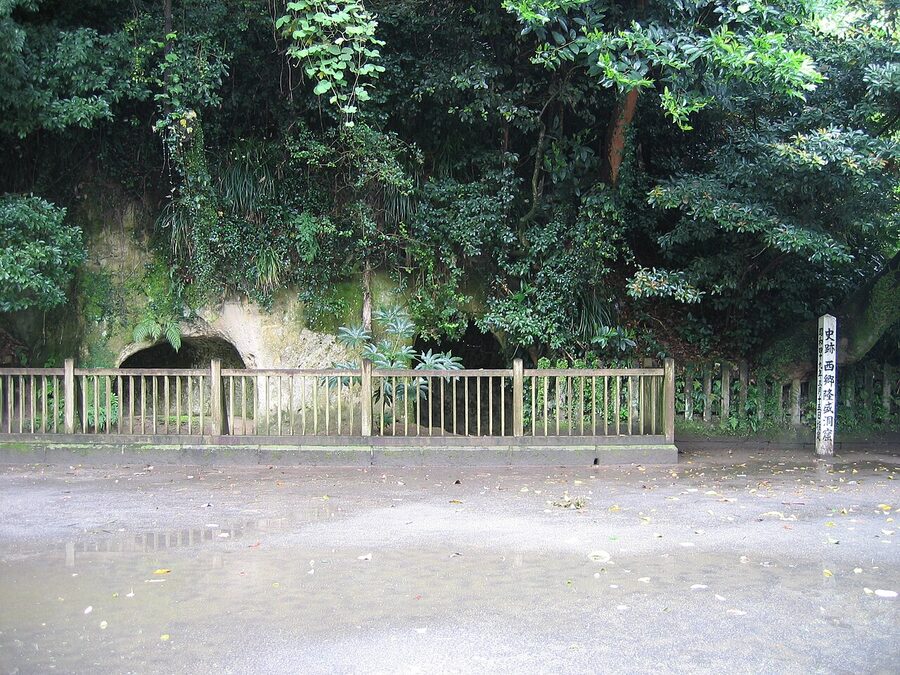
I have mixed feelings about the cave. It is almost certainly not the one he used, and it has been tidied into something you photograph from a car. But it is in the right valley, and if you stand at the railing and look down towards Iwasaki-guchi you are looking at the last stretch of the war.
Nanshū cemetery, shrine and museum, Kagoshima
The Satsuma dead are buried at the Nanshū cemetery in Kamiryūbi-chō, on the north-east side of the city, Nanshū being Saigō’s pen name. After the war the new governor, Iwamura Michitoshi, a Tosa man, had Saigō and his officers buried with care in five temporary graveyards around the town and wrote their grave markers himself. In 1879 they were gathered here, and the dead from all over Kyushu followed: today there are 749 stones for more than two thousand people, with Saigō’s in the middle of the front row and Kirino, Shinohara, Murata, Henmi, Beppu and Katsura around him.
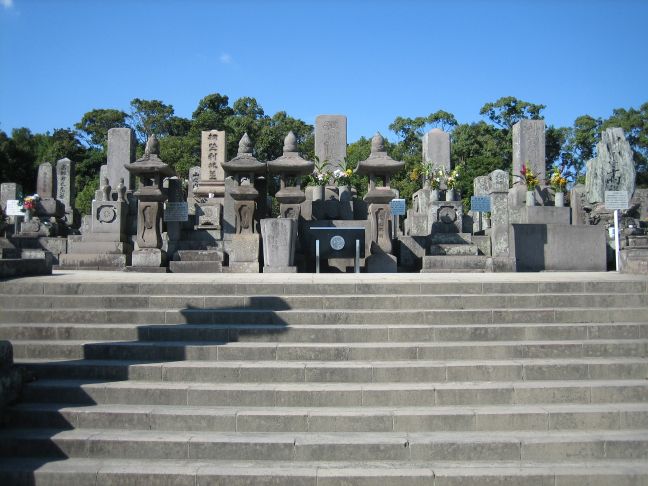
The cemetery is free to enter. Nanshū shrine, beside it, began as a place of worship at the graves in 1880, became a shrine in 1922, burned in the air raids of 1945 and was rebuilt in 1950. It is plain, which suits the place.
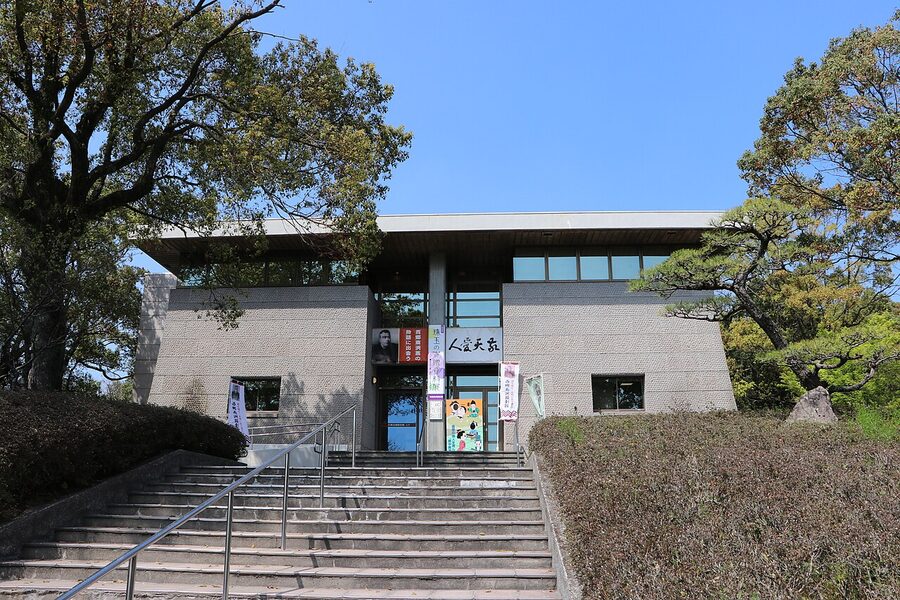
The Saigō Nanshū Kenshōkan, the museum next door, opened in 1978 on donations from all over Japan. It opens from 9.00 to 17.00, closes on Mondays (the next weekday when Monday is a holiday) and from 29 December to 1 January, and costs ¥400 for adults and ¥200 for primary and junior high school children. The City View bus stops right outside; from the city bus stop at Tatebaba it is a seven-minute walk with about a hundred steps.
If you pass through Tokyo, the Ueno statue is a few minutes’ walk from Keisei Ueno Station, and Ōkubo’s memorial is in Shimizudani Park near Akasaka-mitsuke. Seeing the two of them on the same afternoon is worth doing once.
Two bullets
Go back to Tabaruzaka at the end, if you can, and walk down the old road from the museum to the second slope. Somewhere in the fields on either side there is still a pair of bullets that met halfway, one fired by a farmer’s son from the north with a rifle he had carried for a few months, one by a Satsuma man who had been taught since boyhood that he was born to fight. Neither got through. That is about as fair a summary of the Satsuma Rebellion as I know, except that the farmer’s son had a few million more where his came from.