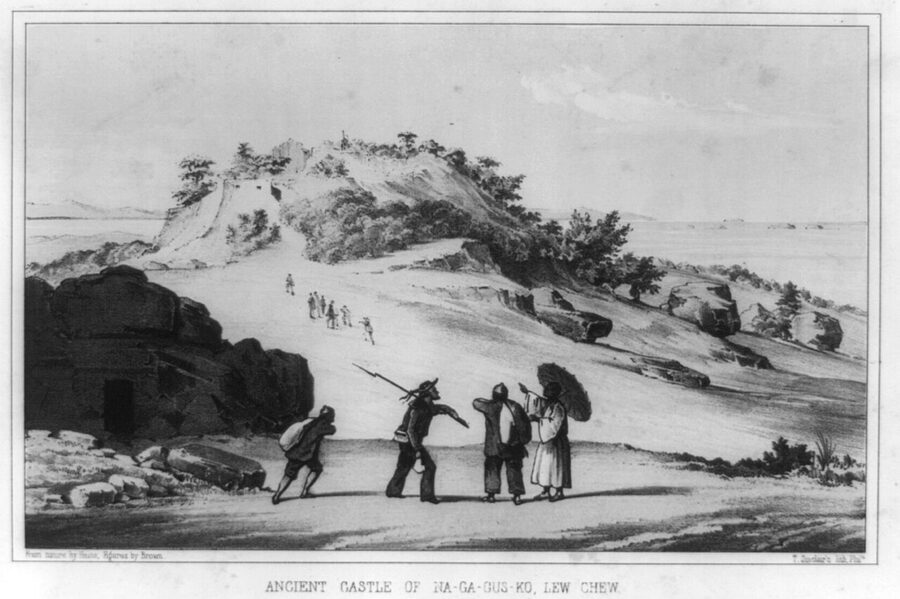
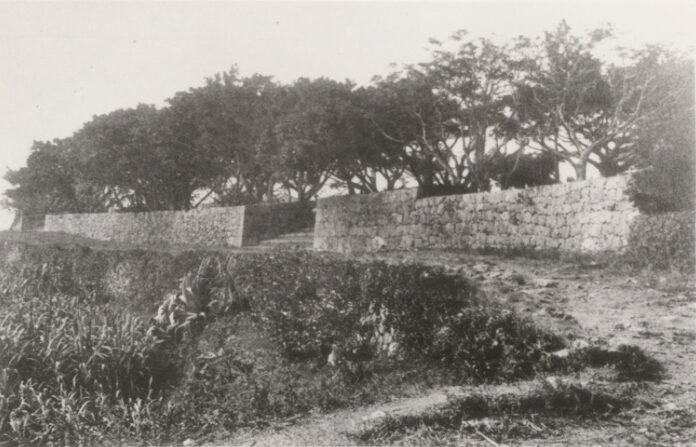
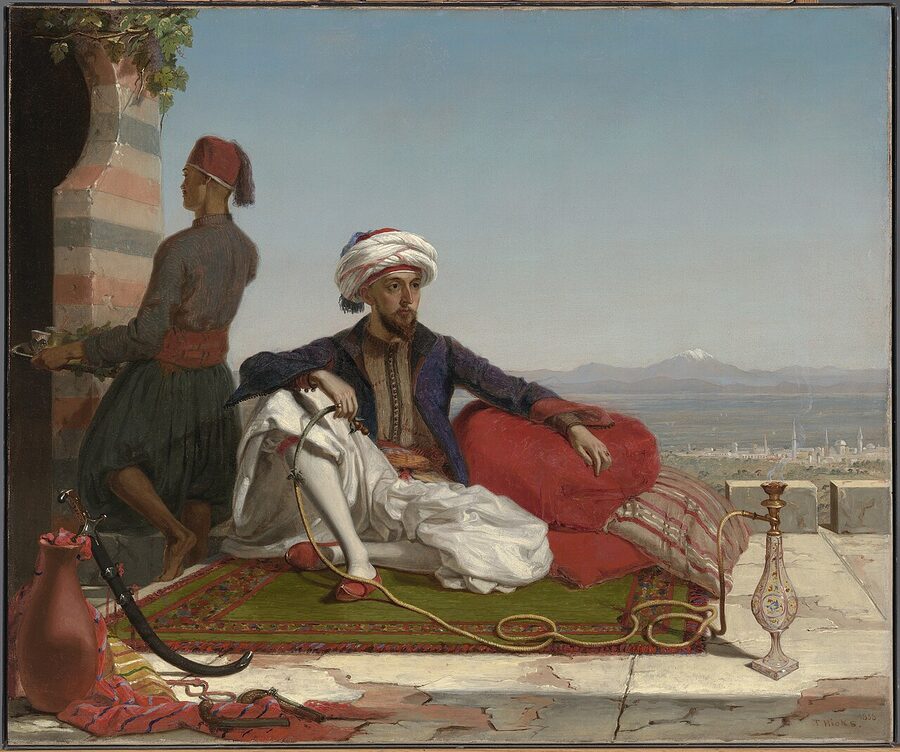
On the second day of their walk across Okinawa, a Tuesday at the very end of May 1853, the chaplain of Commodore Perry’s squadron was striding ahead of his party along a limestone ridge when he saw something ahead of him that he took for a natural rock crossing the road. Then he saw what looked like a window near the top of it. Mr Jones had found a castle, and nobody had told him there was one there.
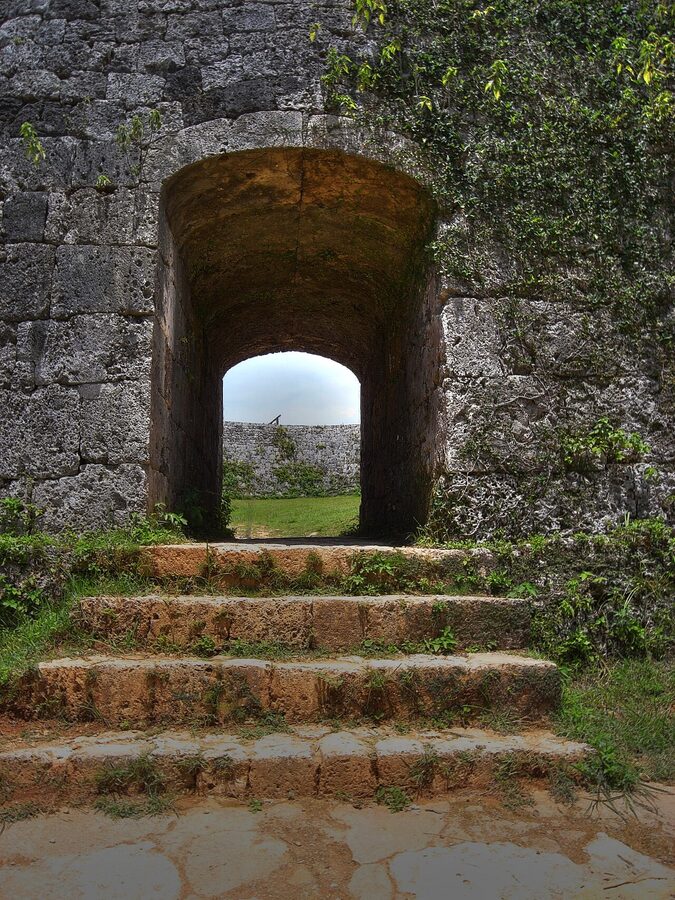
The Americans were thrilled. The writer Bayard Taylor, who was keeping the official journal, recorded the place as 235 paces long, noted the angle of the outer wall at sixty degrees, and admired masonry so carefully cut that the absence of mortar “did not seem to impair the durability of the work”. He noticed that the gate arches were finished with a keystone, which he called “the regular Egyptian arch”. He also noticed that the wall had square projections with a hollow face, which in his opinion would catch a cannon ball rather than deflect it, and he concluded the builders could not have known about guns.
The man living inside served the hot, tired Americans tea, and their Chinese porters, for reasons of their own, called him the “Japanese Consul”. Back on board, the expedition decided it had found the palace of one of the island’s old kings. It had found Nakagusuku, and almost every guess it made about the place was a little bit wrong.
That is a fair introduction to the gusuku (グスク), the stone-walled strongholds of the Ryukyu Islands. Archaeologists have argued for sixty years about what they were, and the kingdom’s own historians told their stories to suit the families who paid for them. I have written separately about Shuri Castle; this piece is about the other four on the World Heritage list, Nakijin, Zakimi, Katsuren and Nakagusuku, the lords who built them and killed each other in them, and how to see them today.
In This Article
- Castle, grove or village?
- Gods inside the walls
- Walls that curve
- Three kings on one island
- Nakijin, the northern capital
- The sword in the Shigema river
- 1429, and the people who doubt it
- Gosamaru builds
- Nakagusuku, the last word in walls
- The lord of Katsuren
- “Like Kamakura in Yamato”
- 1458, as the court told it
- Reasons to doubt the loyal servant
- Revenge on the stage
- Empty castles and a Satsuma army
- Mr Jones finds a window
- Guns on Zakimi
- On the World Heritage list
- Where to see the gusuku today
- Nakijin, and the January cherries
- Zakimi and the Yuntanza Museum
- Katsuren and Amawari Park
- Nakagusuku and the Nakamura house
- Doing it in a day
- A window in the rock
Castle, grove or village?
Nobody agrees where the word comes from. Chamberlain split it into an honorific gu and suku; Iha Fuyū linked suku to an old word for a fortress; Nakahara Zenchū thought gu meant stone. The oldest dated use I know of is on the inscription for Yarazamori gusuku, cut in 1554, which talks of “piling” gusuku, as if the word meant the stone walls themselves. In some Yaeyama dialects it still does.
The Omoro sōshi (おもろさうし), the great collection of sacred songs that the court at Shuri wrote down between 1531 and 1623, uses the word for castles and fortresses most of the time. It also uses it for sacred places, and sometimes simply for Shuri. Writers also gave it the Chinese character for castle, 城, and the World Heritage listing reads that character the Japanese way: the official names are Nakijin-jō ato and so on, “castle ruins”, not gusuku.
The argument about what a gusuku actually was began in earnest in the 1960s. The geographer Nakamatsu Yashū walked the islands from Amami to Yaeyama and found that most places villagers called gusuku looked nothing like castles: too small to live in, without water, on hills, dunes, cliff edges and in caves. Of hundreds, he reckoned, only a dozen or so were fortifications. His book Kami to mura (神と村, “Gods and Villages”) argued that the gusuku began as places of the dead and the gods.
The archaeologists pushed back. Takemoto Masahide sorted the sites into rulers’ residences, defended villages and places of burial or ancestor worship; Tōma Shiichi saw them as the seats of the aji (按司), the local lords. And the digs inside the walls kept turning up pottery, Chinese porcelain and the bones of animals and fish, which is not what you find in a sacred grove.
The Japanese reference works split. One lists four theories (sanctuary, hilltop settlement, castle, lord’s residence) and calls them all unresolved; another, by the historian Takara Kurayoshi, says most researchers agree that a gusuku is at heart a sacred place. The usual answer now is that it depends on the century and the island, with the stone-walled fortress type appearing around the 14th century.
How many are there? Japanese encyclopedias give “more than 200” or “200 to 300”, and admit the survey is unfinished. It also depends what you decide to count.
Gods inside the walls
Whatever else a gusuku was, it nearly always held an utaki (御嶽), a sacred grove or stone where the priestesses called noro prayed to the island’s gods. Shuri Castle enclosed two of them. At Nakijin the most sacred part of the castle is the Uuchibaru, the inner enclosure where, by tradition, the castle’s women lived, and the hill of Kuba no utaki just west of the walls has been a place of worship for as long as anyone can say.
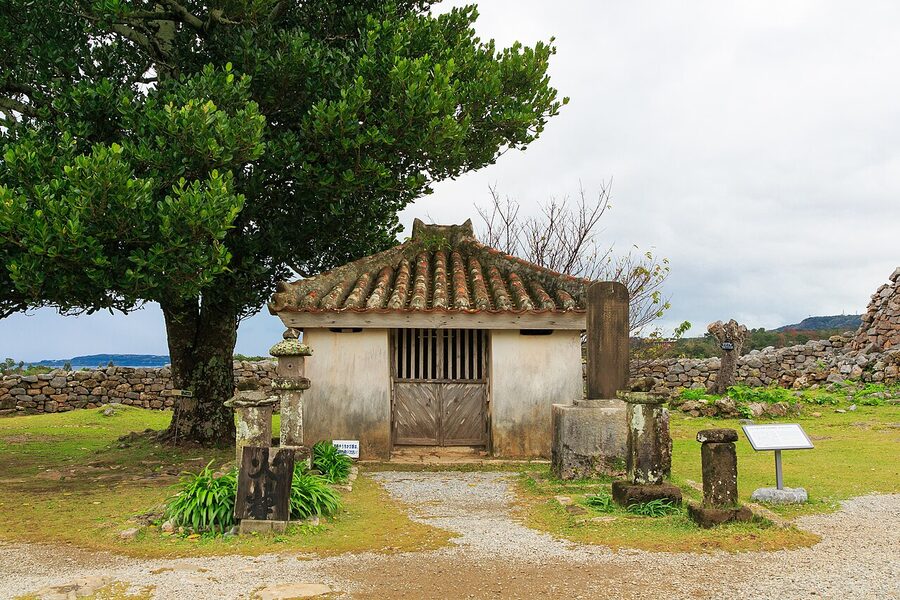
Nakagusuku has eight prayer sites inside its walls, including one that faces Shuri, so that people could bow to the king, and one that faces the sacred island of Kudaka. The management council’s own guide notes that people still come to pray at them. If you see someone with incense at one of these spots, leave them be and walk round the other way.
Walls that curve
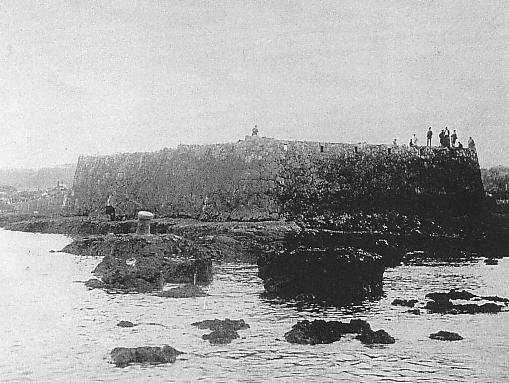
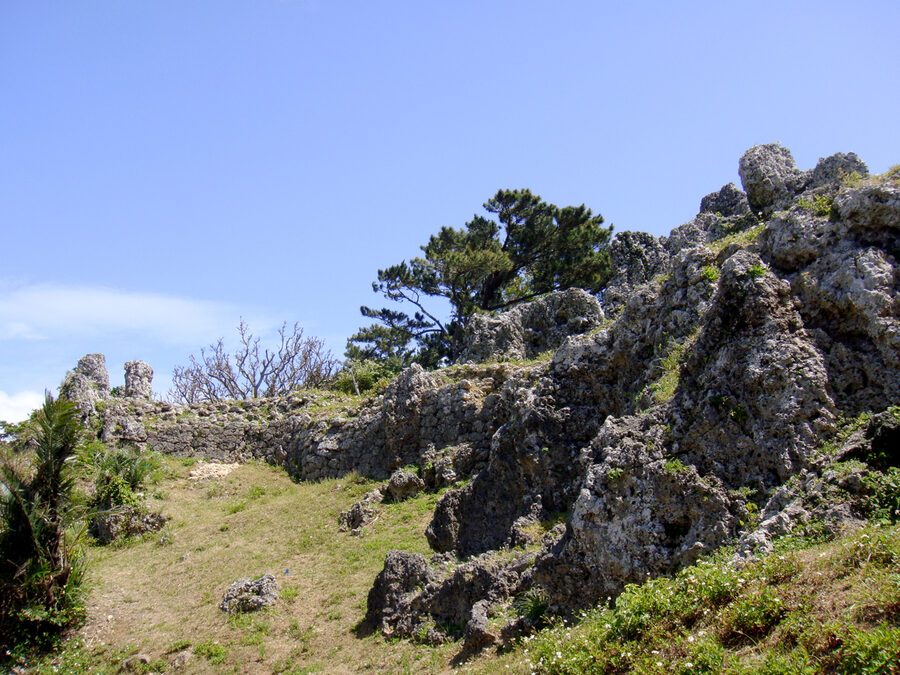
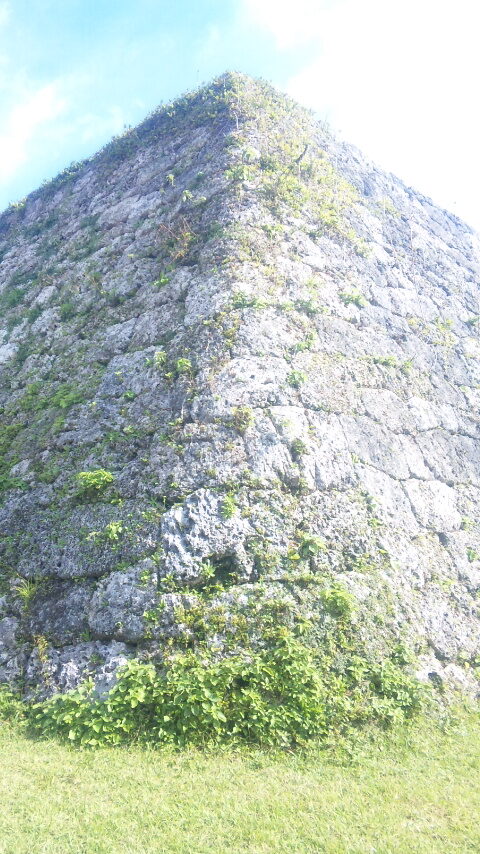
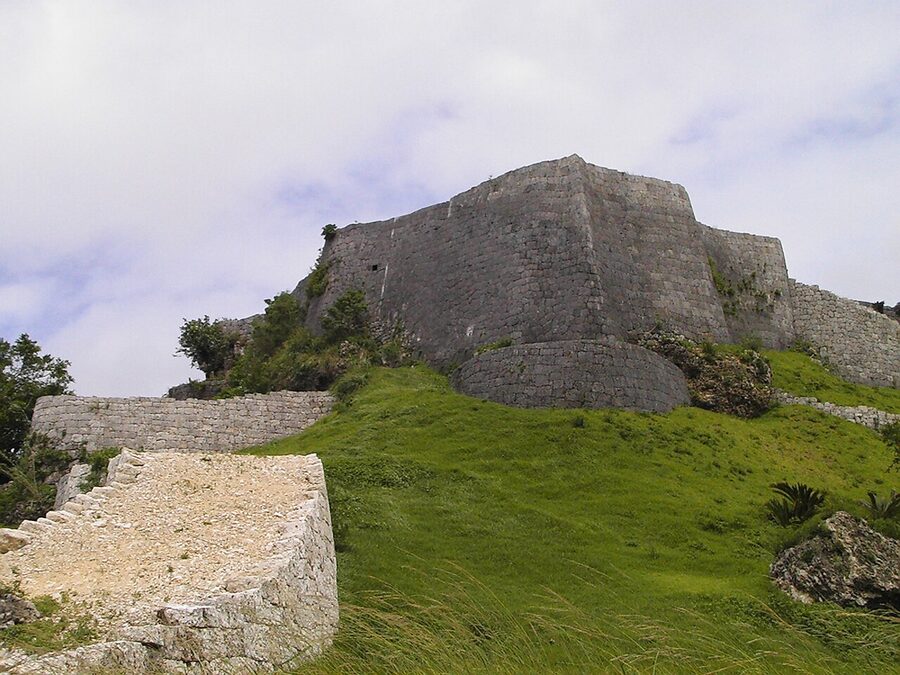
If you have seen Himeji or any of Japan’s 12 original castles, forget them. A gusuku has no keep and no plastered tower. Its buildings were of wood, roofed with boards or thatch (Zakimi has produced no roof tiles at all), and they are long gone. What survives are the walls, of grey Ryukyuan limestone and coral rock, laid without mortar in long lines that follow the bedrock and bend like a snake’s back.
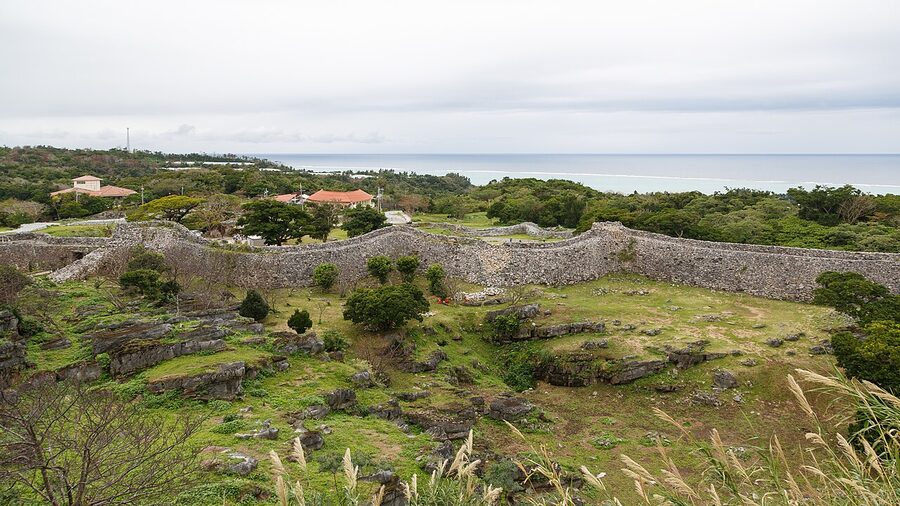
Japanese castle books sort the masonry into three styles, starting with nozura-zumi, rough fieldstone stacked with care but not cut, as at Nakijin. Nuno-zumi is squared blocks laid in courses, “tofu” stacking. Aikata-zumi uses polygonal blocks cut to lock together like a tortoise’s shell. It is the most advanced of the three, and at Nakagusuku it is the work of the last builder.
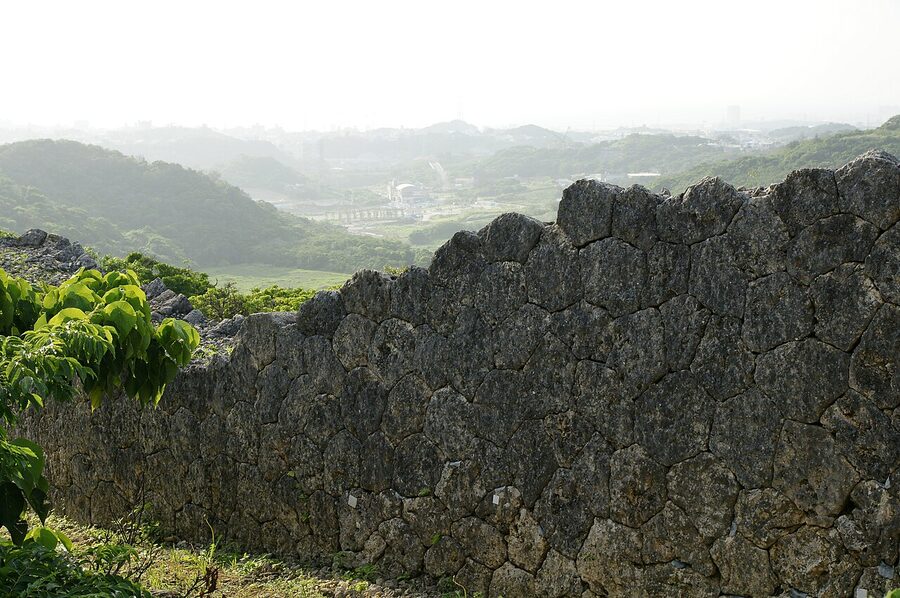
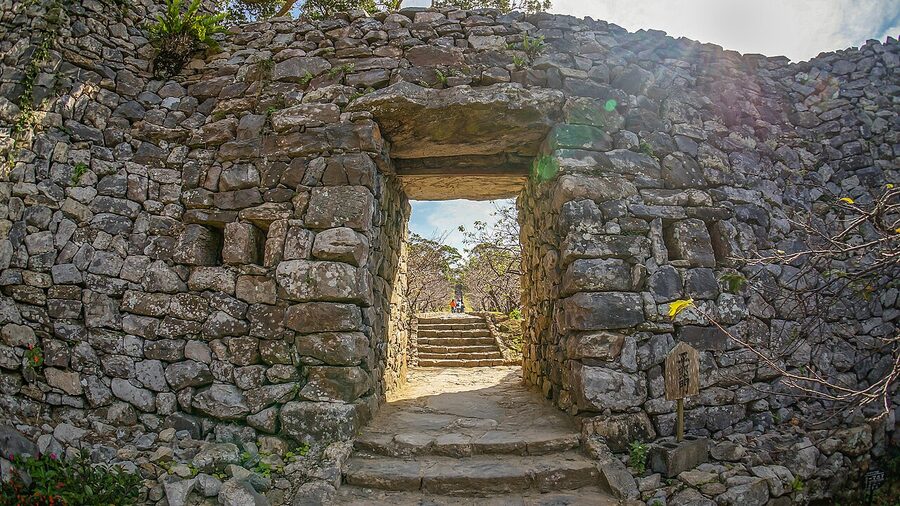
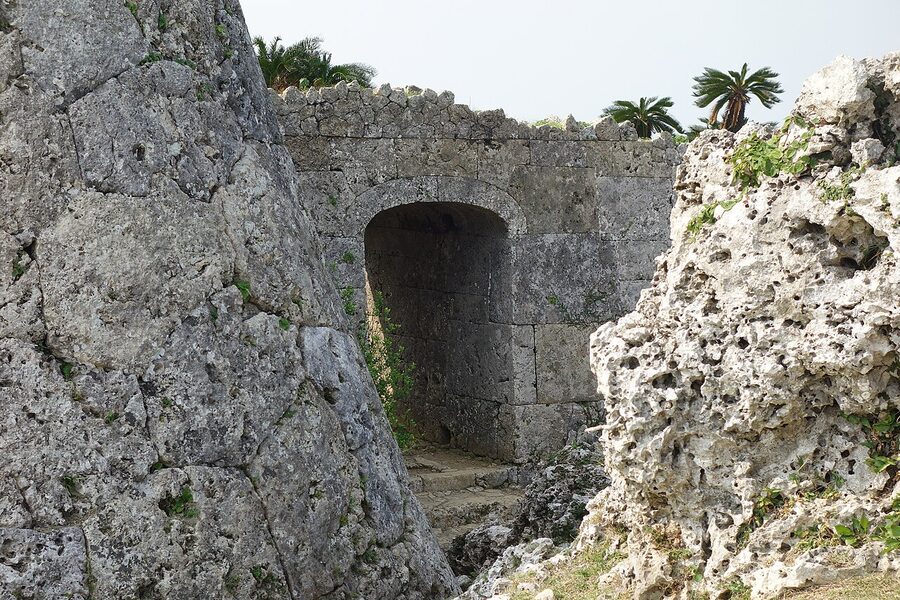
The gates of Zakimi and Nakagusuku are true stone arches with keystones, the “Egyptian” arches that impressed Taylor, and the Zakimi type is considered an early form. Japanese reference works single out these arched gates, kyōmon, as one of the marks of an Okinawan castle. If you have walked round a castle like Okazaki, Wakayama or Iwakuni, with a white keep on a cut-stone base, the first gusuku you visit will feel like the ruin of something from a different continent.
Three kings on one island
By the 14th century the aji of Okinawa Island had sorted themselves into three loose kingdoms, and the century or so that followed is known as the Sanzan (三山), the Three Mountains. Hokuzan held the big, mountainous north from Nakijin. Chūzan held the middle of the island from Urasoe, near the harbour at Naha. Nanzan held the south from its castle at Shimajiri Ōzato in what is now Itoman.
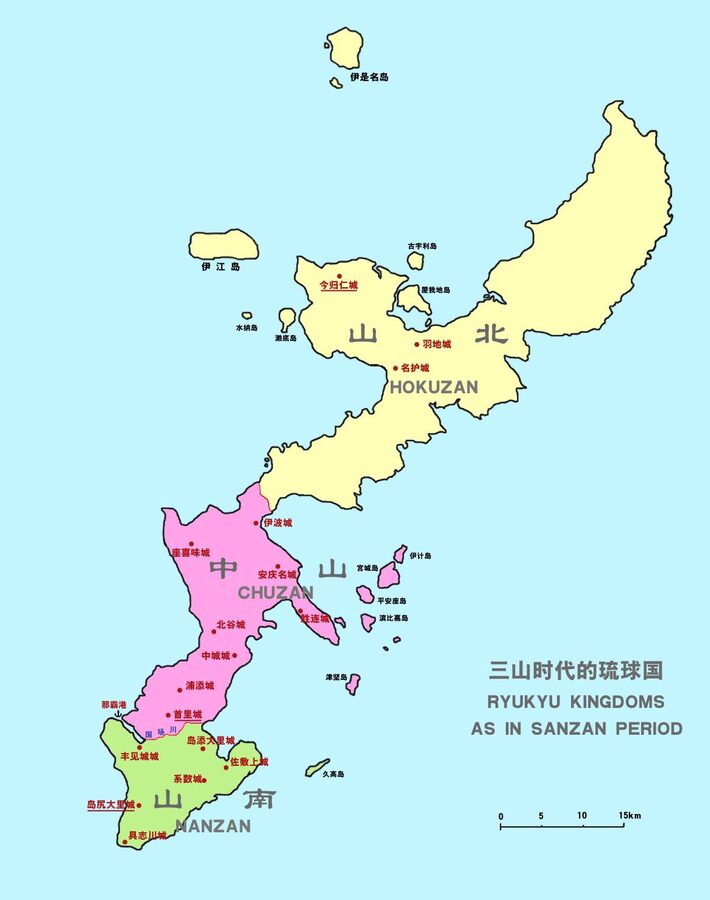
Most of what anyone knows about them comes from China. In 1372 Chūzan, under King Satto, sent its first tribute mission to the new Ming court; Nanzan followed in 1380 and Hokuzan in 1383. The Ming records actually call the northern and southern kingdoms Sanhoku and Sannan, “north of the mountains” and “south of the mountains”; the names Hokuzan and Nanzan come from later Ryukyuan histories written to match Chūzan. Both forms are correct, and you will see both.
Tribute was in effect a trade licence, and the kingdom that sent the most ships got richest. The Ming History records fourteen missions under Hokuzan’s last king, far fewer than Chūzan sent, and the gap tells you who was winning before anyone drew a sword. The north had the forest and the castle; the middle had the harbour.
The kings of Hokuzan are shadowy figures. Two of their names in the Chinese records, Haniji and Han’anchi (攀安知, often written Hananchi in English), are usually read as transcriptions of a single dynastic name, Haneji, rather than personal names at all. The scholar Ishii Nozomu has gone further and argued that all three kings’ names are Chinese renderings of bahan, the word for the Japanese sea raiders I wrote about in my piece on the wokou. It is an intriguing idea and very much a minority one.
Nakijin, the northern capital
Nakijin sits on a limestone outcrop on the Motobu Peninsula, about a hundred metres up, with a gorge on one side and a drop to the East China Sea on the other. It is one of the biggest gusuku in Okinawa: roughly 350 metres north to south and 800 east to west, about 37,000 square metres inside the walls, with some 1.5 kilometres of wall still standing. The oldest parts go back to the 13th century.
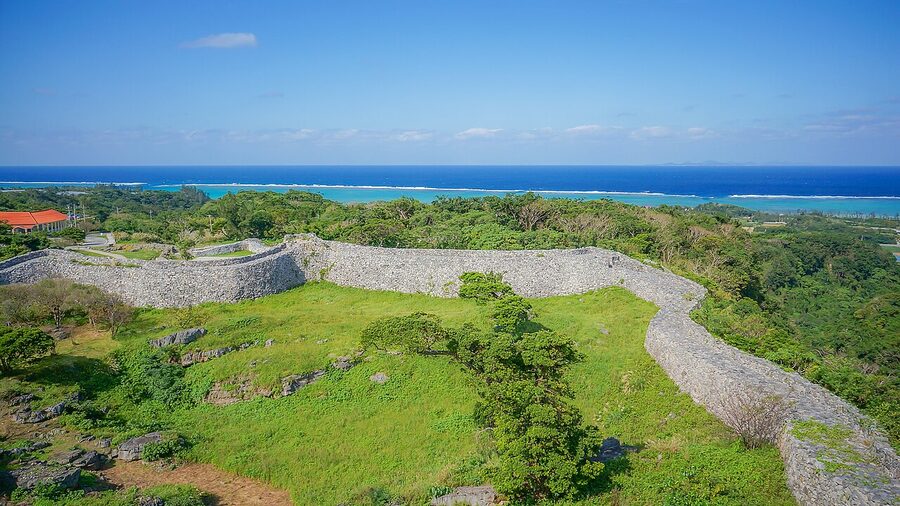
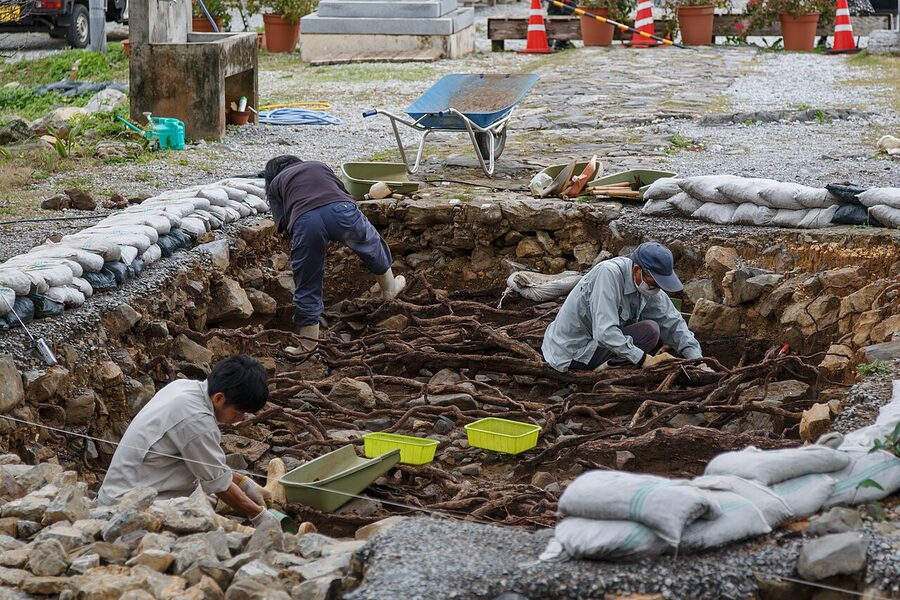
Inside, the castle steps up the ridge in a series of enclosures. Ōsumi, where the tallest walls are, is said to have held the horses and the drill ground; the Ōba, the great courtyard, was flanked by the main hall and its northern and southern halls; the Uuchibaru was the sacred quarter; and the Shigema enclosure at the back seems to have housed the lord’s closest retainers, four of whose buildings the excavators have found. The digs in the main enclosure have traced its whole life, from the first building to the abandonment.
What came out is the best evidence for the Hokuzan kings’ wealth: Chinese porcelain of the 14th and 15th centuries in quantity, Korean celadon, wares from Southeast Asia and Japan, weapons and ritual objects.
The sword in the Shigema river
The man who ended the three-way contest was a minor lord from the south coast. Shō Hashi (尚巴志) was born in 1372 and became aji of Sashiki, in the south of the island, while still young. In 1406 he attacked the Chūzan king Bunei, destroyed his line, put his own father Shishō on the throne, and moved the capital from Urasoe to Shuri. Nearly every Japanese reference work I checked gives 1406 for the coup, though one summary of the period has 1405.
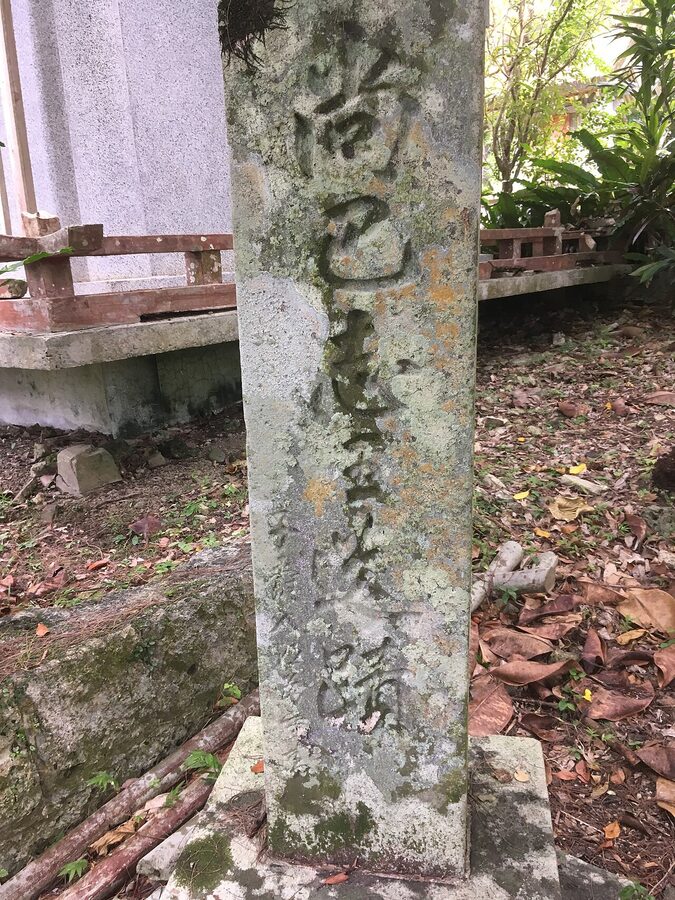
Hokuzan was next. In 1416 Shō Hashi marched north with an alliance that included several northern aji, the lords of Kunigami, Haneji and Nago among them, who had fallen out with the Hokuzan king’s chief retainer, Motobu Teihara, and quietly changed sides. The court histories add that a young lord from the central west coast, Gosamaru, led a second column of 800 men overland while Shō Hashi’s main force went by sea. Gosamaru was himself descended, the genealogies say, from an older line of Nakijin lords that the Hokuzan kings had destroyed, so he had his own reasons.
The castle held. Then Motobu Teihara, worked on by Gosamaru (in the chronicles’ version), turned on his king. Han’anchi, whom the court histories describe as peerless in arms and vicious beyond measure, killed Teihara and then killed himself inside his castle.
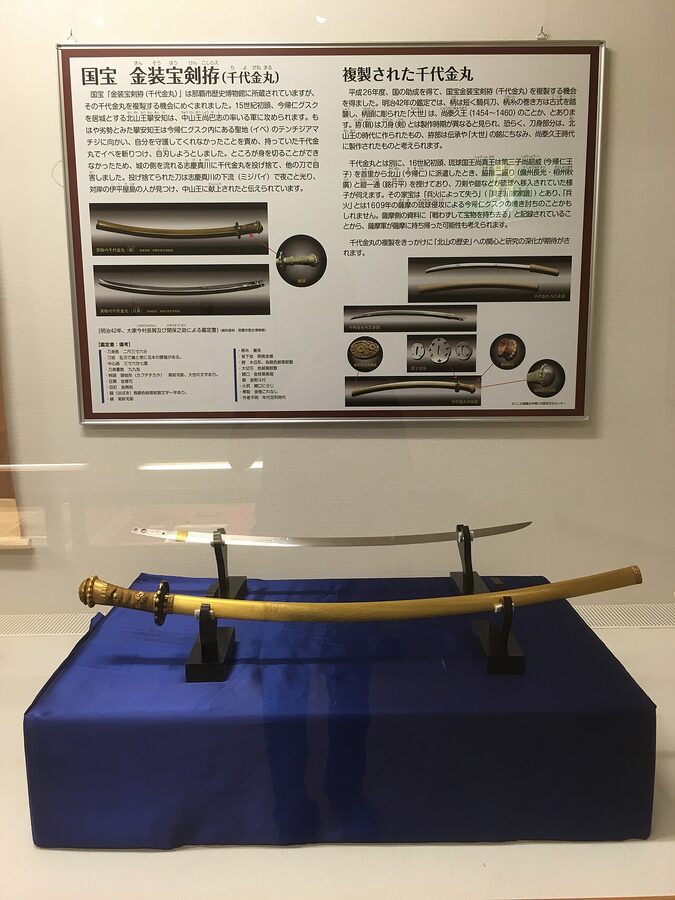
Nakijin’s own version of the ending is better. According to the story told at the castle today, Han’anchi went to the castle’s sacred place, Tenchiji-amachiji, blamed its god for failing to protect him, and slashed at it with his sword. Then he tried to kill himself with the same blade and found it would not cut him, so he threw it into the Shigema river below the walls and used another. Downstream the river glowed every night, until a man from Iheya, the island across the water, found the sword and presented it to the Chūzan king.
That sword is the Chiyoganemaru (千代金丸), the hereditary treasure of the Hokuzan line, which passed after the king’s death to the kings at Shuri and is now a National Treasure in the Naha City Museum of History. Going by an appraisal of 1909, the panel at Nakijin explains, the blade is probably of the Hokuzan period and the gold mounting later, from Shō Taikyū’s reign. There is no way to test the river story, and I would not try. But it is the kind of story that tells you how the north felt about the conquest: their king did not lose to Shō Hashi, he lost because his god let him down.
1429, and the people who doubt it
Shishō died in 1421 and Shō Hashi became king of Chūzan the next year. In 1429 he destroyed Nanzan and its king, Taromai, and that is the date every textbook gives for the founding of a single Ryukyu Kingdom, with Shuri as its capital. Some Japanese reference works put the fall of Hokuzan in 1422 rather than 1416; one dictionary notes 1422 as a minority date for the unification itself.
The historian Wada Hisanori went further and pointed out that neither the Ming annals nor the kingdom’s own diplomatic archive, the Rekidai hōan, ever actually says the three were united. The Nanzan envoys simply stop appearing. Ishii Nozomu traces the idea of a conquest to a Chinese geography of 1456, where it is offered as a guess. Either way, there were rebellions still to come, fought in castles on this list.
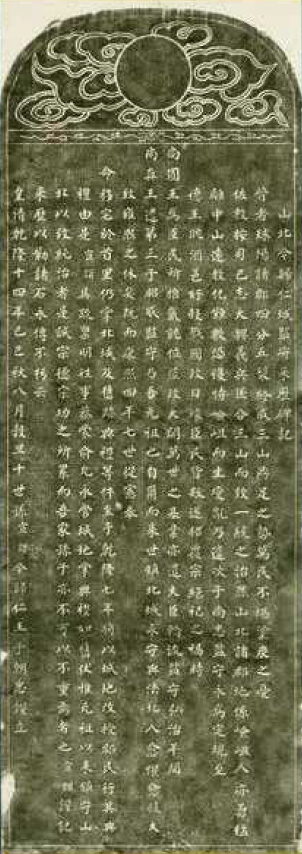
Shō Hashi spent his reign rebuilding Shuri into a royal castle and turning Naha into a port, trading with China, Japan, Korea and Southeast Asia with the help of a Chinese adviser, Kaiki. He died on the 20th day of the fourth month of 1439. In the north he left his second son, Shō Chū, as kanshu (監守), a royal warden living in Nakijin to keep the old kingdom quiet. The wardens stayed until 1665, and a stone inscription put up at the castle in 1749 tells their history.
Gosamaru builds
Gosamaru (護佐丸) is the one name in this story that every Okinawan knows. The sources do not agree on when he was born (1390, 1391 and 1393 are all given), and his more formal names, the Japanese-style Nakagusuku Aji Gosamaru Seishun and the Chinese-style Mō Kokutei, were attached to him by later generations. He grew up at Yamada gusuku in what is now Onna, on the west coast, where his family held the lordship of Yomitanzan.
After the fall of Nakijin, Shō Hashi needed a reliable man between Shuri and the conquered north, and Gosamaru got the job. Accounts differ on the details: some have him given Nakijin itself first, others have him ordered straight away to build a new castle at Zakimi, about four kilometres from Yamada, on a rise with a good harbour below it and a view over the whole of the central coast. Yomitan village dates the building to 1416 and notes that some put it in 1422. Either way, by the 1420s he was lord of Zakimi.
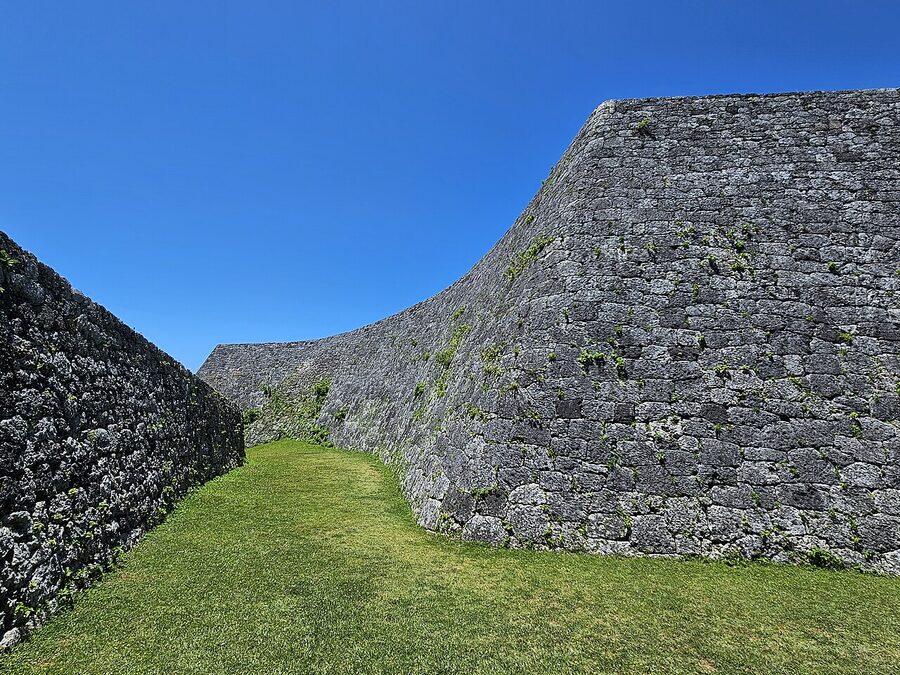
The site was a plateau of soft red clay, which is not what anyone would choose to put a stone wall on. Gosamaru’s answer was a castle of long, smooth curves, roughly 365 metres round with 7,385 square metres inside, built in two enclosures whose walls bulge out at the corners, a typically Ryukyuan defensive trick. The tradition is that he tore down his old castle at Yamada and had the stones passed hand to hand along a line of labourers to the new site.
Some of those labourers, the stories say, were rounded up from the Amami islands, and for generations afterwards a crying child could be silenced with the words “Gosamaru is coming”. Folk memory or folk invention, it is a useful corrective to the loyal servant you will meet later in this story.
Nakagusuku, the last word in walls
Gosamaru did not build Nakagusuku from scratch. Over several generations in the late 14th century the earlier lords, the Sakinakagusuku aji, had put up its southern, western, first and second enclosures on a ridge about 160 metres up, two kilometres from the old trading port at Yagi. The cliff on the east side did most of the defending for them.
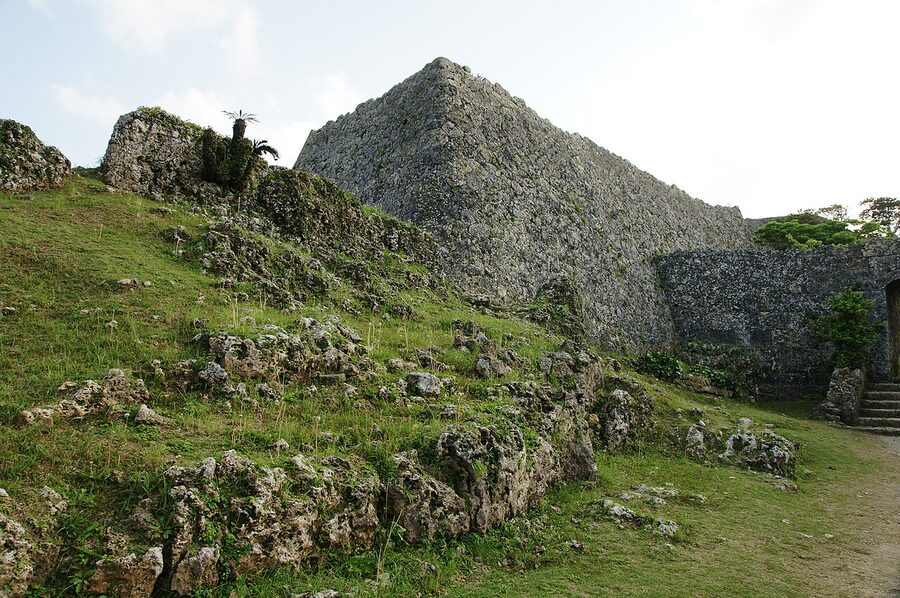
Gosamaru added the third enclosure (still called the Mīgusuku, the “new castle”) and the northern enclosure, in polygonal aikata-zumi, and he rebuilt the gates of the first enclosure as stone arches to match. He also walled in a large well, the Ufugā, so that the castle could hold out in a long siege. The result is the best-preserved gusuku in Okinawa and, to my eye, the finest piece of dry-stone building anywhere in the Japanese islands.
When he moved is disputed. Several Japanese accounts have the land granted in 1430 and the move made in 1440, when the rebuilding was finished; others simply give 1430. English-language accounts often say King Shō Taikyū sent him there, which fits neither date, since Taikyū came to the throne in 1454.
The reason for the move is not in dispute. Across the bay, on the next peninsula, a lord was growing rich, and Nakagusuku looks straight at him.
The lord of Katsuren
Katsuren sits on a limestone hill 60 to 100 metres high at the root of the Yokatsu Peninsula, with the Pacific on two sides. Its walls climb the hill in a series of stepped enclosures, the highest at the top, and from the summit you look out over Nakagusuku Bay. Japanese sources disagree about its age (one encyclopedia says the 13th century, a castle dictionary the 12th or 13th, and other accounts credit the fifth son of the Eiso-dynasty king Taisei, early in the 14th), but it is usually counted the oldest of the five gusuku on the World Heritage list.
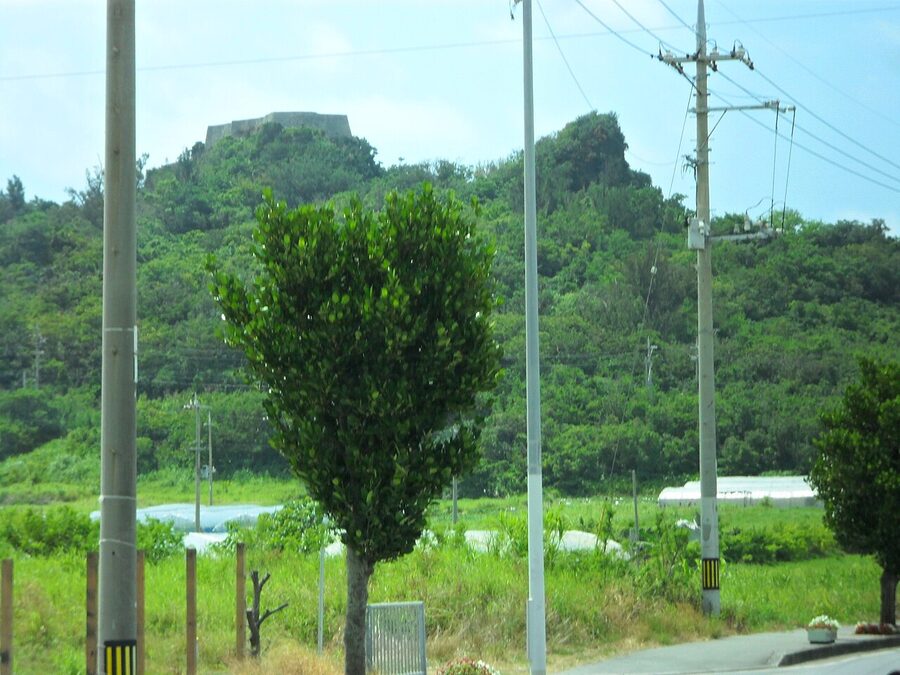
Its last lord was Amawari (阿麻和利). He was born, the histories say, in Yara in Chatan, in what is now Kadena, of humble family, and his childhood name was Kana. He came to Katsuren as a retainer of its ninth lord, Mochizuki, whom the court histories paint as a drunkard and a tyrant, overthrew him, and made himself the tenth. Then he did what lords with harbours did in the 15th century: he traded, with the Amami islands, with Japan and beyond, and got rich.
The castle proves it. Digs have produced Yuan-dynasty blue-and-white porcelain, which was rare and expensive, and in the second enclosure the foundations of a large hall about 17 metres across and 14.5 deep, with Japanese-style roof tiles found nearby. Below the castle to the south lay the village of Haebaru and its harbour.
Then, in 2016, the Uruma city board of education announced that ten small copper coins dug up at the castle in 2013 included four Roman coins of the 3rd and 4th centuries and one Ottoman coin struck between 1669 and 1679. The Roman coins came out of a layer of made ground dated by the Chinese porcelain in it to the 14th or 15th century. Nobody had found Roman coins at a site in Japan before.
How they got there is anyone’s guess. The board suggested the sea trade of the 14th and 15th centuries; others think they came centuries late, by way of China or Southeast Asia, as curiosities rather than money. I like to imagine them in a lacquer box in Amawari’s hall, being shown to guests, on no evidence at all.
“Like Kamakura in Yamato”
The best witness to Amawari’s Katsuren is the sixteenth volume of the Omoro sōshi, the songs of Katsuren and Gushikawa, which the court wrote down on the seventh day of the third month of 1623. They sing of the castle as if it were the centre of the world. One asks what Katsuren is to be compared with, and answers, “To Kamakura in Yamato”, meaning the warrior capital described in my piece on Kamakura.
And they sing of Amawari by name. “Amawari of Katsuren, reign ten hundred years,” goes one; another gives him the jewelled ladle of a ruler and wants the news spread as far as Kyoto and Kamakura. These are not the songs you write for a traitor.
The folklorist Yanagita Kunio read the songs as evidence of a whole “Katsuren culture”, separate from that of Urasoe and Shuri. In 1454, when a succession quarrel killed both claimants and left the throne to Shō Hashi’s son Shō Taikyū, Katsuren must have looked like the most dangerous place on the island outside the capital. Taikyū tried to bind Amawari to him by marriage, and gave him his eldest daughter, Momoto Fumiagari. Her mother was Gosamaru’s daughter.
1458, as the court told it
Here is the story as the kingdom’s official histories give it. Amawari wanted the throne. Taikyū, nervous, relied on Gosamaru at Nakagusuku to keep an eye on him. Gosamaru, a loyal old soldier, began drilling men and horses; the western enclosure at Nakagusuku, 120 metres long, is said to be where the castle’s troops trained.
Amawari went to Shuri and told the king that Gosamaru was preparing a rebellion. The king sent to look, saw that Gosamaru was indeed under arms, and gave Amawari command of the royal army to deal with him. When Gosamaru learned that the army at his gates was the king’s, he would not fight back. He killed himself, with his wife and children, rather than raise his hand against his king.
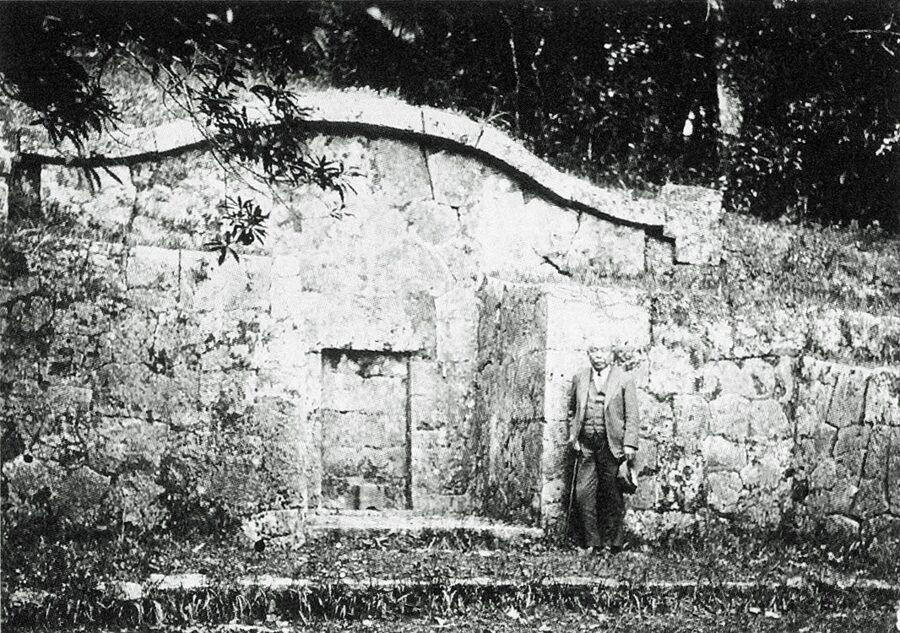
Not all of them died. His third son, still an infant, was carried out of the castle by his wet nurse and hidden at Kuniyoshi in Itoman, where she had family. He grew up to be appointed district head of Tomigusuku under a later king, and his descendants, the Mō family of Tomigusuku Dunchi, became one of the five great houses of the kingdom and filled its highest offices for centuries. Remember that.
With Gosamaru gone, Amawari prepared to march on Shuri. His wife, the princess Momoto Fumiagari, learned of the plan and fled to warn her father, carried on the back of her attendant, Ōgusuku Ken’yū, a man so huge and fierce that people called him Uni-Ufugusuku, “Ōgusuku the demon”. The king gave Ufugusuku the army, and he besieged Katsuren.
The walls were too strong, so (in the version in the Kyūyō, the official chronicle compiled in the 1740s) he dressed as a woman, got inside, and killed Amawari himself. Both his brothers died in the fighting.
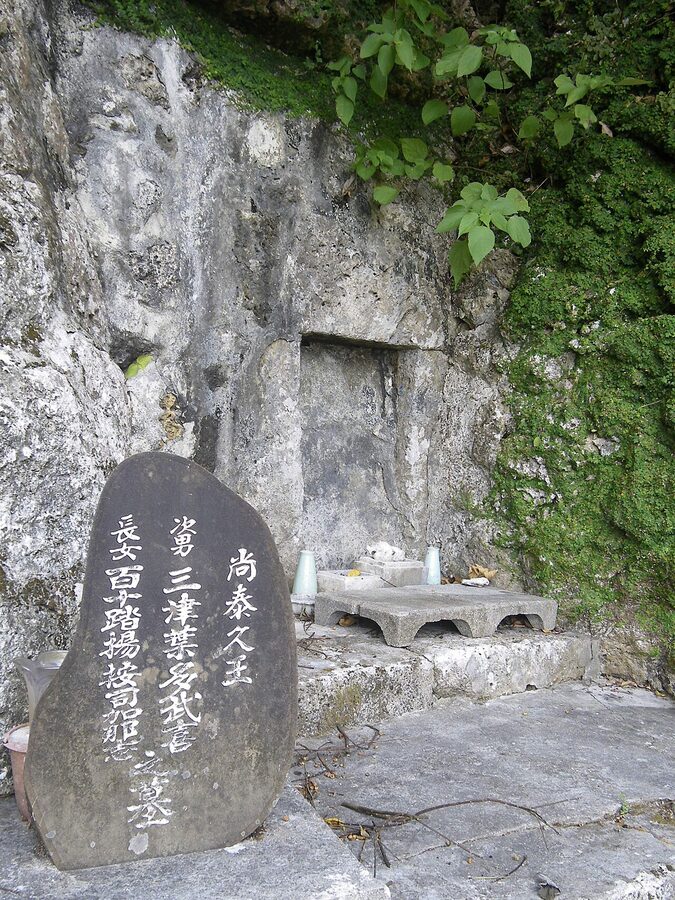
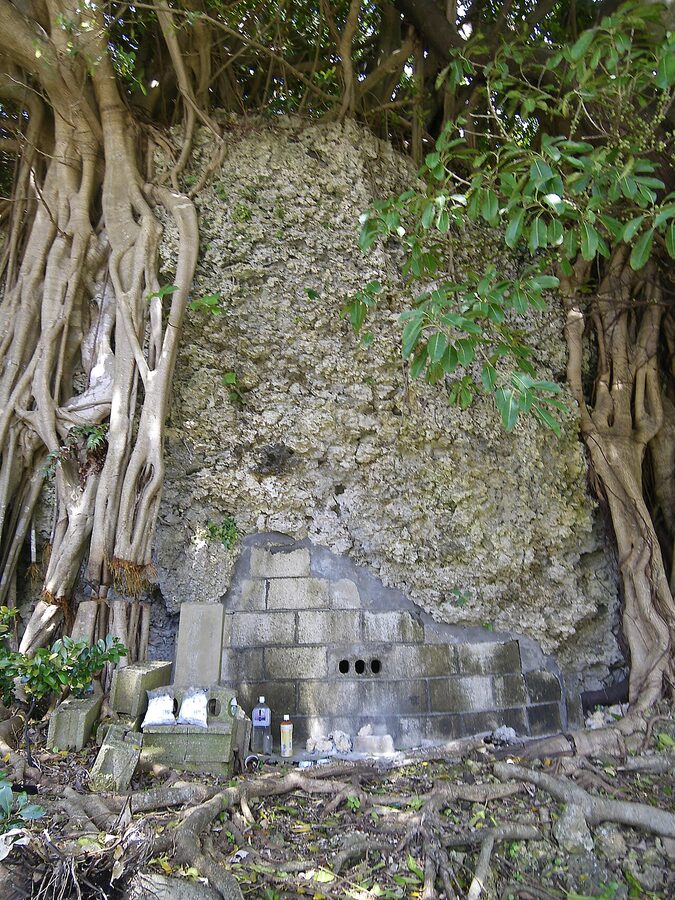
Ufugusuku was made lord of Goeku and married the princess. Eleven years later, when a court official named Kanamaru seized the throne and founded a new dynasty as Shō En, the loyal servant of the old royal house was hunted down. The tradition is that he was driven into a cave on the side of Chibana gusuku and burned to death. Momoto Fumiagari went to live with her brother in the south and died young.
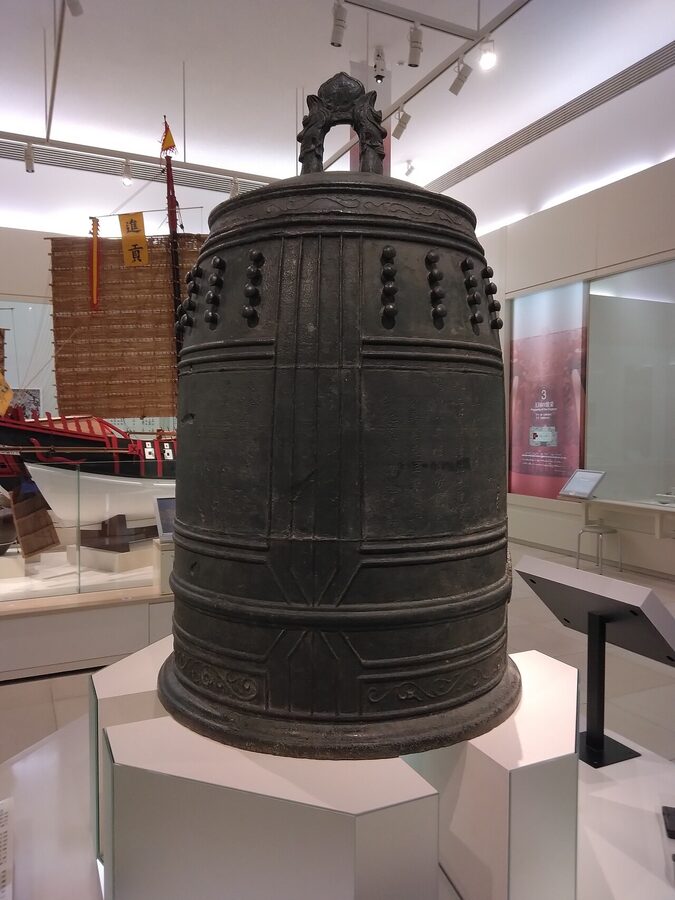
That same year of 1458 King Taikyū had a great bronze bell cast for the main hall at Shuri. It is known as the Bankoku shinryō bell, the bell of the “bridge of all nations”, and you can see it now in the prefectural museum in Naha.
Reasons to doubt the loyal servant
The trouble with this story is where it comes from. The kingdom’s first official history, the Chūzan seikan (中山世鑑), was compiled by Haneji Chōshū in 1650, nearly two centuries after the events, and Japanese accounts do not even agree on whether it tells the story: one says it has nothing on the affair, perhaps because pages are lost. The full version arrives with the Chūzan seifu, a Chinese-language history begun in 1697 and finished in 1701, and with the Kyūyō of 1745.
By then Gosamaru’s descendants were among the most powerful families at court, and a loyal ancestor was worth a great deal to them. Japanese encyclopedias say plainly that the image of Gosamaru the faithful retainer was spread through his descendants’ family records, the official histories and the stage.
Then there are the oddities. Why did a king who distrusted Amawari believe him, and why did Gosamaru, who supposedly saw through the plot, die without a word of explanation to Shuri? Why do the Katsuren songs, written down at Shuri in 1623, a generation before the first chronicle, praise Amawari as a great lord? And why, if Gosamaru’s loyalty was proved, did neither of Taikyū’s sons by Gosamaru’s daughter succeed to the throne?
Iha Fuyū asked these questions, and later Okinawan historians such as Arashiro Toshiaki have kept asking them. The theories run from the simple (Gosamaru really was a rebel) to the elaborate: that the whole affair was arranged by Kanamaru, the future Shō En, to rid the crown of its two most powerful lords before he took it himself. Another reading sees it as a fight over the Amami trade, with Gosamaru and Katsuren both tied to the northern islands that Shuri wanted for itself.
Katsuren, too, shows no sign of a great battle, and one story has Amawari exiled to Hateruma rather than killed. I do not know which version to believe, and I do not think anyone does. One Japanese encyclopedia calls the affair the last clash between a great aji and the royal power; whoever plotted against whom, the castles lost.
Revenge on the stage
The official version was fixed in the public mind by a play. In 1719 Tamagusuku Chōkun’s Nidō tekiuchi (二童敵討), “The Two Boys’ Revenge”, was first performed at the banquet for the Chinese envoys who had come to invest King Shō Kei. It is counted the first work of kumi odori, the Ryukyuan court dance drama.
In it, two of Gosamaru’s sons, Tsurumatsu and Kamijū, survive the fall of Nakagusuku, grow up, disguise themselves as dancers at one of Amawari’s outdoor drinking parties, wait until the delighted lord has given them his sword and coat, and cut him down. It is still performed, and Amawari is still the villain.
Katsuren has answered in its own way. There is a stage show, Kimutaka no Amawari, which takes its title from Kimutaka, the poetic twin name for Katsuren in the omoro. In 2024 the Okinawan broadcaster RBC made a television drama about him with the subtitle “The Last Hero”. After five and a half centuries, the argument is being conducted in costume.
Empty castles and a Satsuma army
After 1458 the gusuku had lost their reason to exist. Katsuren was abandoned, and Nakagusuku became the residence of the crown prince, which is why the heir to the throne was known as the Nakagusuku Ōji. Zakimi stayed in some use into the 16th century, judging by the finds, and Nakijin kept its royal warden. Power and money now lived at Shuri and in the port at Naha.
This was the kingdom’s great age of trade, and while Japan tore itself apart in the Sengoku era Ryukyu was making a good living. It could not last. The Shimazu lords of Satsuma, in southern Kyushu, had long claimed control of Japanese trade with Ryukyu, and the wars of the late 16th century left them deep in debt.
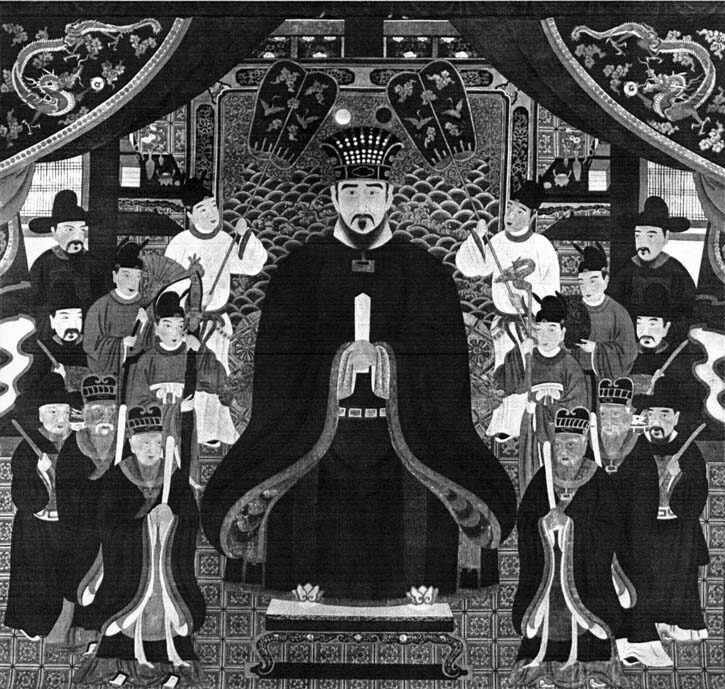
In 1591 Toyotomi Hideyoshi ordered Ryukyu to share Satsuma’s burden for his invasion of Korea, the Imjin War, and threatened to attack the kingdom first if it refused. It sent half the rice demanded, which put it further in Satsuma’s debt. After Sekigahara, Satsuma wanted Ryukyu to send Tokugawa Ieyasu an embassy of thanks for a returned shipwrecked crew, and to help reopen Japanese trade with China. The court at Shuri, led by the minister Jana Rizan, kept saying no.
Early in 1609, with the new Tokugawa shogunate‘s permission, Satsuma sent an army: about 3,000 men of the clan of Shimazu Yoshihiro, in some eighty ships under Kabayama Hisataka, carrying muskets. They sailed from Yamagawa on the 4th day of the third month, took the Amami islands with real fighting only on Tokunoshima, and on the 25th came into Unten harbour, the old port of Hokuzan below Nakijin.
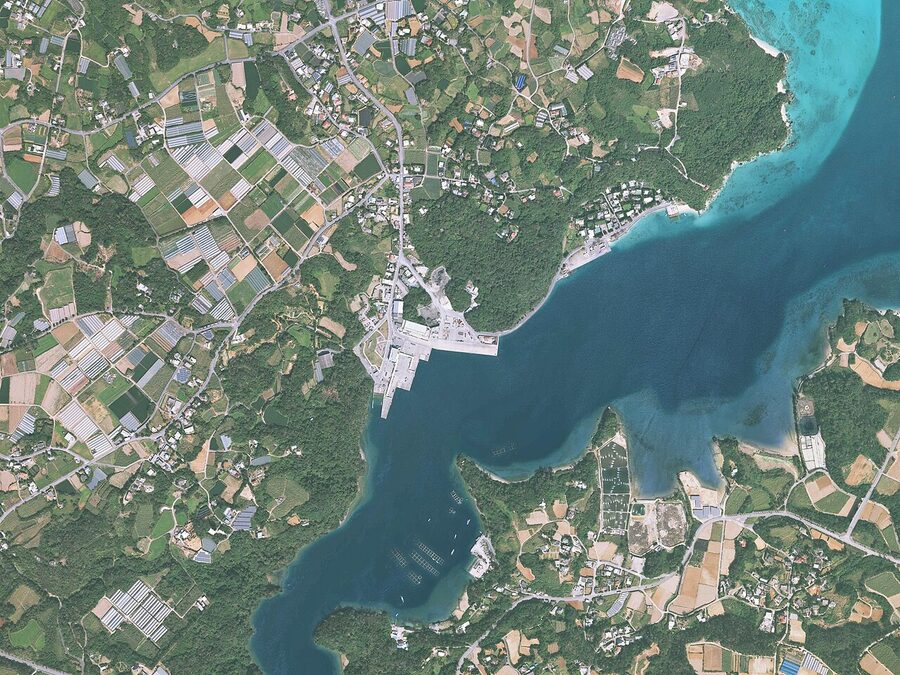
English-language accounts often describe a hard fight for Nakijin with heavy losses on both sides. The Satsuma campaign records, as Japanese historians read them, tell a duller story: on the 27th the army marched to the castle, found it empty, and set fire to it. One Japanese encyclopedia says the lord of Nakijin of the day was killed when it fell. Whichever is true, Nakijin was the first target of the invasion, and it has been a ruin since.
There is an omoro, in the fourteenth volume, in which the priestess Akeshino of Serikaku, in Nakijin, calls down a passing shower from Mount Katsu to soak the armour of a Yamato army landing at Unten. Nobody can say which Japanese army it means. I like to think it was this one, and that the rain did at least make them miserable.
Shuri came to terms on the 1st day of the fourth month. King Shō Nei was taken to Kagoshima, and in 1610 to Sunpu and Edo to meet Ieyasu and the shogun Hidetada. In 1611 he and his ministers signed an oath that Ryukyu had always been a Shimazu dependency; Jana refused and was beheaded. Satsuma took the Amami islands and ran the rest through a commissioner at Naha, while the kingdom went on sending tribute to China as if nothing had changed.
That pretence explains my favourite Nakagusuku tradition. After 1609 the castle became the district office, and when Chinese investiture envoys came to Shuri, the story goes, Satsuma’s officials went up to Nakagusuku and stayed out of sight until they had gone. It is a tradition rather than a documented fact, but it fits the Edo era in Ryukyu exactly, and it makes the porters’ “Japanese Consul” of 1853 a better joke than they knew.
Mr Jones finds a window
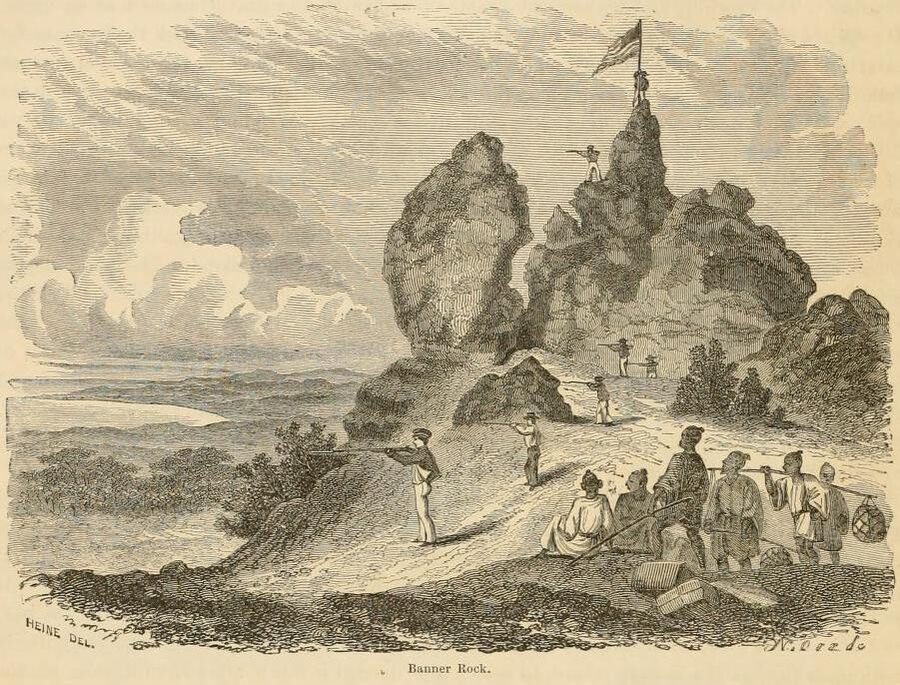
The Americans who walked into Nakagusuku in 1853 were the inland exploring party of Perry’s squadron, which had arrived at Naha in May on its way to Japan; I tell the larger story in my piece on the Black Ships. Perry sent a party of a dozen men under his chaplain, Mr Jones, to cross the island to the east coast and march north, with orders to be back within six days. They set out on Monday the 30th of May by their own calendar, with the artist Wilhelm Heine, the writer Bayard Taylor, a few armed men, some Chinese porters, and a Ryukyuan escort who watched every step they took.
On the second morning they climbed a ridge, unfurled the flag on a jagged limestone pinnacle, fired a salute and named it Banner Rock, to the bafflement of the locals. Less than an hour later they reached the castle. Taylor’s account mentions the arched gateway, a terrace with a stone structure he thought looked like a cenotaph, a second gate and vestibule, a grove of trees and a respectable house at the far end, and a flight of steps cut in the rock down to a grotto with a pool of “cold, sweet water”.
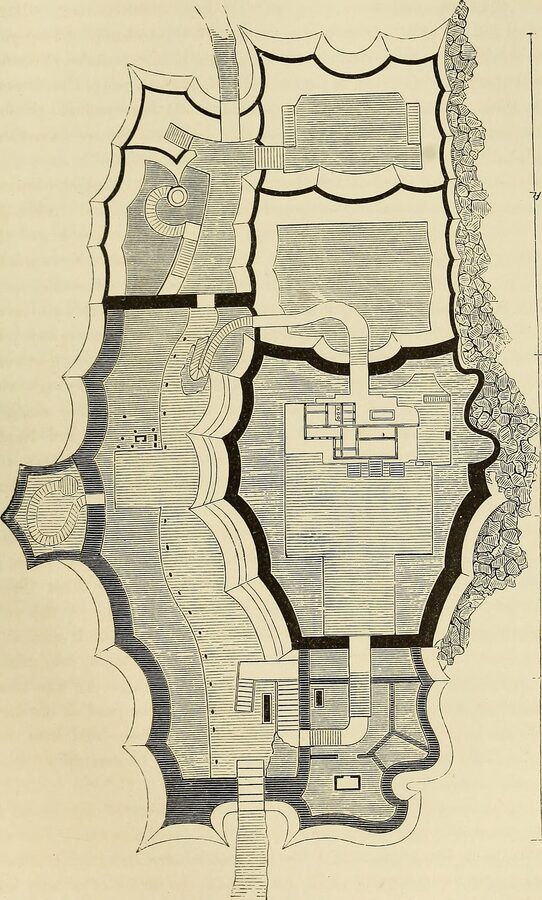
Jones, who doubled as the party’s geologist, drew a ground plan while the meal was cooking. He later wrote that the walls had “that inward curve” he had seen at Shuri, and that the missionary Bettelheim had told him the island once had seven kingdoms, then three, then one. Nakagusuku had never been a royal capital, but in fairness to Jones, it had been the crown prince’s.
Taylor’s remark about the cannon is the one I return to. Japanese sources report that excavations inside Nakagusuku have found metal and stone balls thought to be shot from Ming-period Chinese firearms. The builders may not have known European cannon, but they knew guns.
The kingdom had twenty-six years left. In 1879 the Meiji government abolished it and made Ryukyu into Okinawa Prefecture, and some of the old gusuku passed to the Japanese army. Nakagusuku’s first enclosure became the office of Nakagusuku village and stayed so until the Second World War.
Guns on Zakimi
In August 1944 a company of a Japanese independent anti-aircraft battalion dug its guns into the first enclosure of Zakimi, to protect the North Airfield at Yomitan below it. In October that year American aircraft struck Okinawa in what the island remembers as the 10 October air raid, and the gun position on the castle was smashed, taking much of the castle with it.
On the morning of 1 April 1945 the Americans landed on the beaches of Yomitan and Chatan, and by nightfall both airfields were theirs. The Battle of Okinawa was fought out further south, and it destroyed Shuri Castle completely. It is a part of Shōwa history that Okinawa has not finished thinking about, and I will not try to sum it up here.
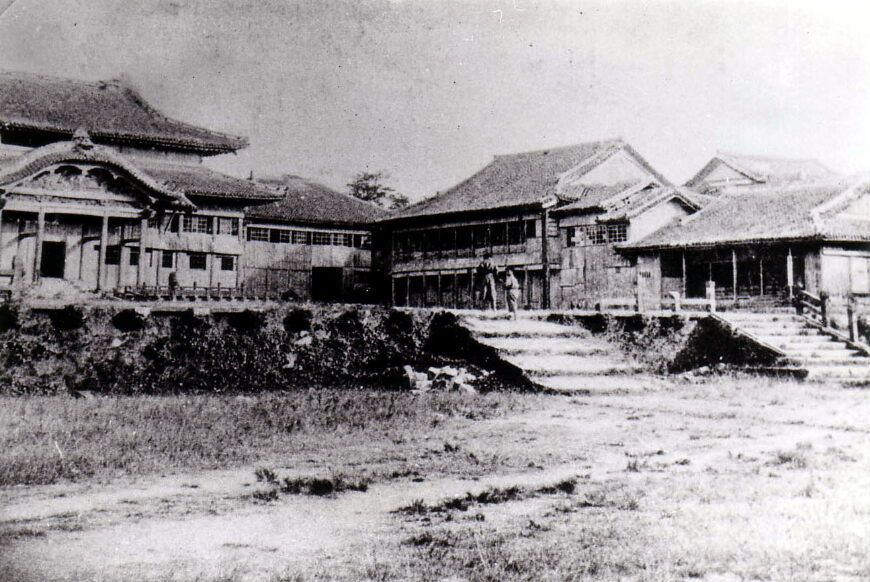
The gusuku outside the battle zone came off better. Nakagusuku, oddly, suffered very little, and the management council tells a story that the Japanese army began to dig an air-raid shelter beside the main gate and gave up because the stonework was too hard to cut through. The village office in the first enclosure, though, burned. Katsuren had a different enemy: over the years road-builders carted away much of its walls as stone.
Zakimi stayed in American hands. The ruin became part of the Bolo Point firing range, and although the government of the Ryukyu Islands listed it as an Important Cultural Property in 1956, the US Army built a radar station for its Nike anti-aircraft missiles on it from 1958. The Corps of Engineers designed a folding metal shelter, the “clamshell”, to protect the radar from typhoons. It sat on Gosamaru’s castle until 31 October 1974.
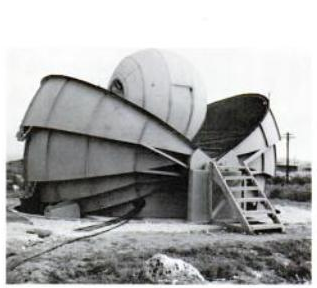
Okinawa went back to Japan on 15 May 1972, and on that day Nakijin, Zakimi, Katsuren and Nakagusuku all became National Historic Sites, with the part of Zakimi still inside the base added after its return. Excavation and repair of Zakimi’s walls ran from 1973 to 1985. When it was done, the story goes, American veterans who had served at the radar site were astonished at what had been underneath it.
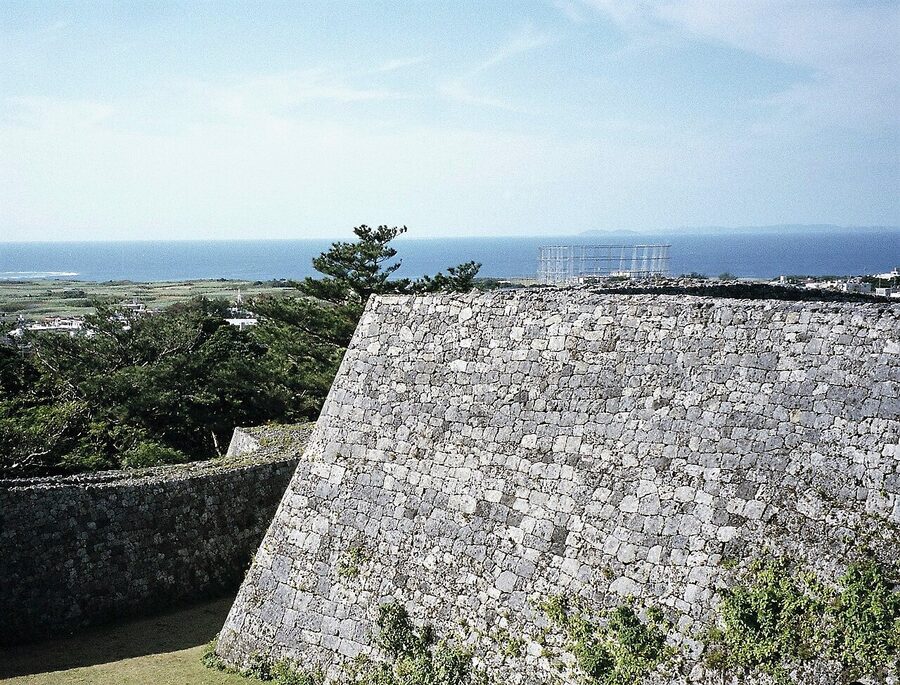
Nakagusuku had its own post-war fight. After the castle was protected in 1955, the park association that ran it decided to build a hotel in the main enclosure, and the heritage committee threatened prosecution. The hotel went up outside the walls instead in the early 1970s, with the 1975 Ocean Expo in mind, but the builder is said to have gone bankrupt, and the concrete shell stood above the castle for more than forty years until the prefecture pulled it down from May 2019, at a cost of about ¥200 million.
On the World Heritage list
Nominated in June 1999, the gusuku were inscribed by the World Heritage Committee at its meeting in Cairns at the turn of November and December 2000, as the “Gusuku Sites and Related Properties of the Kingdom of Ryukyu”. Okinawan sources give the date as 2 December; others give 30 November, the day the committee took the decision. It was Japan’s eleventh World Heritage site, in Heisei 12.
There are nine parts: the castles of Nakijin, Zakimi, Katsuren, Nakagusuku and Shuri, the Sonohyan-utaki stone gate, the royal mausoleum of Tamaudun, the Shikinaen garden and the sacred grove of Sēfa-utaki. Four of the five castles are ruins; Shuri is the one that was rebuilt. The other four are the purest examples of what the listing is about, which is stone.
And the gods. The walls of Nakijin, Katsuren and Nakagusuku still hold working places of prayer, and the noro of Nakijin still come up to the castle for the festivals of Imadomari, the village below. That, more than the walls, is what makes a gusuku different from the castles of mainland Japan, which stopped being anything but monuments when the samurai left. Nor will you find anything like the samurai districts of a mainland castle town below them: the people who lived beneath a gusuku were farmers, fishermen and traders, and their lords were aji.
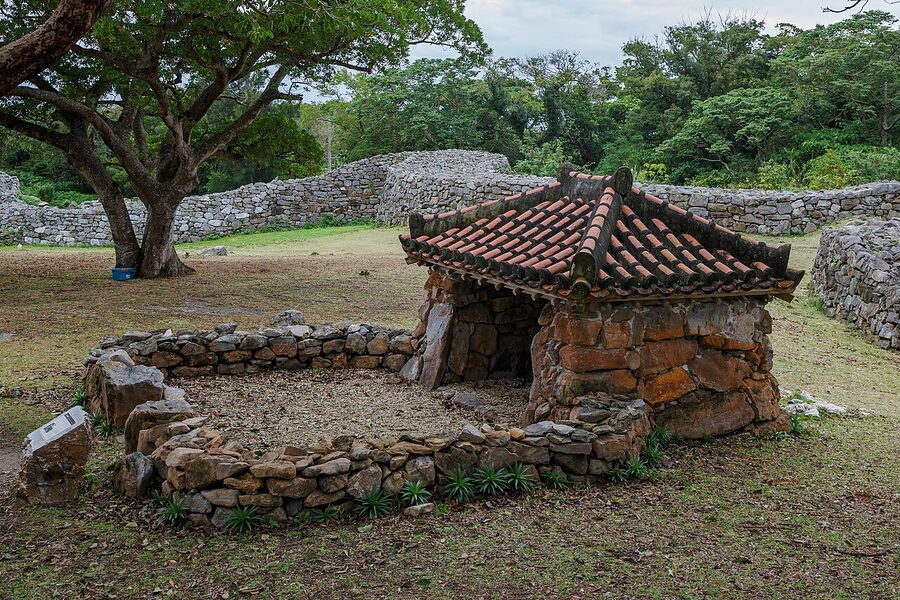
Okinawa sells itself to the world through beaches, food and karate, and the gusuku are a quieter part of the island’s sense of itself. On a winter evening at Nakijin you will see local families walking the walls under the cherry trees. They are not visiting Japanese history; they are visiting their own, a distinction worth keeping in mind.
Where to see the gusuku today
All four castles are on Okinawa’s main island, and the only practical way to see them in a day or two is by car. Nakagusuku and Katsuren are close together in the middle of the island; Zakimi is on the west coast at Yomitan; Nakijin is far up the Motobu Peninsula in the north. I checked every price and opening time below on the castles’ official sites in November 2026, and they change, so check again before you go.
Every one of these castles means uneven stone steps and steep paths, slippery in the rain and hard going with a wheelchair or pushchair. All of them close at short notice for typhoons, and the official sites post closures on the day.
Nakijin, and the January cherries
The castle’s official site puts it about 110 kilometres and 2 hours 45 minutes by car from Naha Airport, which seems pessimistic to me, but allow for it. There is free parking for about 320 cars, though the first car park has been closed since 1 September 2026 and you should use the others. Without a car, Okinawa Bus routes 65 and 66 on the Motobu Peninsula stop at Nakijin-jōseki-iriguchi, a fifteen-minute walk away, and the Yanbaru Express bus from the airport stops right at the castle.
The castle is open every day from 8:00 to 18:00 (last entry 17:30) from September to April, and from 8:00 to 19:00 (last entry 18:30) from May to August. Admission rose on 1 September 2025 to ¥1,000 for adults and ¥500 for junior high and high school students; younger children are free. You cannot eat inside the walls. Give it two hours, and walk up to the Uuchibaru for the view north over the sea.
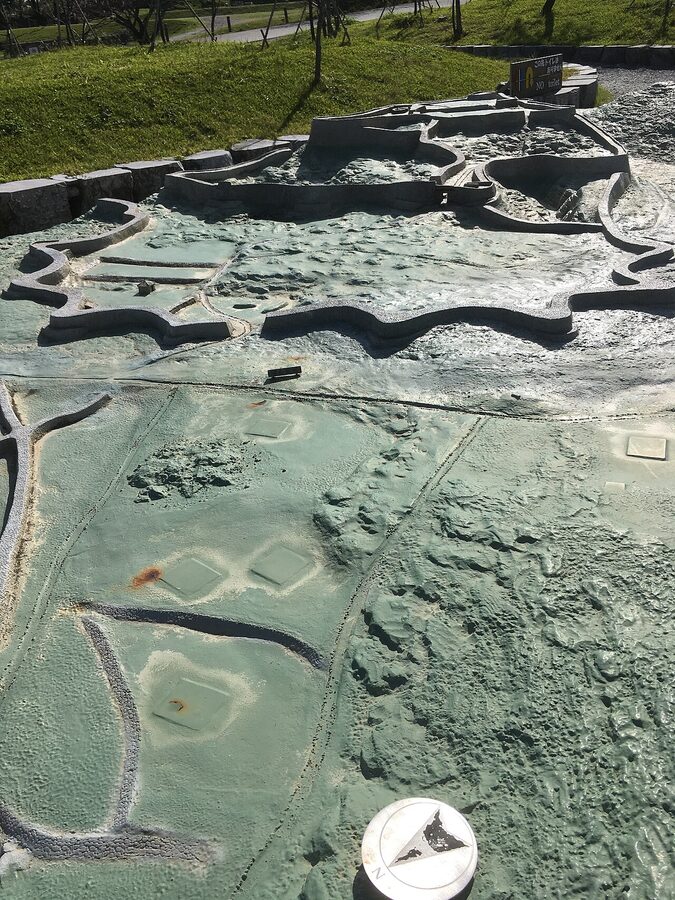
The Nakijin Village Historical Culture Center by the entrance is free, open 9:00 to 17:00 (last entry 16:30), and closed on Mondays and over the New Year. It shows the excavated porcelain, and sells a ten-minute mixed-reality show, “The Battle of Nakijin”, for ¥500 (ages 14 and up, booked online). I suspect Han’anchi would not have approved.
Nakijin is most famous for its cherries. The steps up to the gate are lined with kanhizakura, a deep pink cherry that flowers here at the end of January and into early February, among the first blossom anywhere in Japan; my piece on cherry blossom explains what the first flowers mean to the rest of the country. The castle’s 20th cherry festival is scheduled for 30 January to 7 February 2027.
Zakimi and the Yuntanza Museum
Zakimi is the easiest of the four to enjoy and the only one you can walk into for nothing: Yomitan village says plainly that you can enter freely. It sits on high ground above the village of Zakimi in Yomitan. Walk the walls of the first enclosure for the view west to Cape Zanpa, and on a clear day to the Kerama islands out to sea.
The World Heritage Zakimi Castle Ruins Yuntanza Museum at the foot of the castle opened on 23 June 2018, and covers the castle, Yomitan’s history and folk culture, its crafts and its nature. It is open 9:00 to 18:00 (last entry 17:30), closed on Wednesdays (or the following day if Wednesday is a public holiday) and from 28 December to 4 January. Admission for visitors from outside the village is ¥500 for adults, ¥400 for those over 65 and ¥300 for elementary and junior high school pupils.
Katsuren and Amawari Park
Katsuren’s site puts it about 80 minutes by car from Naha Airport, with free parking for 148 cars. By bus, the number 52 from Naha Bus Terminal and the number 61 from Parco City both run to Yakena Bus Terminal by way of Katsuren; the stop for the castle is a short walk away. The castle and its visitor centre, Amawari Park, are open every day from 9:00 to 18:00, with the last tickets sold at 17:30.
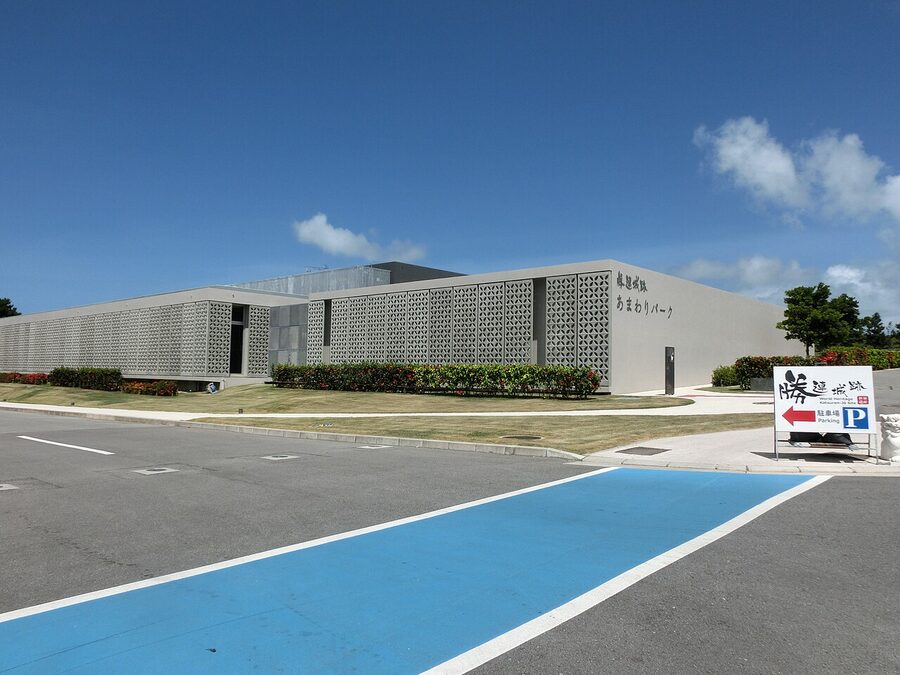
Admission, which includes the permanent exhibition in Amawari Park, is ¥850 for high school students and adults and ¥550 for junior high pupils and younger; Okinawa residents pay less. The exhibition alone is ¥600 and ¥300. Guided tours can be booked three days ahead for groups of two or more, and there are live performances on the plaza at weekends.
The climb is the steepest of the four. A sloping path runs up to the lower enclosures, but it is too steep for wheelchairs (there is an electric cart; ask the staff), and from the third enclosure up it is all steps. It is worth it. From the top you look straight across the bay to Nakagusuku, and you understand at once why Gosamaru was sent there.
Nakagusuku and the Nakamura house
Nakagusuku is the closest to Naha: take the Okinawa Expressway to the Kitanakagusuku exit and follow the signs past the Aniya junctions to the free car park (about 50 cars). Without a car, the council suggests a bus to Aeon Mall Okinawa Rycom and then the on-demand “mobi” service from there. The castle is open every day; you can enter from 8:30 to 17:00 (18:00 from May to September), and the gates close half an hour later.
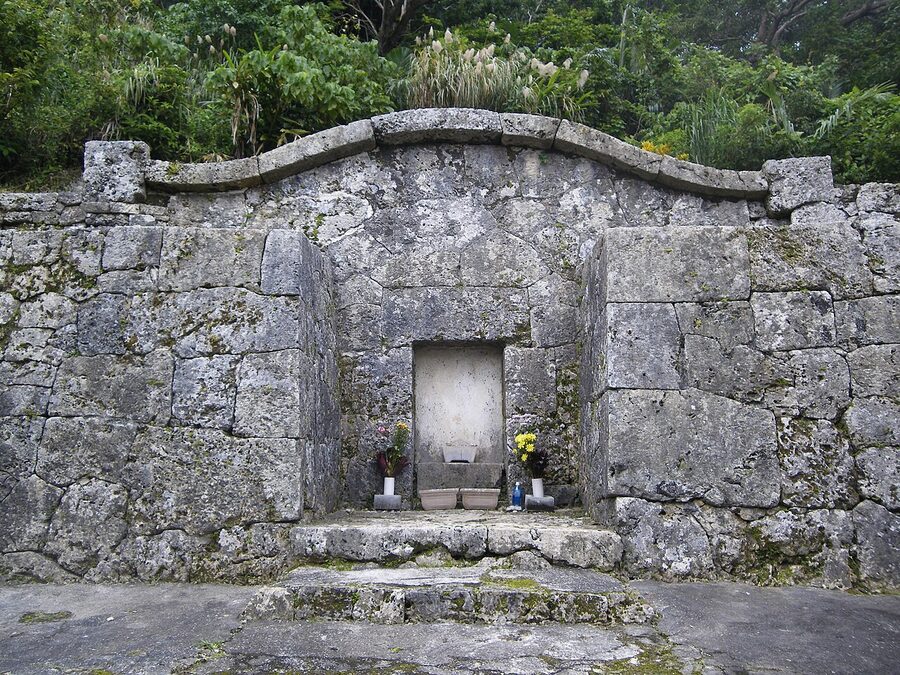
Admission is ¥500 for adults, ¥300 for junior and senior high school students and ¥200 for elementary pupils. A volunteer group, the Gusuku no Kai, gives free guided tours, and the council runs a free cart from the car park. When I checked, the council’s notices mentioned repairs to the north wall of the first enclosure from October 2026, so part of the circuit may be fenced off. Allow an hour and a half, and go in the late afternoon, when the low sun brings out the joints in the aikata-zumi.
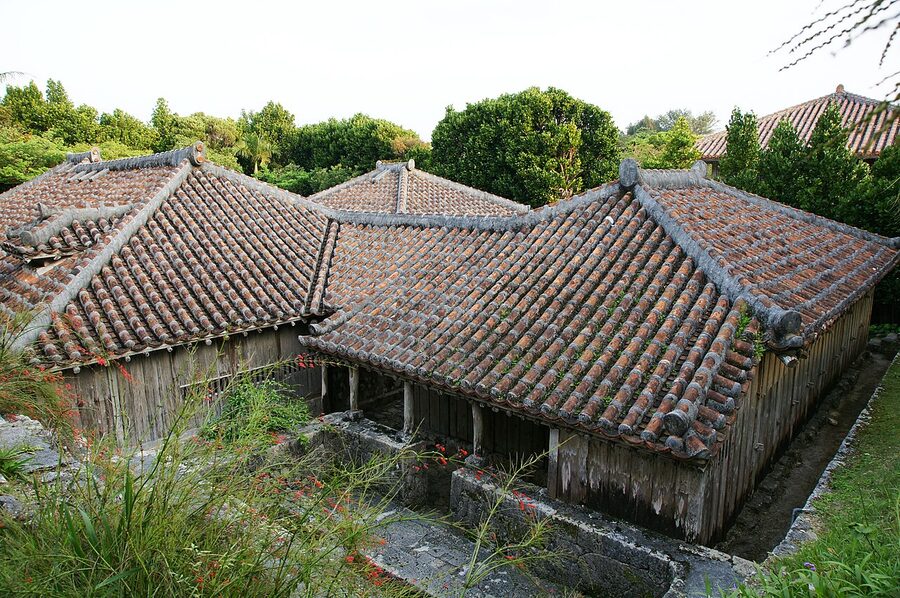
Gosamaru’s tomb is about 200 metres east of the walls. North of the castle is the Nakamura house, a large farmhouse of the mid-18th century that escaped the war and on 15 May 1972 became an Important Cultural Property. The family’s tradition is that their ancestor came here with Gosamaru as his master builder. Its own website lists opening days and the fee; I could not get it to load when I checked, so look before you go.
Doing it in a day
If you have one day and a car, start at Nakagusuku when it opens, cross to Katsuren for late morning, drive up the west coast to Zakimi for lunch and the museum, and finish at Nakijin, which in summer stays open until 19:00. It is a long day. With two, give Nakijin a morning to itself.
Finish the set at Shuri and at the prefectural museum in Naha, where the bell of 1458 hangs. My walk through Japan through the ages puts the mainland’s eras side by side, and it is worth remembering, as you read it, that for most of that time Ryukyu was not part of them.
A window in the rock
The Americans who stumbled on Nakagusuku in 1853 thought they had discovered a forgotten palace of a vanished king, built by people who had never heard of guns. They were wrong about the king and the guns. They were right about the stone, and right, I think, to be surprised.
Go up the ridge from the car park the way Jones did, slowly, with your eyes on the line of the hill. Somewhere along the way the rock will turn into a wall, and the wall will turn out to have a window in it. When it does, stop for a minute before you go through. Someone may be praying inside.