To fight for the Empress’s Cup at the Tokyo Budokan in Ayase on 6 December, you need a fourth-dan certificate, Japanese nationality, a red and white sash of your own to tie across your back, and you need to be a woman. Bouts last five minutes. You may score on the head, the wrists, the flank, the throat and, the target that makes visiting kendo players wince, the shin. The men have a national championship too, now in its 26th edition and fought in the same hall the day before, but the cup with the Empress’s name on it is on its 71st outing, and it has always gone to a woman.
I like that entry form because almost nothing in it would have made sense to the people who first carried the weapon. For its first four hundred years the naginata (薙刀) belonged to hooded monks from Mount Hiei and Nara, to foot soldiers who hacked at horses’ legs, to the giant Benkei of legend, and to a line of shoguns whose family heirloom was a naginata called Honebami, the Bone-Eater. How a weapon of monks and men became the thing every Japanese schoolgirl of 1943 was drilled in, and then a sport with a women’s cup, is a story of later centuries rewriting earlier ones. It ends in places you can still visit.
In This Article
- A word that needed a footnote
- Blade, shaft and a very long tang
- Hooded monks on Mount Hiei
- Twenty-four arrows on the Uji bridge
- Five-shaku blades and the Bone-Eater
- Why the spear won
- A blade in the bride’s trousseau
- Show business, schoolgirls and the war
- Atarashii naginata: the new naginata
- Where to see the naginata today
- Tokyo National Museum, Ueno
- Ōyamazumi Shrine, Ōmishima
- Nikkō Tōshōgū
- Kyoto and Uji: the Bone-Eater and the bridge monks
- Watching naginata: the Empress’s Cup and the Budokan
- Red and white
A word that needed a footnote
The first time the word turns up in a Japanese document, the writer felt he had to explain it. In the court chronicle Honchō Seiki, under the second year of Kyūan (1146), the weapons of a warrior named Minamoto no Tsunemitsu include one that is “commonly called naginata“, spelled out phonetically in four characters, 奈木奈多, as if it were slang. The chronicle was compiled in the 1150s, late in the Heian era, so the word was still new enough, or low enough, to need a gloss.
Before that, everything is guesswork. Heian texts speak of 長刀, “long blades”, which a later age read as naginata but which may simply mean long swords, and the American historian Karl Friday has pointed out that one early text has the weapon drawn with nuku, the verb for unsheathing a sword, rather than hazusu, the verb medieval writers used for uncovering a naginata. Japanese scholars offer two family trees. In one, warriors who wanted more reach simply lengthened the hilt of the tachi until it became a pole; in the other, the naginata grew out of the tehoko, a blade of one or two shaku on a short haft that was in use from the late Nara period.
Nobody has settled it, and the Japanese reference works say so with unusual frankness. Others have been less careful. The All Japan Naginata Federation’s own English history says the name first appears in the Kojiki of 712 and that warrior priests used the weapon around 750; scholars who have gone looking for the word in the Kojiki have not found it. The same text dates the first recorded combat use to 1086, from the account of the Later Three Years’ War in the north, which is fair as far as the events go, but the version that survives is a picture scroll whose text is dated 1347, more than two and a half centuries after the fighting.
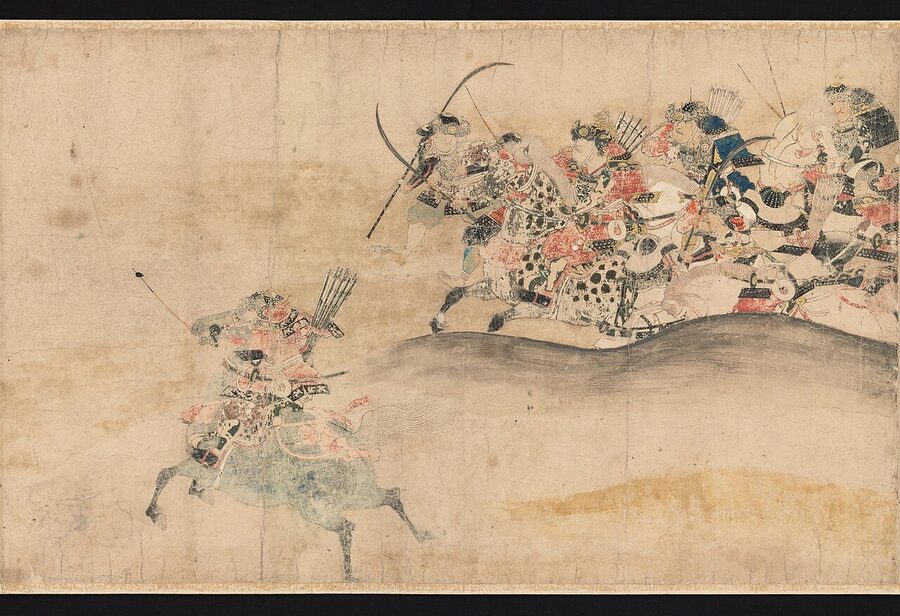
What is certain is that by the Genpei War of the 1180s the naginata was everywhere, and when the great picture scrolls were painted in the 13th century, artists put it in the hands of foot soldiers, monks and mounted men alike. Friday notes that the earliest physical evidence for the weapon dates only from the middle of the Kamakura era, a century after the stories it is supposed to illustrate. You are always looking at the naginata through someone else’s century, and the trick is to know whose.
Blade, shaft and a very long tang
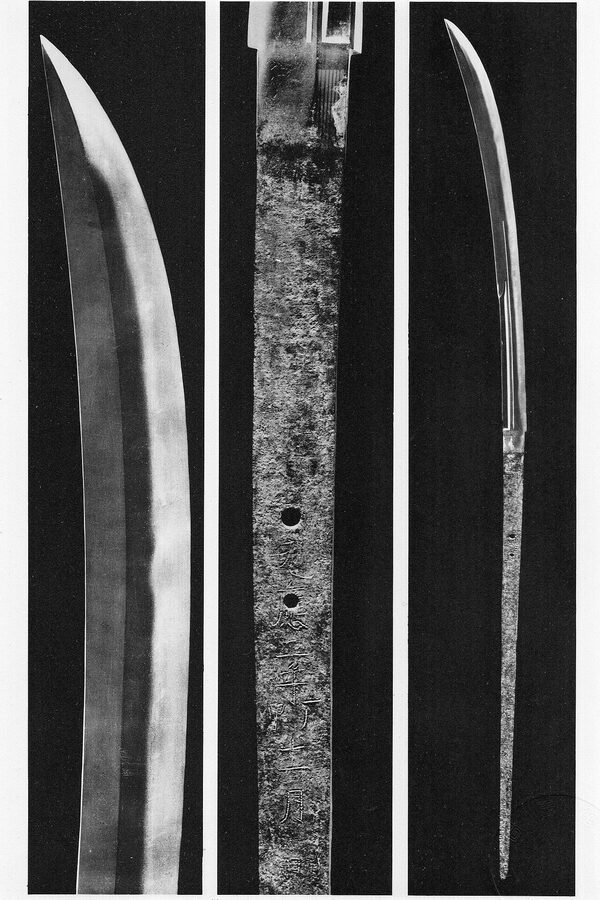
Put a naginata next to a European glaive and they look like cousins, but the Japanese one is a sword at heart. The blade, usually 40 to 60 centimetres in the classic period, was forged and hardened exactly as a Japanese sword was, with the same steel, the same clay-coated quench and the same temper line, by the same men: the great Osafune smiths of Bizen, Nagamitsu and Kagemitsu, made naginata, and so did the Yoshioka Ichimonji school. What gives it away is the tang. A sword’s tang is a short stub hidden in the hilt; a naginata’s runs back into the shaft for roughly the length of the blade itself, held by a bamboo peg called a mekugi.
The shaft was oval in section, not round, so that your hands always know which way the edge faces. The end that takes the blade was often bound with lacquered cord or wrapped in a thin spiral of metal, the hirumaki or “leech wrap”, to stop it splitting. At the other end the iron butt-cap, the ishizuki, was usually cut in a half-moon rather than a point, because a naginata was not meant to be planted in the ground like a spear; the butt was another edge.
Down to the Muromachi period the shaft was usually four to five shaku, about 120 to 150 centimetres, and guards only appear around then. How long shafts grew afterwards depends on whom you read. One Japanese reference has Edo-period shafts at nine shaku as standard, over two and a half metres, while the Nipponica encyclopedia gives five or six shaku and blades shrunk to between one and one and a half shaku; surviving pieces support both, which is what happens to a weapon in use for seven hundred years.
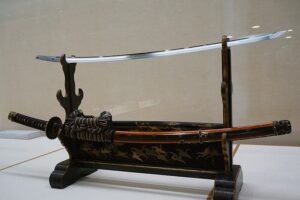
The picture scrolls give naginata huge, scything curves, and for a long time people assumed early blades looked like that. Japanese researchers now split on it. Blades with a battlefield history tend to be fairly shallow with a narrow point, like the one Osafune Kagemitsu dated the eighth month of the second year of Genkō (1322), now in the Tokyo National Museum, and some suspect the deep curves were artistic licence or belonged to ceremonial pieces. The two names you will hear for the shapes, tomoe-gata for the wide, deeply curved blade and shizuka-gata for the slim, shallow one, honour the warrior woman Tomoe Gozen and Yoshitsune’s dancer Shizuka Gozen, and they are classifications of the Meiji era, not the Middle Ages.
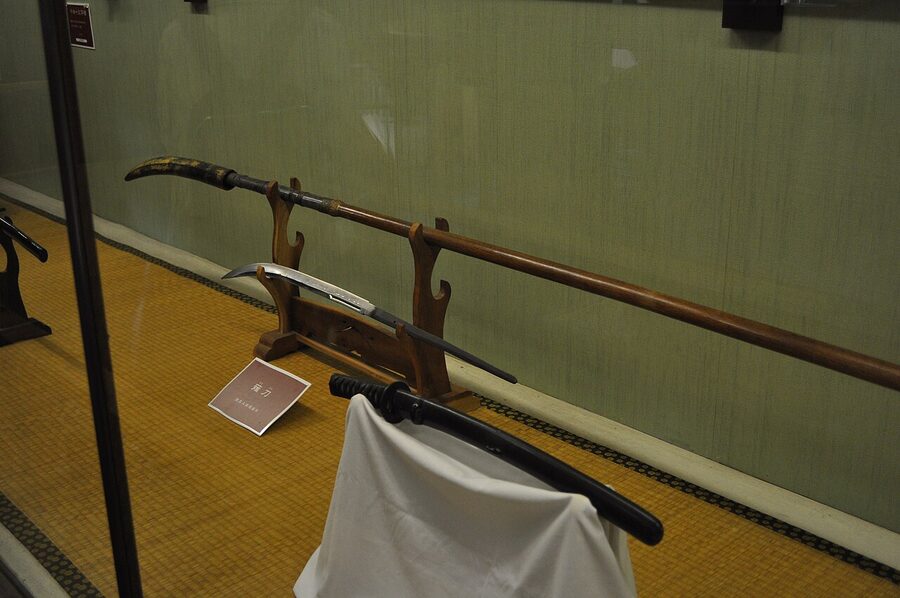
The armoury displays at Hirosaki Castle are one of the few places where you see the whole thing assembled, blade, collar, shaft and butt. There were odder variants too. In Kyushu in the Muromachi period warriors used the tsukushi naginata, whose blade had a ring on its back into which the shaft was slotted, like a farm billhook, and the Ōtomo family chronicle calls it a “billhook naginata”; the navies of the Inland Sea later had a similar socketed type, the fukuro naginata, perhaps because it turned an oar into a weapon in a hurry. One surviving school still uses a kagi naginata, with an iron hook in place of the guard for catching an opponent’s weapon.
The common thread is a cutting edge on a stick, and the Japanese never stopped tinkering with it. Much of the best early work survives because warriors gave it away: shrines and temples received weapons as offerings throughout the Middle Ages, and the West Octagonal Hall of Hōryū-ji kept its share. The smith’s side of the story belongs with the swords, which still rank high among Japan’s greatest traditional crafts.

Hooded monks on Mount Hiei
The picture most people carry of the naginata is a monk: head wrapped in a white cloth so only the eyes show, armour under black robes, high clogs, and a naginata over the shoulder. The great temples of the Heian period really did keep armed men. Kōfuku-ji in Nara had its Nara hōshi, and Enryaku-ji on Mount Hiei its yama hōshi, mountain monks, and they marched on the capital carrying the sacred palanquins of their shrines to force the court’s hand. The retired emperor Shirakawa listed three things in the world he could not control: the waters of the Kamo River, the fall of the dice, and the monks of the mountain.
The word everyone now uses for them, sōhei (僧兵), “monk soldiers”, is an Edo-period coinage; people at the time said akusō, fierce monks, or hōshi-musha, priest-warriors. Japanese historians think most of them probably did not even shave their heads. And Karl Friday argues that the naginata was not especially theirs: late 13th- and 14th-century paintings show monks carrying it as one weapon among several, just as samurai and commoners did, and only pictures made centuries later turn it into the monk’s badge.
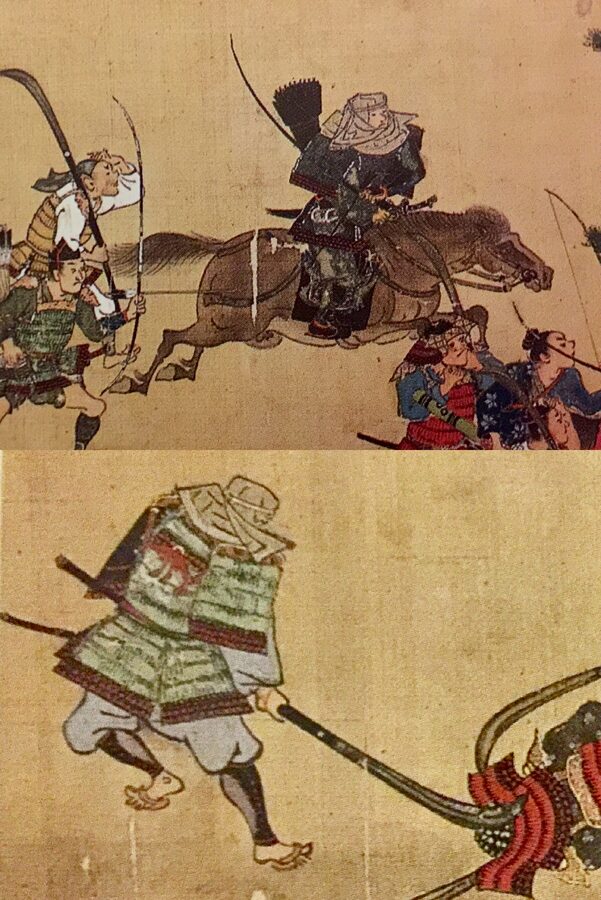
Their power lasted until Oda Nobunaga burned Mount Hiei in 1571, and Hideyoshi’s sword hunt of 1588 took the weapons out of temple hands for good. By then the monks had given Japan something else. One of them, In’ei of the Hōzōin at Kōfuku-ji, founded the most famous school of spear fighting in the country, which is a story for later in this piece.
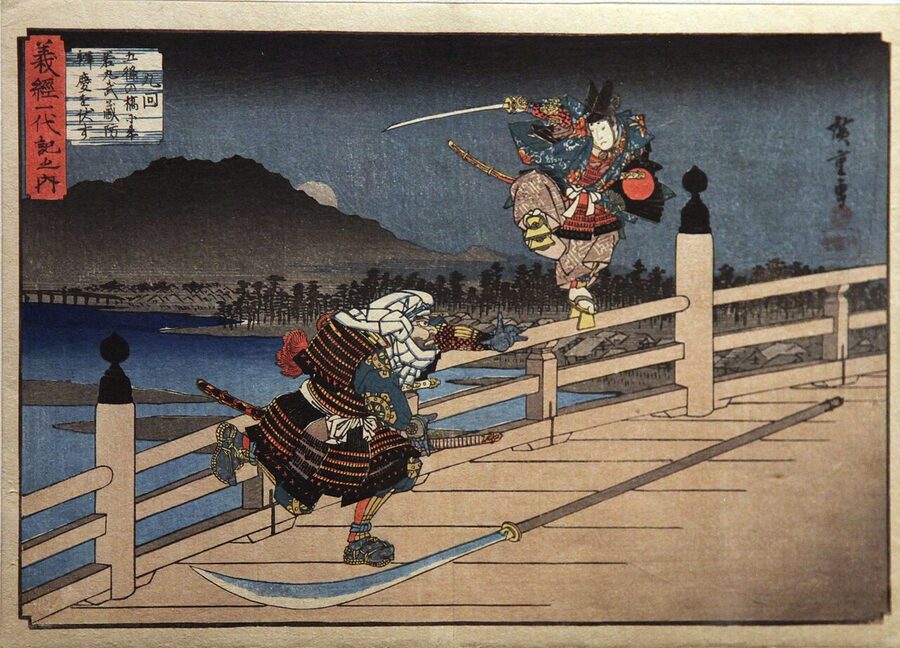
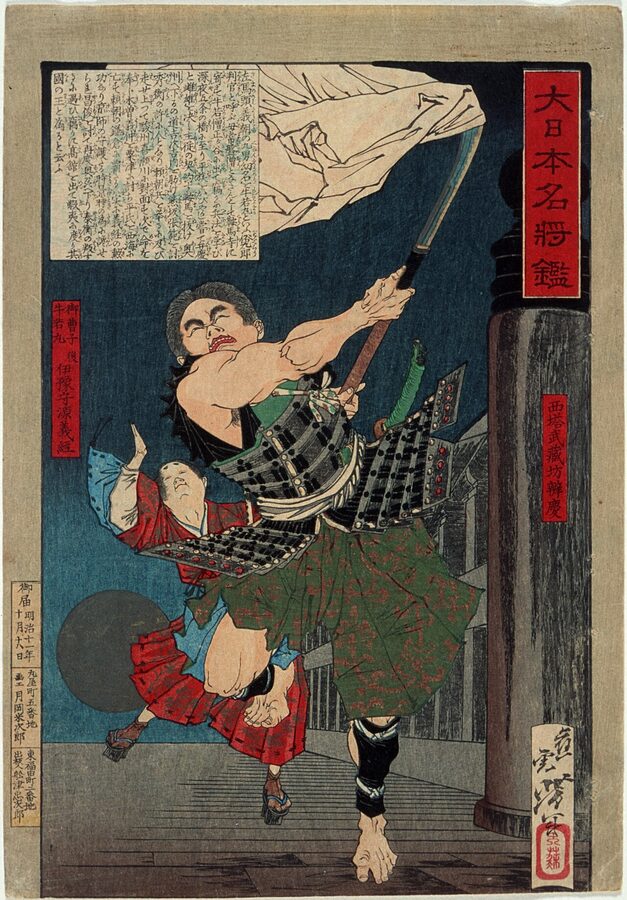
The most famous monk with a naginata hardly exists in the record. Musashibō Benkei, the giant retainer of Minamoto no Yoshitsune, is little more than a name in the Tale of the Heike; almost everything people believe about him comes from the Gikeiki, a romance of Yoshitsune’s life written in the late 14th or early 15th century, two centuries after Benkei was supposed to have died. The Gikeiki tells how Benkei, a rogue monk who had left Mount Hiei in disgrace, set out to take a thousand swords from passers-by in Kyoto, reached nine hundred and ninety-nine, and was beaten by a boy, the young Yoshitsune, in a running fight that ends at Kiyomizu-dera.
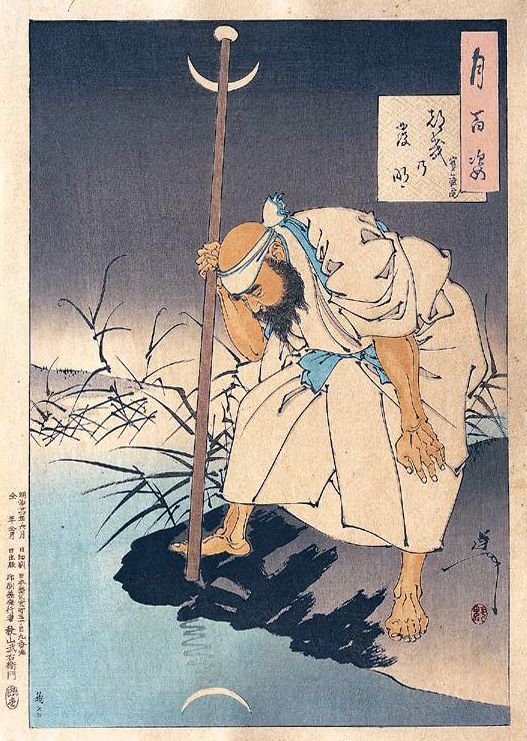
The bridge came later. The Noh play Hashi Benkei moved the duel to the Gojō bridge and put a naginata in Benkei’s hands, Edo printmakers drew it that way for generations, and in 1911 a song in the state primary-school songbook fixed the scene for every child in Japan: the big man on the bridge with his long naginata, the boy leaping from the rail. The same Gikeiki has Benkei die at Koromogawa in 1189 on his feet, stuck with arrows and propped on his naginata, a scene that gave Japanese the phrase tachi-ōjō, to be stalled where you stand. As history it is worthless; as a guide to what the naginata meant to the people who told it, it could hardly be better.
Twenty-four arrows on the Uji bridge
The best naginata fighting in Japanese literature happens on a bridge with no planks. In the fifth month of 1180 Prince Mochihito and the old warrior Minamoto no Yorimasa, fleeing the Taira after their plot had leaked, stopped at Byōdō-in in Uji because the exhausted prince kept falling off his horse, and their men tore up the boards of the Uji bridge to hold the river. It was the opening act of the war between the Minamoto and Taira no Kiyomori‘s clan. The Heike tells the fight that followed, the Hashi Gassen, through a handful of warrior monks from Mii-dera who had joined the rising.
The first was Gochi-in no Tajima, who walked out onto the bare beams with his naginata and, the Heike says, cut the Taira arrows out of the air as they came at him, which earned him the name Yakiri no Tajima, Tajima the Arrow-Cutter. Then came Tsutsui no Jōmyō Meishū. He shot his twenty-four arrows, killing twelve men and wounding eleven, threw down his bow and went out along the beam with his naginata; he cut down five, and on the sixth the shaft snapped. He drew his sword and killed eight more, the sword broke on the ninth, and he fought on with his dagger.
At that point the monk Ichirai Hōshi, unable to get past him on the narrow beam, put a hand on Jōmyō’s helmet and vaulted over his head with a polite apology, and died fighting in front of him. Jōmyō made his way back to the gate of Byōdō-in, took off his armour and counted sixty-three arrow strikes, five of which had gone through. Then the Taira forded the river on horseback, Yorimasa killed himself in the temple grounds, and the prince was caught and killed on the road to Nara.
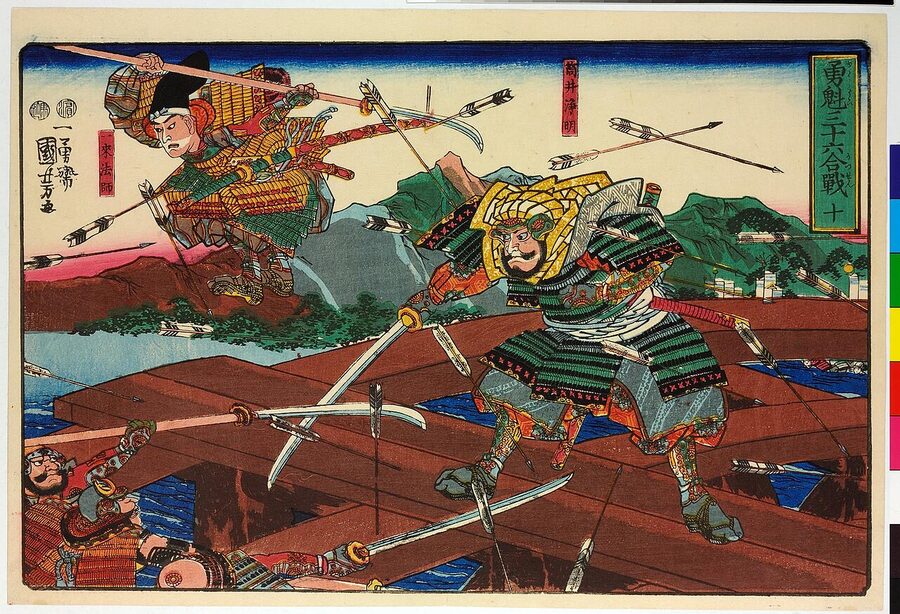
How much of this happened? The courtier Kujō Kanezane, writing in his diary Gyokuyō, records the Taira vanguard crossing the river and the rebels’ stand at Byōdō-in, and praises Yorimasa’s son Kanetsuna for fighting like the great hero Hachiman Tarō, but has nothing to say about acrobatic monks. The Heike reached the form most people read in the 14th century, after generations of being chanted by blind storytellers who knew what an audience liked. I believe in the missing planks and the cavalry in the river; Jōmyō’s tally I treat the way I would a fisherman’s.
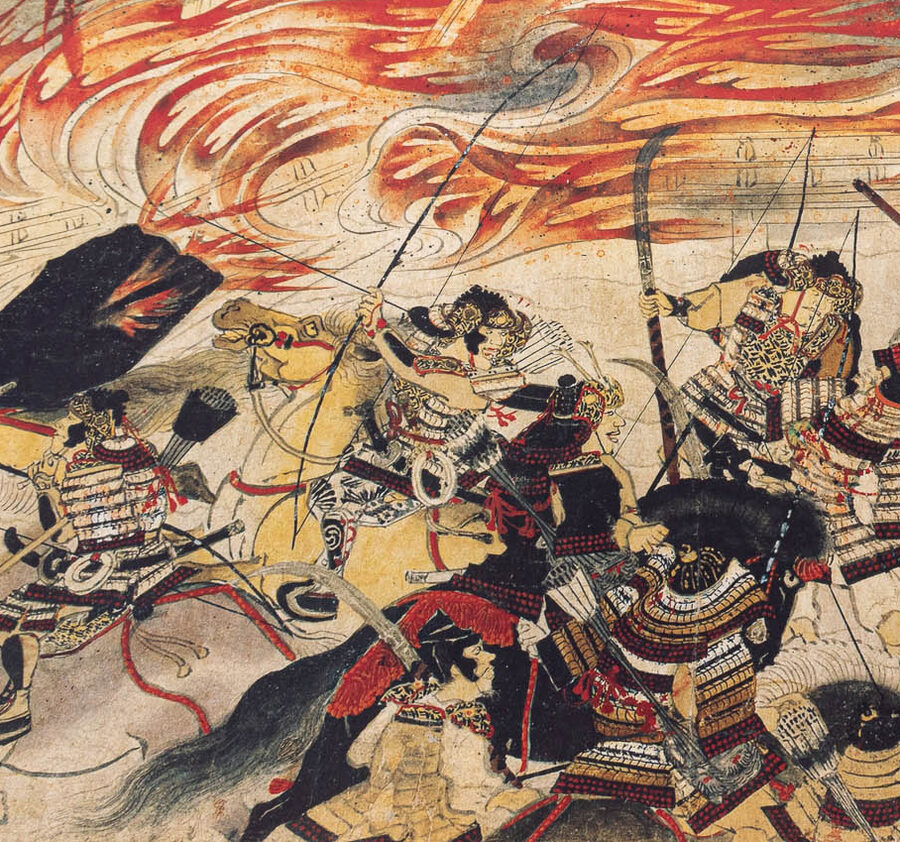
Stories like this are why the Genpei generation is remembered as the naginata’s age. Mounted archery still decided battles, but the naginata had found its job on foot: kept at a distance by its length, a man could slash at a horse’s legs and bring the rider down, or follow his own lord’s horse and cut at the enemy’s. Shin guards, suneate, became part of the armour of the period, and English and Japanese writers alike connect them with exactly this kind of low cut; the modern sport still lets you score on the shin. Samurai armour grew to fit the weapon.
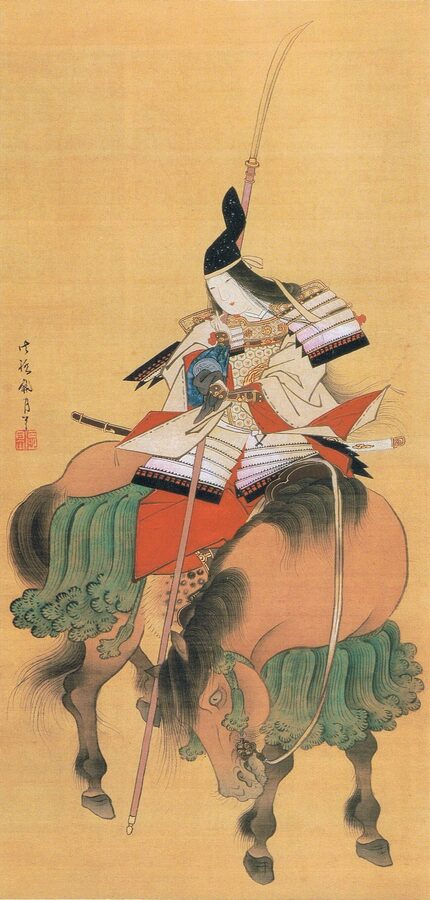
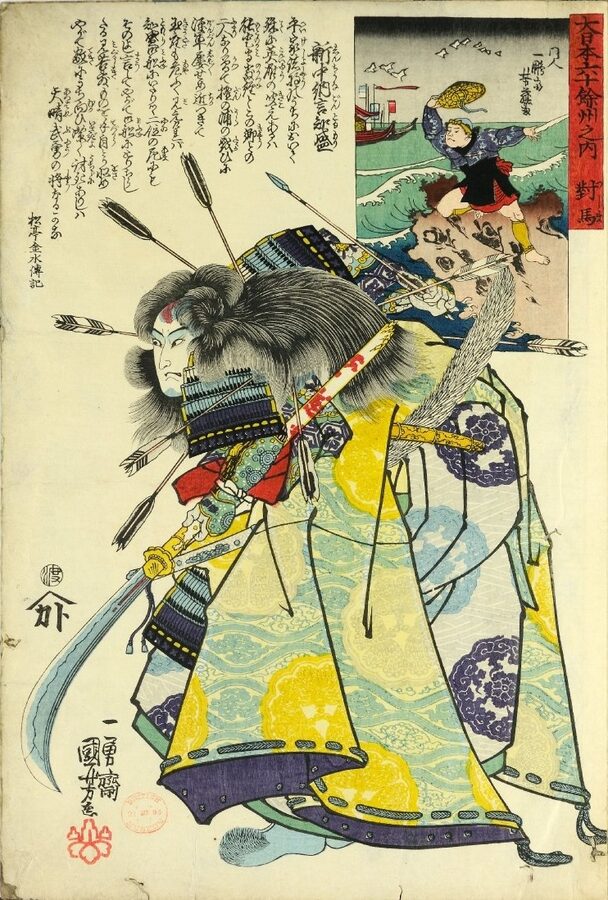
The naginata’s most famous woman of the age is a borrowing. In the Heike, Tomoe Gozen, who rode with Kiso Yoshinaka, is a strong archer who drags an enemy from his horse and takes his head; the book gives her a great sword and a bow. It is the Noh play Tomoe, written two centuries later, whose ghost fights with a naginata, and every painter since has followed the stage rather than the book. The same thing happened to the Taira general Tomomori, whom the Noh play Funa Benkei brings back from the sea at Dan-no-ura as a ghost with a naginata.
Five-shaku blades and the Bone-Eater
The naginata’s high summer came after the Genpei War, in the long civil war between two imperial courts that began in the 1330s. Warriors of the Nanbokuchō period went in for size, with tachi so long they had to be carried by a servant, and naginata grew to match. The Taiheiki, the great chronicle of those wars and of Kusunoki Masashige‘s stand for the southern emperor, speaks of “a little naginata of three shaku five sun and a great naginata of over four shaku”. In one passage it describes a Bizen naginata with a shaft of five shaku and a blade of the same length, a metre and a half of steel on a metre and a half of wood.
Japanese historians argue about how much good all this did. Some call the naginata the strongest weapon of the Nanbokuchō and early Muromachi era, because it could cut, thrust, strike with the butt and sweep a horse off its feet; others point out that a wooden shaft breaks more easily than a great sword and think the giant ōdachi did more of the work. Either way the fashion for monster blades lasted only a couple of decades. The chroniclers loved it while it lasted, and the Taiheiki is full of strongmen whirling great naginata and mowing down the enemy like grass, which is what the name, a “mowing blade”, always promised.
The most famous naginata of the period is one that is no longer a naginata. Honebami, the Bone-Eater, is credited to Awataguchi Yoshimitsu, the 13th-century Kyoto smith better known for his daggers, who otherwise made almost no long blades. In the Baishōron, a chronicle of the Ashikaga rise written around 1349, Ashikaga Takauji rides out to the battle of Tatarahama in the third month of 1336 wearing two swords, one of them “the hereditary Honebami”. Whether that is the same blade has been argued over since the Edo period, not least because the oldest manuscript of the Baishōron gives the sword a different name.
The firmer evidence is a muster record of 1487. On the 12th day of the ninth month, when the shogun Ashikaga Yoshihisa marched into Ōmi against the Rokkaku, a servant walked beside him carrying “the hereditary naginata called Honekami”. So in the 15th century it was still a naginata, and the kind of object a shogun took to war the way a later king took a crown; the name, an 18th-century catalogue of famous swords explains, came from its habit of crushing bones when someone merely pretended to cut with it, and the Jesuit João Rodrigues, who was shown it by Hideyoshi, wrote that it went through bone like a radish.
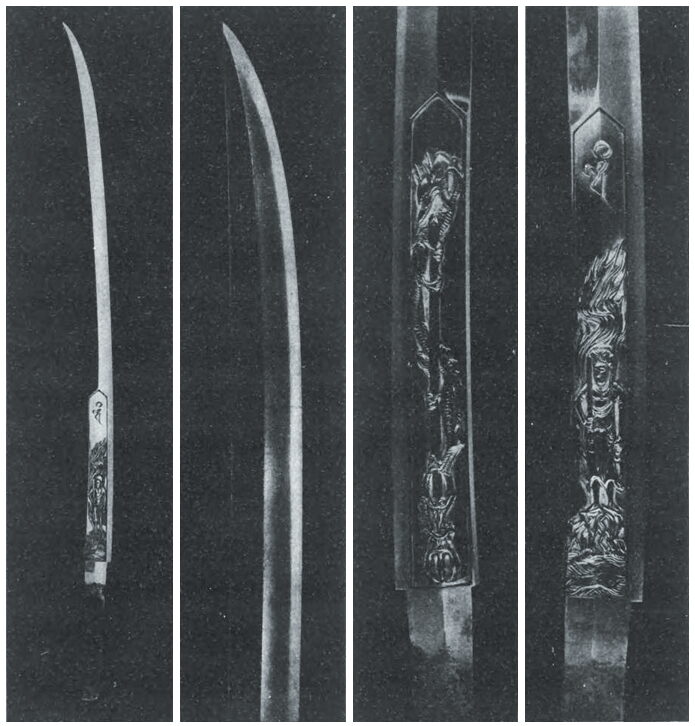
Then it went the way of its kind. The Ōtomo family chronicle, written in 1635, says the Ashikaga lost it when the shogun Yoshiteru was murdered in 1565 and that Ōtomo Sōrin bought it back from Matsunaga Hisahide. By the time Toyotomi Hideyoshi extracted it from Sōrin’s son, a thank-you letter dated the 27th day of the ninth month of 1585 shows it had already been cut down into a long wakizashi.
It survived the fall of Osaka Castle in 1615, reportedly fished out of the moat, lost its temper line in the Meireki fire of 1657 and was re-hardened by the third Echizen Yasutsugu, and in 1889 the head of the Tokugawa house gave it to the society organising Hideyoshi’s three-hundredth memorial. It now belongs to Toyokuni Shrine in Kyoto and lives on deposit at the Kyoto National Museum. A bone-eating naginata that ended as a short sword in a shrine to the man who disarmed Japan: I could not have made it up.
Why the spear won
By the Sengoku period the naginata was losing. The Ōnin War of 1467 to 1477 began a new kind of fighting, with large bodies of ashigaru, light foot soldiers, in close order, and a weapon that works by swinging needs room. A man in a packed rank can thrust a spear past his neighbour’s shoulder; he cannot whirl a naginata without hitting him. The yari, a short and minor weapon in the 14th century, grew longer and longer until the pike blocks of the late Sengoku era carried shafts of five or six metres, and then the matchlock arrived in 1543 and both were working for the gun.
How fast it happened is another argument. The historian Kondō Yoshikazu thinks the spear only clearly overtook the naginata in the second half of the Sengoku period, and the evidence of who carried what in the 1500s is thin. When Akechi Mitsuhide‘s men broke into Honnō-ji in 1582, Ōta Gyūichi, who had served Nobunaga and wrote his life years later, says his lord shot arrows until the bowstring snapped and then fought with a spear; the Jesuit Luís Fróis, writing to Europe within months, has him fighting with a naginata. Two good witnesses to the Honnō-ji incident, and they cannot agree which pole he picked up.
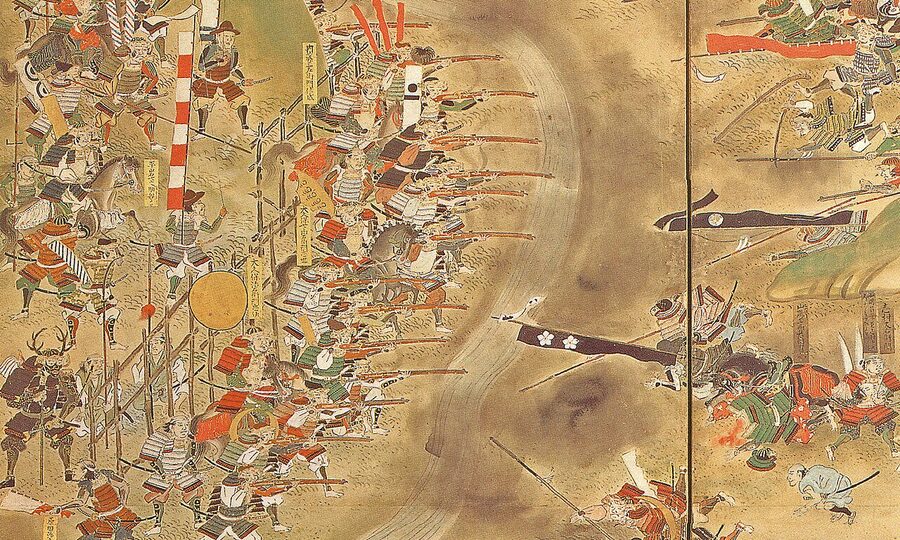
The Battle of Nagashino is usually told as the triumph of the gun, and so it was, but the screens painted of it afterwards are also a census of what an army of the 1570s carried. The irony is that the spear’s most famous school came out of a temple. In’ei (1521–1607), a monk of the Hōzōin subtemple of Kōfuku-ji, the same house that had once sent hooded naginata men against the capital, founded the Hōzōin-ryū, whose cross-bladed jūmonji yari became the classic spear of the Edo period. Hōzōin-ryū once taught naginata too; that side of the school has died out, and only the spear survives.
In between came the nagamaki, the “long wrap”, which Japanese writers are careful to keep apart from the naginata: it is a long sword with an equally long hilt, bound in cord like a sword’s, where the naginata is a pole with a blade on it. It had its fashion in the 15th and 16th centuries and went the same way, and there is a good case that in its day it took over some of the naginata’s work before the spear took both.
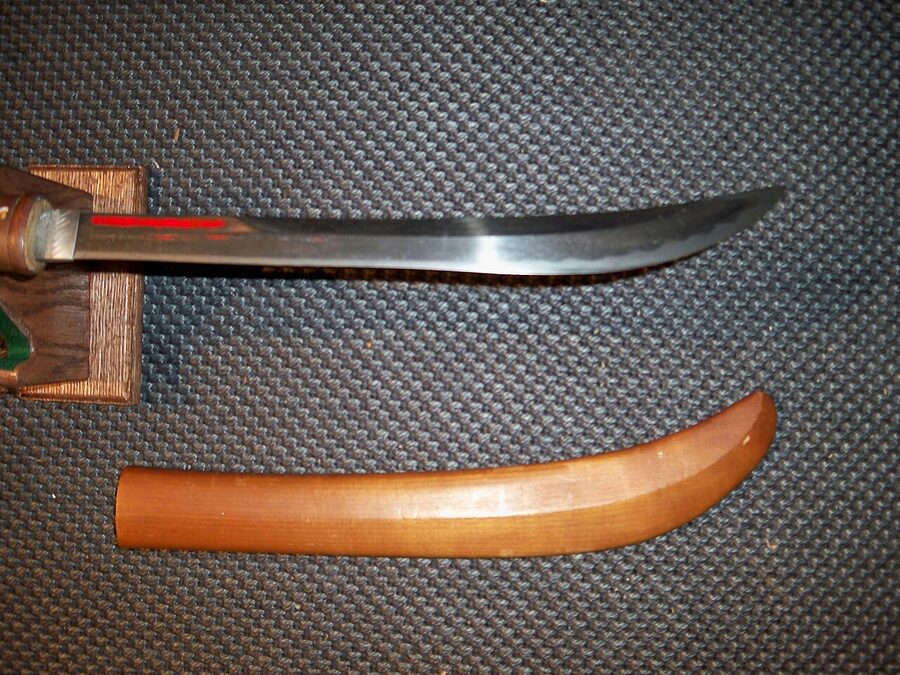
What happened to all the old naginata? Many were cut down into swords. A smith would shorten the tang, grind back the swelling near the point and reduce the curve, and the result, a naginata-naoshi or “remade naginata”, usually became a wakizashi or a dagger, since naginata blades were short. Two of the most famous blades in Japan began this way, Honebami and its stablemate Namazuo Tōshirō, another Yoshimitsu, which Toyotomi Hideyori wore, and the admiral Kuki Yoshitaka carried a sword made from a great naginata.
Sword people still say naginata-naoshi ni namakura nashi: there is no such thing as a dull remade naginata. The reasoning is that naginata were made for use, not for display or offering, that they had been tested in real fighting, and that nobody bothered to remake a mass-produced blade, so anything that survived long enough to be cut down was good. Smiths liked the look so much they began forging new blades in the shape of remade naginata, called naginata-naoshi-zukuri, and without a pedigree or an inscription they can be very hard to tell from the real thing.
A blade in the bride’s trousseau
Peace in 1600 left the naginata a weapon without a battlefield, and the Edo era gave it a second life as a martial art. Schools multiplied: the Anazawa-ryū of the early 17th century is usually counted the first devoted to it, and Japanese reference works list dozens more, though most taught naginata as a side subject to the sword or the spear. Training was by kata, fixed sequences rehearsed with a wooden naginata against a partner with a wooden sword, and for most swordsmen the naginata was simply the other weapon you had to learn to face.
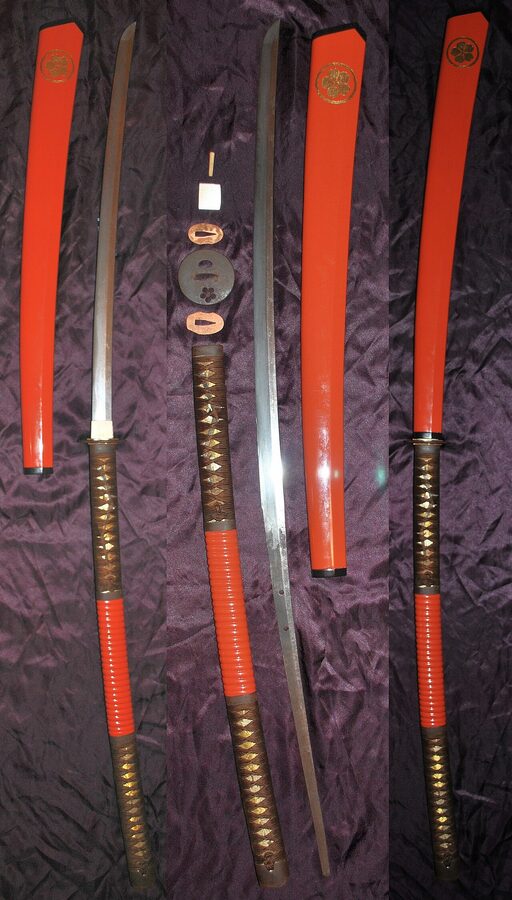
This is also when the naginata became a woman’s weapon, or at least when people began to say so. The usual account, which the federation repeats and most English books copy, is that daughters of samurai houses trained with it to defend the home, carried one in their trousseau when they married, and kept it over the door. There is good evidence for the trousseau: Edo naginata survive with blades by good smiths and mounts in gold nashiji lacquer, maki-e and mother-of-pearl, the family crest on the sheath, and several have been designated cultural properties, mounts and all. Women sometimes gave their own naginata to the family temple, and some of the fittings are so delicate that nobody can have meant to fight with them.
The training is harder to pin down. Japanese scholars point out that sources describing how Edo samurai women actually practised the naginata are rare, and a study published in Japan in 2025 concluded that when and why the weapon came to be seen as a woman’s is still unclear. The popular idea that blades grew smaller because women used them is just that, an idea. What is certain is that men went on learning it: the one licence Sakamoto Ryōma is known to have received from the Chiba fencing school in Edo, dated the first month of 1858, is for its naginata curriculum, and it was his sister Otome who had the reputation with the weapon in Tosa.
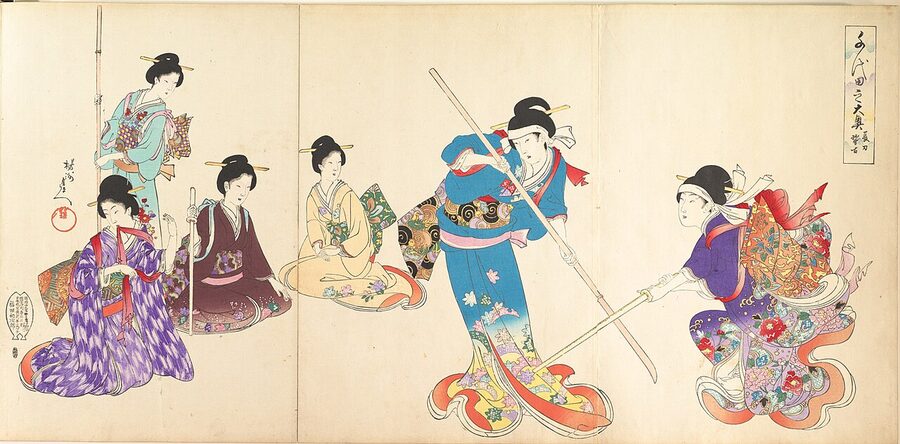
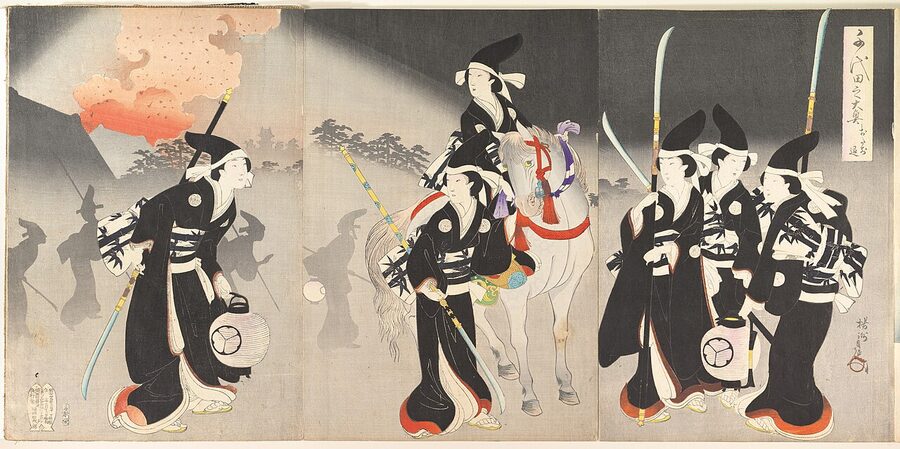
A good deal of the picture of Edo women with naginata was painted afterwards. Toyohara Chikanobu’s series Chiyoda no Ōoku, the women’s quarters of Edo Castle, published in 1894–96, nearly thirty years after the shogunate fell, shows the shogun’s women practising with wooden naginata and turning out with them on a night of fire. That does not make it false. It makes it a Meiji picture of the Edo period, made for a public that had never been inside, and that is a different kind of evidence from a diary.
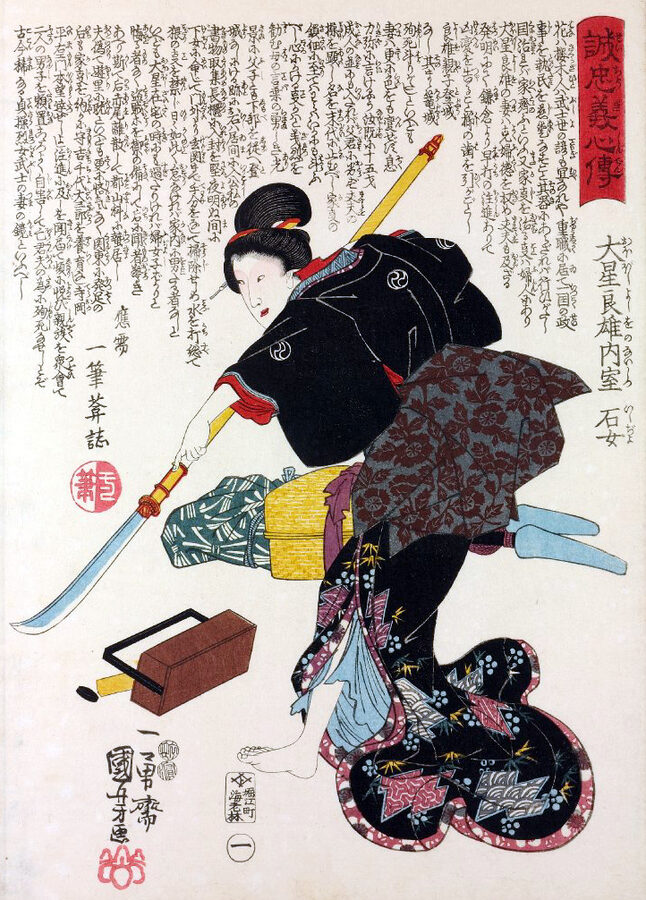
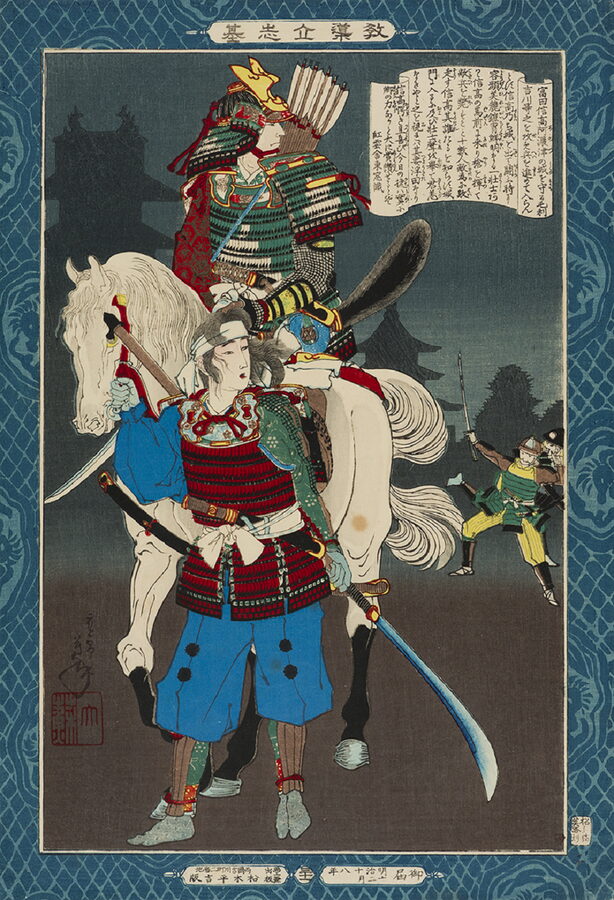
The stories the Edo period itself told were mostly about sieges. Yuki no Kata, wife of Tomita Nobutaka, is said to have put on armour to fight beside her husband when Tsu Castle was attacked in 1600, and Yoshitoshi drew her with a naginata in 1885 for a series of moral examples for the young. The kabuki and print versions of the 47 Ronin story give the wife of the ronin leader a naginata as well, though the real woman, Ōishi Riku, had been sent home to her family in Toyooka before the attack.
The one episode in which samurai women really did go into battle with naginata came at the very end. During the siege of Aizu in 1868 a band of the domain’s women, trained with the naginata, attacked government troops outside the town, and on the 25th day of the eighth month Nakano Takeko was shot and killed at Yanagibashi. Her naginata, the shaft five shaku three sun and the blade a shaku and a half, its point chipped, is kept at Hōkai-ji in Aizubange, where she is buried. The full story belongs in my pieces on samurai women, the Boshin War and the siege of Tsuruga Castle; here it is enough that the last time anyone remembers naginata carried into a Japanese battle, women carried them.
Show business, schoolgirls and the war
The Meiji Restoration nearly finished the martial arts, and the naginata survived the way swordsmanship did, on stage. In April 1873 the former shogunal fencing master Sakakibara Kenkichi put on a ten-day public show of fencing in Asakusa modelled on sumo, with naginata bouts between the sword matches, and soon there were thirty-seven fencing shows running in Tokyo alone; my piece on kendo tells that story. Women fighting men with the naginata were a reliable draw, and Shigeo, wife of the showman Satake Kanryūsai, was a star for her looks and for a technique one encyclopedia calls without equal.
Into one of Satake’s touring troupes, in 1886, walked a sixteen-year-old from the old Sendai domain called Tarita, a name meaning roughly “enough”: her father, who wanted an heir, had decided after his sixth daughter that girls were enough. She learned the troupe’s naginata, did a thousand swings morning and evening, took her licence in 1888 and the name Hideo with it, and after a second marriage became Sonobe Hideo. She is the reason the naginata’s modern history has a face.
In 1899, at the festival of the Dai Nippon Butokukai in Kyoto, the society’s president, Prince Komatsu Akihito, asked to see her fight Watanabe Noboru, a 61-year-old swordsman who had been head student of the Renpeikan in the 1860s and was said to have killed men in Kyoto; she was 29, and Watanabe abandoned the bout. Two years later his pupil Hotta Sutejirō, aged 19, took two head strikes off her at the same festival, and the hall, where applause was forbidden, would not stop cheering. In 1955, at 85, she told a reporter from the Yomiuri that she had not lost to Hotta at all. Japanese accounts credit her with only two defeats in her whole career, and since she disputed one of them, the arithmetic is generous.
Her rival as the great teacher of the age was Mitamura Chiyo of the Tendō-ryū, niece and adopted daughter of Mitamura Akinori, who taught Tendō-ryū naginata at the Butokukai’s headquarters in Kyoto from the late Meiji years. Someone once asked Chiyo why the soles of her feet stayed clean after practice, and she said she always moved a sheet of paper above the floor. Between them, these two women and their schools turned the naginata into the women’s martial art of modern Japan.
The state did the rest. From around the First Sino-Japanese War educators promoted the naginata as physical training and moral discipline for girls, the Butokukai opened a naginata section in 1904, and girls’ high schools took it up, at first as a sports-day display. In 1934 the Butokukai set up a course to train naginata teachers, Sonobe ran another at her own hall in Tokyo from 1936, and that year the Ministry of Education allowed naginata and archery into the regular physical education of girls’ secondary schools.
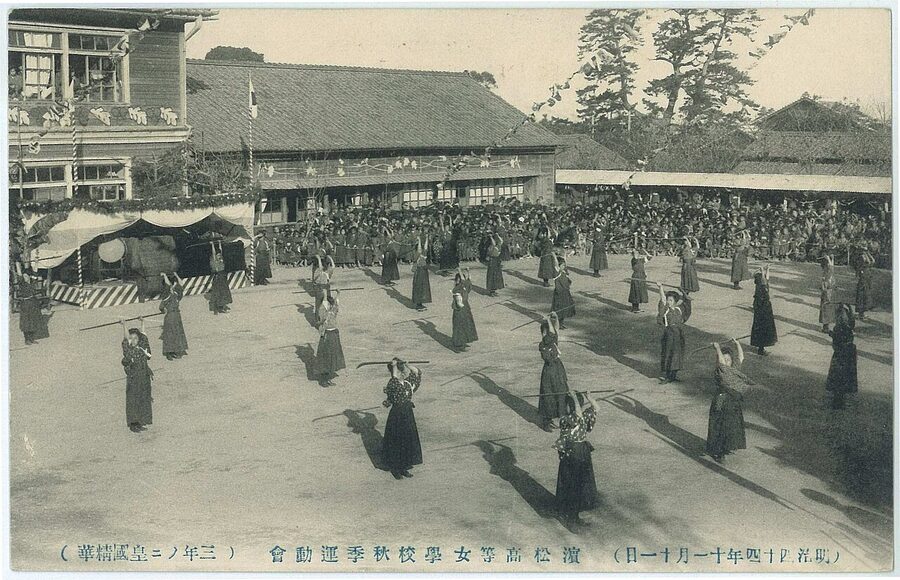
In 1940 the Butokukai merged the methods of the two leading schools, Tendō-ryū and Jikishinkage-ryū, into a single set of “basic movements of naginata-dō”, and from 1941 the National School Ordinance put naginata into the physical training of girls in the new national schools. Mitamura Chiyo refused to accept the merged syllabus and opened her own Tendō-ryū teacher-training school, which ran until the end of the war; late in the war, as the air raids grew, her circle was reportedly asked to help guard the Empress. By 1943, in the depths of the Shōwa era‘s war, schoolgirls all over Japan were drilling with naginata in front of uniformed officers, and the occupation magazines of the empire showed them to the people of Java as a model.
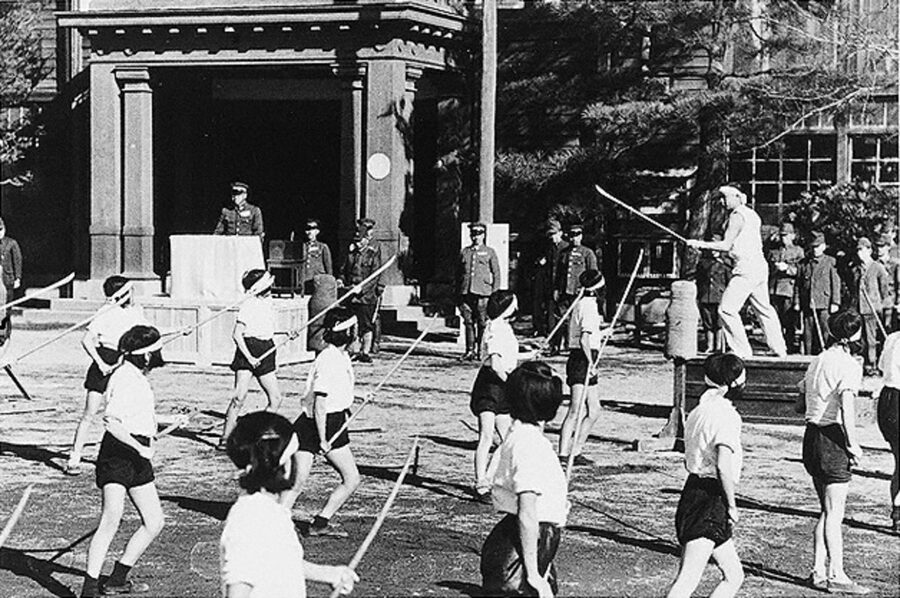
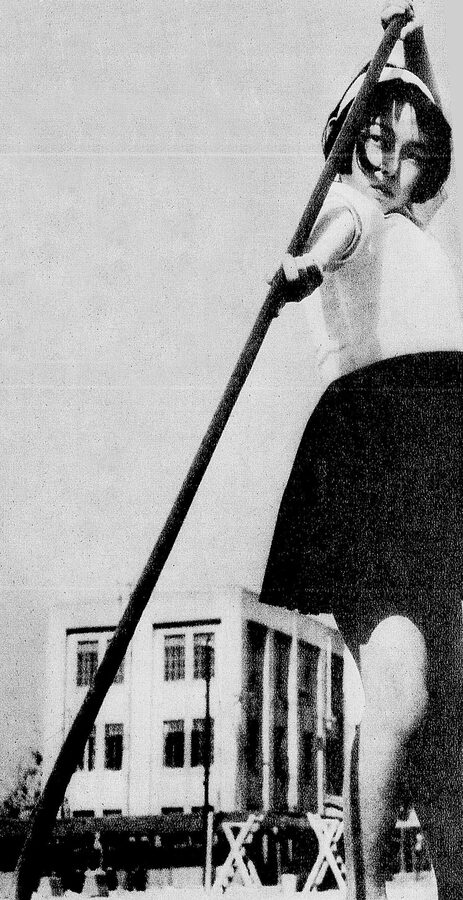
Defeat ended it at once. Martial arts were struck out of the schools, the Butokukai was dissolved, and the naginata, which had become a symbol of the girls’ war effort, was more compromised than most. The new rhetoric about character and harmony that surrounds the sport today is partly a reaction to that, and so, I suspect, is its enthusiasm for the word “sport”.
Atarashii naginata: the new naginata
The revival began in Kyoto in 1953. A committee met to bring naginata back, and on 4 May, at the first postwar festival of the martial arts at the Butokuden, the Tendō-ryū and the Jikishinkage-ryū gave demonstrations side by side. A Kinki regional federation followed in 1954 and the national All Japan Naginata Federation in 1955, though one Japanese encyclopedia gives 1954 for the national body; it split from the kendo federation it had been attached to. In 1964 the federation settled on writing the name in hiragana, なぎなた, rather than the old characters, the clearest possible signal that this was a sport and not a weapon.
The new naginata, atarashii naginata, was built for schools. The federation wrote standard kata and competition rules, in 1959 naginata returned to junior high schools as a club activity, and in 1967 it was approved as a regular part of high-school physical education. It became an event at the National Sports Festival from the Gunma games of 1983, and at the national high-school championships, the Inter-High, from the Kyoto championships of 1997.
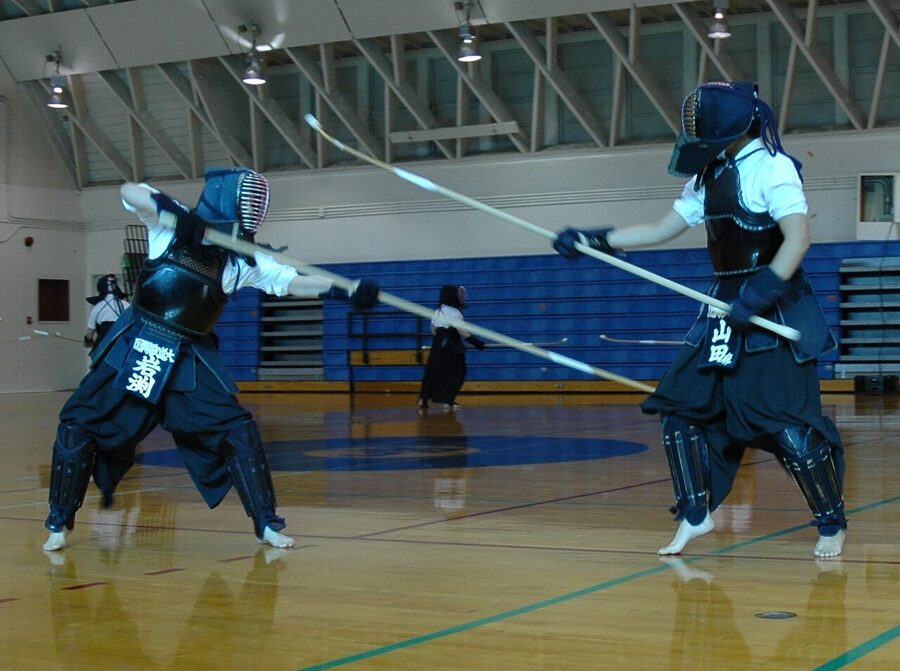
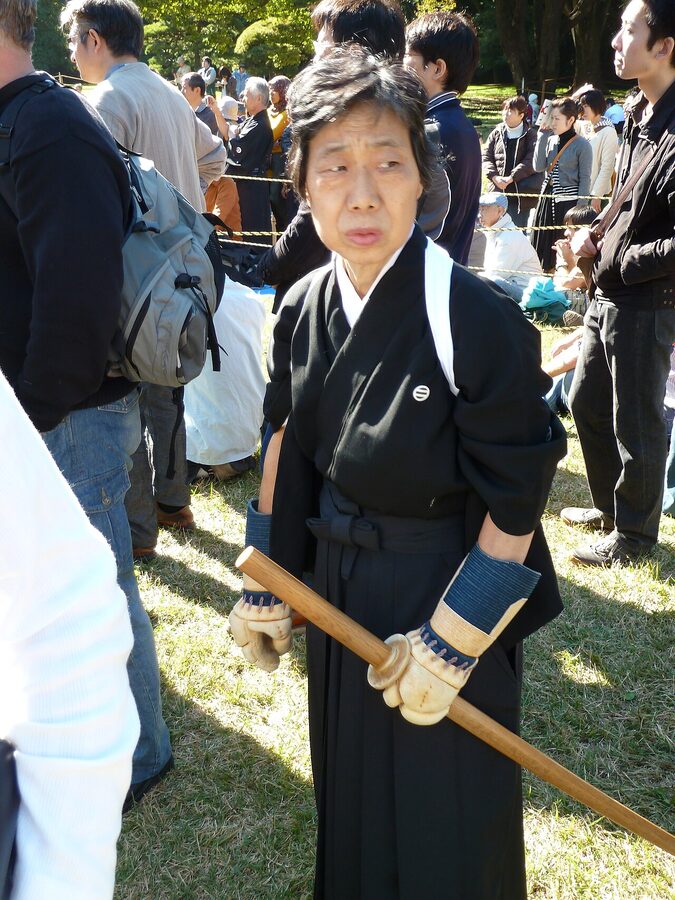
If you have watched kendo you will recognise most of what you see. The players wear the same head guard, breastplate and waist armour, the bōgu, plus shin guards, and their gloves have a separate index finger, because a naginata slides through the hands in a way a sword never does. The practice naginata is between 2.10 and 2.25 metres long, with an oak shaft and a replaceable “blade” of split bamboo, the habu, which is taped on and broken often. Bouts are fought on a twelve-metre square, a point needs two of the three referees to agree, and two points win.
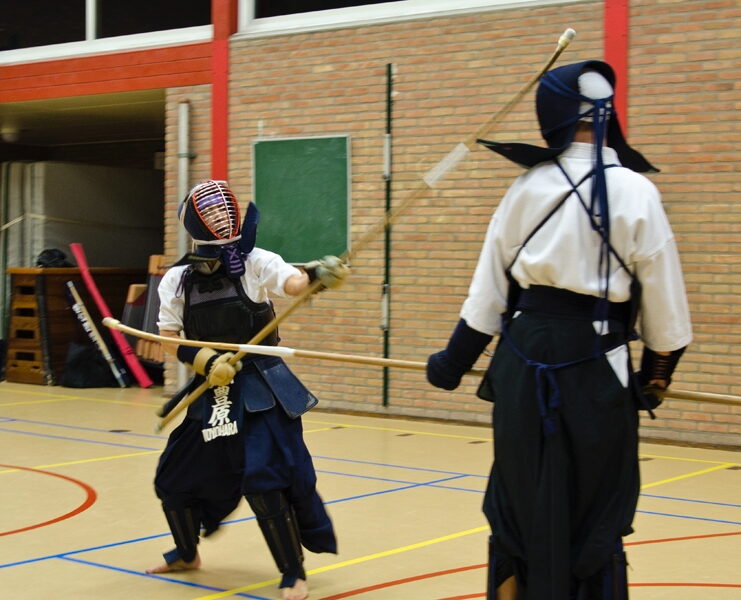
The targets are the head, the wrists, the flank, the throat and the shin, and the shin is what makes the sport. A kendo player who tries naginata spends his first month being hit on the leg by someone who cannot yet reach his head, and the footwork, constantly changing hands and leading foot, is unlike anything in swordsmanship. The federation sells it on the way it works both sides of the body equally, and that is a fair claim.
It is also, in Japan, overwhelmingly a sport for women and girls, though nothing in the rules says so. The men’s national championship is a creation of this century and still the smaller event; abroad, where clubs often grew out of kendo dojo, plenty of men practise. The International Naginata Federation was founded on 8 December 1990 with seven members (the United States, France, New Zealand, the Netherlands, Sweden, Belgium and Japan), and the first World Naginata Championships were held in Tokyo in 1995.
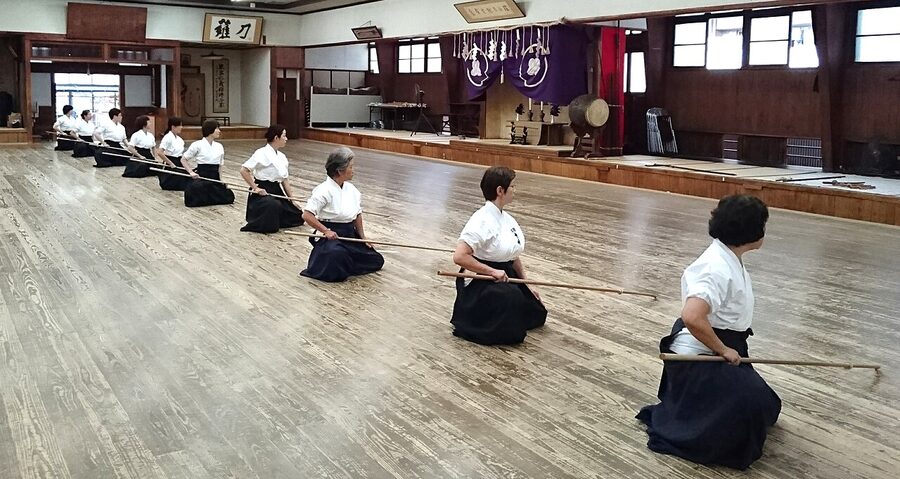
Beside the sport the old schools survive, and they are where you see what the naginata was. The Tendō-ryū traces itself to Saitō Denkibō, a swordsman killed in 1587 by the followers of a rival he had beaten, came down through the fencing masters of the Kameyama domain, and is now based at the Shūbukan in Itami, a dojo the Konishi sake-brewing family opened in 1786 to defend the town; it is known for a twisting thrust called midare. The Jikishinkage-ryū, Sonobe’s school, uses a small, light, deeply curved blade with no guard, has about six hundred members in its national body, and is famous for its kazaguruma, the “windmill”, whose wheeling return became the furikaeshi of the modern sport.
Smaller and stranger is the Toda-ha Bukō-ryū, which claims descent from a swordsman in the service of the Asakura and from the Sengoku lord Hōjō Ujikuni and his wife, and was kept for generations by a family in Chichibu. It is the school of the hooked kagi naginata, and unusually most of its forms set naginata against naginata, which made it a model when the federation drew up its own kata. Six of its heads in a row through the 20th century were women, and a Danish teacher was named deputy head by the last but one.
Where to see the naginata today
There is no naginata museum. To see the old blades you go to the places that collected weapons, and to see the art you go to a tournament or a demonstration, which are cheap or free and almost never advertised in English. These are the ones I would plan a day around.
Tokyo National Museum, Ueno
The Tokyo National Museum owns the naginata Osafune Kagemitsu signed in the eighth month of 1322, an Important Cultural Property, and the sword room on the second floor of the Honkan, Room 13, rotates blades from the collection every few weeks, so check the museum’s list of works on display before you go. The collection also includes the Gosannen Kassen Emaki and Shitomi Kangetsu’s Tomoe Gozen, neither of them always out, and a faithful copy of Honebami made by the first Echizen Yasutsugu before the 1657 fire. If no naginata is on show, the swords alone justify the trip.
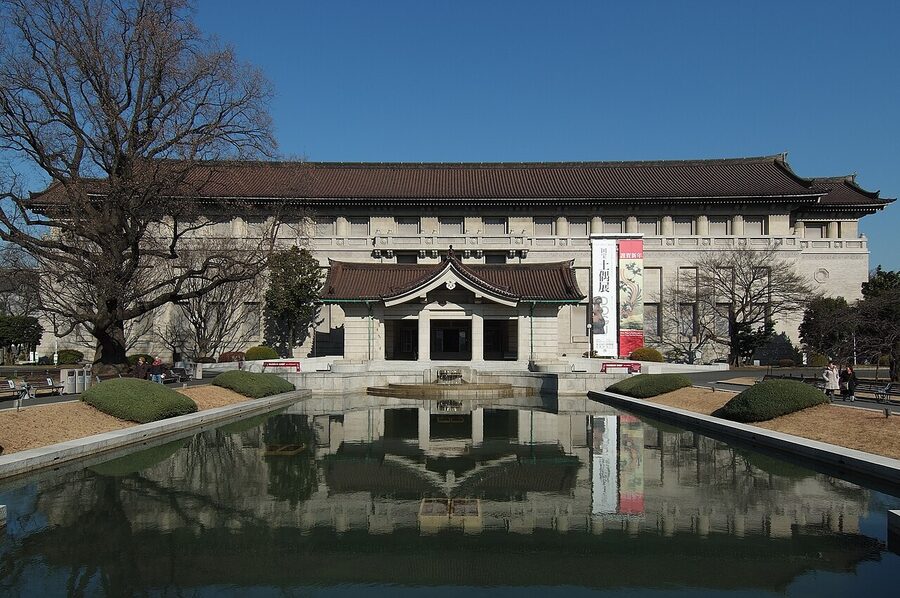
The museum is open 9:30–17:00, until 20:00 on Fridays and Saturdays, and closed on Mondays (on Tuesday instead when Monday is a holiday). Admission to the collection is ¥1,000 for adults and ¥500 for university students, free for anyone under 18 or over 70, and buying online saves a queue at the Main Gate that can run past half an hour. It is a ten-minute walk from JR Ueno or Uguisudani Station.
Ōyamazumi Shrine, Ōmishima
If you go to one place for old weapons, go to Ōmishima, an island in the Inland Sea on the Shimanami Kaidō between Onomichi and Imabari. Ōyamazumi Shrine, patron of the Mishima navies, received armour and blades from warriors for centuries, and it holds about two-fifths of all the armour Japan has designated as National Treasures or Important Cultural Properties. Among the weapons designated in 1966 are seven naginata: one is really a nagamaki, signed Muneyoshi; five are unsigned; and one is signed by Yoshiie, land steward of Iwato-no-shō in Bizen, and dated the twelfth month of the second year of Gentoku, an era that ran from 1329 to 1331.
You will read in English that the shrine keeps naginata given by Benkei and by Tomoe Gozen. I have not found either attribution in the official designation or in the shrine’s own material, and I would treat them the way I treat Jōmyō’s arrow count. The things that are certain are better anyway: a National Treasure ōdachi of 180 centimetres attributed to the smith Tomoyuki of Bungo and linked to the warrior Ōmori Hikoshichi, armour associated with Kōno Michiari, who fought the Mongol invasions, and, by shrine tradition, the corselet of Tsuruhime, the priest’s daughter said to have fought in a sea battle of 1541.
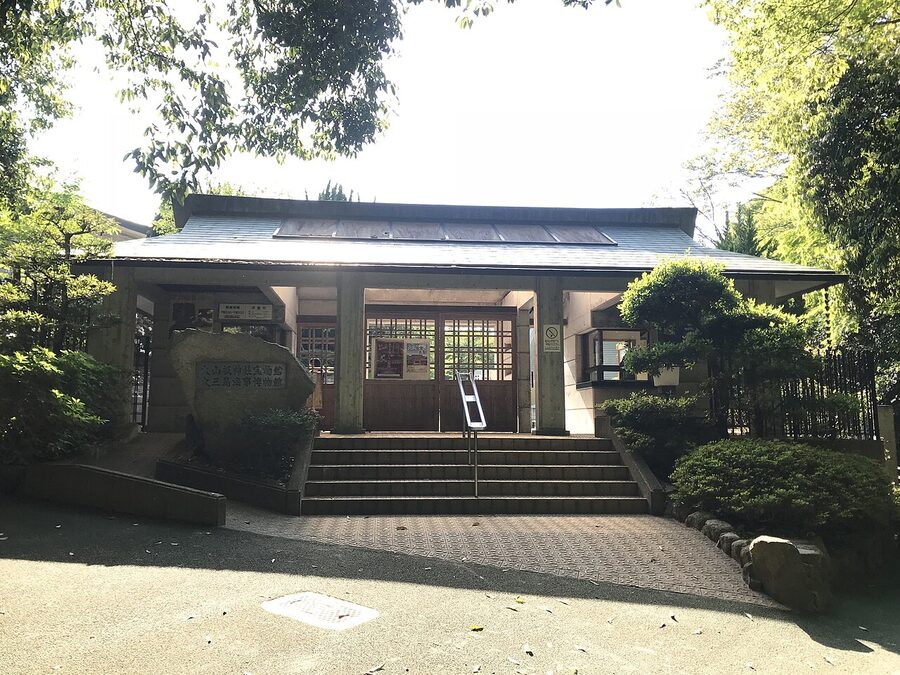
The two treasure halls, the Shiyōden and the Kokuhōkan, are open 9:00–16:30 with last entry at 16:00, and a combined ticket was ¥1,000 for adults when I last checked; the shrine’s website does not publish the fee, so take cash. From Imabari Station an express bus to Miyaura-kō takes about an hour and stops at Ōyamazumi-jinja-mae, and by car the shrine is about four kilometres west of the Ōmishima interchange. If you are cycling the Shimanami Kaidō, it is the obvious detour.
Nikkō Tōshōgū
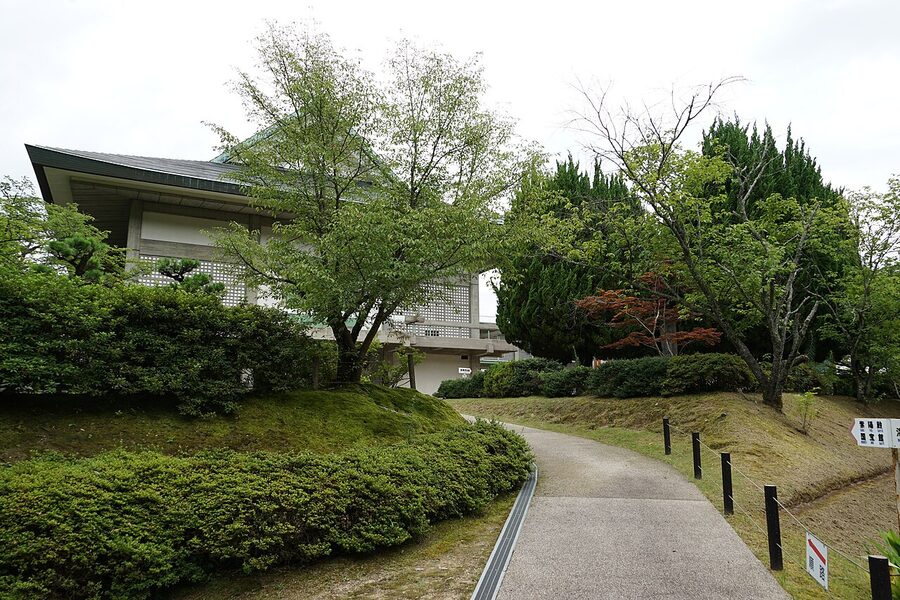
The treasure museum at Nikkō Tōshōgū owns an ōnaginata with a blade of 65.9 centimetres and a tang longer still, 77.7 centimetres, which shows you how far back into the shaft the steel went. It is not always on display, but the museum’s Tokugawa arms are strong and it is a short walk from the shrine. Hours are 9:00–17:00 from April to October and 9:00–16:00 from November to March, with tickets on sale until thirty minutes before closing; the museum alone is ¥1,000, the shrine alone ¥1,600, and a combined ticket ¥2,400.
Kyoto and Uji: the Bone-Eater and the bridge monks
Honebami is kept at the Kyoto National Museum on deposit from Toyokuni Shrine, and it appears in exhibitions rather than on permanent display, so watch the museum’s programme. Toyokuni Shrine itself, a short walk from the museum, was rebuilt in the Meiji era for Hideyoshi, and its great gate is by tradition a survivor of Fushimi Castle.
Every year on 24 July, in the second procession of the Gion Matsuri, the Jōmyō-yama float carries the Uji bridge fight through the streets: Ichirai Hōshi caught in mid-vault over Jōmyō on the beam. The floats stand in their neighbourhoods for a few evenings beforehand, and that is when you can walk up and look at the figures properly, which you cannot do during the procession itself.
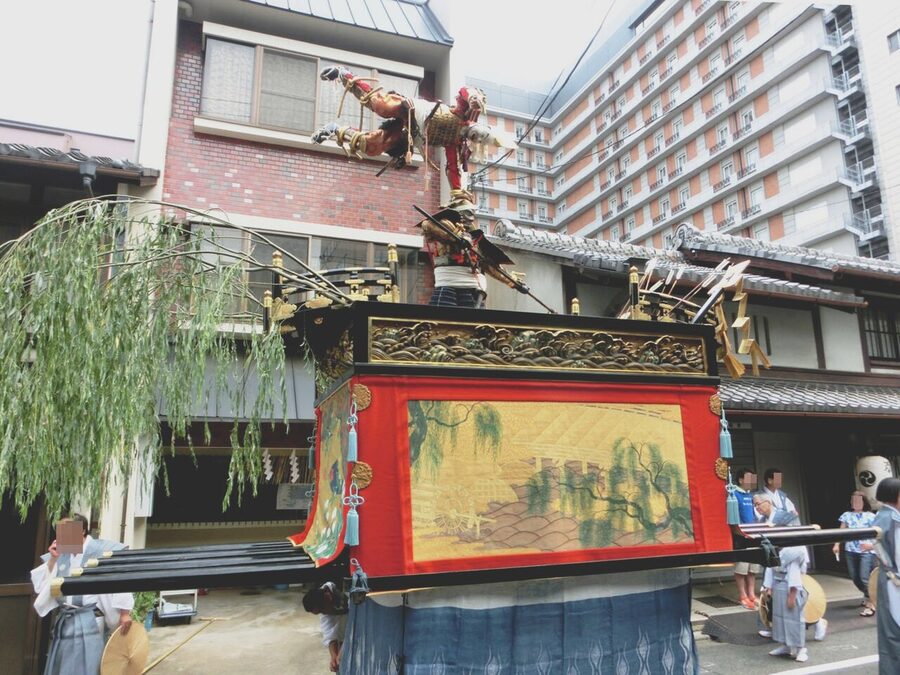
Then go to Uji, half an hour south. At Byōdō-in the fan-shaped lawn inside the gate is where Yorimasa is said to have killed himself after the bridge fight, the river is a few minutes’ walk away, and admission to the garden and museum is ¥700. Stand on the modern Uji bridge, look down at the current, and Jōmyō’s walk along a bare beam starts to look less like a story and more like a death wish.
Watching naginata: the Empress’s Cup and the Budokan
The 71st All Japan Naginata Championship, the Empress’s Cup, is on Sunday 6 December 2026 at the Tokyo Budokan in Ayase, six minutes’ walk from the east exit of Ayase Station. The opening ceremony is at 9:30, a demonstration at 9:50, bouts from 10:30 and the closing ceremony at 14:30, and the men’s championship is in the same hall the day before. The federation’s notice is written for competitors and says nothing about tickets, so ask the Tokyo naginata federation before you travel.
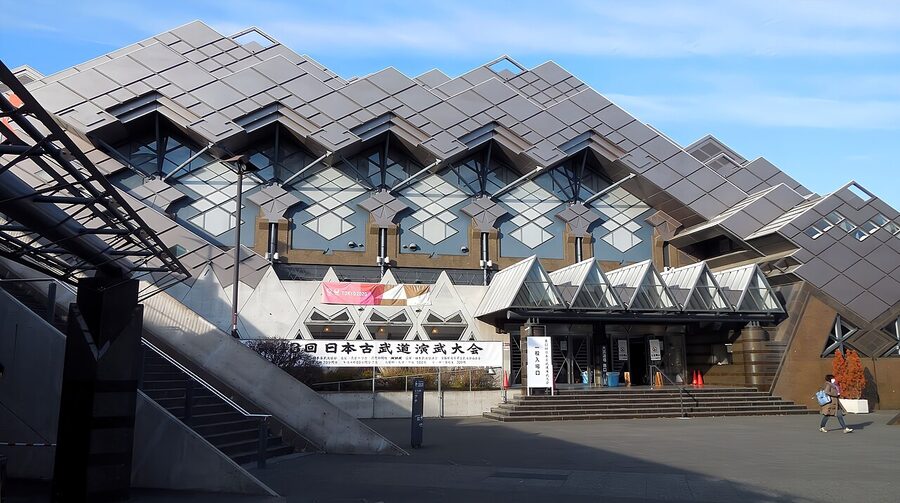
For the old schools, the event to aim for is the Japanese Kobudō Demonstration at the Nippon Budokan in Kudanshita, held at the start of February: the 49th was on 1 February 2026, free to watch, with schools taking turns on the main floor, and the Jikishinkage-ryū naginata has been among them. The Budokan publishes the programme in Japanese a few weeks ahead.
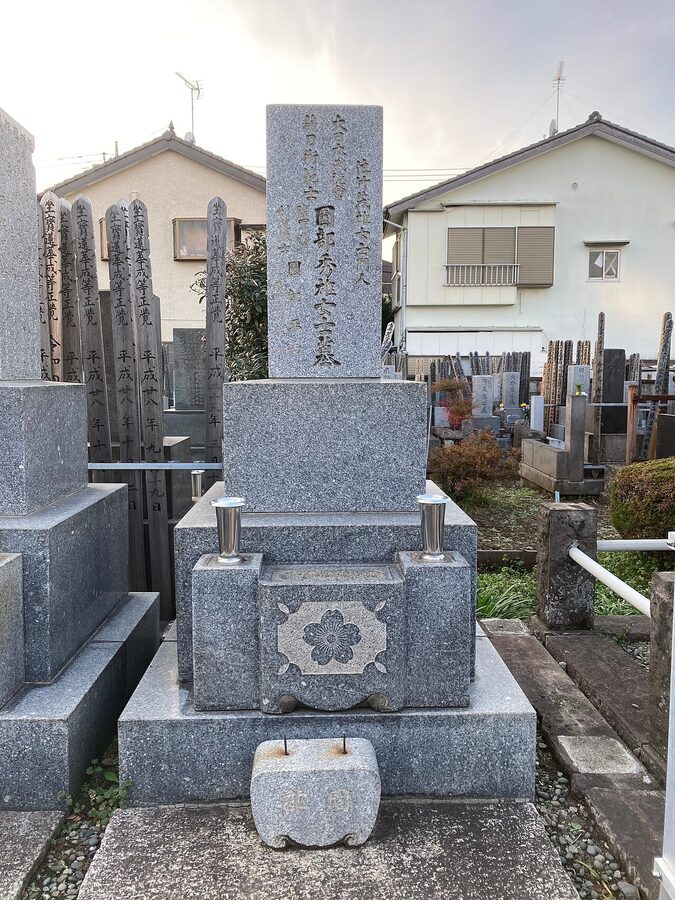
Itami, between Osaka and Kobe, likes to call itself the home of naginata, with reason: the federation has its headquarters there, the city teaches naginata in its schools, and the Shūbukan, where the Tendō-ryū has its main dojo, has been teaching since the 18th century. It is a working dojo, not a museum, so write before you turn up. And in Tokyo, if you are passing through Shimotakaido in Suginami, Sonobe Hideo is buried at the temple of Sōgen-ji, under a plain stone.
Red and white
Come back to the entry form. The red and white sash every Empress’s Cup fighter must bring is the same kind of cord the women in Chikanobu’s Ōoku prints use to tie back their sleeves, and the shin they are aiming at is the one Genpei foot soldiers cut at under the horses. Most of what lies between, the hooded monk, Benkei on the bridge, the bride with her lacquered blade, was put together after the fact by people who wanted the naginata to mean something. If you are in Tokyo in early December, take the train out to Ayase and watch two fourth-dan women go for each other’s shins: it is the oldest thing in the building, and the least embroidered.