When the defenders of Ōta gave up, in the fourth month of 1585, Toyotomi Hideyoshi did something that looked like mercy. Fifty-three of their leaders lost their heads. The farmers who had held out beside them for a month, behind a lake of Hideyoshi’s making, were told they could go home, and they could take their hoes, their tools and their household goods with them. They could not take their guns.
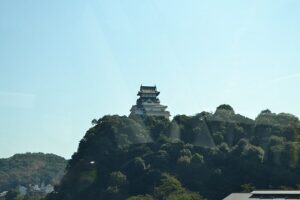
Japanese historians call that order the first sword hunt, the trial run for the disarmament of the whole country three years later. It was also the end of a province that had run itself for a century without a real lord, and Wakayama Castle is the building that was put down on top of it. Work started that same year on a low hill across town from Ōta. The castle became the seat of one of the three senior branches of the Tokugawa and sent a lord to Edo to be shogun, its keep burned twice, and what stands on the hill today is a concrete copy, made in 1958, of a keep that was itself a copy made in 1850.
I like Wakayama more than its reputation suggests. The keep makes no secret of being a reconstruction, but it stands on walls laid by three regimes in three different styles, and around the town are the places that explain why the castle is there at all.
In This Article
- A province without a lord
- Monks with matchlocks
- The Saika league, and the man in the print
- Spring 1585
- Sengokubori and the burning of Negoro
- Water at Ōta
- Kōyasan bends
- A castle on the crouching tiger
- The Asano years
- A son for the south
- What gosanke meant
- Too big for comfort
- Kishū Tōshōgū and the poets’ bay
- The lord who left for Edo
- Kyōhō
- What Edo did to Wakayama
- Three keeps on one hill
- After the lords
- The night of 9 July 1945
- Concrete, 1958
- Reading the walls and the garden
- Three walls, three regimes
- The covered bridge
- Momijidani and the Nishinomaru
- The gates that survived
- Where to visit Wakayama Castle today
- Getting there
- The keep and the grounds
- The garden, the bridge and the teahouse
- Ōta and the fifty-three
- Kishū Tōshōgū and Wakaura
- Kimiidera
- Negoro-ji
- Further afield
A province without a lord
In the late 16th century the Jesuit Luís Fróis described Kii as a land of four or five religious “republics”, each so strong that no war had ever destroyed it. He named Kōyasan, Kokawa-dera, Negoro-ji and the Saika, and Japanese historians usually add the shrines of Kumano, at the far end of the Kumano Kodō, as the fifth. The Hatakeyama governors could not rule Kii without the temples. No warlord ever grew out of the province to unite it, which is the main reason somebody from outside eventually came to do it for them.
Under medieval custom a great temple’s grounds were closed to government police and tax collectors, and anyone who got inside, debtor or fugitive, was beyond reach. Kōyasan and Negoro grew into temple towns that were rich, armed and neutral, and they meant to stay that way.
Monks with matchlocks
Negoro-ji began as a quarrel on Kōyasan. The monk Kakuban, who wanted to reform the mountain’s teaching, was driven off it in 1140 by rivals who burned his quarters, and he settled at Negoro, under the Izumi hills on the north side of the Kinokawa valley. In 1288 his successors moved their whole institution down there, and Negoro became the head of a separate branch of Shingon Buddhism. By about 1575 the precinct held at least 450 lodges and more than 5,000 people; some accounts put the number of halls and lodges at 2,700.
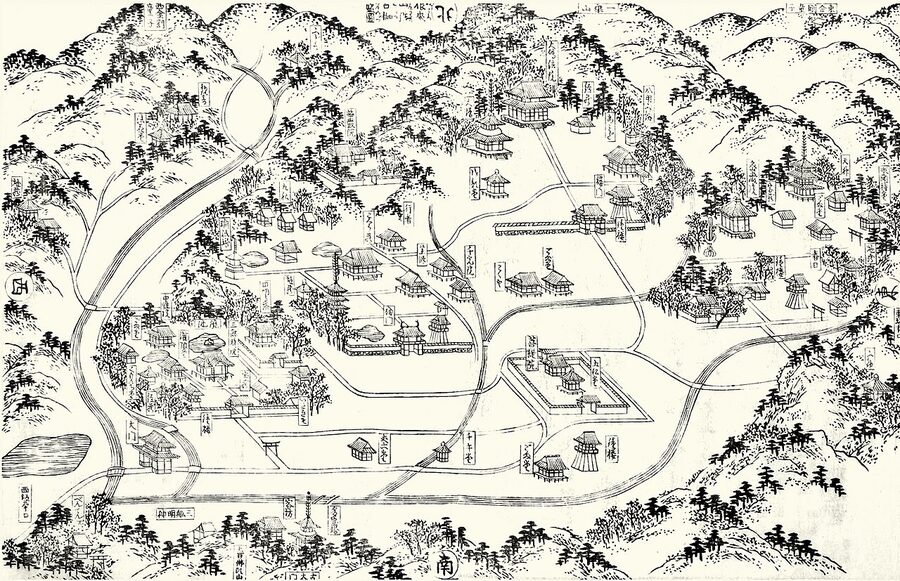
The fighting strength belonged to the gyōnin, the working monks who managed the estates and guarded the gates, rather than to the scholar monks. Local landed families from Kii, Izumi and Kawachi built lodges inside Negoro and installed their sons at the head of them: the Tsuda at Suginobō, the Tsuchihashi of Saika at Senshikibō. Their representatives met in a council that set the temple’s policy. In practice the “monks of Negoro” were a league of country gentry operating under a temple’s name.
And they had guns early. The matchlock reached Tanegashima in 1543, and the tradition is that a Negoro man, Tsuda Kazunaga, brought one back soon afterwards. Where Negoro and its neighbours found the iron and above all the saltpetre is still not clear; saltpetre had to be imported, and Kii had a port.
The Saika league, and the man in the print
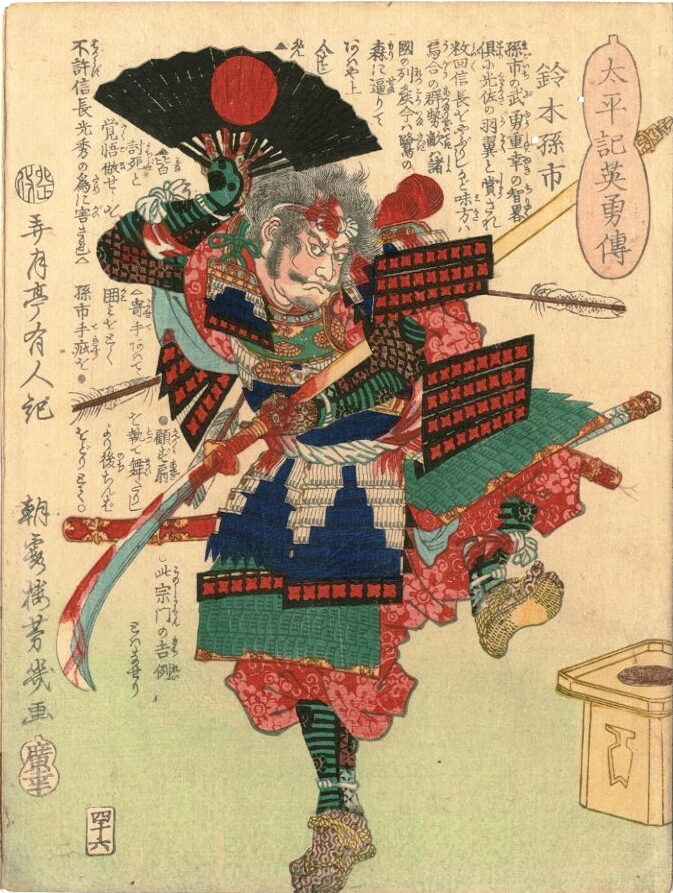
Saika was not a temple but a coalition of villages around the mouth of the Kinokawa: five districts of fishermen, shippers and farmers whose leading families ran their own affairs. A chronicle from across the strait in Awa describes Saika as a country with no governor, “held by the farmers”. The name is pronounced Saika; English books often write it Saiga, which Japanese scholars regard as a plain misreading. The word first turns up in 1535, in the diary of a son of the Honganji patriarch Rennyo, who noted some three hundred Saika men arriving to help at Osaka.
The popular picture of Saika is a band of devout Ikkō Buddhist gunmen fighting to the death for the Honganji against Oda Nobunaga, and most English-language accounts repeat it. Some Japanese dictionaries say much the same. The documents are messier: the historian Takeuchi Yoshinobu has shown that Saika held followers of the Jōdo and Shingon schools as well as the Honganji, that the leading Tsuchihashi family worshipped at a Jōdo temple, and that Saika troops fought on Nobunaga’s side in 1570. His conclusion is blunt: there is no evidence that the Saika league as a whole ever went to war for the Honganji.
What happened instead was a split. The Honganji’s followers in Saika, with men like Suzuki Magoichi at their head, joined anti-Nobunaga families such as the Tsuchihashi in what Japanese scholars call the Saika Ikkō ikki, while three of the five districts stayed out and, in 1577, went over to Nobunaga. When he invaded that spring, the Saika men, by an Edo-period account, sank stakes and spear-heads in the bed of their river and held the far bank with volley fire, and they fought him to a stalemate. Magoichi and six others signed a pledge of submission that Nobunaga accepted on the 15th day of the third month, and within months Saika was fighting again.
Suzuki Magoichi is the name everyone remembers, and he is a slippery man. The first reliable document to mention him is a sworn oath of 1562 addressed to thirty-six Saika men, among them “Lord Suzuki Magoichi”; he signed his own letters Suzuki Magoichi Shigehide, and a court noble’s diary calls him “Magoichi of Saika”. Later writers piled several people under the name, a father, a brother, a son. The grave shown as his at Renjō-ji in Hirai belongs, by its own inscription, to a different Suzuki.
Shiba Ryōtarō made him a swaggering hero in the novel Shiri-kurae Magoichi, filmed in 1969, and comics and games took it from there. The Magoichi of the documents is less heroic and more interesting. Early in 1582, with Nobunaga’s approval, he had his rival Tsuchihashi Wakadayū murdered and made Saika an Oda client. On the morning of the 3rd day of the sixth month news of the Honnō-ji incident reached Saika from Sakai, and Magoichi was gone by nightfall.
Spring 1585
Saika and Negoro had picked the wrong side once too often. In 1584, while Hideyoshi was fighting Tokugawa Ieyasu in the Komaki-Nagakute campaign, the Kii men marched on his new capital behind his back. They attacked Kishiwada Castle, seized Sakai and burned their way into the unfinished town around Osaka Castle, and for a few days the looting was said to be as bad as Azuchi’s after Nobunaga’s death.
With Ieyasu dealt with, he turned south. Early in the third month of 1585 he sent the monk Mokujiki Ōgo to Negoro with terms: give back part of the land you have taken, and keep the rest. The Negoro council split, and the hardliners settled the argument by firing guns into Ōgo’s lodgings at night. He went home to Kyoto in a hurry.
Sengokubori and the burning of Negoro
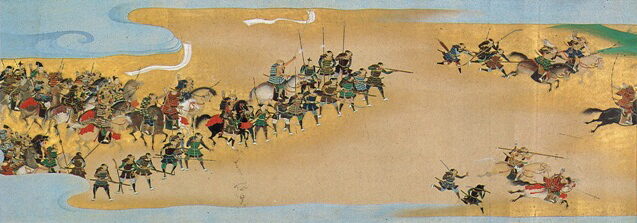
Hideyoshi left Osaka on the 21st day of the third month with an army that Japanese accounts put at 100,000, though another count gives 60,000 for the force that entered Kii. Facing him on the Izumi border was a line of forts with about 9,000 men. The first one hit was Sengokubori, held by some 1,400 or 1,500 of Negoro’s best fighters with several thousand non-combatants inside.
The gunfire was so heavy that Hideyoshi’s nephew Hidetsugu, commanding the assault, had more than a thousand men killed or wounded in about an hour, by the usual account. Then a fire arrow from the Tsutsui contingent dropped into the fort’s powder store, and Sengokubori blew up and burned. Hideyoshi ordered that nobody inside was to live; the chroniclers say even the horses, dogs and cats were killed. Within three days every fort on the line had fallen or surrendered.
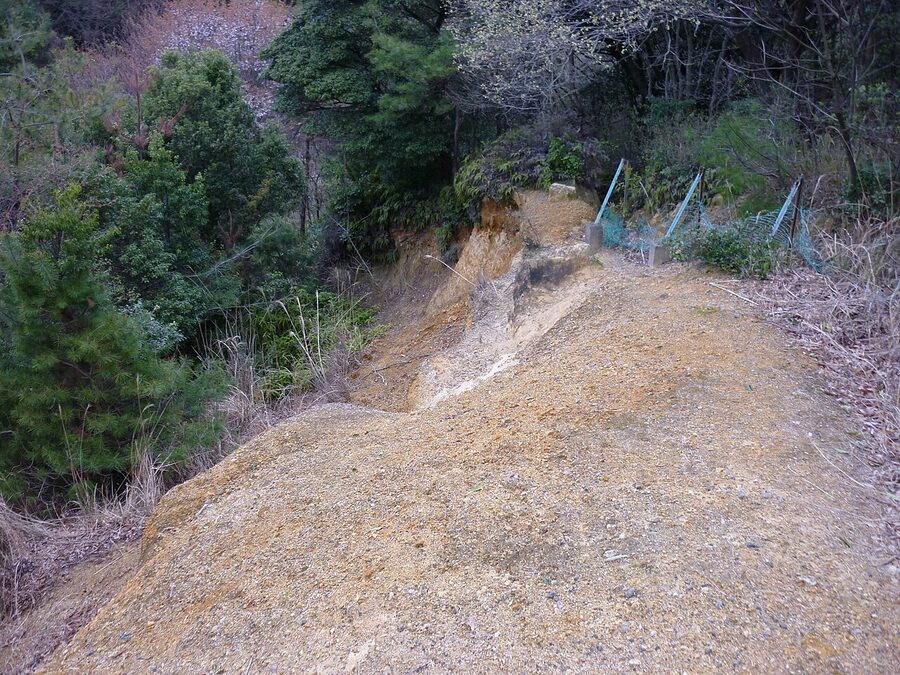
On the 23rd Hideyoshi reached Negoro and found it nearly empty, its fighting men lost on the Izumi front. That night the temple caught fire and burned for three days, and the Honganji’s priests, then living at Kaizuka on the Izumi coast, said they could see the sky glowing red. Nobody knows who started it. Japanese historians list three suspects, the monks themselves, Hideyoshi, and his soldiers acting without orders, and none of them can be proved.
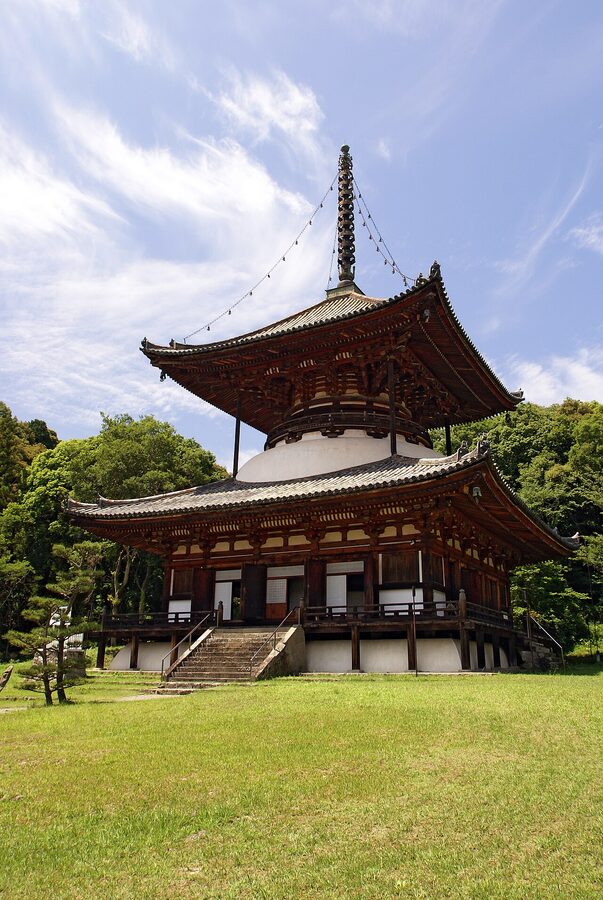
The great pagoda and the founder’s hall survived, and so did the main hall, the Daidenpō-dō, which Hideyoshi then took anyway. He had it dismantled and carted off to be the main hall of the Tenshō-ji, a temple he was planning on Funaoka-yama in Kyoto for Nobunaga’s memory. The temple was never built. The timbers were left lying beside a river in Osaka, at a place that is still called Denpō.
Water at Ōta
What was left of Saika fell apart from the inside. On the 22nd one Saika faction changed sides and opened fire on its neighbours, and Tsuchihashi Heijō fled by boat to Tosa. On the 25th, with Saika burning, Hideyoshi paid a visit to Kimiidera, the hill temple across the bay. The last of the resistance gathered at Ōta, a moated village in the Miya district near the great shrine of Hinokuma and Kunikakasu, under Ōta Sakon Munemasa, with perhaps 5,000 people inside.
Fróis wrote that Ōta was like a town, and it was: a farming settlement ringed with water channels, not a fortress on a hill. Hideyoshi first planned to starve it out, then decided that would take too long, and he did not want a storm either, probably because Sengokubori had cost so much and a bloody assault would look like a struggle. From the 28th day of the third month his men raised a dike around the village and turned the river into it.
The traditional figures for the dike are 7.2 kilometres long and 7 metres high, and it was finished by the 5th day of the fourth month. Some Japanese scholars now think it was much smaller, a short bank that used natural levees and a river terrace to pond the Miyai river, with Ōta itself a little south of where its monument stands today. Either way the water rose. On the 8th the village’s own flood bank gave way, and on the 9th part of Hideyoshi’s dike burst and drowned many of Ukita Hideie’s men, which the defenders took as a sign from the gods.
On the 21st Hideyoshi floated Konishi Yukinaga’s warships into the new lake and attacked from the water, and although the attack was beaten off, the defenders had had enough. They surrendered on the 22nd (one account says the 24th) and gave up fifty-three heads. The wives of the leading men, twenty-three of them, were crucified, and the heads were displayed at Abeno outside Osaka. The rest went home, with their tools and without their weapons.
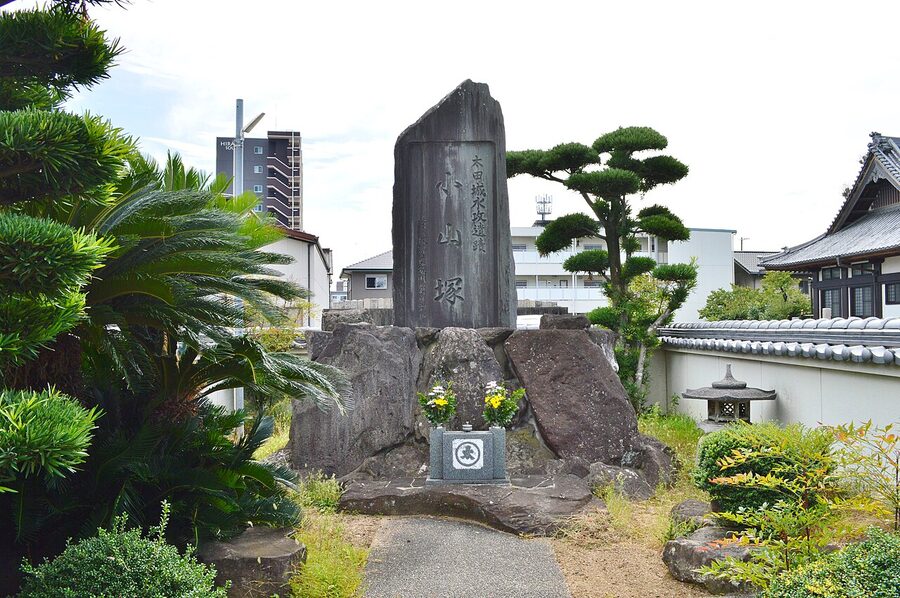
The historian Kaizu Ichirō calls the siege a climax of Japanese history, the moment when the armed religious communities of the middle ages met the new order head on, and he calls Kii the birthplace of “Hideyoshi’s peace”. That is a big claim for a muddy month in a flooded village, but the Sengoku era had few fights that changed as much. Two months later the sword hunt was extended to the whole of Kii and to Kōyasan, and on the 8th day of the seventh month of 1588 to all of Japan.
Kōyasan bends
Kōyasan was next. On the 10th day of the fourth month, with Ōta still holding out, Hideyoshi sent the mountain an ultimatum: hand back most of the land you have taken over the years, give up your weapons, stop sheltering fugitives, or be burned. The monks argued it out and accepted. On the 16th Mokujiki Ōgo, the same monk Negoro had shot at, went down to Hideyoshi’s camp carrying the mountain’s two greatest treasures, a letter in the hand of Emperor Saga and a document bearing the handprint of Kūkai.
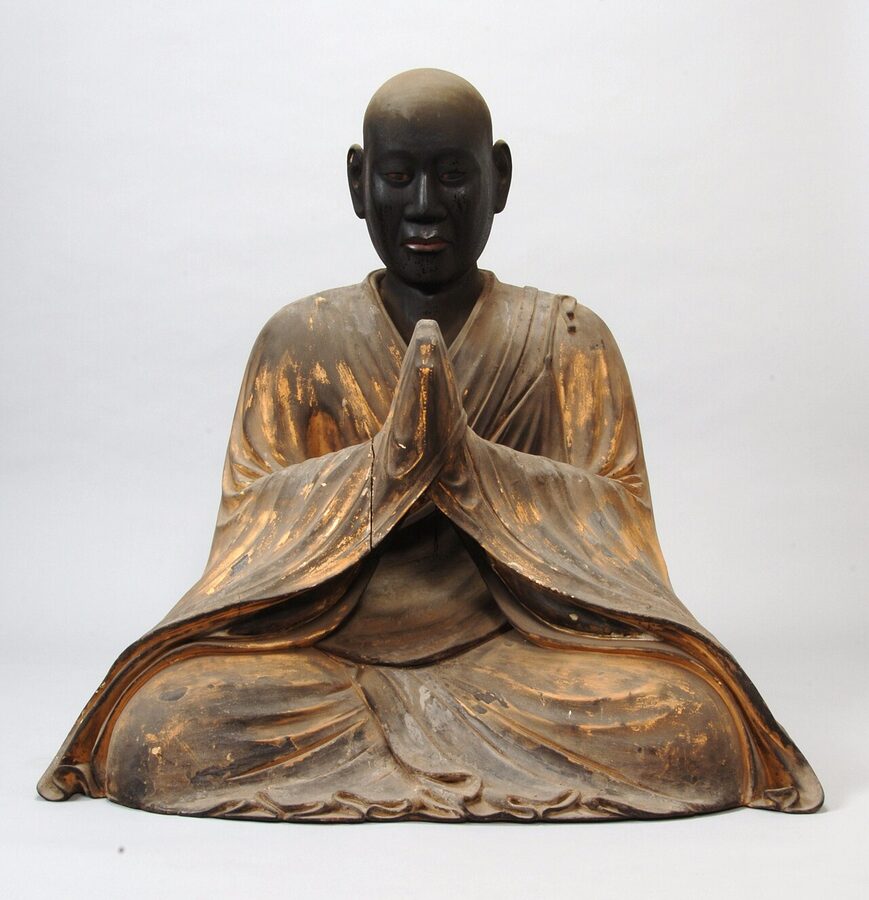
It worked. Hideyoshi spared the mountain, the disarmament was finished by the 23rd day of the tenth month, and in 1591 Kōyasan was confirmed in an estate of 10,000 koku, with another 1,000 for Ōgo himself. The year after that, Hideyoshi founded a temple there for the memory of his mother, the forerunner of today’s Kongōbu-ji. Kōyasan survived by giving up exactly what Negoro and Saika had died trying to keep.
A castle on the crouching tiger
Kii went to Hideyoshi’s younger brother Hidenaga, along with Izumi, on top of the Yamato lands he already held. The site for the new castle was a hill near the river mouth then called Okayama and now Torafusu-yama, “the hill of the crouching tiger”: 48.9 metres high, with the Kinokawa on its north side as a ready-made moat. Hideyoshi is said to have picked the spot himself and laid out the plan, and the building was put in the hands of Tōdō Takatora, who was making his name as an engineer. It took about a year.
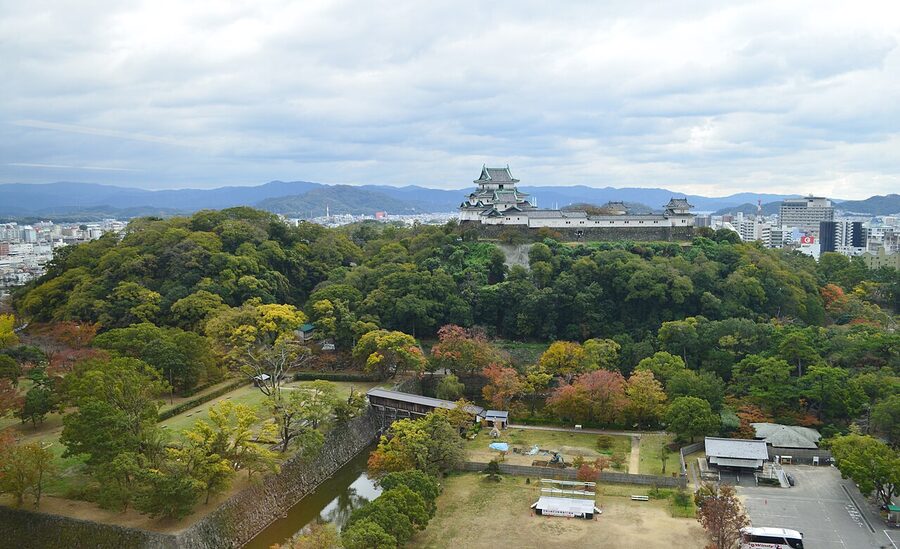
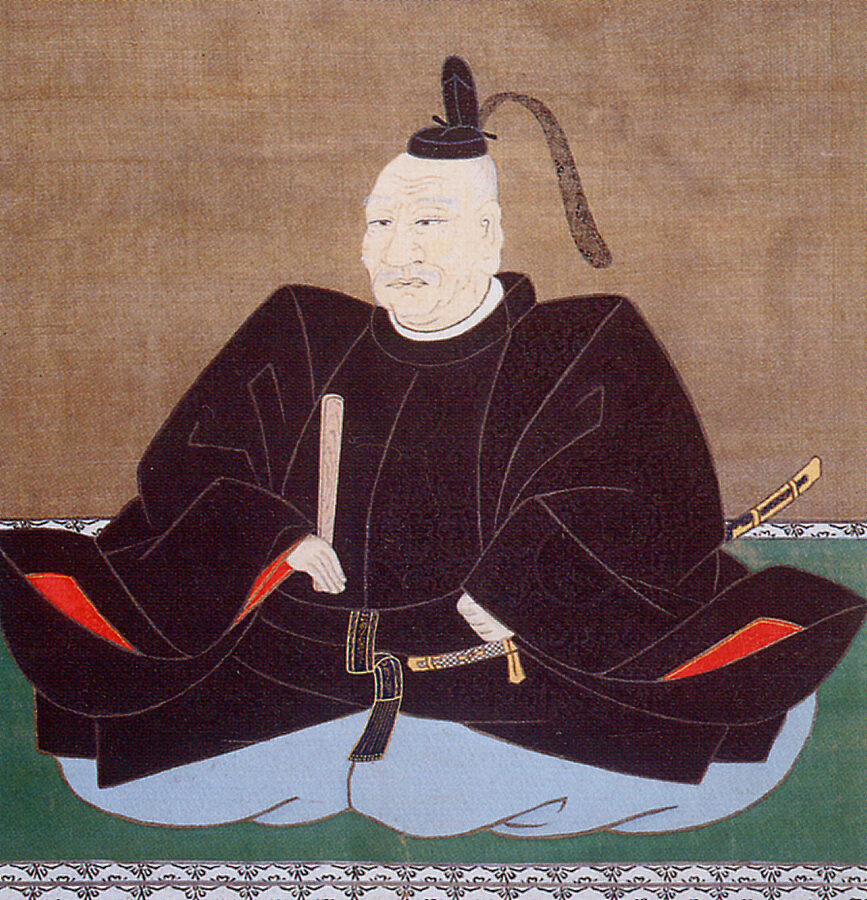
The name had been written with characters meaning “young mountain”, and at about this time it was rewritten with the waka of classical poetry, as in Wakanoura, the poets’ bay to the south. Hidenaga himself stayed at Kōriyama in Yamato and left Wakayama to Kuwayama Shigeharu, a veteran soldier who had learned his tea from Sen no Rikyū. The first Wakayama Castle was a modest place: low walls of rough, greenish schist following the lie of the hill.
The Asano years
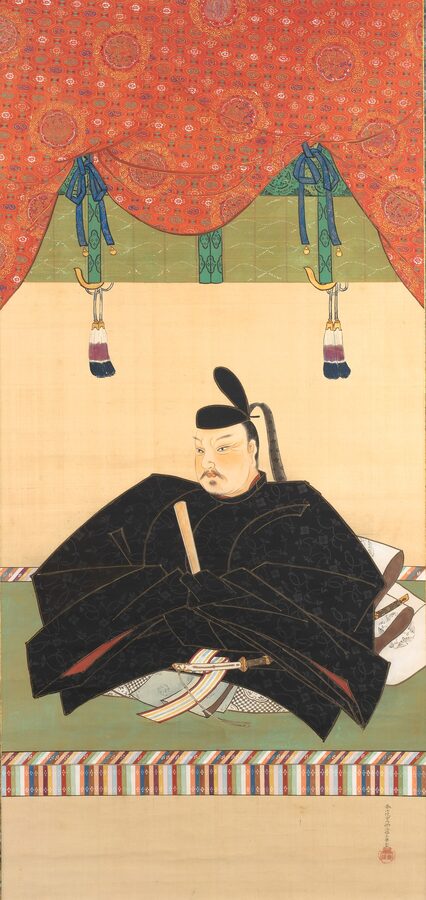
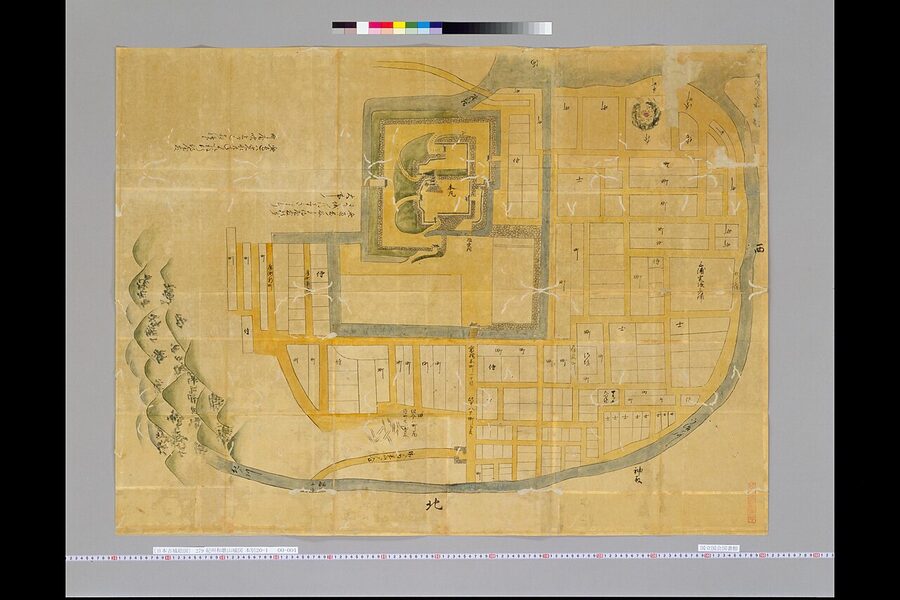
Kuwayama and his grandson held the castle until 1600, when they sided with Ieyasu at Sekigahara. Kii then went to Asano Yoshinaga with about 376,000 koku as a reward for his part in the campaign, and the castle became a great lord’s seat for the first time. The Asano built a connected keep on the west peak of the hill, to the same plan as today’s but faced in black weatherboarding, and they turned the castle round: the main gate moved from the Okaguchi side to the Ichi-no-hashi side facing the town, and a new main street, Honmachi, was laid out to meet it.
When that keep went up is disputed. One Japanese reference gives about 1605 and another says only that it stood by 1606, and there are two schools on who built the keep that burned in 1846: the Asano around 1600, or the Tokugawa after 1619. Yoshinaga died without an heir in 1613, and his younger brother Nagaakira took over.
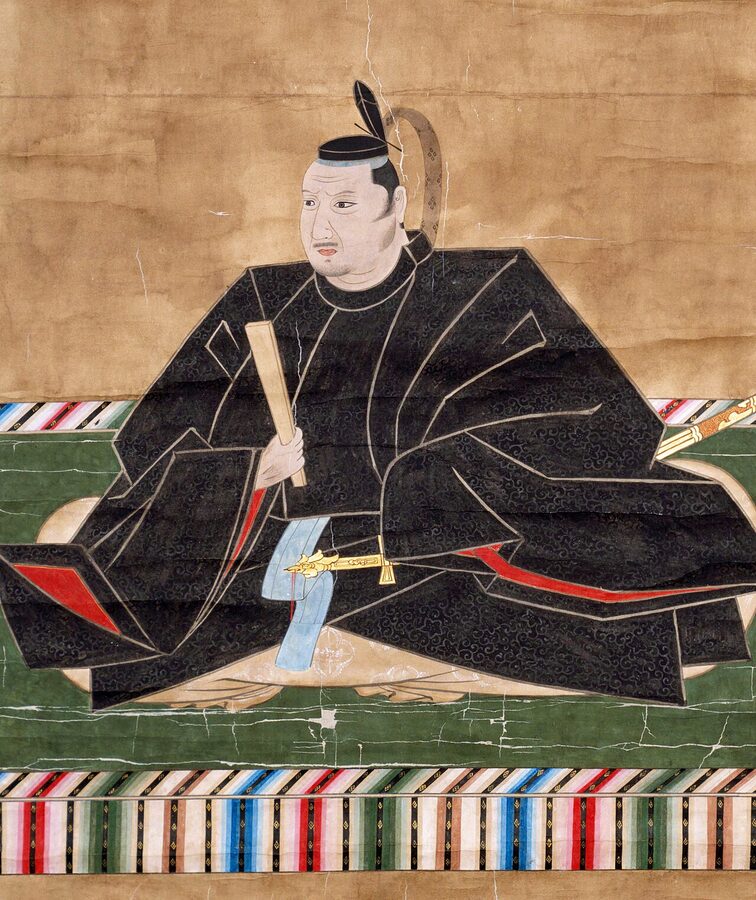
Nagaakira had the harder time. During the Osaka campaigns of 1614 and 1615 the gentry of Kii rose twice behind his back, the second time in the fourth month of 1615, aiming at Wakayama Castle while he was away; the Asano put them down and executed 443 people. That same spring an Osaka force sent to take Wakayama met Nagaakira at Kashii and lost one of its commanders, Ban Naoyuki. Four years later the shogunate took Hiroshima away from Fukushima Masanori and gave it to the Asano, who stayed at Hiroshima Castle for the rest of the Edo period.
A son for the south
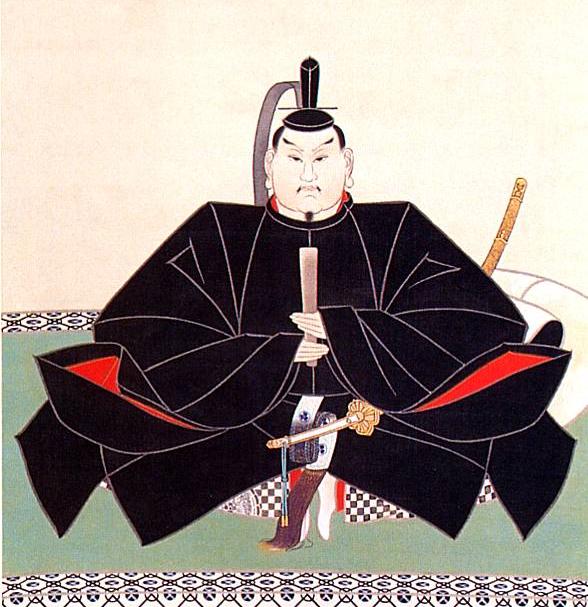
In the seventh month of 1619 Tokugawa Yorinobu, Ieyasu’s tenth son, was ordered to Kii with 555,000 koku: the province, a large slice of Ise and a sliver of Yamato. He was eighteen by Japanese count. He had been given Mito as a baby and, as a boy, the rich domain of Sunpu, where his father spent his last years. Ieyasu had died in 1616, so it was Hidetada who made the transfer: carrying out his father’s wishes, in one reading, or showing that he could move even the son Ieyasu had kept at his side to the end.
The reasons are easy to see on a map. Kii sits across the southern approach to Osaka, guards the sea route between Edo and Osaka, and had just been held by an outside lord, a tozama. A Tokugawa son with half a million koku at Wakayama could keep an eye on the western daimyo and hold the region until help came from Edo. Yorinobu, by one account, asked for Osaka Castle instead and was turned down.
What gosanke meant
Yorinobu’s house became one of the gosanke, the “three houses”. Ieyasu set three of his youngest sons up as great lords bearing the Tokugawa name: Yoshinao, the ninth, at Nagoya with 619,500 koku; Yorinobu, the tenth, at Wakayama; and Yorifusa, the eleventh, at Mito, eventually with 350,000. They ranked below the shogun and above every other lord in Japan, and if the main line ever ran out of heirs, the next shogun could come from one of them.
That last clause was the point. Ieyasu knew his history: the line of Minamoto no Yoritomo, the first Kamakura shogun, had died out in 1219, and he had no intention of letting that happen to his own. The gosanke were insurance, and their lords sat apart from the rest; the Mito lords even lived permanently in Edo and never made the alternate-attendance journeys.
For about a century the insurance was never claimed.
Too big for comfort
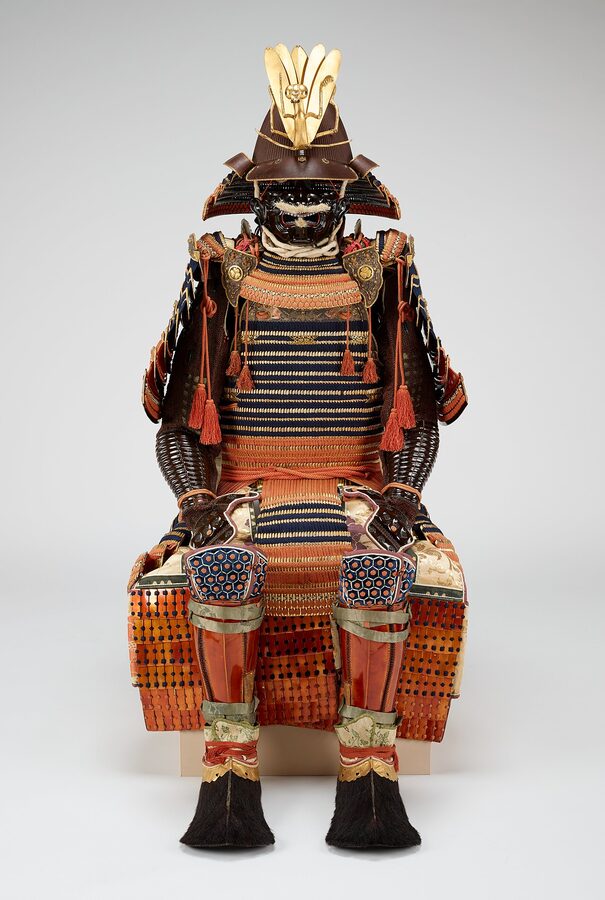
Yorinobu wanted a castle that matched his rank. In 1621 Hidetada gave him silver to pay for it, 2,000 kan by the castle’s own chronology, though another Japanese account says 5,000, and he set about extending the Ninomaru westward, adding two new enclosures, the Sunanomaru and the Minaminomaru, and enlarging the town. The stone for this phase came from Kumano: a hard granite porphyry, cut square and fitted tight. Yorinobu had married Katō Kiyomasa‘s daughter in 1617, and she came to live in the palace on the summit with him; most later lords preferred the Ninomaru at the foot of the hill.
It was too much. The scale of the works fed rumours in Edo that Kii was getting ready to rebel, and his senior retainer Andō Naotsugu had to talk the shogunate round. An outer moat meant to wrap round the southern town was stopped where it had got to and filled in west of the Waka road, and the district is still called Horidome, “where the moat stopped”.
The second scare was worse. In 1651 the plotter Yui Shōsetsu was found with forged documents bearing Yorinobu’s seal, and Yorinobu, questioned in Edo with guards waiting to seize him, answered (the story goes) that if a rebel had to forge a Tokugawa’s signature, the realm was in no danger at all. He was cleared, but the shogunate kept him in Edo for eight years. English-language accounts sometimes blame this 1651 affair for stopping the castle works; in Japanese sources the castle scare comes first, in the 1620s.
He hired rōnin, men left masterless by the wars, in large numbers, which strained his budget and made the shogunate nervous. He turned the old Kii gentry into a rank of country samurai, jishi, instead of fighting them, and in 1660 had a short code on duty to parents, the Fubojō, distributed across the province. He retired in 1667 and died at Wakayama on the 10th day of the first month of 1671, aged seventy by Japanese count.
His town survives better on the map than on the ground. The senior retainers’ mansions stood in the Sannomaru, where the prefectural office and the city hall are now; for walls and gateways of that kind you have to go to the towns with surviving samurai districts.
Kishū Tōshōgū and the poets’ bay
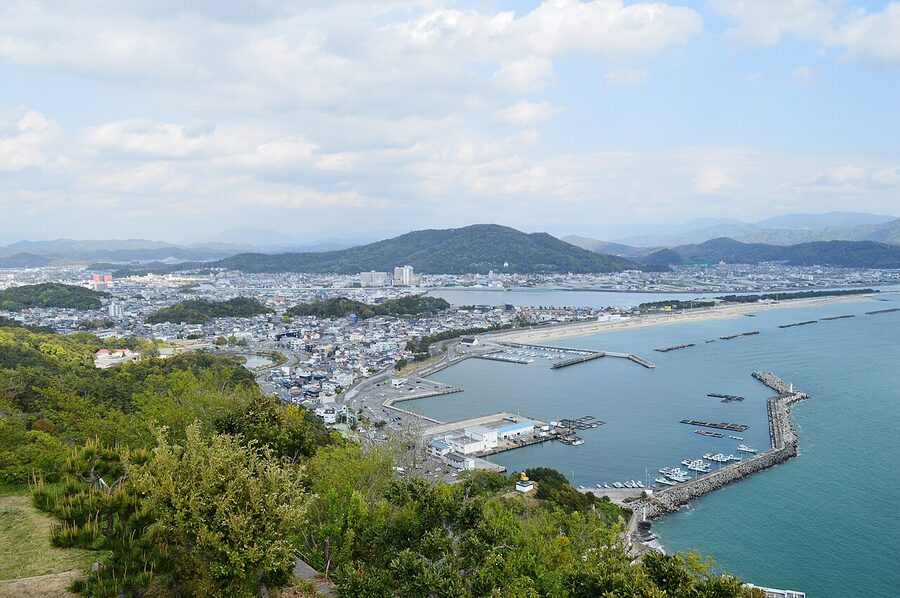
In the year he arrived, Yorinobu began a shrine to his father on Saika-yama above Wakanoura, the bay that the 8th-century poet Yamabe no Akahito had made famous with a verse about cranes crossing to the reeds as the tide came in. The Kishū Tōshōgū was finished in 1621. Its carvings are said to be by Hidari Jingorō and its paintings by artists of the Kanō and Tosa schools, people call it the Nikkō of the Kansai, and the first head of its attached temple was Tenkai, the Tendai abbot who had argued Ieyasu into godhood at Nikkō.
Its festival, the Wakamatsuri, first held in 1622, became the province’s great annual event. Yorinobu was later enshrined beside his father as Nanryū, but he chose to be buried at Chōhō-ji, an old temple down the coast in what is now Kainan, which he made the family’s burial temple in 1666.
The lord who left for Edo
Tokugawa Yoshimune was born on the 21st day of the tenth month of 1684 in the Fukiage residence below the castle, the fourth son of Yorinobu’s heir Mitsusada. His mother was Monko, a daughter of Kose Toshikiyo; the story that she was a bath attendant in the castle’s women’s quarters, which Japanese books like to repeat, is exactly that, a story. Fourth sons do not inherit, and for twenty years nobody expected him to.
Then in 1705 his eldest brother Tsunanori, the lord, died. Tsunanori had married the daughter of the shogun Tsunayoshi and had been talked of as Tsunayoshi’s heir. Within months their father and the next brother died too, and Yoshimune became lord of Kii at twenty-two by Japanese count, with a domain deep in debt: three funerals to pay for, a loan of 100,000 ryō owed to the shogunate, and, in 1707, the coast wrecked by the Hōei earthquake and tsunami.
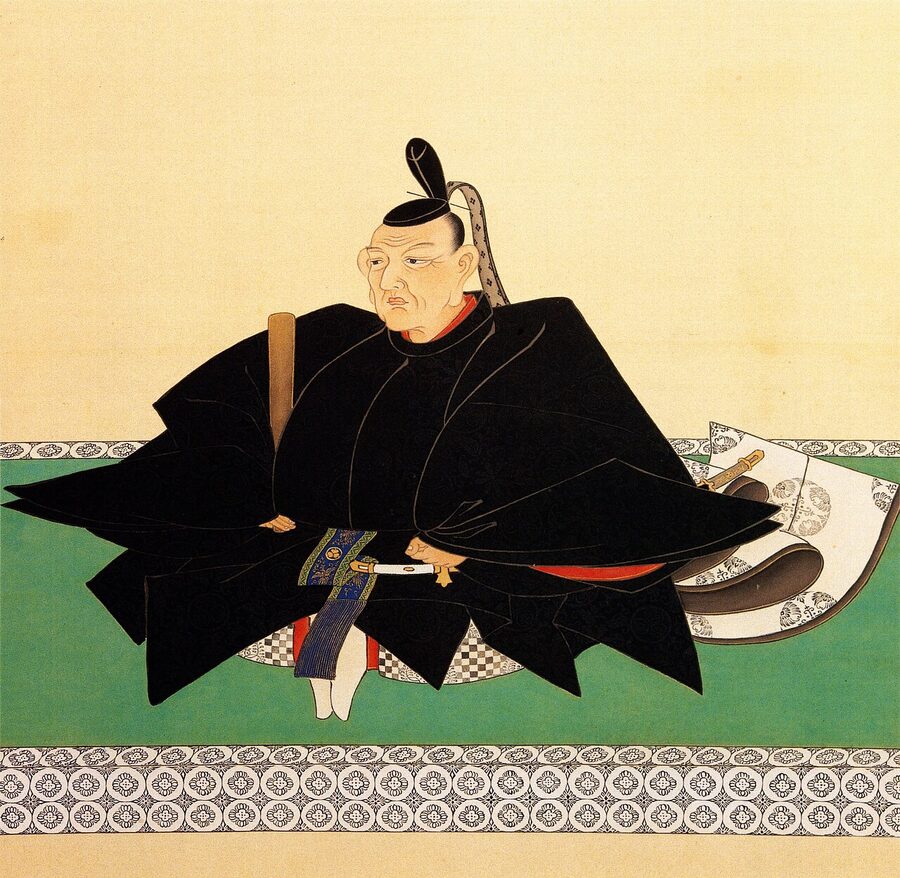
He fixed it the hard way: he trimmed the administration, wore cotton, called in a twentieth of his retainers’ incomes, raised new taxes and opened new rice land. He also set up a petition box outside the Ichi-no-hashi gate of the castle, so that anyone could put a complaint in front of the lord, and the Confucian scholar Muro Kyūsō said that learning in Kii was livelier than anywhere in Japan. By the time Yoshimune left, the domain’s finances stood on their own feet.
In 1716 the boy shogun Ietsugu died, aged eight by Japanese count, and for the first time the gosanke insurance had to be claimed. The senior candidate on paper was the lord of Owari, Tsugutomo, who had friends among the late shogun’s advisers. Yoshimune had the women of the inner palace behind him, including the boy’s mother, and the officials who wanted those advisers gone. He became the eighth shogun at thirty-three.
What he did next shows the Kii training. Two earlier shoguns who had come in from branch lines had let their old domains be abolished and their retainers absorbed; Yoshimune refused, calling the gosanke a trust from Ieyasu, and passed Kii to his cousin Munenao. He walked into Edo Castle with only about forty men from Kii, minor retainers said to be simply the ones on duty that day, and the old families liked him for it; over the years more than two hundred Kii retainers followed.
Kyōhō
The Kyōhō reforms, named for the era that began the year he took office, were the Kii programme at national scale, and they set the tone of the shogunate for the rest of the Edo era. Yoshimune cut costs, made the great lords contribute rice, fixed tax rates, pushed new rice fields, promoted Ōoka Tadasuke, organised the townsmen’s fire brigades, opened a public clinic at Koishikawa and codified the law in the Kujikata Osadamegaki. He set up a petition box in Edo, as he had at the Ichi-no-hashi gate, and in 1720 relaxed the ban on Western books, one of the roots of Japan’s later “Dutch learning”.
Kii supplied the engineers too: Izawa Yasobei went with him to Edo and took the Kishū school of river engineering all over Japan.
It had costs: raising the rice tax to half the harvest set off peasant uprisings, and the thrift he forced on everyone flattened trade and culture for a generation. He was also curious in ways no administrator needs to be: in 1728 he ordered an elephant from Vietnam and had it walked from Nagasaki to Edo, and Edo went elephant-mad. Wakayama Castle has since been a location for a long line of television period dramas about him, Abarenbō Shōgun among them.
What Edo did to Wakayama
Wakayama got a shogun and paid for him. Munenao was hit by the Kyōhō famine, which cost the domain 57 per cent of its harvest, and borrowed 20,000 ryō from the shogunate to get through. After that, covering deficits with shogunate money became a habit. Being close to the shogun made Kii dependent on him, and the shogun’s treasury felt it; by the time of the eleventh lord, the outstanding loans had reached 45,000 ryō.
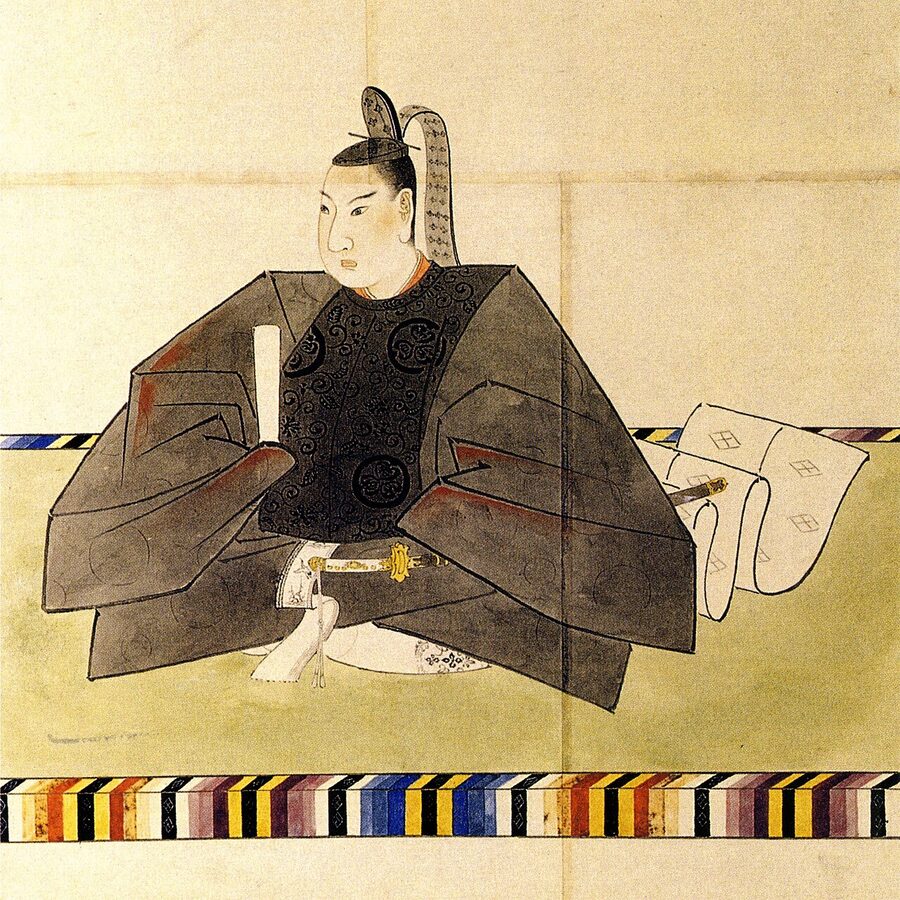
The connection never broke. Every shogun after Yoshimune came either from Kii or from Hitotsubashi, one of the cadet houses he founded for his sons in Edo. In 1858 the boy lord of Kii, Yoshitomi, was chosen as heir to the childless shogun Iesada over Hitotsubashi Yoshinobu, after a bitter fight that Ii Naosuke settled in Kii’s favour, and he became the fourteenth shogun, Iemochi. He died at Osaka Castle in 1866, in the middle of a failing war against Chōshū, and the man he had been picked over became the last shogun, Tokugawa Yoshinobu.
Three keeps on one hill
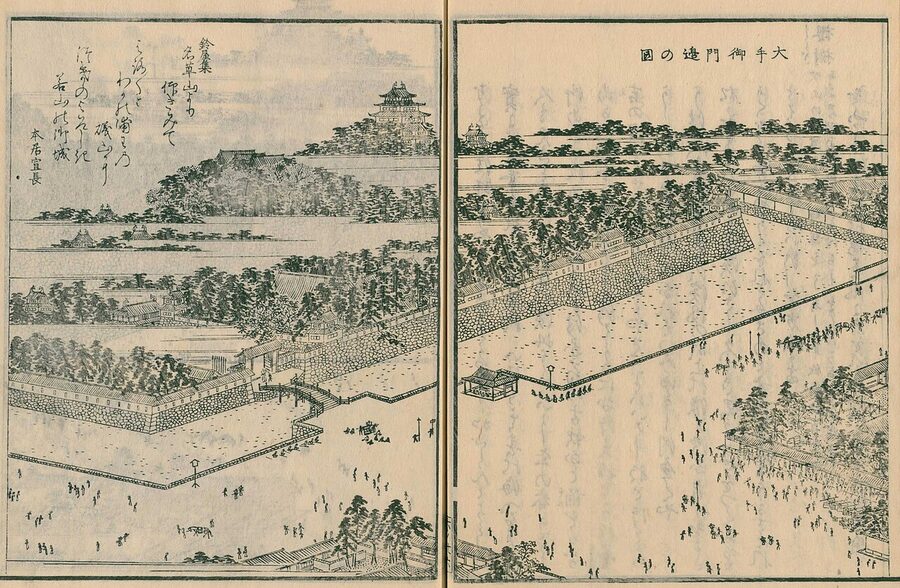
The Asano keep was black. In 1798 the tenth lord, Harutomi, a cultivated man who made the garden of Yōsuien, had it plastered white, and it was white when lightning struck the keep compound on the 26th day of the seventh month of 1846. The fire took the large and small keeps and nearly everything else on the summit except the palace.
Under the Laws for the Military Houses, the shogunate’s code for the great lords, nobody was supposed to build a new keep. Kii was not nobody, and as a gosanke house it was given special leave to rebuild. Plans were drawn, with a wooden model, for a grander keep of five storeys, then dropped, partly out of deference to Edo and partly for lack of money, and the new keep of 1850 followed the old one’s three storeys almost exactly. One Japanese castle guide says the burnt keep itself had five storeys; most sources, the castle’s own among them, say it was rebuilt much as it had been.
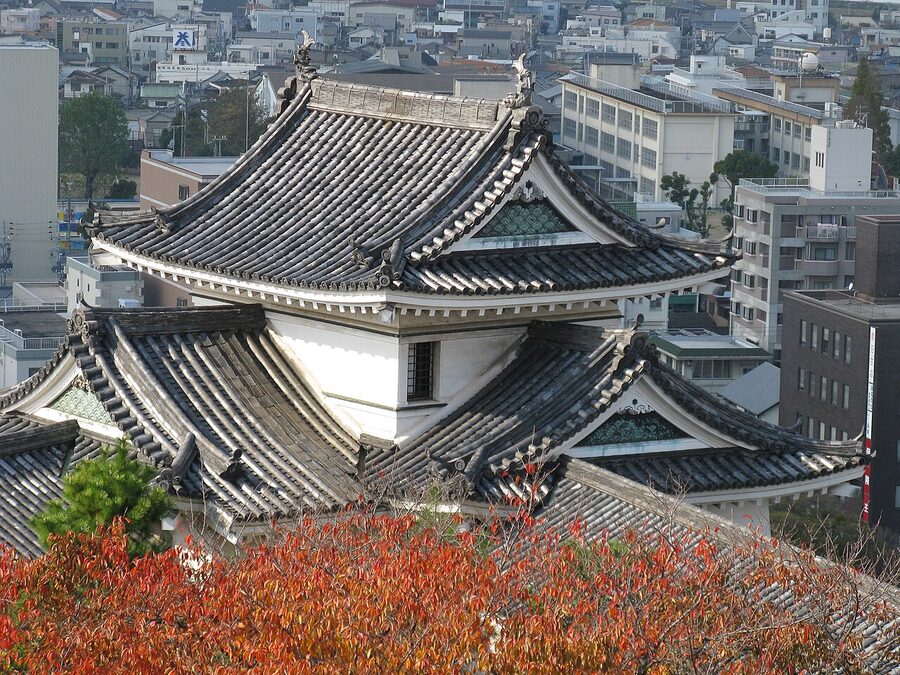
The 1850 keep is the one in the old photographs. It was a connected keep, renritsu-shiki: a three-storey main keep and a smaller keep joined to two corner turrets by roofed walls around a courtyard, a type Japanese writers group with Himeji and Matsuyama as the three great connected castles on low hills. Its base was nearly a rhombus, so the first storey used paired gables to square up the floors above. Had it lasted one more century, it would be on the short list of Japan’s original keeps.
After the lords
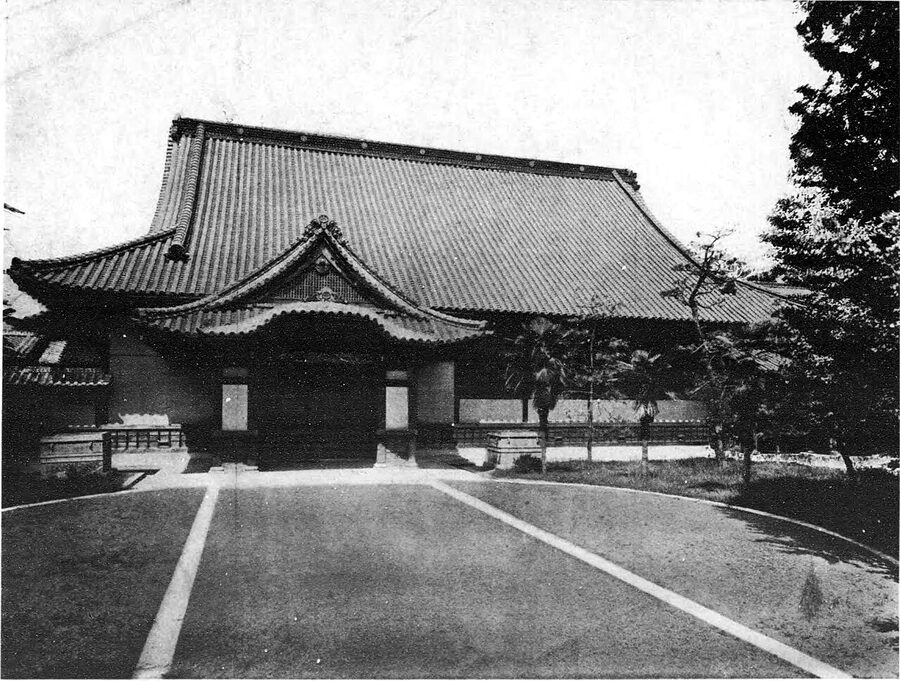
The domain was abolished in 1871, the inner castle passed to the army ministry, and most buildings except the keep group were pulled down or sold. The finest halls of the Ninomaru palace were taken to Osaka Castle in 1885 to serve as the 4th Division’s headquarters, the “Kishū Palace”; they became the city of Osaka’s guest house in 1931 and burned in a fire in September 1947 while the occupation forces were using them. In 1901 the inner castle opened as Wakayama Park, and in 1935 the keep and ten other buildings were named National Treasures.
The night of 9 July 1945
Wakayama knew what was coming. At some point after 1944, by the city’s best guess, the keep’s white walls were hung with straw matting so that they would not shine for bombers, and there is a photograph of it in the city’s collection. On the evening of 9 July 1945 B-29s from Tinian began dropping flares over the river mouth at 23:36, and by the time the bombing stopped, at 1:48 the next morning, the centre of the city was gone.
The Home Ministry counted 1,208 dead a week later; other figures run from 1,101 to 1,400. About 748 people died in a single open space, the site of the old prefectural office, now Migiwa Park, where they had run from the fire and the heat found them. The keep and every one of the National Treasure buildings on the hill burned with the city. The Okaguchi gate, on the south-east side, did not.
Concrete, 1958
Rebuilding was not a foregone conclusion. In 1949 the mayor, Takagaki Zen’ichi, told the assembly that some called a keep feudal and out of place in a democracy, and he kept his distance. In a city still short of houses, the opposition put it as “bread or nostalgia?”. The city went ahead in 1956 on donations, with no promise of help from the prefecture: of the total cost of 120 million yen, about 57 million came from the townspeople, and Matsushita Kōnosuke, the Wakayama-born founder of Panasonic, gave more than anyone.
Across Japan in the postwar Shōwa era burnt keeps were coming back in reinforced concrete, which people thought of as modern, and Wakayama’s preservation committee split between wood, for beauty, and fireproof concrete for a museum inside. Concrete won, partly because nobody could find the timber. But the architect, Fujioka Michio of the Tokyo Institute of Technology, who had studied the keep before the war, designed it in wood first and then translated it into concrete, and the quarrel pushed everyone towards a faithful exterior. He worked from the drawings of the 1850 master carpenter, Mizushima Heijirō, and because they gave no heights, those were worked out from pre-war photographs.
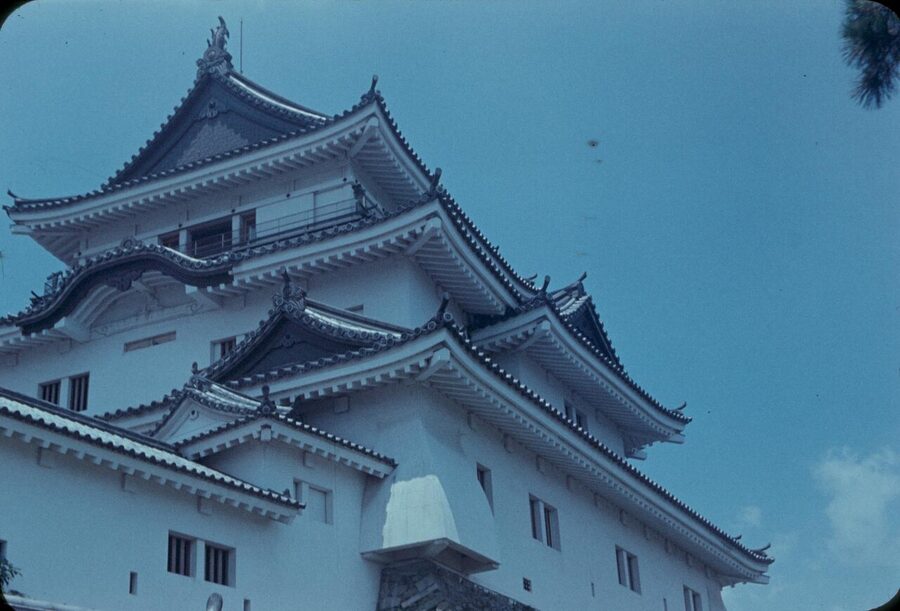
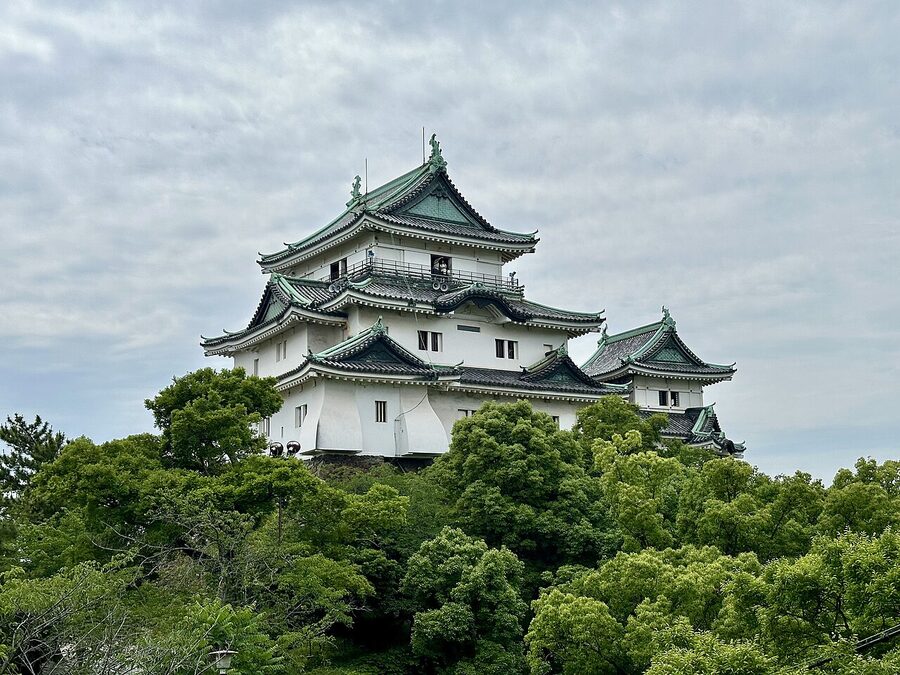
The new keep was finished in October 1958. A curator at the castle, Ōyama Ryōsuke, has pointed out that it was only the second keep in Japan, after Hiroshima, to be rebuilt as a faithful copy of the old exterior; at least one other castle Fujioka designed got a viewing deck the original never had, because the town asked for it. Inside, of course, it is a museum with stairs.
Sixty years on, the concrete is the problem. A seismic survey the city published in 2018 found that the main keep could collapse in an earthquake of upper 6 to 7 on the Japanese scale, and the city has been weighing whether to strengthen it or rebuild in wood, as Nagoya decided to do with its own concrete keep. Meanwhile it has been appealing for old photographs and plans of the keep and of the lost turrets along the Ninomaru, so that any reconstruction has evidence to stand on. Japanese accounts describe a long-term ambition to rebuild the keeps, palaces and turrets in wood; for now the 1958 keep is open as usual.
Reading the walls and the garden
Three walls, three regimes
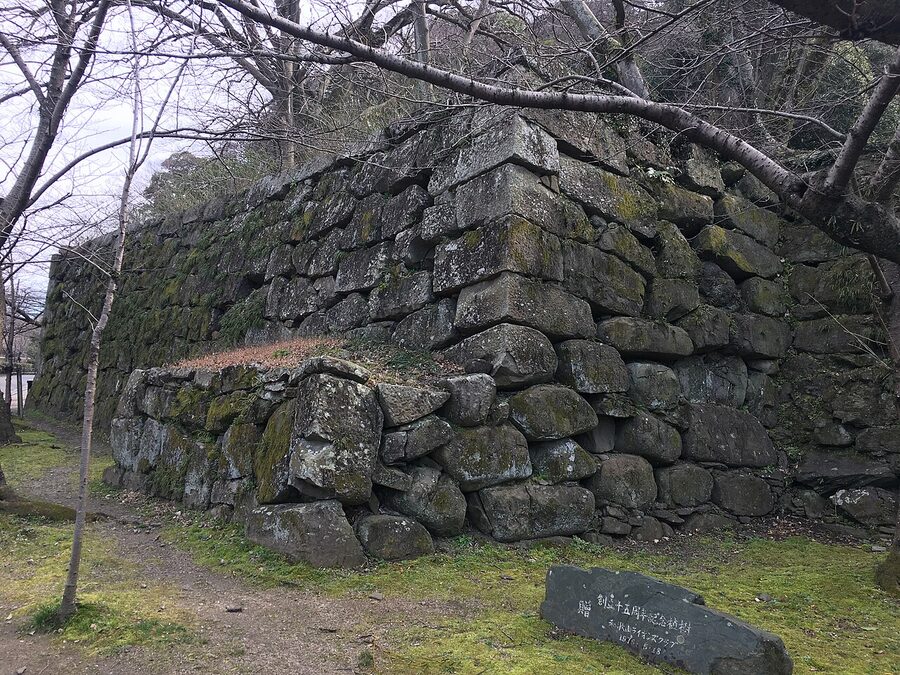
The best thing at Wakayama Castle is not the keep but the stone, because the castle’s whole history is written in it. The Toyotomi walls of the 1580s are nozura-zumi, “field-face” work: natural blocks of the local green schist, stacked rough. The Asano walls are uchikomi-hagi, stone quarried on the island of Tomogashima and elsewhere, the faces knocked roughly flat so the joints close up. The Tokugawa walls are kirikomi-hagi, granite porphyry from Kumano, cut so square that the seams are thin lines.
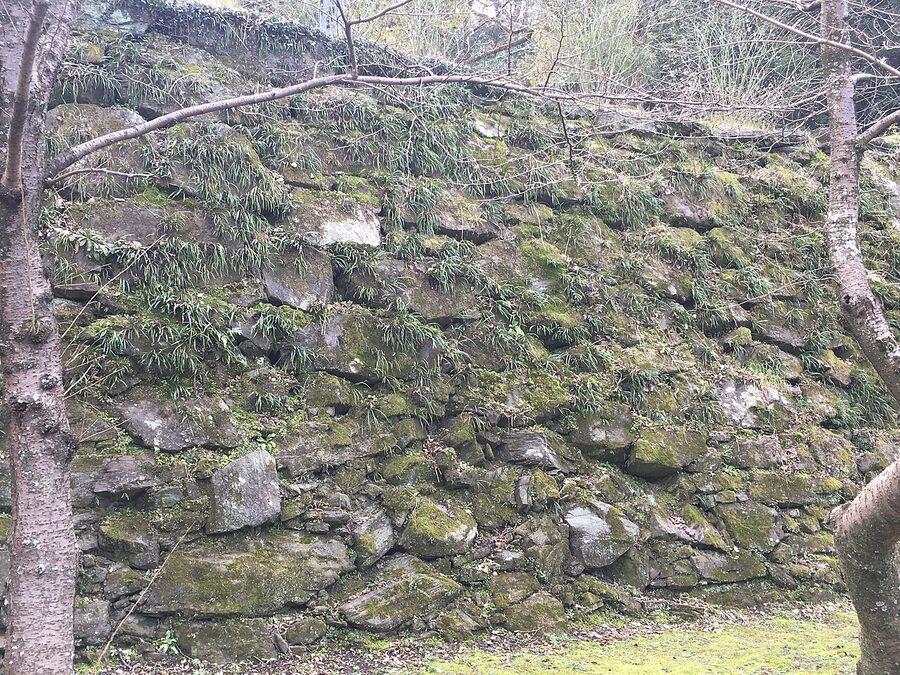
On the Toyotomi and Asano stones, look for marks. The masons and the work gangs cut symbols into the blocks, and about 170 different marks have been found on more than 2,100 stones, most of them a sandstone from Izumi. The green schist, wet after rain, is a colour you will not see in many other Japanese castles.
The covered bridge
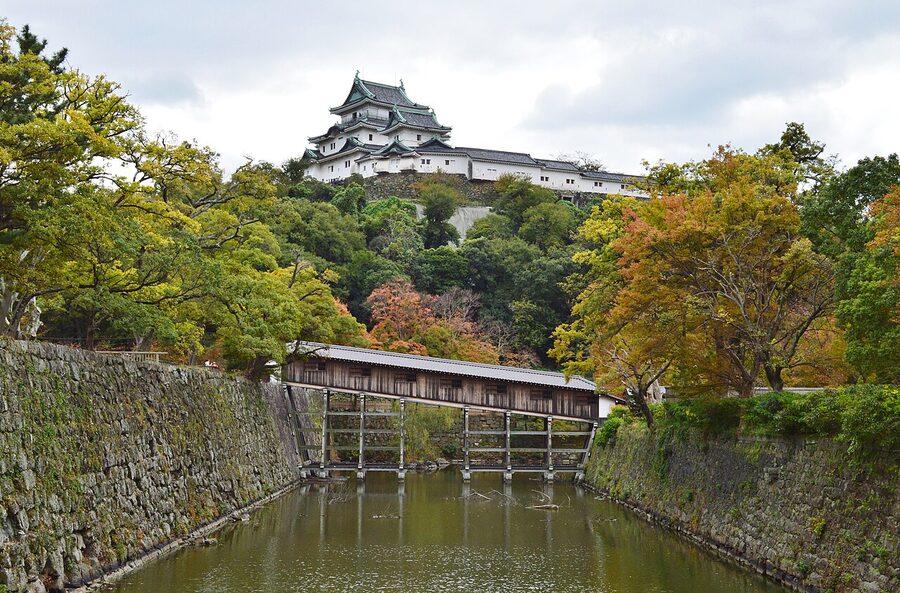
The Ohashi-rōka is the oddest structure in the castle and one of the newest. It is a roofed, walled bridge across the inner moat between the Ninomaru, where the lord lived and where the women’s quarters stood, and the Nishinomaru, his garden and retreat, and it slopes because the two banks are at different heights. The walls were there so that the lord, his attendants and the women of the household could cross without being seen or rained on. Wakayama is said to be one of only three castles with women’s quarters, an ōoku, on the Edo model, the others being Edo itself and Nagoya.
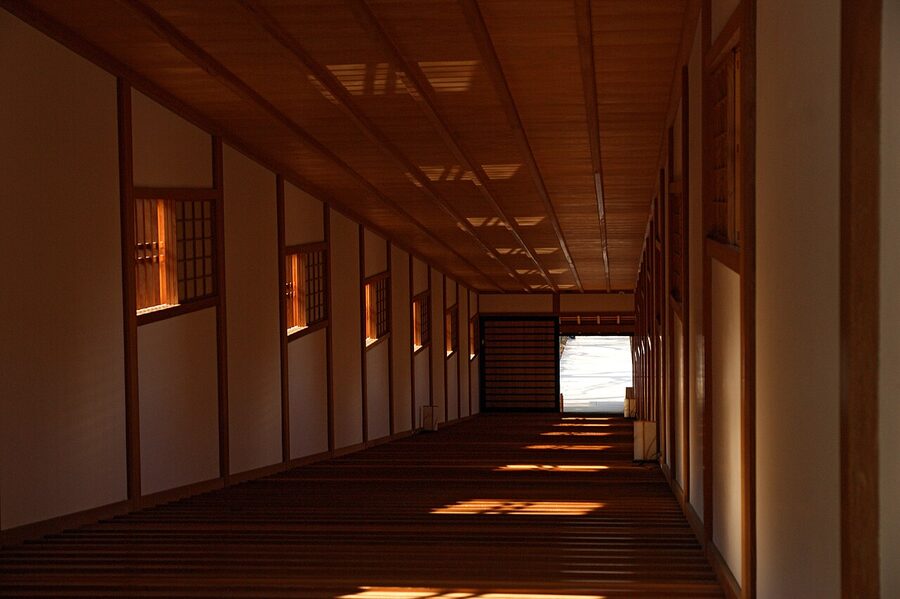
It was rebuilt in wood from Edo-period drawings and opened in 2006, and you can walk it for free. Go slowly: the sawtooth floor does its job, but it feels like nothing else underfoot.
Momijidani and the Nishinomaru
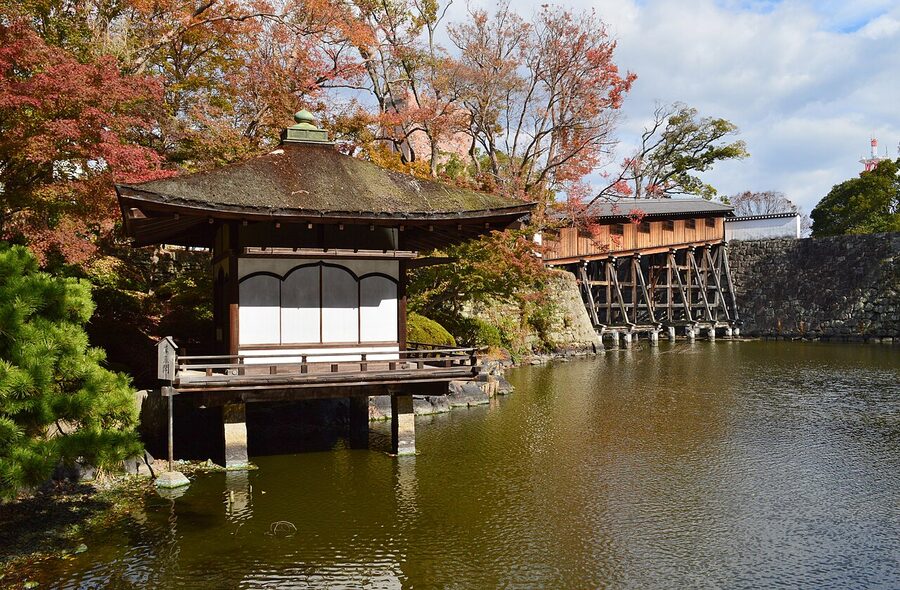
Below the bridge lies the Nishinomaru garden, better known as Momijidani teien, “the maple valley garden”. It was made in the early Edo period alongside a palace for the lord’s leisure and retirement, and it uses the steep north-west slope of the hill: a cascade, two ponds fed by springs, and the inner moat itself drafted in as the biggest pond of all. The usual attribution is to Yorinobu, in the manner of Kobori Enshū, but there is a strong rival case for Ueda Sōko, the Asano family’s senior retainer, which would make it older.
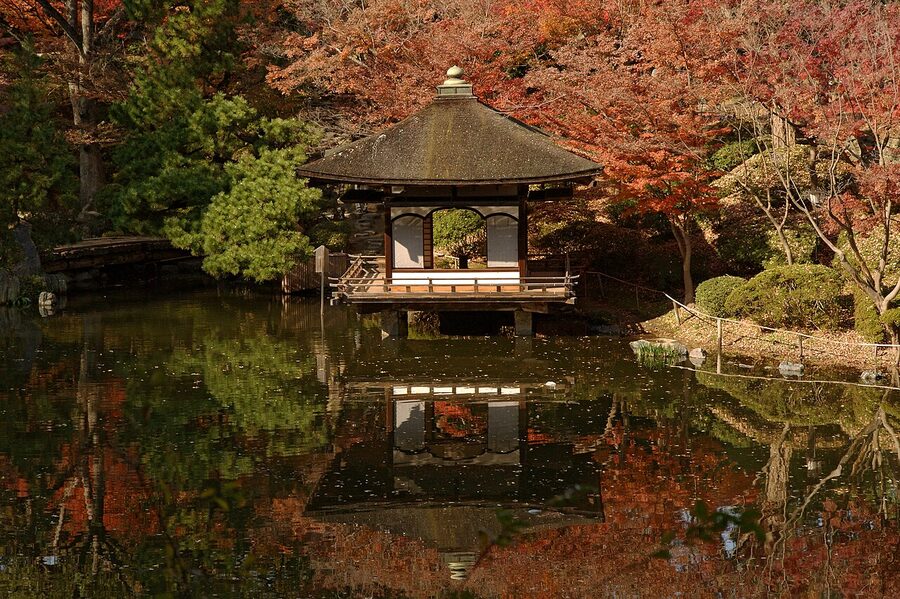
The Nishinomaru was where the lords played, with tea rooms, a noh stage and a detached pavilion. The garden was neglected after the Meiji era, restored from the 1970s and designated a national Place of Scenic Beauty in 1985 (some English sources say 1987). The pavilion out on the water, the Engyokaku, was rebuilt in 1972, and excavation since has suggested that the original stood nearer the middle of the pond. Its name comes from a line in the Chinese Book of Odes about kites flying up to heaven and fish leaping in the deep, which is a good description of what a Japanese garden is for.
The teahouse, Kōshōan, was a gift from Matsushita Kōnosuke and opened in May 1974; its name takes the kō of the maple and the shō, “pine”, of Matsushita. Excavation in 1970 had found the remains of a tea room on the same spot, so it is not pure invention, and the tea it serves is the most civilised ¥600 you will spend in Wakayama.
The gates that survived
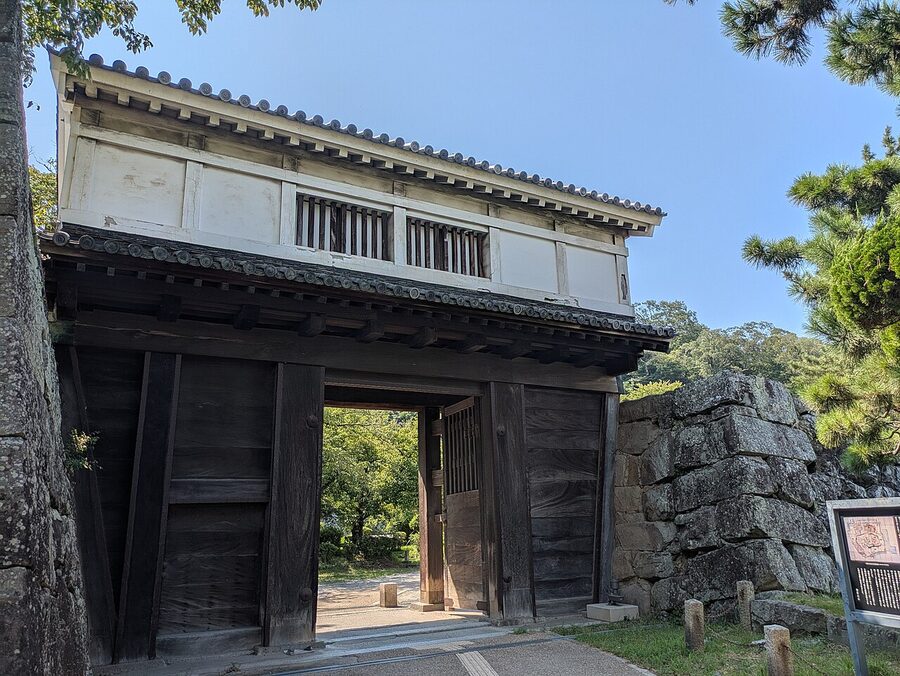
Two gates are genuinely old. The Okaguchi-mon on the south-east side stands where the first main gate was, before the Asano turned the castle round to face the town; the present two-storey gate was built by the Tokugawa in 1621, came through the 1945 raid, and has been an Important Cultural Property, together with the earthen wall beside it, since 1957. A wartime photograph shows it with a sign reading “Stop playing and go home” and the cherry trees behind it in full flower.
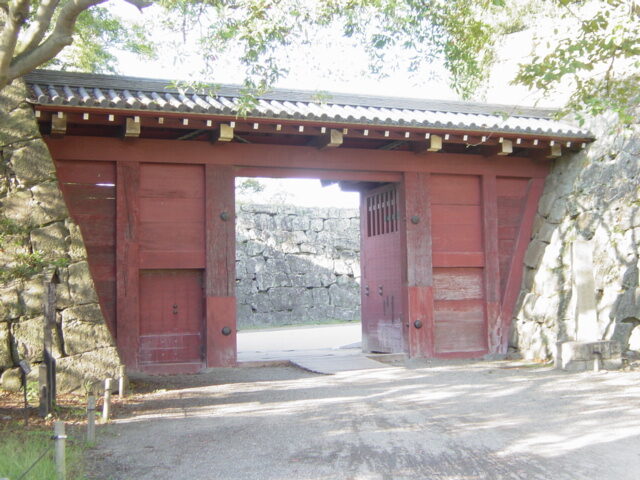
The Oimawashi-mon on the west side, a simple gate of the kōrai type, led from the riding ground to the horse field outside; the name means roughly “the gate where the horses were chased round”. When it was taken apart for repair in 1984 and 1985, traces showed it had been painted vermilion in the Edo period, and it is red again now. One theory is that it was painted to ward off evil, because it stood to the south-west of the lord’s quarters, the unlucky “back demon gate” direction.
Where to visit Wakayama Castle today
Getting there
Wakayama is an easy day out from Osaka or Kansai Airport. From Namba, Nankai’s Southern limited express takes about an hour to Wakayamashi Station; from Shin-Osaka, the JR Kuroshio limited express takes about an hour to JR Wakayama Station. From the airport there is a limousine bus to JR Wakayama Station, about forty minutes, or Nankai trains with a change at Izumisano to Wakayamashi, about forty-five.
From Wakayamashi Station the castle is about fifteen minutes on foot, or a short Wakayama Bus ride to Shiyakusho-mae. From JR Wakayama Station, take a Wakayama Bus heading for the castle (lines 0 and 25 among others) to Kōen-mae, about ten minutes. There is a paid car park for 58 cars, entered from the south. I took the hours and prices below from the castle’s official site as it stood in the autumn of 2026; it has a machine-translated English version.
The keep and the grounds
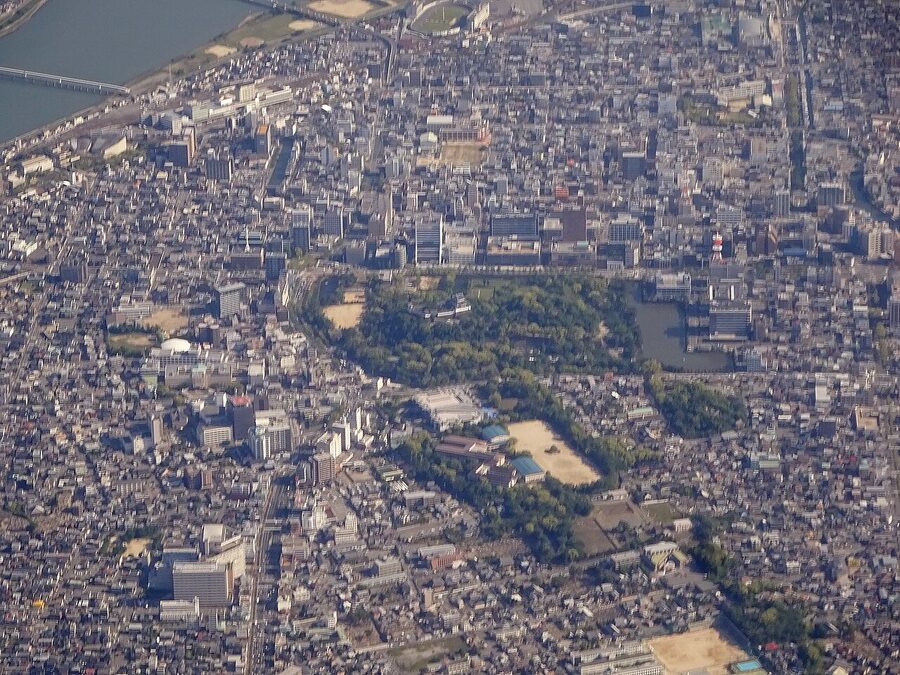
The keep is open 9:00–17:30 (last entry 17:00) every day except 29–31 December, and costs ¥410 for adults and ¥200 for primary and junior high school children. The official site has also announced a one-off closure on 9 December 2026. Inside are three floors of exhibits, and the view from the top over the city and the river is the best reason to pay.
If walking is difficult, the castle’s “hospitality ninja”, staff in ninja costume who roam the park, run an electric wheelchair service from the Omotezaka entrance up to the square in front of the keep; apply in advance with the form on the official site. They are off on Mondays and Tuesdays, except public holidays. I find the costumes faintly ridiculous and the service excellent.
The Wakayama Rekishikan, the history hall near the Shiyakusho-mae bus stop, has a small exhibition upstairs: the golden seal of the Kishū Tokugawa, a reproduction of Harutomi’s teahouse, and a VR film of the late Edo castle that is the nearest you will get to seeing the Ninomaru palace. It keeps the same hours as the keep and costs ¥100 for adults, free for children, and there is a combined ticket. Listen for the castle chime, which plays Saijō Yaso and Nakayama Shinpei’s children’s song “Mari to Tonosama” five times a day.
The garden, the bridge and the teahouse
The Nishinomaru garden and the Ohashi-rōka are free, 9:00–17:00 (last entry 16:45), closed 29–31 December. The maples turn in late November and early December, which is when the garden is busiest, and the castle is one of Wakayama’s cherry-blossom spots in spring. Kōshōan is open 9:00–16:30 (go in by 16:00) and serves matcha with a seasonal fresh sweet for ¥600 or a dry sweet for ¥500; during the maple and cherry seasons only the ¥600 set is offered. It closes from 29 December to 3 January.
Ōta and the fifty-three
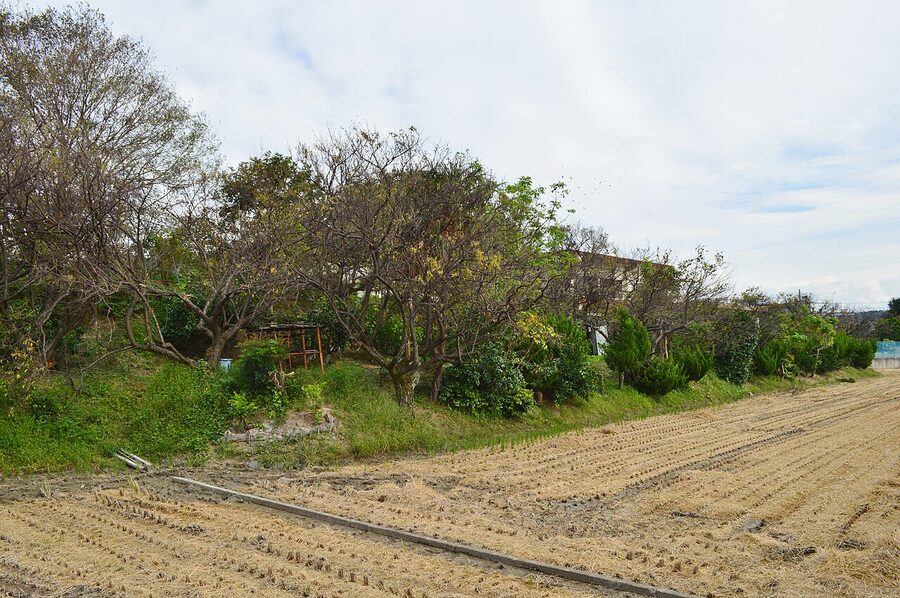
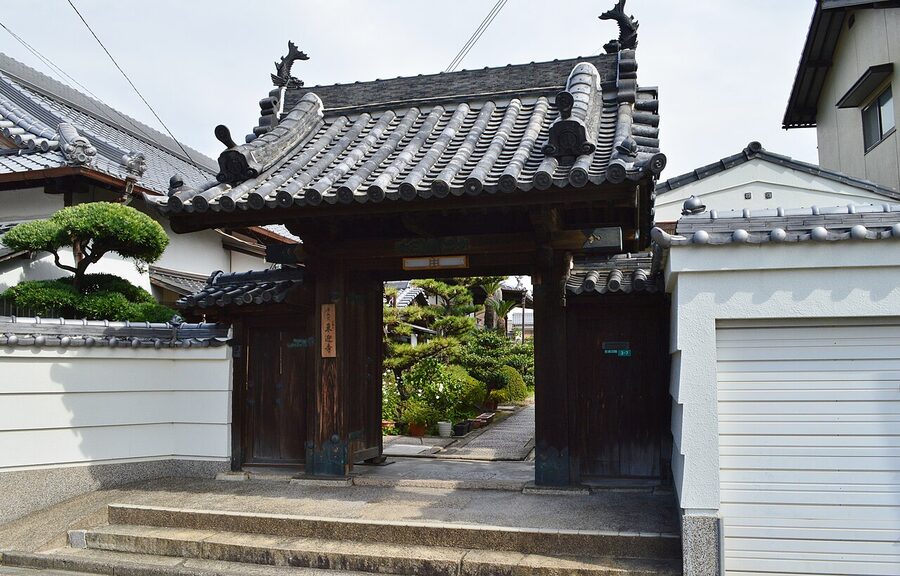
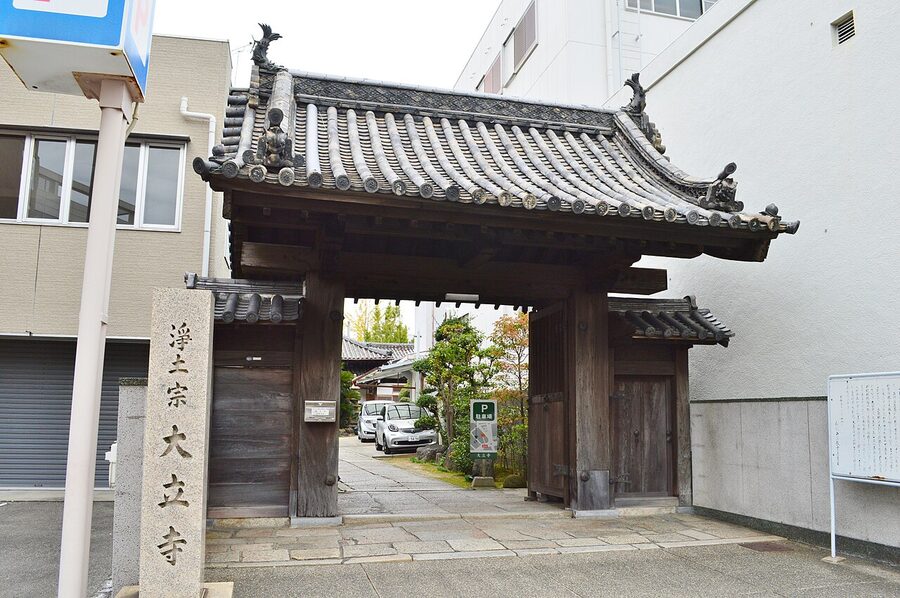
The remains of Ōta are about seven minutes’ walk from JR Wakayama Station, in a residential district that has almost entirely covered them. Raigō-ji is said to stand on the site of the inner enclosure, with a stone monument of 1921 marking the castle site; the Koyamazuka, one of the three burial places of the fifty-three heads, is near Gentsū-ji; and a short stretch of the siege dike survives further out near Demizu. Ōta’s main gate is said to survive at Dairyū-ji in Hashimukō-chō. These are temples and street corners, so go quietly.
Kishū Tōshōgū and Wakaura
The Tōshōgū is at Wakaura, south of the castle; Wakayama Bus services from either station stop at Gongen-mae, a minute’s walk from the shrine’s lane. Admission is ¥300 for adults and ¥100 for school students, paid at the shrine office at the top, and the precinct is open 9:00–16:30. The Wakamatsuri is held in May.
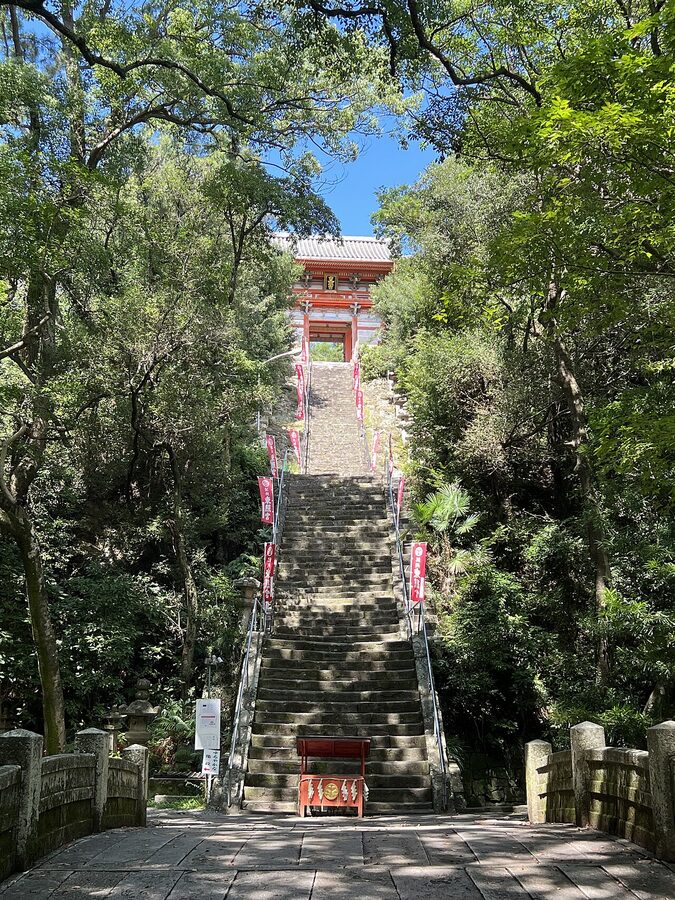
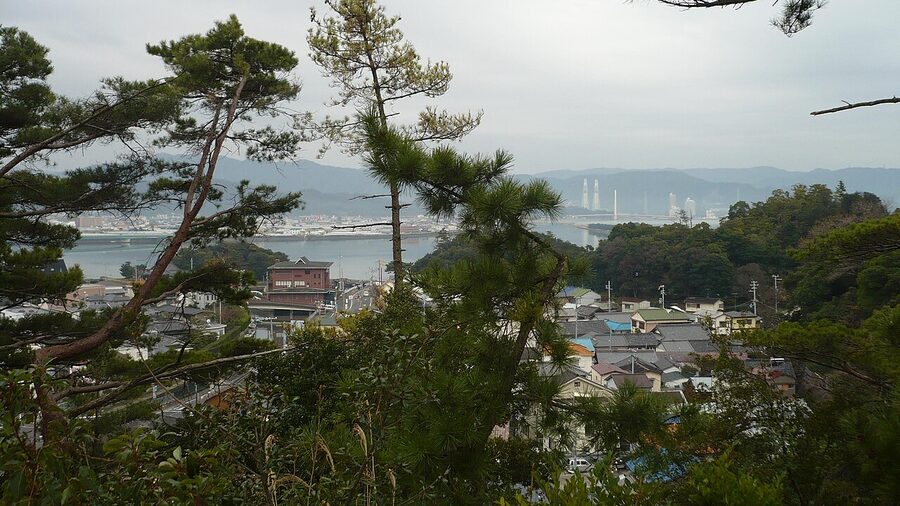
Wakanoura itself is a national Place of Scenic Beauty and, since 2017, part of a Japan Heritage designation. Walk on from the shrine to Tamatsushima Shrine, where the emperor Shōmu ordered the spirits of the bay honoured in 724 and where poets came for centuries to pray for better verse, and to the hill of Myōken-yama nearby, where the Suzuki of Saika had their castle. It is a strange and pleasant thing to stand on the Saika hill and look across the water at the Tokugawa shrine.
Kimiidera
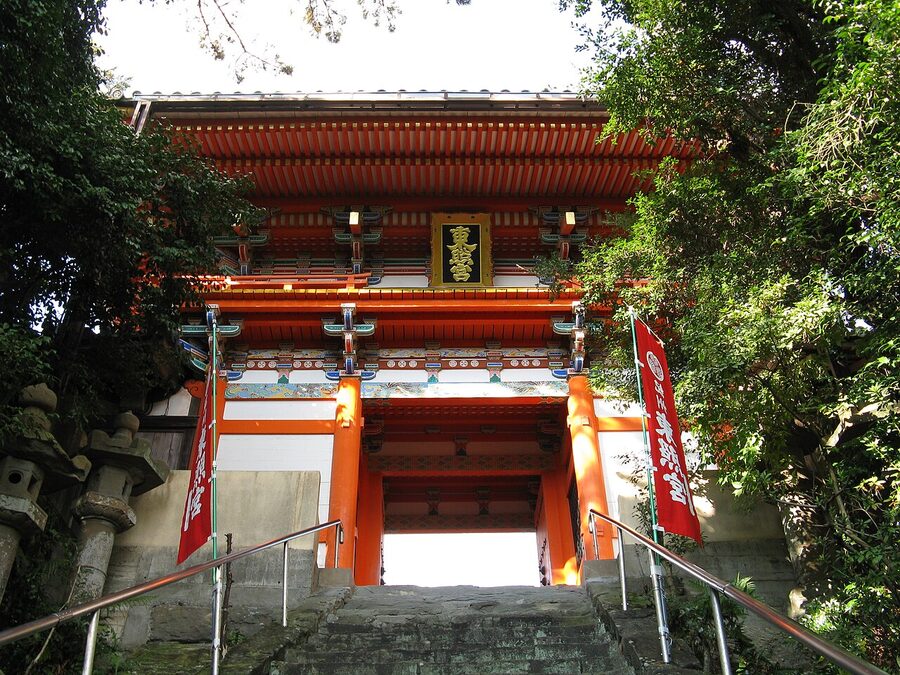
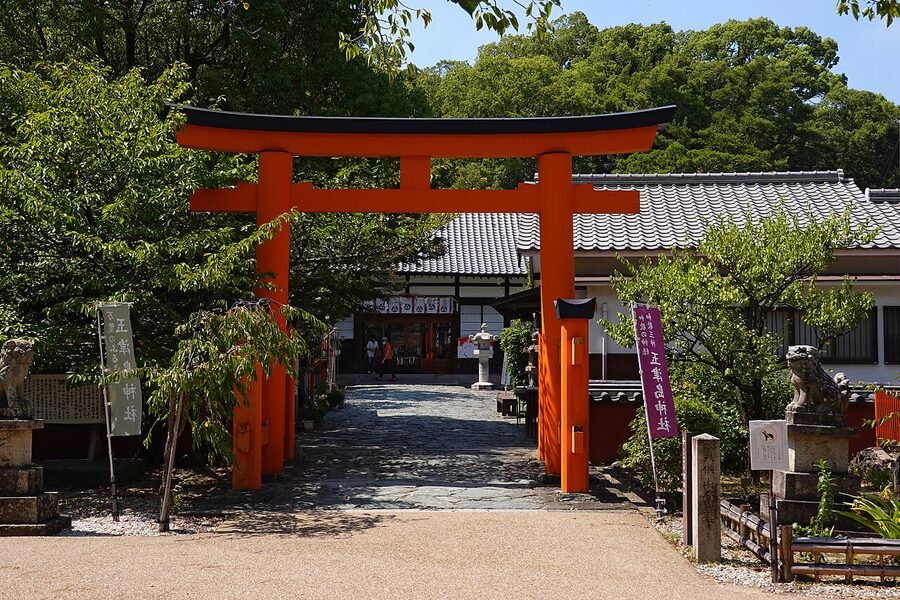
Kimiidera, the temple Hideyoshi visited while Saika burned, is across the bay on the slope of Nagusa-yama, two stops south of JR Wakayama on the Kinokuni Line and ten minutes’ walk from Kimiidera Station. A record of 1698 says a nun of the temple negotiated with Hideyoshi in person in 1585 and saved it from burning, though he took its lands.
The climb is 231 steep steps from the Rōmon gate. If you walk up, you pay nothing; if you take the cable car that opened in April 2022, it costs ¥400 for the temple plus ¥200 each way, half price for children and over-seventies, and it runs 8:30–16:30. The three springs that give the temple its name have stone basins dated 1650, put in on Yorinobu’s orders, and the cherry tree to the left of the main hall is the official specimen tree for Wakayama’s weather station, usually the first in the Kinki region to flower.
Negoro-ji
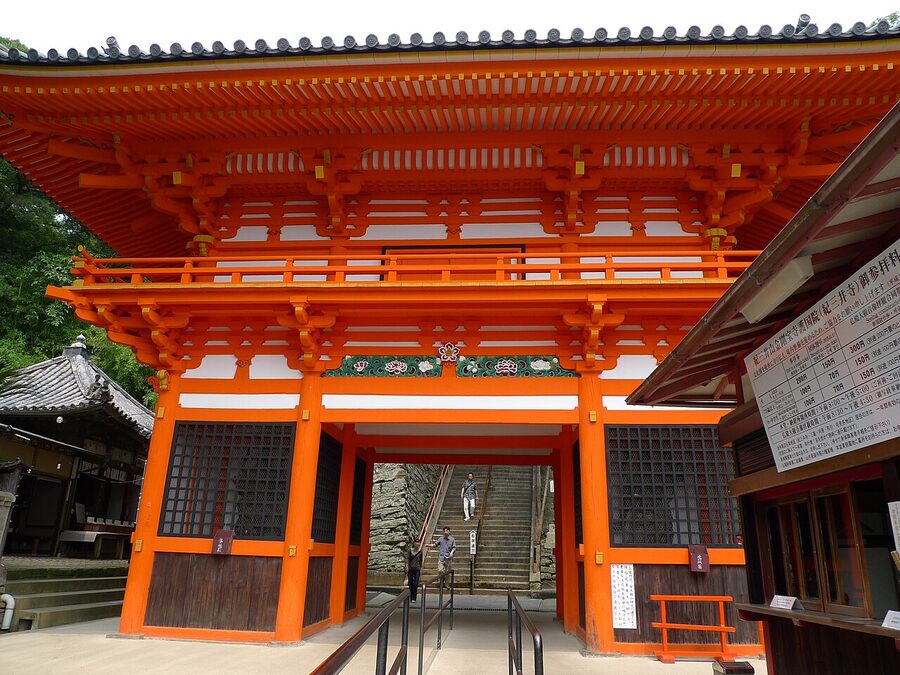
Negoro-ji is inland at Iwade, about half an hour from Kansai Airport by road. Without a car, take the JR Wakayama Line to Iwade and a Wakayama Bus to the Negoroji stop (buses that skip Kindai University stop 1.2 kilometres short). The temple charges ¥500 for adults (children free) for the pagoda and Kōmyōden areas, and is open 9:10–16:30 from April to October and 9:10–16:00 from November to March. In late October the main halls may be closed for ceremonies, and a new head lodge is going up in 2026; check the temple’s site before you go.
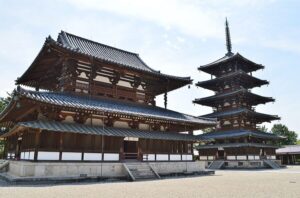
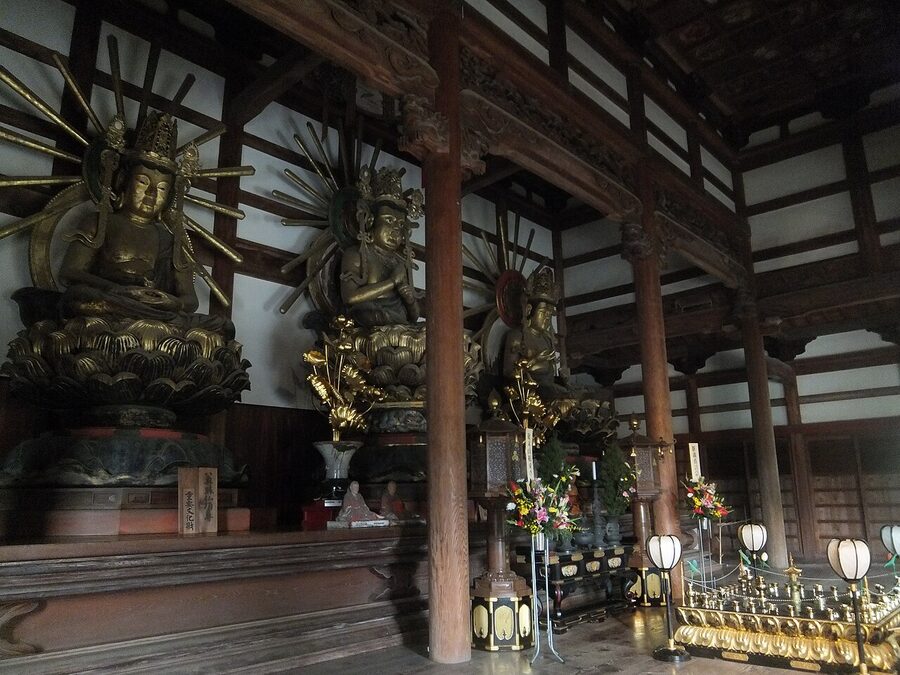
By the temple’s own account, the Daitō is the only great pagoda among Japan’s National Treasures that you can go inside to pray, and marks on its base are said to be bullet holes from 1585. The Daidenpō-dō beside it, rebuilt in 1827 after Hideyoshi took the old one away, holds three great figures carved between 1387 and 1405 that came through the fire.
Further afield
The Wakayama Prefectural Museum, in the old Sannomaru by the Kenchō-mae bus stop, holds the Tōshōgū’s scrolls and festival masks on deposit, though what is on show depends on the exhibition. It opens 9:30–17:00, closes on Mondays, and charges ¥310 for adults, with high school students and over-65s free; tickets for the keep, the history hall and the city’s museums give a discount at the next one within three days.
For Kōyasan, the mountain that bent in 1585, take the JR Wakayama Line to Hashimoto and change to the Nankai line and the cable car; Kimiidera’s own directions put Kōyasan to Wakayama at about two hours twenty. The JR Kinokuni Line runs the other way, south round the coast to Katsuura, Nachi and Shingū, the Kumano end of the pilgrim roads. Chōhō-ji, where Yorinobu and the Kishū lords are buried, is down the same coast in Kainan; check the temple’s own information before you go. For where all this fits, my walk through Japan through the ages puts the Kii wars and the Tokugawa peace in order.
Go up the keep late in the afternoon and look east, past the station, towards Ōta. You cannot see it; there is nothing there now but houses. The castle under your feet exists because of what happened in that village in the fourth month of 1585, and everything that came after, the Tokugawa son, the shogun from Kii, the concrete keep paid for by a burned city, stands on top of it. The farmers walked home carrying their hoes.