The most valuable thing in a Gokayama farmhouse was never the roof. It was the dirt under the floorboards beside the hearth: a pit of earth, chopped mugwort, millet husks and silkworm droppings, turned over by hand three times a year and left to ripen for five. At the end of it, soaked, strained and boiled down with wood-ash lye in an iron pan, the soil gave up off-white crystals of saltpetre. The Kaga domain bought every scrap, and carried it over the mountains to Kanazawa to be made into gunpowder.
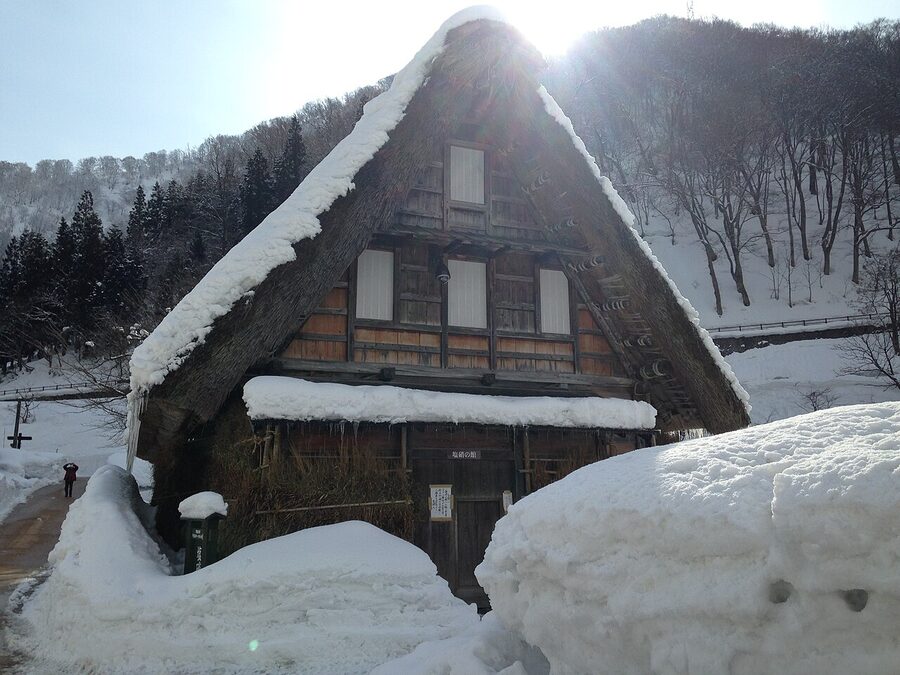
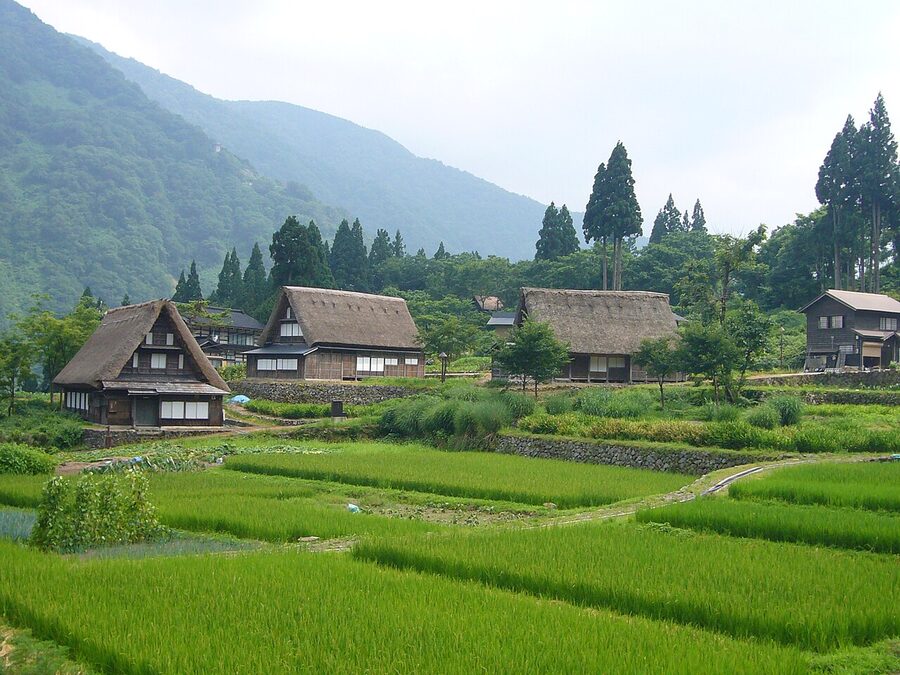
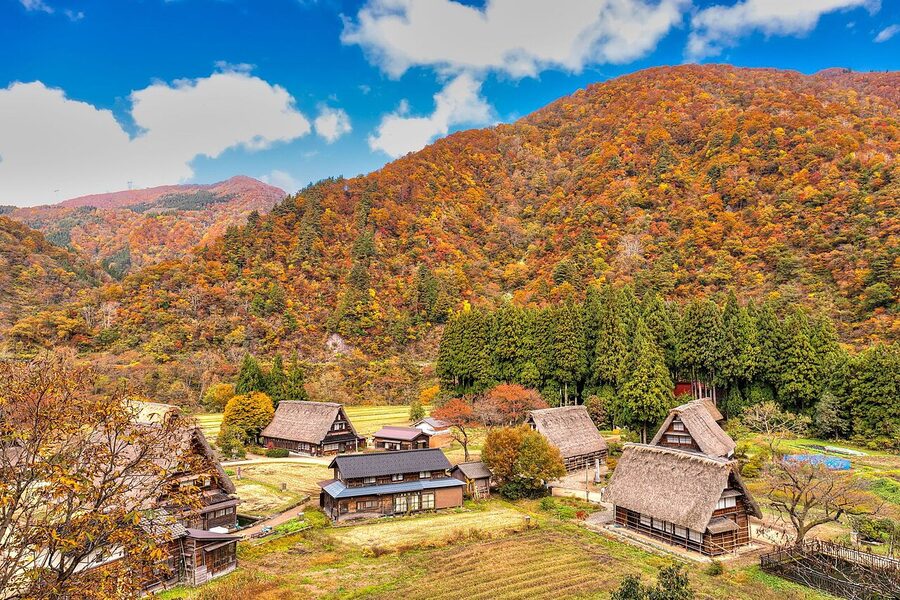
Everybody photographs the roofs, and they are the reason a village of fewer than two thousand people now takes around two million tourists a year. But the steep thatch was only the lid on a machine. Upstairs, on floors of bamboo slats, the families raised silkworms; downstairs, around a fire that never went out, they cooked, slept, and sent the smoke up into the thatch to drive the insects out of it; and under the boards, out of sight, they farmed explosives.
The moment I still like best in these houses is the one most people skip. In the Kanda house in Ogimachi the floor has been opened so you can look down into the place where the saltpetre soil sat. It is a hole in the ground with some old earth in it, and it is the clearest explanation I know of why the houses look the way they do.
What follows is the story of Shirakawa-gō (白川郷) and its downstream neighbour Gokayama (五箇山): the houses, the family system that filled them, the dams and roads that nearly emptied them, and the residents who decided in 1971 to sell nothing, rent nothing and pull nothing down. That is about seven centuries of Japanese history seen from one river. It ends, as everything on this site does, with where to go and how to be there without becoming part of the problem.
In This Article
- A valley at the end of every road
- The monks who came first
- A castle under a mountain
- Two valleys, two masters
- Hands joined in prayer
- North and south, front and side
- Silkworms upstairs
- The hearth that held up the roof
- Gunpowder under the floorboards
- Kaga’s locked room
- Forty people under one roof
- The century that came up the road
- The lake that drowned the valley’s heart
- Emptying out
- Sell nothing, rent nothing, pull nothing down
- World Heritage
- Yui, fire and two million guests
- Fire
- The people who come to look
- Where to see Shirakawa-gō and Gokayama today
- Getting there
- Ogimachi: the Wada house
- The Kanda and Nagase houses
- Myōzen-ji
- The view from the castle mound
- Shirakawa Hachiman Shrine and the Doburoku Festival
- The open-air museum
- Staying the night
- The winter light-ups
- Gokayama: Ainokura
- Gokayama: Suganuma
- More of Gokayama
- Up the valley
- How not to become the problem
- The soil under the floor
A valley at the end of every road
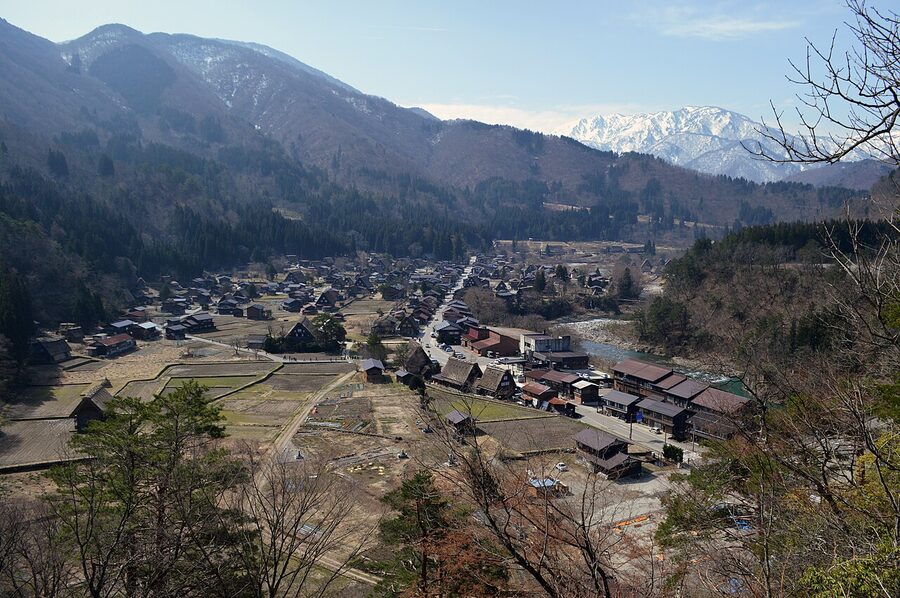
The Shō River rises in the mountains south-west of Takayama, runs north through a gorge so narrow that for most of its length the villages sit on terraces a few hundred metres wide, and reaches the Sea of Japan near Takaoka. Shirakawa-gō is the upper part of the valley, in old Hida Province, now Gifu Prefecture. Gokayama is the middle reach, in old Etchū, now Toyama. To the west is the wall of the Ryōhaku mountains with Mount Hakusan behind it; to the east is more of the same.
The snow is the first thing anyone mentions, and with reason. The village of Shirakawa records an average of close to ten metres of snowfall over a winter, never all at once but enough that drifts beside the paths stand taller than a person by February. Until the second half of the 20th century the valley was cut off by road for months every year, and Japanese writers long called it the last unexplored corner of the country, which tells you more about Tokyo than about Shirakawa.
Both halves of the valley tell the same founding legend: that refugees of the Taira clan fled up the gorge after their defeat in the Genpei War and settled where nobody would follow. Half the remote valleys in Japan claim the same thing, and there is no evidence for it here beyond the name of a village called Taira and some stories. What is better documented is that mountain ascetics of the Hakusan cult were walking these ridges from the 8th century, and that the valley’s first lasting outside institution was a Buddhist one.
The monks who came first
The man who shaped Shirakawa more than any warlord was a priest called Kanenbō Zenshun, a follower of Shinran, the founder of the True Pure Land school, Jōdo Shinshū (浄土真宗). Temple tradition makes Zenshun a son or grandson of the retired emperor Go-Toba, which is the sort of pedigree every temple in Japan likes to claim. He came over the mountains from Mino in the middle of the Kamakura era and founded a meeting hall at Hatogaya, in what is now Shirakawa village. Japanese reference works disagree about the year: some give 1253, while the Nipponica encyclopedia gives 1265.
That hall grew into Shōren-ji (照蓮寺), and Shōren-ji became the most powerful institution in Hida. It owned land, settled disputes, and sent men to fight when the head temple of the sect needed them. By the 16th century almost every household in both halves of the valley belonged to the sect, in Shirakawa through Shōren-ji and in Gokayama through congregations of its own, and the Gokayama farmers were sending silk thread and floss every year as offerings to the head temple, the Hongan-ji.
The sect’s loyalty came with gunpowder attached. When Oda Nobunaga laid siege to the Hongan-ji’s fortress-temple at Ishiyama in Osaka in the 1570s, the Gokayama congregations are said to have sent their whole stock of saltpetre to the defenders, carried down to the coast and shipped round by sea along with a handful of matchlocks. Next door in Kaga the same sect had run an entire province for nearly a century, a story told in my piece on Kanazawa Castle, and the valley’s later rulers never quite forgot what a determined True Pure Land congregation could do.
A castle under a mountain
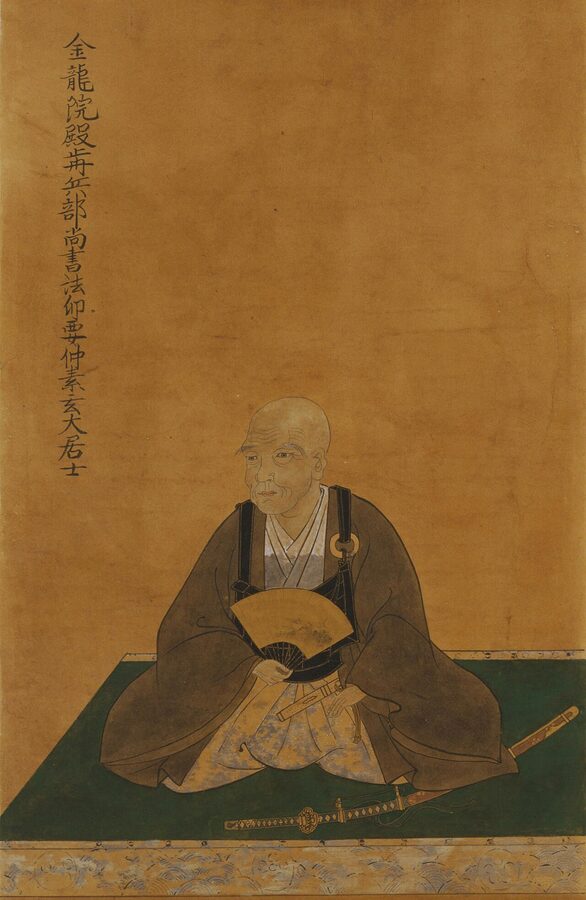
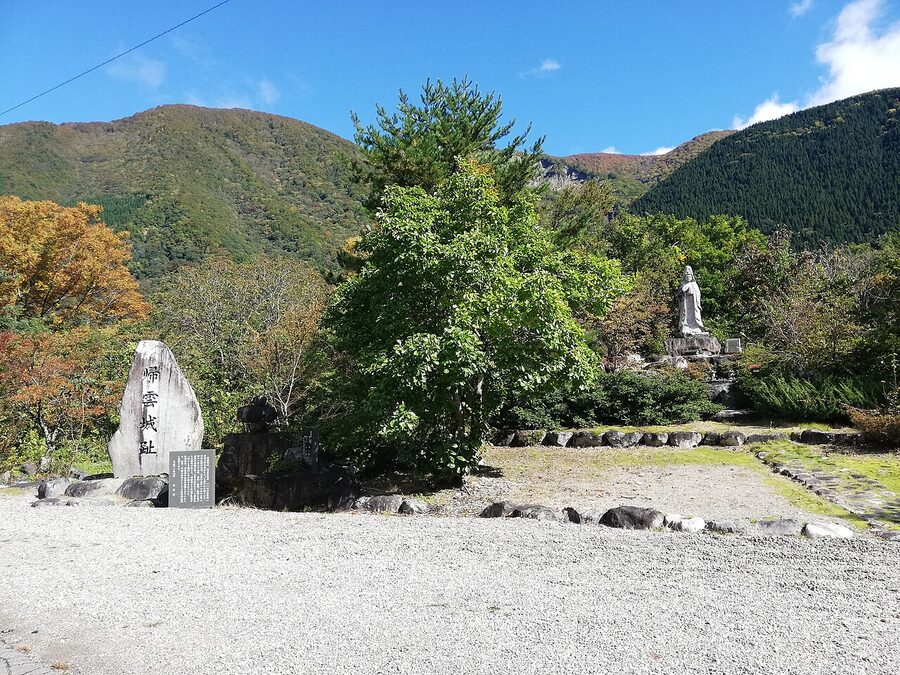
The secular lords of Shirakawa were the Uchigashima, a family who arrived in the valley around 1460 and by the 1470s controlled all of it from Kaerikumo Castle, upstream from Ogimachi. They had gold workings in their mountains, a long feud with Shōren-ji (they burned the temple in 1488 and later made peace with it), and little interest in the wars of the Sengoku era outside. Their last lord, Uchigashima Ujitoshi, had no choice: he fought off invasions from the side of Uesugi Kenshin in the 1570s and then threw in his lot with Oda’s general in Etchū, Sassa Narimasa.
His troops were fighting in Etchū in 1582 when news came of the Honnō-ji Incident, and they went home. Three years later he backed Sassa again, this time against Toyotomi Hideyoshi, and lost. While Ujitoshi was away in Etchū with his army, one of Hideyoshi’s commanders, Kanamori Nagachika, came into Hida from the north, persuaded one of the Uchigashima vassals to change sides, and took Kaerikumo Castle without a fight. Ujitoshi submitted and was allowed to keep his lands as Kanamori’s subordinate.
Then the mountain fell on him. On the 29th day of the eleventh month of Tenshō 13, which a Japanese source converts to 18 January 1586 by the Western calendar, a great earthquake struck central Japan, and the flank of Mount Kaerikumo above the castle collapsed. Uno Mondo, secretary to the Hongan-ji’s head priest, noted in his diary that Kaerikumo and its town had been buried entirely.
Later accounts count more than three hundred houses lost and more than five hundred dead, and the tradition is that only four people survived, all of them away on errands. The Uchigashima line ended that night. Because the 13th year of Tenshō ran into the first weeks of 1586, sources variously date the disaster to 1585 or 1586, and both are right after their fashion.
Nobody has yet found the castle under the debris. There is also a buried-gold legend, which you will see on signboards, but local historians have traced it to a self-proclaimed Uchigashima descendant who began promoting it around 1970.
Two valleys, two masters
After 1585 the valley split along the provincial border, and the two halves lived through very different versions of the Edo era. Shirakawa-gō belonged to Hida. The Kanamori ruled it from Takayama until 1692, when the Tokugawa shogunate moved them away and took the province under its direct control for its timber and its mines, the story told in my piece on the Takayama Matsuri. Part of the valley remained, as it had long been, temple land of Shōren-ji.
Gokayama went to the Maeda. The family of Maeda Toshiie took over Etchū in 1585, and Gokayama became one of the strangest corners of the richest domain in Japan. It was too steep for rice, so its taxes were paid in cash rather than grain, and the domain exempted it from its own famous agricultural regulations because it wanted something else from the valley. It wanted the floors.
Hands joined in prayer
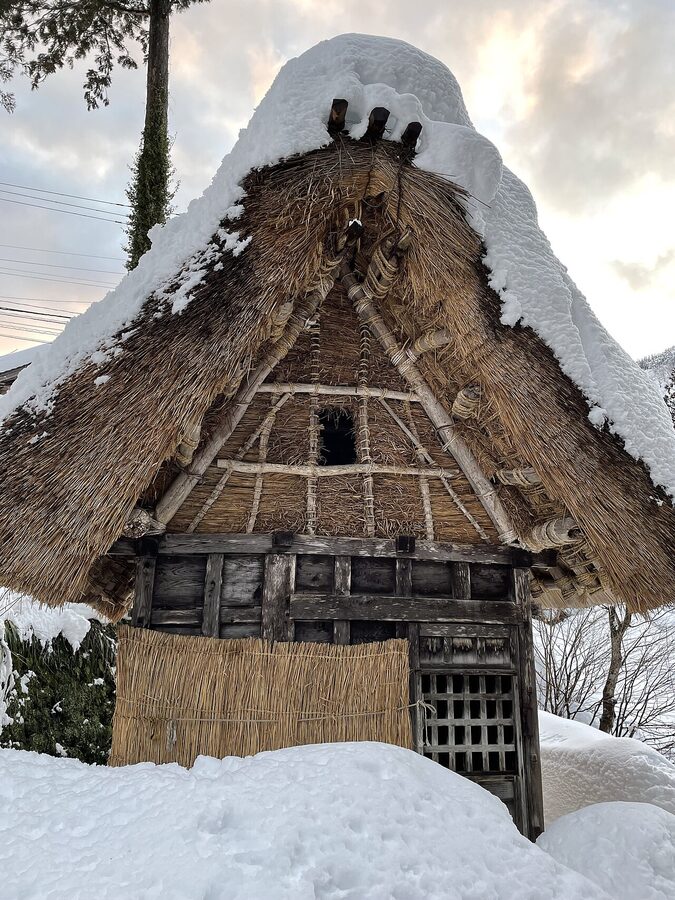
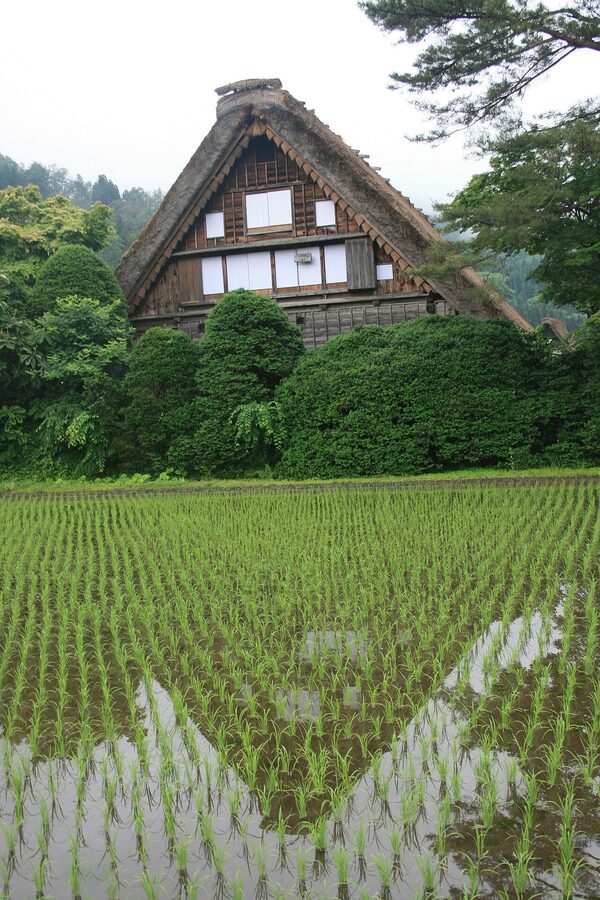
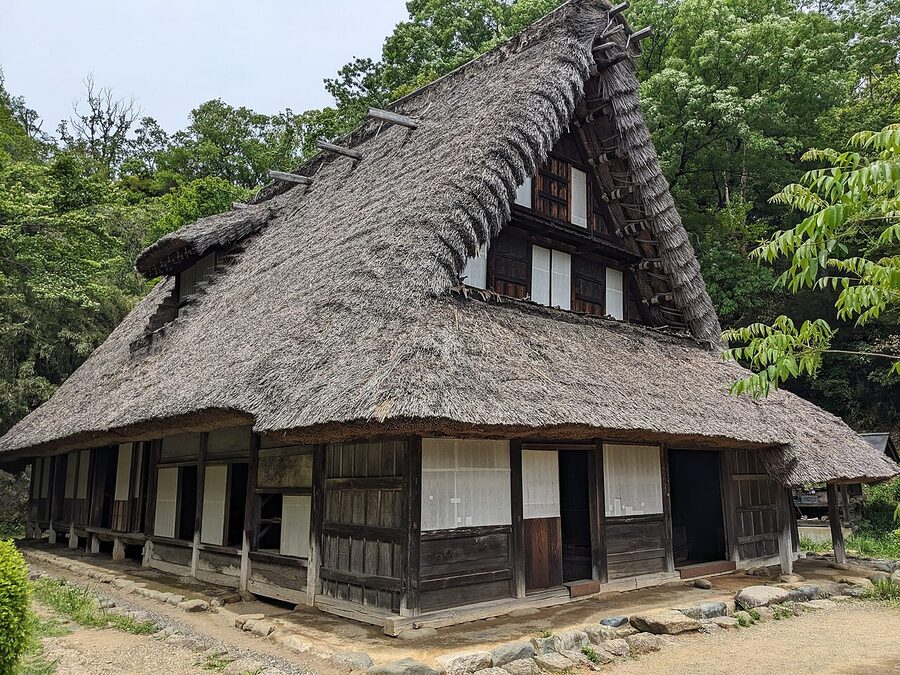
The word gasshō-zukuri (合掌造り) is younger than most people assume. Japanese scholars think it was coined around 1930 by researchers doing fieldwork in the valley, from gasshō, the gesture of pressing the palms together in prayer. The name describes the frame, not the roof: pairs of heavy timbers leaned against each other in an inverted V, like two hands, and tied together at the top.
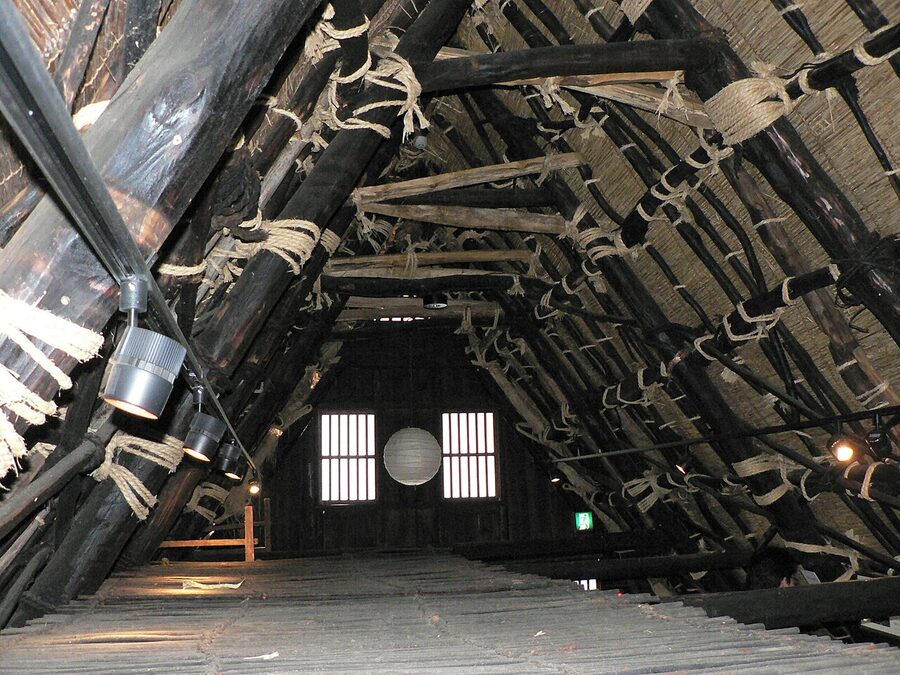
The government’s World Heritage nomination defined the type precisely, if not poetically, as a thatched house with a gabled roof on a sasu (扠首) frame, built that way in order to use the space inside the roof. In an ordinary Japanese roof frame the ridge is held up from below by posts standing on the beams; in a gasshō house the rafters lean on each other, push outward against the ends of the great tie-beams, and leave the whole attic free of posts.
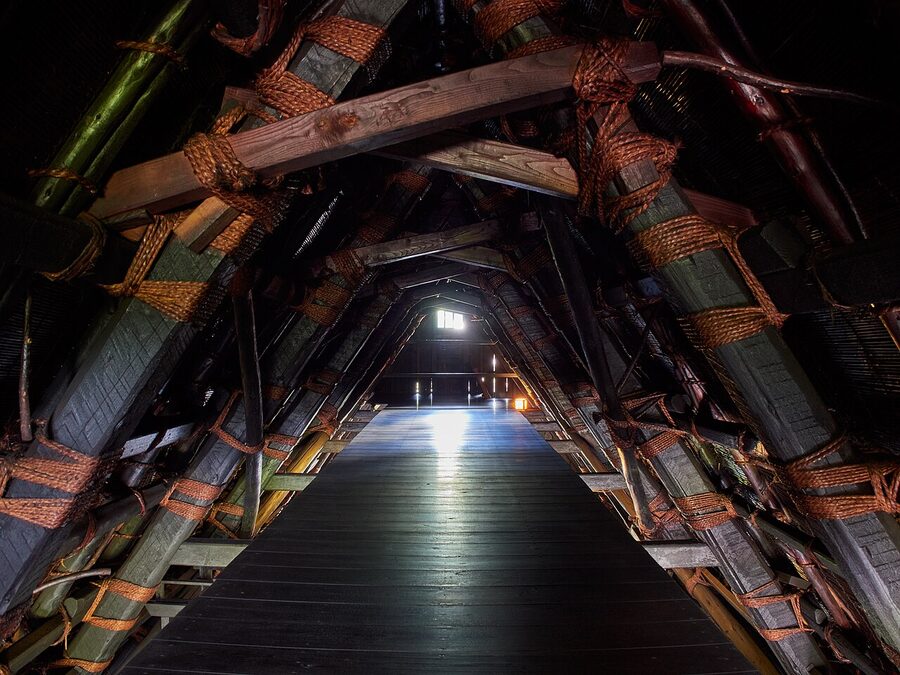
Two things follow from that frame, and both are visible from the road. The first is that the roof has to be steep: an inverted V with shallow sides pushes too hard outward on the tie-beams, so gasshō roofs were never very flat to begin with. The surviving ones range from about 45 degrees to about 60, and as a rule the older houses are the less steep, which suggests the pitch kept rising as the families needed more room upstairs.
The second is that nothing in the roof is nailed. The houses do use nails lower down, for floorboards and fittings, and Japanese architectural historians use them as a dating tool: square hand-forged nails mean the Edo period or early Meiji, round wire nails mean later.
North and south, front and side
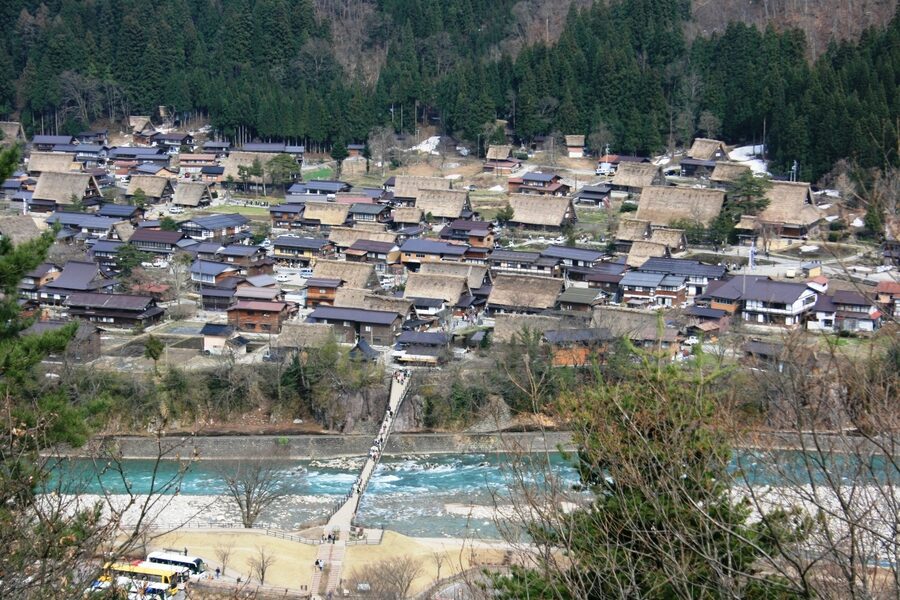
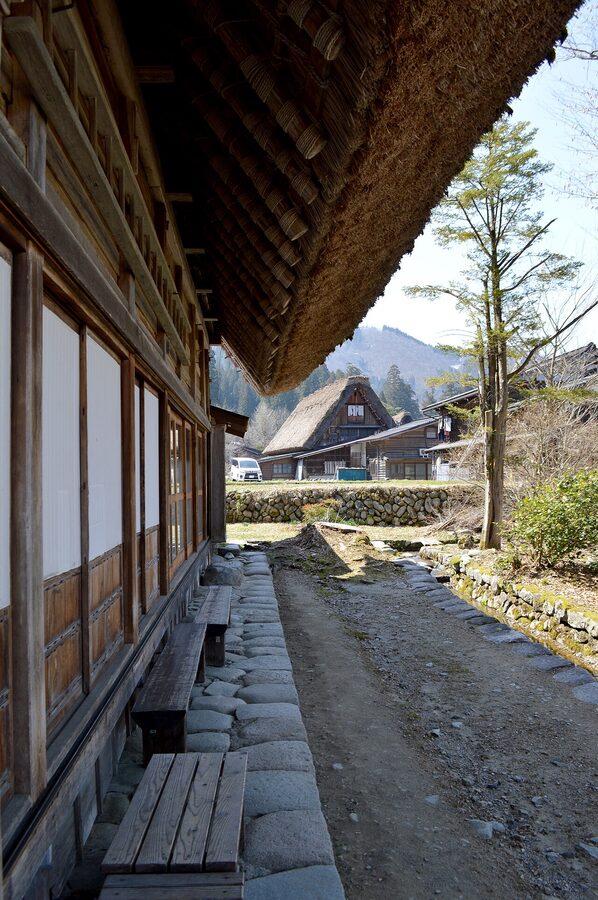
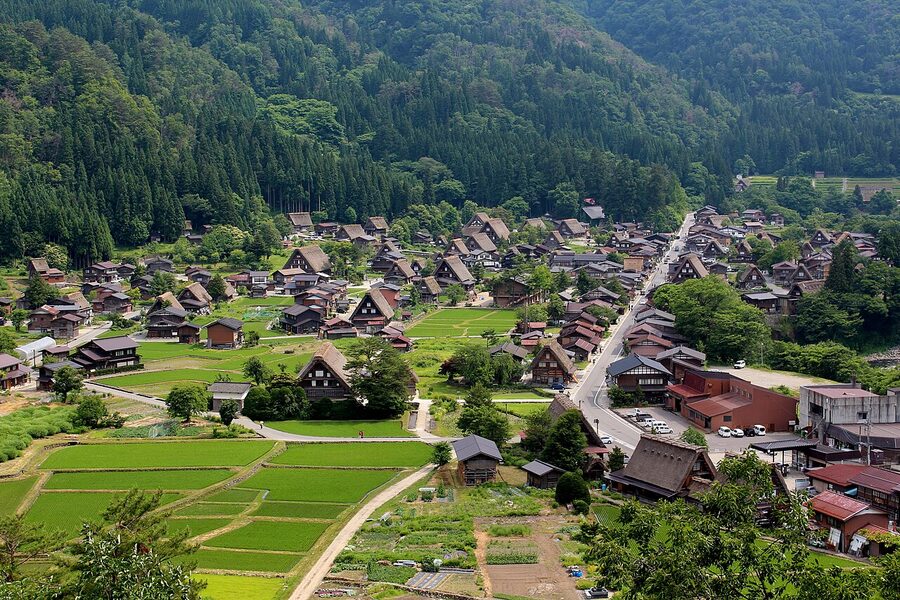
In Ogimachi every house has its gable ends facing north and south, and from the viewpoint above the village the whole settlement looks combed. The narrow gables face the wind that blows up and down the valley, and each roof face gets sun for half the day, which dries the thatch and melts the snow evenly. In summer the attic windows in the gables caught the breeze along the valley, which kept the summer silkworms from cooking.
The two halves of the valley built differently. In Shirakawa the entrance is usually on the long side of the house, under the eaves. In Gokayama it is usually on the gable end, under a small lean-to roof that makes the house look, at first glance, almost like a hipped-and-gabled building. Ainokura’s houses also have smoke vents in the roof, which keep the living rooms clearer but let water into the thatch, so they need re-roofing more often than the houses upstream.
Silkworms upstairs
The reason for the space under the roof was silk. Sericulture had come into the valley by the 16th century, but it became a real industry only in the late 1600s, and the houses grew to fit it. The ground floor was for people. Everything above it, two, three, sometimes four floors of slatted bamboo stacked inside the roof, was for silkworm trays and the mulberry leaves to feed them.
Spring comes late in these mountains. In the lowlands farmers could raise two broods of silkworms a year; in Shirakawa that was a struggle, and the families relied on the warmth of the house to bring the spring brood on in time. The hearth fire ran all day, and its heat rose through the slatted floors into the attic. Separate silkworm sheds were out of the question anyway: there was no flat land to put them on.
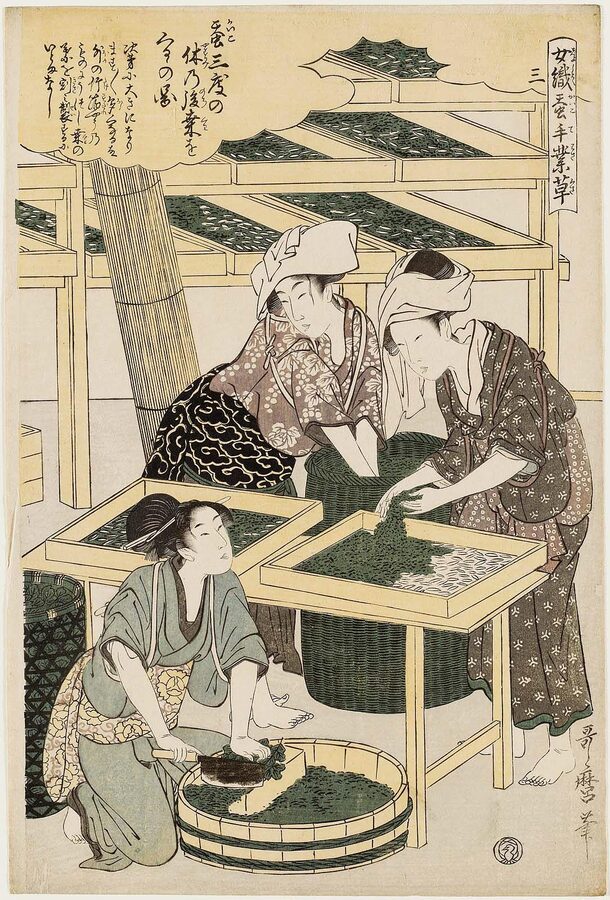
By the end of the 19th century there were roughly 1,850 gasshō buildings along the Shō valley, which sounds like a lot until you set it against the five and a half million farm households in Meiji Japan. They were, Japanese scholars point out, a fraction of a percent of the country’s farmhouses, a local answer to a local problem. Sericulture went on in the valley into the 1970s and then stopped entirely; the Wada house in Ogimachi still raises a few silkworms in July and August so that you can see what the attic was for.
The hearth that held up the roof
At the centre of the ground floor sits the irori, a square sunken hearth in the floor, with a kettle hanging over it from an adjustable hook. It was the kitchen, the heating, the light in the evening and the family’s gathering place, and it was also roof maintenance. The smoke soaked into the rafters and the underside of the thatch, killed insects, kept the straw and rope dry, and over decades turned the whole frame a lacquered black.
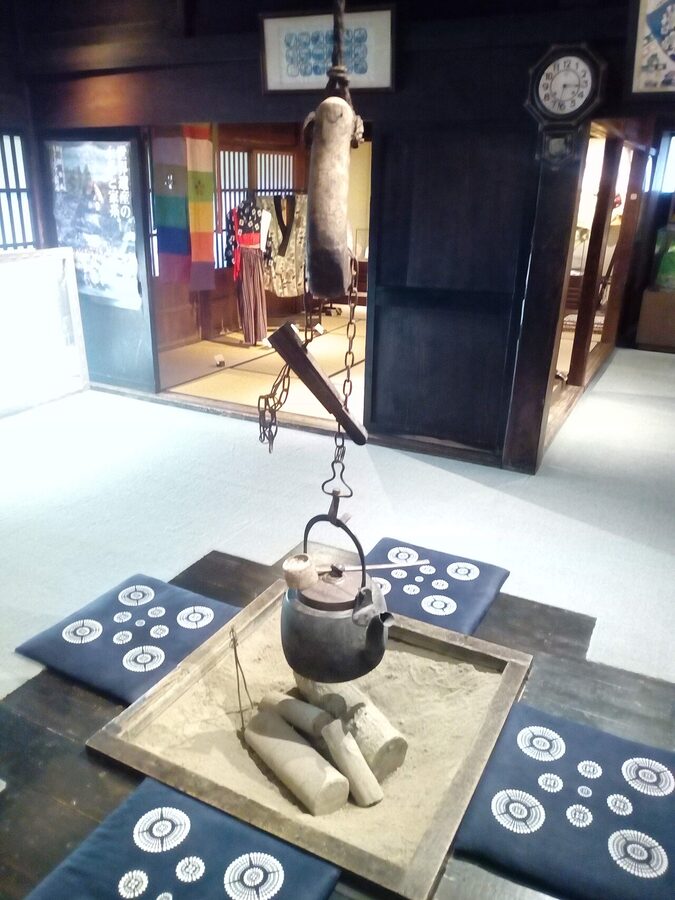
The irori is the country cousin of the hibachi, built into the floor and burning wood rather than charcoal. Myōzen-ji’s folk museum in Ogimachi still lights its hearth every day, and the smell tells you more about these houses than any panel.
Gunpowder under the floorboards
Japan has almost no natural saltpetre. The country is too wet: potassium nitrate dissolves and washes away, so it never builds up in caves or deserts as it does in dry countries. When firearms arrived with Portuguese traders in the 1540s, the early stocks of saltpetre came by sea, imported through the same trade that brought the missionaries described in my piece on Christianity in Japan. Within a few decades Japanese producers had learned to make their own.
The common method was simple and slow: dig up the soil under an old house, where decades of household waste had soaked in, leach it with water, and boil the liquor with wood ash. The Shō valley took this further. Its farmers dug a pit under the floor next to the hearth and fed it three times a year: in spring with the husks of millet, buckwheat and tobacco, in summer with silkworm droppings, and in autumn with steamed mountain grasses such as mugwort.
They turned the heap over repeatedly and waited. After about five years the bacteria had done their work and the soil was ready.
In Kaga the product was written 塩硝, ensho, a spelling peculiar to the domain, and Gokayama’s was considered the best in the country. The earliest document describing the process in detail dates only from 1811, but the trade was far older, and by the 17th century Gokayama was delivering thousands of kilograms a year. The refined saltpetre went over the Bunao Pass to Kanazawa, and the route is still remembered locally as the Ensho no Michi, the saltpetre road.
Shirakawa made it too. The Wada family of Ogimachi, the village headmen, grew rich trading it; the Tōyama family further up the valley made it under their floor until the early Meiji years. It died the way many of Japan’s hand industries died. Once the treaty ports opened, a story that begins with the ships described in my piece on Perry and the Black Ships, cheap mineral nitrate from the Chilean deserts poured in, and nobody needed five-year-old silkworm compost any more.
Kaga’s locked room
The Maeda were outside lords, tozama, the largest of the daimyo who had not been Ieyasu’s men before 1600, and they spent the whole Edo period trying to look harmless to Edo. A gunpowder supply in a valley nobody could reach was exactly what a cautious domain wanted and did not want discussed.
The same remoteness made Gokayama a prison. In 1690 the fifth Maeda lord, Tsunanori, asked his officials to find a place of distant exile inside the domain. The local headman reported that the villages on the right bank of the Shō River could only be reached by a basket slung from a rope across the gorge, and seven of them became official places of banishment. The domain then forbade anyone to bridge the river near them, so that for nearly two centuries the only way across was the kago-watashi, a basket hanging from a cable of twisted vine, hauled over a drop that local accounts compared to climbing a spider’s thread.
The exiles were not all thugs. Many were samurai who had lost a political fight in Kanazawa, the most famous being Ōtsuki Denzō, the reforming minister at the centre of the Kaga Sōdō, the domain’s succession scandal of the 1740s. The plays made him a poisoner; modern historians think he was an able administrator destroyed by his enemies, and the young men of the village put up a memorial to him in 1957 to say so. Exiled samurai taught village boys their letters by writing in the ashes of the hearth.
None of it made Gokayama rich. The domain lent rice and salt to the valley almost every year, and still, in the Tenpō famine of 1837, by one local count, about four in ten of its people starved.
Forty people under one roof
The houses were big because the households were big, and the households were big because of a rule. In the old Shirakawa villages, and in Gokayama too, only the head of the house and his heir were allowed to marry and bring a wife into the household. The younger brothers and sisters stayed at home, unmarried in the formal sense, and worked the family’s land and silkworms for their whole lives.
They were not celibate. The custom, recorded by every ethnographer who came, was that a younger son visited a woman of another household at night, and any children were raised in their mother’s house, as members of her family and not of his. The result was a household of extraordinary genealogical complexity, with the head, his wife and his heir surrounded by uncles, aunts, great-aunts, cousins at several removes, their children, and servants.
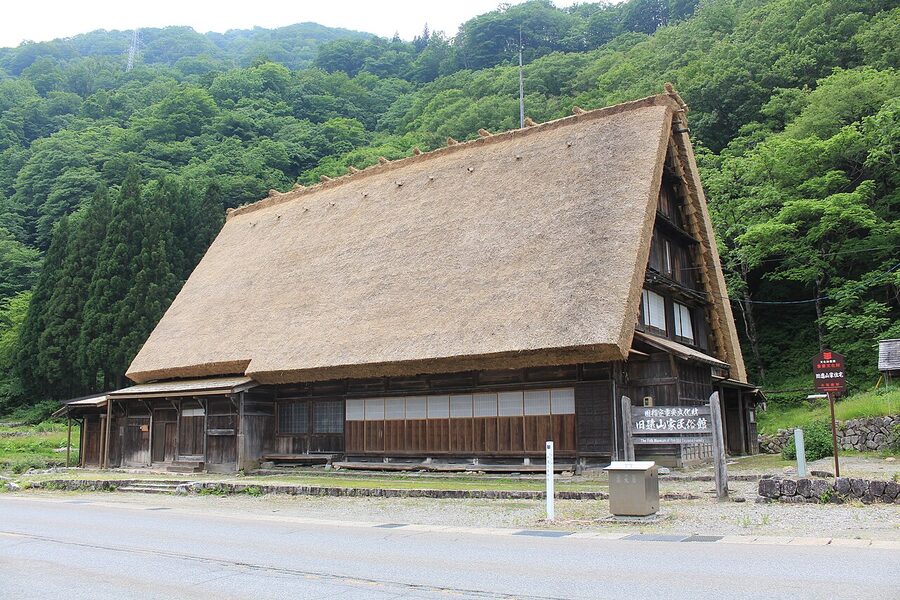
The Tōyama family of Miboro became the textbook example, and its account books survive from 1851 to 1891. They show something the romantic accounts leave out. Each family unit inside the household had a small plot of its own, called shingai, which it farmed on its days off (one day in five), and the head of the house bought the crops from them; members had their own money, fields and time, within limits.
Japanese sociologists of the late 19th and early 20th centuries, reading Western theories of social evolution, thought they had found a living fossil of the ancient Japanese family preserved in the snow. That reading has been abandoned. The standard Japanese view now is that the system was a late, local adaptation: there was no new land to give younger sons, sericulture needed a large workforce in the house, and a family that let its daughters marry out lost their labour.
The system was already fading when the ethnographers arrived in force. The folklorist Yanagita Kunio visited the Tōyama house, and Ema Mieko published her study of the Shirakawa big family in 1943, by which time she was largely describing memory. Most Japanese reference works say it lasted until about the end of the Meiji or the early Taishō years. What killed it was the road: once a younger son could walk out of the valley and find wages, the old bargain stopped making sense.
The century that came up the road
The first proper cart road into Shirakawa was finished in 1926, and the village of Hirase acquired its first shops and inns almost immediately. The main road down the valley became a military road in 1945 and was widened for lorries; buses reached Kanazawa in 1955 and Takayama in 1956. For the first time, the valley’s isolation was a matter of weather rather than geography.
The most famous outsider to make the journey in those years was an architect. Bruno Taut, the German modernist, had left Germany in 1933 and spent three years in Japan writing about its buildings, and on the 17th and 18th of May 1935 he came to Shirakawa. He was unimpressed by much of what Japan thought was its best architecture, including the ornate mausoleum described in my piece on Nikkō Tōshōgū. The farmhouses of the Shō valley he admired without reservation.
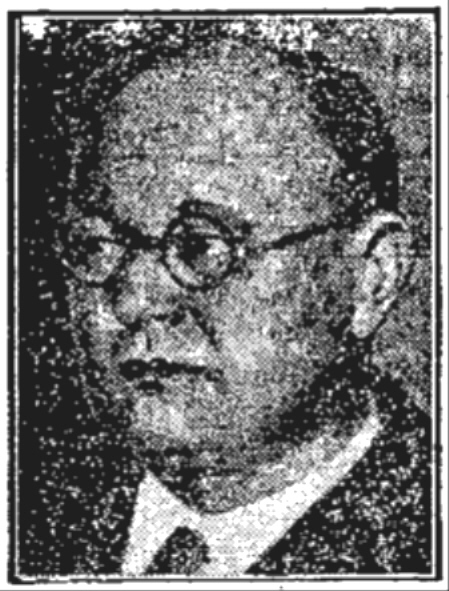
In his book on rediscovering Japanese beauty, published in Japanese in 1939, Taut described the structure of the houses as logical and rational, something quite exceptional in Japanese building. Coming from one of Europe’s best-known modernists, those few pages became the most quoted thing ever written about the valley. The houses had not changed; the people looking at them had.
The lake that drowned the valley’s heart
The real blow came from the electricity industry. The Shō River had been dammed in stages since the 1920s, and in the 1950s the planners wanted one enormous reservoir at the head of the system to keep the turbines downstream running through the winter. The site they chose, at Miboro, was the most fertile land in Shirakawa-gō and the old heart of the valley’s religious life.
The reservoir would flood 230 households and force about 1,200 people out. In 1952 they formed an opposition league; when some families broke away to negotiate, the 174 households who remained renamed themselves the “Society to Defend to the Death”, with a woman, Wakayama Yoshie, as its secretary. The first president of the state power company, Takasaki Tatsunosuke, came up the valley again and again to sit with the families, and the company produced what it called the Memorandum of Happiness, promising that those who moved would be better off than before.
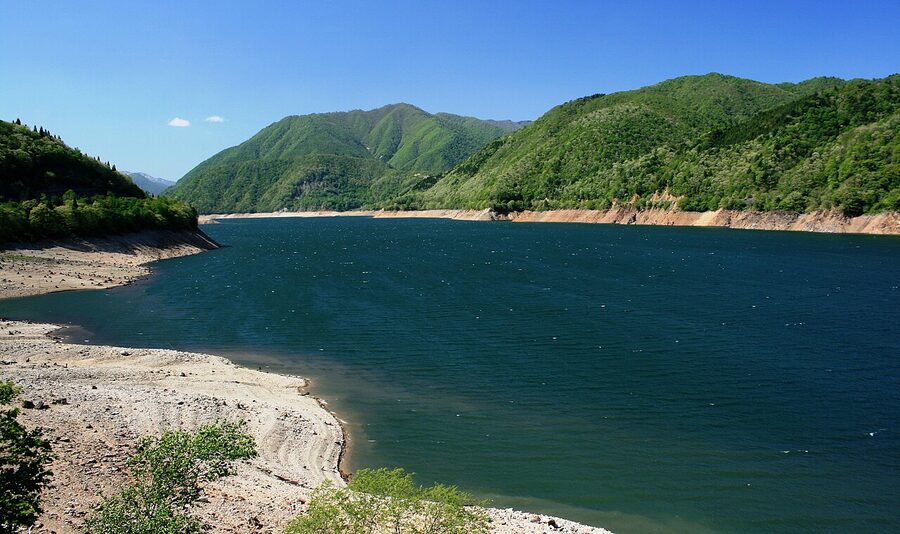
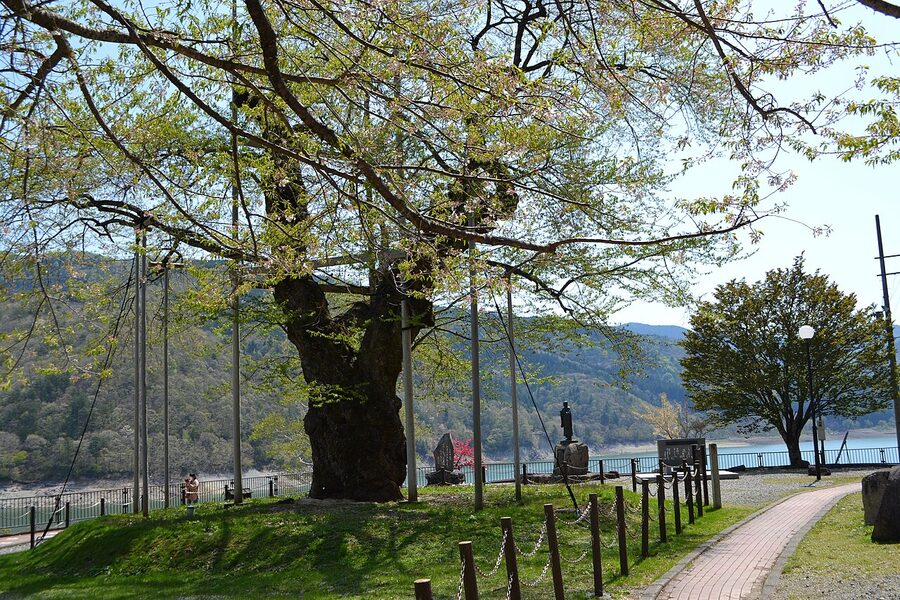
The Society dissolved in November 1959, after seven years. Walking through the doomed village afterwards with Wakayama, Takasaki saw two cherry trees at the temples of Kōrin-ji and Shōren-ji, each more than four centuries old and over thirty tonnes, and decided they should not drown. The cherry specialist Sasabe Shintarō and a nursery firm from Toyohashi hauled both up the hillside to the new lakeshore in December 1960, after a furious argument over how much root and branch to cut, and the following spring both trees put out buds.
The Shōren-ji main hall left with the trees. It was taken down, moved to Shiroyama Park in Takayama, and rebuilt facing the other way, so the oldest building in the valley’s history now stands an hour’s drive from the valley.
Emptying out
The Shōwa economic boom did the rest. The great snow of 1963 cut the upper valley off for months, and many families who had hung on decided they had had enough. Through the high-growth years seventeen settlements in the area were abandoned, and the number of gasshō houses fell from about three hundred in 1945 to roughly half that. In February 1970 a house in the village collapsed under snow and killed a family of four, a reminder that the steep roofs were never maintenance-free.
Many of the houses that survived did so by leaving. Gasshō frames come apart and go back together, and they were bought and rebuilt all over Japan as restaurants, inns and museum pieces; Hida no Sato in Takayama has a group of them.
Sell nothing, rent nothing, pull nothing down
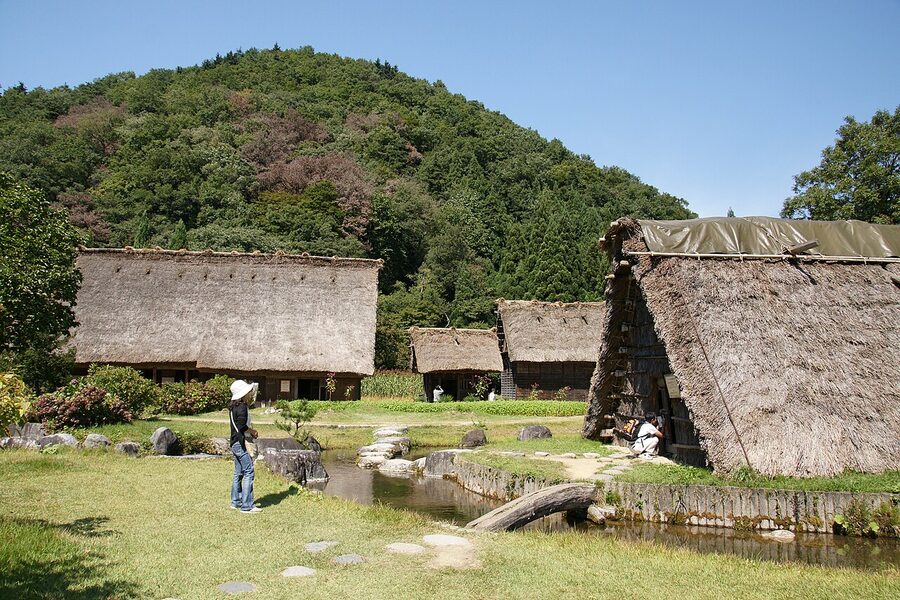
In 1971 the people of Ogimachi formed the Society to Protect the Natural Environment of Ogimachi Village and adopted three rules for gasshō houses: do not sell them, do not rent them out, and do not demolish them. The village opened an open-air museum of rescued houses the same year. The same three rules appear that year in the residents’ charter of Tsumago, the post town on the Nakasendō that was saving itself in exactly the same way at exactly the same time.
The law caught up in 1975, when Japan amended its cultural properties act to protect whole districts of traditional buildings rather than single monuments, and in 1976 Ogimachi became one of the first such districts. It is the same designation that now protects the storehouse street of Kawagoe, and dozens of others. Gokayama had moved earlier on individual houses: three of its great farmhouses were named Important Cultural Properties in 1958, and Ainokura and Suganuma became national historic sites in 1970.
Fifty years on, the three rules still stand, and they are harder to keep than they sound. In a shrinking village, a house nobody may sell or let can end up standing empty, and an empty gasshō house rots from the roof down.
World Heritage
Japan joined the World Heritage convention in 1992 and put the Shō valley on its first list of candidates. The 1994 nomination argued that the villages were outstanding examples of a settlement perfectly adapted to its environment, and that they had survived Japan’s extraordinary speed of change since the 1950s. It skipped the usual comparison with similar sites abroad and quoted Bruno Taut instead.
The World Heritage Committee, meeting in Berlin, inscribed the Historic Villages of Shirakawa-gō and Gokayama in December 1995, early in the Heisei era, a year before it added the Itsukushima Shrine. It was Japan’s sixth World Heritage Site. The advisory body had first recommended Ogimachi on its own; Ainokura and Suganuma were added at the committee’s preparatory meeting, which is why the inscription covers a large, a middle-sized and a tiny village. Only two inhabited villages had been listed before, Hollókő in Hungary and Vlkolínec in Slovakia.
Yui, fire and two million guests
A thatched roof in this valley lasts thirty or forty years, and replacing one is a job for a village, not a family. The system that does it is called yui (結), mutual labour paid back in labour, never in money. The households of Ogimachi are organised in neighbourhood groups called kumi, and the yui runs through them; Japanese writers trace its strength here to the old True Pure Land congregations, which organised the valley long before any lord did.
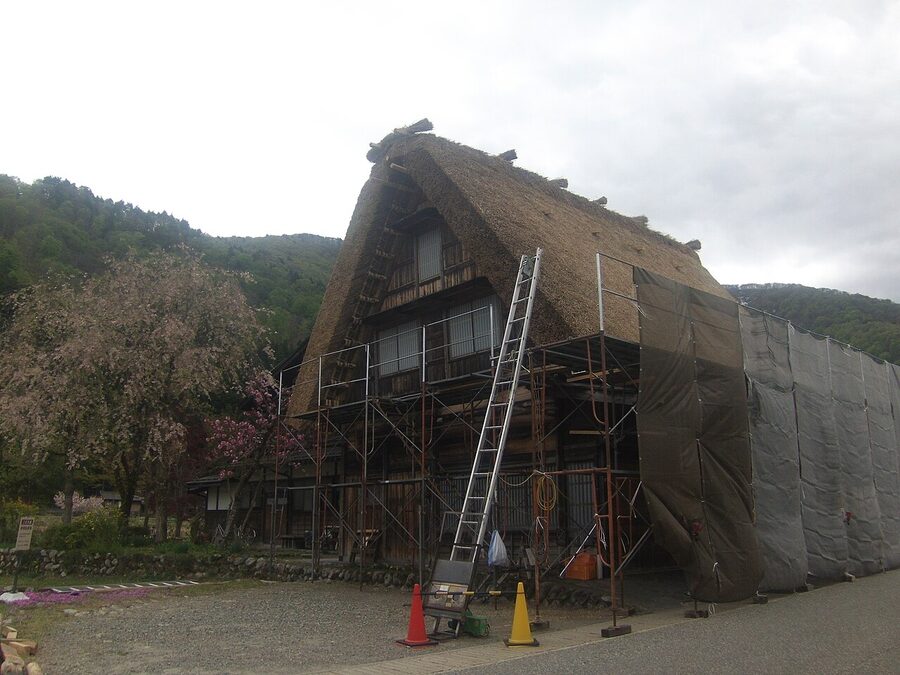
In the classic form, preparations started three years before. The household calculated how much thatch and how many workers the roof needed, cut and stored the grass from the village’s common thatch fields, and went round the village asking for help on a fixed date. On the day, two or three hundred people turned out, the men stripping the old thatch and laying the new while the women cooked for all of them, and one face of the roof was finished from dawn to dusk. Nobody was paid; everyone owed and was owed.
Small repairs are a separate job, done most years, because when the snow slides off a roof in spring it takes thatch with it. The patching is called sashigaya, pushing new grass into the gaps.
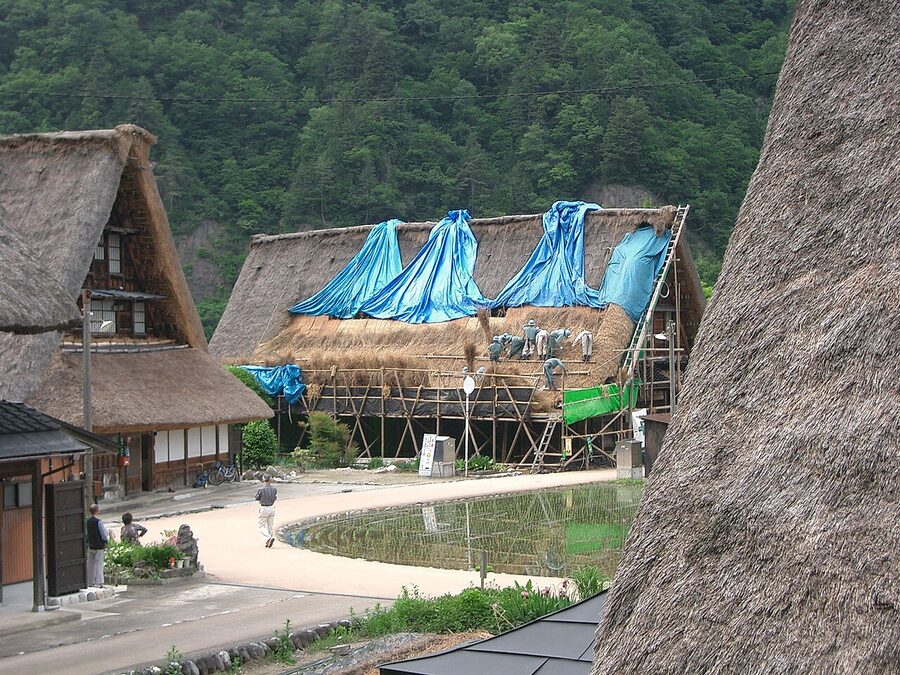
The yui is under strain. Many households in Ogimachi now live in ordinary houses, and for them the old bargain is all giving and no receiving, so the labour comes from the remaining gasshō owners, professional thatchers and volunteers: when the Nagase house was re-roofed in 2001, about five hundred people came from around the country. Thatching is a trade I would add to the list in my piece on Japan’s greatest crafts, if only because so few people can still do it properly.
Fire
A village of thatched wooden houses with open hearths is a village that lives in fear of fire, and Ogimachi organises accordingly. Each kumi walks its streets three times a day, at noon, in the early evening and at nine at night, calling the old warning to mind the fire, and a rota of residents makes a final round of the whole village at eleven. Since the 1970s Ogimachi has installed more than fifty water cannons in small roofed huts among the houses.
Every autumn, before the heating season, the village tests them all at once, and for a minute Ogimachi disappears behind arcs of water; the photographs of it are almost as famous as those of the light-ups. The fire in Suganuma in July 2026 was a reminder of why they bother.
The people who come to look
Tourism saved the valley, and it is also the thing residents worry about most. Before the World Heritage listing, Shirakawa village was taking between six and seven hundred thousand tourists a year; by 2002 it passed 1.5 million, and in 2019 it peaked at about 2.15 million. In 2024 the figure was about 2.08 million, and for the first time more than half, about 1.11 million, came from abroad. The village has around fifteen hundred residents.
Most come on day trips, many on tour buses that stop for an hour or two, and the complaints from Ogimachi have been consistent for twenty-five years: people opening the doors of houses that are homes, parking in lanes that are someone’s only way out, leaving rubbish in a village with nowhere to put it. As the numbers rose, the time each person spent in the village fell, and so did the number staying the night.
The village’s response has been rules rather than bans. Large vehicles have been barred from the central street since 2009, and the light-ups became reservation-only in 2019. From October 2025 the fee for a tour bus in the main car park rose from ¥3,000 to ¥10,000, and from 1 December 2026 every tour bus has to book a parking slot online in advance.
None of this applies to someone arriving on the scheduled bus with a day-pack, which is how I think you should come anyway.
Where to see Shirakawa-gō and Gokayama today
Everything below was checked on the official sites of the Shirakawa-go Tourist Association, the Gokayama tourist information centre and the bus companies in November 2026. Prices are for adults. Opening hours here change with the season and with the snow, so check again before you travel, especially in winter.
Getting there
There is no railway. Nohi Bus runs about sixteen round trips a day between Takayama and Shirakawa-gō, around fifty minutes each way, and some departures continue to Kanazawa, Toyama and Takaoka. From 1 December 2026 the fares are ¥2,900 from Takayama, ¥2,900 from Kanazawa, ¥2,400 from Toyama and ¥2,200 from Takaoka. The Kanazawa services need a seat reservation, and in the autumn colours and on holiday weekends they fill up, so book as soon as your dates are fixed; on the Takayama run some departures are reserved and some are not.
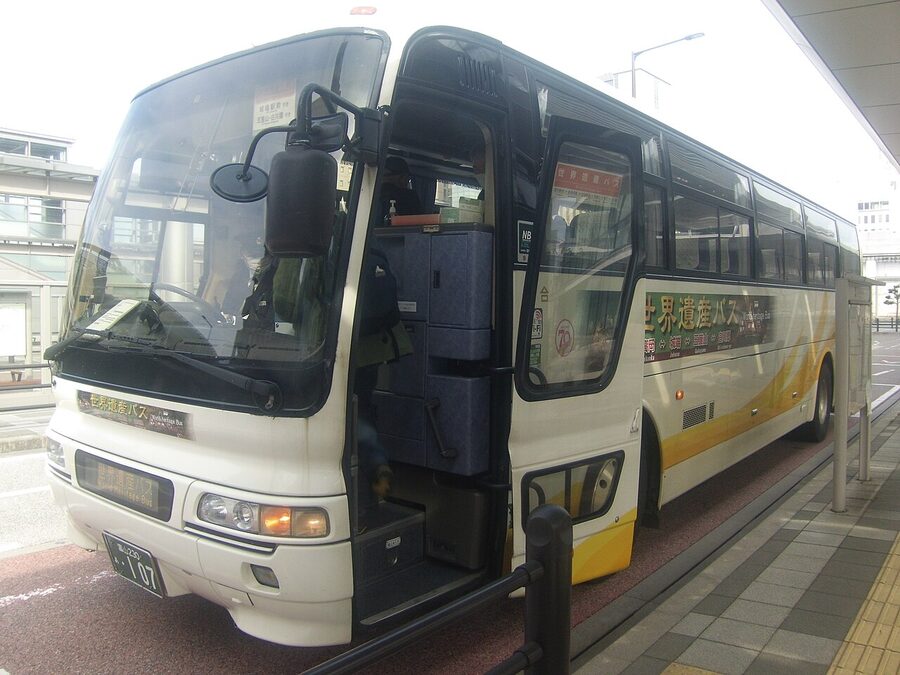
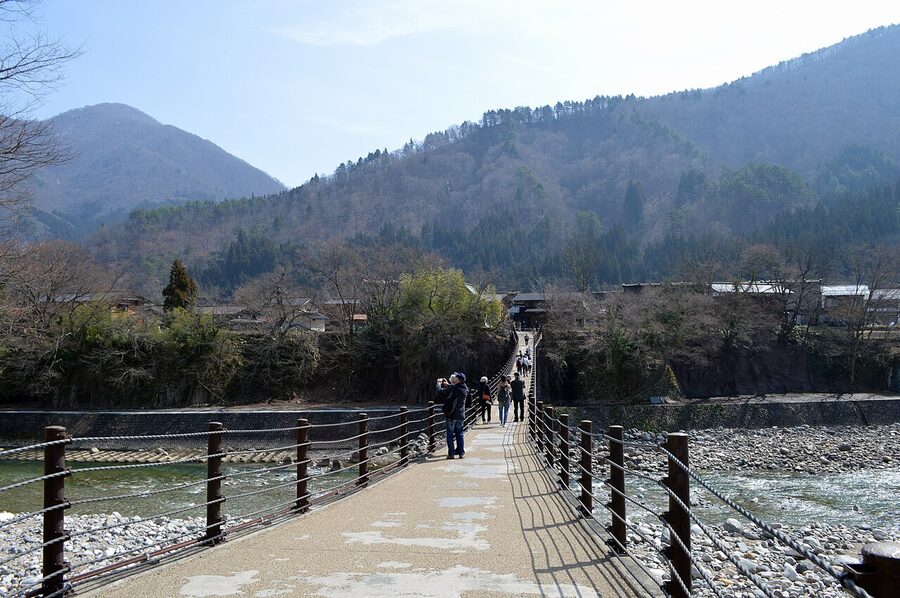
The bus terminal is at the edge of Ogimachi, a few minutes’ walk from the Wada house. If you drive, the village wants you in the Seseragi Park car park across the river (¥2,000 for a car, 8:00 to 17:00), from which a short walk over the Deai-bashi suspension bridge brings you into the village. In heavy traffic the attendants send cars on to overflow lots further away.
For Gokayama, the Kaetsuno World Heritage Bus runs from Takaoka and Shin-Takaoka through Jōhana station to Ainokura-guchi and Suganuma and on to Shirakawa-gō. Ainokura is a ten-minute walk uphill from its bus stop. From April to November some of the Nohi buses between Shirakawa-gō and Kanazawa also call at Suganuma, but only to pick passengers up.
Ogimachi: the Wada house
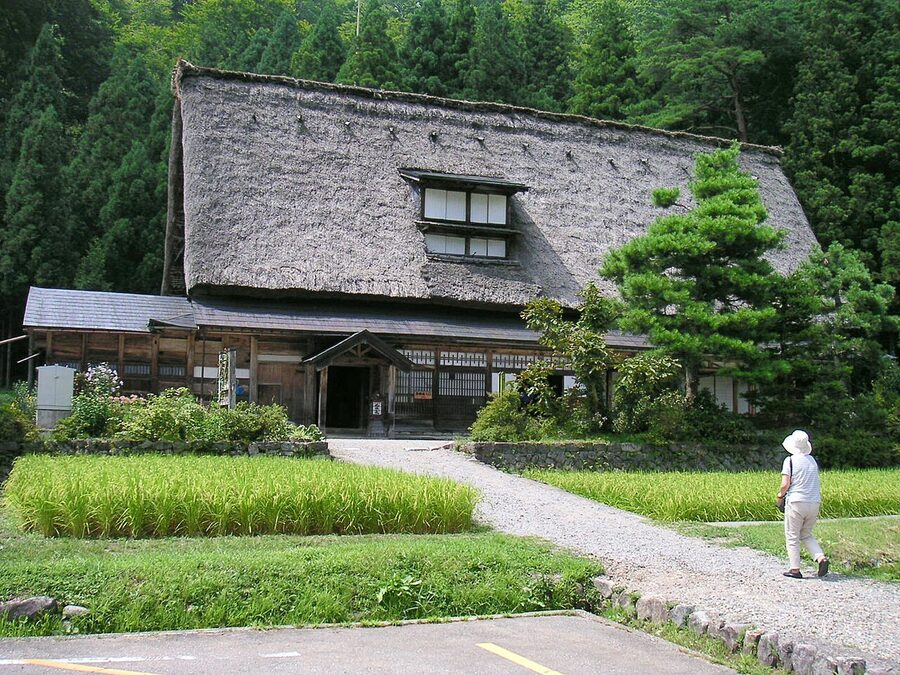
The Wada house (和田家) is the largest gasshō house in Ogimachi and a National Important Cultural Property, the home of a family that has been in the village since 1573. Its heads all took the name Yaemon, served as village headmen and as officials at the checkpoint at Ushikubi, and made their fortune trading saltpetre and silk. The house dates from the late Edo period and still has a family living in part of it.
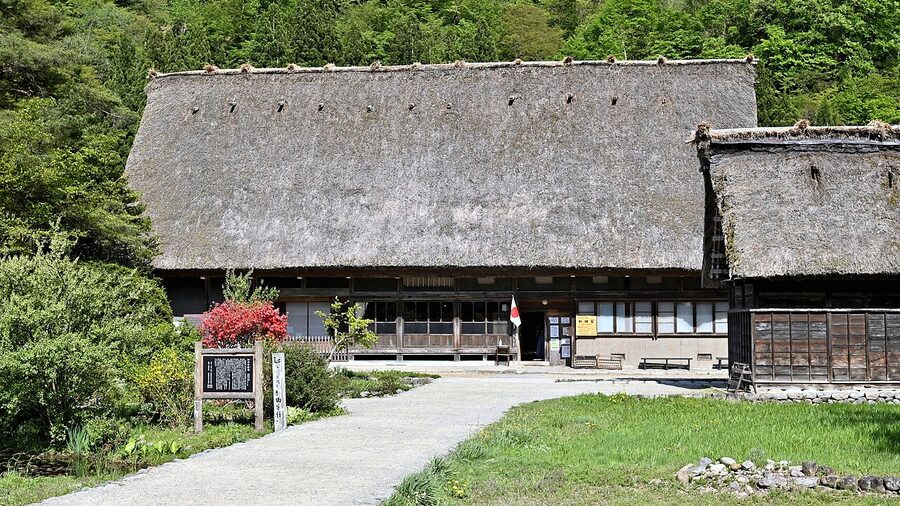
The first and second floors are open, with explanations in Japanese downstairs and English upstairs, and the family raises silkworms in July and August. Admission is ¥400, from 9:00 to 17:00, cash only, with irregular closing days. If you see only one house, see this one, and go early.
The Kanda and Nagase houses
The Kanda house (神田家), a short walk south through the village, is where I would go second. It is a little smaller and much quieter, and the reason I send people there is the floor: the family has opened up the place under the house where the saltpetre soil was made. Admission is ¥400, from 10:00 to 16:00, and it closes on Wednesdays.
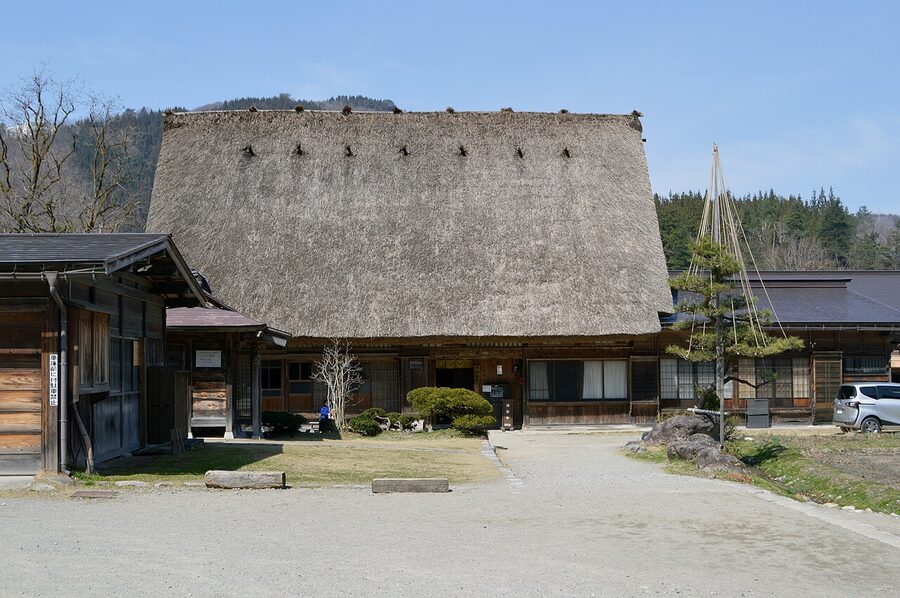
The Nagase house (長瀬家) is the tall one, five storeys inside a single roof, built in the 1890s. It has a family Buddhist altar on the ground floor said to be five hundred years old, tools and household objects in the attics, and a film of the house’s re-thatching in 2001 with its five hundred volunteers, which is the best short introduction to yui I know. Admission is ¥400 and it opens from 9:00 to 16:00, with irregular closures.
Myōzen-ji
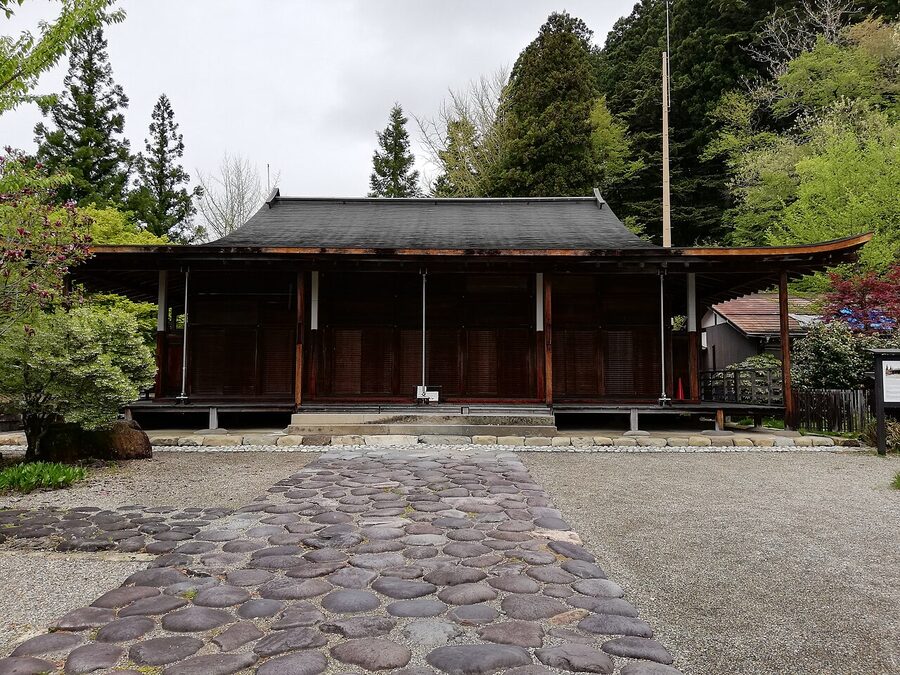
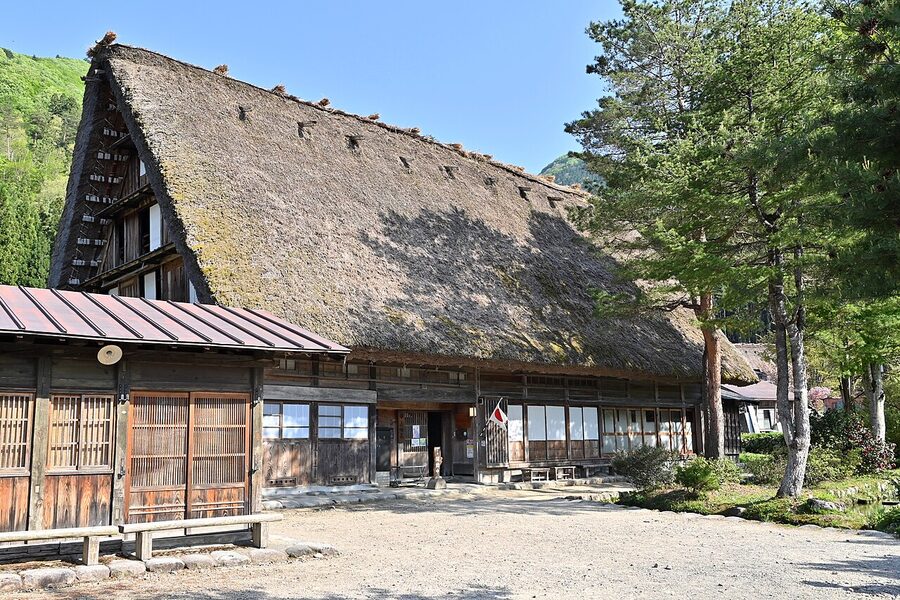
Myōzen-ji (明善寺) is the True Pure Land temple of Ogimachi, and the only temple in the valley whose priests’ quarters are a full gasshō house, five storeys under thatch, built around 1817. The thatched bell-tower gate is older still, from about 1801, and the main hall dates from 1827. The priests’ quarters are now the Myōzen-ji folk museum, with tools and household objects on every floor and a hearth kept burning every day.
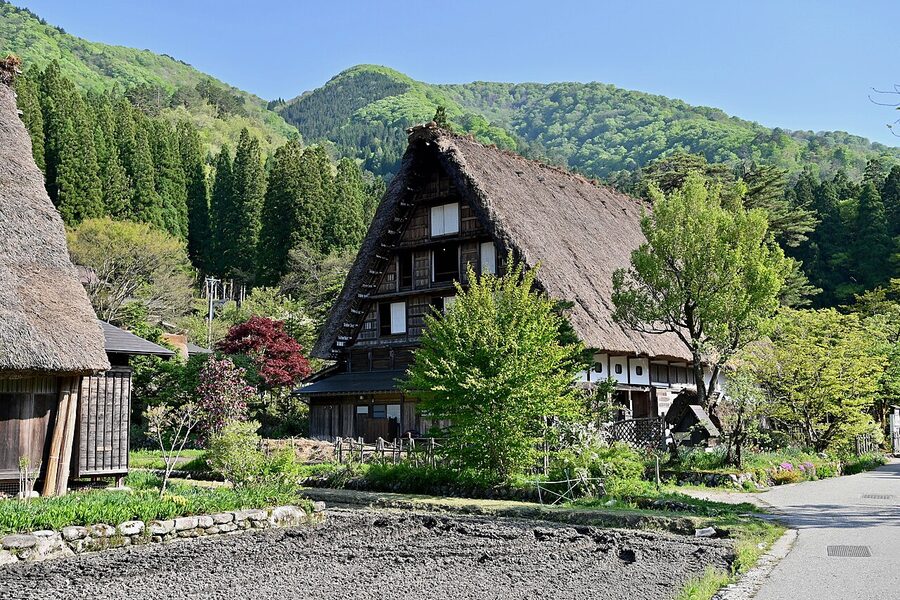
Admission is ¥400; it opens 8:30 to 17:00 from April to November and 9:00 to 16:00 from December to March. Remember that this is a working temple of the sect that built the valley’s community, and that its graveyard is not a photo opportunity.
The view from the castle mound
The classic view of Ogimachi, the one on every poster, is from the site of the old Ogimachi castle on the hill at the north end of the village, sometimes called the Shiroyama viewpoint. There are two lookouts side by side: a free public one on the castle site and a private one next to it with a souvenir shop and café. You can walk up from behind the Wada house in fifteen to twenty minutes on a forest path, or take the small shuttle bus that runs from near the Wada house for a fee.
Shirakawa Hachiman Shrine and the Doburoku Festival
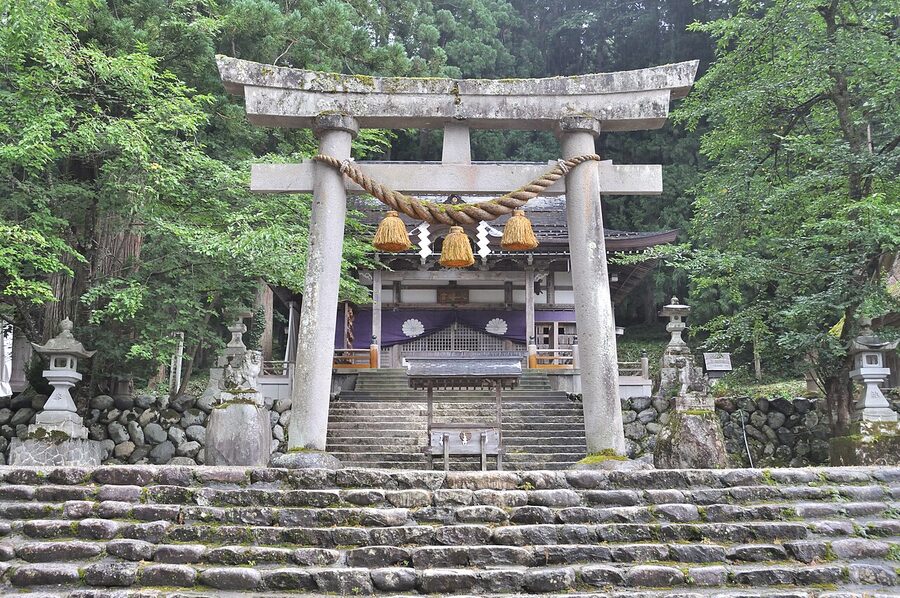
Shirakawa Hachiman Shrine (白川八幡神社), at the southern end of Ogimachi, is the village shrine and the scene, on the 14th and 15th of October, of the Doburoku Festival, when the shrine offers its own doburoku, a cloudy unfiltered rice wine, in thanks for the harvest and pours it for the crowd. The festival brings out the lion dancers and the folk song Kodaijin, and other shrines in the village hold their own versions over the following days.
The open-air museum
The Gassho-zukuri Minkaen (合掌造り民家園), across the river from the main village, is the museum of rescued houses opened in 1971: twenty-five gasshō buildings by the village’s own count, nine of them prefectural cultural properties, including farmhouses, a watermill, storehouses and a horse shed. Many came from abandoned hamlets such as Kazura. Admission is ¥800, open 8:40 to 17:00 from March to November and 9:00 to 16:00 from December to February, and it closes on Thursdays from December to March. It is the one place in Ogimachi where you are positively invited inside, and the attics are worth the climb.
Staying the night
If you can, sleep in the village. The day-trippers leave by late afternoon, and Ogimachi between six in the evening and nine in the morning is a different place: quiet lanes, lit windows, frogs in the paddies in summer. The tourist association lists about forty places to stay in the village and nearby, from gasshō-house minshuku with dinner round the hearth to modern hotels, and takes online bookings about three months ahead.
Expect shared bathrooms, thin walls and early dinners in the old houses. Some gasshō inns now take only one group a day; one belongs to a family with three generations of thatchers. Book well ahead for autumn and for any weekend.
The winter light-ups
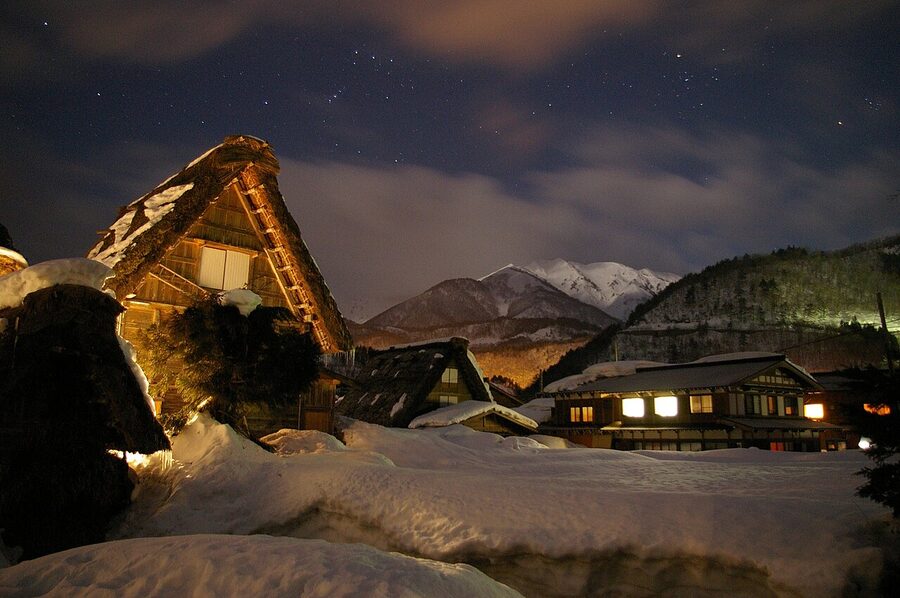
On a few nights each winter the houses of Ogimachi are lit after dark, and the view from the castle mound over snow-covered roofs is what most people outside Japan picture when they hear the name. The 2027 dates are the 11th, 17th, 24th and 31st of January, from 17:30 to 19:30, and entry is by advance reservation only, with a pass worn around your neck that is checked at the village entrance. Without one you will be turned away.
There are three realistic ways in: a room in the village (assigned by lottery, which for 2027 closed in October), a reserved parking space for a private car (¥7,000 for one to five people in the second sales round, opening on 1 December 2026, the first having sold out), or a seat on one of the special highway-bus tours. Tickets for the viewing platform on the castle mound come only with some room and bus packages, in timed sessions. On light-up days the village is open in the daytime as usual, but the car park takes no new arrivals after 15:00.
Gokayama runs its own, smaller events. Ainokura holds light-ups in May, September and February (the next are the 20th and 21st of February 2027), and on a few other evenings the residents simply leave the lights on in their windows and let you walk through; in January 2027 that happens on the 13th and the 27th.
Gokayama: Ainokura
Ainokura (相倉) is the larger of the two Gokayama villages, twenty-odd gasshō houses on a terrace high above the river, with rice fields stepping down below them and cedar forest behind. It feels more like a working village than Ogimachi, and it is far less crowded. The gable-end entrances and the smoke vents in the roofs are worth comparing with what you saw in Shirakawa.
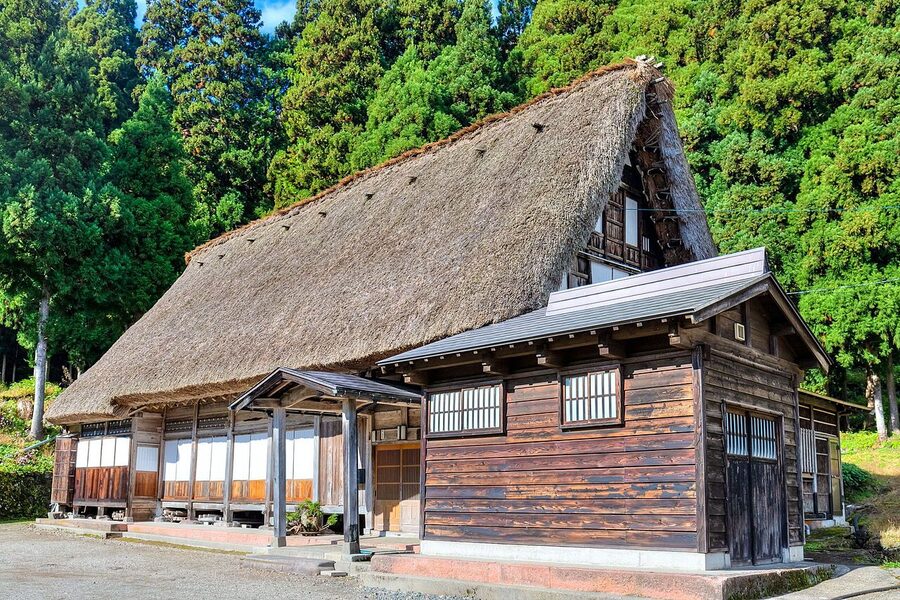
The Ainokura folk museum, in a gasshō house in the village, is listed by the Gokayama tourist office as closed indefinitely at the time of writing, so check before you plan around it; the Ainokura Traditional Industry Museum nearby, on the same joint ticket in normal times, shows the valley’s old trades. The Gokayama tourist information centre at Kaminashi, a short bus ride away, holds performances of the Kokiriko, the valley’s oldest folk song and dance, on fixed weekends through the year for ¥500.
Gokayama: Suganuma
Suganuma (菅沼) is the smallest of the three World Heritage villages, nine gasshō houses on a bend of the river, with steep forest behind it that is protected so it can hold the snow back from the roofs. It takes half an hour to walk round and is at its best under snow, or in the first light, before the buses.
The Gokayama Folk Museum here (¥300) shows the tools of daily life in a gasshō house. The Ensho no Yakata next door, the saltpetre museum, has been closed for repairs since the fire of July 2026; check the Gokayama tourist office’s site before going if that is what you came for.
More of Gokayama
Between the two villages, the Murakami house (村上家) at Kaminashi is one of the oldest gasshō houses in the valley and an Important Cultural Property, usually dated to the middle of the Edo period. Local tradition puts it earlier: a strongman helping to build it, the story goes, could lift the great beams alone until news came that the Hongan-ji at Ishiyama had fallen, and then could not lift them at all. The Toyama prefectural tourism site lists it at ¥400, open 9:00 to 16:00, closed on Tuesdays and Wednesdays and from mid-December to the end of February, and the family will perform the Kokiriko for those who book ahead.
Further south, at Nishi-Akao, the Iwase house (岩瀬家) is one of the largest gasshō houses that survive anywhere. It was built in the late Edo period, over eight years, by Fujii Chōemon, one of the men who refined saltpetre for the Kaga domain, and it housed some thirty-five people including servants. The family’s fortunes collapsed with the Tenpō famine and the domain’s reforms after 1837, and the fall in saltpetre prices after the Meiji Restoration finished them off.
Across the river near Tamukai you can see the Rukei-goya, the rebuilt exile hut, and nearby the site of the old kago-watashi, where a model basket now crosses the gorge with a dummy in it in place of a person.
Up the valley
If you have a car, drive south from Ogimachi on Route 156. Twenty minutes brings you to the Former Tōyama house at Miboro (¥300, 9:00 to 16:00 from April to November and 10:00 to 16:00 from December to March, closed on Wednesdays), the best place in the valley to understand the big-family system, which also serves lunches of local rice, tofu and mountain vegetables. On the way, beside the road at Hokiwaki, is the memorial to Kaerikumo Castle, under the scar where the mountain came down.
Beyond that the road climbs past Miboro Dam and runs the length of Lake Miboro, and near its far end, at Nakano in the Shōkawa district of Takayama, stand the two Shōkawa cherries, at their best from late April to early May. And if you go on to Takayama, walk up to Shiroyama Park and find the old main hall of Nakano Shōren-ji, which made the journey down the valley before the water came.
How not to become the problem
The rules are short. The houses are homes: do not open doors, do not walk into gardens, do not photograph people through their windows, and treat the paid houses as the only interiors you will see. Keep to the lanes and out of the paddies, which are crops, not lawns. Take your rubbish away with you, because the village has nowhere to put it, and do not fly a drone.
Come on the bus, stay the night if you can, and spend money in the village rather than at the coach park. The best thing you can do for Shirakawa-gō is to be the kind of guest it was hoping for when it decided, in 1971, to open its doors rather than sell them.
The soil under the floor
Most of what is written about this valley, in any language, is about roofs: their angle, their weight, the snow on them, the lights under them. They deserve it. But the houses were built from the floor up, around a fire and a pit of fermenting earth, by families whose only real assets were their own labour and their silence about what was under the floorboards.
The Kaga domain is long gone and the gunpowder long since burned. The castle in Kanazawa never had to melt its lead roof tiles into bullets, and no army ever came up its hill to test Gokayama’s gunpowder either; most of the valley’s secret industry was insurance against a siege that never happened.
If you are in Ogimachi anyway, go into the Kanda house and find the opening in the floor. It is only a hole with some dirt in it. Stand there for a minute, and think about who dug it, and who, five years later, came back for what it had grown.