On the 7th day of the sixth month of 1378, the shogun Ashikaga Yoshimitsu sat in a viewing stand in Kyoto to watch the floats of the Gion festival, and beside him, close enough for every courtier in the street to see, sat a boy actor of about fifteen. The boy was the son of a sarugaku player from Nara, and the court regarded his profession as one small step up from vagrancy. A senior courtier, Sanjō Kintada, went home and wrote it down in his diary with some heat. The shogun was making a pet of a performer, he complained, and this kind of entertainment was the business of beggars.
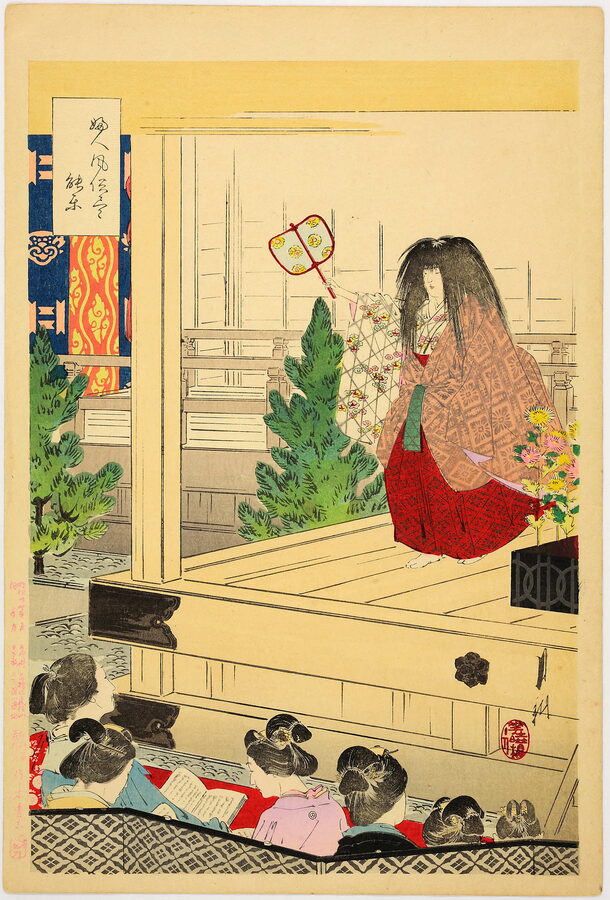
The boy was Zeami. Within thirty years he had turned the beggars’ business into the most refined theatre Japan has produced, written the first treatise on acting in the Japanese language, and perfected a kind of play in which a ghost returns to the place where it suffered and dances the story out for a passing monk. Two centuries after that festival, the Tokugawa made his art the official ceremony of the warrior class, and every daimyo worth his rice kept a stage and a troupe of actors on the payroll.
Noh (能) has been played more or less continuously for about 650 years, which makes it the oldest form of theatre in Japan still performed as a living art. It very nearly died in 1868, and I think the story of how it was saved is nearly as good as the plays. This is that story, an explanation of what is happening when you sit down in front of a Noh stage, and a guide to where to see one, including a stage that stands in the sea.
In This Article
- Monkey music: the sarugaku before Noh
- Imagumano, 1374 or 1375
- The flower and the ghost: what Zeami wrote
- Seventy-two, and sent to Sado
- What happens on the stage
- A roof, a bridge and a painted pine
- Shite, waki and the people who sit still
- The masks
- The robes
- Kyōgen, the comedy in between
- Hideyoshi takes the stage
- The warrior’s ceremony
- 1868 and the empty seats
- Six hundred years on
- Where to see Noh today
- The National Noh Theatre, Sendagaya
- Elsewhere in Tokyo
- Kyoto: the Kongō Noh Theatre and the Kanze Kaikan
- Imagumano Shrine, where it started
- Nishi Hongan-ji’s North Stage
- Itsukushima’s stage on the sea
- Takigi-nō: Noh by firelight
- Sado, the island of exile
- Tickets, manners and what to read first
Monkey music: the sarugaku before Noh
The character 能 means ability, or skill, and in the 14th century it was not the name of a genre: troupes of several kinds called their dramatic numbers nō, as opposed to their acrobatics or their jokes. What is now called Noh was, until 1881, usually called sarugaku (猿楽), “monkey music”.
In the Nara period the court imported from China a mixed entertainment called sangaku (散楽), acrobatics, conjuring and comic mime, and over the Heian centuries the comedy came to the front and the name slid, probably by way of a pun, into sarugaku. Zeami disliked the monkey intensely. He spelled the word with a different character, 申, and claimed the art began when Hata no Kawakatsu performed sixty-six pieces of mimicry before Prince Shōtoku, the character being half of the character for “god”. It is a fine piece of family public relations and there is no evidence for any of it.
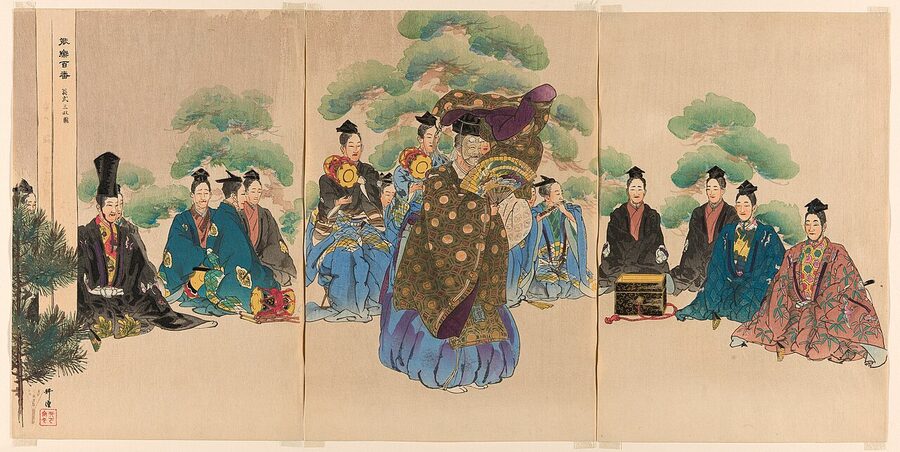
The sarugaku troupes had a rival. Dengaku (田楽), “field music”, had grown from the drums and dances of rice planting into a professional art with its own stars, stilt-walkers and dramatic pieces, and for most of the 14th century it was the more fashionable of the two. The Taiheiki says that the last Hōjō regent of the Kamakura shogunate was so besotted with dengaku that he neglected the government, and that at a charity performance on the riverbed at Shijō in Kyoto in 1349 the viewing stands collapsed under the crowd. Ashikaga Takauji, the first Ashikaga shogun, was a dengaku man too.
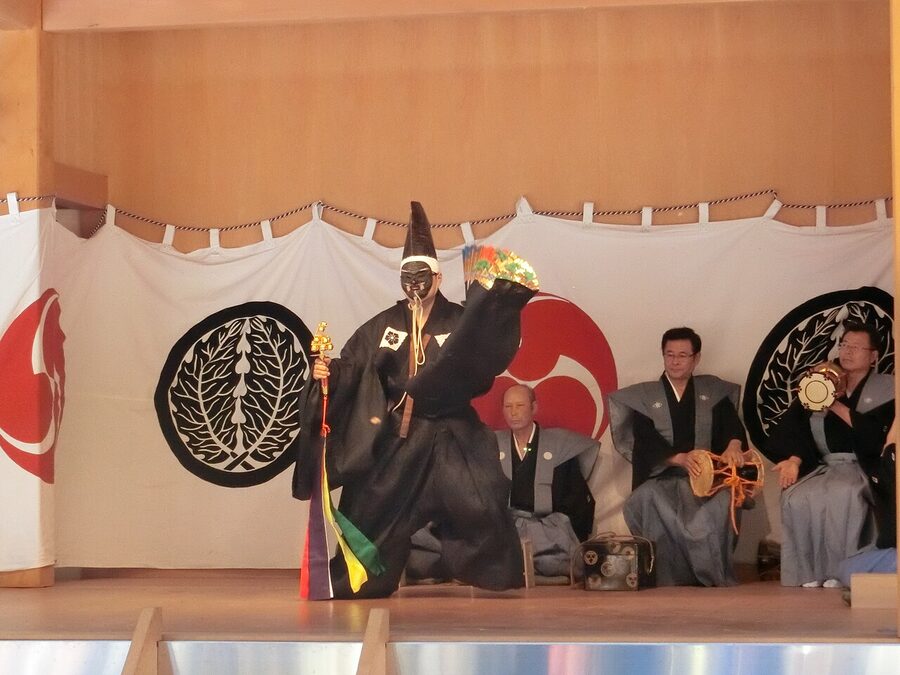
What the sarugaku troupes had that the dengaku troupes did not was Okina (翁), the Old Man. It is less a play than a prayer: a god in the mask of a smiling old man appears, dances, and blesses the land, followed by a second old man in a black mask, Sanbasō, who stamps and shakes a bell-tree for the harvest. A record of the Kasuga Wakamiya festival in Nara for 1283 already names the role of the masked old man.
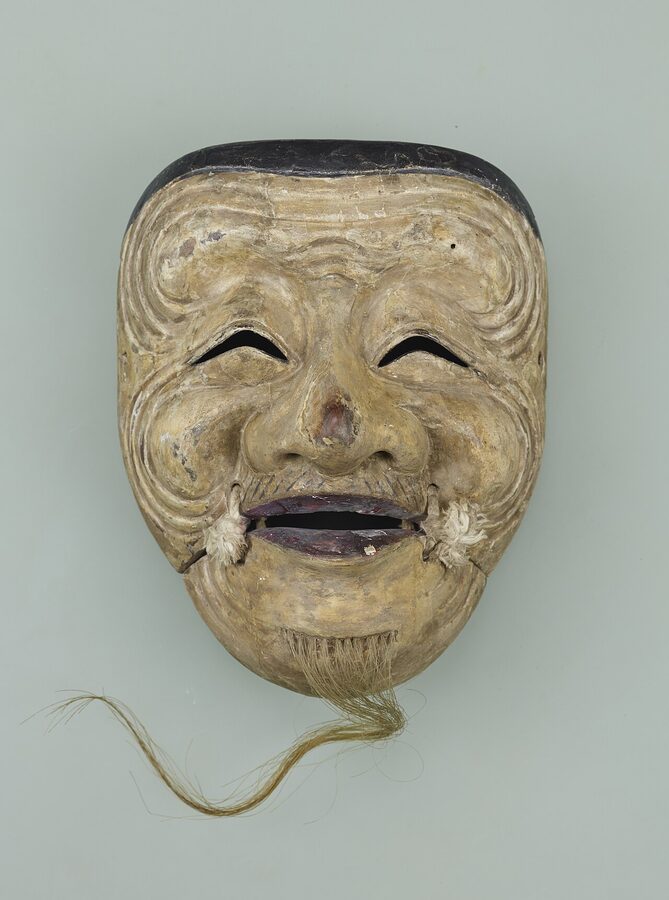
Okina is still treated as closer to a rite than a show. The actors traditionally keep a period of ritual purity beforehand, cooking on a separate fire, and each is purified with a strike of flint before he goes on. If you see “Okina” printed at the top of a programme, expect the house to go very still.
The troupes with a future were the four attached to the temple of Kōfuku-ji and the Kasuga shrine in Nara, which performed at their festivals and at the torchlit takigi sarugaku held at Kōfuku-ji every spring, first recorded in 1255. They were called Enmai, Sakado, Tobi and Yūzaki. Today they are the Konparu, Kongō, Hōshō and Kanze schools, and you can buy tickets to all four.
Imagumano, 1374 or 1375
The man who changed sarugaku was Kan’ami (観阿弥), born in 1333, the leader of the Yūzaki troupe. Zeami describes him as a big man who played women so gracefully that you forgot his size, and a master of the old Yamato specialities, demons and mimicry. What made his troupe the sensation of the capital was what he borrowed: the dance of the dengaku star Itchū, whom he called the master of his style, and the rhythms of kusemai, a popular narrative song-and-dance, which he worked into sarugaku as a set piece that survives in most Noh plays.
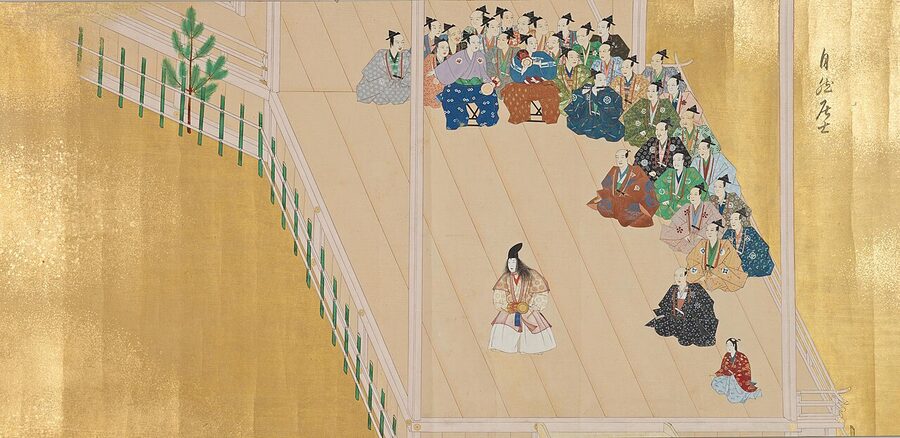
He took the troupe out of Nara and into Kyoto. In 1374, or in 1375 (Japanese reference works split almost evenly, and English-language books mostly settle on 1374), Kan’ami’s company performed at Imagumano, a shrine on the eastern edge of the city founded two centuries earlier by the retired emperor Go-Shirakawa. In the audience was the shogun, Ashikaga Yoshimitsu, then seventeen by the Japanese count. On stage, among others, was Kan’ami’s son, aged twelve.
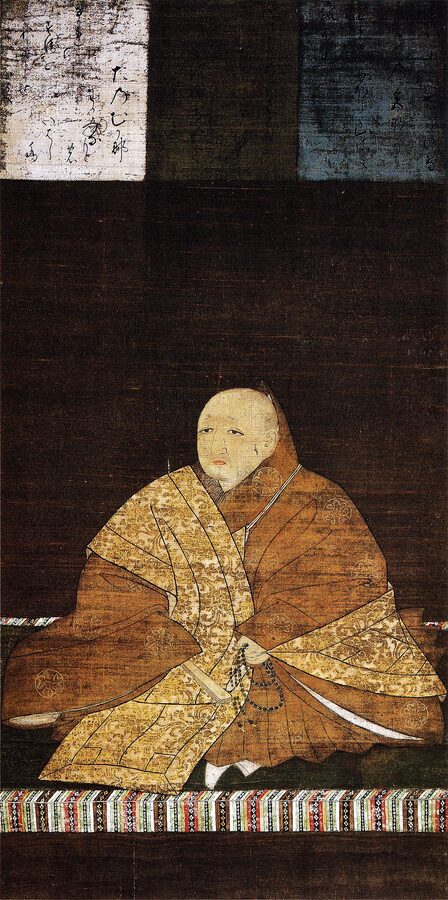
Yoshimitsu was the grandson of Takauji and the third shogun of his house, and under him the Muromachi shogunate reached the height of its wealth and confidence. He was taken with the father’s troupe and much more taken with the son. From Imagumano onward the Kanze troupe, named after Kan’ami’s stage name, performed for the shogun’s household, the great lords followed his taste, and sarugaku overtook dengaku within a generation.
The boy was given an education no actor had ever had. Nijō Yoshimoto, the regent and the finest linked-verse poet of the age, received him at thirteen, gave him the name Fujiwaka, and wrote of him with something close to infatuation: a beauty, good at kickball, good at verse. Then came the Gion festival of 1378 and Sanjō Kintada’s diary. If you have read my account of the Gion Matsuri, those are the same floats, and the courtiers were already complaining about who sat where.
Kan’ami died on the 19th day of the fifth month of 1384 at Suruga, the modern Shizuoka, shortly after performing at the Sengen shrine there. A genealogy found in an old house in Iga in 1962 makes his mother a sister of Kusunoki Masashige, the loyalist general of the Southern Court, which would have made Noh the art of a rebel’s nephew performing for the rebel’s enemies. The Noh historian Omote Akira wrote an entire book to demolish it, and most scholars side with him.
The flower and the ghost: what Zeami wrote
The name Zeami (世阿弥) is a shortening of a religious name, Zeamidabutsu, of the kind taken by the wandering Ji sect, though he was a serious student of Zen and some scholars think the -ami names were simply what performers and artistic retainers called themselves. The same suffix turns up on the shogun’s art connoisseurs of the next century, the men behind Ginkaku-ji. His real name was Motokiyo.
What he wrote is the reason the name lasted. In 1400 he finished the first three books of the Fūshikaden (風姿花伝), usually translated “The Transmission of the Flower through Style”, and added to it for about twenty years; in all he produced some twenty-one treatises on acting, music, playwriting and training. They are the oldest writings on the theory of drama in Japan, and they were never meant for you or me. Zeami wrote them for his heirs, as a manual for staying at the top of a competitive trade, and much of the advice is frankly commercial: know your audience, read the room, save your best effects.
The central idea is hana, the flower: the quality that makes an audience feel it is seeing something fresh and wonderful. A boy actor has a natural flower, Zeami says, his voice and his looks, but it is only “the flower of the moment” and it falls with his voice. The true flower comes from understanding and long work, and depends in part on surprise. Hence the line every Japanese student of the arts can quote: hisureba hana, “what is hidden is the flower”.
Two of his phrases have escaped the theatre entirely. Shoshin wasuru bekarazu, “never forget the beginner’s mind”, hangs on the walls of martial-arts halls and company training rooms, and riken no ken, “the sight seen from outside”, is his instruction to the actor to see himself as the audience does, from behind and from the side. It is a remarkable thing to have written in 1424. Most actors are still working on it.
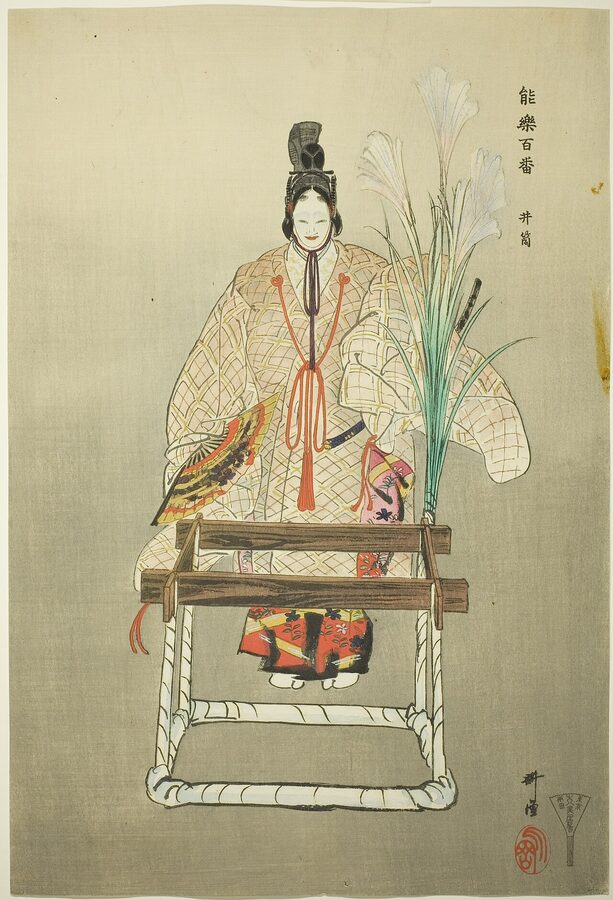
The form most associated with Zeami is the mugen nō (夢幻能), the “dream” play, and once you know its shape you can follow most of the repertoire. A travelling monk, the waki, arrives at a famous place. A local person, the shite, tells him its story with suspicious feeling, then vanishes, hinting that the story was their own. In the second half the same figure returns in its true form, the ghost of the dead lover or the slain warrior, and dances out the moment it cannot let go of before fading at dawn.
Zeami did not invent the ghost on stage, but he gave it its classical shape and wrote the best examples. His warrior plays come from the Tale of the Heike, and their ghosts are almost all losers of the Genpei War who cannot rest. In Atsumori the monk is Kumagai Naozane, the warrior who cut off a teenage enemy’s head at Ichinotani, could not bear it, and became a priest. The boy’s ghost comes for revenge and, at the end, lowers his sword, calls his killer a friend in the Buddhist law, and asks for his prayers.
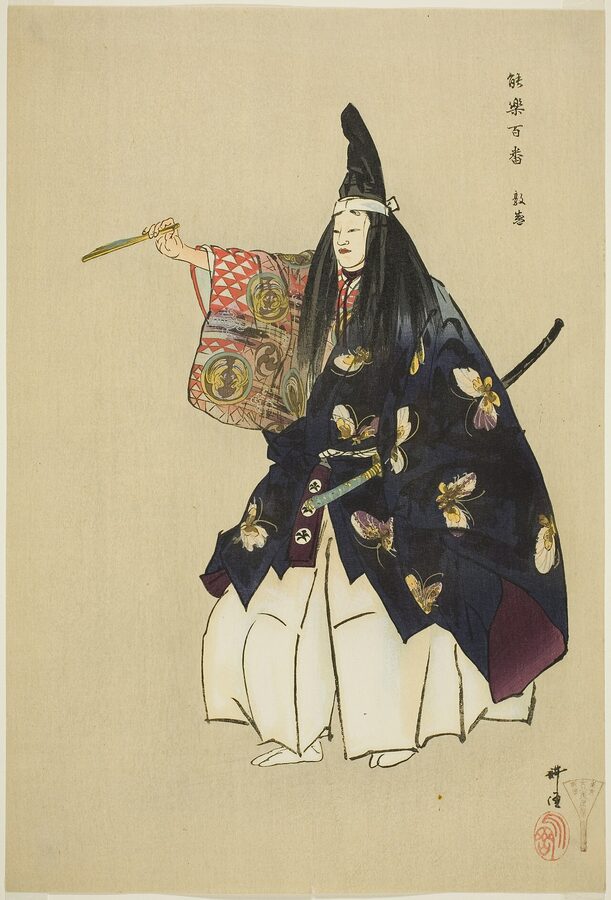
Noh is where many conventions of the Japanese ghost, the yūrei, were fixed: the attachment to a single place and a single wrong, the need for someone to pray. But the ghosts of Noh mostly want to be heard, not to frighten, which makes them sad rather than spooky. One warrior ghost is a woman: Tomoe, the only play of its kind with a female lead, brings back Tomoe Gozen, the fighting companion of Kiso Yoshinaka, swinging a naginata and grieving that she was sent away from her lord’s last stand.
One thing about Zeami’s theatre would astonish a modern audience: it was fast. Comparing start and finish times on surviving Muromachi programmes with the number of plays performed, the scholar Takemoto Mikio estimated that plays in Zeami’s day ran two or three times faster than now. The slow, weighty Noh you will see in Tokyo is largely the creation of the following three centuries, during which Zeami’s treatises sat in the boxes of the Kanze and Konparu houses, copied for a few warlords and read by almost nobody, until the historian Yoshida Tōgo published them in 1909.
Seventy-two, and sent to Sado
Yoshimitsu died in 1408. His son Yoshimochi preferred dengaku, or so it is usually said, though one Japanese reference work points out that there is no real evidence he disliked Zeami, who kept performing for him and wrote most of his great treatises in these years. In 1422 Zeami took Buddhist vows and handed the troupe to his eldest son, Motomasa.
Then the shogunate passed to Ashikaga Yoshinori, Yoshimochi’s brother, a man chosen by lottery and remembered by his contemporaries as a terror. Yoshinori favoured Zeami’s nephew, On’ami. In 1429 father and son were barred from performing at the retired emperor’s palace, and in 1430 Zeami lost his post as master of performances at the Kiyotaki shrine of Daigo-ji. His second son, Motoyoshi, gave up the stage that year, after writing down his father’s conversations about the art as the Sarugaku dangi.
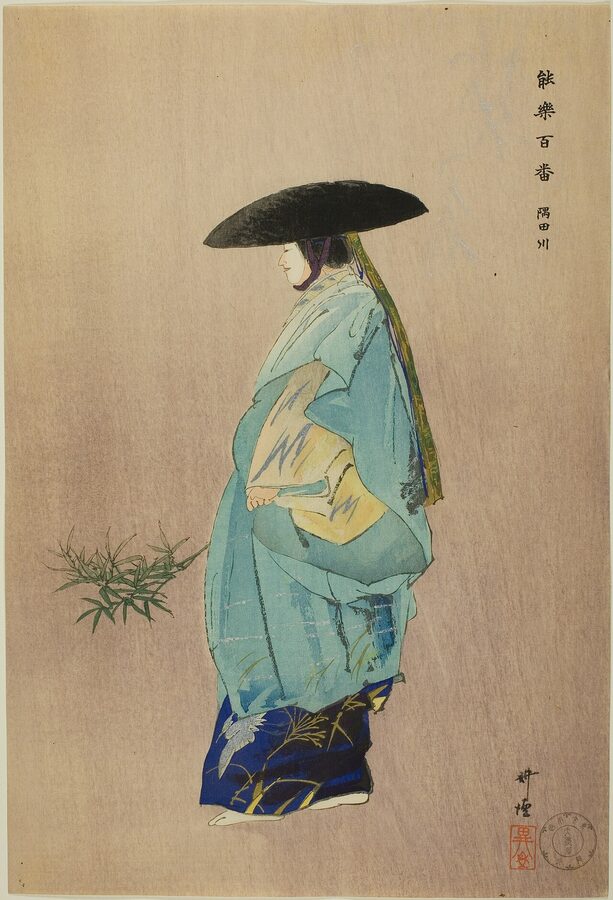
In the eighth month of 1432 Motomasa died on the road at Anotsu in Ise, not yet forty, and Zeami wrote a short lament saying that with his son the way of the house had ended. In 1434, at seventy-two, he was exiled to the island of Sado in the Sea of Japan. No official record of the sentence survives and nobody knows the charge; the guesses run from his refusal to hand the family’s secret books to On’ami, to some connection between Motomasa’s patrons and the defeated Southern Court.
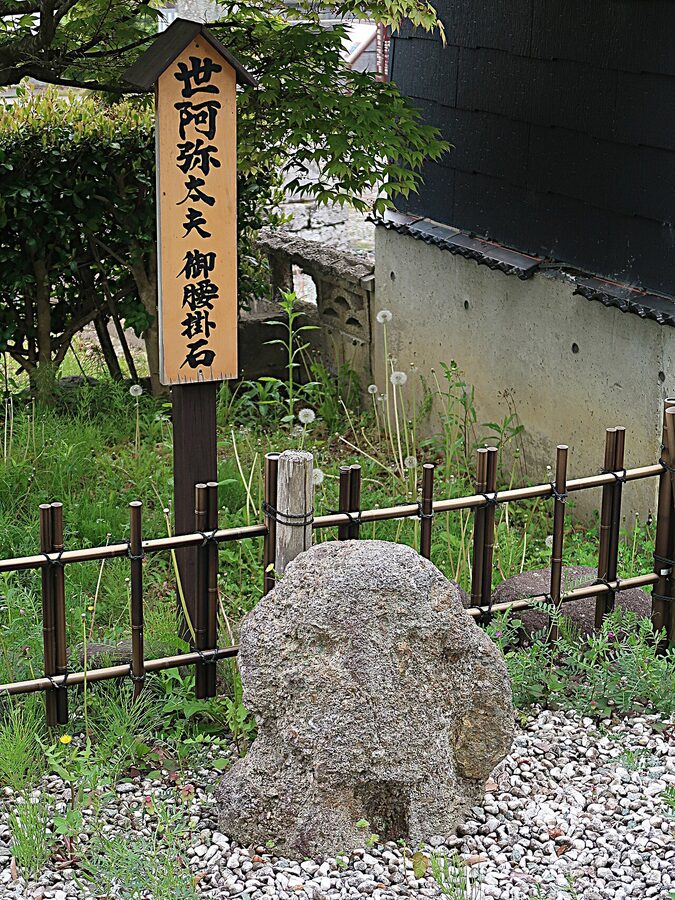
What is known of his exile comes from a slim book of verses and sung pieces he wrote on the island, the Kintōsho (金島書), “The Book of the Golden Isle”. It describes the sea crossing, the place of exile, the shrines and the island’s festivals, in a tone calm to the point of being unsettling. It is dated the second month of 1436, the last time Zeami appears in any document while he was alive.
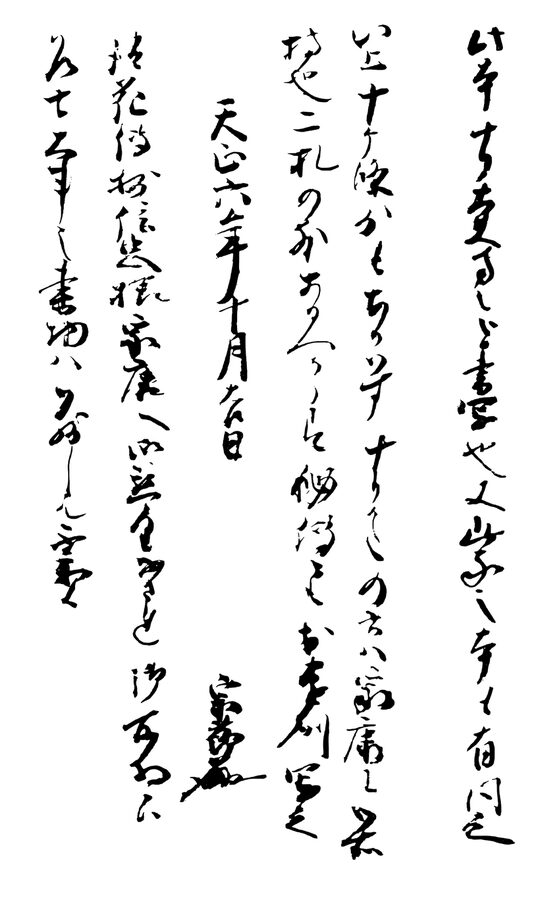
What happened next depends on what you read. English-language accounts usually say that he was pardoned after Yoshinori was murdered in 1441, came home and died in 1443. Japanese reference works say that nobody knows whether he ever left Sado or where he is buried, and that the age of eighty-one you will see quoted is a tradition; the temple near Nara where he studied Zen records only the 8th day of the eighth month as his death day. A letter he wrote from exile to his son-in-law, Konparu Zenchiku, survives at Hōzan-ji on Mount Ikoma, about as close as you can get to him.
What happens on the stage
If you have never seen Noh, the first thing to know is that almost nothing on stage is decoration. The second is that nobody expects you to follow every word, since most Japanese in the audience cannot either: the text is medieval literary Japanese, sung to carry rather than to be understood.
A roof, a bridge and a painted pine
The stage is a square of unpainted cypress about six metres a side; the one at the National Noh Theatre is 5.4 metres. It has its own roof on four pillars even inside a modern building, because until the 1880s Noh stages stood outdoors and the audience sat across an open court. The strip of white gravel between the stage and the front row is the last trace of that court.
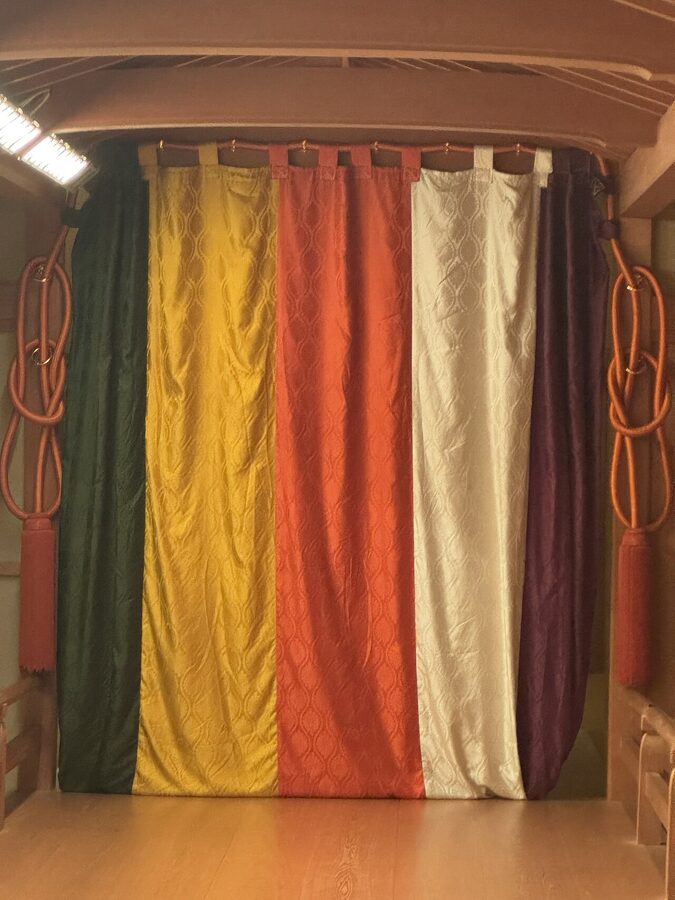
Actors enter along the hashigakari (橋掛り), a railed bridge running back at an angle from the stage to the curtain. Three small pines stand along its front edge, each a little smaller than the last, to make the bridge look longer than it is. A character can travel a hundred miles along it in a few steps, and a ghost who appears at the far end is still, for a moment, in the other world.
The back wall, the kagami-ita, carries a single painted pine that never changes, whatever the play. Tradition says it represents the Yōgō pine at Kasuga in Nara, the tree on which the god of the shrine was believed to have descended, and before which the troupes performed at the Kasuga festival. So every Noh play, in a sense, is still performed for the god of Kasuga.
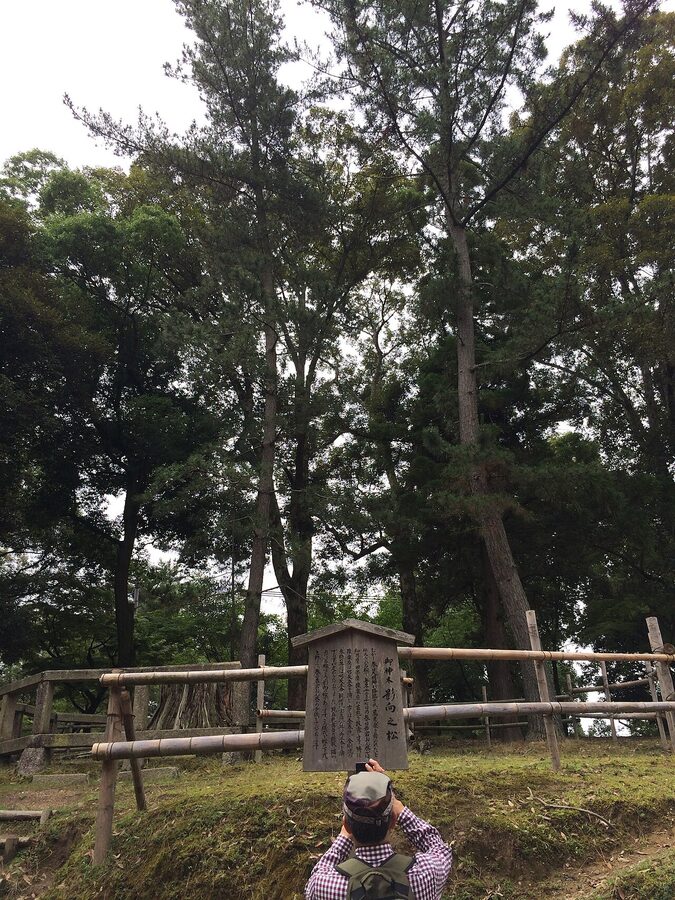
The front left pillar, as you face the stage, is the metsuke-bashira, the “eye-fixing pillar”, and the masks will explain the name. Many old stages have earthenware jars under the floor to make the boards ring when an actor stamps. At the back right is a small low door, the kirido, through which the chorus and stage attendants come and go bent double, because they are not characters and do not use the bridge.
Shite, waki and the people who sit still
The principal role is the shite (シテ), the doer, usually the one in the mask. The waki (ワキ), usually a monk or a traveller, is the person the shite talks to, unmasked, and for much of the play he simply sits by the front right pillar and watches; the actors in Kyoto tell first-timers to imagine themselves as the waki. Child roles, the kokata, sometimes play emperors and great heroes as well as children; one explanation is that a boy distracts less than a grown man would in a sacred role.
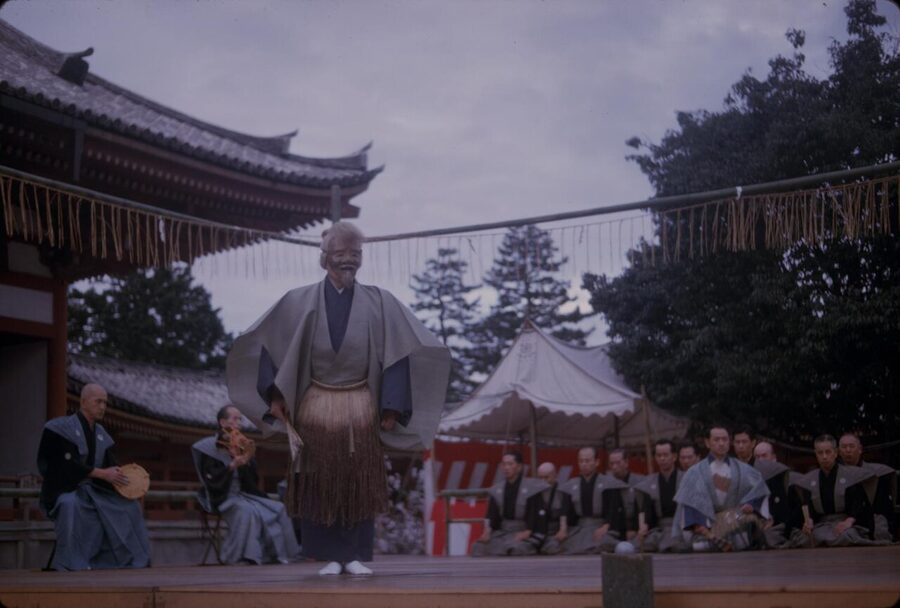
The chorus, usually eight men in black kimono, kneels in two rows on the right. It narrates, describes the scenery, and often sings the shite’s own words while the shite dances, so that a character’s voice passes from one body to another in mid-sentence. The four musicians sit across the back: a bamboo flute, the nōkan, with a deliberately piercing upper register, the shoulder drum and hip drum, and in some plays a stick drum. The drummers’ cries, long falling “yo-o” and sharp “ha!”, are part of the music.
At the back left kneel the kōken, stage assistants in black who straighten a costume or take away a discarded hat. The senior kōken is a senior actor, and if the lead collapses mid-performance it is his job to stand up and finish the play.
The masks
A Noh mask is called an omote, a face, and not everyone wears one. Living adult men are played bare-faced, the actor holding his own face as still as if it were carved; masks are for gods, demons, ghosts, old men and women. Japanese sources count some 250 types, and around sixty basic types are enough to stage nearly all of the roughly 240 plays in the modern repertoire.
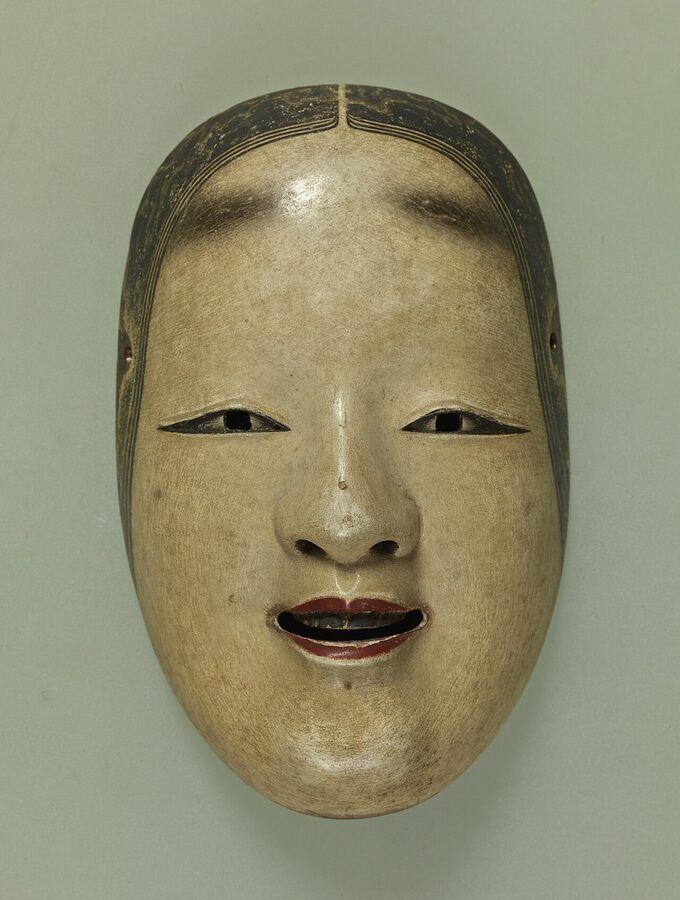
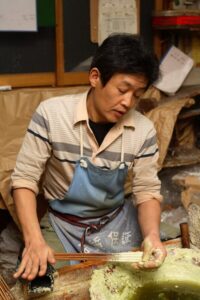
They are carved from Japanese cypress, lacquered inside, and painted over a ground of gofun, a white made from crushed shell; the carvers’ craft, one of those in my guide to Japan’s greatest crafts, reached its classic forms by the 16th century, and Edo-period carvers mostly copied those originals. Toyotomi Hideyoshi is said to have named three ko-omote by a legendary carver Snow, Moon and Flower. Moon burned at Edo Castle, Snow belongs to the Kongō family, and Flower is in the Mitsui Memorial Museum in Tokyo.
A good woman’s mask has no single expression. Tilt it slightly up, “brightening” it in the actors’ term, and it seems to smile; tilt it down, “clouding” it, and it seems to grieve. That is why a ko-omote that looks blank on a museum wall can make a whole theatre wince.
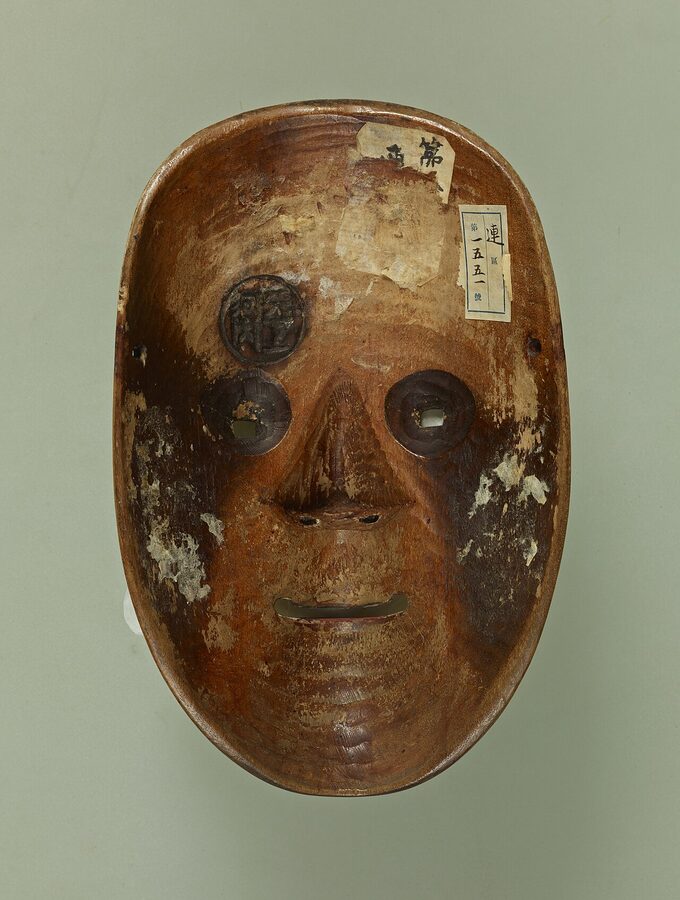
Now the pillar makes sense. A masked actor locates himself by glimpsing the pillars and the musicians, counts his steps, and opens his fan by feel under his sleeve; some Japanese scholars think the gliding walk of Noh began as a way of not falling over. The one easy role is the blind man in Yoroboshi, whose mask has slits instead of holes, so the actor sees better than in any other play.
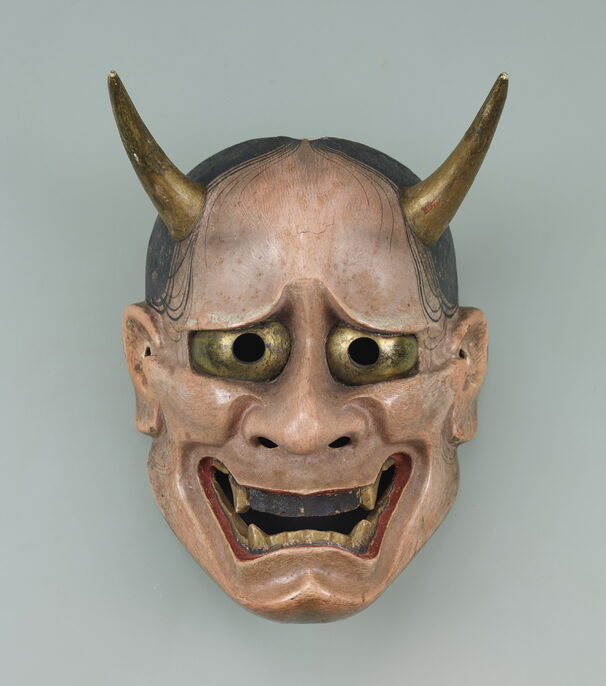
The mask you probably already know is the hannya (般若), and it appears in two of the most performed plays. In Aoi no Ue, adapted from the Tale of Genji, the jealous Lady Rokujō wears it to come for Genji’s wife; in Dōjōji, a spurned woman becomes a serpent and coils around a temple bell with the monk she loved hidden inside. Japanese folk demons are a different family, the oni, but much of the popular image of a female demon comes from this face.
The robes
If the masks are austere, the robes are anything but. The most splendid, the karaori (唐織), “Chinese weave”, is a stiff silk brocade with patterns floated on the surface as if embroidered, worn mainly for women’s roles. Muromachi actors performed in versions of everyday dress, and patrons throwing their own robes onto the stage as rewards is part of how costumes became so magnificent.
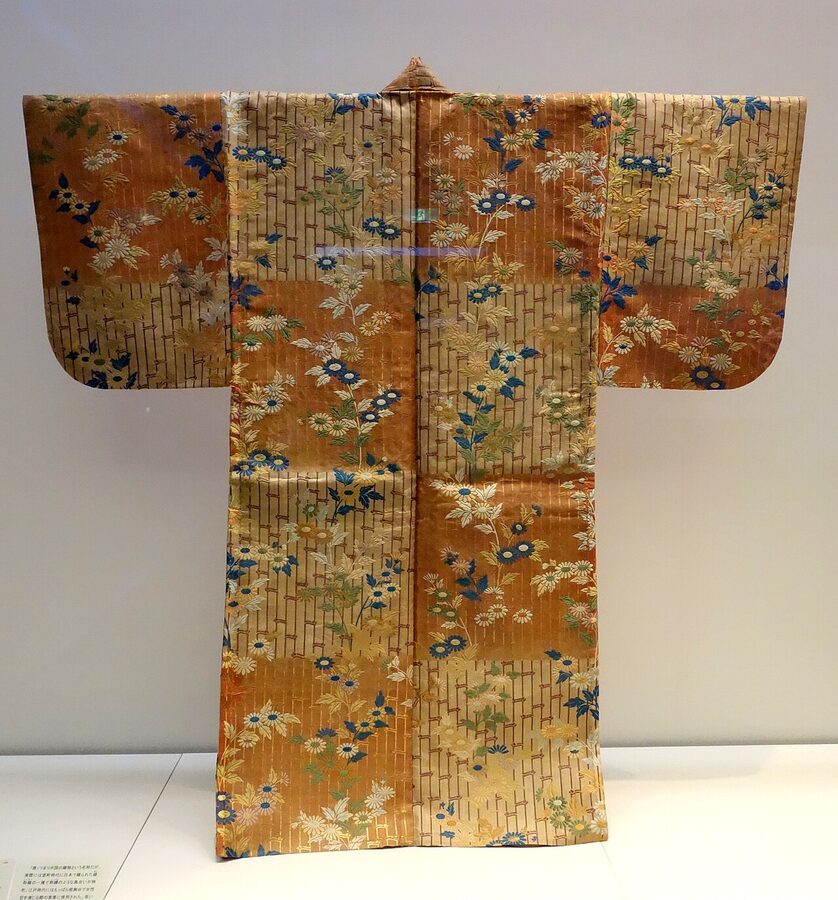
The rule of red is the kind of code Noh is full of, and the regulars read it before the actor reaches the end of the bridge. My piece on the kimono covers the everyday versions of these rules.
Kyōgen, the comedy in between
A full programme alternates Noh with kyōgen (狂言), short comedies performed by a separate set of actors on the same stage. Kyōgen is spoken, in a language close to the everyday speech of the 16th century, and its characters are servants, husbands, fake monks and lords less clever than they think. The classic first comedy is Busu, in which two servants told that a jar holds deadly poison find it is sugar, eat it all, and smash their master’s best scroll so that they can claim they were trying to kill themselves out of remorse.
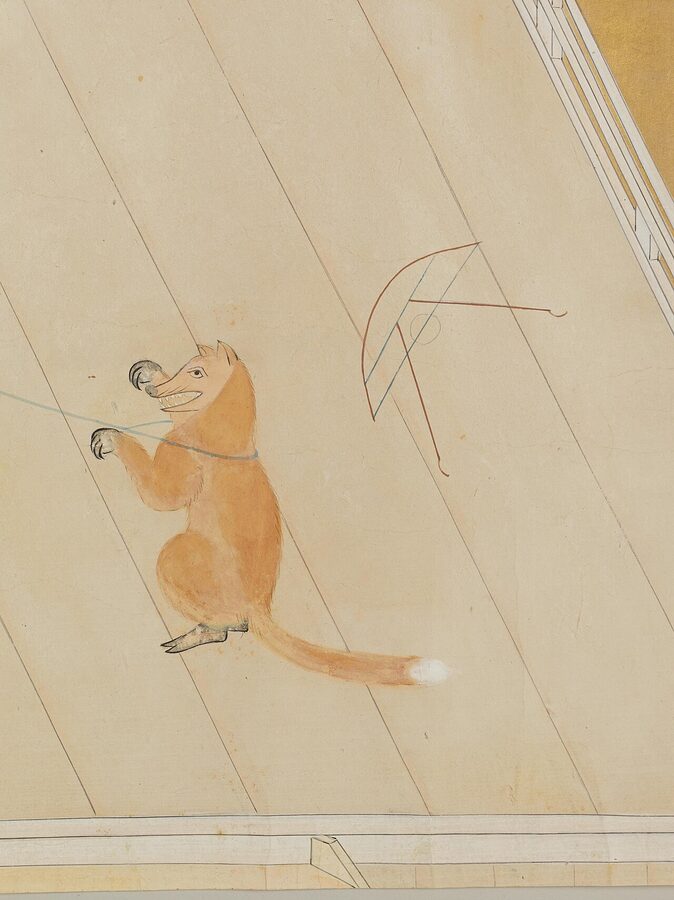
Kyōgen actors also appear inside the Noh plays, most often as a local man who tells the waki the story of the place while the shite changes backstage. Two professional schools survive, Ōkura and Izumi, and the Shigeyama family in Kyoto and the Nomura family in Tokyo are the names you will see most often. If a whole afternoon of Noh sounds daunting, start with a kyōgen evening, and if Tsurigitsune is on the bill, go: few actors anywhere play an animal as well as a kyōgen master plays that kitsune.
A traditional full day ran on a fixed order of five kinds of play, god, warrior, woman, madwoman and demon, with kyōgen between and Okina first, shaped by the principle of jo-ha-kyū: slow opening, development, rapid close. A modern programme is usually one or two Noh and one kyōgen.
Hideyoshi takes the stage
The Ashikaga shogunate fell apart in the Ōnin War and the century of fighting that followed, and with it went the troupes’ secure patronage. Actors drifted to the provinces, townsmen formed amateur companies, and the art spread rather than died. By the late 16th century every warlord with pretensions knew some Noh chant.
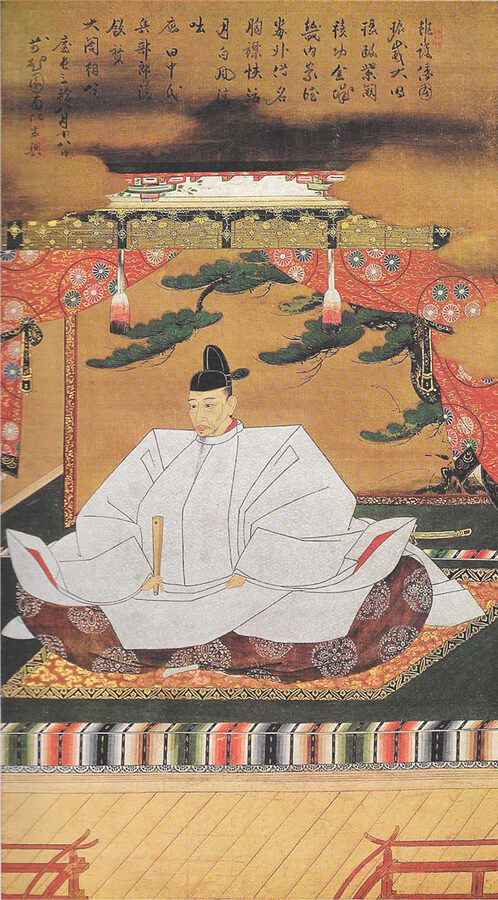
Oda Nobunaga supported actors, but the warlord who did most for Noh, and to it, was Hideyoshi. He studied with Konparu Anshō, head of the Konparu troupe, and in 1593, at his headquarters at Nagoya in Hizen on the coast of Kyushu, while his armies were fighting the invasion of Korea, he threw himself into it so completely that he wrote in a letter that he had no time for anything but Noh. Excavations at the castle site there have found what may be one of the oldest Noh stage foundations in Japan.
In the tenth month of 1593 he staged Noh inside the imperial palace in Kyoto, something no one had done before, and danced in it himself, with Tokugawa Ieyasu and Maeda Toshiie dancing too and the lord Mōri Terumoto playing the shoulder drum. The historian Amano Fumio, who has written a whole book on the obsession, makes the scene sound as uncomfortable as you would imagine: three of the most powerful men in Japan performing for an emperor because the fourth told them to. In the same years Hideyoshi danced Genji kuyō, in which the ghost of Murasaki Shikibu asks for a memorial service for her book.
His own plays were written by his secretary, Ōmura Yūko, ten by the usual count, five of which survive: his pilgrimage to Kōya, his visit to Yoshino, and his victories over Akechi, the Hōjō and Shibata. He played the hero himself. Nobody revives them for their literary merit, but they show plainly what Noh had become to the men who ruled Japan: a stage on which power performed itself.
The warrior’s ceremony
Ieyasu kept Hideyoshi’s arrangements and made them permanent. In 1609 the actors of the four Yamato troupes moved to his court at Sunpu, and by 1618 the great lords were formally required to contribute rice stipends to support them. Under the Tokugawa shogunate Noh became shikigaku (式楽), the ceremonial music of the state, performed at investitures, New Year celebrations and the receptions of ambassadors.
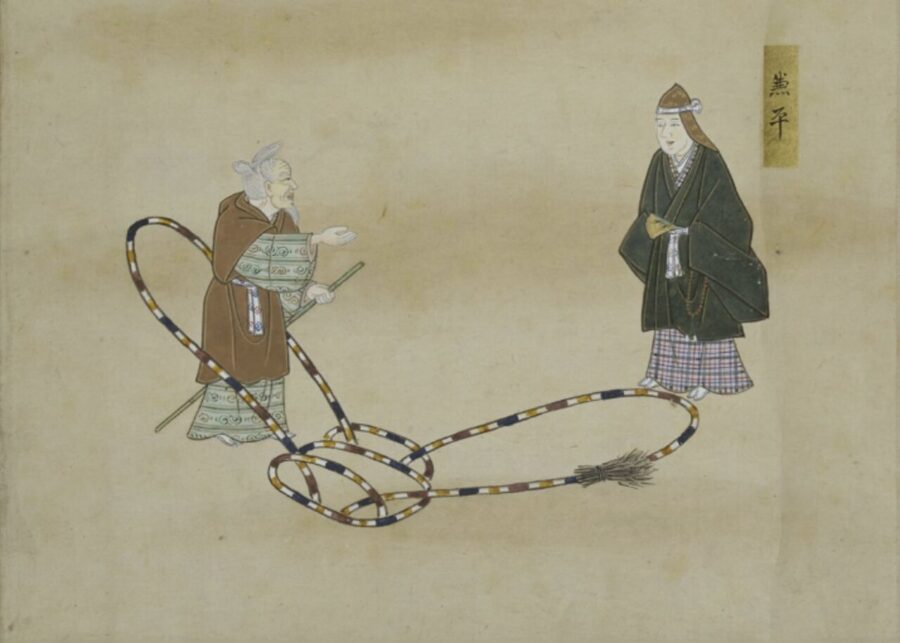
A fifth school joined the four, the only one founded by a single man. Kita Shichidayū, the son of a doctor in Sakai, had danced Hagoromo before Hideyoshi at the age of seven, fought on the Toyotomi side when Osaka Castle fell in 1615, and went into hiding until Ieyasu asked after him because he wanted to see him dance again. When the second shogun, Hidetada, offered him service, Shichidayū answered that a warrior does not serve two masters, and Hidetada told him to serve as an actor instead. The establishment was thereafter formally “four troupes and one school”.
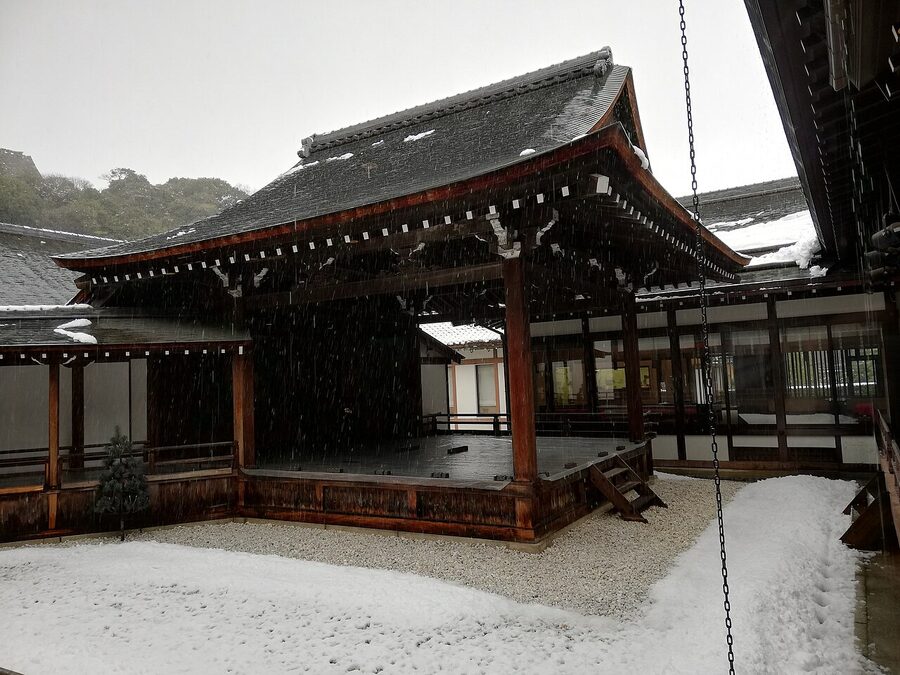
Every daimyo house of any size kept actors and a stage; the Kita school found patrons as far apart as Sendai, Fukuoka and Kumamoto, and the Ii of Hikone were enthusiasts. The fifth shogun, Tokugawa Tsunayoshi, danced constantly, made his lords dance, and had forgotten plays revived, and around 1700 Noh enjoyed a boom across the country.
At great celebrations in Edo Castle, such as a new shogun’s accession, townsmen were let into the castle grounds to watch from the gravel, a custom called machiiri-nō. Outside the castle, chanting passages of the plays became one of the most widespread accomplishments in Japan, and a short passage from Takasago, about an old couple who are the spirits of two pine trees, is still sung at traditional weddings.
The price of official status was fossilisation. New plays mostly stopped, the schools fixed their texts and movements as family property, and over two and a half centuries the tempo slowed and the crouched posture of the modern Noh actor, which Japanese scholars think did not exist in Zeami’s time, became universal. Noh entered the 19th century as the most prestigious and least changing art in the country, and entirely dependent on the samurai for its living.
1868 and the empty seats
Then the samurai class went away. When the shogunate fell in 1868 the actors lost their stipends overnight, and the head of the Kanze school followed the last shogun, Tokugawa Yoshinobu, into retirement in Shizuoka. Many actors took other work, and some schools of musicians and kyōgen players simply ceased to exist.
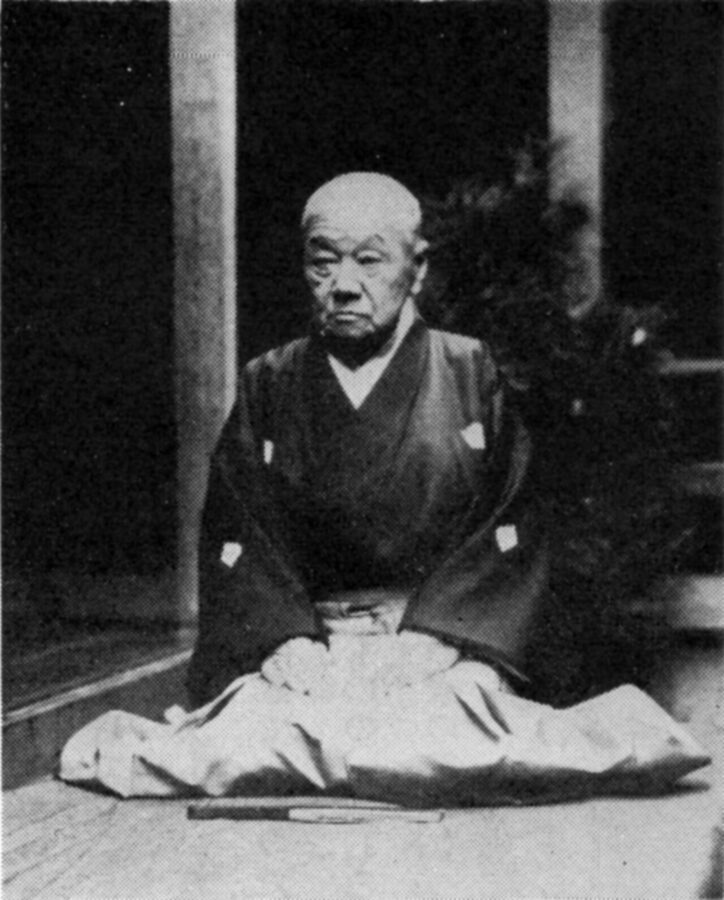
The man most often credited with keeping the art alive is Umewaka Minoru, a Kanze actor who stayed in Tokyo when his head of school left. He performed on the stage in his own house, kept training pupils, and did something unthinkable under the shogunate: he sold tickets to the public. The Meiji Restoration government was no help at first, and in 1872 it banned plays that portrayed emperors in a way it judged disrespectful.
Rescue came from the top. Noh was performed for the visiting Duke of Edinburgh in 1869, and the court noble Iwakura Tomomi, who had led the Iwakura Mission round the world and seen European states patronising their opera houses, came home convinced that Japan needed a theatre of equivalent dignity. In 1876 the Emperor Meiji watched Noh at Iwakura’s residence; in 1878 a stage was built at the Aoyama palace for the Empress Dowager, who loved it; and in 1879 Iwakura entertained the former American president Ulysses S. Grant with a performance at his house.
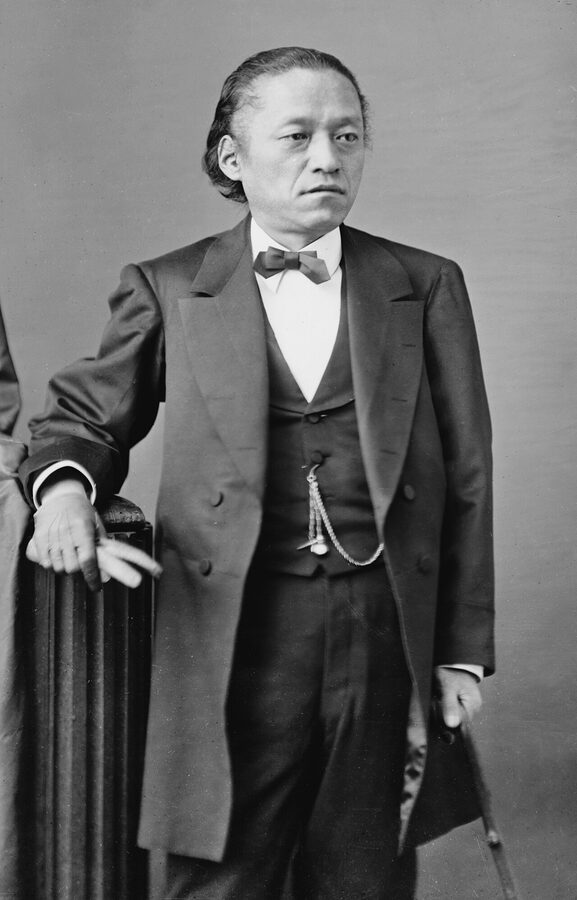
In 1881 Iwakura and a group of former daimyo and court nobles founded the Nōgakusha, the “Noh Society”, and built a stage in Shiba Park beside an exclusive restaurant. It opened on 16 April 1881 with the Empress Dowager in attendance: Hōshō Kurō danced Okina and Takasago, Umewaka Minoru Sakuragawa, and Kongō Yuiichi Kurama Tengu, in which a mountain tengu teaches swordsmanship to the boy Yoshitsune. More than 9,100 people came in the first year. The society also renamed the art: sarugaku, monkey music, became nōgaku, and accounts differ on which founder thought of the word.
The Shiba theatre was in trouble within a few years. Iwakura died in 1883, members stayed away, and the revival worked against it as each school built its own stage. In 1902 (1903 in some accounts) the society presented the building to Yasukuni Shrine, and Omote Akira read the move as the moment the profession had grown strong enough not to need its patrons’ permission.
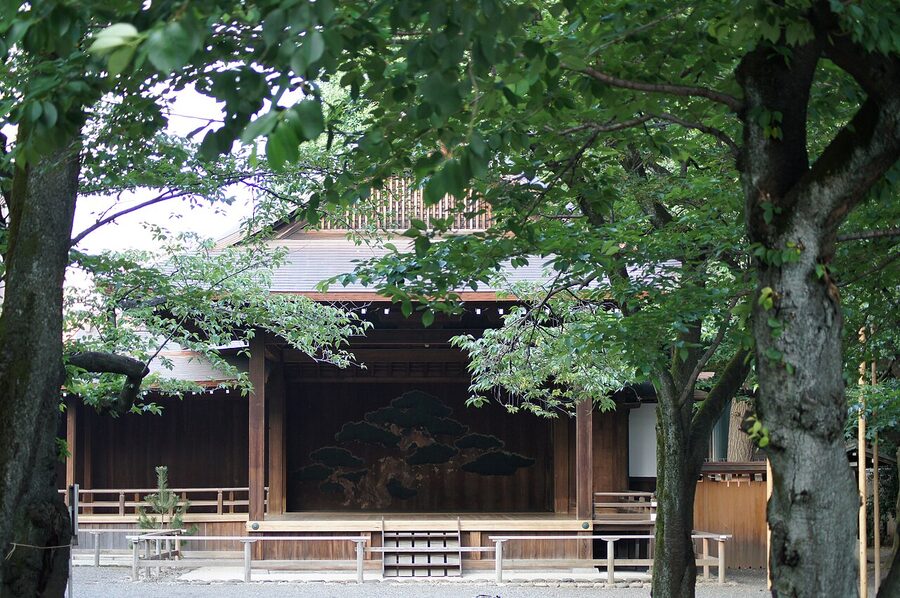
What Shiba did leave behind was a building type. Its stage and auditorium first stood apart across a court, and around 1897 the gap was glazed over and the two joined into one hall: the nōgakudō, the roofed stage inside a building, that you will sit in today.
Six hundred years on
Noh’s modern history is mostly a story of being taken seriously. Zeami’s treatises, published in 1909, turned him into a national figure, and Ernest Fenollosa’s translations, edited by Ezra Pound, brought Noh to English readers and to W. B. Yeats. The earthquake of 1923 and the bombing of 1945 destroyed stages, masks and costumes, and the war years brought their own absurdities: in 1939 the Tokyo police banned Ōhara gokō, in which a retired emperor visits the mourning mother of a drowned child emperor, as disrespectful to the throne.
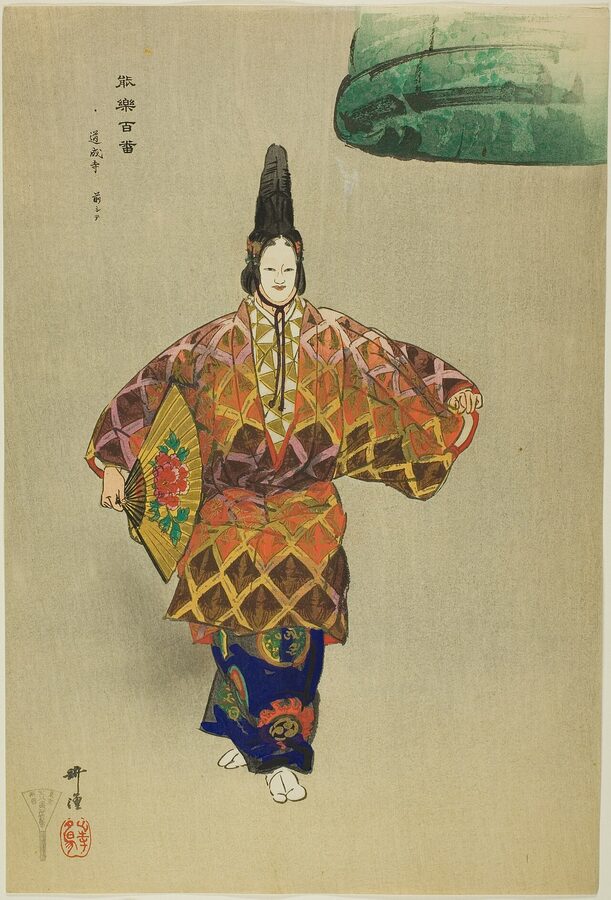
After the war the closed world opened up. Women were admitted to the professional association in 1948, and in 2004 the first women were recognised as holders of nōgaku as an Important Intangible Cultural Property, a designation the art had received in 1957. Yukio Mishima’s Modern Noh Plays of 1956, Aoi no Ue and Sotoba Komachi rewritten in suits and hospitals, became in Donald Keene’s translation the way many readers abroad first heard of Noh, though they are not Noh and do not pretend to be.
UNESCO recognised Noh and kyōgen together, first as a Masterpiece of the Oral and Intangible Heritage of Humanity in 2001 and then on its Representative List in 2008, which is why sources disagree about which year to quote. About 240 plays make up the living repertoire, out of more than 2,500 that scholars estimate were written, and the professional association counted some 1,285 members in 2013. Kabuki, Noh’s noisier descendant, borrowed its first stage, its flute and drums and, in Kanjinchō, an entire play, but it never displaced the original.
Where to see Noh today
You can see Noh almost every week in Tokyo and Kyoto, and on a handful of historic stages on particular days of the year. Prices below were checked in November 2026, and they change.
The National Noh Theatre, Sendagaya
If you see one Noh performance in your life, see it here. The National Noh Theatre (国立能楽堂) opened in Sendagaya in 1983, a low building of dark timber and grey tile by the architect Ōe Hiroshi, with 627 seats. Every seat has a small screen in the seat back showing the text and an explanation, in Japanese and English as standard; the special performances for audiences from abroad, sold as Discover NOH & KYOGEN, have subtitles in six languages and an introduction in English.
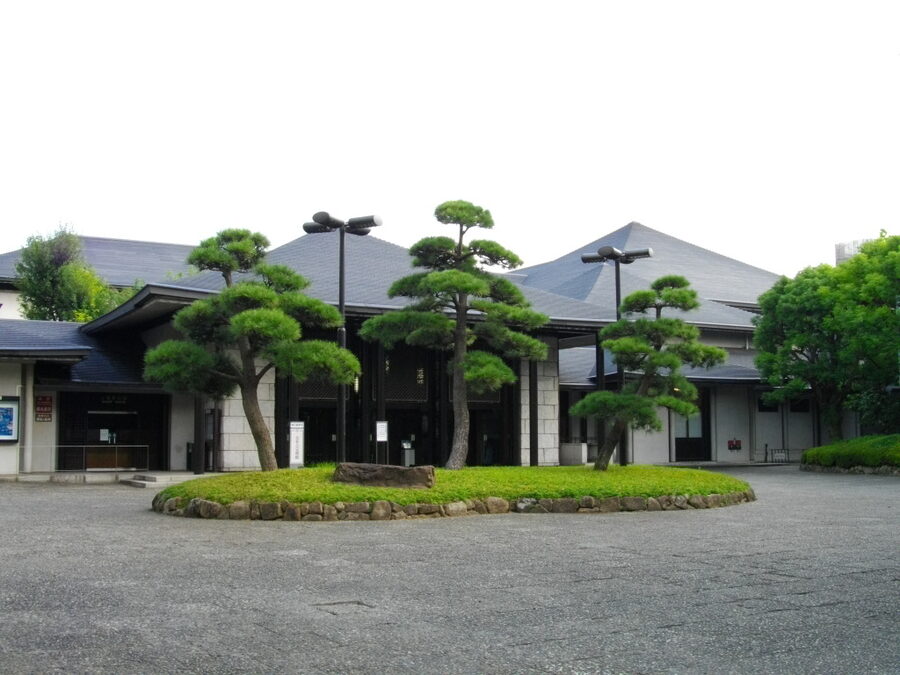
Regular and popular performances cost ¥5,800 for a front seat, ¥4,000 for the side and ¥3,500 for the diagonal block between them in 2026, with student prices of ¥2,800 and ¥2,500 for the cheaper two. Take the side, the waki-shōmen: you look along the bridge at the entrances and see the mask in profile, which is how many of its expressions are meant to be read. Avoid the front of the diagonal block, the naka-shōmen, where the eye-fixing pillar may sit exactly where you want to look.
There is also a beginners’ programme, the National Noh Theatre Showcase, with a talk by an actor and a session with masks beforehand. Tickets are sold online through the National Theatre’s ticket centre and by phone, and the box office opens only on performance days, from 10:00 to 18:00. It is five minutes on foot from JR Sendagaya Station or from exit A4 of Kokuritsu-Kyōgijō on the Toei Ōedo Line, and seven from Kita-sandō on the Fukutoshin Line.
Elsewhere in Tokyo
Each school has its own theatre. The Kanze school’s moved in 2017 to the basement of the GINZA SIX shopping centre, an odd home for the descendants of Kan’ami that works surprisingly well; the Kita Noh Theatre is in a quiet street in Meguro, and the Hōshō school’s is near Suidōbashi. Their audiences are mostly pupils and regulars, which is a pleasant change, but subtitles are the exception.
The old Shiba stage stands at Yasukuni Shrine in Kudan; performances on it are occasional, notably a night-time Noh under the cherry blossom held in most years in early April. Hideyoshi’s Flower ko-omote is in the Mitsui Memorial Museum in Nihonbashi, which shows its masks from time to time, and the Tokyo National Museum in Ueno rotates masks and robes through its permanent galleries.
Kyoto: the Kongō Noh Theatre and the Kanze Kaikan
Kyoto is the home of the Kongō school, and its theatre faces the west side of the Imperial Palace, near the site of the Ashikaga shoguns’ Flower Palace. The Kongō Noh Theatre (金剛能楽堂) opened here in 2003, but the stage inside was moved whole from the school’s previous theatre in the Muromachi district, where it had stood for more than 130 years, so you watch a 19th-century stage inside a 21st-century hall.
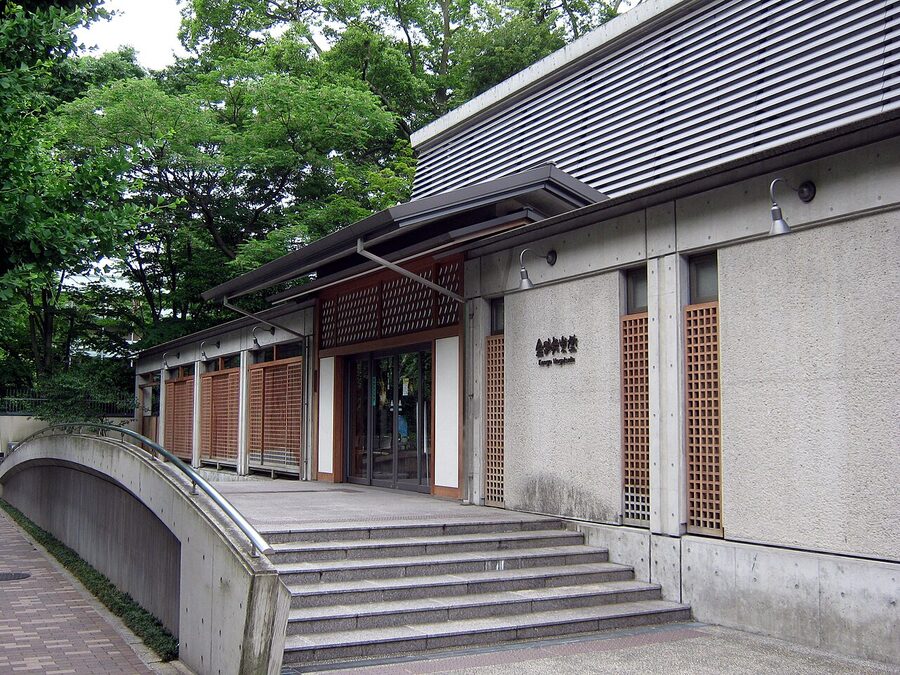
The school’s ten regular performances a year cost ¥6,500 in advance and ¥7,000 on the day, with a ¥3,000 ticket for students and anyone thirty or under. Its candlelit Noh on 16 August, the night of the bonfires on the hills around the city, was skipped in 2026 for the building work and is due to return. Take the Karasuma subway line to Imadegawa and walk five minutes south from exit 6.
The Kyoto Kanze Kaikan (京都観世会館), the Kanze school’s hall, is in Okazaki near Heian Shrine, and it is busier: most weekends bring the Kyoto Kanze association’s monthly performances, the regular shows of the city’s acting families, or a Shigeyama kyōgen evening. At the association’s own performances, ground-floor seats are allocated at the door on the day, first come first served, and the upper floor is unreserved.
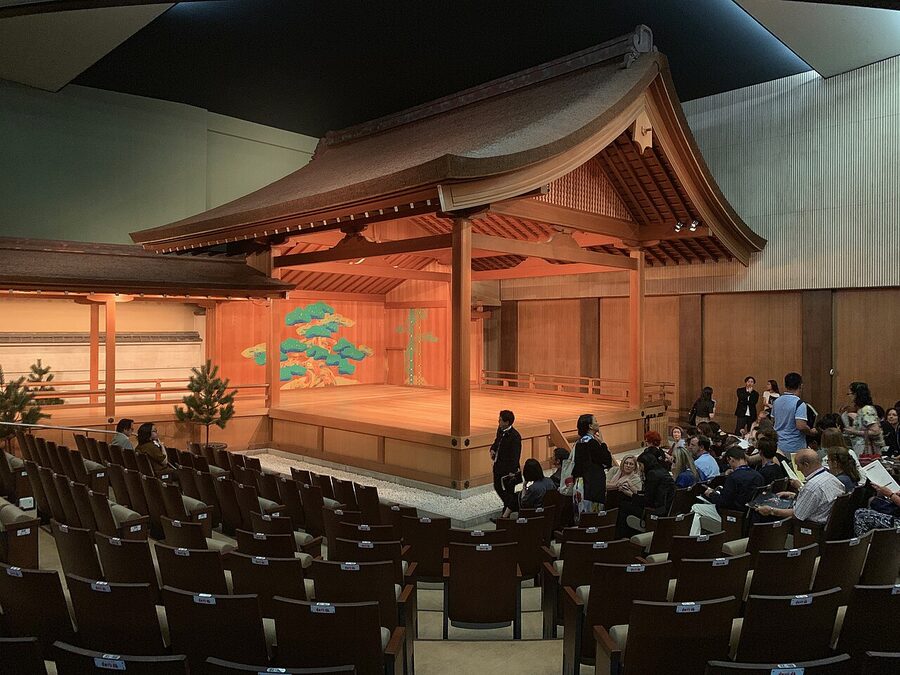
The hall advises first-timers to choose an afternoon programme of one or two plays, and I agree; a full day is a commitment even for the faithful. Take the Tōzai subway line to Higashiyama Station and walk five to eight minutes from exit 1.
Imagumano Shrine, where it started
Imagumano Shrine (新熊野神社) is a small neighbourhood shrine on Higashiōji-dōri in southern Higashiyama, and it calls itself the birthplace of Noh. Go-Shirakawa founded it in 1160 as a branch of the Kumano shrines, so that he could worship Kumano without the long journey south, and Taira no Kiyomori built it for him. The great camphor tree in the precinct is said to have been planted by Go-Shirakawa himself.
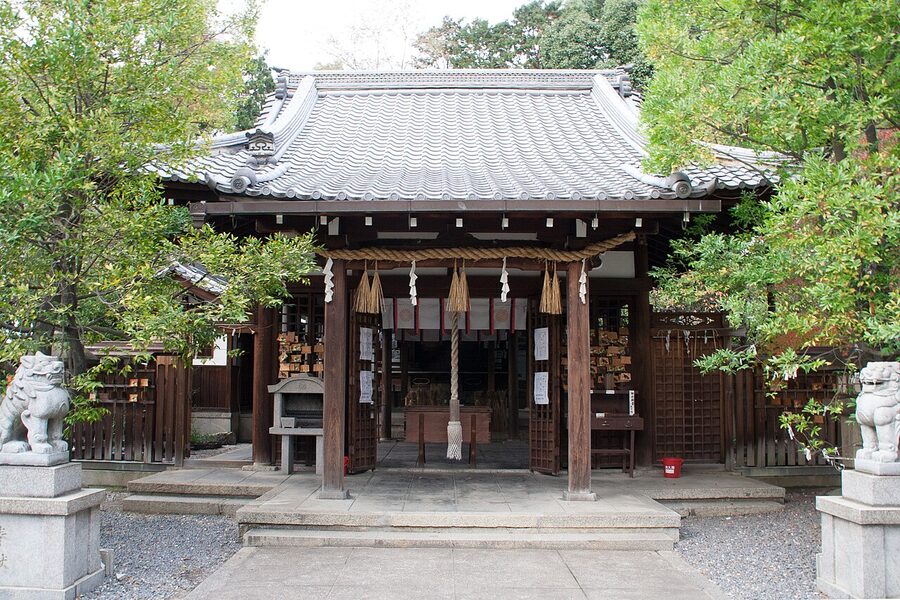
It is about fifteen minutes on foot south-east of Shichijō Station on the Keihan line, and city buses along Higashiōji-dōri stop just outside.
Nishi Hongan-ji’s North Stage
The oldest Noh stage still standing is probably the North Stage (北能舞台) of Nishi Hongan-ji, the great Jōdo Shin temple near Kyoto Station, a National Treasure. An ink inscription on a scrap of paper behind a gable ornament gives the year 1581, long quoted as its date; Japanese architectural historians now treat it with caution, since the paper could have come from anywhere, and say only that the stage was certainly there by the early Edo period.
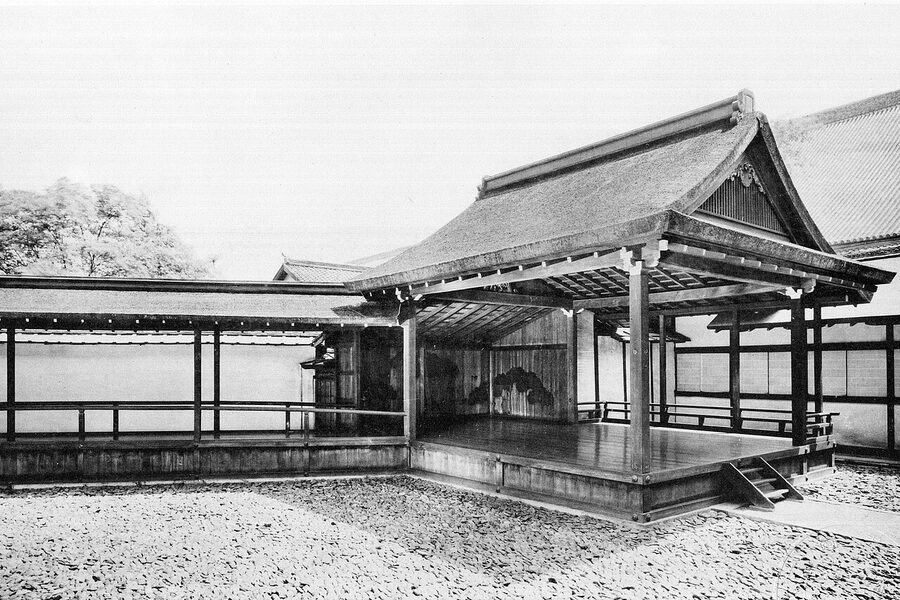
The catch is that the North Stage stands among the temple’s state rooms, open only for occasional special viewings, so check the temple’s site before you plan around it. The larger South Stage, an Important Cultural Property, is the one in use: on 21 May, during the celebration of the founder Shinran’s birthday, Noh is performed on it, and in recent years seats have gone to people who make an offering to the temple. The rest of Nishi Hongan-ji is free to enter every day.
Itsukushima’s stage on the sea
The most beautiful stage in Japan, to my eye, stands on the tidal flat at Itsukushima Shrine on Miyajima, the shrine Kiyomori rebuilt in the 12th century, and at high tide it floats. There are no jars under its floor; the water is said to do their work. It was given in 1680 by Asano Tsunanaga, lord of Hiroshima, and it is an Important Cultural Property.
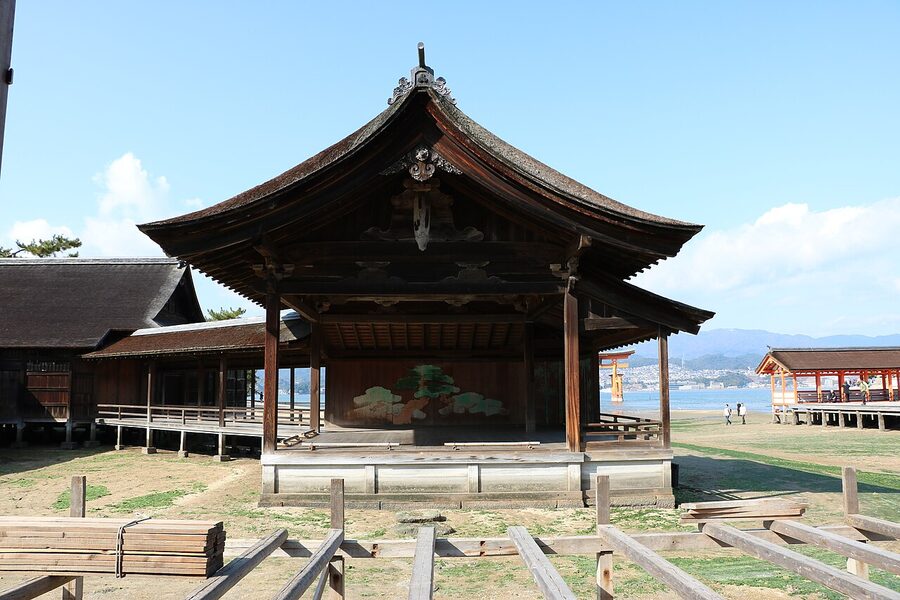
It is used in earnest for the Tōkasai Noh from 16 to 18 April each year, after the shrine’s peach-blossom festival on the 15th, when you can usually watch from the corridors. Go at high tide if you can; at low tide it is a building on mud.
Takigi-nō: Noh by firelight
Takigi-nō (薪能), Noh performed outdoors after dark between burning braziers, is the form a casual traveller is most likely to stumble upon. Its ancestor, the torchlit sarugaku of Kōfuku-ji, is still held there and at Kasuga Taisha in May as the Takigi Onō (薪御能). In 2026 it was on 15 and 16 May, with the evening performances on the site of Kōfuku-ji’s south gate; seats have cost around ¥5,000 in recent years, and the organisers have let people stand at the back for nothing.
Kyoto’s version, the Kyoto Takigi Noh at Heian Shrine, has been held on 1 and 2 June every year since 1950, from 18:00 to about 20:30, moving indoors to the nearby ROHM Theatre if it rains. Tickets in 2026 ran from ¥4,000 unreserved to ¥15,000 for the best seats. Dozens of other towns hold their own at castles and shrines; Himeji and Kamakura are among the better known.
You will see less at takigi-nō than indoors: the light is poor and the programmes are chosen for spectacle. But it is the closest you will come to how Zeami’s audiences saw Noh, outside with the evening coming down, and everyone who loves the art should see it that way once.
Sado, the island of exile
There is an irony waiting for you on Sado. The island has more than thirty Noh stages, more for its size than anywhere in Japan, and likes to call this Zeami’s legacy. It is not, quite: Noh came to Sado in force in the early 17th century with the magistrate Ōkubo Nagayasu, who ran the gold mines and was the son of a sarugaku actor, and the island’s farmers and miners took to it and built stages at their village shrines.
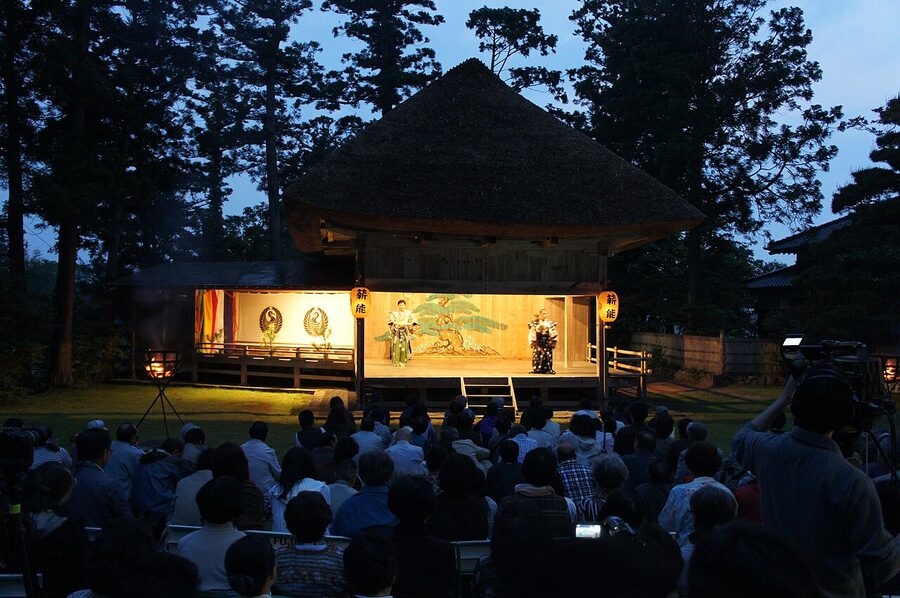
Zeami’s own trail on Sado is short and touching. Shōhō-ji, five minutes’ walk from the Izumi bus stop on the main bus line, has his stone seat and the rain-making demon mask, and every June it holds a candlelit Noh in its main hall in his memory, the one occasion on which the mask is shown. Sado is reached by jetfoil or car ferry from Niigata, and in early June you can see both.
Tickets, manners and what to read first
Book online where you can; the National Theatre’s ticket site has an English version, and most other halls take phone bookings. Wear what you like, though you will see kimono among the regulars.
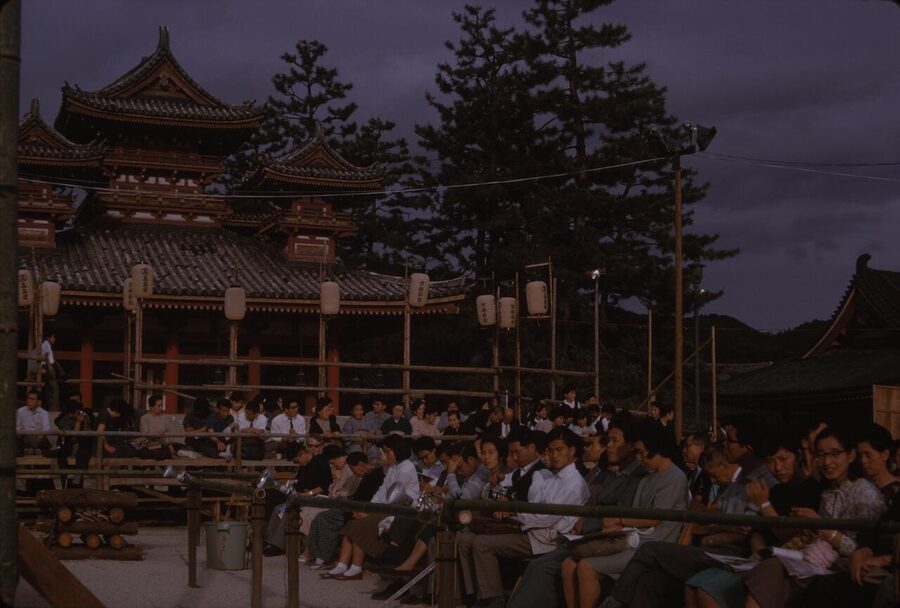
Inside, the rules are few and strict: phones off, no photographs, no eating in the auditorium, and no walking in or out during a play. The trickiest moment is the end. Many people applaud as the shite disappears behind the curtain, others wait until the musicians and chorus have left too, and some regulars prefer silence; follow the house.
Read a translation before you go. Royall Tyler’s Japanese Nō Dramas (Penguin, 1992) has excellent translations with clear introductions, Donald Keene’s Twenty Plays of the Nō Theatre is the classic, and Zeami’s treatises are in Tom Hare’s Zeami: Performance Notes (Columbia, 2008). Read Izutsu, Atsumori and a kyōgen or two, and you will be better prepared than half the house.
Sanjō Kintada would have hated all of it. He would have hated the subtitles, the women on the stage, the government paying for the building and the tourists in the side seats, and he would have been appalled to learn that the beggar boy at the Gion festival is now the most studied Japanese writer of his century. Go and sit at the side, by the bridge, and watch the curtain lift. When the masked figure comes slowly towards you with the flute crying behind it, you are seeing very nearly what the shogun saw at Imagumano, only slower, and from a much better seat.