On the ninth day of the fourth month of 752, an Indian monk named Bodhisena climbed up to the face of the largest bronze statue anyone in Asia had ever cast and painted in its eyes. Tied to his brush was a pale blue cord nearly 190 metres long, and at the other end of it, in the courtyard below, the retired emperor, the empress dowager, the reigning empress and thousands of monks reached out to hold it, so that each of them could say they had a hand in opening the eyes of the Buddha.
The cord still exists. It lies in a wooden storehouse about four hundred metres north of the hall, along with the brush, a fragment of the empress’s crown and the masks worn by the dancers that afternoon. The eyes Bodhisena painted do not. Neither does the hall he stood in, nor the head he painted them on, nor most of the body below it.
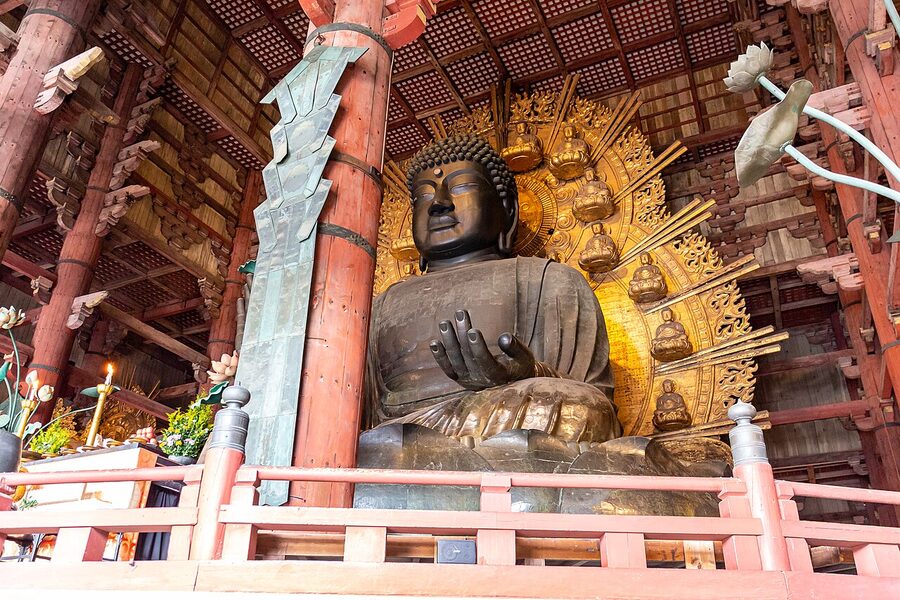
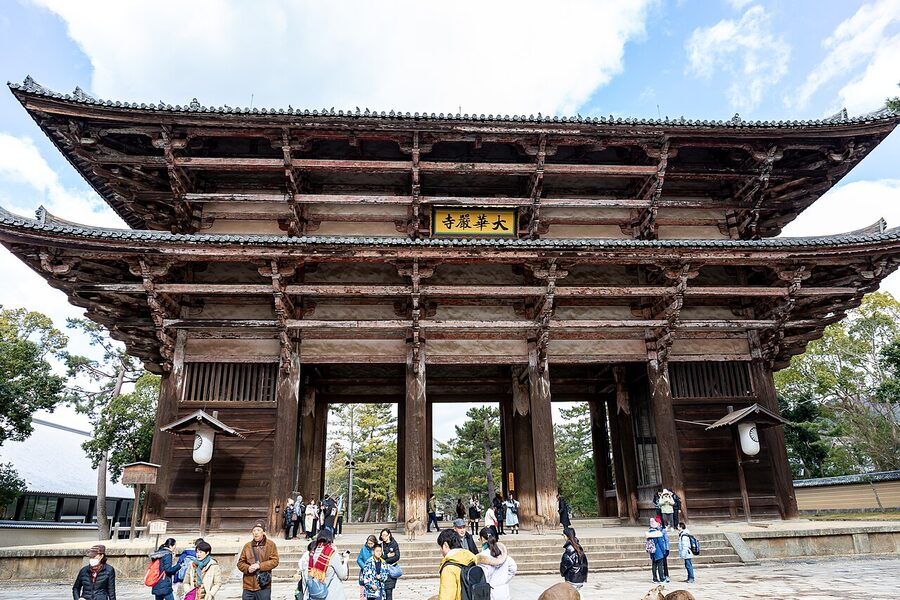
That is the thing to understand about Tōdai-ji (東大寺) before you go. Almost everything you will see there is a rebuilding, of a rebuilding, of something an emperor ordered when his country was falling apart. I have been walking through its gate for fifteen years, and I still think the story of who kept putting it back together is better than the Buddha.
In This Article
- A plague, a dead prince and an emperor who kept moving house
- The edict of 743
- Gyōki, the outlaw monk
- Melting the country’s copper
- A hall to match
- The ninth day of the fourth month
- Kōmyō’s gift to the Buddha
- The Heian centuries
- How tall were the pagodas?
- The 28th day of the twelfth month of 1180
- Chōgen, aged sixty-one
- The Daibutsu style
- Sixty-nine days: the Nandaimon guardians
- 1567: the night the Buddha lost his head again
- Eighty years in the rain
- Kōkei and the hall at two-thirds width
- Is it the biggest wooden building in the world?
- What you are actually looking at
- Fourteen nights of fire: Omizutori
- The deer
- Visiting Tōdai-ji today
- Getting there and getting in
- The Nandaimon and the walk in
- The Great Buddha Hall
- The Hokke-dō (Sangatsu-dō)
- Nigatsu-dō, the bell and the climb
- The Kaidan-in
- The Shōsōin and the autumn exhibition
- The Tegai-mon and the museum
- Further afield
- The cord
A plague, a dead prince and an emperor who kept moving house
Emperor Shōmu came to the throne in 724 and had a miserable reign. His only son by the Fujiwara consort Kōmyō died in the ninth month of 728, before his first birthday, and the grieving parents set up a small mountain retreat for nine monks on the slopes east of the capital to pray for the child. The temple histories call it Konshu-ji (金鐘寺, also read Kinshō-ji), and it is the seed Tōdai-ji grew from.
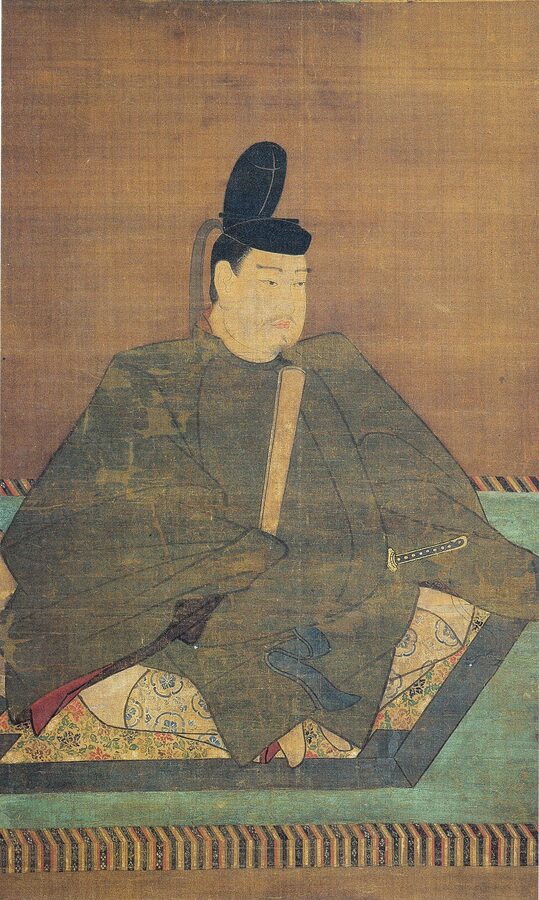
Then came the epidemic. Smallpox reached Japan in 735, and in 737 it killed all four of the Fujiwara brothers who ran the government, along with perhaps a quarter of the population by some modern estimates. In 740 one of their sons, Fujiwara no Hirotsugu, rebelled in Kyushu; my piece on the Fujiwara clan tells how the family survived its worst decade. Shōmu’s answer was to keep moving.
Between 740 and 745 he shifted his court from Heijō-kyō (modern Nara) to Kuni, then Naniwa, then Shigaraki in the hills of Ōmi, and back. The Nara period is named after a capital its emperor spent five years avoiding.
The edict of 743
The Shoku nihongi, the official chronicle completed in 797, says the idea came to him in 740 at a temple called Chishiki-ji in Kawachi, before its statue of the cosmic Buddha Rushana (Vairocana). In 741 he ordered a state temple and nunnery in every province, and on the 15th day of the tenth month of 743, at Shigaraki, he issued the edict for the Great Buddha.
It is a remarkable document. Shōmu announces that he will melt down the copper of the whole country to cast the image and cut away great mountains to build its hall. He reminds everyone that he owns the wealth and power of the realm, and then says that a work made with wealth and power alone would mean nothing: anyone who wants to help with a single branch of grass or a handful of earth should be allowed to.
Work began near Shigaraki, where the statue’s frame went up in 744. Then the hills around the palace kept catching fire, and in 745 the court went back to Heijō-kyō and the Buddha started again on the site of Konshu-ji. The historian Iinuma Kenji has argued that the Nara project was really Kōmyō’s and her nephew Fujiwara no Nakamaro’s, and that the Shigaraki fires were no accident. It is a minority view, but a reminder of how much politics was poured into this bronze.
Gyōki, the outlaw monk
Shōmu knew the court could not do this alone. In 717 the government had condemned a monk called Gyōki for preaching to ordinary people outside the temples. Gyōki carried on regardless, and by the 740s his followers had built some 49 temples and meeting halls, 15 reservoirs, six bridges and a string of free hostels across the home provinces. They were exactly the people Shōmu needed.
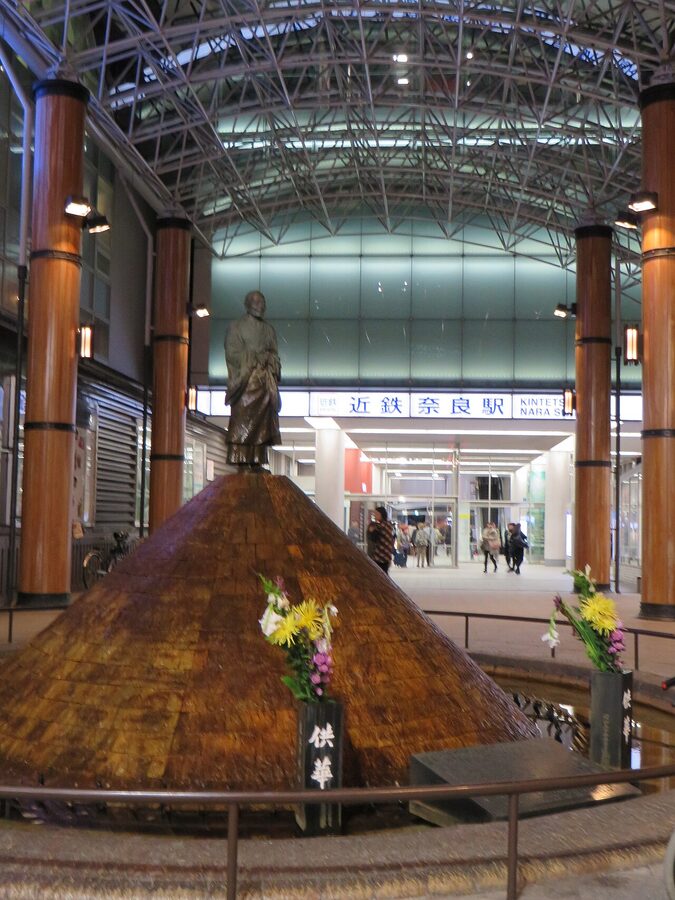
In 745 Shōmu made Gyōki daisōjō, the first man to hold that highest rank in the Buddhist hierarchy, and sent him round the provinces to raise contributions. A much later legend has him pray at the Ise Grand Shrine for seven days until the oracle declared that the sun goddess Amaterasu and the cosmic Buddha were one. Nothing of the period says so. Gyōki died on the second day of the second month of 749, aged eighty-two by the Japanese count, three years before the eyes were opened.
Melting the country’s copper
Casting began on the 29th day of the ninth month of 747 and finished on the 24th day of the tenth month of 749, in eight pourings. That meant building a full-size clay figure on a timber frame, encasing it in a clay mould, lifting the mould off, shaving the core down by the thickness of the bronze and reassembling everything with thousands of small metal spacers to hold the gap. Then they poured, from the bottom up, in eight horizontal bands.
The master sculptor was Kuninaka no Kimimaro, grandson of a Baekje official who had fled to Japan after that kingdom fell in 663. The records give close to 500 tonnes of copper, with tin, mercury and charcoal on the same scale. The arsenic in the oldest bronze ties most of the copper to the Naganobori mine in what is now Yamaguchi, at the far western end of Honshu.
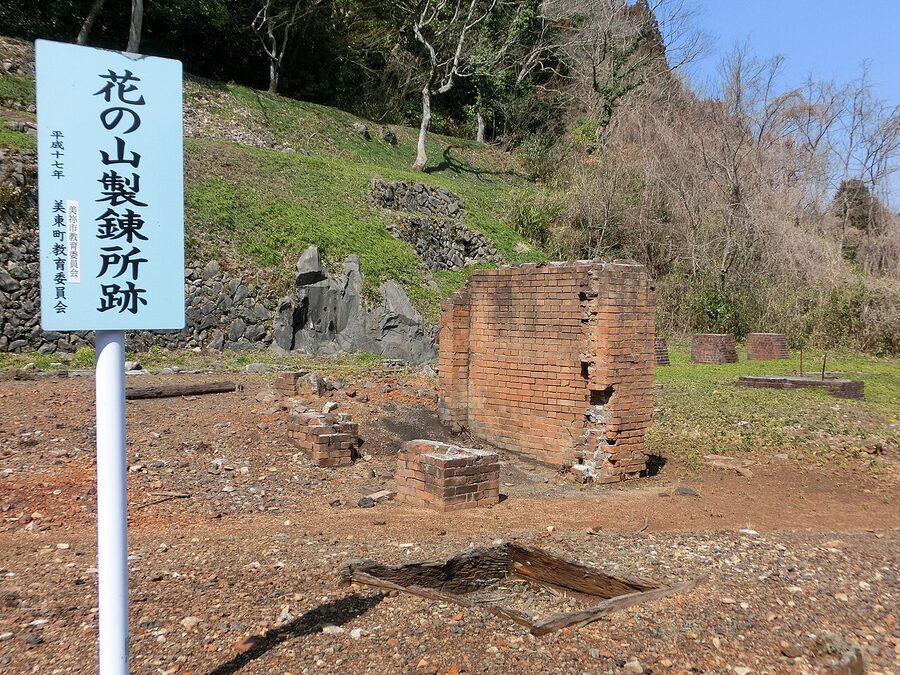
Gold was harder, because Japan had almost none. In 749 the governor of Mutsu in the far north, a descendant of the Baekje royal house, reported gold in his province and sent 900 ryō, roughly 13 kilograms, and Shōmu was so delighted that he renamed the era. The gilding, done by dissolving gold in mercury and burning the mercury off, almost certainly poisoned the men who did it, some Japanese historians think by the hundred.
The temple’s figures say about 2.6 million people took part, counting donors and labour together; English-language accounts often add that 350,000 worked on the statue itself. Treat both as a statement of scale rather than a census. Miyamoto Katsuhiro of Kansai University once costed the project at 2010 prices and arrived at ¥465.7 billion, a number no modern finance ministry would approve either.
A hall to match
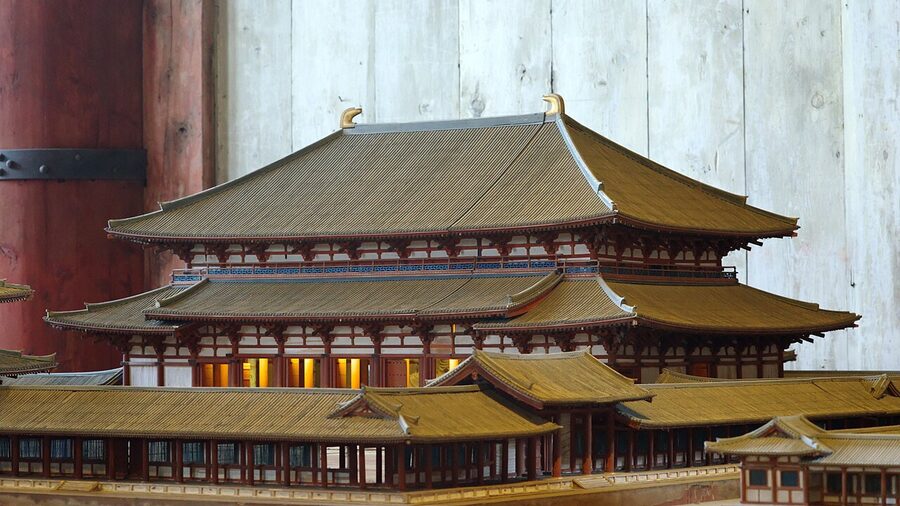
The hall went up around the finished Buddha and was done by 758 in most accounts, though some reference works give 752. Two seven-storey pagodas stood in walled courtyards in front of it, with a lecture hall behind and three long wings of monks’ quarters around that. The whole complex took close to forty years.
The ninth day of the fourth month
The ceremony was meant for the eighth day of the fourth month of 752, the Buddha’s birthday. By the reckoning of the Nihon shoki of 720 it was also exactly two hundred years since Buddhism had come to Japan from Baekje (other early sources give 538, which spoils the arithmetic). For reasons nobody recorded, it slipped a day.
The Shoku nihongi and the temple’s own compilation, the Tōdai-ji yōroku, describe the morning. Shōmu, who had abdicated in favour of his daughter Kōken, was too ill to paint the eyes, so the task fell to Bodhisena, a Brahmin from south India who had come via China in 736 and been greeted at Naniwa by Gyōki. Then the monks filed in through the south gate, ten thousand of them by the chronicle’s count.
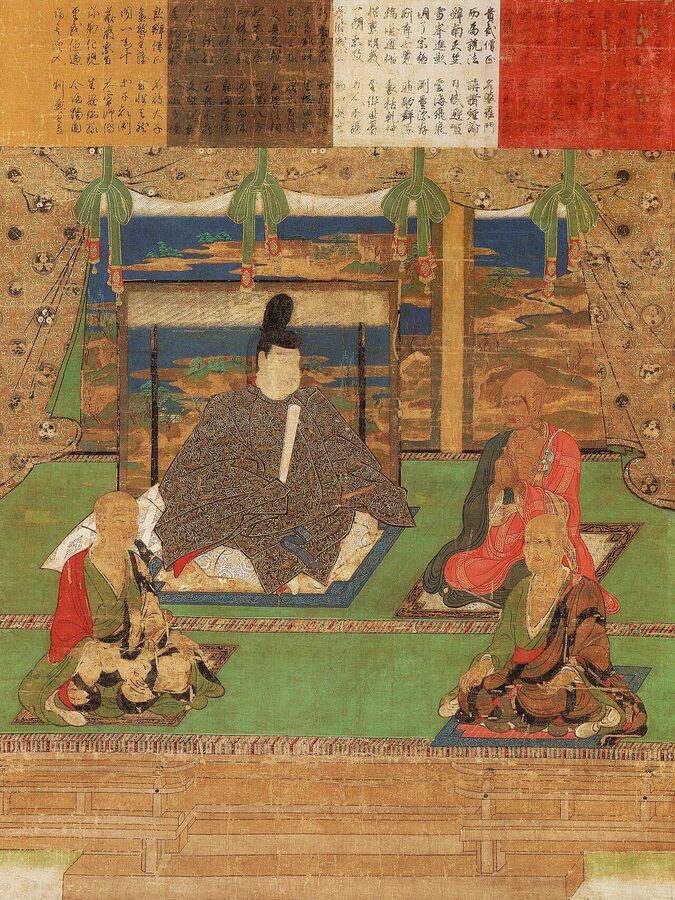
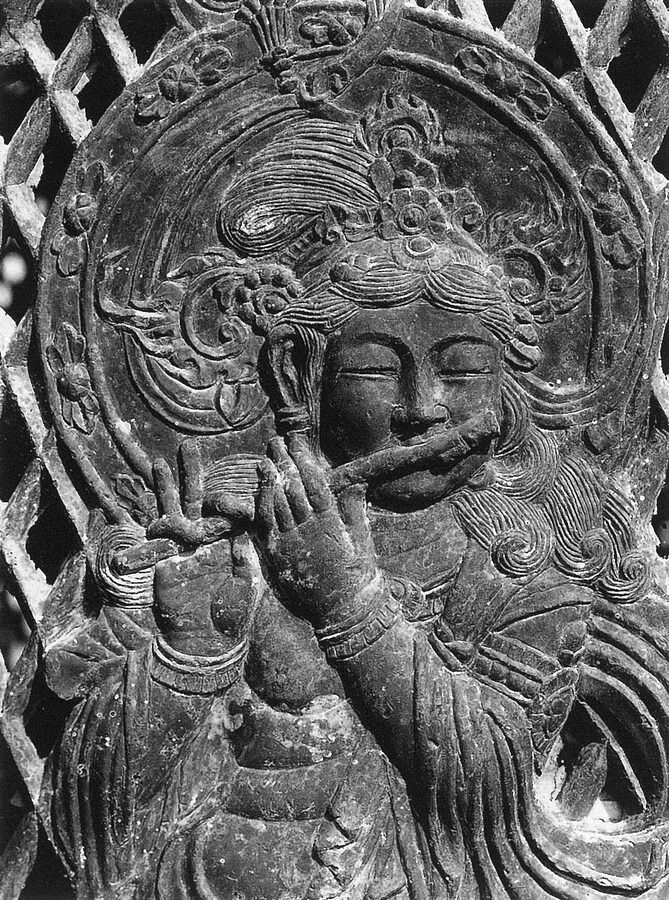
There were sutra lectures, offerings from the great temples of the capital, and then dancing until evening. The programme was the known world as seen from Nara: old Japanese court dances such as the Kume-mai, Tang music, music of the Korean kingdoms, and the music of Champa in present-day Vietnam, taught by a monk who had sailed with Bodhisena. The chronicle says no Buddhist service so magnificent had been held since the Dharma came east.
The Buddha was not actually finished. The gilding had started only weeks before and was not completed until 757, the seams between the eight casting bands were patched until 755, and the halo took until 771. Shōmu’s failing health was once the usual explanation for the rush; the favoured one now is that nobody was going to miss the anniversary for the sake of a little gold leaf.
Kōmyō’s gift to the Buddha
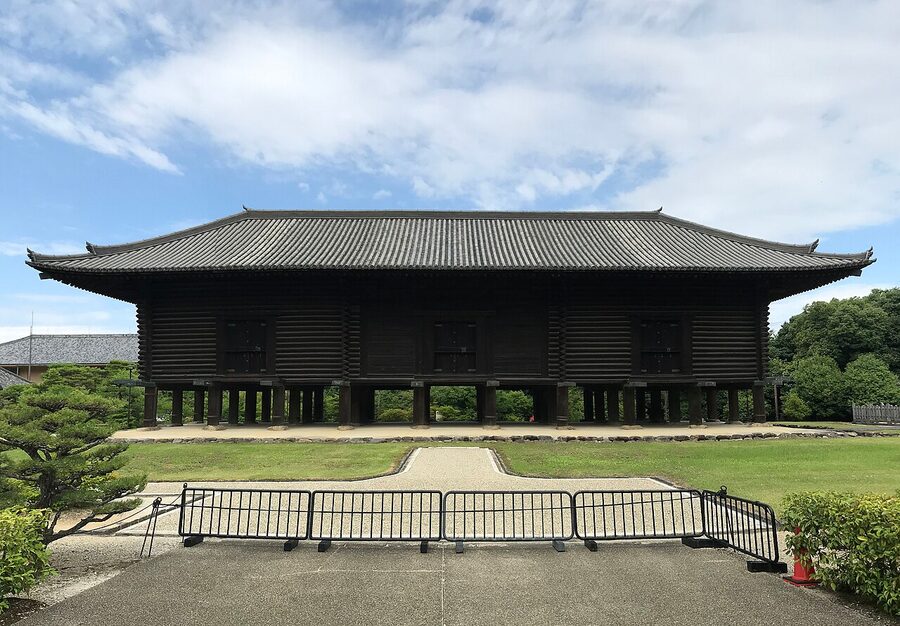
Shōmu died on the second day of the fifth month of 756. On the 49th day after his death, Kōmyō gave the Great Buddha about 650 of her husband’s possessions and sixty kinds of medicine, with inventories that still exist. With the temple’s own ritual equipment, they were stored in a timber warehouse on stilts behind the hall: the Shōsōin (正倉院).
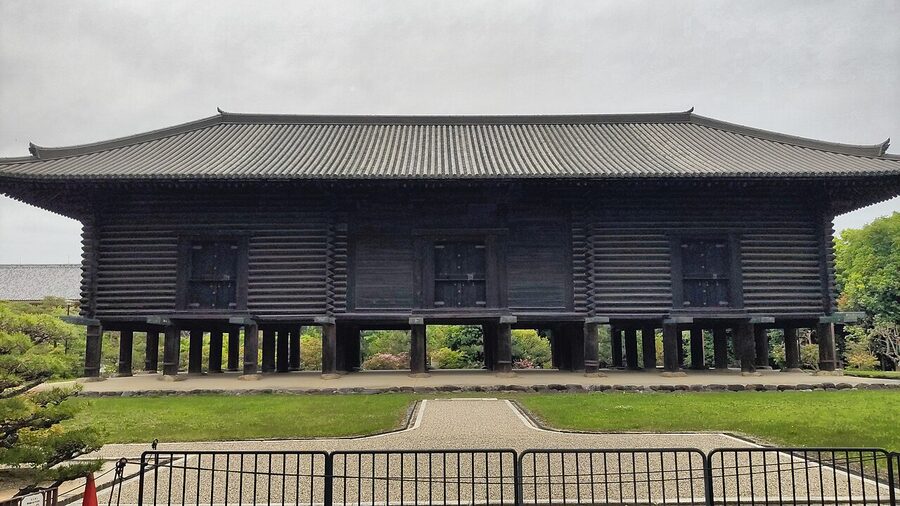
What survives is the best collection of 8th-century objects on earth. There are Sasanian cut-glass bowls, felt rugs of Central Asian wool, mirrors inlaid with Afghan lapis lazuli, the couple’s two beds, which once stood side by side, and the only five-stringed biwa lute to survive anywhere. Modern studies suggest most of the pieces were made in Japan in foreign styles, which is a story in itself.
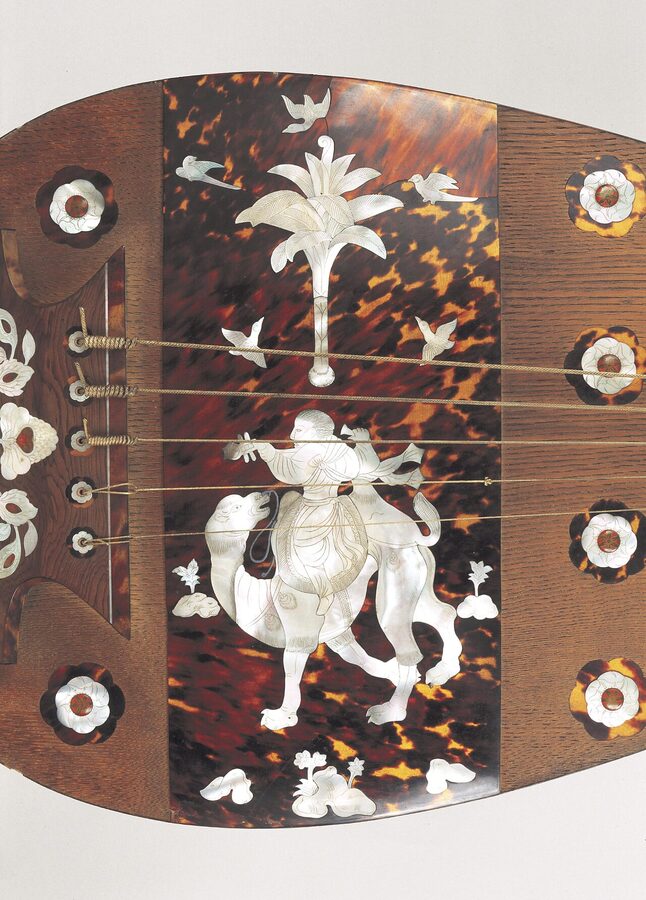
The treasures were not left alone. Two of the most important swords, the “Yang” and “Yin” blades, were withdrawn in the twelfth month of 759 and vanished from the record. In 1907 workmen found swords and gems buried around the base of the Buddha, and in 2010 X-rays of two blades showed the inlaid characters for yō-ken and in-ken: Kōmyō had buried them under her husband’s Buddha. They are in the Tōdai-ji Museum now, about as far back as the story of Japanese swords goes.
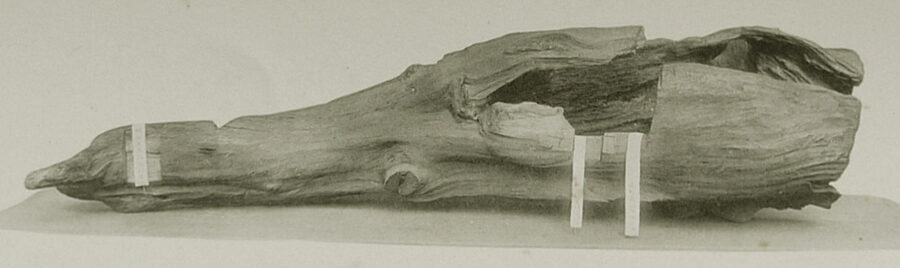
The most famous vandalism is the Ranjatai, the most celebrated incense in Japan. A slice of it was the ultimate trophy, and the men who took one are a roll call of power: the shogun Ashikaga Yoshimitsu, builder of Kinkaku-ji, his son Yoshinori, Oda Nobunaga in the third month of 1574, and Emperor Meiji in 1877. Nobunaga having the storehouse opened for him was a way of telling the court exactly who was in charge.
The Heian centuries
When Emperor Kanmu moved the capital away from Nara in 784, and on to Heian-kyō in 794, he was partly escaping the great temples, and the office that had built Tōdai-ji was wound up. The temple adapted. Kūkai, founder of Shingon Buddhism, served as its administrator early in the 9th century and opened an esoteric training hall in the precinct; the monks still chant a Shingon text before the Buddha every morning and evening. In the Heian era eight schools of Buddhism were studied here side by side.
The Buddha was in trouble almost at once. Its back cracked and began to lean, and in the fifth month of 855 an earthquake brought the head down; a new one was dedicated in 861. Meanwhile the temple gathered estates and an army of monk-soldiers, and joined Kōfuku-ji, the family temple of the Fujiwara, in marching on the capital whenever it wanted something.
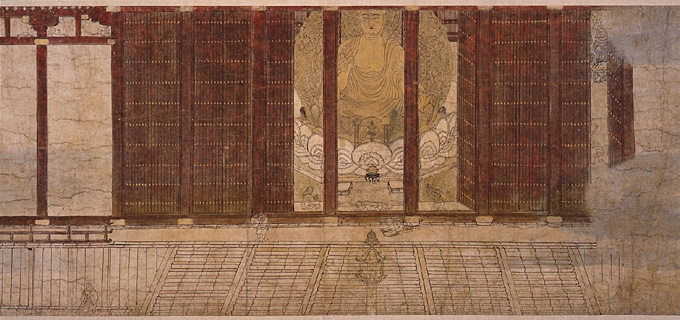
How tall were the pagodas?
For most of the last century, books gave the two pagodas a height of around 100 metres, from medieval copies of the records giving 33 jō. In 2003 Hakozaki Kazuhisa of the Nara National Research Institute for Cultural Properties argued that nobody in the 8th century could have built that. In April 2024 the institute concluded from the oldest text that the true figure was 23 jō, about 70 metres, and the 33 a copyist’s error of the Edo period.
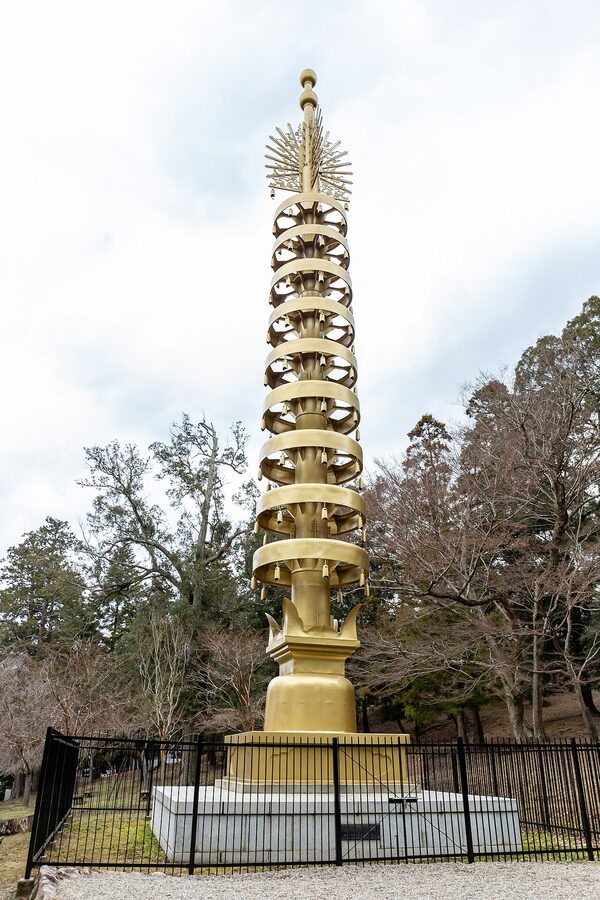
The west pagoda burned after lightning in 934. The east one was destroyed in 1180, rebuilt by 1227 at roughly 96 metres, and burned again in 1362. The temple has been excavating its platform since 2015 with a view to building it again, so add it to the list of things Tōdai-ji plans to put back.
The 28th day of the twelfth month of 1180
By 1180 Taira no Kiyomori dominated the court, and the temples of Nara were among his most dangerous enemies. Kōfuku-ji was the family temple of the Fujiwara regents he had pushed aside, and between them the two temples could put thousands of armed monks in the field. When Prince Mochihito raised the first revolt of the Genpei War in the fifth month of 1180, the Nara monks backed him, and after it failed they talked openly of marching on Kyoto.
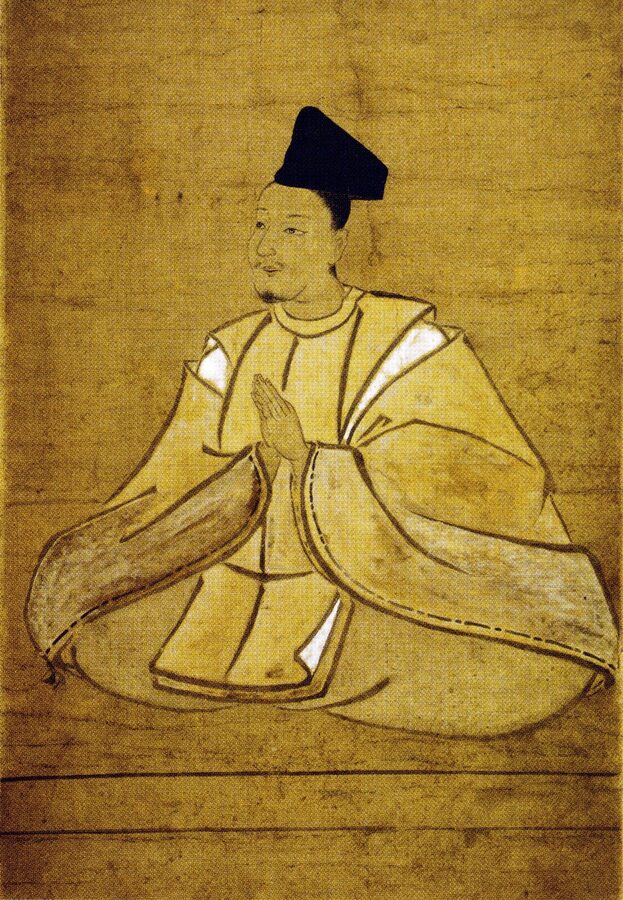
At the end of the year Kiyomori sent his son Shigehira south with an army of tens of thousands in The Tale of the Heike, several thousand in a courtier’s diary of the time. On the 28th day of the twelfth month of Jishō 4, which fell on 15 January 1181 by the Western calendar, the Taira broke through the monks’ ditches at Nara-zaka and Hannya-zaka, and that night the city burned. The Heike says Shigehira’s men lit the houses around them for light and a winter wind did the rest; most modern historians think burning the monks’ quarters was the plan all along, and only the scale was an accident.
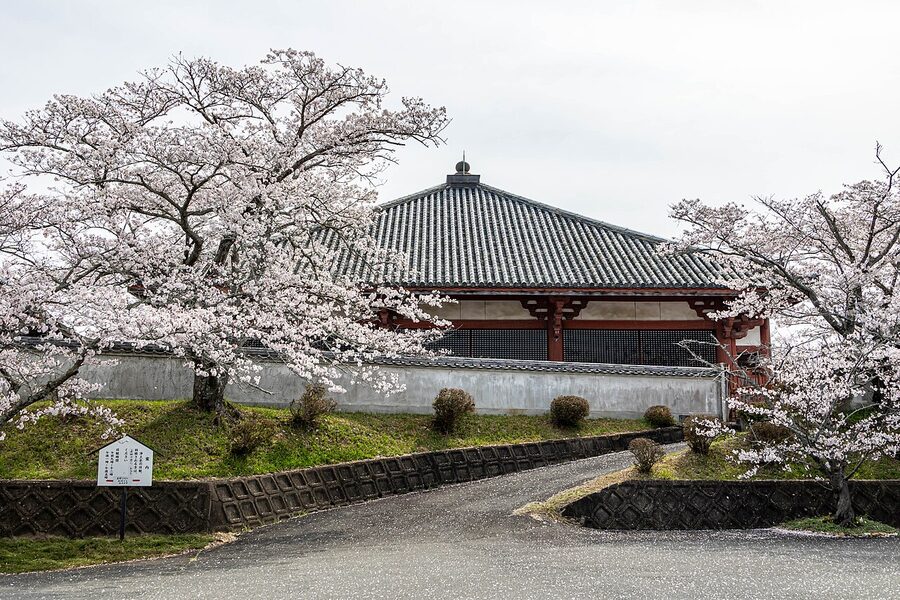
At Tōdai-ji the Great Buddha Hall, the cloisters, the lecture hall, the east pagoda and the ordination hall burned, and Kōfuku-ji lost almost everything. The Buddha’s head and hands melted off and lay in front of and behind the body. What survived were the buildings on the edges of the precinct, the bell tower, the Hokke-dō, the Nigatsu-dō, the Tegai-mon and the Shōsōin, which are still the oldest things you will see.
The number of dead depends on whom you read. The Tale of the Heike says more than 3,500 people were burned alive in the halls, over a thousand of them in the upper storey of the Great Buddha Hall. The Azuma kagami, the Kamakura government’s chronicle, relying on a monk who escaped, gives about a hundred. Kujō Kanezane, a senior minister in Kyoto, wrote in his diary that the grief was worse than losing his own parents.
Kiyomori seized both temples’ estates and forbade any rebuilding. On the fourth day of the leap second month of 1181 he died of a raging fever, and the whole capital assumed it knew why.
Chōgen, aged sixty-one
Kiyomori’s heir reversed the confiscations within weeks. In the third month of 1181 the retired emperor Go-Shirakawa sent an official, Fujiwara no Yukitaka, to inspect the ruins, and in Nara he met a monk who told him exactly how the temple should be rebuilt. His name was Shunjōbō Chōgen, he was sixty-one by the Japanese count, and in the eighth month he was appointed daikanjin, chief fundraiser, for the restoration.
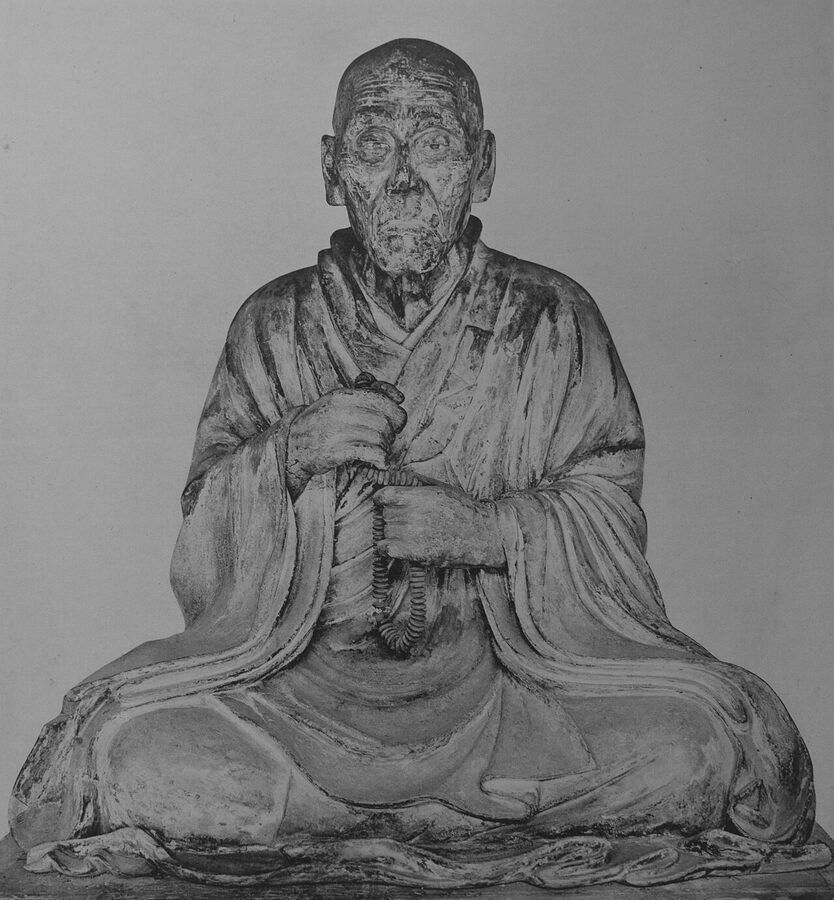
Chōgen claimed three trips to Song China, which some modern scholars doubt, though he certainly came home in 1168 on the same voyage as the monk Eisai. He had trained in the mountains of Ōmine and Kumano and studied with the Pure Land teacher Hōnen. More usefully, he knew Chinese builders. A Song caster, Chen Heqing, recast the Buddha’s head, and at the end of the eighth month of 1185 Go-Shirakawa painted in the eyes himself, with ritual implements brought out of the Shōsōin for the purpose.
The hall was harder. In 1186 the province of Suō, at the western tip of Honshu, was assigned to pay for it, and Chōgen went there with his carpenters, cut a road into the mountains along the upper Saba river and floated out timbers 39 metres long and 1.6 metres thick. He was not above menace: his oaths for local helpers promise anyone who broke their pledge leprosy in this life and endless hell in the next.
The other great patron was Minamoto no Yoritomo. Rebuilding what the Taira had burned was too good an opportunity to miss, and on the 12th day of the third month of 1195 he rode into Nara with his wife Hōjō Masako and an army of escorts for the dedication of the new hall. The Kamakura era began, in a sense, in front of this Buddha.
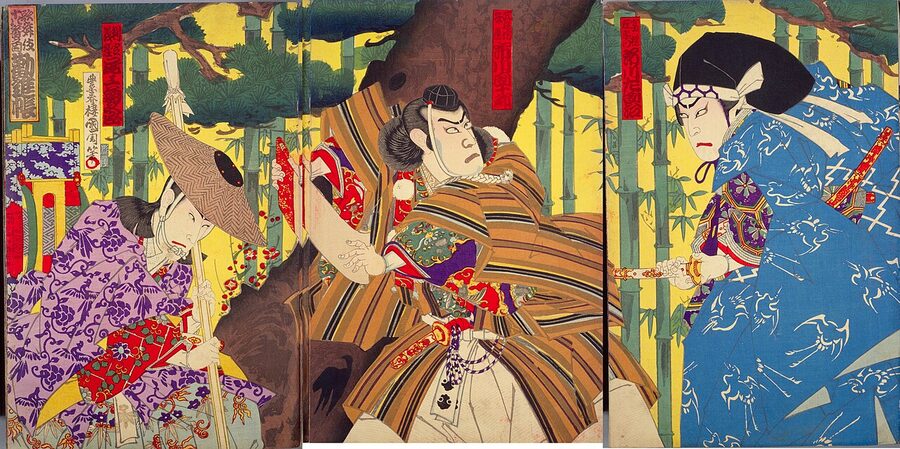
Chōgen’s fundraising entered legend. In the Noh play Ataka and the kabuki play based on it, Yoritomo’s fugitive half-brother Minamoto no Yoshitsune tries to cross a barrier disguised as a mountain monk collecting for Tōdai-ji. His giant retainer Benkei saves them by reading aloud a subscription scroll that is actually blank.
The Daibutsu style
Chōgen’s buildings looked like nothing else in Japan. The style now called Daibutsu-yō, “Great Buddha style”, came from coastal southern China: tie beams run straight through the pillars, brackets stack out in tiers, and there are no ceilings to hide the frame. It is cheap, strong and fast. After his death almost nobody used it in pure form, which says something about how Japanese builders felt about being told to do things the Chinese way.
Sixty-nine days: the Nandaimon guardians
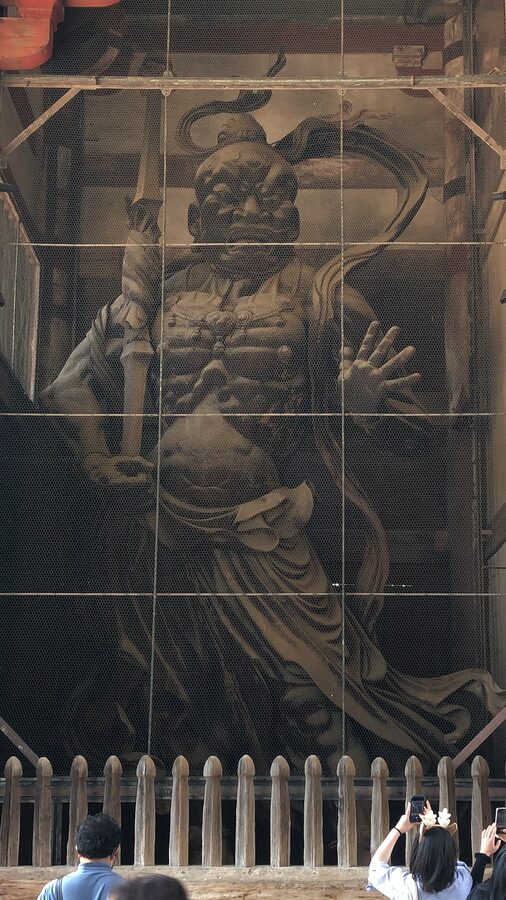
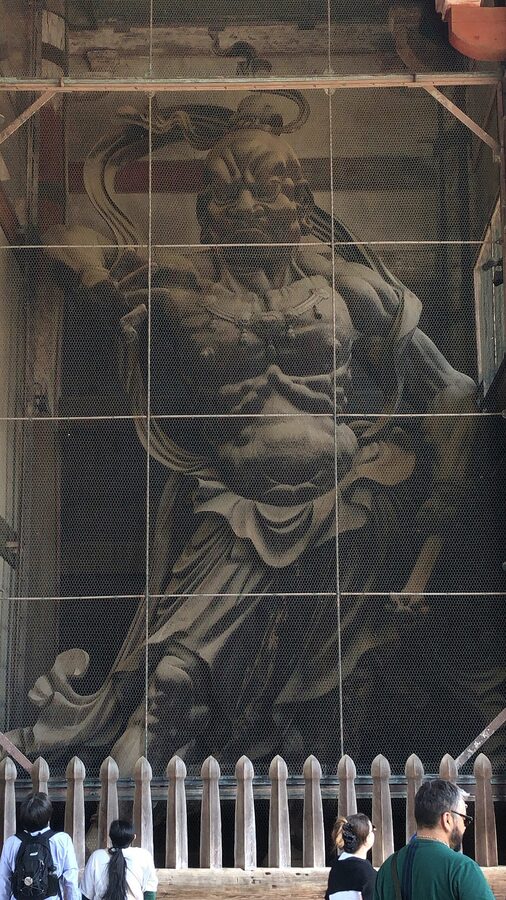
The gate’s two guardians are the most famous sculpture of the Kamakura period. The Niō are 8.4 metres tall, assembled from thousands of blocks of cypress, and according to a Tōdai-ji record they were made in 1203 in 69 days by Unkei, Kaikei, Jōkaku and Tankei. When they were taken apart for the first time in 1988, conservators found the sculptors’ names written inside, with twelve assistants besides.
Look behind the guardians, on the north side of the gate, and you will find a pair of stone lions carved in 1196 by a Song mason from stone imported from China, because the records say Japanese stone would not take the work. They stood at the middle gate until the Muromachi period, and almost nobody looks at them now.
1567: the night the Buddha lost his head again
The second burning was even more pointless than the first. In 1567 Nara was the battleground between two halves of the shattered Miyoshi regime: Matsunaga Hisahide, master of Tamonyama castle just west of Tōdai-ji, against the three Miyoshi lords and the Yamato warlord Tsutsui Junkei. For six months they fought through the streets and temples of Nara in the manner of the Sengoku, each side burning anything the other might use.
In the fifth month the Miyoshi army camped in Tōdai-ji, with the monks’ blessing, since Matsunaga had been eating into the temple’s estates. On the night of the tenth day of the tenth month Matsunaga attacked. The diary of a monk at Kōfuku-ji’s Tamon-in records that fire from a grain store spread along the cloisters, and that by the hour of the ox, around two in the morning, the Great Buddha Hall was gone. The Buddha’s head melted again.
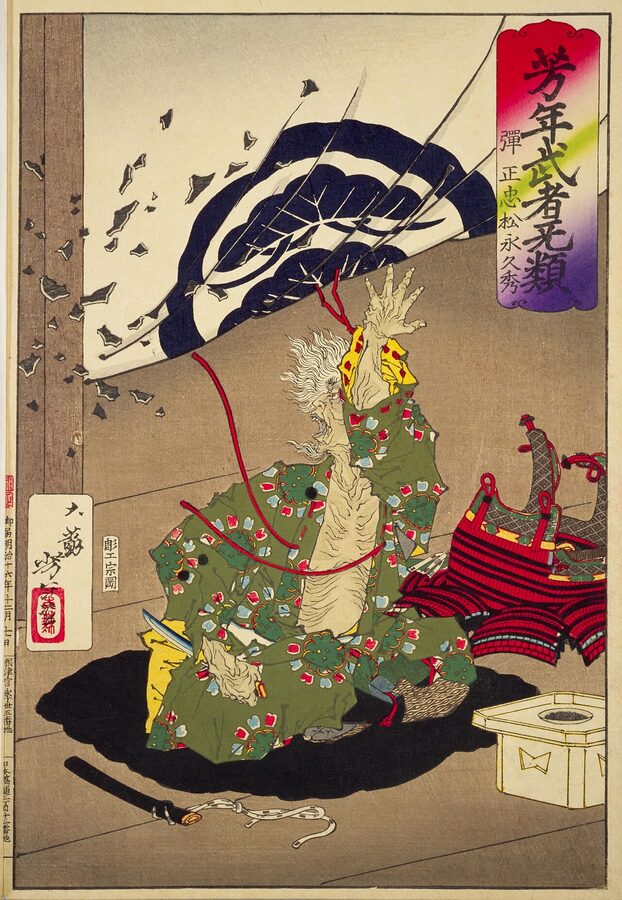
Who started it has been argued ever since. Tradition blamed Matsunaga, and an Edo-period anecdote has Oda Nobunaga introducing him to Tokugawa Ieyasu as a man who had done three things no one else would dare, one of them burning the Great Buddha. The Jesuit Luís Fróis wrote that a Christian soldier in the Miyoshi camp set the fire secretly, and plainly thought it to the man’s credit; my piece on Christianity in Japan covers where that zeal led. Two Japanese chronicles describe gunpowder or straw huts catching fire in the Miyoshi lines, and most historians now settle for an accident in a night battle.
Eighty years in the rain
What followed was worse. A local warrior and painter, Yamada Dōan, patched the Buddha’s head with copper sheet, and a temporary roof went up, only to blow down in a storm in 1610. For the next eight decades the Great Buddha of Nara sat in the open, rained on, snowed on and climbed on.
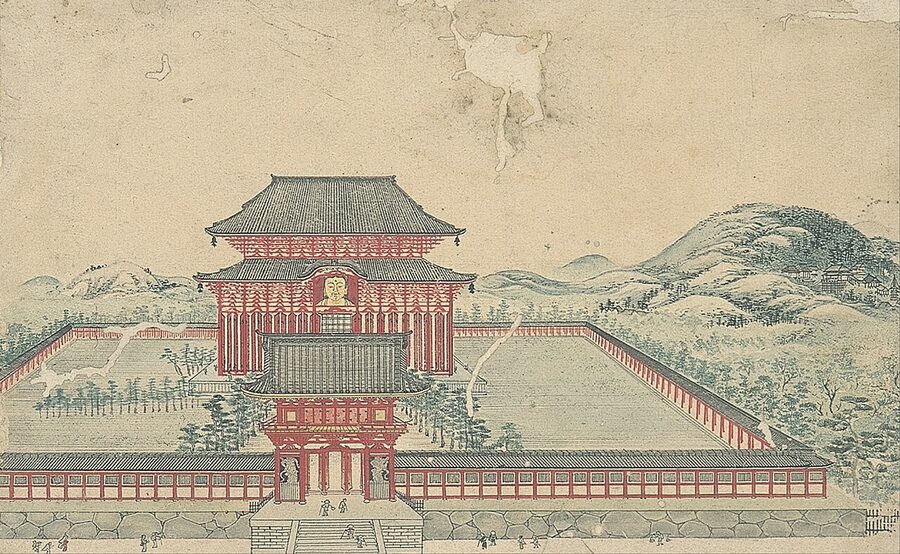
Part of the reason was that Japan already had a replacement. Toyotomi Hideyoshi decided in 1586 to build a new Great Buddha in Kyoto rather than repair the old one, which compares rather badly with Yoritomo. For two centuries, when people in Kyoto and Osaka said “the Great Buddha”, it was usually Kyoto’s they meant.
Kōkei and the hall at two-thirds width
In 1660 a thirteen-year-old boy from Miyazu, on the Japan Sea coast, entered Tōdai-ji as an acolyte. His name in religion was Kōkei, and the temple’s story is that a few days later he saw the Buddha sitting in a downpour and resolved to give it back its roof. In 1684 he got permission from the Tokugawa shogunate to collect across the country under a slogan anyone could understand: isshi hansen, “one sheet of paper, half a coin”.
Within seven years he had raised 11,000 ryō. The present head was cast in 1690, and the third eye-opening was held in 1692. Then Kōkei went to Edo, where he was introduced to the fifth shogun and his mother Keishō-in, both devout Buddhists with money to spend. My piece on Tokugawa Tsunayoshi is mostly about his dogs, but this is one of the good things he paid for.
The problem was timber. Hideyoshi’s Kyoto Buddha halls and a century of castle building had stripped Japan of trees big enough for pillars on the old scale, so the design was cut from eleven bays to seven, and the pillars were built up from a core wrapped in timbers bound with iron hoops, a technique learned at Hōkō-ji. Only the two great beams had to be single trunks. In 1704 two red pines were found on Shiratori-yama in Hyūga, in southern Kyushu, and brought to Nara by sea and river with, by the temple’s count, a hundred thousand days of labour.
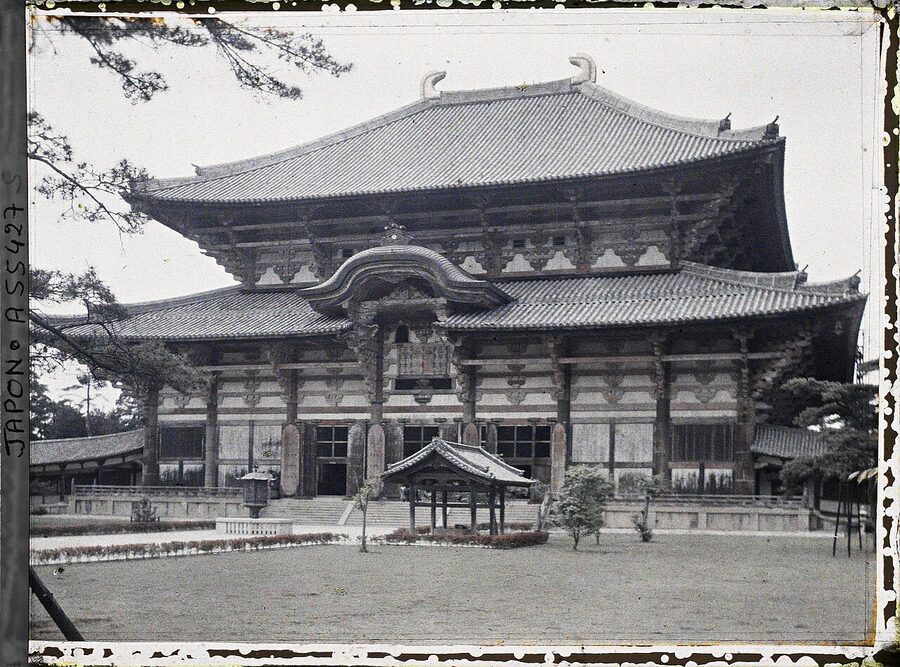
Kōkei saw the ridge beam raised in 1705 and died that summer in Edo, on the twelfth day of the seventh month, aged fifty-eight by the Japanese count. He is buried at Gokō-in, a temple Chōgen founded just north of Tōdai-ji. The hall was dedicated in the third month of 1709. A board plan hanging inside, read by infrared photography, shows the first design copied the Kyoto hall almost exactly, and the architectural historian Kuroda Ryūji thinks Kōkei’s builders worked from Hōkō-ji throughout.
The scholar Motoori Norinaga, who saw both Great Buddhas in the 1750s, compared them in his Kyoto diary. Nara’s hall was a little narrower and its Buddha a little smaller, he wrote, but being narrower it looked taller, which suited it, and its setting was far finer. I have never read a better review.
Is it the biggest wooden building in the world?
Not quite. The hall is about 57 metres wide and 50.5 deep, with its height given as 46.8 metres in some Japanese sources and 49.1 in others. English-language guides still call it the largest timber building on earth, but modern laminated-timber domes overtook it in the 1990s; the careful Japanese claim is the largest traditional post-and-beam timber building, which is true and more interesting.
It has needed help. In 1806 the sagging lower roof had to be propped. The Meiji repair of 1903 to 1913 slung British steel trusses under the two great beams, and the Shōwa repair of 1974 to 1980 stripped the roof and strengthened it with more steel. The Meiji era engineers deserve as much credit for the hall standing today as Kōkei does.
What you are actually looking at
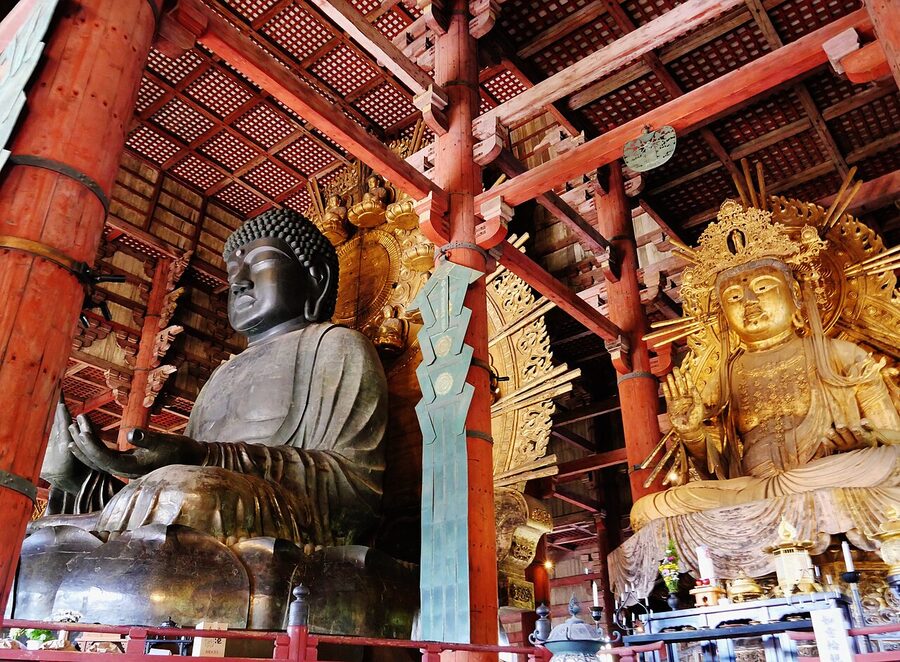
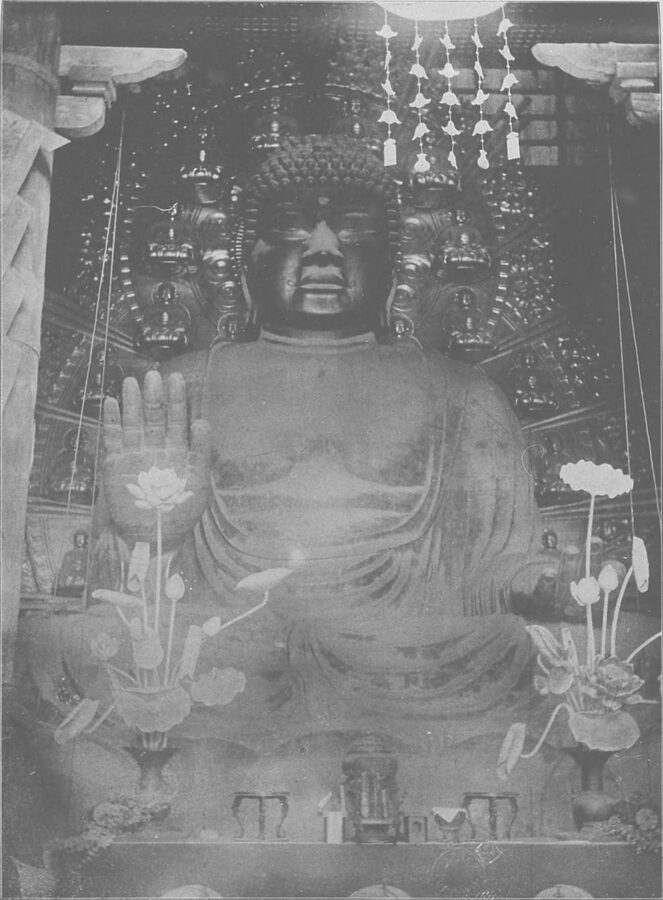
The head is from 1690. The body is mostly repair, though Japanese references disagree on how much is Kamakura and how much is the patching after 1567. The parts generally agreed to be original are the lotus pedestal at the back, parts of the right flank, the sleeves hanging from the arms and much of the crossed legs. The pedestal petals are engraved with the lotus-world cosmology of the Kegon sutra: a Buddha preaching at the top, twenty-five layers of heavens below, and seven small worlds each centred on a sacred mountain.
Even the numbers argue. The temple gives the height as 14.98 metres, Japanese reference works as 14.7. For a thousand years the snail-shell curls on the head were counted at 966, a figure from the 12th-century Tōdai-ji yōroku that English-language accounts still repeat; more recently a team led by Ōishi Takeshi of the University of Tokyo surveyed the head by laser and counted 492, nine of them missing. I prefer the laser.
Fourteen nights of fire: Omizutori
Every year since 752, Tōdai-ji says, the monks have held the Shuni-e, the “rite of the second month”, at the Nigatsu-dō on the hill above the hall. It has never once been missed. In 2026 that made it the 1,275th time, and it is better known by the name of its strangest night, Omizutori, “taking the water”.
The temple’s tradition is that a monk named Jitchū, a disciple of the first abbot Rōben, wandered into a cave on Mount Kasagi in 751 and came out in the Tuṣita heaven, where the heavenly beings were performing a rite of repentance to the eleven-headed Kannon. He was told that a day there lasted four hundred human years, so he could never keep up, and decided to try anyway, by running. The Tōdai-ji yōroku dates the first rite to 752, though the historian Horiike Shunpō doubted the young Jitchū could have led it and some Japanese reference works give 753.
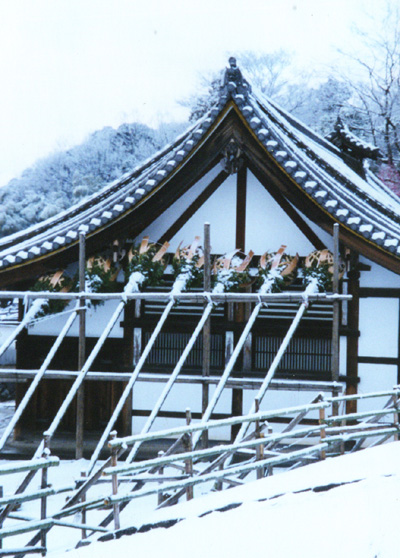
Eleven monks, the rengyōshū, are named each year on 16 December, the anniversary of Rōben’s death. From late February they live together in the Kaidan-in, cooking only on fire struck from flint, wearing robes of paper, forbidden to talk or set foot on bare earth. From 1 March, for fourteen days, they perform the service of repentance six times every day and night, praying for the realm, the harvest and everyone in it.
The fire everyone comes to see is the otaimatsu. Every evening, usually at seven, one of the attendants called dōji (grown men, whatever the word suggests) carries a burning torch six to eight metres long and up to forty kilograms up the covered stair to light a monk to the hall, then runs it along the balcony and swings it over the crowd. On 12 March come the “basket torches”, eight metres and around seventy kilograms (English-language guides sometimes say eighty), and twenty to thirty thousand people. I would go on an earlier night.
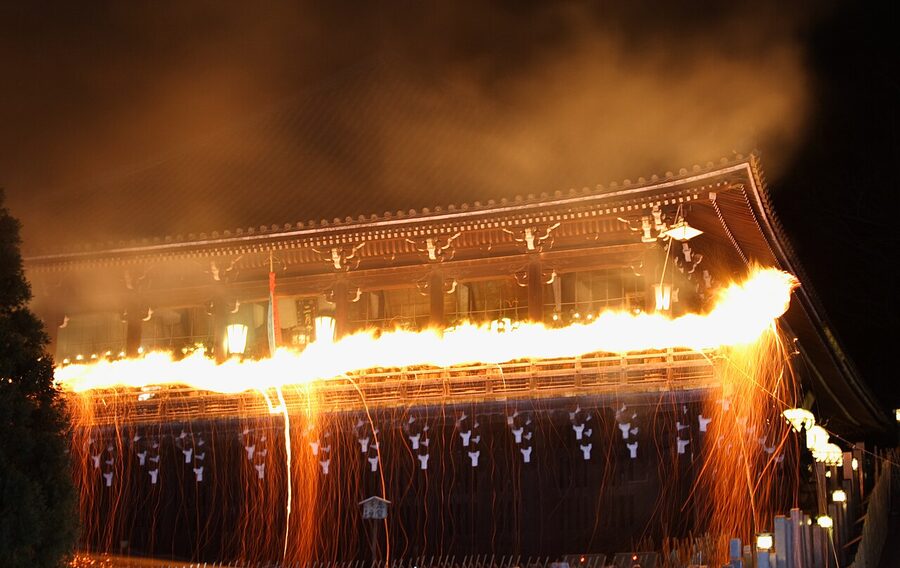
Omizutori itself comes at about half past one in the morning on 13 March, when monks process by torchlight to the well house below the hall and draw water in darkness from the Wakasa well. The story is that when Jitchū summoned the gods of all Japan, Onyū of Wakasa arrived late because he had been out fishing, and by way of apology sent a spring here from his own country. On 2 March each year a temple in Obama on the Japan Sea coast still performs Omizuokuri, “sending the water”, so that it can arrive ten days later.
The service is full of things like that. On two nights the monks read the temple’s register of the dead, from Shōmu onwards, and when they reach Chōgen his title is long enough to make you smile. In the Kamakura period a monk named Shūkei is said to have been interrupted by the ghost of a woman in a blue robe asking why her name had been left out; he whispered “the woman in blue” into the list, and she vanished. Readers still lower their voices there, and she would be at home in my yūrei piece.
At the end of each night the monks run down the stair calling chōzu, chōzu, “just going to the toilet”, because crow tengu once slipped into the empty hall and played with the fire. The rite also survived a real fire: on the thirteenth night of 1667 the Nigatsu-dō burned down, and the monks finished in the Hokke-dō. During the Pacific War they drew the water by candles in bamboo tubes draped with black cloth. My guide to Japan’s greatest festivals has the other fire rites, but none with quite this mixture of solemnity and crowd.
The deer
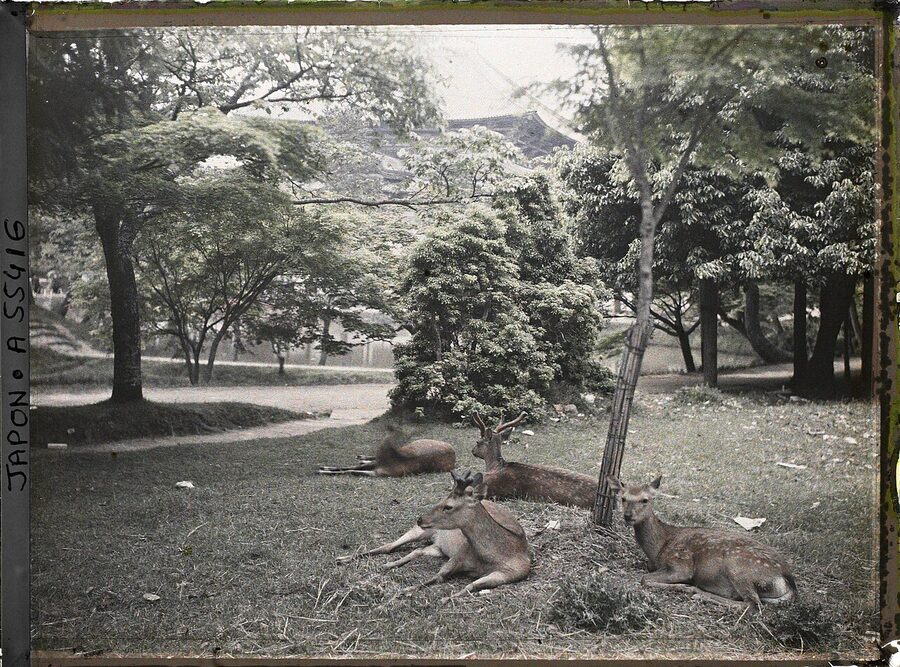
The deer are not Tōdai-ji’s. They belong, insofar as wild animals belong to anyone, to Kasuga Taisha, the shrine of the Fujiwara at the foot of Mount Mikasa, a short walk east. The shrine says that in 768 its chief god, Takemikazuchi, came from Kashima in the east riding a white deer, and from then on the deer of Nara were the god’s messengers. The deer had been here long before; the Man’yōshū poets of the 8th century already hear them calling in the hills.
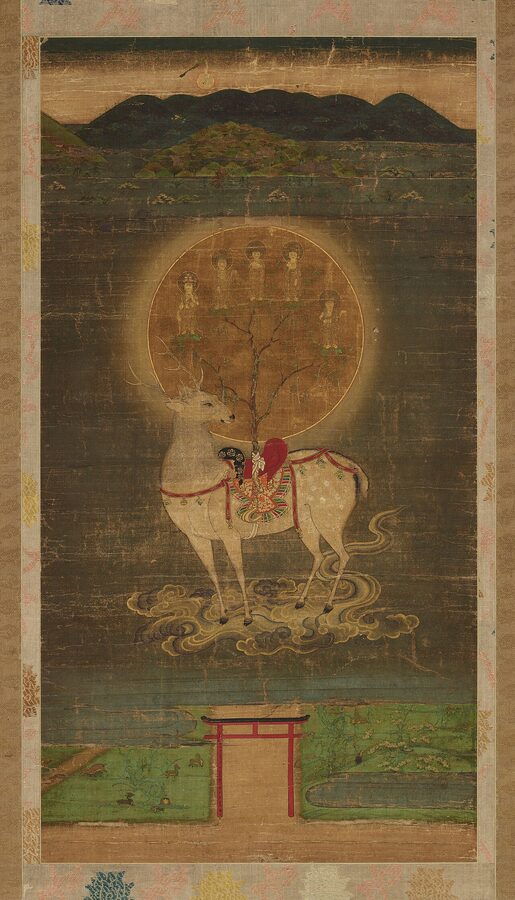
Kōfuku-ji, which ran Nara in the Middle Ages, protected them with a ferocity that is hard to read about. From the Muromachi period killing a deer in Nara could be punished by death, and local legend tells of a boy named Sansaku who was buried alive under stones for hitting one with a paperweight. In 1670 the shogunate’s first commissioner in Nara took over such cases, and within a decade the death penalty for deer was over; the annual sawing of the stags’ antlers, which still happens every autumn, began around then.
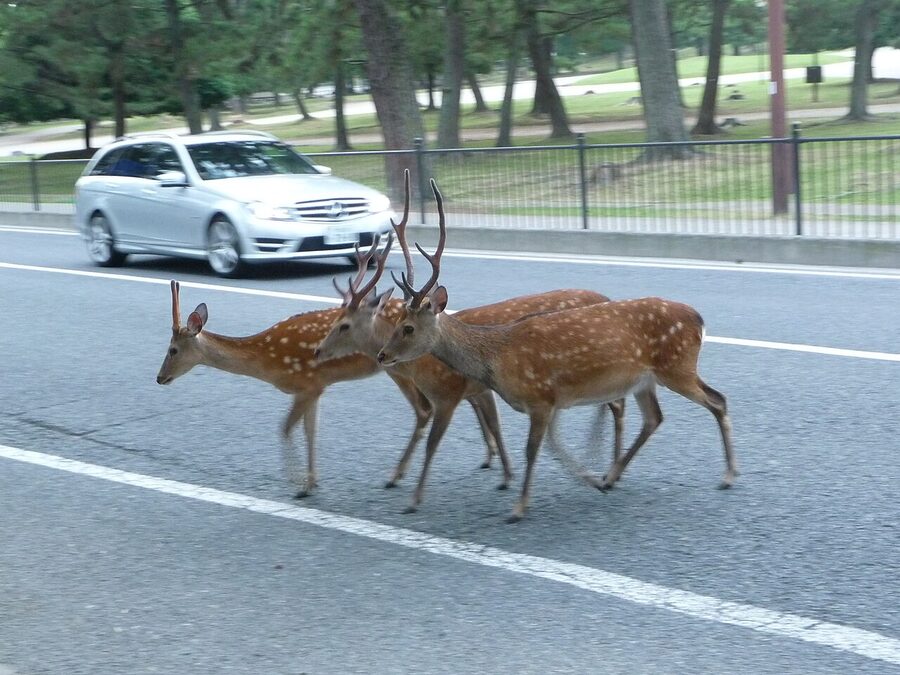
Modern Japan nearly finished them off. In 1871 the prefecture penned them up to protect crops and only 38 survived; in 1945, after wartime and post-war poaching for food, there were 79. The deer of Nara were made a national natural monument in 1957. The count in 2024 was 1,325, and a 2023 genetic study found they have been isolated from the other deer of the Kii peninsula for something like a thousand years.
Visiting Tōdai-ji today
Tōdai-ji sits at the northern end of Nara Park, and you can see the main things in half a day, though the hill behind deserves the afternoon too. The official temple site is the place to check hours and anything unusual before you go. Combine it with Kasuga Taisha and Kōfuku-ji for a full day, and if you are going on to the other great temples of the Nara period, Hōryū-ji is older by a century and the place to meet Prince Shōtoku, whom Shōmu’s court revered as the first great royal patron of Buddhism.
Getting there and getting in
From Kintetsu Nara Station it is about twenty minutes on foot, east along Noborioji and then left up the approach past the souvenir stalls; from JR Nara Station, take the city loop bus to the Daibutsuden stop and walk five minutes. The Kintetsu line runs direct from Osaka Namba in about 40 minutes and from Kyoto in about 50.
The Great Buddha Hall opens at 7:30 and closes at 17:30 from April to October, and opens at 8:00 and closes at 17:00 from November to March. Admission is ¥800 for adults and ¥400 for children aged six to twelve, and the same fee applies separately at the Hokke-dō, the Kaidan-dō and the Tōdai-ji Museum; a combined ticket for the hall and the museum costs ¥1,200. The grounds, the Nandaimon and the Nigatsu-dō cost nothing.
The best time is the first hour. By about half past nine the school trips have arrived, and the hall fills with uniforms and the noise of a thousand teenagers seeing a very large thing. Go early to the hall, then walk up to the Nigatsu-dō while the crowd catches up below. On New Year’s Day the middle gate is opened at midnight and you can go into the hall free until 8:00, a strange and lovely way to start a year.
The Nandaimon and the walk in
Walk under the Nandaimon slowly. The guardians stand behind wire mesh in their bays, eight metres up into the gloom, and the best view is from the middle of the passage looking up. The deer will be waiting on the far side.
The approach then runs north past Kagami-ike, the mirror pond, with its small shrine to Benzaiten on an island, towards the middle gate and the cloister. You enter the courtyard by a side gate on the west, and the hall appears suddenly, square on, at the end of the stone path. That moment is what Kōkei paid for.
The Great Buddha Hall
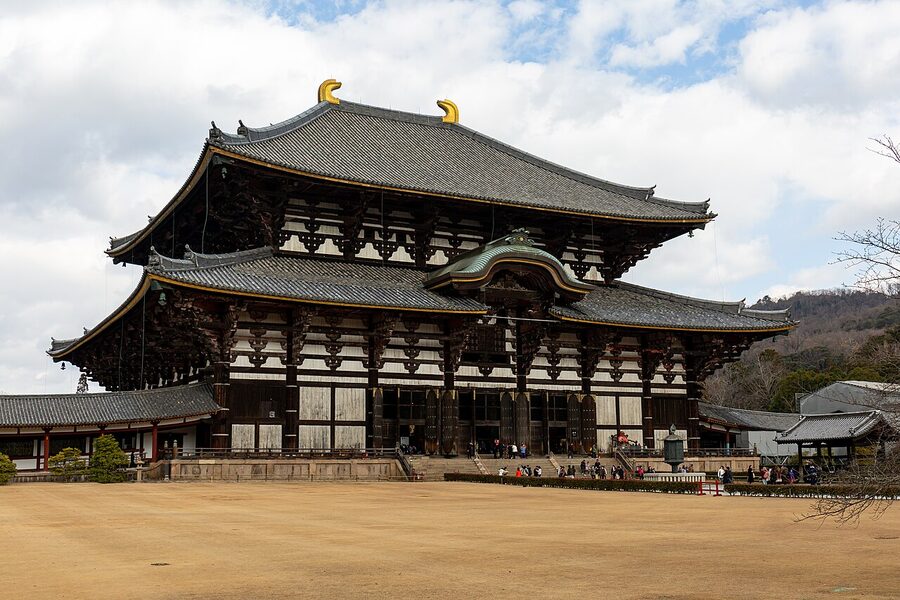
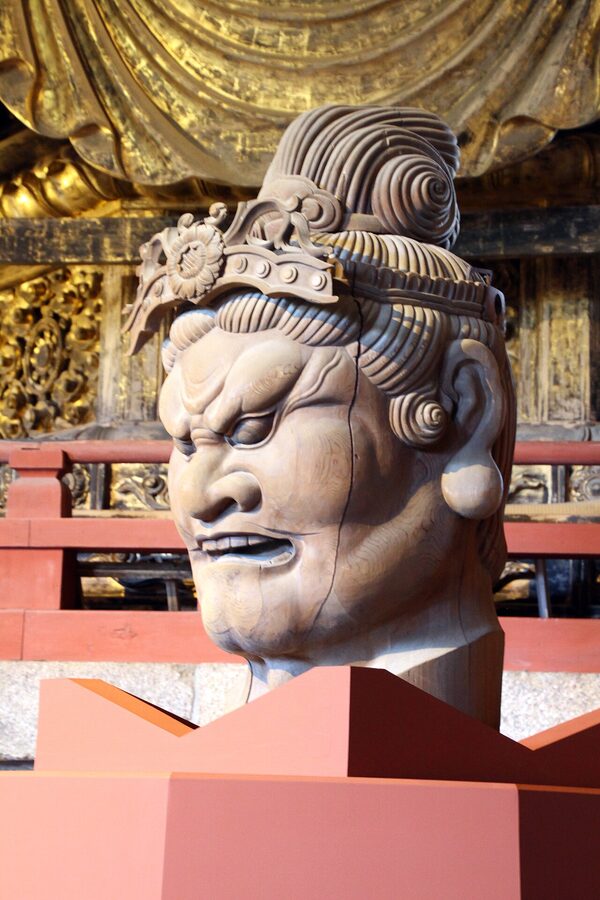
Stop at the bronze lantern in front before you go in. It is one of the few things here that has seen all of it. Inside, the Buddha is in front of you, with Nyoirin Kannon on his right and Kokūzō on his left; walk all the way round clockwise. Behind him in the corners stand two of the four heavenly kings, Kōmokuten and Tamonten, carved during the Edo rebuilding.
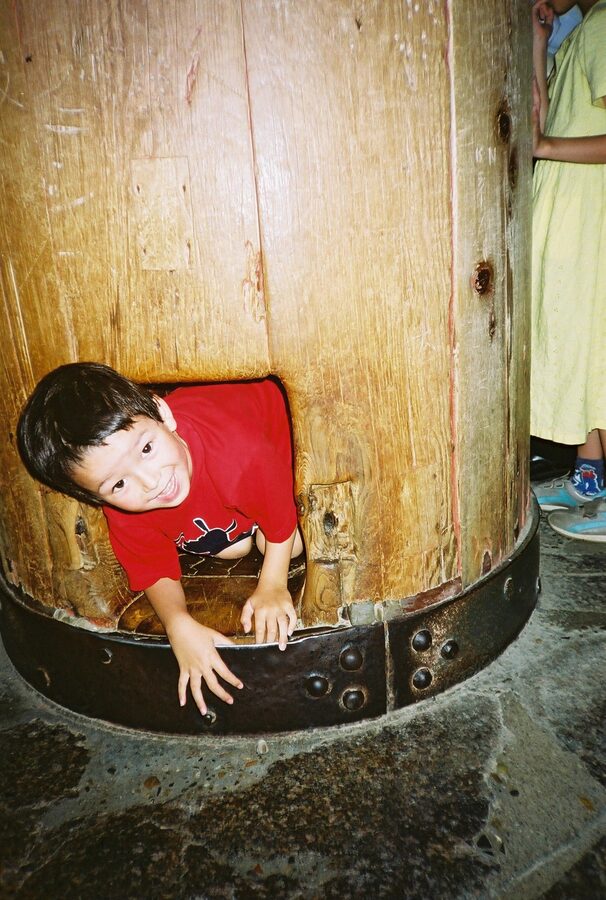
Behind the Buddha you will also find the 1909 model of the original complex, the board plan from Kōkei’s rebuilding hanging above the shop, and a queue. The queue is for a pillar behind the Buddha with a rectangular hole cut through its base, said to be the size of one of the Buddha’s nostrils. Squeeze through, so the tradition goes, and you will have good luck or reach enlightenment, depending on whom you ask.
On your way out, look for the statue of Binzuru, a disciple of the Buddha, sitting outside the hall in a red cape. You are meant to rub the part of him that corresponds to whatever is hurting you, which is why he has no face left to speak of.
The Hokke-dō (Sangatsu-dō)
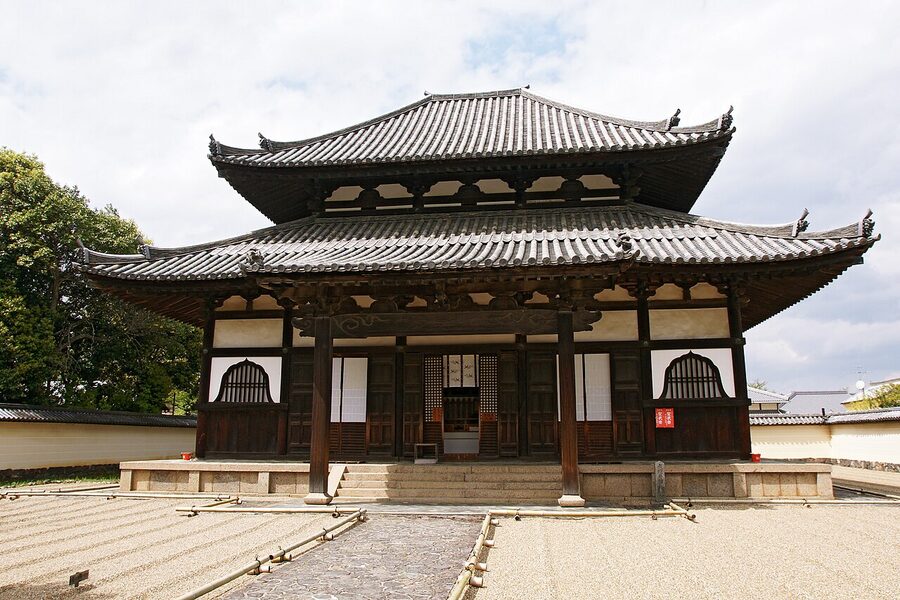
Up the stone steps east of the hall, past the bell tower, the hillside district called Jōin holds the oldest buildings. The Hokke-dō, also called the Sangatsu-dō or Third Month Hall, is the oldest structure at Tōdai-ji. The rear half, the image hall, belonged to Konshu-ji and was built in the 740s, the temple says perhaps as early as 733; Chōgen added the worship hall in front in 1199, and you can see the join in the roof.
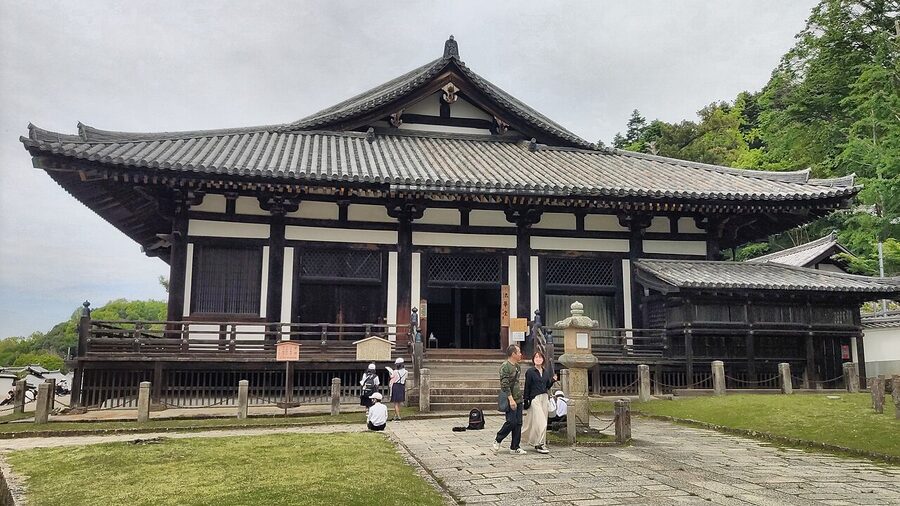
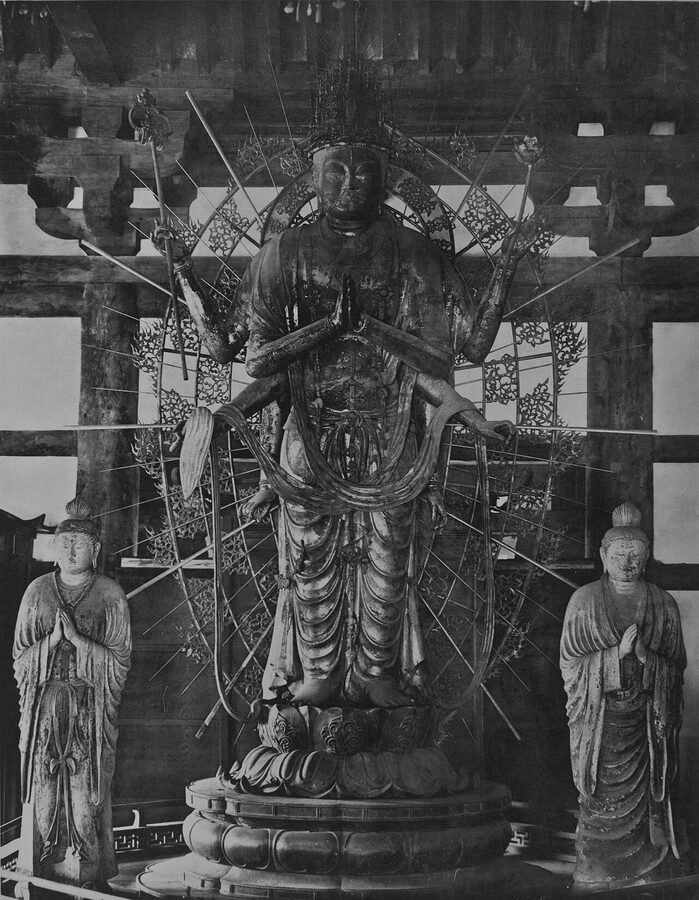
Inside, ten statues of the Nara period stand close together, all National Treasures. The main image is the Fukūkensaku Kannon, a three-eyed, eight-armed figure 3.6 metres tall in hollow dry lacquer, wearing a crown of silver and gems with a small silver Amida at the front. Behind it, in a closed shrine facing north, is the clay Shukongōjin, kept hidden for most of its history and so still bright with its original colours; a later legend says a cord from its topknot turned into a bee and flew off to sting the rebel Taira no Masakado. It is shown once a year, on 16 December.
Nigatsu-dō, the bell and the climb
The Nigatsu-dō sits higher still, its front half hanging off the hillside on a frame of pillars in the same “hanging construction” as the stage at Kiyomizu-dera. The present hall dates from 1669, two years after the fire in the middle of the Shuni-e, and was designated a National Treasure in 2005. Its two images of the eleven-headed Kannon are absolute secrets: nobody, not even the monks who serve them, may look at them.
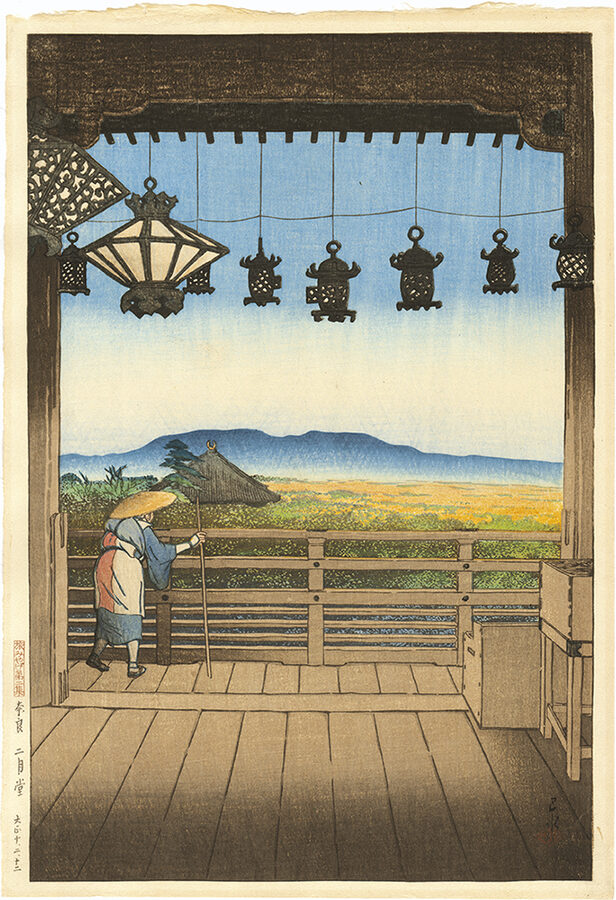
The balcony is free and open at any hour, and it is where I would be at sunset, with the whole of Nara spread out below and the great roof of the Buddha hall glowing in the last light. Come up the covered stair from the north side, the one the torches use, and go down the stone steps on the south past the well house of Omizutori.
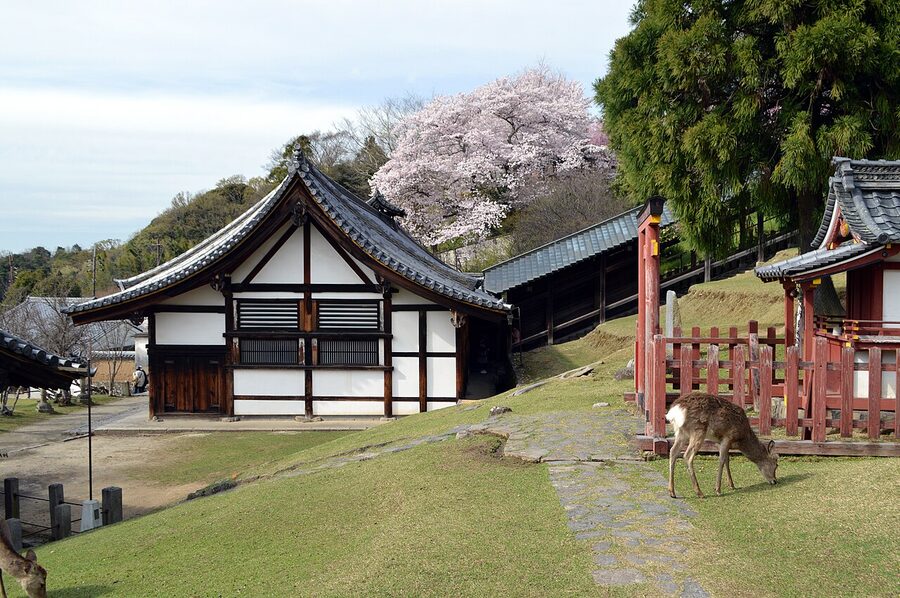
On the way down, the bell tower holds the great bell of Tōdai-ji, cast in 752, 3.85 metres tall and 2.71 across the mouth, and known affectionately as Nara Tarō. It is rung every evening at eight. Close by stands the Shunjō-dō with Chōgen’s portrait statue, and the Kaisan-dō with Rōben’s, an early Heian portrait; both are shown only on special days in the temple’s calendar, and 16 December is the one to aim for if you can.
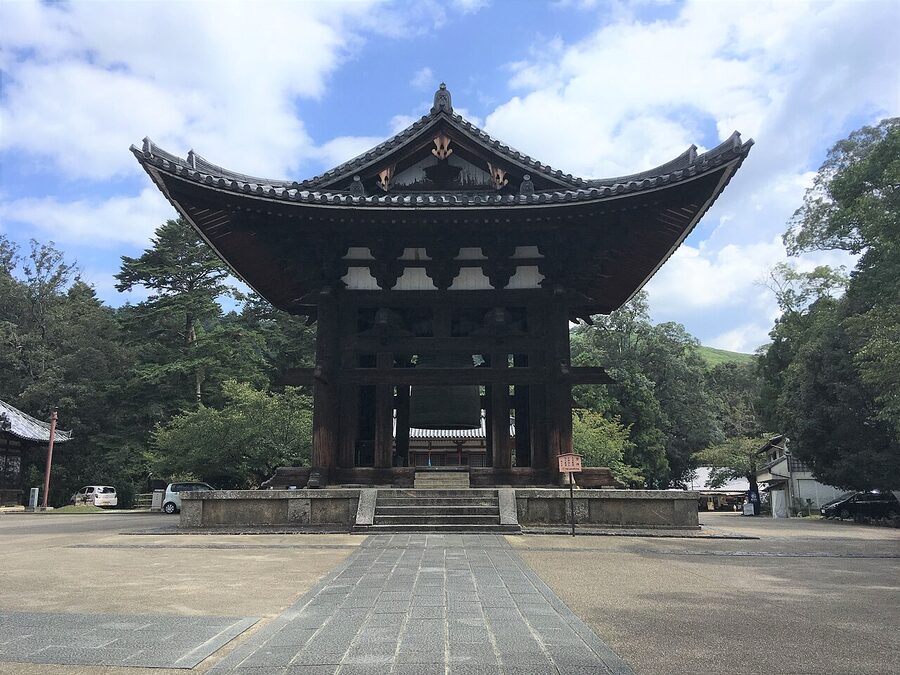
The Kaidan-in
West of the hall, behind its own wall and nearly always quiet, the Kaidan-in was founded in 755 for the Chinese monk Ganjin (Jianzhen), who had failed five times to cross the sea and gone blind before he reached Nara in 754. That spring he ordained Shōmu, Kōmyō and Kōken on a temporary platform in front of the Buddha, and the earth from that platform was moved here. Kūkai and Saichō were both ordained at Tōdai-ji; most of the great monks of the early Heian era came through this gate.
The Shōsōin and the autumn exhibition
The Shōsōin stands north-west of the hall, now run by the Imperial Household Agency rather than the temple. You can look at the building from a viewing area on weekdays, roughly 10:00 to 15:00, free; check the agency’s site for the current days, since it changes around holidays and the exhibition. The treasures themselves are shown only once a year, in the Shōsōin Exhibition at the Nara National Museum, which in 2026 ran from 24 October to 9 November with about sixty objects. It always falls between late October and mid-November, the tickets are timed, and it is famously crowded.
The Tegai-mon and the museum
Walk west from the Shōsōin to the Tegai-mon, the gate at the north-west corner of the precinct, which faced the first avenue of the old capital. It was built in the 750s and survived both 1180 and 1567, so it is the oldest gate at Tōdai-ji and one of the few 8th-century gates in the country. Legend says Taira no Kagekiyo hid here hoping to assassinate Yoritomo on his way to the dedication of 1195, which is why some people call it the Kagekiyo gate.
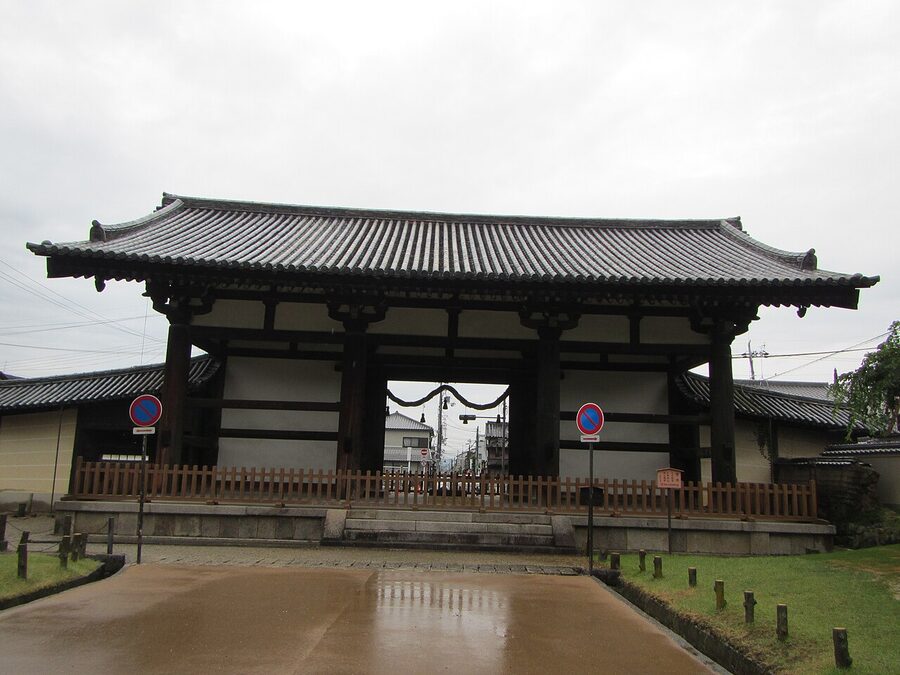
The Tōdai-ji Museum, beside the Nandaimon on its west side, opens from 9:30 (last entry half an hour before closing). It has the Nikkō and Gakkō from the Hokke-dō, the swords Kōmyō buried under the Buddha and an excellent short introduction to the temple. Go after the hall rather than before, so that the objects have somewhere to fit.
Further afield
If the story has caught you, follow it out of Nara. The Shigaraki palace site in Kōka, across the hills in Shiga, is where Shōmu first tried to build his Buddha. Chōgen’s Jōdo-ji at Ono in Hyōgo is the best place to see what the Daibutsu style looked like inside. And the Kamakura Great Buddha at Kōtoku-in, cast in the Kamakura era and sitting in the open air since its hall was lost, by the usual account to a tidal wave in 1498, shows you what Nara’s Buddha looked like for eighty years.
My overview Japan through the ages puts the eight centuries of this temple in order, if you need a map. But the Nara end of it is a short walk.
The cord
The cord from 752 has a name, hanada no ru, “the pale blue thread”, and on the rare occasions it is shown at the autumn exhibition it lies coiled in its case. Ten thousand people once held it. I have always liked that the thing that survives from the greatest ceremony of the Nara age is not the Buddha or the hall but the rope, the part made for everybody else.
Tōdai-ji has been held together in the same way ever since. An outlaw preacher and his followers, a sixty-one-year-old who walked into the mountains of Suō for timber, a thirteen-year-old who watched the rain fall on the Buddha’s patched head. None of them could do it alone, and each of them knew that.
So go early, before the school parties. Stand in front of the hall for a minute before you go in. And when you are inside, look down at the lotus petals at the Buddha’s feet, engraved in the years of Bodhisena’s brush (scholars still argue whether just before or just after). With the bronze lantern outside, they are the only part of this story that has been here the whole time.