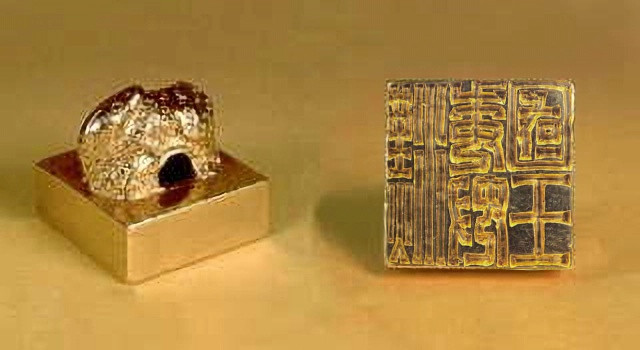
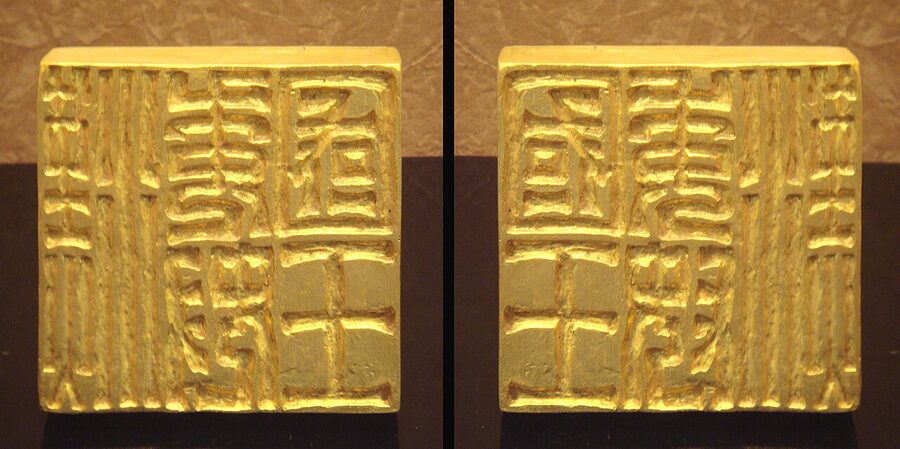
In the twelfth month of a year that may have been 238 and may have been 239, an emperor of Wei signed an order for a lump of gold. It was to be cut as a seal, hung on a purple cord, packed and sealed in a box, and sent through the governor of a Chinese outpost in Korea to a woman across the sea whom the Chinese court now called “Queen of Wa friendly to Wei”. If it followed the pattern of other seals Chinese emperors gave to foreign rulers, it was about 2.3 centimetres square and heavy for its size.
Nobody has found it. Nobody has found her palace for certain either, or her grave, or the country she ruled, and the only text written while anyone could still remember her is a passage of just under 2,000 characters in a Chinese dynastic history. Her own people’s chronicles, compiled about 470 years later, never mention her name. Every Japanese child learns it anyway.
Her name was Himiko (卑弥呼), or rather that is how a Chinese clerk wrote down what he heard, and she is the first person in Japanese history whose name, title, gifts, wars and funeral are on record. I find her the most frustrating figure on this site and also the most fun, because nearly everything about her is in dispute except the text, and the text is very good. What follows is what it says, what has come out of the ground since, and the places where you can stand on the evidence yourself.
In This Article
- About two thousand characters
- What the Chinese saw in the Wa
- A queen who served the way of demons
- A sister who prays and a brother who rules
- The name
- Ten slaves, two bolts of cloth and a hundred mirrors
- What she sent, and what came back
- The war with Kuna
- A hundred paces, a hundred attendants, a girl of thirteen
- Where was Yamatai?
- Three centuries of arguing
- The case for northern Kyushu
- The case for the Nara basin
- Makimuku and the hall of 2009
- Hashihaka and the radiocarbon dates
- Himiko’s mirrors, or somebody’s
- So, where was it?
- The queen the chronicles would not name
- Textbooks, manga and a water bus
- Where to see Himiko’s world today
- Makimuku, Hashihaka and the Sakurai plain
- Kurozuka Kofun Exhibition Hall, Tenri
- Yoshinogari Historical Park, Saga
- Kyushu National Museum, Dazaifu
- The seal that does exist: Fukuoka
About two thousand characters
The text is the section on the Wa (倭) in the Wei zhi (魏志), the “Records of Wei”, which forms the first part of the Sanguo zhi (三国志), the official history of China’s Three Kingdoms. A court historian named Chen Shou put it together after the Jin dynasty swallowed Wei, finishing some time between about 280 and his death in 297. Japanese readers have long cut out the Wa section and treated it as a book of its own, the Gishi Wajinden (魏志倭人伝), “the Account of the Wa people in the Records of Wei”. In most printed editions it runs to roughly 1,980 characters.
Chen Shou never went to Japan. He worked from the reports of officials who did, and he wrote for a court that liked its barbarians distant, exotic and suitably impressed. Read him with that in mind; he is still the closest thing to an eyewitness there is.
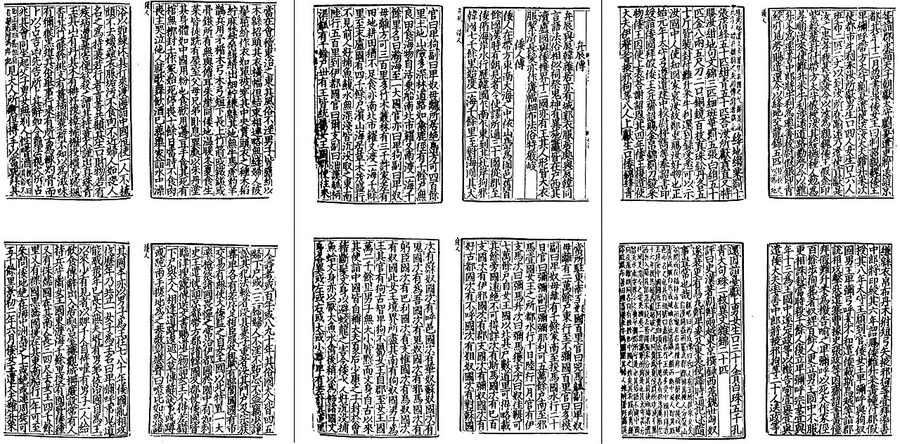
The Account opens with geography. The Wa live on “mountainous islands” in the sea south-east of Daifang (帯方郡), a Chinese commandery around modern Seoul; there used to be more than a hundred Wa countries, and about thirty now send envoys. Then it walks you there, stage by stage, with distances in Chinese li.
From Daifang you sail down the Korean coast, then cross to Tsushima (対馬), where people live on seafood and trade by boat, and on to Iki (一支). A third crossing brings you to Matsuro (末盧), where the grass is so thick that you cannot see the man walking in front of you. Five hundred li overland lies Ito (伊都), which has had kings for generations and is where Chinese envoys always stay.
After Ito the stages go wrong. A hundred li south-east is Na (奴), with 20,000 households, and a hundred li east is Fumi (不弥). Then come two lines that have kept historians in work for three centuries: south to Toma (投馬), twenty days by water, 50,000 households, and south to Yamatai (邪馬台), “where the queen has her capital”, ten days by water and one month on land, with 70,000 households. Follow those directions literally from northern Kyushu and you end up somewhere in the Pacific Ocean, a long way south of Okinawa.
Twenty-one more countries follow by name only, including “the country of Demons”, and then the queen’s territory ends. To the south is Kuna (狗奴), ruled by a man, which does not submit to her. The distance from Daifang to the queen’s country is “more than 12,000 li“, a figure that may not be a distance at all.
What the Chinese saw in the Wa
The middle third of the Account is ethnography, and it is the part I would make anyone read first. Men of every rank tattoo their faces and bodies, originally to scare off large fish while diving. Women wear a single sheet with a hole cut for the head, and people go barefoot, paint their bodies with red pigment “as the Chinese use powder”, and eat with their hands from raised dishes.
Some details are so particular that they almost certainly come from somebody who was there. When a Wa ship sets out for China, one man is chosen to stay unwashed for the whole voyage: he does not comb his hair, pick out his lice, eat meat or go near a woman. He is called the jisai (持衰), roughly “the keeper of mourning”. If the voyage goes well, he is rewarded with slaves and goods; if anyone falls ill or the weather turns, he is killed for not having kept his abstinence properly.
The Wa divine by burning bones and reading the cracks. When they meet someone of rank they clap their hands instead of kneeling, probably the earliest description of the clap you still give before a shrine, at Meiji Shrine or anywhere else. They like drink, and they grow ginger, mandarins, Japanese pepper and myōga but “do not know how to use them for flavour”, the first recorded foreign complaint about Japanese food and a good deal less fair than most of the later ones.
There are markets in every country, taxes and storehouses, and a special inspector based at Ito keeps watch over the countries north of the queen’s, which “fear him”. When commoners meet great men on the road they back off into the grass. This is a society with ranks, tribute and a long reach, which is worth remembering when you get to the arguments about where it was.
A queen who served the way of demons
Then, almost in passing, the Account gets to her: “This country also used to have a man as king; after seventy or eighty years the Wa were in turmoil and attacked one another for years, and then together they set up one woman as ruler, named Himiko.”
The next sentence is the one everybody quotes: 事鬼道、能惑衆, “she served the way of demons and was able to bewitch the people”. The character translated as “demon” is 鬼, the same one Japanese reads as oni, though in 3rd-century Chinese it meant the spirits of the dead more than horned ogres (my piece on oni follows the word’s later career). In Chinese official writing guidao, “the way of spirits”, was a sneer for popular cults and spirit mediums; Chen Shou uses the same phrase for the Daoist sect of Zhang Lu in western China. Most Japanese scholars read it as plain shamanism: she communed with gods or ancestors and spoke for them.
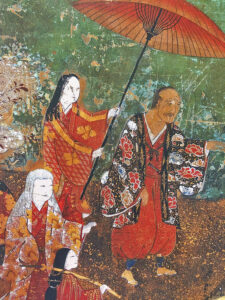
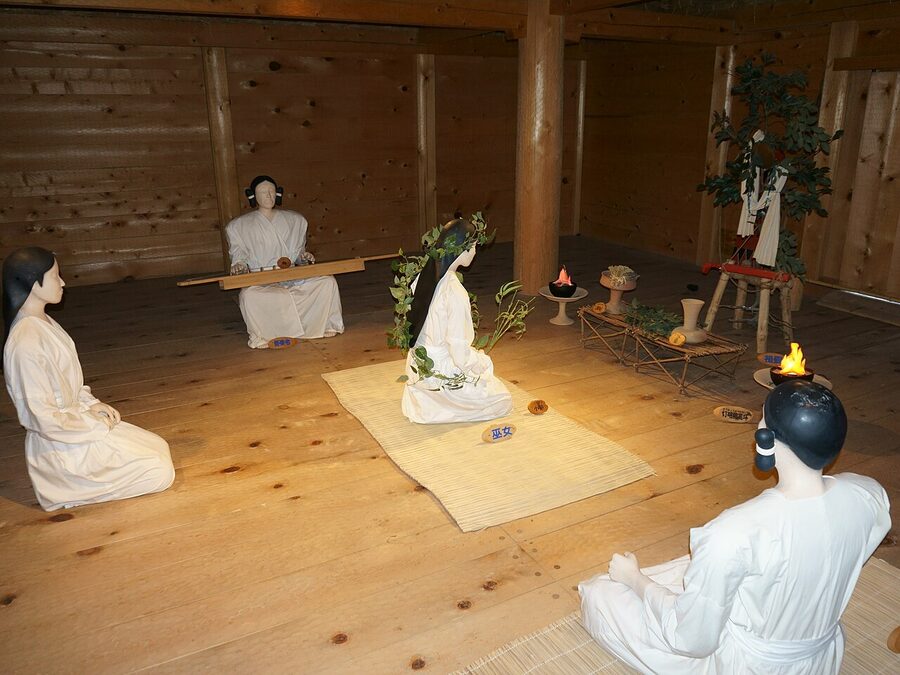
She was “already of mature age” and had no husband. A younger brother helped her govern. After she became ruler few people saw her; she had a thousand women to attend her and a single man who brought her food and drink and carried her words in and out. She lived in a palace with towers and a stockade, “always guarded by men with weapons”.
That is the whole of the description. It is about seventy characters, and almost everything modern Japan believes about Himiko’s personality has been grown from it.
A sister who prays and a brother who rules
The pairing of the queen and her brother has drawn more attention from Japanese historians than her magic. A common reading is the hime-hiko system (ヒメ・ヒコ制), a joint rule in which a woman handled the gods and a male relative handled everything else. The Nihon shoki is full of such pairs in local chiefdoms, many of them in Kyushu, and the ethnologist Torigoe Kenzaburō compared Himiko and her brother to the Ryukyu kingdom, where a royal high priestess, the kikoe-ōgimi, served beside the king at Shuri until the 19th century.
Others push back. The historian Yoshie Akiko has argued that the Account calls the brother a helper, not a co-ruler, and that it shows Himiko running her own foreign policy; there is no reason to make her a figurehead because she was a woman who prayed. The archaeologist Terasawa Kaoru reads the lack of a husband as political as much as sacred: no husband and no children meant no rival line of heirs. I find that the most convincing reading of the lot, partly because it is the least romantic.
Later Chinese histories date the war. The 5th-century Hou Han shu puts it in the reigns of the Han emperors Huan and Ling, between 146 and 189, and the Liang shu narrows it to 178 to 184. That is later historians tidying up, but the picture fits the archaeology of the late Yayoi period, which is full of moats, watchtowers and bodies with arrowheads in them.
The name
卑弥呼 is a Chinese transcription, and the first character means “low” or “humble”. Chinese scribes routinely chose unflattering characters for foreign names (the Wa themselves were written with a character that can mean “dwarfish” or “submissive”), so it says more about the scribe than about her. The modern reading Himiko is a Japanese convention, and the 3rd-century sound was probably closer to Pimiko or Pimeko.
What the word meant is anyone’s guess. The commonest ideas are hime-ko, “princess”, or hi-miko, “sun shrine-maiden”, though the linguist Roy Andrew Miller warned that the supposed Old Japanese word Fimeko is a ghost invented for dictionaries from this very passage. Some writers like the sun reading because it connects her with Amaterasu, the sun goddess; the text says nothing about the sun at all.
Ten slaves, two bolts of cloth and a hundred mirrors
The Account then turns into a diplomatic file, and the tone changes completely. “In the sixth month of the second year of Jingchu, the queen of Wa sent the high officer Nashime (難升米) and others to the commandery, asking to go to the Son of Heaven and present tribute.” The governor of Daifang, Liu Xia, sent them on with an escort to the Wei capital at Luoyang.
The second year of Jingchu is 238, which is more awkward than it looks. In the summer of 238 the Wei general Sima Yi was besieging the warlord Gongsun Yuan, who had held north-east China and the Korean commanderies for his family for half a century, and Gongsun only fell in the eighth month. Many historians think Wa envoys could hardly have reached a Wei-held Daifang in the sixth month, and they correct the year to the third of Jingchu, 239.
They have support. The Nihon shoki, quoting the Wei zhi in 720, gives the third year, and so does the 7th-century Liang shu. Other scholars defend 238, on the grounds that Wei had already seized the Korean commanderies by sea and that a quick-witted queen would want to be first at the door of the new power. English-language accounts often give 238, following the surviving text; most Japanese reference works give 239.
The calendar muddies it further: the twelfth month of the Chinese year 238 fell in January and February 239 by the Western calendar. It also changes who signed the edict, because Emperor Ming (Cao Rui) died on the first day of the following year and was succeeded by a boy of about eight. I use 239 below because that is where the majority sits, not because the argument is over.
What she sent, and what came back
Her tribute was modest: four male and six female slaves (seikō, 生口, “living mouths”) and two bolts and two lengths of patterned cloth. The reply, an imperial edict quoted in full, is the longest single document in the Account and by far the warmest. “You live very far away,” it says, “and yet you send envoys with tribute. This is your loyalty and filial piety, and I am deeply moved by you.”
It made her Shingi Waō (親魏倭王), “Ruler of Wa, friend of Wei”, and gave her a gold seal with a purple cord, sent by way of the governor. Her envoys got silver seals and Chinese military titles. Then came the presents, listed like an inventory: dyed silks and woollens, then, “as a special gift”, brocade, white silk, eight liang of gold, two swords five feet long, one hundred bronze mirrors, and fifty jin each of pearls and red lead. She was to show them all to her people, the edict ends, so that they would know how much the emperor cared for her.
Why was an emperor so pleased with ten slaves? The historian Watanabe Yoshihiro’s answer is politics at home. The faction of Sima Yi’s rival Cao Shuang could point to the Kushan king in Central Asia, made “king friendly to Wei” in 229 under Cao Shuang’s father, and a grateful queen at the far eastern edge of the world, arriving just as Sima’s campaign ended, gave Sima a match. Seen that way, the Account’s huge distances and household numbers may have been inflated on purpose.
The gifts arrived in 240, carried by an officer named Ti Jun, and Himiko sent a letter of thanks. In 243 she sent another embassy with slaves, Wa brocade, silk, short bows and arrows.
The war with Kuna
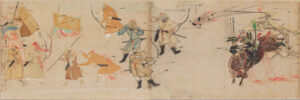
In 245 the emperor ordered a yellow banner, a Chinese military standard, to be given to Nashime, and then events in Korea got in the way: the governor of Daifang was killed that year fighting the Han peoples of southern Korea. In 247 a new governor, Wang Qi, arrived. Himiko sent envoys to tell him that she was fighting the male king of Kuna, a man called Himikuko (卑弥弓呼), with whom she “had never been on good terms”.
The governor sent an official named Zhang Zheng to Wa with the delayed banner and a proclamation urging the queen’s side on. That is the last the Account says of Himiko alive. Where Kuna was is as disputed as Yamatai: Kyushu theorists usually put it among the Kumaso of southern Kyushu, Nara theorists on the plain around modern Nagoya.
A hundred paces, a hundred attendants, a girl of thirteen
The next sentence is 卑彌呼以死, and it can be read two ways. The usual reading is “Himiko had died”, meaning she was already dead when Zhang Zheng arrived; a rarer reading is “Himiko died because of it”, meaning the war, or the blame for losing it. Either way her death is not dated, and the familiar year of 247 is really the year the new governor took office. Most books give 247 or 248, some later; the only safe answer is “around then”.
Some writers once linked her death to solar eclipses in 247 and 248, with a sun-priestess blamed for the sun going out. The astronomy does not cooperate: both were only partial over every plausible site for Yamatai, and partial eclipses are not rare enough to kill a queen.
“A great mound was raised, more than a hundred paces across, and more than a hundred male and female slaves were buried with her.” That is the line that ties Himiko to archaeology, and every word of it is argued over. A Wei pace was about 1.45 metres, so a hundred paces is around 145 metres. Some scholars think the Wa used a much shorter measure, which would make it about 30 metres; others read the sentence as describing many small graves spread over that area, not one big one.
The word for the burial of the slaves, 徇葬, is also not quite the usual word for human sacrifice. Some read it as “followed her in death”, others only as “were buried around her”. No tomb of the period yet excavated in Japan has produced anything like a hundred sacrificed attendants, which either tells you something about where her tomb is or tells you the sentence is Chinese convention.
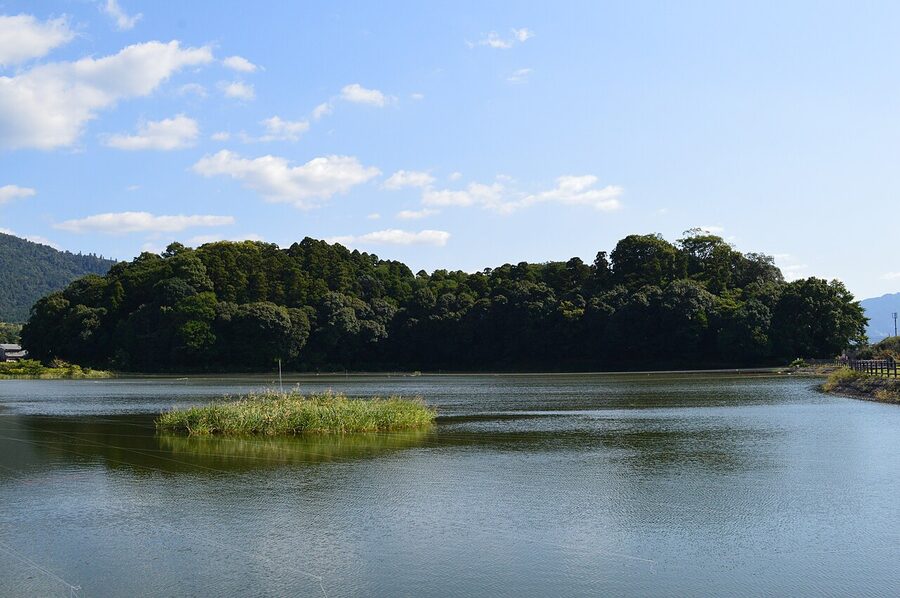
After her death the Wa set up a man as king, the country refused him, and in the fighting “more than a thousand were killed”. Then they chose a girl of thirteen from Himiko’s clan, and “the country was settled”. The surviving text writes her name 壹與, Iyo, but most commentators read it as a copying error for 臺與, Toyo, the same slip that turned Yamatai (邪馬臺) into “Yamaichi” (邪馬壹) in every surviving print. Her envoys escorted Zhang Zheng home with thirty slaves, 5,000 white pearls and two large curved beads of blue stone.
The Jin shu and a lost court diary quoted in the Nihon shoki record a Wa embassy to the new Jin dynasty in 266, probably sent by Toyo. Then Chinese records fall silent about Japan for almost 150 years, until the five kings of Wa start writing to southern Chinese courts in 413. Whatever happened between Toyo and those kings, and it includes the building of the first great keyhole tombs, nobody wrote it down.
Where was Yamatai?
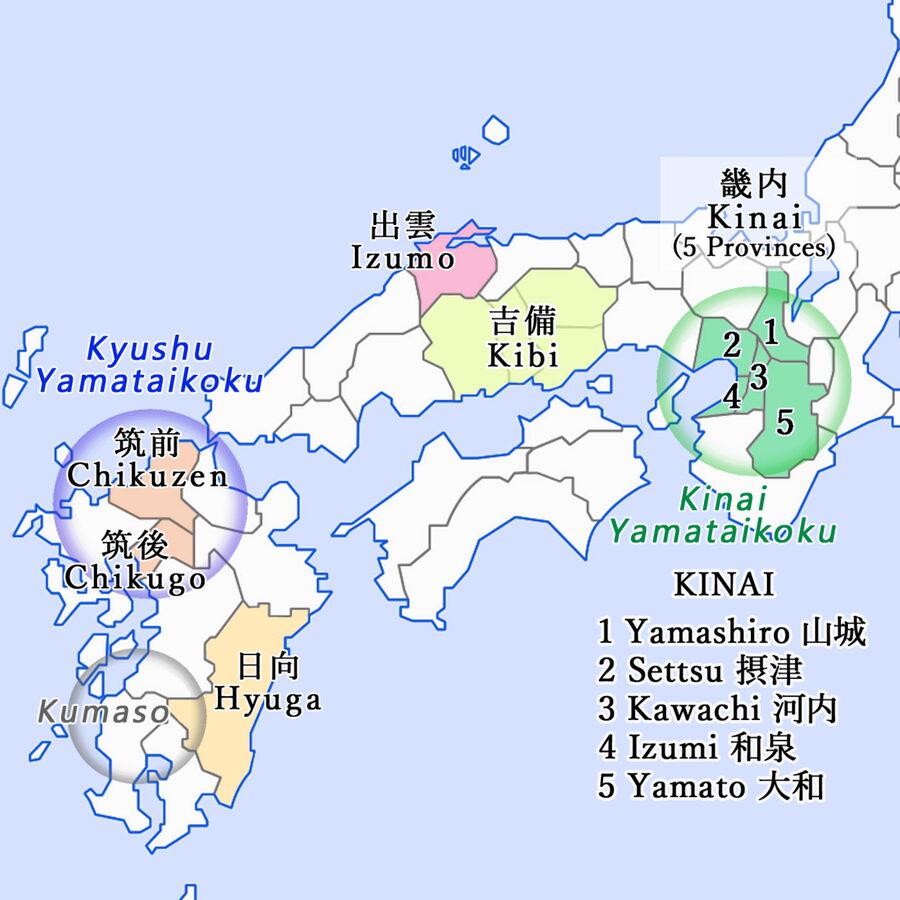
This is the question that has filled more Japanese bookshelves than any other in ancient history, and I will say now what I will repeat at the end: nobody knows. There are two serious candidates, northern Kyushu and the Nara basin, which Japanese call the Kyūshū-setsu (九州説) and the Kinai-setsu (畿内説), and the evidence for each is real, partial and capable of being read the other way.
Three centuries of arguing
The compilers of the Nihon shoki in 720 already took the queen of Wa to be a Yamato ruler, as you will see below. The real controversy began in the Edo period, with two scholars on opposite sides of almost everything.
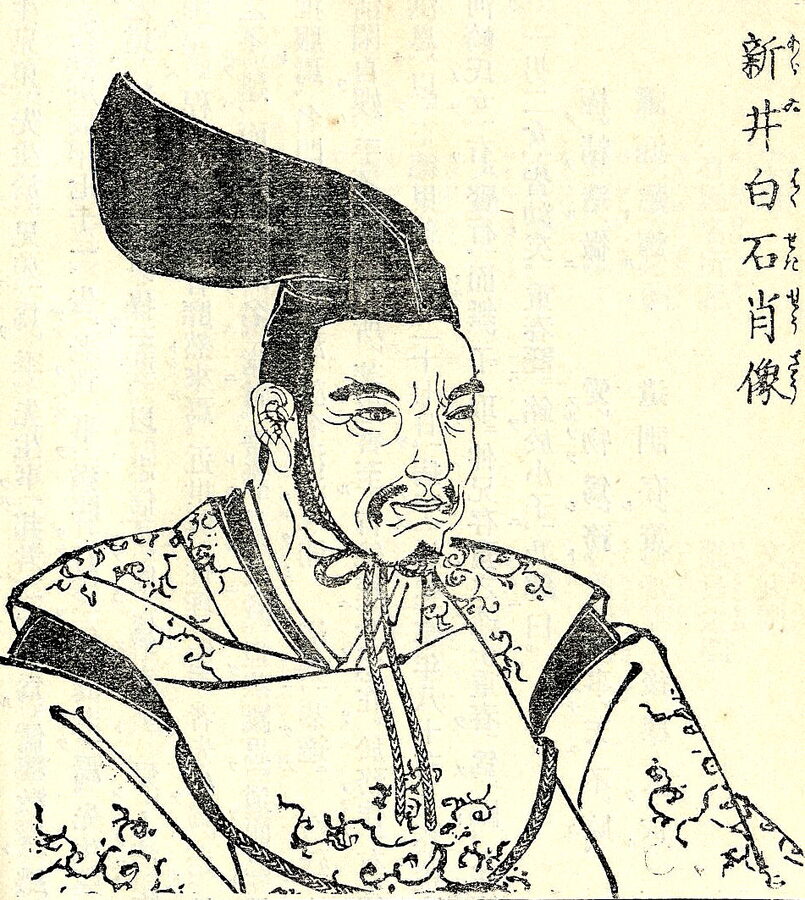
Arai Hakuseki, the Confucian adviser to the shogun Tokugawa Ienobu, first identified Himiko with Jingū and Yamatai with Yamato, then moved it to Yamato in Chikugo province (山門, in modern Fukuoka). He read the place names with the Chinese of his own day, as pronounced by Imamura Eisei, an interpreter from Nagasaki who worked for the Dutch at Dejima. It was a clever idea and about 1,400 years out of date.
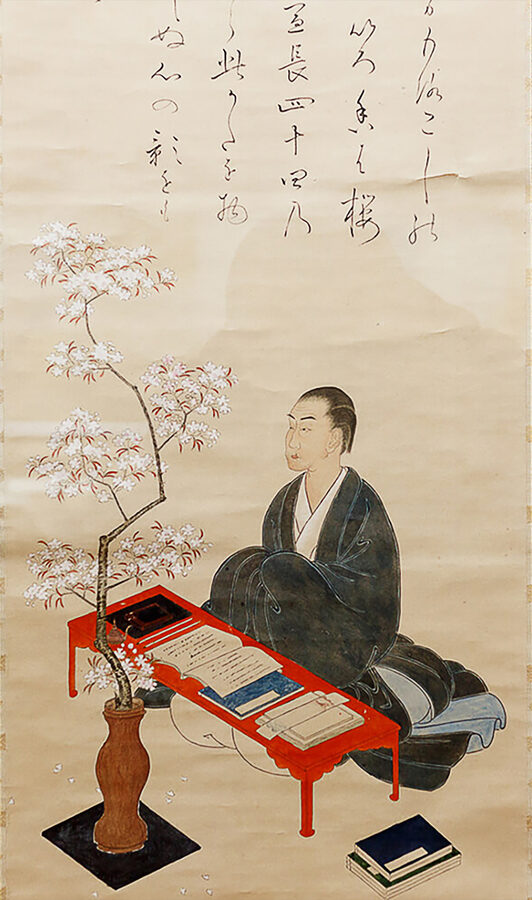
Motoori Norinaga, the great scholar of native learning, could not accept that a Japanese ruler had ever bowed to China, so he decided the envoys had been sent by a Kumaso chieftain in southern Kyushu pretending to be Empress Jingū. It is ingenious, unprovable and entirely driven by what he wanted to be true, and it shaped the debate for a century.
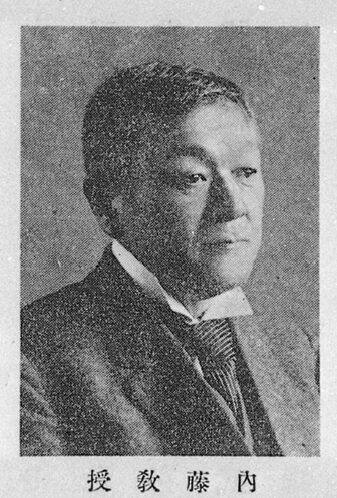
The modern argument opened in 1910, in a few months. The Kyoto sinologist Naitō Konan published a close study of the text that put Yamatai in Yamato and identified Himiko with Yamatohime, the legendary princess who founded the shrine at Ise. Within a couple of months Shiratori Kurakichi in Tokyo answered with the opposite case, putting the queen in northern Kyushu and Kuna among the Kumaso. Kyoto and Tokyo have been loosely identified with the two theories ever since, and it is only half a joke.
The case for northern Kyushu
The Kyushu case starts with the text. The Account knows the north Kyushu countries in detail, with household numbers, officials and scenery, and it knows Ito as the place where envoys stop and a royal inspector watches the other countries. Trust the direction (“south”), assume the distances are exaggerated, and Yamatai lands in the Kyushu plains, in Chikugo, Higo or around Asakura.
Then there are the mirrors and the iron. The archaeologist Mori Kōichi pointed out in the 1960s that late Yayoi graves in northern Kyushu are full of Han-dynasty mirrors while Yayoi graves in the Nara basin have almost none, and argued that Himiko’s hundred mirrors were more likely mirrors of that kind. Northern Kyushu also had far more iron than the Kinai at the time.
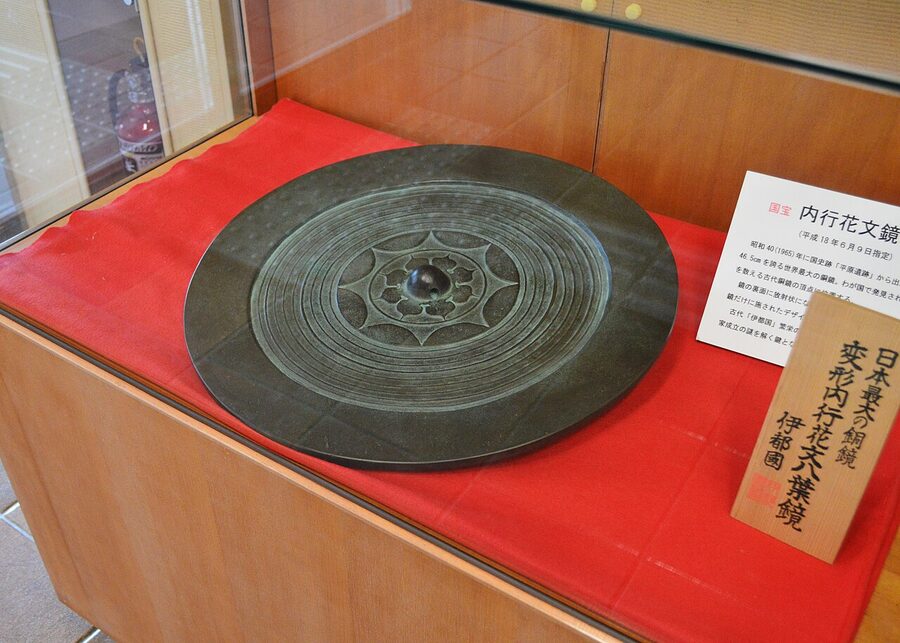
The weakness of the Kyushu case is that it has no single site. Its supporters have placed Yamatai in at least half a dozen districts, and the great Kyushu tombs of the right date that would make the case have not appeared. Yoshinogari, when its scale became public in 1989, was hailed in the newspapers as “Yamatai found”, but it does not fit the Account’s itinerary, and archaeologists disagree about whether it was still at its height in Himiko’s day. You should go anyway, for reasons I give at the end.
The case for the Nara basin
The Kinai case starts with the name. In the Japanese of the 8th century there were two different “to” sounds, and the 臺 in Yamatai matches the one in Yamato, the old name of the Nara region, but not the one in Yamato (山門) in Chikugo. That is a genuine linguistic argument, and Kyushu supporters have never quite answered it.
It then has to deal with “south”. The usual answer is that Chinese geographers believed Japan stretched south from Korea in a long chain of islands; the Account itself places Wa “east of Kuaiji”, opposite the coast of southern China. Turn that map on its side and “south” means “east”, along the Inland Sea or the Japan Sea coast towards Nara. Some historians go further and read the 12,000 li as a symbolic number, the edge of the civilised world in Chinese cosmology, not a measurement.
The archaeology is the Kinai side’s strongest card. In the middle of the 3rd century the Nara basin starts building the first giant keyhole-shaped tombs, the type that spreads across Japan over the next hundred years and becomes the mark of the Yamato kings. The most famous is Hashihaka, and around it is Makimuku.
Makimuku and the hall of 2009
The Makimuku site (纒向遺跡) lies at the foot of Mount Miwa in Sakurai. It was found in 1971, when Nara prefecture’s archaeologists were called in ahead of a housing estate and a school, and the city of Sakurai has run the excavations since 1977. The site covers about 3 square kilometres, and by the end of 2008 only about five per cent of it had been dug.
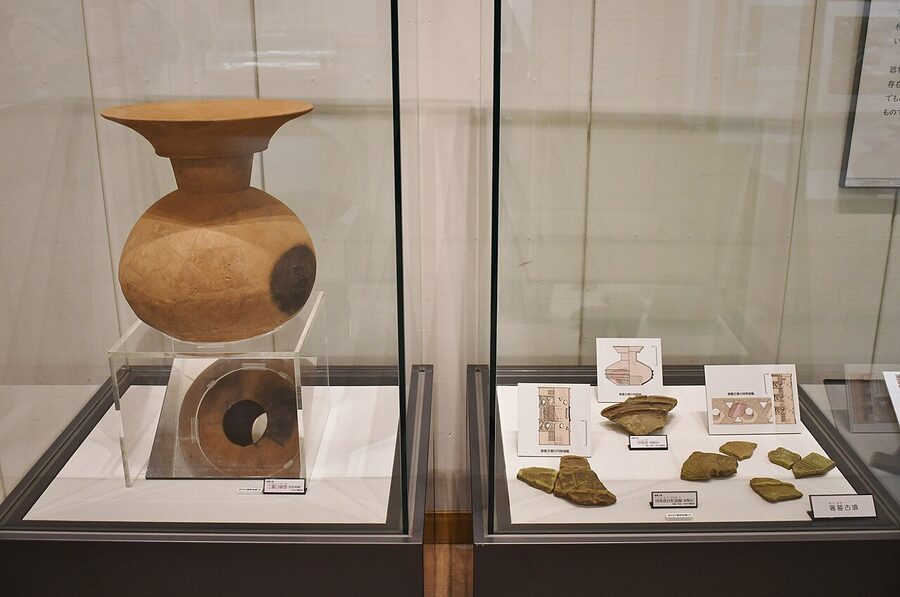
What came out was strange for a Yayoi settlement: no moats and few ordinary houses, but timber-lined canals 5 metres wide, pits full of ritual objects, early keyhole tombs, and pottery from everywhere. Between a quarter and a third of it was made elsewhere, from the Kanto plain to western Honshu, mostly Ise and Owari. Very little came from Kyushu or Korea, which is awkward for anyone who wants Makimuku to be the hub of Himiko’s China trade.
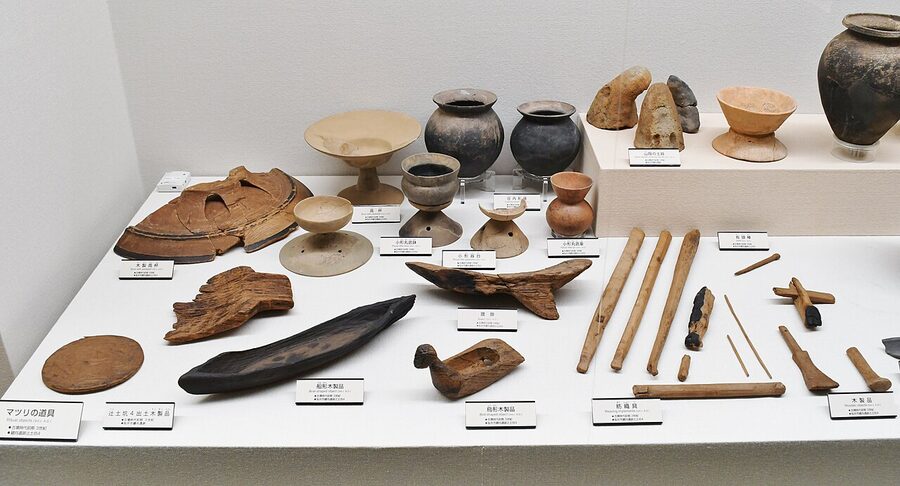
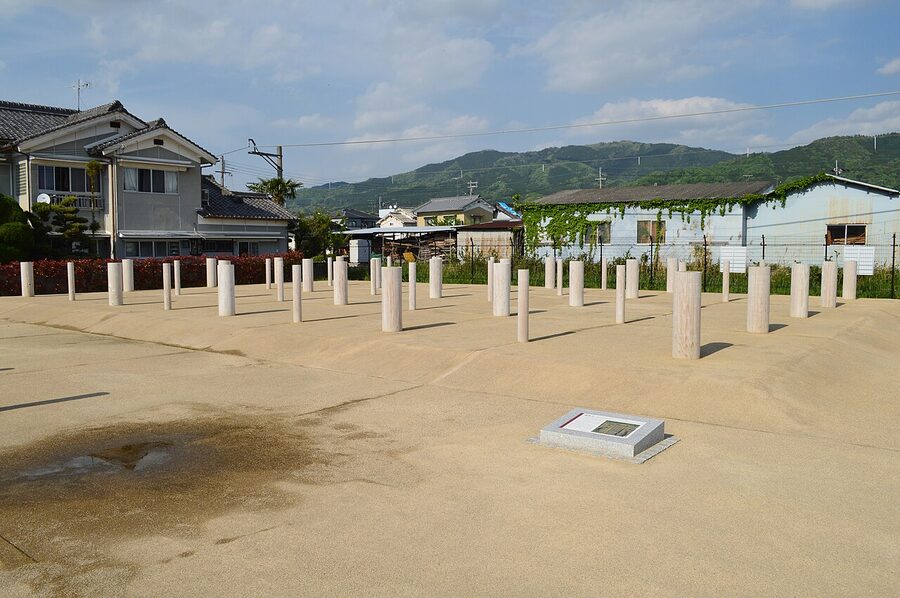
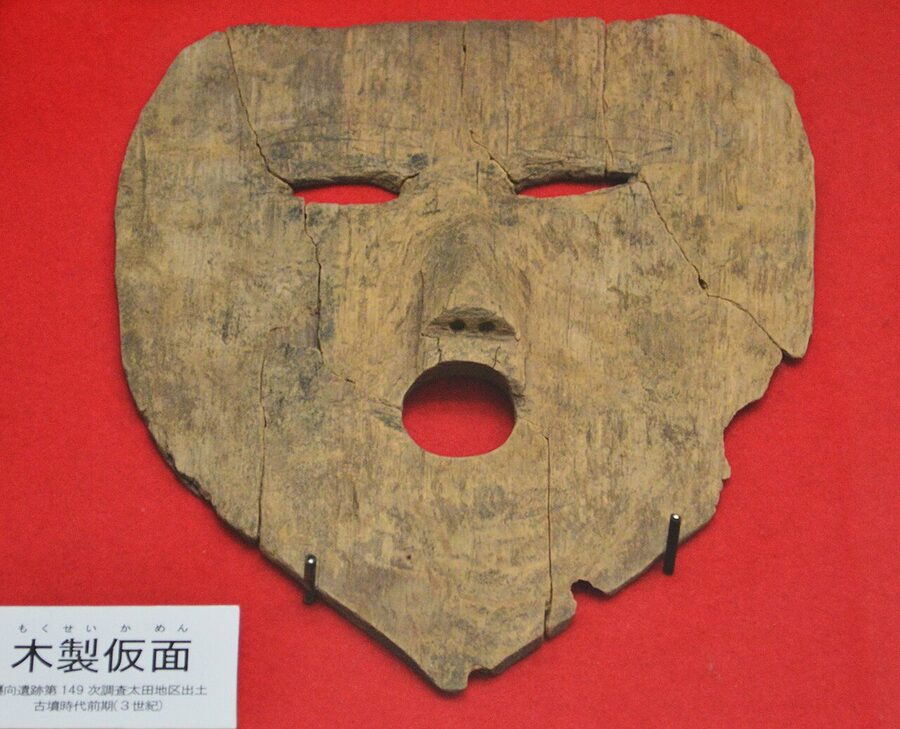
Then, in 2009, the Sakurai excavators announced a row of buildings in the Tsuji district lined up on a single east-west axis. The largest, called building D, measured 19.2 metres by 12.4 metres, a floor area of about 238 square metres, and dated to the first half of the 3rd century. It was the largest building of its time known anywhere in Japan. It stood behind a fence, it was dismantled around the middle of the century, and the newspapers were calling it Himiko’s palace almost at once.
In 2010 a pit just south of it produced more than 2,000 peach stones, the largest single find in Japan; peaches were ritual offerings, and Daoism treated them as protection against evil. In 2015 the excavators found the almost complete skeleton of a dog in a ditch by the hall, and Sakurai unveiled two models of it in 2025, inevitably billed as “Himiko’s dog”. I have no objection. It is the only member of the household anyone has been able to reconstruct.
Hashihaka and the radiocarbon dates
South of the hall lies Hashihaka Kofun, about 280 metres long with a round rear mound some 150 metres across and 30 metres high. It is the oldest of the giant keyhole tombs, the first full statement of the shape that defines the next three centuries. The Imperial Household Agency manages it as the grave of Princess Yamatototohimomosohime, a figure from the Nihon shoki, so nobody may dig it or walk on it.
The Nihon shoki tells two stories about her. In one she is possessed by Ōmononushi, the god of Mount Miwa, and tells Emperor Sujin how to end a plague. In the other she marries the god, finds on the morning he has promised to show himself that he is a small snake, cries out, and in remorse stabs herself with a chopstick, hashi, which gives the tomb its name; men built it by day and gods by night.
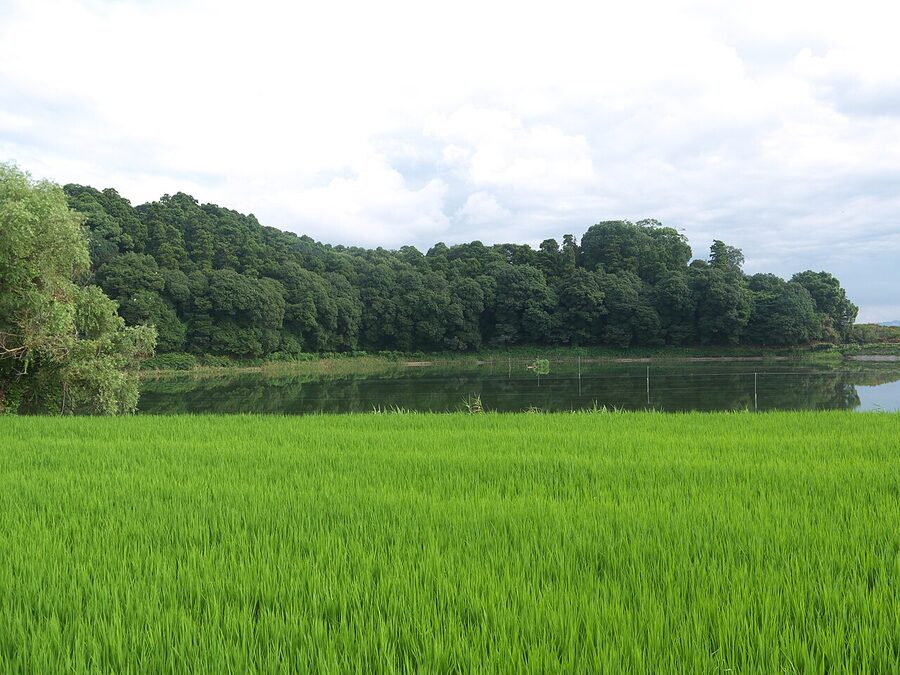
Kasai Shin’ya proposed in the 1920s that the princess and Himiko were the same woman, and later made Hashihaka her tomb: both are shamanic royal women, both more or less unmarried, and the rear mound is the right size. For most of the 20th century the dates did not match, since the pottery put Hashihaka in the late 3rd century, and many Kinai supporters preferred older, smaller mounds at Makimuku as the queen’s grave.
The dates moved. On 30 May 2009 Harunari Hideji, presenting for a team from the National Museum of Japanese History, announced radiocarbon results on soot and residue on pottery from the moat, putting the tomb’s construction at about 240 to 260. That is close enough to Himiko’s death to make headlines, and it pushed many archaeologists towards the identification.
It is not settled. The same team’s earlier claim that the Yayoi period began around the 10th century BC had already drawn fire, and critics argued that old carbon in food residues, from seafood for instance, makes samples look older than they are; Japanese tree rings also show local carbon drifting from the international calibration in the 2nd century. The Nara prefectural institute has given about 280 to 300 from other material, Terasawa Kaoru prefers about 260 to 280, Ishino Hironobu 280 to 290, and Shiraishi Taichirō “just after the middle of the century”, the reign of Toyo rather than Himiko.
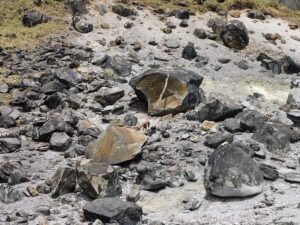
The text causes trouble too. The Account says the Wa “have coffins but no outer chambers”, and Hashihaka probably has a stone chamber, since slabs of basalt have been found on its slopes; it also has a front section the Account never mentions. Supporters reply that a Chinese observer would describe only the round mound, and that the line on coffins is about the Wa in general. Neither side can open the tomb to check.
Himiko’s mirrors, or somebody’s
The hundred bronze mirrors are the other great battlefield. Since the 1920s the leading candidates have been the sankakuen shinjūkyō (三角縁神獣鏡), “triangular-rimmed mirrors with deities and beasts”: large mirrors, usually a little over 20 centimetres across, with a rim that rises to a sharp ridge and a back crowded with Daoist immortals and dragons. More than 500 have been found in Japan, about 430 of them of the type usually called Chinese-made and about 130 of a type called Japanese copies, almost all from early keyhole tombs and clustered around the Kinai.
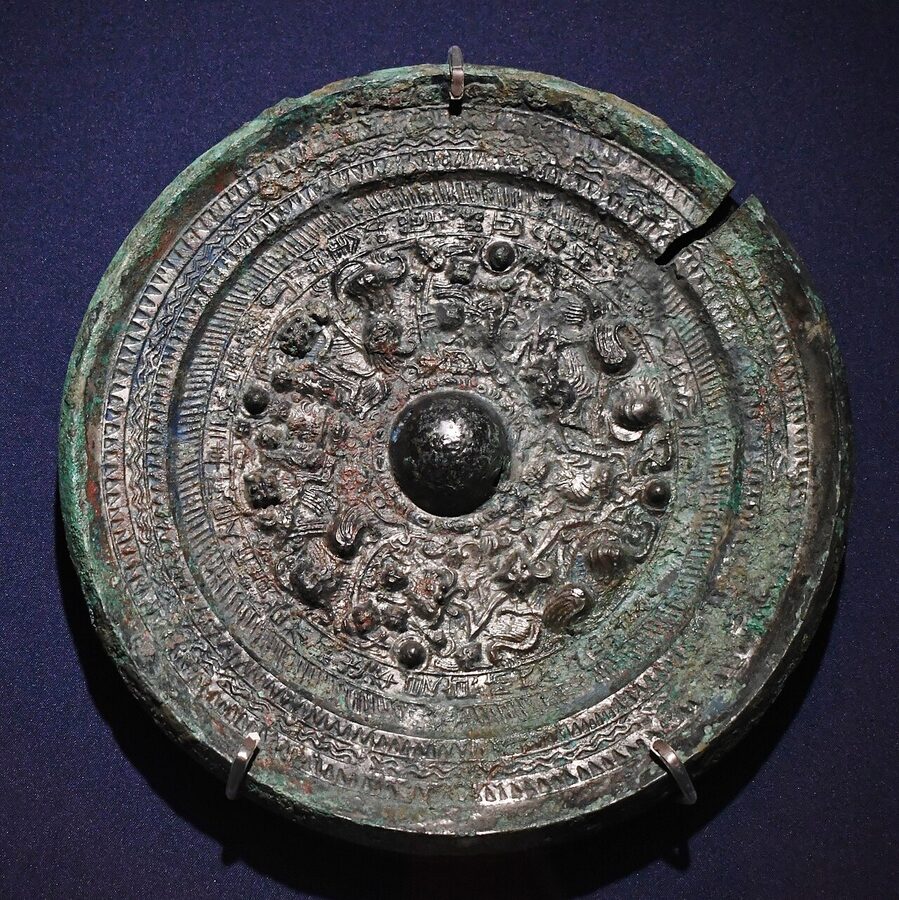
The case for them looks strong. Four of them carry Wei reign dates: the Kanbara mirror is dated 239, and three mirrors cast from the same design, found in Gunma, Hyogo and Yamaguchi, are dated “the first year of Zhengshi”, 240, the year Himiko’s gifts arrived. Many share a mould or a model with mirrors in other tombs hundreds of kilometres away, which the archaeologist Kobayashi Yukio read as the Yamato court handing out mirrors from a central stock to its allies, a picture that fits the Kinai theory beautifully.
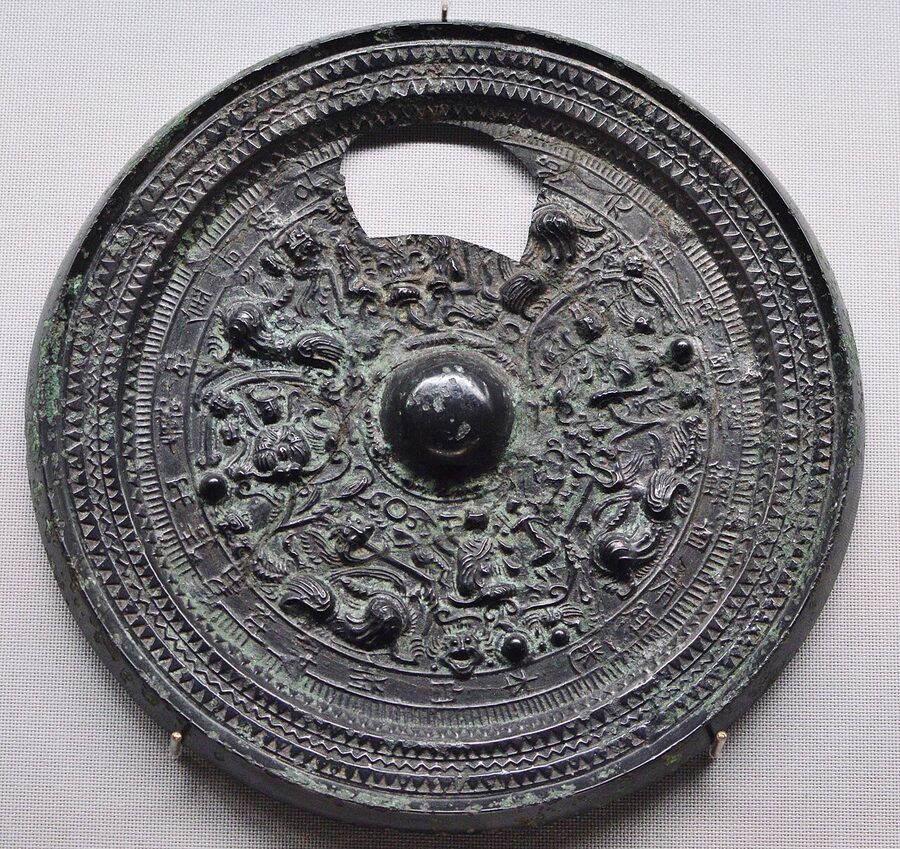
The case against is just as concrete. Not one triangular-rimmed mirror has been found in China or Korea, in a century of looking. The Chinese archaeologist Wang Zhongshu argued in the 1980s that they were made in Japan by craftsmen from the southern state of Wu, Wei’s enemy. And in 1986 a mirror turned up at Hiromine in Kyoto prefecture dated “the fourth year of Jingchu”, a year that never existed, because the era had already changed; a mirror maker in Luoyang would surely have known that, and a craftsman far away might not.
Defenders of the Chinese origin have answers. Tanaka Migaku suggested in 1985 that they were cast specially for export to Wa, which would explain why none stayed in China, and analyses of the metal have found it compatible with Wei and Jin bronze. A hundred mirrors cannot explain five hundred anyway. I would not put money on any of it.
So, where was it?
As fairly as I can put it: most Japanese archaeologists now lean towards the Nara basin, because the giant tombs, the mirrors and Makimuku all point there from the middle of the 3rd century. Sahara Makoto, a former director of the National Museum of Japanese History and a Kinai man himself, said so, and added that portable objects like mirrors can never prove a location to everyone’s satisfaction.
Many historians who start from the text still find the Kyushu reading more natural, and point out that the Kinai case rests on dates that keep moving, mirrors nobody can source and a tomb nobody may open. There is also the “eastern migration” theory, in which a Kyushu Yamatai moved east and became Yamato, and its reverse, in which Yamato conquered it.
The only thing that would settle it is a find with writing on it: a seal, a dated object in a dated grave, a fragment of a letter. Until then, nobody knows, and anyone who tells you otherwise has a book to sell. Usually a good one, to be fair.
The queen the chronicles would not name
The two oldest Japanese histories, the Kojiki of 712 and the Nihon shoki of 720, were written by a court that certainly had the Wei zhi; the Nihon shoki quotes it. Neither book ever names Himiko, and nor do the provincial gazetteers, the fudoki, ordered from 713. My overview of Japan through the ages explains how far back these chronicles reach; for the 3rd century they are a mixture of genealogy, myth and later politics, and Himiko does not fit in any of the three.
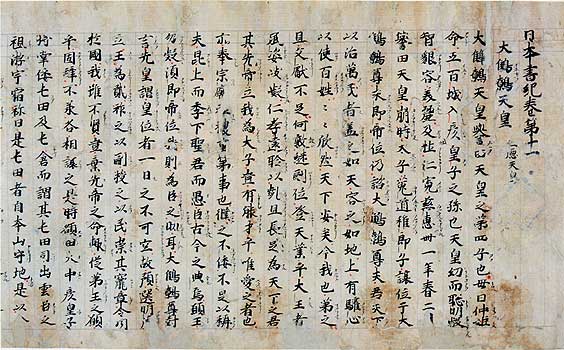
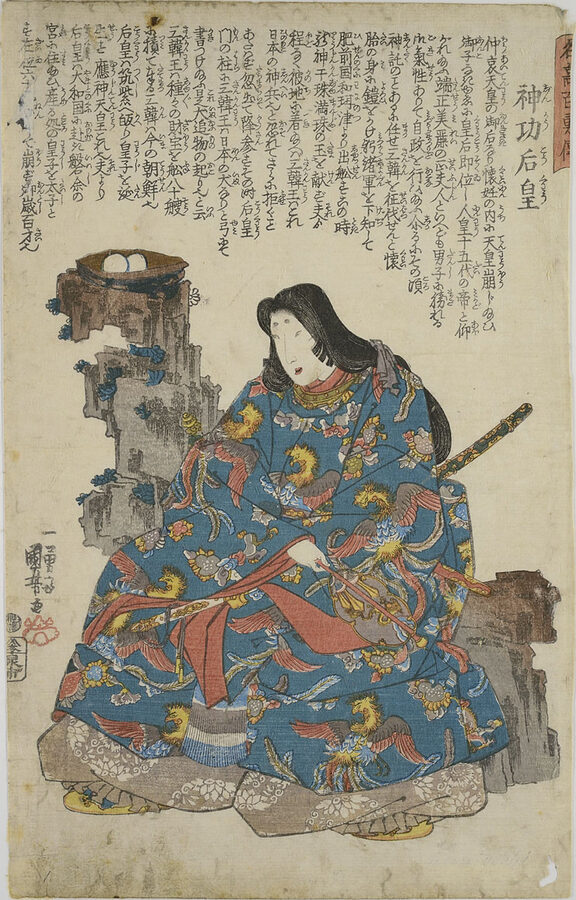
What the Nihon shoki does is cleverer. In its chapter on Empress Jingū, the warrior queen said to have ruled as regent after her husband’s death, it inserts three short notes. Under her 39th year it says: “The Wei zhi says that in the sixth month of the third year of Jingchu, the queen of Wa sent high officers to the commandery.” Under her 40th and 43rd years it records the return embassy and the second mission, and under her 66th year it quotes a Jin court diary on a Wa queen’s envoys in 266.
It never says “Jingū was Himiko”. But by placing those notes in her reign, and by setting her 39th year in 239, the compilers did everything short of saying it. The historian Naka Michiyo showed in the 19th century that the chronicle’s early dates are stretched; on one widely held reading, the compilers moved Jingū back by two sixty-year cycles precisely so that she would sit on top of the Chinese queen.
Why not name her? The common answer is pride: a court that claimed descent from the sun goddess did not want a Japanese ruler who accepted a Chinese title as “friend of Wei”. Another is that they could not find her in their own genealogies and did what they could with the dates. A third, Motoori’s in different clothes, is that Himiko was not a Yamato ruler at all, and the compilers knew it.
Scholars have since matched her with most of the eligible women in the chronicles: Jingū; Yamatohime, Naitō’s choice; Yamatototohimomosohime of Hashihaka; even Amaterasu, which needs the myths to be history in disguise. The historian Seki Kazuhiko has argued that the whole exercise assumes what it needs to prove, that Himiko belonged to the line of the later emperors at all. I agree with him.
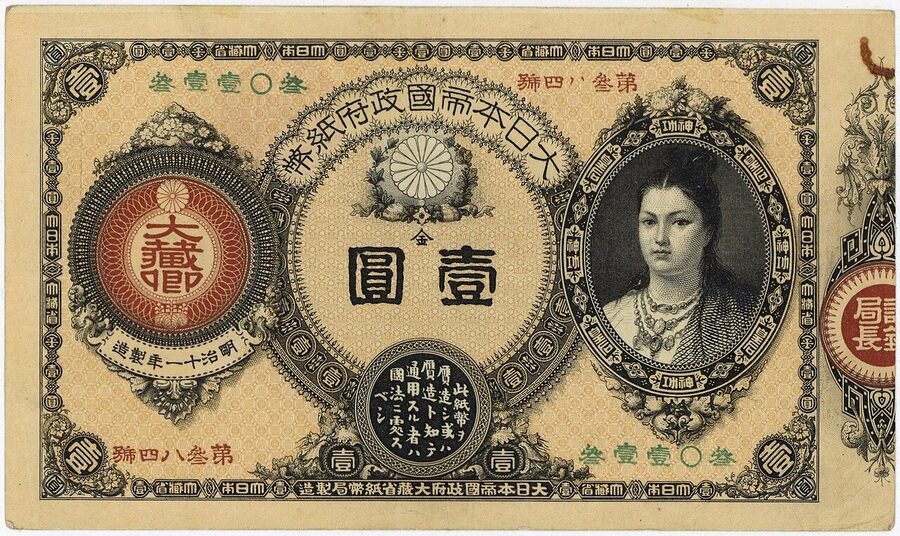
Jingū has not aged well. In 1926 she was removed from the list of reigning sovereigns, and since the war her Korean campaign has been read mainly as a myth that served later empires. Himiko, who appears only in a foreign source and conquered nobody, has done much better out of the 20th century.
Textbooks, manga and a water bus
Himiko is now one of the most recognisable names in Japanese history. A newspaper survey in 2008 found that about 90 per cent of primary school children knew who she was, and she appears in the opening chapter of every Japanese history textbook, usually between a Jōmon pot and a keyhole tomb. If you want the long run-up to her, the sister pieces on the Jōmon period and the Yayoi period cover the ten thousand years before.
She owes her fame to the 1960s as much as to the 3rd century. In 1967 Miyazaki Kōhei, a blind businessman from Shimabara who worked out his Kyushu theory with his wife reading the texts aloud, published Maboroshi no Yamataikoku, “The Phantom Yamatai”, a best seller and later a film. A year later the crime writer Matsumoto Seichō brought out Kodaishi-gi, “Doubts about Ancient History”, and the “Yamatai boom” began, with amateur theories, tour buses and a ready market for any town that could claim her.
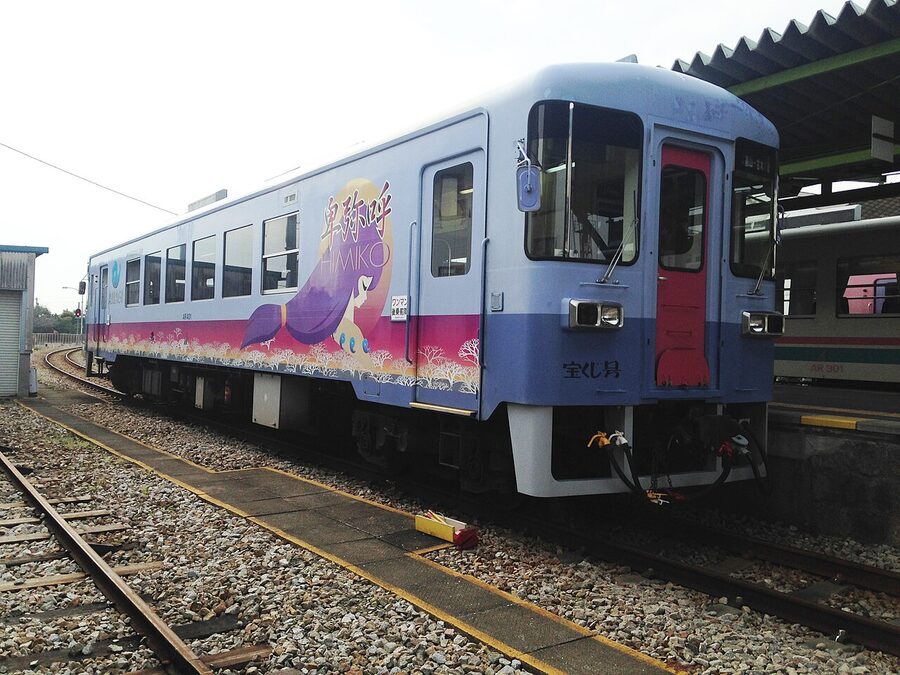
The towns did claim her. Asakura’s mascot, a girl named Himiko-chan who is described as shy and fond of fortune-telling, was created in 2001 when the Hiratsuka-Kawazoe site park opened, and she works alongside a human tourism ambassador who holds the title “Queen Himiko”. Contests for the title of Queen Himiko, judged on charm and looks, were common enough in Nara, Shiga and Kyushu for the anthropologist Laura Miller to write a study of them.
Fiction got there first. Yokomitsu Riichi’s novel Nichirin (1924) was filmed twice; Tezuka Osamu made her the ageing queen of the first story of his manga Phoenix (Hi no tori); Shinoda Masahiro filmed her in 1974 with Iwashita Shima. Since then she has been a dragon in disguise in Dragon Quest III (1988), the undead sun queen of the 2013 Tomb Raider, and a playable character in half the history games on the Japanese market.
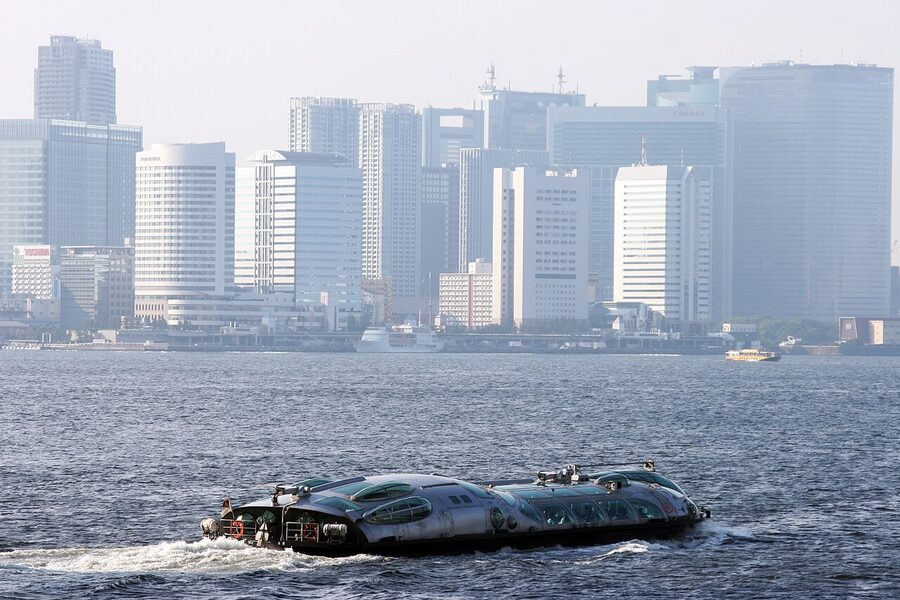
She has also lent her name to a sports car built by Mitsuoka, a racehorse and, in 2009, a gas cloud: astronomers using the Subaru Telescope on Hawaii named a giant blob of glowing hydrogen 12.9 billion light years away “Himiko”, because it was large, ancient and mysterious. It is the most fitting tribute of the lot.
Where to see Himiko’s world today
There is no Himiko site. There are sites in her argument, spread across the two regions in dispute, so a trip to see them is also a trip between the theories. My piece on Japan’s three sacred treasures covers the mirror that became imperial regalia, which some people think descends from mirrors like these.
Makimuku, Hashihaka and the Sakurai plain
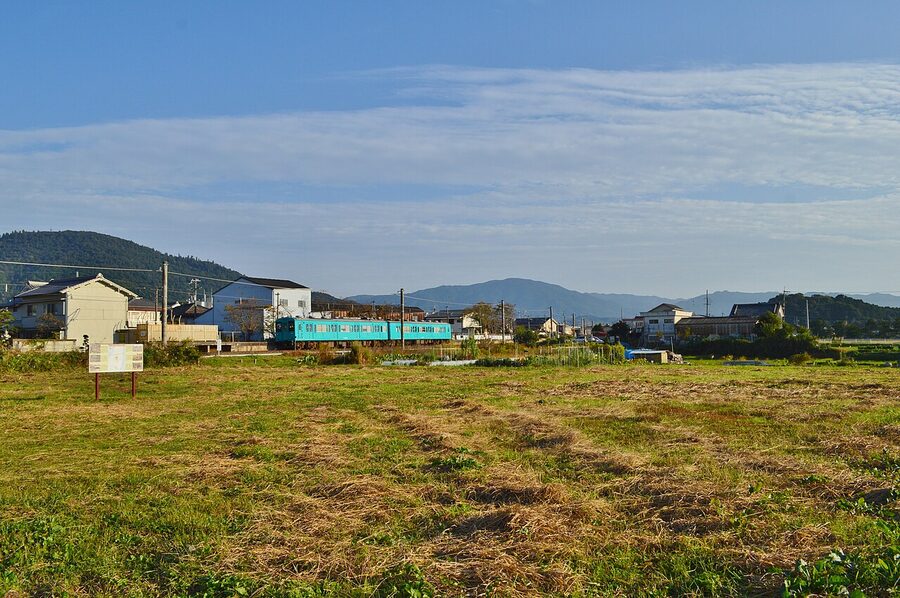
Start at JR Makimuku Station on the JR Sakurai Line, also signed the Man’yō Mahoroba Line, about thirty minutes from Nara by local train. It is a small station with one platform, and it sits on the Makimuku site: the line runs straight through the district where the 3rd-century hall stood.
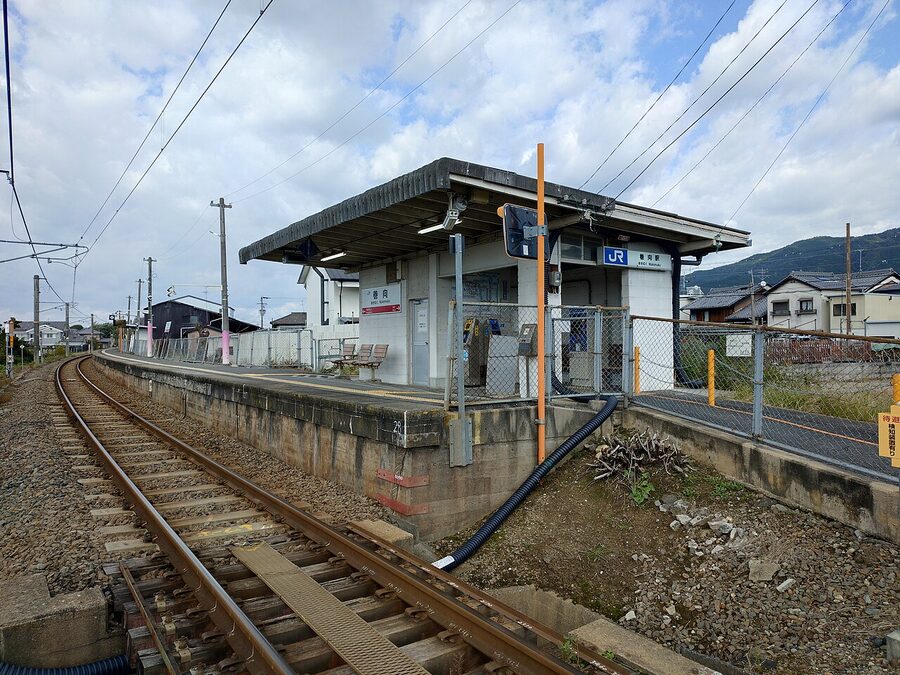
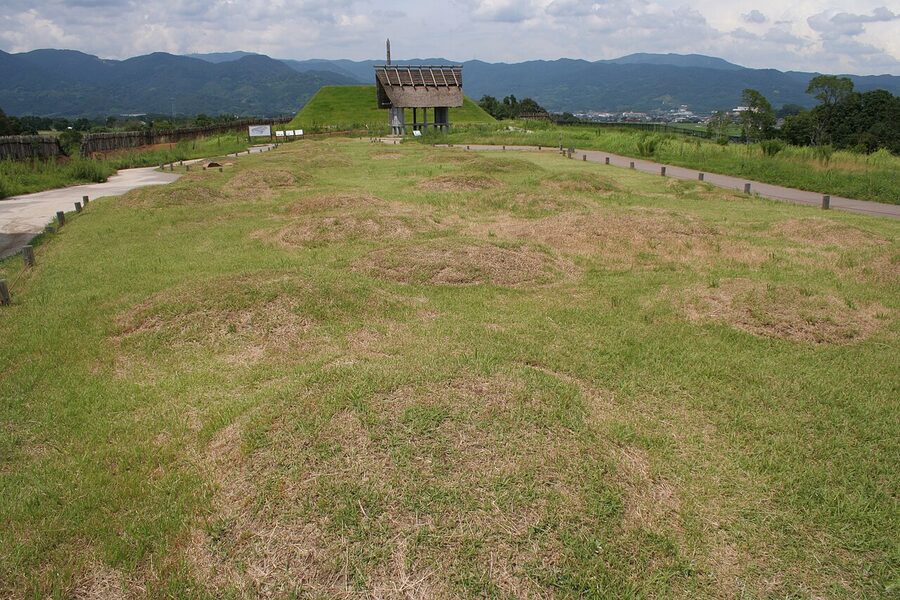
The site of building D is a short walk away, its post positions marked out on the ground. It looks like very little and is worth a few minutes anyway; Mount Miwa fills the eastern sky, which is presumably one reason the hall was here.
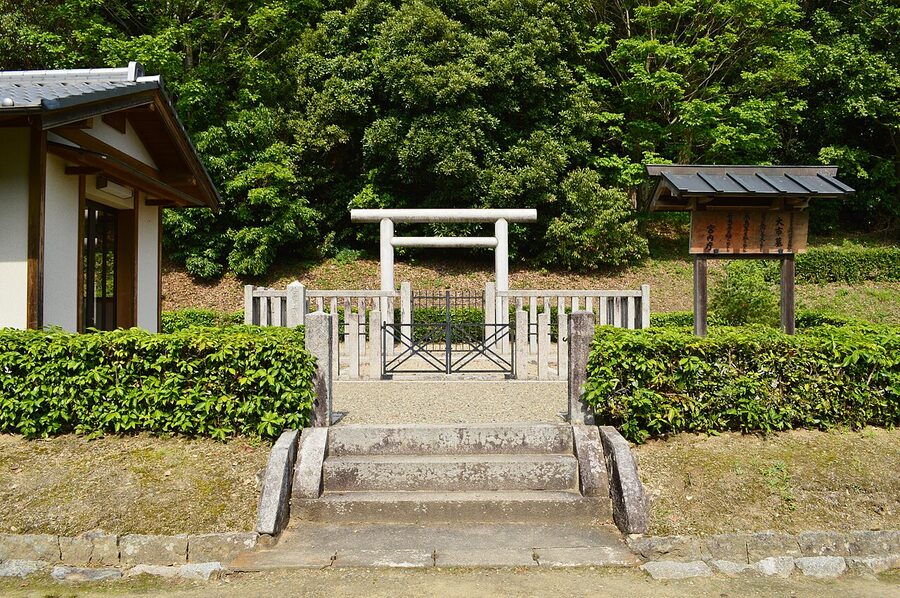
Hashihaka is about fifteen minutes’ walk south. You cannot enter the mound, but you can walk much of its edge on public roads and the bank of the Hashinaka pond, and look at the Imperial Household Agency’s worship place, with its plain torii and fence. Allow an hour to go round slowly, and come on a clear day if you want the view of Miwa behind the mound. There is no charge and no opening time.
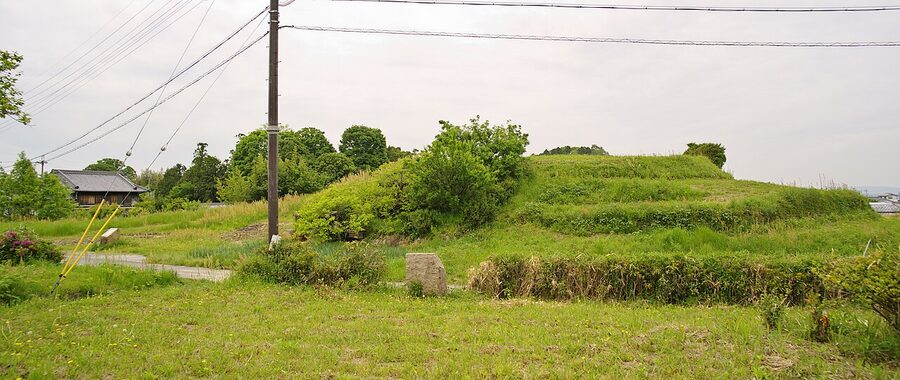
From Hashihaka it is a few minutes east to Hokenoyama Kofun, a small early keyhole tomb that was excavated by the Nara prefectural institute from 1995 and produced a timber-lined burial chamber and Chinese mirrors. Its dating, like Hashihaka’s, ranges from the mid-3rd century to the early 4th depending on whom you ask; unlike Hashihaka, you can walk on it.
For the finds, go to the Sakurai City Archaeological Centre (桜井市立埋蔵文化財センター) near Ōmiwa Jinja, about ten to fifteen minutes’ walk west of JR Miwa Station, one stop south. Its permanent displays cover the city’s excavations from the earliest settlers to the Nara period, Makimuku included. Admission is ¥200, free for residents of Sakurai and children of junior high school age and under; it opens 9:00–16:30 (last entry 16:00) and is closed on Mondays and Tuesdays unless they are public holidays.
My Hashihaka article has more on the tomb and on Ōmiwa Jinja, the shrine whose sacred mountain looks down on all of this. If you have a full day, walk the Yamanobe-no-michi trail north from Miwa through the Makimuku area to Tenri, which brings you to the next stop on foot.
Kurozuka Kofun Exhibition Hall, Tenri
In January 1998 the excavators of Kurozuka Kofun, a 130-metre keyhole tomb in Yanagimoto, announced a nearly unrobbed stone chamber with 33 triangular-rimmed mirrors laid around the coffin and a smaller Chinese mirror at the head. The Kinai theory has hardly stopped talking about it since.
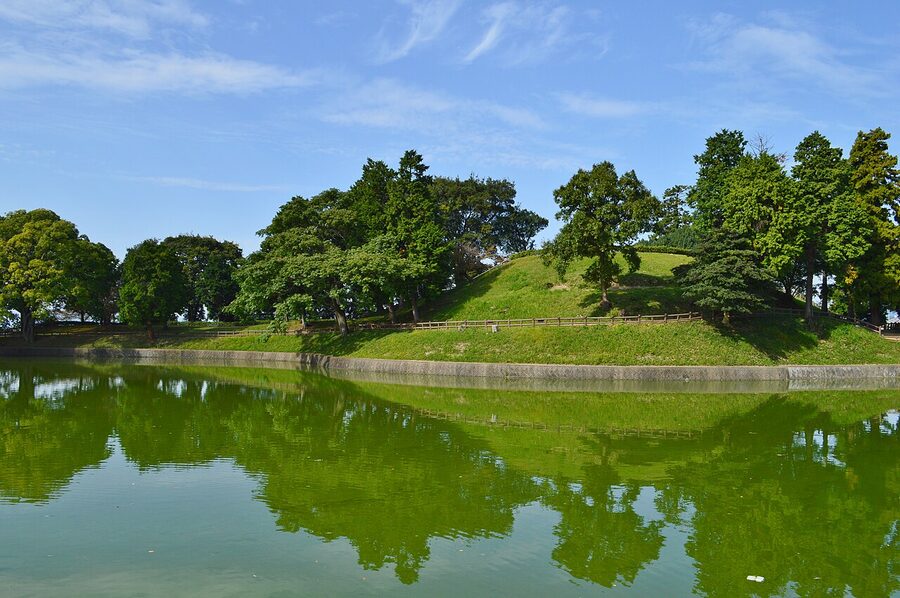
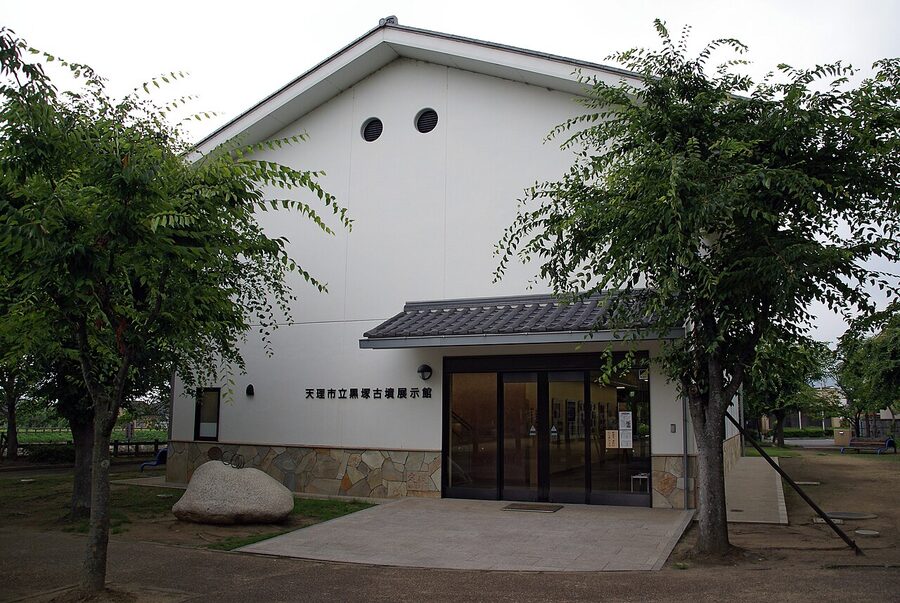
The Tenri Municipal Kurozuka Kofun Exhibition Hall (天理市立黒塚古墳展示館) beside the mound has a full-size replica of the stone chamber, set out to show how the burial was found. It is free, open 9:00–17:00, and closed on Mondays and the day after public holidays, and over the New Year. It is about five minutes’ walk from JR Yanagimoto Station, the next stop north of Makimuku on the same line.
Yoshinogari Historical Park, Saga
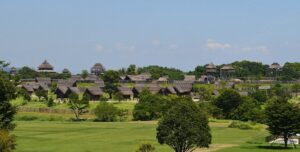
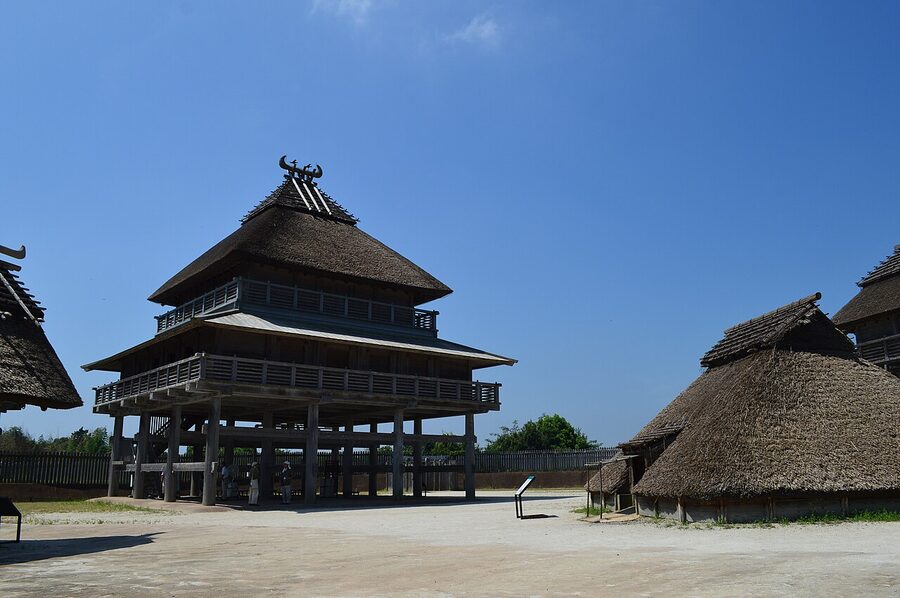
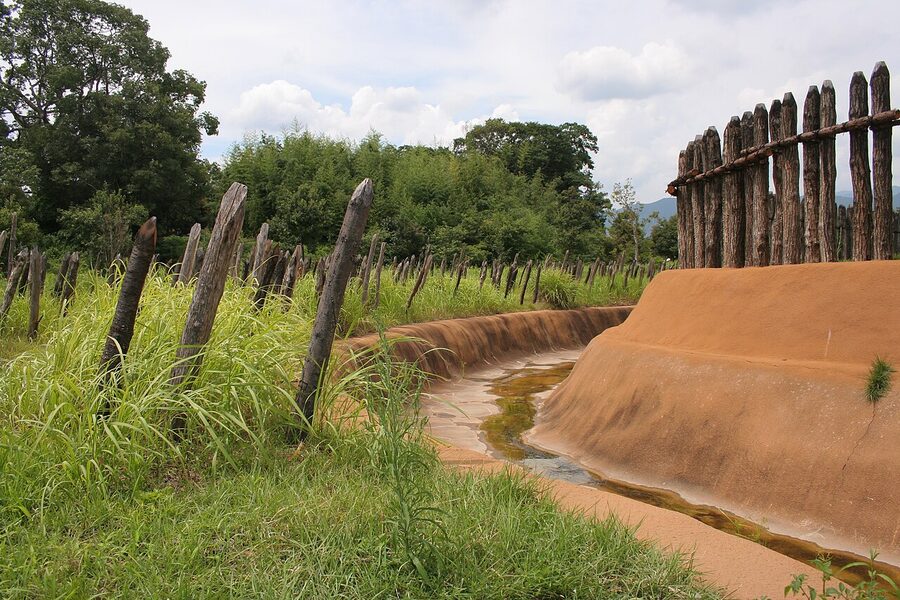
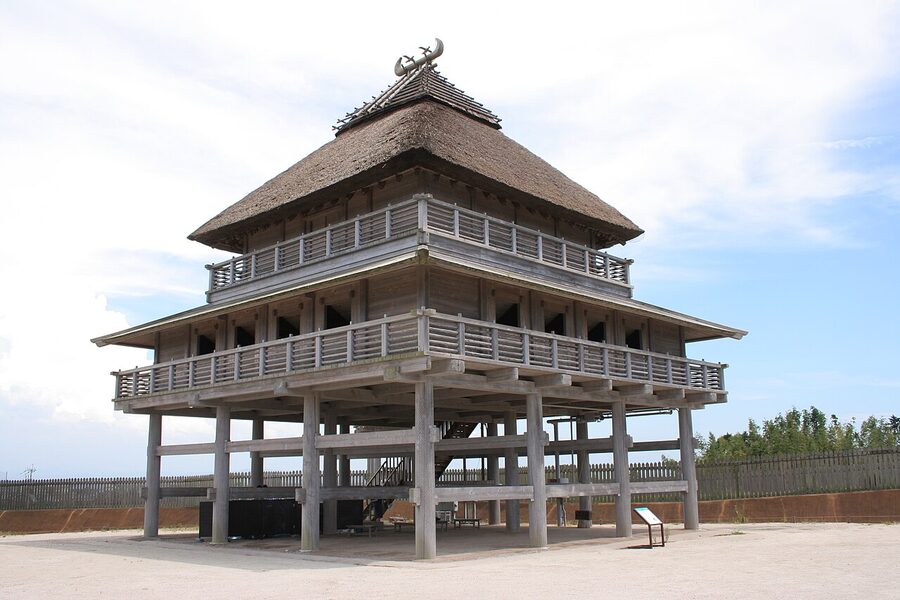
Yoshinogari (吉野ヶ里) is not Yamatai, and the park, to its credit, does not quite claim it is. It is the largest moated Yayoi settlement known in Japan, dug from 1986 when Saga prefecture planned an industrial estate on the hill, and it shows better than anywhere what a Wa country of the Account might have looked like: double moats, watchtowers, an inner enclosure for the rulers and a great ritual hall.
The reconstructions are guesses based on post holes, some of them bold ones, including the three-storey main hall and the priestess scene near the top of this article. Read the panels, which are careful about what is evidence and what is reconstruction, then go and look at the jar burials and the moats, which are real.
In 2023 the hill produced one more surprise. A stone coffin about 2.3 metres long, its lid marked with incised crosses, turned up in a corner of the site that had been left unexcavated because a shrine stood on it, and the prefecture dated it to between the late 2nd and mid 3rd century. It was opened on 5 June 2023 in front of the national press, and it held soil and traces of red pigment, no bones and no grave goods. The excitement beforehand tells you more about Japan’s appetite for Yamatai than the coffin does.
The park opens at 9:00 and closes at 17:00, or at 18:00 from June to August; it is closed on 31 December and on the third Monday of January and the day after. Admission is ¥460 for adults (15 and over), ¥200 for those 65 and over, and free for junior high school students and under. The park announced a change to its opening hours from 1 September 2026, so check its own site before you go.
JR Yoshinogari-kōen Station on the Nagasaki Line is about fifteen minutes’ walk from the east gate, and JR Kanzaki Station about fifteen minutes from the west gate. From Hakata, the limited express Midori runs direct to Yoshinogari-kōen in about 36 minutes on some services; otherwise change at Tosu or take the shinkansen to Shin-Tosu. The site is big and largely without shade, so allow at least three hours and take water in summer.
Kyushu National Museum, Dazaifu
If you are in Kyushu before 11 January 2027, go to Dazaifu. The Kyushu National Museum (九州国立博物館) is running a special exhibition whose Japanese title translates as “Himiko’s mirrors: the triangular-rimmed mirrors that made the Yamato kingship”. You will notice that the title takes a side, in Kyushu, and I have not decided whether that is a joke or a sign of how far the argument has moved.
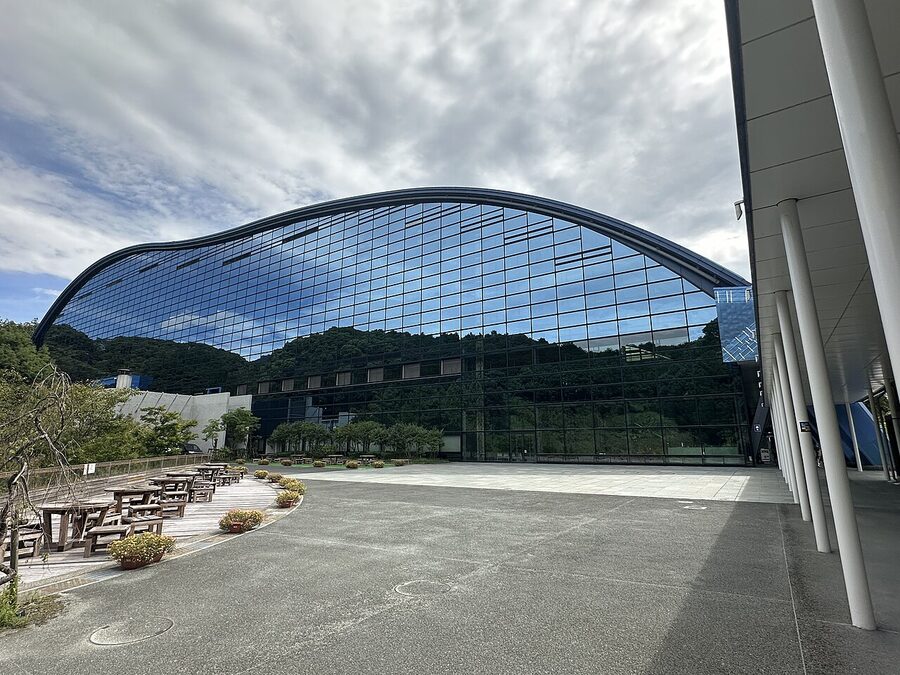
The exhibition brings together mirrors from across Japan, including the Kanizawa mirror dated 240, a mirror from the Ishizukayama tumulus in Fukuoka, a mirror from the Takeshima tumulus in Yamaguchi, and a mirror recently excavated at the Tomio Maruyama tumulus in Nara. It runs until 11 January 2027. Tickets are ¥2,000 for adults and ¥1,200 for university students, and free for high school students and anyone under 18; they are sold only at the museum, on the day, and they also admit you to the permanent galleries.
The museum is open 9:30–17:00 (last entry 16:30) on Sundays and Tuesday to Friday, and until 19:00 on Saturdays during the exhibition. It is closed on Mondays, except 23 November and 11 January, and also on 24 November and from 24 to 31 December. Outside the special exhibition, the permanent galleries have their own cheaper ticket; one of the giant Hirabaru mirrors is kept here, while the other four are at the Ito-koku History Museum in Itoshima.
The seal that does exist: Fukuoka
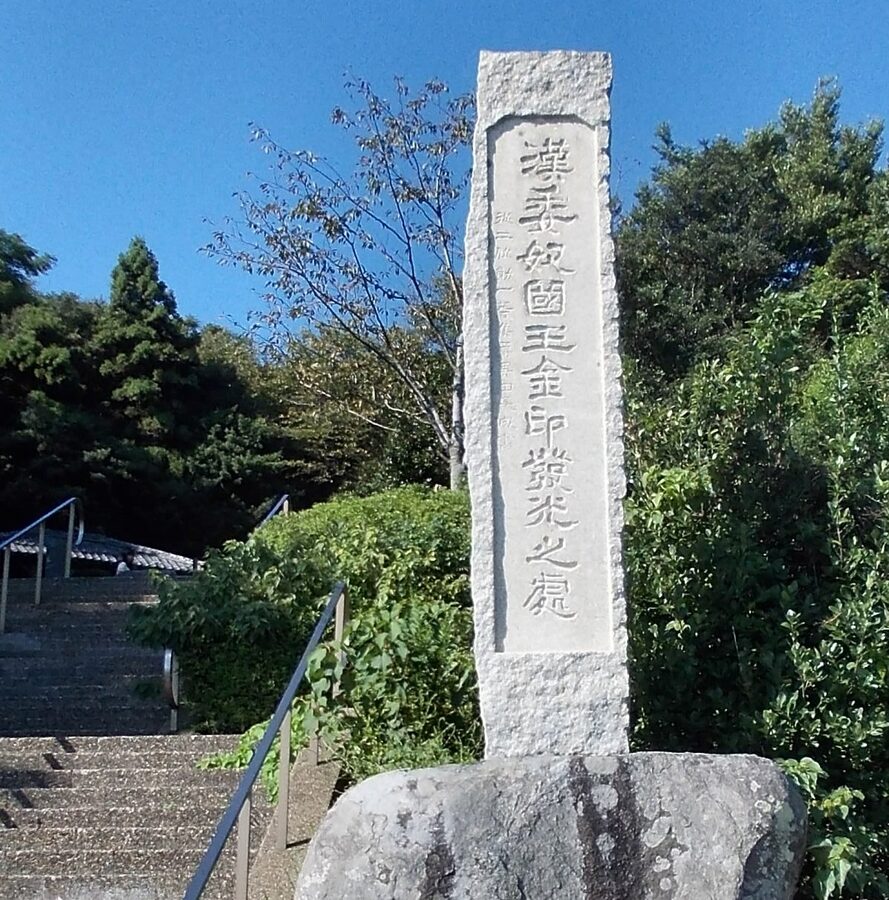
Finish where the hook of this piece started. The King of Na seal is the first thing you see in the permanent galleries of the Fukuoka City Museum in Momochi. The permanent galleries cost ¥200 for adults and ¥150 for high school and university students, free for junior high school age and under; the museum is open 9:30–17:30 (last entry 17:00) and closed on Mondays, or the following weekday when Monday is a holiday, and from 28 December to 4 January.
The seal is tiny, and you will probably be disappointed for about five seconds. Then look at the snake on top, and the five characters cut into the face, and remember that a Han official in Luoyang packed it in a box in 57 and that it was lying under a stone on an island in Hakata Bay when a farmer’s spade found it seventeen centuries later. Himiko’s seal was sent the same way, by the same kind of official, in the same kind of box. Somewhere, unless someone melted it down long ago, it is still in the ground.