In the spring of 1843 an Edo publisher brought out a set of prints of the Kanda Festival, thick with expensive safflower red, and sold them about as fast as his printers could pull them. According to the diary kept by Fujioka-ya Yoshizō, a second-hand bookseller in Sotokanda who wrote down every rumour in the city, the more sheets the man sold, the more money he lost. The shogunate had just limited colour prints to seven or eight printings and fixed the price of a single sheet at sixteen mon or less, which was about what a bowl of soba cost at a street stall. He had produced a hit and been punished for it by arithmetic.
I find that story more useful than any amount of talk about the delicate soul of Japanese art. Ukiyo-e (浮世絵), “pictures of the floating world”, were a commercial product: drawn by one man, carved by a second, printed by a third, paid for and sold by a fourth, inspected by a ward official, and bought by people who pasted them on the wall or rolled them up with the shopping. The same sheets now hang under dimmed lights in Boston, Paris and Ueno, and the road from there to here runs through the pleasure quarter, the theatre, three rounds of government reform, a publisher with a gift for trouble and a Dutch painter copying plum trees in oil. It ends, like everything on this site, somewhere you can go and stand in front of the real thing.
In This Article
- From the sorrowful world to the floating one
- Before the woodblock: screens, scrolls and a man from Awa
- Black, orange, pink, and then everything
- Four trades and an inspector
- Tsutaya Jūzaburō, the publisher who made the names
- Faces: actors, beauties and close-ups
- Utamaro and the Kansei beauties
- Ten months of Sharaku
- Heroes, landscapes and the bedroom
- Shunga, stated plainly
- Seals, handcuffs and a spider
- Yokohama, red ink and the newspaper
- How the prints reached Paris
- New prints from an old workshop
- Where to see ukiyo-e today
- Ōta Memorial Museum of Art, Harajuku
- Tokyo National Museum, Ueno
- Sumida Hokusai Museum and the Edo-Tokyo Museum, Ryōgoku
- Adachi Institute of Woodblock Prints, Mejiro
- Shōhō-ji, Higashi-Asakusa
- Japan Ukiyo-e Museum, Matsumoto
- Boston, Amsterdam and Giverny
From the sorrowful world to the floating one
The word came before the pictures. Ukiyo began as 憂き世, the “sorrowful world” of Heian poetry, a phrase for a life that is painful and short, and that is the sense it has in the Tales of Ise. By the end of the Heian period the Buddhist idea of impermanence had seeped in, and writers began spelling the same sound with the character for “floating”, 浮き世, the drifting, unstable world. Then, in the Edo era, the meaning turned inside out: if the world is fleeting, enjoy it.
Asai Ryōi set out the new attitude in his Ukiyo monogatari, the Tales of the Floating World, of around 1661: live for the moment, look at the moon, the snow, the cherry blossom and the maple leaves, sing, drink sake, and drift along like a gourd carried down the river, untroubled by the poverty staring you in the face. That, he wrote, is ukiyo. The novelist Ryūtei Tanehiko put it more drily in his notebooks around 1826. There are two ukiyo, he said: the sorrowful one everybody knows from old poems, and another that simply means “up to date”, and ukiyo-e are pictures of the up to date.
Up to date, in Edo, meant two places. When Tokugawa Ieyasu became shogun in 1603 and governed from Edo, and his successors required every daimyo to spend alternate years there under sankin-kōtai, the city filled with men: samurai on rotation, labourers, carpenters, porters, clerks. By some estimates nearly seventy percent of the population was male. The shogunate’s answer to a city of single men was the licensed quarter of Yoshiwara, moved after the Meireki fire of 1657 to the rice fields north of Asakusa, and the answer to their boredom was the kabuki theatre.
Neither place was respectable, which was rather the point. The Yoshiwara sold sex at the bottom and an elaborate, ruinously expensive performance of courtship at the top; the theatre sold stars. The people paying were chōnin, townsmen, the merchants and craftsmen who sat at the bottom of the official order of society and near the top of the cash economy. They had no political voice and were lectured by edict after edict about what they could wear and spend, but they could buy a picture of the most famous courtesan in Edo or the actor everybody was talking about, and that is the market ukiyo-e was made for.
Before the woodblock: screens, scrolls and a man from Awa
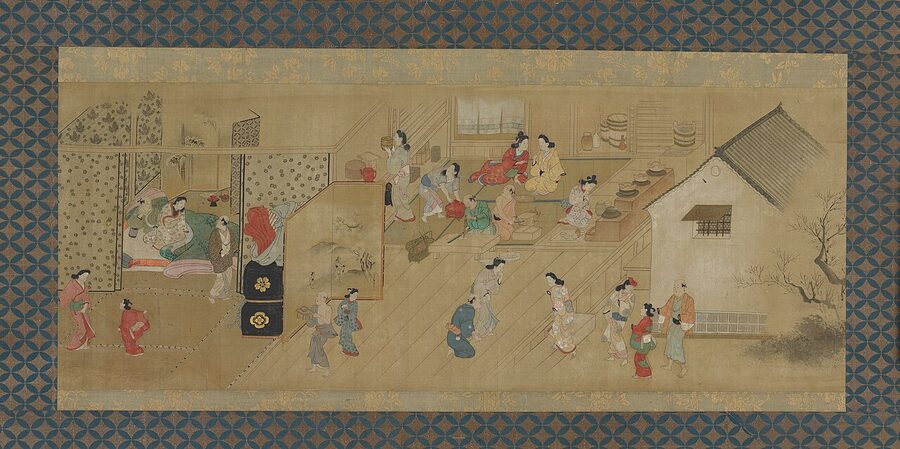
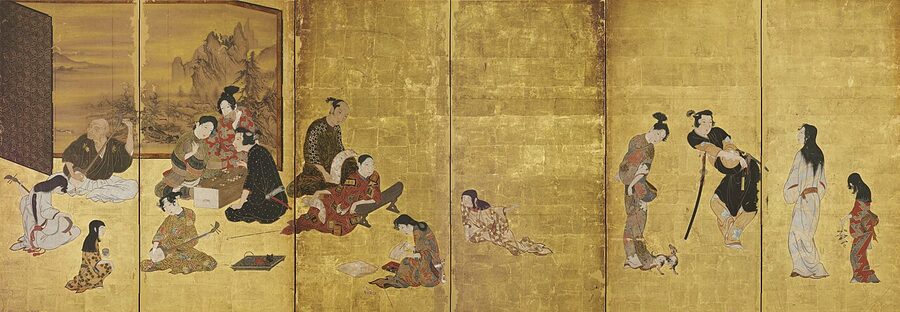
The first pictures of the floating world were not prints at all. In the Kan’ei era (1624–1644), painters trained in the grand Kanō and Tosa manners began making folding screens in which the subject was no longer a battle or a scene from Genji but people enjoying themselves. The best of them is the Hikone screen, a National Treasure kept at the Hikone Castle Museum, which has been credited at various times to Iwasa Matabei. Japanese scholarship has long liked to call Matabei the true founder of ukiyo-e; Western writers from James Michener on preferred to start with the prints and with Moronobu, and the argument has never been settled.
Hishikawa Moronobu (菱川師宣) came from somewhere else entirely. He was born in Hota, a fishing village in Awa province on the far side of Edo Bay, the son of an embroiderer who stitched gold and silver thread into fine robes, and the family trade explains a good deal about how he drew cloth. He crossed to Edo some time after the Meireki fire, studied the official Kanō, Tosa and Hasegawa styles, and began by illustrating books without signing them. In 1672 he put his name in a picture book of warrior poets, the first Edo illustrator to do so, and before long he was signing himself Yamato-eshi, “painter in the Japanese manner”, a claim to a lineage as much as a job title.
His real innovation was commercial. Book illustrations could be printed in hundreds, and Moronobu began issuing pictures as single sheets, some of them pulled from his own books, to be bought and looked at on their own. They were black ink only, sumizuri-e, sometimes coloured by hand afterwards, while his workshop turned out hanging scrolls for customers who could pay more. He illustrated over a hundred picture books and more than fifty volumes of erotica, and when he died on the fourth day of the sixth month of 1694, in the reign of Tokugawa Tsunayoshi, Edo’s culture had drawn level with Kyoto’s.
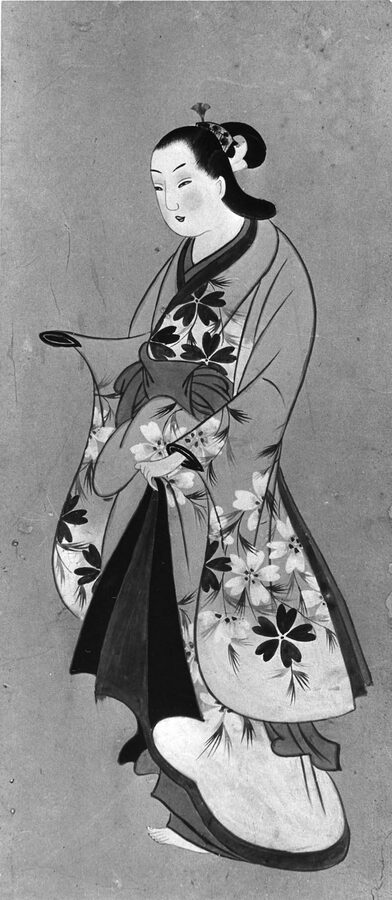
After Moronobu the courtesan picture became a production line. Kaigetsudō Ando and his studio painted standing beauties to a formula, tall women in enormous robes against an empty ground, in cheap pigments so that ordinary customers could afford a hand-painted scroll. The studio ended abruptly in 1714, when Ando was exiled over the Ejima-Ikushima affair, a scandal involving a senior lady-in-waiting from Edo Castle and a kabuki actor that ended in banishment for both of them and a death sentence for her brother.
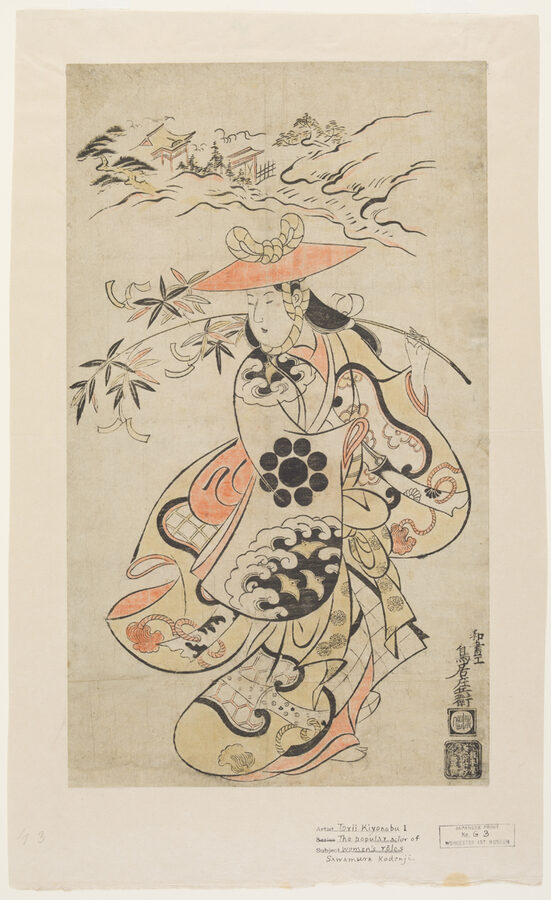
The theatre had its own specialists. The Torii family painted the great signboards outside the playhouses, and they developed a manner built to be seen across a crowded street, which Japanese critics call “gourd legs and earthworm lines”: swelling limbs and outlines that wriggle across the sheet. The Torii line survived into the 21st century, still painting the billboards at the Kabuki-za.
Black, orange, pink, and then everything
For the best part of a century the colour in ukiyo-e was added by hand. First came tan-e, black prints tinted with an orange made from red lead; then beni-e, coloured with pink from the safflower; then urushi-e, in which the black was thickened with glue until it shone like lacquer. All of it had to be brushed in sheet by sheet, which kept prices up and output down. True colour printing, with a separate block for each colour, reached single sheets in the 1740s as benizuri-e, usually just pink and green laid over the black.
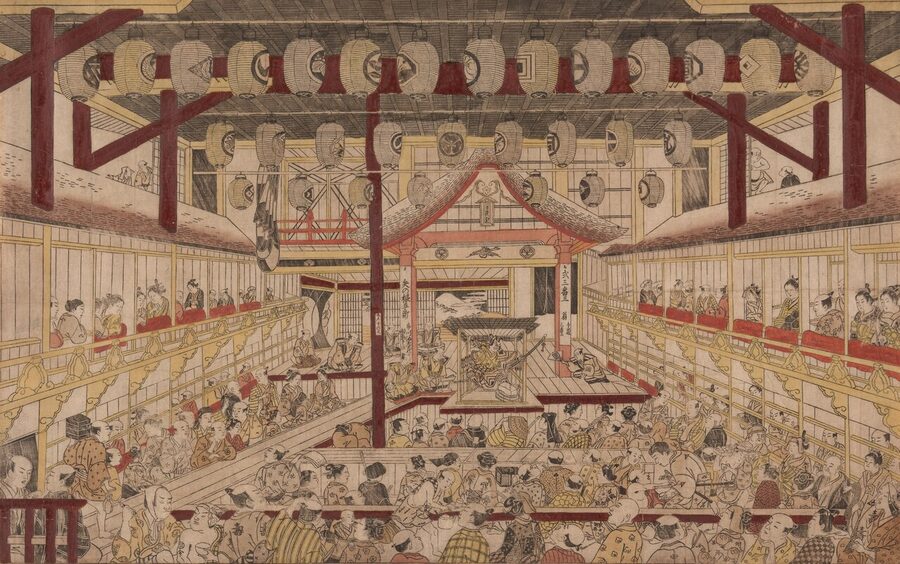
The name most attached to this period is Okumura Masanobu (奥村政信), a self-promoter of real talent who designed prints and ran his own shop for half a century. He is credited with the lacquer print, the tall narrow pillar print, and the uki-e, “floating pictures”, which borrowed the single vanishing point of the European engravings that came in through Dejima after 1720, when the eighth shogun, Yoshimune, relaxed the ban on Western books that had nothing to do with Christianity. One tradition also credits Masanobu’s circle with the kentō, the corner notch and side guide cut into every block that let a printer lay the paper down in exactly the same place each time. Without kentō there is no colour printing worth the name; with it, the number of colours is limited only by money.
Money arrived in 1765, the second year of the Meiwa era, with a craze among wealthy amateurs. The lunar calendar mixed long months of thirty days and short ones of twenty-nine in a pattern that changed every year. Circles of well-off haikai poets began commissioning picture calendars, egoyomi, with the numbers of the long months hidden somewhere in the design, and exchanging them at gatherings. The leading lights were two bannermen of the shogun’s household, Ōkubo Jinshirō, who wrote verse as Kyosen and drew a stipend of 1,600 koku, and Abe Hachinoshin, known as Sakei, on 1,000 koku: men with money to spend on an elegant joke.
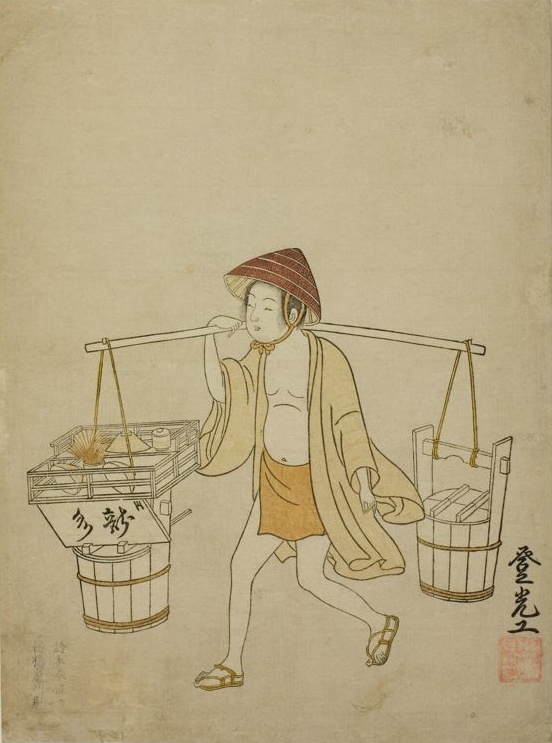
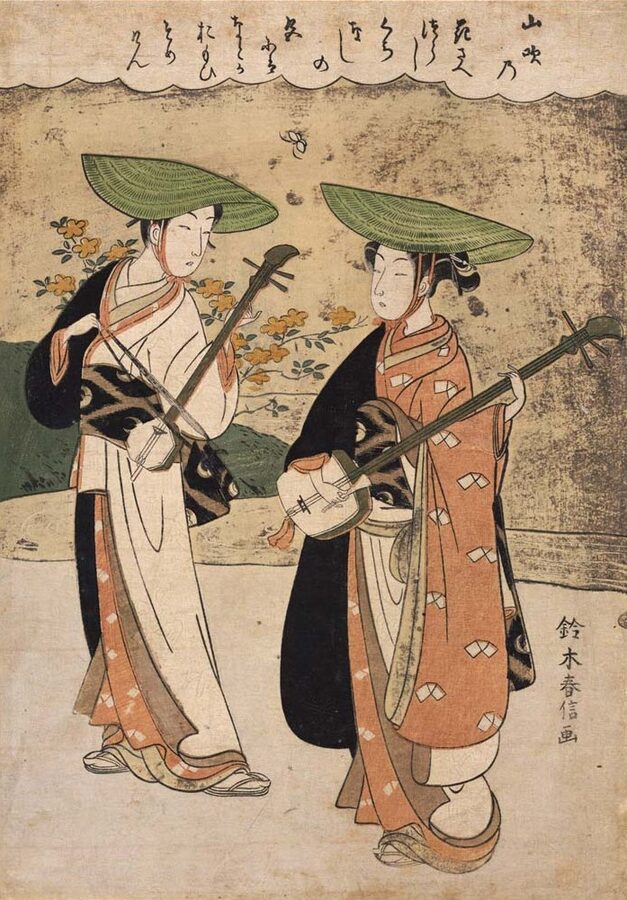
The designer they used was Suzuki Harunobu (鈴木春信), a landlord in Kanda whose neighbour and friend was the inventor and showman Hiraga Gennai. With nobody counting the cost, Harunobu and his carvers and printers used seven, eight and more blocks on a sheet, thick Echizen hōsho paper that could stand being printed again and again, and colours softened with white into chalky half-tones. The results were called Azuma nishiki-e, “brocade pictures of the East”, partly in praise and partly to tell them apart from a Kyoto novelty that already used the name nishiki-e. When the calendar season was over, the publishers reused the blocks: the patron’s name was cut out, the artist’s put in, and the prints went on sale.
The commercial version swept everything before it. By about 1780 almost no other kind of ukiyo-e print was being made, and by the 19th century a nishiki-e and an ukiyo-e print meant the same thing. Harunobu had only five years to enjoy it before he died in the sixth month of 1770, and one of his pupils, the future pioneer of Western-style etching Shiba Kōkan, admitted in later life that he had turned out Harunobu prints, signature and all, after the master’s death.
Four trades and an inspector
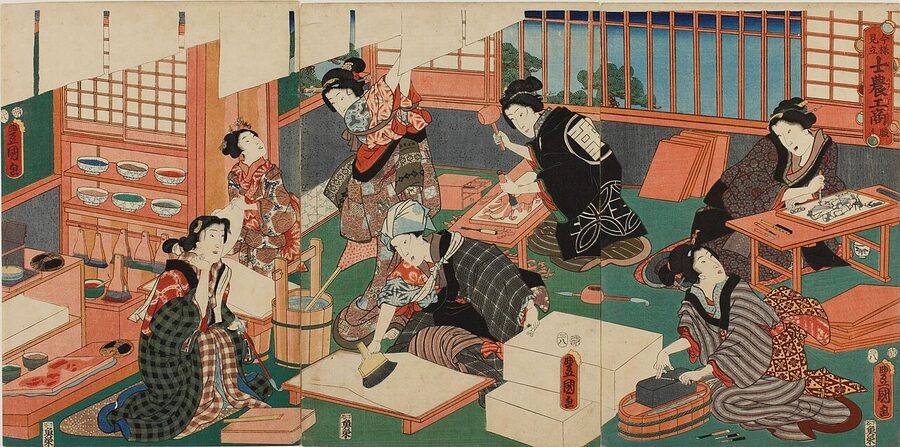
A print began with the publisher, the hanmoto (版元), and the order matters, because the Western habit of treating ukiyo-e as artists’ work hides who was in charge. The publisher chose the subject, hired the designer, paid the carver and printer, owned the blocks, and sold the result, usually from his own shop. Edo’s picture publishers were jihon-don’ya, dealers in local books, and more than a thousand of them are known across the period; at the peak, in the 1840s and 1850s, around two hundred were trading in Edo alone. Only two names normally appear on a finished print, the designer’s and the publisher’s, and the publisher’s is the one that tells you who took the risk.
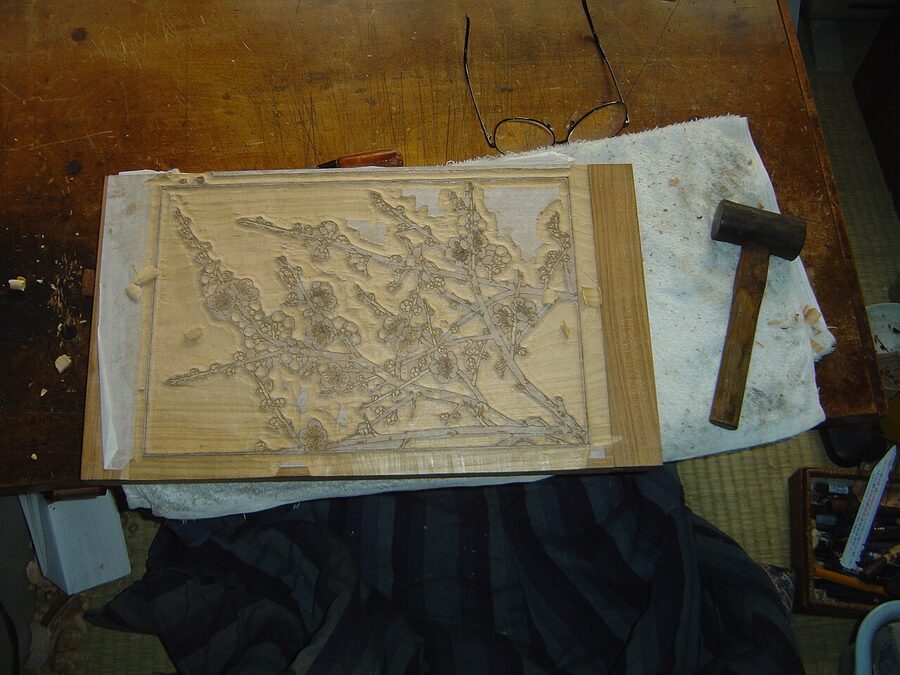
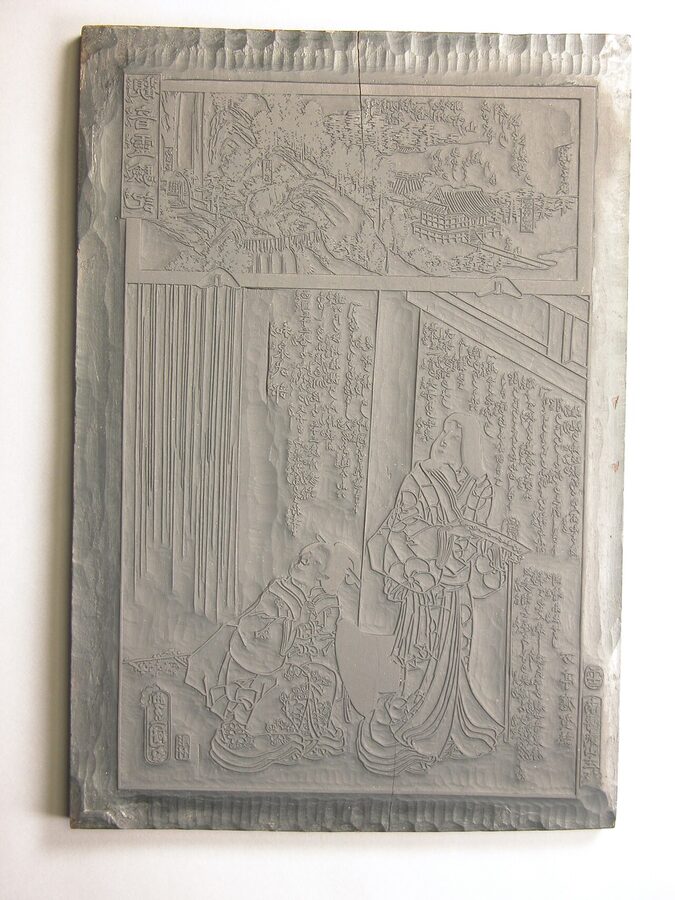
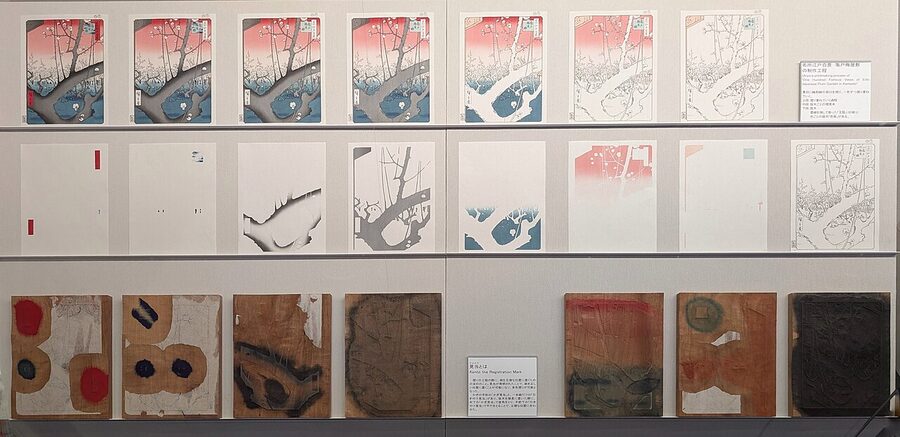
The designer, the eshi (絵師), drew the composition in black ink on thin paper. The publisher took this drawing to the ward official responsible for picture books for a seal of approval, and only then did it go to the carver, the horishi (彫師). He pasted it face down onto a plank of mountain cherry, cut along the grain, and carved straight through it, which is why almost no finished design drawings survive: the drawing was destroyed in making the key block, the omohan.
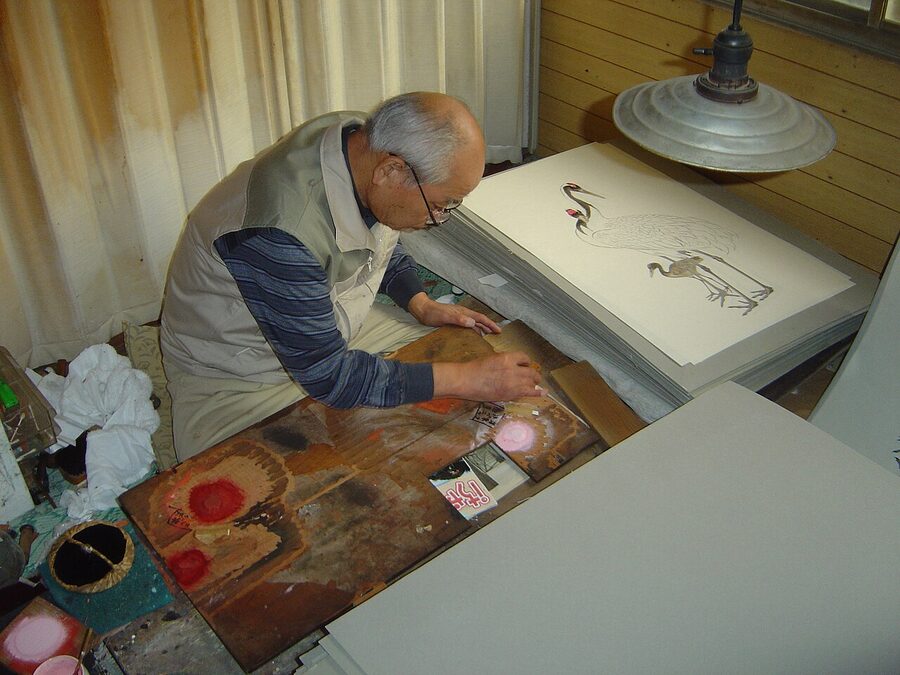
From the key block the printer, the surishi (摺師), pulled a dozen or so proofs in black, and these went back to the designer, who marked each one in red to show where a single colour should go. The carver then cut one block per colour from the marked proofs, leaving the L-shaped notch and the straight guide, kagi and hikitsuke, that make up the kentō. The printer brushed water-based colour onto the raised surface, laid the damp paper against the registration marks, and rubbed the back with a baren, a disc of coiled cord wrapped in a bamboo sheath. The paper had first been sized with dōsa, a mix of animal glue and alum, so that the colour stayed where it was put.
The tricks were in the printing. A printer could wipe a graded tone across a block before each pull, bokashi, so that a sky darkened towards the top; print with no colour at all to emboss the pattern of a collar, karazuri; dust mica onto a wet glue ground so that the background glittered; or burnish the blacks to a shine. The colours were safflower pink, indigo and dayflower blue, turmeric and gamboge yellow, red ochre and vermilion, and from around 1830 the imported Prussian blue that Japanese printers called bero-ai, “Berlin indigo”. A first printing, the hatsuzuri, commonly ran to about two hundred sheets, and if it sold, the publisher simply printed more, owing the designer and the carver nothing further.
Then the print went into the shop. Prints were sold at ezōshi-ya, picture-book shops that hung the new sheets on strings across the shopfront, and by hawkers who carried them round the streets, and visitors to Edo bought them as azuma-e, “eastern pictures”, to take home much as you might buy a postcard. The price is the one fact everybody remembers, that a print cost the same as a bowl of noodles, and for once the cliché is close to the record. Diaries and travel journals put a large nishiki-e at around twenty mon from about 1800 to the mid-19th century, and street soba was sixteen mon by the shogunate’s last years.
The best single source is a passage in a comic book of 1805 by Santō Kyōden listing what small change would buy: two actor prints for sixteen mon, two storybooks for eighteen, one big brocade picture for twenty. At the top of the market, Harunobu’s eight-sheet set Eight Views of the Parlour had gone out in a paulownia box for one bu of gold, about a thousand mon, and in 1840 the novelist Kyokutei Bakin complained in his diary that a Kuniyoshi triptych of a scene from his own novel Hakkenden was overpriced at 118 mon, then bought it anyway because he heard it used extra colour blocks.
Tsutaya Jūzaburō, the publisher who made the names
If you want to see what a publisher could do, look at Tsutaya Jūzaburō (蔦屋重三郎), Tsutajū to his friends. He was born in the Yoshiwara on the seventh day of the first month of 1750 and adopted at the age of seven by the Kitagawa family, whose shop was called Tsutaya. In 1773 he opened a small bookshop on the road that led up to the quarter’s great gate, selling and lending the saiken, guides to the Yoshiwara that listed every house, every courtesan and her rank. Within two years he was publishing his own, and since he had grown up inside the quarter, it was the best.
In the ninth month of 1783 he bought out a shop in Tōriabura-chō in Nihonbashi, the street where Edo’s old-established picture publishers stood and set about publishing the sharpest comic writers and poets in the city: Ōta Nanpo, Santō Kyōden, Koikawa Harumachi, Hōseidō Kisanji. He lodged the young Utamaro under his own roof, took on Kyokutei Bakin as a clerk, and put up Jippensha Ikku in the years before Ikku wrote the most popular comic novel of the age. Bakin’s verdict was that plenty of men had lost a fortune in the Yoshiwara, but precious few came out of it and made one.
Then politics arrived. In 1787 Matsudaira Sadanobu became senior councillor and launched the Kansei reforms, a programme of thrift, moral improvement and censorship meant to tighten the grip of the Tokugawa shogunate after the free-spending years of Tanuma Okitsugu. Tsutaya’s writers lampooned it in comic books that sold, according to Bakin, as nothing had sold before, and the government banned three of them. Harumachi was summoned to explain himself and died before he answered; Kisanji’s lord ordered him to stop writing.
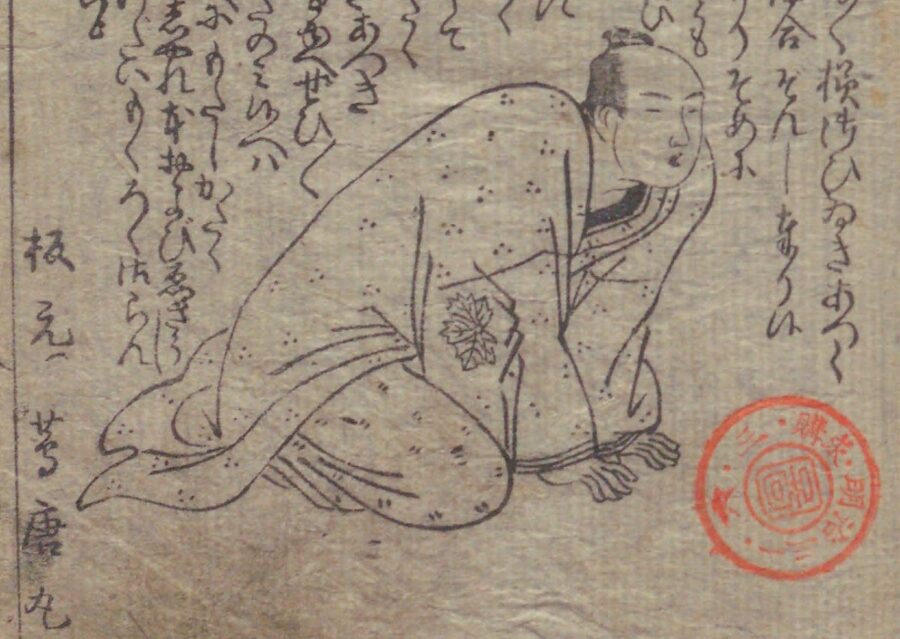
In 1791 the authorities caught up with Tsutaya himself, over a comic book and three sharebon, witty little novels of the pleasure quarters, all by Kyōden. Kyōden was sentenced to fifty days in handcuffs, a common punishment that meant living at home with your wrists locked together, and Tsutaya was fined half of everything he owned. The picture below comes from that very comic book, and shows the publisher on his knees.
He changed direction rather than stopping. Tsutaya bought a licence to publish serious books, so that he could deal in scholarship as well as jokes, and put his money into single-sheet prints, and above all into Utamaro.
Faces: actors, beauties and close-ups
Actor prints, yakusha-e, were the bread and butter of the trade, made for each new production the way posters are now, and for most of the 18th century nobody expected them to look like anybody. The Torii school drew actors as types, the hero, the villain, the young lover, identifiable mainly by their family crests. In the 1770s Katsukawa Shunshō started drawing faces you could tell apart without reading the label, and his likenesses of stars like Ichikawa Danjūrō V drove the Torii manner out of the market; he did the same to prints of sumo wrestlers. His best-known pupil started out under the name Shunrō and is better known as Hokusai.
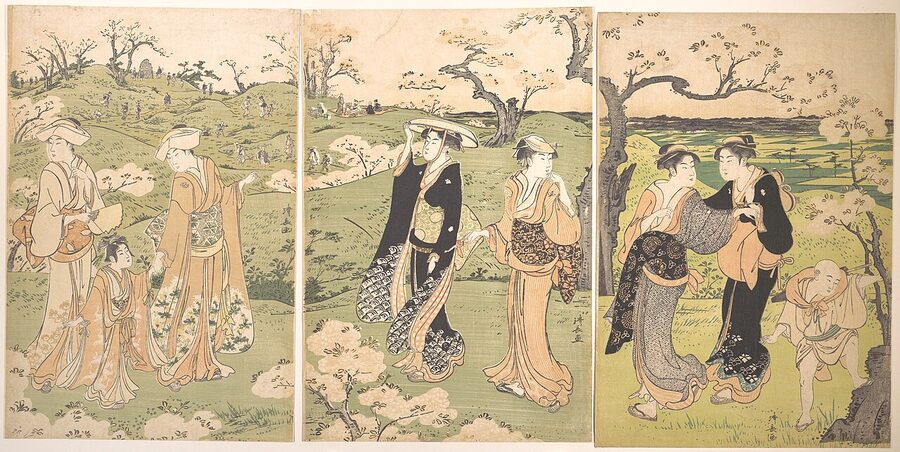
Beauties, bijin-ga, were the other staple. In the 1780s Torii Kiyonaga, head of the Torii school, drew tall, composed women in groups that ran across two and three sheets, set in real places around Edo with real weather, and for a decade he was the most admired designer in the city. His women are idealised and almost interchangeable. Then Tsutaya and Utamaro went in close.
Utamaro and the Kansei beauties
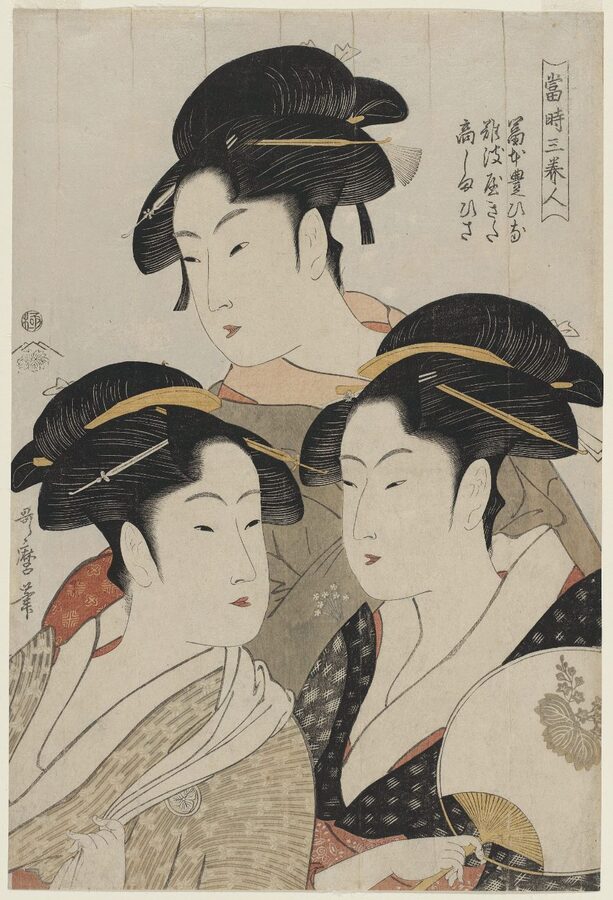
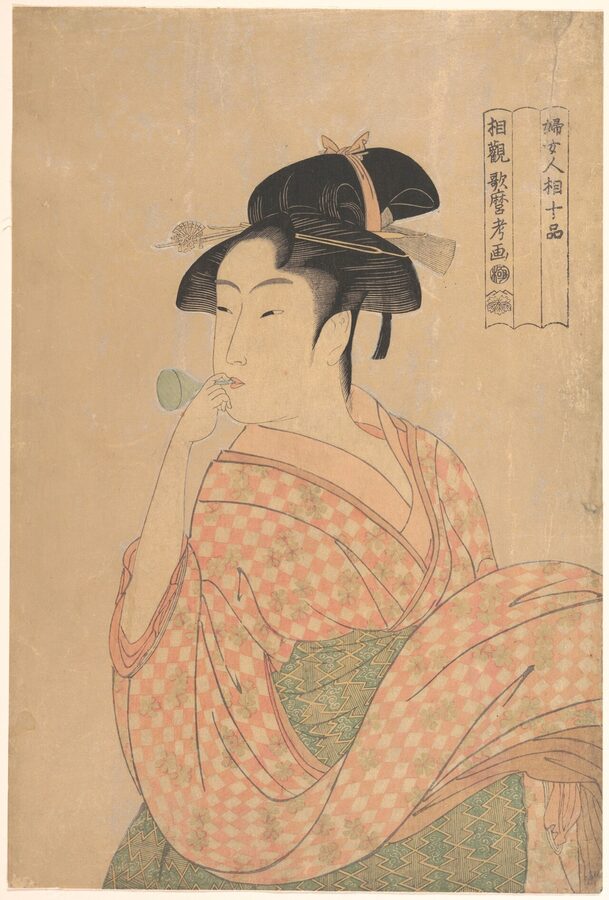
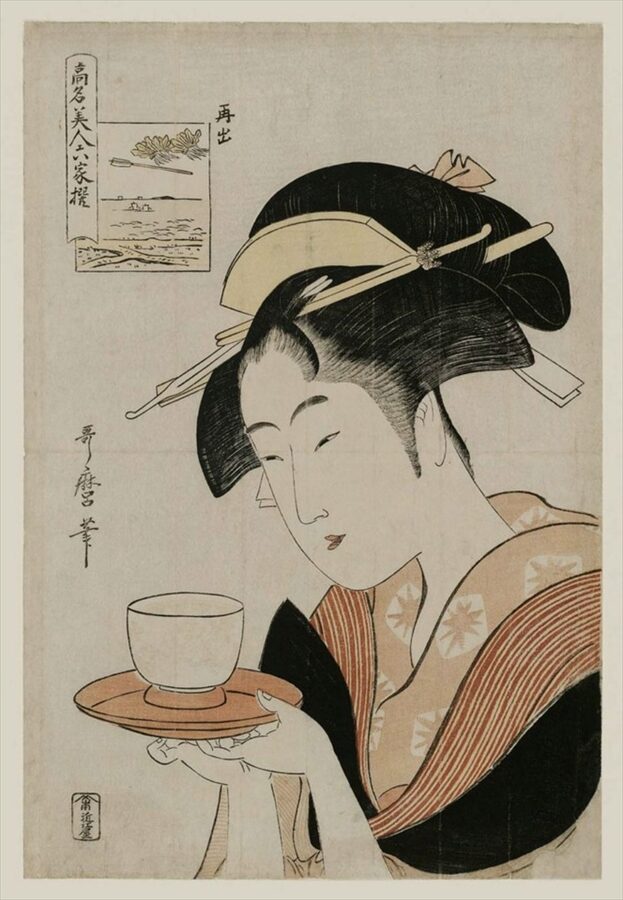
Kitagawa Utamaro (喜多川歌麿) had been working with Tsutaya since the early 1780s, illustrating luxury books of comic verse printed with every trick the shop’s craftsmen knew, and around 1792 the two men tried something new. They took the ōkubi-e, the “big head” close-up already used for actors, and turned it on women, cropping the figure at the chest so that face, hand and hair filled the sheet. Utamaro used the space for something no designer had bothered with before: telling women apart, by the set of a face, a gesture, a mood, rather than by their clothes.
The most famous women in the series were not courtesans at all. The Three Beauties of the Kansei era were Naniwaya Okita, who served tea at a stall beside the Zuishin-mon gate of Sensō-ji; Takashima Ohisa, daughter of a rice-cracker shop at Yagenbori near Ryōgoku; and Tomimoto Toyohina, a Yoshiwara geisha and singer. The story that Okita’s stall drew such crowds that she raised the price of her tea has been told ever since and cannot be checked. What is documented is the government’s response, an order that the names of townswomen were not to appear on single-sheet prints.
Tsutaya and Utamaro answered with a rebus. In the series Kōmei bijin rokkasen, Famous Beauties as the Six Poetic Immortals, of about 1795 to 1796, each woman’s name is spelled out by a little picture puzzle in a panel at the top of the sheet. In 1796 the rebus names were banned as well. Utamaro and Tsutaya drifted apart, by most accounts over how far to push the censors, and the publisher went looking for another hit.
Ten months of Sharaku
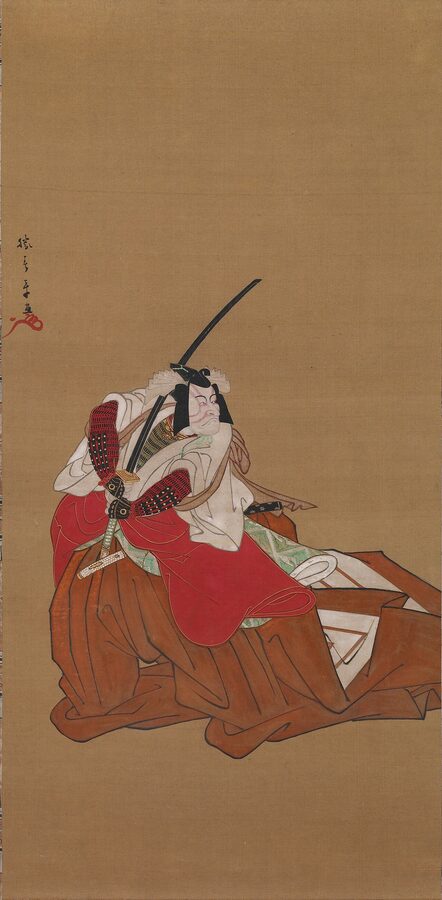
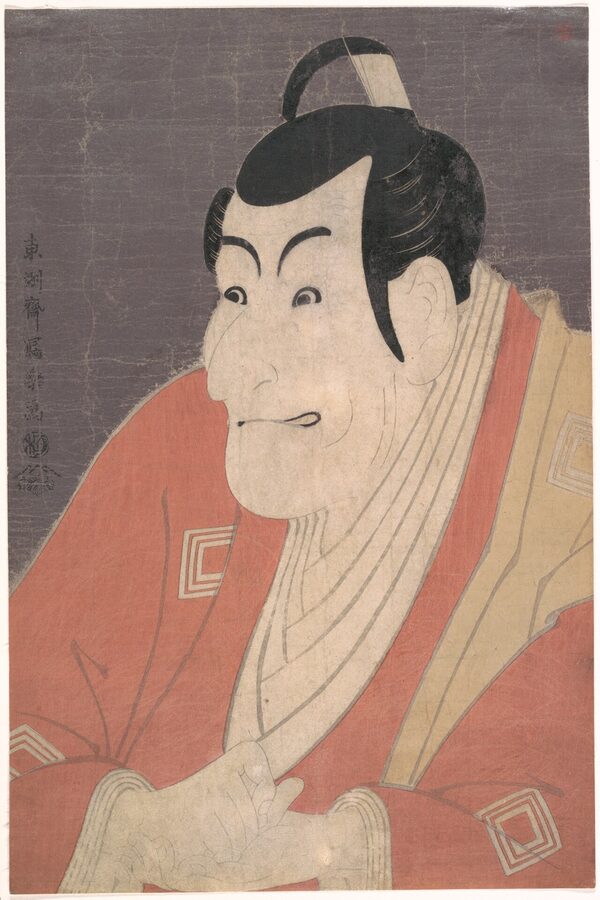
The hit Tsutaya chose was a complete unknown. In the fifth month of 1794 his shop brought out, all at once, twenty-eight large prints of kabuki actors in close-up, each on a dark ground of mica, by a designer signing himself Tōshūsai Sharaku (東洲斎写楽). Nobody in Edo had heard of him. Launching an untried artist on that scale and at that expense was without precedent, and scholars have wondered ever since whether someone else was paying.
The prints were the opposite of flattering. Sharaku drew the faces under the make-up: Ichikawa Ebizō’s great hooked nose, the heavy jaw of a man playing a young woman, the middle age of stars billed as young lovers. A few of them are among the most striking pictures ever made in Japan, and they did not sell. Ōta Nanpo’s notes in the Ukiyo-e ruikō, the nearest thing Edo produced to a dictionary of print designers, dispose of him in a sentence: he tried so hard to draw the truth that he drew the actors as they ought not to be shown, and so he did not last, and stopped within a year or two.
Over the next eight months the shop issued more than a hundred further Sharaku designs, smaller, cheaper and visibly weaker, until the last appeared in the first month of 1795. Japanese reference works count about 145 in all, and some give 149, depending on how you treat drafts and sumo prints. “Ten months” is the usual figure for his career, and it only adds up because 1794 had an extra, intercalary eleventh month. Then he disappeared.
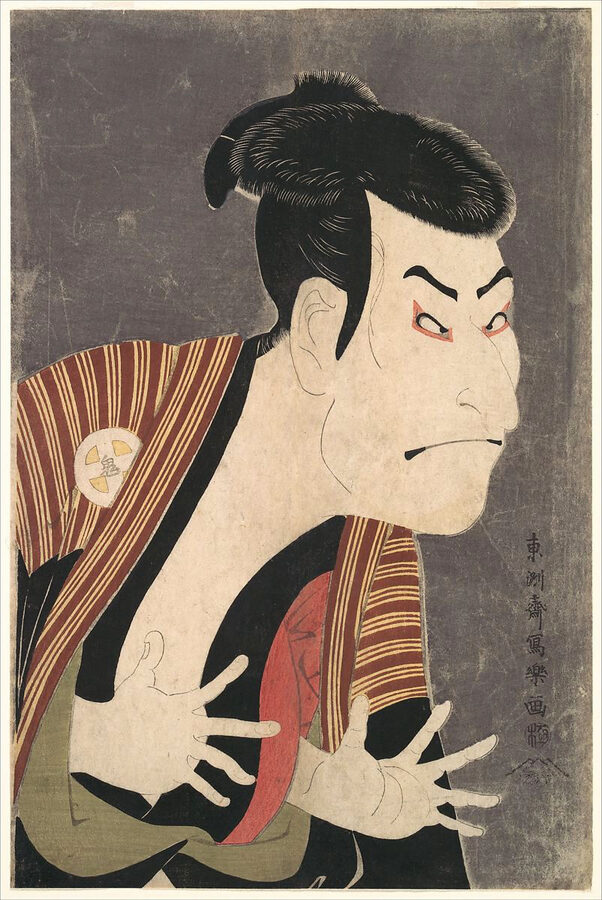
The disappearance produced two centuries of guessing. Candidates have included Hokusai, Utamaro, Toyokuni, Santō Kyōden, the Kyoto painter Maruyama Ōkyo and Tsutaya himself. The only Edo-period answer, a note added to the Ukiyo-e ruikō, said he was Saitō Jūrobei, a Noh actor retained by the lord of Awa and living at Hatchōbori, and for a long time nobody could find any other trace of such a man.
Then the documents turned up one by one: Saitō’s name on the rolls of the Hachisuka household’s actors, a “Sharakusai” listed at Jizōbashi in Hatchōbori in a directory of Edo’s cultured residents, and, in 1997, a temple death register in Koshigaya recording that Saitō Jūrobei of Jizōbashi, Hatchōbori, a retainer of Awa, died on the seventh day of the third month of 1820, aged fifty-eight. Most Japanese scholars now accept that the Noh actor was Sharaku. It does not explain how a Noh actor came to draw like that, though a man with a post in a daimyo’s household had every reason not to make a second career of it.
Heroes, landscapes and the bedroom
The 19th century belonged to the Utagawa school, the largest dynasty ukiyo-e produced, built up by Toyokuni, whose pupils took a character from his name: Kunisada, Kuniyoshi and dozens more. But the two men who changed what ukiyo-e was about stood a little apart.
Hokusai turned landscape from a backdrop into a subject with his Thirty-six Views of Mount Fuji in the early 1830s, the series that includes the Great Wave off Kanagawa, and Utagawa Hiroshige answered within a few years with The Fifty-three Stations of the Tōkaidō. Hiroshige then finished the Sixty-nine Stations of the Kisokaidō, begun by Keisai Eisen, which did for the Nakasendō what his Tōkaidō had done for the coast road. Both have their own articles here. For this story the point is commercial: landscape sold, and it sold best when the government made beauties and actors dangerous to publish.
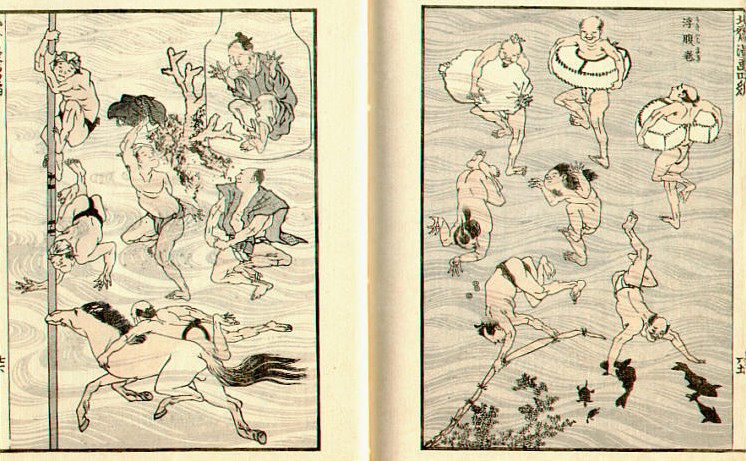
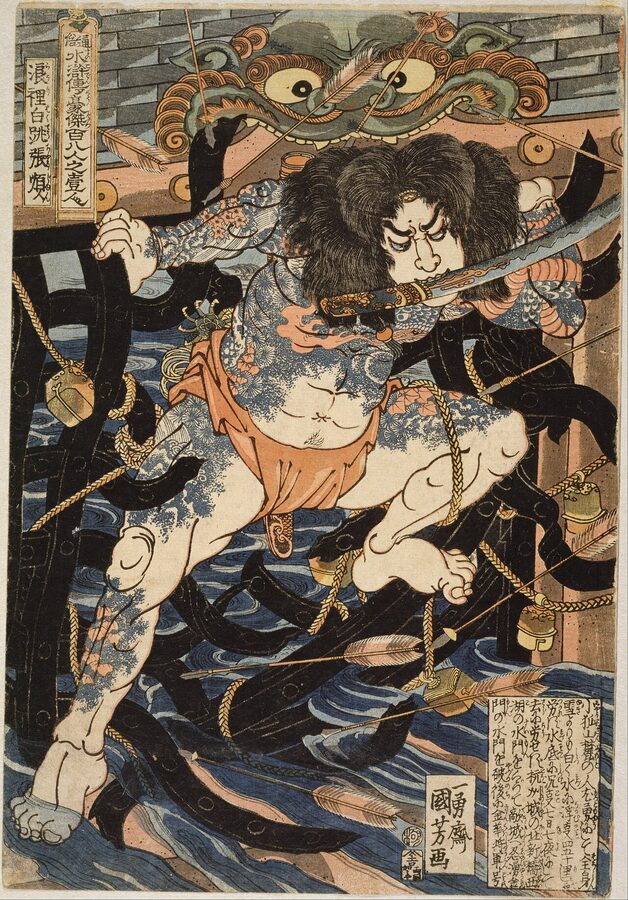
Warrior prints, musha-e, came into their own with Utagawa Kuniyoshi (歌川国芳), who spent years in the shadow of his master and his fellow pupil Kunisada until, around 1827, the publisher Kagaya Kichiemon issued his series of heroes from the Chinese novel Suikoden, The Water Margin. The outlaws brawl in rivers, fight underwater and are covered in tattoos, and the series made him “Kuniyoshi of the warrior prints” more or less overnight. It is often said that Edo firemen had his heroes tattooed onto their backs; the full-body tattoo certainly took off in the same years.
Kuniyoshi turned to Japanese heroes too, among them Minamoto no Yoshitsune, Miyamoto Musashi and, in 1847, the forty-seven rōnin, in a series of portraits of the loyal retainers one by one. Warrior prints had a second use. Because anything after the 1570s was off limits, designers set their comments on the present in the distant past, and a picture of a Heian hero could be read as a picture of the man in Edo Castle.
Shunga, stated plainly
Nearly every major designer also made shunga (春画), “spring pictures”: explicit erotic prints and books, often funny, frequently absurd in their anatomy, and sold in large numbers. Moronobu illustrated more than fifty erotic books, and Harunobu, Kiyonaga, Utamaro, Hokusai and Kuniyoshi all produced them, whatever the law said. The law said a good deal. The shogun Yoshimune’s publishing edicts of 1722 banned new erotic books outright, and the trade simply carried on.
Sources differ on how openly it carried on. Some English-language accounts say erotica was a minor offence that the censors generally let through; Japanese reference works describe shunga as illegal, never displayed in the picture-book shops, and sold under the counter, through lending libraries, or as paintings commissioned by the rich. The historian Timon Screech has argued that later collectors, especially in the West, exaggerated how relaxed Edo was about these pictures, and I think he is right: something sold under the counter is, by definition, something people were a little nervous about.
The Meiji government, anxious about how Japan looked to Western visitors, suppressed shunga thoroughly, and the first major shunga exhibition in Japan did not open until 2015, at the Eisei Bunko in Tokyo, two years after the British Museum had held one in London.
Seals, handcuffs and a spider
Almost every print you see from after 1790 carries, somewhere in the margin, a small round or oval seal that has nothing to do with art. That year, under the Kansei reforms, the shogunate ordered that every print be checked before publication and stamped with a seal reading kiwame (極), “certified”. From 1842 the stamp named the ward elders who had done the checking, and from the early 1850s it added the year and month, which is why a dealer can often date a late Edo print to within a few weeks. Japanese reference works give 1872, the fifth year of Meiji, as the end of the system.
The rules themselves kept moving. The Kansei edicts went after luxury: no extravagant colours, no expensive finishes, a price cap of sixteen to eighteen mon on new prints from 1795, no names of townswomen, then no rebuses either. An edict of 1804 forbade any picture of warriors from the Tenshō era (1573–1592) onwards with their names, crests or recognisable insignia, and that one brought down the biggest name in the trade.
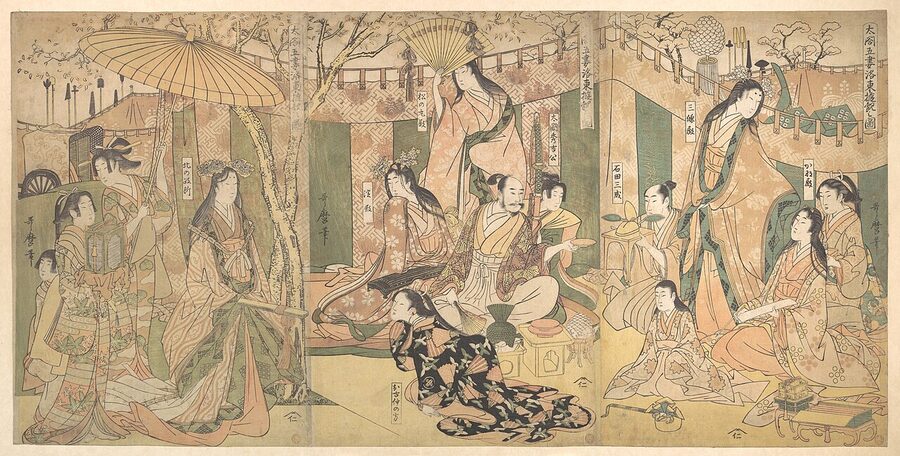
In the fifth month of 1804 Utamaro was arrested over a triptych of Toyotomi Hideyoshi, the Taikō, at a blossom party east of Kyoto with his wives, in which Hideyoshi’s name and crest, the names of his wife and of his concubine Yodo-dono, and the name of Ishida Mitsunari were all given. It was one of a flood of prints and books spun off from Ehon Taikōki, a best-selling illustrated life of Hideyoshi published in Osaka from 1797, and the book itself was banned. Japanese accounts say Utamaro spent three days in jail and then fifty days in handcuffs.
English-language accounts add that Toyokuni, Shuntei and the novelist Jippensha Ikku were manacled with him; one standard English account also says, elsewhere, that no record of his actual punishment survives. He died in the ninth month of 1806. The story that the handcuffs broke him is old, plausible and impossible to prove, and Japanese sources add that once publishers heard he was not expected to recover, they rushed to commission everything they could while he was still able to work.
The Tenpō reforms of Mizuno Tadakuni, from 1841 to 1843, were harsher. In 1842 prints of kabuki actors and courtesans were banned outright, the theatres themselves were moved out to Saruwaka-chō on the far side of Asakusa, colour printing was limited to seven or eight blocks, and the price of a print to sixteen mon. That was the year before the Kanda Festival publisher found himself losing money on a bestseller.
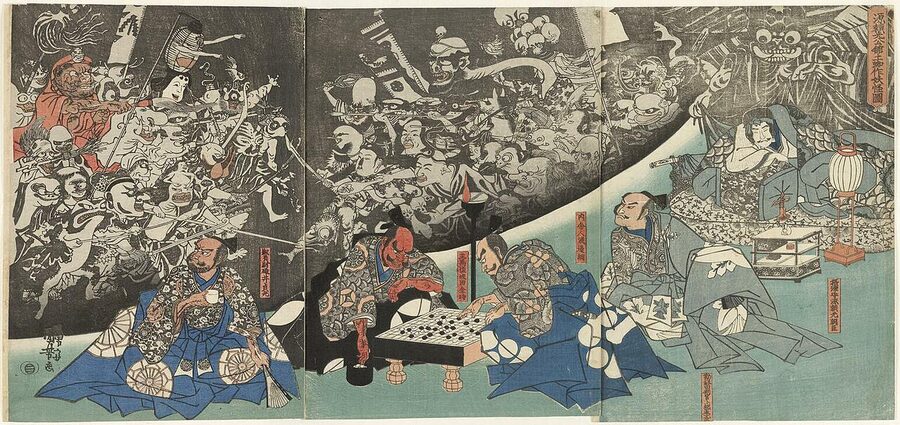
Kuniyoshi answered with a joke the whole city understood. In 1843 Kagaya published his triptych of the earth spider conjuring demons at the mansion of Minamoto no Raikō, the Heian warrior who was supposed to have killed it. Edo read it at once as a satire: the sleeping, bewitched Raikō was the shogun Tokugawa Ieyoshi, the retainer looking the other way was Mizuno, and the goblins crowding in were the people the reforms had ruined. There was a lottery goblin for the banned lotteries, and a toothless long-necked goblin because “no teeth”, ha-nashi, sounds like hanashi, the comic storytelling the reforms had shut down.
The publisher recalled the prints and shaved the blocks flat. Pirated copies appeared at once, and Fujioka-ya noted a recut version by Utagawa Sadahide selling on the quiet for a hundred mon, more than six times the legal price.
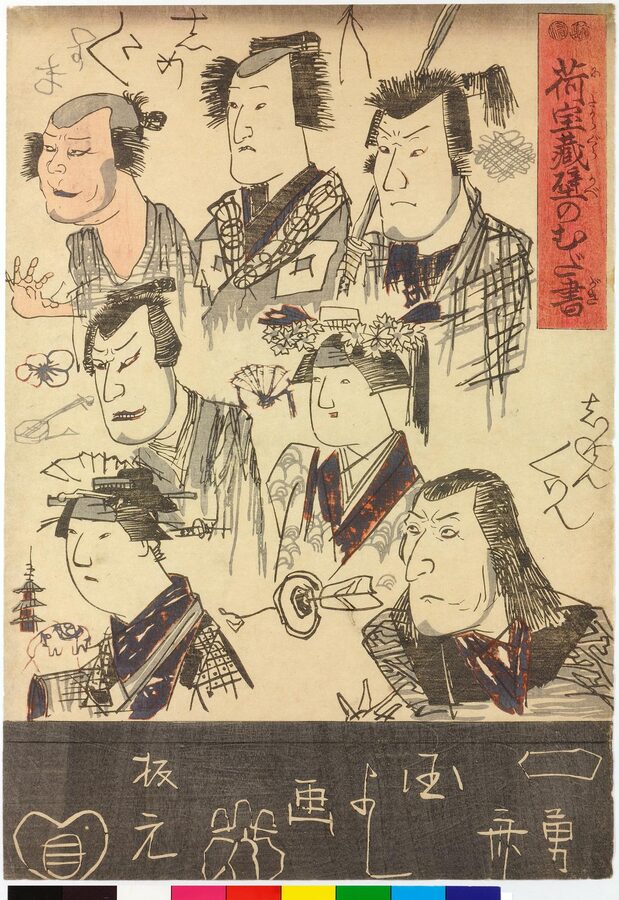
Kuniyoshi kept going. With actor prints banned, he published Scribblings on the Storehouse Wall, a set of faces drawn as if scratched into plaster by a child, which every theatregoer in Edo could identify and no censor could quite call an actor print. He was hauled before the magistrates again and again and fined, and every summons made him more popular.
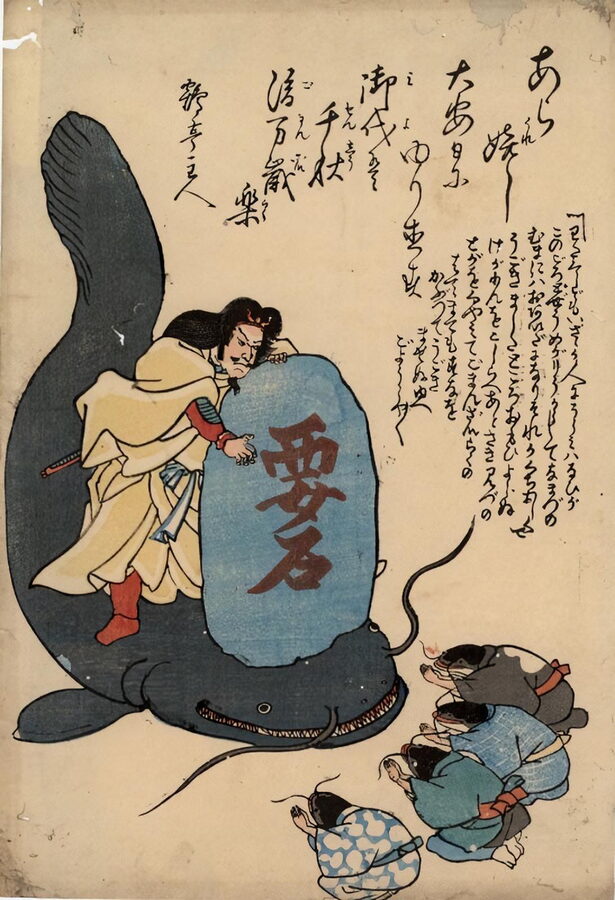
The censors’ power had limits, and an earthquake showed where they were. On the second day of the tenth month of 1855 the Ansei earthquake struck Edo and killed thousands of people. Within days the streets were full of namazu-e, catfish pictures, built on the belief that a giant catfish caused earthquakes and was normally pinned down by the god of Kashima Shrine; the god, people said, had been away at Izumo, since the tenth month was the month without gods.
Hundreds of designs appeared, almost none of them with a censor’s seal, a publisher’s mark or a signature. In some the catfish is beaten by angry townspeople; in others it apologises, or helps the carpenters rebuild, or showers money on the tradesmen getting rich from the disaster.
Yokohama, red ink and the newspaper
The treaties that followed Perry and the Black Ships opened Yokohama to foreign trade in 1859, and Edo’s publishers sent their designers down the road to draw the newcomers. Yokohama-e, mostly by Utagawa-school designers, showed Americans, Britons, Frenchmen, Russians and Dutchmen, their ships, their houses and their horses, with what can generously be called varying accuracy.
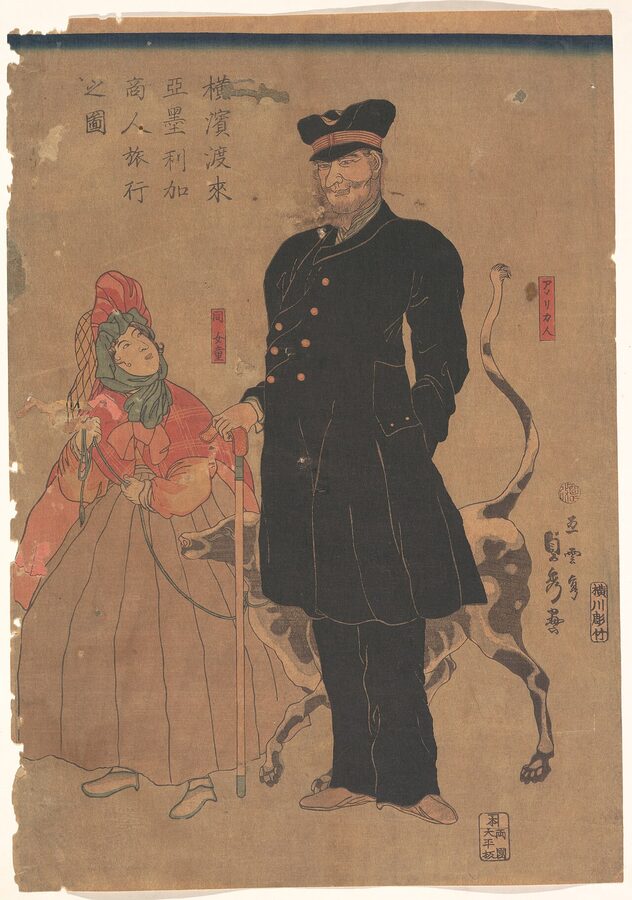
The fall of the shogunate in 1868 dismantled the old censorship and much of the old market with it. Print designers covered the Boshin War as news, above all the fight at Ueno in which the Shōgitai were destroyed, and the new government let them, since the coverage was on its side. Imported aniline dyes, on sale from 1864, gave early Meiji prints a shrieking red that collectors still call aka-e, “red pictures”, and the subjects followed the government’s lead into the Meiji era: brick buildings, gas lamps, the railway from Shinbashi to Yokohama, and the emperor and empress in Western dress.
Woodblock printing turned journalist. In 1874 the Tōkyō Nichinichi Shinbun put out colour-print supplements drawn by Ochiai Yoshiiku, and rival papers hired Tsukioka Yoshitoshi; since a print could never beat a newspaper for speed, these newspaper nishiki-e specialised in murders, ghosts and scandal in the loudest colours available. Prints covered the Satsuma Rebellion of 1877, then the wars with China in 1894 and 1895 and with Russia in 1904 and 1905 by the hundred, and the Sino-Japanese War in particular gave the trade one last boom.
Two designers made something new out of the decline. Kobayashi Kiyochika, a low-ranking retainer of the shogun who had fought at Toba-Fushimi and followed Tokugawa Yoshinobu into retirement at Shizuoka, came back to Tokyo in 1874 and began making prints of the city at dusk, in rain and under gaslight, studied from Western prints and photographs. They were called kōsenga, “light-ray pictures”. Yoshitoshi, who in the 1860s had designed some of the bloodiest prints ever published, spent his last years on One Hundred Aspects of the Moon, from 1885 to 1892, a series of quiet, strange scenes from history and legend.
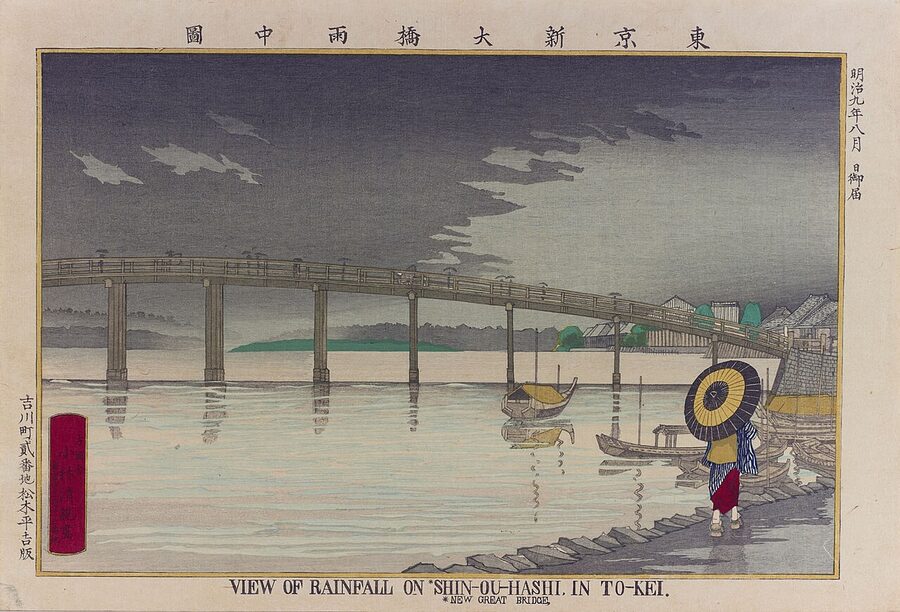
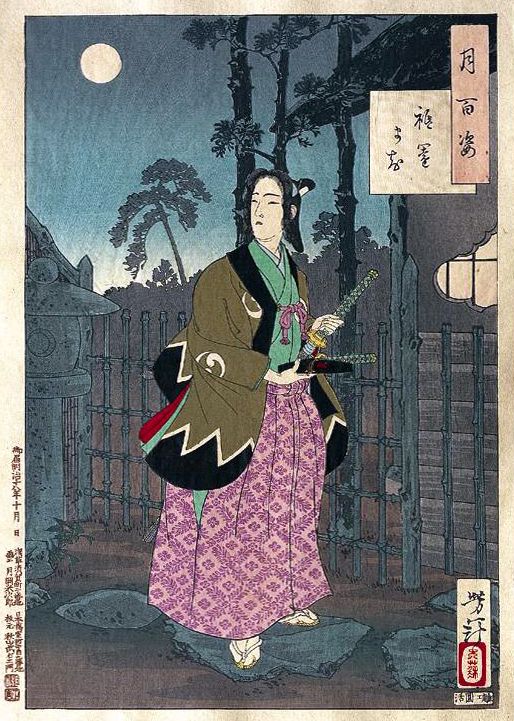
By the turn of the century the market had gone. Photography, lithography and, above all, the picture postcard did the print’s work more cheaply. On 4 October 1907 the Asahi Shimbun ran a piece on the brocade-print wholesalers: the nishiki-e, once counted among the famous products of Edo, had declined beyond recognition, it said, and these days there was nobody left to draw them and nobody to carve them. The painter Kaburaki Kiyokata remembered a few picture-book shops hanging on in Tokyo into the Taishō era, and then they were gone, one more casualty of the sharpest turn in Japan’s long history.
How the prints reached Paris
The prints were already in Europe, and the Europeans had a very different idea of what they were worth. The Dutch at Nagasaki had been taking them home since the 18th century, during the long years of sakoku when theirs was the only European ship allowed in; the Swedish doctor Carl Peter Thunberg collected them during his year on Dejima in the 1770s, and Philipp Franz von Siebold reproduced pages of the Hokusai Manga in his book on Japan from 1832. When Japan sent official exhibits to the Paris Exposition of 1867, prints were among them, and within a few years they were a fashion.
The founding story of that fashion is that in 1856 the etcher Félix Bracquemond came across a volume of the Hokusai Manga at his printer’s workshop, in some versions as the wrapping round a consignment of porcelain, and showed it round his friends. It is a lovely story, and Japanese scholarship has treated it with suspicion since the 1990s, while English accounts still often tell it as fact. What is certain is that by the 1860s Paris had shops selling Japanese goods, where Whistler, Manet and Degas bought prints, and that by the 1870s the critic Philippe Burty had coined a word for the craze, japonisme.
The trade had two great middlemen. Siegfried Bing, a German-born dealer in Paris, published the magazine Artistic Japan from 1888 to 1891 and put on a large ukiyo-e exhibition at the École des Beaux-Arts in 1890. Hayashi Tadamasa, a Japanese dealer based in Paris, helped Edmond de Goncourt with his books on Utamaro and Hokusai and shipped prints out of Japan in such quantities that later Japanese critics accused him of draining the country of its heritage.
Hayashi saw it the other way round. In 1892, in the catalogue of a print exhibition in Tokyo organised by the dealer Kobayashi Bunshichi, he warned that the Japanese looked down on ukiyo-e as vulgar paper pictures and would lose them altogether if they did not change their minds. Who held the first ukiyo-e exhibition in Japan is itself disputed: Kobayashi’s of 1892, Ernest Fenollosa’s in Tokyo in 1898 and the collector Matsukata Kōjirō’s of 1925 have all been given the title.
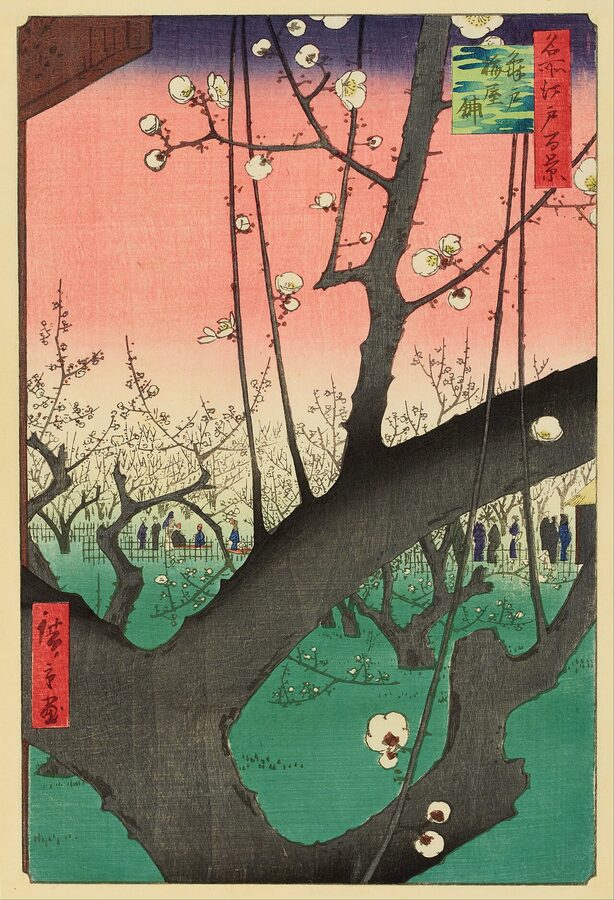
The artist who took the prints most literally was Vincent van Gogh. He and his brother Theo bought them by the hundred from Bing’s stock, he hung them for an exhibition at the Café du Tambourin in 1887, and that year he made oil copies of two Hiroshige prints from One Hundred Famous Views of Edo, Plum Park in Kameido and Sudden Shower over Shin-Ōhashi, and of a courtesan by Keisai Eisen from the cover of a Paris magazine. He even painted borders of Japanese characters around them, almost certainly without being able to read a word.
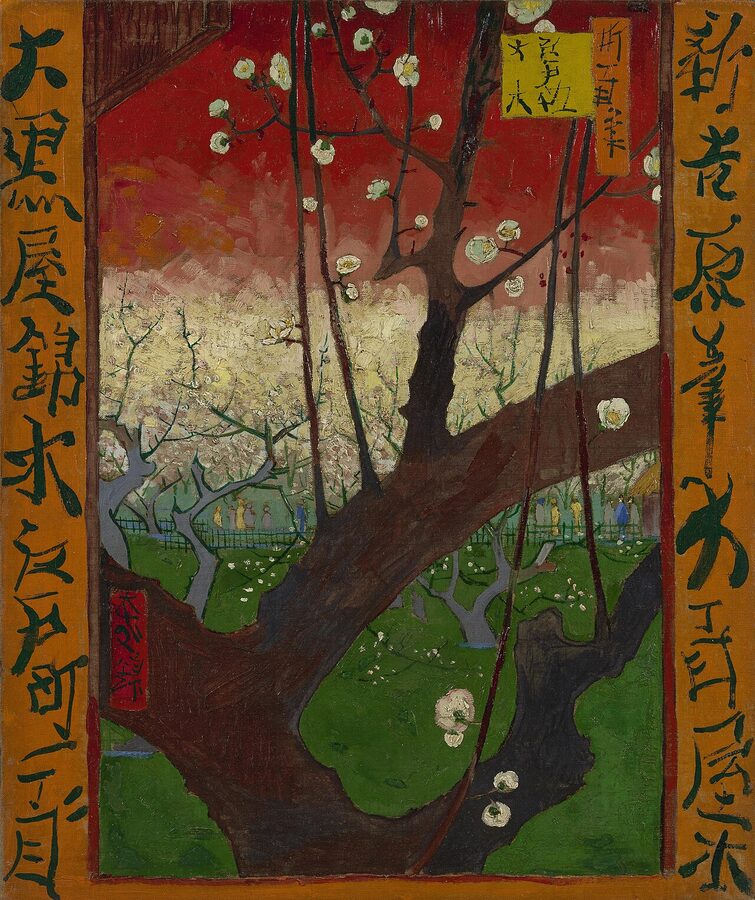
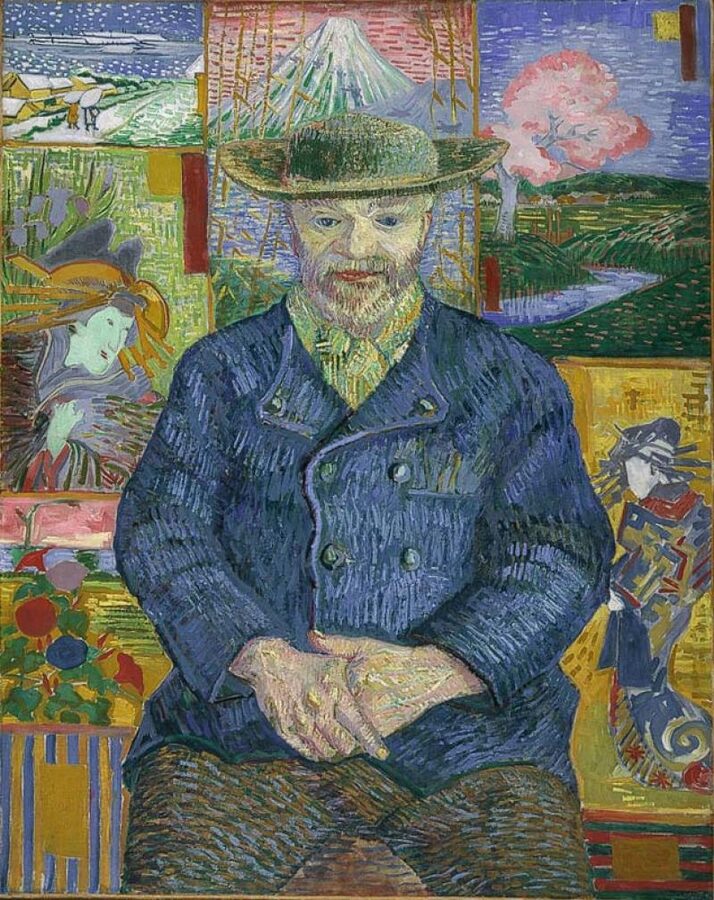
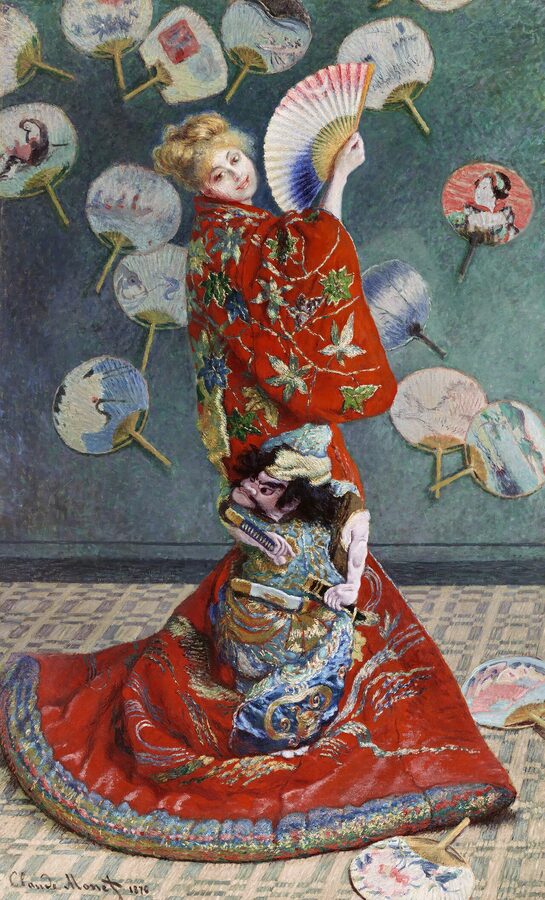
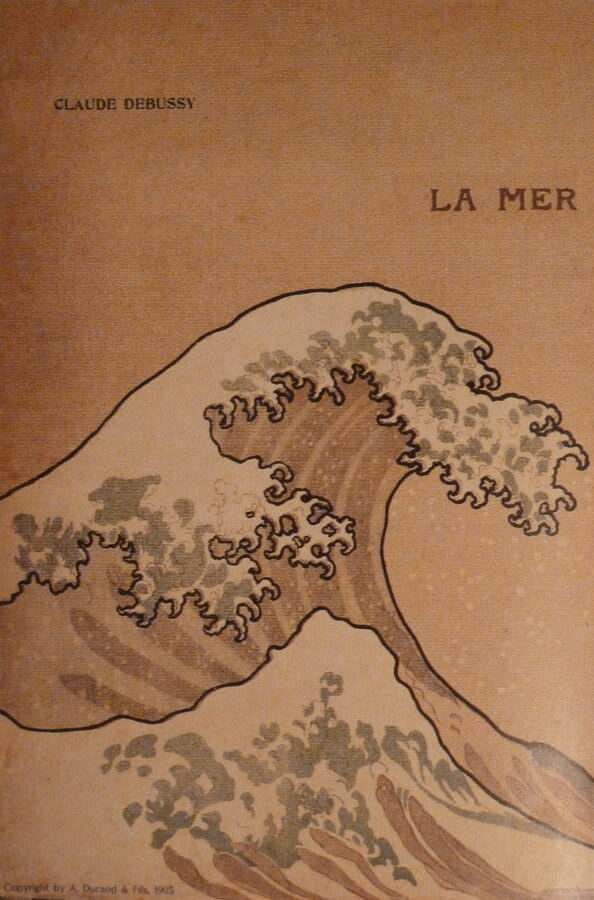
The rest of Paris followed in its own fashion. Monet painted his wife Camille in a red kimono against a wall of fans in 1876, and later filled his house at Giverny with prints and built a Japanese bridge over his lily pond; Degas traded his own paintings for prints; Toulouse-Lautrec signed his posters with his initials in a circle, in imitation of a Japanese seal. In 1905 Claude Debussy, who owned a copy of the Great Wave, had its crest put on the cover of the first edition of La Mer.
The money brought forgers. Takamizawa Enji, a Tokyo dealer, recut old blocks to print fresh colour over faded originals and rubbed tobacco ash into the results to age them; Frank Lloyd Wright took around 1,500 of them back to America and sold a number before the fraud came to light. Today the largest collection anywhere is at the Museum of Fine Arts in Boston, which English sources put at more than 100,000 items and Japanese sources at about 50,000 prints. Japanese estimates put the number of ukiyo-e abroad at about half a million, against some 300,000 still in Japan.
The novelist Tanizaki Jun’ichirō thought Westerners were rather pleased with themselves for “discovering” an art that Japanese of every class had enjoyed all along. I think he had a point.
New prints from an old workshop
In the end a publisher saved the craft. Watanabe Shōzaburō (渡辺庄三郎) had worked for a Yokohama firm selling Japanese art to foreigners, and in 1905 he set up on his own, hiring carvers and printers to make reproductions of old prints. In 1915 he began commissioning new designs in the old system, publisher, designer, carver, printer, and called them shin-hanga, “new prints”. Hashiguchi Goyō, nicknamed the Utamaro of the Taishō era, Itō Shinsui and Kawase Hasui made their names with him, and so did the English painter Charles Bartlett.
Shin-hanga sold far better abroad than at home, where it was dismissed as warmed-over ukiyo-e; exhibitions in Boston in 1924 and in Toledo, Ohio, in 1930 and 1936 did more for it than anything in Tokyo. The Great Kantō Earthquake of 1923 destroyed Watanabe’s shop and much of his stock of blocks, and he started again, taking on the painter Yoshida Hiroshi, who knew the American market. A rival movement, sōsaku-hanga, “creative prints”, rejected the division of labour altogether and insisted that the artist design, carve and print alone, which is how most Japanese printmakers have worked ever since.
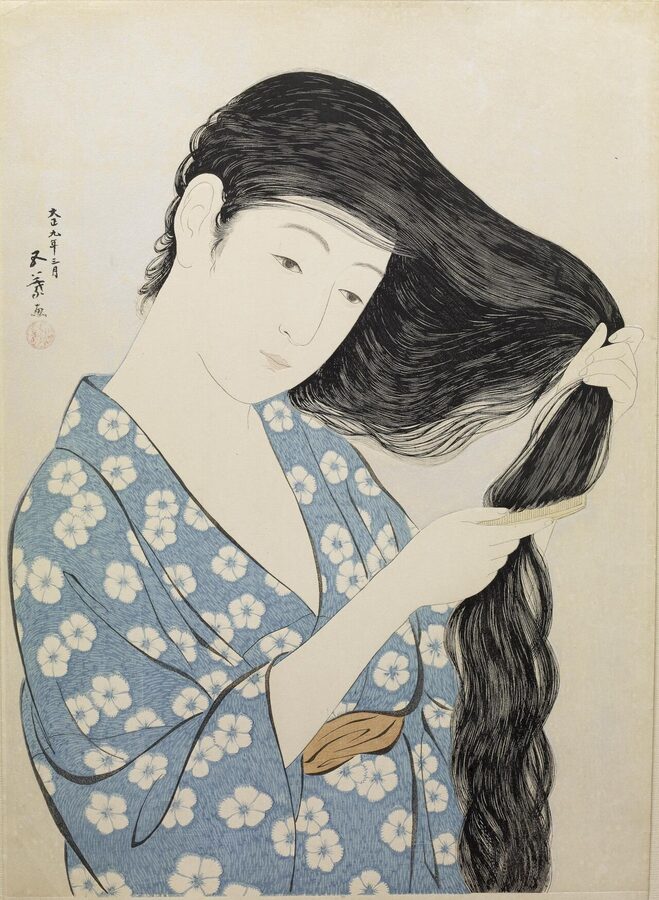
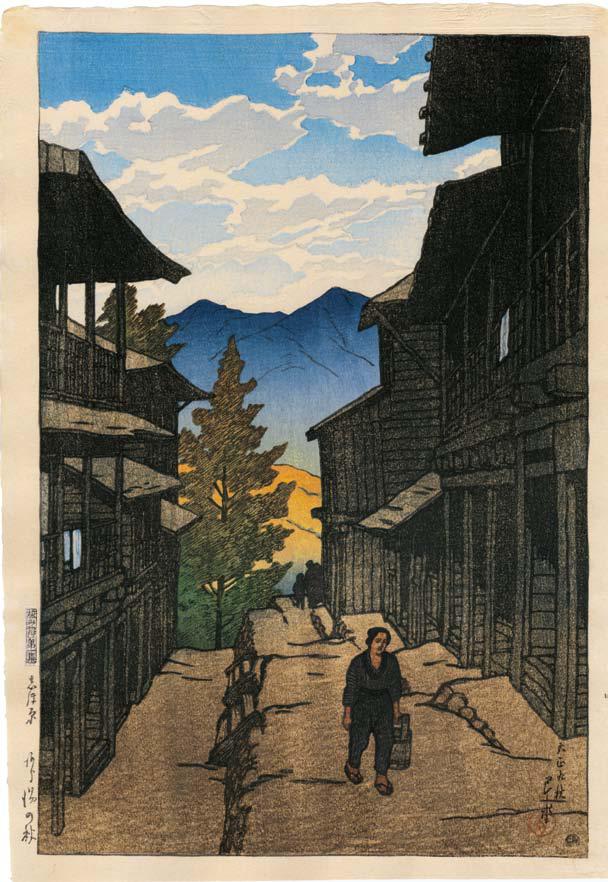
The old workshop system survives. Watanabe’s firm is still in business more than a century on, and the Adachi Institute of Woodblock Prints in Mejiro, which keeps its own trained carvers and printers, reproduces Edo prints and publishes new work by living artists in exactly the old way. If anything deserves a place among Japan’s greatest traditional crafts, it is the skill of a printer who can lay down a gradient by hand two hundred times and get it the same every time.
Where to see ukiyo-e today
The first thing to understand is that you will rarely see the same print twice. Ukiyo-e fade in light, the dayflower blue of Harunobu’s time has gone from most surviving sheets, and museums show originals for a few weeks and then put them back in the dark for years; the Sumida Hokusai Museum says its originals are out for thirty days a year at most. Plan around exhibitions, not collections, and check each museum’s calendar before you go.
Ōta Memorial Museum of Art, Harajuku
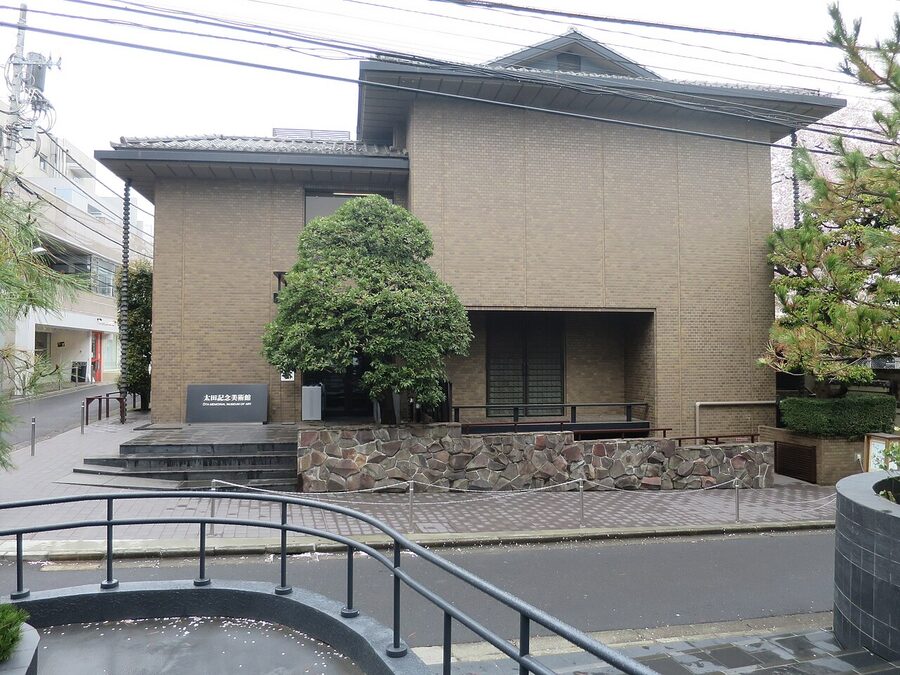
Of Tokyo’s ukiyo-e museums, make this your first stop. It stands on a side street off Omotesandō, five minutes’ walk from the Omotesandō exit of JR Harajuku Station or three from exit 5 of Meiji-jingūmae on the Chiyoda and Fukutoshin lines, and it is given over entirely to ukiyo-e from the collection built by the businessman Ōta Seizō. There is no permanent display; exhibitions change roughly monthly, and the galleries take about an hour.
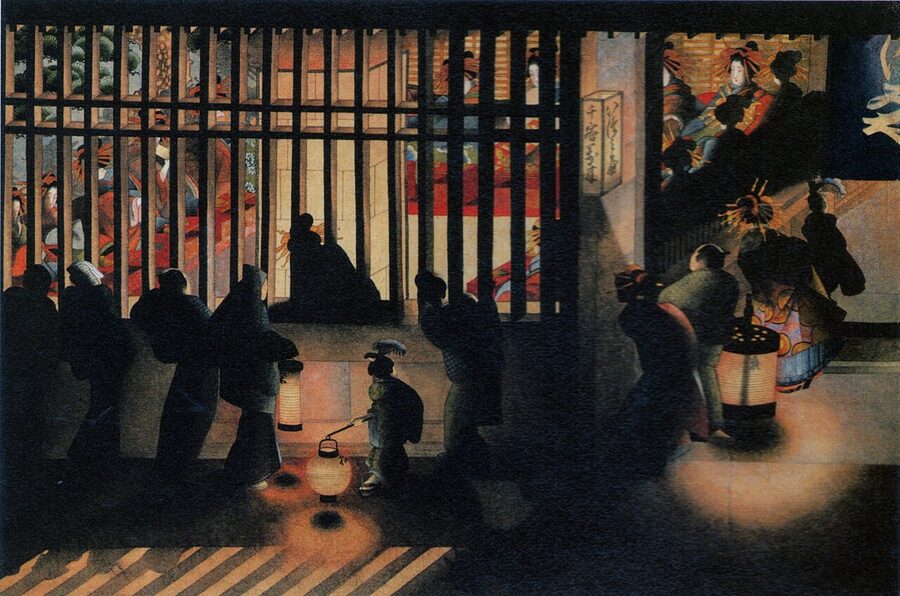
Until 6 December 2026 it is showing Katsushika Ōi’s Yoshiwara Kōshisaki no zu, a night scene of courtesans behind the lattice of a Yoshiwara house, for the first time in three years, with night views by Harunobu, Hiroshige, Kiyochika and others around it; from 12 December to 17 January 2027 the theme is designers you have probably never heard of. Admission to the current exhibition is ¥1,200 (¥800 for high school and university students), cash only, and the museum is open 10:30–17:30 with last entry at 17:00, closing most Mondays and for a few days between exhibitions. Photography is not allowed. The tatami platform where you once took your shoes off was removed in 2022.
Tokyo National Museum, Ueno
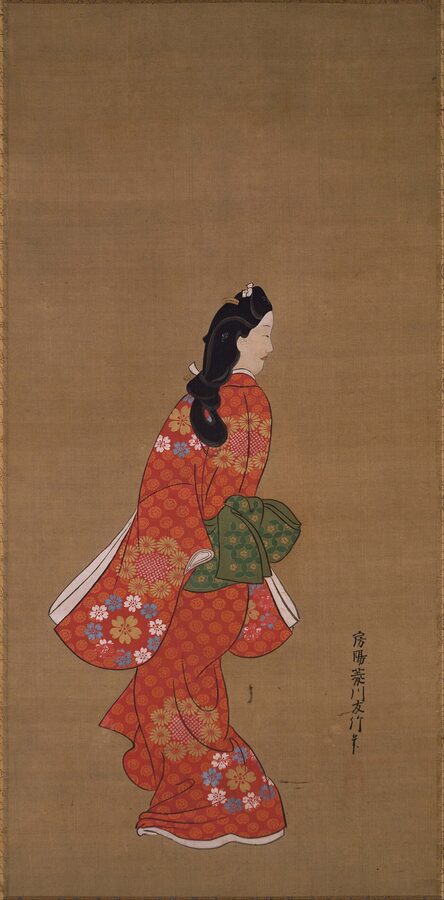
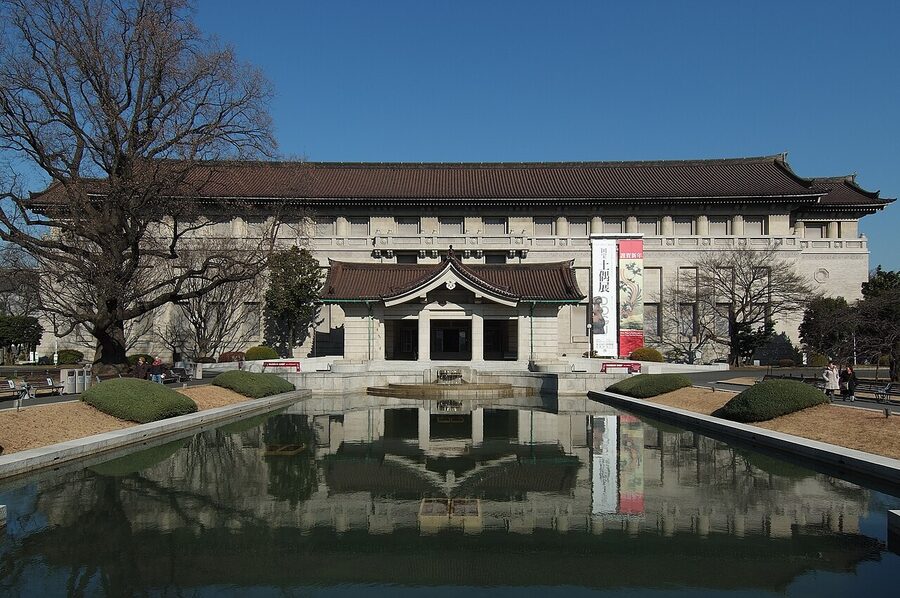
The national collection is the largest in Japan, and its ukiyo-e are shown in Room 10 upstairs in the Honkan, the main building, alongside Edo-period costume, with the selection changing roughly every month. Moronobu’s Beauty Looking Back comes out now and then, and is worth the trip on its own. The collection galleries are open 9:30–17:00 (until 20:00 on Fridays and Saturdays), closed on Mondays, and cost ¥1,000; the museum is ten minutes’ walk from the Park exit of JR Ueno Station.
Until 20 December 2026 the museum is also holding its first full-scale Hiroshige exhibition, built on 1,025 prints from the collection of Uchiyama Susumu, with the three great series shown complete in turn: the Kisokaidō until 23 November, and One Hundred Famous Views of Edo, including Plum Park in Kameido, from 25 November. Tickets are ¥1,500 and also get you into the collection galleries on the same day, and the exhibition is closed on Mondays and on 24 November.
Sumida Hokusai Museum and the Edo-Tokyo Museum, Ryōgoku
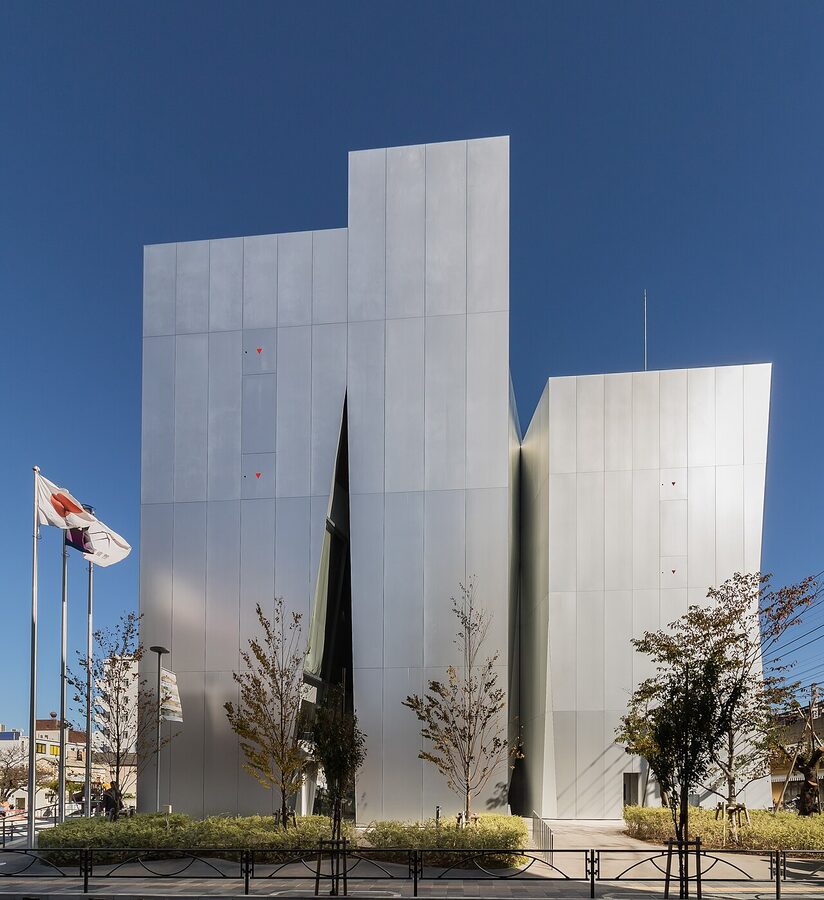
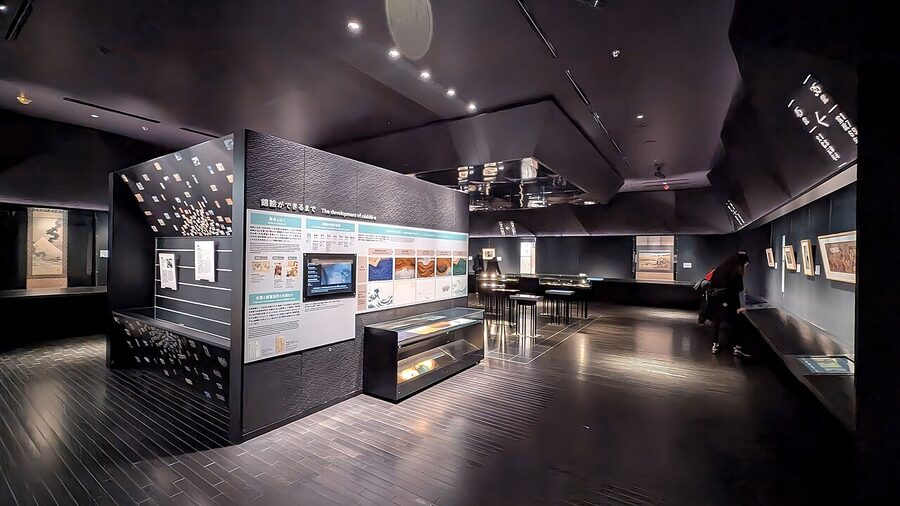
Hokusai was born, and spent most of his life, in what is now Sumida ward, and the ward built this museum, a cluster of aluminium-clad blocks a few minutes’ walk from the east exit of JR Ryōgoku Station. The permanent gallery, AURORA, tells his life in seven sections with full-size, high-definition replicas, because the originals can be out for only thirty days a year, and it has a life-size model of the cramped room where he lived and worked with Ōi at eighty-four. It costs ¥400, more for special exhibitions, opens 9:30–17:30 and closes on Mondays, and photography is allowed in AURORA, with a few exceptions.
The Edo-Tokyo Museum, beside the Kokugikan sumo hall on the other side of the station, has reopened after its long renovation; its permanent galleries cost ¥800. In the autumn of 2026 they included the display of every printing stage of Plum Park in Kameido, blocks and all, shown further up this page; ask at the desk whether it is still there.
Adachi Institute of Woodblock Prints, Mejiro
If you want to see the craft rather than the result, go to Mejiro. The Adachi Institute (アダチ版画研究所) keeps its own carvers and printers and has reproduced around 1,200 ukiyo-e designs; its showroom, ten minutes’ walk from JR Mejiro Station, shows and sells reproductions and new prints by contemporary artists, with a standing display on how they are made. It is a shop, so entry is free, and it opens 10:00–18:00 on weekdays and 10:00–17:00 on Saturdays, closed on Sundays, Mondays and public holidays. Until mid-December 2026 the building is in scaffolding; do not be put off.
The real prize is a printing demonstration. The Adachi foundation runs free sessions on a few Saturdays a year, at its exhibition space in the same building, with a printer working through a print stage by stage while a member of staff explains in Japanese. Places, about thirty-five per session, are allocated by lottery to groups of up to three; the 2026 sessions are all done, and the schedule for the year from April 2027 is due around March. If you can follow some Japanese, watching a printer lay down a bokashi gradient will teach you more than any museum label.
Shōhō-ji, Higashi-Asakusa
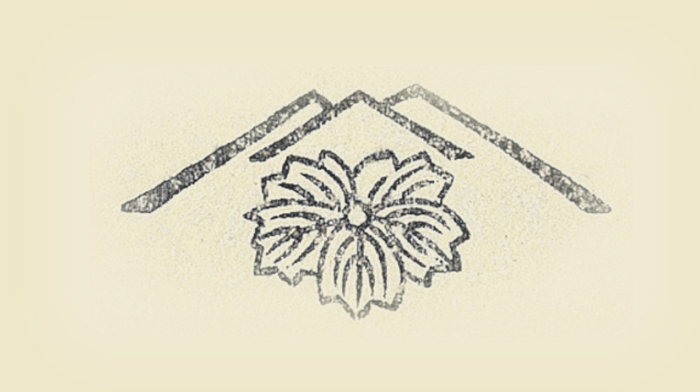
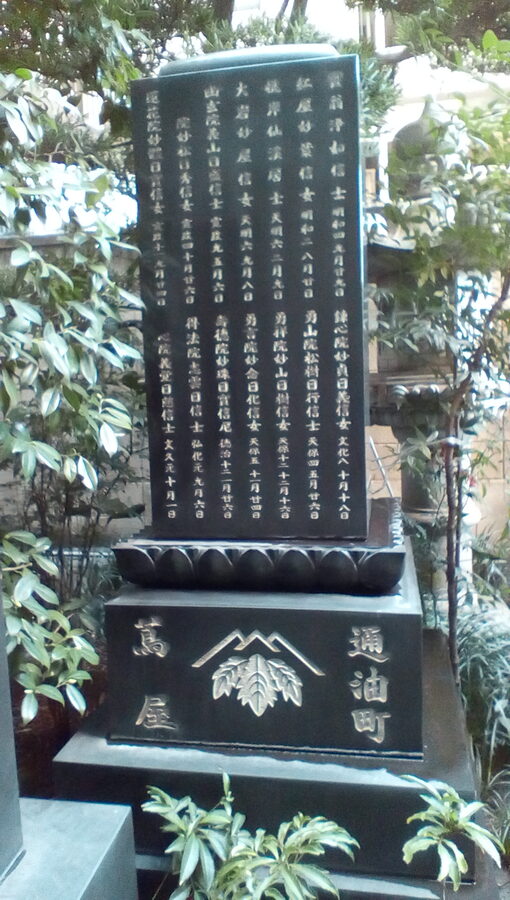
Tsutaya Jūzaburō died of beriberi on the sixth day of the fifth month of 1797, aged forty-seven by the usual count and forty-eight by Bakin’s, and was buried at Shōhō-ji, a small Nichiren temple in Higashi-Asakusa, not far from the Yoshiwara where he was born. The original grave and the epitaph composed for it by the poet Ishikawa Masamochi were lost to earthquake and war, but the temple keeps memorial stones, one carrying the text of the epitaph and one with the shop’s ivy-under-Fuji mark and the name of Tōriabura-chō. It is a walk north of Sensō-ji, an easy addition to a morning there or to the Sanja Matsuri in May; it is a working temple, so keep your voice down and stay out of the family graves.
Japan Ukiyo-e Museum, Matsumoto
Outside Tokyo, the largest collection in Japan, around 100,000 items, belongs to the Sakai family, whose Tokyo shop, Sakai Kōkodō, calls itself the oldest ukiyo-e dealer in the country, and it is shown at the Japan Ukiyo-e Museum on the edge of Matsumoto. Until 20 December 2026 it has an exhibition of travel prints by Kawase Hasui and Yoshida Hiroshi. It is open 10:00–17:00 (last entry 16:30), closed on Mondays, and costs ¥1,000; from the Alps exit of JR Matsumoto Station take the Gurutto Matsumoto bus to the Ukiyo-e Hakubutsukan Rekishi no Sato stop, about twenty-four minutes, or a taxi for about seven. Add Matsumoto Castle and you have a good day.
Boston, Amsterdam and Giverny
If you live near Boston, Amsterdam or Paris you have less excuse than you thought. The Museum of Fine Arts in Boston shows the largest collection anywhere in rotation; the Van Gogh Museum holds both Vincent’s copies and the prints he and Theo collected; and at Giverny, Monet’s house is hung with Japanese prints as he hung it.
Fujioka-ya’s publisher would have been baffled by all of this. He sold a picture of a festival for the price of a bowl of noodles, lost money doing it, and assumed, like everyone in Edo, that the sheets would be pasted up, faded, torn and thrown away. Most of them were. The ones that survived are the reason you now pay ¥1,200 to stand in a dim room in Harajuku and look at one, and on the whole I think that is a better deal than he got.