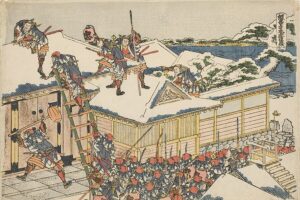
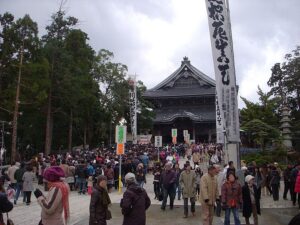
On 18 December 2020 the priests of Amano Iwato Shrine, in the mountains of northern Miyazaki, hung a sacred straw rope across a cave on the far side of the Iwato River gorge. It was the first time anyone from the shrine had managed it since the shrine was founded, and it had been, in the shrine’s own word, a long-held wish. The cave is the one the shrine identifies as the Ama-no-Iwato, the rock door of heaven, behind which the sun goddess Amaterasu shut herself away and left the world in darkness.
The rope has a good precedent. In the Kojiki, compiled in 712, the moment Amaterasu stepped back out into the light a god called Futodama stretched a rope across the cave mouth behind her and told her, politely but firmly, that she was not to go back in. Tradition counts it as the first shimenawa.
Between those two ropes lie thirteen centuries, every period of Japanese history since the Nara court, in which the goddess was a sun, a weaver, a priestess, the grandmother of emperors, a Buddha in disguise, a man in court robes, a paper talisman in nine Edo households out of ten, the keystone of a state ideology and, after a New Year rescript in 1946, something quieter and harder to pin down. I find her the most interesting figure in Japanese myth for exactly that reason: she has never stayed one thing for long.
In This Article
- Born from a washed eye: the goddess in two books
- Armour, a contest and a flayed horse
- Roosters, a mirror and a dance on an upturned tub
- Eclipse, solstice or ritual?
- A grandson, a mirror and an order from heaven
- From the palace to Ise
- Tenshō Daijin: the goddess goes public
- The state takes the goddess
- 1 January 1946
- Prints, masks and a white wolf
- Where to see Amaterasu today
- Ise Jingū: the Naikū
- Amano Iwato Shrine, Takachiho
- Amano Yasukawara
- Takachiho Kagura
- Heiwadai Park, Miyazaki
Born from a washed eye: the goddess in two books
Almost everything anyone knows about Amaterasu comes from two books written within eight years of each other. The Kojiki (“Record of Ancient Matters”), presented to the court in 712, tells one continuous story in a hybrid Chinese script designed to keep Japanese sounds intact. The Nihon shoki (“Chronicles of Japan”), finished in 720, is a formal history in classical Chinese, and it does something the Kojiki never does: after its main text it adds variant versions, introduced with the words “in one writing it says”. Its editors were collecting traditions, not reconciling them, and for Amaterasu the variants matter as much as the main story.
In the Kojiki she is born in a river. Izanagi, the creator god, has just come back from Yomi, the land of the dead, where he failed to bring back his wife Izanami, and he bathes at a river mouth in Himuka in Tsukushi to wash off the pollution. When he washes his left eye Amaterasu is born; from his right eye comes Tsukuyomi, the moon; from his nose comes Susanoo, the storm. Delighted to have three noble children at the end of a long career of creation, Izanagi hands Amaterasu the string of jewels from his own neck and gives her the High Plain of Heaven, Takamagahara, to rule.
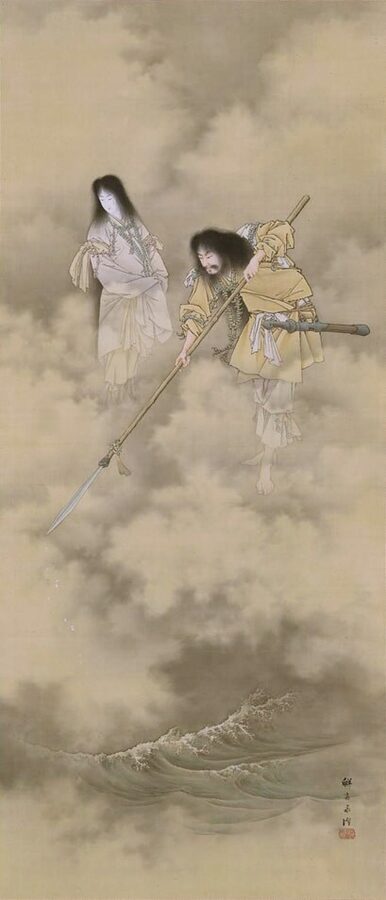
The Nihon shoki main text tells it differently. There Izanagi and Izanami, having made the islands and the mountains, rivers and trees, decide to produce a ruler for all under heaven, and together they produce a daughter who shines through all six directions. She is too splendid to keep on earth, so they send her up to heaven by the ladder that still joins the two.
One variant has Izanagi produce her by holding a white bronze mirror in his left hand, an interesting detail for a goddess whose mirror will matter so much later. Japanese reference works sum this up as three traditions of her birth: from water, from a womb and from a mirror.
The texts give her several names. The Kojiki calls her Amaterasu Ōmikami (天照大御神), “the great august deity who shines in heaven”, which is less a name than a description, a verb wrapped around an honorific. The Nihon shoki main text calls her Ōhirume-no-muchi (大日孁貴), and here the scholars part company. Hirume is usually read as “woman of the sun”, but the character 孁 is close in meaning to “shamaness”, and several Japanese historians read the name as a priestess who served the sun rather than the sun itself.
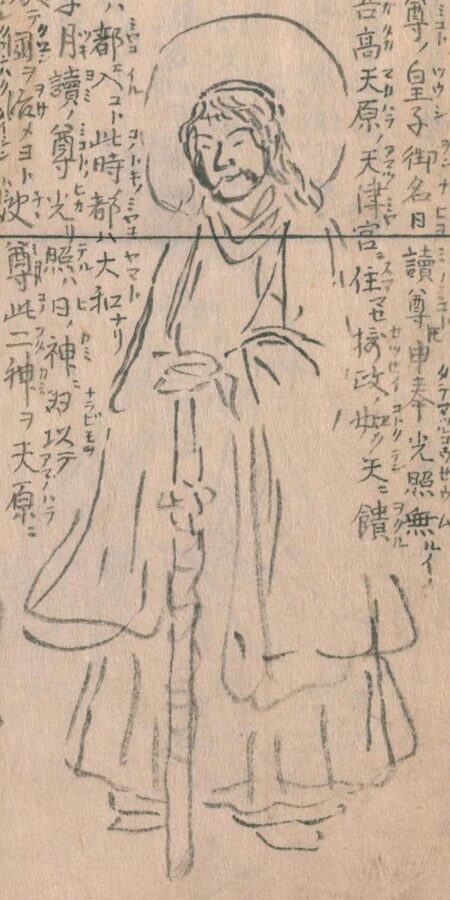
That reading feeds an older argument, about whether she was always a goddess. Neither book states her sex outright, but she calls Susanoo her younger brother, she weaves, and when she arms herself she has to undo her hair and retie it in the boys’ style, which tells you how she normally wore it.
Against that, Edo-period scholars such as Ogyū Sorai, and in the 20th century the historians Tsuda Sōkichi and Matsumae Takeshi, argued that the original sun god of Ise was male. Matsumae pointed out that most of the local sun gods called Amateru, worshipped around the Kinki region and beyond, were male. Every shrine in Japan today treats her as a goddess, and so will I.
Armour, a contest and a flayed horse
The quarrel that sends her into the cave starts with a farewell. Susanoo, given the seas to rule, refuses to rule them and weeps for his dead mother until the mountains wither and the rivers dry. Izanagi throws him out. Before leaving for the underworld, Susanoo climbs to heaven to say goodbye to his sister, and the mountains and rivers shake as he comes.
Amaterasu assumes he has come to take her land. In the Kojiki she lets down her hair, binds it into bunches, winds strings of jewels around her arms, slings a quiver of a thousand arrows on her back and another of five hundred at her side, and stamps the hard ground until her legs sink in to the thigh, kicking up earth like snow. It is one of the best descriptions in early Japanese literature, and it is of a sun goddess preparing for a fight with her little brother.
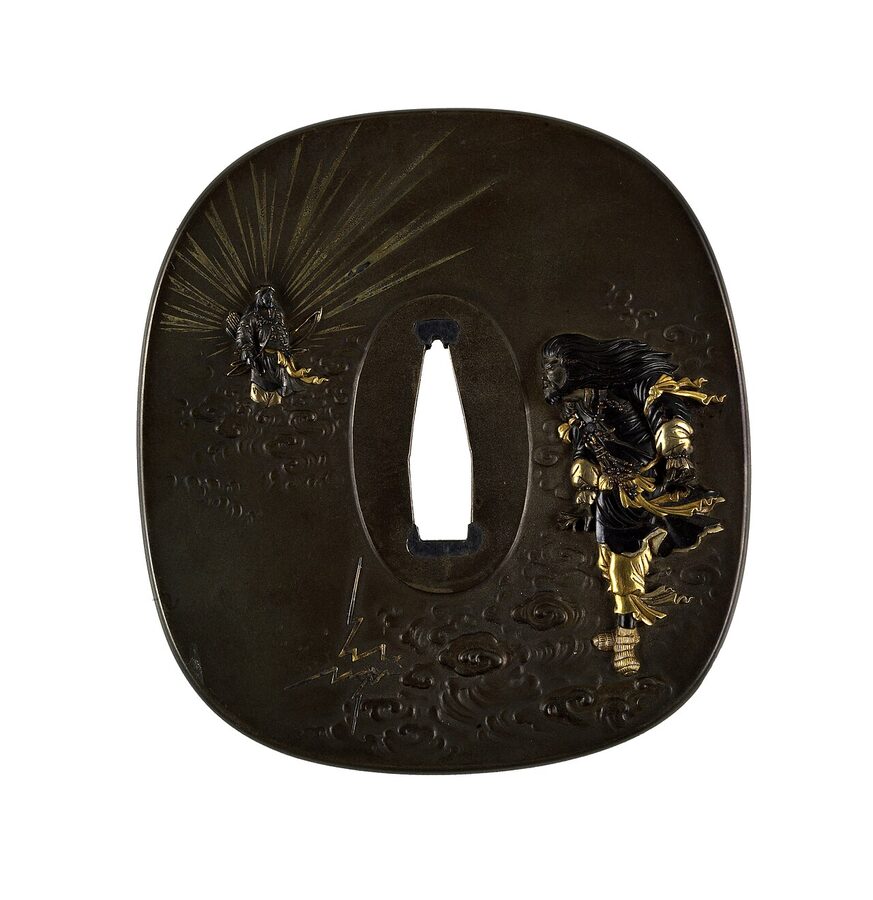
Susanoo proposes a contest, an ukehi, a sworn divination to prove he means no harm. Each takes something of the other’s: Amaterasu breaks his sword into three, chews the pieces and blows out a mist from which three goddesses are born; Susanoo chews her jewels and produces five gods. Amaterasu rules that the goddesses are his and the gods are hers, since they came from her jewels. The eldest of those five sons, Ame-no-Oshihomimi, will become the father of Ninigi, and through Ninigi the imperial line.
Then the two books disagree about who won. In the Kojiki Susanoo declares that his gentle daughters prove his good intentions, and he wins; one Nihon shoki variant has him win because he produced the sons.
Either way he takes his victory badly. He breaks down the ridges between his sister’s rice fields, fills in the ditches, and defecates in the hall where she holds the harvest feast. Amaterasu, remarkably, makes excuses for him: the mess must be vomit from drinking, she says, and he only filled the ditches because he did not like to see land wasted.
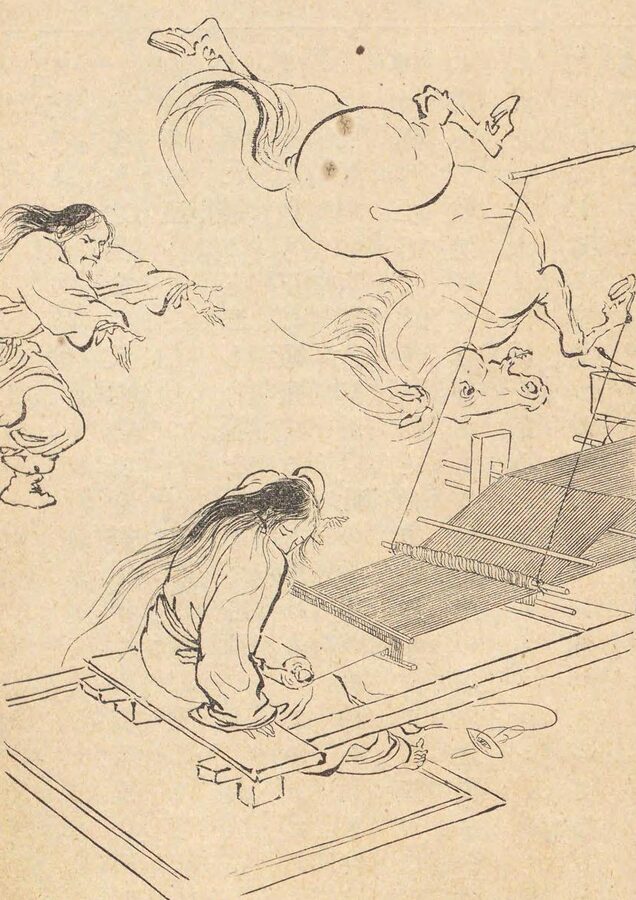
The last outrage is the one that breaks her. While Amaterasu sits in her sacred weaving hall making clothes for the gods, Susanoo tears a hole in the roof and drops in a piebald horse he has flayed backwards, from tail to head. In the Kojiki a weaving maiden is so startled that she strikes herself with her shuttle and dies.
The Nihon shoki main text has Amaterasu herself wounded by the shuttle; one variant names the victim as Wakahirume, “the young sun woman”, sometimes read as a younger sister; another drops the horse altogether and makes the final straw excrement on her seat at the harvest feast. Whatever the injury, she goes into the rock cave of heaven, shuts the door, and the High Plain of Heaven and the Central Land of Reed Plains both go dark.
Roosters, a mirror and a dance on an upturned tub
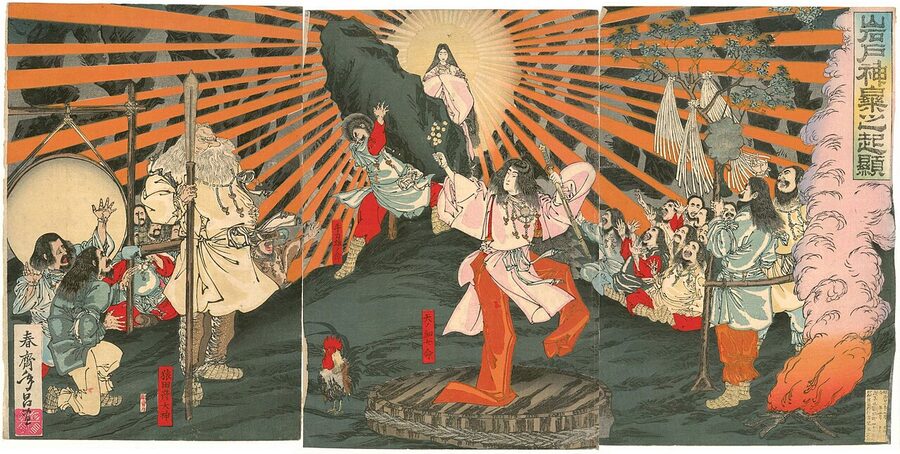
The Kojiki version of what follows is stranger than most retellings. With the world in endless night, the voices of evil gods swarming like summer flies and every kind of disaster breaking out, the gods, all of them, the yaoyorozu no kami or “eight million gods”, meet on the bed of the Heavenly Peaceful River. The plan comes from Omoikane, the god of thought.
They gather the long-crying birds of the Eternal Land, which is to say roosters, and set them crowing. They find the smith Amatsumara and have the goddess Ishikoridome cast a mirror from the hard rock of the river bed and iron from the heavenly mountains. They have Tamanoya make long strings of curved jewels, magatama. Two gods, Ame-no-Koyane and Futodama, divine with the shoulder blade of a stag, then pull up a sakaki tree from Mount Kagu by the roots and hang the jewels on its upper branches, the mirror in the middle, and white and blue cloth below.
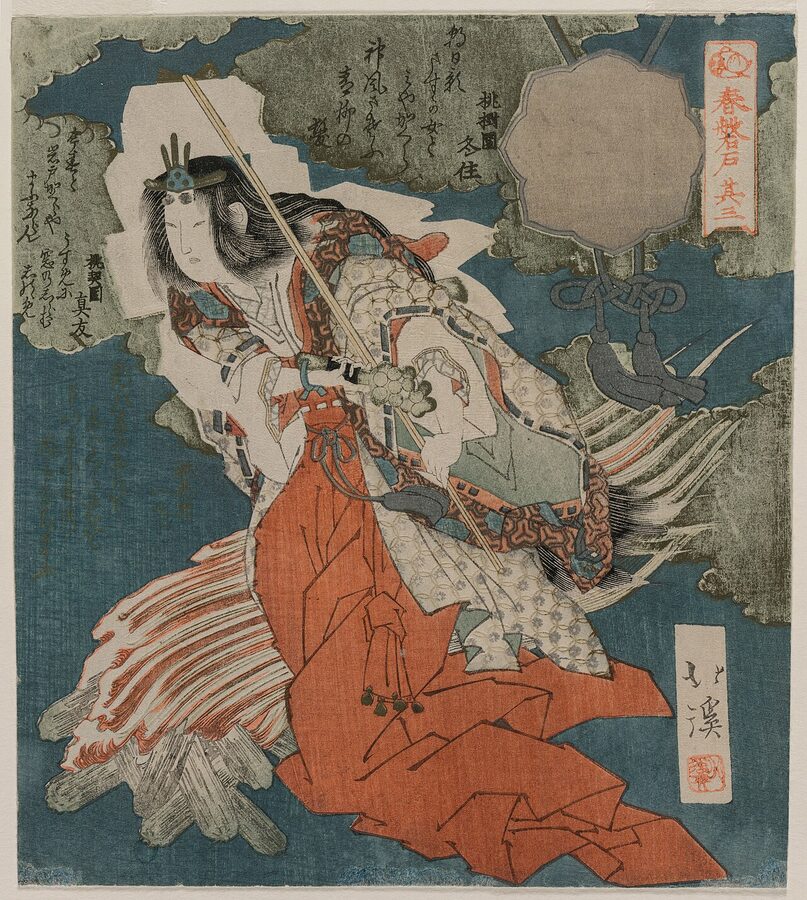
Futodama holds up the tree as an offering, Ame-no-Koyane recites a prayer, and the strongman god Ame-no-Tajikarao hides beside the door. Then Ame-no-Uzume ties up her sleeves with a cord of clubmoss, crowns herself with spindle-tree vine, takes a bundle of bamboo grass in her hand, turns a tub upside down in front of the cave and stamps on it until it booms. She falls into a divine trance, bares her breasts and pushes her skirt cord down to her genitals. The whole of heaven shakes with the laughter of eight million gods.
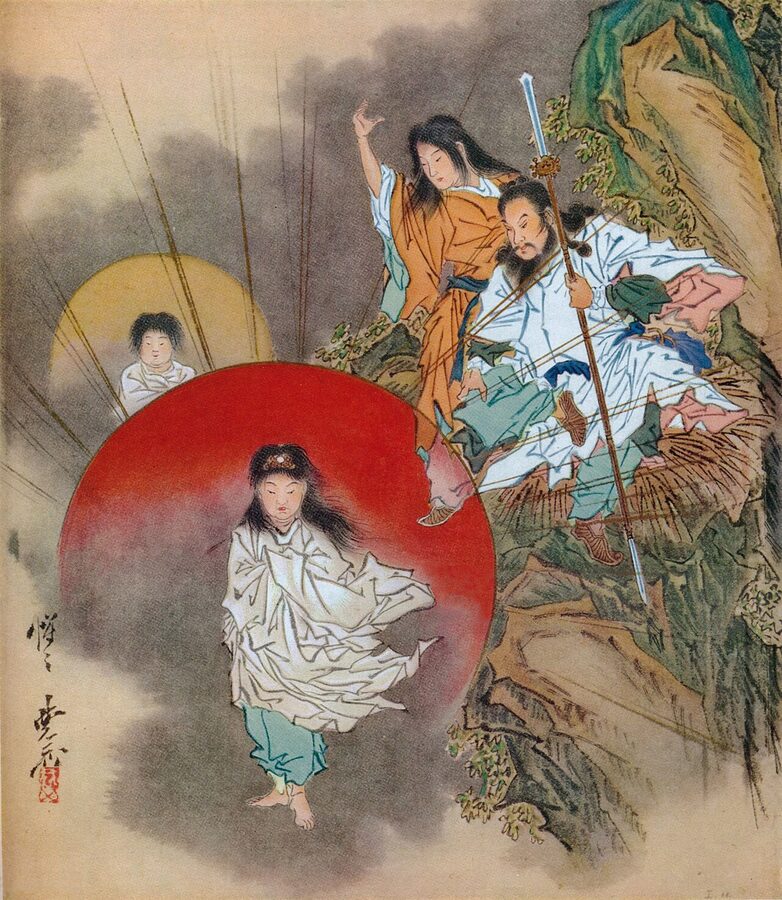
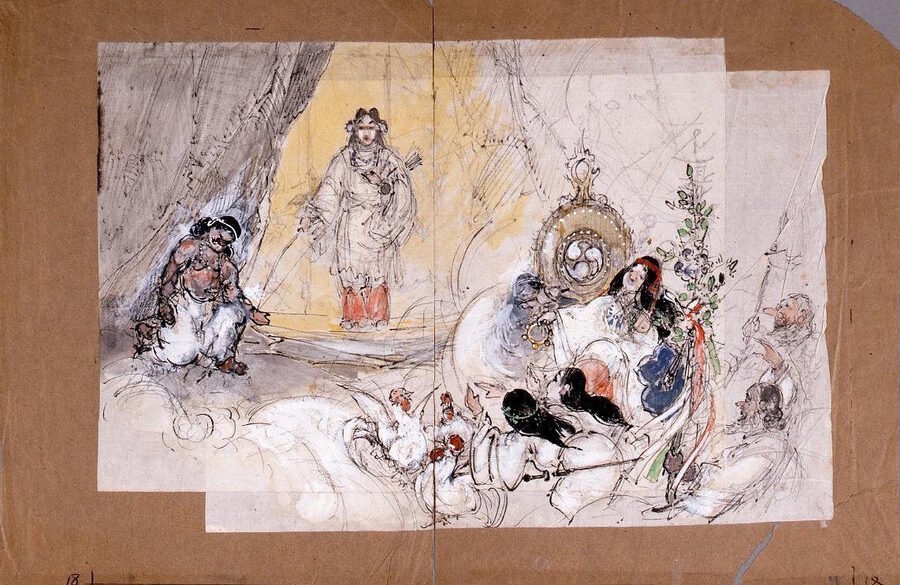
Inside the cave, Amaterasu is puzzled. She opens the door a crack and asks why, with the world dark because she has hidden, Uzume is dancing and the gods are laughing. Uzume tells her that they are celebrating because a goddess greater than she has appeared. As she says it, Ame-no-Koyane and Futodama hold up the mirror.
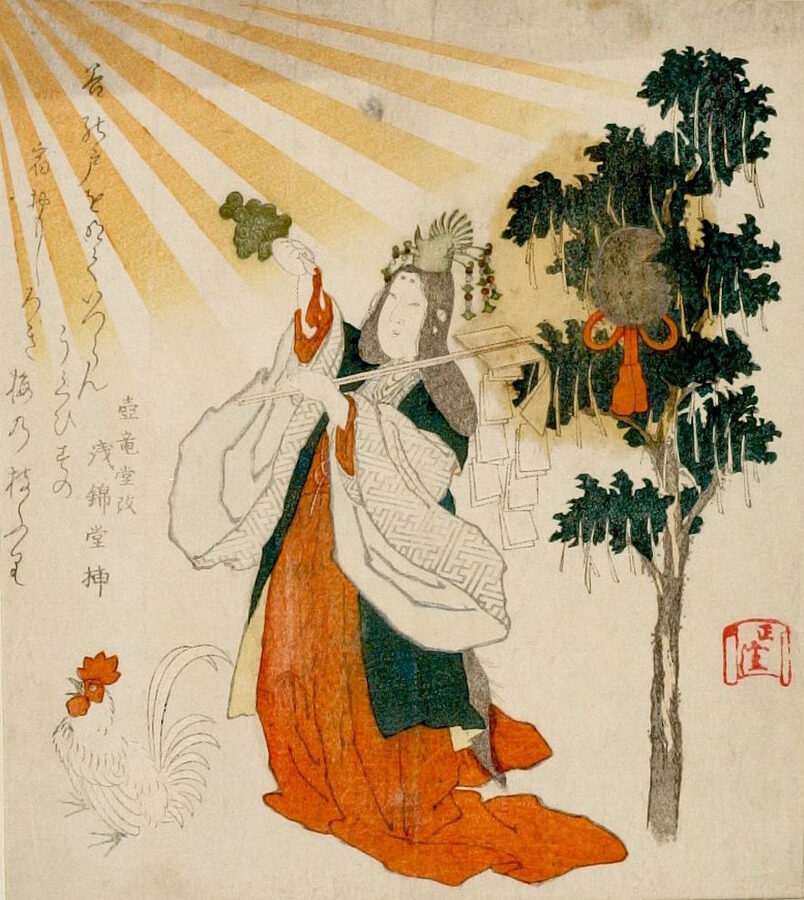
Amaterasu, seeing her own reflection and taking it for the rival goddess, leans further out to look. Tajikarao takes her by the hand and pulls her out, and Futodama strings the rope across the door. Light returns to both worlds. The gods then fine Susanoo a thousand tables of offerings, cut off his beard and the nails of his hands and feet, and drive him out of heaven, which is how he ends up in Izumo killing an eight-headed serpent and finding a sword in its tail.
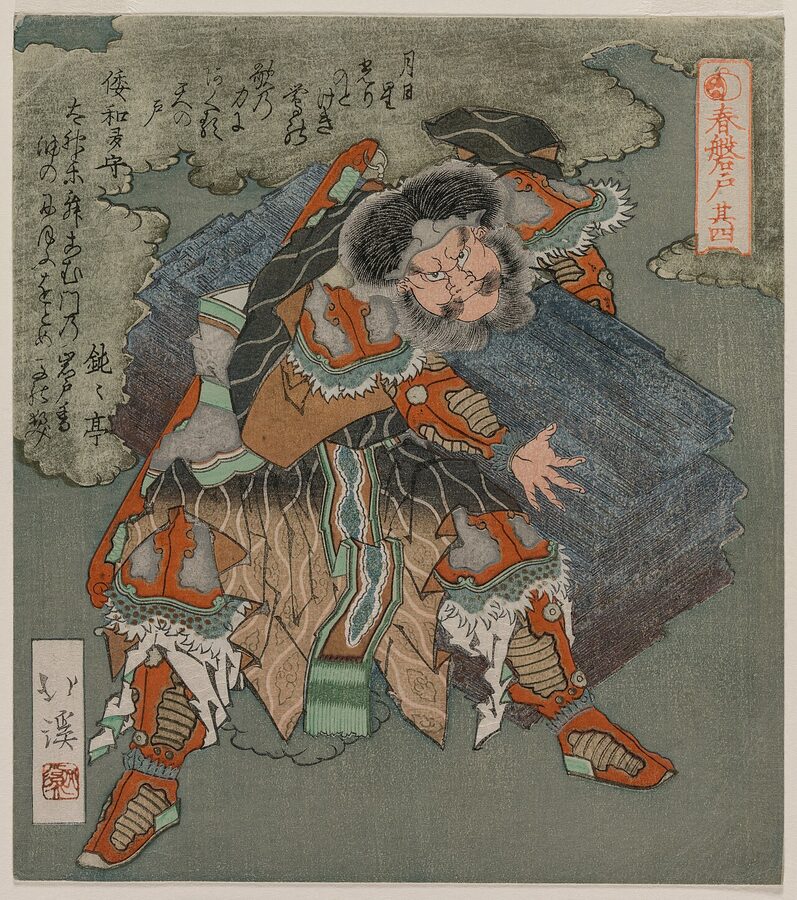
The Nihon shoki main text tells the same plot with almost all the fun taken out. Uzume performs skilfully before the door, but no one is described as laughing, and there is no rival goddess: Amaterasu simply wonders why Uzume is so cheerful, peers out, and Tajikarao pulls her free.
The variants go further. In one, the gods simply make a mirror, jewels and cloth, a long prayer of praise is recited, and the sun goddess opens the door because, she says, of all the many petitions people have brought her, she has never heard words so beautiful. That variant has no dance and no laughter at all. It is a story about the power of a well-made prayer, which tells you something about who was keeping it.
The Kogo shūi, a complaint to the throne written in 807 by Inbe no Hironari, whose clan claimed Futodama as its ancestor, adds the gods’ reaction to the returning light. Their faces were lit up white, it says, and they cried ana omoshiro, “how white our faces”, which it offers as the origin of the everyday word omoshiroi, “interesting”. It is folk etymology and almost certainly wrong. I still think of it every time someone tells me something is omoshiroi.
Eclipse, solstice or ritual?
Readers have always wanted the cave to be something that happened. The most popular answer is an eclipse. Astronomers have computed solar eclipses over western Japan in 247 and 248, and a line of writers, the popular historian Izawa Motohiko among them, has tied the story to the second, often with the further suggestion that Amaterasu is a memory of Himiko, the queen of Wa whom the Chinese Wei zhi records dying around that time. The statistician Yasumoto Bitten has argued for 247 and Himiko’s death.
The astronomy is shakier than the books suggest. Calculating exactly where an eclipse 1,800 years ago was total depends on how much the Earth’s rotation has slowed since, and in 2010 two astronomers at the National Astronomical Observatory of Japan, Tanikawa Kiyotaka and Sōma Mitsuru, argued that neither eclipse would have been total over Japan; others have read the same corrections differently since. I like the idea, and I do not believe it. A story that survives in two court books compiled more than 450 years later, in several incompatible variants, is a poor witness to a single afternoon at the end of the Yayoi period.
The scholarly answer is ritual. Japanese historians of religion have long noticed how closely the cave scene matches the chinkonsai (鎮魂祭), the “calming of the spirit”, a court rite held on the day before the emperor’s harvest festival in the eleventh lunar month, at the time of year when the sun is weakest. In the rite as the 10th-century Engishiki describes it, a woman of the Sarume clan, which claimed descent from Uzume, stood on an upturned tub and struck it with a spear, while the emperor’s robe was shaken to revive his soul. The Kogo shūi says plainly that the rite came from Uzume.
On that reading, the cave is not an eclipse but the winter solstice, the yearly death and return of the sun, projected back into the age of the gods and fused with the rite that renewed the sun’s descendant on earth. Kurazuka Yōko, writing in Heibonsha’s World Encyclopaedia, puts it squarely: the cave story carries a projection of the court rite. The rite has not stopped. It is still held in the palace every 22 November, the evening before the harvest festival, and the descriptions published of it still include the tub.
The myth also has cousins across Asia. Several minority peoples of southern China tell of suns shot from the sky until the last one hides in a cave and has to be coaxed out, and in the Miao version it is a rooster that does it. I find that more persuasive than the eclipse: the roosters at the cave mouth look like a much older idea than the court that wrote them down.
A grandson, a mirror and an order from heaven
With light restored and Susanoo banished, the myth turns to politics. The land below, the Central Land of Reed Plains, is ruled by Ōkuninushi, a descendant of Susanoo, and heaven decides it should belong to Amaterasu’s line instead. Envoys are sent and go native, and in the end two warrior gods force Ōkuninushi to hand the land over.
Who gives the order depends, again, on which book you read. In the Nihon shoki main text it is not Amaterasu at all but Takamimusubi, a primordial god, who wraps his infant grandson Ninigi in a coverlet and sends him down; Amaterasu is not mentioned. The Kojiki has Amaterasu and Takamimusubi command together, and only the Nihon shoki variants give her the lead. Many Japanese scholars, the historian Mizoguchi Mutsuko prominent among them, take this as evidence that Takamimusubi was the older ancestral god of the royal house and that Amaterasu took over the role in the late 7th century.
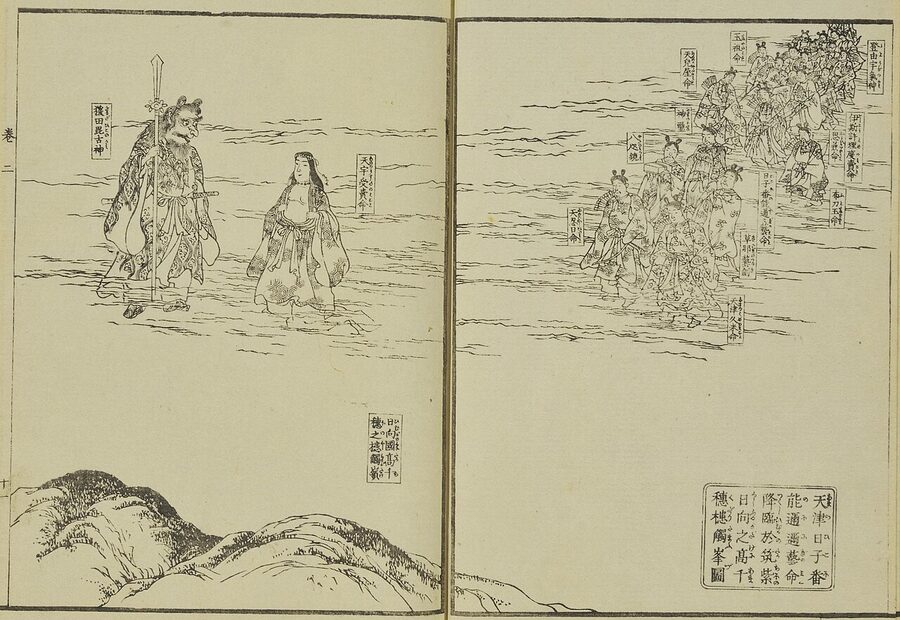
In the Kojiki, Ninigi comes down with five gods attached to him, and they are the ancestors of the clans who ran court ritual: Ame-no-Koyane of the Nakatomi, who later became the Fujiwara clan; Futodama of the Inbe; Uzume of the Sarume; and the mirror maker and jewel maker of their guilds. The cast of the cave scene, in other words, is a list of 8th-century court families with job descriptions. With them he carries the mirror, the jewels and the sword Susanoo found in the serpent, and Amaterasu tells him to treat the mirror as her own spirit and worship it as he would worship her. Those three objects are the Three Sacred Treasures, whose later history has its own article.
One Nihon shoki variant gives her a speech that would carry a great deal of weight later. Aston’s 1896 translation renders it: “This Reed-plain-1500-autumns-fair-rice-ear Land is the region which my descendants shall be lords of… Go! and may prosperity attend thy dynasty, and may it, like Heaven and Earth, endure for ever.”
In Japanese it is the tenjō mukyū no shinchoku, the oracle of a dynasty as eternal as heaven and earth. For twelve hundred years it was one variant among many. Until 1945 it was taught to schoolchildren as the foundation of the state.
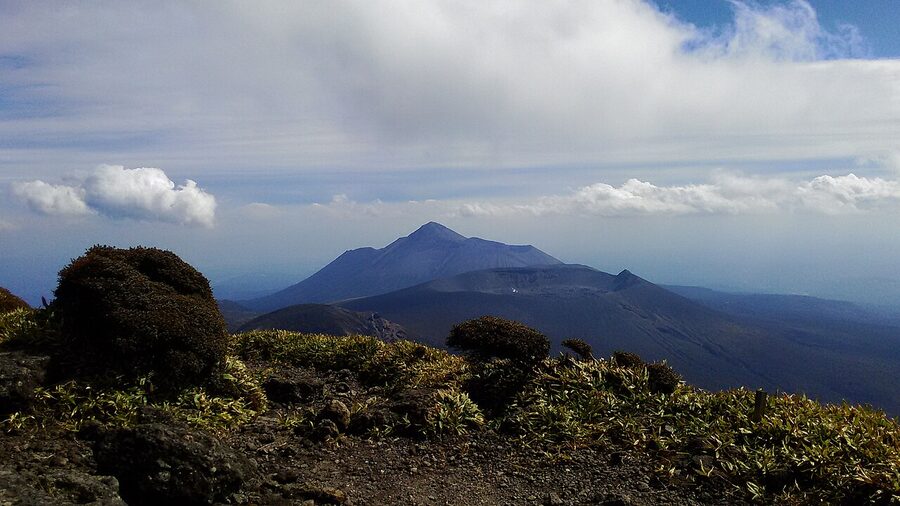
The books put the landing at a peak called Takachiho in Himuka, and two places claim it. One is Takachiho-no-mine, a volcano in the Kirishima range; the other is the town of Takachiho in the hills of northern Miyazaki, home of the cave. Japanese reference works say, with some tact, that the original meaning was a god of grain descending onto a sacred place of “high-piled rice ears”, which is what takachiho means, and that the question of which mountain was a later one. Both places have tourist offices and neither is going to concede.
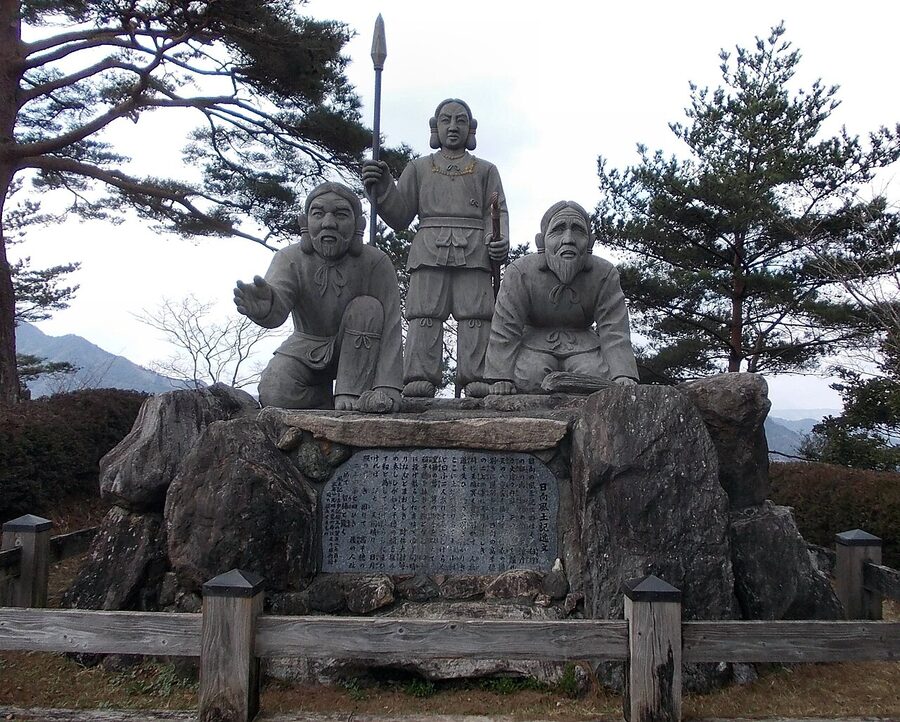
Ninigi’s great-grandson, called Kamuyamato Iwarebiko, leaves Himuka to look for a better place to rule, and the books follow him east along the Inland Sea, through defeats and the death of his brother, around the Kii peninsula and into the mountains of Kumano. Lost in the forest, he is guided by a giant crow, the Yatagarasu, which the Kojiki says Takamimusubi sent and the Nihon shoki says Amaterasu sent. The crow still appears on the emblem of the Japan Football Association, and the three great shrines at the end of the Kumano Kodō print it on their talismans.
He takes Yamato and is enthroned at Kashihara as Emperor Jimmu. The Nihon shoki puts the enthronement on the first day of the first month of a year it names only by the sixty-year cycle. In 1873 the government of the Meiji era converted that to 11 February 660 BCE by the Western calendar and made the day a national holiday, Kigensetsu. It is still a holiday, now called National Foundation Day, and the date is still the result of a 19th-century calculation applied to a year that no historian believes in.
From the palace to Ise
The Nihon shoki also explains how Amaterasu ended up in Ise rather than in the palace. Under the tenth emperor, Sujin, a plague breaks out, and the emperor grows uneasy about living under the same roof as two such powerful deities, Amaterasu and the god of the land of Yamato. He entrusts Amaterasu, in the form of her mirror, to his daughter Toyosukiirihime, who enshrines her in the village of Kasanui. Under the next emperor, Suinin, another daughter, Yamatohime, takes over and wanders with the mirror through Uda, Ōmi and Mino looking for a permanent home, until in Ise the goddess speaks.
“The province of Ise, of the divine wind, is the land whither repair the waves from the eternal world, the successive waves,” she says in Aston’s version. “It is a secluded and pleasant land. In this land I wish to dwell.”
A shrine is built on the upper reaches of the Isuzu River, and that is the origin story of the Naikū, the Inner Shrine of Ise Grand Shrine. Medieval Ise tradition later fleshed out Yamatohime’s travels into a long pilgrimage with a string of temporary halts, the moto-Ise, many of which still have shrines that claim the honour.
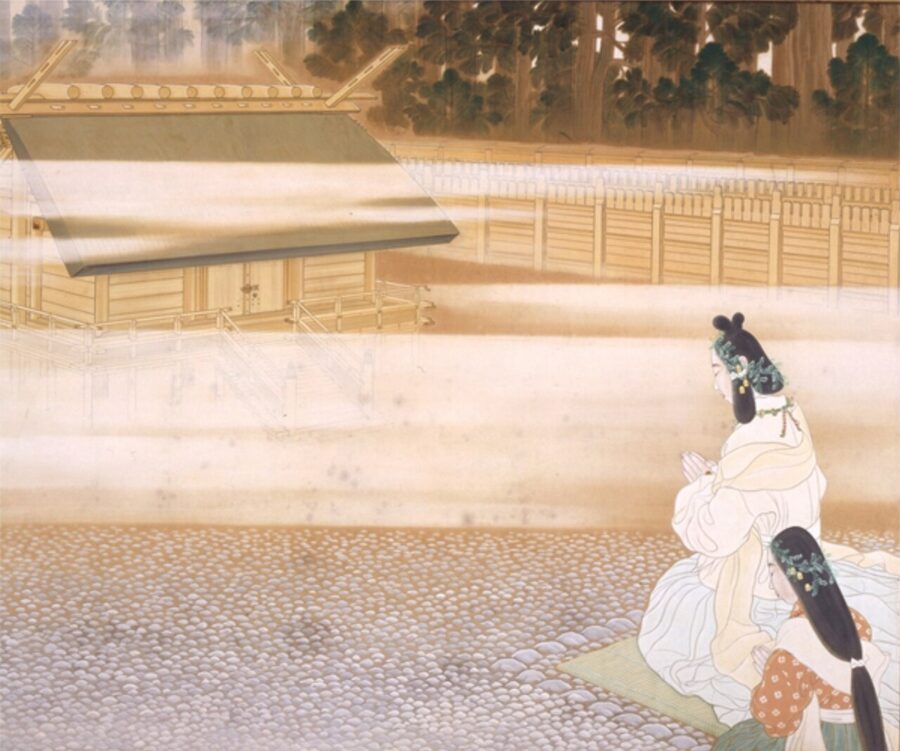
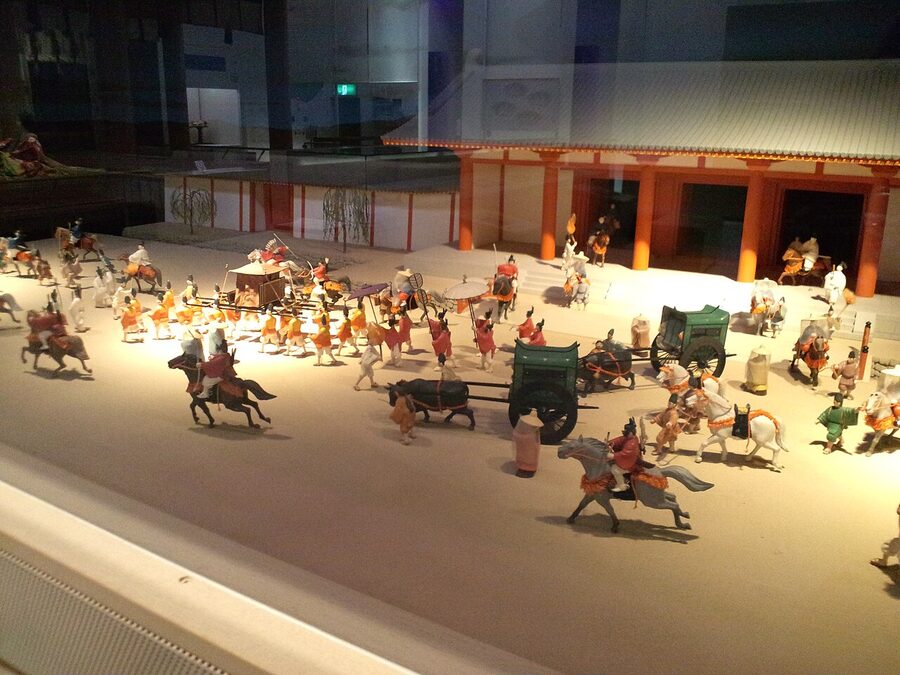
Historians date things rather later. The emperors Sujin and Suinin cannot be dated with any confidence, and the first princess known for certain to have served the goddess at Ise is Ōku, a daughter of Emperor Tenmu, appointed in 673 according to the 11th-century chronicle Fusō ryakki and sent to Ise the following year. The historian Naoki Kōjirō argued that Tenmu’s victory in the civil war of 672, during which he paused in Ise to bow towards the goddess, was what raised her from one clan’s deity to the ancestor of the whole state. The first ritual rebuilding of the Ise shrines is recorded under his widow, the empress Jitō, in 690, and apart from a gap of more than a century during the wars of the 15th and 16th centuries they have been rebuilt every twenty years or so ever since.
Where the goddess came from before that is disputed. One school, associated with Tsukushi Nobuzane, argues that the original god of Ise was a local sun deity worshipped by the fishermen of the Isobe, probably male, which the court adopted, renamed and made its own. What is not disputed is that by the 8th century she sat at the top of the court’s pantheon, and that her shrine was closed to everybody else.
The rule was called shihei kindan: no one but the emperor could make offerings at Ise. Private prayer there was forbidden, and enshrining the goddess at home was a punishable offence. The author of the Sarashina Diary, a well-read noblewoman of the Heian era writing in the middle of the 11th century, records being told to pray to Amaterasu and not knowing where the deity was, or even whether it was a god or a buddha.
Tenshō Daijin: the goddess goes public
That changed in the Middle Ages, and the reason was money. As the estates that had funded Ise decayed, the shrine’s lower priests, the oshi, went out into the provinces to find new patrons, distributing talismans, arranging pilgrimages and preaching the goddess to anyone who would listen. By the Kamakura era she was being invoked in written oaths as “Tenshō Daijin, lord of the land of Japan”. Tenshō Daijin is simply the Sino-Japanese reading of the same characters as Amaterasu Ōmikami, and it is the name by which most medieval people knew her.
She was also being absorbed into Buddhism. Under the doctrine of honji suijaku, which held that the kami were local manifestations of buddhas, Amaterasu was first matched with an eleven-headed form of Kannon, and then, more lastingly, with Dainichi, the great sun buddha of esoteric Buddhism. The Shingon monk Dōhan identified the two outright. Ise itself kept Buddhism at arm’s length, with taboo words its priests used in place of Buddhist terms, but monks such as the poet Saigyō came on pilgrimage, sutras were recited in temples nearby, and very few people saw any contradiction.
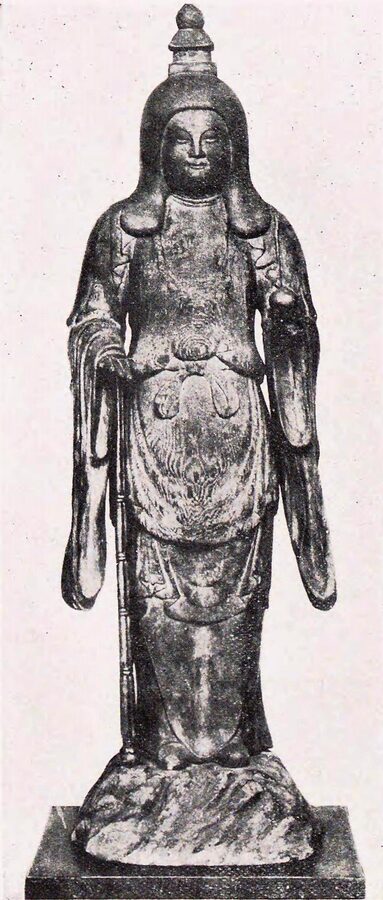
The medieval goddess had stranger forms too. A Kamakura-period monk, Tsūkai, recorded a story current among Ise priests that the goddess visited the Saiō’s bed at night and left snake scales behind, which the historian Tsukushi took as a memory of a male god who married his priestess.
A 14th-century Tendai encyclopaedia, the Keiran shūyōshū, explains that when she hid in the cave she took the form of a dragon-fox, a shinko, because it is the only animal that shines with its own light. That fox would go on to an interesting career of its own in kitsune lore. In the war chronicle Taiheiki, the general Nitta Yoshisada, praying on the beach before his attack on Kamakura in 1333, addresses her as a dragon god of the blue ocean.
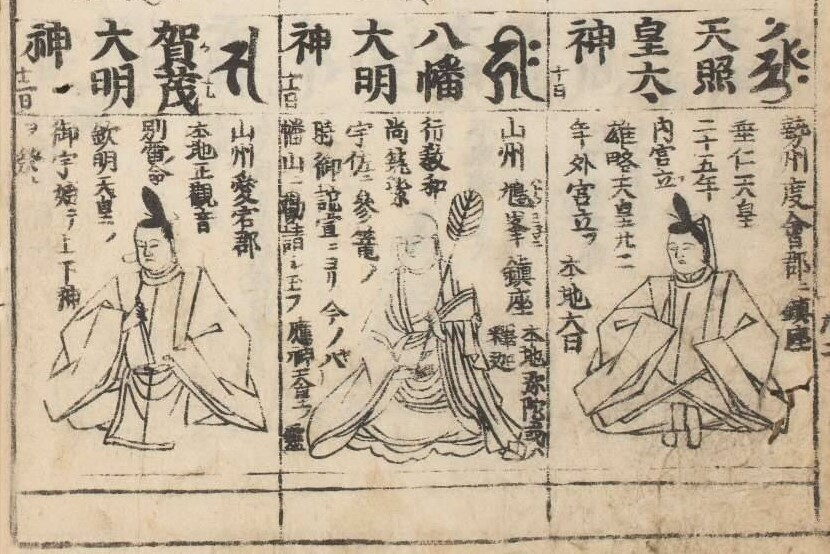
The male goddess had a long life in popular art. On the Iwato-yama float of Kyoto’s Gion Matsuri, which has paraded the cave story through the streets since the Middle Ages, the figures of Izanagi, Tajikarao and Amaterasu are all male; the Amaterasu carved after the great fire of 1788 is a handsome young man with a mirror round his neck. The wandering monk-sculptor Enkū carved her as a man. In the Muromachi era the Kyoto priest Yoshida Kanetomo went so far as to report, in 1489, that the sacred objects of Ise had flown through the air and landed at his own shrine, a claim the Ise priests did not take well.
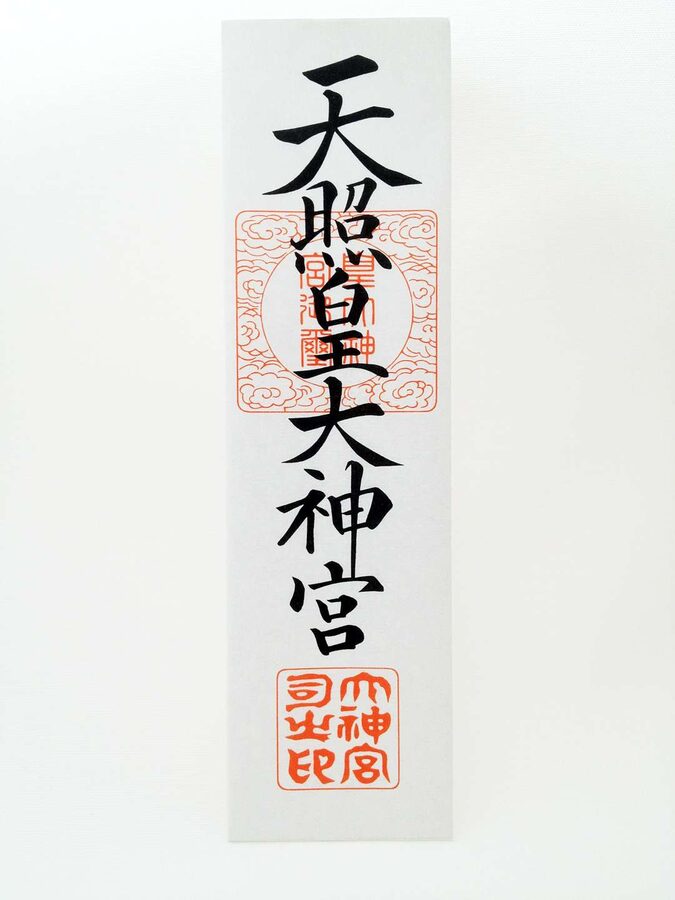
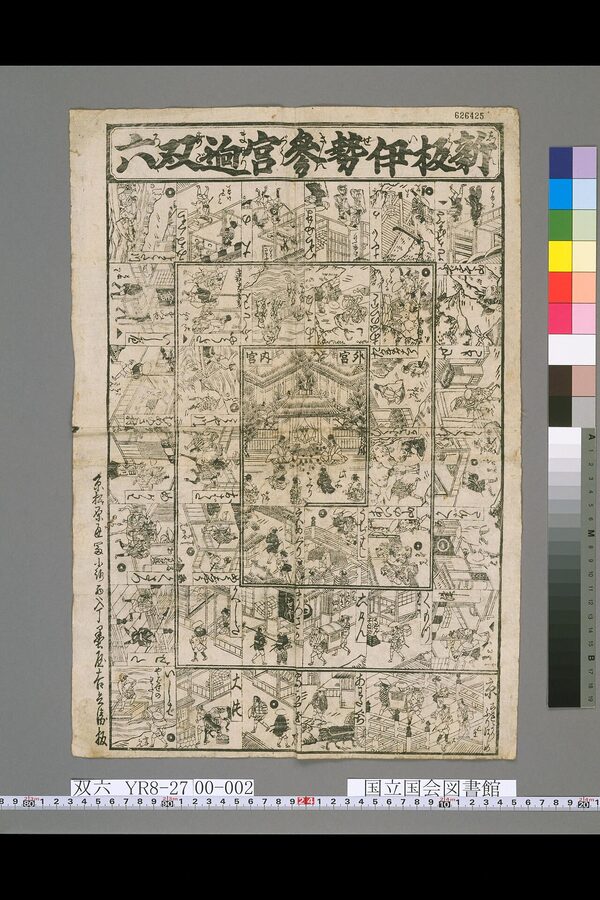
Under the Tokugawa shogunate the goddess reached nearly every house in Japan. The Ise oshi sent out their paper talisman, the Jingū taima, to registered households across the country along with a farming almanac, and by the late Edo era it hung on the household shelf of something like nine homes in ten. Villages opening new rice land enshrined her as a farming deity, sometimes worshipping a hoe as her body. In the Edo period she was a goddess of good harvests, cured illnesses and general good luck, a long way from the jealous ancestor of the court.
Then there were the okage mairi, the mass pilgrimages to Ise that broke out roughly every sixty years, usually after rumours that talismans had fallen from the sky. Shop boys, servants and children walked out of their jobs without permission and set off with a ladle in hand, living on the charity of people along the road. In 1705, between the ninth day of the fourth month and the 29th day of the fifth, by one shrine record 3,620,000 people came to Ise. In 1771 a little over two million crossed the Miyagawa river ferry in four months, and in 1830 4,276,500 did so in under four, at a time when the population of Japan was around thirty million.
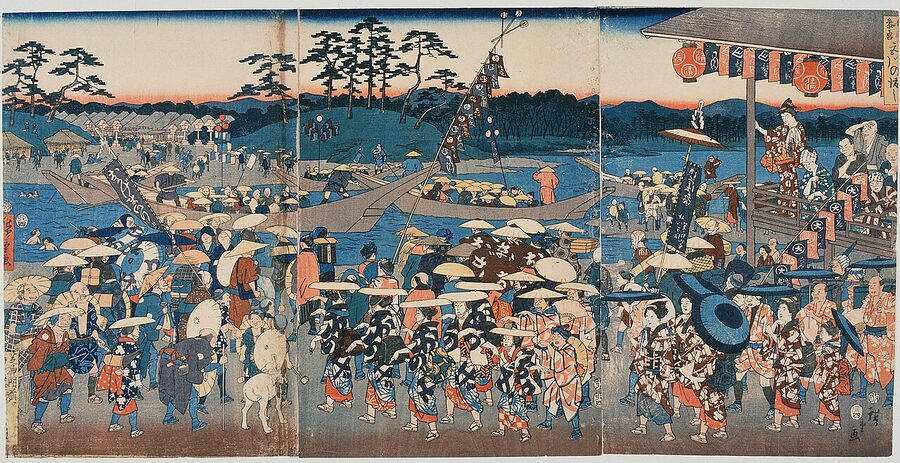
The pilgrimages had a habit of turning into something else. In the autumn of 1867, with the shogunate collapsing, talismans were again said to be falling from the sky across central Japan, and crowds danced through the streets of Nagoya, Osaka and Kyoto chanting ee ja nai ka, “isn’t it fine, who cares?”. Historians still argue about how much of it was spontaneous. That same autumn the last shogun handed power back to the court, and the goddess was about to acquire a new and much more demanding patron.
The state takes the goddess
The men who made the Meiji Restoration of 1868 believed, or found it useful to believe, that the throne’s authority came from Amaterasu and that Buddhism had spent a thousand years obscuring the fact. In 1868 the new government revived the ancient Department of Divinities and ordered kami and buddhas separated, and in the violence that followed, temples were stripped and Buddhist statues burned. The Dainichi of the Middle Ages was quietly removed from the goddess. Kongōshō-ji, the temple above Ise, survived; many of the Buddhist temples in the town of Ise itself did not.
In 1871 every shrine in Japan became an institution of state ritual, arranged in a single ranked hierarchy with Ise at the top as the “head shrine” of all of them. The Ise oshi were abolished and the distribution of talismans taken over by the shrine itself, then by the state’s shrine network. Between 1880 and 1881 a furious dispute broke out over whether the national Shinto office in Hibiya should enshrine Ōkuninushi beside Amaterasu, the Izumo party saying yes and the Ise party no, and the argument was settled only by a decision from Emperor Meiji himself. Ise won.
The government then drew a line that would shape the next sixty years. In 1882 the priests of the major shrines were forbidden to preach or conduct funerals, and shrine worship was declared to be not a religion at all but a civic duty, the rites of the nation, which anyone of any faith could and should perform.
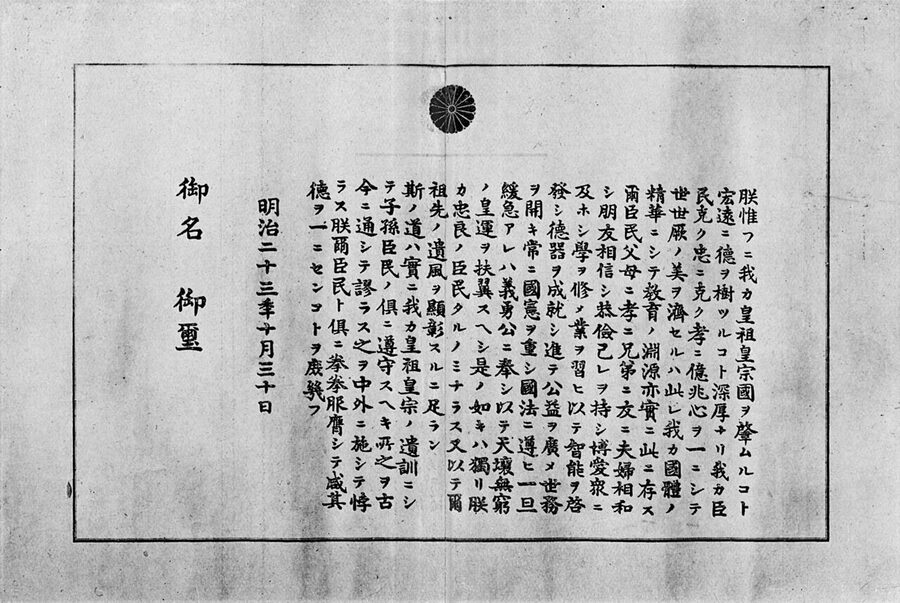
That allowed the 1889 constitution, which opened with an emperor reigning over “a line unbroken for ages eternal” and called him “sacred and inviolable”, to promise freedom of religion at the same time. The 1890 Imperial Rescript on Education, read aloud in every school, taught loyalty to that line as the essence of the nation. New shrines to emperors went up, from Kashihara Jingū for Jimmu in 1890 to Meiji Shrine in 1920. Historians now call the system State Shinto; at the time it had no name, because it was not supposed to be a religion.
The pressure increased in the 20th century, and it fell hardest on people who were not Shinto at all. From the 1930s Christian schools were pressed to enshrine the Ise talisman, and in the colonies worship became an obligation: by 1937 more than half a million households in Taiwan had a Jingū taima shelf, and nearly four hundred shrines were built in Korea, where attendance was compulsory. In 1937 the Ministry of Education published Kokutai no hongi, “the fundamentals of our national polity”, which described the emperor as a living god descended from Amaterasu. Writers had already learned to step around her: when Akutagawa Ryūnosuke put the cave myth into a story in 1922, late in the Taishō era, he called the goddess Ōhirume-no-muchi rather than risk her imperial name.
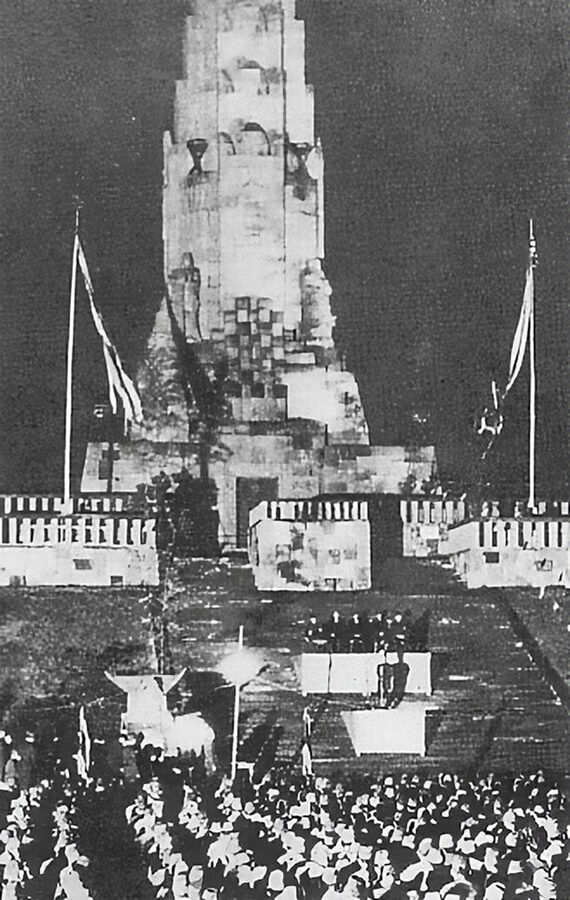
The peak came in 1940, which by the Meiji reckoning was the 2,600th year since Jimmu’s enthronement. The Shrine Bureau became the Institute of Divinities, and celebrations ran across the empire. In Miyazaki, the prefecture of the cave and the descent, the governor raised a tower 36.4 metres high on a hill above the city, built with some sixty thousand days of labour, mostly by students, on a base of 1,789 stones gathered from the prefectures, the colonies and, it later emerged, the battlefields of China, where the army had ordered units to collect them. Its front carried the slogan hakkō ichiu, “the eight corners of the world under one roof”.
The language went with the army. In the last months of the war in Okinawa, the command bunker dug under Shuri Castle was named after the rock cave of heaven. I find it hard to think of a more exact or more bleak use of the myth: a goddess shutting herself into the dark while the world outside is destroyed.
1 January 1946
The occupation dismantled the system in two documents. The first, the Shinto Directive of 15 December 1945, ordered the complete separation of shrine and state, ended public funding for shrines and banned the teaching of Shinto doctrine in schools, including the idea that the emperor and the Japanese were superior to other peoples. It said nothing about the emperor’s divinity. The occupation authorities hoped the emperor would say that himself.
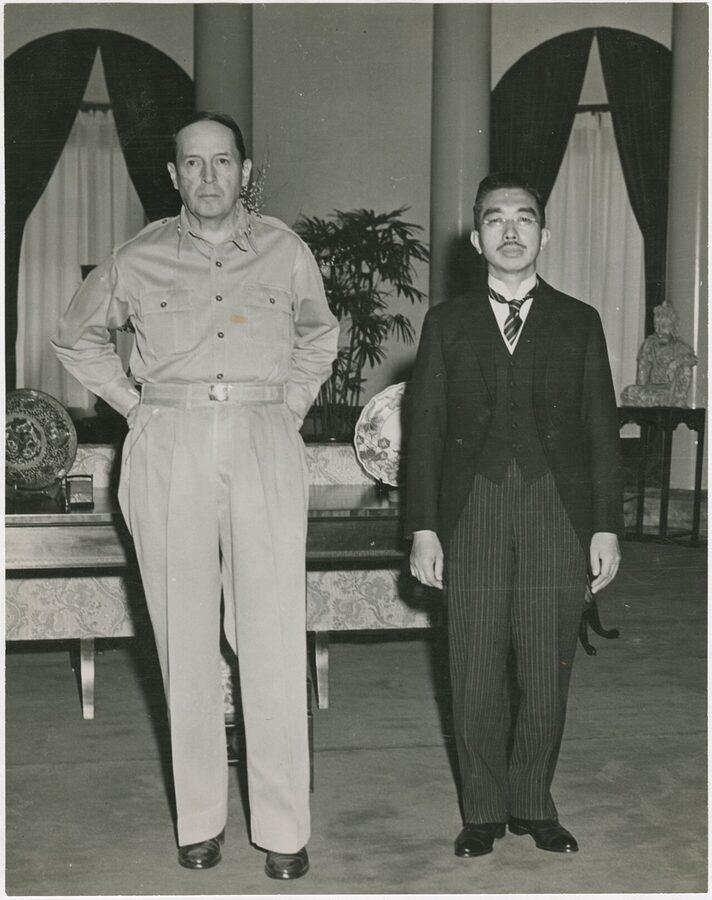
The second was the New Year rescript of 1 January 1946, issued by the emperor of the Shōwa era, officially an imperial rescript on the construction of a new Japan and universally known as the ningen sengen, the “humanity declaration”. Its first draft came from two haiku scholars, the Englishman Reginald Blyth, who taught at the Gakushūin, and the American Harold Henderson of the occupation’s education section. The Japanese cabinet reworked it heavily, and the emperor himself insisted that it open with the full text of the Charter Oath of 1868, so that the new democracy could be presented as Japanese in origin.
The passage the world noticed comes near the end. In the official English, the ties between the emperor and his people “do not depend upon mere legends and myths. They are not predicated on the false conception that the Emperor is divine, and that the Japanese people are superior to other races and fated to rule the world.” The word translated “divine” is akitsumikami, a “manifest god”, an old title for the emperor, and scholars have argued ever since over whether rejecting it was the same as rejecting divine descent.
On that the emperor was clear. A month before the rescript, he told his vice grand chamberlain Kinoshita Michio that it was acceptable to call the idea that the Japanese were descended from gods a false conception, but absolutely not acceptable to call the descent of the emperor from the gods a fantasy. The rescript does not deny it. Japanese newspapers on New Year’s Day led on peace and the new Japan and barely mentioned the divinity passage, and in a press conference in 1977 the emperor said that the Charter Oath, not the renunciation, had been the point.
What did change was the law. Under the constitution in force since 3 May 1947 the emperor is “the symbol of the State and of the unity of the people”, the shrines became private religious corporations, and Ise became, in law, a religious body like any other.
The court rites continue as the emperor’s private religious practice. Ise still distributes the Jingū taima through shrines across the country, and the Association of Shinto Shrines describes Amaterasu as the tutelary deity of the whole Japanese people. Hirohito’s son and grandson have since come to the throne, in 1989 and 2019, with the same mirror waiting at Ise, unseen.
Prints, masks and a white wolf
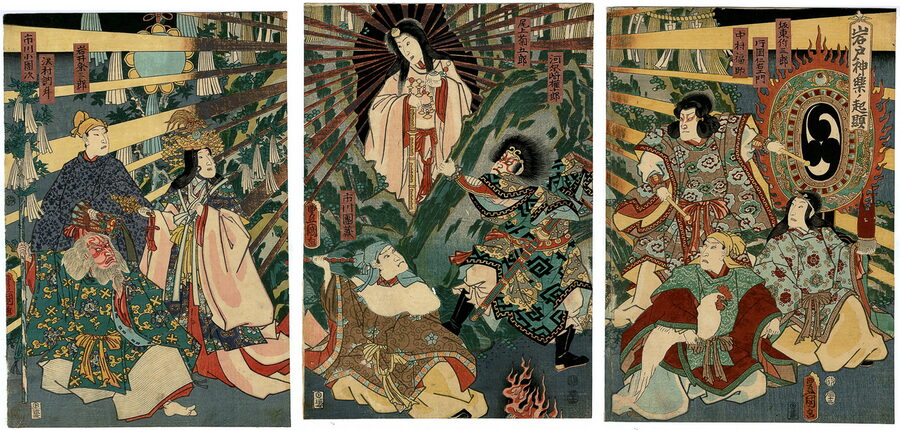
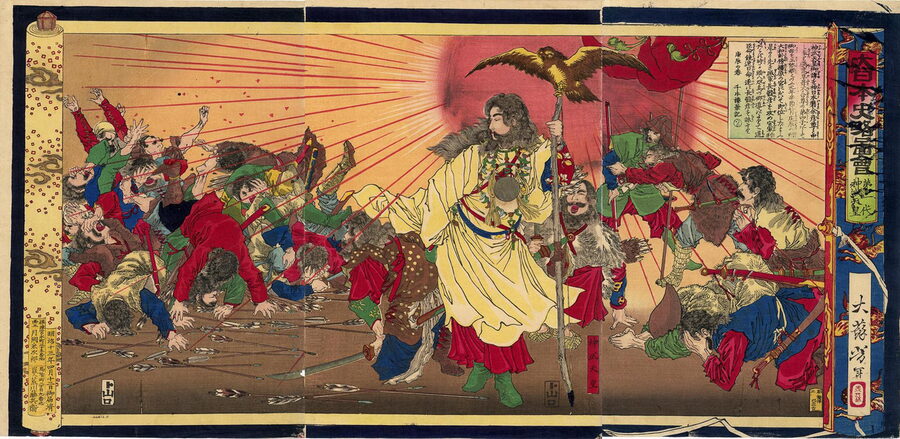
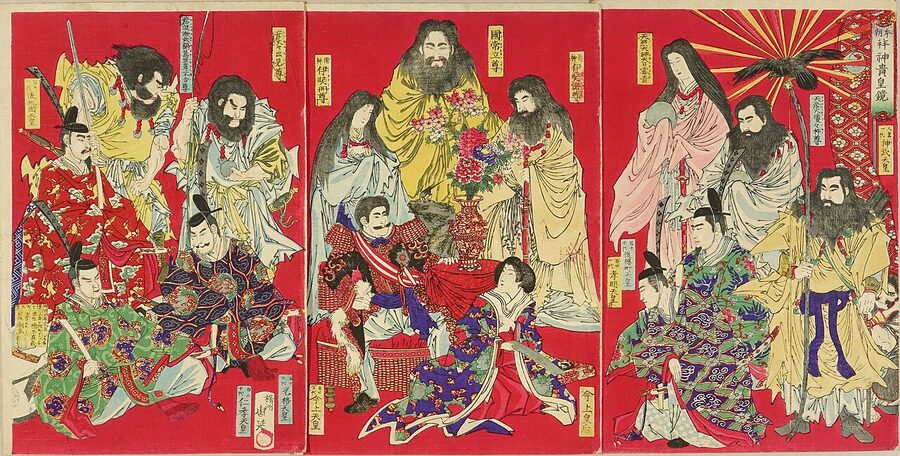
Amaterasu has been easier to draw than to define. Edo printmakers loved the cave scene because it had everything: a crowd, a dance, a burst of light and an excuse for gold and red. Kunisada’s triptych set the pattern that ukiyo-e artists followed for the rest of the century.
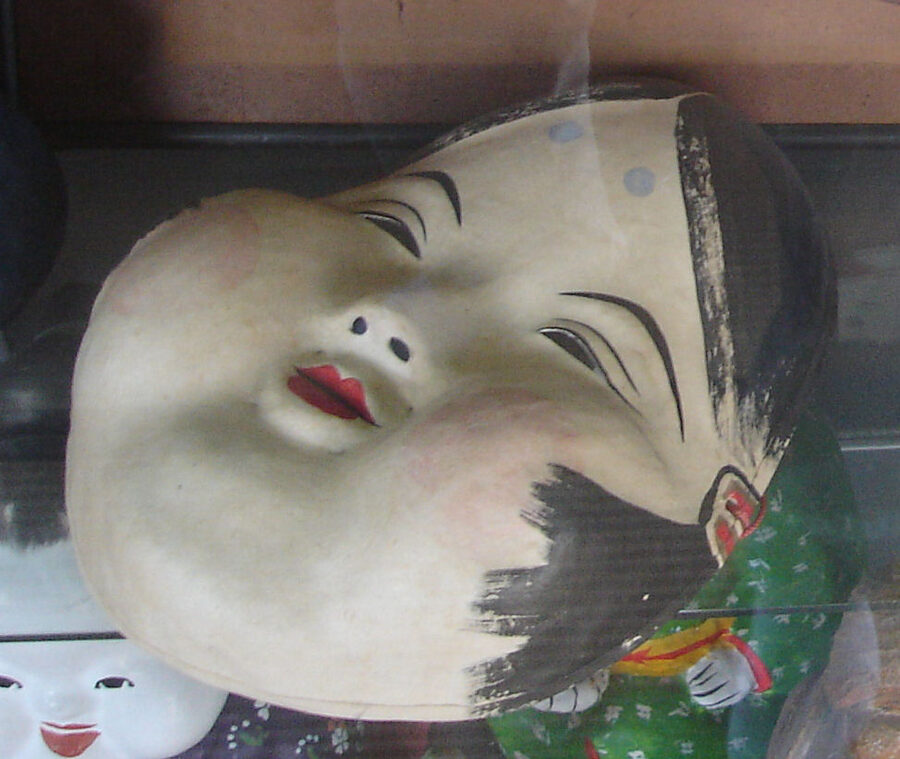
Uzume, meanwhile, became a folk figure in her own right. Her round laughing face turned into Okame, or Otafuku, the plump good-luck woman of masks, sweets and festival stalls, and on the strength of the cave dance she is honoured as the founder of the performing arts. Zeami, writing about Noh in the years around 1400, traced his own art back to her dance before the cave.
When the economy took off between 1958 and 1961, the previous boom had already been named after Emperor Jimmu as the biggest since the first emperor, so the press had to go back further. They called it the Iwato boom, the biggest since the cave.
The modern versions are less reverent and, I think, more affectionate. In the 2006 video game Ōkami, Amaterasu returns as a white wolf, the title playing on ōkami, which can mean both “great god” and “wolf”, and the player restores a cursed land with a brush. The film-maker Shinkai Makoto named the heroine of his 2022 film Suzume Iwato Suzume, after the cave door and Uzume. Neither treats her as a political symbol, and both send people to Takachiho, which seems to me a reasonable outcome.
Where to see Amaterasu today
There is no image of Amaterasu at any of the places below. You will be facing a fence, a building or a cliff, and the thing being worshipped will be behind it. That is the point.
Ise Jingū: the Naikū
The Inner Shrine at Ise, the Naikū or Kōtai Jingū, is the goddess’s principal home and the place where the mirror is enshrined. My sister article on Ise Grand Shrine covers the visit in full; the short version is that you cross the Uji Bridge over the Isuzu River, about a hundred metres of cypress rebuilt along with the shrine, walk the gravel approach for a quarter of an hour, and stand at the bottom of the steps to the main sanctuary, which you may photograph only from below.
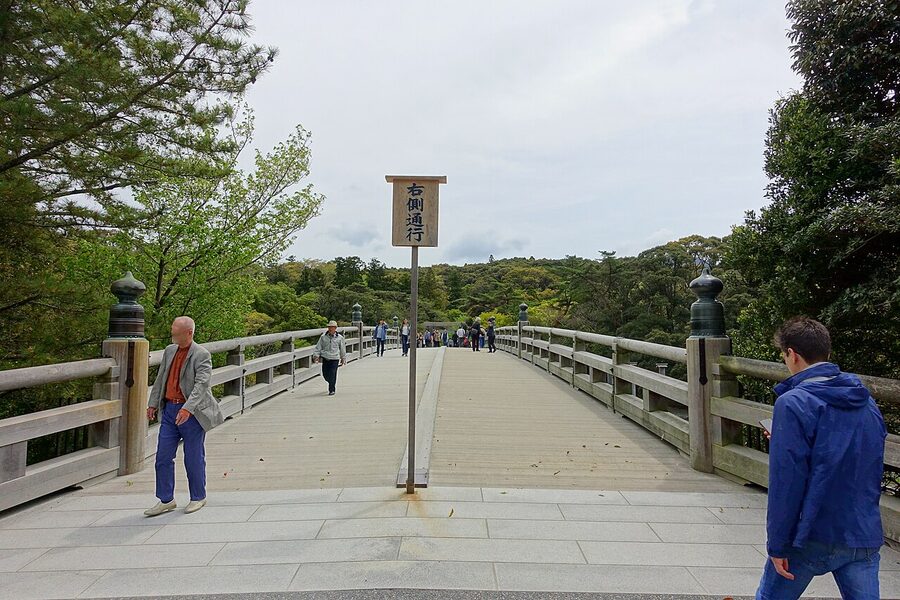
Entry is free. The shrine is open from 5:00 to 18:00 in January to April and September, 5:00 to 19:00 from May to August, and 5:00 to 17:00 from October to December, with changes over New Year. The 63rd rebuilding is under way: the preparatory rites began in 2025 and the transfer of the goddess to her new sanctuary is expected in 2033, so for the next few years you may well run into one of the ceremonies that go with it.
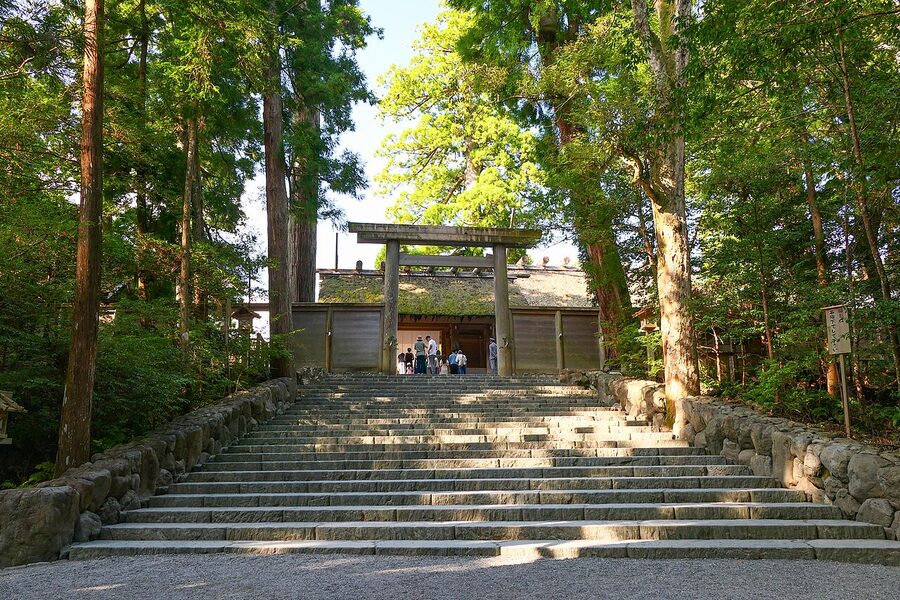
Two smaller sanctuaries inside the Naikū precinct are worth your time. The Aramatsuri-no-miya, a short walk behind the main sanctuary, enshrines the goddess’s aramitama, her rough or active spirit, and the usual advice is that this is where you bring a personal request. The Kazahinomi-no-miya, across a small bridge to the south, enshrines the wind gods who were credited with the typhoon that wrecked the fleet of the second Mongol invasion in 1281, and it was promoted to its present rank in 1293 in gratitude. The sacred chickens on the gravel are descendants, in theory, of the birds that crowed outside the cave.
Amano Iwato Shrine, Takachiho
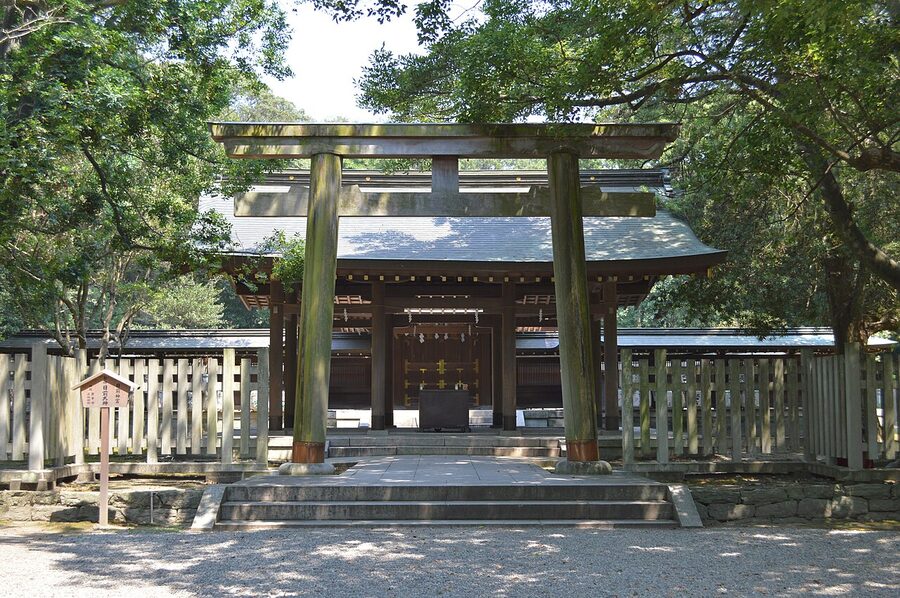
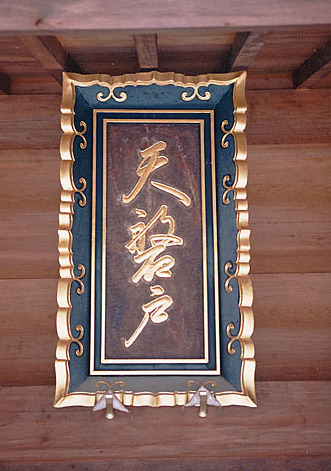
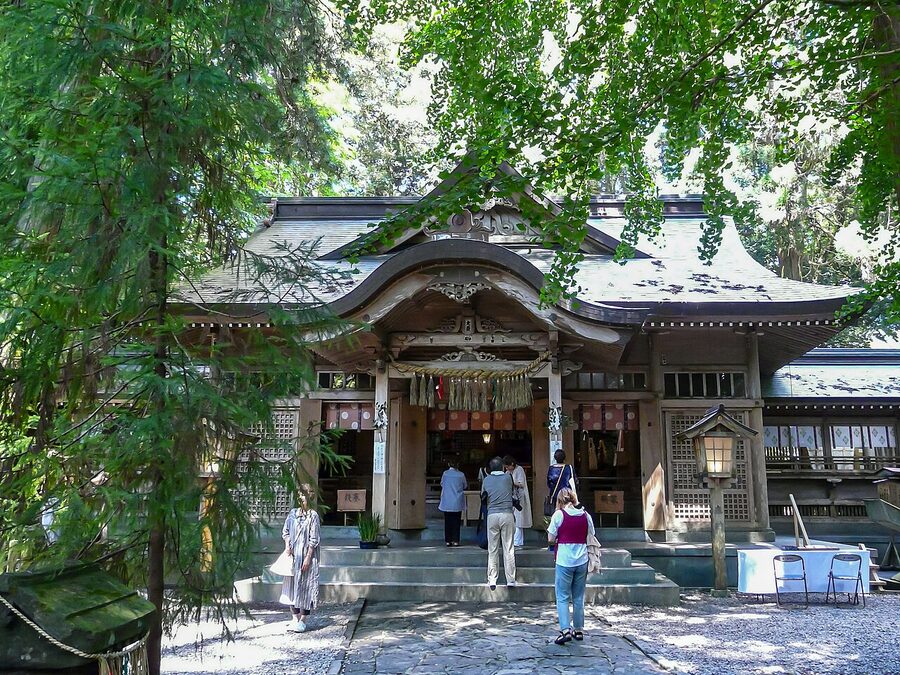
Amano Iwato Shrine sits on both sides of the Iwato River, about fifteen minutes by bus from the centre of Takachiho. The West Hongū enshrines the goddess as Ōhirume, and its object of worship is the cave itself, a hollow in the cliff face across the river. The East Hongū, five minutes’ walk away, enshrines her as Amaterasu Sume Ōmikami and marks the place where, local tradition says, she first lived after leaving the cave. Japanese local historians think the East Hongū was the real centre of worship for most of its history, and that the West Hongū began as a simple hall for bowing towards the cliff.
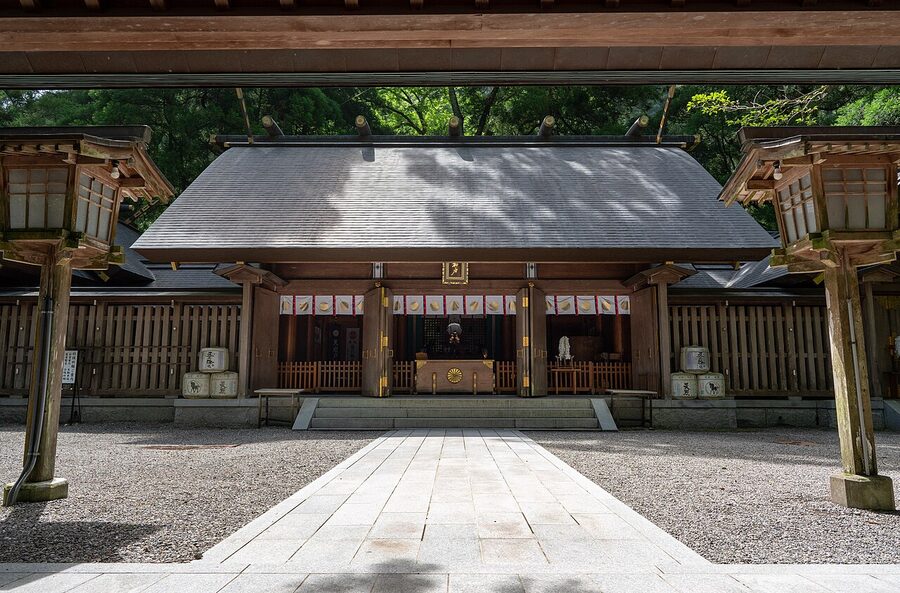
The cave is visible, after a fashion, only on a guided visit. Priests take groups through to a viewing point behind the hall, after a short purification, several times a day; you gather at the rest area near the office before the start time, the visit takes ten to fifteen minutes, it is free, with a donation box for those who want to give, and photography is forbidden.
Do not expect to see much. The explorer Matsuura Takeshirō, who came in 1837, wrote that the mouth of the cave was hard to make out, and noted that at least two people had died trying to climb down the cliff to find it. The shrine office and talisman counter are open from 8:30 to 17:00.
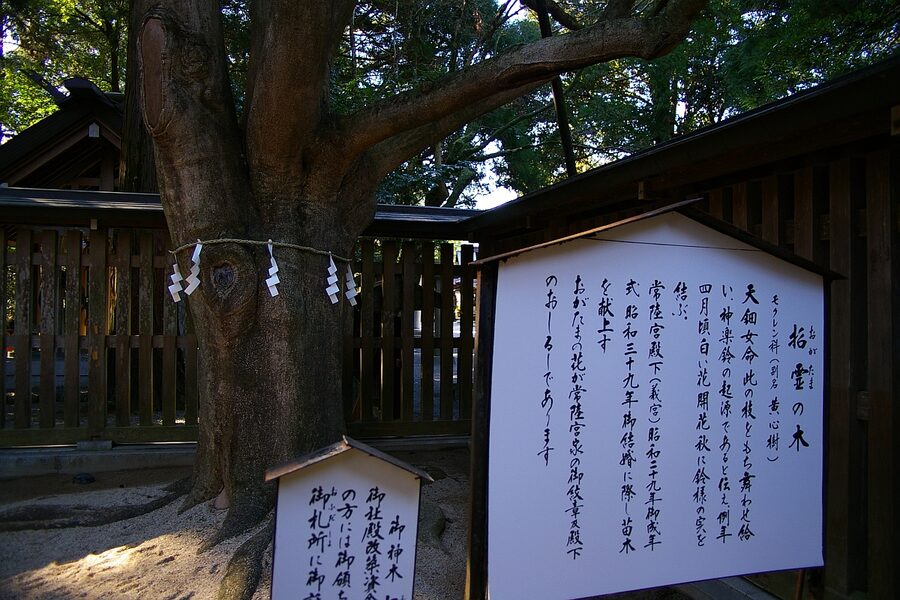
In front of the West Hongū grows the shrine’s sacred tree, an ogatama (招霊), the “spirit-summoning” tree. Its seed clusters are said to be the model for the bells that kagura dancers shake, and the shrine hands out saplings at the counter if you want to try growing one. Behind the East Hongū a spring rises at the foot of a sacred cedar, and you may drink from it.
Amano Yasukawara
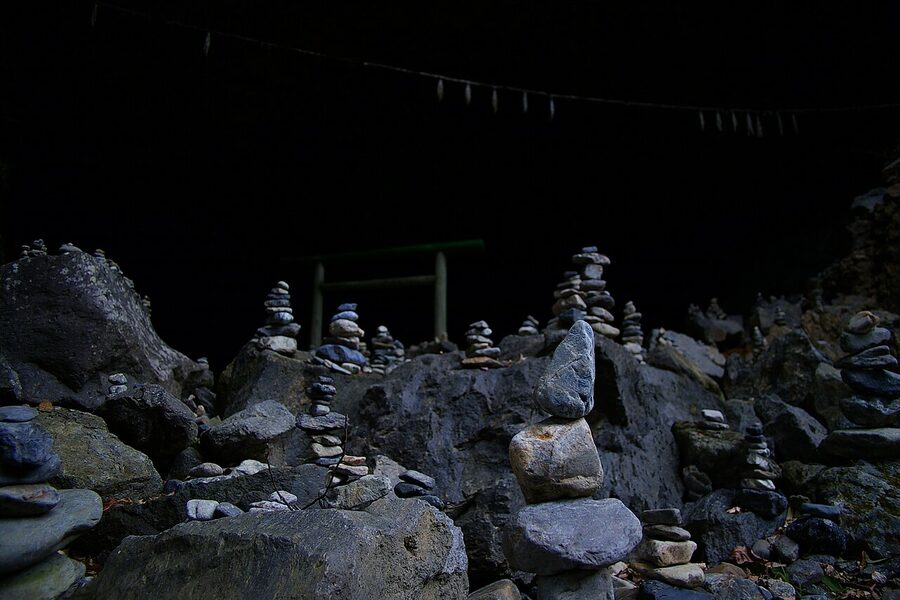
Follow the path upstream from the West Hongū for about fifteen minutes, some 500 metres, and you reach Amano Yasukawara, the river bed where the gods are said to have met to plan. It is a shallow cave in the cliff, forty metres wide and thirty deep, with a small shrine to Omoikane and the eight million gods. The floor is covered with thousands of small stone stacks, left by people who believe that piling a stone with a wish will make it come true.
Takachiho Kagura
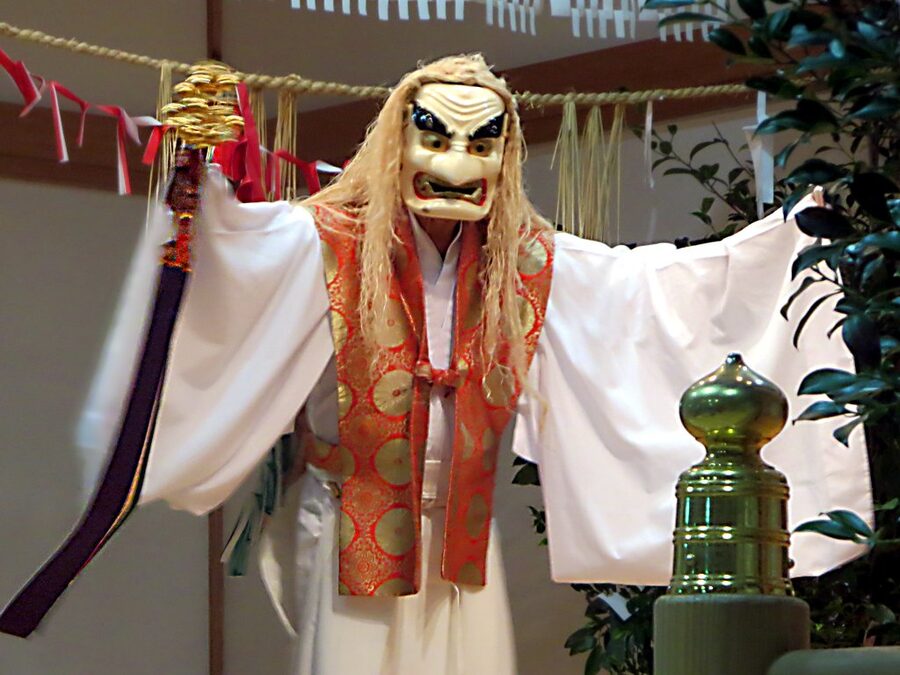
The cave story is danced in Takachiho every night of the year. Between mid-November and early February, about twenty hamlets around the town hold the full yokagura, the night kagura: each borrows a house or a community hall, invites its local god in, and performs thirty-three dances from late afternoon until the next morning. The tradition is designated an Important Intangible Folk Cultural Property and is among the most remarkable things in Japan’s festival year; outsiders are usually welcome if they behave as guests, and the town tourist association publishes a schedule.
If your dates do not coincide, go to the Takachiho Kagura at Takachiho Shrine, where four of the thirty-three dances are performed every evening from 20:00 to 21:00. Three of them are the dances of the cave: Tajikarao searching for it, Uzume dancing to draw the goddess out, and the dance in which Tajikarao tears the door away and throws it. The fourth is a comic duet for Izanagi and Izanami, which Japanese descriptions variously call the making of the land and the brewing of sake. Tickets cost ¥1,000, and children up to the end of primary school go free.
Book online, from 10:00 thirty days ahead, for one of the 230 reserved seats, paying by card; a further 50 or 60 places are sold at the door from 19:30 and go fast in the autumn. There are no chairs, and you can take photographs without flash. The performance is cancelled on 31 December and 1 January, and on 22 and 23 November it gives way to the town’s annual kagura festival at the same shrine. Amano Iwato Shrine holds its own public performance of all thirty-three dances every 3 November.
To get to Takachiho by public transport, take the Miyazaki Kōtsū express bus, the Takachiho-gō, from Kumamoto Station or Aso Kumamoto Airport to the Takachiho Bus Center, or a local bus from Nobeoka Station. From the Bus Center the town’s community bus runs to Iwato. If you are driving, the shrine has four car parks, all free, and they fill up at holiday weekends.
Heiwadai Park, Miyazaki
If you are passing through Miyazaki city, give an hour to the other side of the story. The hakkō ichiu tower still stands in Heiwadai Park, on the hill north of the city centre. In 1946 the occupation had the slogan and the statue of a warrior spirit removed; prefectural staff hid the original calligraphy in a storehouse at Miyazaki Jingū; the tower was renamed the Peace Tower in 1957; and in 1965, after the warrior had already gone back up, the slogan was restored too.
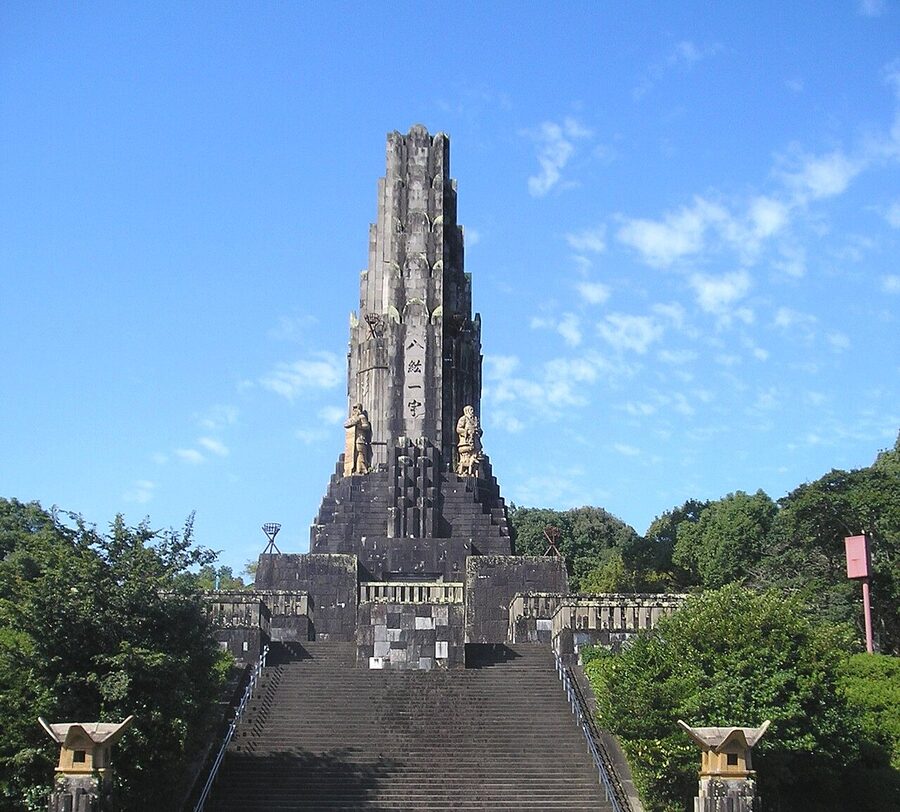
The park is free and open all day, and Miyazaki Kōtsū buses from the east exit of Miyazaki Station take about half an hour. Read the names on the stones, then walk down the hill. It is the most instructive monument to the uses of a myth that I know of in Japan, because nobody ever quite decided what to do with it.
The last time I went to Amano Iwato it was late afternoon, and I joined the final guided visit of the day. From the viewing point behind the hall, across the gorge, the new rope was just visible against the cliff, a pale line in the shadow, strung over a hollow in the rock that you are allowed to look at but not to photograph. I thought of Futodama with his rope, telling the sun not to go back in. Thirteen centuries on, it still seems to be holding.