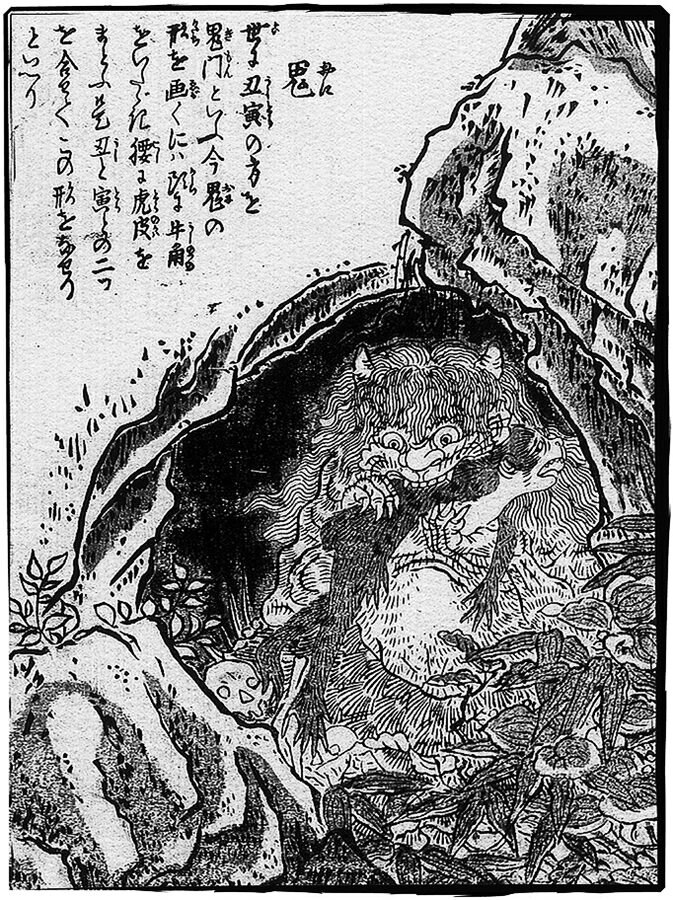
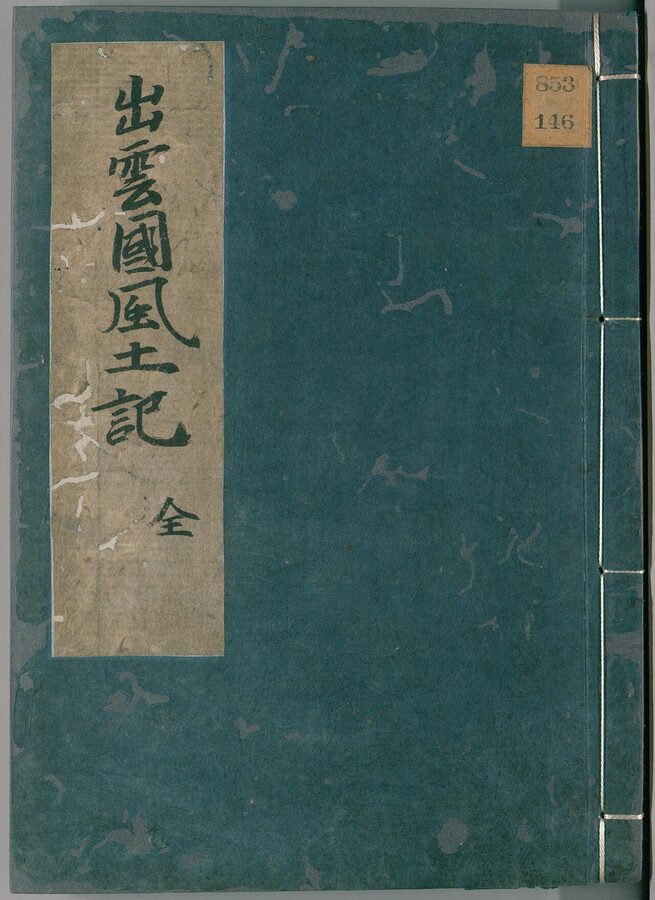
Some time before 733, a man was tending a hillside rice field in Ōhara district, in the province of Izumo, when a one-eyed oni came out of nowhere and ate him. His parents were hiding in a bamboo thicket close by. As the bamboo leaves shook, the man cried out “ayo, ayo”, an old word for that trembling, and the place has been called Ayo ever since. It is the first man-eating oni in Japanese writing, and it survives for the most bureaucratic reason imaginable: the court had ordered every province to explain its place names, and the clerks of Izumo filed it under local etymology.
I like starting there because nearly everything people now say about oni is missing from that first one: no tiger-skin loincloth, no iron club, no horns, no beans. Over the next thousand years the oni (鬼) would be a ghost, a plague, a bandit chief, a jealous wife, a warden of hell, a conquered people, a roof tile and a tourist-board mascot, and a few temples would end up inviting it in for the new year. The trail ends, as everything on this site does, at places you can still walk into.
In This Article
- A ghost from China, a hidden thing at home
- Horns of the ox, skin of the tiger
- One mouthful: the oni of the Heian night
- The arm at Rashōmon
- Shuten-dōji, the drunk of Mount Ōe
- Bandits, smiths and the people who would not kneel
- From tsuina to Setsubun
- Oni wa uchi: the places that let them in
- Momotarō and the island of oni
- Masks: hannya, buaku and an oni with a gong
- The namahage are not oni, whatever the posters say
- Tag, tiles and a boy with a sword: oni now
- Where to meet oni in Japan today
- Ōe: the oni museum and Mount Ōe
- Kyoto: Rashōmon, Modoribashi and the head at Oinosaka
- Setsubun in Kyoto: Yoshida jinja and Rozan-ji
- Yoshino: Kinpusen-ji, where the oni are welcome
- Oga: the namahage at home
- Okayama and Megijima, for Momotarō
A ghost from China, a hidden thing at home
The character came from China with a different job. In Chinese, 鬼 (guǐ) is the spirit of a dead person. Chinese thought split a person into a soul that rose to heaven at death and a second soul that stayed with the body and became a guǐ, and the ones who died violently, or had nobody left to make offerings to them, turned dangerous. Japanese still keeps that sense in a few stiff phrases: to “enter the register of ghosts”, kiseki ni iru (鬼籍に入る), simply means to die.
The Japanese word that got attached to the character was something else. The Wamyō ruijushō, a dictionary compiled in the 930s, explains oni as a corruption of on (隠), “hidden”, because the thing hides and does not wish to show its shape. Modern dictionaries still quote it, with the caveat that it is a guess, and the rival guesses are no better. For centuries the character didn’t even settle on that reading: writers read it mono, kami or shiko, and the Konjaku monogatari, the great story collection of the early twelfth century, still glosses it mono in places.
Mono is the key. When a lady in The Tale of Genji feels “as though attacked by a mono“, she means a resentful spirit, invisible and specific, the kind of thing that made people ill. The oni reading only became close to universal at the very end of the Heian era, by which time the creature had a body.
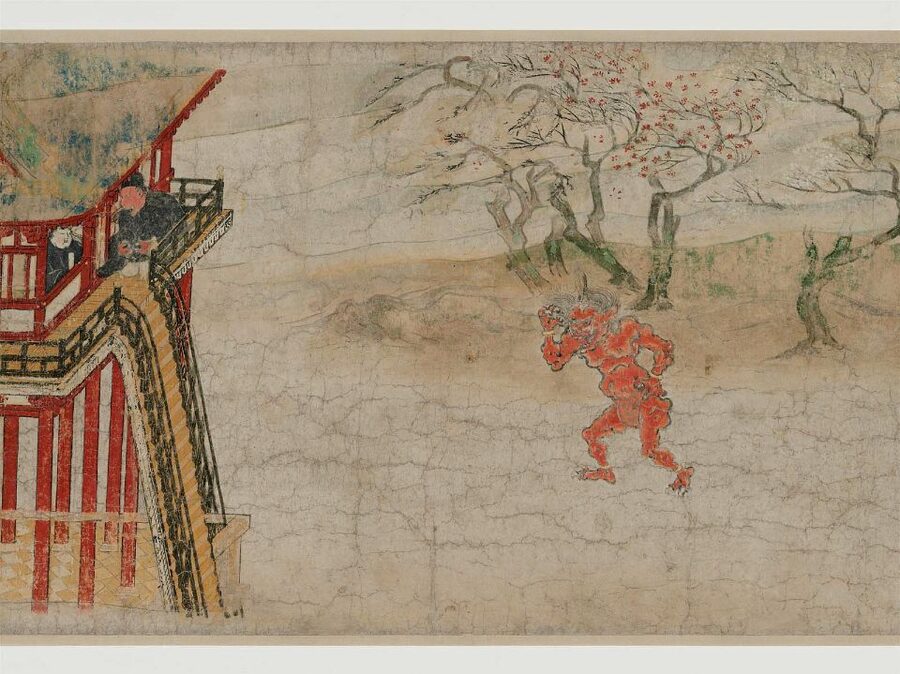
The other early oni is a spectator. The Nihon shoki, the court chronicle finished in 720, records that on the evening of the first day of the eighth month of 661, while the court held the funeral of Empress Saimei at Asakura in Kyushu, an oni “wearing a great hat” watched the rites from the top of Mount Asakura, and everyone who saw it was uneasy. It doesn’t eat anybody. It simply stands on the ridge and looks, which is somehow worse.
Educated Heian men also used the character in the Chinese sense, for the angry dead. Fujiwara no Sanesuke wrote in his diary, the Shōyūki, that the regent Fujiwara no Yorimichi had fallen ill in 1029 because of the “oni-spirit” of his uncle Michitaka, and Fujiwara no Yorinaga blamed a retired emperor’s illness on the oni of his grandfather. In the world of the Fujiwara clan, where every promotion created an enemy, there were a lot of uncles to worry about.
Horns of the ox, skin of the tiger
The oni on the January bean packets is a big man with one or two horns, curly hair, fangs and claws, wearing a loincloth of tiger skin and carrying a knobbed iron club, the kanabō. Its skin is red, blue, yellow, green or black. Japanese folklorists explain the five colours as the five phases of Chinese cosmology crossed with the five hindrances of Buddhism: blue for anger, red for greed, yellow for agitation, green for torpor, black for doubt. By the phases green ought to be white, and nobody seems sure why it isn’t.
The horns and the tiger skin come, by the standard explanation, from a point on the compass. In onmyōdō, the yin-yang divination of the Heian court, the northeast was the kimon (鬼門), the demon gate through which evil arrived. On the compass of the twelve zodiac animals the northeast falls between the ox and the tiger, ushitora (丑寅), and if you put the ox and the tiger on one body you get horns and a tiger-skin loincloth. Toriyama Sekien wrote it in the corner of his oni in 1779, and Japanese dictionaries have repeated it ever since.
There is a rival account, and I suspect both are partly true. Buddhist hell already had horned wardens, the ox-headed gozu, and the Indologist Sadakata Akira has pointed out that Shiva on Kushan coins carries a club and an animal skin, and that one of his titles is “he who wears the tiger’s hide”. Japanese images rarely have only one parent. By the Muromachi era the type was fixed, and illustrated story books spread it everywhere.
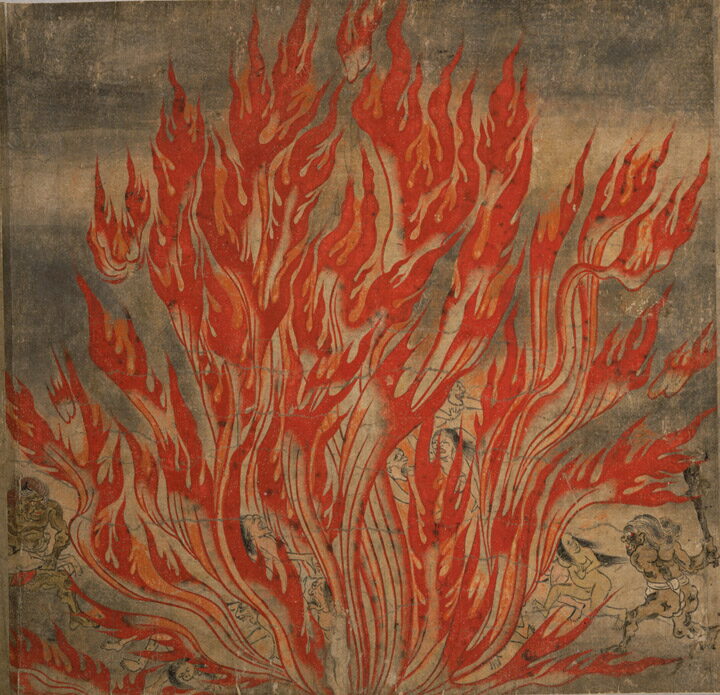
The hell wardens did a lot of the work. When the monk Genshin finished his Ōjōyōshū in 985, a guide to the paths to rebirth in paradise that spent rather more of its pages on the torments of the eight great hells, he gave Japanese Buddhism a catalogue of pain that painters could not resist. The oni who run hell for King Enma became the most widely seen oni of all.
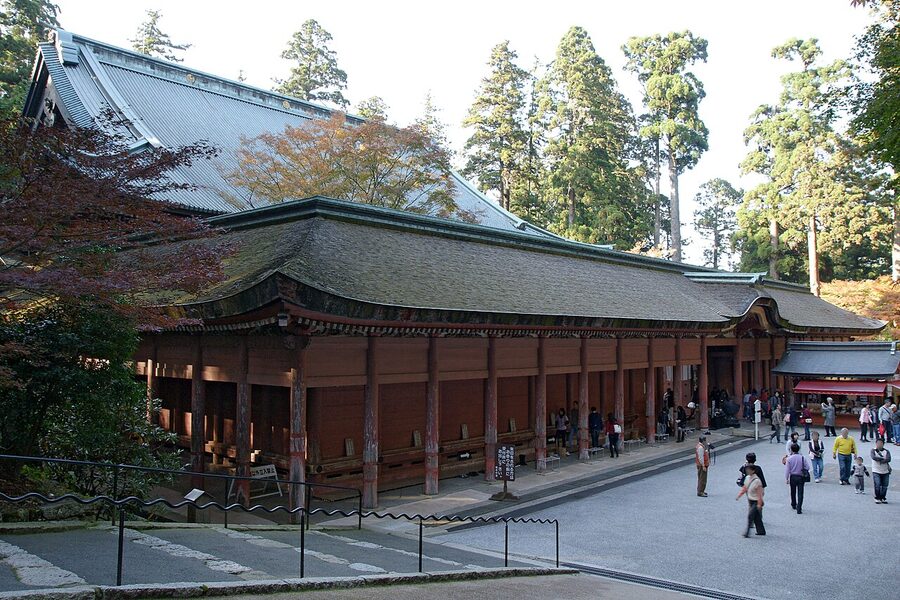
The demon gate was taken seriously by people who laid out cities. In Heian-kyō, founded in 794, Enryaku-ji on Mount Hiei sat to the northeast of the palace, and the monk Jien wrote a poem early in the Kamakura era describing the mountain as plugging the oni’s door; Iwashimizu Hachimangū covered the southwest, the “rear demon gate”. Yoshida jinja, which you will meet again at Setsubun, also guards the capital’s northeast. Sceptics point out that Enryaku-ji was founded in 788, six years before Heian-kyō existed, so its guard duty was probably assigned after the fact.
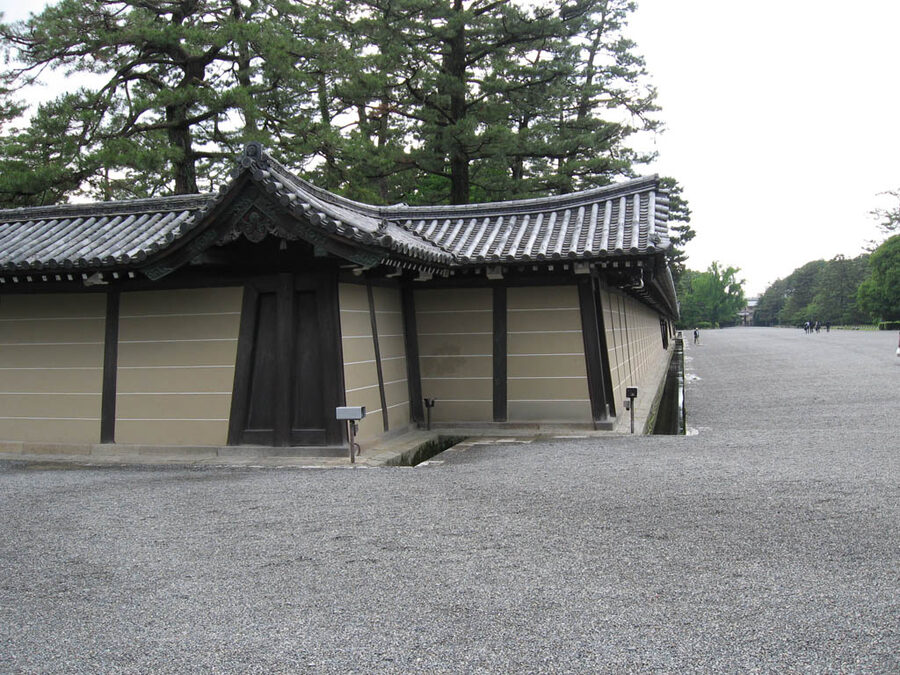
Edo copied the scheme with Kan’ei-ji at Ueno to the northeast of Edo Castle and Zōjō-ji to the southwest. The Kyoto Imperial Palace still has a notch in its outer wall at the northeast corner, the Sarugatsuji or “monkey’s corner”, so that there is technically no corner for anything to come through. A carved wooden monkey sits up under the eaves: the opposite point of the compass is the sheep and monkey, and the monkey is also the messenger of the Hie shrine that protects the palace.
Warriors took the opposite line. Several castles, Azuchi, Fukuchiyama, Okayama and Himeji among them, are said to have put a latrine in the southwest, the rear demon gate, which one writer on house divination reads as a soldier’s contempt for the danger. In the early eighteenth century the scholar-official Arai Hakuseki wrote a whole essay, Kimon setsu, picking apart where the idea came from. Nobody listened.
The Meiji state called it superstition, and in 1936 the Ministry of Education, whose job included stamping out superstition, demolished a brand-new minister’s lavatory in the northeast of its building after two education ministers died in quick succession. The Ōsaka Mainichi newspaper made the obvious point. A Kyoto non-profit counted roughly 1,100 demon-gate charms in the city centre alone in 2015: squares of white gravel, holly and nanten bushes tucked into the northeast corners of offices, shops and houses.
One mouthful: the oni of the Heian night
Heian literature is full of oni, and mostly they eat people, often in a single bite. The death was common enough to get its own phrase, oni hitokuchi, “one mouthful for the oni”. In the sixth episode of the Tales of Ise, a man runs off with a woman he could never marry openly, they shelter from a thunderstorm in an empty storehouse, and he keeps guard at the door with his bow all night. At dawn she is gone, swallowed whole by the oni that lived inside, her scream lost in the thunder.
Later readers decided the man was Ariwara no Narihira and the woman the future empress Fujiwara no Takaiko. The text names neither, which hasn’t stopped anybody.
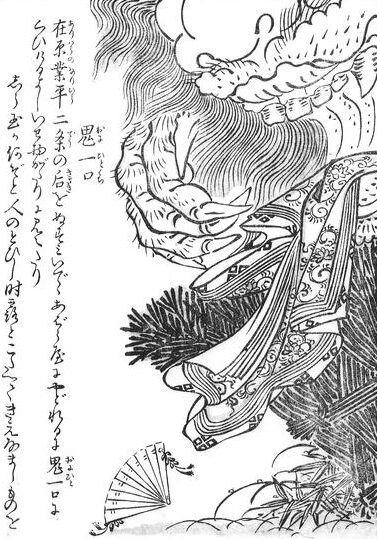
The Nihon ryōiki, the monk Kyōkai’s early ninth-century book of Buddhist cautionary tales, has the grimmest version. A wealthy girl in Yamato is married to a suitor who sends carts of fine silk, and on the wedding night she cries out three times; her parents assume the usual and go back to sleep. In the morning nothing is left of her but her head and one finger. The Konjaku monogatari sets another in the reign of Emperor Kōkō, on the night of the seventeenth day of the eighth month: a handsome man under a pine by the palace takes one of three young women aside, and when her friends look, only her hands and feet are left.
The folklorist Okabe Takashi reads these stories as a way of naming what war, famine and epidemic left behind in a city: people who were simply no longer there. The Heian capital lost people constantly to smallpox, fire and bandits, and the oni was the shape the absence took. It also explains why the oni of this period are so rarely described: you don’t see the thing that eats you in the dark.
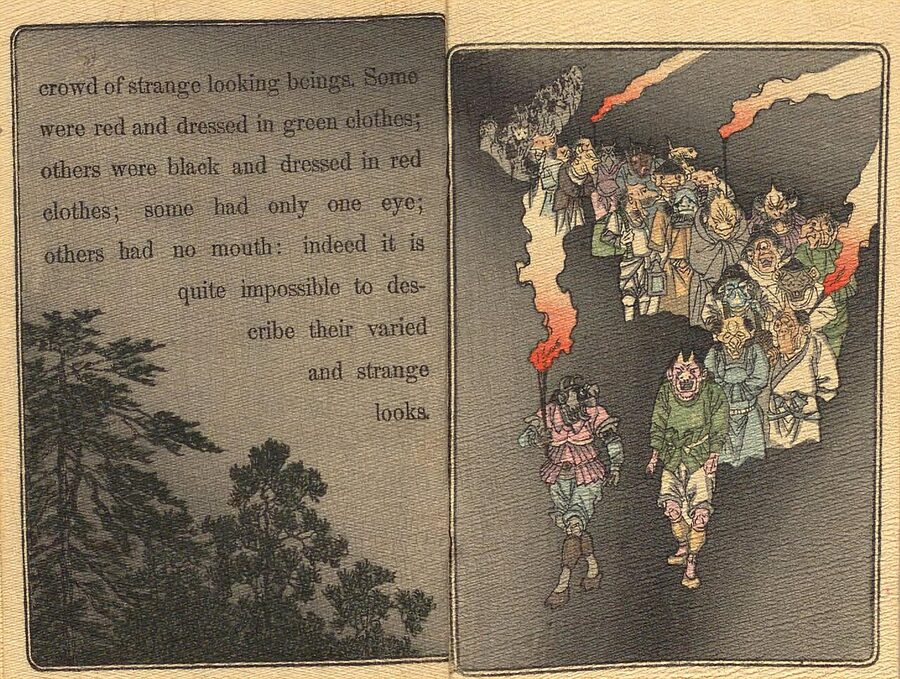
They travelled in groups. The Konjaku tells of a young nobleman who walked into the hyakki yagyō, the night parade of a hundred demons, and lived only because his nurse had sewn a Buddhist incantation into his collar. In the Uji shūi monogatari‘s version of the old man with the lump, Kobutori, a woodcutter sheltering in a hollow tree watches a crowd of oni feasting by firelight: red ones, blue ones, one with a single eye, one with no mouth. He dances for them so well that they take his lump as a pledge he will come back, which is how he loses it.
The arm at Rashōmon
Rashōmon, properly Rajōmon, was the great south gate of Heian-kyō at the bottom of Suzaku Avenue. It blew down on the sixteenth day of the eighth month of 816, was rebuilt, and fell again in a storm on the ninth day of the seventh month of 980, after which nobody bothered. Even before then its upper storey was where unclaimed bodies were left, the setting of the Konjaku story of a thief who finds an old woman pulling the hair from a corpse to make wigs. Akutagawa Ryūnosuke turned it into “Rashōmon” in 1915.
By the early eleventh century the gate was down to its foundation stones, and Sanesuke’s diary records that Fujiwara no Michinaga had those carted off for his new temple, Hōjō-ji. It is hard to think of anything more Fujiwara.
The oni most people associate with the gate first appears somewhere else. In the “Tsurugi no maki”, the chapter on swords attached to some texts of the Heike monogatari, Watanabe no Tsuna, the senior of Minamoto no Raikō’s four retainers, is riding past Ichijō Modoribashi at night when a beautiful woman asks him to see her home. He lifts her onto his horse. She turns into an oni, grabs him by the hair and flies off towards Mount Atago, and he cuts off her arm with the Minamoto sword Higekiri and drops back to earth.
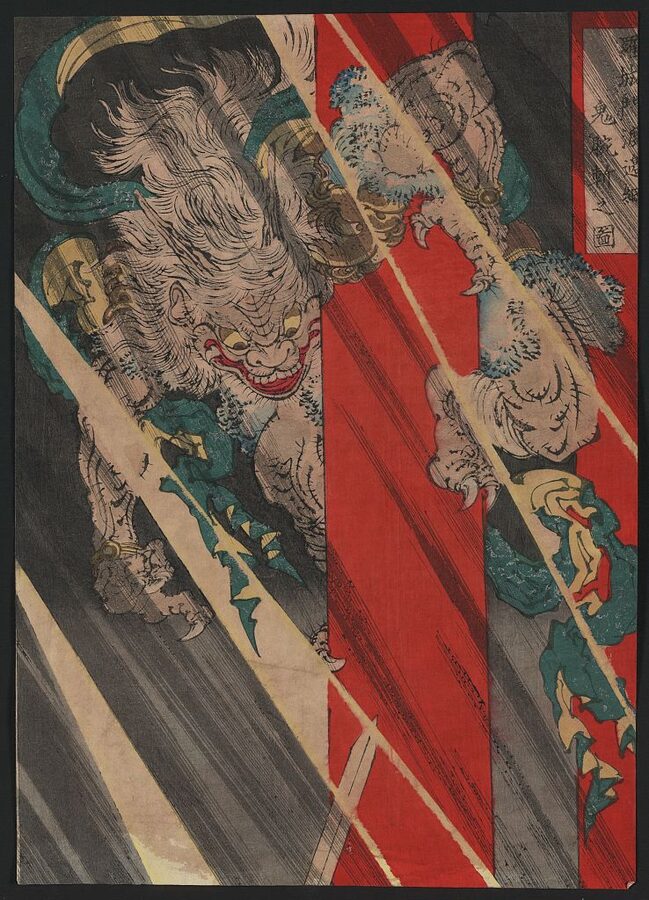
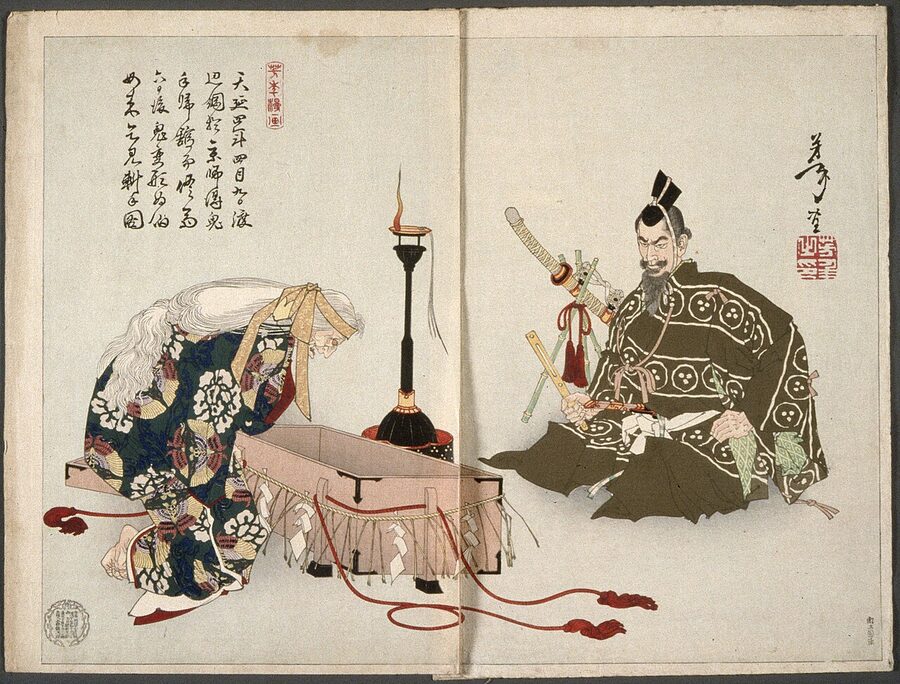
Tsuna brings the arm to Raikō, and a diviner (Abe no Seimei, in some versions) warns that the oni will come back for it: seven days of ritual seclusion, and let nobody in. On the seventh night his aunt arrives from Settsu, an old woman who raised him, and weeps on the doorstep at his ingratitude until he gives in. She asks to see the famous arm. He opens the chest, she takes it in her hand, becomes an oni and leaves through the roof.
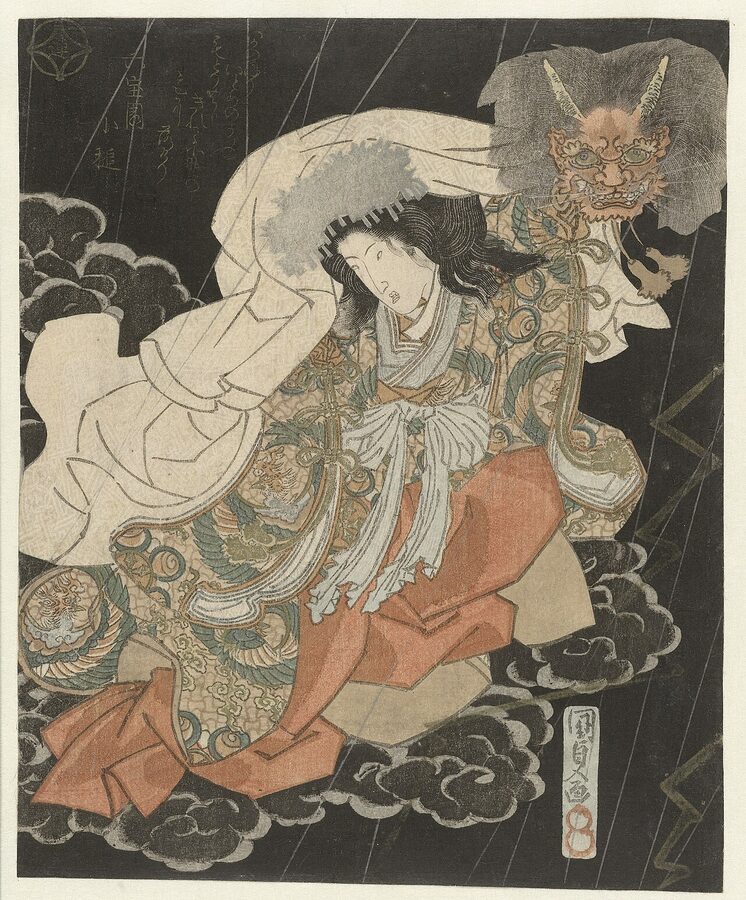
The fifteenth-century Noh play Rashōmon by Kanze Nobumitsu moved the fight from the bridge to the gate, and later retellings, the kabuki dance Ibaraki above all, gave the arm-stealing oni a name: Ibaraki-dōji, the chief lieutenant of Shuten-dōji. English-language retellings usually say flatly that Tsuna cut off Ibaraki-dōji’s arm at Rashōmon. Japanese reference works point out that the gate oni and Ibaraki-dōji began as separate creatures and that the merger is the theatre talking.
One small legacy is still observed. Families named Watanabe, as putative descendants of Tsuna, traditionally don’t throw beans at Setsubun. The oni are too frightened of the name to come anywhere near the house.
Shuten-dōji, the drunk of Mount Ōe
The greatest oni of all first appears in the Ōeyama ekotoba, a picture scroll of the late fourteenth century now in the Itsuō Art Museum at Ikeda, outside Osaka. In the reign of Emperor Ichijō the young men and women of the capital start to vanish, the diviner Abe no Seimei names an oni on Mount Ōe as the culprit, and the emperor sends Minamoto no Raikō (Yorimitsu) and Fujiwara no Yasumasa to deal with it. Sources disagree on the year: some give 990, others 995.
The warriors go disguised as yamabushi, mountain ascetics, with their armour hidden in their pack frames, and ask for a night’s lodging. Shuten-dōji questions them closely, then relaxes over sake and tells his story: he once lived on Mount Hira, until Saichō built Enryaku-ji and drove him out, and he settled on Mount Ōe in 849. He drinks so much that his followers call him Shuten-dōji, “the sake-drinking boy”. Raikō pours him a sake given by the gods, jinben kidokushu, harmless to men and poison to demons, and the warriors cut off his head as he sleeps; the head flies up and bites at Raikō’s helmet.
In the scroll his true form is about fifteen metres tall, with a red head and body, a black left leg, a yellow right arm, a white right leg, a blue left arm, five horns and fifteen eyes.
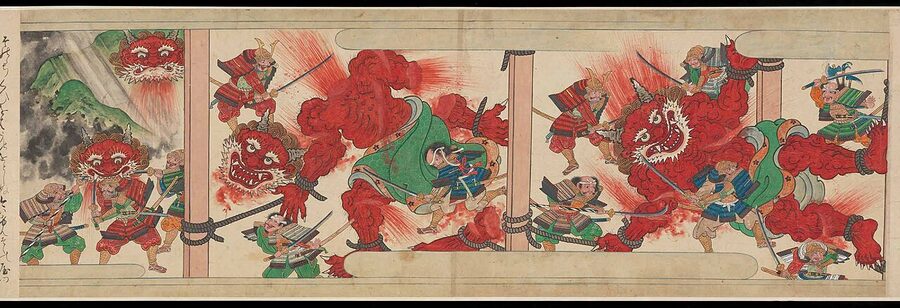
The version Edo readers knew is the Otogi-zōshi text published by Shibukawa Seiemon around 1720. Here Raikō leads his famous four retainers, Watanabe no Tsuna, Sakata no Kintoki, Usui Sadamitsu and Urabe no Suetake, with Yasumasa demoted to a hanger-on.
To allay suspicion, the warriors eat human flesh and drink a captive princess’s blood with their host. And Shuten-dōji, dying, calls them cheats: oni ni ōdō nashi, “there is no deceit among oni”. It is the best line in the story, and the oni gets it.
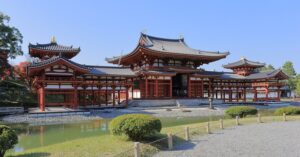
Raikō’s family was the Settsu branch of the Minamoto, cousins of the line that later produced Minamoto no Yoritomo, and the oni-slaying stories did the Minamoto no harm at all when they needed a heroic pedigree. Komatsu Kazuhiko adds a telling detail. He names Shuten-dōji, the fox Tamamo-no-mae (whom you can meet in the kitsune article) and the oni Ōtakemaru as the three monsters medieval Kyoto feared most, and notes that all three were said to have ended up as trophies in the treasure house of the Byōdō-in at Uji, the Fujiwara regents’ temple, like heads on a wall.
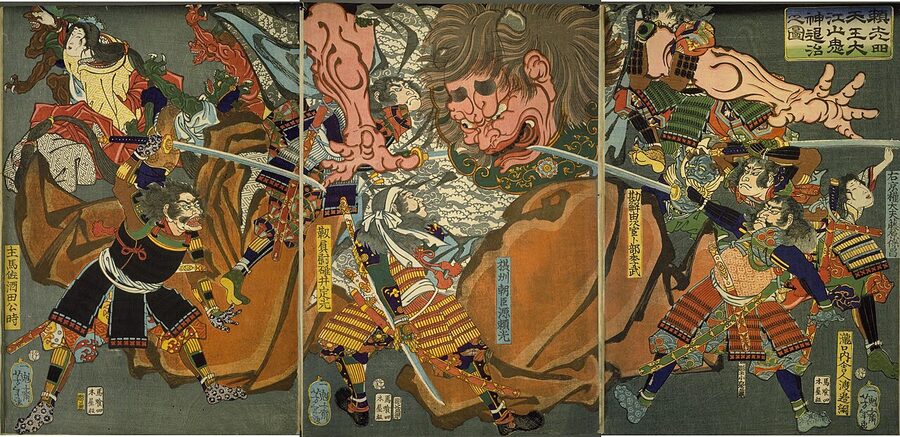
Another tradition says the head never reached the capital. At Oinosaka, the pass on the old road west out of Kyoto, a roadside Jizō told Raikō’s men that nothing unclean could enter the city, and the head became too heavy to lift; they buried it on the spot. In some versions Shuten-dōji repented as he died and asked to help people with illnesses above the neck, and the small shrine on the pass, Kubizuka Daimyōjin, still claims him for anything wrong above the neck.
Where Shuten-dōji came from depends on who is telling it. Echigo claims him as a temple page at Kokujō-ji so beautiful that the local girls sent him love letters; he burned them unread, the smoke of their longing wrapped round him, and he turned into an oni. The Ibuki version makes him the son of the god of Mount Ibuki and a rich man’s daughter, a page on Mount Hiei who made oni masks for a dance to celebrate the new capital (Hiei, after all, being the demon gate), got drunk, slept in his mask and woke to find it would not come off.
The historian Takahashi Masaaki has another answer. He links the legend to the smallpox epidemic of 994 that tore through the capital, reads the oni’s palace inside the mountain as a kind of underworld, and sees Chinese tales of a white ape that steals women behind the plot. Another school puts the “real” Ōeyama at Ōeyama (大枝山), the highwaymen’s pass at Oinosaka, and reads the legend as bandit trouble dressed up.
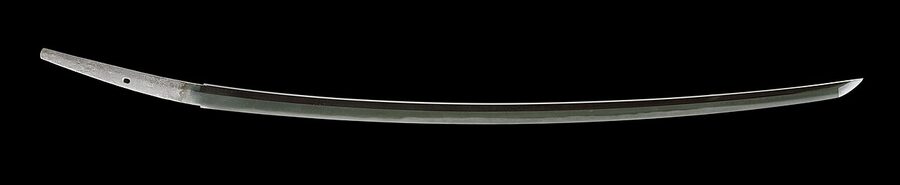
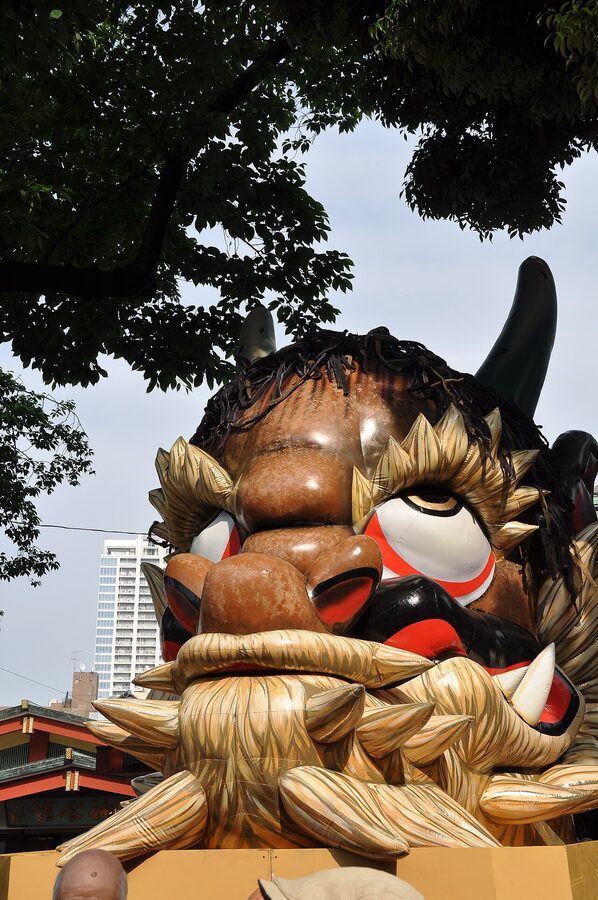
The sword survives, which is more than most legends can say: Dōjigiri, “the boy-cutter”, is counted among the finest Japanese swords in existence. Shuten-dōji himself became Edo’s favourite oni: a giant head of him rode in the Kanda Matsuri in the days when it was a “festival under heaven” that passed through the shogun’s castle, and when the float came back in 2007, as a four-metre balloon, it had been missing for about 170 years.
Bandits, smiths and the people who would not kneel
For about a century Japanese scholars have been asking who the oni were in life, and the answers say more about Japan than about monsters. The Nihon shoki already calls the peoples who would not submit to the Yamato court “evil oni”. Komatsu Kazuhiko’s list of people who could, at one time or another, be called oni runs from rebels and bandit gangs to smiths, performers, yamabushi and anyone in the mountains who did not farm.
The northern campaigns of Sakanoue no Tamuramaro left Tōhoku full of stories of oni subdued with the help of the gods, and Ōtakemaru, remembered as an Emishi chief, is an oni in those stories. In 1981 the folklorist Wakao Itsuo argued that oni were metalworkers, pointing out how often oni legends sit on old mine sites. It fits Ōe uncomfortably well: the mountain had copper and nickel mines into the twentieth century, and the oni museum stands on the site of one.
Ōe itself has three oni hunts, not one. In the oldest, a prince named Hikoimasu subdues a tsuchigumo chieftain called Kugamimi no Mikasa; in the next, Prince Maroko, a brother of Prince Shōtoku, kills three oni on the mountain; and only then come Raikō and Shuten-dōji. A conquering court that keeps sending heroes to the same mountain is telling you something about the mountain’s inhabitants.
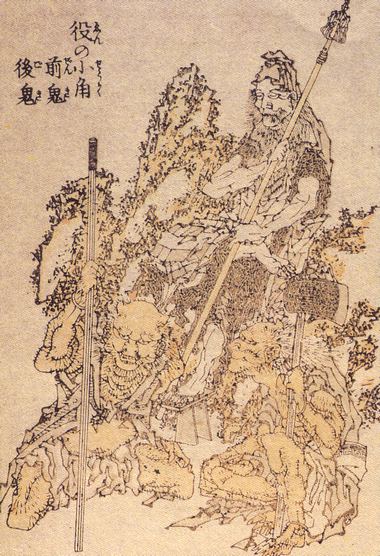
Some families were proud of it: the descendants of Zenki and Goki, the oni servants of the seventh-century mountain ascetic En no Gyōja, lived as people in a village named for their ancestor, and the people of Yase, below Mount Hiei, traced themselves to oni who had served Saichō. In the Meiji era a rumour went round that the oni had been Russians, helped by the Russia scare around the Russo-Japanese War and the naval base at Maizuru just over the hills from Mount Ōe. An Edo-period gazetteer of Tango had already suggested pirates from overseas. Every age gets the oni it is afraid of.
From tsuina to Setsubun
The oni-chasing every Japanese child does in February began as a Chinese palace exorcism. The Shoku nihongi records that in 706, with epidemics killing people across the provinces, the court first performed the great exorcism, taina, on the last night of the year. A man in a golden mask with four eyes, a black upper robe and red skirts, carrying a spear and a shield, played the hōsōshi, the exorcist, with a troop of boys behind him; a diviner read an address to the plague demons, the hōsōshi shouted and struck his shield three times, and courtiers shot reed arrows from peach-wood bows to drive the invisible demons out of the gates.
The court took the casting seriously. The Nihon sandai jitsuroku notes that in 866 it asked the eastern provinces to send a man over six shaku three sun, about 190 centimetres, to play the part. In the tenth century the author of the Kagerō nikki heard the city outside her house shouting “na yarau, na yarau“, “drive out the demons”, on the night of the rite.
Then something odd happened: from about the ninth century the peach-wood arrows start to be aimed at the hōsōshi and his boys, and the name of the rite changes from taina to tsuina (追儺), “chasing the demon”. The exorcist had become the oni. The historian Miyake Kazurō notes that the hōsōshi also walked in funerals, and the taint of death may have done it. The court rite faded from the Kamakura era and had gone completely by the Edo era, but its name survived as the polite word for what everybody else was doing on Setsubun night.
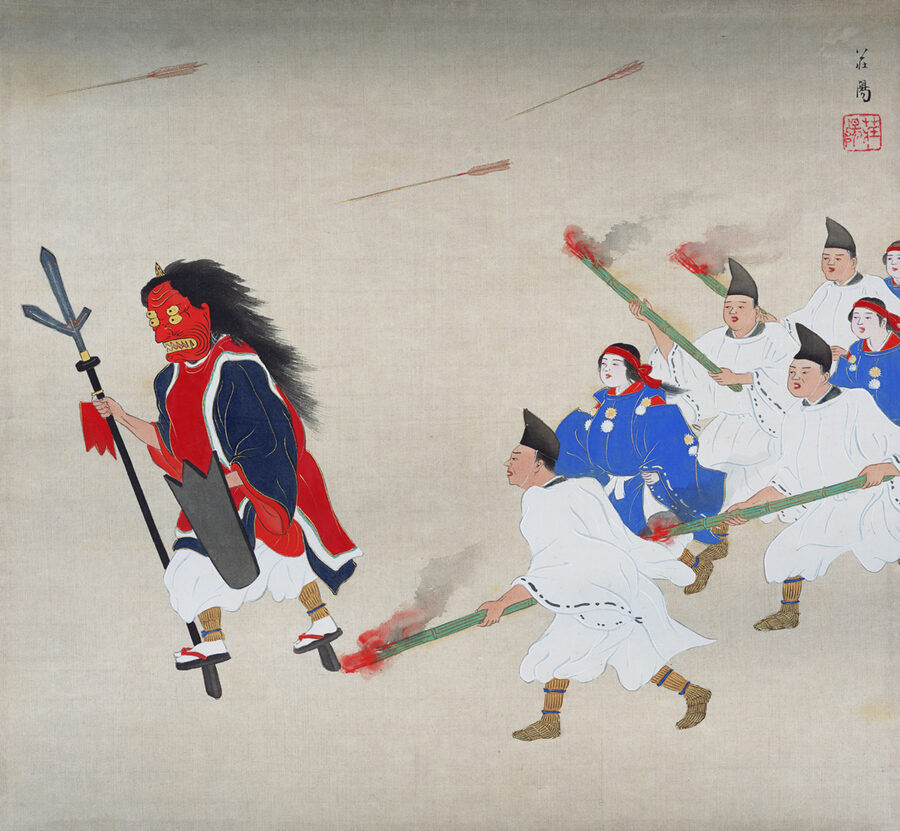
Setsubun means “dividing the seasons”, the eve of risshun, the first day of spring. Under the old lunar calendar the year began on the new moon nearest to risshun, so Setsubun was a second new year’s eve, and some districts still call it toshikoshi, “crossing the year”. In 2027 it falls on 3 February. Seasons turning were when sickness came in, and sickness was an oni.
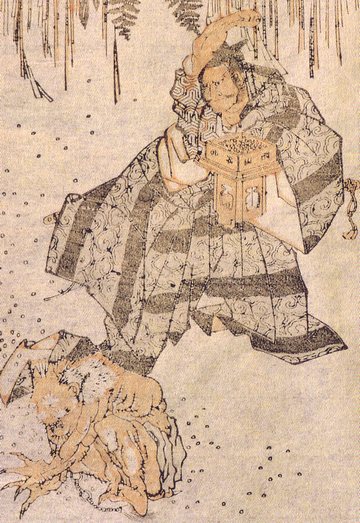
The beans are a later addition; the court rite never used them. The first records come from the same day, the eighth day of the first month of 1425, in two diaries: Prince Fushimi-no-miya Sadafusa’s Kanmon nikki notes the bean-throwing at oni as a recent custom at court, and a record of the shogun’s household lists who was to do the throwing that night. Twenty years later the dictionary Ainōshō supplied an origin story: in the reign of Emperor Uda an oni came out of a hole by Mizoro pond north of the capital, and a monk of Kurama sealed the hole and blinded the oni with three koku three shō of roasted beans.
The beans work, the explanations run, because mame (bean) sounds like mametsu, “destroying evil”, or ma-me, “the demon’s eye”, and because a grain carries life. They are roasted so they cannot sprout, which might let the evil grow back. The chant first turns up in the 1440s, in the diary of Zuikei Shūhō, a monk at Shōkoku-ji, who writes of scattering roasted beans and shouting “oni wa soto, fuku wa uchi“, “oni out, luck in”. Then everyone eats one bean for each year of their age, or one more for luck.
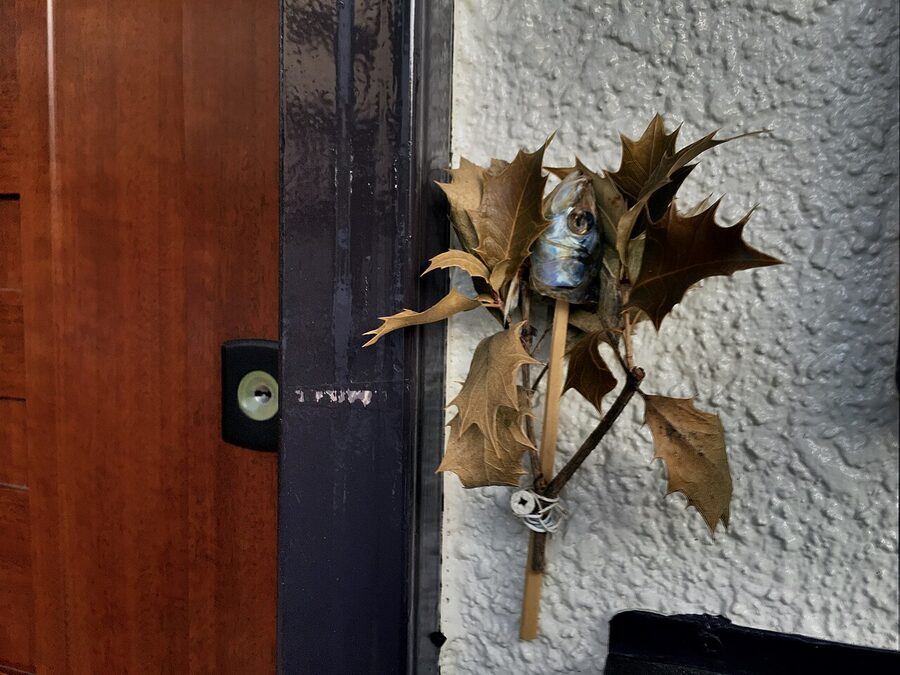
The door gets its own defence. A sprig of holly with a grilled sardine head on it, hiiragi iwashi, goes up at the entrance: the oni hate the stink of the fish and are afraid of getting the holly spines in their eyes. Other regions are more inventive. In eastern Gifu, households stick cards by the door showing an oni’s face, a five-pointed star and thirteen dots, and the oni, finding thirteen dots where there ought to be twelve months, count and recount them, and hunt for the star’s starting point, until dawn sends them away.
The temples and shrines made a show of it. At Sensō-ji in Asakusa a character called Gomottomo-san, “quite right, sir”, stands behind the bean-throwers fanning with a giant rice paddle. In Kyoto’s geisha districts Setsubun means obake, when geiko and maiko go out in costume to confuse the oni, and an old relative of the exorcism survives in the hadaka matsuri at Konomiya, whose formal name is the naoi shinji, the rite of the one who carries the demons, where a single man takes on everyone’s bad luck. More in Japan’s greatest festivals.
Oni wa uchi: the places that let them in
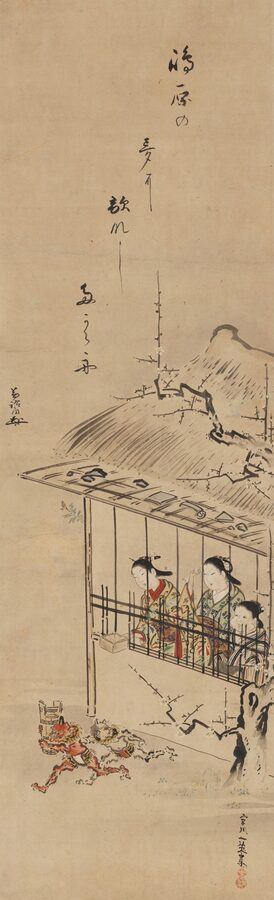
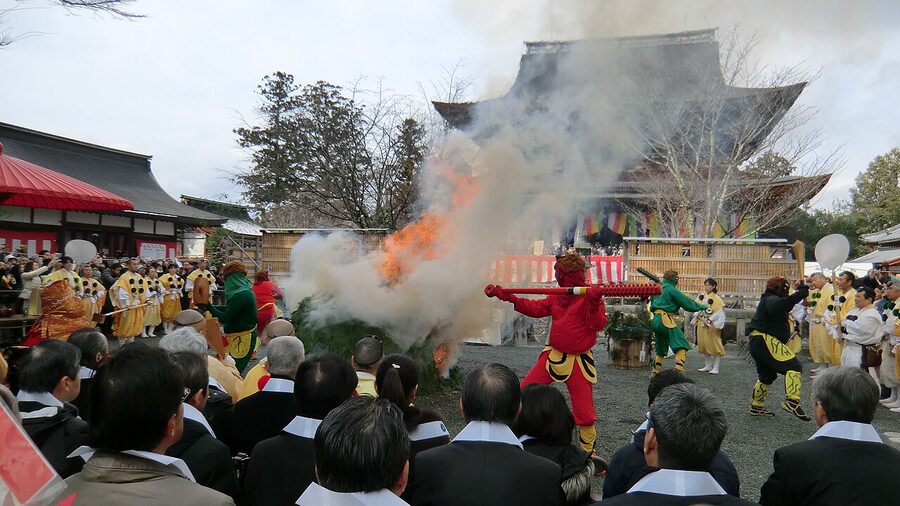
At Kinpusen-ji in Yoshino the Setsubun chant is “fuku wa uchi, oni mo uchi“, “luck in, and oni in too”, because En no Gyōja, the temple’s founder, converted oni into disciples rather than chasing them off. The Ōmoto religious movement, which reveres a god it calls the Ushitora no Konjin, the golden god of the northeast, says “oni wa uchi” as a matter of doctrine.
Families with “oni” in their surname, the Onizukas and the Kitōs, often welcome them in, and so did the domain of the Kuki family, whose name is written with the oni character, out of respect for the lord. In the old Nihonmatsu domain, ruled by the Niwa family, “oni wa soto” sounds uncomfortably like “O-Niwa soto“, “out with the Niwa”, so some districts say “oni, soto” and leave the “wa” out. At Naritasan Shinshō-ji they shout only “fuku wa uchi“: before Fudō Myōō, the temple says, even oni repent.
Momotarō and the island of oni
In the most famous Japanese children’s story the oni are simply there to be beaten. The oldest surviving printed text of Momotarō is a small red-cover picture book of 1723, and in the Edo versions the old couple usually find a peach, eat it, grow young again and have a baby the ordinary way. The boy who bursts out of the fruit itself is mostly a creature of the nineteenth century.
The modern story was fixed by the state. It entered the national school readers in 1887, and the children’s writer Iwaya Sazanami, who effectively wrote the textbook version, published his own retelling in 1894 with a new detail: Onigashima, the island of the oni, lies to the northeast, the demon-gate direction. That was also the year of the First Sino-Japanese War, and from then until 1945 Momotarō, in his headband and surcoat with his “retainers” the dog, monkey and pheasant (in older versions they were just companions), served as a little imperial soldier. He even led a wartime animated film.
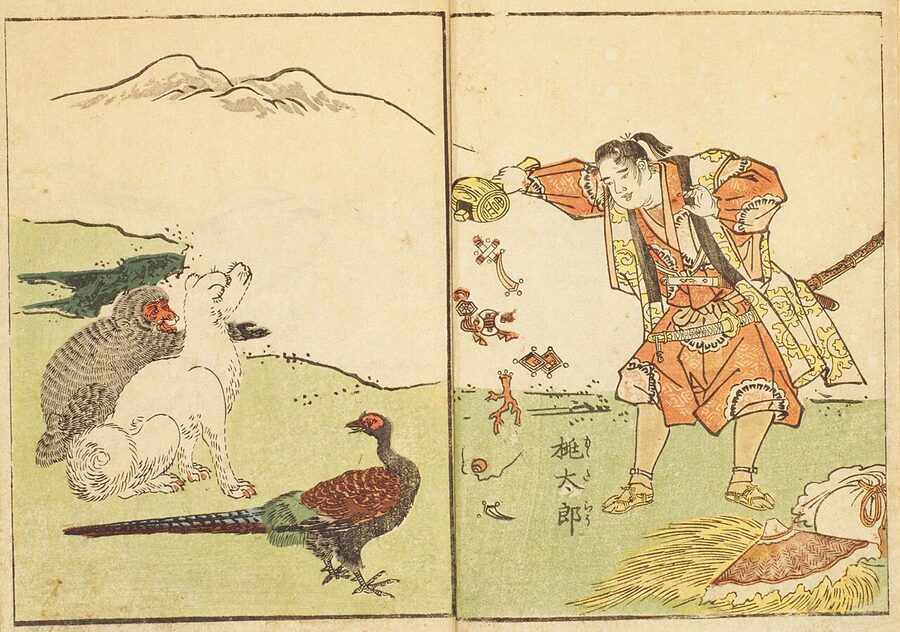
Not everybody was charmed. In 1871 Fukuzawa Yukichi wrote a set of moral lessons for his sons in which he asked what exactly Momotarō had gone to the island for: the treasure belonged to the oni, so taking it was theft. In 1924 Akutagawa Ryūnosuke wrote a “Momotarō” in which the oni live peacefully on a paradise island until the boy invades it, slaughters them and leaves the survivors plotting revenge. Read it now and it is hard to miss which empire Akutagawa had in mind.
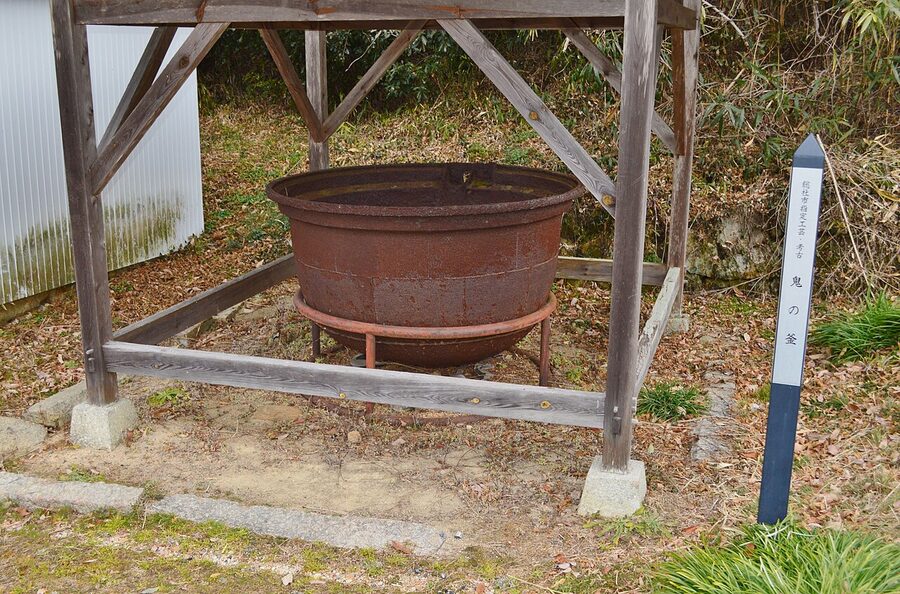
Okayama claims the story through Kibitsuhiko, a prince of legend sent to subdue Ura, an oni who ruled from a castle in the hills, Kinojō, and raided the coast. In the shrine’s tradition his three helpers came from families of dog-keepers, monkey-keepers and bird-keepers, which is suspiciously convenient, and the Okayama claim was first floated by a local sculptor in the early Shōwa years and pushed hard by the prefecture from the 1960s. Historians read the legend as the memory of the Yamato court’s conquest of Kibi, which was once nearly its equal, and Ura’s severed head, the shrine says, still howls under the kettle in the Kibitsu jinja’s cauldron hall.
Masks: hannya, buaku and an oni with a gong
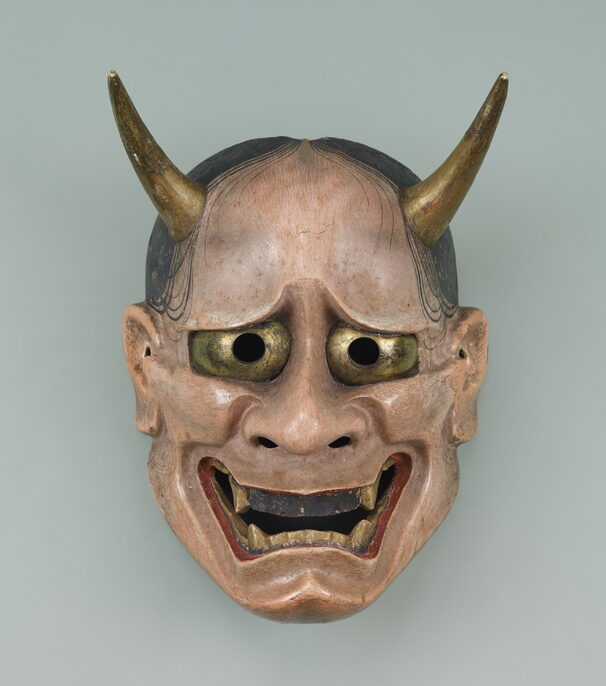
Zeami wrote in his treatise Fūshi kaden that Noh has two kinds of oni, the vengeful spirit or possessing demon, as in Aoi no ue, and the oni of hell, and oni plays are a whole category, performed last in a programme. The most famous oni mask, though, is a woman’s. The hannya is the face of a woman turned demon by jealousy: two gilded horns, gold eyes, a mouth torn open in rage, and, if you look again, a brow knotted in grief.
That double face is the point: in the confrontation scenes of Aoi no ue, Dōjōji and Kurozuka, the three classic demon-woman plays, the actor keeps dropping the mask and raising it as the priests pray against her, so that it looks sorrowful when lowered and murderous when lifted. The name “hannya” doesn’t appear in the earliest list of masks, in 1430, and turns up in the writings of the actor Shimotsuma Nakataka around 1600. One explanation credits a mask-carver called Hannyabō; another points to the line in Aoi no ue where the demon, hearing the priests chant the Heart Sutra, cries out at the dreadful voice of hannya, wisdom. A later Noh master preferred his own explanation: this is the face you get when you misuse wisdom.
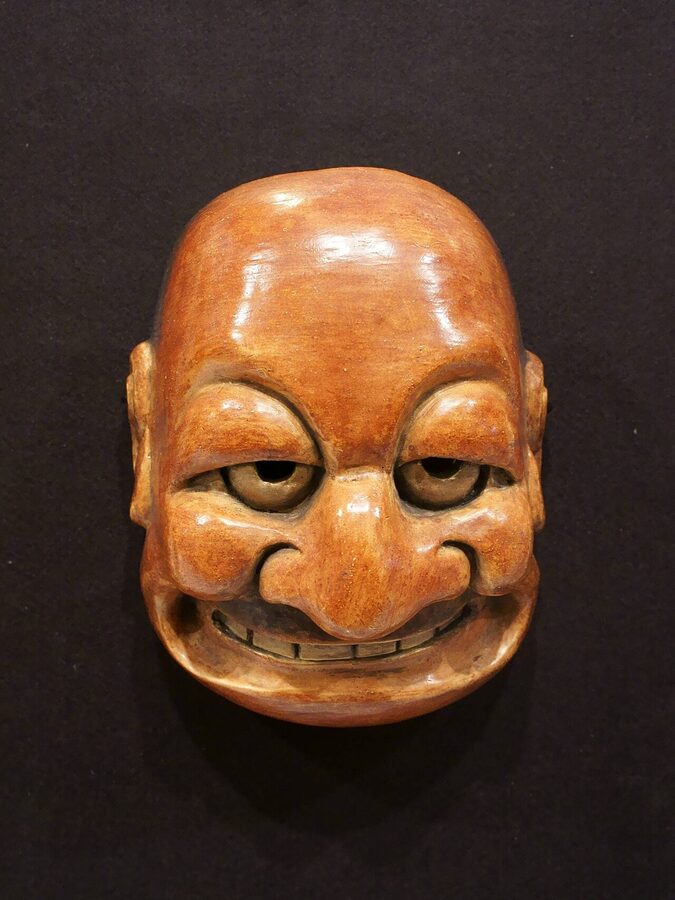
Kyōgen, the comic plays performed between Noh pieces, took the opposite view. Its oni wear a mask called buaku, look fearsome and turn out to be weak, dim and rather sweet. In the kyōgen Setsubun, an oni from the island of Hōrai turns up at a house on Setsubun night, falls for the woman inside and hands over his magic treasures to win her, at which point she pelts him with beans and drives him out. He leaves in tears, and audiences tend to be on his side.
Kabuki took the stories of Tsuna and Raikō and made dance plays out of them, Ibaraki, Modoribashi and Momijigari, the last about a demon woman of Mount Togakushi who entertains a general under the autumn maples before showing her horns. The printmakers of ukiyo-e followed the theatre, and oni became a test piece for anyone who wanted to show off. Hokusai drew dozens of them, mostly comic, while Kuniyoshi and Yoshitoshi went for scale and gore.
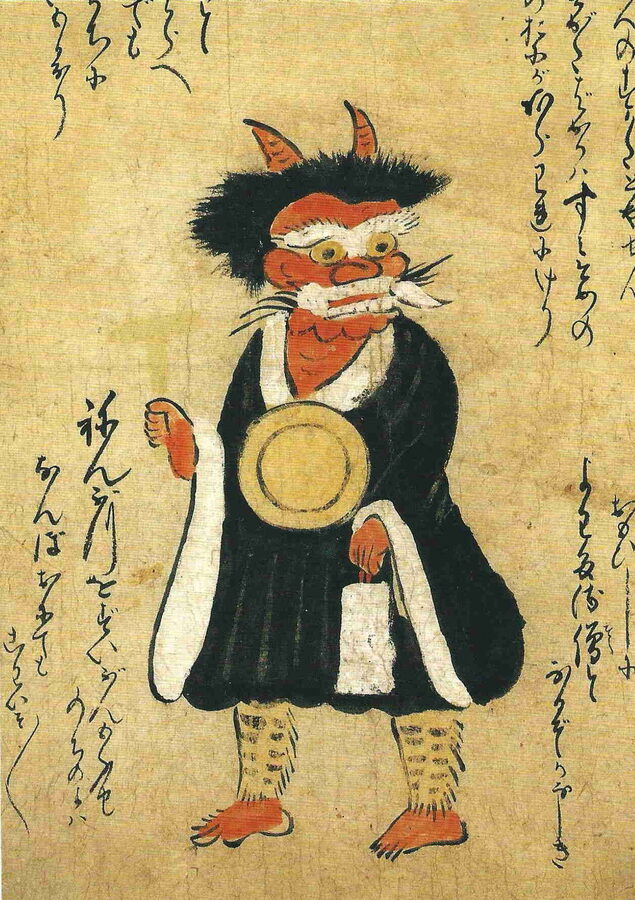
At the bottom of the market were the Ōtsu-e, cheap folk paintings sold to travellers at Ōtsu, on the Tōkaidō just east of Kyoto. Their best-known subject is an oni dressed as a begging monk, a gong round his neck and a subscription book in his hand, a joke about hypocrites that was also sold as a charm against crying babies.
The namahage are not oni, whatever the posters say
On the evening of 31 December, in villages on the Oga peninsula in Akita, young men put on red or blue masks with horns and capes of straw, pick up a wooden knife, and go from house to house roaring “naku ko wa inee ga“, any crying children here, and “warui ko wa inee ga“, any bad ones. The head of the household receives them formally, apologises for the family’s faults of the past year, feeds them and gives them sake, and they leave with a promise to come back next year.
Small children tend to remember the evening for a long time.
The posters, the airport souvenirs and most English-language guides call them ogres or demons. Japanese sources, and the people of Oga, are firm that the namahage are not oni at all but raihōshin, visiting gods who come at the turn of the year to scold the idle and bless the house; the horns crept in as the two figures were confused in modern times. The name comes from namomi-hagi, “peeling off the namomi”, the heat blisters you got from sitting too long by the hearth in winter, which the visitors would peel off the lazy.
The first written description is by the travel writer Sugae Masumi, who watched the visit on the fifteenth day of the first month of 1811 (8 February by the Western calendar, as the converted record gives it). It belonged to the little new year in mid-January until after the Second World War, when it settled on 31 December. It became an Important Intangible Folk Cultural Property in 1978 and was added to UNESCO’s list in 2018 with nine other visiting-god rites, but surveys by Oga city found it alive in only about eighty of the city’s 148 districts, with depopulation the main cause.
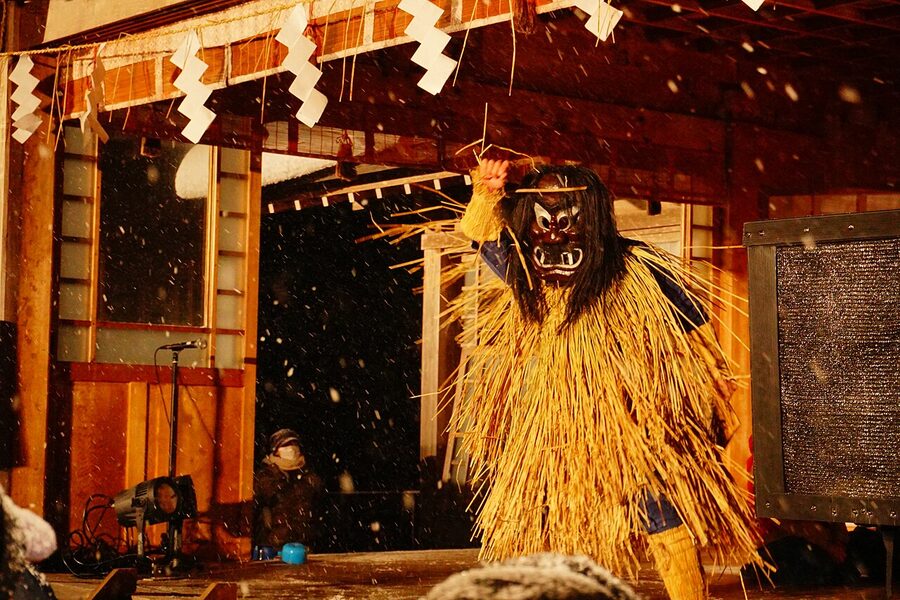
Even gods have bad nights. On 31 December 2007 a namahage got drunk on the hospitality and burst into the women’s bath at a hot-spring inn, and Oga city, after some thought, settled for a “return to the original spirit of the tradition” rather than a rulebook.
Tag, tiles and a boy with a sword: oni now
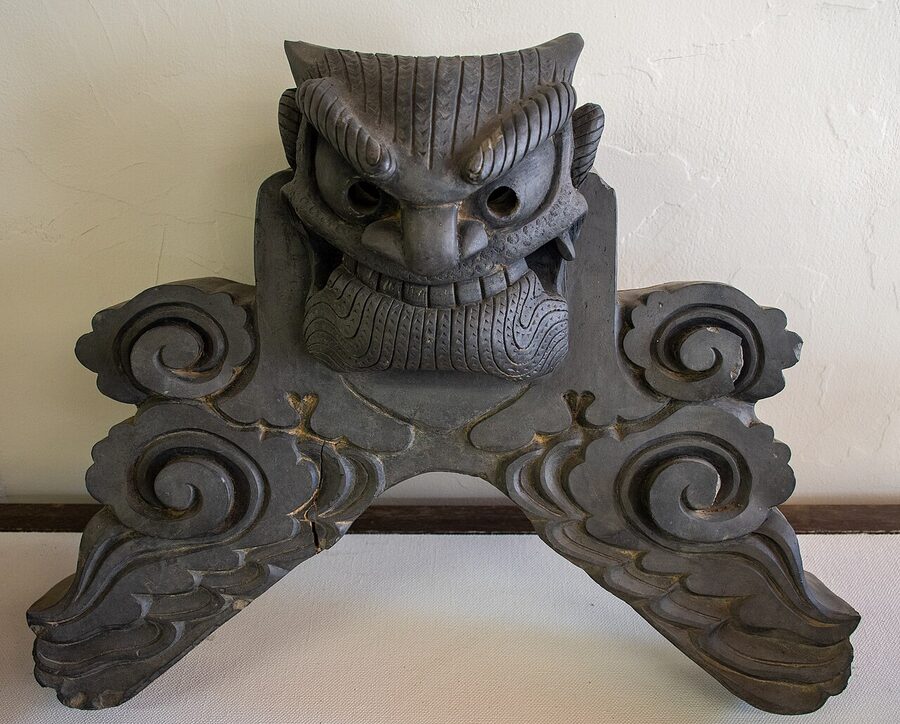
Every Japanese child has played the oni. In onigokko, tag, whoever is “it” is the oni, and folklorists in the line of Yanagita Kunio trace the game to children copying the tsuina; others object that in the game the oni does the chasing, which is the wrong way round. The oni is also on the roof. Onigawara, the ridge-end tiles that guard the ends of a temple or farmhouse roof, carried oni faces from the Nara period onwards, and every kawara workshop still turns them out.
The word has gone soft in everyday Japanese. As a prefix it means “huge” or “extreme”: the oniyanma is Japan’s biggest dragonfly, an oni-yuri a tiger lily, and teenagers say oni-umai for “really, really tasty”. “Speak of next year and the oni laugh” means don’t make plans, and “even an oni weeps sometimes” covers your hard-hearted boss at the retirement party.
Then there is Kimetsu no yaiba, Gotōge Koyoharu’s manga about a boy who hunts oni after they kill his family, serialised from 2016 to 2020, which sold in numbers that rewrote the industry’s records. Its oni are tragic ex-humans, often pale and beautiful, who eat people, which makes them, oddly, closer to the Heian original than the bean-packet ogre. The boom sent fans up to the oni museum at Ōe, whose total visitor count passed half a million in July 2022.
If you want the wider family, the yōkai article covers the rest of the night parade, the tengu are the oni’s cousins in the mountains, and the yūrei are what the angry dead turned into once the oni had grown horns. The long view is in Japan through the ages.
Where to meet oni in Japan today
The places worth a journey cluster in Kyoto and the hills north of it, Yoshino, and the Oga peninsula in Akita. Setsubun, on 3 February in 2027, is the one day the oni come out in daylight, so plan around it if you can.
Ōe: the oni museum and Mount Ōe
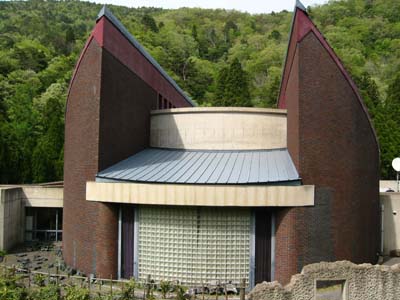
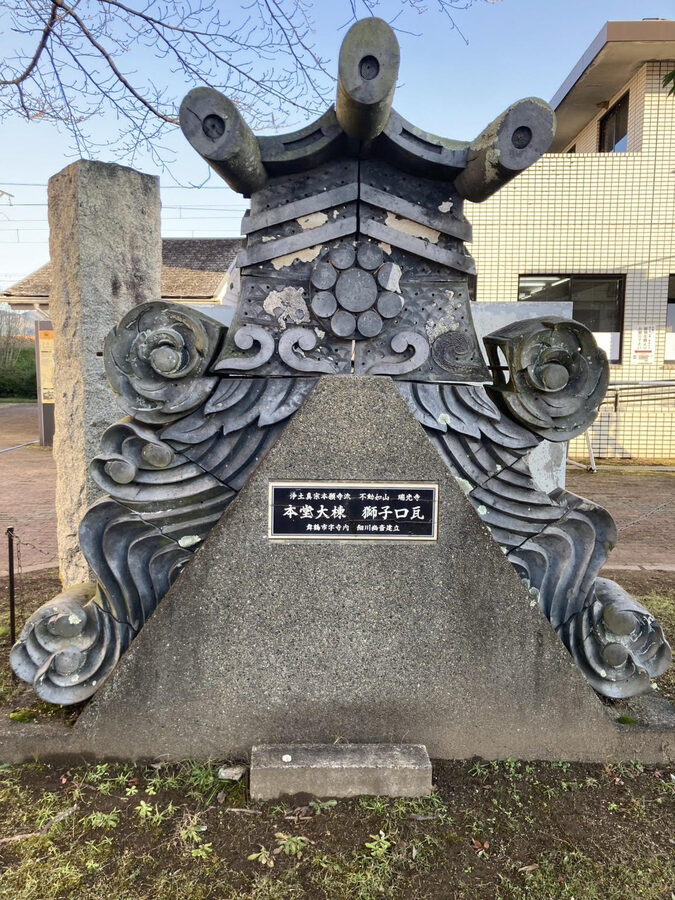
The Nihon no Oni no Kōryū Hakubutsukan (日本の鬼の交流博物館), the “Japan oni exchange museum”, sits on the eastern slopes of Mount Ōe in Ōe-chō, Fukuchiyama, on the site of the Kōmori copper mine. It opened in 1993 and holds about 3,000 items: scrolls of the three Ōe legends, festival masks from Japan and abroad, and about fifty onigawara from the Asuka period on. Out front stands Japan’s largest onigawara, five metres tall and ten tonnes, made by the guild of oni-shi, the specialist oni-tile makers.
It opens 9:00–17:00 (last entry 16:30) and closes on Mondays (or the following day after a holiday), on the day after national holidays and from 28 December to 4 January. Admission is ¥330, ¥220 for high-school students and ¥160 for younger children. Getting there takes planning: from JR Fukuchiyama Station take the Kyoto Tango Railway Miyafuku Line to Ōe Station, then the city bus to the Ōeyama no Ie stop, two minutes’ walk from the door.
The catch is that the city bus has not run on Saturdays, Sundays and holidays since November 2021. On those days the alternative is the “Oni-taku”, a shared car service from Ōe Station that has to be booked by 17:00 two days ahead; details are on the city’s website. By car it is about fifteen minutes from Ōe Station.
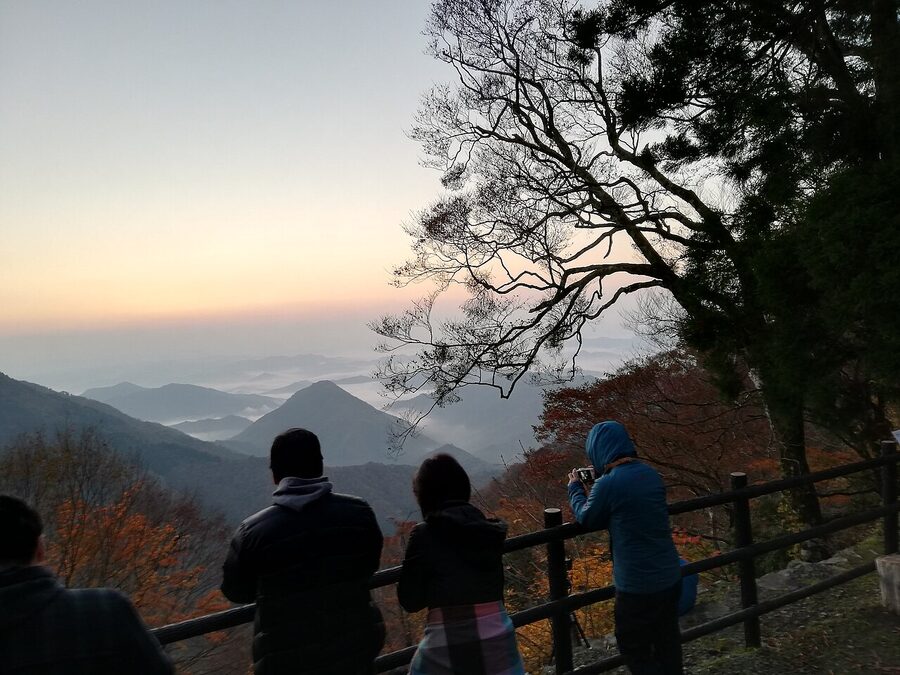
Further up the mountain, Onitake Inari jinja stands at about 640 metres, near the eighth station of Mount Ōe. On still, clear mornings from late October to early December, after rain the day before, the Yura river valley below fills with cloud, and the shrine’s terrace is the place to watch it. Go at dawn: by about eight the sun burns it off. The summit of Mount Ōe proper, Senjōgatake, is 832 metres and an easy hike from there if the weather holds.
Kyoto: Rashōmon, Modoribashi and the head at Oinosaka
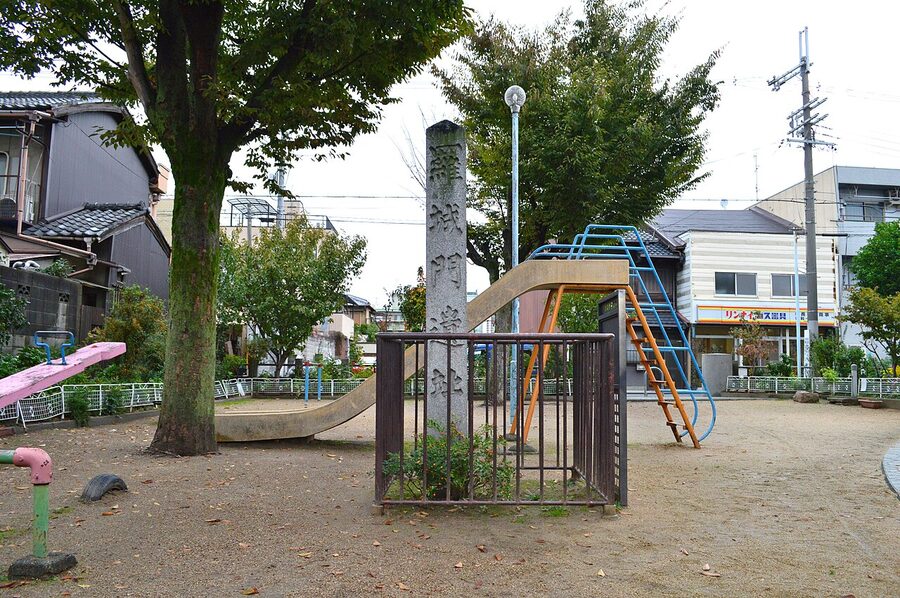
The site of Rashōmon is in Karahashi Rajōmon-chō, Minami-ku, where Kujō-dōri meets Senbon-dōri, about ten minutes’ walk west along Kujō-dōri from Tō-ji. Archaeologists have never found the gate itself, so what you get is a stone marker in a children’s playground. Go anyway: standing at the bottom of the vanished Suzaku Avenue tells you how far the capital’s edge was from its palace. Tō-ji keeps a statue of Tobatsu Bishamonten that is said to have stood on the gate, though you’ll need its spring or autumn treasure-house openings to see it.
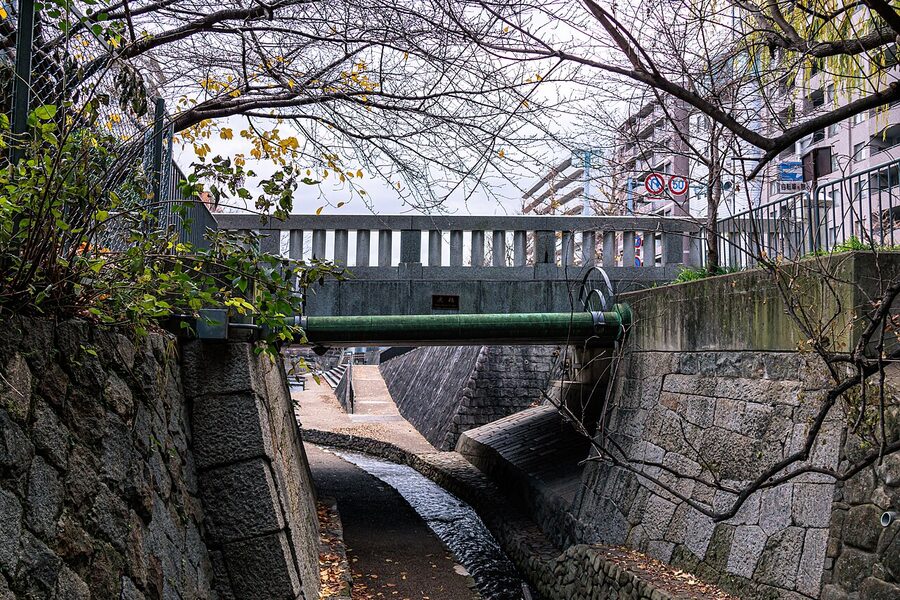
Ichijō Modoribashi, where Tsuna met his “beautiful woman”, crosses the Horikawa channel on Ichijō-dōri, and the city bus stop is called Ichijō Modoribashi Seimei-jinja-mae. The present bridge dates from 1995 and is short and plain. Its history is not: Sen no Rikyū‘s head is said to have been displayed here, and in 1597 the twenty-six Christians later known as the Twenty-Six Martyrs had their ears cut here before being marched to Nagasaki. Across the road, Seimei jinja keeps a small reconstruction of the older bridge built from its original timbers.
For the head, go west. Kubizuka Daimyōjin is a short walk from the Oinosaka-tōge bus stop on the Keihan Kyoto Kōtsū buses that run between Kyoto and Kameoka along Route 9, then up the old pass road through the woods. It is two torii, a small burial mound and a lightning-blackened sacred tree, and people still leave sake on the mound. The annual festival is on 15 April.
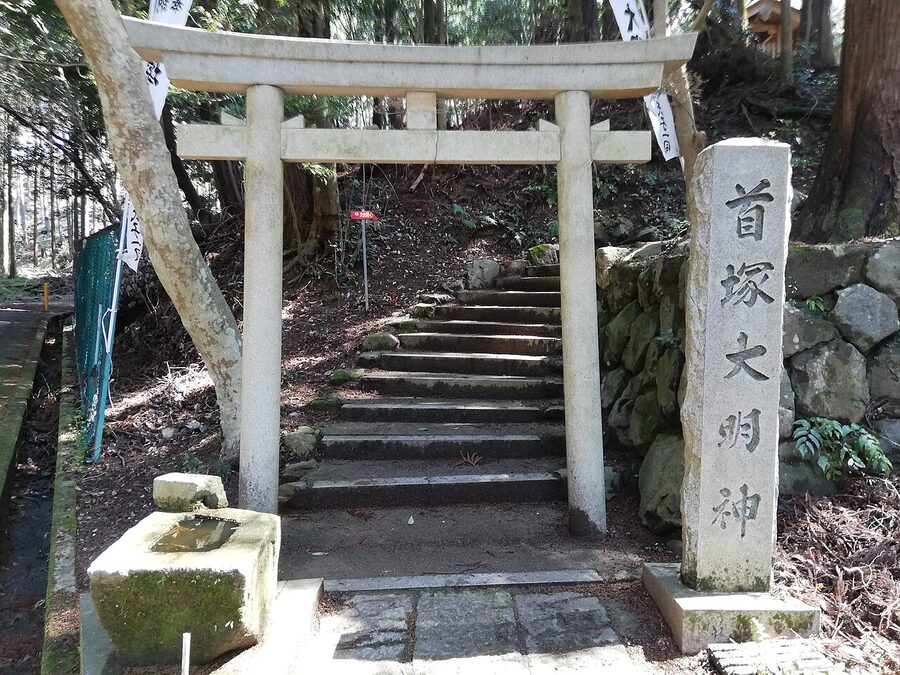
In central Kyoto, the palace’s monkey corner is free to see from the Kyoto Gyoen at any hour, and Enryaku-ji on Mount Hiei makes a full day on its own.
Setsubun in Kyoto: Yoshida jinja and Rozan-ji
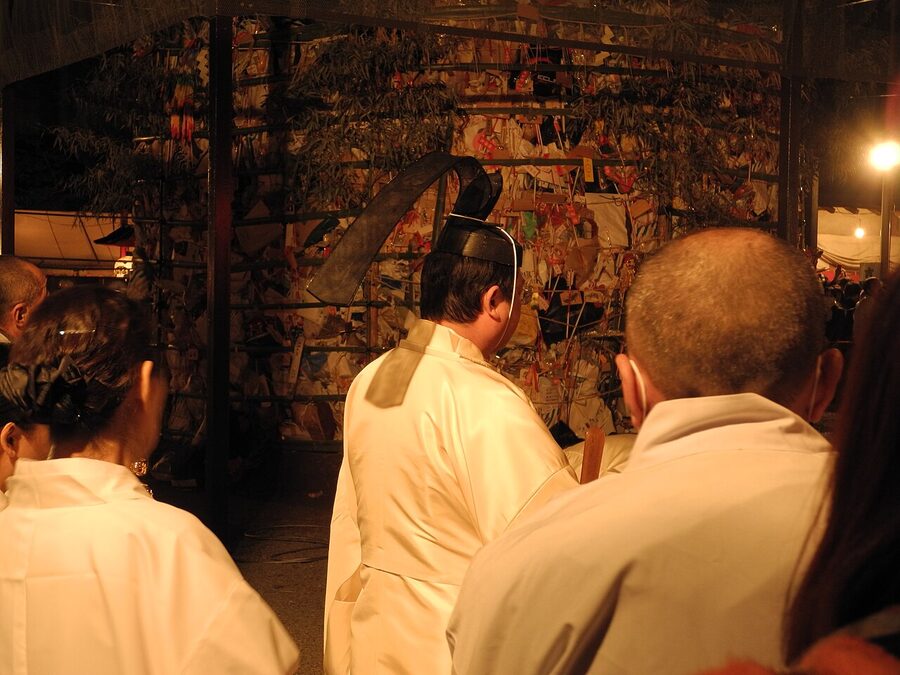
Yoshida jinja, at Yoshida Kaguraoka-chō in Sakyō-ku, behind Kyoto University, has held Setsubun since the Muromachi era and draws about 500,000 people over three days, from the day before Setsubun to the day after; in 2027 that means 2–4 February. On the eve comes the tsuina in front of the main shrine: the hōsōshi in his golden four-eyed mask, black robe and red skirts, with spear and shield, leads his boys round the dance pavilion and drives out the red, blue and yellow oni, and the courtiers fire reed arrows from peach bows. It is the closest thing to the Heian rite you can see; arrive early.
On Setsubun day itself the shrine burns the year’s old charms in a huge bonfire, the karo-sai, and around 800 food stalls line the approach. Take the city bus to Kyōdai Seimon-mae or walk about twenty minutes from Keihan Demachiyanagi; there is no parking during the festival.
Rozan-ji, on Teramachi-dōri in Kamigyō-ku, is the temple built on the site of Murasaki Shikibu‘s family house, and on Setsubun day it holds the oni-hōraku, known to everyone as the oni dance. From 15:00, to drums and conch shells, a red oni with a torch and sword, a blue oni with an axe and a black oni with a mallet dance round the hall while the abbot performs a fire rite inside; they stand for greed, anger and folly, the three poisons. The rite’s arrows, rice cakes and the temple’s sugar-coated hōrai-mame beans drive them out.
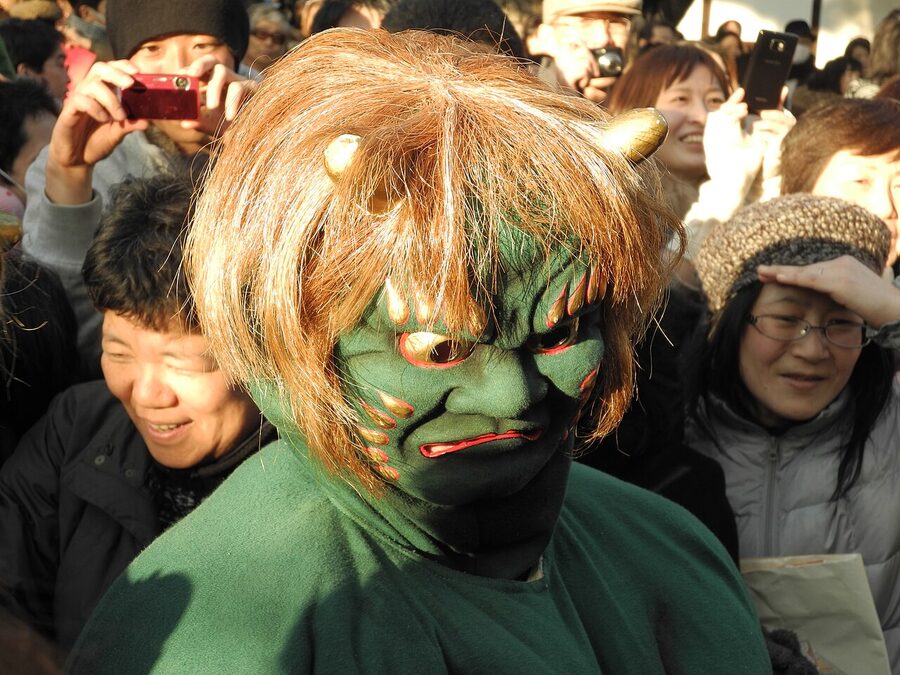
The oni blessings run from 14:00 to 14:45 and again after the dance ends, around 16:00. The temple’s famous moss-and-bellflower Genji garden normally costs ¥500 but is closed for several days around Setsubun. Rozan-ji is fifteen minutes’ walk from Keihan Demachiyanagi Station, or five minutes from the Furitsu Idai Byōin-mae stop on city buses 4, 17 and 205 from Kyoto Station. Its abbots once had good reason to like Akechi Mitsuhide: the temple says he kept it out of Nobunaga’s burning of Mount Hiei.
Yoshino: Kinpusen-ji, where the oni are welcome
Kinpusen-ji’s Setsubun-e, on 3 February in most years, is the one to see if you want the oni let in. The day runs from 9:30, with the oni-subduing ceremony and a great fire rite at 11:00 in front of the Zaō-dō, and the bean-scattering at 13:00. The Zaō-dō is open 8:30–16:00, and entry costs ¥800 in ordinary times and ¥1,600 during the special showings of the hidden main images.
Yoshino is about an hour and a quarter by Kintetsu limited express from Osaka Abenobashi, or an hour and forty minutes from Kyoto with a change at Kashihara-jingūmae. From Kintetsu Yoshino Station it is a stiff climb; check whether the Yoshino Ōmine Cable is running.
Oga: the namahage at home
You cannot see the real namahage visits unless you have friends in Oga, since they happen in private houses on 31 December. What you can do is go to Shinzan, where the Namahage-kan museum lines up about 150 namahage costumes and masks from the peninsula’s districts, each one different, and the Oga Shinzan Denshōkan next door stages a namahage visit in a 1907 farmhouse, with a local man playing the head of the household and an audience playing his family.
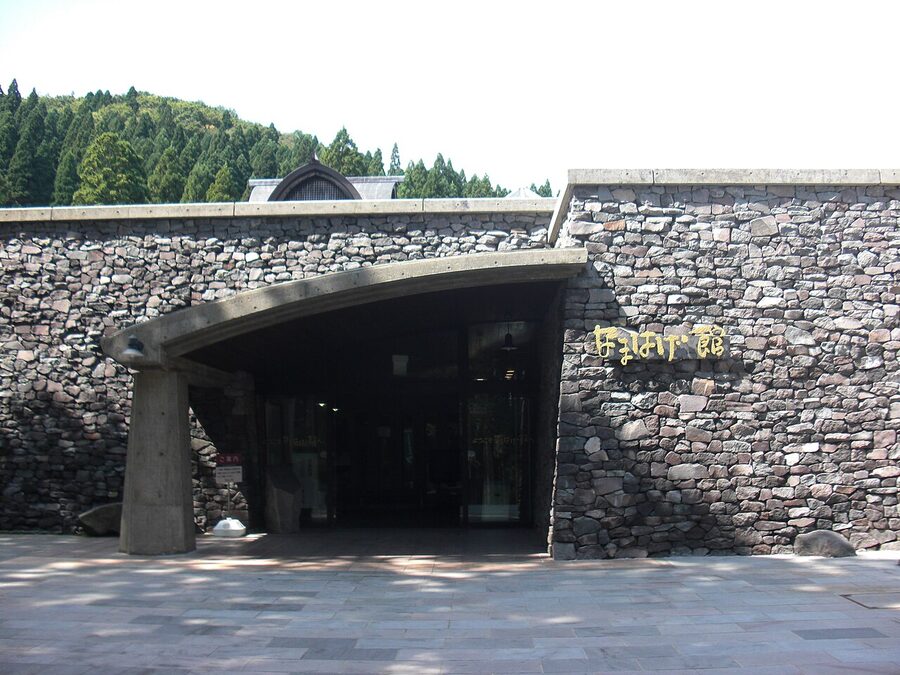
The Namahage-kan opens 8:30–17:00 every day of the year; admission is ¥660, or ¥1,100 combined with the Denshōkan, whose sessions run several times a day (half-hourly from April to November, hourly in winter). From Akita take the JR Oga Line, 55 minutes, to Oga Station, then the Namahage Shuttle, about 25 minutes, which has to be booked ahead.
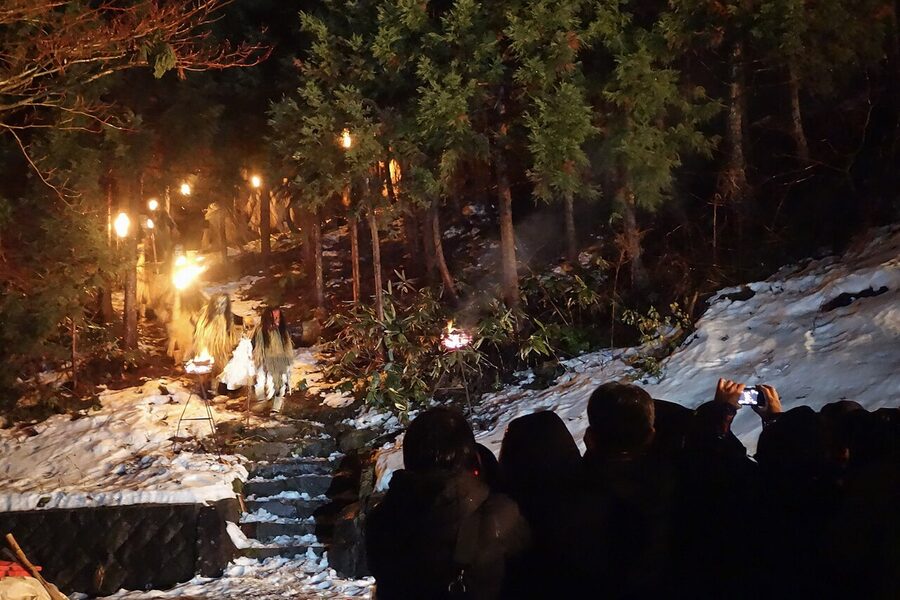
If you can only go once, go for the Namahage Sedo Matsuri at Shinzan jinja, on the second Friday, Saturday and Sunday of February. It was invented for visitors in 1964 and is a show rather than a rite, but a very good one: namahage coming down a snowy mountain with torches is the image the posters keep failing to capture.
Okayama and Megijima, for Momotarō
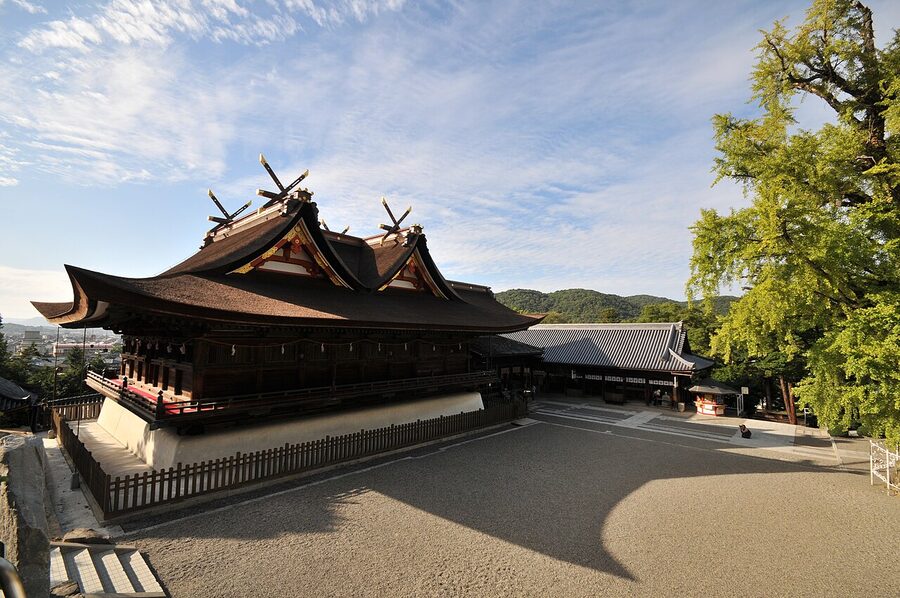
If the Momotarō thread interests you, Kibitsu jinja in Okayama is the place for it: a main hall of 1425 under a doubled hip-and-gable roof found nowhere else, a long covered corridor, and the cauldron hall where the narukama shinji, the kettle-roaring divination over the buried head of Ura, is still performed on every day except Fridays. The grounds are free. Kinojō, the hill fortress of Ura’s legend, is a short drive away in the hills above Sōja.
Out in the Inland Sea, Megijima, twenty minutes by ferry from Takamatsu, has called itself Onigashima since a local historian found a large man-made cave near its summit in 1914 and declared it the oni’s lair. The cave is cheerful nonsense; the view from the summit above it is not.
The oni at Ayo got two lines in a gazetteer and no horns. If you stand on the gravel by the Sarugatsuji on a February evening, with beans rattling against doors all over Kyoto, it is worth remembering that the creature everyone is chasing out began as a name for whatever took people away in the dark, and that the first people to see one hid in the bamboo and said nothing until it had gone.