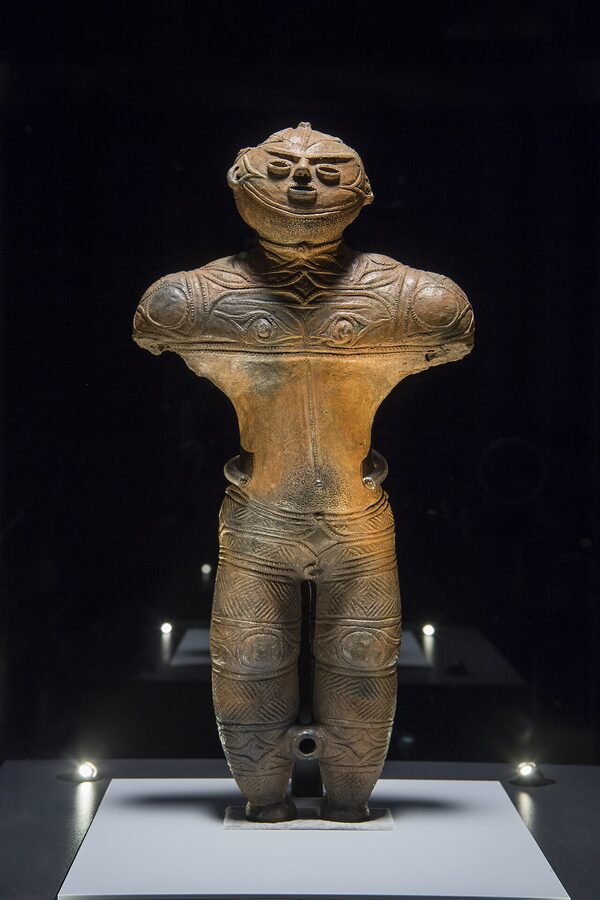
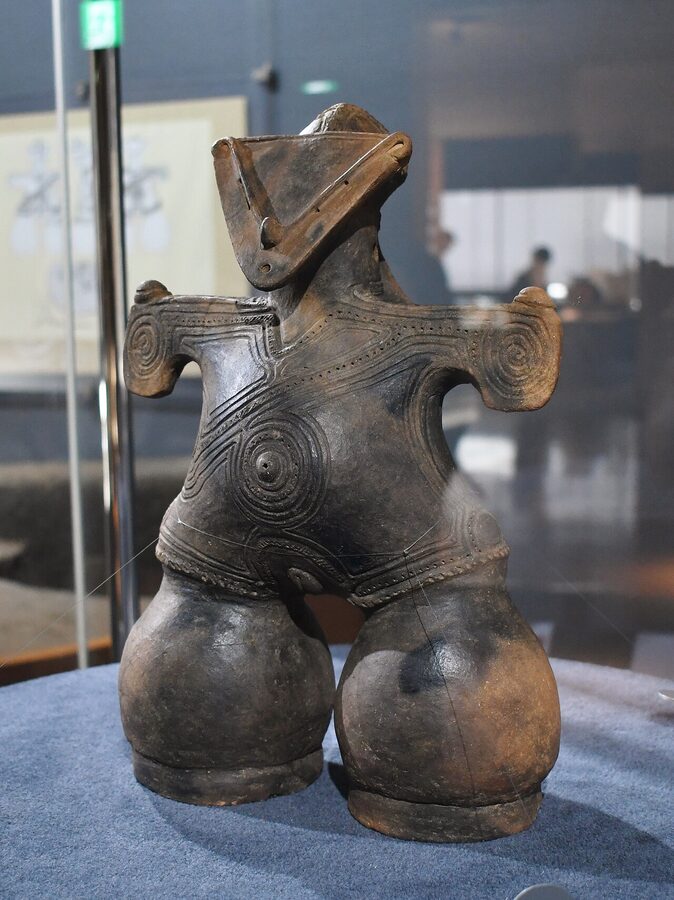
For thirty-odd years the largest hollow clay figure ever found in Japan lived in a paulownia box inside a safe. The safe belonged to the treasurer’s office of Minamikayabe, a kelp-fishing town on the Pacific side of southern Hokkaido, and the figure had gone into it after it turned up in a farmer’s field at Chobonai on 24 August 1975. It is 41.5 centimetres tall, hollow, painted once with lacquer, and about 3,500 years old. In 2007 the state made it a National Treasure, the only one Hokkaido has, and a few years later it moved out of the strongroom and into a museum.
I keep coming back to that safe because it is the whole story of the Jōmon period in miniature. For most of the modern era Japan’s ten-thousand-year age of hunter-gatherers has been something to be kept in a box: the “Stone Age” before history proper, the people the rice farmers replaced, a prologue to the emperors. Then, in the space of about half a century, radiocarbon dates pushed its pottery back toward the end of the Ice Age, a baseball stadium in Aomori turned into a village of several hundred people, and UNESCO wrote it onto the World Heritage List.
What follows runs from the zoologist who first dug it up in 1877 to the slow arrival of rice, and ends with where you can stand in front of the pots and figures yourself. If you want the whole sweep of eras it belongs to, my guide to Japan through the ages puts it in sequence.
In This Article
- A zoologist at the train window
- Ten thousand years, give or take five thousand
- Pottery before farming
- The flame pots of the Shinano River
- How ten thousand years of people lived
- The figures nobody can explain
- The goggle-eyed figure
- Five National Treasures
- Sannai-Maruyama and the stamp of 2021
- Whose ancestors?
- The slow end of a long age
- Where to see the Jōmon today
- Sannai-Maruyama, Aomori
- Tokyo National Museum and the Ōmori shell mound
- Togariishi, Chino
- Tokamachi City Museum, Niigata
- If you have more time
A zoologist at the train window
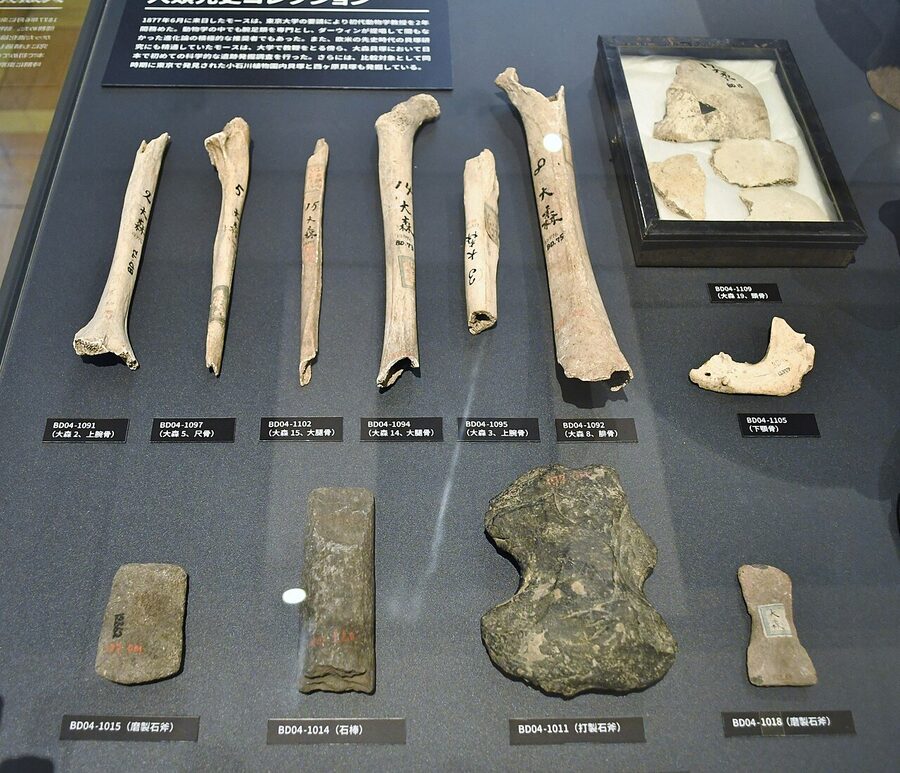
The modern history of the Jōmon starts with a man looking out of a train. Edward Sylvester Morse, an American zoologist who had come to Japan to collect brachiopods, landed at Yokohama in June 1877 and within a day or two was on the new railway to Shinbashi. Just past Ōmori he saw, in the cutting beside the line, a bank of white shells. He had helped dig shell middens back in New England, and he knew at once what he was looking at.
Morse was the sort of man who happens to a country only once. He had been expelled from three schools as a boy, one of them for carving his desk, and had no university degree; he was nevertheless a professor at Bowdoin College by 1871. He was fully ambidextrous and drew on the blackboard with a piece of chalk in each hand, a party trick that got applause at his lectures. Within weeks of arriving he had been talked into the chair of zoology at the new University of Tokyo, one of the o-yatoi, the foreign experts the Meiji government hired by the hundred.

On 16 September 1877 he went back to Ōmori with three helpers, the zoology assistant Matsumura Jinzō and the students Matsuura Sayohiko and Sasaki Chūjirō, and started to dig. He sent a report to Nature dated 21 September, got the university to ask the Tokyo authorities for exclusive rights to the site, and in 1879 published Shell Mounds of Omori, usually counted as Japan’s first scientific excavation report. In it he described the pottery as “cord marked”, because the surfaces had been patterned by pressing or rolling twisted cord into the wet clay.
He was in a hurry for a reason.
Heinrich von Siebold, the younger son of the physician Philipp Franz von Siebold who had worked from the Dutch trading post at Dejima decades earlier, was an interpreter at the Austro-Hungarian legation and an enthusiastic amateur archaeologist. In a letter of July 1878 to the Danish archaeologist Jens Worsaae he claimed to have dug at Ōmori in the autumn of 1877, possibly before Morse, and in January 1878 he said so in Nature, which made Morse furious. Siebold’s diplomatic work eventually swallowed his archaeology, but he left one durable thing behind: his little book Kōko setsuryaku gave Japanese the word kōkogaku, “archaeology”.
Morse’s theories have aged less well. He found an ape-like bone in the midden and, having asked whether old Japanese records mentioned a large ape, decided it might belong to a hihi, the baboon-like monster of yōkai lore. More seriously, he found broken and cut human bones mixed with food waste. In a lecture to some 500 people at a restaurant hall in Asakusa on 30 June 1878 he concluded that the islands had once been home to a cannibal people who came before the Ainu, since the Ainu, he reasoned, did not eat each other.
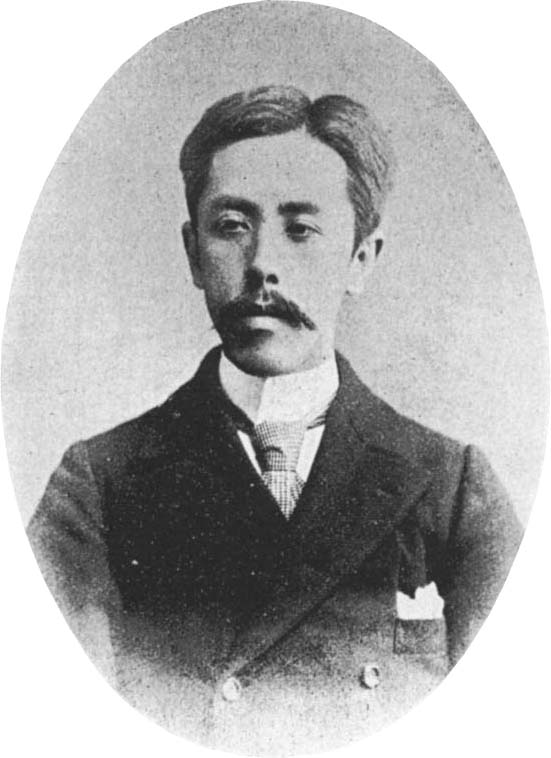
That argument about who the “Stone Age people” were ran for half a century.
Siebold thought they were simply the ancestors of the Ainu. The seismologist John Milne, and after him the anthropologist Tsuboi Shōgorō, argued for the koropokkuru, a race of little people from Ainu folklore who were supposed to have lived in pits before the Ainu came. The anatomist Koganei Yoshikiyo went back to the Ainu. By the mid-1920s the skull measurements of Hasebe Kotondo and the statistics of Kiyono Kenji had made the dull answer the mainstream one: the people of the shell mounds were ancestors of the modern Japanese.
The name itself took a while to settle.
Yatabe Ryōkichi translated Morse’s “cord marked” in 1879 as sakumon, “rope pattern”. The botanist Shirai Mitsutarō used jōmon written 縄紋 in 1886, and that is what the anthropologists adopted. The now-standard spelling 縄文 appears in a piece by Kanda Takahira in 1888, which most histories treat as the turning point; the researcher Satomi Ayako has argued that it was simply a misprint. Some archaeologists, Yamanouchi Sugao and Kobayashi Tatsuo among them, kept writing 縄紋, on the grounds that a pattern is not a piece of writing.
Ten thousand years, give or take five thousand
The figure in every textbook is “about 10,000 years”, and the right way to read it is as a floor. The edges of the Jōmon period have moved by thousands of years within living memory, and they are still moving. The fight over them is one of the better stories in Japanese archaeology, because it was conducted with real venom.
Before the war, the Jōmon had a very short chronology. Yamanouchi Sugao, the archaeologist who did more than anyone to sort the pottery into a sequence, worked by typology: which style lies over which in the ground, which style looks like which. He divided the period into phases, gave each phase a notional length, and arrived at a Jōmon that began around 3,000 years ago. Later, on the basis of grooved stones he took for arrow-shaft polishers and cross-dated to Siberia and Europe, he moved the start back to about 2500 BC.
In 1959 the University of Michigan sent back radiocarbon dates for shells and charcoal from the lowest pottery layer of the Natsushima shell mound in Yokosuka: 9,450 and 9,240 years before present, give or take a few hundred. That was some 5,000 years older than anyone had been teaching. Yamanouchi responded by splitting off an even earlier “Incipient” phase and insisting it was only about 4,500 years old, and he dismissed the new science as an “extreme inflation of dates” and a form of worship of American imperialism. Serizawa Chōsuke and the radiocarbon camp won anyway, because Yamanouchi’s continental cross-dates turned out to be shakier than the physics.
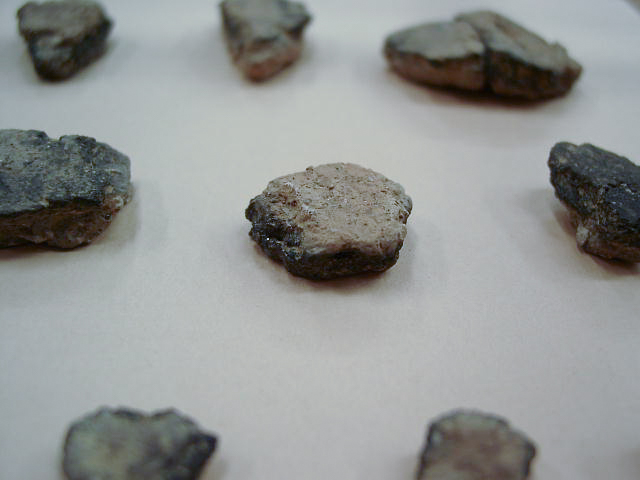
The next jump came with accelerator mass spectrometry, which can date a few milligrams of carbon, and with calibration, which turns raw radiocarbon years into calendar years. In 1998 a dig before a house rebuild at Odai Yamamoto I, a farm hamlet on the Tsugaru Peninsula, produced small sherds of plain pottery with carbonised food crusts inside. Calibrated, the crusts were first published as roughly 16,500 to 15,500 years old. The World Heritage documentation is more cautious and says “around 13,000 BCE”, about 15,000 years ago; many Japanese reference works say about 16,000.
So where does the Jōmon begin? Some dictionaries still say about 12,000 years ago, the World Heritage dossier about 15,000, and many archaeologists 16,000, because they define the period by the first pottery. The end is just as soft, because it was never one event: rice farming took hold in northern Kyushu centuries before it reached the Kantō, and the far north never really took it up at all.
The period is conventionally cut into six sub-periods by pottery style: Incipient, Initial, Early, Middle, Late and Final. The names are an accident of research history, because Yamanouchi set out Early to Final in 1937 and the two older phases were bolted onto the front later as older pottery turned up. One recent Japanese synthesis gives them as roughly 17,000 to 11,500 years ago for Incipient, 11,500 to 7,000 for Initial, 7,000 to 5,500 for Early, 5,500 to 4,400 for Middle, 4,400 to 3,200 for Late, and 3,200 to 2,400 for Final in Tōhoku and the Kantō. English-language tables often print tidier and noticeably later numbers, and you will notice that the “Middle” Jōmon is nowhere near the middle.
In the 1936 “Minerva debate”, named after the journal it was fought in, the historian Kita Sadakichi even argued that Tōhoku people were making Jōmon-style pots as late as the Kamakura period. Yamanouchi’s sequences proved him wrong, but Kita had noticed something real: in Hokkaido an “Epi-Jōmon” culture went on without rice for centuries after the south had changed.
Pottery before farming
For most of the world, pottery comes with farming, as part of the package of sedentary life. The Jōmon is the most famous exception: people here were making pots for perhaps eight thousand years before anyone in the islands grew rice in a paddy. Japan used to claim the oldest pottery in the world outright; sherds from Xianrendong cave in Jiangxi, China, dated to around 20,000 years ago in 2012, have taken that title, and I would rather tell you that than pretend otherwise.
What the early pots were for is not in doubt, because the soot and food crusts are still on them. They were cooking pots: small, round- or flat-bottomed vessels for boiling. Boiling is more important than it sounds. It makes acorns and horse chestnuts edible once the tannins have been leached out, it turns shellfish and tough meat into soup, and it lets you feed small children and the toothless, which is not a minor thing in a population of foragers.
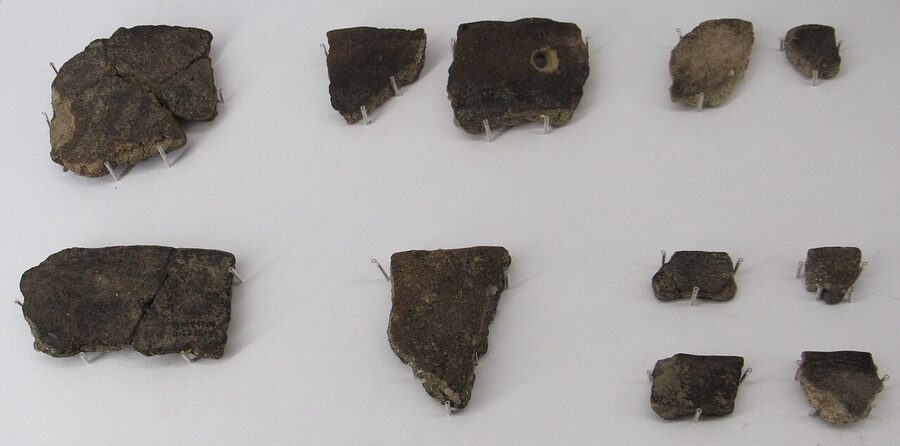
Jōmon potters never used a wheel or a kiln. They built pots from coils of clay, smoothed them, decorated them and fired them in open bonfires at roughly 600 to 900°C, which is why the fabric always stayed coarse. They knew their materials: Middle Jōmon potters in the Kantō loaded their clay with so much mica that the pots glitter, Kyushu potters added talc for a soapy sheen, and some large vessels were built with rows of tiny wooden sticks set into the joins, a technique Kobayashi Tatsuo compared to reinforced concrete. Archaeologists recognise about 70 broad styles and several hundred local types across the period.
The cord marks themselves took decades to understand. It was Yamanouchi who showed, by experiment, that most of them were made by rolling a twisted cord across the clay rather than pressing a rope into it, and that the direction of the twist and the number of plies could be read like a signature. Not every Jōmon pot is cord-marked, though. Western Japan dropped the cord in the later periods, and the most famous Jōmon pots of all have almost none.
The flame pots of the Shinano River
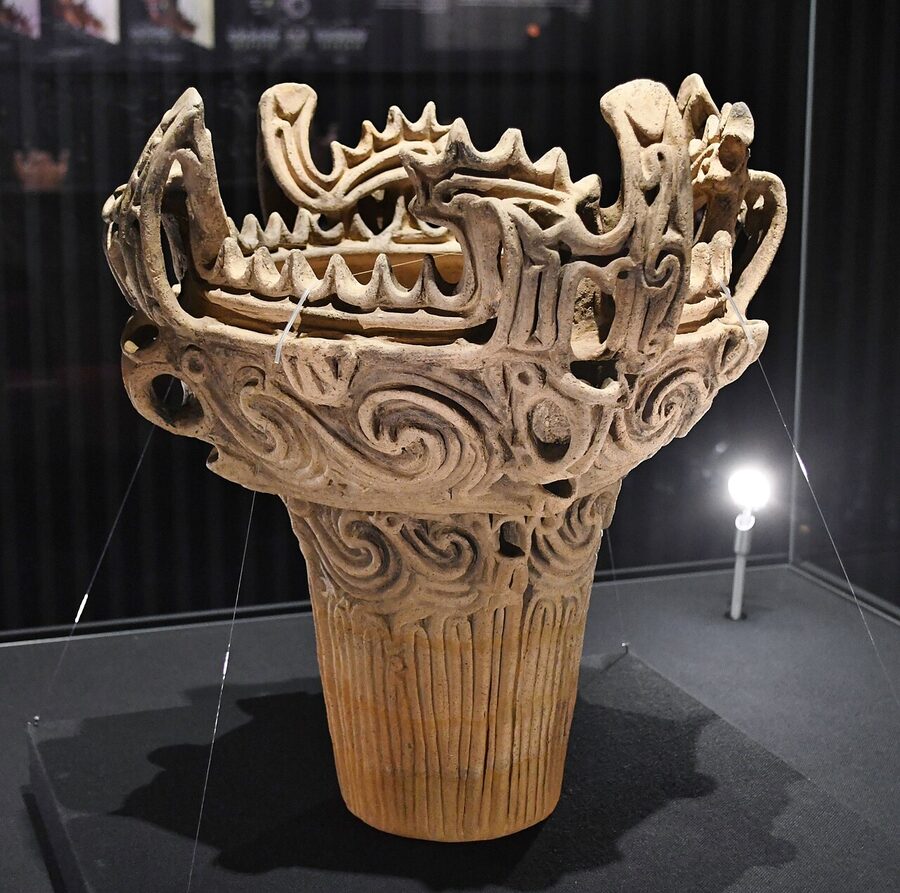
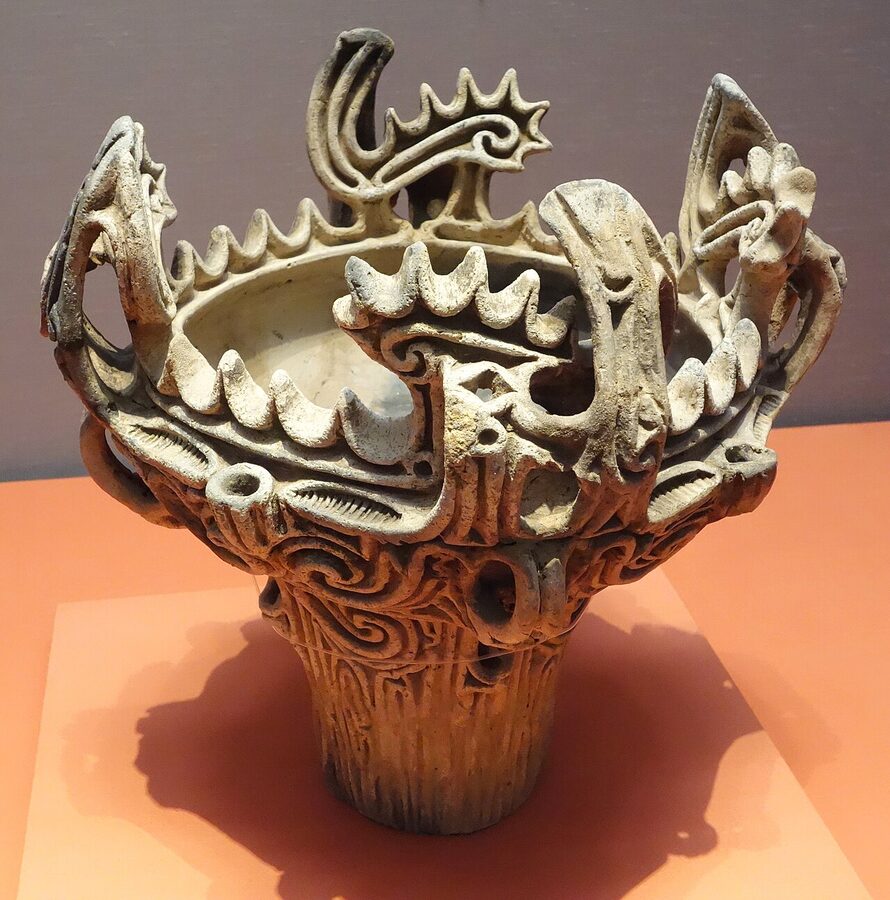
At the end of 1936 a local archaeologist named Kondō Tokusaburō dug a pot out of the ground at Umataka, near Nagaoka in Niigata, whose rim seemed to be on fire. Four great handles curled up from it like flames or cockscombs, the rim was cut into saw teeth, and the body was covered with raised coils of clay in S-curves and spirals. It was named the kaen doki, the “flame pot”, and every similar vessel found since is a kaen-gata doki, a “flame-type pot”.
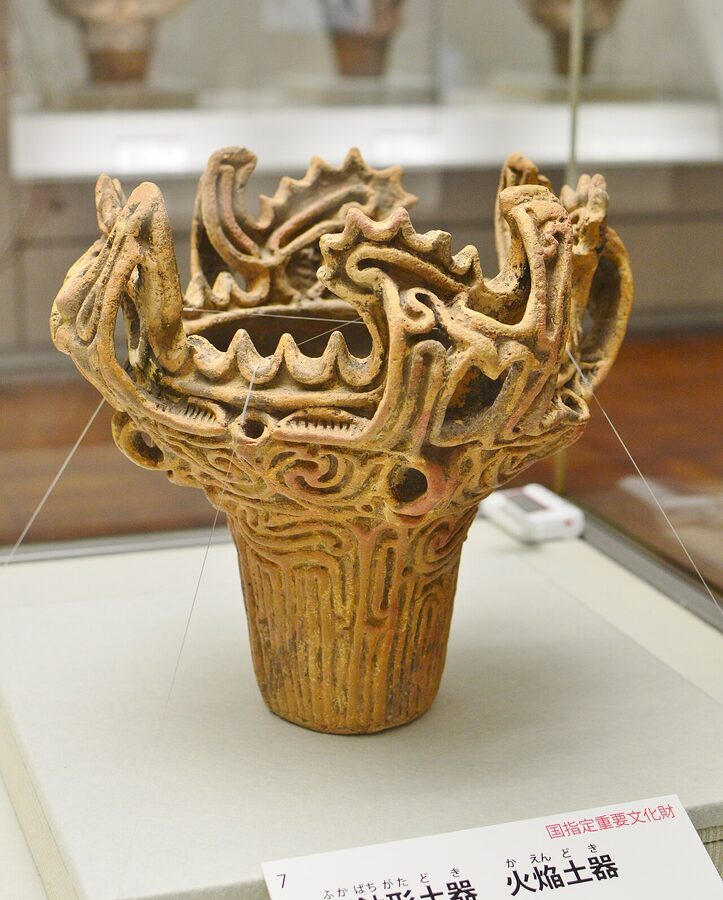
Flame-type pots belong to the Middle Jōmon, roughly 5,000 to 4,500 years ago, and they appear rather suddenly, with no obvious ancestor. More than 200 sites in eastern Japan have produced them, but the great majority come from a short stretch of the middle Shinano River in Niigata, where the snow lies two or three metres deep in winter. Soot and charred food inside some of them show they were used for cooking, which does not stop people arguing that they were also ritual vessels; I see no reason a pot cannot be both.
Between 1980 and 1986 the excavation of the Sasayama site in Tokamachi produced a whole group of them. In 1999, 57 vessels from Sasayama became Niigata Prefecture’s only National Treasure, the second Jōmon object ever to receive the title, and 14 of them are flame-type. Number 1 on the designation list, the one you see on posters and in textbooks, has been given the nickname Jōmon Yukihomura, “Jōmon snow-flame”.
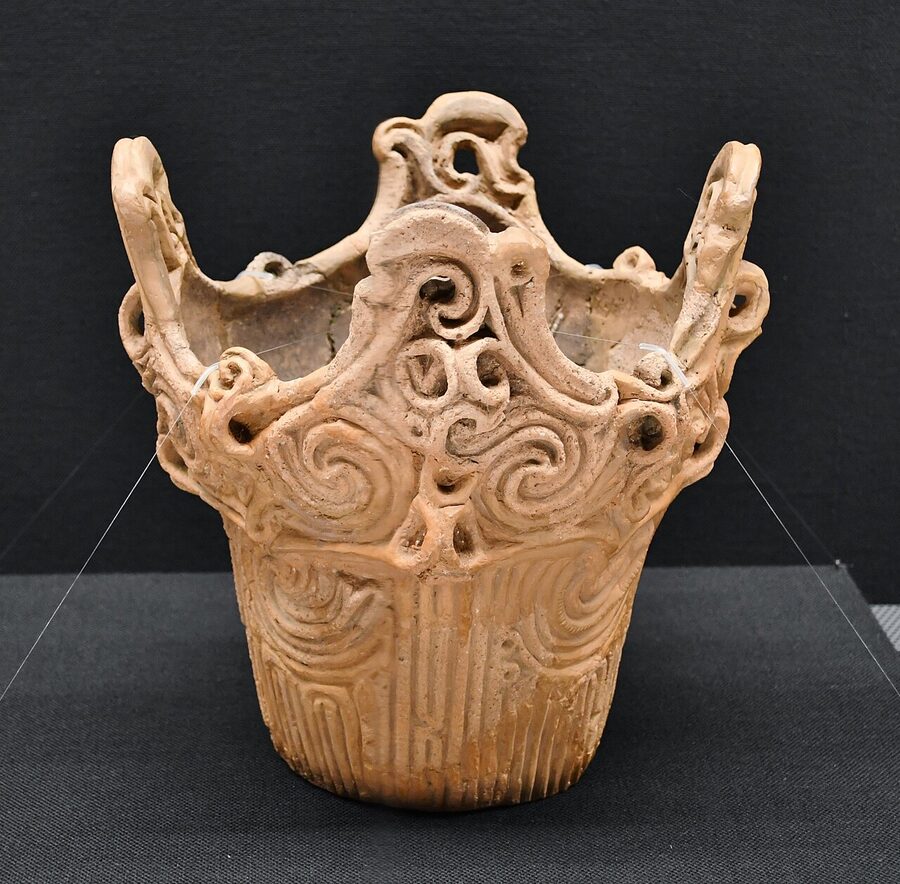
The same sites produce a sister type, the “crown-type” pot, with a different rim and squarer handles. The two are found side by side, but their rims and handles never borrow from each other, which has led archaeologists to suspect that the two shapes stood for two opposed ideas. What those ideas were, nobody knows.
Modern Japan discovered these pots as art rather late, and the man usually credited is the painter Okamoto Tarō. On 7 November 1951 he walked into the Tokyo National Museum, saw Jōmon pottery, and was shaken by it; his essay “Dialogue with the Fourth Dimension: On Jōmon Pottery”, published in the art magazine Mizue in 1952, is often said to be the reason Japanese art history now starts in the Jōmon rather than with Buddhist sculpture. If you want to follow that thread into the crafts that came later, my guide to Japan’s greatest crafts picks it up.
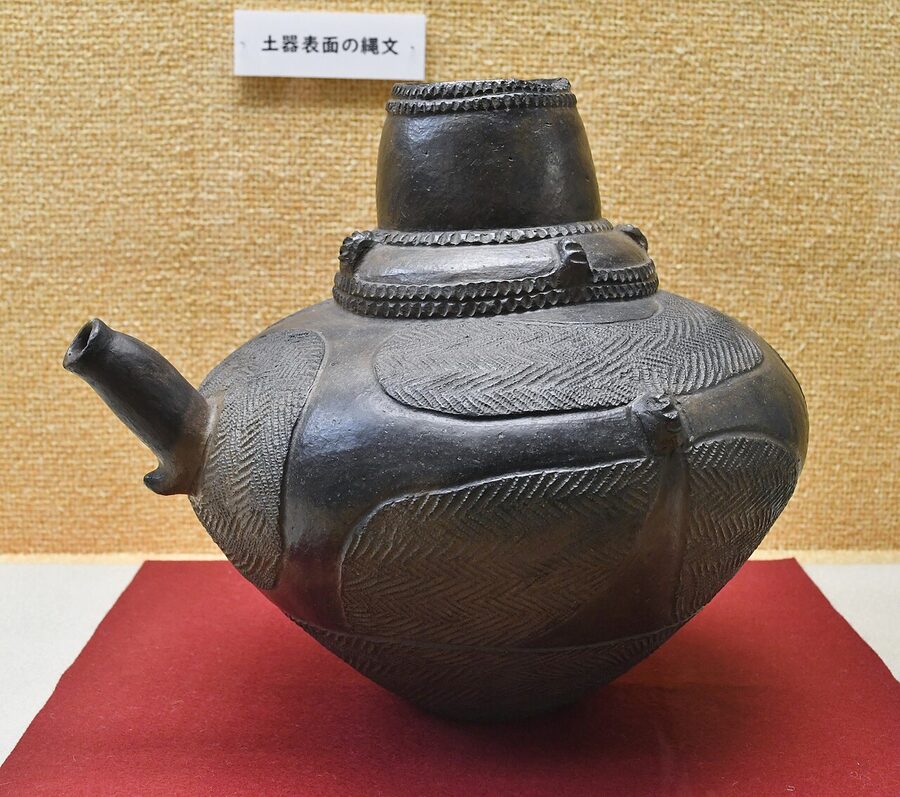
The other high point of Jōmon pottery comes at the very end, in the far north. The Kamegaoka culture of the Final Jōmon, named after a site in what is now Tsugaru city, made thin, burnished, almost metallic-looking vessels: spouted pots, footed bowls and jars, some painted red with lacquer mixed with iron oxide. Japanese archaeologists sometimes call them the masterpieces of Jōmon pottery, and I would not argue.
How ten thousand years of people lived
The Jōmon world was made by a warming climate. As the last Ice Age ended, sea levels rose by more than a hundred metres, the land bridges and frozen straits closed, and warm water from the Tsushima Current flooded into the Sea of Japan. Around 6,000 years ago the sea stood three to five metres higher than today, the “Jōmon transgression”, and drowned river valleys became shallow, food-rich bays. Deciduous forests of oak, beech, walnut and chestnut spread across eastern Japan, and evergreen laurel forest across the west.
People settled down in that world without farming it, or at least without farming it in the way the textbooks used to require. Japanese sites have produced the remains of more than 60 kinds of mammal, 350 kinds of shellfish, 70 kinds of fish, 35 kinds of bird and 55 kinds of plant food. On land, deer and wild boar make up nearly 40 percent each of the animal bones. In the north the salmon and trout runs mattered as much as anything that walked.
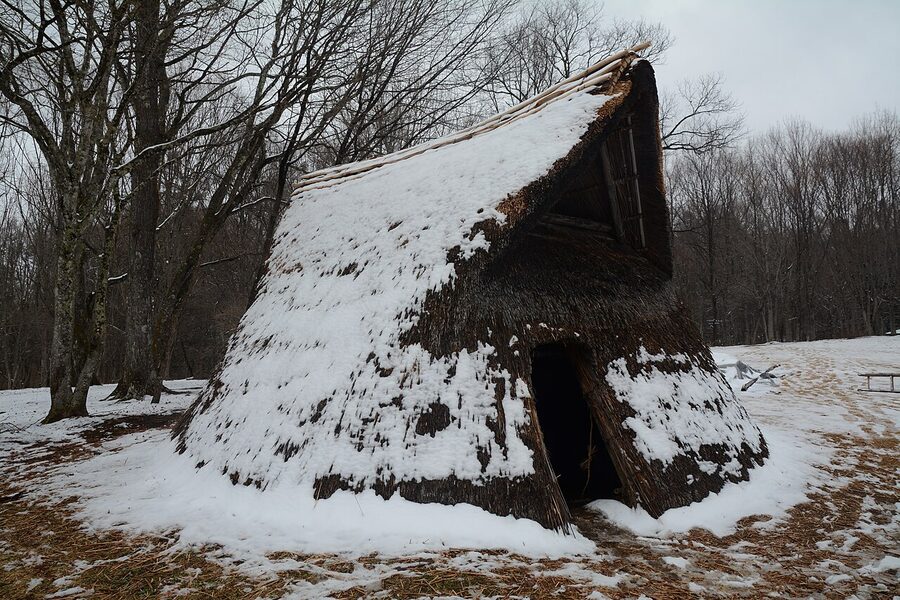
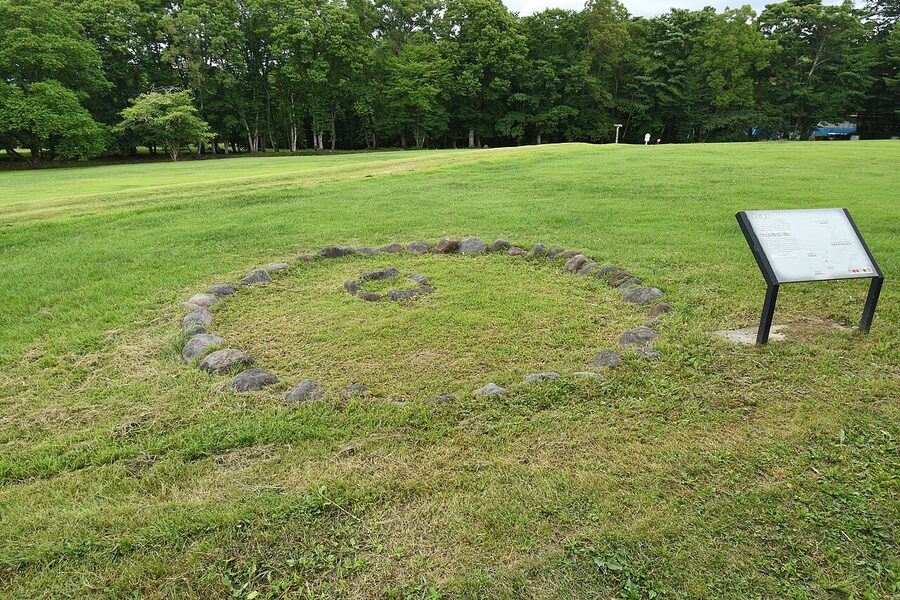
Home was a pit dwelling: a floor dug half a metre or more into the ground, a ring of posts, a conical roof of thatch, bark or earth, and a hearth in the middle. By the Early and Middle Jōmon the houses were arranged in rings or horseshoes around an open plaza, with burials in the middle, a layout archaeologists call a ring settlement. The first one ever recognised in Japan was at Togariishi in Nagano, where a local amateur archaeologist named Miyasaka Fusakazu dug almost single-handed from 1930, carried on through the war, and by 1952 had traced a U-shaped village about 170 metres across.
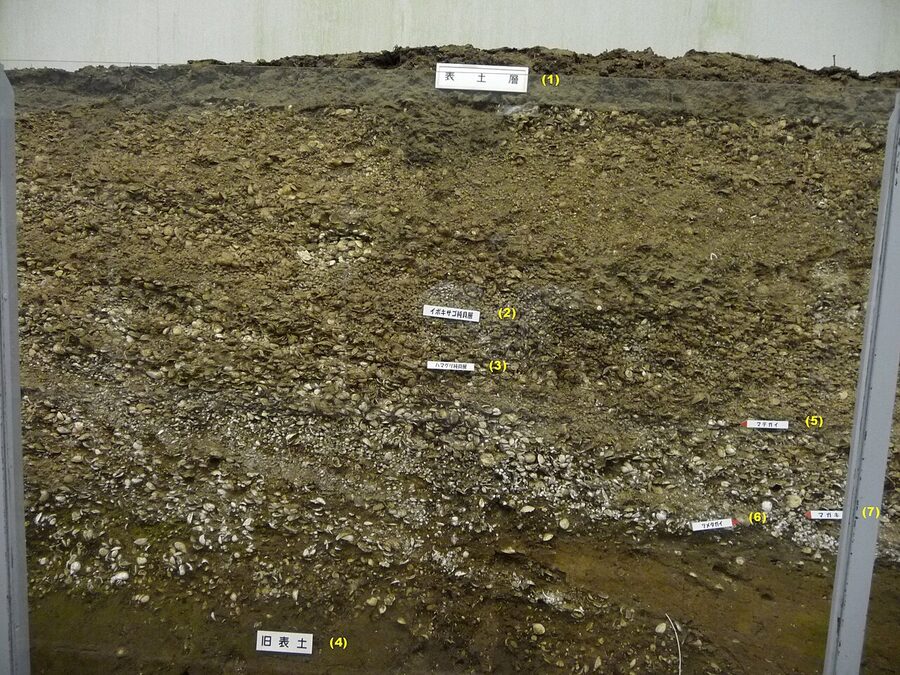
The rubbish tells you the rest. Shell mounds, the middens where generations dumped shells, bones, broken pots and sometimes their dead, are the classic Jōmon site, and about 60 percent of all those in Japan are in the Kantō, around the old shallow bays of Tokyo and Chiba. The Kasori shell mound in Chiba city is among the largest, two great rings of shell several hundred metres across.
Food was managed as much as gathered. Pollen and wood studies show chestnut groves kept around villages in eastern Japan from the Early Jōmon, and chestnut was the favoured timber because it could be felled with a stone axe and lasted in wet ground. The lacquer tree, introduced from the continent, was tended for its sap, and red and black lacquered bowls and combs appear early; lacquered thread from the Kakinoshima site near Hakodate is about 9,000 years old. Beans such as azuki and soy were probably being cultivated by the Middle Jōmon, and the sizes of the beans grow through the Late Jōmon.
Rice is still argued over. Reports of rice plant opals, microscopic silica from rice leaves, in Middle Jōmon soils are doubted because the opals sink through soil, and several supposed rice impressions on Late Jōmon pots have been re-identified. What is certain is that rice, barley and millet had arrived by the very end of the Final Jōmon, as one crop among many.
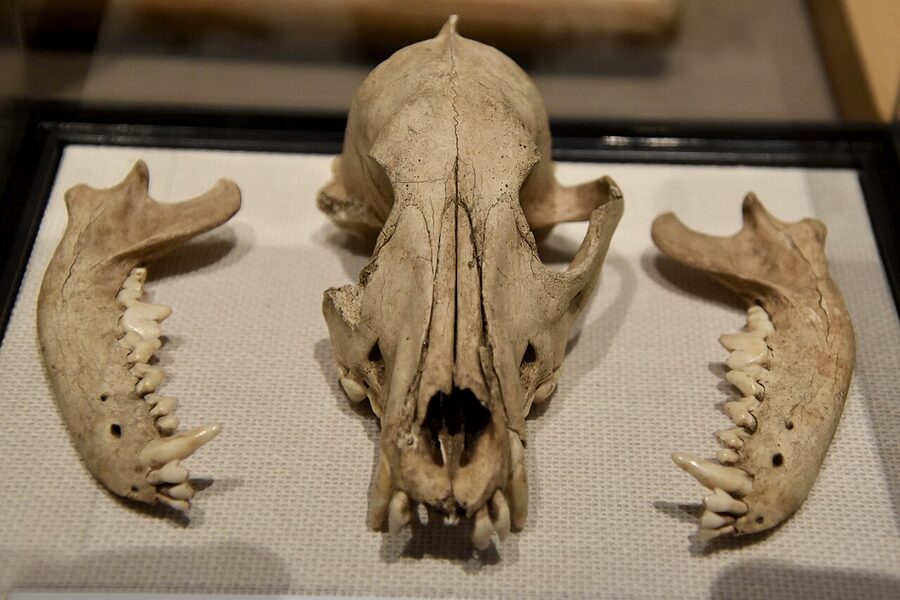
Dogs were family, and their burials increase from the Early to the Final Jōmon. People also moved wild boar around by canoe: boar bones on Izu Ōshima and Hachijōjima, islands boar never reached on their own, mean somebody took piglets across the sea. A cedar dugout from the Torihama shell mound in Fukui is 6.08 metres long and about 5,500 years old; in 1986 Okamoto Tarō, by then an old man, captained a replica on its launch.
Trade is where the Jōmon world looks most surprising. Obsidian from the Wada Pass and Hoshikuso Pass sources in the mountains of central Nagano turns up hundreds of kilometres away, and Japanese obsidian reached the Korean Peninsula and Sakhalin. Jadeite came from one place only, the Itoigawa area on the Niigata coast, where it was ground into big pendant beads; those beads ended up in Aomori, nearly 500 kilometres to the north-east as the crow flies. Natural asphalt from the oil seeps of Akita and Niigata was traded as glue for hafting arrowheads and, as you will see, for mending figurines.
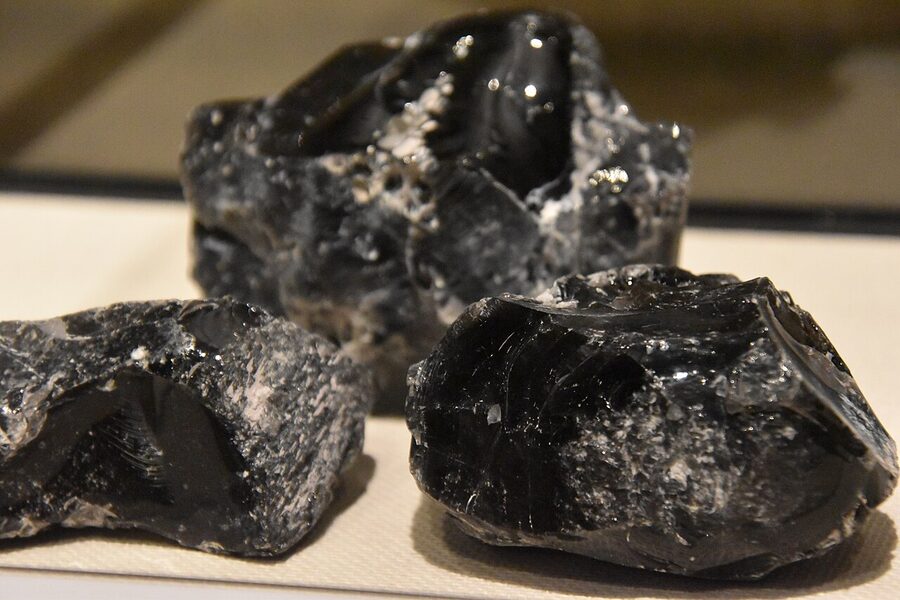
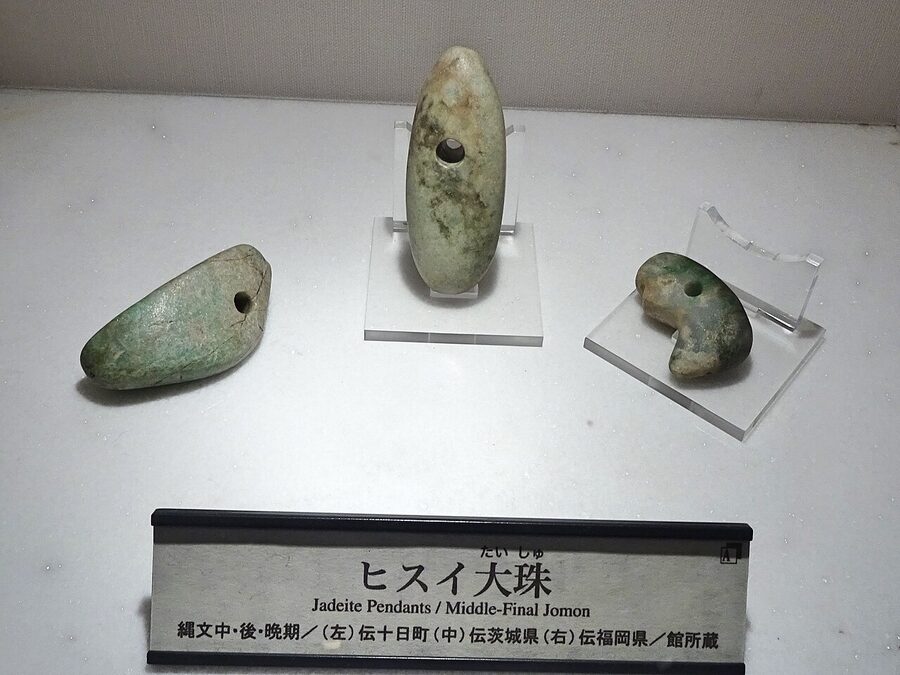
One more number deserves attention. A 2016 study of skeletons by teams at Yamaguchi and Okayama universities found signs of violent death in about 1.8 percent of Jōmon individuals, under a fifth of the rate typical for prehistoric foragers elsewhere. That figure has been turned into a slogan about “ten thousand years of peace”, which goes too far, since skeletons record only some kinds of violence. But the contrast with what follows is real: skeletons with arrowheads in them become common with the arrival of rice.
The good times were not continuous. The eruption of the Kikai caldera, south of Kyushu, about 7,300 years ago devastated southern Kyushu for centuries. After about 4,000 years ago the climate cooled, the Kantō bays silted up, their shell mounds stopped growing and the number of sites in central Japan dropped sharply.
The figures nobody can explain
If the pots are the Jōmon’s handwriting, the dogū are its riddle. A dogū is a small fired-clay figure of a human, or a human-like spirit, and Japanese archaeology has found somewhere between 15,000 and 20,000 of them, depending on whose count and what you include. Most come from eastern Japan. One researcher, extrapolating from the excavated fraction, has suggested that the Jōmon made something like 30 million over the whole period; treat that as a guess with a calculator.
The oldest are tiny. A figure found on 26 May 2010 at the Aidani Kumahara site in Shiga is 3.1 centimetres tall, weighs 14.6 grams and is about 13,000 years old. It has no face and no limbs to speak of, but it has breasts, and so does the larger of two figures from Kayumi Ijiri in Mie; the three share the title of oldest dogū in Japan.
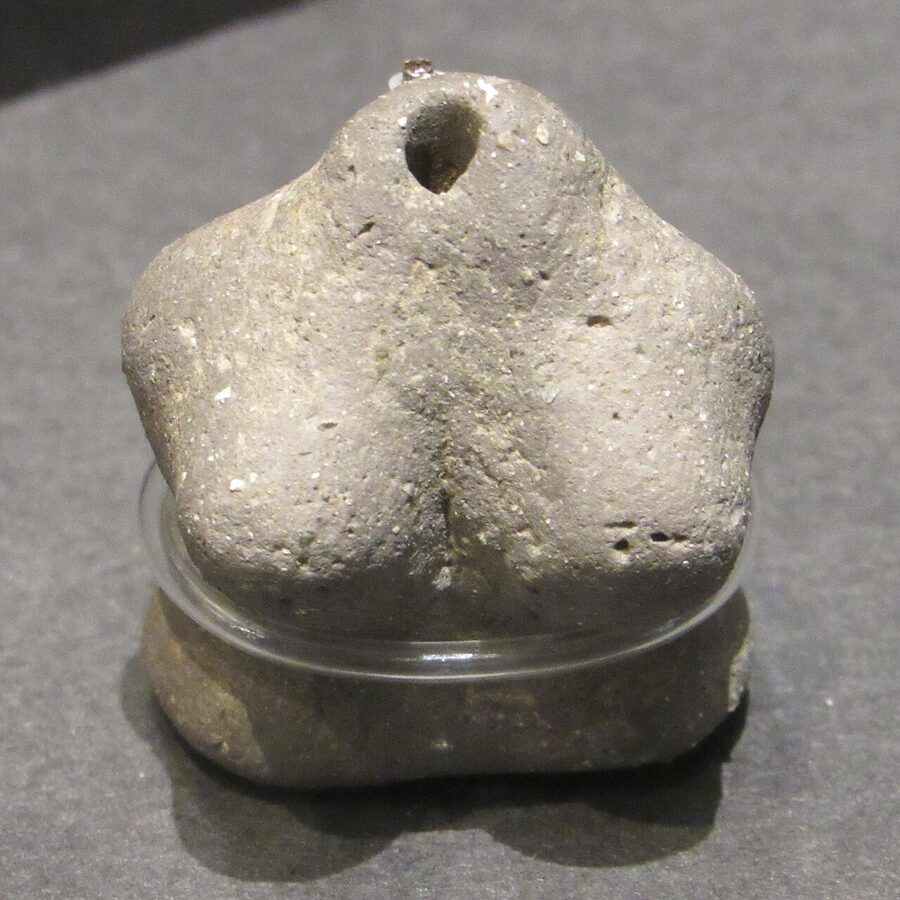
Over the next ten thousand years the figures grew larger, stood up, acquired faces and, in the Middle Jōmon, began to show pregnancy in detail. And almost all of them are broken. Very few dogū come out of the ground whole; many are missing exactly one leg or one arm, and a large share are found among the rubbish in the midden rather than in a grave or a house.
What they were for is the one question every museum label dodges, and with reason. The candidates include fertility and safe childbirth, which the breasts and bellies support; substitutes that were broken to take an illness or injury away from a living person, which the missing limbs support; figures of a mother goddess or of spirits; and objects of ritual at the community level. The archaeologist Mizuno Masayoshi argued that they were used mainly in winter, when people feared the weakening of the sun. None of these excludes the others, and I would be suspicious of anyone who tells you there is one answer.
The goggle-eyed figure
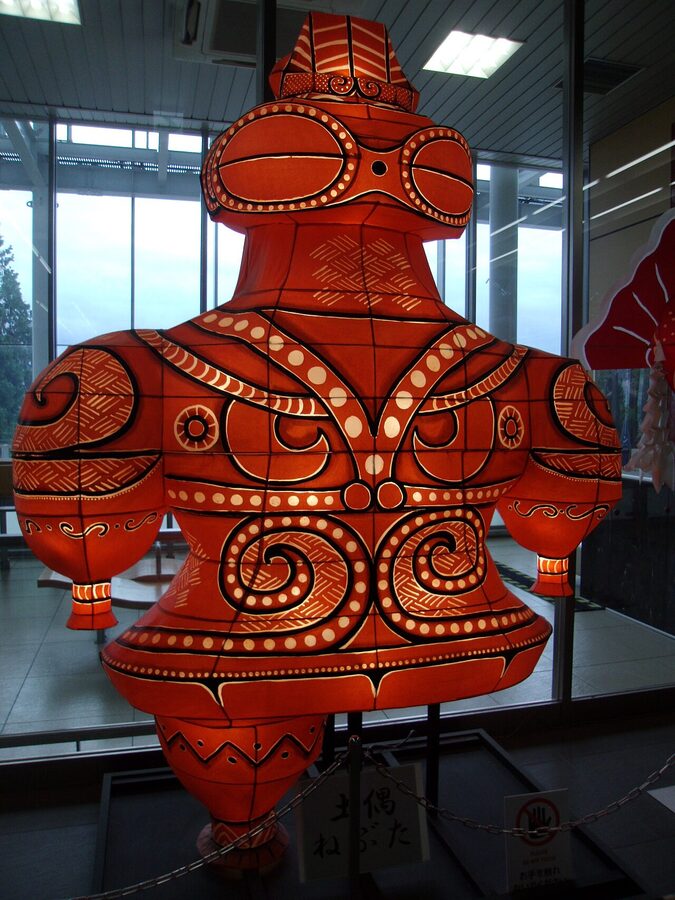
The dogū most people picture is the shakōki dogū, the “goggle-eyed figure” of the Final Jōmon in northern Tōhoku, with enormous eyes like slit visors, a crowned head and a body covered in the same curling patterns as the Kamegaoka pots. The name comes from Tsuboi Shōgorō. Studying in London around 1890, he saw the snow goggles of Inuit hunters in the British Museum, noticed the resemblance, and wrote it up in 1891 in a “London letter” to the journal of the Tokyo Anthropological Society.
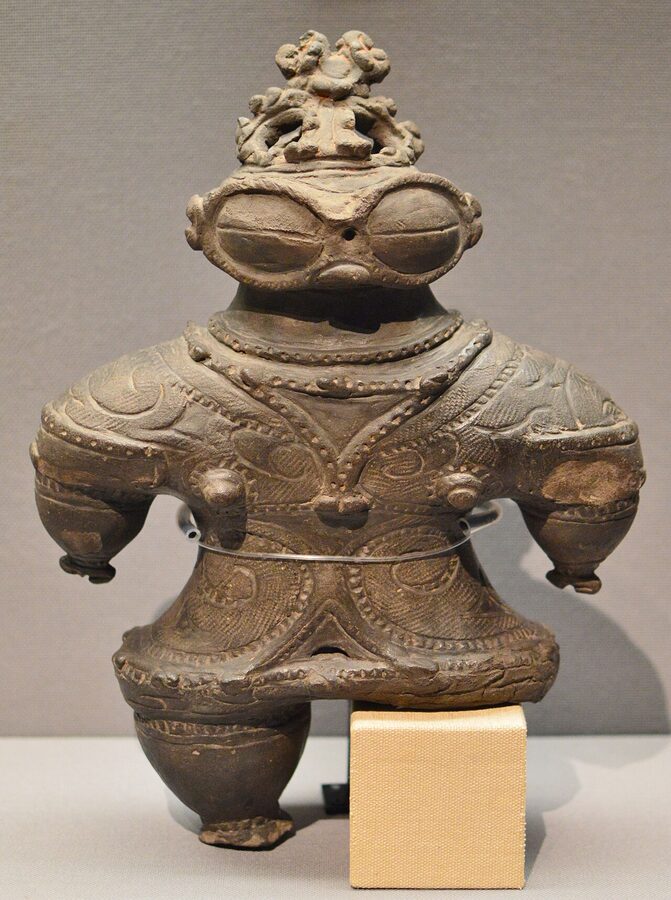
The goggles theory is almost certainly wrong. No snow goggles have ever turned up in Jōmon sites, even in waterlogged deposits that preserve wood, and the archaeologist Harada Masayuki has shown that the bulging eyes appear only in one phase of the type, growing larger over time and then shrinking again. Yoneda Kōnosuke argued in 1984 that they are closed eyes, the eyes of the dead, exaggerated until they fill the face. Whatever they are, they are eyes, not eyewear.
The most famous example came out of the peat in a rice paddy at Kamegaoka, in the Tsugaru plain, in 1886 or 1887; the sources disagree, and Kanda Takahira’s description of it was published in December 1887. Kamegaoka had been a treasure ground long before that. When Tsugaru Nobuhira, the second lord of the domain that built Hirosaki Castle, began a castle on the hill there in 1622, his workmen kept digging up pots and figures; the castle was abandoned after the shogunate’s one-castle-per-province rule, but the digging went on.
Through the Edo era “Kamegaoka things” were collectors’ pieces, and some were sold as far away as the Netherlands. More than 10,000 complete pots are said to have been taken from the site before it was protected. The figure itself went through private hands and was designated in 1957, and it has since been made into cakes, biscuits, a Doraemon villain and a railway station.
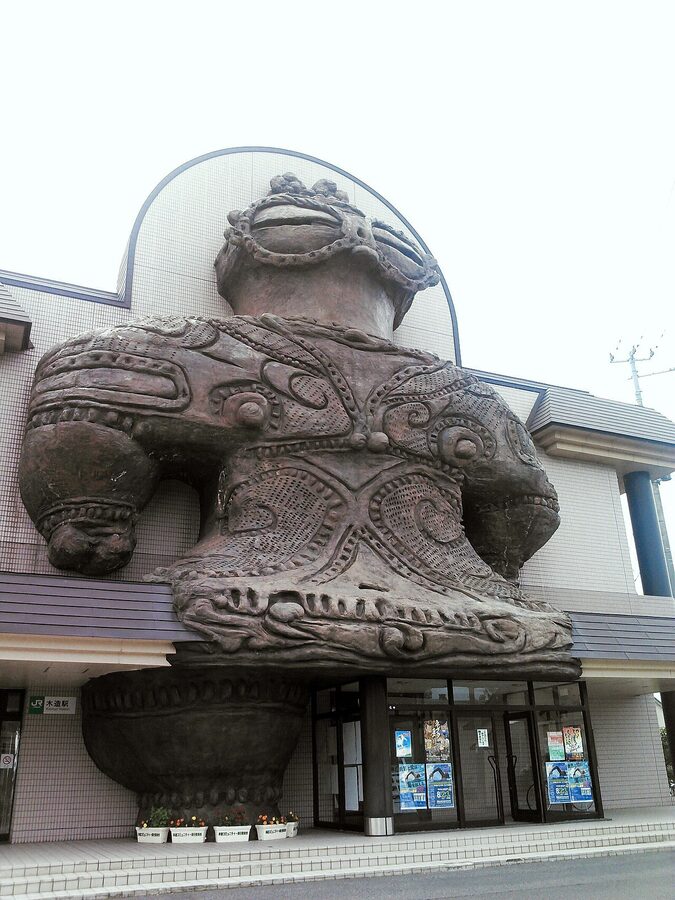
Five National Treasures
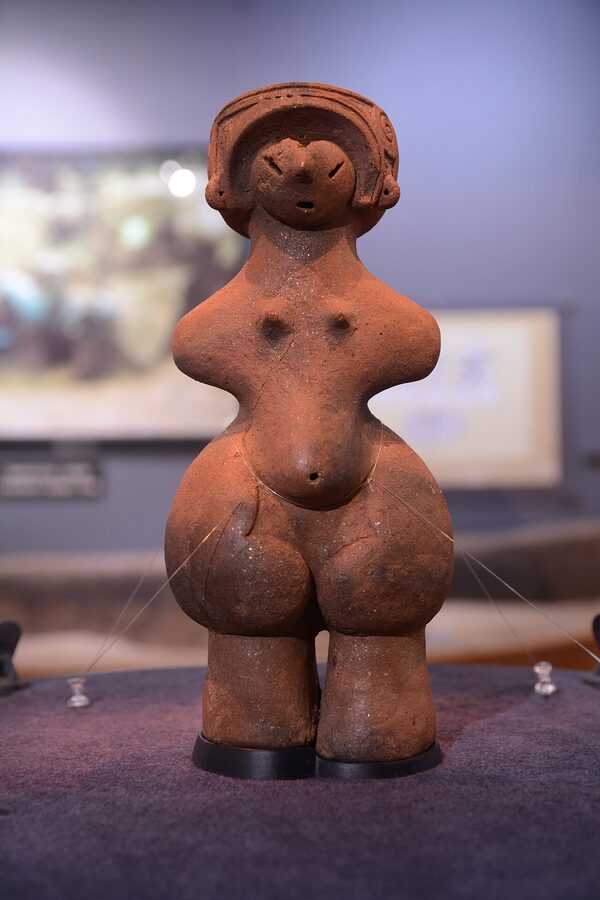
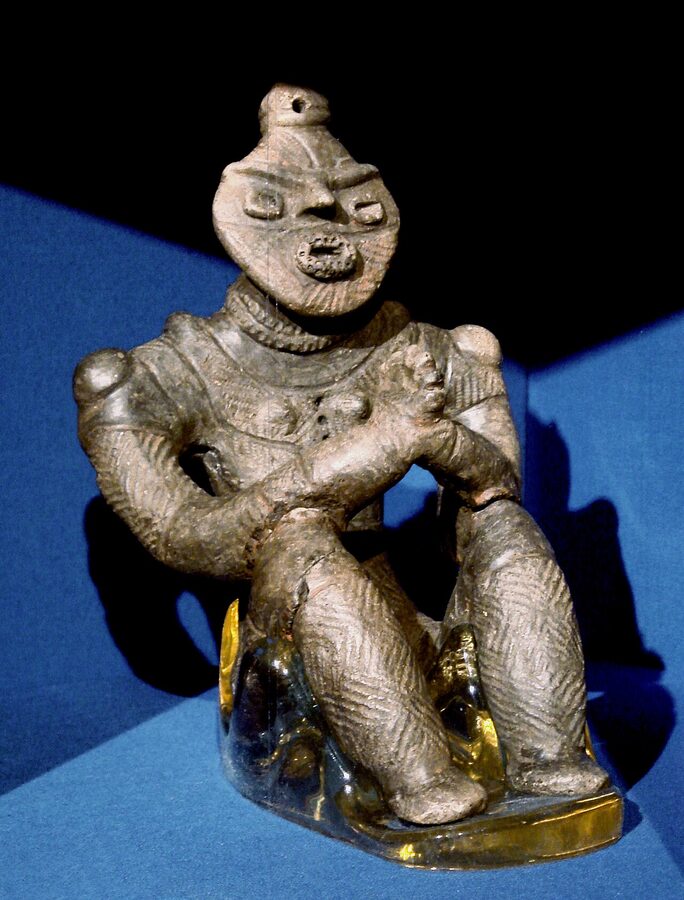
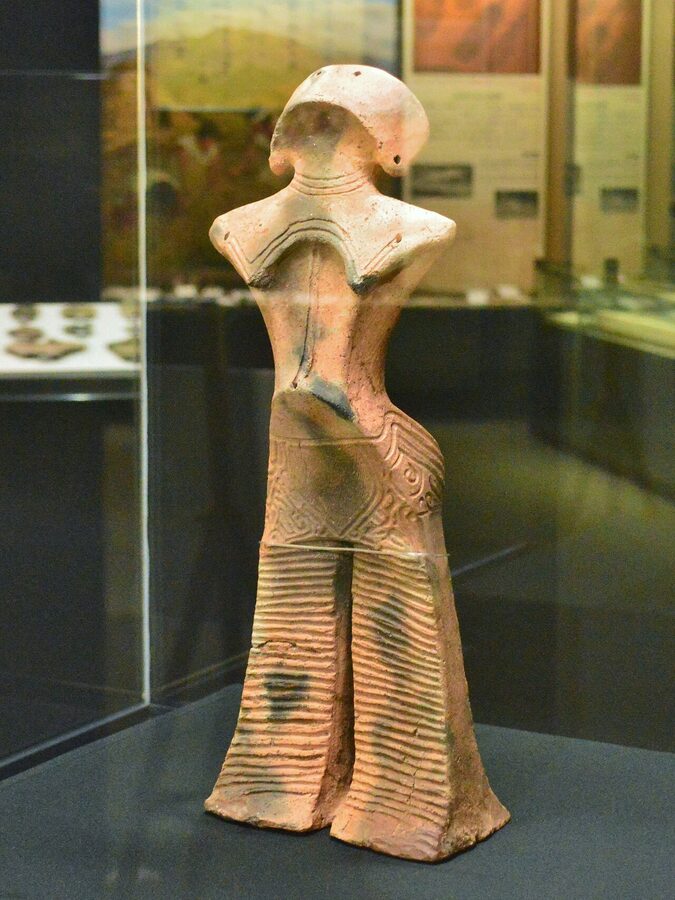
Japan has designated five dogū as National Treasures, all from eastern Japan and two from the same city in Nagano. Here they are in the order the state got round to them, which is also roughly the order in which archaeology stopped thinking of dogū as curiosities.
The Jōmon Venus came out of pit 500 at the Tanabatake site in Chino on 8 September 1986. She is 27 centimetres tall, solid, and weighs 2.14 kilograms, a Middle Jōmon standing figure of about 5,000 years ago with a small, mask-like face, a round belly and broad hips. In 1995 she became the first dogū, and the first Jōmon object of any kind, to be made a National Treasure.
Kakkū, the hollow figure from the safe, followed in 2007; she is Late Jōmon, about 3,500 years old, and came from a burial ground. In 2009 it was the turn of the Gasshō dogū, the “praying-hands figure”, found in July 1989 at the Kazahari I site in Hachinohe, Aomori. She sits with her knees up and her hands pressed together in front of her, 19.8 centimetres tall, and her breaks were mended in antiquity with natural asphalt, so somebody wanted her kept.
The Jōmon Goddess from the Nishinomae site in Funagata, Yamagata, followed in 2012. She was excavated in August 1992 in five pieces scattered across the site, and reassembled she is a Middle Jōmon figure of about 4,500 years ago with a flat, faceless head and long legs. She is the most modern-looking of them all, and she lives at the Yamagata Prefectural Museum.
The last, in 2014, was the Masked Goddess from the Nakappara site, also in Chino, found on 23 August 2000. She is 34 centimetres tall and weighs 2.7 kilograms, Late Jōmon, about 4,000 years old, and she wears a triangular mask tied on at the back of the head. She was found in a grave pit, buried with one leg detached, which is the dogū pattern again.
Sannai-Maruyama and the stamp of 2021
The site that changed what people thought the Jōmon could do was found because Aomori Prefecture wanted a baseball ground. People had known there was something at Sannai, on the western edge of Aomori city, for centuries. A local chronicle records a great many dogū coming out of the ground there on the second day of the first month of 1623, and the travel writer Sugae Masumi noted pots and figure fragments in a collapsed weir at Sannai village on the 14th day of the fourth month of 1796.
The rescue excavation for the new prefectural stadium began in 1992. In 1994 the diggers found six enormous post holes, still holding the stumps of chestnut posts about a metre across. The prefecture stopped the stadium, which was already under construction, and kept the site; a planned city road was later dropped too, because a burial avenue turned out to run along its route.
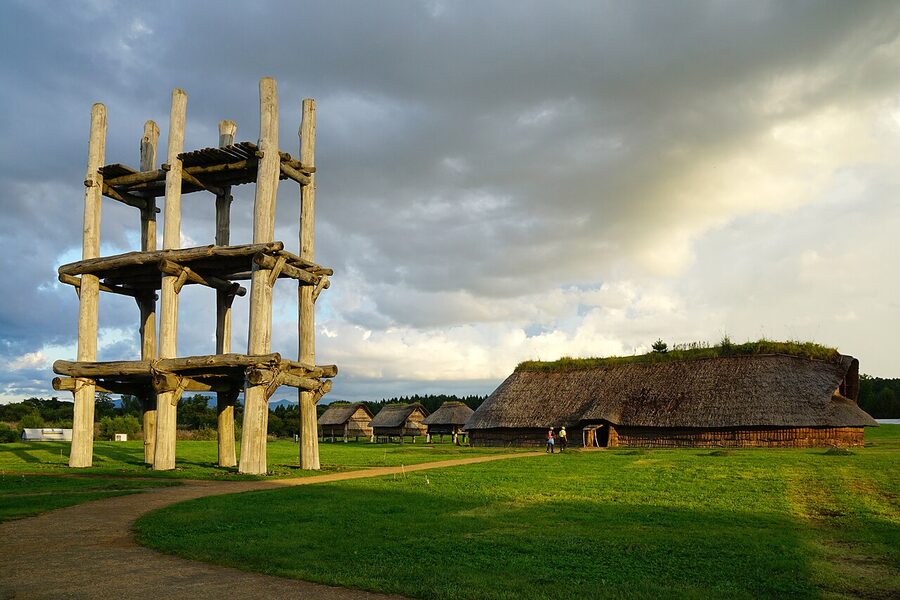
What emerged was a planned settlement of about 40 hectares, occupied from roughly 5,900 to 4,200 years ago, in the Early and Middle Jōmon. Excavators have counted around 780 pit dwellings over that time, more than ten large buildings, raised storehouses, rows of adult graves along roads, separate jar burials for children, clay pits, dumps and two great artificial mounds built up from centuries of earth, pottery and rubbish. At a symposium in Aomori in September 1994 someone suggested 500 people lived there at its height; others objected at once, and estimates still range from a few dozen households to several hundred people.
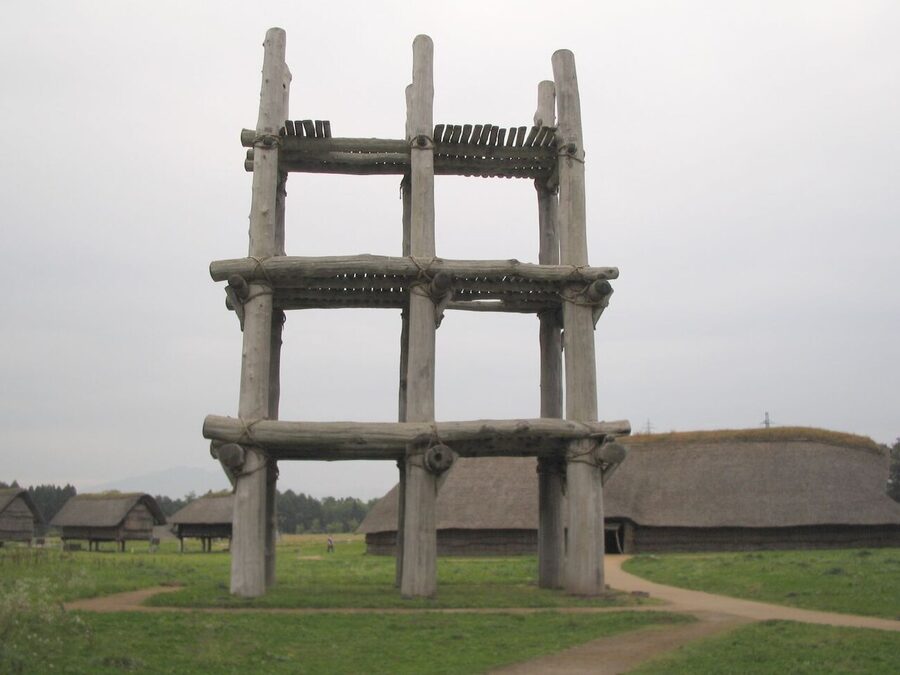
The six-pillar structure is the emblem. Its post holes are each 2 metres wide and 2 metres deep and spaced exactly 4.2 metres apart, and the posts were charred to slow rot and set leaning inward by about two degrees. Since 4.2 metres is twelve times 35 centimetres, and 35 centimetres turns up as a spacing at other Jōmon sites, some archaeologists talk of a “Jōmon foot”. Nobody knows what the building looked like, and the reconstruction, supervised by the anthropologist Koyama Shūzō and built by the contractor Obayashi, is a committee’s compromise: three floors and no roof.
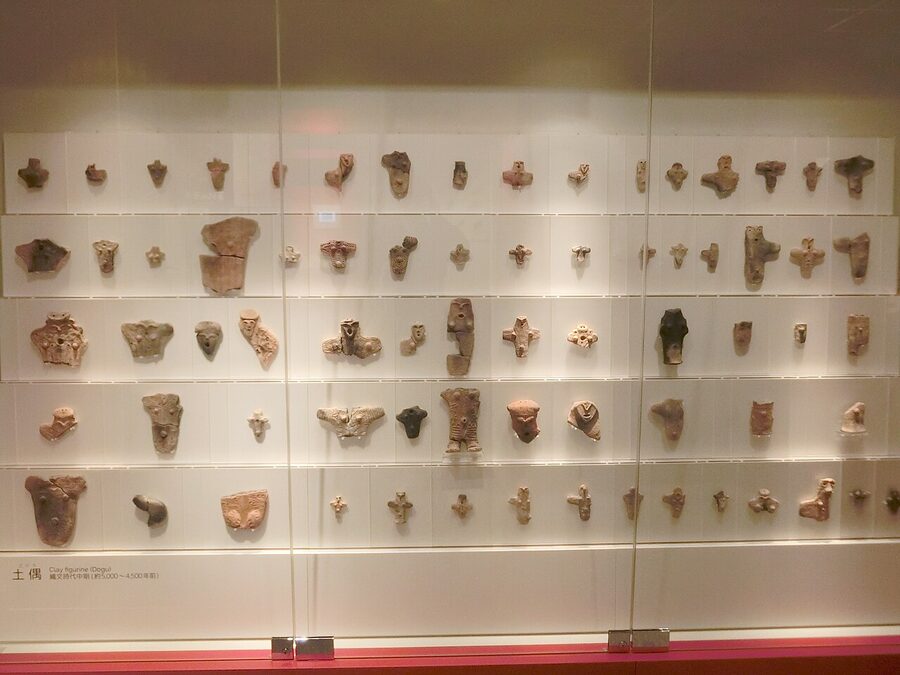
The finds fill tens of thousands of crates. Sannai-Maruyama has produced more than 2,000 dogū, the most from any site in Japan, nearly all of them flat and cross-shaped, along with jade from Itoigawa, obsidian, amber, asphalt and lacquerware; 1,958 objects were designated an Important Cultural Property in 2003. The animal bones are unexpected: about 70 percent are hares and flying squirrels rather than deer and boar, which suggests the big game nearby had been hunted out.
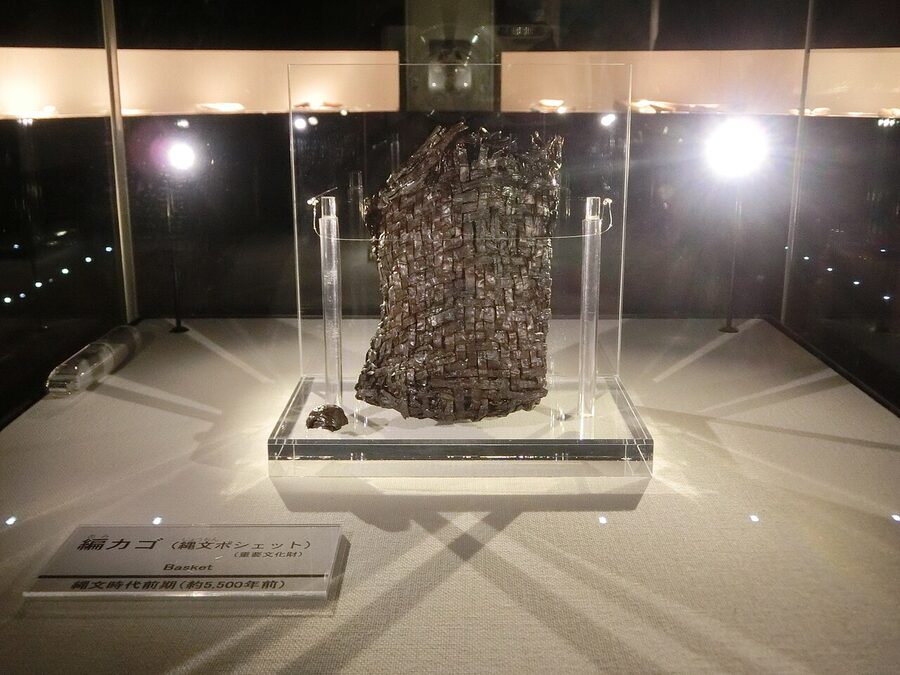
Sannai-Maruyama is also where the cultivation argument got its best evidence. DNA from chestnuts on the site shows them to be genetically very uniform, unlike a wild population, which points to people planting and selecting them. Annual plants such as egoma (a perilla grown for its oily seeds), bottle gourd, burdock and beans also turn up. “Hunter-gatherers” is still the right word for the Jōmon, but these were hunter-gatherers with orchards.
On 27 July 2021, at the online 44th session of the UNESCO World Heritage Committee, the “Jōmon Prehistoric Sites in Northern Japan” were inscribed: 17 sites in Hokkaido, Aomori, Iwate and Akita, from Odai Yamamoto’s sherds through Sannai-Maruyama to the Final Jōmon cemeteries, chosen to show the rise and maturing of a settled hunter-fisher-gatherer society over about 10,000 years. The inscription rests on criteria (iii) and (v), the second of which rewards a long way of living with the land that did not reshape it the way farming does. Japan changed the English name along the way from “Hokkaido and Northern Tohoku” to “Northern Japan”, on the reasonable grounds that few people abroad know where Tōhoku is.
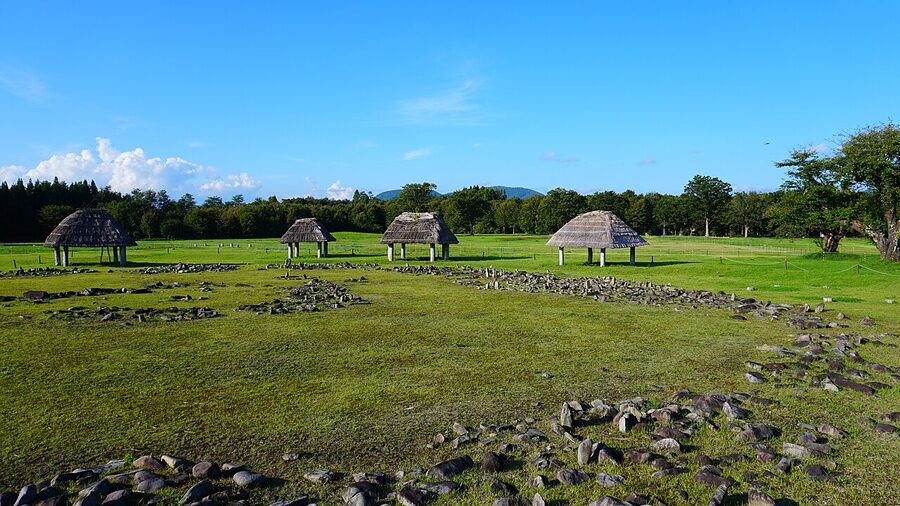
The listing had critics, and some of their points stand. Japan has something like 90,000 Jōmon sites, and Japan’s own Council for Cultural Affairs asked why this particular package from four northern prefectures should speak for all of them. Nagano’s obsidian mines and villages, Togariishi included, and Niigata’s flame pots were left out, and the archaeologist Sekine Tatsuhito of Hirosaki University has suggested a separate “stone Jōmon” nomination for central Japan. Conservation charters also prefer excavated remains to be reburied rather than rebuilt, so at Kamegaoka and Korekawa almost everything is back under the soil.
Whose ancestors?
This is the part where I have to be careful, because the subject attracts nonsense. The old question that Morse, Siebold and Tsuboi argued about, who the Jōmon people were, now has genetic answers, and the answers are more interesting than any of the nineteenth-century theories. They also have a political history: from the 1930s, as Japan’s state myth demanded a nation founded in 660 BC, archaeologists who had shown that the Jōmon people were ancestors of the Japanese were quietly ignored, and some found it wiser to agree with the chronicles.
Physically, Jōmon people were short and sturdy, the men a little under 160 centimetres and the women under 150, with strong jaws and deep-set eyes. Many had their front teeth deliberately pulled or filed as adults, probably as rites of passage. Since 2016 a series of ancient genomes, from the Sanganji shell midden in Fukushima, the Ikawazu shell mound in Aichi and a woman buried at Funadomari on Rebun Island about 3,800 years ago, has shown that the Jōmon were a distinctive branch of East Asians who separated from other populations between roughly 20,000 and 15,000 years ago and then lived in relative isolation.
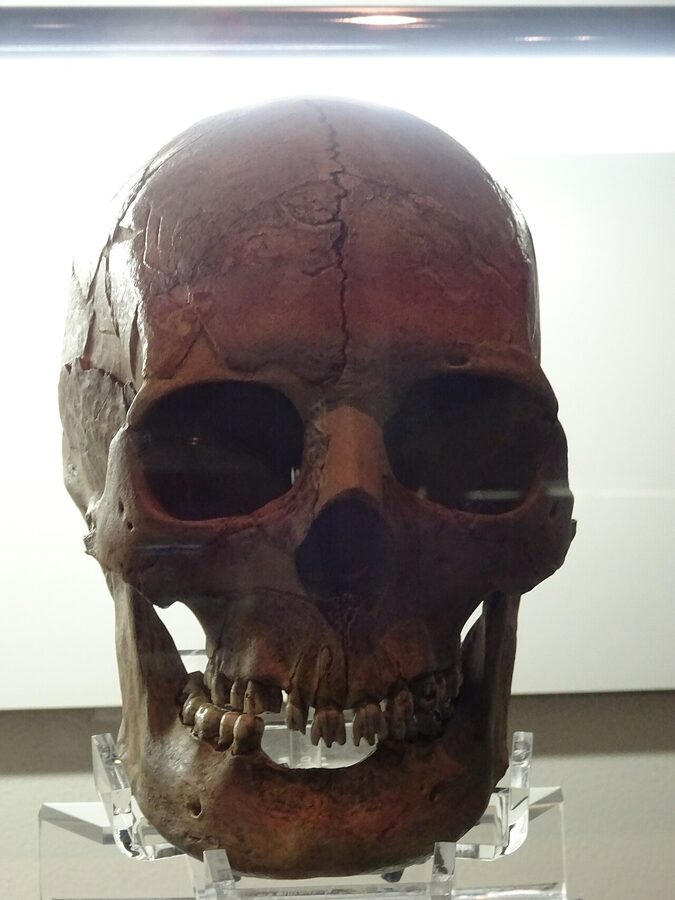
How much of that ancestry survives today? The figures quoted by the National Museum of Nature and Science are roughly 10 to 20 percent of the genome for most mainland Japanese, about 30 percent for Okinawans, and about 70 percent for the Ainu. The old “dual structure” model of the anthropologist Hanihara Kazurō in 1991, Jōmon foragers mixed with Yayoi-period migrants, has been refined by a 2021 study from Nakagome Shigeki’s group in Dublin and colleagues in Japan into a three-part model, with a further wave of East Asian ancestry arriving in the Kofun period.
The Ainu figure needs handling with care. It does not mean that the Ainu people are the Jōmon preserved, any more than modern Britons are Neolithic farmers. Ainu ancestry also includes people of the Okhotsk culture who came down from Sakhalin, and Ainu culture took shape in the 13th century; in December 2025 Japan’s three leading anthropological and archaeological societies issued a joint statement condemning the use of fragments of their research, including the 13th-century date for Ainu culture, to deny that the Ainu are an Indigenous people of Hokkaido. The once-popular equation of Jōmon, the emishi of Heian-era chronicles and the Ainu is not accepted by scholars today.
The slow end of a long age
The Jōmon did not end; it was overtaken, region by region, over centuries. In northern Kyushu, in the last phase of the Final Jōmon, people using the local Jōmon pottery began to dig irrigated rice paddies with wooden tools of continental design. The paddies at Nabatake in Karatsu and Itazuke in Fukuoka sit under or alongside pottery of the Yūsu type, a Final Jōmon style, which is why one site’s signs say Jōmon and another’s say Yayoi.
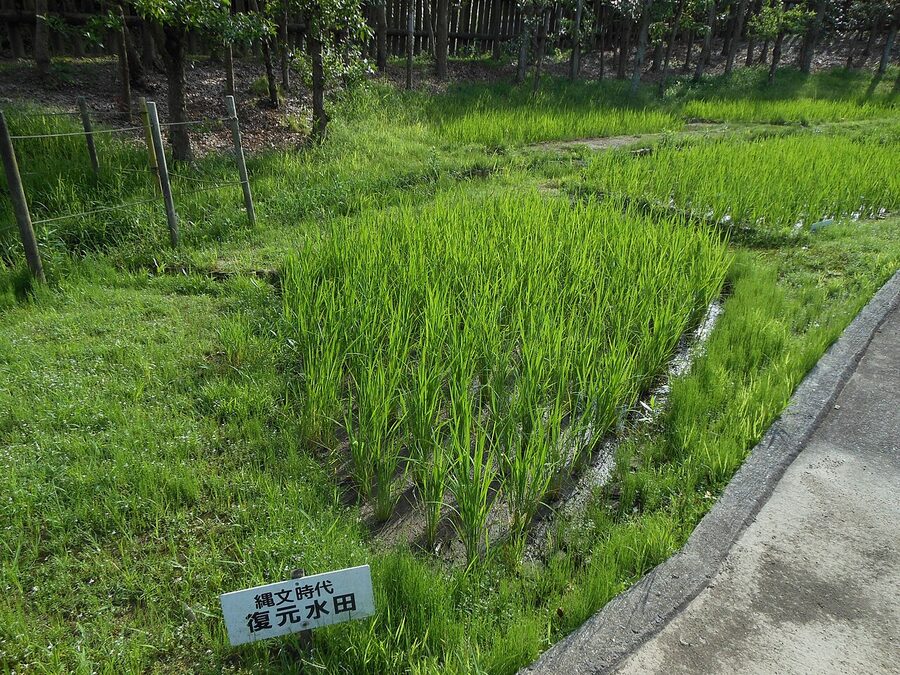
When did that happen? In 2003 the National Museum of Japanese History, Rekihaku, published AMS dates on carbon from cooking pots and argued that paddy farming began in northern Kyushu around 1000 BC, five or six centuries earlier than the 5th or 4th century BC most textbooks then taught, which would put it in the time of the Western Zhou rather than China’s Warring States. Many archaeologists now accept an earlier start than before, often somewhere in the 10th to 8th centuries BC; others still hold to the later date, and marine reservoir effects in the samples remain a live objection. English-language books often still print 300 BC for the start of the Yayoi, which at least has the merit of being the latest possible answer.
Rice then spread east and north over centuries, and the north took to it fitfully. In Hokkaido it never took hold: the Epi-Jōmon foragers there gave way to the Satsumon culture from around the 7th century, and that in turn to the Ainu world. The story of the farmers, the bronze bells and the moated villages belongs to my companion piece on the Yayoi period, and that story runs on through the queen Himiko to the first great tombs such as Hashihaka.
It is worth noticing what the written sources do with all this, which is nothing. The Kojiki of 712 begins with gods, and the Nihon shoki of 720 dates the accession of the first emperor, Jimmu, to 660 BC, which by today’s radiocarbon dates falls in the Final Jōmon over most of Japan. The chroniclers knew about the sun goddess Amaterasu and the shrine at Ise; they knew nothing about pit houses, shell mounds or flame pots. Keep the myth and the archaeology apart and both become more interesting.
Where to see the Jōmon today
Jōmon Japan is spread thin, which makes it a trip rather than an afternoon. If you have time for only one place, go to Sannai-Maruyama; if you have only an hour in Tokyo, go to Ueno.
Sannai-Maruyama, Aomori
The site and its museum, the Sannai Maruyama Jōmon Culture Center (the building is called the Jōmon Jiyūkan), sit on the western edge of Aomori city. You enter through the museum, walk through a tunnel and come out on the open site, where the six-pillar tower, the longhouse, raised storehouses and pit dwellings stand on grass where the stadium was going to be. Some excavated features are shown under shelters, and the museum displays about 1,700 finds, including the big flat dogū and the pochette.
Admission is ¥500 for adults and ¥250 for university students, and free for high-school students and younger; special exhibitions cost extra. It is open 9:00–17:00, and until 18:00 during Golden Week and from 1 June to 30 September, with last entry 30 minutes before closing. It closes on the fourth Monday of each month (the following day if that Monday is a holiday) and from 30 December to 1 January.
From Shin-Aomori Station on the Tōhoku Shinkansen, the Aomori shuttle bus “Nebutan-gō” takes about 15 minutes to the Sannai Maruyama Iseki stop, and a taxi about 10. From Aomori Station the city bus to Sannai Maruyama Iseki takes about 30 minutes. The Aomori Museum of Art is a ten-minute walk away and makes a good pairing; in winter the centre lends boots, and the site holds a “Jōmon winter festival” with the buildings lit up in the snow.
Allow half a day, and go on a weekday out of season, when you can stand in the longhouse alone. If you arrive by Tōhoku Shinkansen, watch out of the window: the viaduct runs right beside the site.
Tokyo National Museum and the Ōmori shell mound
The Japanese Archaeology Gallery is on the ground floor of the Heiseikan, the building behind the main hall at the Tokyo National Museum in Ueno Park. It takes you from the Paleolithic through the Kofun period, and its Jōmon section is the best single room in the country for seeing pottery and dogū from many regions side by side. The museum owns the Kamegaoka goggle-eyed figure and the flame vessel attributed to Umataka, among a great deal else; displays rotate, so check the museum’s online gallery list if there is one object you have come for.
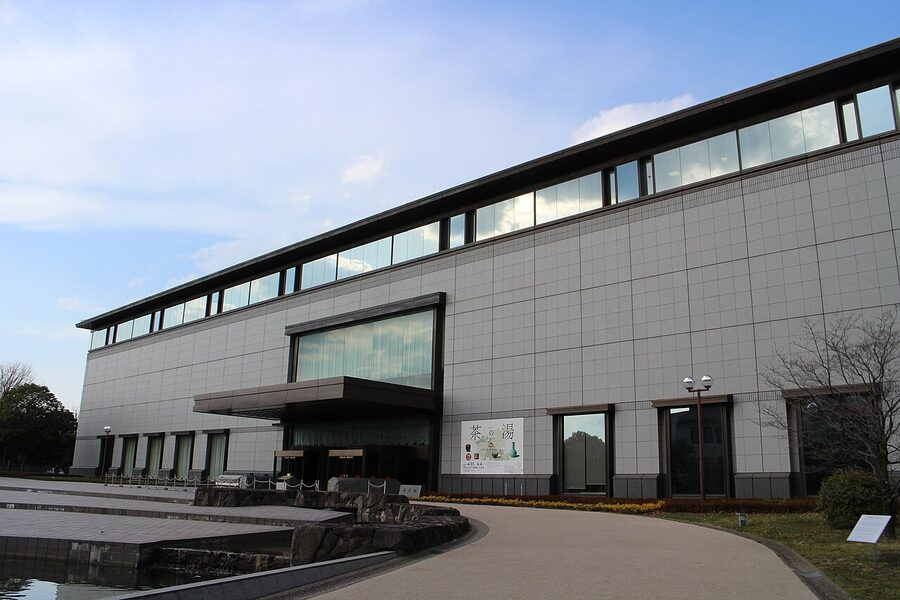
Admission to the collection galleries is ¥1,000 for adults and ¥500 for university students; under-18s and over-70s go free. Hours are 9:30–17:00, extended to 20:00 on Fridays and Saturdays, and the museum is closed on Mondays (the following day when Monday is a holiday). It is about ten minutes’ walk from the Park exit of JR Ueno Station or from Uguisudani Station; there is now security screening at the main gate, and suitcases are not allowed in, so leave them in a station locker.
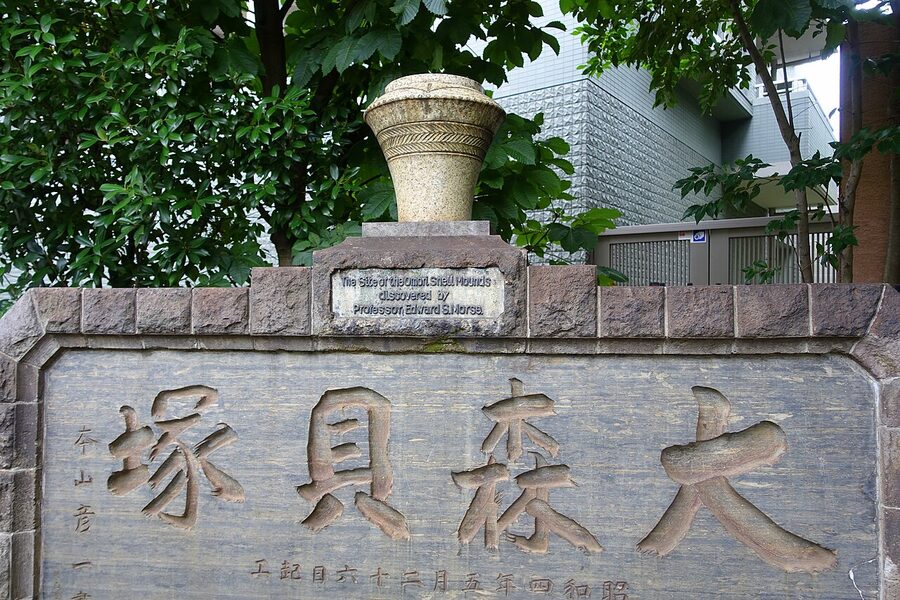
For the place where it all started, take the JR Keihin-Tōhoku Line to Ōmori, two stops south of Shinagawa. About five minutes’ walk from the north exit, in Ōi 6-chōme in Shinagawa ward, is the Ōmori Shell Mounds Garden, a small park with a display of the shell layer, a bust of Morse and the 1929 monument. A second monument of 1930 stands about 300 metres away on the Ōta ward side, two minutes from the station along the tracks; for decades the two wards argued about which marked the real spot, until research in the 1980s turned up the record of a 50-yen compensation payment to a landowner in Ōi and settled it for Shinagawa.
Togariishi, Chino
Chino, on the Chūō Line between Kōfu and Matsumoto, is the place to see the Jōmon of the mountains. The Togariishi Museum of Jōmon Archaeology stands in the site park of the Togariishi and Yosukeone sites, a Special Historic Site, at about 1,050 metres on the slopes of the Yatsugatake range; around it are reconstructed pit houses, the open ground where Miyasaka found his ring village, and the pointed stone that gave the site its name. The museum holds two of the five National Treasure dogū, the Jōmon Venus and the Masked Goddess.
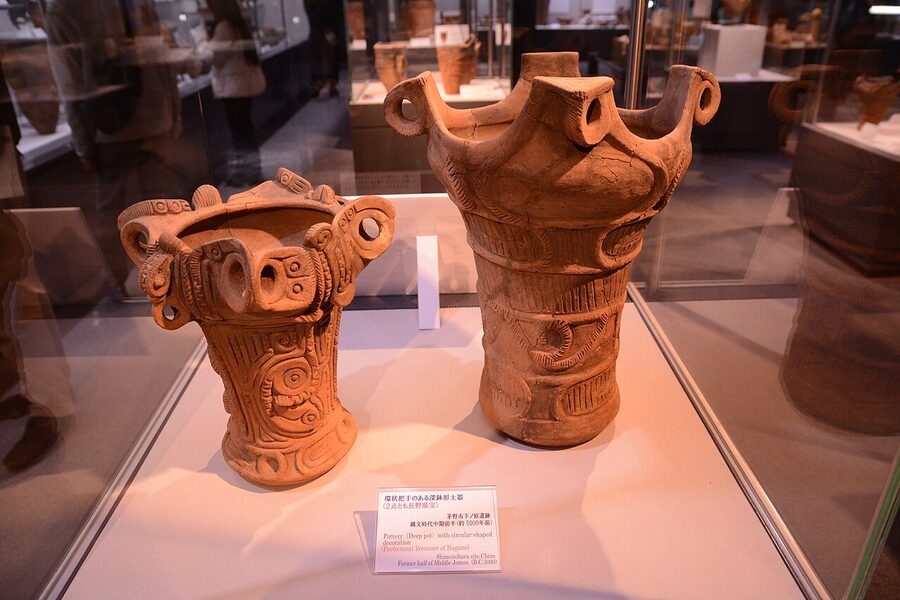
One warning for this autumn. As of November 2026 the museum is showing the real Venus but a replica of the Masked Goddess, because she is on loan to Tokamachi until 23 November; check the museum’s notices before you go if she is your reason for the trip. The museum is also planning a temporary closure from February to early March 2027.
Admission is ¥600 for adults and ¥500 for high-school and university students. The museum opens at 9:00, with last entry at 16:30 and the galleries closing at 17:00; it is closed on Mondays (unless a holiday), on the day after a national holiday, and from 28 December to 4 January. The Merhen Kaidō bus from Chino Station takes about 20 minutes but runs only three times a day, so check the timetable on the museum’s site or take a taxi; drivers come in about 25 minutes from the Suwa interchange of the Chūō Expressway.
Tokamachi City Museum, Niigata
Tokamachi is snow country, the town where the Sasayama flame pots were found, and its museum, rebuilt in 2020 and nicknamed TOPPAKU, is the best place in Japan to see flame pots in quantity. The Jōmon gallery shows the National Treasure group from Sasayama, and the rest of the building covers the town’s textiles and its ferocious winters.
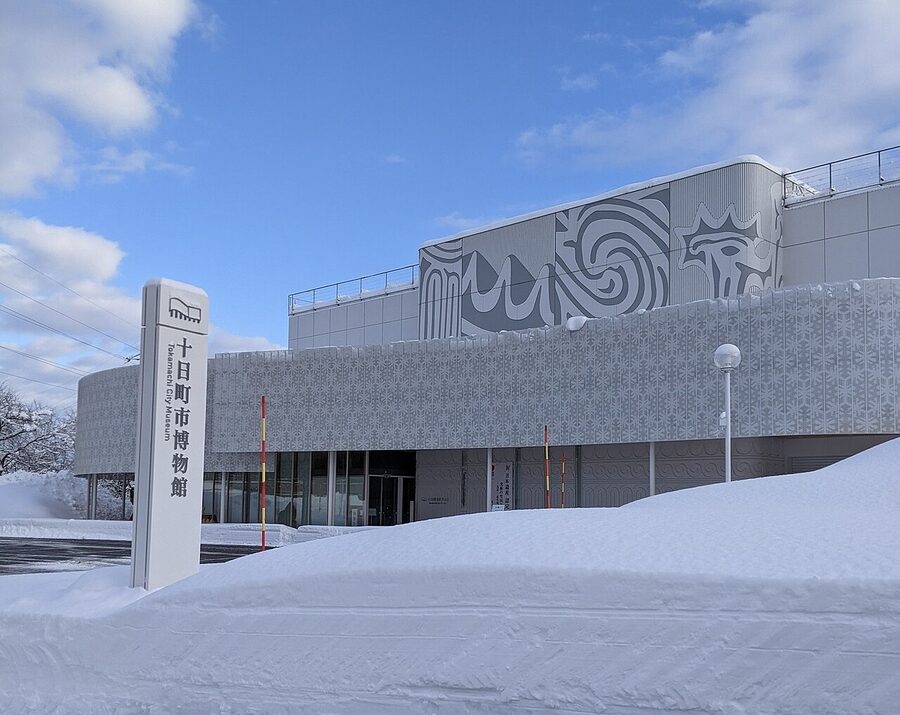
Admission is ¥600 for adults, ¥500 for groups of 20 or more, and free for junior-high students and younger. It opens 9:00–17:00 with last entry at 16:30 and is closed on Mondays (the next weekday after a holiday), on Mondays and Tuesdays from December to February, and from 28 December to 3 January. Until 23 November 2026 a special exhibition built around the Masked Goddess on loan from Chino is on, at ¥1,100 including the permanent galleries.
The museum is about ten minutes’ walk from the west exit of Tokamachi Station, which is on the JR Iiyama Line and the Hokuhoku Line; the Hokuhoku Line connects with the Jōetsu Shinkansen at Echigo-Yuzawa. If you have a car, the Umataka Jōmon Museum in Nagaoka, home of the first flame pot, is the natural second stop.
If you have more time
North of Sannai-Maruyama the World Heritage sites are mostly fields where the remains have been reburied, so go to them for the museums. In Hachinohe, the Korekawa Jōmon Museum (Korekawa Jōmonkan) holds the Gasshō dogū and an outstanding collection of Final Jōmon lacquer from the waterlogged Korekawa site; from Hachinohe Station the Nanbu bus to Korekawa Jōmonkan runs to the door, though only on weekends and holidays, so check before you travel.
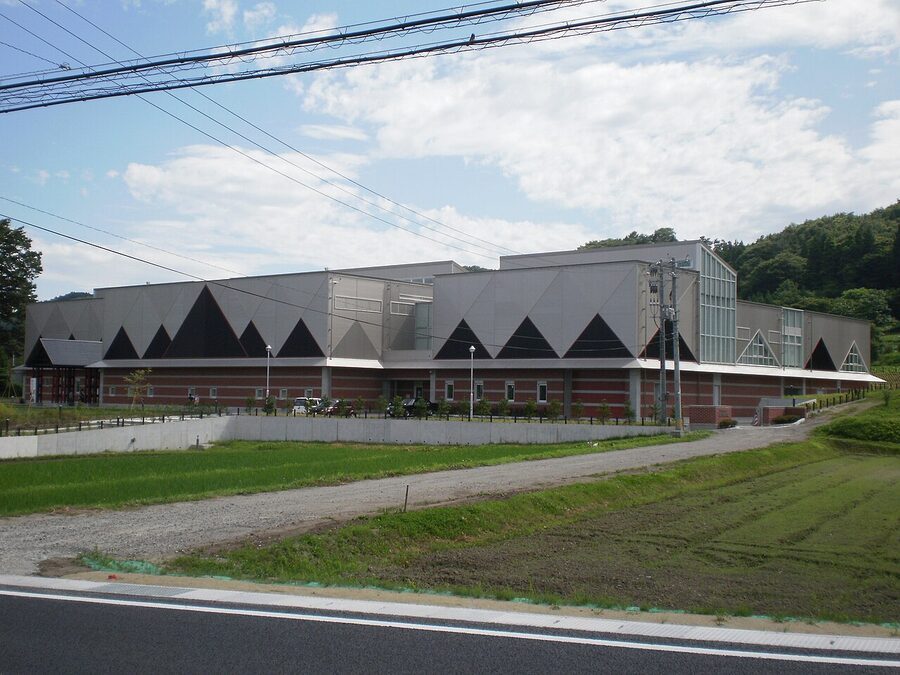
On the Tsugaru plain, Kamegaoka itself is fields and a stone Shako-chan; Kizukuri station is the better sight, and Hirosaki the obvious base. In Hokkaido, Kakkū is at the Hakodate Jōmon Culture Center in Minamikayabe, about an hour’s drive from central Hakodate, next to the Kakinoshima site; it combines easily with a day in Hakodate and the star fort at Goryōkaku. And if stone circles appeal more than pots, the Ōyu circles at Kazuno in Akita are the largest in Japan, and best seen outside the snow months.
Check opening dates for all of these. Several close in winter for snow, and in 2025 the Ōmori Katsuyama site near Hirosaki ended its season early after bears were seen on the site.
The Jōmon spent its first century of modern study being explained away, as cannibals, little people from folklore, a prologue to the farmers, and its finest figure spent thirty years in a safe. You do not have to go to Hakodate to see Kakkū. But if you are there anyway, drive out along the coast to Minamikayabe, look at her for a while, and remember that for three decades the finest hollow figure in Japan was filed away with a fishing town’s cash books.