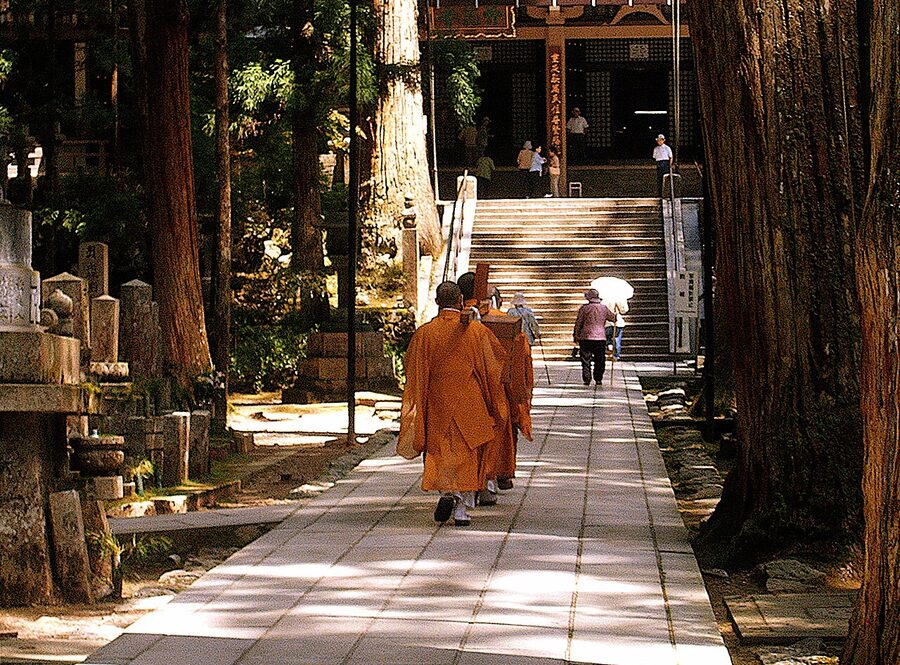
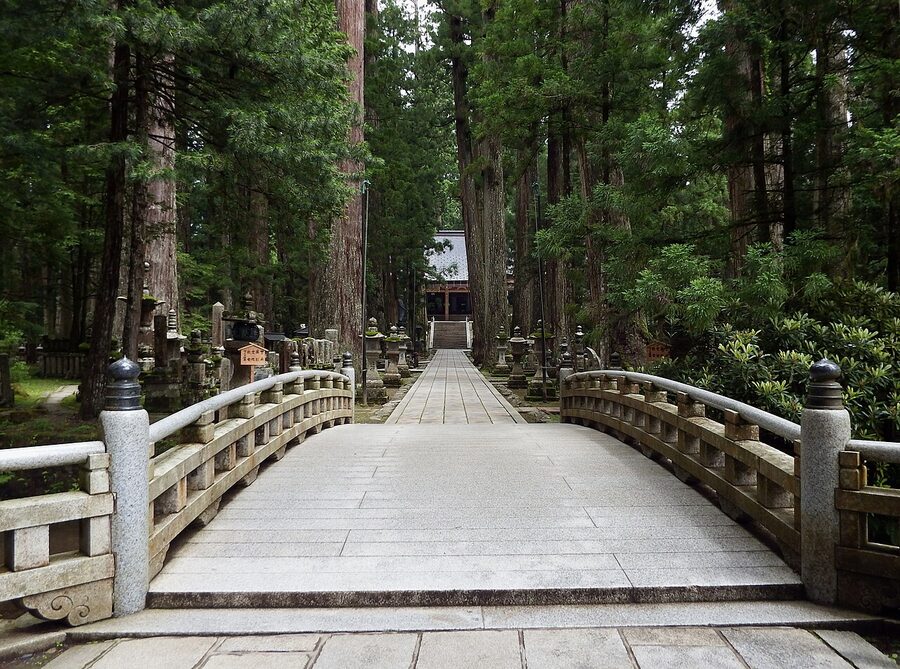
At six o’clock every morning, before the first bus of pilgrims has reached the top of the mountain, two monks in ochre robes lift a wooden box onto a pole and carry it out of a kitchen in the forest at Okunoin on Kōyasan. They walk it across a stone bridge, past the lantern hall, and up to a small cypress-roofed building behind a fence, where they leave breakfast for a man who stopped eating in 835. At half past ten they do it again with lunch. Before either meal goes in, it is set in front of a small stone Jizō beside the kitchen, whose only job is to taste it first.
The menu is strictly vegetarian, because meat and fish have been banned on the mountain since the 9th century, but it is not frozen in time. Some days it is rice, miso soup and simmered vegetables; some days, I am told, it is pasta. In summer the monks add a fan and in winter a charcoal brazier. The man in the building is Kūkai (空海), whom almost everyone in Japan calls Kōbō Daishi, and the Shingon school he founded holds that he is not dead.
He sat down in meditation on the 21st day of the third month of 835, the faithful say, and has been waiting there ever since for the next Buddha, who is due in roughly 5.6 billion years. I find him the hardest figure in early Japanese history to write about, and the most fun. There is a real man here, a provincial boy who dropped out of the state university, slipped onto a government ship to China, learned in months what was supposed to take twenty years, and came home to found a school of Buddhism, a mountain monastery, a reservoir and a school open to the poor.
And there is a second man, built over eleven centuries out of more than 5,000 local legends, who struck springs out of rock with his staff, invented the Japanese alphabet (he did not), and still walks the island of Shikoku beside every pilgrim. This piece tries to keep the two apart, says which text says what, and ends where you can go and meet both of them.
In This Article
- A boy called True Fish
- The dropout and the morning star
- Four ships, two arrivals
- Pouring water from one vase into another
- Twenty years’ study in two
- The friend who borrowed books
- What he actually taught
- A mountain shaped like a lotus
- Engineer, schoolmaster, rainmaker
- The last three months
- Hair grown a little longer
- Five thousand legends
- The alphabet he did not write
- “Even Kōbō slips with the brush”
- Dōgyō ninin: how the 88 temples formed
- Heretic, hero, film star
- Where to find Kūkai today
- Tō-ji, Kyoto
- Kōyasan and the Okunoin
- Zentsū-ji, where he was born
- Mannō-ike
- Cape Muroto and the cave
- A day on the henro
A boy called True Fish
He was born in 774 in Sanuki Province, on the north coast of Shikoku, in what is now the city of Zentsūji in Kagawa. His father, Saeki no Tagimi, was a district official from a local branch of the Saeki, and his mother came from the Atō, a family of scholars. His childhood name was Mao (真魚), True Fish, which is the sort of name you give a third son on a coast where the fish matter more than the sons.
Shingon tradition celebrates his birthday on the 15th day of the sixth month. No early text gives that date, and Japanese reference works point out where it probably comes from. The Indian master Amoghavajra, one of the great translators of esoteric Buddhism in China, died in 774, and a later generation decided that Kūkai must have been his reincarnation. It is a beautiful idea and an unprovable one, and it sets the pattern for almost everything else in this story.
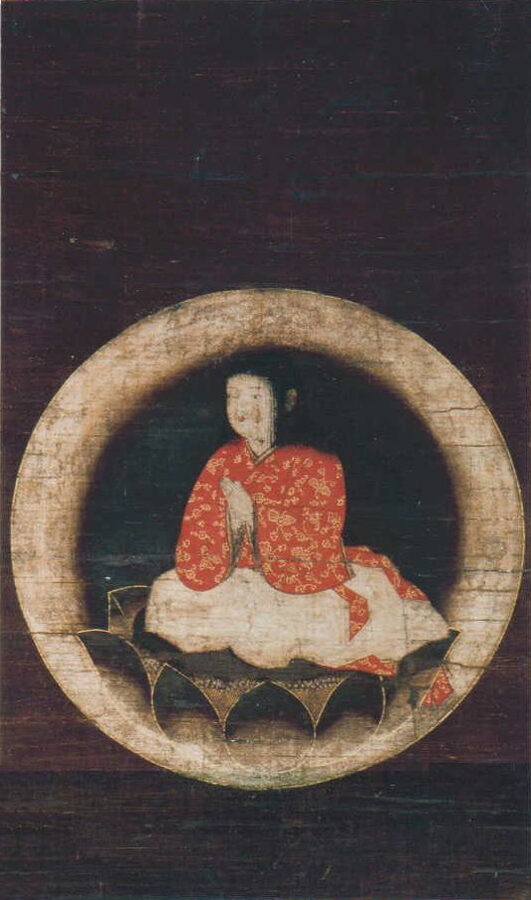
At fifteen, in 788, he went to the capital region to study the Chinese classics under his maternal uncle, Atō no Ōtari, tutor to one of Emperor Kanmu’s sons. At eighteen he entered the Daigakuryō, the state university that trained the sons of officials, and read the Confucian curriculum. Sources give his entry year as 791 or 792, depending on how you count his age. English-language accounts usually put the university in Nara, but the court had moved to Nagaoka in 784, and the Japanese biographies are careful to say only “the capital”.
The family needed him to finish. The wider Saeki and Ōtomo kin group had been under a cloud since the Ōtomo were implicated in the murder of Fujiwara no Tanetsugu in 785, the killing that helped push Kanmu out of Nagaoka altogether. Within a year or two he walked out.
The dropout and the morning star
What he did instead is described in his own words in the Sangō shiiki (三教指帰), “Pointing the Way for the Three Teachings”, finished in 797 when he was twenty-four. It is a satirical play in Chinese prose. A wealthy man asks three teachers to reform his good-for-nothing nephew: a Confucian called Master Turtle-Hair, a Taoist hermit called Empty-Nothing, and a ragged Buddhist beggar. Turtle hair is the stock Buddhist example of a thing that does not exist, so you can guess how the Confucian fares, and the beggar, very obviously the author, wins.
The first draft, under the title Rōko shiiki, survives in Kūkai’s own hand at Kongōbu-ji on Kōyasan and is a National Treasure. His preface to the final version is the only first-hand account of his twenties. A monk, he says, taught him the Kokūzō gumonji-hō, a practice in which you recite the mantra of the bodhisattva Ākāśagarbha a million times in a hundred days for a memory that never forgets a text.
So he went into the mountains to recite it. He names two places: Tairyū-dake, a peak in Awa (now Tokushima), and the cape at Muroto at the southern tip of Tosa (now Kōchi). There, he writes, “the valleys did not spare their echoes, and the morning star came and cast its light”. That is all.
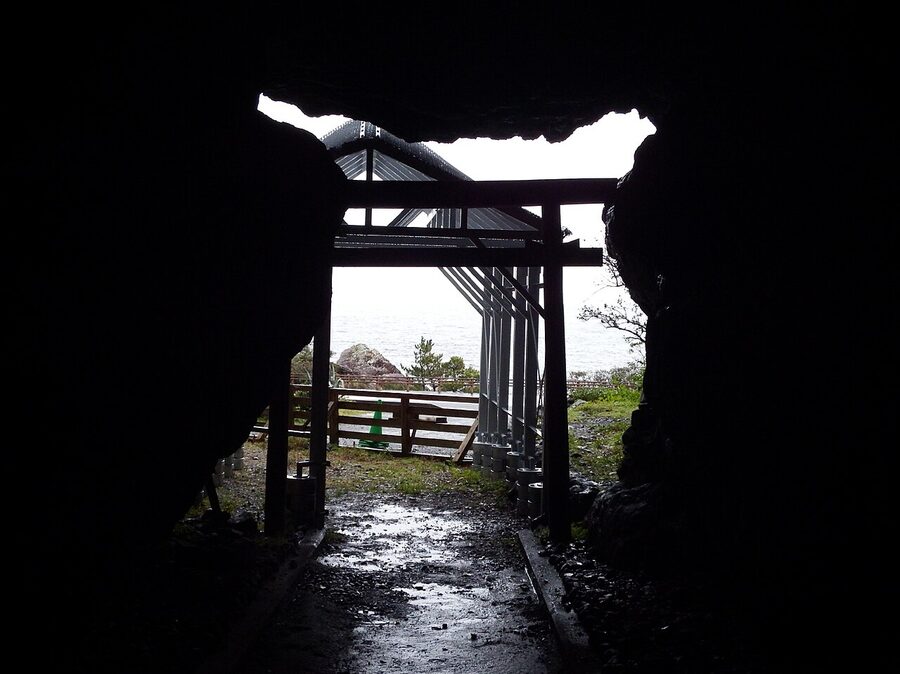
The version everyone knows, in which the star flew down into his mouth, comes from later hagiography. So does the lovely explanation of his name: Kū-kai, “sky and sea”, because from the mouth of his sea cave at Muroto that was all he could see.
The name itself first appears in an official record of 804. Before that he was one of the shidosō, self-ordained monks who wandered outside the state system. When and where he was properly ordained is one of the old arguments. One tradition puts it in 793 under a monk called Gonzō; the theory most Japanese scholars now favour puts it at the ordination platform of Tōdai-ji in 804, just weeks before he sailed, which would make his ordination a ticket for the boat.
Between 797 and 804 there are seven years about which almost nothing is known. He was probably reading in the libraries of the great temples of the Nara period and learning to write Chinese better than most Chinese. Somewhere he found the Mahāvairocana Sūtra, the core text of esoteric Buddhism, and could not understand it. Parts were in Siddhaṃ script, the rituals could only be learned from a teacher, and there was no such teacher in Japan.
Four ships, two arrivals
In 804 the court sent its first embassy to the Tang in a generation: four ships under the ambassador Fujiwara no Kadonomaro, one of the Fujiwara who were then quietly taking over the court. Kūkai went as a ryūgakushō, a long-term student monk, contracted to stay in China for twenty years. How an unknown monk without a court sponsor got that place nobody knows.
On the second ship was a man seven years older who needed no connections at all. Saichō was already one of the emperor’s ten personal chaplains, travelling as a short-term scholar with his own interpreter to bring back the Tendai teachings of Mount Tiantai. The two most important figures in early Heian era Buddhism sailed in the same fleet, and as far as anyone knows, they did not meet.
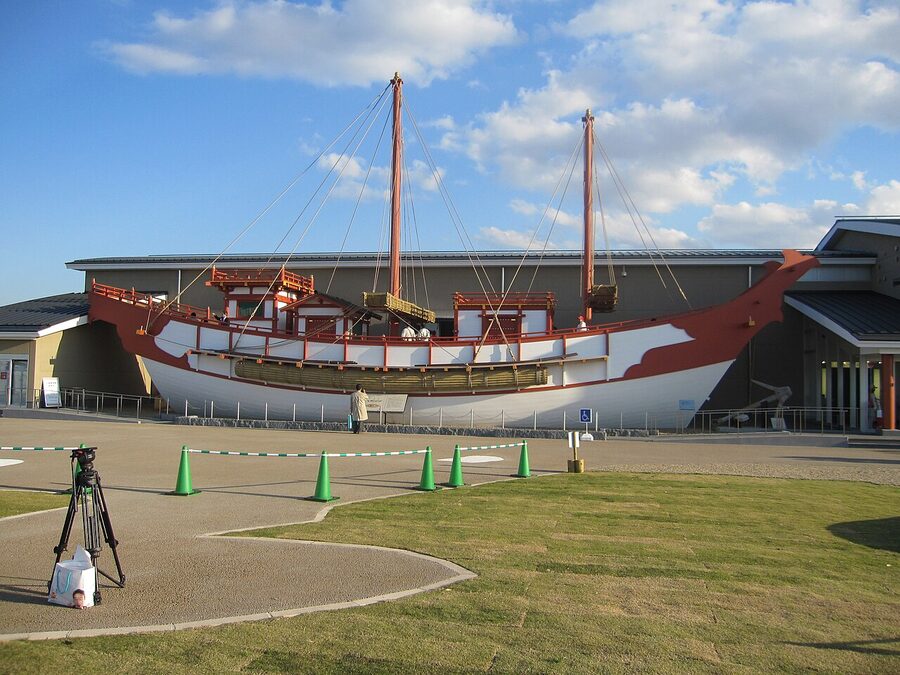
The fleet left Naniwa on the 12th day of the fifth month and struck out from the Gotō Islands on the 6th day of the seventh month. A storm scattered it. Saichō’s ship reached Mingzhou more or less on course, but Kūkai’s was blown far south and drifted ashore on the 10th day of the eighth month at Chixian, on the coast of Fujian. The local authorities took one look at a battered foreign ship with no proper papers and decided it was full of pirates.
They were kept on the beach for about fifty days. The ambassador’s letters to the governor got nowhere, so somebody suggested the student monk try. Kūkai’s letter, preserved in his collected writings, is so good, both in its Chinese and its handwriting, that the governor let them go. The embassy reached Chang’an on the 23rd day of the twelfth month of 804; the third and fourth ships never arrived at all.
Pouring water from one vase into another
Chang’an in 805 was perhaps the largest city in the world, with a million people, Persian merchants and a whole district of Buddhist monasteries. Kūkai was given rooms at Ximing-si, where Japanese student monks traditionally lodged, and polished his Sanskrit with an Indian master, Prajña, who had studied at Nālandā.
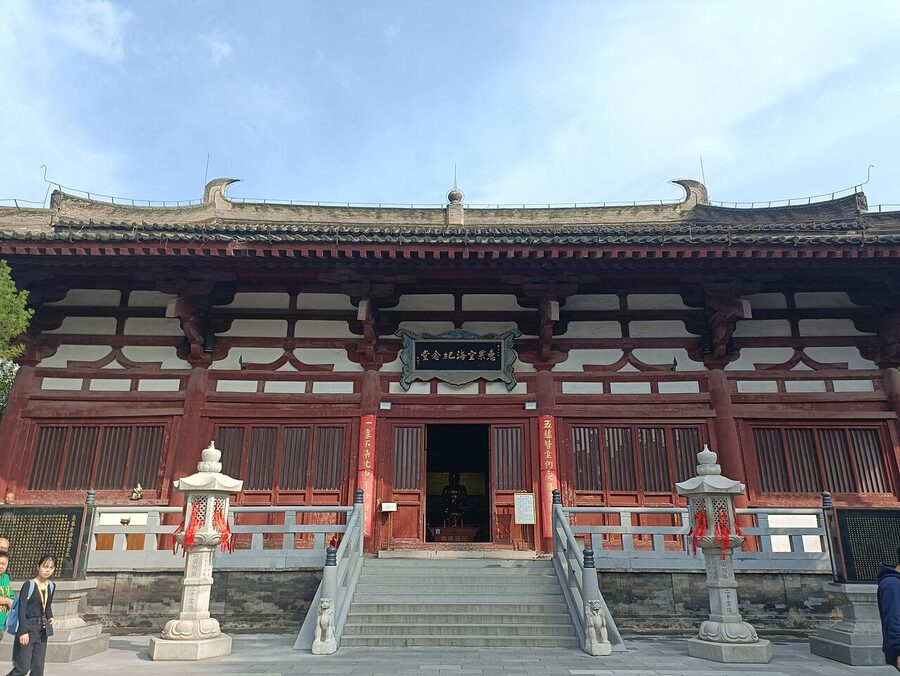
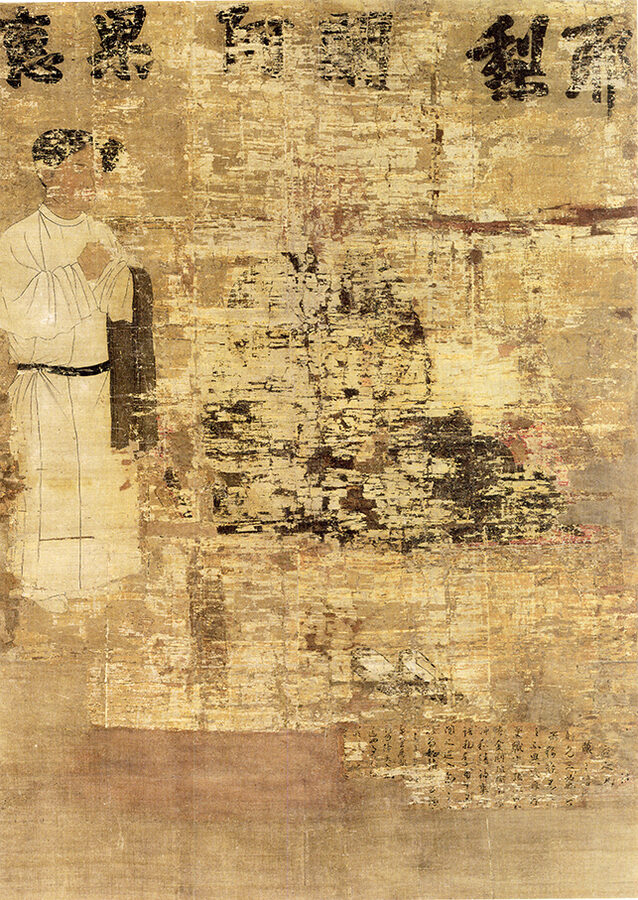
Then, in the fifth month of 805, he went to see Huiguo (恵果), the seventh patriarch of esoteric Buddhism, abbot of Qinglong-si and teacher to three Tang emperors. Kūkai’s own report of the meeting has the old man smiling as he walked in. He had known Kūkai would come, he said, and had waited a long time; his life was nearly over and he had no one to pass the teaching to. “How good, how good.”
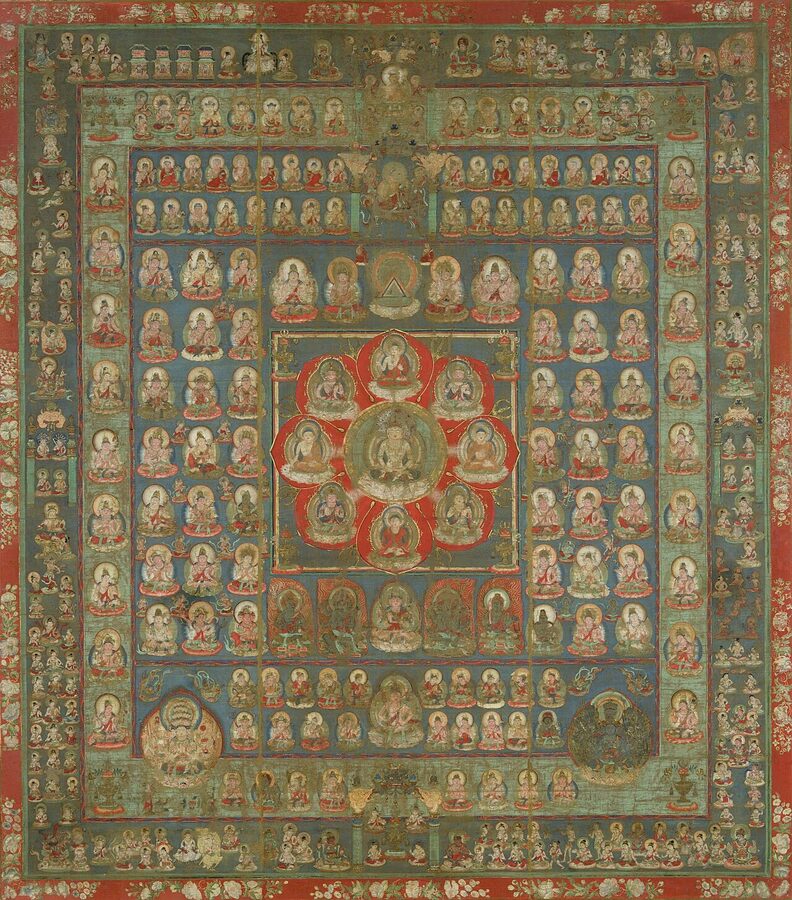
What followed was the fastest transmission in the history of the school. In the sixth month Huiguo gave him the initiation of the Womb Realm, and in the seventh the Diamond Realm. In both rites the blindfolded initiate throws a flower onto a mandala, and Kūkai records that both times his flower fell on Mahāvairocana, the Great Sun Buddha at the centre. On the 10th day of the eighth month he became a master, an ācārya, with the name Henjō Kongō (遍照金剛), “the Vajra That Shines Everywhere”.
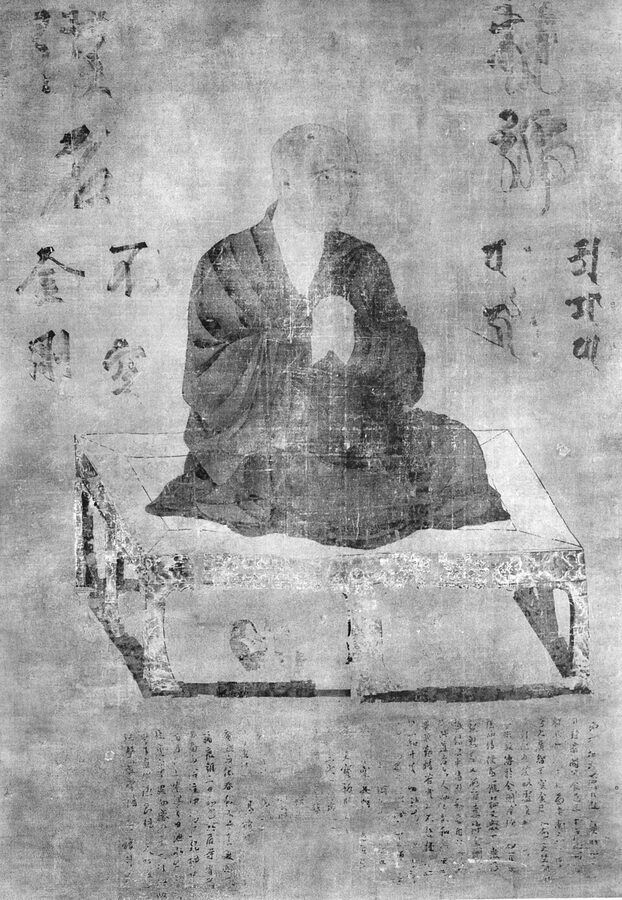
A Shingon saying puts it in a phrase: the teaching passed from Huiguo to Kūkai like water poured from one vase into another, without a drop spilt. Huiguo had court painters make mandalas and portraits, had scribes copy the sutras, and gave him the master’s regalia handed down from Amoghavajra. Then, on the 15th day of the twelfth month of 805, aged sixty, he died. Out of all his disciples, the foreigner was chosen to write his memorial inscription.
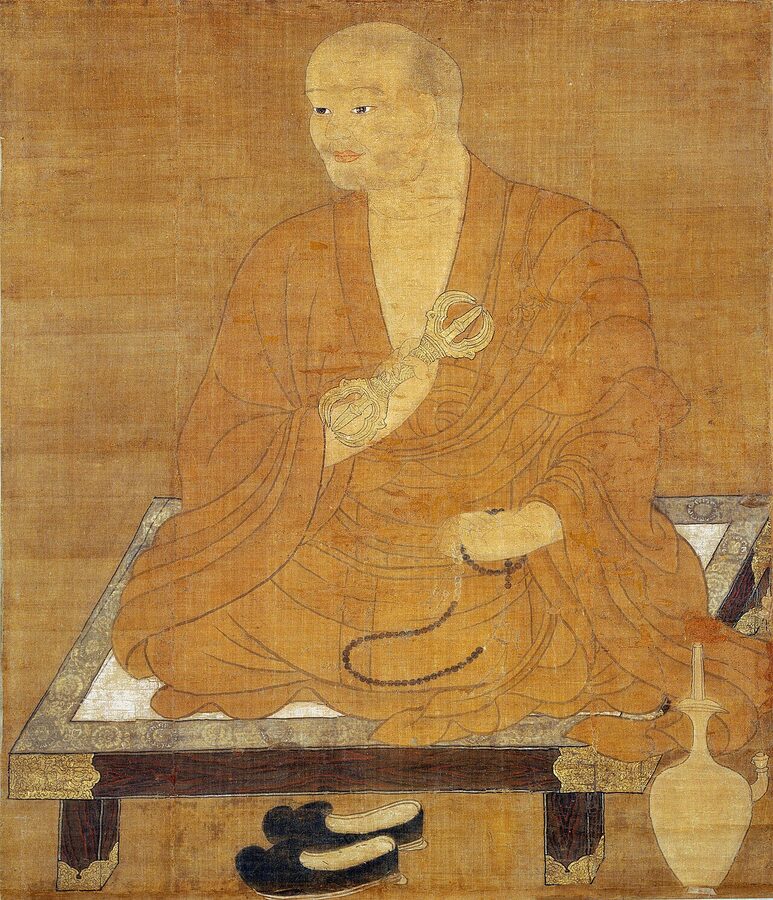
Huiguo’s last instruction, according to Kūkai, was to go home and spread the teaching. That was a problem, because Kūkai had signed up for twenty years. Early in 806 a Japanese envoy turned up unexpectedly in Chang’an: Takashina no Tōnari, who had survived the wreck of the fourth ship and been sent back across the sea on new business. Kūkai petitioned through him to go home early, explaining that two years had used up twenty years’ funds, spent four months in Yuezhou buying books, and sailed from Mingzhou in the eighth month.
Twenty years’ study in two
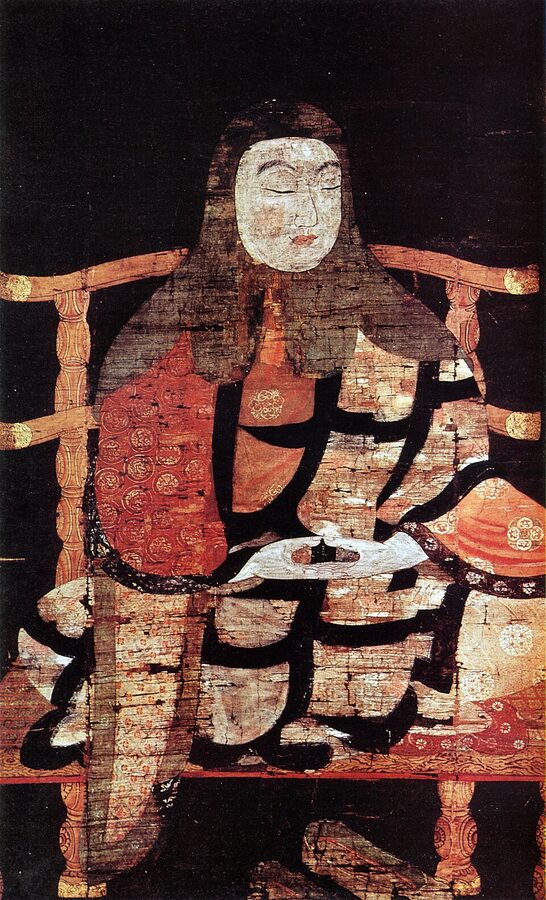
He landed at Hakata in the tenth month of 806 and sent the court a Catalogue of Imported Items, the Shōrai mokuroku, dated the 22nd day of that month (one reference work has it reaching the capital in the twelfth). It lists 216 texts in 461 fascicles, ritual implements, mandalas, portraits and the relics Huiguo had given him. It is an invoice and a sales pitch at once: this is a new Buddhism, more complete than anything in Japan, and it can protect the state.
The court’s answer was silence. Kanmu, who had sent him, had died that spring, and a student who had broken a twenty-year contract could not simply walk back into the capital. Kūkai spent three years in Kyushu, much of it at Kanzeon-ji near Dazaifu, painting mandalas for local patrons. I like to picture the most learned man in Japan at the far end of the country with a shipload of books, waiting for a reply.
It came in 809, after the emperor Heizei abdicated in favour of his brother Saga, who loved Chinese poetry and calligraphy. In the seventh month the court ordered Kūkai into Takaosan-ji in the hills northwest of the capital, and one of the people who had lobbied for him was Saichō.
The friend who borrowed books
For the next few years Saichō and Kūkai were something like friends. Saichō had picked up a little esoteric training in China, and the court had liked the rituals so much that esoteric practice became part of the Tendai curriculum. He knew better than anyone how little he had actually learned. So the senior man, the emperor’s own chaplain, asked to borrow Kūkai’s books, and then asked to be taught.
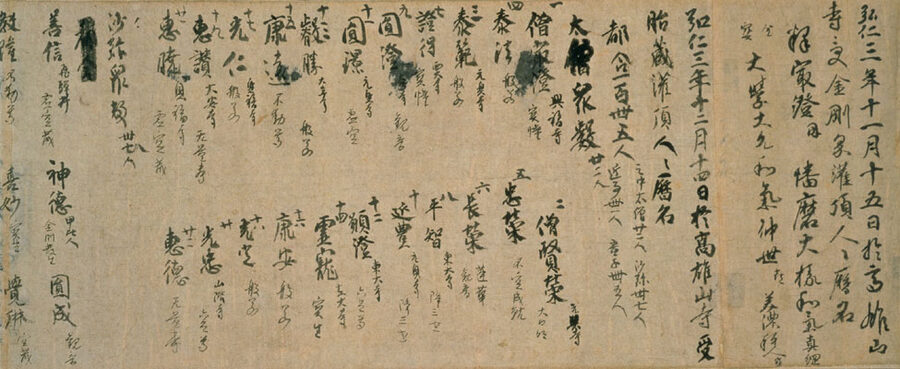
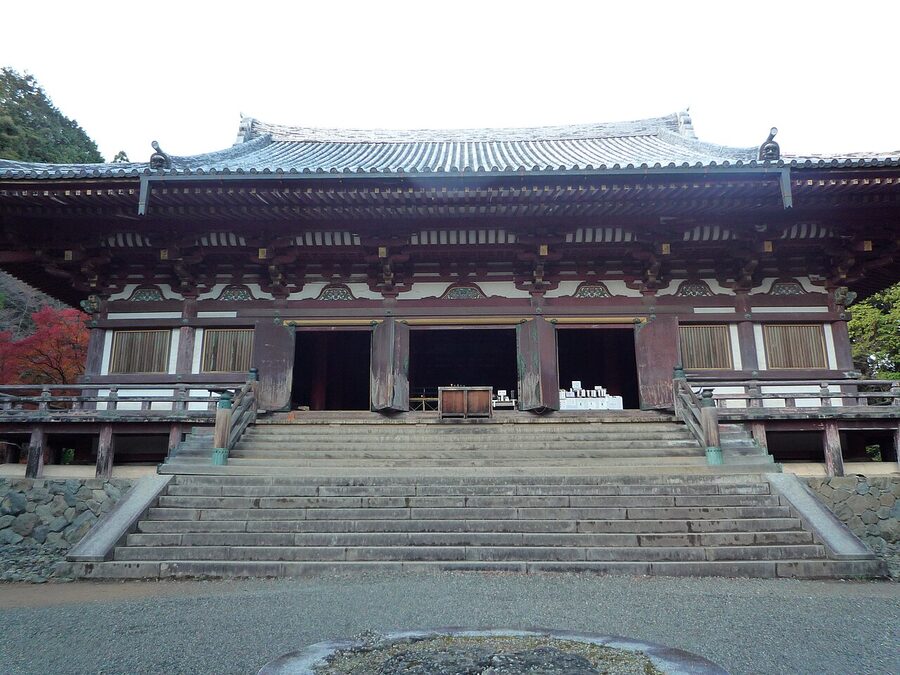
On the 15th day of the eleventh month of 812, at Takaosan-ji, Kūkai gave Saichō and a few others the initiation of the Diamond Realm. On the 14th day of the twelfth month he opened the Womb Realm initiation, and Saichō and his disciples were among the crowd. Kūkai’s own handwritten register of names, the Kanjō rekimei, survives at Jingo-ji, and the totals given for it range from 166 to 194, depending on who is counting.
The letters between the two men tell the rest. Three of Kūkai’s letters to Saichō survive as a single scroll, the Fūshinjō (風信帖), named for its opening words about a letter arriving on the wind, and it is a National Treasure. There were five once. The colophon records that one was stolen and another was handed over in 1592 to Toyotomi Hidetsugu, nephew of Toyotomi Hideyoshi, because he asked for it, and nobody refused a Toyotomi in 1592.
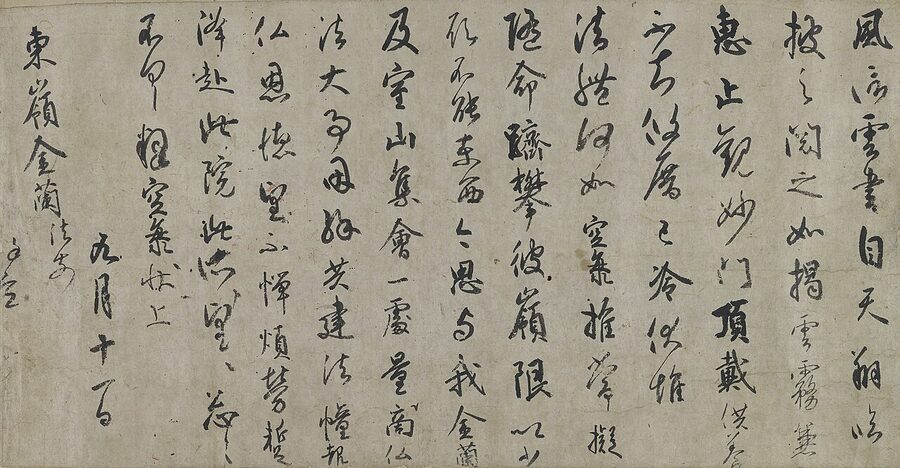
The break came over a book. On the 23rd day of the eleventh month of 813 Saichō asked to borrow a commentary on the Rishukyō, the most sensitive text in the esoteric canon. Kūkai refused, telling him in effect that the esoteric teaching cannot be learned by reading but passes from master to disciple through practice. Then Saichō’s favourite disciple, Taihan, went to study with Kūkai and never came back.
By 816 the friendship was over, and so, for the next thousand years, was any warmth between Tendai and Shingon. I side with Kūkai on the principle and with Saichō on everything else. One man was protecting a teaching he had been given on condition that he pass it on properly; the other was trying to build a school for the whole country and needed the books.
What he actually taught
Kūkai called his Buddhism mikkyō, the secret teaching, as opposed to the exoteric schools whose doctrines anyone could read. His central claim, set out in a short treatise around 817, is sokushin jōbutsu (即身成仏), “becoming a Buddha in this very body”. Other schools taught that enlightenment took countless lifetimes. Kūkai argued that everything, mountains, sounds and letters included, is already the body and speech of Mahāvairocana, and that by uniting body, speech and mind with the Buddha’s through mudra, mantra and meditation, you could realise it now.
From this comes the weight he put on mantra, mandala and the beautiful ritual object. Sound is not a label for reality, he wrote in another treatise; it is reality. You can see why a court that loved poetry and calligraphy found this irresistible.
In 830, for Emperor Junna, he wrote his longest work, the Jūjūshinron (十住心論), the Ten Stages of the Mind. It ranks every philosophy he knew on a ladder. At the bottom is the mind of a ram, interested only in food and sex; Confucian morality is the second rung, Taoism the third, and the Buddhist schools of Nara fill the middle.
Saichō’s Tendai comes eighth, Kegon ninth, and Shingon, naturally, tenth. It is a generous work, since every lower stage is treated as a partial truth rather than an error. It is also, I cannot help noticing, a list that puts the author’s old friend two places below the author.
A mountain shaped like a lotus
On the 19th day of the sixth month of 816 Kūkai petitioned Emperor Saga for a piece of wild mountain in the province of Kii. He had found it as a young man, he wrote: a day’s walk south from Yoshino and two days west, a high flat valley ringed by peaks, called Kōya. Permission came on the 8th day of the seventh month.
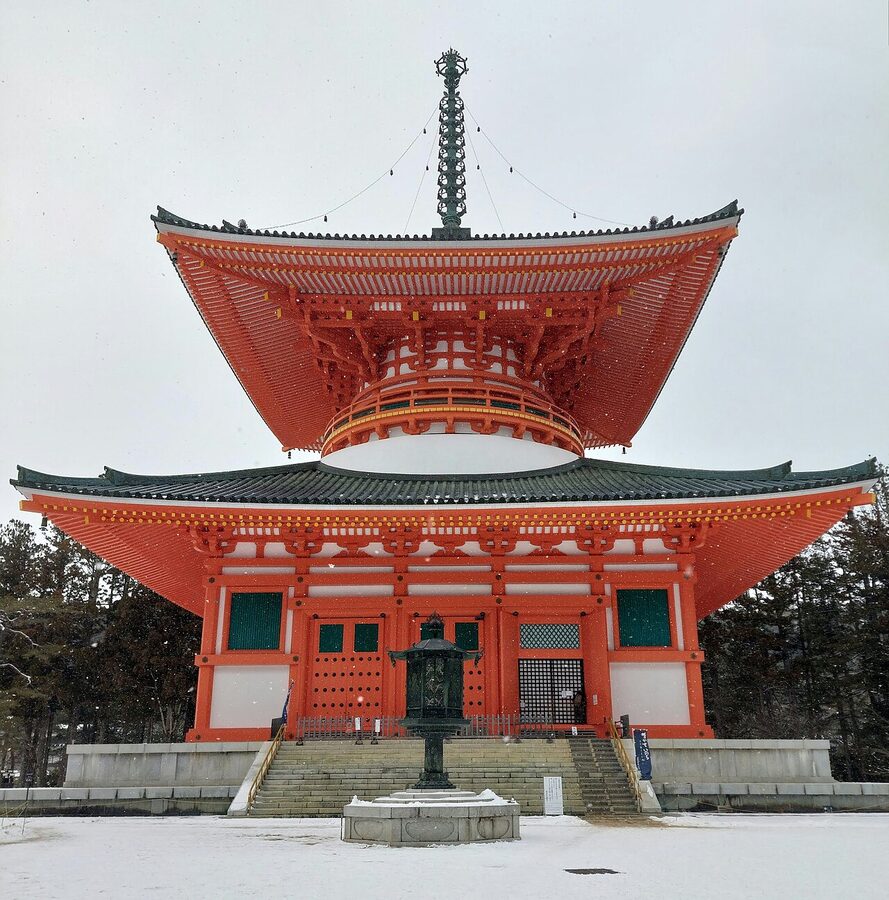
To Kūkai the shape of it was the point. Kōyasan is a basin about 800 metres up, surrounded by eight low summits, and he saw it as the eight-petalled lotus at the heart of the Womb Realm mandala. He named the monastery Kongōbu-ji, the Temple of the Diamond Peak. His disciples went up in 817; he climbed it himself in the eleventh month of 818, and in 819 he marked out its sacred boundary.
A temple history written down in the 10th century tells it differently. Searching for a site, Kūkai met a tall hunter in Yamato with two dogs, one black and one white, which led him to the foot of the mountain. There the local goddess, Niutsuhime, appeared and gave him her land, and the hunter turned out to be a god too, Kariba Myōjin. Scholars read the story as a negotiation: an imported religion asking the mountain’s own gods for permission to move in.
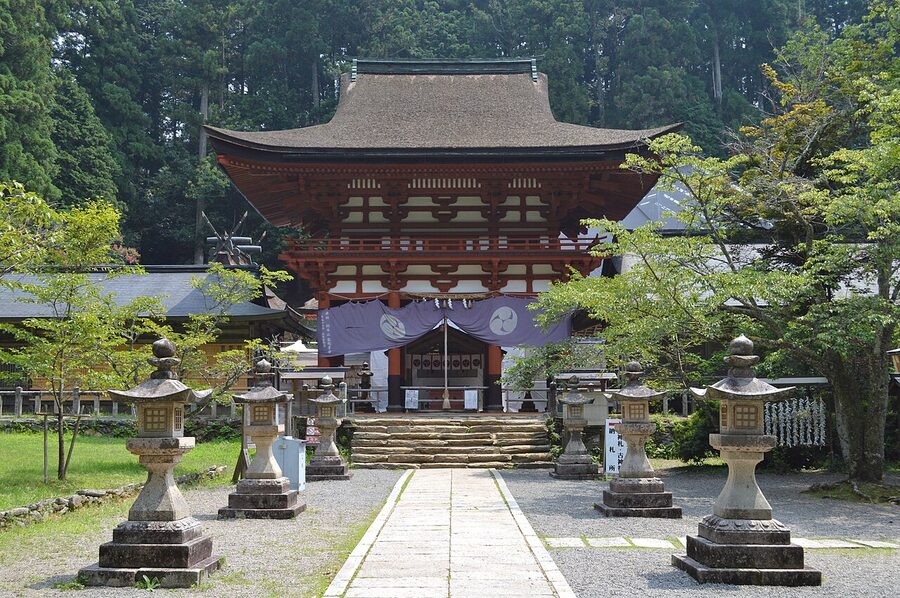
The mountain’s rules lasted until the Meiji era. No meat or fish, no women, no musical instruments played for pleasure, and no chickens or cats. Dogs were allowed, because dogs had shown Kūkai the way. A story told on the mountain has Hideyoshi staging a Noh play there with drums and flutes, at which a cloudless sky turned black, thunder shook the peaks, and the most powerful man in Japan rode down the mountain alone.
Women were formally allowed up in 1872, though Kongōbu-ji did not lift the last of its boundaries until 1906. Kūkai wanted his monastery built without state money and spent much of the rest of his life writing begging letters for it. When he died only a few buildings were finished.
Engineer, schoolmaster, rainmaker
Kūkai was not given much time for meditation. In 821 the court sent him home to Sanuki on an engineering job. Mannō-ike, a reservoir south of Zentsūji first built in the early 700s, fed the rice fields of a plain that gets very little rain, and in 818 a flood had burst its dam.
The government’s engineer, Michi no Hamatsugu, could not raise the labour to rebuild it, and local officials begged the court for Kūkai, a Sanuki man whom people would turn out for. He was appointed commissioner, and the dam was finished in about three months. Reference works disagree on whether he started in the fifth month or the ninth.
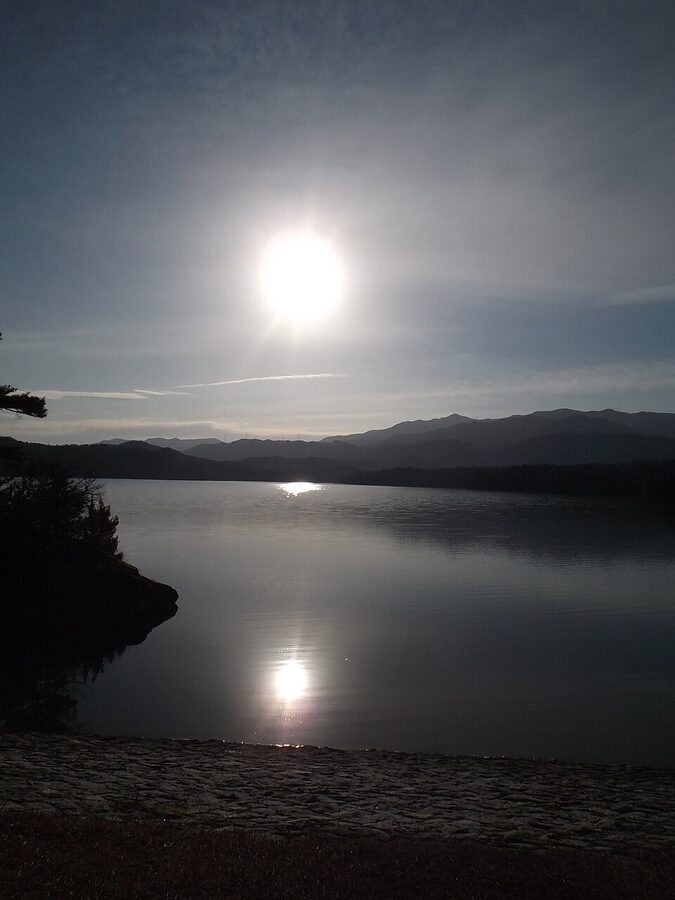
Japanese accounts credit him with an embankment curved against the water, the arch shape engineers still use, and say he kept a fire ritual burning on a rock above the site, still called Gomadan-iwa. The curve is hard to prove after so many rebuildings; the three months and the official title are in the record. The Konjaku monogatari, compiled around 1120, adds that the dragon king of the pond was once snatched by a tengu and shut up in a mountain cave, which is the kind of thing that happens near esoteric monks.
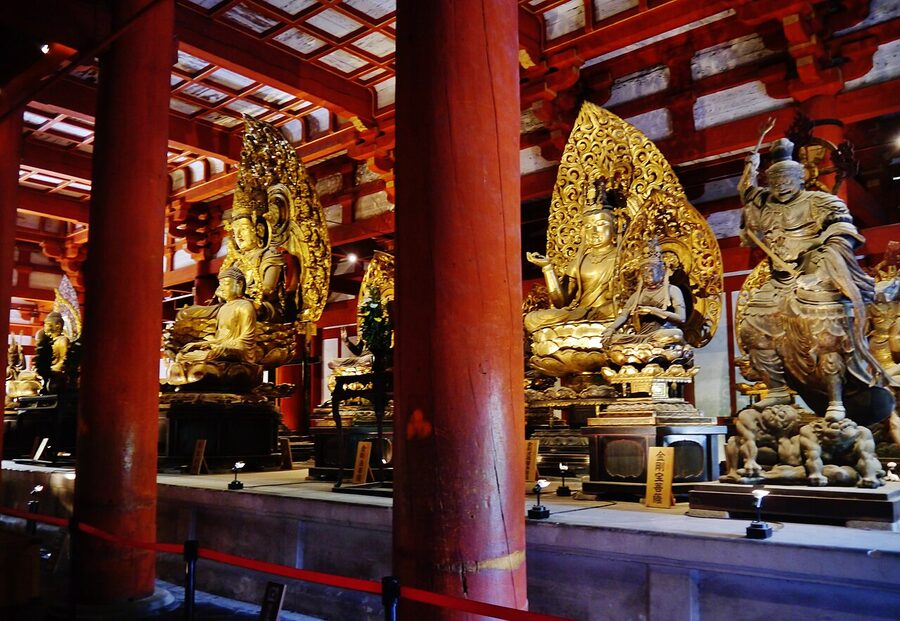
In the first month of 823, Saga gave him Tō-ji (東寺), the East Temple, one of the two official temples beside the Rashōmon gate at the southern entrance of the capital, still unfinished nearly thirty years after the move to Heian. Kūkai began a lecture hall in 825 and a great pagoda in 826. The new emperor, Junna, confirmed his school as the Shingon-shū, the Mantra School, with fifty monks of its own at Tō-ji. No temple in Japan had been given to a single school before.
The pagoda caused trouble. Its timber was cut from the hill at Inari, and early in 827, the official histories record, Junna fell ill and the diviners blamed the god of the hill. The court gave the god a rank to placate him. From this grew the Shingon tradition that Inari became Tō-ji’s guardian, which is why the portable shrines of Fushimi Inari still stop at Tō-ji every May.
In 828 he opened something stranger. The Shugei Shuchi-in (綜芸種智院), the School of Arts and Sciences, was set up in a house near Tō-ji given by the minister Fujiwara no Mimori. Higher education was then for the sons of officials and local gentry. Kūkai’s school took anyone, taught Buddhism alongside Confucianism and Taoism, and fed its students and teachers, because the poor could not otherwise afford to attend.
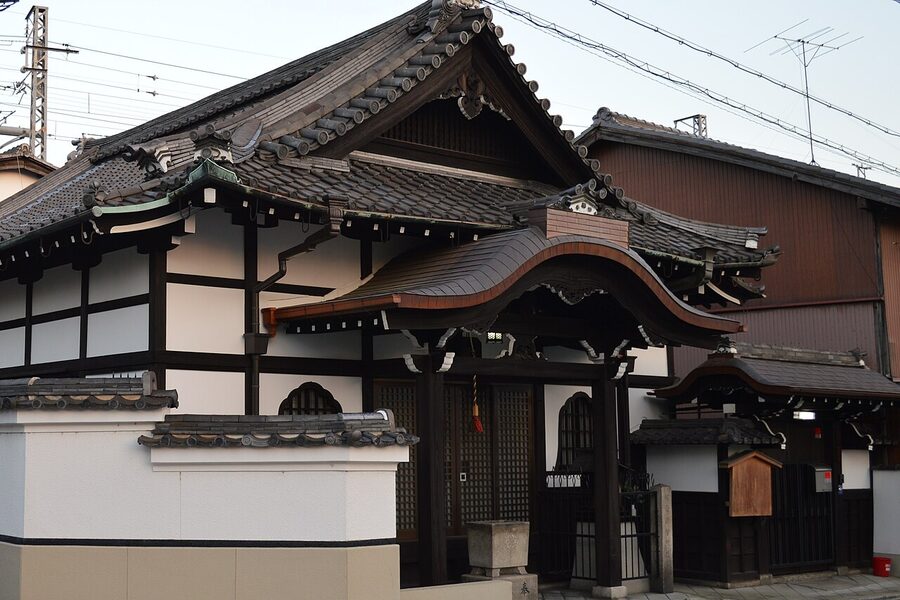
His charter admits the risk plainly: “the rise and fall of things depends on people”. It closed around 845, ten years after his death, when his disciples sold the property and bought rice land in Tanba to fund Tō-ji. Shuchiin University in Kyoto borrowed the name. As for rainmaking, in 824 he performed a rain ritual at Shinsen-en, the imperial garden pond, which later legend turned into a magical contest with a rival monk, won, of course, by summoning a dragon from India.
The last three months
In 831 he fell ill and tried to resign his post in the state’s office of monks; the emperor would not let him. In the eighth month of 832 he held the first lantern-and-flower service on Kōyasan and wrote the line Shingon monks still quote: “When the void is exhausted, when living beings are exhausted, when nirvana is exhausted, then my vow too will be exhausted.” That autumn he withdrew to the mountain and stopped eating grain.
The final months were frantic. In the twelfth month of 834 he won permission to perform an esoteric rite for the emperor’s health in the palace every New Year, and he performed it from the 8th to the 14th day of the first month of 835; it is still performed every January, now at Tō-ji. On the 22nd day of the first month the court allowed Shingon three new ordinations a year at Kōyasan. On the 30th day of the second month Kongōbu-ji became an officially recognised temple.
On the 15th day of the third month he gave his disciples his last instructions. He died on the 21st day of the third month of 835, around four in the morning, aged sixty-two by Japanese count. English reference works give the date as 22 April 835 by the Western calendar.
Hair grown a little longer
Did he die, though? The earliest records seem to think so. A biography attributed to his disciple Shinzai says he died of illness, and the Shoku nihon kōki, the official history of the reign compiled in 869, includes a message from the retired emperor Junna that mentions his cremation. A letter his senior disciple Jitsue sent to Qinglong-si in China can also be read as describing one.
The first surviving text to say that Kūkai did not die but entered eternal meditation, nyūjō (入定), is a temple history of Kongōbu-ji dated 968, more than a century and a quarter later. By then the mountain was in trouble. It had been through a bitter quarrel with Tō-ji over the books Kūkai brought from China, its monks had abandoned it for twenty years, and it badly needed a reason for anyone to climb it.
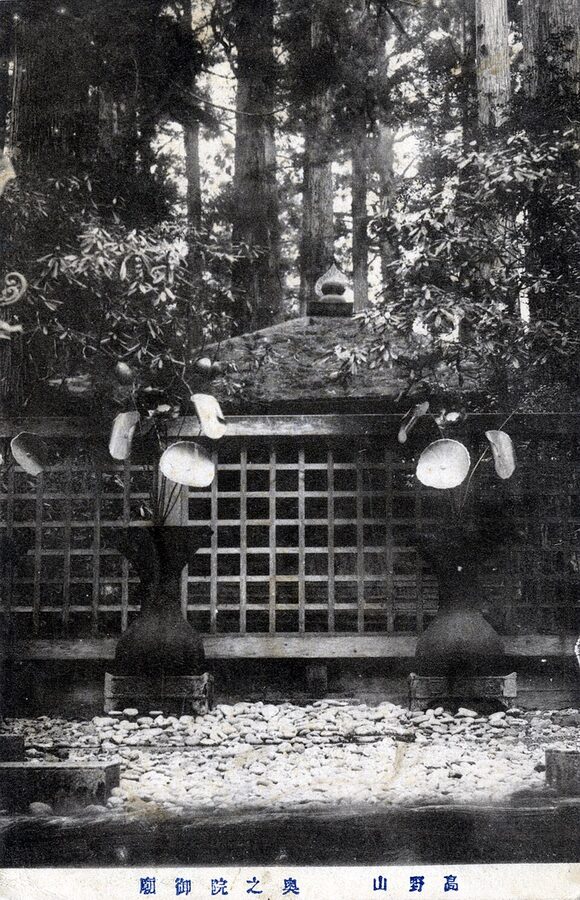
The reason came from Kangen, abbot of Tō-ji. On the 27th day of the tenth month of 921, at his request, Emperor Daigo granted Kūkai the title Kōbō Daishi (弘法大師), “Great Teacher Who Spread the Dharma”, with a new robe of cypress-bark brown; the first title proposed had been Hongaku Daishi. Kangen took the robe up the mountain, and later Shingon tradition tells what happened next. He opened the tomb and found Kūkai sitting in meditation, his complexion unchanged and his hair grown a little longer.
Kangen shaved him and changed his robe. His disciple Shunnyū could see nothing, so Kangen guided his hand to Kūkai’s knee, and Shunnyū’s hand smelled of incense for the rest of his life.
The story worked. In 1023 Fujiwara no Michinaga, the most powerful man in Japan, climbed the mountain to pray at the tomb, and the retired emperors Shirakawa and Toba followed, the same men whose devotion to the Kumano Kodō shows how seriously late Heian rulers took a long walk to a holy place. People began sending ashes or a lock of a dead relative’s hair to be buried near the Daishi, so they would be close by when the future Buddha came and Kūkai rose to greet him. The first record of it is from 1108, with hair of the late Emperor Horikawa.
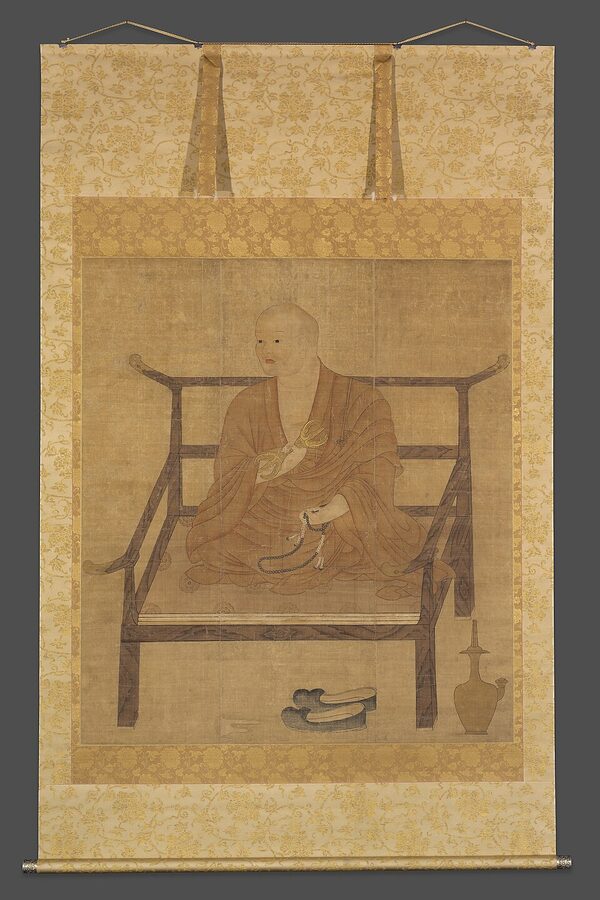
The people who carried the cult across the country were the Kōya hijiri, wandering holy men who preached, sold charms and medicine, raised money and collected bones. The scholar monks thought them vulgar, but it was they, Japanese historians agree, who took the Daishi to every village and left behind most of the legends below. Their reach was a kind of power: in 1581, when Oda Nobunaga fell out with the mountain, he is said to have rounded up and killed 1,383 of them.
Five thousand legends
Japanese folklorists count more than 5,000 local legends about Kōbō Daishi, in every prefecture except Hokkaido, most of them in places he never went. The commonest is the Kōbō shimizu. A thirsty monk asks for water; the old woman walks a long way to fetch it; the monk strikes the ground with his staff, and a spring wells up. There are well over a thousand of them, and a mean-hearted version in which the woman refuses and her well runs dry.
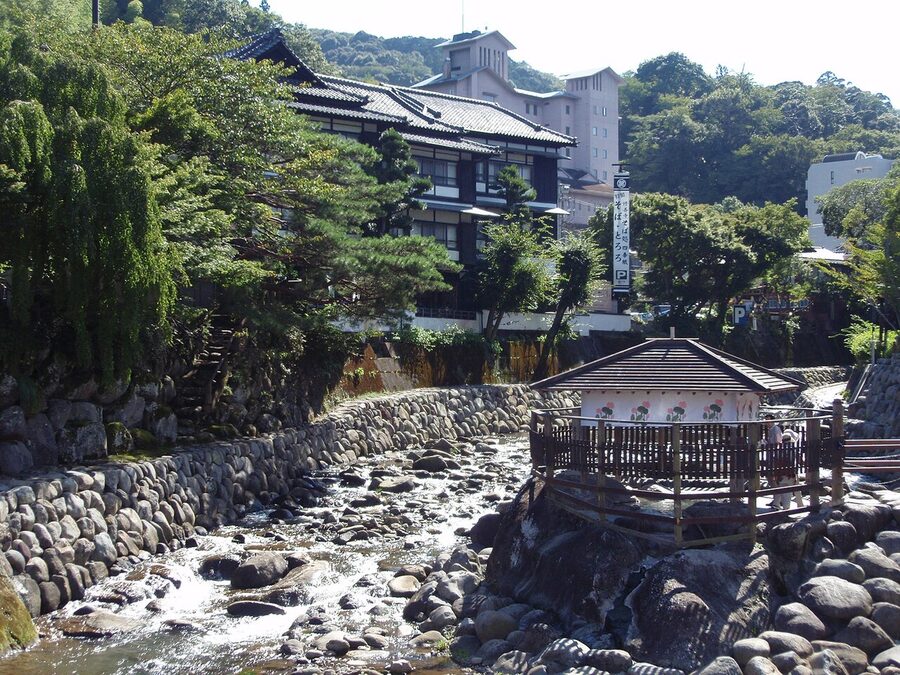
Hot springs, footprints in rock, pines grown from his staff, a fish found in only one river in Kyushu: the list goes on. Shikoku, a story goes, has no foxes because Kūkai banished them until an iron bridge crossed the sea. In 1988 the steel Seto Ōhashi opened to the mainland, and some people on the island now say the kitsune may be on their way back.
The folklorist Yanagita Kunio suspected that an older visiting winter god, the “great child”, written with characters that can also be read daishi, had simply been renamed. The hijiri, who travelled everywhere in Kūkai’s name, did the rest.
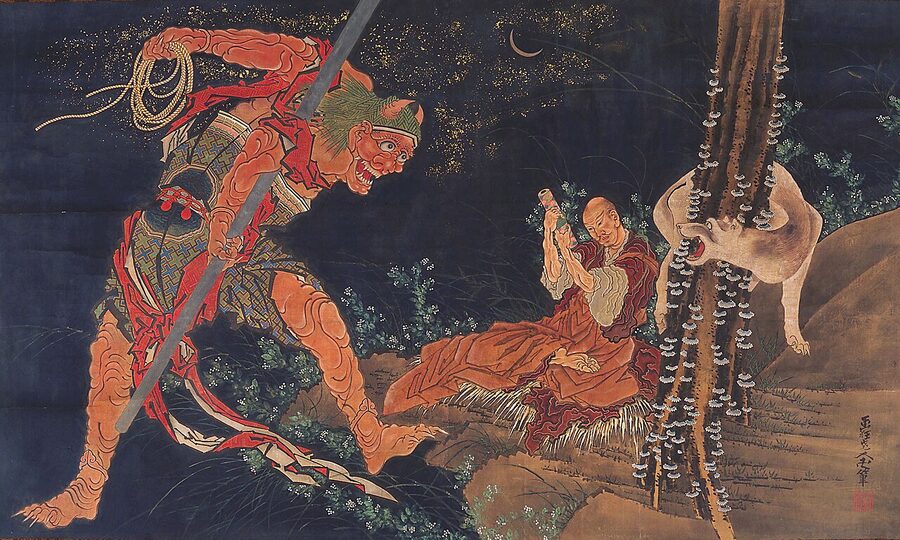
Some legends were made for him on purpose. A later Shingon text claims he was the rebirth of Prince Shōtoku, the prince credited with planting Buddhism in Japan, and statues of the newborn Kūkai look very like statues of Shōtoku as a two-year-old. Mahāvairocana, the Great Sun Buddha, was identified with the sun goddess Amaterasu, and later Shingon monks read the inner and outer shrines at Ise as the two mandalas.
The alphabet he did not write
The most persistent claim of all is that Kūkai invented kana, the Japanese syllabary, and wrote the Iroha, the poem that uses each of the 47 syllables exactly once and served as the Japanese alphabet song for nine hundred years. You will still find it in English guidebooks. Japanese scholars have known for more than a century that it is not true.
Kana grew gradually out of Chinese characters used for their sound; nobody invented it. The Iroha first appears in a text of 1079, two and a half centuries after Kūkai died, and is missing from a book of 970 that lists the earlier alphabet poems. It also uses a single “e” sound where the Japanese of Kūkai’s day still distinguished two.
The Meiji linguist Ōya Tōru laid out the case. The modern view is that an anonymous Shingon scholar monk wrote the poem, and it was credited to the most famous Shingon monk anyone could name.
“Even Kōbō slips with the brush”
His calligraphy was so admired that it became two proverbs, which contradict each other. Kōbō mo fude no ayamari, “even Kōbō slips with the brush”, means even experts make mistakes. Saga, the story goes, asked him to write the name board for the Ōtenmon, a palace gate, and when it went up everyone could see he had left the top dot off the first character. Rather than take it down, he threw his brush at the board, and the dot landed exactly where it should be.
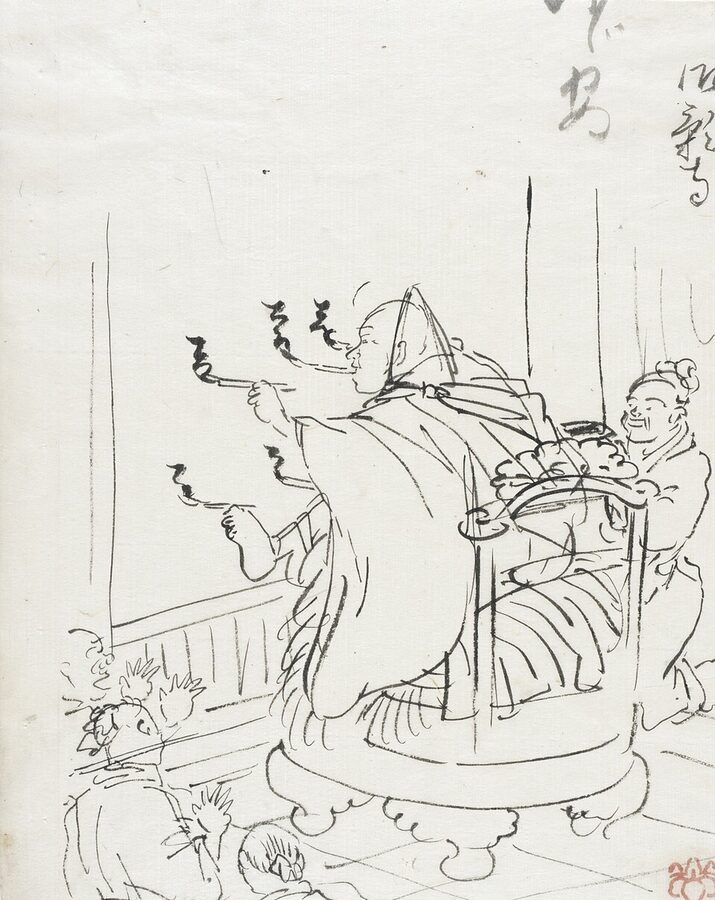
The other proverb, Kōbō fude wo erabazu, “Kōbō does not choose his brush”, means a real master can work with any tool. It is awkward, then, that in a letter in his collected writings Kūkai complains he could not write properly because the brush was no good. A third phrase is less flattering still: goma no hai, “ash from the fire ritual”, once meant swindlers who sold travellers ash supposedly from Kōbō Daishi’s own fires.
Dōgyō ninin: how the 88 temples formed
The legend that counts most for most Japanese is the one you can walk. The Shikoku henro (四国遍路) is a circuit of 88 temples round the island where Kūkai was born, roughly 1,100 to 1,400 kilometres depending on the route, and about forty days on foot. Every pilgrim walks dōgyō ninin, “two travelling together”, with Kūkai as the invisible companion, and the phrase is written on their hats.
The temples will tell you he founded the circuit in 815, at forty-two, the unluckiest age for a man. Japanese historians are blunt that this is tradition, not history. What is real is older and looser: in the late Heian period the Konjaku monogatari and the song collection Ryōjin hishō describe monks doing hechi, ascetic wandering along the remote coasts of Shikoku, exactly as the young Kūkai had.
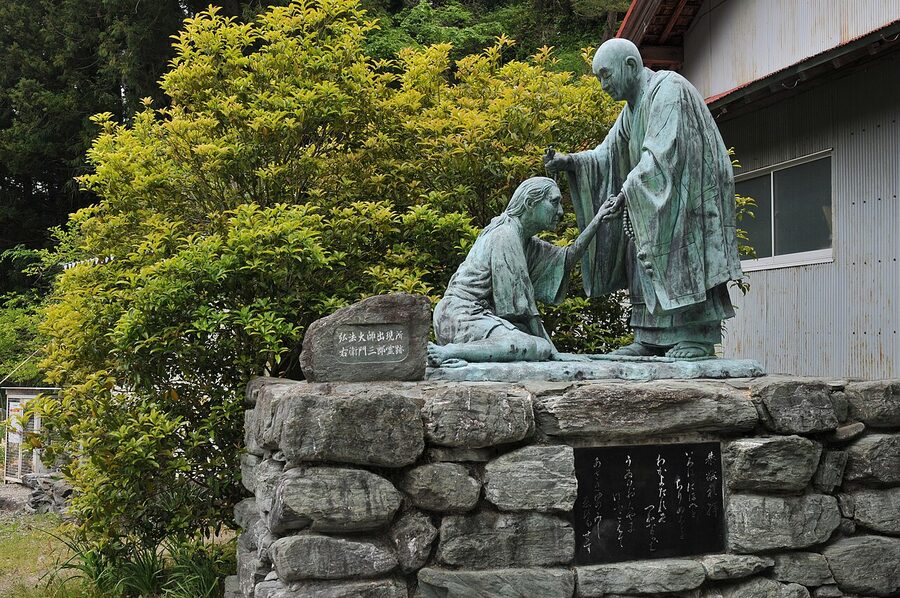
In the Kamakura era the monk Dōhan wrote of visiting Kūkai’s sites while in exile on Shikoku. A scrawl on a beam at Kokubun-ji, temple 80, dated 1513, already contains the words “Shikoku henro, companions just two”. The wars of the late 16th century burned more than thirty of the temples, but a monk called Chōzen who walked the island in 1653 found the circuit essentially as it is now.
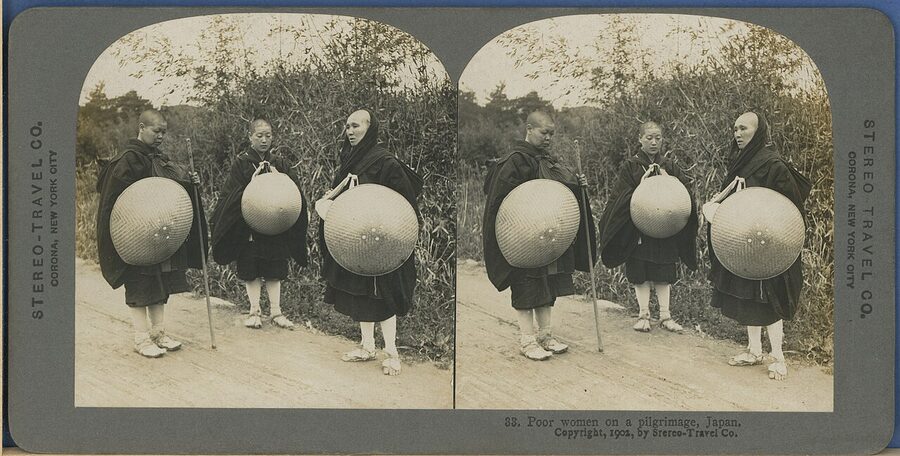
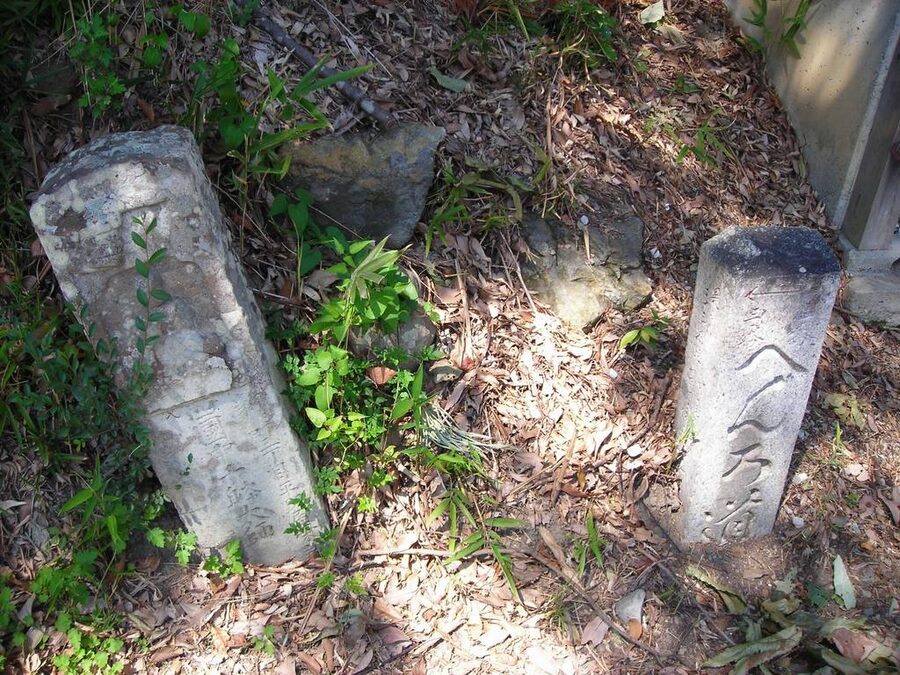
The pilgrimage as a mass movement belongs to the Edo era and to one book. In 1687 a monk named Shinnen published the Shikoku henro michishirube, a pocket guide that numbered the 88 temples and gave the distances between them, and stone guideposts went up along the way. Farmers, merchants, the sick hoping for a cure and outcasts with nowhere else to go began to walk. Many wore white, the colour of the dead, so that if they fell on the road they were already dressed for it.
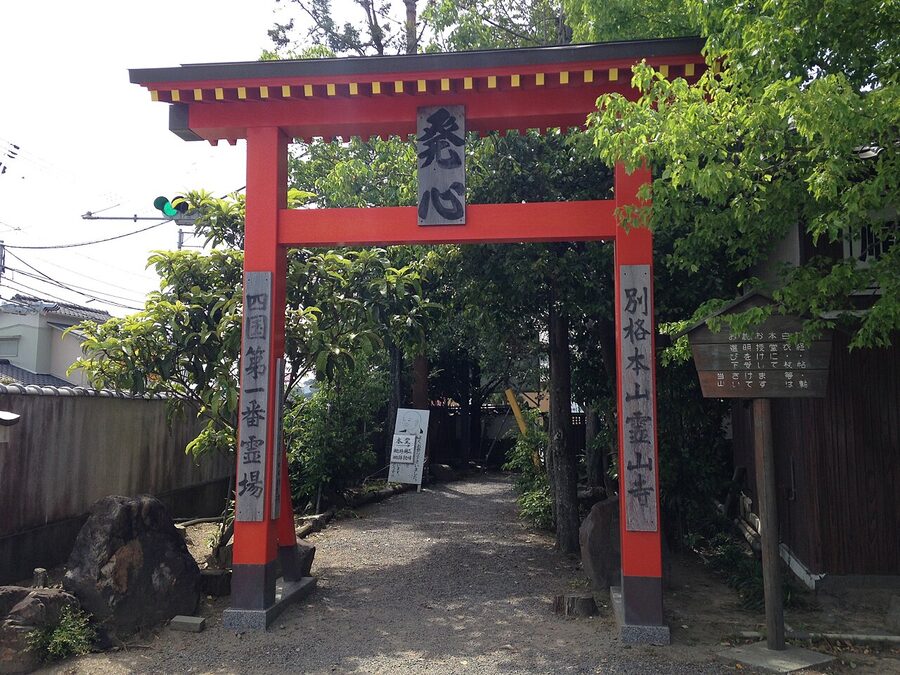
The Meiji separation of Shinto and Buddhism turned several of the temples into shrines, and the last disputed number, temple 30, was not settled until 1994. The pilgrimage now draws an estimated 100,000 to 300,000 people a year, most by car or bus, a few thousand on foot, and a rising number of foreigners. Local people still practise o-settai, giving food, drinks or a bed to pilgrims, because any pilgrim might be Kūkai.
Heretic, hero, film star
The cult has had its downs. Edo-period nativist scholars attacked Buddhism, and Kūkai with it, as a foreign pollution of Japan, and the anti-Buddhist frenzy of the early 1870s hit his temples hard. The 1,100th memorial in 1934 was turned into a national newspaper campaign that recast him as a creator of Japanese culture, in a decade looking for heroes, and the 1,150th in 1984 brought a feature film, Kūkai, with Kitaōji Kin’ya.
Shiba Ryōtarō’s 1975 novel Kūkai no fūkei is still the most widely read portrait of him and exists in English as Kukai the Universal. Chen Kaige’s 2017 film Legend of the Demon Cat sends a young Kūkai, played by Sometani Shōta, to solve a supernatural murder in Chang’an, which is a fair description of what the hagiographers did with him too. For the man himself in English, Yoshito Hakeda’s translations of his major works are still the place to start.
You do not need any of it to see why he lasted. He brought a religion across the sea in two years, dressed it in the best art and writing of his age, and made it useful, to emperors who wanted protection and farmers who wanted water. Japanese history has plenty of men who ruled the country; very few are still being fed.
Where to find Kūkai today
Three places call themselves the great sites of the Daishi: Tō-ji in Kyoto, Kōyasan, and Zentsū-ji where he was born. Between them they give you the scholar, the saint and the boy. Add the reservoir, the cave and a day on the pilgrimage path if you have time.
Tō-ji, Kyoto
Tō-ji is fifteen minutes’ walk southwest from the Hachijō exit of Kyoto Station, or ten minutes from Tōji Station on the Kintetsu line. The Kondō, the lecture hall and the dining hall still stand in a single line at their Heian sizes, though the buildings are later. The Kondō and lecture hall are open 8:00 to 17:00 (last entry 16:30) for ¥800, or ¥1,200 when the first floor of the pagoda is open too, usually in early January, from late March into May, and from late October to early December.
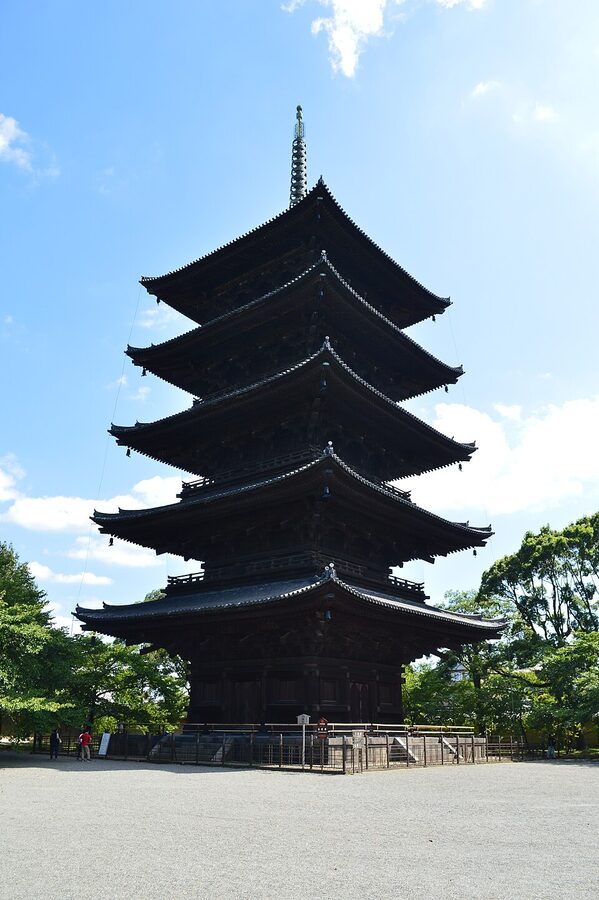
Go into the lecture hall for the statue mandala and stay longer than you planned; the Kondō is grander, but the lecture hall is Kūkai’s own idea. Then cross to the Mieidō in the western precinct, which is free. Every morning at 6:00 the monks offer the shōjingu meal here too, to a statue of Kūkai carved in 1233, and anyone may attend; it is far less crowded than Kōyasan.
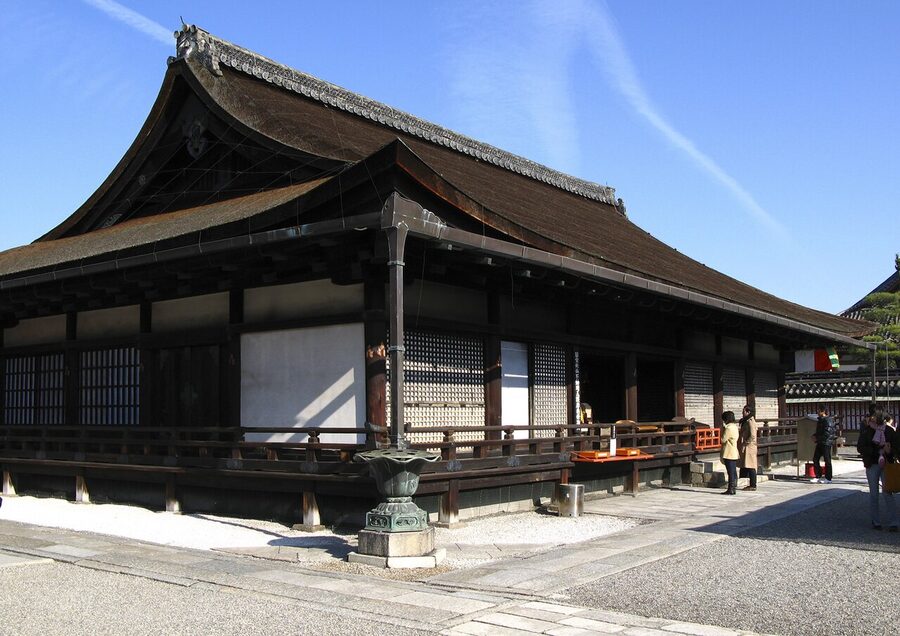
On the 21st of every month, the day of Kūkai’s death, Tō-ji holds the Kōbō-ichi, a market that grew up around the monthly memorial and now fills the grounds with nearly a thousand stalls. Kyoto’s own listings give the hours as roughly 8:00 to 15:00, though dealers are trading by first light and the best things have gone by nine. The memorial service in the Mieidō is at 10:00, and the December and January markets are the busiest of the year.
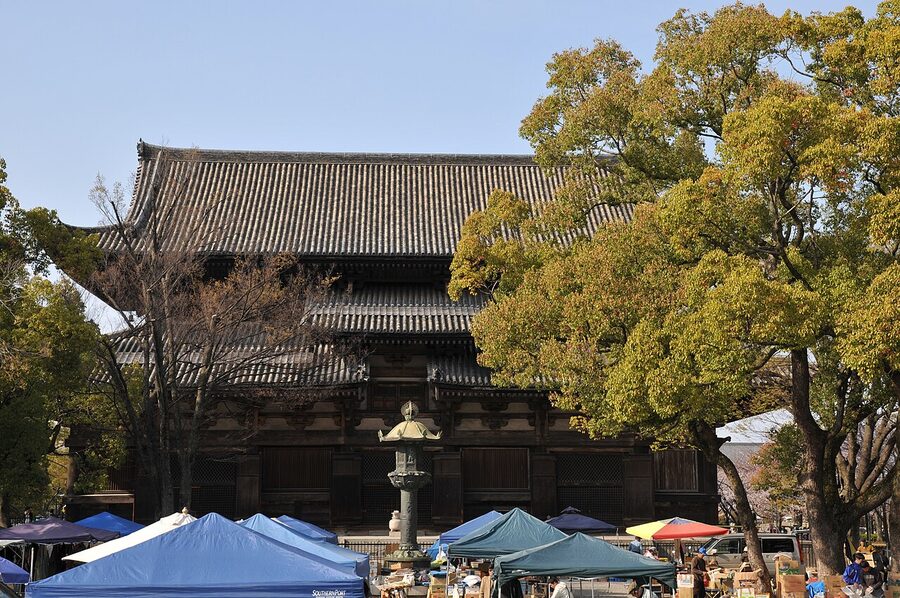
Tō-ji pairs well with Fushimi Inari, five minutes from Kyoto Station on the JR Nara Line. For Jingo-ji at Takao, allow half a day and a bus from Kyoto Station, and go in November for the maples if you can bear the crowds.
Kōyasan and the Okunoin
Kōyasan deserves a visit of its own and a night in a temple lodging, but for Kūkai the essential place is the Okunoin, at the eastern end of the town. Start at Ichi-no-hashi, the first bridge, and walk the two kilometres through the cemetery to the mausoleum. It is free and always open, and takes about forty minutes if you do not stop, which you will.
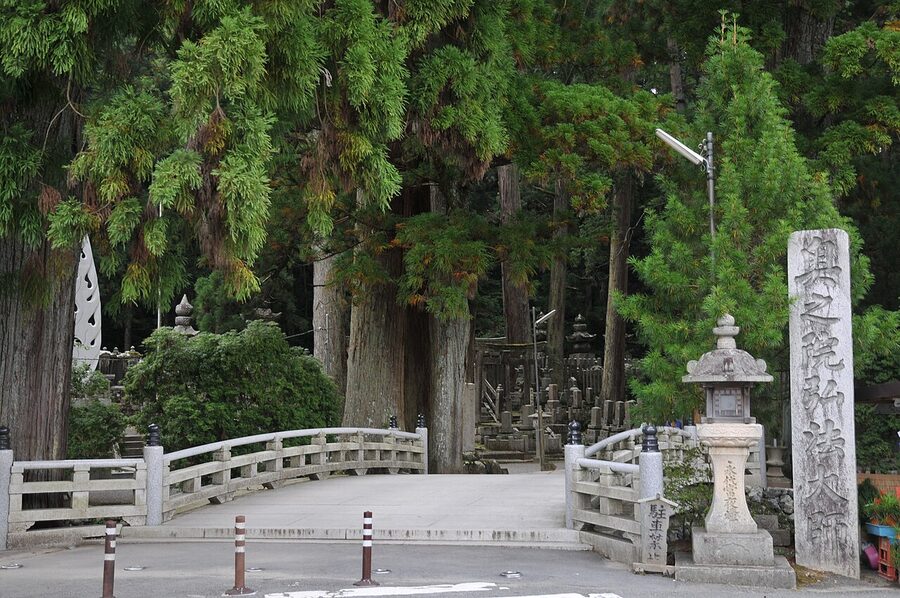
The path is lined, depending on who is counting, by 100,000 or 200,000 graves and memorials under centuries-old cedars, because everyone wanted to be near the Daishi when he wakes. There are memorials to Oda Nobunaga and to his murderer Akechi Mitsuhide, to Toyotomi Hideyoshi and the Uesugi, to the 47 rōnin, and a stone raised in 1599 by Shimazu Yoshihiro for the dead of both sides of the Imjin War. More than 40 percent of the daimyo families of the Edo period put up something here, alongside companies, war memorials and, my favourite, the termite-control trade’s memorial to the termites it has killed.
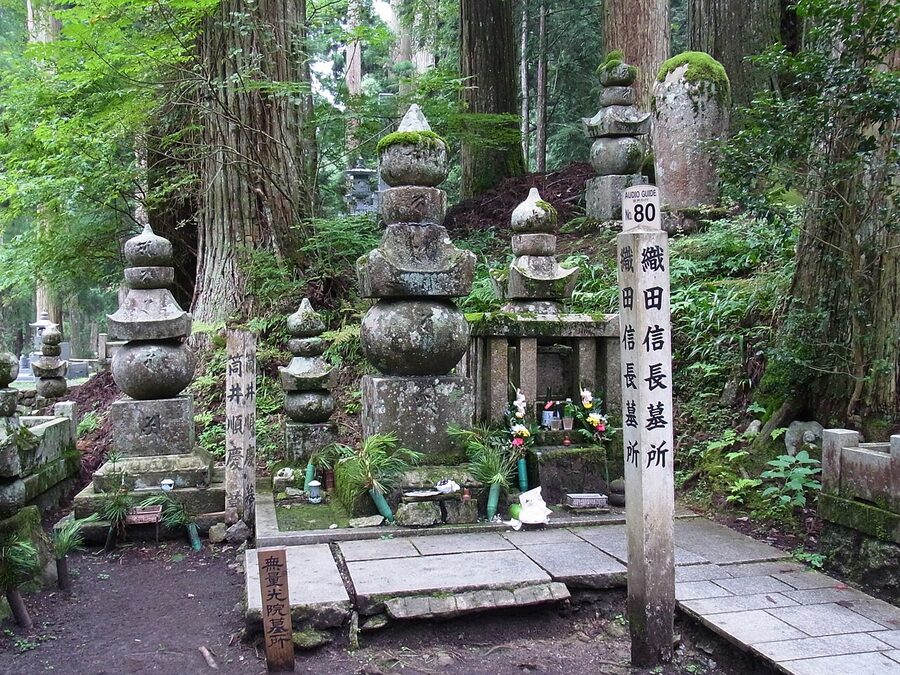
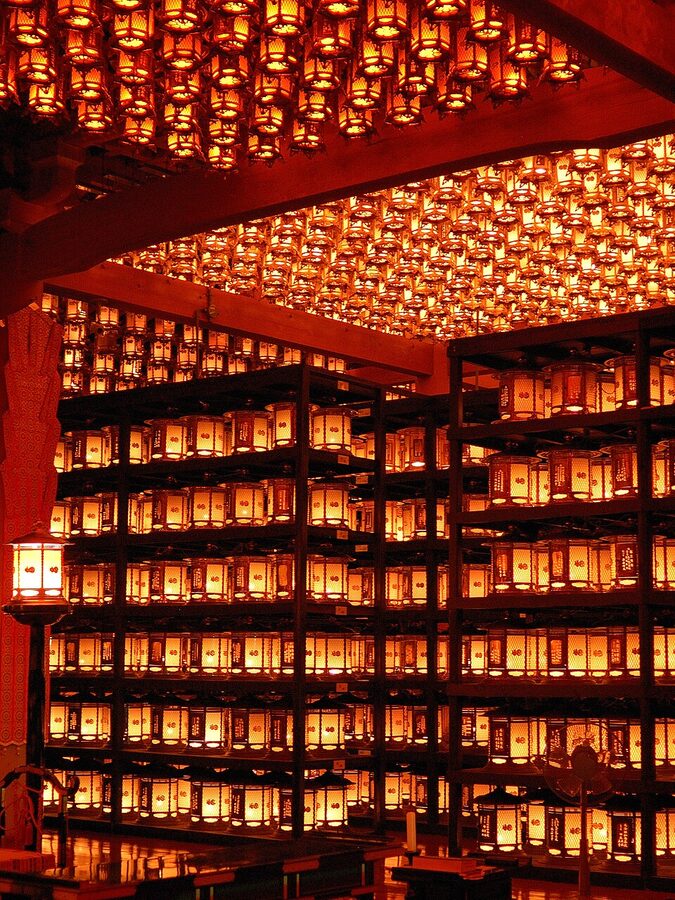
Near the end, the stone Jizō stands by the Gokusho, the kitchen where the meal is prepared; the procession leaves at 6:00 and 10:30, and the second is easier to catch. Beyond the Gobyō bridge, photography, food and loud voices are forbidden. The Tōrōdō, the lantern hall, is open 6:00 to 17:00, and below it is a basement chamber where you can stand as close to Kūkai as anyone is allowed.
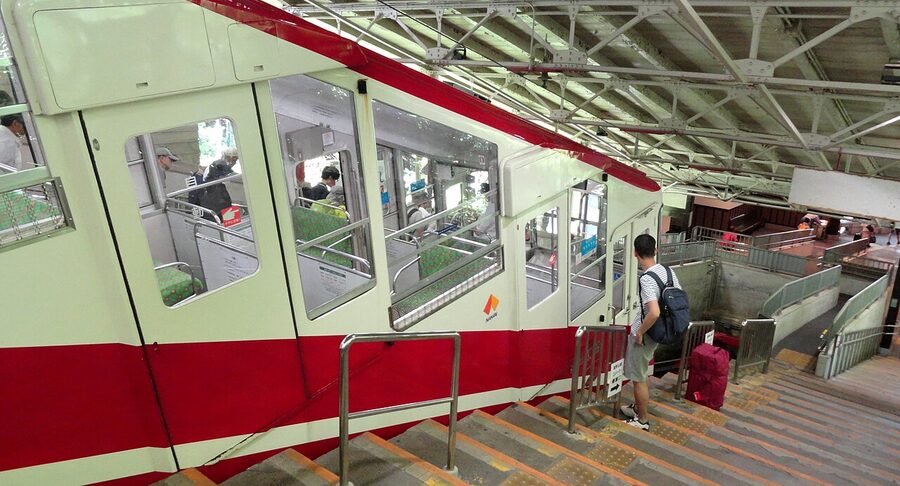
Take the Nankai Kōya Line from Namba in Osaka to Gokurakubashi, the cable car up the last steep stretch, then a bus from Kōyasan Station to Okunoin-mae or Ichi-no-hashi; allow about two hours from Namba. On the mountain, Kongōbu-ji is ¥1,000 and the Konpon Daitō and Kondō ¥500 each, open 8:30 to 17:00, or ¥2,500 for the five main paid sites together. On the night of 13 August around 100,000 candles are lit along the Okunoin path, and it is the best night of the year to be there.
Zentsū-ji, where he was born
Zentsū-ji (善通寺) in Kagawa is temple 75 of the Shikoku pilgrimage, about twenty minutes’ walk from JR Zentsūji Station, which is about an hour from Takamatsu or Okayama. The eastern precinct holds the main hall and the pagoda. The western precinct stands on the site the tradition gives for the Saeki family house, and its Mieidō is built over the spot where he was born.
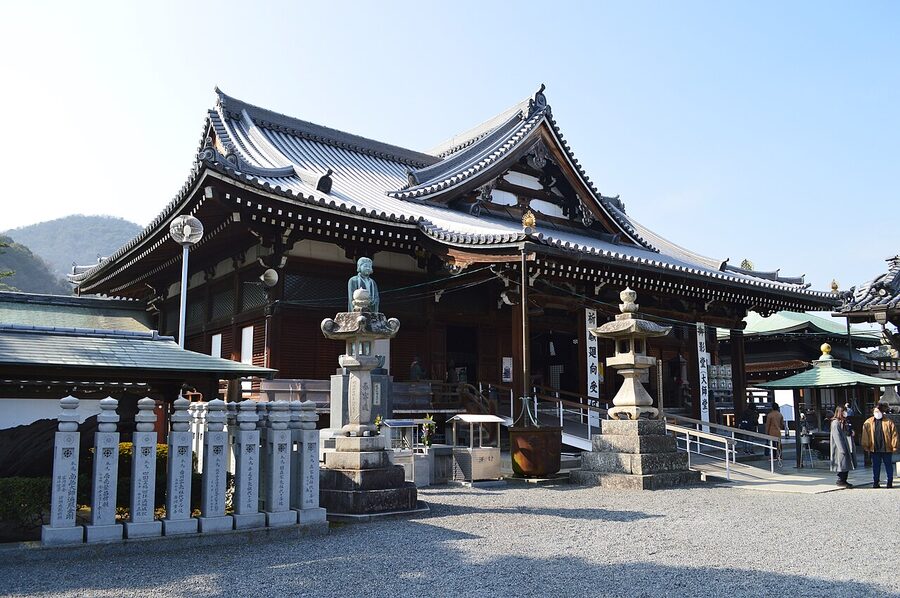
The grounds are free. For ¥700 you can visit the treasure hall and walk the kaidan meguri, a pitch-dark passage of about 100 metres under the Mieidō that you feel your way round with one hand on the wall. Both are open 8:00 to 17:00 (last entry 16:30). Look for the two camphor trees in the eastern precinct, said to be more than a thousand years old; the temple says one was already standing when Kūkai was a boy.
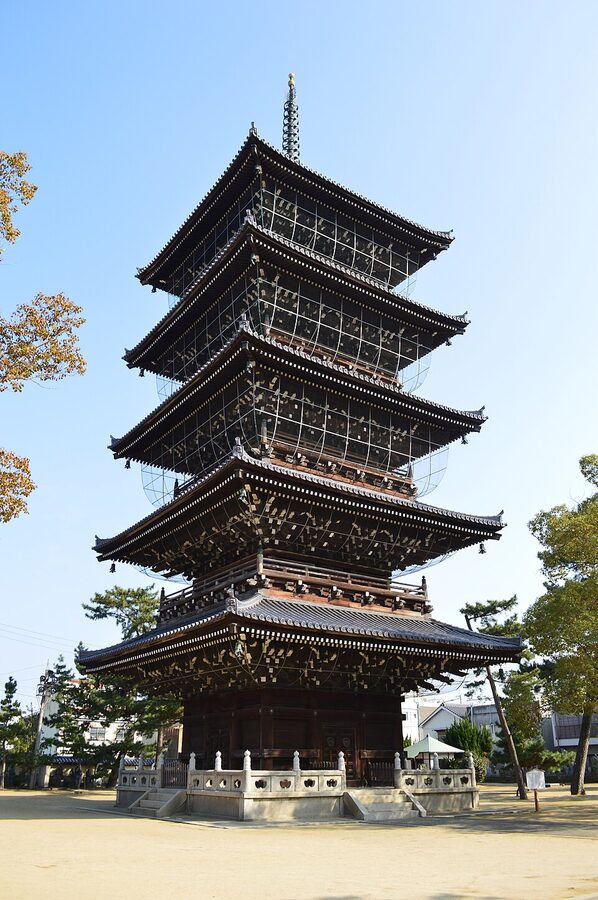
With a full day, add Marugame Castle, a short train ride away, and Mannō-ike.
Mannō-ike
The reservoir is about fifteen minutes by taxi from Kotohira. Come in mid-June if you can, when the sluice is opened for the yurunuki, the annual release of water for rice planting, and the whole Sanuki plain plants at once. On the bank are a shrine to the pond’s guardian gods and a temple, Kanno-ji, and out in the water the rock where Kūkai is said to have kept his fire burning; in recent dry summers the level has dropped far enough to leave it on land.
Cape Muroto and the cave
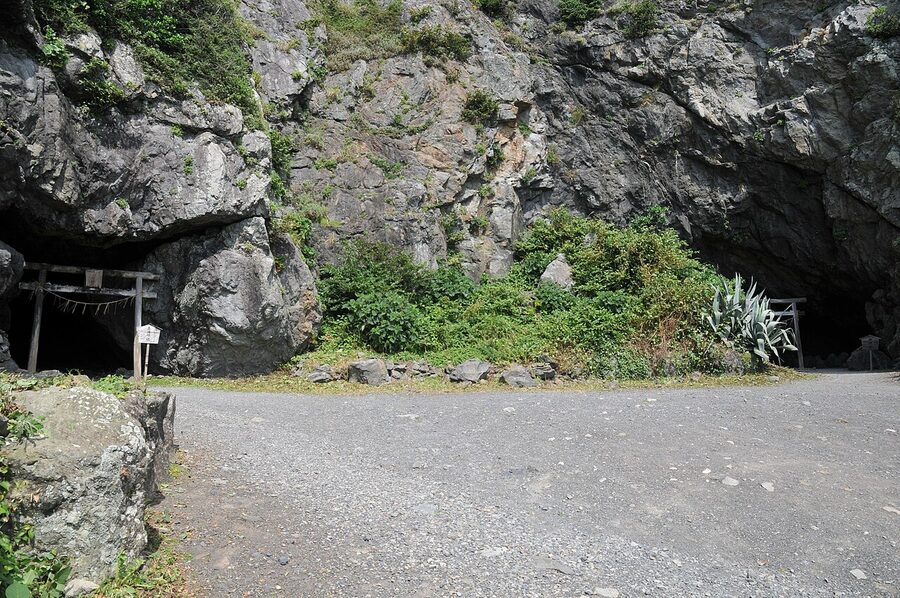
Mikurodo is on the coast road at the tip of Cape Muroto in Kōchi, by the Misaki Hotel bus stop, and a long way from anywhere else. It was closed for years because of falling rocks and reopened in 2019 with a steel roof over the entrance; you can go in between 8:00 and 17:00 wearing a helmet lent at the office in the car park. Temple 24, Hotsumisaki-ji, stands on the hill above.
A day on the henro
You do not have to walk 1,200 kilometres to feel the pilgrimage. Ryōzen-ji, temple 1, is ten minutes’ walk from JR Bandō Station near Naruto in Tokushima and sells everything you need: white vest, hat, staff and stamp book. Temples 2 to 5 lie within about eleven kilometres along mostly flat roads, which makes an easy day, and stamp offices are open 8:00 to 17:00.
Bow at each gate, and if someone hands you an orange or a can of coffee, accept it with thanks; refusing o-settai is the one real mistake you can make. Back on Kōyasan, or at Tō-ji at six in the morning, the monks will be carrying out his breakfast again. He promised to stay until the void runs out, and the kitchen at Okunoin is planning on it.