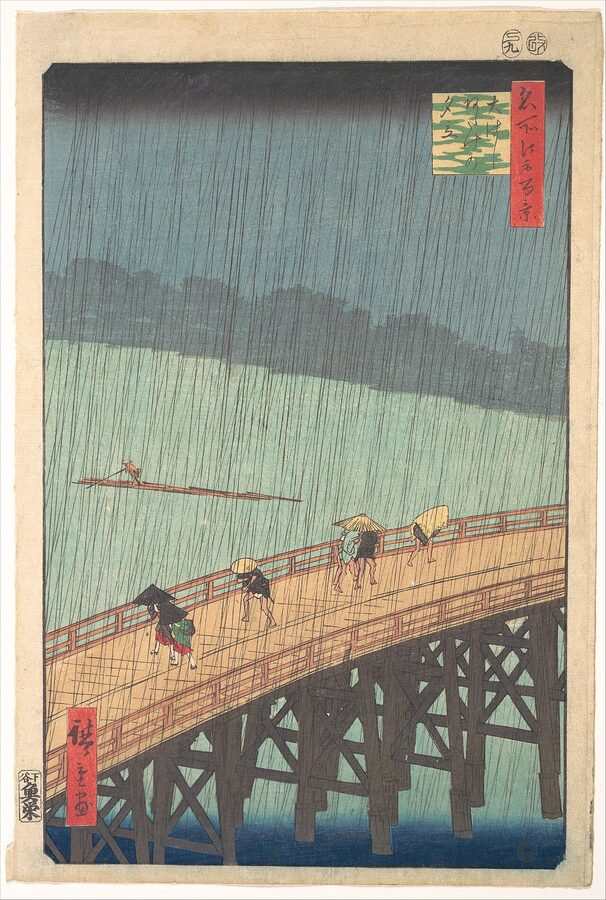
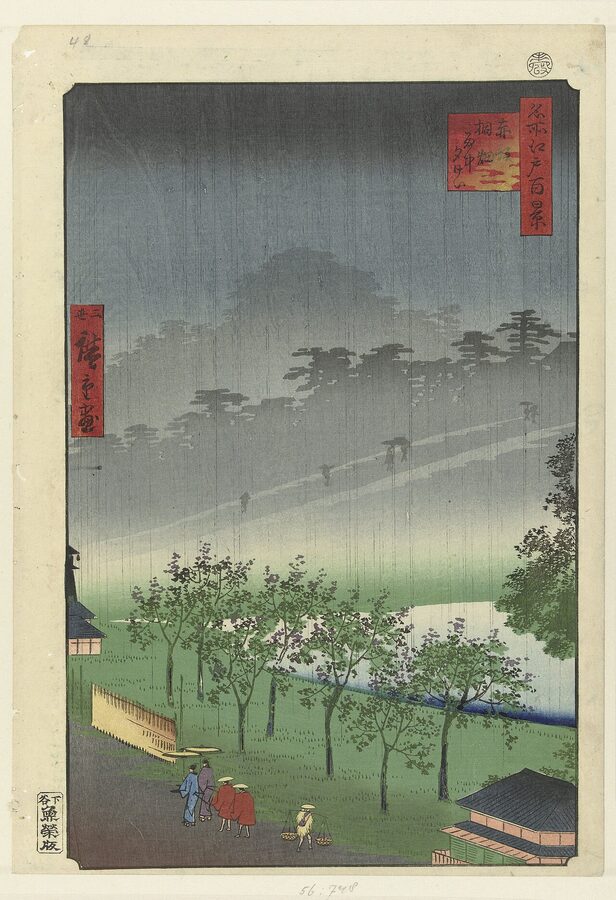
The rain in Hiroshige’s most famous print falls as hundreds of fine straight lines, cut so close together on the block that the paper between them is barely there. Under it, half a dozen people scurry across a wooden bridge over the Sumida River, bent double under straw mats and paper umbrellas, while a lone raftsman poles his logs through water the colour of a slate roof. The far bank has dissolved into a grey smudge. You can almost hear it.
Thirty years after it was printed, a Dutch painter in Paris who could not read a word of Japanese copied that print in oil, and filled the margins with characters copied from other prints. The man who designed it had spent more than twenty years as a hereditary officer in the shogun‘s fire brigade, and the journey that made him famous may never have happened. I find all of that more interesting than the usual line about the last great master of ukiyo-e, so that is the Hiroshige I want to follow here: the fireman, the doubtful traveller, the overworked jobbing artist, and the old man who drew Edo one more time before cholera, or something like it, took him.
In This Article
- A boy in the fire brigade
- Turned away at the door
- The road to Kyoto, or a book about it
- Hōeidō and a lucky break
- Rain, snow and night
- Other roads, a lake and some geese
- Kōfu, a curtain and a lost diary
- A hundred views of a damaged city
- The thing in front
- Van Gogh’s tracing paper
- Cholera, a will and two Hiroshiges
- The name goes on
- Hiroshige and Hokusai
- Where to see Hiroshige today
- Yui and the Satta Pass
- Kambara
- Kanaya and the Ōi River
- Seki, Kameyama and Shōno
- The Batō Hiroshige Museum, Tochigi
- The Nakasendō Hiroshige Museum, Ena
- The Ōta Memorial Museum, Tokyo
- The Edo-Tokyo Museum, Ryōgoku
- Edo views you can still find
- Tōgaku-ji, Adachi
- The rain at Ōhashi
A boy in the fire brigade
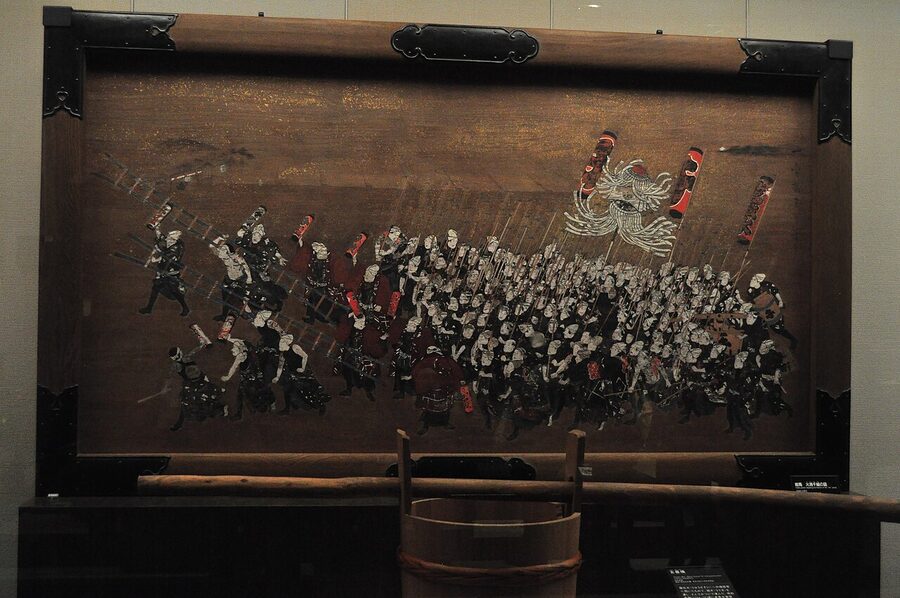
Edo burned constantly. Between 1601 and 1867 the city had 49 great fires and, by one count, 1,798 fires in all, and after the Meireki fire of 1657 killed something like 68,000 people and took the keep of Edo Castle with it, the Tokugawa shogunate built a standing fire service of its own. These were the jōbikeshi (定火消), the shogun’s own brigades, founded in the ninth month of 1658 and settled by 1704 at ten stations ringed around the castle. Each was commanded by a bannerman with six mounted yoriki and thirty dōshin, the lowest grade of samurai officer, under whom worked the hired firemen, the gaen, who slept in a row with their heads on a single long log so that one blow of a mallet on the end would wake them all.
One of the ten stations stood at Yayosu-gashi, on the moat bank below the castle, in what is now the Marunouchi district a short walk from Tokyo Station. Andō Gen’emon, a man born into the Tanaka family and adopted into the Andō, was a dōshin there, and in 1797 his wife gave him a son, Tokutarō. The boy grew up inside the compound, with its three-jō watchtower, its drum and its fire bell, and with a fellow officer in the same compound, Okajima Rinsai, who painted in the academic Kanō manner and is said to have given him his first lessons.
The family’s fortunes turned in a single year. In the second month of 1809 Tokutarō’s mother died, his father retired the same month, and the boy inherited the post at thirteen by the Japanese count, twelve by ours. His father died in the twelfth month. Sources disagree a little on the order of these events (English-language accounts usually have the father dying first and passing on the job from his deathbed), but the result is the same: by his teens Andō Tokutarō was a salaried fire officer with a household to run.
It was not, by most accounts, a demanding job. The jōbikeshi had been pulled back to the castle district by then, and the real firefighting in the town had passed to the townsmen’s companies.
The boy had time on his hands, and he spent it drawing. A handscroll of the Ryūkyū embassy’s procession through Edo, painted in 1807 and attributed to the ten-year-old Tokutarō (the age is by the Japanese count again), survives in the Ōta Memorial Museum in Tokyo. A Meiji biographer thought it did not look like a child’s work at all.
Turned away at the door
At about fifteen he went to the most fashionable studio in Edo, that of Utagawa Toyokuni, the great designer of actor prints for the kabuki theatres, and asked to be taken on. Toyokuni had too many pupils already and said no. A lending-library man who called at the house introduced him instead to Toyokuni’s quieter colleague, Utagawa Toyohiro, at Shiba, and in 1811 Toyohiro accepted him. The next year Toyohiro gave him an art name made from one character of his own and one of the boy’s: Hiroshige.
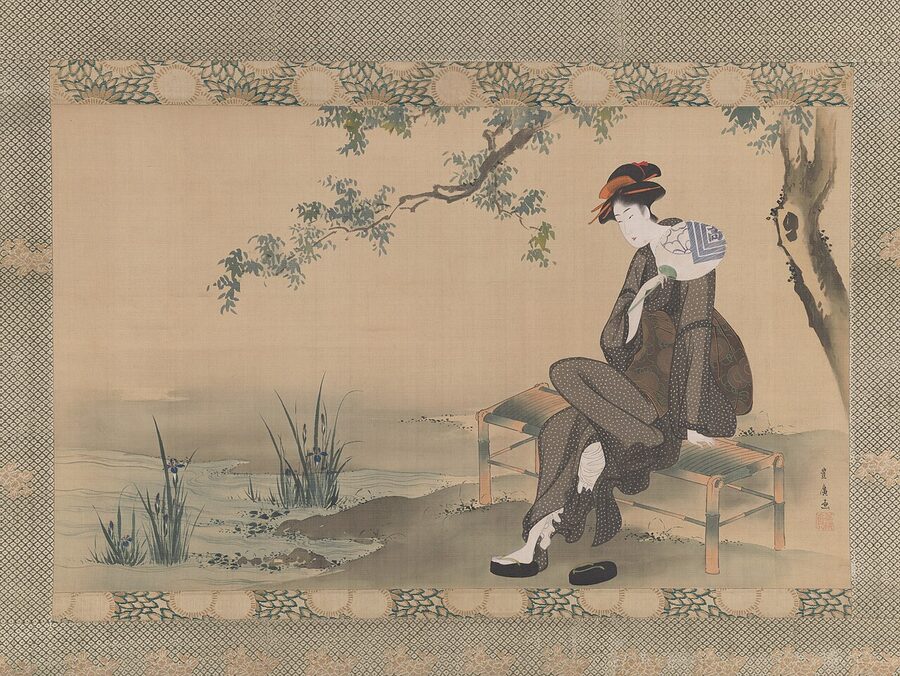
Nothing much happened for the next fifteen years, and I mean that kindly. Hiroshige’s first prints that can be dated with confidence are two actor prints of 1818, signed Ichiyūsai, and through the 1820s he produced beauties, warriors, toy prints and book illustrations in the house style of the Utagawa school, none of them memorable. In 1821 he married the daughter of another fire dōshin, Okabe Yazaemon. In 1823 he handed the family post to Nakajirō, the eight-year-old son of his adoptive grandfather, and stayed on as the boy’s guardian and deputy until Nakajirō came of age.
English-language accounts often say he passed the post to “his son”; Japanese sources are clear that it went back to the Andō heir, and that Hiroshige only finally gave it up in 1832, when Nakajirō turned seventeen. So for more than twenty years the man was, at least on paper, a fire officer who drew, rather than an artist who fought fires.
The change came at the end of the decade. Toyohiro died in the twelfth month of Bunsei 12, which some English accounts give as 1828 and which ran into January 1830 by the Western calendar, and around the same time Hiroshige began making landscapes and bird-and-flower prints under the new name Ichiyūsai with a different second character. The Famous Places in the Eastern Capital of about 1831 was his first landscape series of note.
The timing was not an accident. Katsushika Hokusai‘s Thirty-six Views of Mount Fuji, with the Great Wave among them, was coming out at the same moment and proving that a landscape could sell as well as an actor.
The road to Kyoto, or a book about it
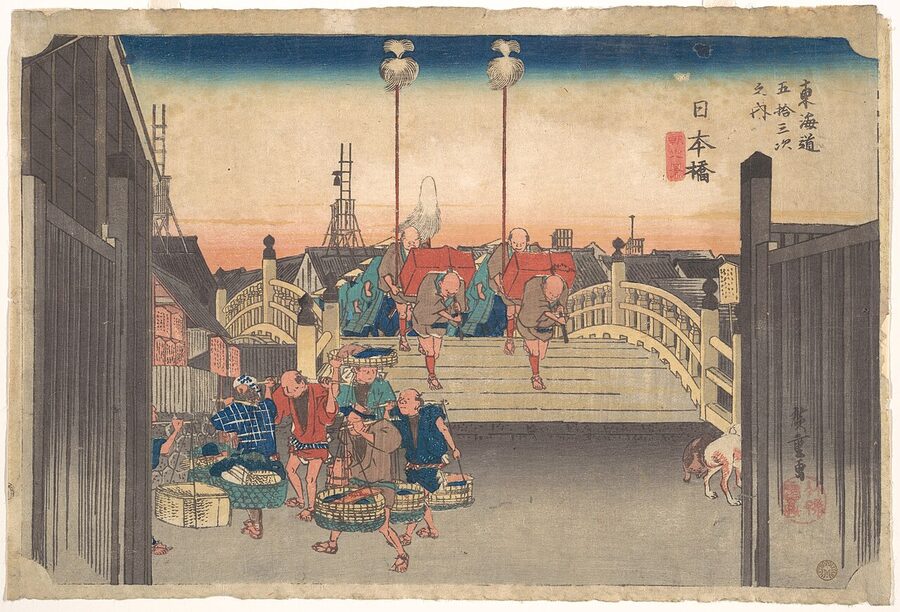
The story everyone tells goes like this. In the autumn of 1832 the shogunate sent its annual gift of horses to the emperor in Kyoto, the hassaku presentation tied to the first day of the eighth month, and Hiroshige, by virtue of his fire-officer rank, got himself attached to the party. He sketched all the way up the Tōkaidō and back, and the next year he began publishing what he had seen.
It is a good story. It was first set down in the Meiji period by the print historian Iijima Kyoshin, and most writers since have repeated it. The road itself was one of the five highways that Tokugawa Ieyasu began organising in 1601, the year after Sekigahara, and by Hiroshige’s day it was the busiest road in Japan.
Japanese scholars have been picking at it for a century. The mountaineer and print collector Kojima Usui asked in 1914 why the shogunate would have ordered a jobbing print designer, not an official painter, to record a court ceremony. Suzuki Jūzō pointed out that neither the Andō family record compiled in 1866 nor the standard biographical dictionary of print artists published in 1868 says a word about the trip. Nagata Seiji added that Hiroshige had handed over his fire post in the third month of 1832, which leaves the question of what official capacity he travelled in.
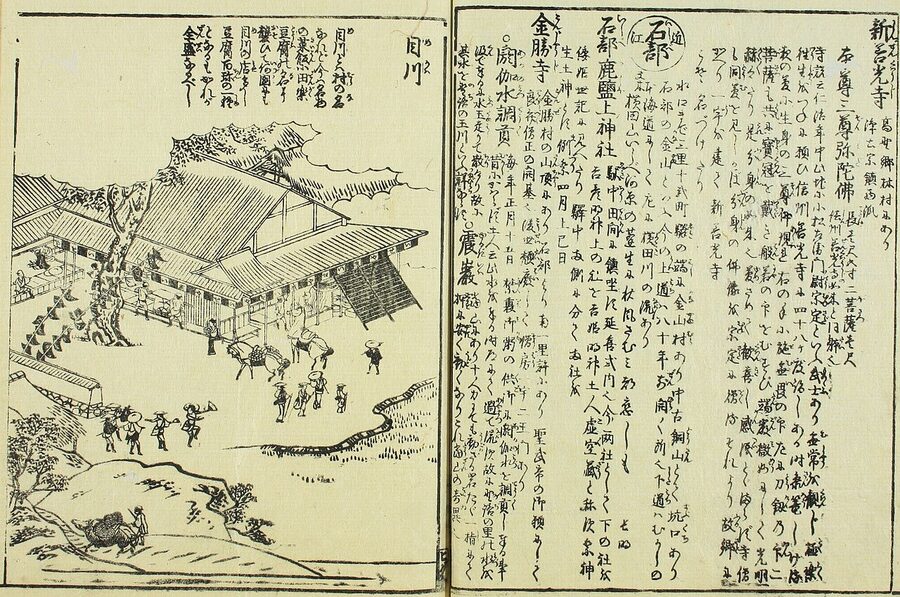
Then there are the pictures themselves. As the series moves west, more and more of them follow the illustrations in the Tōkaidō meisho zue, a guidebook published in 1797, and fewer show landscape a traveller would have seen for himself. The art historian Ōkubo Jun’ichi has charted the borrowings print by print. My own view, for what it is worth, is that Hiroshige probably did go up the road at some point in his life, and certainly went in 1837, when he travelled to Kyoto by the inland road and came home by the coast, but that the Hōeidō series was built at least as much in the studio as on the road.
Hōeidō and a lucky break
The publisher was as new to this as the artist. Takenouchi Magohachi, who traded as Hōeidō, was a pawnbroker’s son who set up as a print publisher in 1833, and nobody quite knows why an untested house took on a project of 55 large sheets. One theory has him and Hiroshige in the same comic-verse circle. The first prints came out jointly with the established firm of Senkakudō, but its owner died in 1833 and the shop burned the next year, and Hōeidō carried on alone.
The series runs from Nihonbashi in Edo to the Sanjō bridge in Kyoto, one print for each of the 53 post stations and one for each end. An album edition carries a preface dated to the first month of Tenpō 5, which is 1834, and most scholars take the sheets to have appeared between 1833 and 1834, although Suzuki Jūzō came to argue that the preface marks the start of publication rather than the end, and some reference works give 1834 to 1835.
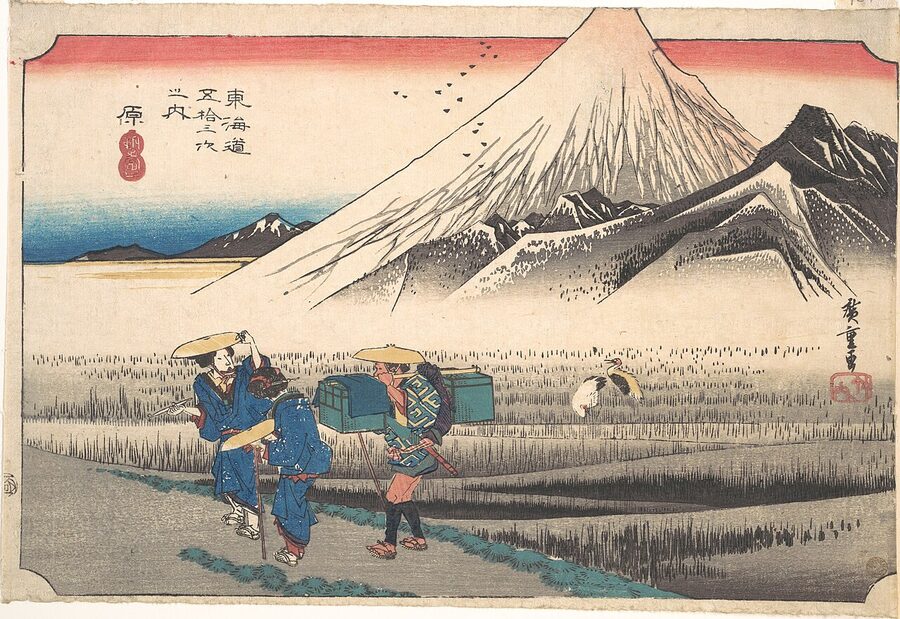
It sold. The print scholar Yoshida Eiji estimated that some designs were printed a hundred runs over, which means more than 20,000 sheets, against around 7,000 for its nearest rival, Kunisada’s actor Tōkaidō. Ōkubo notes that more than a hundred impressions of each Hōeidō design survive, many of them from blocks so worn the lines have broken down, which tells you how hard they were driven. A kabuki play on the Tōkaidō theme opened at the Ichimura theatre in the second month of 1835, and the print historian Ishii Kendō thought the play and the prints sold each other.
Why it sold is easier to see than to explain. Ordinary people in Edo were travelling more than ever, on pilgrimage to Ise or to the hot springs at Hakone, and Jippensha Ikku’s comic novel Tōkaidōchū hizakurige, the adventures of two hopeless Edo travellers, Yaji and Kita, had been a bestseller since 1802. Hiroshige gave people the road they had read about, and the road they wanted to walk. He was also careful to put them in it.
Each sheet was the work of at least four people: Hiroshige drew the design in ink, a carver pasted it face down on cherry wood and cut through it, more blocks were cut for each colour, and a printer laid the colours on by hand with a baren, grading them on the block for the skies. The publisher paid for all of it and owned the blocks. The craft is one of those I cover in Japan’s greatest crafts, and it is why a print can look so different from one impression to the next.
Rain, snow and night
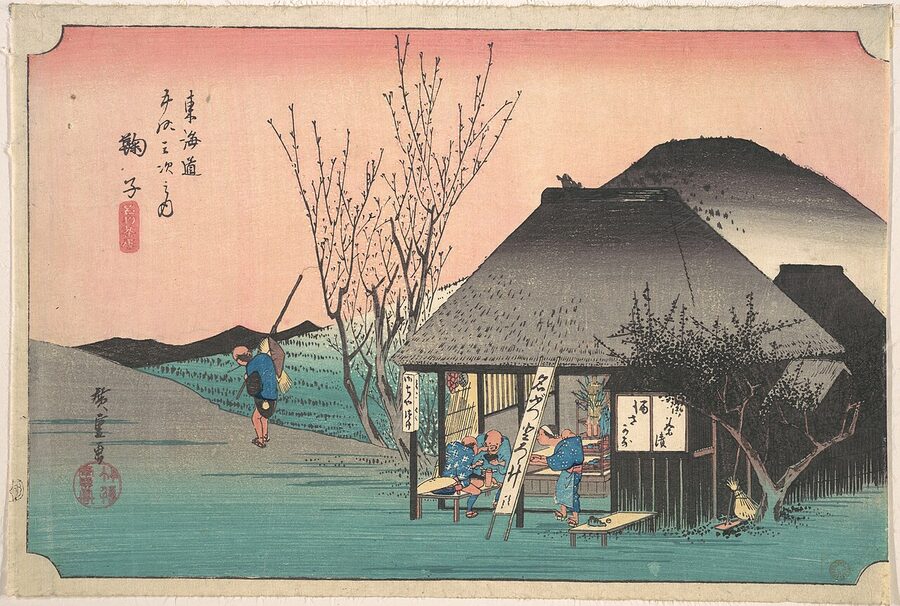
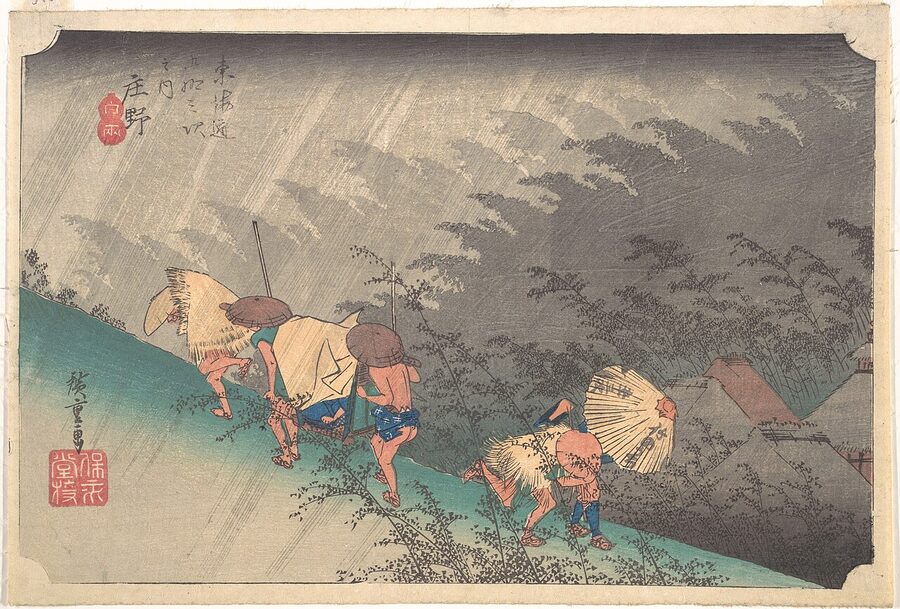
The prints people love are not the famous sights. The curator Kamiya Hiroshi picks out five as the best of the series: Mishima in mist, Kambara in snow, Shōno in a sudden shower, Kameyama after snow and Tsuchiyama in spring rain. None of them is a temple or a castle or a view of Fuji. What they have in common is weather and time of day, which is what nobody had put into a series of road prints before, and which Hokusai, for all his genius, mostly left out.
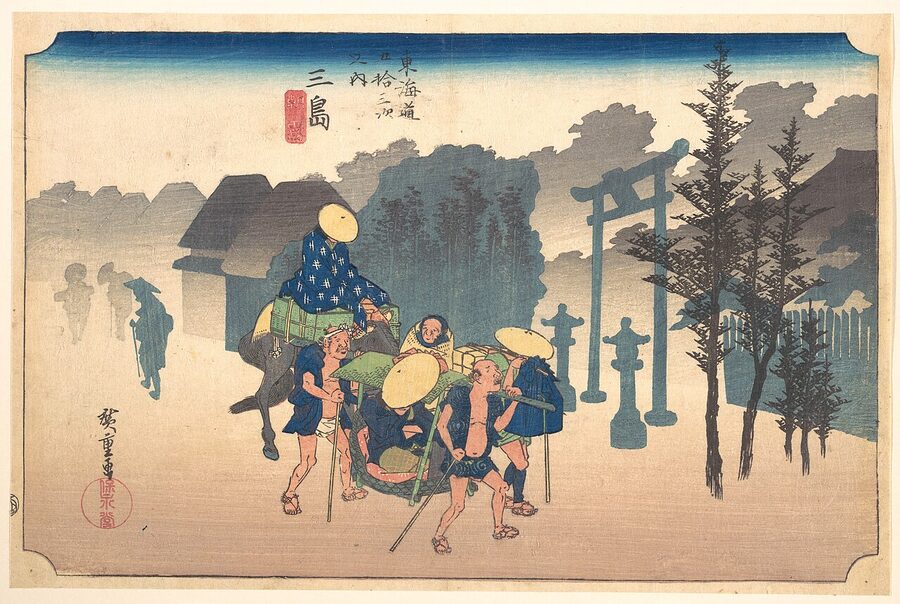
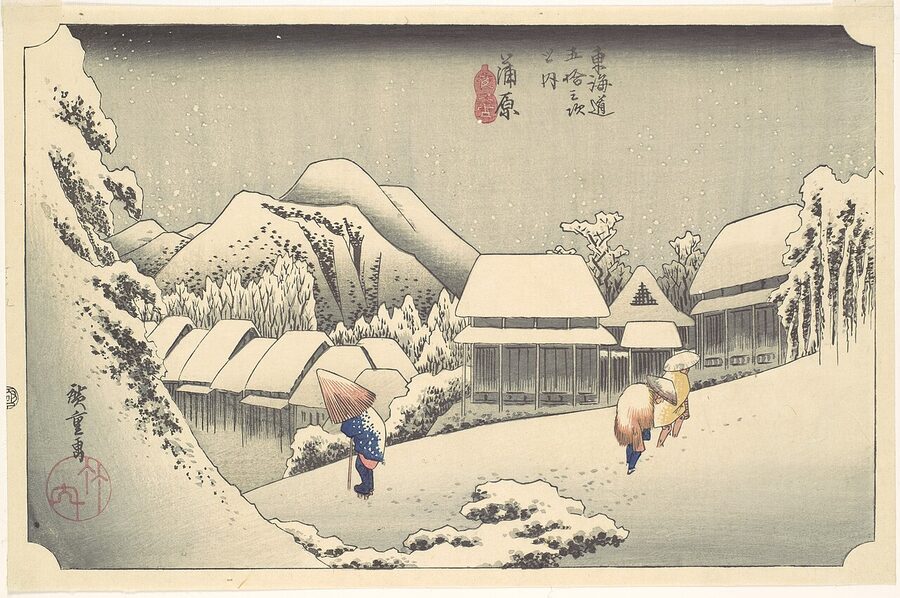
Shōno is my favourite. Porters with a palanquin and a couple of travellers are running up a slope through a squall that has just hit them, one with an umbrella blown nearly inside out, and the bamboo grove behind them is printed as silhouettes in three greys, bending under the wind. The umbrella is lettered with the publisher’s name, Takenouchi, and the series title, which makes it a small advertisement in the middle of a storm.
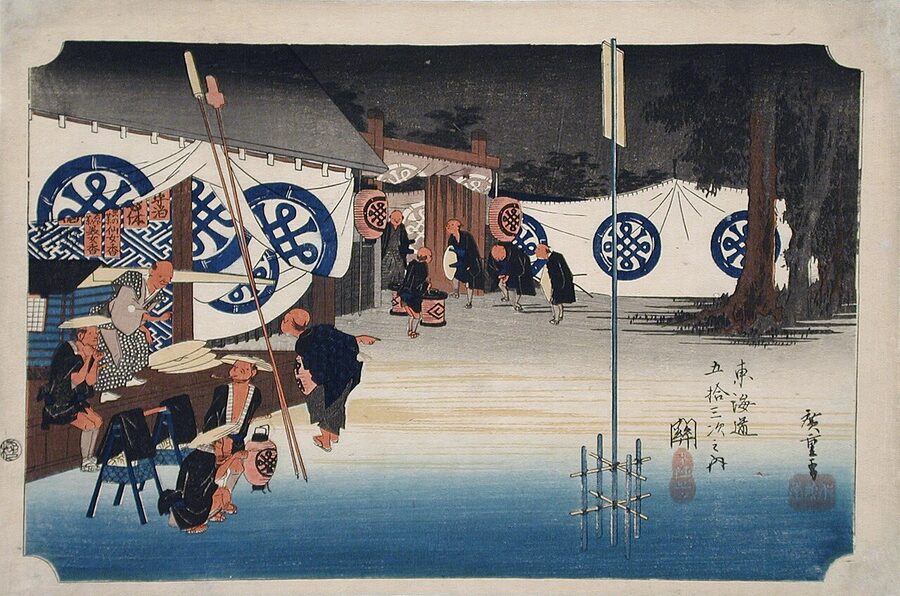
Then there is the plain work of the road. At Seki, Hiroshige shows a lord’s party getting ready to leave the official inn before dawn, the curtains with the family crest still hung out across the gateway and the servants busy with lanterns. At Kanaya and Shimada he shows the Ōi River, which the shogunate refused to bridge, and the professional porters who carried travellers over it on their shoulders. It is a road made of work as well as scenery.
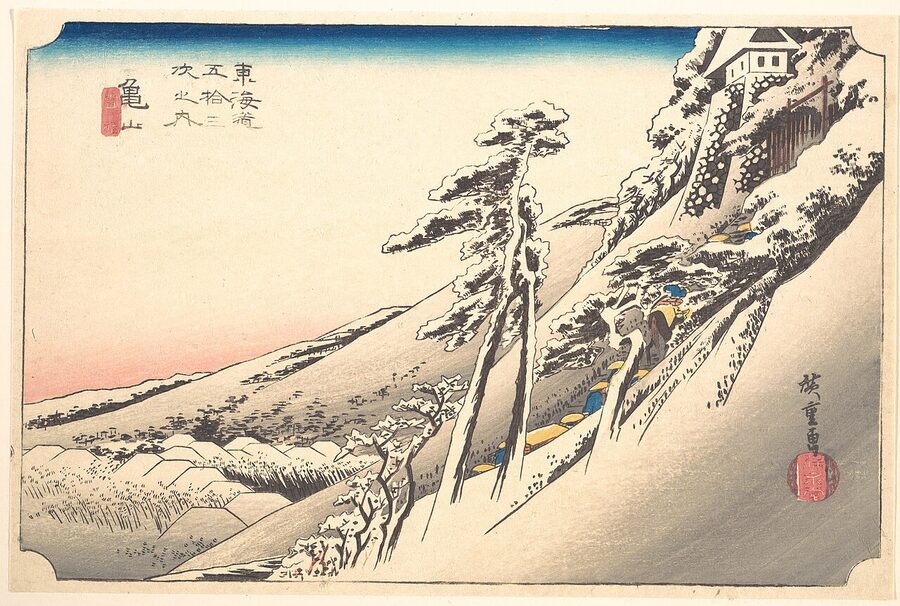
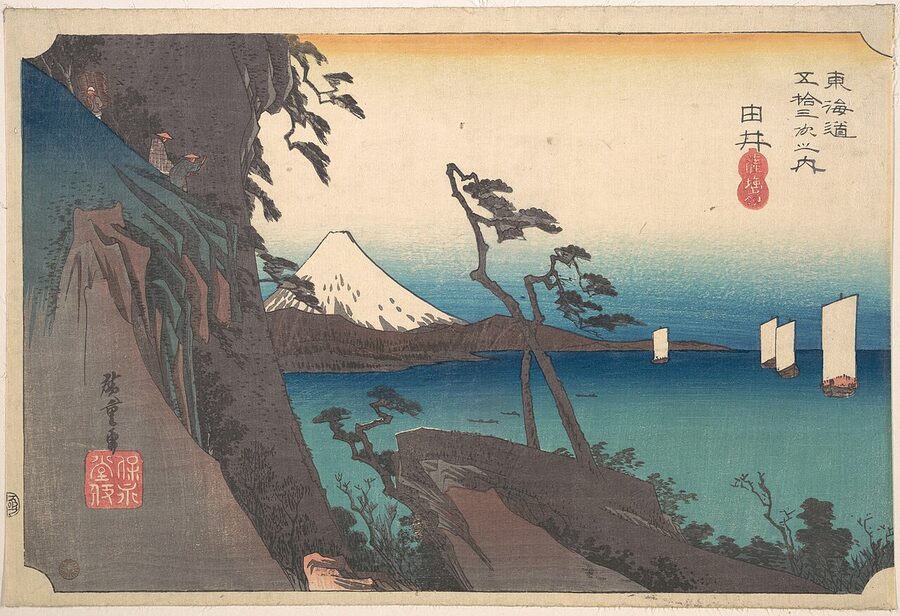
Hiroshige never stopped drawing the road. Japanese reference works count anything from thirty to forty Tōkaidō series from his hand, in every format from full-size sheets to fan prints and board games, including a fine set from around 1842 known from its calligraphic titles as the Gyōsho Tōkaidō, a set of the 1840s with comic verses, and a vertical series of 1855. None of them, to my eye, quite matches the Hōeidō set, and I am not alone; the encyclopaedias say the same thing in politer words.
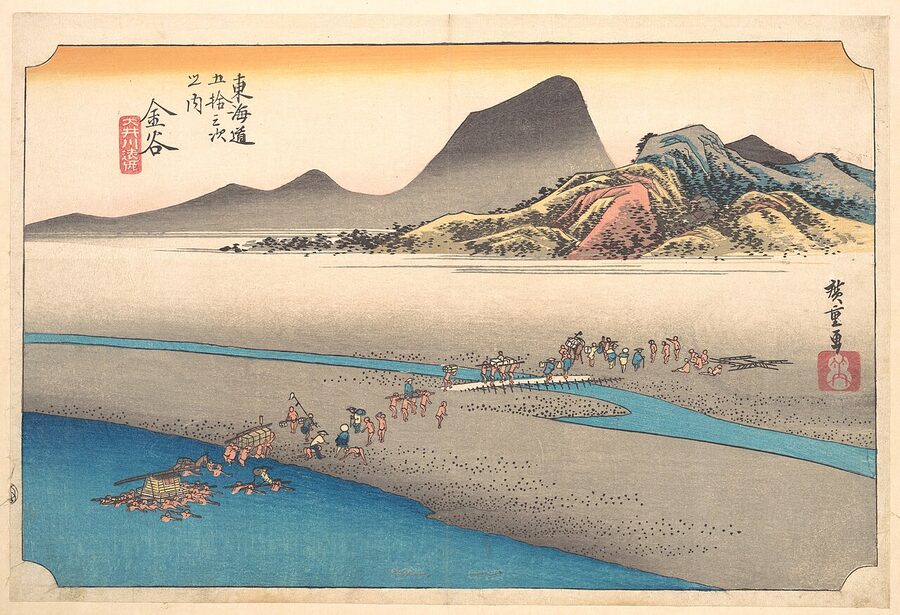
Other roads, a lake and some geese
After the Tōkaidō, the commissions came quickly, and the 1830s were his best years. He did an Eight Views of Ōmi for Hōeidō and another publisher around 1834, the classical eight scenes of Lake Biwa, including the night rain on the old pine at Karasaki and the evening bell at Mii-dera. English-language accounts often say he had never been west of Kyoto when he drew them and worked from books. For the 1834 set that is probably true; a Japanese account has him travelling in 1837 by the inland road to Kyoto and Osaka, and on across the sea to Marugame in Shikoku, before coming home by Nara, Ise and the coast.
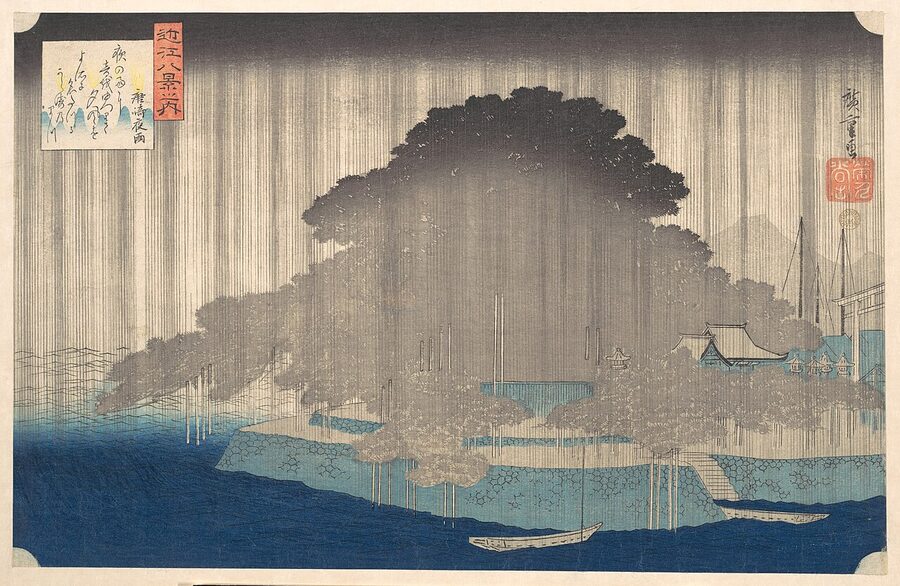
The next big road project was a joint one. Keisai Eisen had started a series on the 69 stations of the inland road to Kyoto, the Nakasendō, for Hōeidō around 1835, and some time around 1837 or 1838 Hiroshige took it over. The set was finished by about 1842 under a second publisher, Kinjudō.
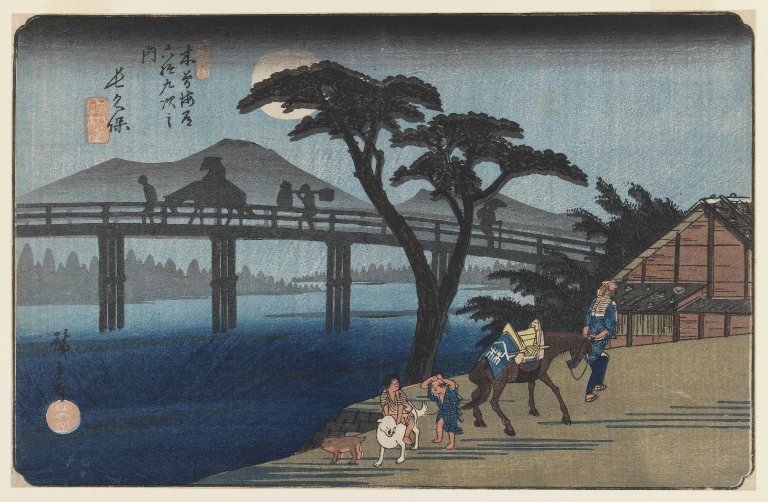
Eisen did 24 designs and Hiroshige 46, or 47 if you count the second version he made of Nakatsugawa, which is why sources give the series as 70 or 71 sheets. It includes some of his loveliest work: the moonlit bridge at Nagakubo, the family crossing the river at Miyanokoshi, the snow at Ōi. One Japanese encyclopaedia notes, a little unkindly, that it did not sell.
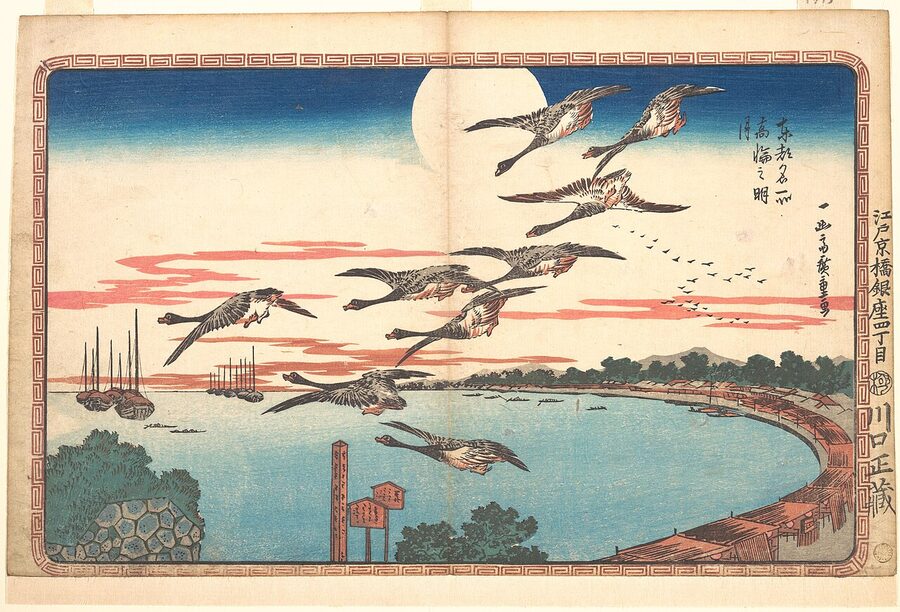
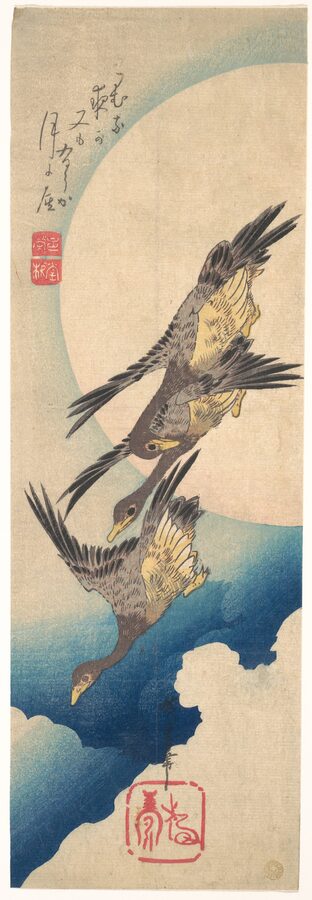
He was also, and this tends to get forgotten, a fine bird-and-flower artist. From the early 1830s he made narrow vertical prints, the tanzaku format, of geese, kingfishers, sparrows in snow and carp, each with a short poem, and they are among the most perfectly made things he ever did. The best known shows geese plunging past a full moon. In 1949 the Japanese post office put it on a stamp, and stamp collectors of a certain age still talk about it.
Kōfu, a curtain and a lost diary
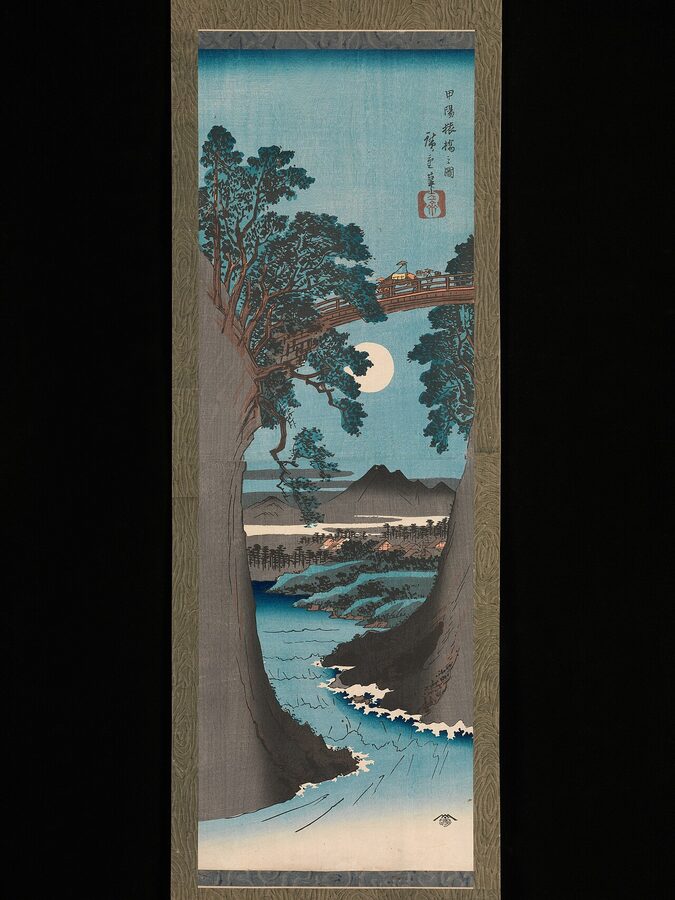
In the fourth month of 1841 Hiroshige walked out along the Kōshū road to Kōfu, in the mountains west of Edo, because the merchants of one of its wards had commissioned him to paint the great curtains hung in the streets for their Dōsojin festival. He was paid five ryō in advance and stayed for weeks, going to the theatre and to poetry parties, and he kept a diary with sketches of what he saw on the way. The finished curtains showed 39 views of the Tōkaidō. Two survive in the Yamanashi Prefectural Museum.
The original diary burned in the Great Kantō Earthquake of 1923, though a printed transcript survives. A separate sketchbook of nineteen leaves, which left Japan after the death of Hiroshige III in 1894 and was published by the English collector Edward Strange in 1925, then vanished for eighty years. It turned up at a London auction in 2005 and was identified as genuine by a curator from the Batō Hiroshige Museum, which is the kind of sentence that makes print scholars very happy.
The 1840s were harder. The Tenpō reforms of 1841 to 1843 restricted what prints could show, and actor and courtesan prints were banned outright for a time, which pushed everyone towards history, legend and safe landscape. Hiroshige turned out a sixteen-sheet Chūshingura on the vendetta of the 47 rōnin, comic prints, picture books and dozens of minor landscape series, and the quality dipped as the quantity rose.
The encyclopaedias call it overproduction. He needed the money; he was paid by the design, and not well.
One episode from these years makes me laugh every time. The domain of Tendō, in the north, was so short of money around 1851 that it borrowed heavily from rich merchants and farmers, and when it could not repay them it handed out hanging scrolls painted by Hiroshige instead. More than two hundred of these “Tendō Hiroshige” paintings were made. Somewhere in a farmhouse in Yamagata there may still be a family whose loan was paid back in landscapes.
A hundred views of a damaged city
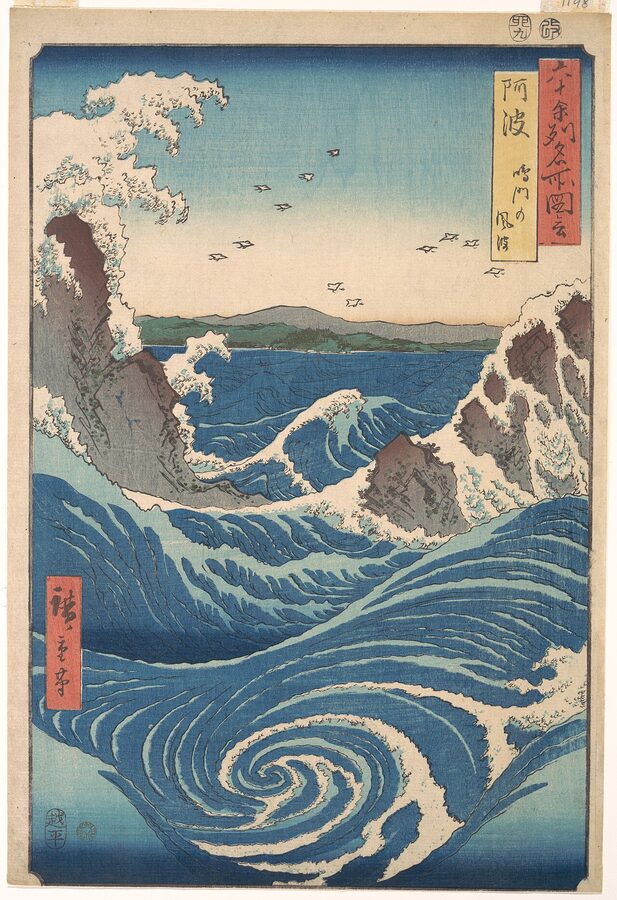
In the second month of 1856, when he was 60 by the Japanese count, Hiroshige began the series he is now most loved for. The publisher was Uoya Eikichi, who traded as Uoei, and the prints came out a few at a time until the tenth month of 1858, the month after Hiroshige died. Each sheet was in the large vertical format, each showed a single place in or around Edo, and the whole set was sold under a title page that called it the Edo hyakkei of Ichiryūsai Hiroshige, isse ichidai, the work of a lifetime.
The count depends on whom you ask. A Japanese encyclopaedia gives 118 prints by Hiroshige; the usual English figure is 119, plus a contents page by the designer Baisotei Gengyo; one Japanese listing makes it 120 by adding a print of the paulownia grove at Akasaka that Hiroshige’s successor designed in 1859. Three of the prints were published a month after Hiroshige’s death and probably have his successor’s hand in them as well.
A story that turns up in English books has the series paid for in advance by a wealthy monk in love with the publisher’s daughter. I have never found it in a Japanese source, and I file it with the dealers’ tales.
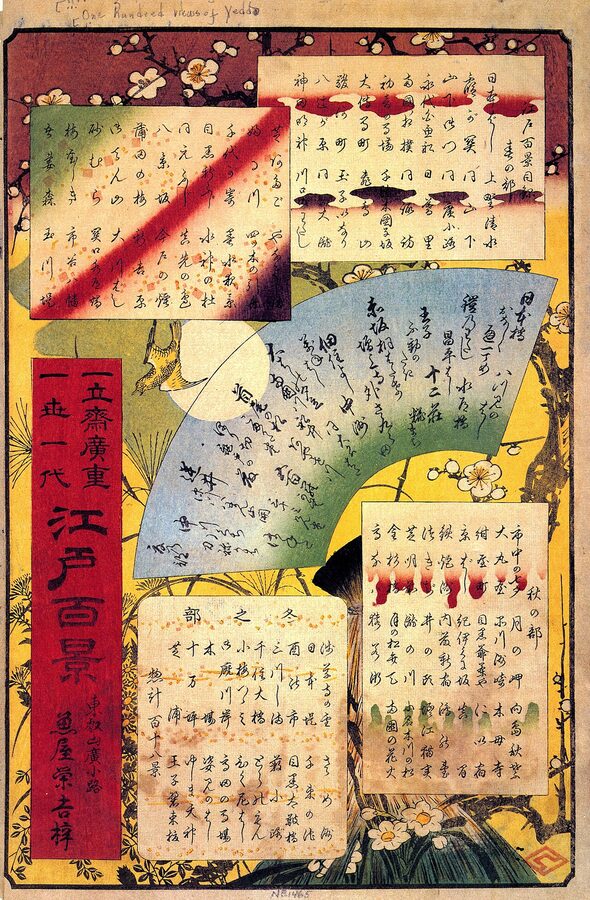
The city he drew was a damaged one. On the second day of the tenth month of 1855 the Ansei earthquake had flattened large parts of Edo and set much of the rest on fire, and the series began only a few months later. Some Japanese scholars read the whole thing as a prayer for the city’s recovery; others think the publisher simply knew that people want pictures of what they have nearly lost. Either way, the Edo in these prints is a whole and lovely place, with nothing broken in it, painted in the last years of the long peace I trace in Japan through the ages.
The thing in front
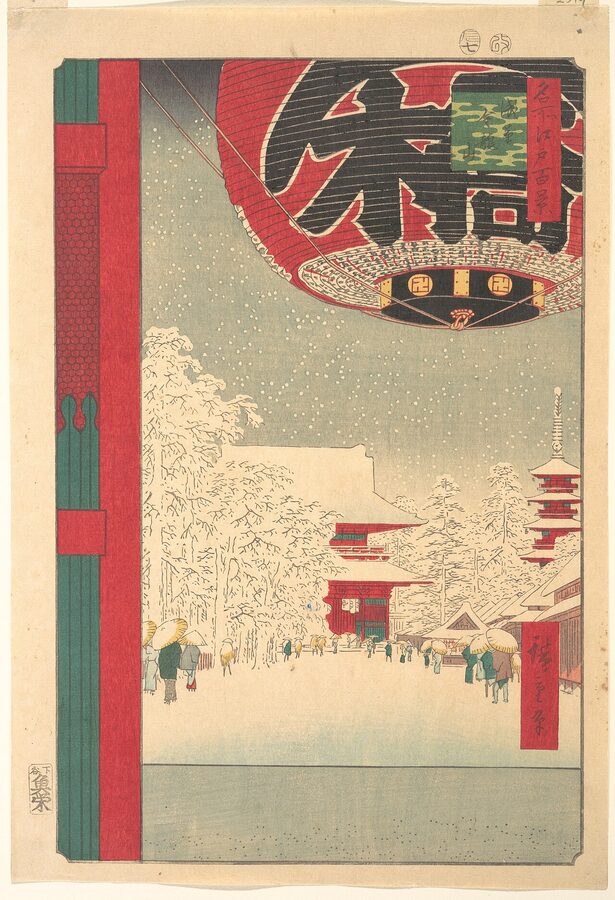
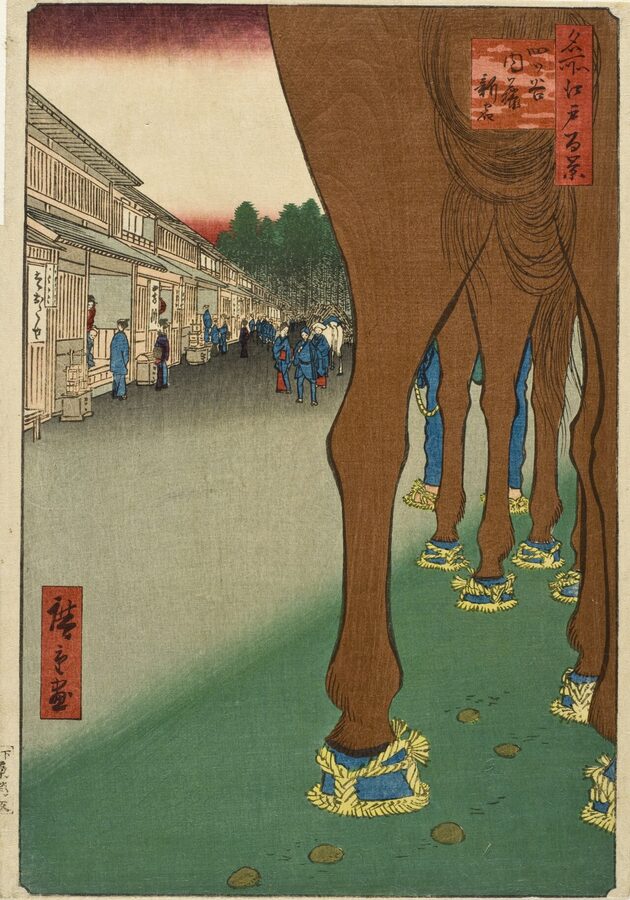
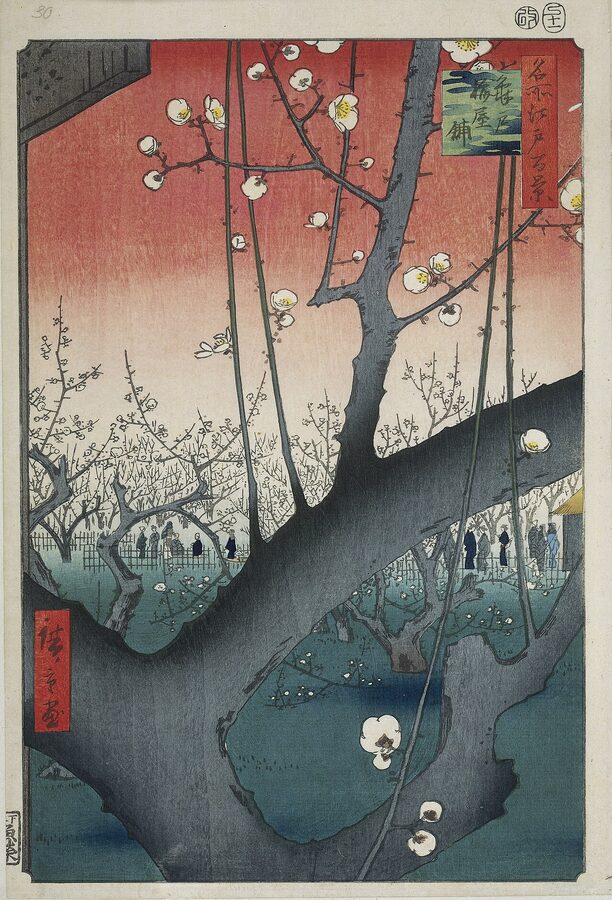
The device everyone notices is the foreground. Hiroshige puts something enormous right up against your nose: the hindquarters and hooves of a packhorse at Naitō Shinjuku, the branch of a plum tree at Kameido, an eagle diving across the sky at Fukagawa Susaki, a carp streamer at Suidōbashi. The view proper sits small and far away behind it. Western painting had used such cut-off foregrounds in perspective prints for a century, and Japanese “floating pictures” had copied them, but nobody had made them the whole point of the picture before.
The other device is the sky. Hiroshige’s skies in this series are printed in deep graded bands of colour, red at sunrise, indigo at night, and the blue is not indigo at all. It is Prussian blue, the synthetic European pigment that the Japanese called bero-ai and that came into wide use in Edo prints in the 1830s. It is brighter and more stable than plant indigo, and abroad the shade became known as “Hiroshige blue”.
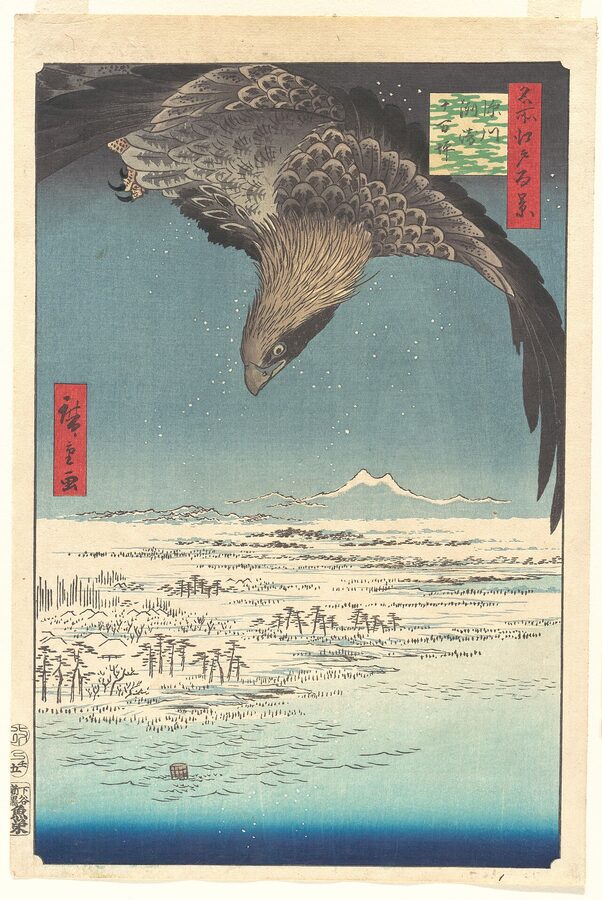
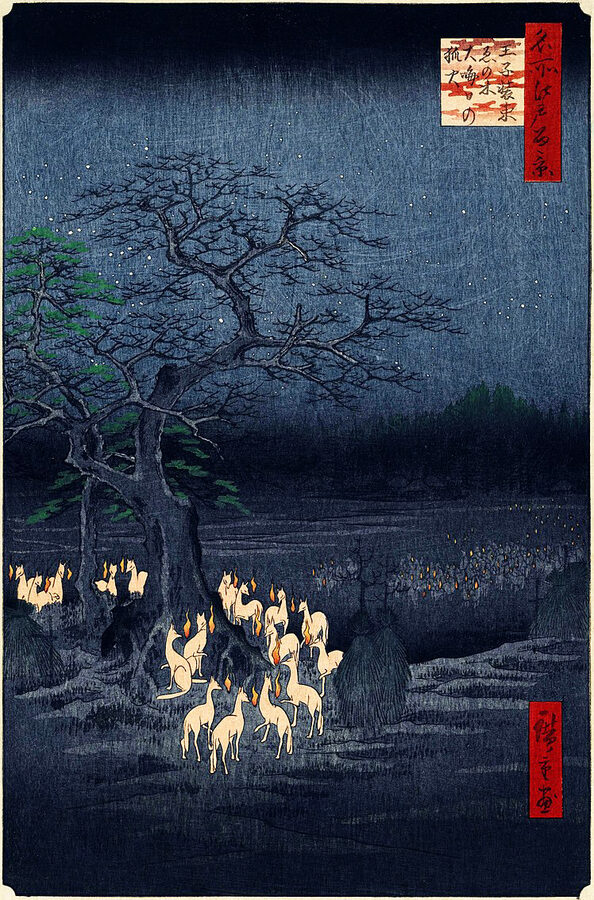
The series is also a map of a city’s pleasures, and it is full of places on this site. There is a Tanabata print of bamboo poles hung with decorations above the rooftops of the merchants’ quarter, a dawn view of the shrine of the Kanda festival, cherry trees along the Sumida embankment for the hanami crowds, fireworks at Ryōgoku and the moats and walls of the castle. Hiroshige was showing his customers the Edo they lived in, at its best and on its holidays.
Van Gogh’s tracing paper
Between 1886 and 1888, Vincent van Gogh and his brother Theo bought more than 600 Japanese prints from the Paris dealer Siegfried Bing, at an average of about fifteen centimes each, which tells you how cheap they then were in Paris. Most of them are now in the Van Gogh Museum in Amsterdam, and no fewer than 78 are by Hiroshige. In the autumn of 1887 Vincent painted copies of two of them: the plum garden at Kameido and the bridge in the rain.
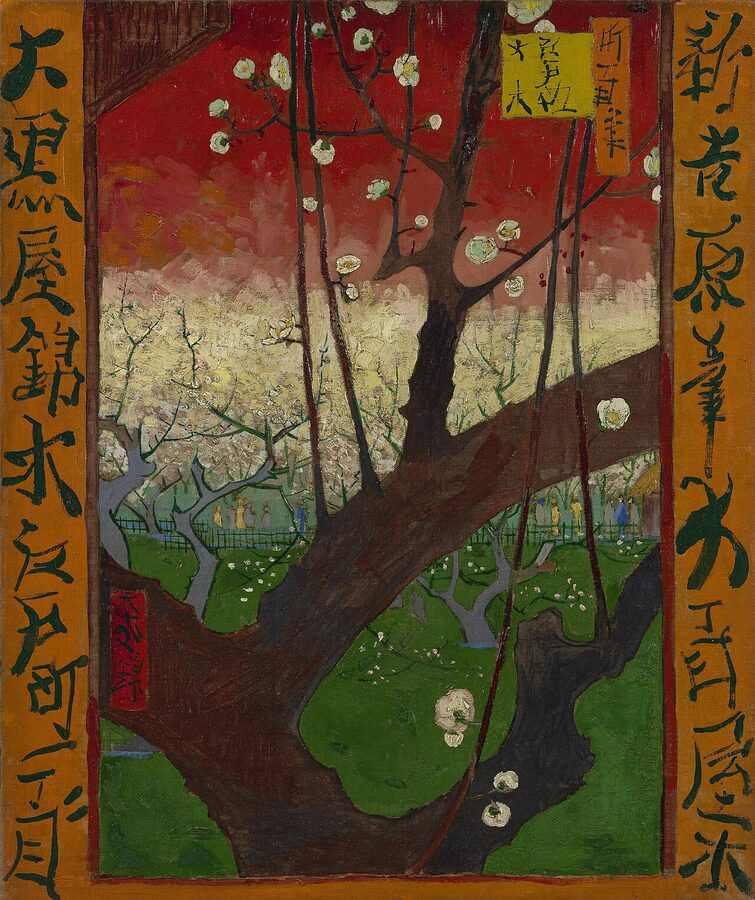
How he did it is known in unusual detail. He traced the Kameido print onto thin paper, gridded the tracing and scaled it up onto the canvas, and when the conservation scientist Capucine Korenberg examined his own copy of the print at the British Museum, she found a five-centimetre pencil line on it that matches the cut edge of the tracing. Before the British Museum borrowed that print for its 2025 Hiroshige exhibition, Amsterdam had lent it only once, in 2002. It has faded badly, which is what happens to a print an artist actually uses.
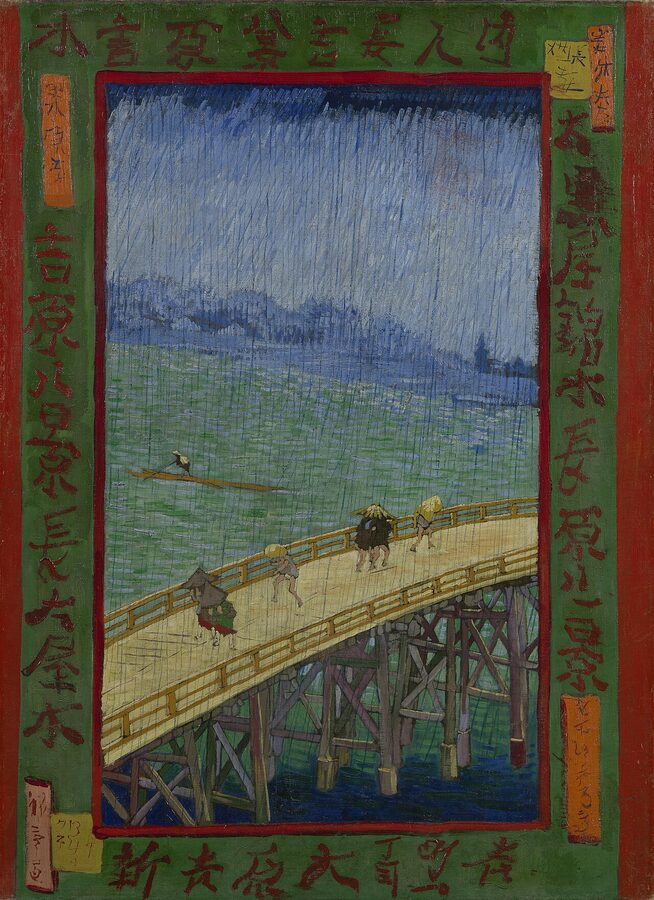
Van Gogh was not alone. James McNeill Whistler drew on Hiroshige’s night view of the Kyōbashi bamboo wharf from the same series for his Nocturne: Blue and Gold, Old Battersea Bridge, Monet collected him, and in 1883 the French critic Louis Gonse called him the greatest landscape painter of the century. In 1906 the architect Frank Lloyd Wright, a keen collector and dealer, staged the first retrospective of his work anywhere, at the Art Institute of Chicago. Hiroshige had been dead less than fifty years, and the country that made him had largely stopped noticing.
Cholera, a will and two Hiroshiges
Cholera reached Edo from Nagasaki in the seventh month of 1858 and raged through the eighth. The townsman and chronicler Saitō Gesshin, in his Bukō nenpyō, put the dead at more than 28,000, and contemporary estimates went far higher. The writer Kanagaki Robun published a list of well-known victims, and among them, under “painters”, is “Ryūsai Hiroshige”. A broadsheet print of the same year shows the year’s famous dead enjoying a performance together in the next world, and Hiroshige is in the audience, with his name on his robe.
He died on the sixth day of the ninth month of 1858, 12 October by the Western calendar, aged 62 by the Japanese count and about 61 by ours. Whether cholera killed him is not certain. The scholar Uchida Minoru pointed out in 1930 that Hiroshige wrote out his will on the second and third days of the month, four and three days before his death, and cholera in 1858 killed people within hours of the first symptoms. Uchida also passed on a recollection from Hiroshige III, who said his master had been unwell for about ten days with a fever, but with no vomiting and no diarrhoea.
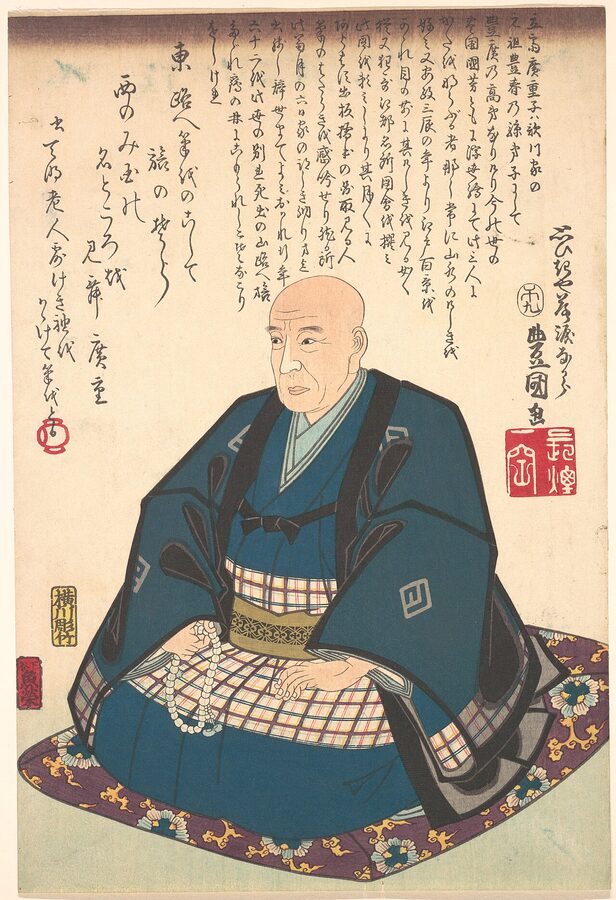
Both versions of the will, dated the second and third days, are in the Edo-Tokyo Museum. They deal with keepsakes and the funeral. A Japanese biographical dictionary quotes a comic verse from them that I think is the best thing he ever wrote: whatever the verdict in hell when I am gone, what happens here afterwards comes down to money.
The death poem on the memorial portrait is more conventional. Azumaji e / fude o nokoshite / tabi no sora / nishi no mikuni no / meisho o min: leaving my brush behind in the east, I set off on my journey, to see the famous places of the western land.
The western land is the Pure Land of the Buddha Amida, and also, for a man who drew the Tōkaidō forty times, the road west to Kyoto. Some scholars have wondered whether the poem was composed for him afterwards. A Meiji biographer adds, without fuss, that Hiroshige had shaved his head in the Tenpō era, which sits awkwardly with the English accounts that have him taking the tonsure in 1856. They cannot both be right, and I lean to the Japanese one.
He was buried at Tōgaku-ji, a Zen temple in the temple district of Asakusa, under the name Kenkōin Tokuō Ryūsai Koji. In 1882 his pupils put up a memorial stone at the Akiba shrine in Mukōjima; it was destroyed in the air raids of 1945. The temple itself later moved out to Ikō, in Adachi Ward, and the grave, damaged in the earthquake of 1923 and again in the war, was rebuilt in 1958 for the centenary of his death.
The name goes on
Hiroshige left no son. His pupil Shigenobu, born Suzuki Chinpei in 1826 to another fire-officer family, married Hiroshige’s adopted daughter Otatsu, then sixteen, and took the name Hiroshige II. Japanese sources variously give his surname as Suzuki, Andō and Morita, because he used all three at different times.
The marriage failed and they separated in 1865. He went to Yokohama, designed labels for the tea chests shipped to the West and became known to foreign merchants as “Chabako Hiroshige”, tea-box Hiroshige, before working under the name Kisai Risshō. He died in 1869, the year after the Meiji Restoration. The Nakasendō Hiroshige Museum in Ena is marking the bicentenary of his birth this autumn.
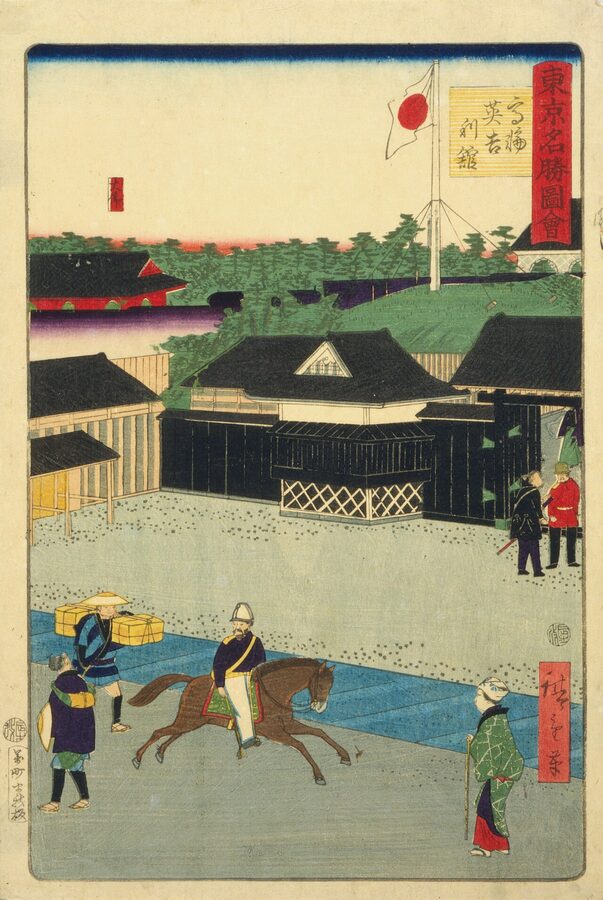
Hiroshige III died in 1894. A fourth, Kikuchi Kiichirō, a pupil of Hiroshige II, took the name in 1911 and spent much of his life looking after the first Hiroshige’s papers and relics, and a fifth followed him. None of them came close to the original, and I doubt any of them expected to.
Hiroshige and Hokusai
It is impossible to write about Hiroshige without the comparison, so here it is. Hokusai was 37 years older, a ferociously inventive draughtsman who pushed every composition until it nearly broke, and his Thirty-six Views of Mount Fuji came out just before the Hōeidō Tōkaidō. Hokusai had drawn the Tōkaidō himself, in seven different series by one count, but his were crowded with people and incident, and the landscape was a stage. The gist of the critic Yoshida Susugu’s comparison is that Hokusai drew people on the road, and Hiroshige drew the road.
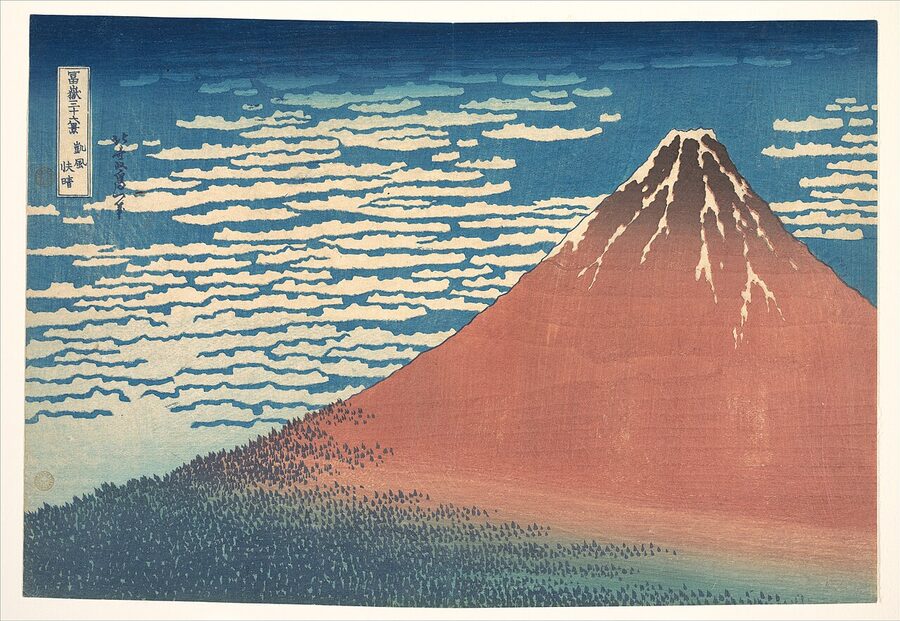
Contemporaries did not rank them the way later critics have. A satirical ranking sheet of 1858 paired Hiroshige with the actor Bandō Hikosaburō V under a phrase that reads, roughly, “not flashy, but nothing to fault”, while Kunisada was set beside the great Ichikawa Danjūrō VII.
Japanese critics have long said Hiroshige worked against Hokusai’s staged pictures and set out to draw true views, though the art historian Asano Shūgō has shown that Hiroshige rearranged real places just as freely. My own verdict is that Hokusai is the greater artist and Hiroshige the better company. If I had to hang one of them in the room where I eat breakfast every morning, it would be Hiroshige.
Where to see Hiroshige today
Hiroshige’s prints are fragile, and no museum shows the same ones for long; a sheet left in the light fades within months. So my advice is: check what is on before you travel, and go for the places as much as the prints. Most of the Tōkaidō is now under Route 1 and the bypasses, but a handful of stretches still let you stand where he stood, or where he said he did.
Yui and the Satta Pass
The Shizuoka City Tōkaidō Hiroshige Museum of Art stands in Yui Honjin Park, on the site of the old official inn of the Yui post station, and it was built around Hiroshige’s road prints. Check before you go: the museum closed on 1 June 2026 for equipment work and expects to reopen in early April 2027. Until then a satellite gallery in the Tōkaidō Yui-juku Kōryūkan, in the same park, shows a full modern recut of the Hōeidō series and lets you try printing a sheet yourself (¥550); it is free to enter and open 09:00–17:00, closed on Mondays. When the museum reopens, its usual adult ticket is ¥520.
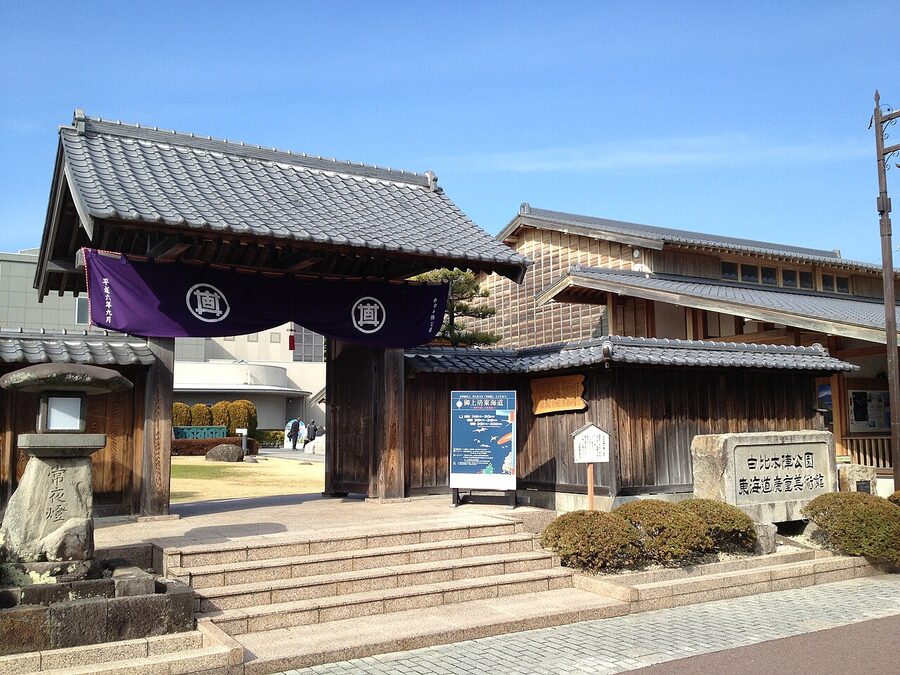
From Yui station on the JR Tōkaidō line it is about 25 minutes’ walk east along the old road, past houses with the low eaves of the post-town era, or five minutes by taxi. The town lives on sakura shrimp and whitebait, and the shrimp fritters sold along the old road are the reason to come at lunchtime. Between late October and late December, and again in spring, you can see the catch drying in pink sheets on the riverbanks.
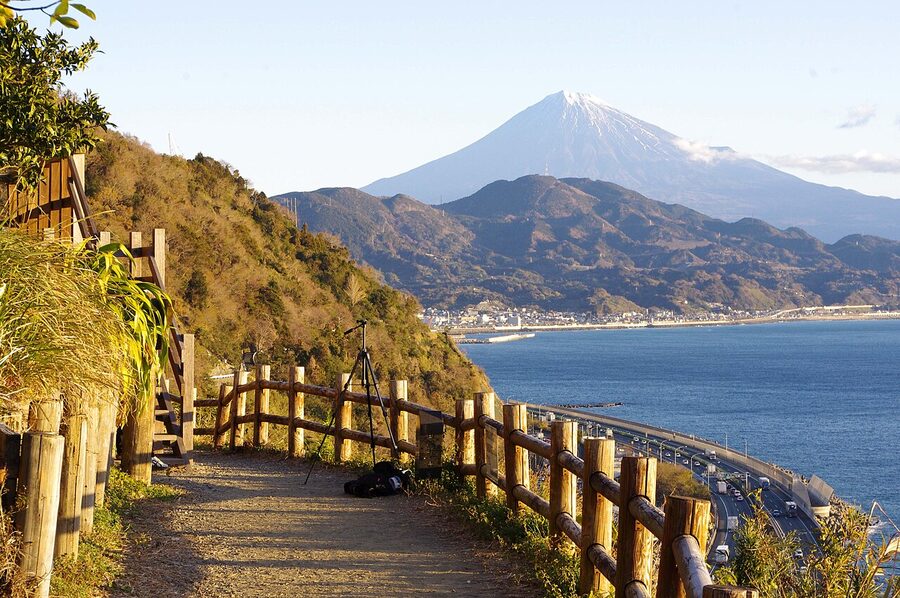
The Satta Pass, the cliff path in Hiroshige’s Yui print, is the best walk on this stretch. Go from Okitsu station towards Yui, up through the mandarin orchards, and you reach the lookout in about an hour. Below you, the Tōmei Expressway, Route 1 and the Tōkaidō line squeeze round the headland on the same strip of shore that frightened Edo travellers, and Fuji stands over the bay exactly where Hiroshige put it. Go on a clear winter morning, which is when Fuji shows itself.
Kambara
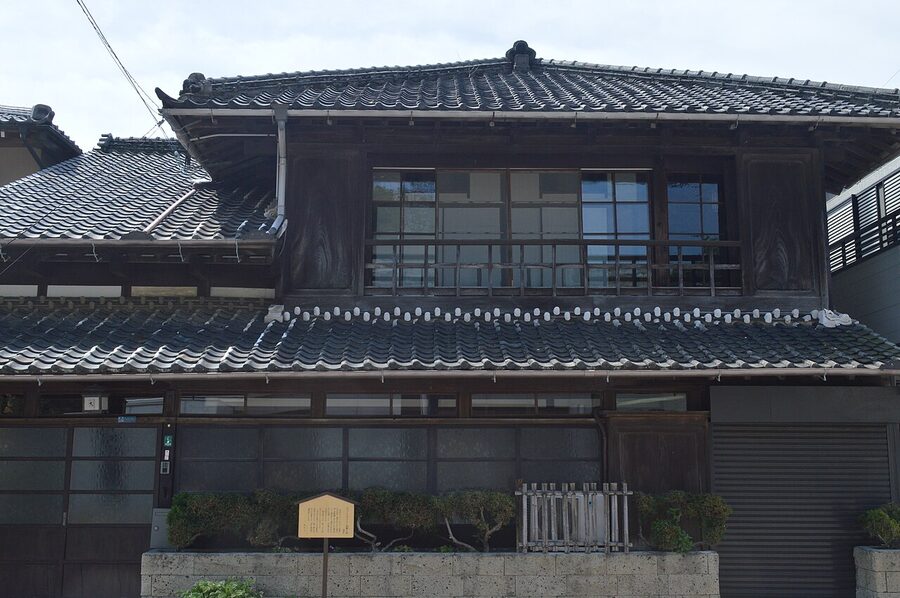
One stop east, Kambara is a quiet former post town that has done a good job of keeping its houses: lattice-fronted shops, an early 20th-century Western-style dentist’s surgery that is now a registered cultural property, and merchant houses with storehouse walls. Shin-Kambara station on the JR Tōkaidō line is about five minutes’ walk from the public rest house on the old road. There is a monument to the snow print in the town, and no snow.
Kanaya and the Ōi River
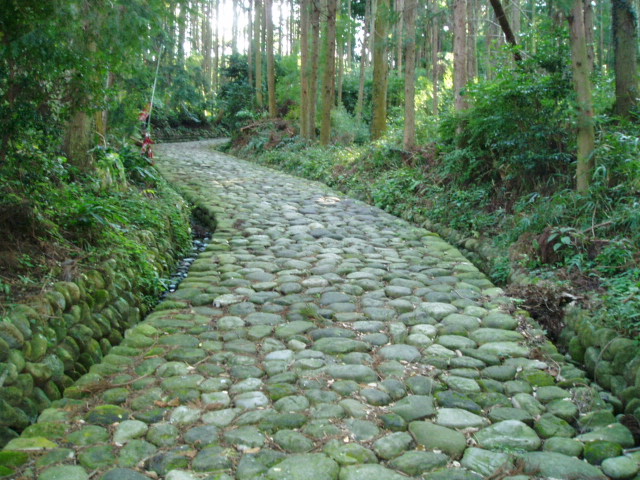
West of Shizuoka, the old road climbs out of Kanaya over the Kanaya-zaka, and here about 430 metres of stone paving were relaid by local people in 1991 as a community project using some 71,000 stones. Only about 30 metres of the Edo-period paving had survived. The slope starts about 20 minutes’ walk from Kanaya station on the JR Tōkaidō line, and it is steep and slippery when wet. On the other side of the river, in Shimada, the reconstructed buildings of the river-crossing station, the kawagoshi site, are open daily 09:00–16:30 except at New Year, and the Shimada City Museum and its annex next door cost ¥300 for adults.
Seki, Kameyama and Shōno
If you want one Tōkaidō post town that still looks the part, go to Seki, in Kameyama city, Mie. The 47th station counting from Edo, it kept about 1.8 kilometres of its street of old inns and merchant houses because the railway and the main road passed it by, and it is a national preservation district. The Tamaya inn, a restored hatago of the Edo period, and the Seki Machinami museum share a ticket of ¥300 for adults; both open 09:00–16:30 and close on Mondays and over New Year. Seki station on the JR Kansai line is about ten minutes’ walk away.
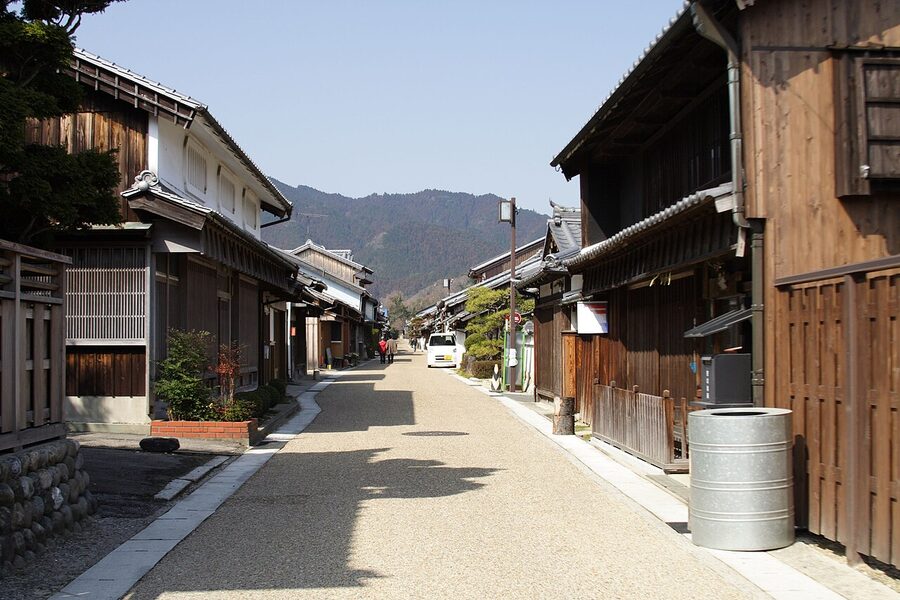
Kameyama, one station east, is where Hiroshige’s snowy slope leads up to the castle, of which a single turret remains on its walls. Shōno, the site of the rainstorm, is a few stations further on and has a small post-town museum; I would not make a special trip, but if you are walking the road anyway it is a pleasant stop.
The Batō Hiroshige Museum, Tochigi
The best single collection of Hiroshige’s paintings, as opposed to prints, is in a small town in the hills of Tochigi. The Nakagawa-machi Batō Hiroshige Museum of Art was built around the collection of a fertiliser merchant, Aoki Tōsaku, whose family gave it to the town after their house was damaged in the Kobe earthquake of 1995. It holds about 4,500 items, including more than forty Hiroshige paintings, among them some of the Tendō scrolls.
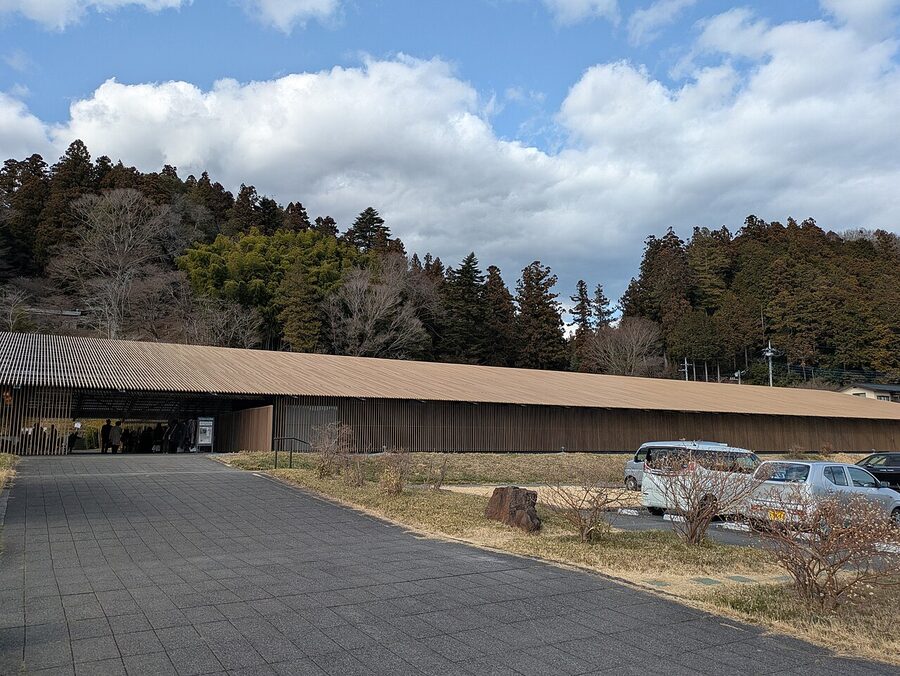
Getting there takes effort. From Utsunomiya, take the JR line to Ujiie and the Kantō Bus to Batō for about an hour, getting off at Muromachi, two or three minutes’ walk from the museum. It opens 09:30–17:00 and closes on Mondays and the day after public holidays. Ordinary exhibitions cost ¥500 for adults and special ones ¥700; until 6 December 2026 it is showing the painter Honda Takashi’s response to Hiroshige, with prints from the collection alongside.
The Nakasendō Hiroshige Museum, Ena
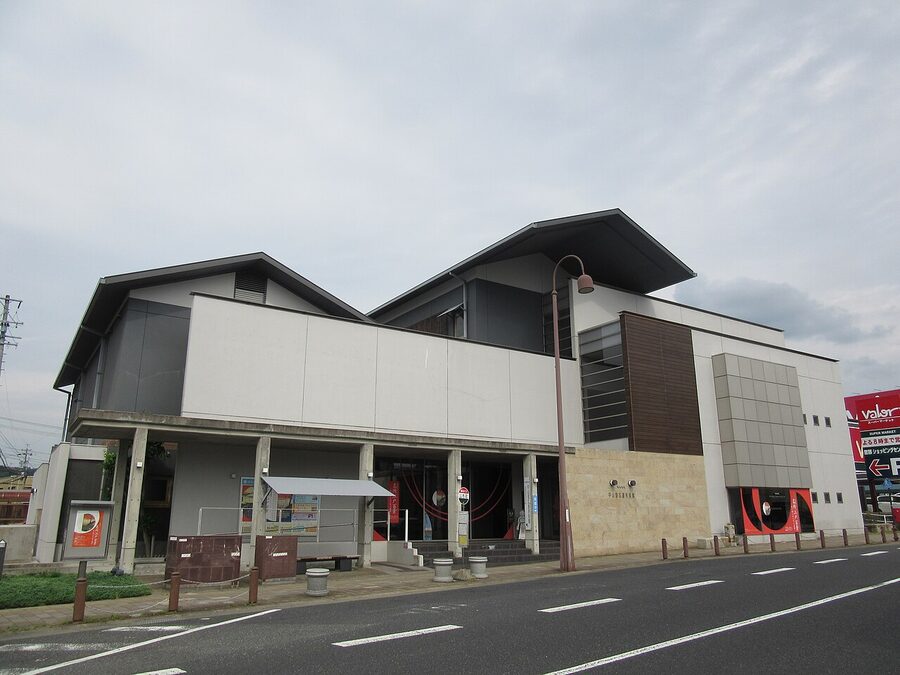
In Ena, on the old Nakasendō in Gifu, the Nakasendō Hiroshige Museum of Art collects the Kisokaidō series and Hiroshige’s other road prints. I cover the museum and the walking around it in my piece on the Nakasendō. Until 6 December 2026 it has an exhibition on Hiroshige II for his bicentenary (adults ¥820), followed from 10 December 2026 to 23 February 2027 by the Gyōsho Tōkaidō (¥520). Admission is free every Wednesday and Friday until the end of March 2027.
The Ōta Memorial Museum, Tokyo
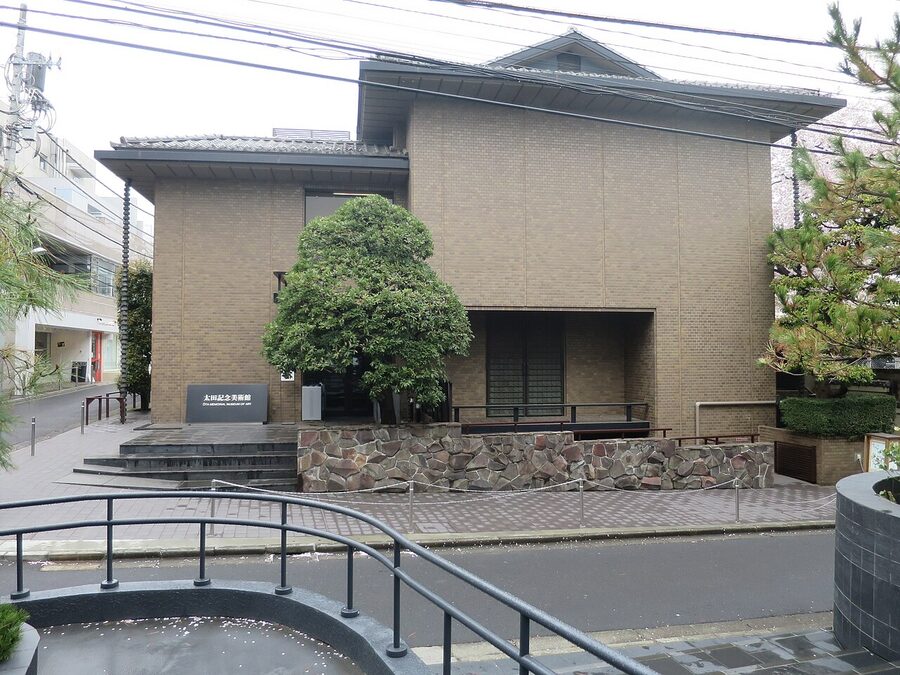
In Tokyo, the Ōta Memorial Museum of Art, a private museum off Omotesandō, has around 15,000 prints and puts on a new exhibition almost every month, very often with Hiroshige in it. It has no permanent display, so check the schedule first.
It opens 10:30–17:30 and closes on Mondays; tickets vary by exhibition and are cash only. Its exhibition on Katsushika Ōi runs to 6 December 2026, and the next, on lesser-known print artists, from 12 December 2026 to 17 January 2027. It is five minutes from the Omotesandō exit of JR Harajuku station, or three from exit 5 of Meiji-jingūmae on the Tokyo Metro.
The Edo-Tokyo Museum, Ryōgoku
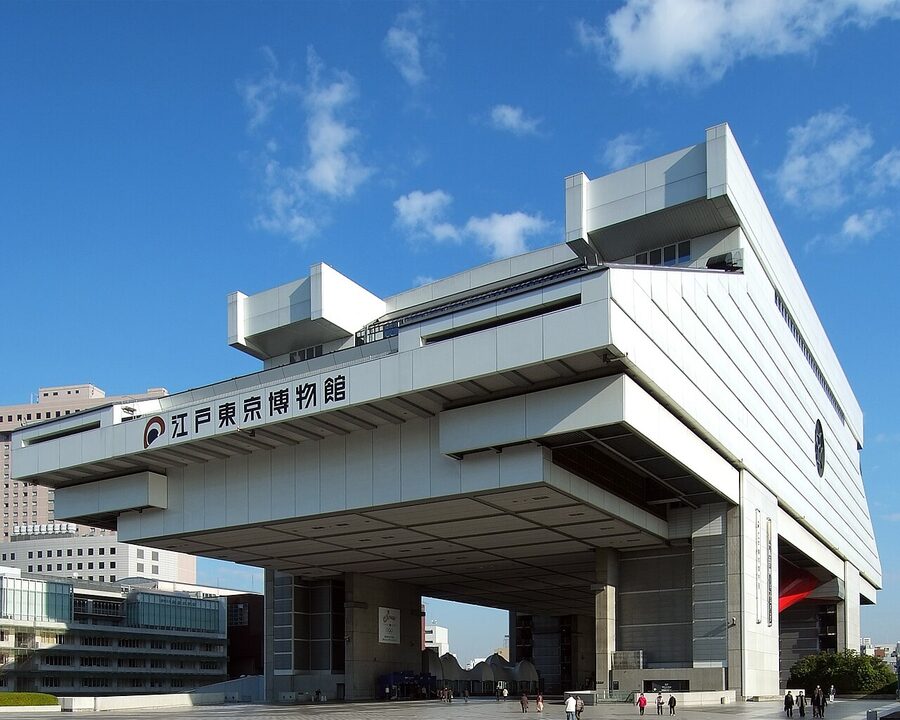
The Edo-Tokyo Museum at Ryōgoku reopened on 31 March 2026 after four years of renovation. It owns Hiroshige’s two wills, though they are not always on display, and its permanent galleries start on a life-size half of the Nihonbashi bridge, the bridge where his Tōkaidō begins. Entry to the permanent exhibition is ¥800 for adults; it opens 09:30–17:30 (to 19:30 on Saturdays) and closes on Mondays. Ryōgoku station on the JR Sōbu line is three minutes from the west exit.
Edo views you can still find
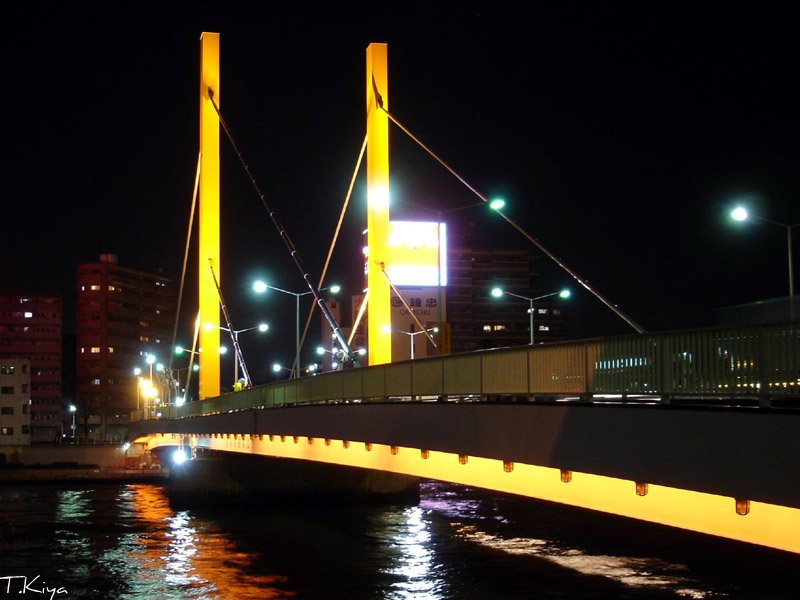
Most of the places in the Hundred Views are still there in name, and some are worth a walk with the print on your phone. Shin-Ōhashi, the bridge in the rain, is a short walk from Hamachō station on the Toei Shinjuku line; the present bridge opened in 1977, and part of the 1912 iron bridge it replaced was moved to the Meiji Mura open-air museum near Nagoya.
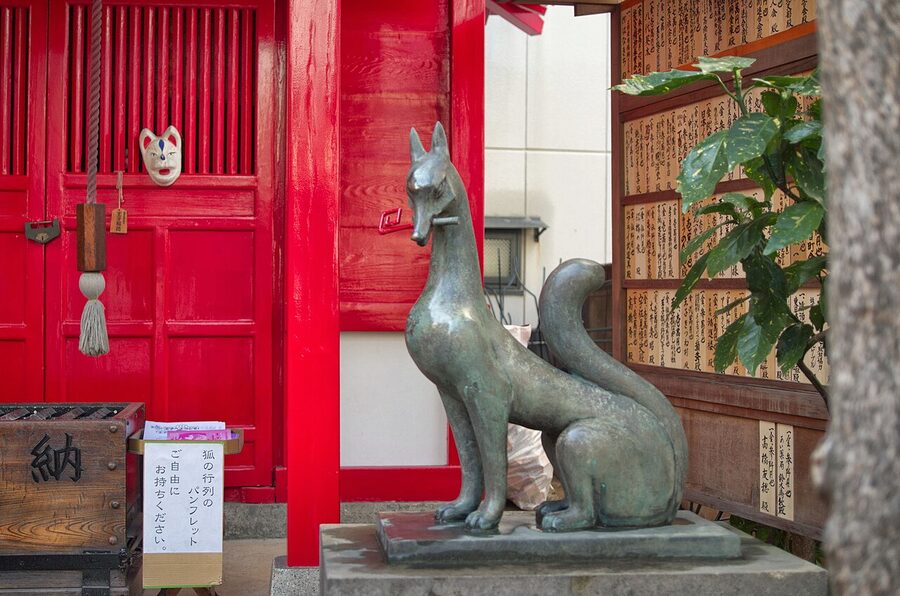
At Kameido, a stone on the Kitajukken River in Kameido 3-chōme marks the site of the plum garden, and a small Inari shrine nearby has a few plum trees; Kameido Tenjin shrine, a ten-minute walk away and also in the series, has its own plums in February and its wisteria in late April. At Ōji, Shōzoku Inari, the little shrine where the foxes were said to change into court dress, stands near the station, and since the 1990s local people in fox masks have walked from it to Ōji Inari shrine on the night of 31 December. In Asakusa, the lantern is in its place.
Tōgaku-ji, Adachi
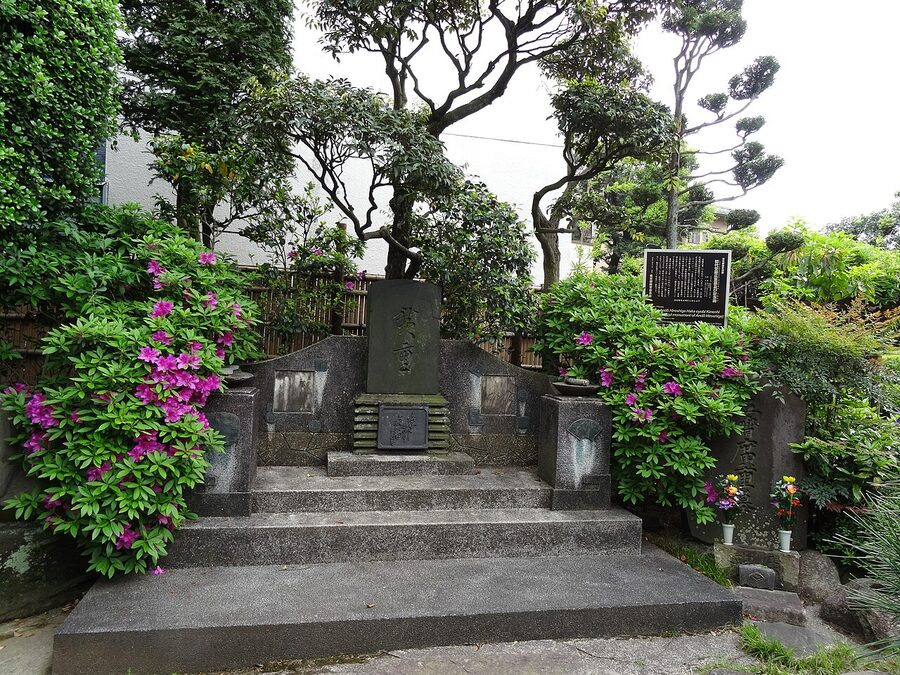
Hiroshige’s grave is at Tōgaku-ji, in the temple district of Ikō in Adachi Ward, where a group of Asakusa temples resettled after the earthquake of 1923. The grave and a memorial stone stand on the left inside the gate, with a board explaining who he was.
The nearest station is Takenotsuka on the Tōbu Skytree line, and you walk from the west exit; the streets of the temple district are a maze, so take a map. It is a temple, not a museum, so there is nothing to pay. Bow, leave quietly, and do not tread on the azaleas.
The rain at Ōhashi
I have stood on the Shin-Ōhashi in a summer cloudburst, the kind that comes over the Sumida late on a hot afternoon and turns the far bank grey in a minute, and watched people do exactly what Hiroshige’s people do: put their heads down, pull something over them and run. Nobody on the bridge looked at the view. It was a fire officer’s son, who may never have walked half the road he made famous, who taught the rest of the world to look at weather in the first place.
If you are in Tokyo in July and the sky to the west goes dark, walk down to the bridge from Hamachō. Do not take an umbrella.