Under the main hall of Yasaka Shrine there is a pond that nobody alive has seen. The shrine calls it the ryūketsu (龍穴), the dragon’s hole, home of the blue dragon that guards the eastern side of Kyoto, and at some unrecorded date somebody sealed it under a dome of white plaster and left the god’s inner sanctuary standing on top. A carpenter who worked on the hall in 1905, when he was eleven years old, remembered clear water lying in the dark beneath the floor. He is the last eyewitness I know of.
The older reports are better. The Zoku kojidan, a collection of court anecdotes put together in the early 13th century, says that after the hall burned in 1070 the abbot of Mount Hiei had the pond sounded, let a line down fifty jō, about 150 metres, and never touched bottom. It adds that in 1123, when the court was rounding up Hiei’s warrior monks, a crowd of them ran into the sanctuary to hide, and that one of them, so people said, fell into a channel in the floor. I cannot tell you what became of him, but I can tell you that no story sums up this shrine better: a god’s house built over a bottomless hole and full of armed Buddhist monks.
Today Yasaka draws about a million people in the first three days of the year alone, and almost none of them know that until 1868 this was not Yasaka Shrine at all. It was Gion-sha, the sanctuary of a bull-headed plague god, run by Buddhist monks and owned by Mount Hiei, and its story runs through nearly every chapter of Japan’s history from the Heian court to the pandemic. The pond is still there under the plaster. So, in a sense, is everything else.
In This Article
- A god with the head of a bull
- Somin Shōrai’s descendants
- Two foundings and a cough
- The mountain’s branch office
- The jinin and their money
- The bowstring sellers
- Arrows in the sanctuary
- The angry dead and the god of plague
- War, a gate from 1497 and a new patron
- 1868: the year the Ox-Head King disappeared
- One roof over the god
- Where to see Yasaka Shrine today
- Getting there and opening hours
- The front door and the side door
- Inside the precinct
- The shrine’s year
- The shrine at night
- Okera-mairi on New Year’s Eve
- Maruyama Park and the weeping cherry
- Chion-in and Hōnen’s grave
- South to Kōdai-ji and Kiyomizu-dera
- The god’s houses downtown
- Under the floor
A god with the head of a bull
The god’s name was Gozu Tennō (牛頭天王), the Ox-Head Heavenly King, and the first thing to know about him is that nobody has ever found him outside Japan. Medieval writers said he was the guardian of Jetavana, the monastery park in India where the Buddha preached, which in Japanese is Gion Shōja (祇園精舎). That is where the word Gion comes from: first the name of the shrine, then of the district around it, and now of probably the most photographed geisha quarter on earth.
Scholars who have gone looking for an Indian or Chinese Gozu Tennō have come back empty-handed. The current view in Japan is that he was assembled here, out of Buddhist, Daoist and yin-yang parts, sometime in the Heian period. The early records do not even use his name: until the Kamakura period the god of Gion is simply “the Heavenly Deity” or “the Heavenly Deity of Gion”, and only later sources say plainly that he is the Ox-Head King.
He was assembled to be frightening. The Iroha jiruishō, a dictionary of the late Heian period, makes him the king of a country north of India who married the daughter of Sāgara, the dragon king of the sea, and fathered eight princes, with 84,654 lesser spirits in his retinue. The Hoki naiden, a yin-yang almanac of the 14th century that claimed to be the work of the diviner Abe no Seimei, gives him the face of a yellow ox with horns. A later temple legend says that at seven he already stood over two metres tall, with an ox’s head and red horns, and that no woman would come near him, so he took to drink.
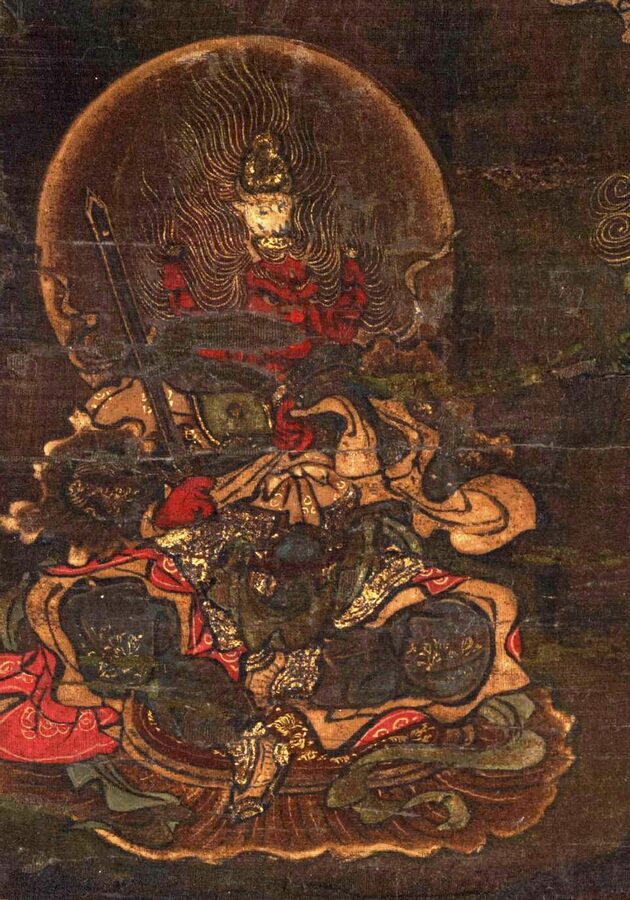
What the legend does next explains the whole shrine. On his way to the dragon palace to find a wife, the god asked for a night’s lodging from a rich man called Kotan Shōrai, who turned him away. Kotan’s poor elder brother, Somin Shōrai (蘇民将来), took him in and fed him on millet. Years later the god came back with his army, destroyed Kotan’s household, and promised that anyone who wore a ring of reeds and declared themselves a descendant of Somin Shōrai would be spared when he next brought sickness.
The oldest version of the story is the one I trust least and like most. It survives only as a fragment of the 8th-century gazetteer of Bingo province, quoted five centuries later in a commentary on the Nihon shoki, and in it the traveller is a god called Mutō who, after killing everyone except Somin’s daughter, announces that he is Haya-Susano-o. That single line is the hinge of the whole history. A foreign-sounding plague god and Susanoo, the unruly storm god of Japanese myth who killed the eight-headed serpent, were already being treated as one person.
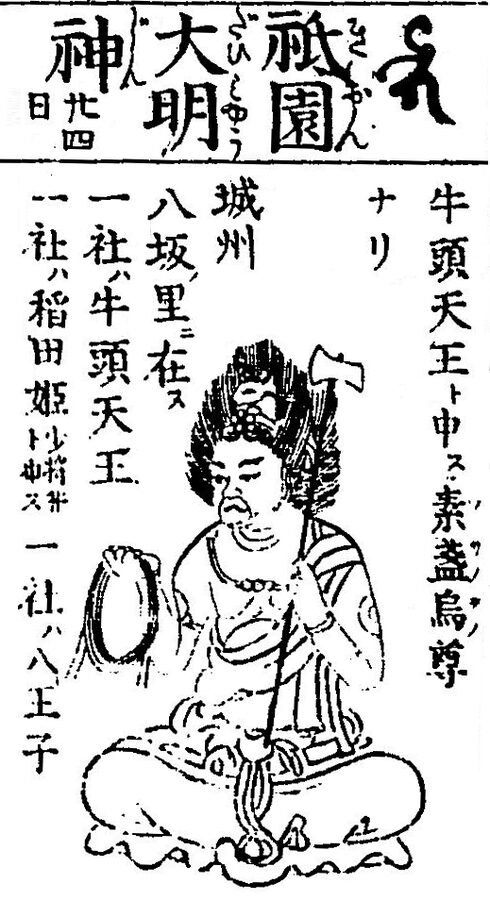
In the Buddhist reading, the Ox-Head King was a local appearance of Yakushi, the Buddha of healing, which is a tidy arrangement: the power that sends the disease is the power that takes it away, provided you ask properly. His wife Harisai-nyo was matched with the goddess of the lucky direction in the almanac, and his eight princes with the eight generals of the yin-yang calendar, so the old shrine dealt in dates and directions as much as in medicine. The eastern seat of the sanctuary still holds Jadokke no kami, a snake-venom goddess no shrine record properly explains; some say she is what became of the eight-headed serpent.
Somin Shōrai’s descendants
You will meet Somin at Yasaka if you look for him. In July every float in the Gion Matsuri sells chimaki (粽), bundles of bamboo leaf that contain no rice and are not for eating, each carrying a tag that reads Somin Shōrai shison nari, “I am a descendant of Somin Shōrai”. Kyoto households hang them over the front door for the year, which means a large part of the city is still, technically, claiming kinship with a man who gave a god his dinner. The oldest charm with those words ever found is a wooden tag dug out of Nagaoka-kyō, the short-lived capital that came before Kyoto.
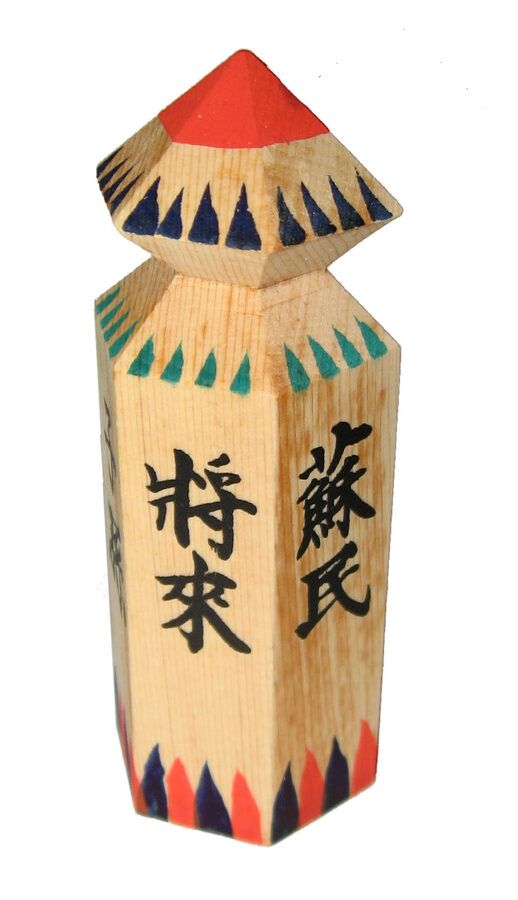
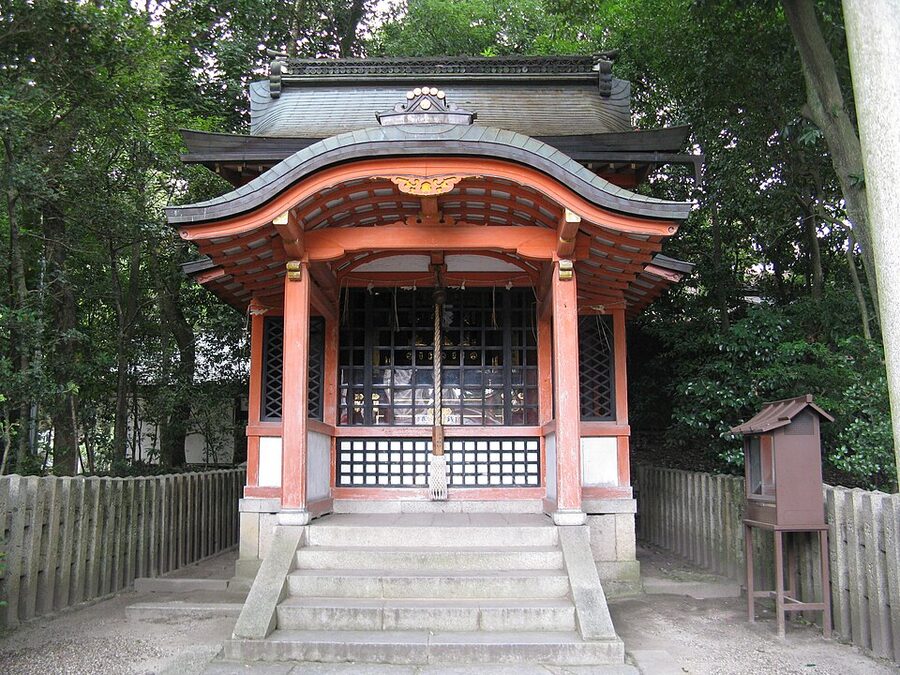
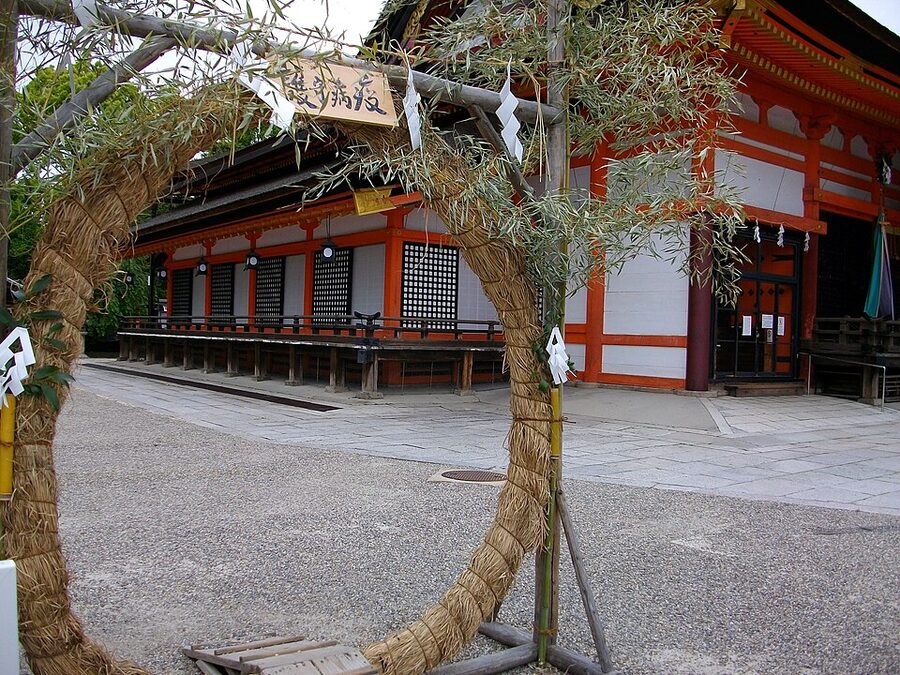
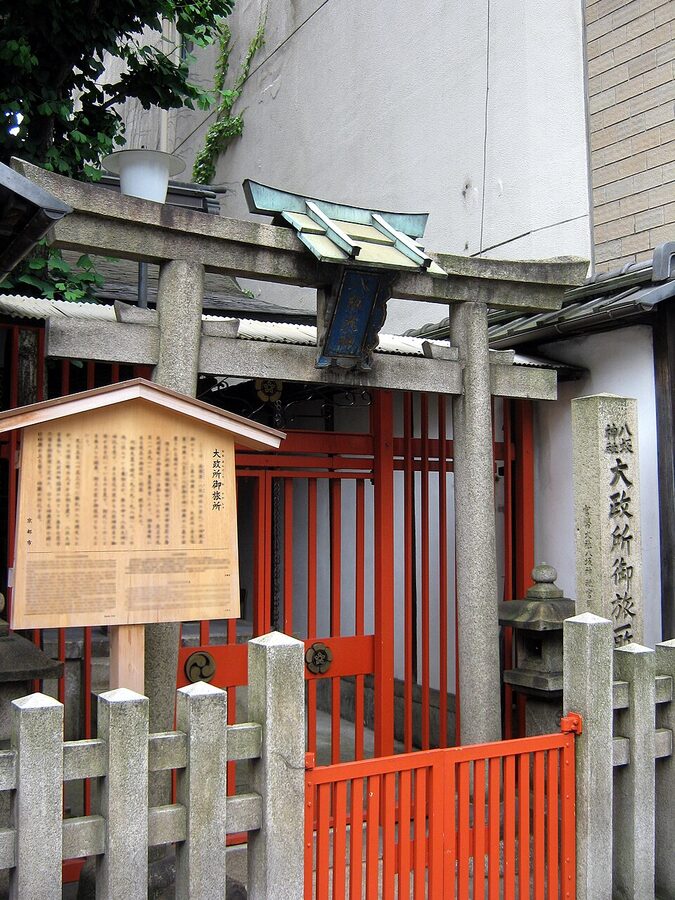
Somin has his own shrine in the precinct, the Ekijinja (疫神社), the Plague God Shrine, a small hall rebuilt around 1823. On the last day of July, when the festival closes, a great ring of woven reeds goes up in front of it and people walk through it, the reed ring of the Bingo story, then take home a reed charm and a cake of millet. Millet, because that is what Somin served. I find it hard not to like a religion that still remembers the menu.
Two foundings and a cough
Ask the shrine when it was founded and it gives you two answers, which is one more than most shrines manage. The first says that in 656, the second year of Empress Saimei, an envoy from the Korean kingdom of Goguryeo named Irishi brought over the spirit of Susanoo from Mount Gozu in Silla and enshrined it here, in the Yasaka district of Otagi. The second says that in 876 a monk from Nara named Ennyo built a hall here with an image of Yakushi, and that in the sixth month of the same year the god came down in the Gion woods at the foot of Higashiyama.
English-language guides usually give you 656 as a plain fact. Japanese historians are less sure. The 656 story rests on a document the shrine printed in 1870, which claims to copy a text dated 1079; the 876 story comes from a record compiled at the end of the Kamakura period by the shrine’s own administrators. In a 1962 paper that remains the starting point, the historian Kubota Osamu weighed the sources and came down on 876, with Ennyo’s temple, Kankei-ji, as the seed from which the shrine grew.
There is a third story, and Kubota demolished it. From the late Muromachi period the Yoshida school of Shinto spread the claim that the god had first landed at Akashi Bay in Harima, moved to Hiromine near Himeji, then to Tōkō-ji in the north of Kyoto, and only reached Gion in the Gangyō era (877–885). Hiromine Shrine, which had been a dependency of Gion, used the story to call itself the original, and by the Edo period even Gion sometimes repeated it. Kubota pointed out that no Heian source mentions Hiromine at all, and that the name Gion was in use before Tōkō-ji existed.
The earliest record of the place is not a founding but a cough. On the 23rd day of the intercalary sixth month of 920, the great minister Fujiwara no Tadahira noted in his diary, the Teishinkōki, that he was sending offerings and racehorses to “Gion” to be rid of a coughing sickness. Whatever stood here by then, the most powerful man of the Fujiwara clan thought it worth a horse.
The shrine’s own history adds a scene from 877, when an epidemic broke out and the diviners blamed a god somewhere to the southeast. The court sent offerings to shrine after shrine without result, until a second divination named “the small shrine in Higashiyama”; an imperial envoy prayed there, and the sickness stopped. Two years later, the shrine says, the boy emperor Yōzei gave it twelve blocks of land along the Horikawa, and the 360 timber merchants who traded there became its jinin (神人), the god’s lay servants. If even half of that is true, Gion had a commercial wing before it had a proper roof.
The date the Gion Matsuri counts from, 869, deserves the same scrutiny. The story of sixty-six halberds set up in the Shinsen-en garden, one for each province, is told in a shrine compilation, the Gion hon’en zatsujikki, that dates from 1670 or later; the shrine says so itself, on its own website, which I admire.
What the official chronicle does record is a rite for angry spirits at Shinsen-en on the 20th day of the fifth month of 863. The 869 rite may well have happened, and the festival was certainly annual by around 970. It is simply that the account of it is eight centuries younger than the event.
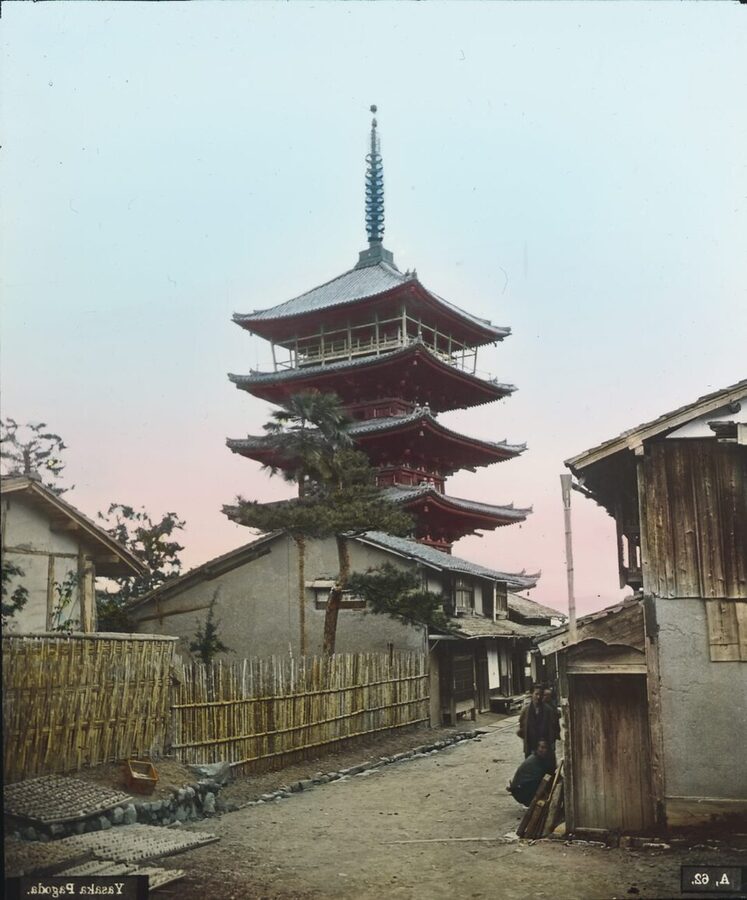
The name Yasaka is older than any of this. It belonged to the district, Yasaka-gō, and to a family of immigrant descent, the Yasaka no miyatsuko, whose ancestor is listed in a 9th-century register of noble houses with a Korean name. Their temple is generally taken to be Yasaka-dera, the one you know as the Yasaka pagoda, a few minutes’ walk south of the shrine. When the Meiji government needed a new, un-Buddhist name for Gion-sha in 1868, it reached for the oldest local word it could find.
The mountain’s branch office
For nearly six hundred years Gion-sha did not belong to itself. In the 10th century it was a branch of Kōfuku-ji, the great temple of Nara, and so was its neighbour up the hill, Kiyomizu-dera. In 959 the two fell out, and one standard Japanese reference makes that quarrel the reason Gion changed sides: by 974, in the years when the abbot Ryōgen was rebuilding Hiei’s power, it had become a branch of Enryaku-ji, the Tendai monastery on Mount Hiei. The shrine’s own history says, with some dignity, that the reasons are unknown.
The result was a front line through the middle of Higashiyama. Nara owned Kiyomizu, Hiei owned Gion, and the long feud between the southern capital and the northern peak was fought out partly on these slopes. In 1165, after a quarrel at an emperor’s funeral, Hiei’s men came down and burned Kiyomizu-dera. Gion, ten minutes’ walk downhill, was the mountain’s base in the city.
Hiei ran its Kyoto shrine through a Buddhist office called Kanshin-in (感神院), founded in 934 as a sub-temple of Ennyo’s Kankei-ji, which it soon swallowed. From the late 11th century the post of shigyō, the shrine’s chief executive, passed down through one branch of the Ki clan, and their journals, the Gion shigyō nikki, are one of the great sources for medieval Kyoto. The name on official paperwork until 1868 was Gion Kanshin-in, and the word is still carved into the stone water basin on your left as you come through the west gate.
In 1070, the year of the fire, a decree of the Council of State fixed the shrine’s territory, and the boundaries take some believing: east to the Higashiyama hills, south to Gojō (today’s Matsubara-dōri), west to the bank of the Kamo river, north to Sanjō. The decree is the oldest document in the shrine’s archive of more than two thousand, and it shut outside officials out of that whole area. A large slice of what is now eastern Kyoto, including most of the teahouse streets of Gion, was in effect a small Tendai state.
The jinin and their money
The jinin are where it gets interesting. They were the god’s lay servants, exempt from many dues and protected by the understanding that anyone who touched them would answer to Hiei, and they used that position the way you would expect. By 1343 the shrine’s cotton guild, with shops at Sanjō and Shichijō, had a monopoly on selling cotton in the capital. The same protection covered the business that kept medieval Kyoto running, the moneylending of the dosō (土倉), the storehouse pawnbrokers, a great many of whom worked under the shelter of Hiei and its shrines.
A debt owed to the god’s servant was, in a sense, owed to the god. In 1393 the Muromachi shogunate finally cut into the arrangement, taxing the pawnbrokers directly at 6,000 kan a year in exchange for overriding the claims of the temples and shrines behind them. When the debt-cancellation leagues of the 15th century rose, the storehouses of the dosō were the first buildings they broke into.
The bowstring sellers
At the bottom of the shrine’s hierarchy were the inu-jinin (犬神人), literally the “dog servants”, outcasts who lived along the river and on the slope below Kiyomizu. They cleared the precinct of anything ritually polluting, which in practice meant corpses, held rights over funerals in much of the city, and made and sold bowstrings, which is why Kyoto called them tsurumeso, from their street cry, “Bowstrings, anyone?” In the festival procession they walked ahead of the god’s palanquins in red robes and white hoods, only their eyes showing, carrying eight-sided staves.
They were also the mountain’s demolition squad. In the sixth month of 1227 Hiei sent them to destroy the grave of Hōnen, the founder of Pure Land Buddhism and himself a former Hiei monk, on the hillside where Chion-in now stands; his followers, afraid the body would be thrown into the Kamo, dug it up and smuggled it away to Saga. In 1345 the mountain tried to send them against Tenryū-ji, because an emperor planned to attend its dedication. The people of Yumiya-chō, the bowstring sellers’ old street, kept marching in armour ahead of the palanquins until 1974, and after a fund-raising campaign they marched again in 2025, led by a descendant of the family that had always played the general.
Arrows in the sanctuary
The jinin could fight, and their most famous fight was with the Taira. On the 15th day of the sixth month of 1147, during the shrine’s special festival, the young Taira no Kiyomori came to offer a dengaku dance in fulfilment of a vow, escorted by armed retainers. The jinin objected to the weapons, there was a scuffle and arrows were loosed, one of them lodging in the sanctuary itself, and a number of people were hurt. Hiei answered with a gōso, carrying sacred palanquins down from the mountain and demanding that Kiyomori and his father Tadamori be exiled.
The retired emperor Toba refused to exile anyone. After weeks of argument the court fined Kiyomori thirty kin of copper and sent an envoy to Gion to apologise to the god, and the matter closed. It tells you something about the shrine’s standing that an arrow in its wall was a constitutional crisis.
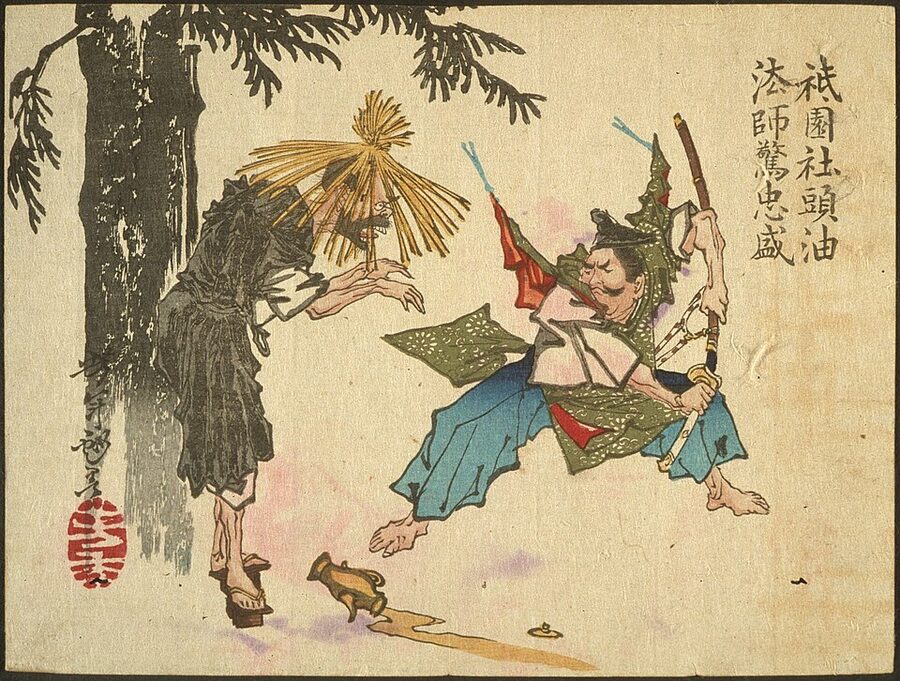
Tadamori had his own Gion story, and it is the one the shrine still tells. The cloistered emperor Shirakawa kept a favourite known only as the Gion Nyōgo, the Lady of Gion, who lived beside the shrine and in 1105 built a hall there so lavish that a courtier’s diary called it extravagant beyond all measure. One rainy night, says the Heike monogatari, Shirakawa was on his way to her when his party saw a glowing shape ahead that seemed to bristle with silver needles; Tadamori was told to kill it, chose instead to seize it, and found an old monk of the shrine with an oil pot and a straw hat, lighting the lanterns. The Heike’s punchline is that Shirakawa rewarded him with the lady herself, already pregnant, and that the child was Kiyomori.
Historians do not believe the paternity story, and I suspect the Heike’s audience did not either; that was not the point. The stone lantern the old man is supposed to have been lighting still stands in the precinct, labelled Tadamori-dōrō. The shrine’s version keeps the courage and leaves out the baby.
The angry dead and the god of plague
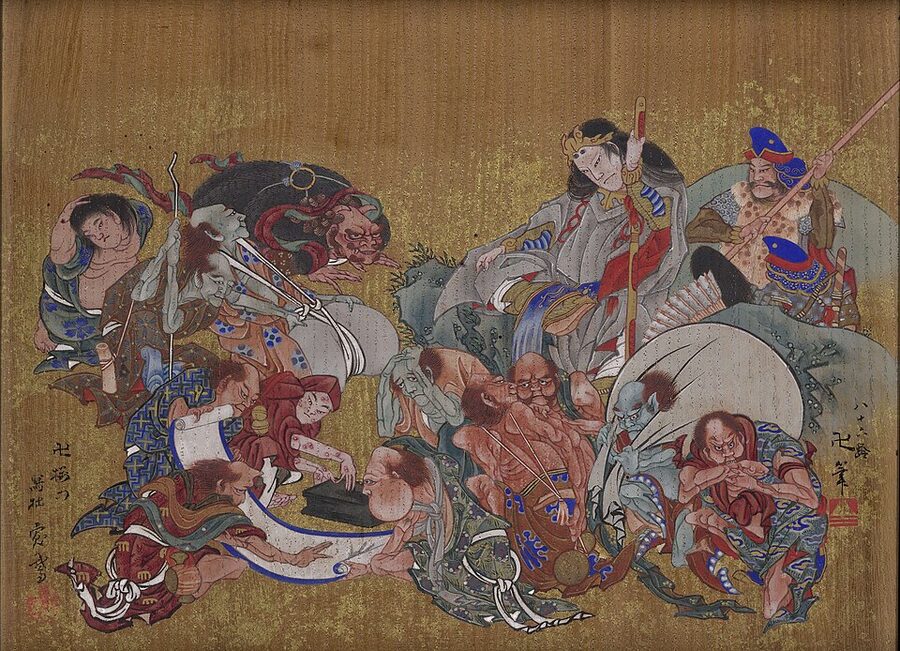
To understand why the court courted this god you need the idea of goryō (御霊), the honourable spirits, which is a polite name for furious ghosts. In the 9th century the court came to believe that epidemics were the work of people who had died wronged: Prince Sawara, who starved to death on the road to exile in 785, and a list of banished or executed nobles. The rite at Shinsen-en in 863 was held for six of them, with sutra readings, music and dancing, and with the gates of the imperial garden thrown open to the public. A goryō-e was a party for the dead, given in the hope that they would leave.
Gozu Tennō fitted this world and also changed it. He was not a wronged human but a god of epidemics in his own right, the general of the sickness rather than one of its victims, and that made the logic simpler: honour him properly and he would call off his own troops. By the end of the Heian period crowds were parading under flowered umbrellas and tall halberds to drive the pestilence out of the streets and herd it towards Gion, where the god would hold it. The god who sends the plague is the god who stops it.
The court took him very seriously. In 975 Emperor En’yū, recovered from smallpox, ordered a thanksgiving festival at Gion on the 15th day of the sixth month, held yearly from 1124 until 1450. Gion joined the select group of shrines that received imperial offerings in a crisis in the 990s (Japanese sources date its listing to 995, English ones often to 994), and from 1072, when Go-Sanjō came in person, emperors and retired emperors visited regularly.
And the god travelled. The shrine now heads a network it puts at about 2,300 shrines; older reference works count over 3,000 Yasaka, Gion and Tennō shrines across Japan. The Tsushima Tennō Matsuri, with its lantern boats, belongs to the same god, and so do the Gion festivals of Hakata and Aizu-Tajima. When you see “Tennō” in a Japanese place name, Tennōzu in Tokyo for instance, the emperor is often not involved: many such names come from the Ox-Head King.
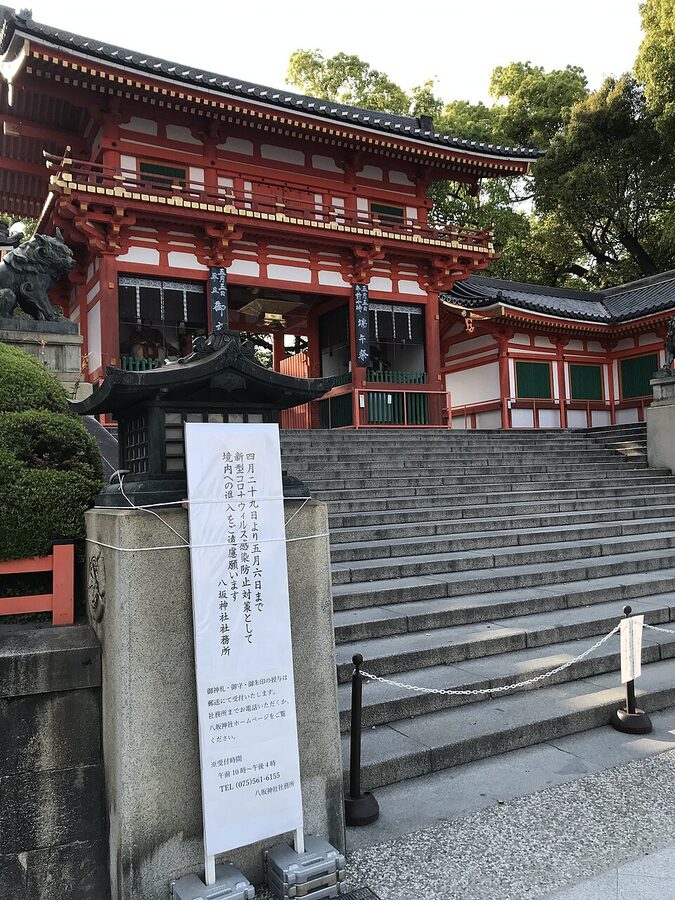
I did not expect any of this to feel current, and then 2020 happened. That spring the shrine pulled up the bell ropes in front of the main hall so that no one would touch them, set up a special reed ring for people praying for the epidemic to end, and on some days in May closed the gates of a precinct that is normally open all night, every night. In 2022 it began a new ceremony, exchanging sacred water with Shinsen-en, the garden of the 863 rite. A thousand years on, the shrine was doing exactly what it was built to do.
War, a gate from 1497 and a new patron
The Ōnin War burned Gion along with most of Kyoto from 1467, and for once the shrine had no protector strong enough to rebuild it quickly. The god was formally reinstalled in a repaired sanctuary only in 1492, and the festival procession was not revived until 1500, thirty-three years after the last one. The west gate went back up in 1497, and it is now the oldest building in the precinct: the vermilion two-storey gate at the top of Shijō that appears on every postcard of Gion.
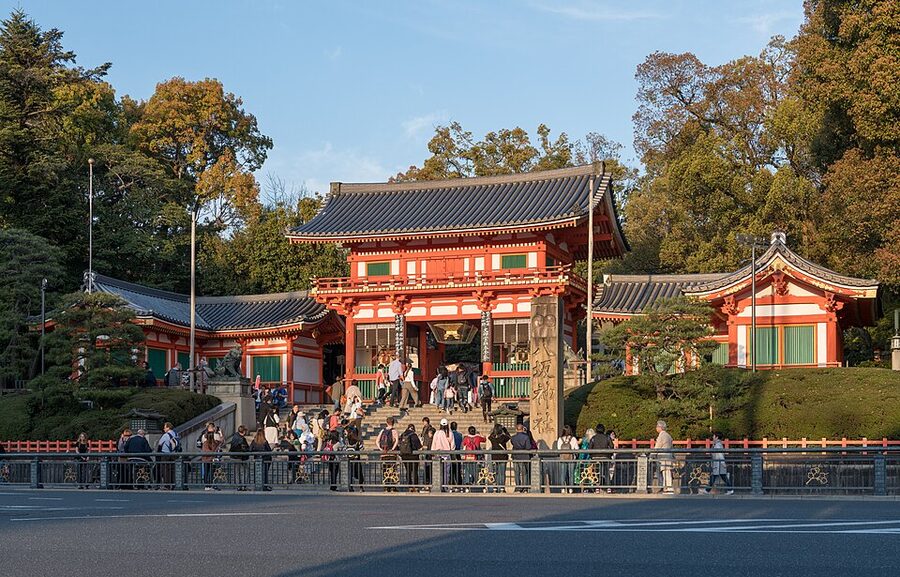
Hiei’s grip loosened in stages. In 1384 the shogun Ashikaga Yoshimitsu detached Gion from Enryaku-ji’s direct control, and the Ashikaga house treated the shrine as its own patron, but the mountain could still stop the festival: in 1533 it had the procession cancelled, and the float districts replied that even if the shrine held no rites, they would like to run the floats anyway. Hiei’s control ended for good in the ninth month of 1571, when Oda Nobunaga burned Enryaku-ji and killed its monks.
The next patron was a peasant’s son. In 1590 Toyotomi Hideyoshi prayed at Gion for the recovery of his mother, Ōmandokoro, then gave the shrine 10,000 koku and rebuilt its great pagoda. The following year he merged the festival’s two downtown lodging places into one, at Shijō Kyōgoku, where the god’s palanquins still spend a week each July. One of the old lodgings had been called the Ōmandokoro long before Hideyoshi’s mother held that title, a coincidence I have never seen explained.
The Tokugawa shogunate was more careful with money and more careful with its image. It repaired the main hall at its own cost and reinstalled the god on the 28th day of the fifth month of 1646; on the 18th day of the eleventh month of the same year the hall burned down. It was rebuilt in 1654 on the orders of the fourth shogun, Ietsuna, and the shrine notes, a little pointedly, that this was the last building project the shogunate ever carried out directly for a temple or shrine. Every later repair was paid for by the float districts and the parishioners.
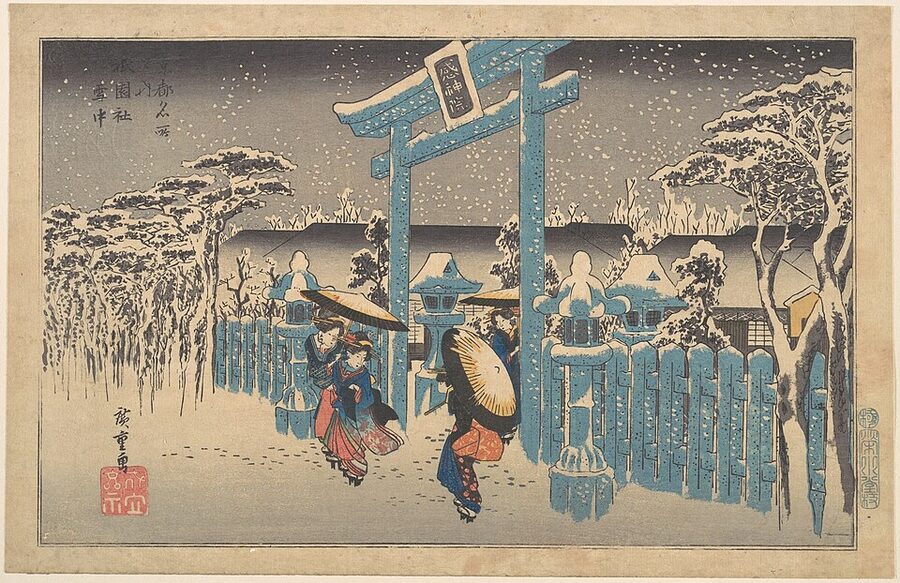
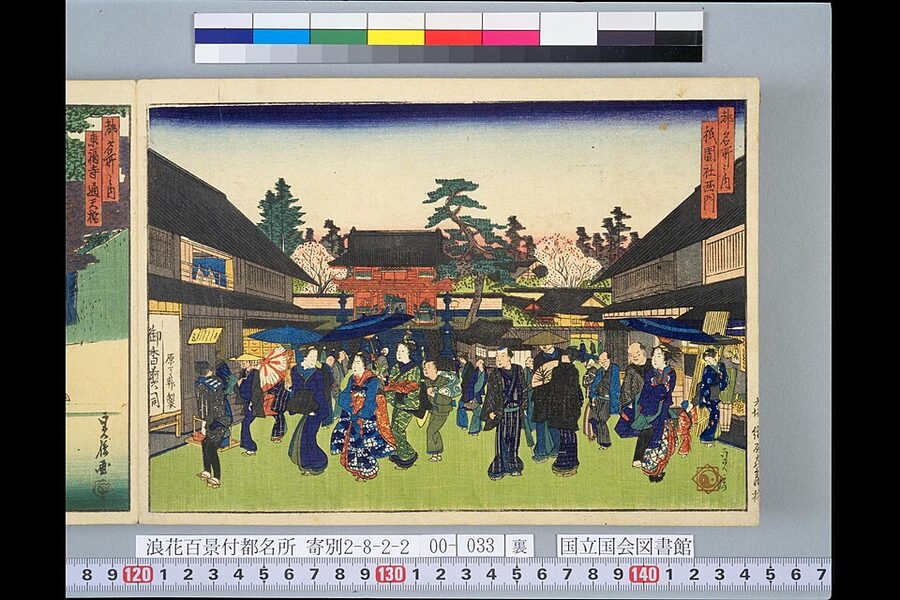
By the late Edo period the district of Gion, which grew up as the shrine’s front yard, catered first to pilgrims and then to everybody else.
1868: the year the Ox-Head King disappeared
In the third month of 1868, the first spring of the Meiji Restoration, a series of orders known together as shinbutsu bunri, the separation of kami and Buddhas, told shrines to remove their Buddhist images, dismiss their Buddhist clergy and drop their Buddhist names. Gozu Tennō was named in the notices, alongside the gongen, the Buddhist-style avatars, as exactly the kind of hybrid god the new state did not want. For a place that was Buddhist down to its name, it amounted to an order to become somebody else.
It became somebody else with remarkable speed. Kanshin-in was abolished, and Gion-sha became Yasaka Jinja, after the old name of the district; Gozu Tennō became Susanoo, his wife became Kushinada-hime, the princess Susanoo saved from the serpent, and the eight princes became Susanoo’s eight children. The monks were sent away, and the hall of Yakushi that stood just west of the main hall, the last building of Ennyo’s Kankei-ji, was pulled down. The shrine dates its new name to 1868; some Japanese reference works give 1871, which is also the year it entered the new state ranking of shrines.
The Buddhas went to other temples. The standing Yakushi that had been the god’s Buddhist true form, a late Heian figure probably carved just after the fire of 1070, went to Dairen-ji, a Pure Land temple, along with an eleven-headed Kannon of the 10th century, and the temple bell went to Daiun-in. The plaque that hung on the stone torii, reading Kanshin-in in the hand of an imperial prince, was taken down. And the dragon’s pond, in the shrine’s own words, was sealed along with the rest, though the plaster must have gone on some time after a boy saw water there in 1905.
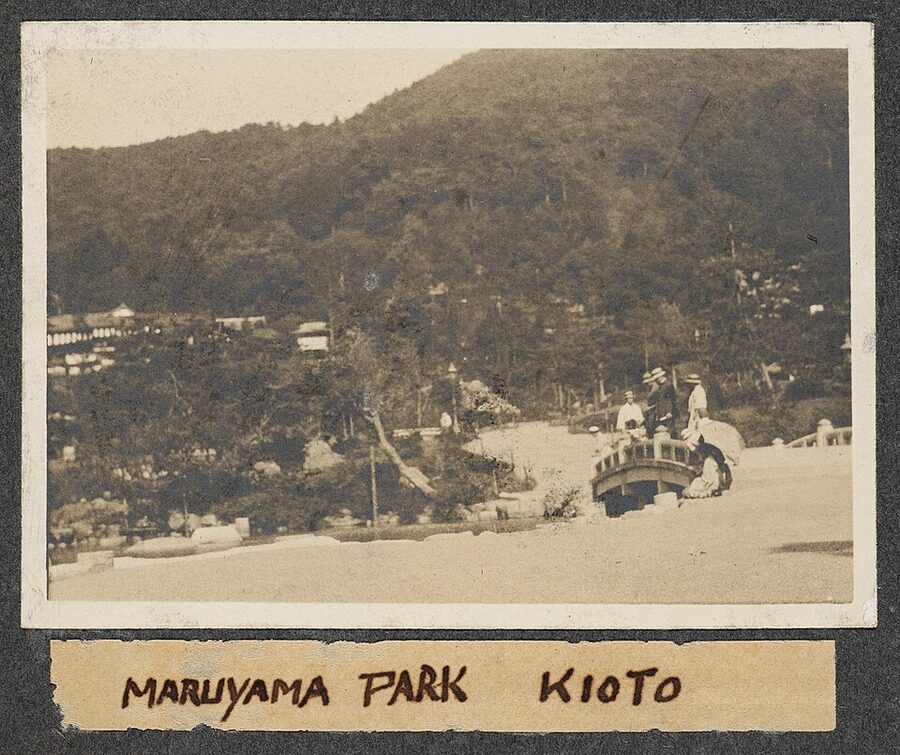
Maruyama Park is another product of that year and the ones that followed. In 1871 the government confiscated temple and shrine land across Japan, and the hillside behind the shrine, part of it Kanshin-in’s and part of it the grounds of three neighbouring temples, became state property; it opened as a public park in 1886 and became Kyoto’s first city park the following year. When you sit under the cherry trees there, you are sitting in a Buddhist garden that was nationalised.
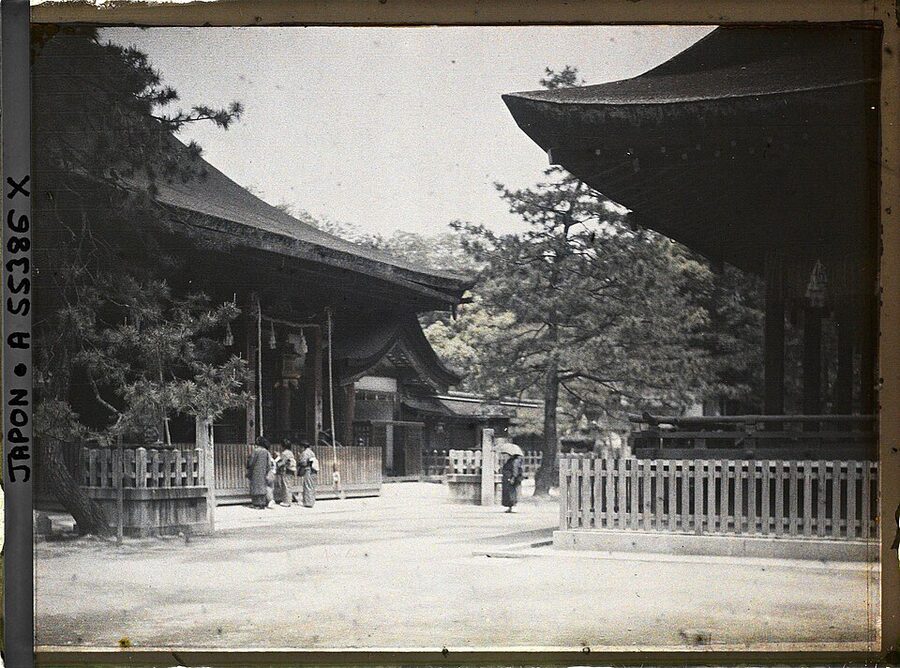
What survives is in the corners. The water basin inside the west gate still says Kanshin-in, a stone lantern inscribed Gion-sha is one of the few pre-1868 names left standing, and the shrine still lists a wooden seated Gozu Tennō among its Important Cultural Properties. On 20 July 2024, in the middle of the festival, monks of Enryaku-ji came down the mountain and prayed with the priests inside the main hall. The shrine has since launched an appeal to “restore the Kanshin-in of Reiwa”, bringing back rites from the Buddhist centuries.
I find this oddly moving and also slightly comic. A century and a half after the state told the god to stop being Buddhist, his shrine is asking the Buddhists back, and from the very mountain whose men used to carry Gion’s palanquins into the capital to bully the emperor. The chief priest’s appeal mentions the pandemic, the Noto earthquake and the wars in the news. When things go badly enough, Kyoto has always gone back to the god who sends the plague.
One roof over the god
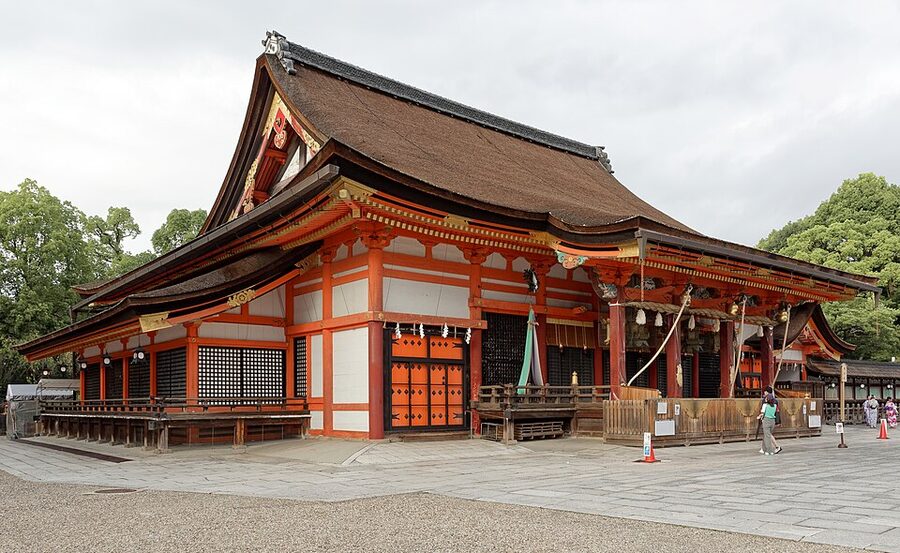
The main hall is the reason the national government finally gave Yasaka its highest rating, and it is stranger than it looks. Most shrines put the god in one building, the honden, and the worshippers in another in front of it, the haiden. At Yasaka a single huge hip-and-gable roof of cypress bark covers both, and around three sides, north, east and west, extra lean-to eaves called matabisashi shelter a ring of small rooms. The style is unusual enough to have its own name, Gion-zukuri (祇園造), and by floor area this is the largest main hall of any shrine in Japan.
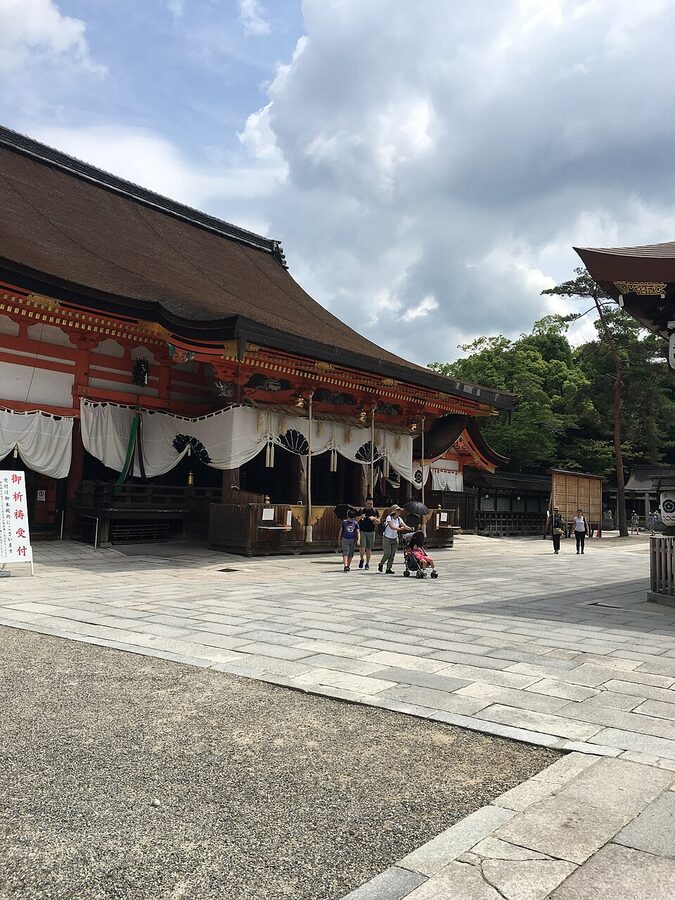
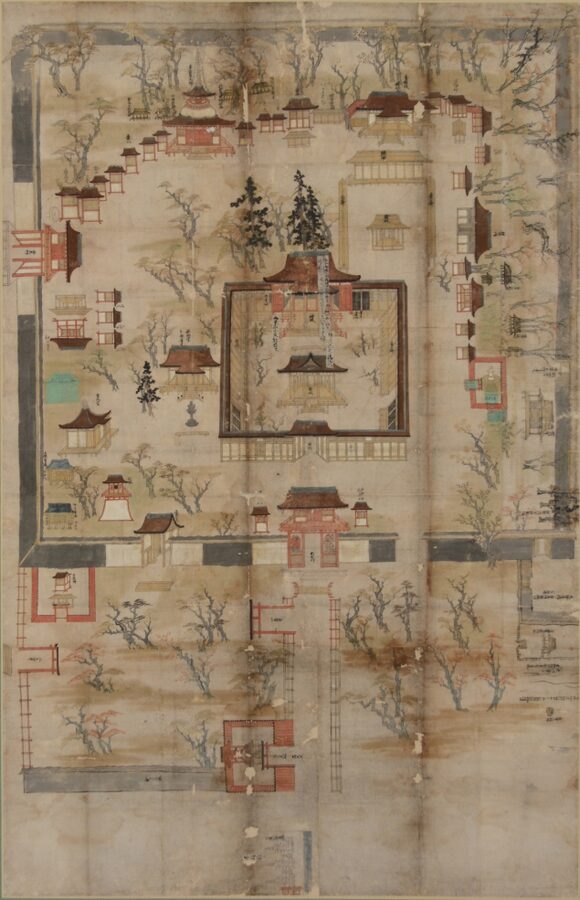
The form is old even though the timber dates from 1654. A decree of 935, quoted in a Muromachi compilation, describes a five-bay sanctuary for “Tenjin, Barime and Hachiōji” and a separate five-bay worship hall, both roofed in cypress bark. When fire destroyed the hall in 1220, the damage report in the diary of the courtier Kujō Michiie describes a building that matches the present one, so the single-roof plan must have been in place by the rebuilding of 1148 at the latest. A floor plan of the 14th century, labelled room by room, shows the same inner sanctuary, the same ring of chambers, even columns painted on one face only, as they still are.
The plan explains a great deal. Shrine halls are meant to be closed boxes in which a god lives unseen, but this is a building made for people to come inside, sit up all night in side rooms and recite scripture close to the god, and one of those side rooms was labelled the sutra room. That is what a Buddhist hall is for, and the Gion-zukuri is what you get when a shrine spends centuries in the care of monks.
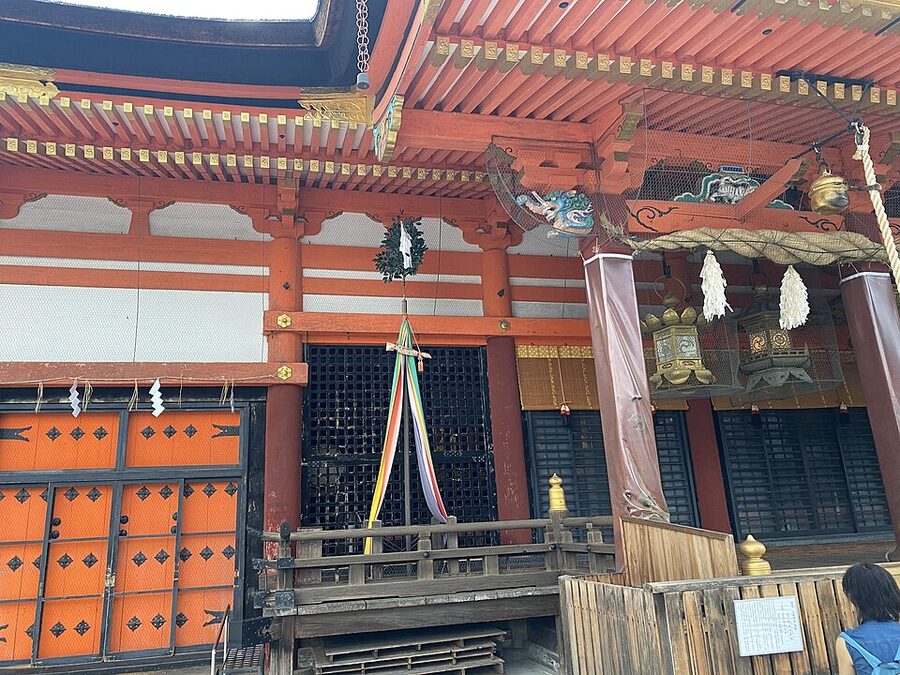
The hall had been on the national protected list since 1911. On 16 October 2020 the Council for Cultural Affairs recommended raising it to National Treasure, and the designation took effect on 23 December, with 26 more buildings in and outside the precinct added to the list of Important Cultural Properties at the same time, 29 in all. The choice is telling. Alongside the obvious candidates it includes the 1928 storehouse for the festival palanquins, made almost entirely of concrete cast to look like wood, and the god’s lodgings downtown.
The shrine’s explanation is that the treasure is not just a hall but the community that kept it standing: the float districts, the palanquin-bearers’ streets and the parishioners who paid for every repair after 1654. I agree, and I would add one thing. The state that had ordered this building’s Buddhist life stripped out in 1868 chose in 2020 to honour it for preserving a plan that took shape over centuries of monks and worshippers sleeping under one roof with their god. History in Japan rarely apologises, but occasionally it changes the subject.
Where to see Yasaka Shrine today
Yasaka Shrine stands at the east end of Shijō-dōri, where the street runs into the hills, in Kyoto’s Higashiyama ward. It is free, it never closes, and it is the natural start or finish of the best short walk in Kyoto, south through the old lanes to Kōdai-ji and Kiyomizu-dera. I checked every hour and price below on the official websites in November 2026; check them again before you go, especially around New Year.
Getting there and opening hours
The nearest station is Gion-Shijō on the Keihan line, about five minutes’ walk east along Shijō; from Kyoto-Kawaramachi on the Hankyū line it is about eight minutes. From Kyoto Station, city buses 100 and 206 stop at Gion, right outside the west gate, though in cherry and maple season you will often walk faster than the bus moves. There is no parking at the shrine.
The precinct is open for worship 24 hours a day and admission is free. The shrine office, where you can also get amulets and the shrine’s stamp, is open 9:00–17:00, and formal prayers are taken 9:00–16:00. For anything else, use the shrine’s own website, which has a short English section.
The front door and the side door
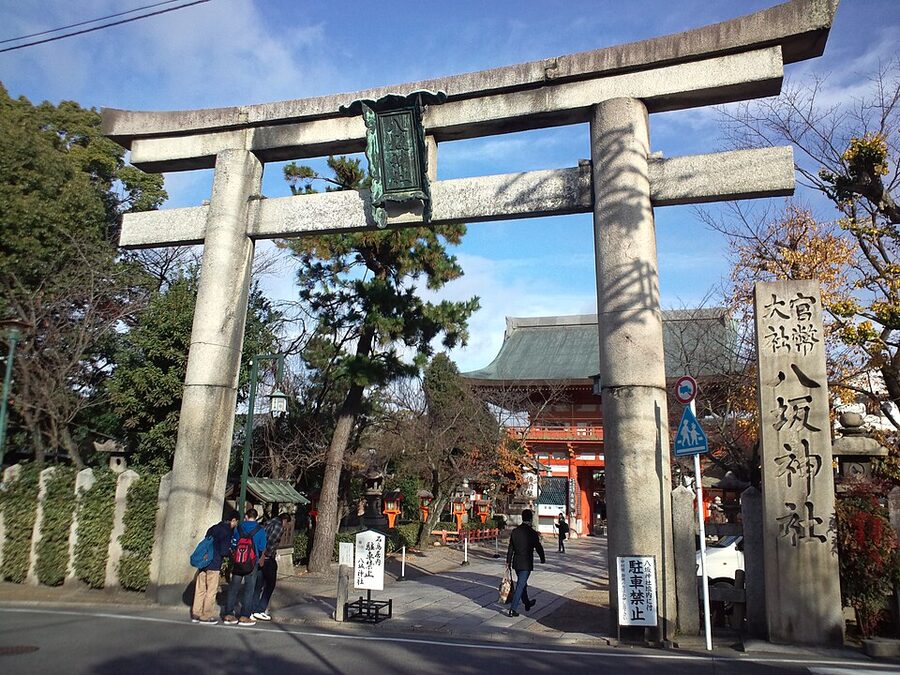
Almost everyone comes in through the west gate from Shijō, climbs the steps past its two guardian figures, and walks into the precinct from the side. That is the side door. The front door is the south gate, the Minami-rōmon, rebuilt in 1879 after an 1866 fire, with the stone torii of 1646 standing before it on the Shimogawara road; the palanquins leave from here every July, and wedding processions still start from it. If you want to approach the shrine the way it was meant to be approached, walk round to the south, through the torii, and enter on the axis of the main hall.
Inside the precinct
The dance stage in front of the main hall, the buden, is hung with paper lanterns given by the teahouses of Gion and the restaurants nearby, each carrying the donor’s name, and they are lit every night. Weddings take place here, offerings of dance are performed here, and the three palanquins rest here before they go out in July. If you are interested in the geiko and maiko of Gion, the lantern names are a free directory of the district’s houses.
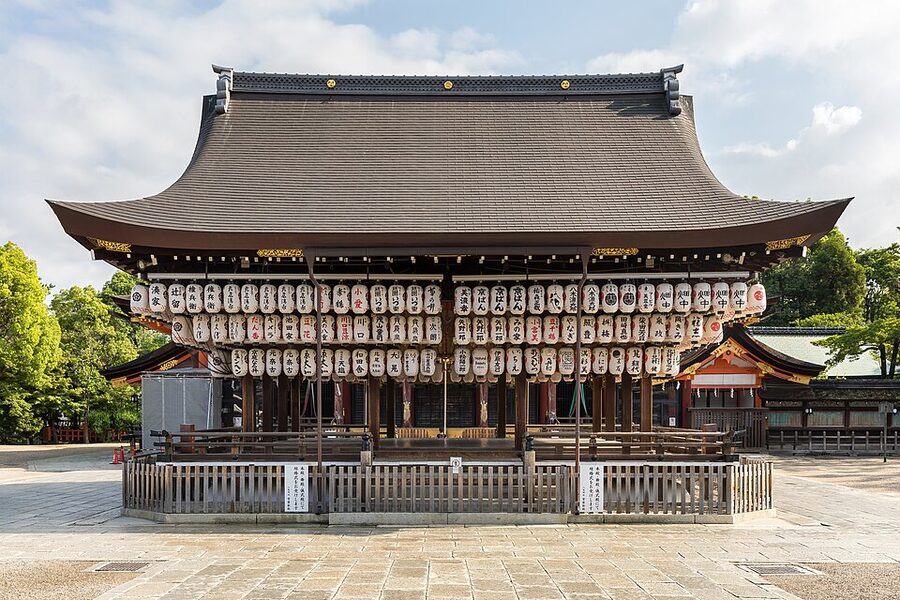
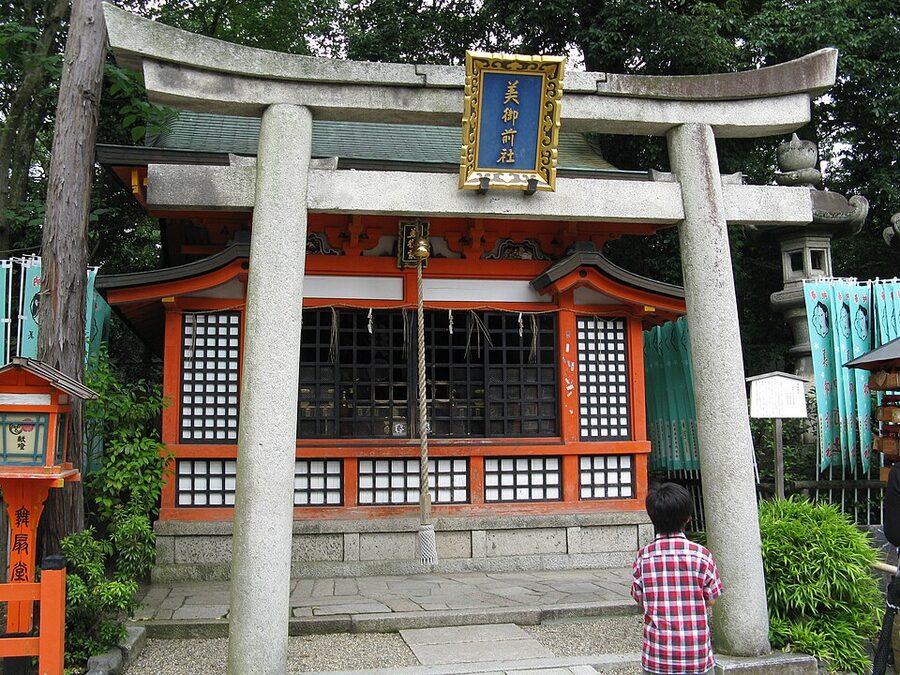
Then walk round the smaller shrines, which is where the old Gion survives. The Utsukushi-gozen-sha (美御前社), built in 1591, houses the three Munakata goddesses who, in the myth, were born from Susanoo’s sword during his contest of oaths with his sister Amaterasu; one of them, Ichikishima-hime, is the goddess of Itsukushima. Because the goddesses were said to be beautiful, the shrine is now dedicated to beauty, and Kyoto’s barbers and hairdressers hold a thanksgiving here on the third Monday of November. A spring beside it, the biyōsui, is said to make you beautiful in body and spirit if you dab two or three drops on your skin.
Look out for three more. The small Hiyoshi-sha guards the shrine’s northeast, the “demon gate” through which oni and misfortune were thought to enter, and its gods are those of Hie at Sakamoto, the guardian shrine of Mount Hiei: the mountain is still keeping watch here, in miniature. The Akuōji-sha holds the rough spirit of Susanoo, his aramitama, and the shrine takes care to explain that aku here means strong, not wicked. In the Ema-dō, the hall of votive pictures, look for the replica of a sangaku, a wooden board of mathematics problems offered in 1691, whose original is an Important Cultural Property.
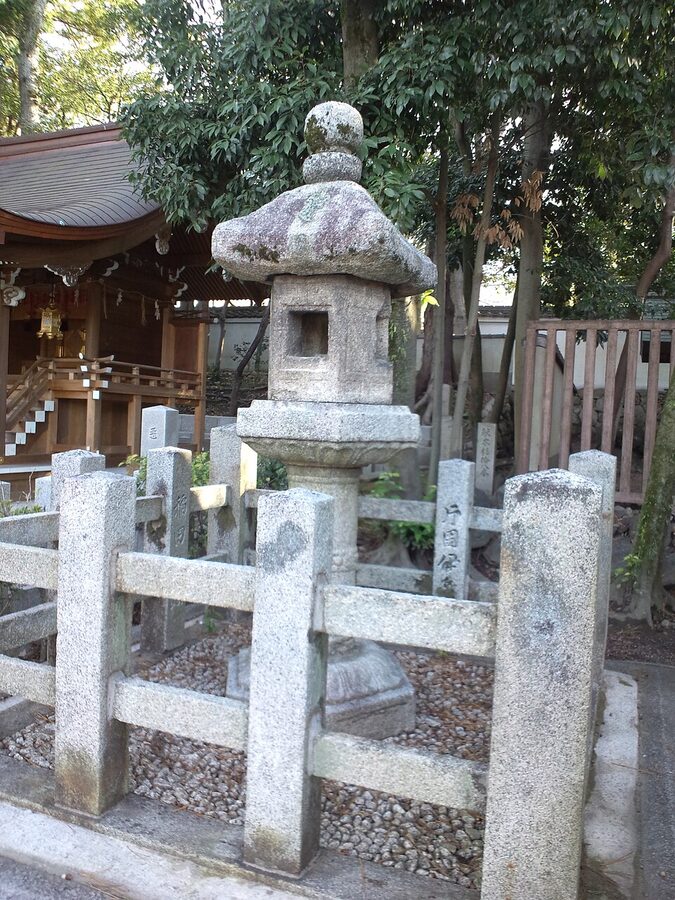
Look too for the gekka hyōjin-seki, a stone that served in the late Edo and Meiji years as a message board for families looking for lost children. Outside the south gate, the restaurant Nakamura-rō is the survivor of two teahouses that once faced each other there.
The shrine’s year
Beyond the Gion Matsuri, one of Japan’s greatest festivals, the shrine’s year is worth knowing. On 3 January the Kongō and Kanze schools take turns to perform Okina, the most sacred piece of Noh, on the shrine’s stage. Setsubun on 2 and 3 February brings bean-throwing and maiko dances, and the annual festival on 15 June keeps the date of the imperial thanksgiving of 975. The Omotesenke and Urasenke schools hold a monthly tea gathering in the shrine’s tea pavilion.
The shrine at night
Yasaka’s gates face all four directions, so it is one of the few major shrines in Kyoto you can walk into at midnight, and the lanterns of the dance stage and the hundred or so lanterns around the precinct are lit after dark. To my mind it is the best time to come: the stalls have shut, the tour groups are back at their hotels, and the west gate glows over Higashiōji like stage scenery. From about 17:00 to about 6:00 the bell ropes in front of the main hall are pulled up for safety, so at night you pray without the bell.
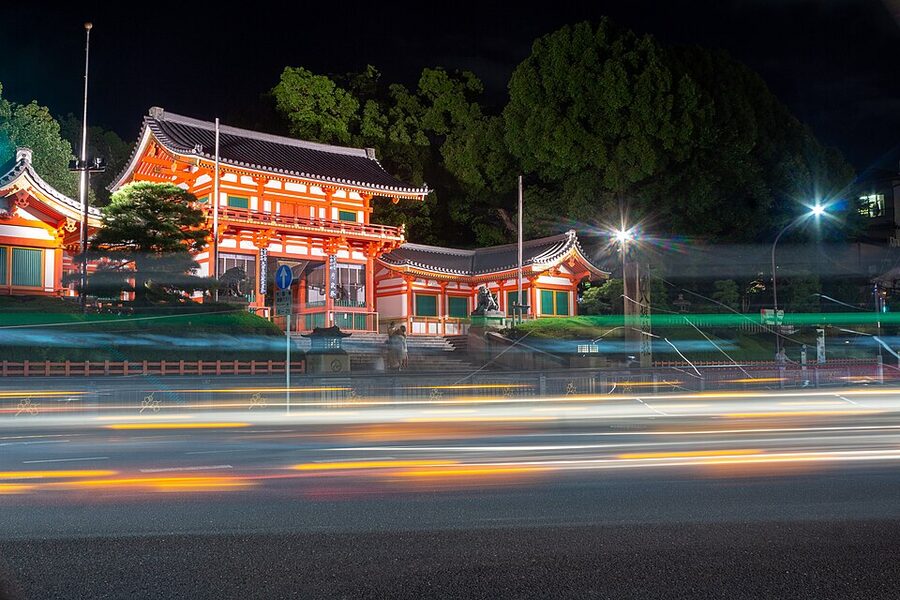
Two points of etiquette are worth knowing. The shrine has no objection to personal snapshots, but in 2024 it banned commercial shoots, tripods, selfie sticks, parasols and other props, photographing amulets, photographing inside the main hall, and standing in the centre in front of the hall to take pictures; staff who ask you to stop may also ask you to leave. Bow at the torii on the way in and out, keep to the side of the path, since the middle belongs to the god, and pray with two bows, two claps and one more bow.
Okera-mairi on New Year’s Eve
The best night of the year at Yasaka is the last one. At four in the morning of 28 December a priest makes fire the old way, with a wooden drill and block, and lights the okera lantern inside the main hall. On the evening of the 31st, after the year-end rite at 19:00, that fire is carried out to lanterns in the precinct and fed with okera, the dried root of a medicinal plant of the daisy family that burns with a sharp, clean smell, and with sticks of wood on which people have written their wishes for the year.
From about 19:30 until about 5:00 on New Year’s morning, people queue to light a coil of bamboo rope, the hinawa, from the flame. The point is to get the god’s fire home. You whirl the rope to keep it alight, and in the old days the ember lit the kitchen fire for the New Year soup.
These days the trains and buses will not let you board with a burning rope, so most people put it out and hang the rope in the kitchen as a charm against fire. The shrine sells a hanging rope that has already taken the okera fire for ¥1,000. Free okera sake was served too, until queues of visitors who had read about it online stretched out of the precinct; it stopped from 2019.
It used to be ruder. In the Edo period the lamps of the precinct were put out at the end of the year’s last night, and in the dark the crowd traded insults, the fouler the better; Ihara Saikaku wrote the custom into a story published in 1692. At 5:00 on 1 January the priests hold the Okera-sai in the main hall and scatter burning shavings mixed with okera onto the stones in front of it. If you are quick you can light your rope from those too, before they burn out in a dozen seconds or so.
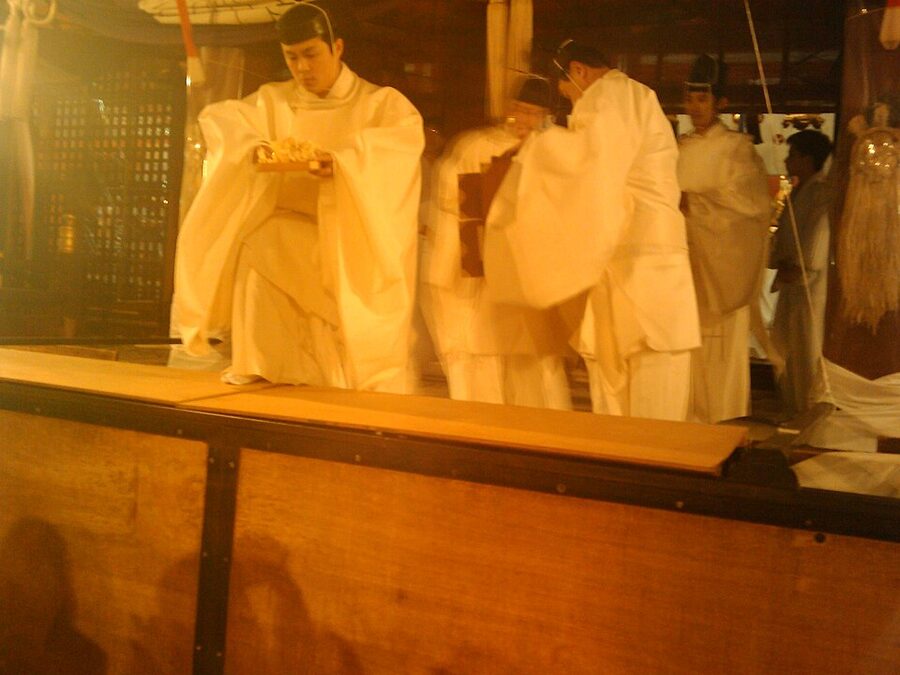
A practical warning: the shrine draws about a million people over the first three days of the year, second in the Kyoto area only to Fushimi Inari, and the approaches are packed on the night of the 31st. If you want the okera fire without the crush, come when it starts at about 19:30, or after 3:00 in the morning, and leave by the south gate.
Maruyama Park and the weeping cherry
Walk through the shrine and out the back and you are in Maruyama Park, a national Place of Scenic Beauty, free and open day and night. Its centrepiece is the Gion shidare-zakura, a single-flowered white weeping cherry that is lit up at night in season and is one of the most photographed trees in Kyoto. The original, a tree of great age, died in 1947. The one you see is its successor, raised by the cherry-keeper Sano Tōemon XV, whose family has tended Kyoto’s cherries for generations.
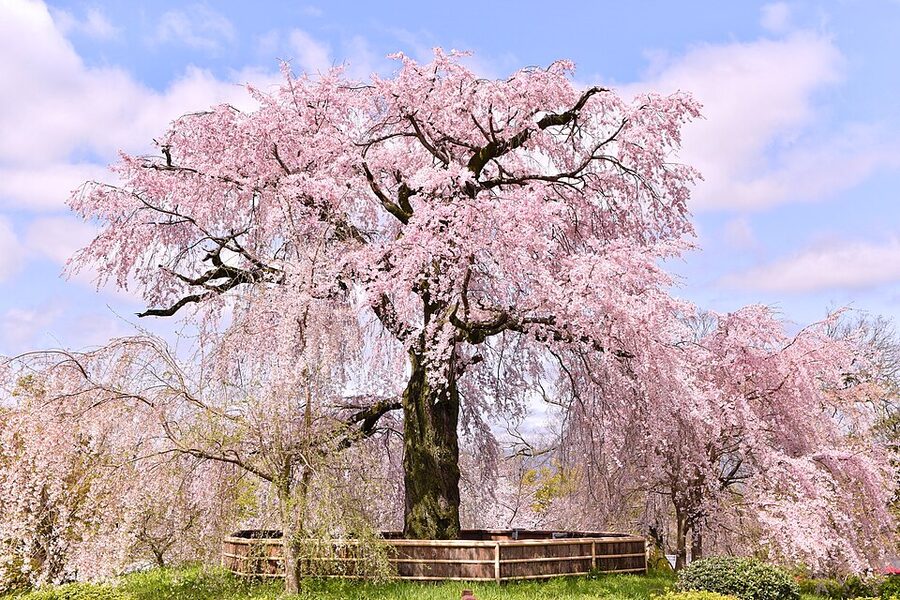
The second tree has had a hard life, with crows breaking its twigs, and in some springs it looks thin. It is still worth seeing at dusk on a weekday in the cherry blossom season, usually late March or early April. The night-time cherry party here, with food stalls, blue plastic sheets and a great deal of beer, is one of Kyoto’s least refined traditions and one of its best.
Chion-in and Hōnen’s grave
On the north side of the park the enormous gate of Chion-in, head temple of the Jōdo school, rises over the trees. Climb behind the temple to the mausoleum of Hōnen and you are standing on the hillside where Hiei’s bowstring sellers came with their tools in 1227 to smash his first grave. The temple gates are open 6:00–16:00, with paid areas from 9:00. Pure Land Buddhism won that argument in the end, and the size of the gate is the evidence.
South to Kōdai-ji and Kiyomizu-dera
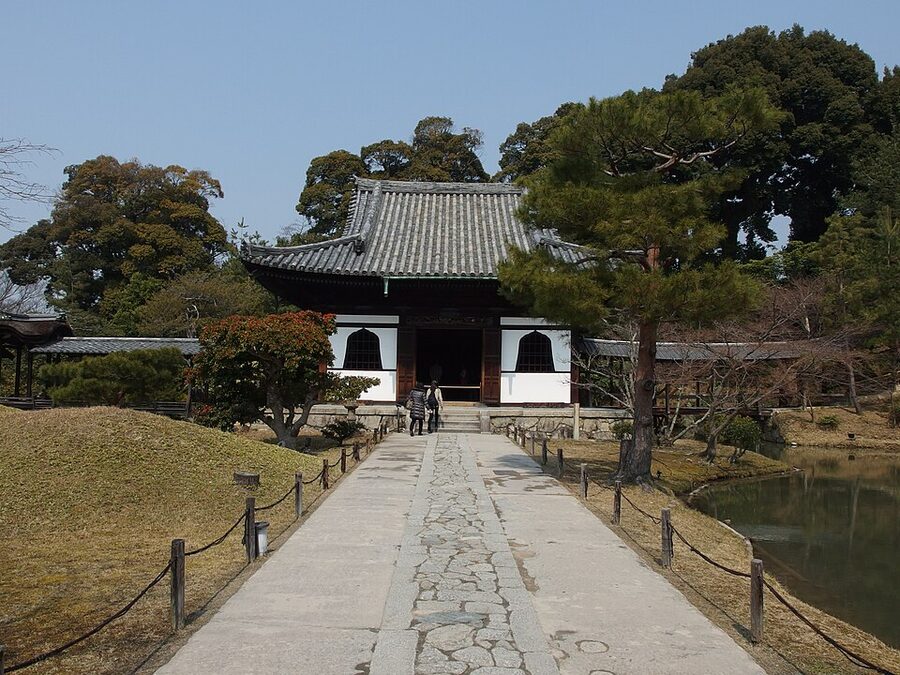
From the south gate the walk to Kiyomizu-dera takes about twenty minutes without stopping, which nobody manages. Turn south along Nene-no-michi, the stone-paved road named after Hideyoshi’s widow, and step into Ishibe-kōji, a lane of stone walls, inns and closed gates that wanders off to the west and is at its best on a wet evening. Kōdai-ji, which Nene founded in memory of Hideyoshi in 1606, is up the steps on the east side: it opens 9:00–17:30 (last entry 17:00), costs ¥800 for adults, and stays open until 22:00 for its autumn evenings, which this year run from 23 October to 13 December.
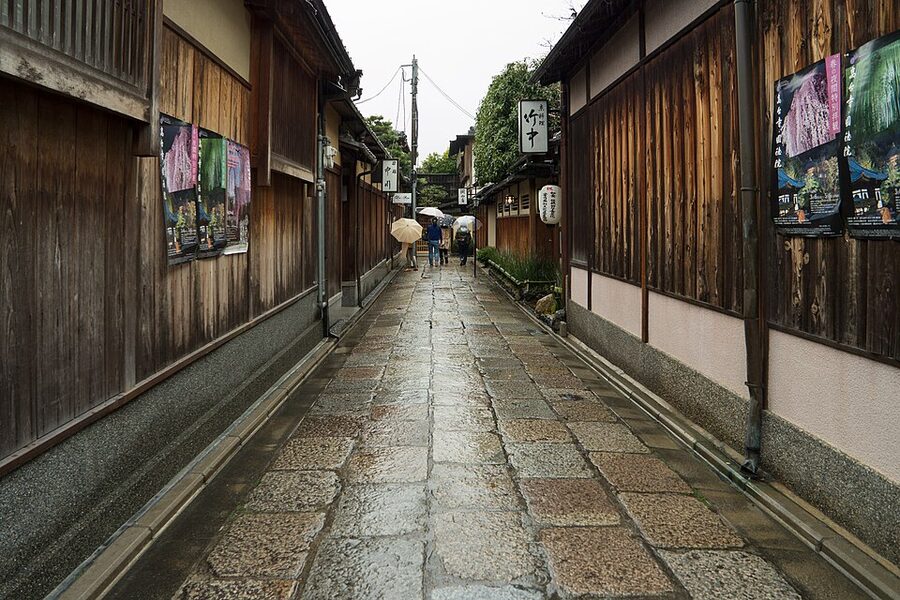
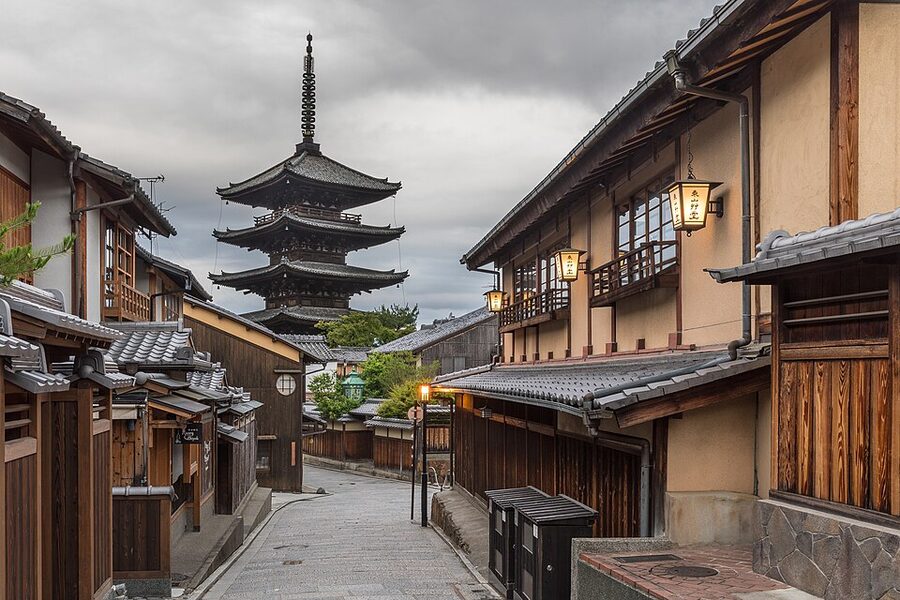
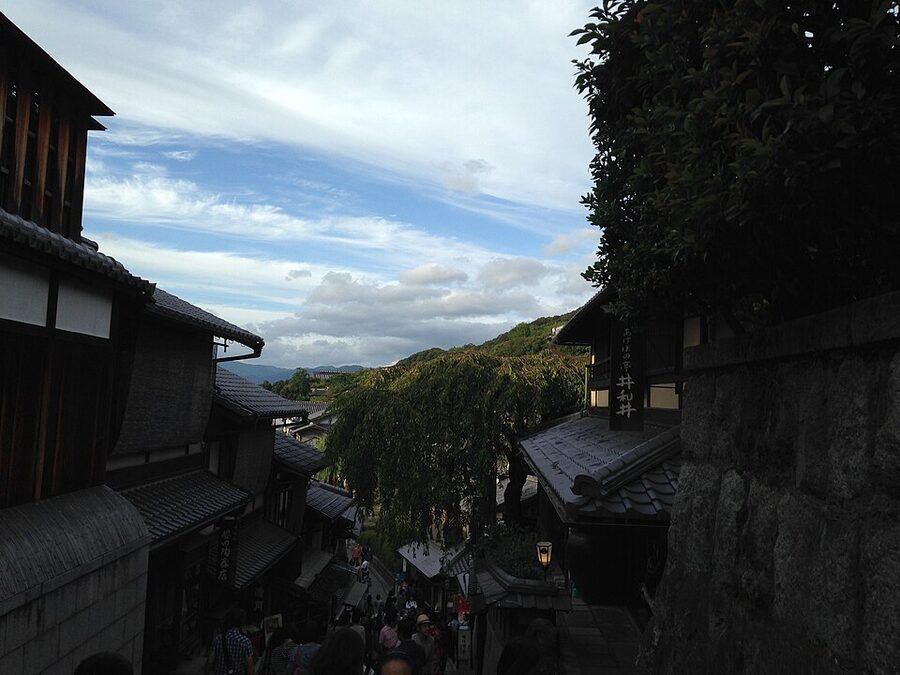
Below Kōdai-ji the lanes drop to the Yasaka pagoda and climb again by the stone steps of Ninenzaka and Sannenzaka, lined with shops selling pickles, pottery and sweet-bean everything, to Kiyomizu-dera. The temple opens at 6:00 and closes at 18:00 (18:30 in July and August), with evening openings in spring, summer and autumn; this autumn’s run from 21 to 30 November, 17:30–21:00. The full story of the temple is in my piece on Kiyomizu-dera, but keep Gion in mind as you climb: these were the two great sanctuaries of Higashiyama, one Nara’s and one Hiei’s, and the road between them was a border.
The god’s houses downtown
If you have time, follow the god into the city. The Shijō Otabisho, on Shijō just east of Teramachi, is where the three palanquins spend the week from 17 to 24 July; for the rest of the year its storehouse is a souvenir shop, which seems fair. The Ōmandokoro, the old lodging on Karasuma, is a tiny shrine between office buildings, and the Shinsen-en garden, where the rite of 863 was held, is just south of Nijō Castle. The Yakushi that was the god’s Buddhist self is at Dairen-ji in Sakyō ward, an active temple rather than a museum, so ask before you go.
Under the floor
The shrine now takes small groups of its supporters inside the main hall for what it calls ryūketsu-mairi, a pilgrimage to the dragon’s hole, though what they see is the inside of the hall; the pond itself stays under its plaster. I have not been. A pond 150 metres deep, or bottomless, sealed under the god’s seat on a date nobody wrote down, is better as a story than as a dome.
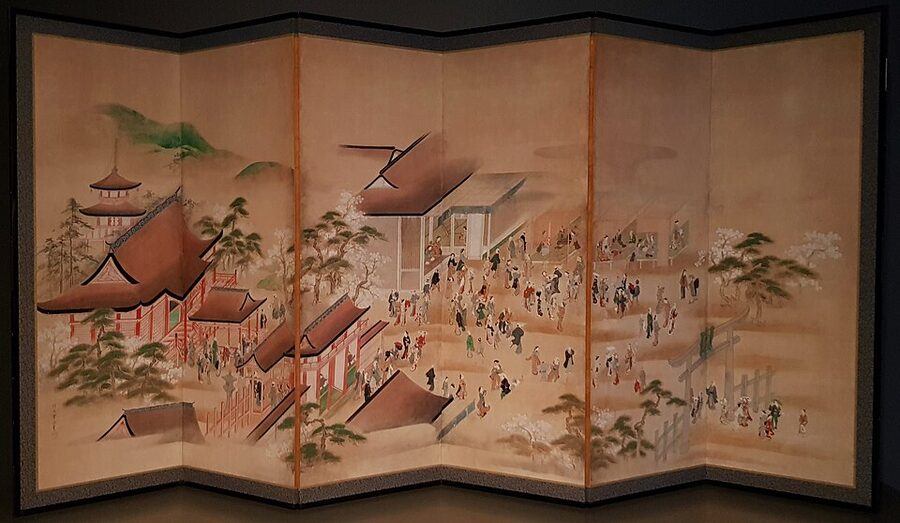
So go at night, walk round to the south, and stand where the painter of 1331 put the main hall at the centre of the world. Somewhere under your feet is the water a boy saw in 1905, and above it is a god who has had at least four names and still answers to all of them. Buy a Somin Shōrai charm on the way out. It is the cheapest insurance in Kyoto, with a thousand years of claims behind it.