Some time after his eightieth birthday, the most famous painter in Japan folded his arms over a sheet of paper, stared at it for a while, and wept because he could not draw a cat. His daughter told the story to one of his pupils, and she told it as a joke at the old man’s expense. Then she added the part that made it worth repeating: that the day you feel you are falling short is the day you are getting better. The old man, sitting beside her, said “Quite right, quite right.”
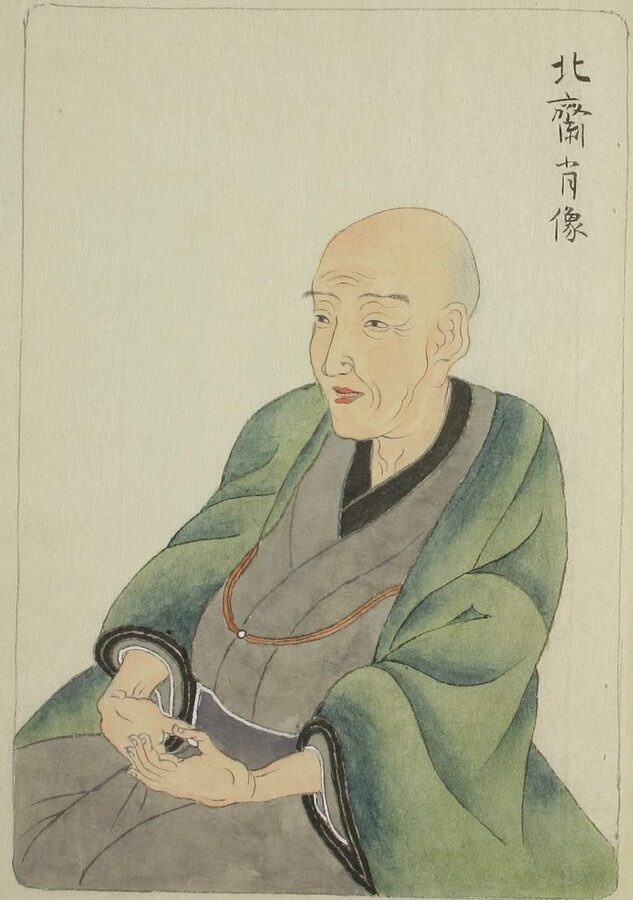
That was Katsushika Hokusai (葛飾北斎) at the end of seventy years with a brush in his hand. By then he had used something over thirty names, moved house, by the count his first biographer collected, ninety-three times, published more than 30,000 pictures by the most generous reckoning, and designed the single image of Japan that the rest of the world knows best. He was also broke, filthy, a famous nuisance to landlords and convinced that he had barely started. I find the cat more useful than the wave if you want to understand him, and I think by the end of this you will too.
In This Article
- A mirror-maker’s boy from the wrong side of the river
- Shunrō, actor prints and the Katsukawa years
- Thirty names, and what each one was for
- Foreigners, giants and a novelist
- The Manga: thousands of drawings for people who never met him
- Iitsu and the blue: the Thirty-six Views of Mount Fuji
- At seventy-three I partly understood
- Ei, who signed herself Ōi
- Obuse: an eighty-three-year-old walks to Shinano
- Five more years: the death at Henshō-in
- How Europe found him first
- Where to see Hokusai today
- The Sumida Hokusai Museum, Ryogoku
- Seikyō-ji and the grave, Asakusa
- The Hokusai-kan, Obuse
- Ganshō-in, Obuse
A mirror-maker’s boy from the wrong side of the river
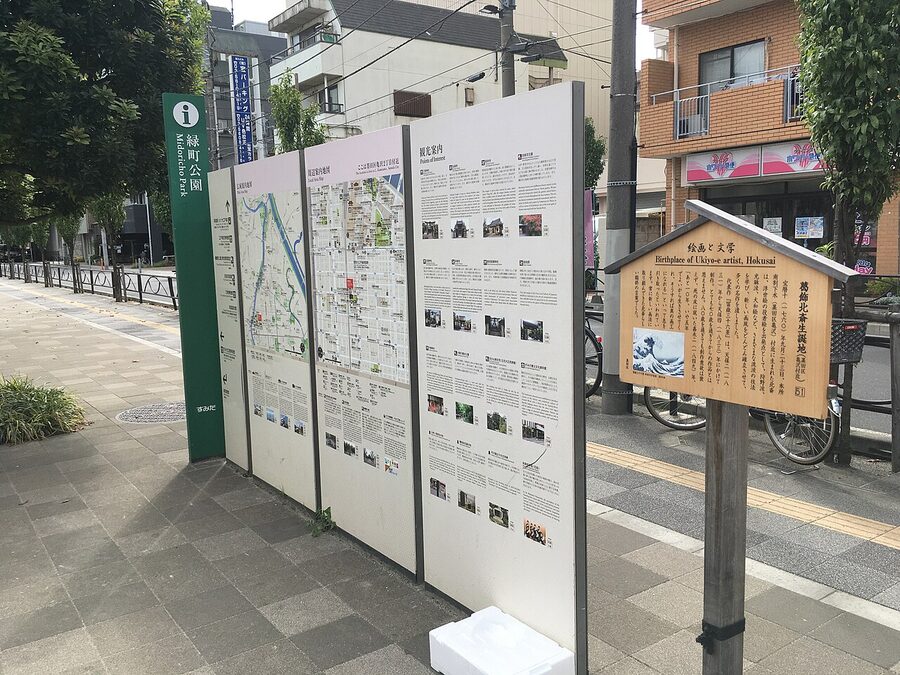
He was born in Honjo, the low, canal-cut district on the east bank of the Sumida River, on the 23rd day of the ninth month of 1760. The date comes from his own inscription on a painting he made at eighty-five, and modern reference works convert it to 31 October 1760 by the Western calendar. The neighbourhood was Warigesui, named after the drainage channel that ran through it, and the channel’s line is now a street called Hokusai-dōri. Almost everything else about his first years is disputed.
His childhood name was Tokitarō, later Tetsuzō. The usual account, which goes back to the biography the art historian Iijima Kyoshin published in 1893, has him born into a family called Kawamura and adopted at three or four by Nakajima Ise, a mirror-polisher by appointment to the shogun’s household. Other scholars think he was Nakajima’s own son, or his nephew, and the gravestone at his family temple says Kawamura. Nobody has found a document that settles it, and I would not hold your breath.
There is one family story worth knowing because it ties the boy from Honjo to the most famous revenge in Japanese history. Iijima records that Hokusai’s mother descended from Kobayashi Heihachirō, a retainer of Kira Yoshinaka who died defending his lord’s house on the night the 47 Rōnin broke in, and that Hokusai said so himself. English-language accounts often turn this into an adoptive grandfather killed in the raid. Japanese sources keep it on his mother’s side, and it is family lore either way.
He liked drawing from about the age of six, by his own later account. He may have worked as a boy in a lending library, though the scholar who annotated Iijima’s biography could find no source for that story. More solidly, from about fourteen to nineteen he cut woodblocks for a living, and in 1775 his hand carved the text of a small book of pleasure-quarter fiction called Rakujo kōshi. A man who has spent four years with a knife in a blockcutter’s shop knows exactly what a carver can and cannot do with a line, and Hokusai never forgot it: years later he was writing pointed letters to his publishers about carvers who had cut his noses in the wrong school’s style.
Shunrō, actor prints and the Katsukawa years
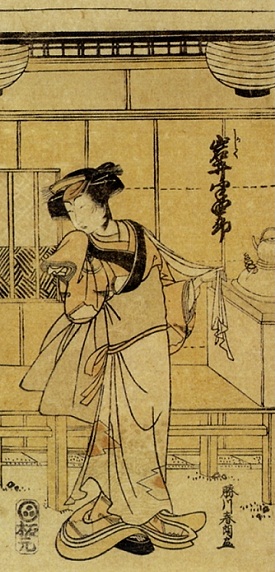
In 1778 he entered the studio of Katsukawa Shunshō, the leading painter of kabuki actors in Edo. Within a year he was publishing under the name Shunrō, and the name itself was a compliment: both characters came from his teacher, the “Shun” of Shunshō and the “rō” of one of Shunshō’s other names. Pupils were not usually given two. His first prints, in 1779, were three narrow actor portraits, among them Iwai Hanshirō IV as the courtesan Kashiku.
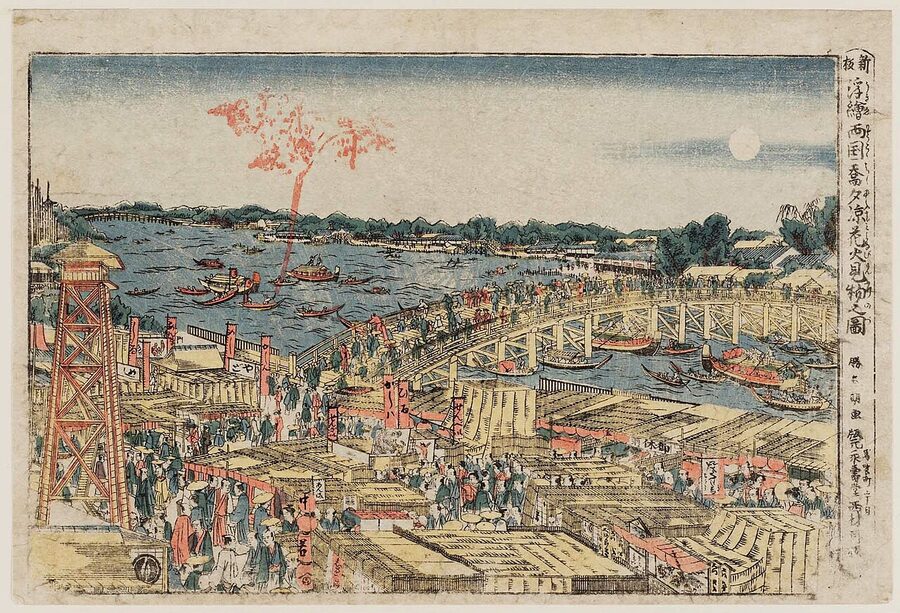
For the next fifteen years he did what a Katsukawa man did, and a good deal more. He drew kabuki actors and sumo wrestlers, beauties and children, warriors and legends, and he illustrated cheap comic novels by the dozen. He also experimented with uki-e, the “floating pictures” that borrowed Western single-point perspective from Dutch engravings, which is how a young ukiyo-e designer in a closed country learned to make a street recede to a vanishing point.
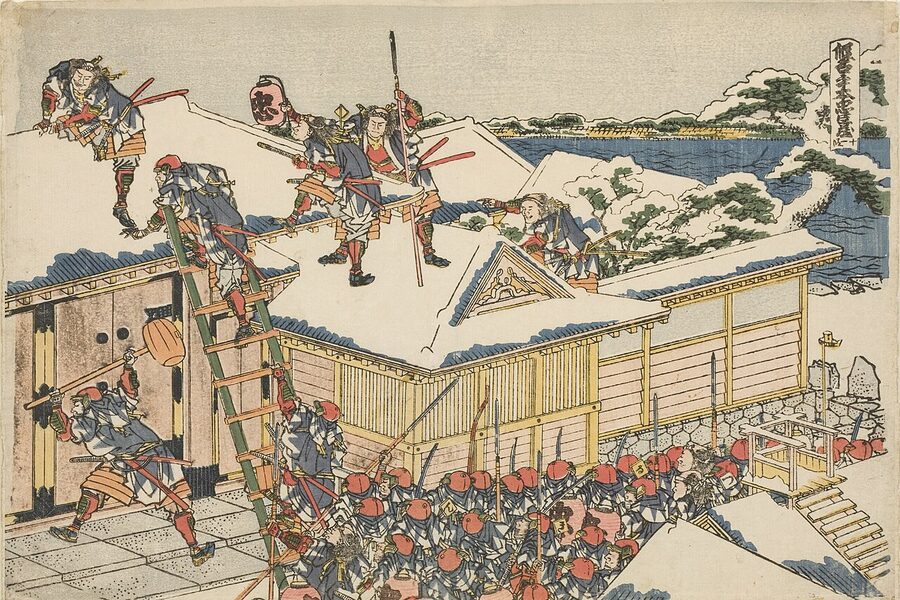
The same perspective tricks went into his series of prints on Chūshingura, the stage version of the 47 Rōnin story, where the snow-heavy roofs of Kira’s mansion slide away in obedient diagonals. If his great-grandfather really did die in that courtyard, Hokusai was drawing his own family’s worst night for a paying audience. He does not seem to have minded.
He left the Katsukawa studio in 1794. Iijima’s biography says he was thrown out for secretly studying the rival Kanō school; most Japanese scholars now think the real cause was a feud with the senior pupil Katsukawa Shunkō, and English-language accounts often blend the two. Either way he was in his mid-thirties with a family and no school, and the tradition says he got through it by hawking seven-spice chilli pepper and printed pillar calendars in the street.
Thirty names, and what each one was for
What happened next is the part of Hokusai’s life that confuses everyone, because he kept changing his name. Most books say he used more than thirty. Iijima lists Shunrō, Gunbatei, Sōri, Tokimasa, Raishin, Taito, Iitsu, Gakyōjin, Manji and many more, plus a couple of names he used only for his erotic books that do not translate politely.
The scholar Yasuda Gōzō argued, sensibly, that only six of them really matter: Shunrō, Sōri, Hokusai, Taito, Iitsu and Manji. Each marks a period, and each period had a different kind of work. The rest are variations, combinations and jokes, such as signatures that just give his age (“drawn by the old man of eighty-seven, Manji”).
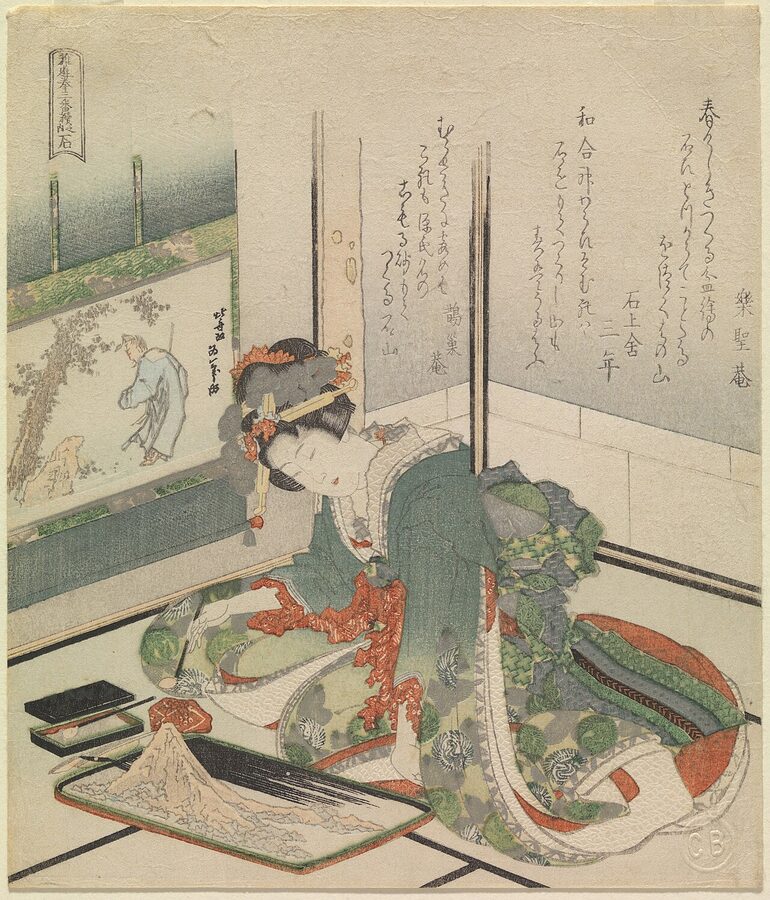
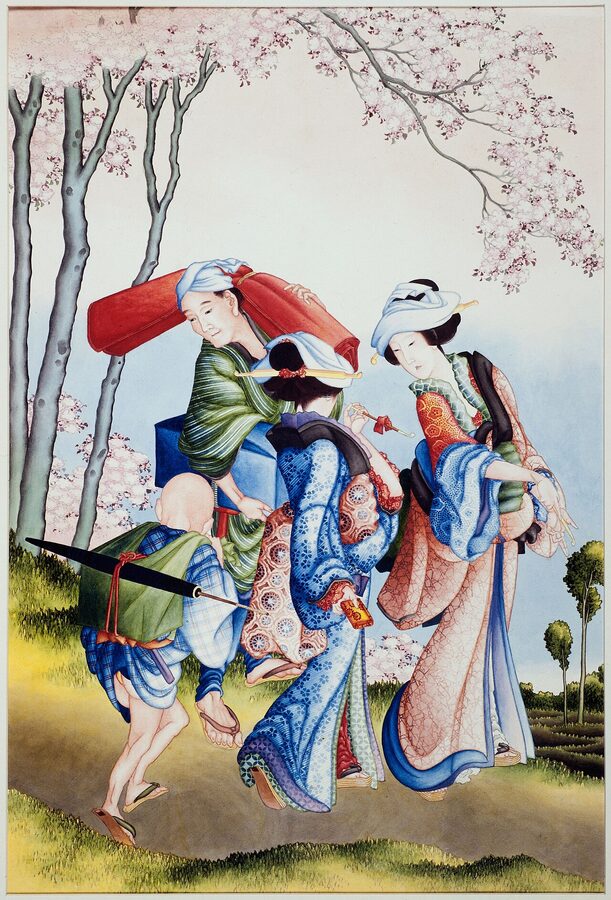
In 1794 or early 1795 he took the name Sōri, the second man to hold it, from the Tawaraya line of the Rinpa school, the decorative tradition founded by Tawaraya Sōtatsu. Nobody knows quite how a Katsukawa reject came to inherit it. As Sōri he stopped making cheap commercial prints almost entirely and designed surimono instead: privately commissioned prints on thick paper, often for poetry clubs, cut and printed with every refinement the trade could manage. His slender, melancholy, melon-faced women became a recognised type, the “Sōri style,” and Edo collectors loved them.
By 1798 he had given the name Sōri to a pupil and set up on his own, signing himself Hokusai Tokimasa. “Hokusai” means North Studio, and it comes from his devotion to Myōken, the bodhisattva of the North Star, to whom he had made a vow at the Hōshō-ji temple at Yanagishima after an early commission paid him far more than he expected. He marked his independence by handing out a print of a turtle stamped with a seal reading shi zōka: “nature is my teacher.”
Why so many names? One theory is money: a name could be passed on to a pupil for a fee, and Hokusai passed on “Hokusai” itself, among others. Another is temperament, a man who liked to slip out from under his own reputation.
I think both are true, and I also think he got bored. Every name change came with a new kind of work, and he dropped each identity the moment it started to feel like a habit.
Foreigners, giants and a novelist
The Dutch found him early. Around 1798, according to a collection of painters’ anecdotes compiled by Asaoka Okisada, the head of the Dutch trading post at Nagasaki, visiting Edo on the annual journey to the shogun’s court, commissioned scrolls from him, and the job ended in a row over payment. In the 1820s the trading post commissioned dozens more paintings of Japanese daily life, and by 1829 something like fifty-four of them had left the country. Most went out through Dejima, the one door the policy of sakoku left ajar.
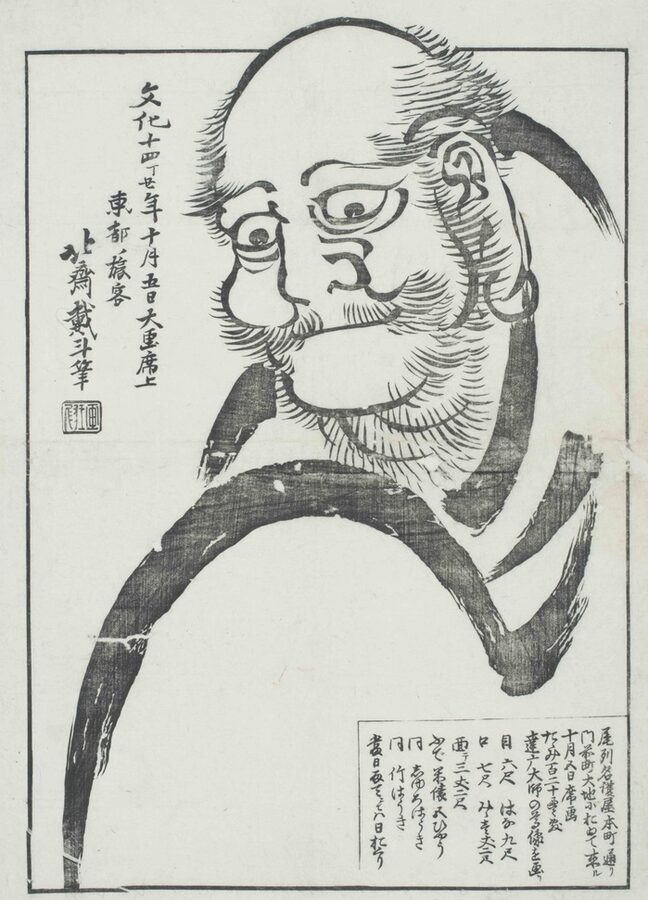
At home, he was learning to be a showman. In 1804, in the grounds of Gokoku-ji at Otowa, he painted a half-length Daruma, the founder of Zen, on a sheet of paper more than 120 tatami mats in area, using a broom for a brush and buckets of ink. The writer Ōta Nanpo recorded it. In Nagoya, on the fifth day of the tenth month of 1817, he did it again in the precinct of the Honganji branch temple, partly to advertise the new volumes of his Manga.
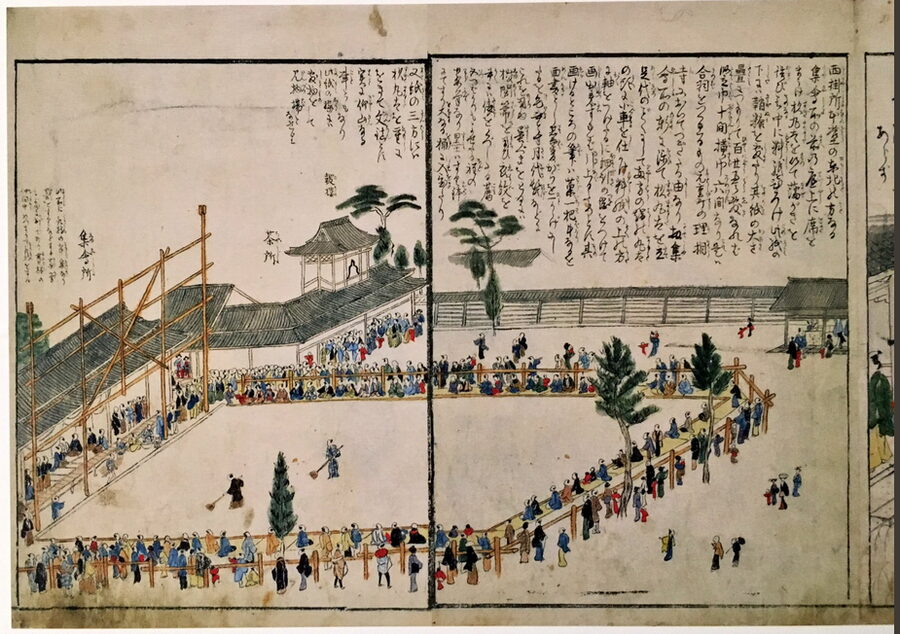
English-language accounts usually give that Nagoya date as “5 October 1817,” which is the lunar date wearing the wrong calendar; by the Western one it was well into November. The painting itself is gone. The handbills sold afterwards survive, and the Daruma on them glares at you as if he knows exactly how much money changed hands.
The best-loved story of all has no contemporary document behind it, and you should enjoy it on those terms.
The shogun Tokugawa Ienari, out hawking, is supposed to have summoned Hokusai to paint before him in competition with a more respectable artist. Hokusai brushed a long blue stripe across a sheet, dipped the feet of a cockerel in red paint and chased it over the paper, then bowed and called it the Tatsuta River with autumn maple leaves floating on it. He won, of course. It is the kind of thing he would have done.
The serious money in those years came from illustrated novels, the yomihon. Between about 1805 and 1813 Hokusai illustrated roughly two hundred volumes, around 1,400 pictures in ink and grey wash, and the best of them were written by Kyokutei Bakin. In 1806 the two men were close enough that Hokusai lodged in Bakin’s house. They also fought over the pictures for Bakin’s version of the Chinese Water Margin so badly that the publisher had to bring in another translator.
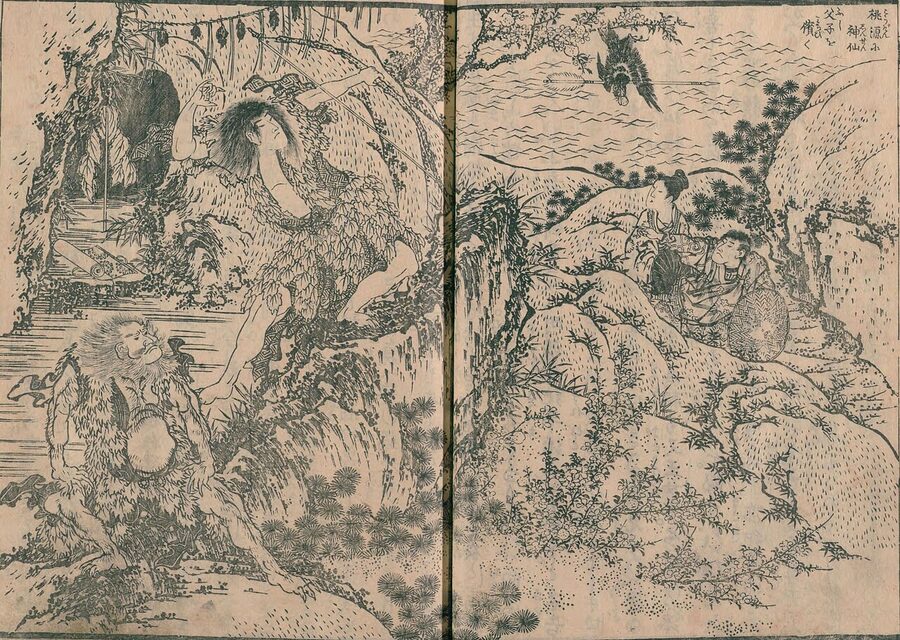
Their masterpiece was Chinsetsu Yumiharizuki, the swashbuckling tale of Tametomo, in twenty-nine volumes. Not long after it ended, the partnership did too. The reasons depend on who you read: an argument about who served whom, a quarrel over a single illustration, two very large egos. Bakin went on to write one of the longest novels of the Edo period with other illustrators, and Hokusai went to Nagoya.
The Manga: thousands of drawings for people who never met him
He arrived in Nagoya in the autumn of 1812 and stayed for about half a year with a pupil, Maki Bokusen. In that time he produced more than three hundred drawings, not finished pictures but sketches of everything: people at work and at rest, animals, fish, tools, ghosts, rocks and buildings. A Nagoya publisher, Eirakuya Tōshirō, saw them and in the first month of 1814 brought out a slim volume called the Hokusai Manga.
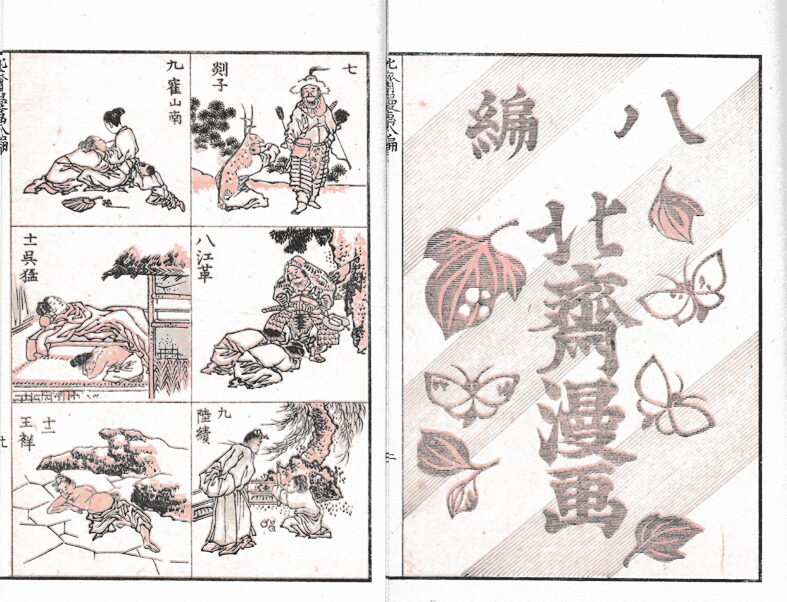
It was meant to be a single book. It sold so well that ten volumes were out by 1819, and the series kept going after Hokusai’s death until the fifteenth volume in 1878, in the eleventh year of the Meiji era, by which time some of the drawings were other people’s work. Depending on who counts and how, the fifteen volumes hold somewhere between three and four thousand pictures over 970 pages. Each volume cost two monme and eight bu of silver from the Nagoya publisher, at a time when a bowl of soba cost sixteen copper coins, so a lot of readers met the Manga through the lending libraries.
The scholar Nagata Seiji, who spent his life on Hokusai, gave three reasons for it, and I find them convincing. Hokusai had too many pupils to draw a model sheet for each one. He had followers all over the country whom he would never meet. And craftsmen in other trades were already copying his drawings as designs, so he might as well sell them a pattern book.
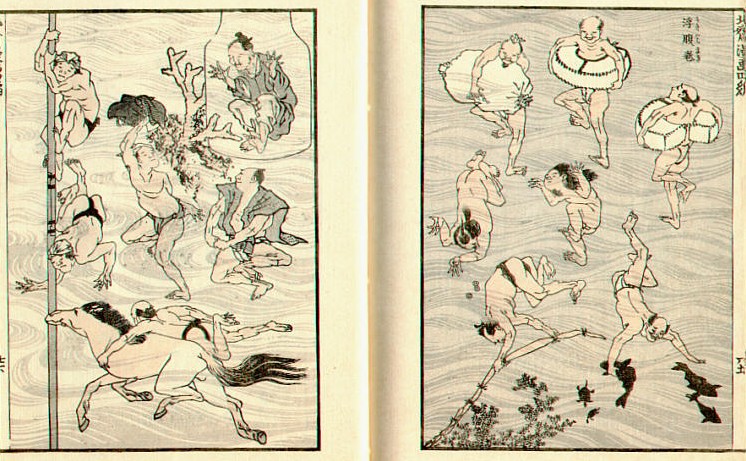
The early volumes are a jumble from his notebooks. Later ones have themes: buildings and Buddhist furniture in the fifth, weapons and martial arts in the sixth, landscapes in the seventh, ghosts and immortals in the tenth. Two years before the first Manga he had published a drawing manual that told students all shapes could be built from the square and the circle, and showed them how with a ruler and compasses. You can see the same geometry under the most casual-looking figures.
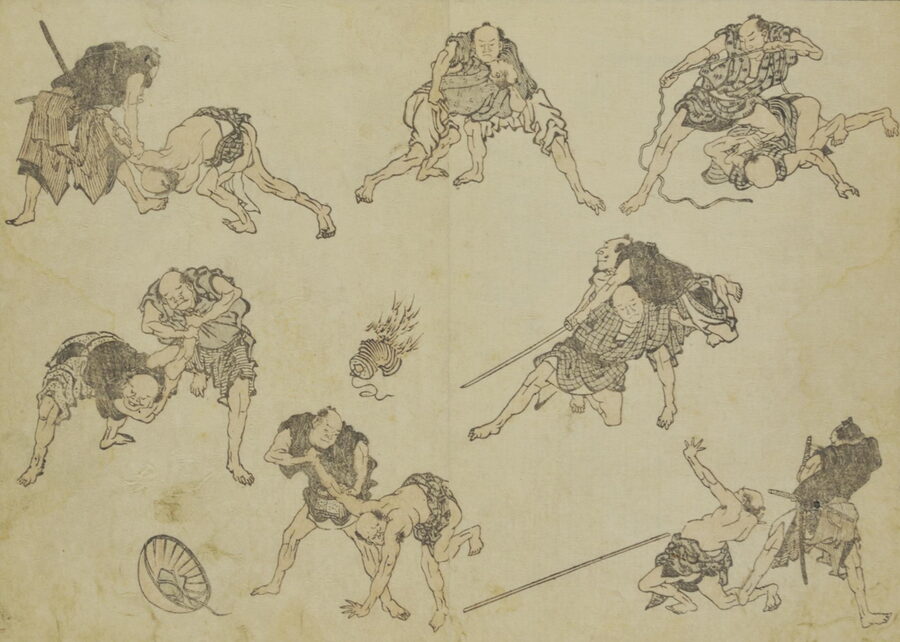
The Manga was also the book that took him abroad, which comes later in this story. But it changed what his work was for at home. A craftsman in a provincial town who would never see a Hokusai painting could own Hokusai’s eye for the price of a few meals, and copy it onto a sword guard, a comb or a fan.
Iitsu and the blue: the Thirty-six Views of Mount Fuji
From the first month of 1820 he signed himself Iitsu, a name often read as “one again,” taken as he completed his sixtieth year and the zodiac cycle started over, and he kept it for thirteen years. His sixties were not easy. Iijima says he had a stroke near the end of the 1820s and cured himself with a medicine of his own made from yuzu citrus; his wife Koto died on the 5th day of the sixth month of 1828; and a delinquent grandson, the son of his eldest daughter, ran up debts that Hokusai kept paying. “This spring I have no money and no clothes,” he wrote in one letter, “just enough to keep my mouth fed.”
And then, in his early seventies, he produced the series that made him immortal. The publisher Nishimuraya Yohachi began issuing the Fugaku sanjūrokkei, the Thirty-six Views of Mount Fuji, around 1830 or 1831, and an advertisement of 1831 tells you exactly what was being sold. They were aizuri, “blue prints,” one view to a sheet, issued one after another, to show how the shape of Fuji changes with the place you see it from.
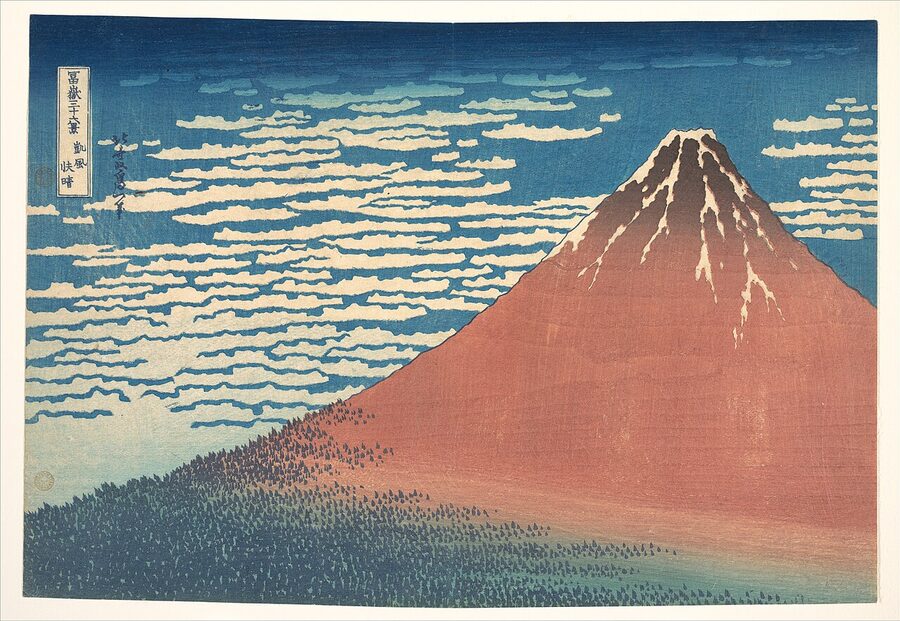
The blue was the novelty. Prussian blue, a synthetic pigment invented in Berlin early in the 18th century and imported to Japan as bero-ai, first appears in ukiyo-e in 1829. It did not fade like the old plant blues, it could be graded smoothly from dark to pale, and it made skies and water look like skies and water. Hokusai was one of the first artists to see what it could do.
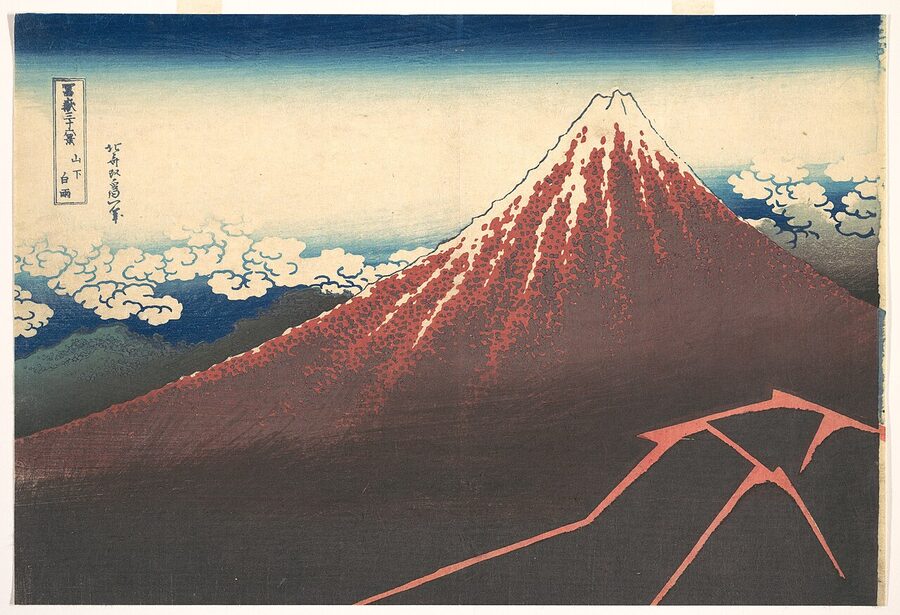
The series sold well enough that the thirty-six became forty-six. The ten additions, printed with black outlines instead of blue, are known as the ura Fuji, the Fuji from the back. The blocks were printed until they wore out; later impressions show blurred lines and broken edges, which is one reason the same design can look so different in two museums.
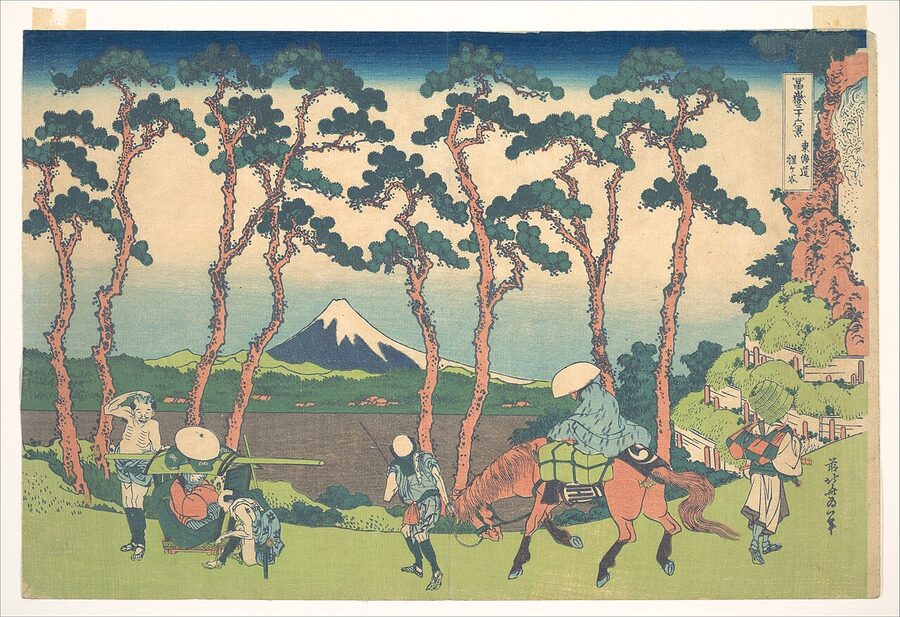
It sold because Edo was travelling. People had money for pilgrimages and outings, Fuji was a holy mountain with its own climbing clubs, and a mountain that could be seen from half the city was the perfect subject for a souvenir. Hokusai’s genius was to make Fuji small in most of the pictures and put people, boats, barrels and bridges in front of it.
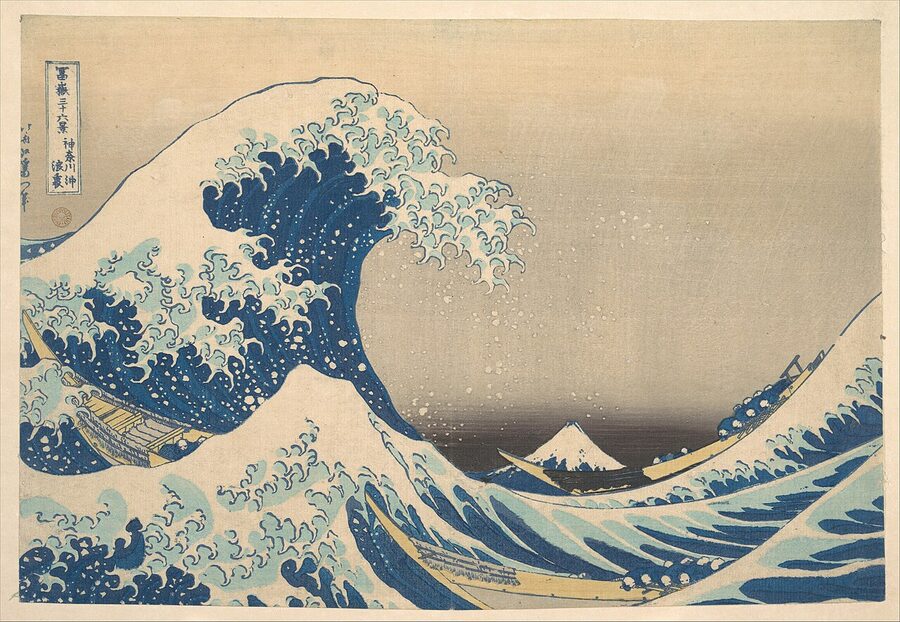
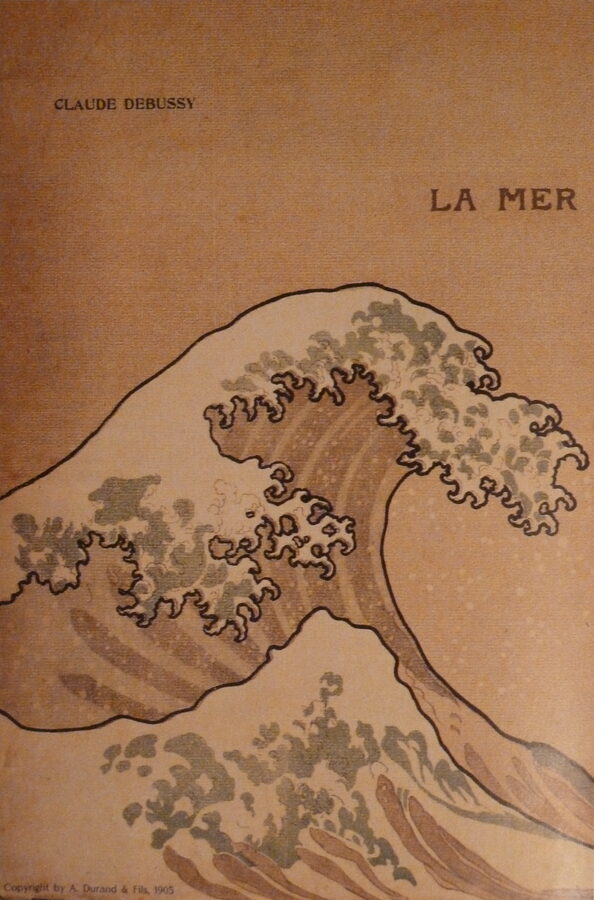
The most famous of the forty-six is Kanagawa-oki nami-ura, the Great Wave off Kanagawa, and it has its own article here, so I will give it one paragraph. It was one of the first ten designs, it was cheap, and it has become the most reproduced image in Japanese art: on the cover of Debussy’s La Mer, on Japan’s passport pages since 2020 and on the back of the ¥1,000 note since 2024. Van Gogh, writing to his brother, saw claws in the spray. It is a better picture than its fame suggests, and the companion article explains why at the length it deserves.
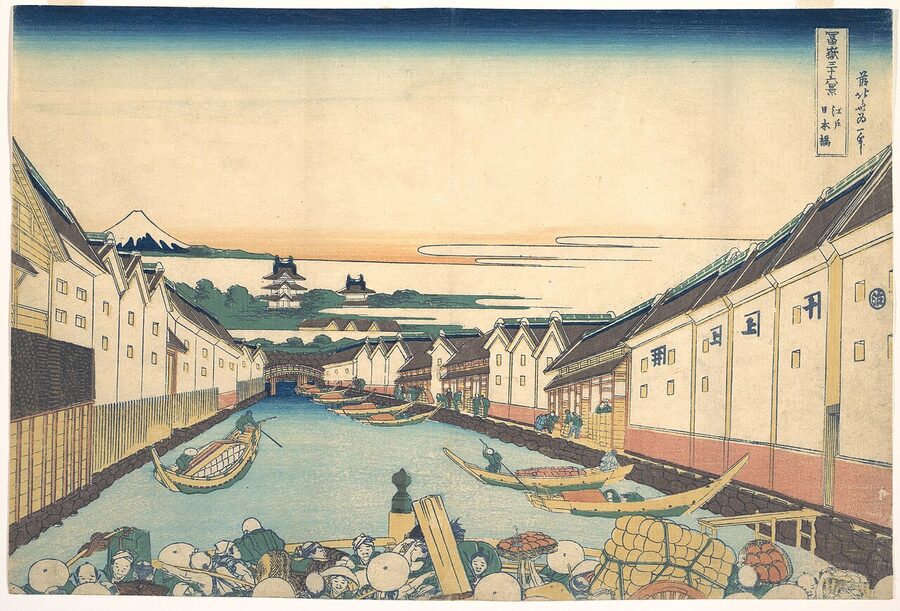
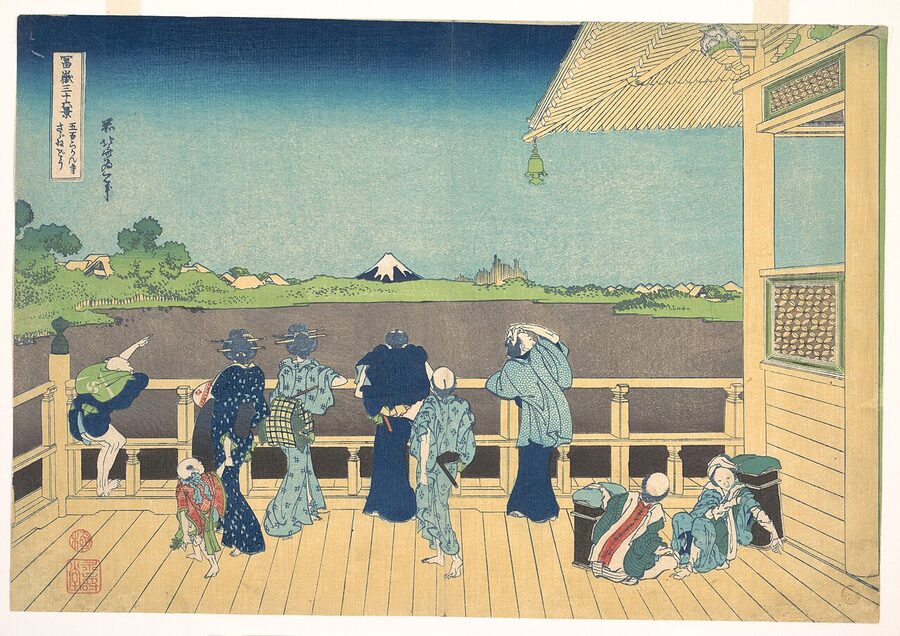
Several of the views are of Hokusai’s own neighbourhood. The timber yards at Tatekawa in Honjo appear, and so does the Sazai Hall of the Temple of the Five Hundred Arhats, a spiral-staircased pagoda that was one of Edo’s sights. The real temple has since moved, and the hall is long gone.
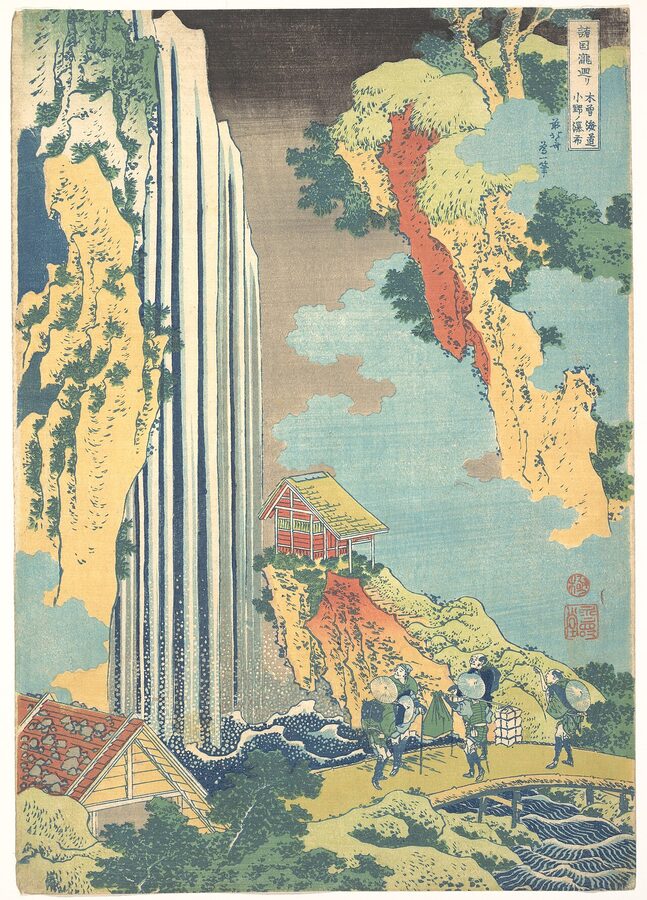
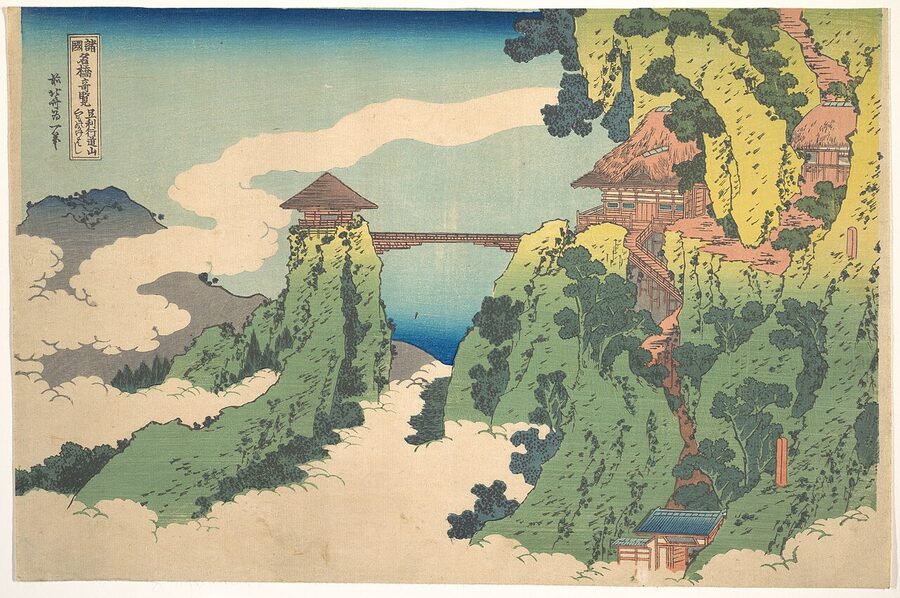
In 1833 and 1834, with the same publisher, he made his other great landscape sets: eight prints of waterfalls, Shokoku taki meguri, and eleven of bridges, Shokoku meikyō kiran. The waterfalls are the stranger series, falling water treated almost as solid matter, and he chose falls that were places of local worship, not simply the famous ones.
By about 1833 the fashion was moving on. A young designer called Utagawa Hiroshige had just published his Fifty-three Stations of the Tōkaidō, softer, wetter and more like what a traveller actually saw. Hiroshige later wrote, politely, that Hokusai’s Fuji pictures were clever inventions while his own were drawn from life. Hokusai, by most accounts, simply stopped making landscape prints.
At seventy-three I partly understood
In the third month of 1834 Hokusai published the first volume of Fugaku hyakkei, One Hundred Views of Mount Fuji, three books of black-and-grey woodcuts with a hundred and two pictures between them. He signed it with a new name, Gakyō Rōjin Manji, “the old man mad about painting, Manji.” The publisher’s advertisement quoted him: “My true secrets of painting are all in this book.” Plenty of people, me included, think the Hundred Views is better than the Thirty-six.
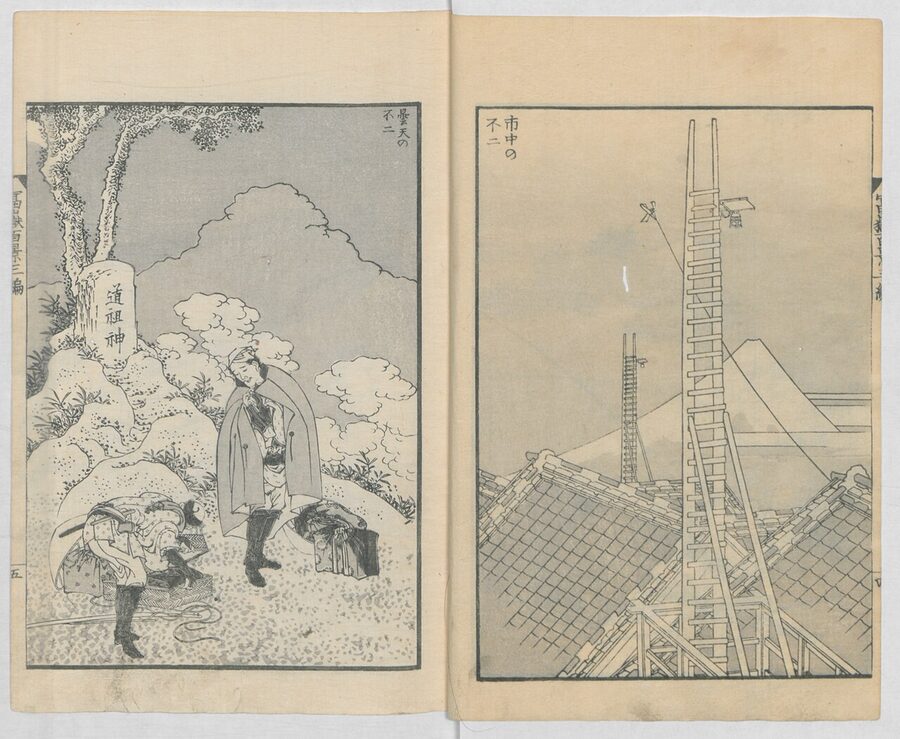
At the end of the first volume he wrote a postscript about himself, the only one he ever published. In my own rough English it goes like this: “From the age of six I had a habit of copying the shapes of things, and from about fifty my pictures were often published, but nothing I drew before seventy is worth taking notice of. At seventy-three I began to grasp something of the build of birds and beasts, insects and fish, and the way grasses and trees grow.”
“So at eighty-six I shall have made more progress, at ninety I shall see further into their secrets, and at a hundred I may reach the divine. At a hundred and ten every dot and every line will be alive.”
He ended by asking the gods of long life to watch and see that he was not lying. Read it again and notice what he is doing. He is seventy-five years old, by the Japanese count, and he has just dismissed everything before the Great Wave as juvenilia.
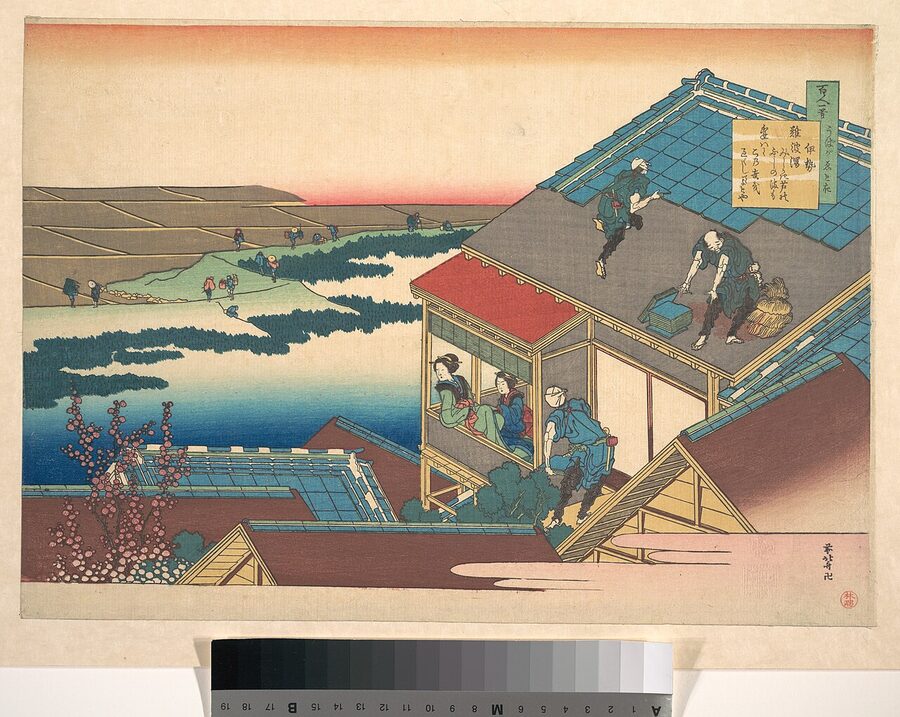
The mid-1830s were bad years to be an old printmaker. The Tenpō famine emptied the markets and closed publishers; a set of a hundred poem prints, Hyakunin isshu uba ga etoki, the hundred poems “explained by the nurse,” stopped after twenty-seven designs. Iijima says Hokusai kept going by painting small albums by hand and having the print shops sell them.
Between the winter of 1834 and about 1836 he disappeared from Edo altogether. He was living at Uraga, at the mouth of Edo Bay, under the name Miuraya Hachiemon, and the reason is unclear. Iijima suggests he was hiding from the consequences of something a relative had done, possibly the grandson again. Uraga was where Perry’s black ships would drop anchor nineteen years later, which is the sort of coincidence history leaves lying around.
In 1839 his house in Daruma-yokochō burned down, the first fire of his life, and he lost his papers and his tools. Iijima’s version is that he ran out with nothing but his brushes in his fist, smashed a sake bottle, and used the base to wash his brushes and the shards as paint dishes. He was nearly eighty. He went on painting.
From 1842 into 1843 he painted a Chinese lion, a shishi, every morning as a charm against misfortune, and called the series nisshin joma, “a new day, demons banished.” Most of them he crumpled and threw into the street. Some were rescued, and in 1997 a group was withdrawn from a Christie’s sale the day before the auction, after the Agency for Cultural Affairs pointed out they could not legally leave Japan. The largest set, 219 sheets, went to the Kyushu National Museum in 2018.
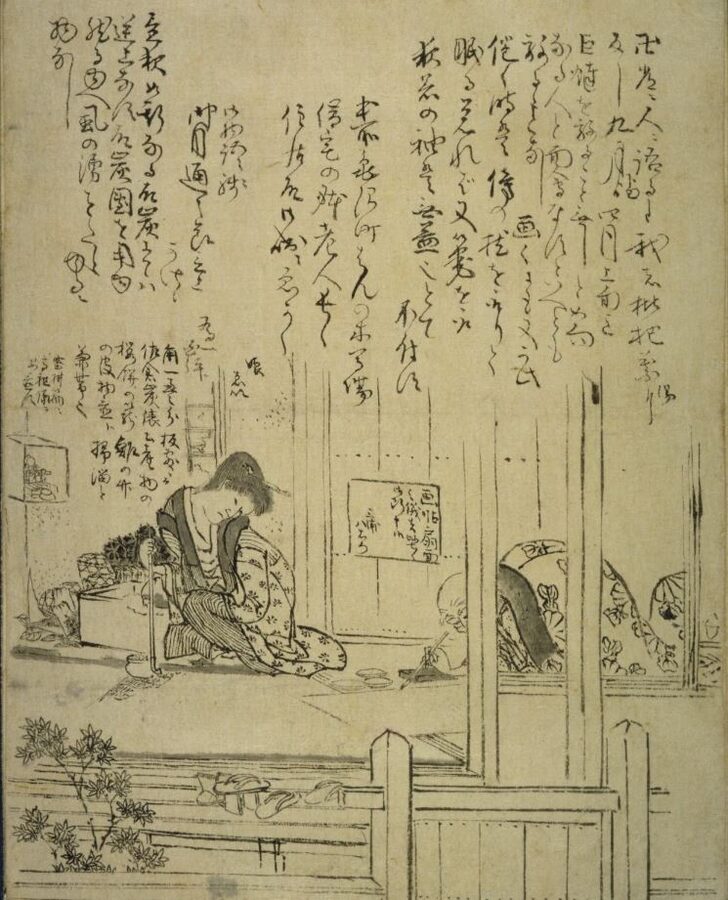
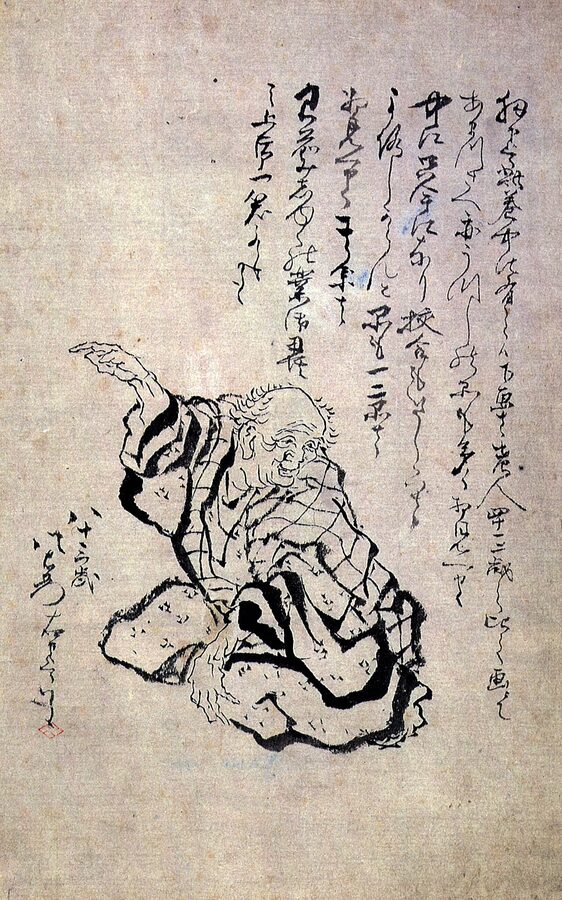
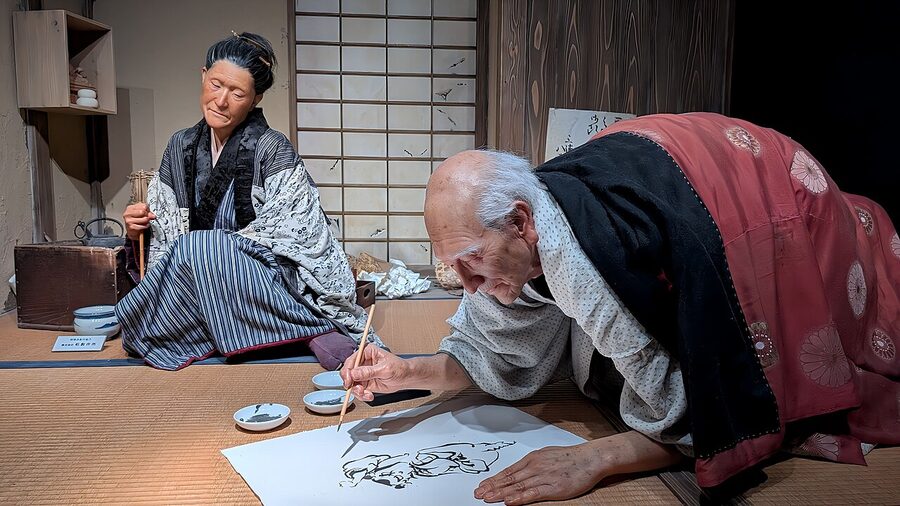
That sketch is the best picture anyone has of how he lived, and the accounts agree with it. He wore rough cotton and a sleeveless jacket in winter, sat at the kotatsu from the end of the ninth month to the beginning of the fourth, and never cooked; food was bought or given and eaten straight from the wrapper, and when the family lived next to a cheap restaurant they had all three meals sent round. He did not drink or smoke, but he had a sweet tooth. He walked about with a six-foot stick muttering the spells of the Lotus Sutra, and Iijima says nobody dared speak to him.
When the kabuki star Onoe Baikō came to commission a painting, he found the room so filthy he had his palanquin-bearers lay down a mat before he would sit. And when the mess got beyond even Hokusai, the family moved. That is the best answer I can give about the ninety-three houses: the figure comes from one playwright’s recollection, quoted by Iijima, and nobody has verified it, but the habit was real. In an 1836 directory of Edo’s cultural figures, Hokusai is the only one of 473 names listed with no fixed address.
Ei, who signed herself Ōi
The woman watching in that sketch was Hokusai’s third daughter, Ei, born around 1800, though estimates run from 1792 to 1802. She married a painter called Minamizawa Tōmei, laughed at his pictures, did no sewing, and was sent home. From then on she lived and worked with her father, and from at least the early 1830s she ran his studio, his household such as it was, and a fair amount of his painting.
Her art name was Ōi. One explanation is that her father never called her anything but “Oi!”, the Japanese for “hey, you.” Another is that she called him “Oi, oi, oyaji-dono,” from a popular song, and a third that it means “answering Iitsu,” after one of his names. All three are probably true in the sense that matters, which is that the family thought it was funny.
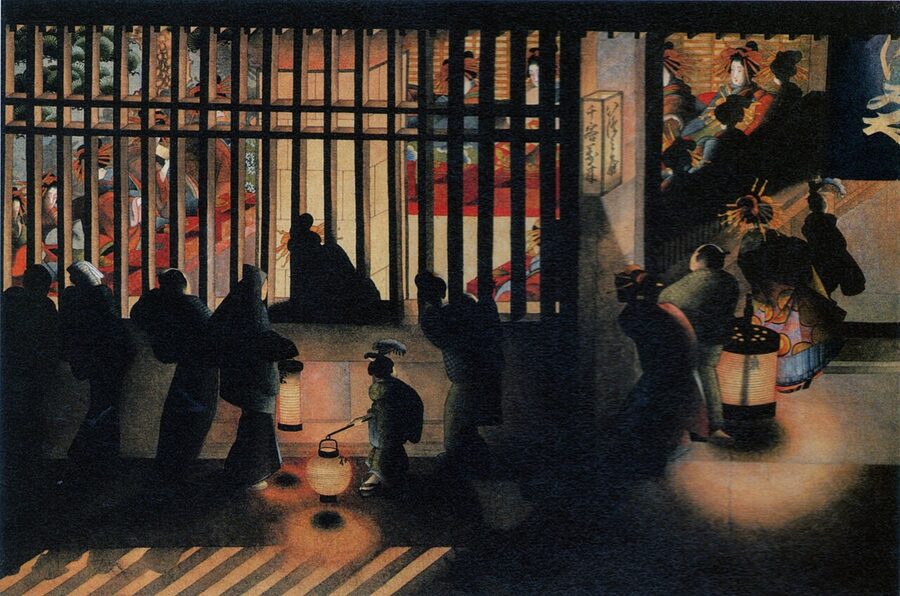
She was, by her own account and everyone else’s, as indifferent to housework as he was. The diarist Saitō Gesshin noted that neither father nor daughter ever cooked, that the dishes were never cleared, and that if someone gave them a fresh fish they gave it away rather than gut it. Unlike her father she smoked and drank. Once she dropped ash from her pipe onto one of his paintings, gave up smoking in remorse, and took it up again soon after.
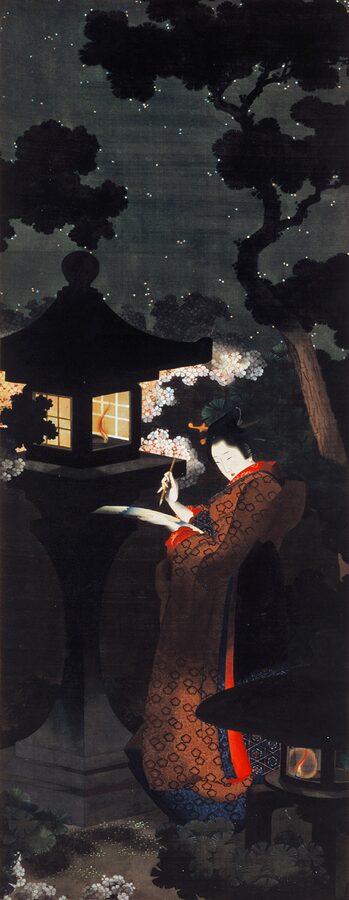
Hokusai himself is supposed to have said that in pictures of beautiful women he could not match her. Keisai Eisen, writing in 1833, called her “a master.” The difficulty is that only a dozen or so paintings are securely hers, and in print she is credited with illustrations in just two books, of 1847 and 1848. Many scholars think a good number of the late “Hokusai” paintings, especially the ones with unusually fresh colour and very fine detail, are partly or wholly by Ei.
After 1849 she lived for a while with relatives, then vanished from the record. One story has her dying at Kanazawa at sixty-seven, another at Obuse.
The line attributed to her that I like best: “Give me a single brush and I will never want for food or clothes. Why should I bother with household accounts?” A feature film about her, Ōi, Ōi, opened in Japan in 2025, and it is high time.
Obuse: an eighty-three-year-old walks to Shinano
In 1842, at eighty-three by the Japanese count, Hokusai made the first of several journeys to Obuse, a prosperous farming town in Shinano province, now Nagano Prefecture. The usual road would have taken him up the Nakasendō and off towards Zenkō-ji. Why he went is debated. One theory is that the shogunate‘s Tenpō reforms, which clamped down on prints and luxury in Edo, made it a good time to leave; the other is simply that he was invited.
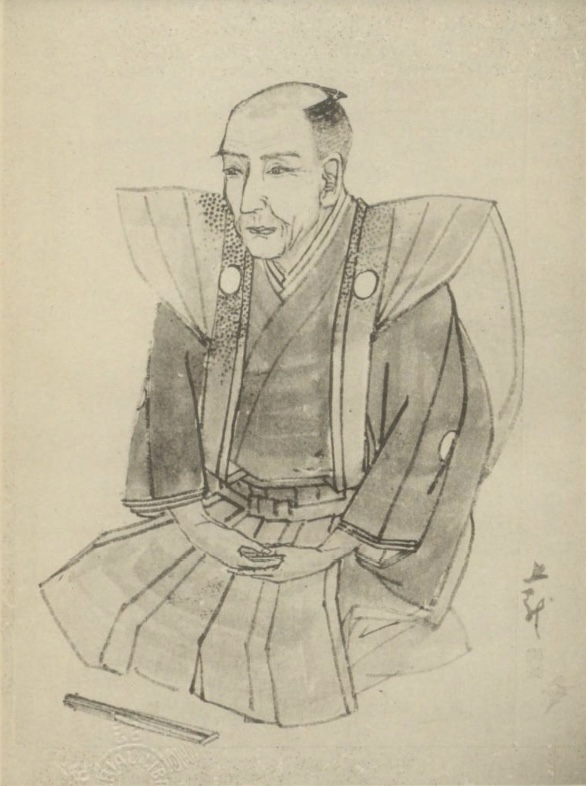
The man who invited him was Takai Kōzan (1806–1883), heir to the richest family in Obuse. Kōzan had studied Confucian learning, painting and calligraphy in Kyoto and Edo, and he gave Hokusai a studio called the Hekiiken and treated him as an honoured guest. By the Hokusai-kan museum’s account the two called each other “Master” and “Patron,” and meant it. Hokusai went back and forth between Edo and Obuse at least four or five times, in his eighties, over the mountains.
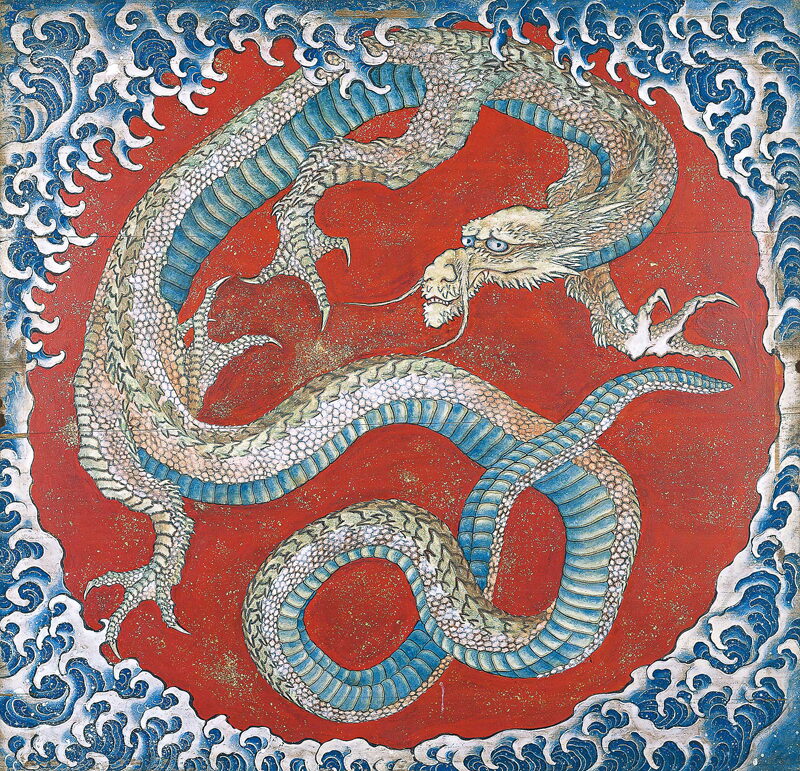
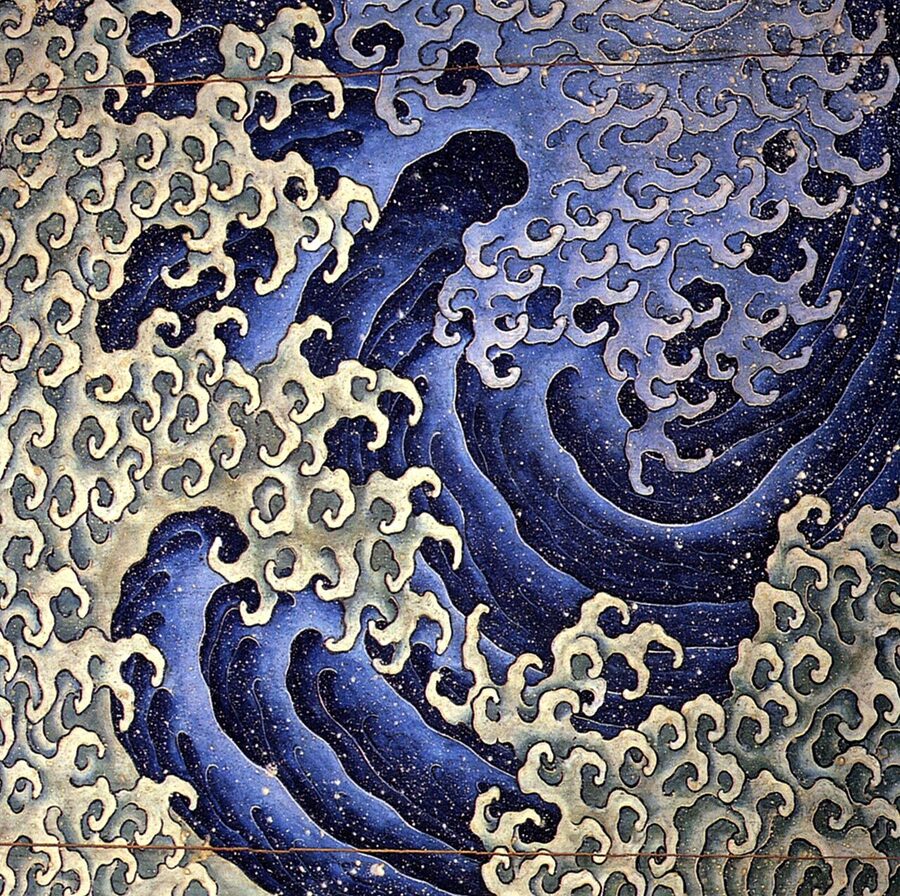
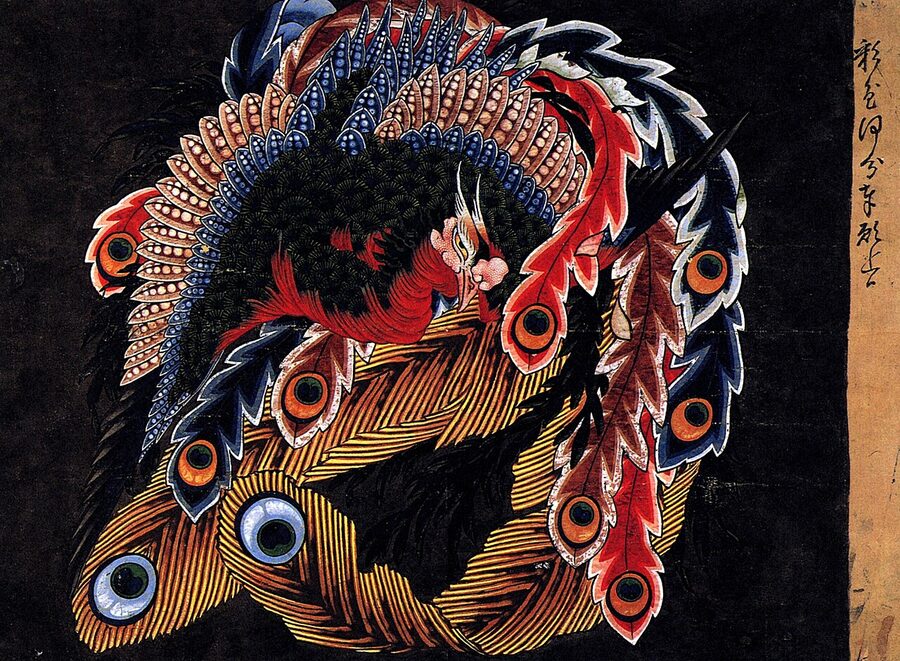
In 1844 he painted the two ceiling panels of the Higashimachi festival cart, the oldest of the town’s carts, built in 1806: a dragon on red and a phoenix on dark ground, opposites in the yin and yang manner. In 1845 and 1846 he painted the ceiling of the Kanmachi cart, which Kōzan had paid for himself, with two panels of breaking surf, the Onami and Menami, “Masculine Wave” and “Feminine Wave.”
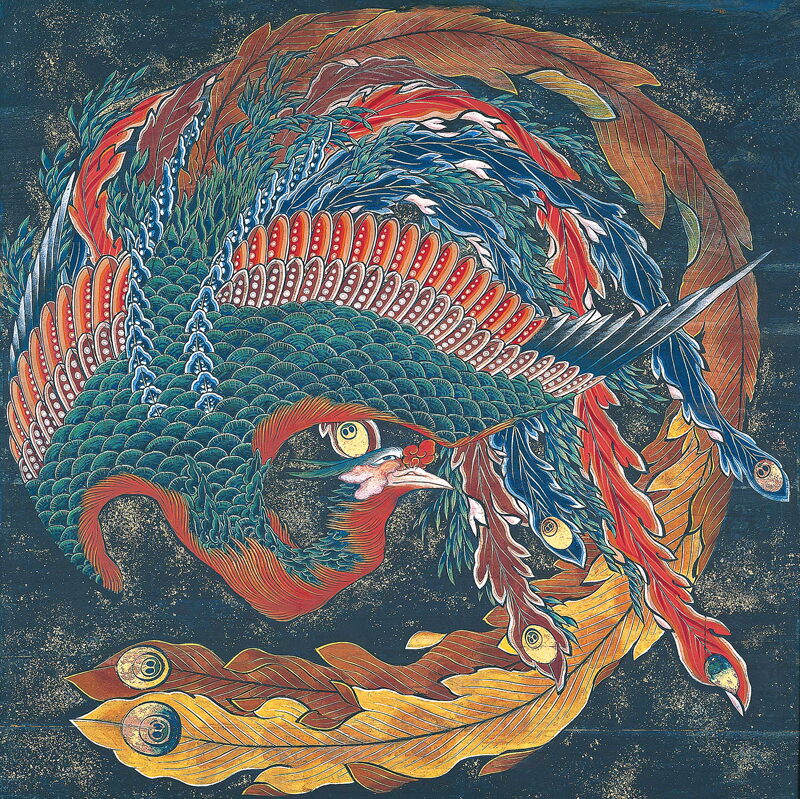
His last and largest work in Obuse is on the ceiling of the main hall at Ganshō-in, a Zen temple at the foot of the hills east of the town. It is a phoenix, happō nirami, “glaring in eight directions,” painted so that its eye seems to follow you round the room, and it covers about twenty-one tatami mats. The temple says Hokusai painted it over about a year on his fourth visit, at eighty-eight and eighty-nine, which puts it in 1847 or 1848; Japanese reference works generally give 1848. It has never been repainted.
For a long time nobody in Tokyo took Obuse seriously. Iijima barely mentions it, and art historians of the 1940s and 1950s wrote that Hokusai’s artistic life was over by seventy, that the Tenpō years showed only an empty shell. One of them was Narazaki Muneshige. Then the preparations for a Hokusai exhibition in the Soviet Union in 1966 sent researchers to Obuse, and when the Hokusai-kan opened in 1976 Narazaki stood up at the ceremony and said, “I declare in front of you all that my study of Hokusai begins today.”
Five more years: the death at Henshō-in
In the spring of 1849 he fell ill, and the doctor told Ei there was nothing to be done. Hokusai said it himself: “It is old age. There is no curing it.” Pupils and old friends came every day to nurse him.
Iijima records his last words, which have been translated a hundred ways: “If heaven would give me ten more years…” and then, after a pause, “If heaven would give me just five more years, I could become a real painter.”
He died at about four in the morning on the 18th day of the fourth month of 1849, which converts to 10 May 1849 by the Western calendar. He was living, as he had lived for most of his life, in a rented row-house, this one in the grounds of Henshō-in, a sub-temple of Sensō-ji in Asakusa. Japanese sources give his age as ninety by the old count, while English-language ones usually say eighty-eight, and both are right.
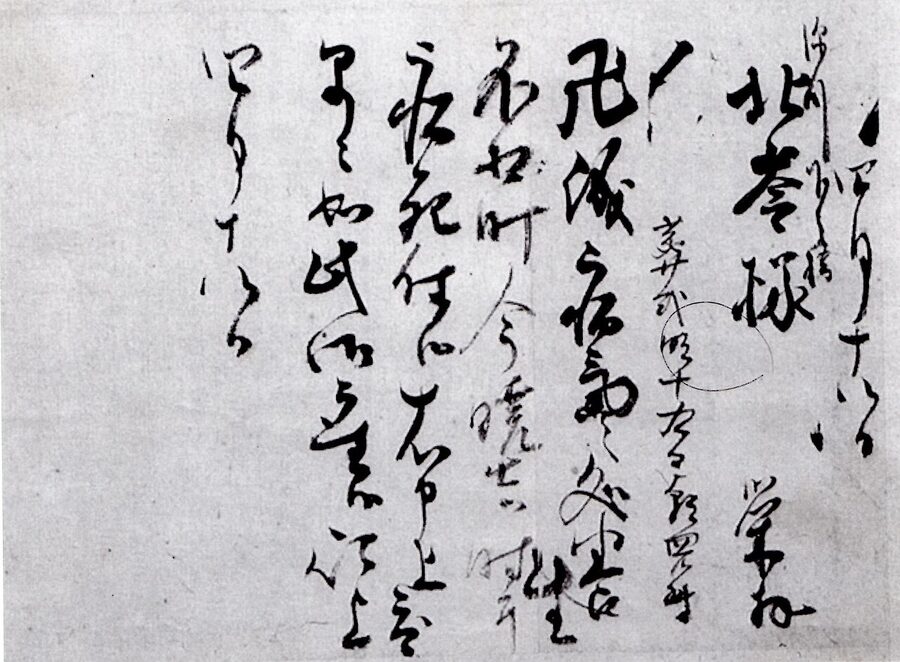
Ei’s notice survives. It is addressed to the pupil Hokurei at Fukagawa and says, in effect: Manji fell ill, care did not help, he died this morning before dawn, the funeral is tomorrow at the fourth hour. He was buried the next day at Seikyō-ji, a small temple of the Jōdo sect a short walk away.
His death poem is carved on his gravestone: hitodama de / yuku kisanji ya / natsu no hara. Roughly: “As a soul-fire, I’ll go wandering at my ease over the summer fields.” Hitodama are the floating lights that Japanese folklore says leave the body after death, and he had drawn plenty of the ghosts that go with them. It is a cheerful poem, and I think he meant it to be.
How Europe found him first
He died four years before Perry arrived, and nineteen years before the fall of the shogunate. By then his work had been leaking out of Japan for half a century. The Dutch commissions went home to Leiden, and Philipp Franz von Siebold, the German doctor at Dejima expelled from Japan in 1829, took copies of the Manga with him and reproduced pages in his great book on Japan. The Bibliothèque nationale in Paris had a volume of the Manga by 1843, and the British Museum was buying his prints by 1860.
The story every museum guide likes to tell is that in 1856 the French printmaker Félix Bracquemond unpacked a crate of Japanese porcelain and found it wrapped in pages of the Manga, which he showed to Manet, Degas and Whistler. Japanese scholars treat this with a raised eyebrow, and you should too. What is certain is that the shogunate itself sent fourteen volumes of the Manga to the Paris Exposition of 1867, and that within twenty years French critics had decided Hokusai was the greatest painter Japan had produced.
Not everyone agreed. Ernest Fenollosa and the British collector William Anderson thought it absurd to set a mere print-designer beside the great medieval ink painters, and said that it was like comparing a cartoonist from Punch with Fra Angelico. The French scholar Michel Revon answered, in 1896, by asking how the French would feel if the Japanese announced that Paul Gavarni was the summit of French art. Meanwhile Degas was quoted as saying Hokusai was not one artist among others but a world in himself.
Japan took much longer. Nagata Seiji remembered buying a Hokusai picture book in a second-hand shop for ¥100 as a boy in the 1960s. The first work by Hokusai to be designated an Important Cultural Property, a painting of people gathering shellfish at low tide, was only listed on 30 June 1997, more than thirty years after Shunshō, Utamaro, Sharaku and Hiroshige. What changed it was an American magazine: in 1998 Life put Hokusai at number 86 among the hundred most important people of the past thousand years, the only Japanese on the list.
That is how the country whose porcelain was supposedly wrapped in his books ended up putting his wave on its banknotes. It is a pattern you meet often on the long walk through Japan’s history: the culture of the Edo period, which the new state of the 1870s spent decades trying to modernise away, was taken seriously abroad before it was taken seriously at home.
For Hokusai, the British Museum’s 2017 exhibition, which concentrated on his last thirty years, and its 2021 display of 103 drawings for an encyclopedia he never published, did more than anything else to show the world that the old man had been right about getting better.
Where to see Hokusai today
Hokusai’s world is split between two places a few hours apart: the east bank of the Sumida in Tokyo, where he was born, lived and died, and the chestnut town of Obuse in Nagano, where he painted his last great works. You can do the Tokyo sites in a morning and Obuse in a long day from Tokyo, though it deserves a night.
The Sumida Hokusai Museum, Ryogoku
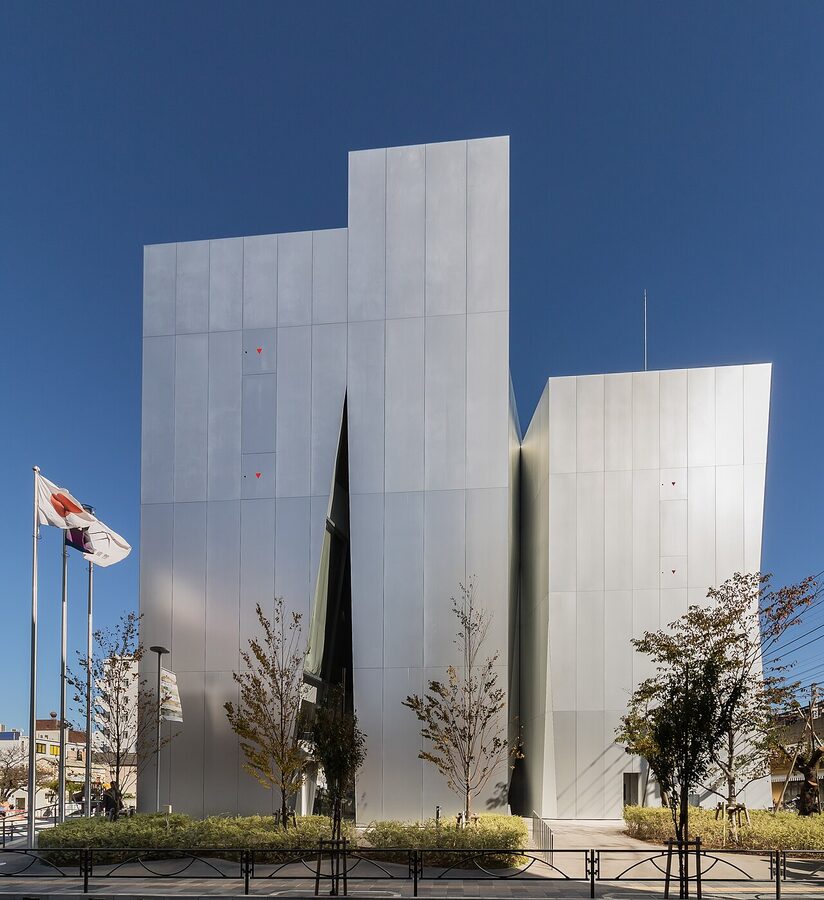
The museum stands in Kamezawa, the district where Hokusai was born, a few minutes from the old canal line that is now Hokusai-dōri. It opened on 22 November 2016, after nearly thirty years of planning, a funding freeze and a failed construction tender, and its core is the collection of the American scholar Peter Morse, about six hundred works bought from his family. The building is by Kazuyo Sejima and the exhibits are better than the building, which is saying something.
The permanent gallery on the fourth floor uses high-quality reproductions and touch screens, which is the only way a museum can show prints that must spend most of their lives in the dark; it costs ¥400. Special exhibitions, which show the originals, change every couple of months and are priced separately. The museum is open 9:30–17:30, last entry 17:00, and closed on Mondays (or the next weekday when Monday is a holiday) and over the New Year; check the museum’s own website before you go.
Take the Ōedo subway line to Ryōgoku and walk five minutes from exit A3, or walk about nine minutes from the east exit of JR Ryōgoku. If the special exhibition includes the Sumidagawa ryōgan keshiki zukan, a seven-metre scroll of both banks of the river that had been lost for about a century and was the museum’s opening show, go for that alone.
Seikyō-ji and the grave, Asakusa
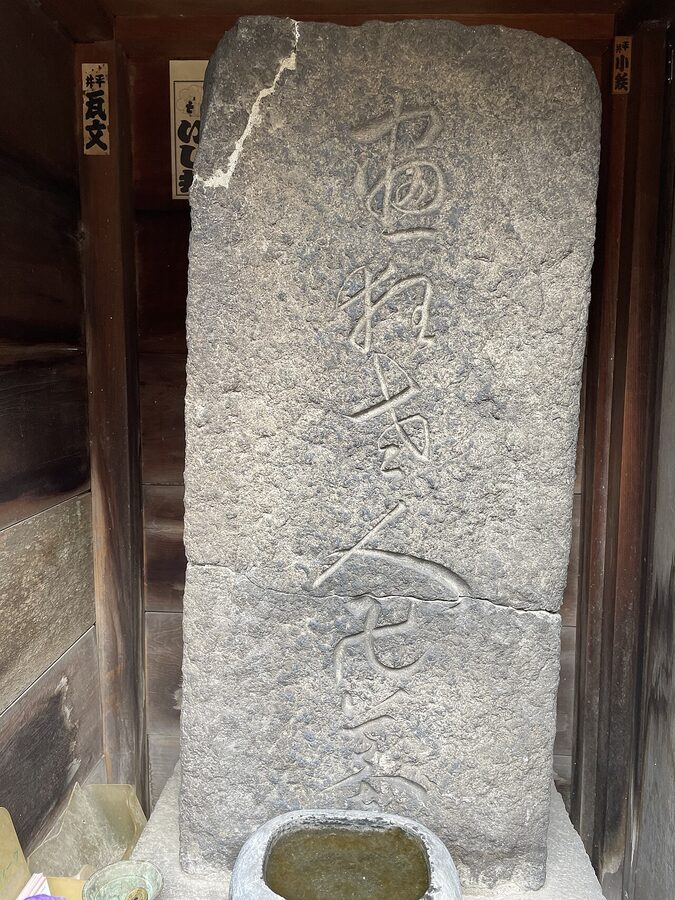
Seikyō-ji is a small Jōdo temple in Moto-Asakusa, south-west of the Kappabashi kitchenware street, and Hokusai’s family had been parishioners there before he was buried in it. The gravestone is a Tokyo Metropolitan Historic Site. It reads simply Gakyō Rōjin Manji no haka, the grave of the old man mad about painting, and the death poem about the summer fields is cut on its side.
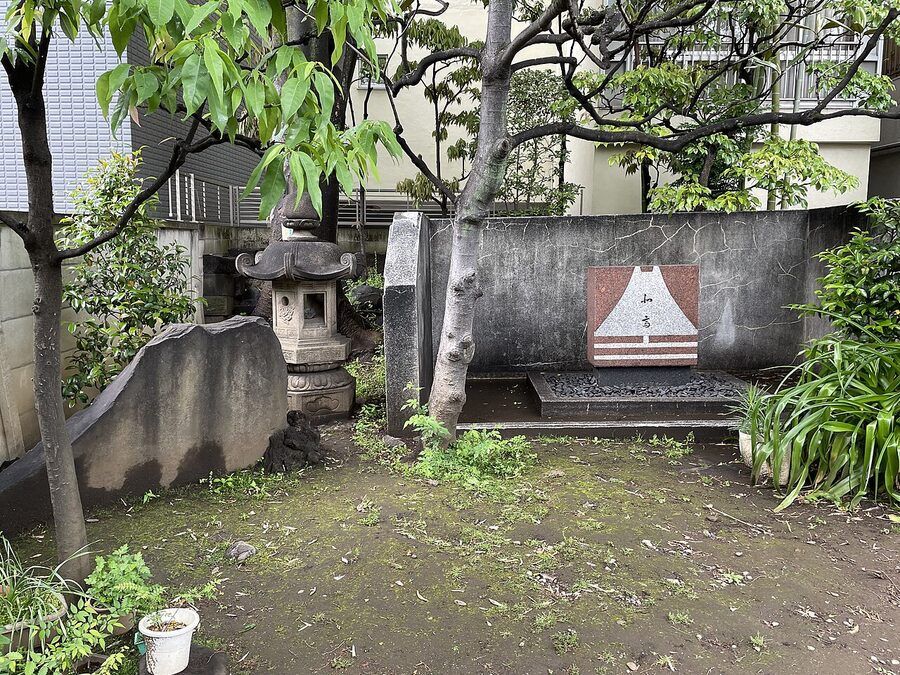
It is a short walk from Inarichō station on the Ginza Line, and there is no charge. This is a working temple in a residential street, not an attraction, so keep your voice down and do not wander into the private parts of the grounds. From there you can walk on to Sensō-ji in a quarter of an hour; Henshō-in, where he died, was in the Shōden-chō area a little to the north-east, but nothing marks the row-house now.
The Hokusai-kan, Obuse
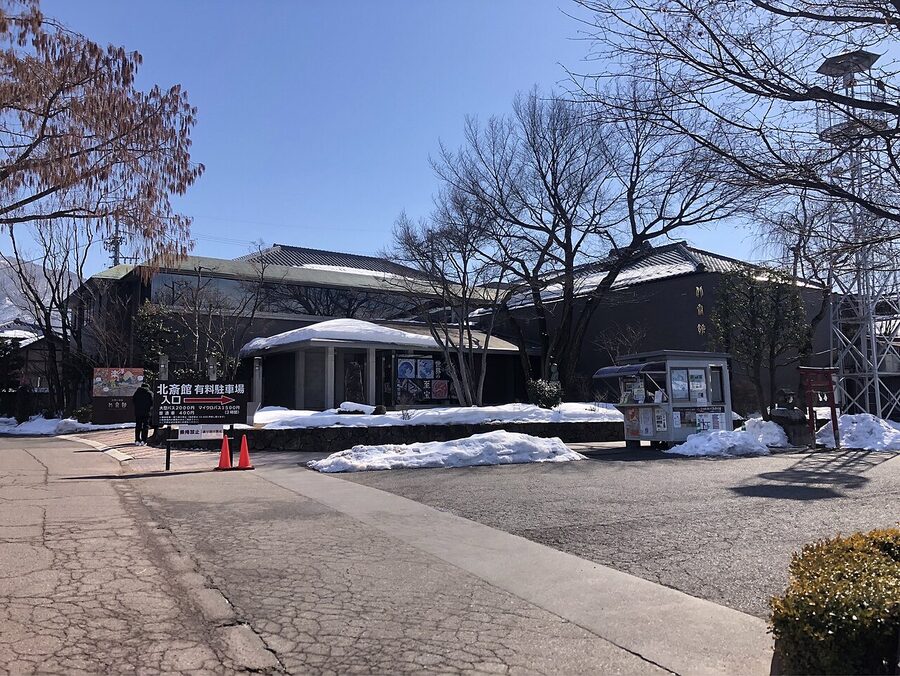
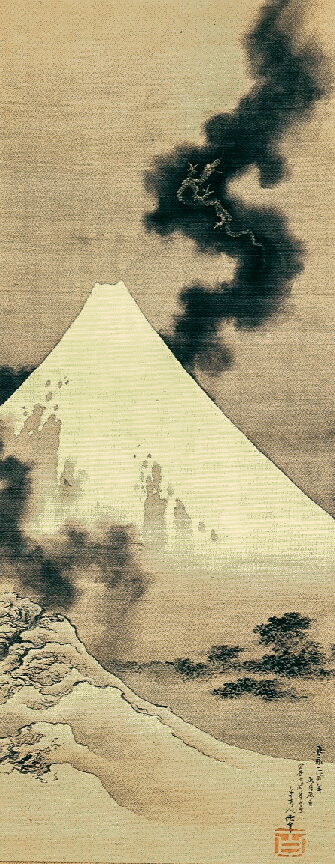
The Hokusai-kan holds the two festival carts with their ceilings, the dragon, the phoenix and the two waves, in their own gallery, along with forty or so paintings from the Obuse years, including Dragon over Mount Fuji when it is on show. Seeing the paintings in the carts they were made for is the reason to come. The museum is open every day, 9:00–17:00 with last entry at 16:30, and admission is ¥1,200 for adults; special exhibitions sometimes cost more.
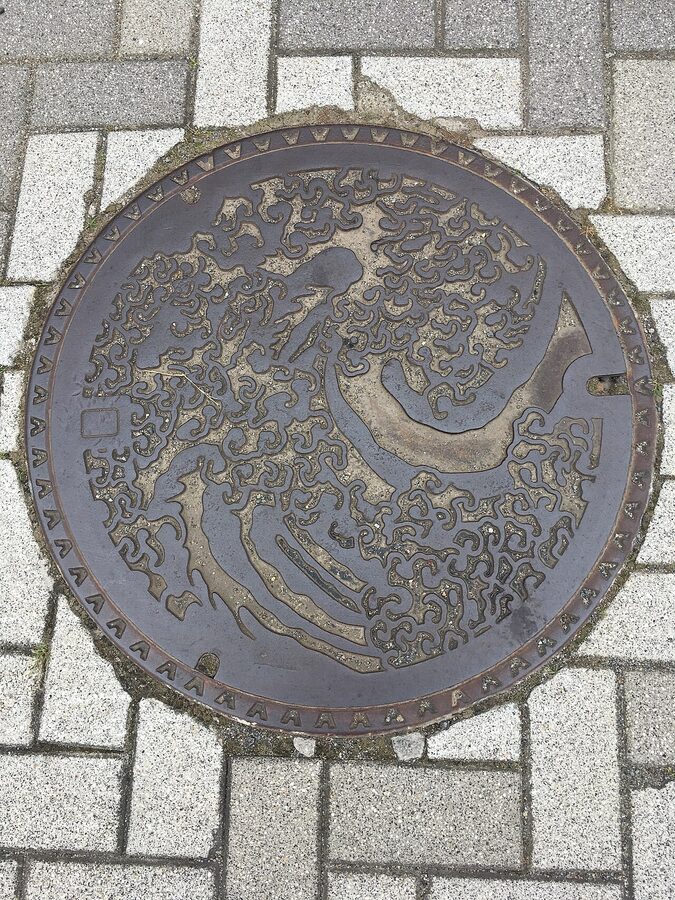
Obuse is on the Nagano Electric Railway. From the Zenkōji exit of JR Nagano station, which is on the Hokuriku Shinkansen from Tokyo, the limited express takes about twenty minutes and the local about thirty. From Obuse station it is a twelve-minute walk to the museum, through a town centre of old merchant houses and a great many chestnut sweet shops. Go in autumn, when the chestnuts are in season.
Ganshō-in, Obuse
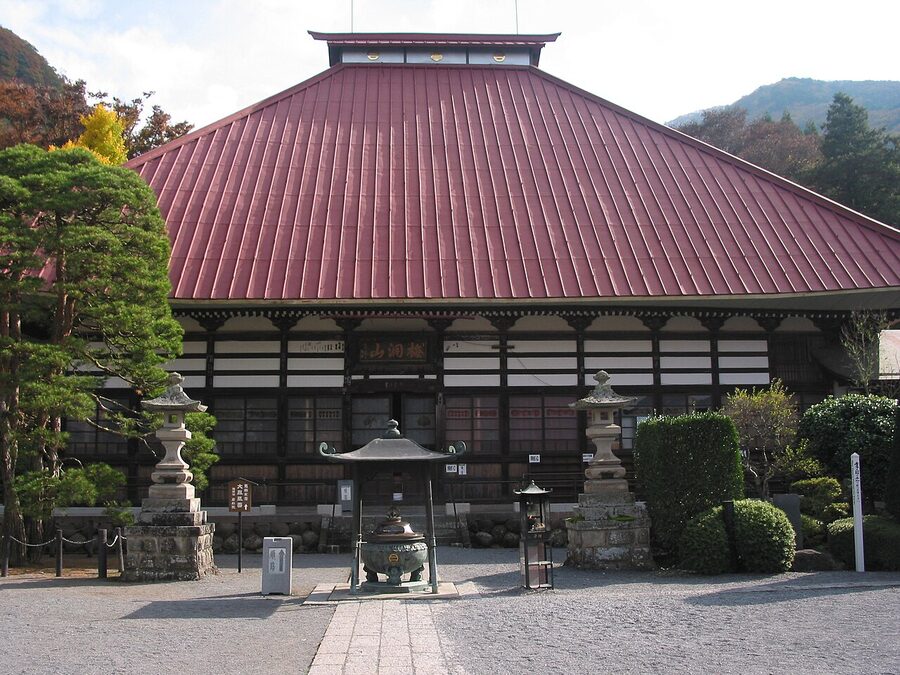
Ganshō-in is a Sōtō Zen temple on the hillside east of the town centre, about thirty minutes’ walk from Obuse station, ten minutes by taxi, or by seasonal shuttle bus. The main hall costs ¥600 for adults; the garden is free. Hours change with the season: 9:00–16:30 from April to October, 9:00–16:00 in November and 9:30–15:30 from December to March. Every thirty minutes a guide gives a short talk in Japanese while you sit on chairs directly beneath the phoenix, and an English audio guide is available.
The temple has two other claims to fame, and both are worth your time. It holds the mausoleum of the daimyo Fukushima Masanori, the first of Toyotomi Hideyoshi‘s “Seven Spears” at Shizugatake, who fought for Ieyasu at Sekigahara and was moved to this corner of Shinano in 1619 for rebuilding Hiroshima Castle without permission. And behind the hall is the pond where the poet Kobayashi Issa watched toads fighting in 1816 and wrote yase-gaeru / makeru na Issa / kore ni ari: “Skinny frog, don’t give up, Issa is here.” The toads still come in spring.
Stand under the phoenix for a while. It was painted by a man of eighty-eight who, a few years earlier, had cried because he could not draw a cat, and who would have told you he was only just starting. If you are going to Obuse anyway, let the guide finish, then look up one more time and try to catch the bird’s eye.