By the end of the afternoon there were seventy-three of them left, and they went into a farmhouse near the Minato River to die. The Taiheiki, the great war chronicle of the 14th century, says they sat down in two rows in the main room, chanted the name of the Buddha ten times together, and began to cut their bellies. Kusunoki Masashige, who had eleven wounds, turned to his younger brother and asked him where, among the nine realms of rebirth, he hoped to go next.
The brother laughed. He wanted, he said, to be born a human being seven more times, so that he could keep on killing the enemies of the court.
Masashige looked pleased. “It is a sinful and evil thought,” he answered, “but I feel the same.” Then the two of them stabbed each other, and the others set fire to the house.
The author of that scene meant it as a horror. To a medieval Buddhist reader a man who chooses slaughter over salvation is damned, and the same chronicle brings Masashige back a few books later as a demon. Six hundred years on, the brothers’ wish had been polished into a four-character slogan, shichishō hōkoku (七生報国), “seven lives to repay the country”, and it was being written on the headbands of young men about to fly aircraft into American ships.
I find Kusunoki Masashige the strangest case of reinvention in Japanese history, and I have been to most of the places involved. The real man is visible in the records for barely five years, from 1331 to 1336, and for the first of those the government called him a bandit. What follows separates the warrior of Kawachi from the god of Minatogawa as well as the sources allow, says which text says what, and ends where you can still go and find both of them.
In This Article
- A camphor tree in a dream
- Akasaka, and the castle that burned with the wrong bodies in it
- Chihaya: a hundred days on a ridge
- Three trees and a blade of grass
- The advice nobody took
- Sakurai: the parting that probably never happened
- Minatogawa: the 25th day of the fifth month of 1336
- From enemy of the court to god
- Seven lives for the country
- Masatsura at Shijōnawate
- Where to find Kusunoki Masashige today
- Minatogawa Shrine, Kobe
- Chihaya castle and the Akasaka hills
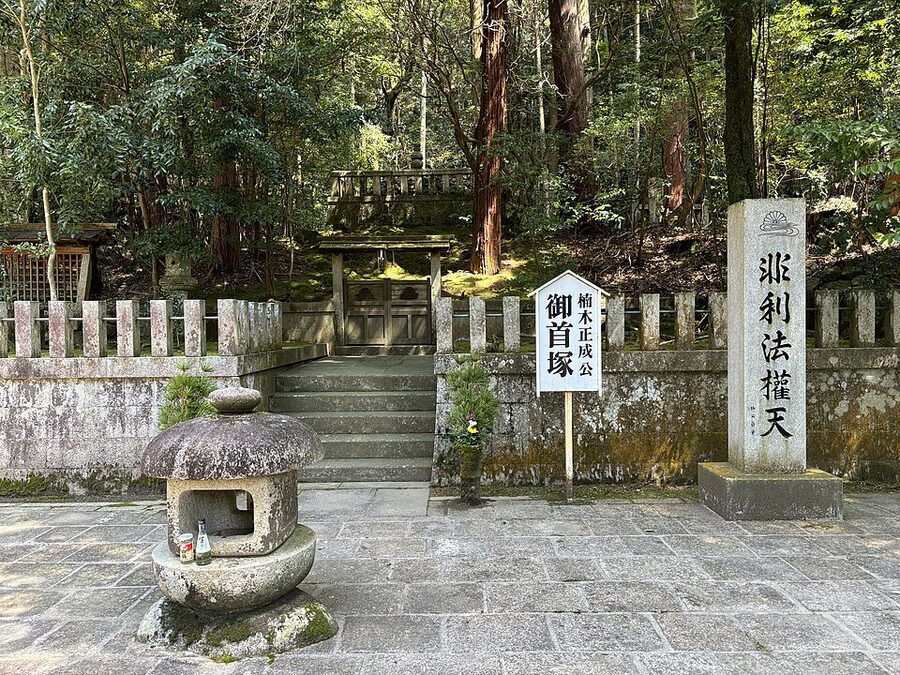
- Kanshin-ji, Kawachinagano
- The Sakurai station site, Shimamoto
- The statue in the Imperial Palace Outer Garden, Tokyo
- Shijōnawate Shrine
A camphor tree in a dream
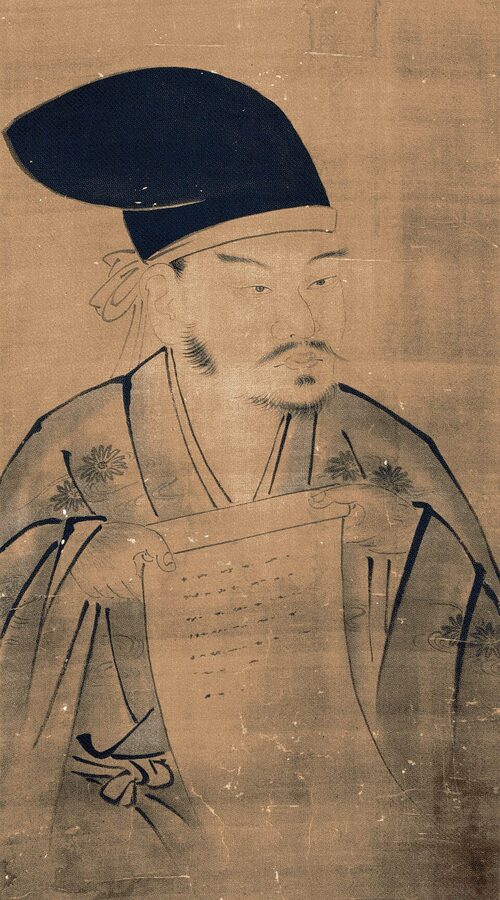
The Taiheiki introduces him with a dream. In the eighth month of 1331 Emperor Go-Daigo, on the run from the Kamakura shogunate, was camped in the temple on Mount Kasagi with a handful of monks and not a single warrior of note. He dreamed of a great tree in a courtyard, its branches reaching south, with a seat beneath it facing south and left empty for him. When he woke he noticed that the character for “tree” beside the character for “south” makes 楠, kusu, camphor, and asked whether there was a warrior called Kusunoki anywhere nearby.
There was, at the foot of Mount Kongō in Kawachi, and he came at once. It is a lovely story and almost certainly not how it happened. Documents in the archive of Tenryū-ji show that by the second month of 1331, months before the emperor fled, Masashige was already in possession of Wakamatsu estate in Izumi, land Go-Daigo had given to a Shingon monk called Dōyū. Japanese historians generally think the introduction came through esoteric monks close to the emperor, Dōyū and the notorious Monkan among them, which is less poetic and much more like the way the 14th century actually worked.
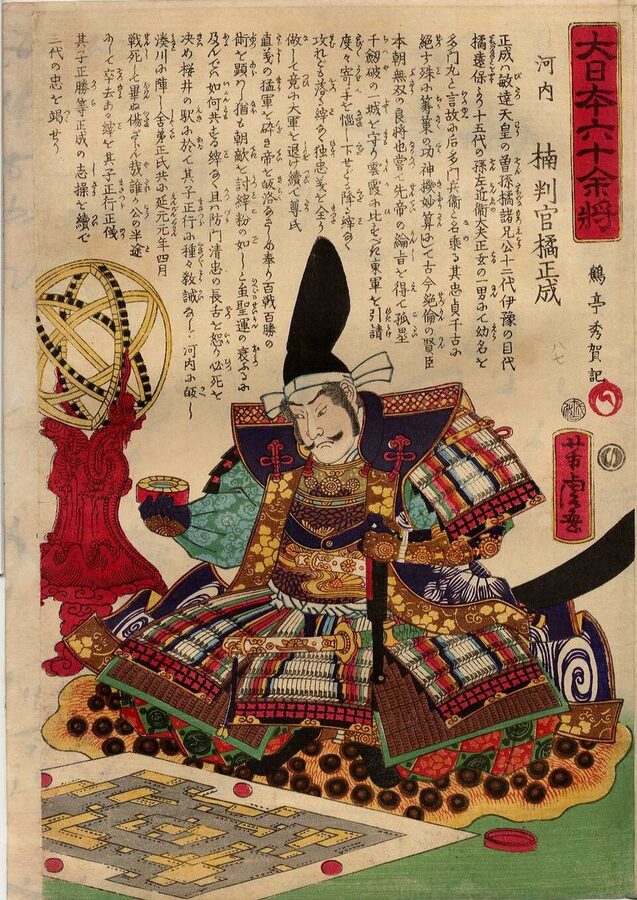
The first time the government mentions him by name, it calls him a criminal. In the ninth month of 1331 the Rokuhara office, the shogunate’s headquarters in Kyoto, confiscated Wakamatsu estate as “the former holding of the akutō Kusunoki Hyōe-no-jō”. Akutō (悪党) translates literally as “bad band”, and in the late Kamakura era it meant something more specific than a thief. It was the label for armed men who defied estate owners and the shogunate, usually with money and local muscle behind them.
Masashige’s family may have been in that line for a while. In 1295 a man called the Kusunoki lay monk of Kawachi turns up among a gang accused of keeping back the taxes of Ōbe, an estate in Harima that belonged to Tōdai-ji, and the historian Kuroda Toshio suggested he was Masashige’s father. Other scholars have pointed to the Kusunoki grip on roads between Settsu, Kawachi and Yamato, and to the cinnabar workings on Mount Kongō, which supplied the mercury that medieval Japan used for everything from vermilion to gilding. On that reading he was less a country squire than an armed merchant who controlled a trade route.
There is a third theory, and it is the most uncomfortable for the later legend. Some Japanese historians argue that the Kusunoki were vassals of the Hōjō, the very regents Masashige helped destroy, and had been planted in Kawachi from the east. There was a village called Kusunoki in Suruga, in an estate tied to the Hōjō’s chief retainers, and in the intercalary second month of 1333, with the shogunate’s armies pouring through Kyoto to attack him, someone posted a satirical verse that the courtier Nijō Michihira copied into his diary: “The camphor tree’s roots are in Kamakura, so why go out to cut its branches?”
Critics reply that much of that evidence comes from Edo-period texts leaning on a notoriously inventive commentary on the Taiheiki, and a place called Kusunoki has since turned up in Kawachi after all. I follow the historian Ikoma Takaomi, who argues that a warrior of the capital region in 1330 could be merchant, courtier, vassal and outlaw all at once. The single-minded patriot came later.
What can be said is that he was a local man with roots in the hill country of southern Kawachi, around what is now the village of Chihaya-Akasaka, and that the family was devoted to Kanshin-ji, a Shingon temple a few kilometres away where tradition says he studied as a boy. A genealogy of the Kanze school of Noh even makes Masashige’s sister the mother of Kan’ami, the playwright who founded it. Nobody can prove it. Minatogawa Shrine built a Noh stage on the strength of it anyway.
Akasaka, and the castle that burned with the wrong bodies in it
The rising of 1331 was a disaster for almost everyone. Go-Daigo’s plot against the Kamakura regime leaked in the fourth month, he fled to Mount Kasagi in the eighth, and Kasagi fell in the ninth. The emperor was captured and later exiled to the Oki Islands. His son, Prince Morinaga, escaped to the one place still holding out: a hastily built fort called Akasaka, in the hills above Masashige’s home.
The Taiheiki turns the siege of Akasaka into a catalogue of tricks. It has 300,000 Kamakura horsemen surround a fort the attackers expected to take in a day. When they swarmed the walls, the defenders cut the ropes holding an outer false wall, dropping a thousand men into the ditch and rolling logs and boulders on top of them; when they came back with shields and grappling hooks, the garrison poured boiling water on them from ladles with handles three metres long.
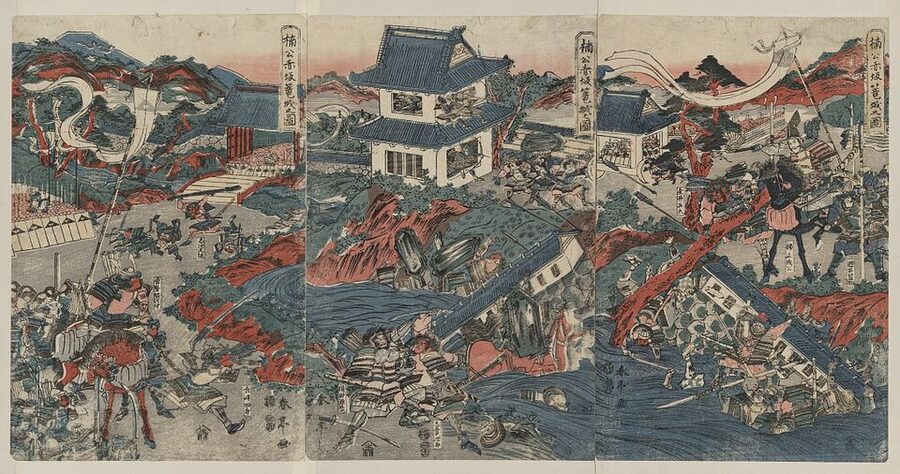
The documents tell a duller story with one glorious detail in it. A warrior from Izumi called Wada Sukeie recorded joining the attack on “the Kusunoki castle” on the 14th day of the ninth month, when it was still a local affair. On the 15th day of the tenth month, according to another surviving record, four regular armies marched out of Kyoto against Akasaka by four different roads. The general leading the column over the Iga road was a young Kamakura vassal called Ashikaga Takauji, the man who would kill Masashige five years later, and whose own extraordinary career I have written up in my piece on Ashikaga Takauji.
Akasaka was too small and too new to hold. The Taiheiki says the food ran out after about twenty days, and that on the night of the 21st day of the tenth month Masashige burned the fort himself, leaving twenty or thirty charred corpses of the fallen in a great pit for the enemy to find. The besiegers decided the bodies were Masashige and his family and went home. The Edo-period military writer Ejima Tamenobu admired the escape and still marked Masashige down for rising too early and building a fort with a bad water supply, which seems fair.
He vanished for about a year, and when he came back he came back fast. The shogunate had given Akasaka to Yuasa Munefuji of Kii, and the Taiheiki says Masashige ambushed a convoy of five or six hundred porters bringing rice to the fort by night, swapped his own men in for them, and hid their weapons inside the empty bales. Once through the gate they pulled out the swords, the force outside broke down the gate, and Yuasa surrendered without a fight and changed sides. Sources variously date the recapture to the fourth or the twelfth month of 1332; the Taiheiki‘s chronology is notoriously loose, and the twelfth month fits the other evidence better.
From there he took most of Izumi and Kawachi and pushed north to Shitennō-ji, the great temple of Osaka. The Taiheiki has him lure a Rokuhara army over the Watanabe bridge by showing only 300 men, then fall on it from three sides, and later outface Utsunomiya Kintsuna, “the finest bowman of the east”, by lighting bonfires on every hill for three nights until the nervous easterners withdrew. “A good general wins without fighting,” Masashige says, which is the most quoted line in the chapter and also, conveniently, the reason he never had to meet Utsunomiya in battle.
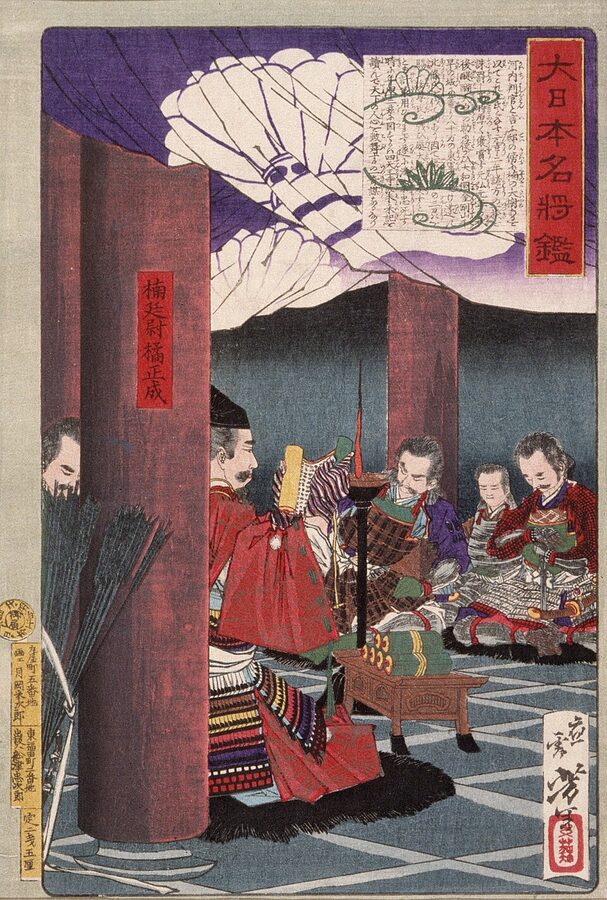
That prophecy is the Taiheiki at its most enjoyable. Shown the prince’s hidden Miraiki, his “Record of the Future”, Masashige reads that in the reign of the 95th sovereign the realm will fall into disorder, an eastern fish will swallow the four seas, and after 370 days and more a western bird will come and eat the eastern fish. He decides that the fish is the Hōjō and the end is near. Nobody has ever found the book, which is just as well for the book.
Chihaya: a hundred days on a ridge
Behind Akasaka, high on a spur of Mount Kongō, Masashige built the castle that made his name. Chihaya stood at 673 metres on a narrow ridge with deep ravines on three sides, so that the only easy approach was down the mountain from above. It was not a castle in the sense of the stone keeps people photograph today. Think instead of five levelled terraces, wooden palisades, towers and storehouses, set in forest above a gorge.
Kamakura took the threat seriously this time. By the end of the first month of 1333 a great army from the east had split into three, against Prince Morinaga in Yoshino, against Akasaka and against Chihaya. The upper Akasaka fort, under a commander called Hirano Shōgen and Masashige’s brother, held until the attackers found and cut its water supply. Its 282 surviving defenders surrendered and were beheaded on the riverbed in Kyoto, and the Taiheiki says that after hearing of it nobody at Chihaya ever thought of surrendering again.
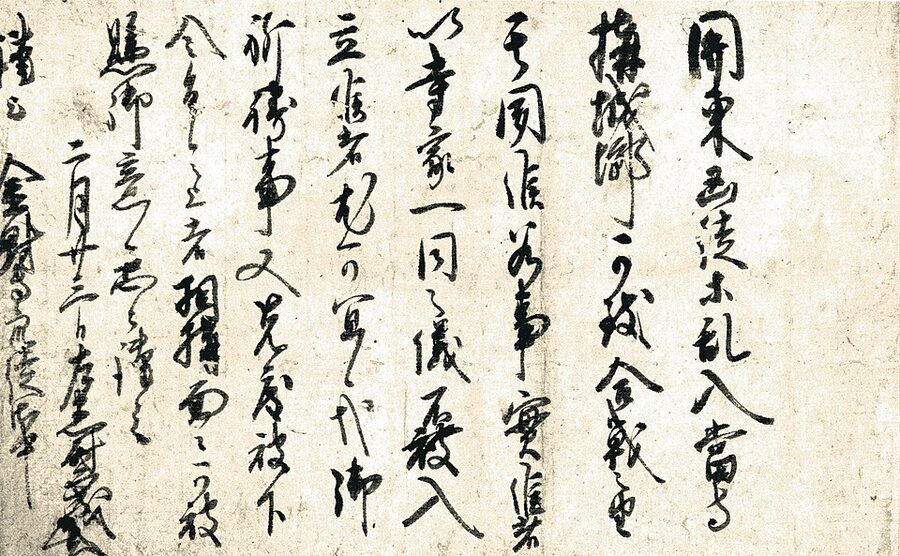
The siege that followed is where the chronicle and the documents part company most entertainingly. The Taiheiki puts the attackers at a million men, and in one passage two million. A surviving shogunate muster list, the Kusunoki kassen chūmon, names the units involved, and the historian Arai Takashige, counting vassals per province and men per vassal, arrives at about 25,000. Against them Masashige had fewer than a thousand.
The dates are firmer than the numbers. The documents show the attack on Chihaya beginning on the 27th day of the second month and ending on the ninth day of the fifth; that year had an intercalary second month, so the siege lasted about three and a half months. Local guides call it the hundred-day war, which is close enough.
Inside those dates the Taiheiki packs its most famous scenes. Stones dropped from the towers smashed the first rush, and the shogunate’s commissioner, Nagasaki Takasada, needed twelve clerks writing for three days and nights to record the dead. When the besiegers settled down to cut the water, as they had at Akasaka, they found the garrison had filled three hundred hollowed-out logs with water and was in no hurry.
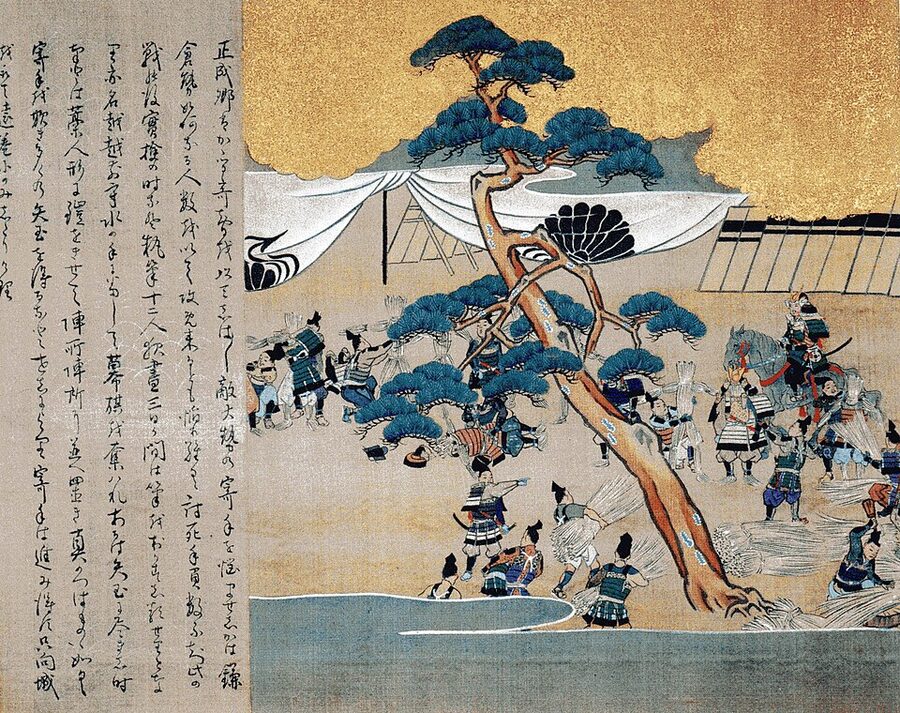
The dummies are the episode everyone remembers. Masashige had straw figures dressed in armour and set at the foot of the walls before dawn, with 500 men hidden behind them shouting war cries in the mist. The besiegers charged what they took to be a sortie, the real men fell back loosing arrows, and as the attackers reached the dummies the garrison rolled boulders down on them, killing 300 and wounding 500.
Boredom did the rest. The Taiheiki says the eastern lords sent for courtesans from the river ports of Eguchi and Kanzaki, and that a Nagoe lord and his nephew quarrelled over dice, stabbed each other, and set their followers fighting until 200 were dead. On the fourth day of the third month a furious order arrived from Kamakura to take the castle, and the besiegers brought 500 carpenters from Kyoto to build a bridge more than sixty metres long to throw across the ravine. The garrison sprayed it with oil from hand pumps, threw torches after the oil, and watched it burn and break in the middle with the attackers on it.
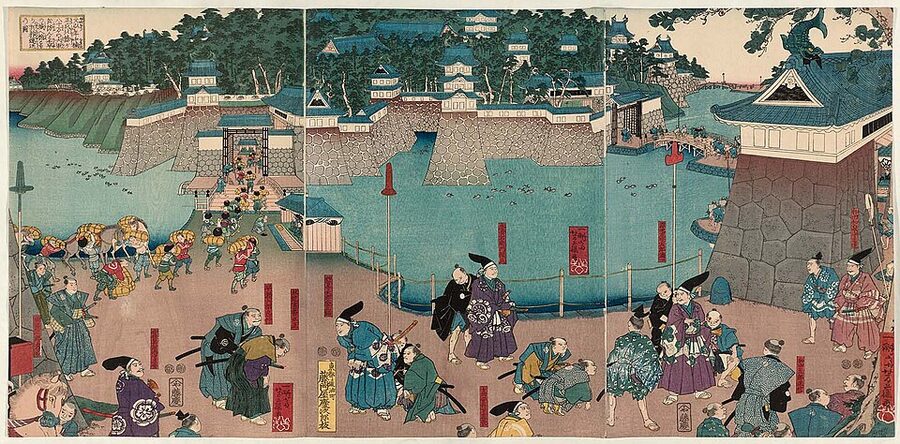
No other source mentions the bridge, though a stretch of the ravine below the castle still carries the place name Kakehashi, “hanging bridge”, which suggests the story has something under it. What the sources agree on is what the siege achieved. While the best of the shogunate’s army sat on Mount Kongō, mountain irregulars loyal to Prince Morinaga cut its supply lines, the besiegers began to starve, and the rest of the country started to move.
In the intercalary second month Go-Daigo escaped from Oki. Akamatsu Enshin rose in Harima, the Kōno in Iyo and the Kikuchi in Kyushu, and Ashikaga Takauji, sent west to crush the rebellion, changed sides instead and took the Rokuhara office in Kyoto on the seventh day of the fifth month.
The besiegers at Chihaya heard the news the next day and left, losing more men in the retreat through the mountains than in the assault. About a dozen days after the last attacker left Chihaya, on the 22nd day of the fifth month, Nitta Yoshisada stormed Kamakura, and the Hōjō and their men killed themselves at Tōshō-ji, a scene I describe in my piece on seppuku. The historian Goza Yūichi makes the case neatly: a shogunate that could not take one small castle had lost the reputation for invincibility on which its rule depended.
Three trees and a blade of grass
Masashige met the returning emperor at Hyōgo on the second day of the sixth month of 1333 and rode at the head of his procession into Kyoto. For the next three years he was a member of the new government. The emperor made him governor of Kawachi, military governor of Kawachi and Izumi, a police captain of the capital and a member of the Records Office, the highest administrative body of the regime, with estates scattered from Tosa to the far north.
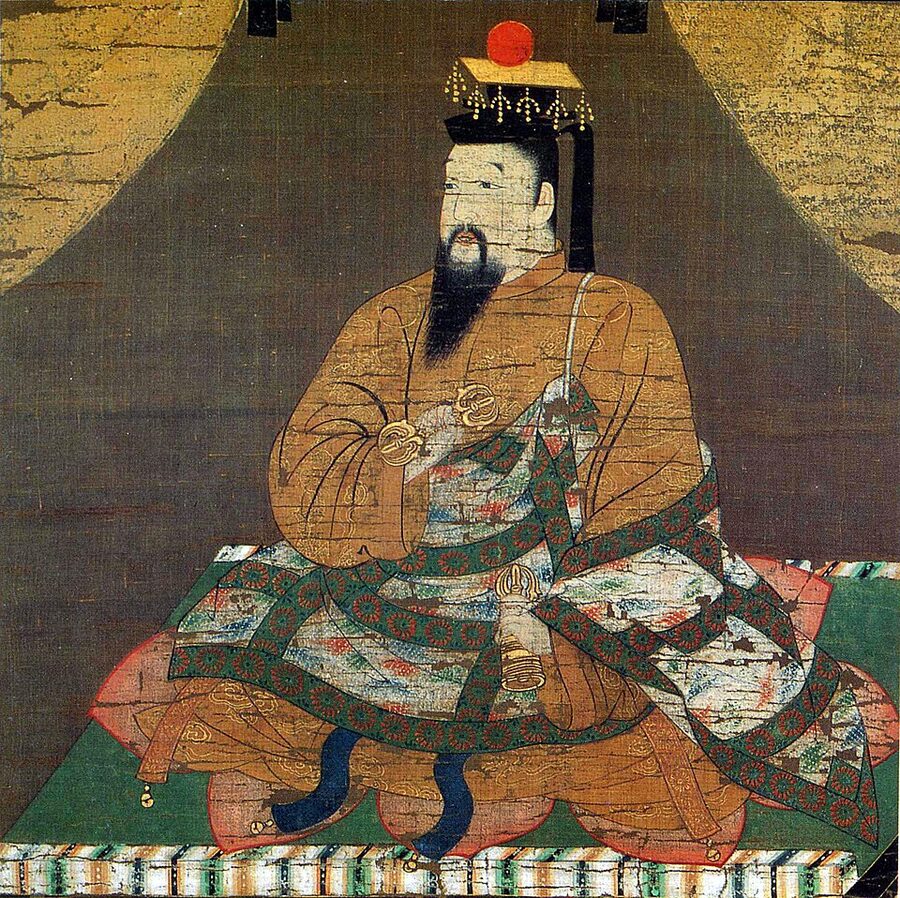
Kyoto noticed. The wits of the capital called the four favourites who rose fastest in the new court the sanboku issō, “three trees and one blade of grass”: Yūki, Hōki (Nawa Nagatoshi, governor of Hōki) and Kusunoki all end in the sound ki, tree, and Chigusa contains kusa, grass. It was not a compliment. The phrase meant upstarts who flaunted the emperor’s favour, and the Kenmu Restoration, as Go-Daigo’s experiment is called, was soon drowning in claims for reward.
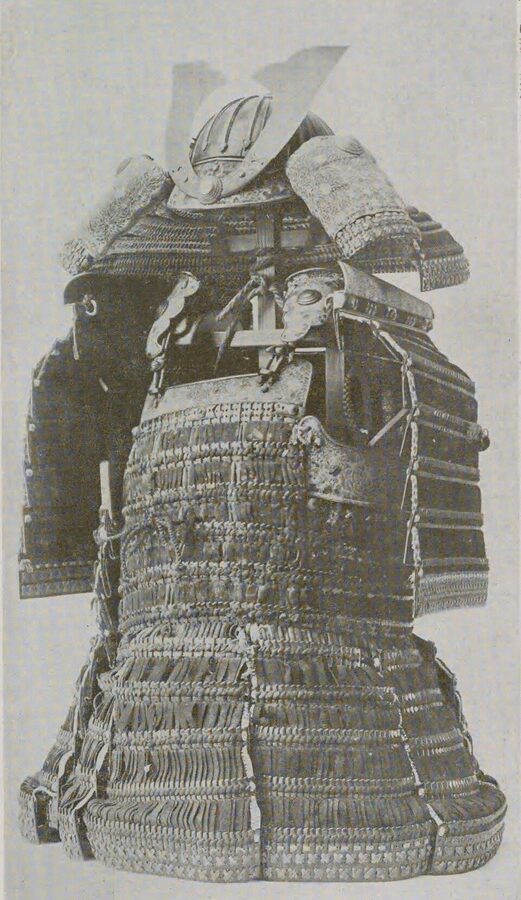
Two small facts suggest the sort of man he was in office. A petition of 1384 from the Kikuchi family of Kyushu recalls that when rewards were being handed out, Masashige urged that the first should go not to the living but to Kikuchi Taketoki, who had died attacking the shogunate’s Kyushu headquarters on the emperor’s order. And the historian Mori Yukio notes that his appointment to the Records Office was one of the few genuinely radical promotions Go-Daigo made: the other members were trained administrators, which implies Masashige could do the paperwork.
He also spent money on his home ground. In 1334 he supervised the rebuilding of the main hall of Kanshin-ji on the emperor’s orders and rebuilt the family’s tutelary shrine, Takemikumari, below Akasaka. When the coalition broke apart he was on the losing side of the first quarrel. Prince Morinaga, the fighting son he had sheltered at Akasaka, fell foul of his father and of Takauji in 1334, was arrested and sent to Kamakura, where he was murdered the next year, and Masashige resigned many of his posts soon after his arrest.
The wider war belongs to Takauji’s story. In 1335 he went east to put down a Hōjō revival, stayed there and turned against the court; in the first month of 1336 his army took Kyoto, and Masashige, Nitta Yoshisada and Kitabatake Akiie drove it out again within the month. By the second month Takauji had fled to Kyushu, apparently finished. My overview of Japan through the ages shows where these three short years of Kenmu sit in the longer story.
The advice nobody took
This is where Masashige stops looking like a loyalist hero and starts looking like the shrewdest man in Kyoto. The Baishōron, a chronicle written from the Ashikaga side some years later, says that after the victory he advised the emperor to make peace with Takauji. Takauji, he argued, had done more to bring down Kamakura than anyone; the warriors had followed him into exile, which proved they trusted him; and Nitta Yoshisada, who had no such following, should be killed and his head sent to Takauji as a peace offering. The courtiers laughed at him.
The story exists only in the Baishōron, and Japanese historians handle it carefully. But it fits what else is known: Masashige worked with the temples and local warriors of the capital region that Takauji courted and Nitta never understood, and a major Japanese historical dictionary singles out his warning that Takauji would soon be back as proof of an uncommon strategic mind. Takauji was back within three months. He won in Kyushu at Tatarahama, sailed east with the fleets of Shikoku, and by the middle of the fifth month Nitta, worn down besieging a single castle in Harima, had fallen back to Hyōgo with an army shrinking by the day.
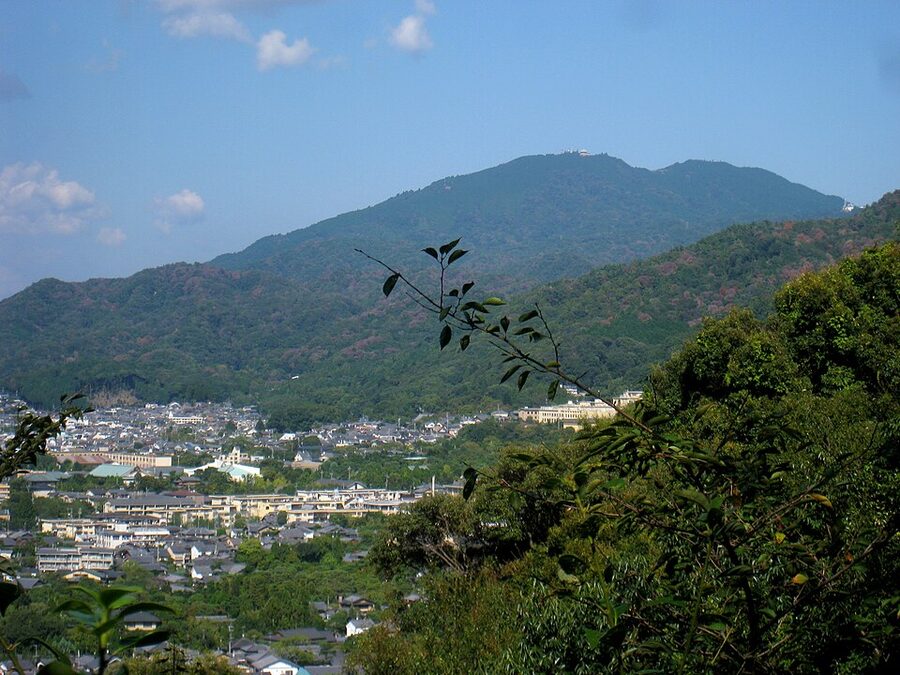
The famous version of the next scene is the Taiheiki‘s. Summoned to the palace and ordered to join Nitta at Hyōgo, Masashige proposed something else: the emperor should withdraw to Mount Hiei as he had in the first month, Masashige would go home to Kawachi and seize the mouth of the Yodo River, and with the Ashikaga trapped and hungry in Kyoto, Nitta would come down from the mountain while Masashige struck from the rear. The courtiers were inclined to agree, until the councillor Bōmon Kiyotada objected that for the emperor to abandon his capital twice in a year would cheapen the throne, and that the court’s victories had come from heaven’s favour rather than generalship. Go-Daigo sided with Kiyotada.
Here the manuscripts disagree, and the disagreement is worth knowing. In the Seigen-in text, one of the oldest versions of the Taiheiki, Bōmon Kiyotada does not appear at all, and Masashige answers the refusal by asking for an imperial order “to die in battle”. In another early text, kept at the Jingū Chōkokan in Ise, he is openly sarcastic: if the emperor wants his one irreplaceable soldier thrown at a huge army instead of winning by strategy, then as a loyal and brave retainer he will be happy to go and die.
The Baishōron preserves what sounds like his real voice. On the road to Hyōgo, it says, he sent a message back to the emperor from Amagasaki.
“This time Your Majesty’s war will certainly be lost. When I called out the men of Izumi and Kawachi, the two provinces I govern by imperial order, even my own kinsmen were reluctant, and how much more the people at large. This is the proof that the realm has turned its back on its sovereign. My life is of no further use; I shall die in the front line.”
That is not a man in love with death. It is a general reading the numbers, and they were all against him.
Sakurai: the parting that probably never happened
On the way to Hyōgo, says the Taiheiki, the army stopped at the post station of Sakurai on the western highway, and Masashige called his eldest son to him. Masatsura was eleven years old. His father told him this was likely the last time he would see his face in this life, that after his death the realm would pass to Takauji, and that the boy’s duty was to survive, grow up, and hold the family to the emperor’s cause. In the version every Japanese schoolchild later learned, he handed the boy a dagger the emperor had once given him, and sent him home to his mother.
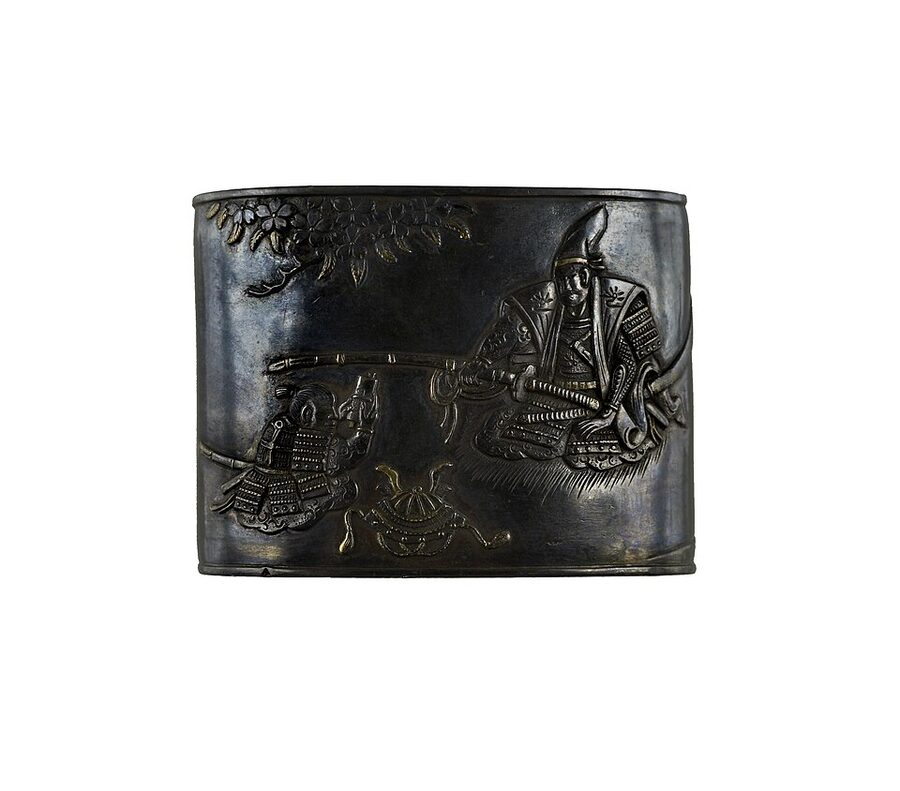
Of all the Taiheiki‘s scenes, this is the one that did most work in modern Japan. It was in school readers before the war, it had its own song, Aoba shigereru Sakurai no, “Where the green leaves grow thick at Sakurai”, with words by the Meiji poet Ochiai Naobumi, and every child in the country could sing it. Since the war, Japanese historians have treated both the parting and the Sakurai post station as inventions of the chronicle, and excavations at the traditional site between 2005 and 2008 found nothing to change their minds.
The Taiheiki follows the boy home with an even harder scene. When Takauji, in a gesture of respect, sent Masashige’s head back to his family, Masatsura took it and drew the emperor’s dagger on himself, and his mother stopped him by reminding him what his father had told him to do. None of it can be checked. All of it was quoted at schoolboys for the next six centuries.
Minatogawa: the 25th day of the fifth month of 1336
Masashige reached Hyōgo on the 24th day of the fifth month and spent the evening with Nitta Yoshisada. The Taiheiki says Nitta, humiliated by a string of defeats, wanted to fight the coming battle regardless of the odds to save his name, and that Masashige told him a good general retreats when he must and ignores what people say. They talked through the night over a few cups of sake. The historian Mineshige Sumio suspects Masashige was as dismayed as he was sympathetic, which is my reading too.
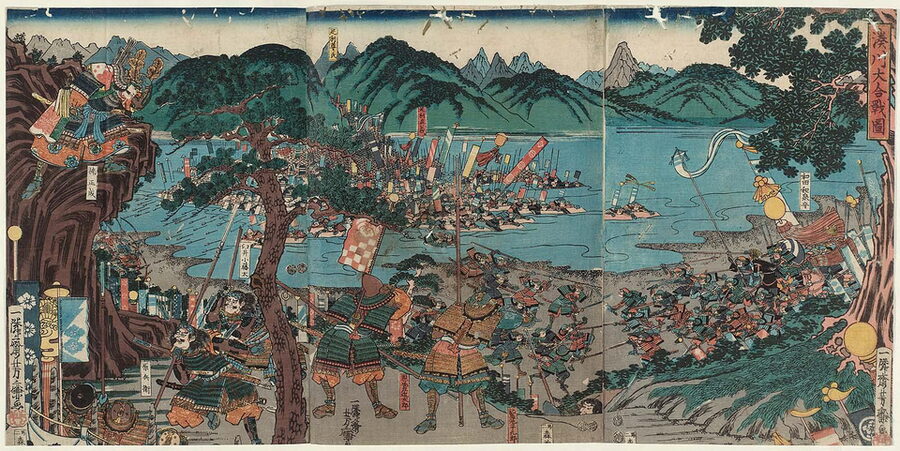
The battle began at about eight in the morning of the 25th day of the fifth month of 1336. English reference works convert the date to 4 July, sometimes 5 July, by the Western calendar. Takauji came by sea with the fleet; his brother Ashikaga Tadayoshi came by land along the western highway with the main army. Nitta held the shore at Wada Point, the cape of Hyōgo harbour, and Masashige, with about 700 horsemen of his own and no one else’s, took the hill west of the Minato River now called Egeyama.
The decisive move was made on the water. Hosokawa Jōzen’s Shikoku squadron sailed east along the coast and began to land behind Nitta at Ikuta, and Nitta, fearing he would be cut off from Kyoto, pulled his army back east. That left a gap, Takauji came ashore into it, and Masashige was alone.
The historian Yamamoto Takashi argues that, on the evidence of the Baishōron, the two sides were not as unequal as legend says and the day was won by a naval feint and Nitta’s mistake. Minatogawa is not one of the nine Sengoku fights in my list of Japan’s most decisive battles, but it settled more than most of them: within weeks Takauji was in Kyoto with an emperor of his own choosing, and the Ashikaga would rule from there for two centuries.
The Taiheiki gives the land fight in its full colours. Masashige and his brother charged Tadayoshi’s army, splitting and rejoining seven times, and drove it back towards Suma; Tadayoshi himself barely escaped. Takauji sent fresh troops round to cut them off, and Masashige turned and charged again. After sixteen charges in six hours, by the Taiheiki‘s count, or three hours in some modern summaries, there were seventy-three men left, and they went into the farmhouse.
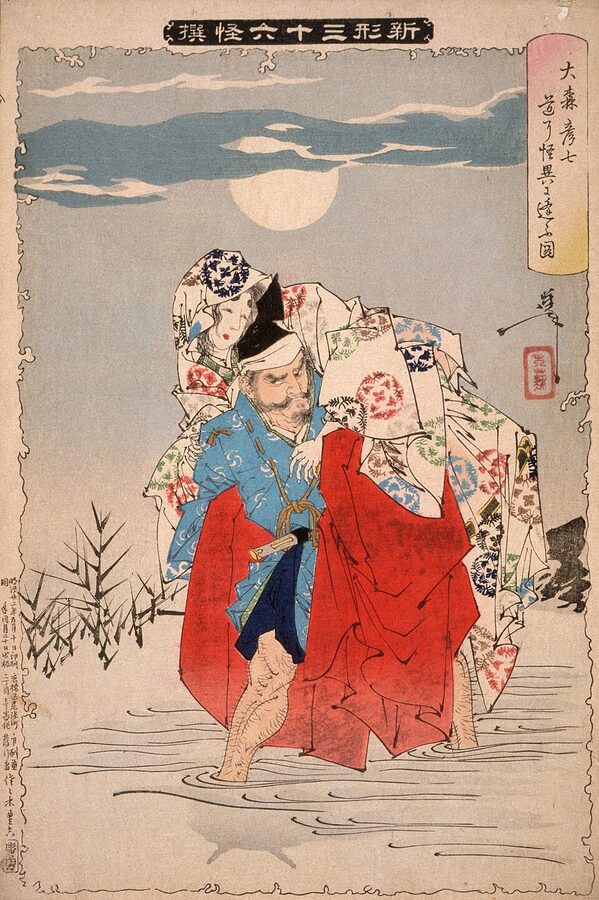
Japanese reference works disagree slightly about where the farmhouse stood, and about the brother’s name. The Baishōron calls him simply Shichirō; the popular text of the Taiheiki calls him Masasue, which is how he has been known ever since, though historians are not sure the two are the same person. The Taiheiki gives Masashige’s age as forty-three, which is the only basis for the traditional birth year of 1294. Sixteen of the family and about fifty retainers died with him.
The exchange about seven lives is the Taiheiki‘s, and Japanese scholars such as Uwayokote Masataka and Imai Masanosuke read it as its author intended: a curse, shichishō metsuzoku, “seven lives to destroy the rebels”, the deathbed wish of a man so consumed by hatred that he chooses to stay in the cycle of killing. That is why the same chronicle brings him back as a demon. The historical Masashige, who copied the Lotus Sutra in his own hand the year before, was by every sign a devout Buddhist, and the curse sits oddly on him.
From enemy of the court to god
For two centuries Masashige was officially a rebel. His head was displayed on the riverbed at Rokujō in Kyoto, where people, having seen a fake Kusunoki head earlier that year, were not sure it was really his. The Ashikaga shogunate that ruled until the 16th century, described in my piece on the Muromachi era, counted the Southern Court as a usurper and its generals as enemies of the throne. It took until the 20th day of the eleventh month of 1559, when a man claiming descent from him petitioned Emperor Ōgimachi, for the family to be pardoned, and even then the pardon was granted on the grounds that his descendants regretted his crimes.
The Taiheiki kept him alive in the meantime. Its author praised him as the one man of his age with all three Confucian virtues, wisdom, benevolence and courage, and from about the time of the Ōnin War a stream of forged military manuals circulated under his name. A commentary on the Taiheiki, printed in 1645, became an Edo bestseller and the basis of a “Kusunoki school” of strategy; one teacher of it, Yui Shōsetsu, plotted to overthrow the shogunate in 1651, a story I tell in the article on rōnin.
Not every scholar was convinced. The Confucian Yamazaki Ansai ranked Masashige below Zhuge Liang and remarked in 1657 that anyone who credited him with all three virtues had obviously never read the Doctrine of the Mean.
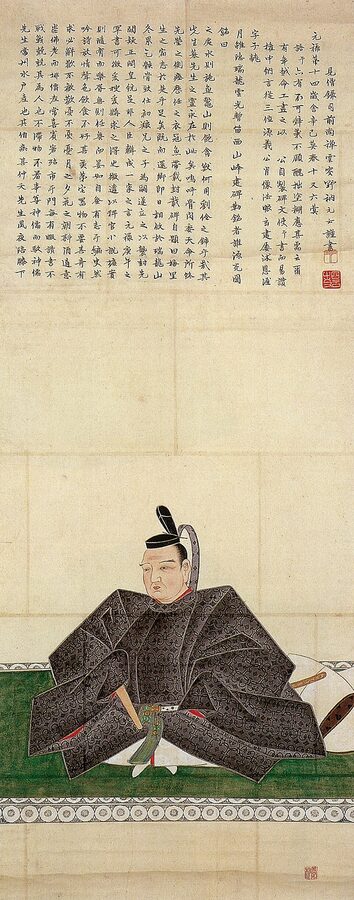
The grave at Minatogawa had a long, modest history before Mitsukuni found it. It first appears in a land survey of the 1590s as a tax-exempt plot twenty-four tsubo in size in the middle of rice fields. Around 1646 a lord of Amagasaki planted a plum and a pine there and set up a small stone pagoda, and in 1664 the scholar Kaibara Ekiken visited, found only the two trees, drafted an inscription and then decided it would be presumptuous for a man of his rank to put up a monument in another lord’s domain.
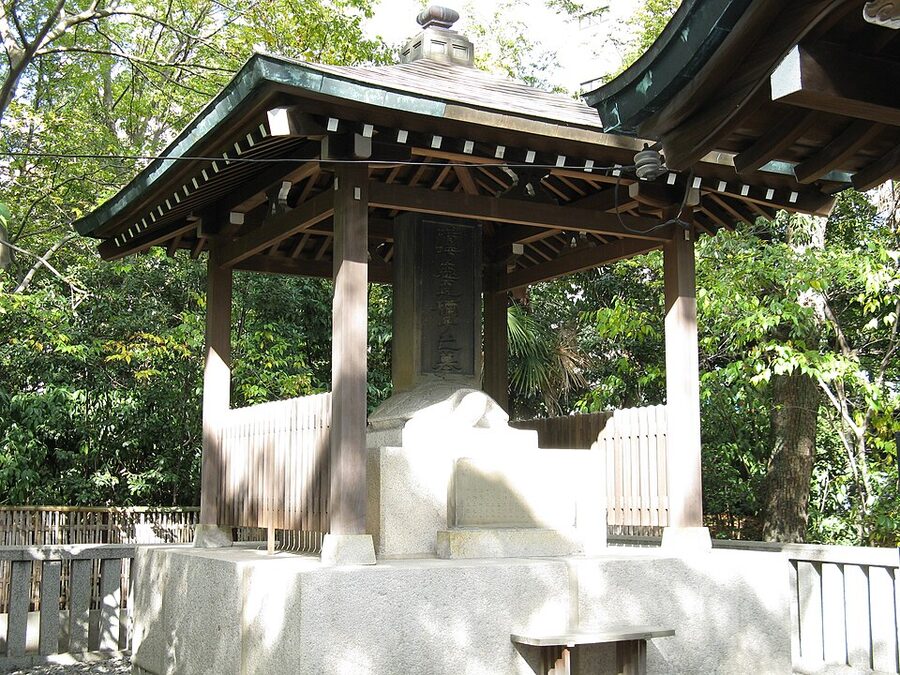
Mitsukuni had no such scruples. His retainer Sassa Munekiyo, the original of the “Suke-san” of television, met the monk who looked after the grave in 1685, and in 1692 the work began: a two-tier base by stonemasons from Sumiyoshi, a turtle of white Shirakawa stone from Kyoto, and a slab of blue Izumi stone. The face carries eight characters in Mitsukuni’s own hand, 嗚呼忠臣楠子之墓, “Alas, the grave of Master Kusunoki, loyal retainer”, modelled on an inscription Confucius was said to have written for a Chinese prince.
On the back is a eulogy by Zhu Shunshui, a Ming loyalist who had fled to Japan when the Manchus took China and who had died ten years before; it was first written for a painting of the parting at Sakurai. The bill came to 183 ryō of gold and change.
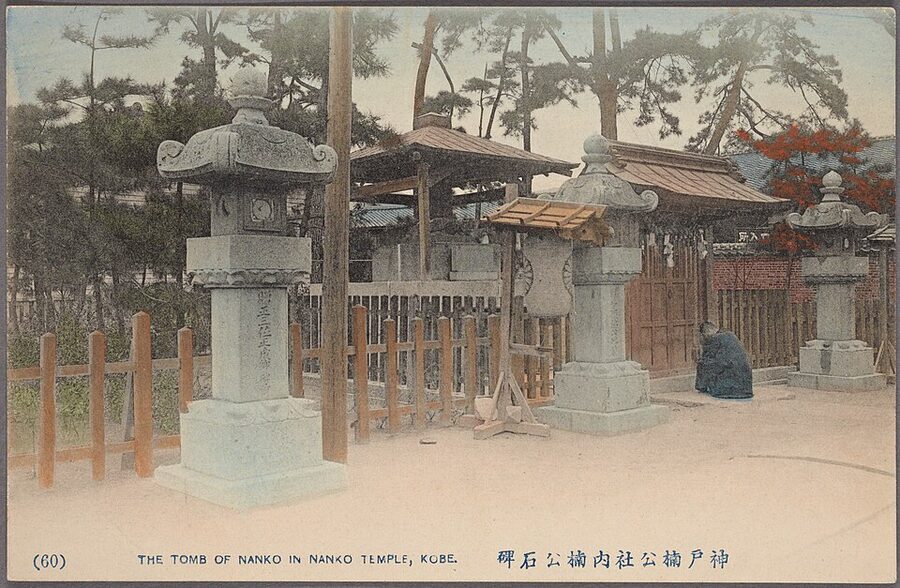
That stone did more than any book to turn Masashige into a cult. Pilgrims took rubbings home, and the shrine still lists among them Yoshida Shōin, the teacher of the Chōshū activists, and Yokoi Shōnan. Maki Izumi of Kurume, a Shinto priest so devoted that friends called him the “modern Kusunoki”, held a festival for Masashige every year on the anniversary of his death from the 1840s, even under house arrest. In Saga, where a statue of father and son had been made as early as 1663, Edayoshi Shin’yō founded a loyalist league in 1850 to keep the anniversary, and among its members were Ōkuma Shigenobu, Etō Shinpei and Ōki Takatō, all of them later ministers of Meiji.
By the 1860s the festivals had become something new. The rebels of Chōshū began enshrining their own dead alongside Masashige, the seed of the shrine to the war dead that became Yasukuni, and in 1867 the lord of Owari petitioned the court for a national shrine to him. The Meiji Restoration government ordered one in 1868.
Saigō Takamori was among the Satsuma men who went to look over possible sites, the grounds were fixed in 1869 to include both the grave and the traditional place of death, and the spirit was installed on the 24th day of the fifth month of 1872. Some English accounts give 1871.
The new shrine was so new that the state had to invent a category for it. Its god was neither an emperor nor one of the ancient deities, so in 1872 the government created the rank of bekkaku kanpeisha, special imperial shrine, for subjects who had served the state, with Minatogawa as the first, and the shrines to Toyotomi Hideyoshi and Tokugawa Ieyasu soon joined it. In 1880 Masashige was promoted posthumously to Senior First Rank, the highest the court could give. Even Emperor Meiji is said to have played at being Masashige, shouting that he would strike down the traitor Takauji.
Seven lives for the country
Meiji schools taught the Taiheiki as history, and in 1911 the question of which court had been legitimate became a political crisis when a state textbook was accused of treating the two lines as equal. The government ruled for the Southern Court, which had held the regalia described in my piece on the Three Sacred Treasures, the textbook was rewritten, and from then on Masashige was a fixture of ethics classes, the model of a subject who goes knowingly to his death because the sovereign has commanded it.
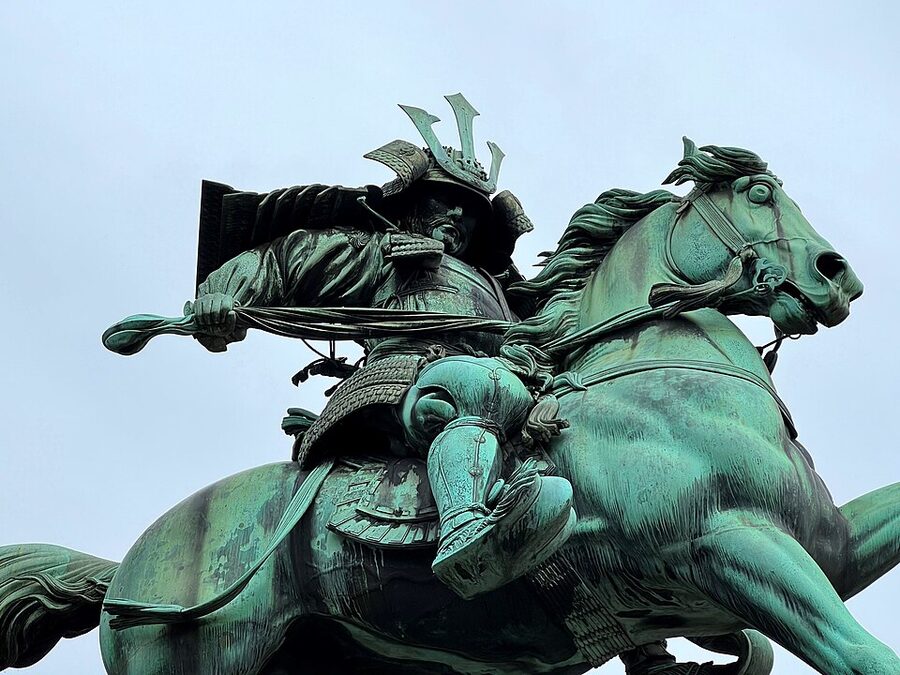
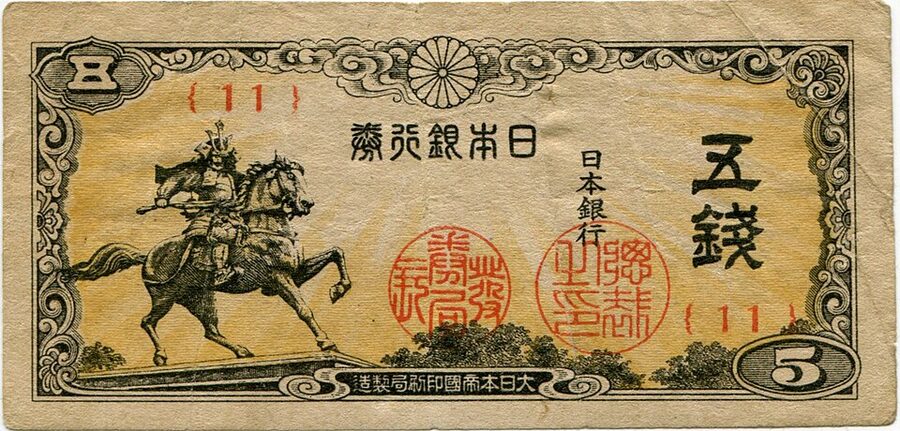
The statue is the clearest statement of what the state wanted from him. Commissioned around 1890, it took about ten years to make and is usually dated to 1900, though one Japanese reference gives 1904; at about four metres, eight with the plinth, it is one of the three great bronzes of Tokyo with Saigō Takamori in Ueno and Ōmura Masujirō at Yasukuni. It stands in the outer garden of what had been Edo Castle, facing the palace, and from 1944 it was on the five-sen banknote.
The slogan arrived around the same time as the statue. The earliest known use of shichishō hōkoku is a Chinese-style poem by the naval officer Hirose Takeo, killed in the blockade of Port Arthur in 1904 and published in a Tokyo newspaper that spring, in the war described in my piece on the Russo-Japanese War. The historian Hiraizumi Kiyoshi, the most influential imperial-history scholar of the Shōwa era, used it in 1929, and from then on the curse of the Taiheiki was quietly replaced by a vow. As late as 1916, the Taishō emperor’s own poem on Masashige still used the old wording.
In 1935, the 600th anniversary of his death, the country put on a festival. In Kobe a procession of 3,000 people in armour was reported to have drawn half a million spectators, a railway company opened a station named after Sakurai, and five years later the schoolchildren and teachers of Japan paid for a stone tower near his birthplace, 43 shaku high (about 13 metres), one for each year of his life.
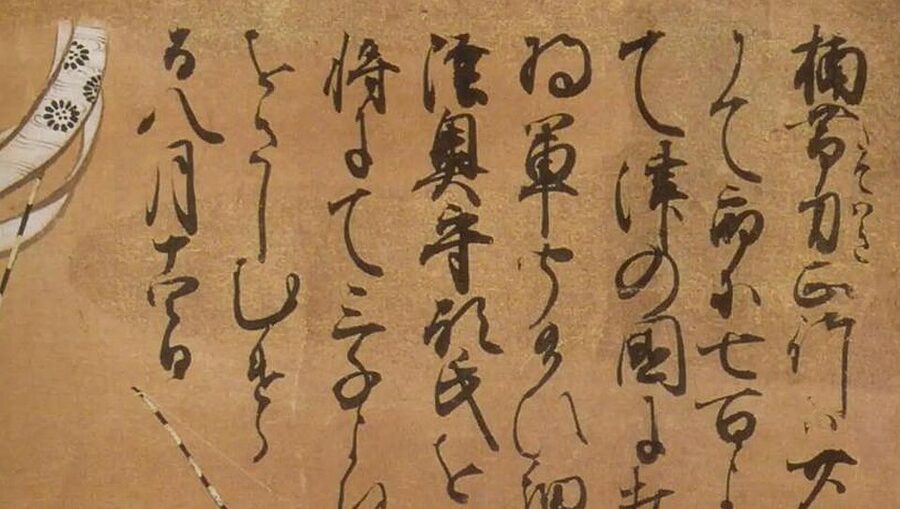
Then the uses of Masashige became deadly. From 6 April to 22 June 1945 the mass suicide attacks off Okinawa were named the Kikusui operations, after his crest; Japanese figures put the losses at 940 navy and 887 army aircraft, and 3,067 men. The kikusui was painted on the kaiten manned torpedoes, and Nonaka Gorō, who led the bombers carrying the piloted Ōka rocket bombs, compared his mission bitterly to Minatogawa: a hopeless order, obeyed.
The shrine itself burned in the air raids on Kobe of 17 March and 5 June 1945, and the local police put up a sign among the ashes telling people to defend Nankō’s sacred ground.
After 1945 the god fell off his plinth, though the statue stayed on its own. Historians rediscovered the akutō, the novelist Yoshikawa Eiji wrote a Masashige far from the prewar saint, and when an NHK history programme titled an episode “the akutō Kusunoki Masashige kills himself”, Minatogawa Shrine complained. The slogan lived on at the fringes. In 1960 the student Yamaguchi Otoya, who had stabbed the socialist leader Asanuma Inejirō on stage, wrote shichishō hōkoku on the wall of his cell before hanging himself, and in 1970 the novelist Mishima Yukio wore the same four characters on his headband at Ichigaya on the day he cut his belly, an episode I come back to in my piece on bushidō.
Masatsura at Shijōnawate
The son came closer than anyone to doing what the Taiheiki says his father asked. By 1347 Masatsura was the leading commander of the Southern Court, and in a few months he beat one Ashikaga army at Fujiidera and another at Sumiyoshi and Tennōji. The Taiheiki says that after the second he pulled some 500 drowning enemies out of the river at the Watanabe bridge, gave them clothes and medicine, and sent them home.
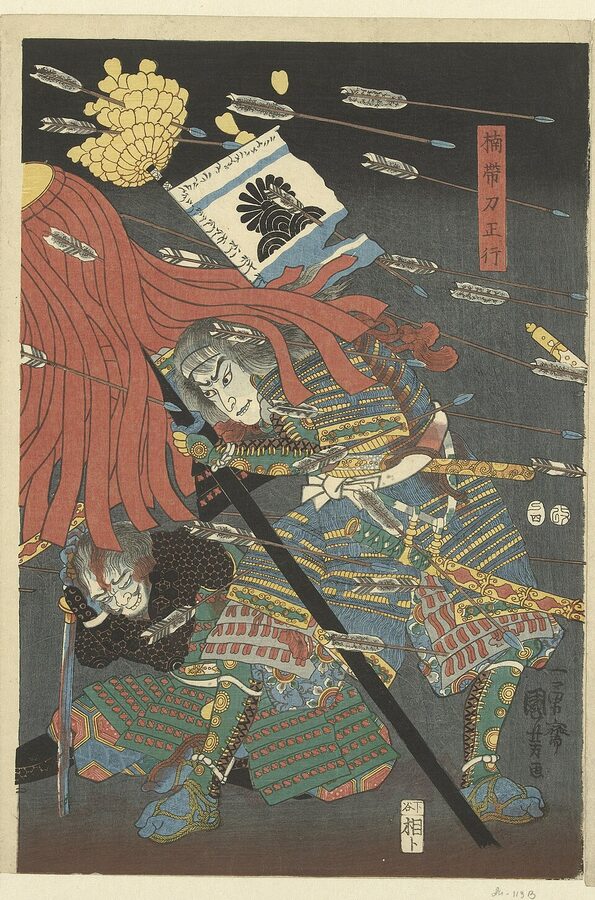
The shogunate then sent its best generals, the brothers Kō no Moronao and Moroyasu, with a large army. On the 27th day of the twelfth month of 1347 Masatsura went to Yoshino to take leave of Emperor Go-Murakami, visited Go-Daigo’s tomb at Nyoirin-ji, and, the Taiheiki says, wrote the names of 143 followers on the temple door with a farewell poem: “Knowing I shall not return, I leave my name among the dead.” On the fifth day of the first month of 1348 his army was destroyed at Shijōnawate, and he and his brother Masatoki killed each other as their father and uncle had. The versions of the Taiheiki give his age as anything from twenty-two to twenty-five.
Chihaya held out for the Southern Court for decades more and fell to Hatakeyama Motokuni in 1392, the year the two courts were reunited, though one reference work dates its fall to 1390. The Kusunoki line faded out in the wars that followed, and when the Meiji government went looking for heirs to ennoble in the 1880s, it could not find a provable descendant. The Nitta, Kikuchi and Nawa families got their barons. The Kusunoki got the shrines.
You will not find Masashige in my ranked field guide to Japan’s greatest samurai, which keeps to the Sengoku and after. He would not fit the scoring anyway: he lost the war that counted, and became more famous for losing it than anyone who won.
Where to find Kusunoki Masashige today
The places split neatly in two. Kobe and Tokyo have the god, the shrines and statues of the 19th and 20th centuries. The hills of southern Osaka have the warrior: castle terraces, a temple hall he rebuilt, and the mound where his head is buried. If you have one day, spend it in the hills.
Minatogawa Shrine, Kobe
Minatogawa Shrine (湊川神社), “Nankō-san” to the people of Kobe, stands on Tamon-dōri in Chūō-ku, a three-minute walk north of JR Kobe Station. From the Hankyu and Hanshin lines at Kōsoku-Kōbe you come up the stairs from the east ticket gate straight to the front gate, and Ōkurayama on the subway’s Seishin-Yamate Line is about five minutes to the north. The gate is open 6:00–18:00 all year and the grounds are free.
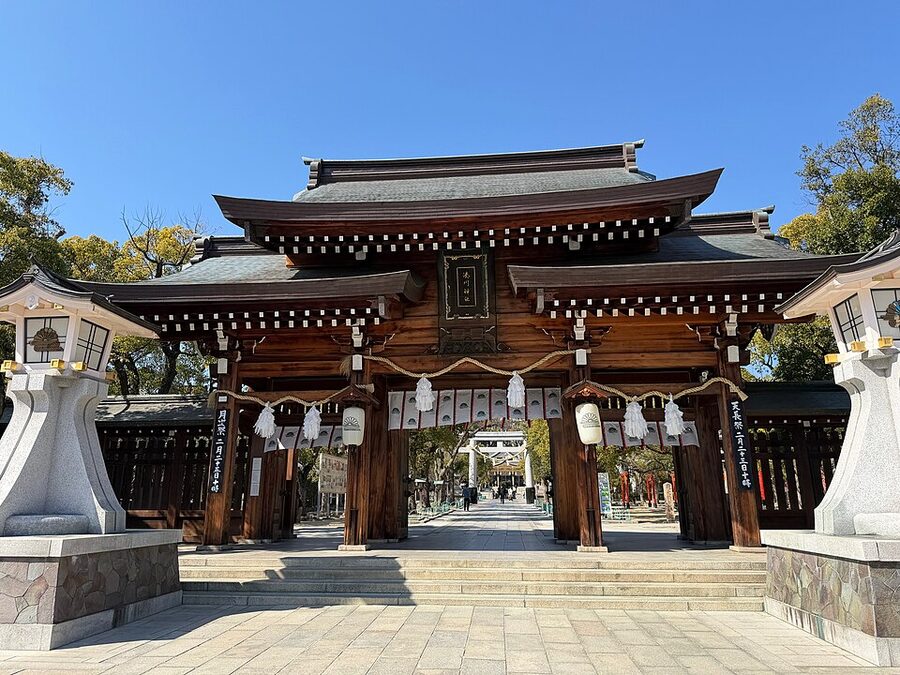
Most visitors photograph the main hall and leave. Do not. The two places that matter lie at opposite corners of the grounds, deliberately: the shrine’s own guide points out that its land was laid out to join the grave and the place of death on a diagonal.
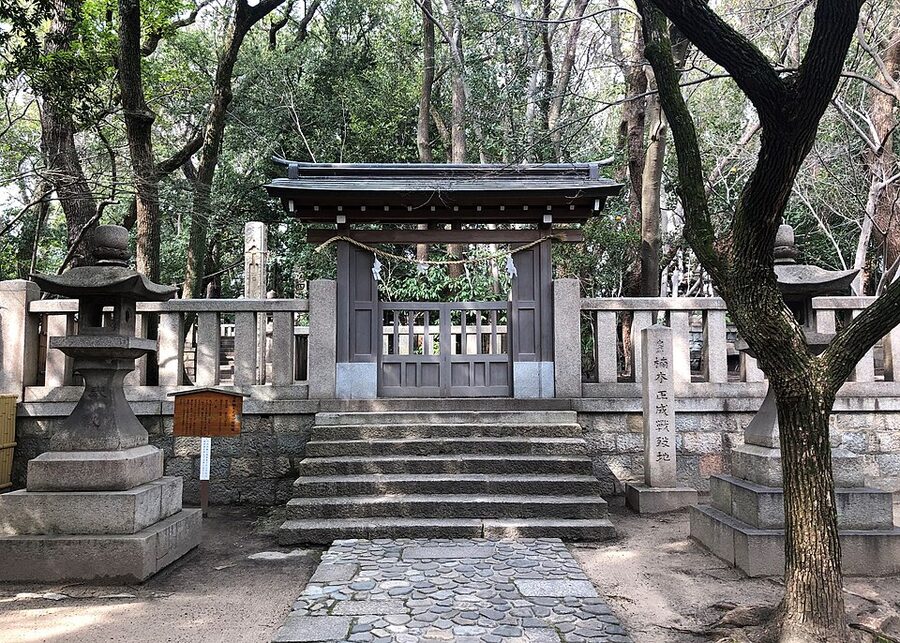
The grave is near the front, inside its own enclosure on the east side. Mitsukuni’s stone sits under a roofed shelter, successor to one his officials put up in 1695 to keep the crows off, and the turtle is still underneath it. A rival tradition places the suicide at Kōgon-ji, the “Kusunoki temple” three minutes from Ōkurayama Station, the Zen temple that looked after the grave for centuries; its main hall is now a modern building that doubles as a concert hall.
The treasure hall opens 10:00–15:00, closes on Wednesdays and from 25 December to 5 January, and charges ¥300 for adults, ¥200 for high school and university students and ¥100 for children. Its holdings include the Lotus Sutra colophon of 1335 in Masashige’s hand, the only example of his formal script to survive, and an armour said to be his that the Wakisaka lords of Tatsuno gave in 1891. Exhibits change several times a year, so check the shrine’s site if there is something particular you want to see.
Chihaya castle and the Akasaka hills
Chihaya-Akasaka is the only village in Osaka Prefecture, and it is a pleasant place to spend a day: terraced fields, orchards, and Mount Kongō rising behind. For the castle site, take the Nankai bus bound for Kongōsan Ropeway-mae from Kawachinagano Station, on the Nankai Kōya Line and the Kintetsu Nagano Line, to the Kongō Tozanguchi stop. From there it is a walk of about twenty minutes, most of it up a long flight of stone steps.
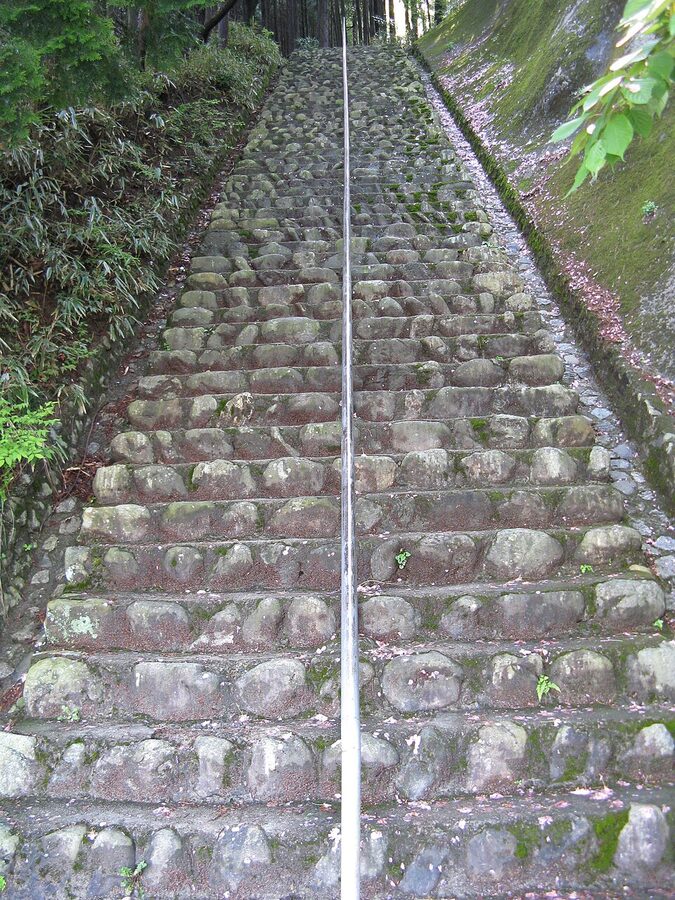
There is nothing standing, and the site is free and open. Chihaya Shrine occupies the second enclosure, the main enclosure beyond it is a long, narrow clearing about 100 metres by 20, and the grave of Masashige’s third son Masanori lies about 100 metres further east. What you get is the ground itself: the ravines falling away on three sides, the ridge running up to Mount Kongō behind, and the realisation of how small the defended area really was.
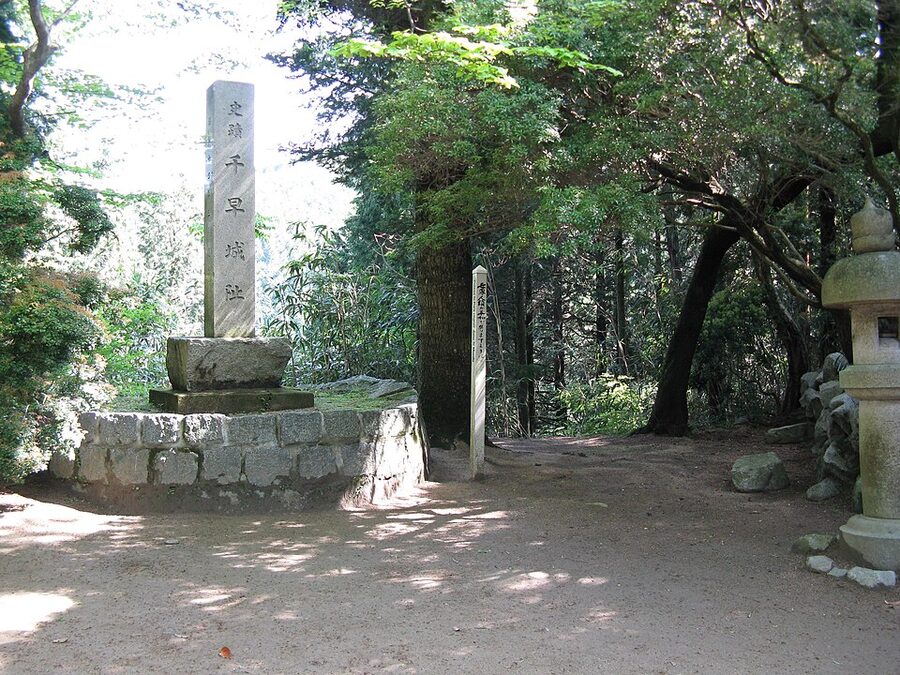
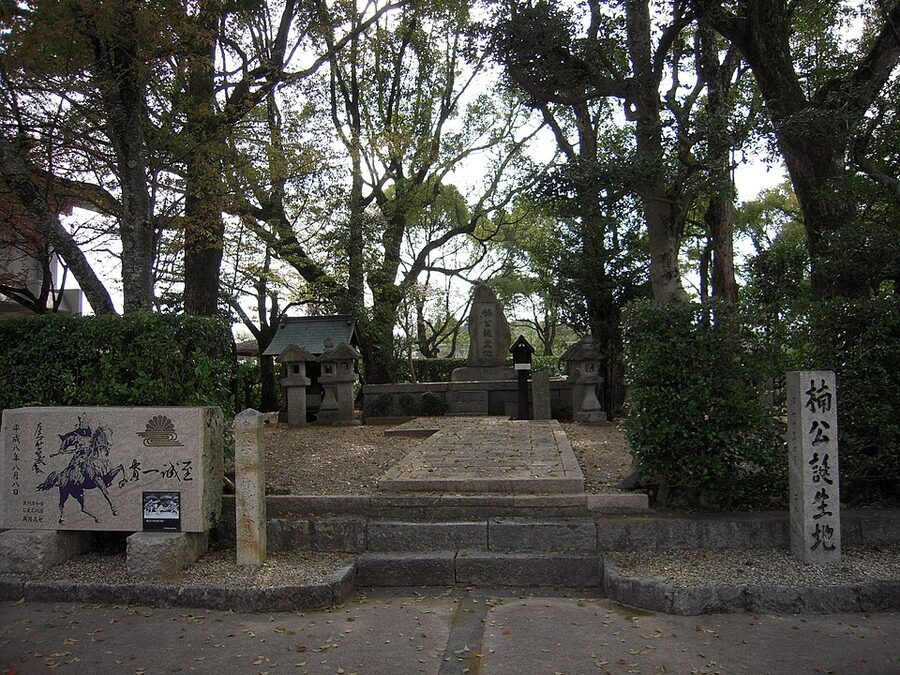
Masashige’s traditional birthplace is a few kilometres down the valley, next to the village museum, Kusunoki Hall and the roadside station Michi-no-eki Chihaya-Akasaka. It is free; the village’s Nankō festival is held in front of it on 25 April, and the 1940 memorial tower is a three-minute walk south. From Tondabayashi Station on the Kintetsu Nagano Line, a community bus runs to the village office, and the birthplace is about ten minutes on foot from there. The museum’s opening days are limited, so check the village’s site before you build a trip around it.
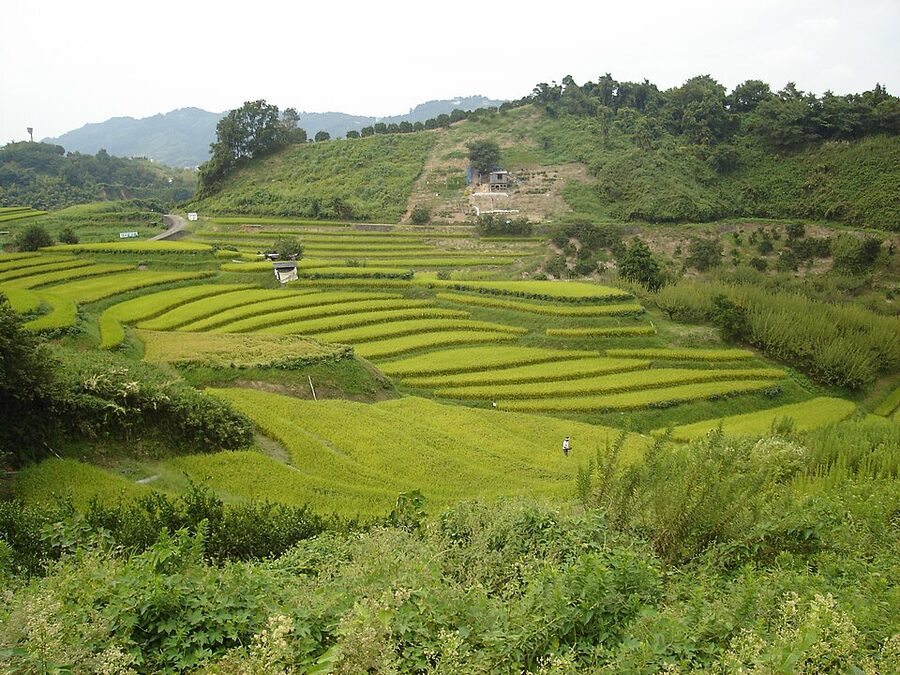
The site of Shimo-Akasaka castle, the fort of 1331, is a hill of rice terraces a short drive away; no one is quite sure where the fort’s walls stood. Nearby, the Nagi shrine within Takemikumari Shrine claims to be the oldest shrine to Masashige, founded the year after his death around an image said to have been carved by Go-Daigo himself.
Kanshin-ji, Kawachinagano
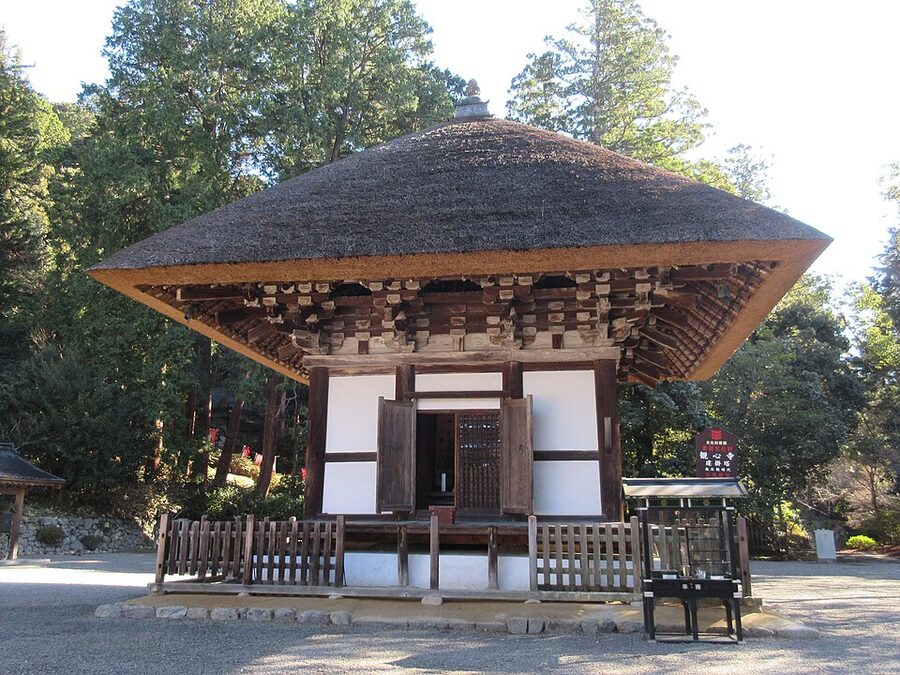
Kanshin-ji (観心寺) is the family temple, and the one place where his own building projects, or their direct successors, are still standing. It is a Shingon temple whose founding legends involve Kūkai, and it sat on the pilgrims’ road from Kyoto to Kōyasan. Take the Nankai bus bound for Kongōsan Ropeway-mae or Kobukidai from stand 3 at Kawachinagano Station to the Kanshinji stop, which is at the temple.
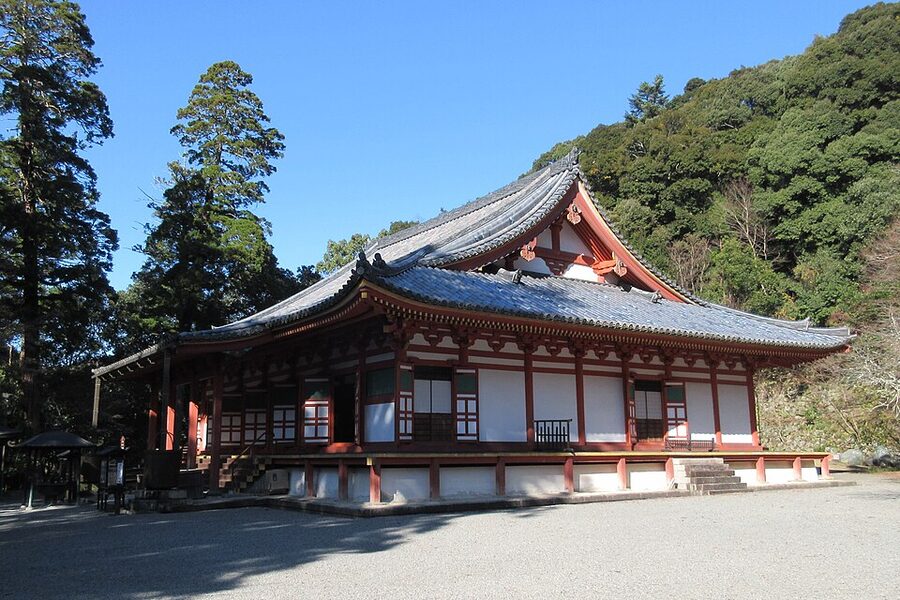
The temple opens 9:00–17:00 (last entry 16:30) and charges ¥300 for adults. On 17 and 18 April, when the hidden Kannon is shown from 10:00 to 16:00, the entry is ¥1,000, and in my opinion it is worth every yen. Come in February or March instead if you want the plum garden, about three hundred trees.
Look too for the Tatekake-tō, the “building tower” by the main hall. It is the first storey of a three-storey pagoda that Masashige vowed for the success of the restoration, so the story goes, and that was never finished because he died at Minatogawa. The present building is a rebuilding of 1502. In the grounds is the tomb of Emperor Go-Murakami, who used Kanshin-ji as a palace in 1359 and 1360.
The Sakurai station site, Shimamoto
The site where the Taiheiki places the parting is a small park in Shimamoto, a minute from JR Shimamoto Station on the Kyoto Line, or about ten minutes from Minase on the Hankyu Kyoto Line. It became a national historic site in 1921 and is free. Opposite stands the town’s history museum, in the memorial hall built in 1941; its hours are limited, so check the town’s site.
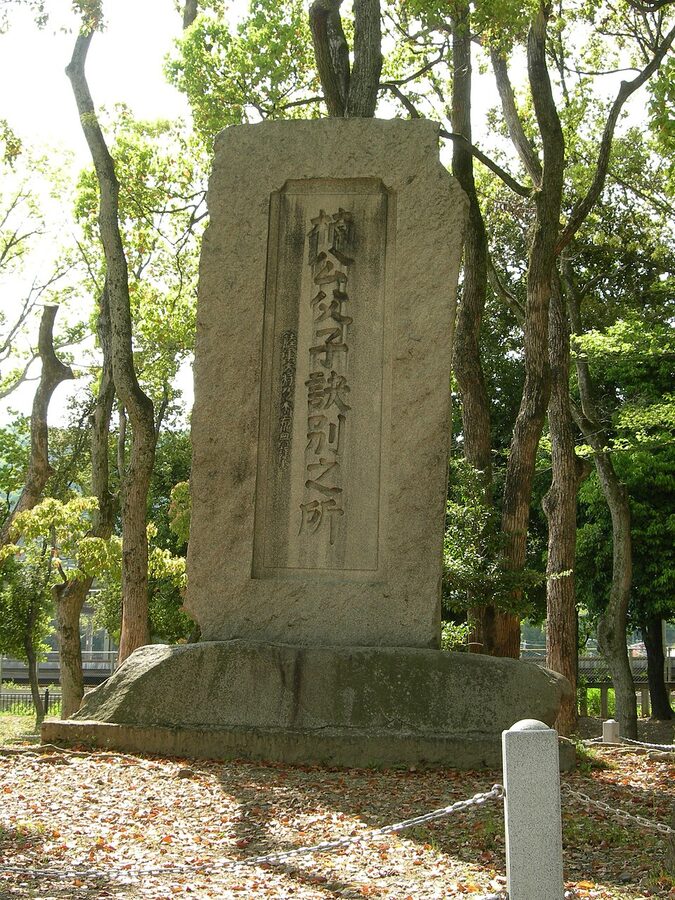
The monuments are the attraction, since there was never a station here. Besides Nogi’s and Tōgō’s, there is a stone put up in 1876 by Sir Harry Parkes, the British minister to Japan, with an explanation in English on the back. It is a strange thing to find beside a commuter station: a Victorian diplomat, moved by a medieval legend, signing a monument to a farewell that never happened. Combine it with the Suntory distillery at Yamazaki and the battlefield of Yamazaki, both close by along the same line.
The statue in the Imperial Palace Outer Garden, Tokyo
The bronze stands on the lawns of the Outer Garden, about five minutes’ walk from Nijūbashi-mae Station on the Tokyo Metro Chiyoda Line. The garden is free and never closes. Walk round the plinth, whose inscription records the Sumitomo family’s gift, and then stand back: the office towers of Marunouchi are never far out of shot, and most of the people hurrying past never look up.
Shijōnawate Shrine
For Masatsura’s half of the story, Shijōnawate Shrine (四條畷神社), founded in 1890 to enshrine him, is about fifteen minutes’ walk uphill from Shijōnawate Station on the JR Gakkentoshi Line. The grounds are free.
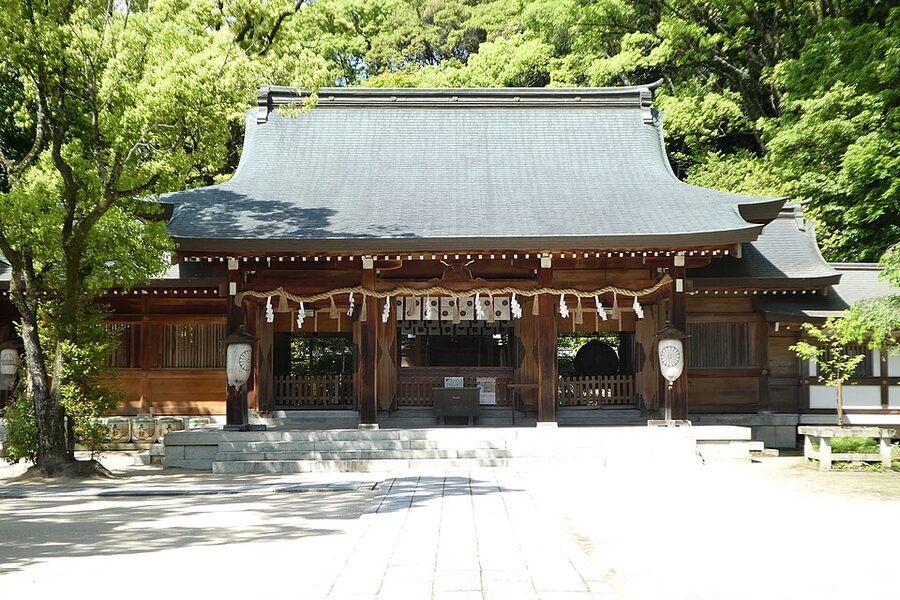
When you leave Minatogawa, go out by the back of the grounds, past the fence round the farmhouse site. The Taiheiki‘s author put two men there who wished to be born again seven times to go on killing, and thought it a sin. The shrine gate faces the other way, towards the sea and the place where the battle was actually lost, and most people walk out of it with the version they were taught.