There is not a single grave on Miyajima, and as far as anyone knows there never has been. When someone died on the island in the 16th century, the body went across the strait to Akasaki on the mainland that same day, and the family stayed over there until the mourning was done. The shrine priest Tanamori Fusaaki, who set down the island’s rules in 1580, was just as blunt about the living: “If a woman gives birth, mother and child are put straight into a boat for the mainland,” and they came home after a hundred days. Women in their monthly period waited out the days in thatched huts on the hillside above the town, at a place called Ase-yama.
Tanamori had watched those rules meet their hardest test. On the first morning of the tenth month of 1555, about four thousand seven hundred men were killed on the island in a few hours, and the winner, Mōri Motonari, spent the following week shipping every body to the mainland, scraping the bloodied earth off the beaches and having the shrine sluiced from the inner sanctuary to the last corridor with seawater. Then he paid for seven days of sacred dance and a ten-thousand-fold sutra reading for the dead.
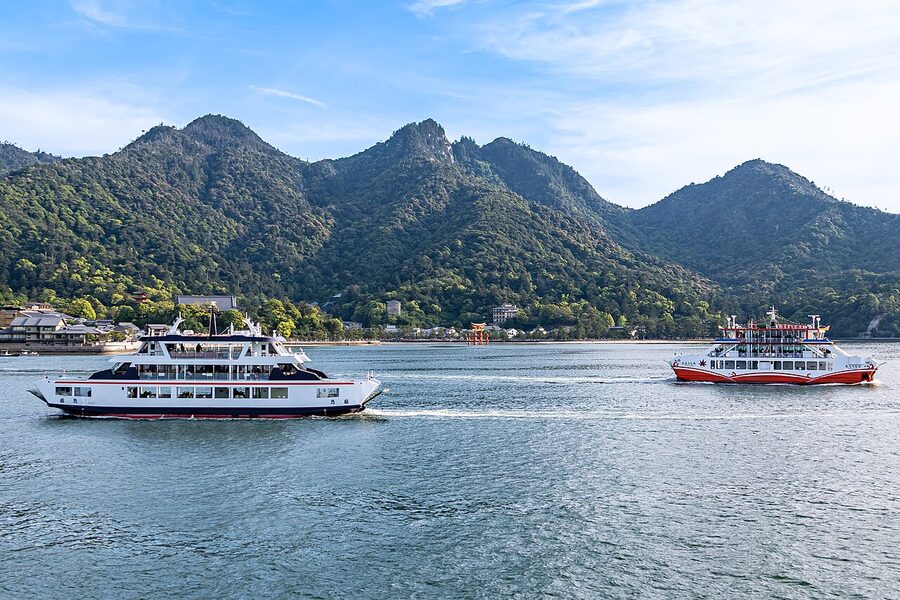
The shrine is the logical end of that way of thinking. If the island itself is divine, you cannot very well dig foundations into it, so the halls of Itsukushima stand on posts in a tidal bay, the gate stands in the sea, and the proper way to arrive was by boat, through the gate, to a landing at the foot of the halls. What follows is the goddess who chose the spot, the Taira chancellor who rebuilt it as a palace on the water, the battle that soaked it in blood, the unfinished hall Hideyoshi left on the hill, and the gate that has stood in the sea since 1875 without being fixed to anything. It ends with how to go, and on Miyajima that means learning to read a tide table.
In This Article
- A goddess you could not set foot on
- The shrine’s own story, and the documented one
- Worship from across the water
- The Saeki, priests for fourteen centuries
- Kiyomori’s palace on the water
- The design: a court mansion standing in the sea
- The sutras that exhausted beauty
- A Taira shrine that outlived the Taira
- A battle on holy ground, 1555
- The decoy that probably was not a decoy
- The night crossing
- The morning of the first day of the tenth month
- Cleaning a goddess
- Who really won it
- A thousand mats, a pagoda and a stage
- Older than Hideyoshi: the pagodas
- The stage on the tide
- Pilgrims, and one of the Three Views of Japan
- The gate that stands under its own weight
- Two trees and a coat of paint
- The repair of 2019 to 2022
- Typhoons, the Meiji axe and World Heritage
- World Heritage, and a tax
- Where to visit Itsukushima Shrine today
- Getting there
- Reading the tide
- The shrine and the treasure hall
- Senjōkaku, the pagoda and Daigan-ji
- Daishō-in and Mount Misen
- The Miyajima History and Folklore Museum
- Deer, oysters and momiji manjū
- Staying the night
- Festivals
- Across the strait: Jigozen and Tōun-ji
- The island with no graves
A goddess you could not set foot on
The name tells you most of it. Itsukushima (厳島) is usually explained as itsuku-shima, the island where the gods are served, and the shrine’s chief goddess, Ichikishima-hime (市杵島姫), carries the same root in her own name. The island and the deity were never quite separate ideas, and the earliest record of the place names a god rather than a shrine.
Her story belongs to the oldest layer of Japanese myth. When the sun goddess Amaterasu and her storm-god brother Susanoo held their contest of oaths in heaven, she broke his sword in three, chewed the pieces and breathed out three goddesses: Ichikishima-hime, Tagori-hime and Tagitsu-hime. They are better known as the Munakata goddesses, after their shrine in northern Kyushu on the sea road to Korea, and as daughters of the god now worshipped at Yasaka Shrine in Kyoto they were natural patrons of anyone who lived by the sea.
The shrine’s own story, and the documented one
The shrine dates its founding to 593, the first year of Empress Suiko. In its own telling, a local chieftain called Saeki no Kuramoto received an oracle, and a pair of sacred crows led him and the goddesses around the island’s bays until they reached a spot where the tide came in and went out; there he built the first hall. The shrine still holds its foundation festival on the first day of the monkey in December, moved from the eleventh lunar month when Japan changed calendars.
None of that can be checked, and it should be kept apart from what can. The first document is the court chronicle Nihon Kōki, which records under 811 that the god of “Itsukishima” in Aki province was ranked among the eminent gods and given offerings in all four seasons. By the early 10th century the shrine was listed in the Engishiki among the great shrines of the realm, and it had become the first shrine of Aki province.
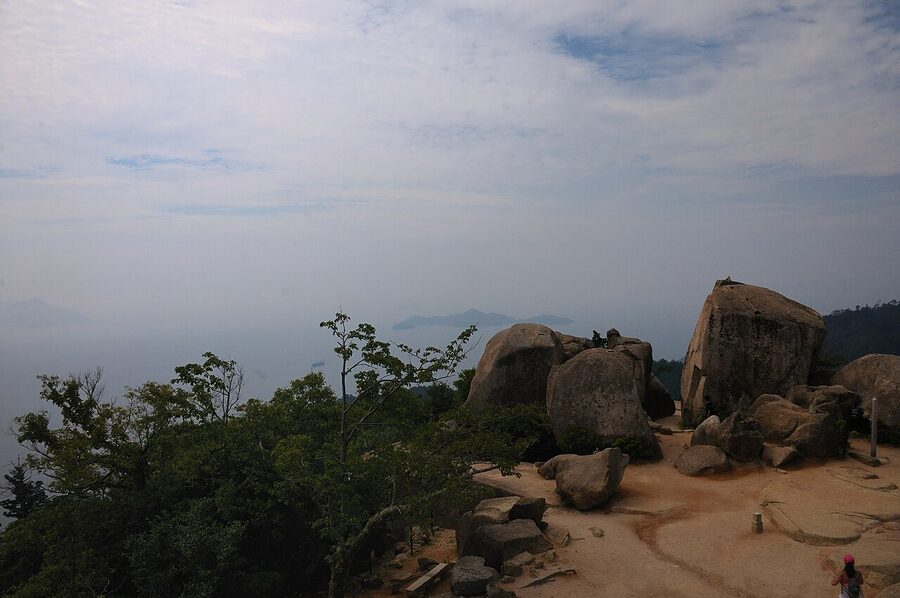
The mountain came first. Misen is crowned with giant boulders of the kind the Japanese call iwakura, god-seats, and the shrine on the shore faces the mountain as much as the sea. Behind the main sanctuary is a gate, the Akazu-no-mon, through which only the goddesses pass, on their way down from the peak.
Worship from across the water
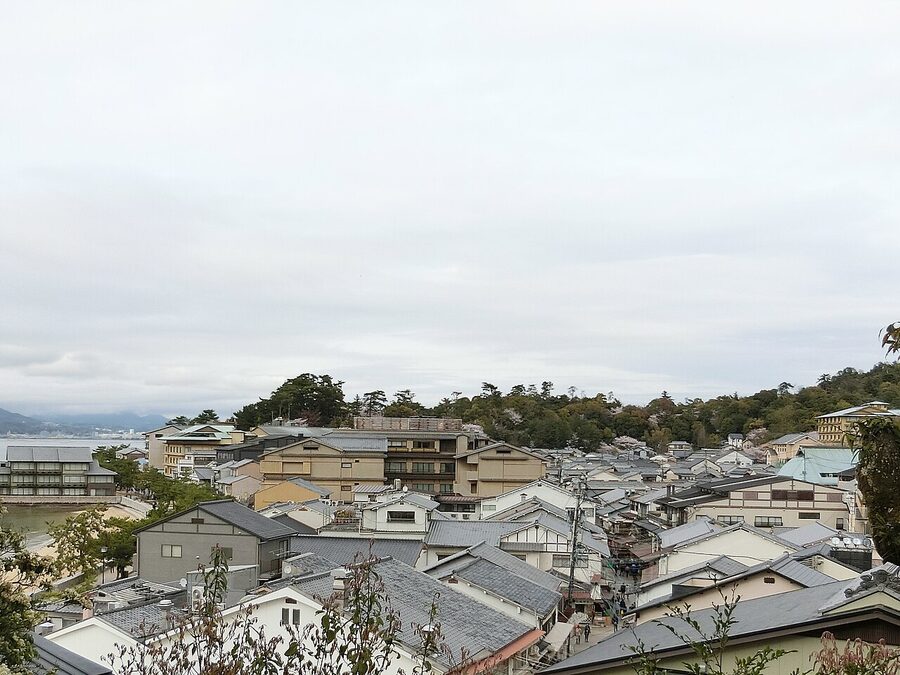
For a long time almost nobody lived on the island. Priests performed the main rites at Jigozen, on the mainland opposite, and the island itself was a forbidden precinct; only from the end of the Kamakura period did shrine staff and monks settle on it, and a town grew up around them.
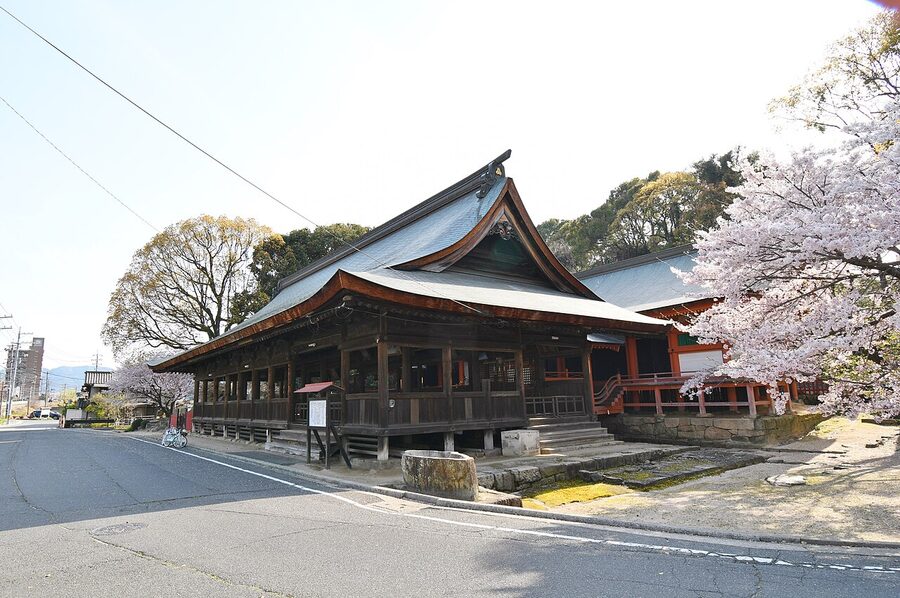
The rules that Tanamori recorded kept the island fit for its goddess. Iron tools were not put into the soil, so there was no farming, and because the island was understood to be the goddess’s own body, weaving and bleaching cloth were forbidden too. Food came across the strait by boat, a sight that lasted until after the Second World War, and the mainland town of Hatsukaichi, the “twentieth-day market”, grew from the fair held on the last day of the shrine’s monthly festival.
The animals had rules of their own. Deer were the goddess’s messengers, so islanders put up deer-gates to keep them out of the houses and left scraps in a tub outside; nobody kept dogs, and a stray was caught and shipped back to the mainland. The custom of sending the dead across the water lasted until about the Second World War, and the island still has no cemetery.
The Saeki, priests for fourteen centuries
The family that served the goddess claims an unbroken line from Kuramoto. The Saeki ruled Saeki district in Aki and controlled the priesthood by the 10th century. They lost it when they backed the retired emperor Go-Toba in his failed war against the Kamakura shogunate in 1221, and a shogunate vassal, Fujiwara no Chikazane, took the high priesthood; his line held it for some three hundred years, until it died out in the wars of 1541, and the Saeki came back.
Kiyomori’s palace on the water
The man who turned a provincial shrine into a national one was Taira no Kiyomori. He was governor of Aki from 1146, with a break, until 1156, and in those years he came to know the shrine’s priest, Saeki Kagehiro. Kiyomori’s family made its fortune on the Inland Sea, policing pirates, carrying tax rice and trading with Song China, and the goddesses of Itsukushima guarded that sea.
The war tales give him a more mystical motive. While he was rebuilding the great pagoda on Mount Kōya, they say, an old monk told him that if he restored Itsukushima he would rise to the highest rank in the land. His devotion is on record either way: in the eighth month of 1160 he made the pilgrimage he called his long-held wish, and documents show at least ten visits by the tenth month of 1180, when the Genpei War had already begun.
The design: a court mansion standing in the sea
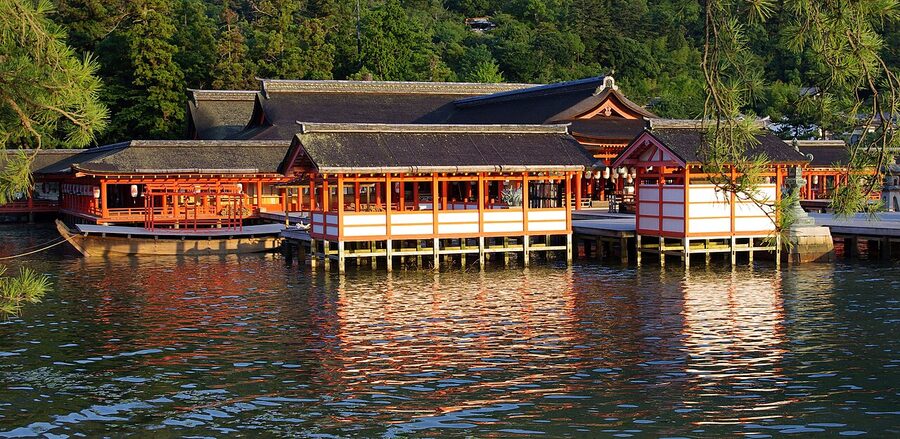
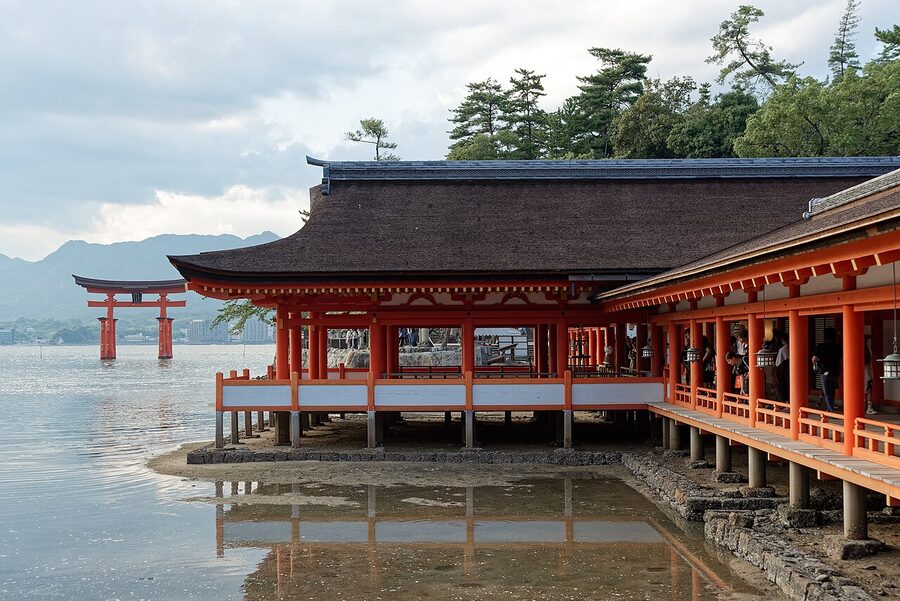
Around 1168, with Taira money behind him, Saeki Kagehiro rebuilt the shrine on the scale you see today. The model was the shinden-zukuri mansion of the Heian aristocracy, a main hall joined to lesser buildings by long roofed corridors, here laid out over the water with the mountain behind. Kiyomori was designing for an arrival by boat, and the arrival is still the best way to see it.
The main sanctuary faces north-west, out to sea, and it is not symmetrical. Its inner sanctuary holds six treasure shrines, and the bay in front of Ichikishima-hime’s is wider than the rest, so the whole axis of the building is pulled towards her. The front of the main hall has eight bays and the oratory ten, even numbers that almost never occur in shrine architecture.
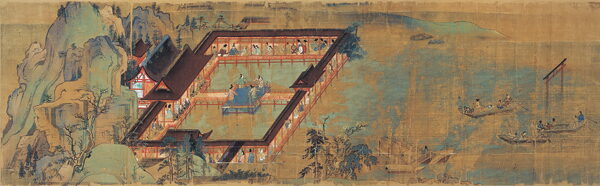
How does a shrine in the sea survive at all? The architectural historian Miura Masayuki of Hiroshima points out that in some 850 years the inner sanctuary has never once been flooded, and argues that the main halls were sited above the level of a storm surge expected once in two hundred years. He also thinks the bay was dug out of what had been dry land, which would explain why the posts stand on firm ground and have never sunk unevenly.
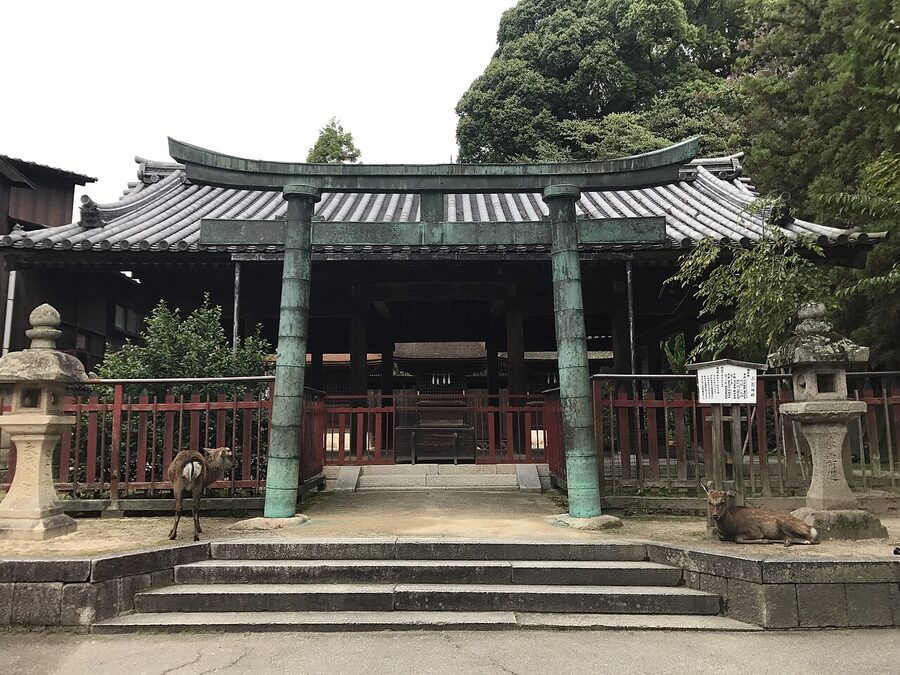
The buildings that suffer in typhoons are the ones Kiyomori never built. The music rooms, the gate shrines and the Noh stage were added later and sit further out, and they wash away and get rebuilt while the old halls at the back sit tight. When the foot of a timber post rots, carpenters splice a new length onto it rather than replace the whole post.
The sutras that exhausted beauty
Kiyomori’s most famous gift is not a building. In the ninth month of 1164 he dedicated the first scrolls of the Heike Nōkyō (平家納経), the sutras of the Taira house, and the set was finished by 1167. His own dedication says the family had exhausted goodness and exhausted beauty, and every cover, frontispiece, sheet and roller bears him out, each scroll decorated differently in gold and silver leaf, paint, lacquer and openwork metal.
The arithmetic is usually given wrong. There are thirty-three scrolls: the twenty-eight chapters of the Lotus Sutra with its opening and closing sutras, the Amida Sutra, the Heart Sutra and Kiyomori’s dedication. English-language accounts often say thirty-two, leaving out the dedication; thirty-three was chosen for the thirty-three forms of the eleven-headed Kannon, the Buddhist identity of the shrine’s goddess, and thirty-two members of the clan each took charge of a scroll.
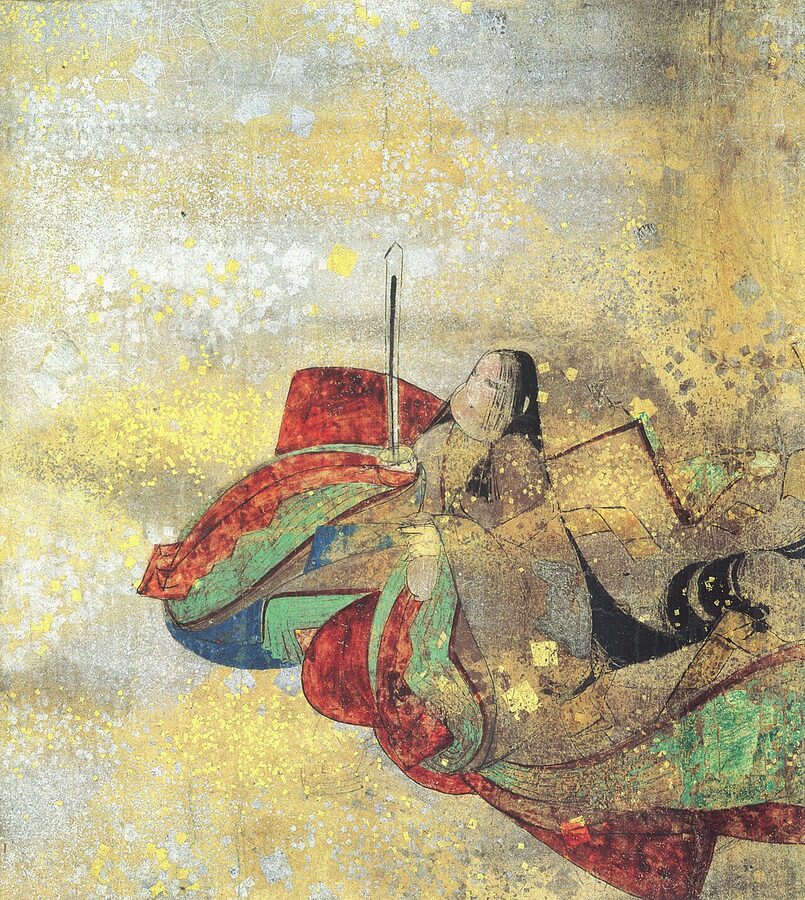
Fukushima Masanori, the lord of Hiroshima after 1600, paid for that repair and gave the lacquered chest that still holds the scrolls. In 1920 the shrine’s chief priest, Takayama Noboru, made his case for a copy at a tea gathering of Tokyo financiers, and within two or three hours some thirty donors had paid for it. The copyist, Tanaka Shinbi, borrowed the originals two or three at a time and worked for five and a half years; when the Great Kantō Earthquake struck in 1923 he is said to have held the scrolls he had in his arms while the building shook, and his copy, delivered in 1925, is what the treasure hall usually shows.
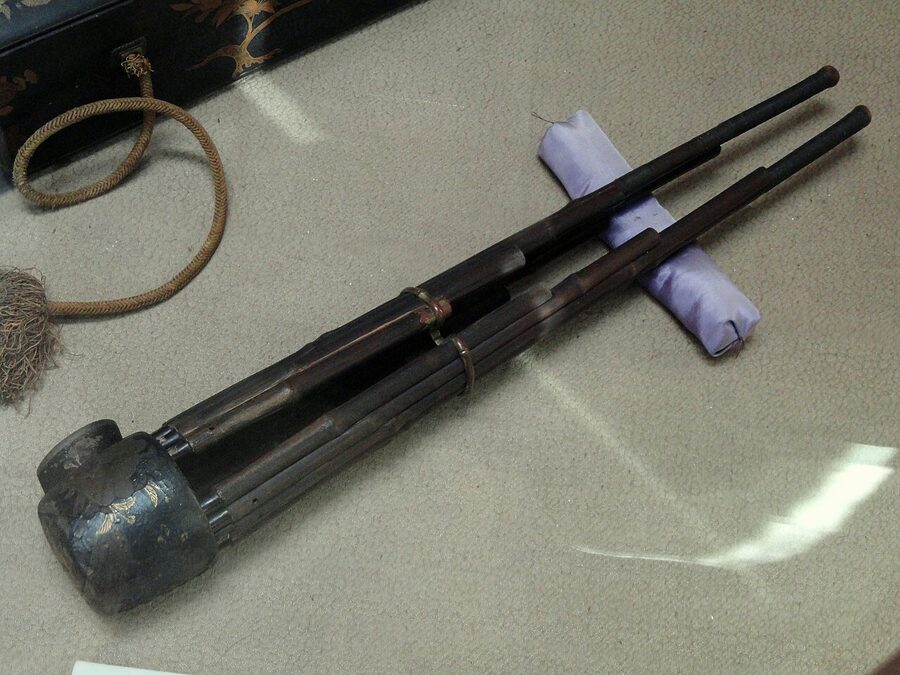
Kiyomori also brought the capital to the island. He had court dance, bugaku, transplanted from Shitennō-ji in Osaka, and it is still danced on the raised stage in front of the main hall. Retired Emperor Go-Shirakawa came with his consort Kenshunmon-in in 1174, and the great summer festival, the Kangensai, is said to be Kiyomori’s version of the boating parties with music that courtiers held on their ponds in Kyoto.
A Taira shrine that outlived the Taira
The Taira were destroyed at Dan-no-ura in 1185, and you might expect their shrine to have gone with them. It did not, because the goddess was never one family’s property; she governed the sea lanes of western Japan, and whoever ruled the sea needed her. The Minamoto kept up the offerings, and the shrine names Ashikaga Takauji and his grandson Yoshimitsu among its later patrons.
Fire did more damage than politics. The shrine burned in 1207 and again in 1223, and the main buildings were put up again in 1241; the Marōdo halls and most of the main shrine’s oratory date from that rebuilding. Architectural historians agree the rebuilders followed Kiyomori’s plan, so what you see is a 13th-century copy of a 12th-century idea.
A battle on holy ground, 1555
For two centuries after the Taira, the shrine slid. Its high priests fought their neighbours, the great Ōuchi house of Suō became the island’s real overlords, and by the 16th century Itsukushima sat on the frontier between the Ōuchi lands and the province of Aki. Any army moving along the Inland Sea stopped there.
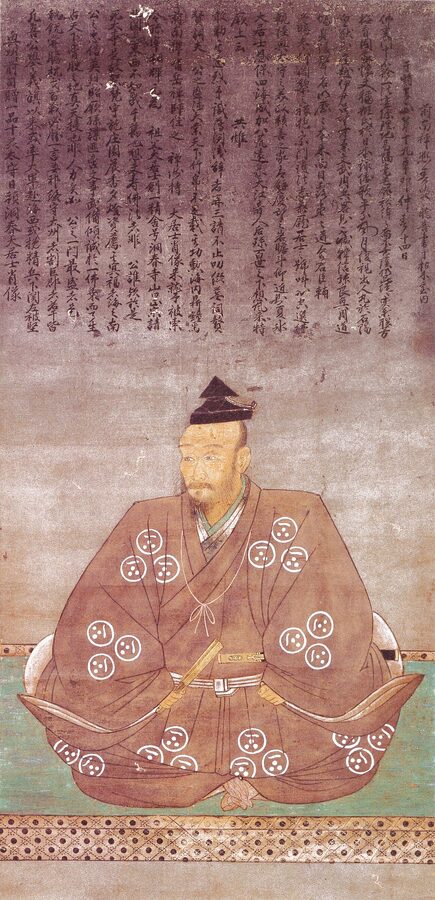
In 1551 Sue Takafusa, the leading vassal of the Ōuchi, rose against Yoshitaka, drove him to suicide at the temple of Taineiji and set up a puppet in his place, taking the name by which history knows him, Sue Harukata. In Aki, Mōri Motonari, a minor lord who had spent thirty years climbing from obscurity, went along with him at first. Then, in the fifth month of 1554, he broke with Sue and seized the castles around Hiroshima Bay, the island included.
The decoy that probably was not a decoy
The traditional story is a masterpiece of cunning, and it comes mostly from the Intoku Taiheiki, a chronicle compiled about a century and a half later and generous to the Mōri at every turn. In it, Motonari builds a small fort on the island, Miyao Castle, as bait, lets Sue’s spies hear that he would be finished if the island were attacked, and has a vassal write offering to betray him. Sue takes the bait and brings twenty thousand men onto an island where numbers count for nothing.
The documents are duller. Tanamori’s memoir mentions Miyao Castle in 1554, before Motonari could have built it as a trap, and Japanese historians now think it was an older fortification he strengthened with a thousand labourers in a month. Armies always stopped at Itsukushima, and Sue hardly needed tricking into attacking the one fort that controlled it.
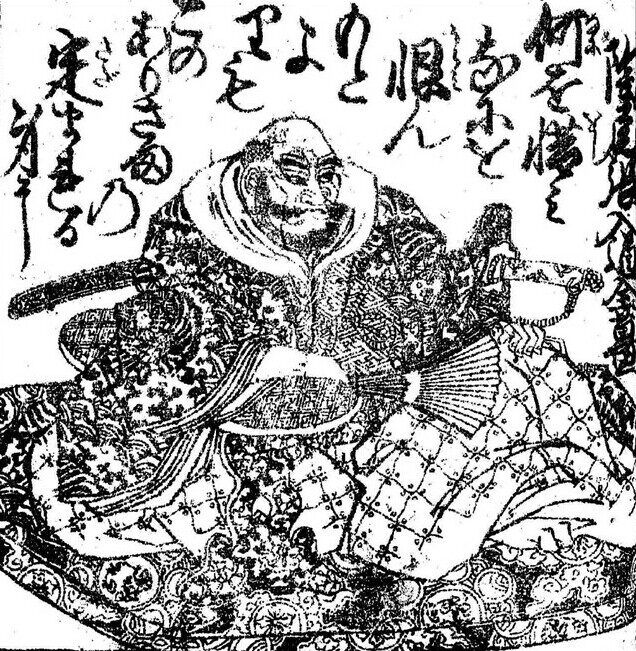
The numbers have shrunk too. The chronicles give Sue twenty to thirty thousand men; modern estimates, counting which of his vassals actually turned up, put his army under ten thousand and perhaps around eight. Motonari’s force is traditionally four thousand, probably more once all his allies are counted, and the odds were closer than the legend allows.
The night crossing
Sue sailed from Iwakuni on the 21st day of the ninth month and landed the next morning at Ōmoto-ura, near the present aquarium. He made his headquarters on Tō-no-oka, the hill beside the shrine where the five-storey pagoda stands, spread his men through the town and up towards Daishō-in, and set about cutting off Miyao Castle’s water.
Motonari waited on the mainland at Kusatsu, and he was waiting for pirates. The Murakami of the Inland Sea, sea lords whose story belongs alongside that of the wokou though they were something quite different, could decide any battle on the water, and Motonari’s letters of those days come close to begging. On the 28th, two or three hundred Murakami boats arrived, and he moved his army to Jigozen, opposite the shrine.
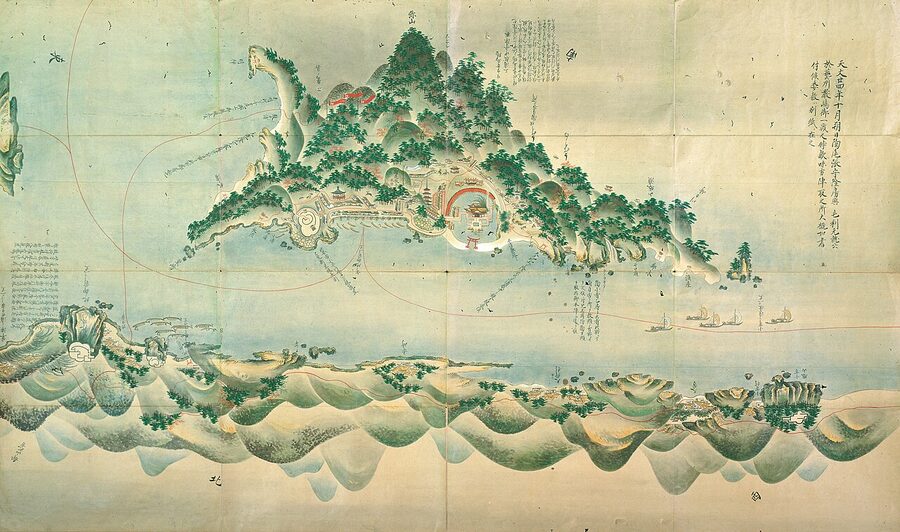
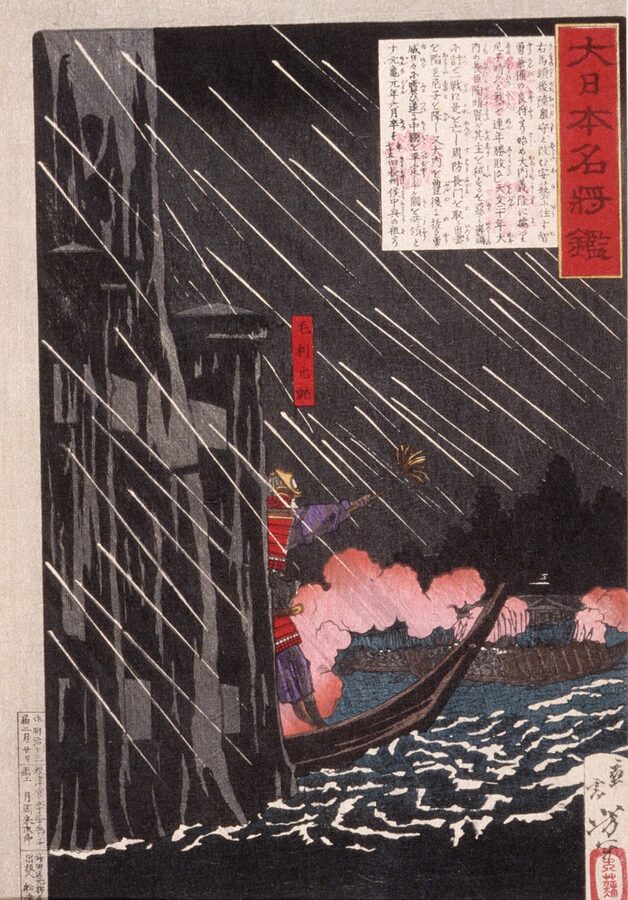
On the evening of the 30th day of the ninth month, the last of the month, a storm blew up with thunder and driving rain. Motonari declared it a lucky day and the gods’ favour, and at six in the evening he put to sea. His boat carried the only lantern in the fleet; the main army rounded the island in the dark, landed at about nine at Tsutsumi-ga-ura on the eastern shore, and sent the boats back so that nobody could think of retreat.
His son Kobayakawa Takakage took the second division the long way round, through the Ōno strait, and came up to the shrine from the sea. One account has his men calling to Sue’s sentries that they were reinforcements from Chikuzen, in Kyushu, come to pay their respects to Lord Sue, and being allowed to land. The Murakami waited offshore.
The morning of the first day of the tenth month
At six in the morning on the first day of the tenth month, which Japanese reference works convert to 16 October 1555, the main army came down the slopes behind Sue’s camp with a war cry, Takakage’s men and the castle garrison charged up Tō-no-oka from the front, and the Murakami fell on Sue’s fleet and burned it. The camp collapsed. Tanamori, who was there, wrote that Sue and his commander Hironaka Takakane did not loose a single arrow before falling back to the west.
The rest was a hunt. Men fought over boats and drowned; Hironaka made a stand in the lanes south of the shrine and set fires to cover his retreat, and Motonari’s son Kikkawa Motoharu, the story goes, stopped to put them out before they reached the shrine. Hironaka held out on a crag of the neighbouring peak until the 3rd day, and died there with his son.
Sue found no boats. With a handful of retainers he reached Ōe-ura on the western shore and took his own life there; the retainers hid his head and killed themselves. On the 5th day the Mōri caught a boy who had carried Sue’s sandals, spared him in exchange for the hiding place, and took the head to Sakurao Castle on the mainland, where Motonari is said to have struck it three times with a whip for the crime of killing a lord.
Cleaning a goddess
The Mōri chronicles count 4,780 of Sue’s men killed and over three thousand captured; Tanamori, counting from the shrine, gives 4,700 dead and 3,000 prisoners. Motonari had fought on the goddess herself, and the week after was spent undoing it: the bodies to Ōno across the strait, the bloodstained earth dug out, the shrine washed with seawater, and from the day after the battle seven days of sacred dance and a vast sutra reading for the dead.
The victory made the Mōri. Within two years the Ōuchi house was finished, and Motonari’s family went on to rule ten provinces and to fight Oda Nobunaga at sea with the navy that grew out of this campaign. His grandson Terumoto would later found Hiroshima Castle on the delta across the bay.
Who really won it
Two modern historians have fought their own battle over the credit. Yamamuro Kyōko argued that the Mōri issued no letters of commendation for Itsukushima because no Mōri warrior did anything worth commending, and that the real victors were the Murakami of Kurushima. Akiyama Nobutaka replied that the Mōri had simply stopped issuing such letters because they were running out of land to reward men with, and pointed to a retainer’s own note recording three heads taken and no commendation for anyone.
Which Murakami came is its own argument. English-language accounts usually name the Noshima Murakami under the famous Takeyoshi; Japanese scholars now think Noshima was still on Sue’s side in 1554 and probably stayed out, and that the boats came from Kurushima. Kurushima later went over to Hideyoshi and dropped out of Mōri history, while Noshima became Mōri retainers, and it was their family histories that put them at the battle.
The island had one more killing to absorb. In 1569 two brothers of the Wachi family of Bingo, rebels against Motonari, barricaded themselves in the main sanctuary and were killed inside it, and in 1571 Motonari had the defiled building pulled down and rebuilt. That is why the innermost hall is three centuries younger than the oratory in front of it.
A thousand mats, a pagoda and a stage
The next great patron came in 1587, on his way to conquer Kyushu. Toyotomi Hideyoshi stopped at the island, held a linked-verse party at Daishō-in, and ordered a great sutra hall built on Tō-no-oka, where Sue had camped, for the souls of the war dead. Mōri Terumoto was told to build it, and the Mōri’s monk-diplomat Ankokuji Ekei directed the work.
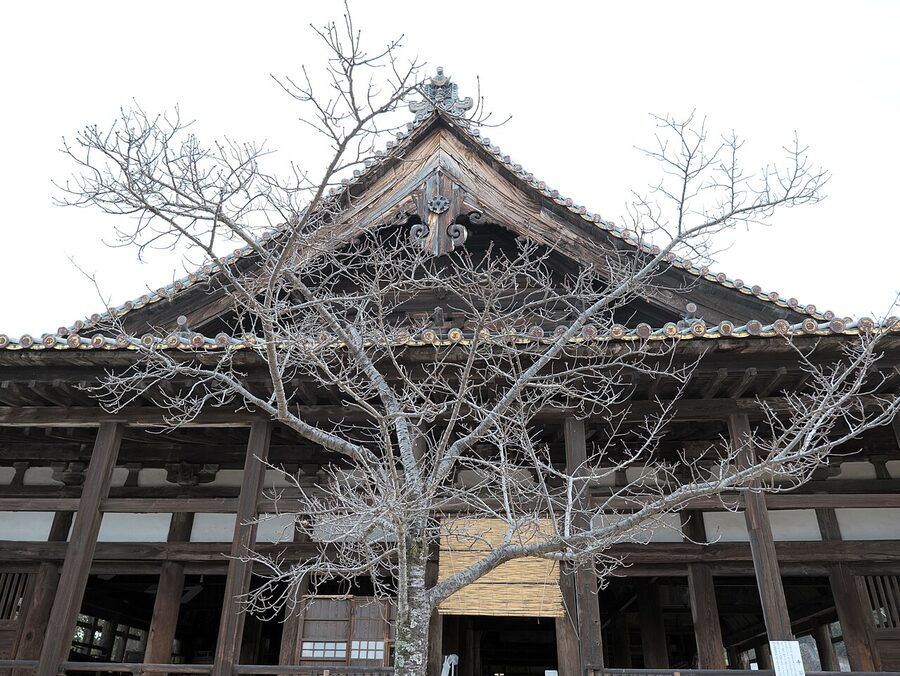
It is called the Senjōkaku (千畳閣), the hall of a thousand mats, though its boarded floor would take 857 tatami. It measures about 40 metres by 21, built with enormous timbers and gold-leafed eave tiles, and it was never finished: some sources blame the invasion of Korea in 1592, which swallowed the money and the men, and others Hideyoshi’s death in 1598.
An Edo guidebook put the result well: the hall was built for reading sutras, no sutra was ever read in it, and people simply came to enjoy the cool. Since the early Meiji years it has been the Toyokuni Shrine, honouring Hideyoshi and his general Katō Kiyomasa; votive paintings hang from its beams, and inside you can see the carpenters’ measuring staff from the rebuilding of the great torii.
Older than Hideyoshi: the pagodas
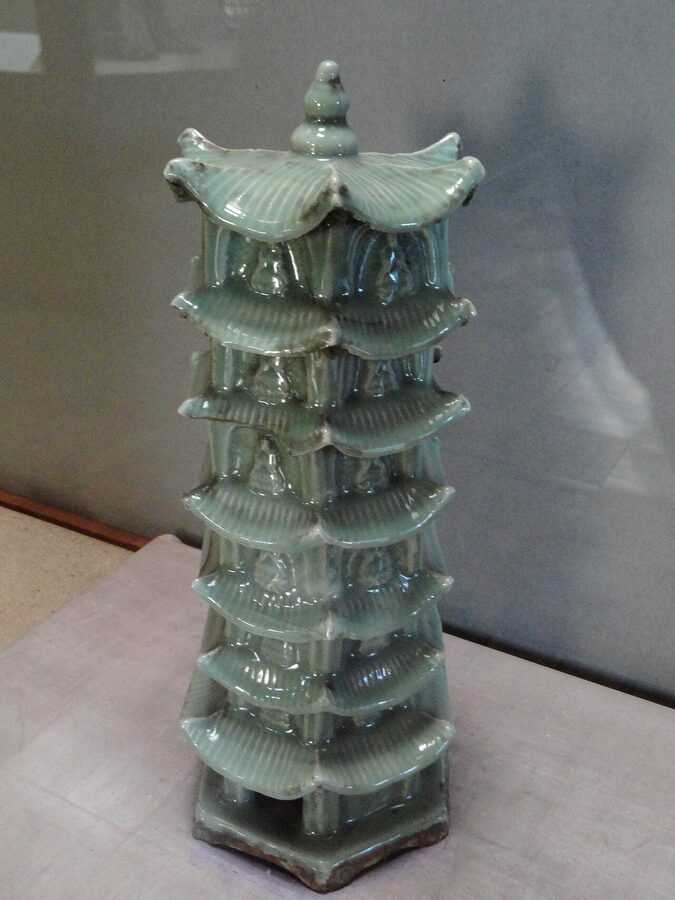
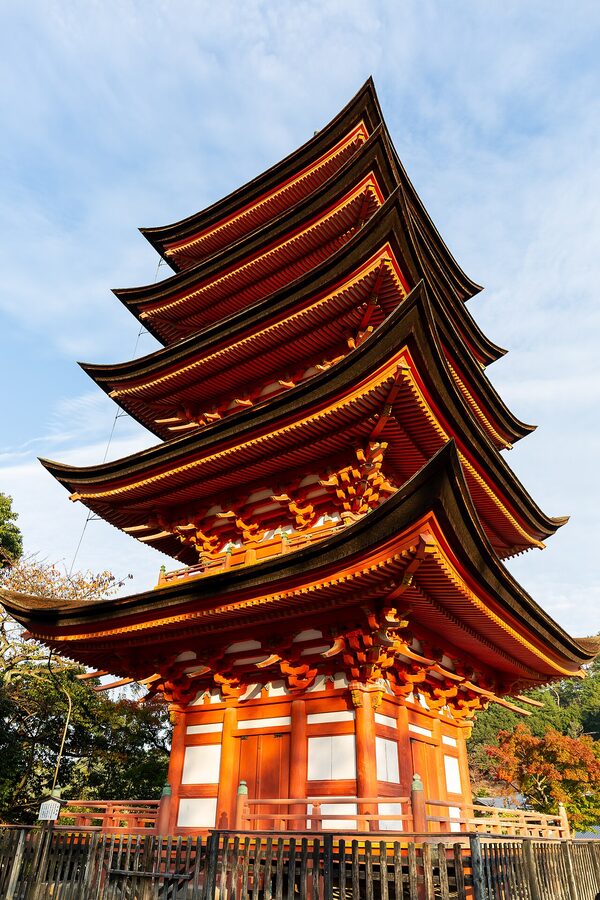
Hideyoshi was not the first to build Buddhist halls beside the shrine. For most of its history Itsukushima was as Buddhist as it was Shinto: its goddess was worshipped as a form of Kannon and as the music goddess Benzaiten, and the temples of Daishō-in and Daigan-ji ran its rites and its building works. The five-storey pagoda on Tō-no-oka went up in 1407, and the two-storey Tahōtō on the other side of the bay in 1523.
The stage on the tide
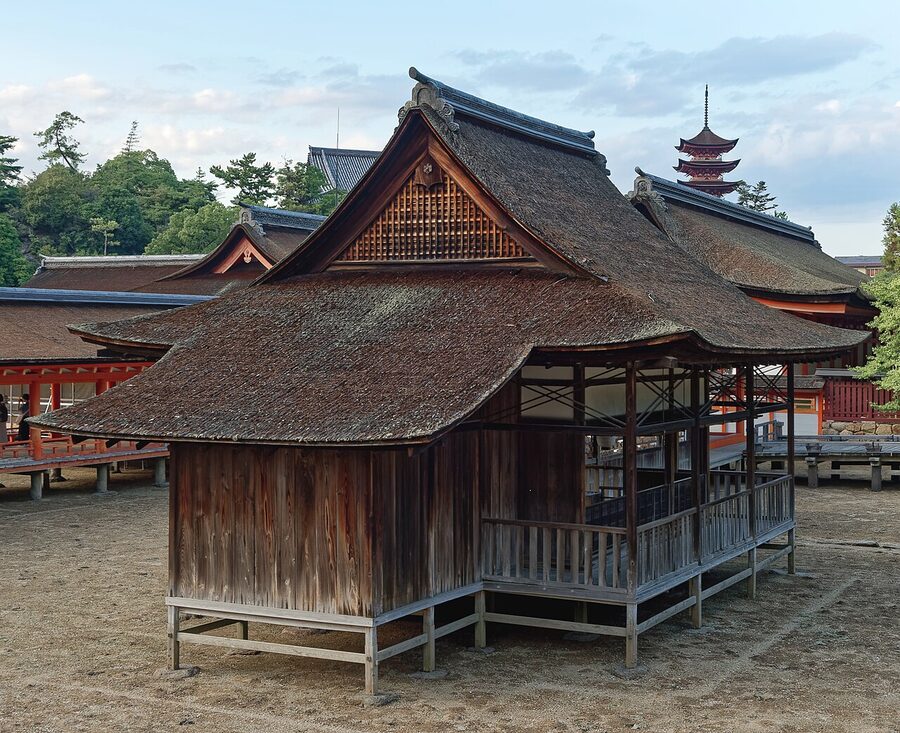
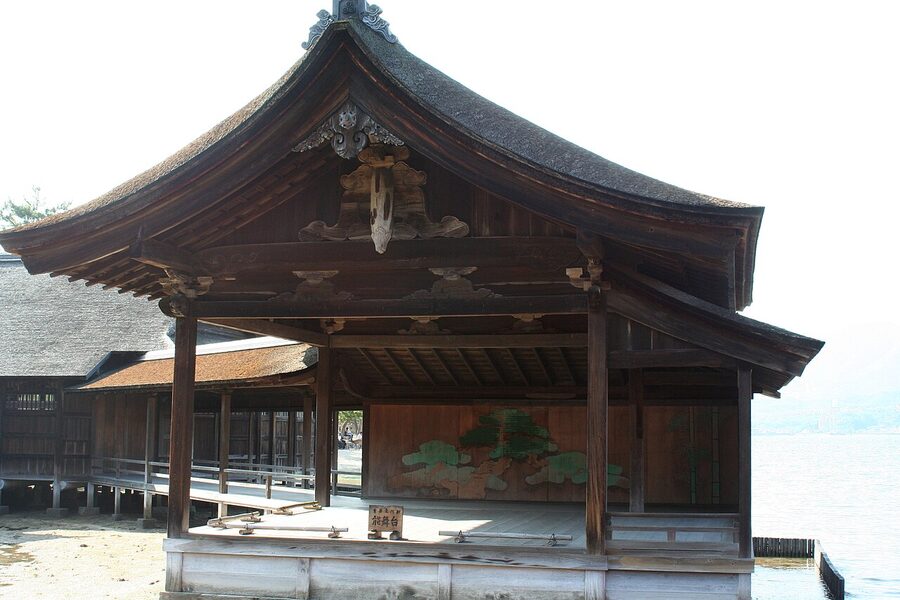
The shrine’s great performing tradition came with the Mōri. Motonari dedicated Noh performances here in 1563, the Kanze troupe played in 1568, and the island became a regular stop for actors, as you can read in the site’s history of Noh. The present stage on its platform over the bay was given in 1680 by Asano Tsunanaga, the lord of Hiroshima, and is still used for the April festival.
Pilgrims, and one of the Three Views of Japan
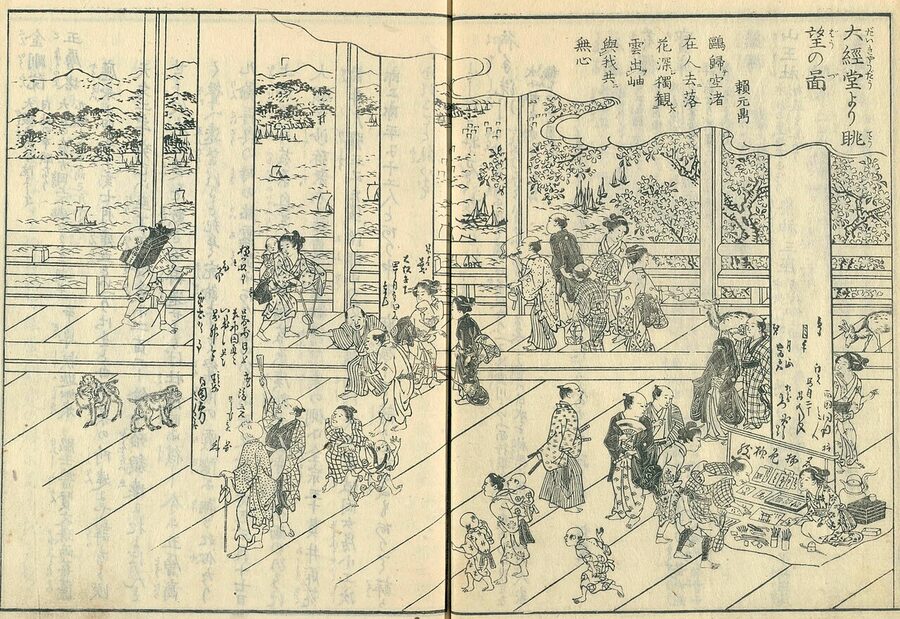
In the Edo period the island belonged directly to the Asano lords of Hiroshima, run by a magistrate with the shrine and the two temples, and it became what it still is, a pilgrimage site with a shopping street attached. There were markets, lotteries, sumo and kabuki; the novelist Ihara Saikaku counted Miyajima among the three great theatre towns of western Japan. Since nobody was allowed to farm, the souvenir trade was a matter of survival.
That trade produced a classic. An Edo-period monk named Seishin, of the temple of Kōmyō-in, suggested to the townsmen a wooden rice paddle shaped like the lute of Benzaiten and inscribed with prayers, and the shamoji sold so well that one word for a rice paddle in Japanese is still miyajima.
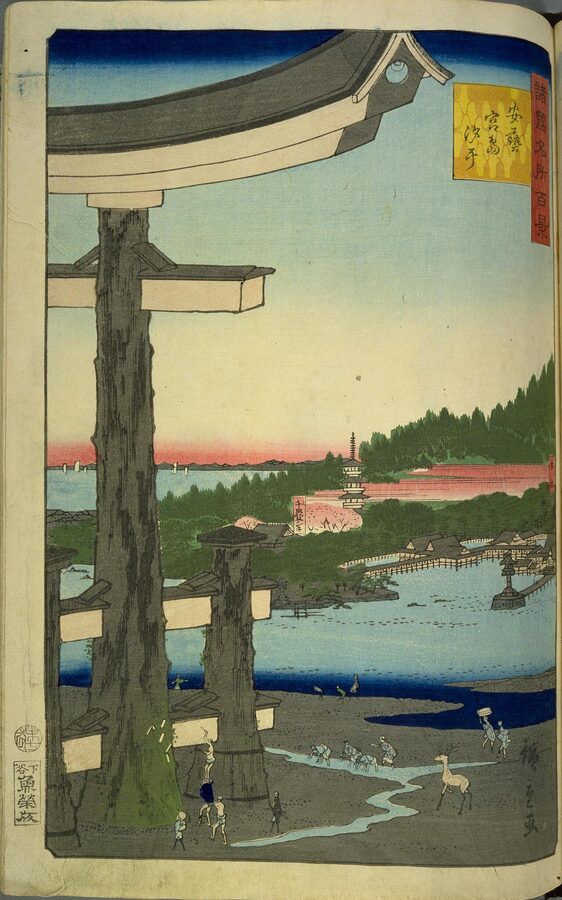
The island’s fame as a view goes back to one sentence. In 1643 the Confucian scholar Hayashi Gahō named the pine islands of Matsushima, the sandbar of Amanohashidate and Itsukushima as the three most remarkable sights in Japan, and by the 18th century the trio had hardened into the Three Views. The print publishers took it from there, and the torii became as standard a subject in ukiyo-e as Mount Fuji; Hiroshige himself drew the shrine for his views of the sixty-odd provinces in 1853.
Europe had heard of it even earlier. The first map of Japan printed in Europe, in Antwerp in 1595, marks very few places, and one of them is “Itoqulchima”. In 1866 the shogunate’s envoy Katsu Kaishū met the Chōshū rebels’ envoys at Daigan-ji to negotiate an end to the second war against them, and later wrote that he had his hair dressed every morning at his inn, so that if he were beheaded he would at least look respectable.
The gate that stands under its own weight
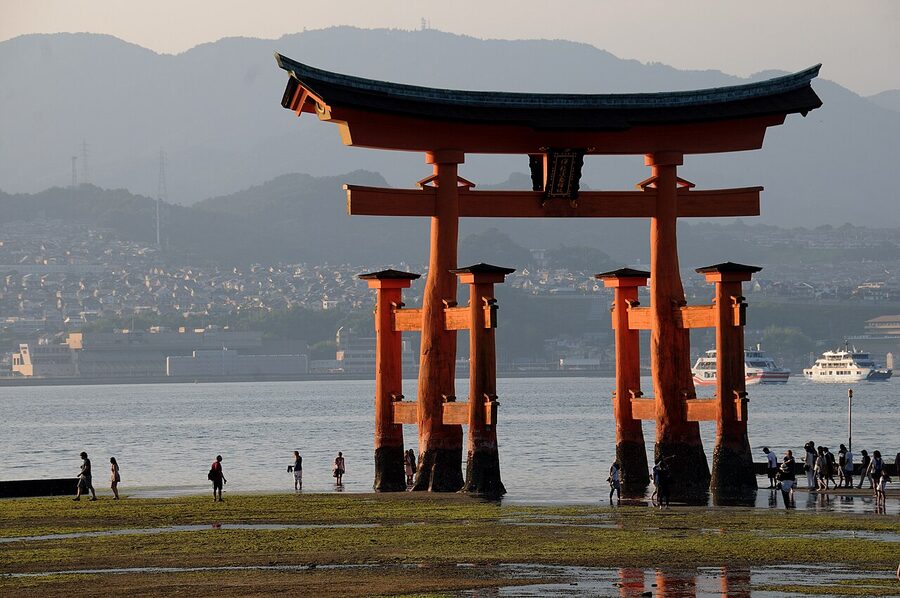
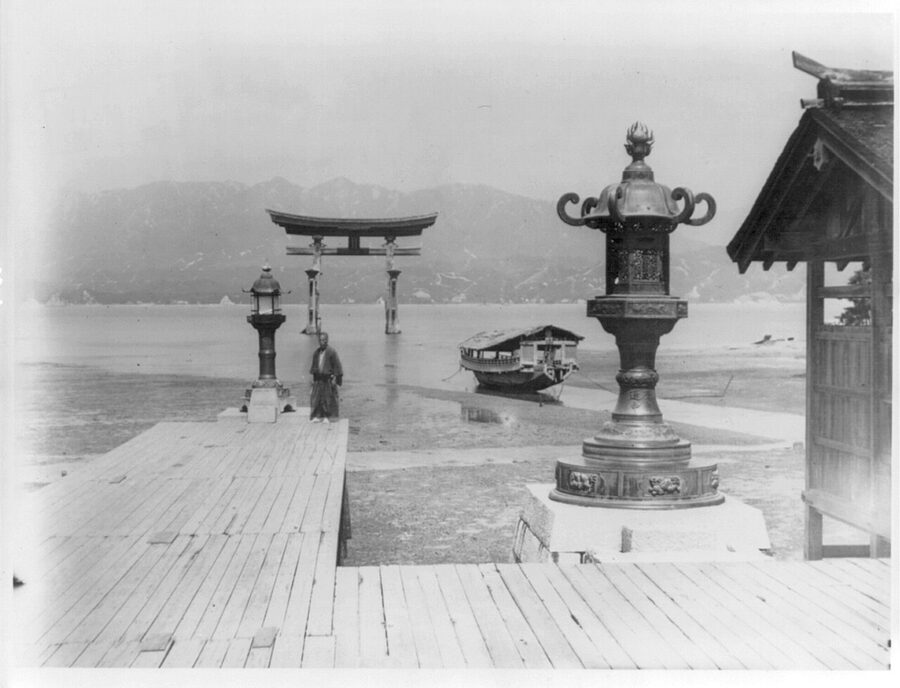
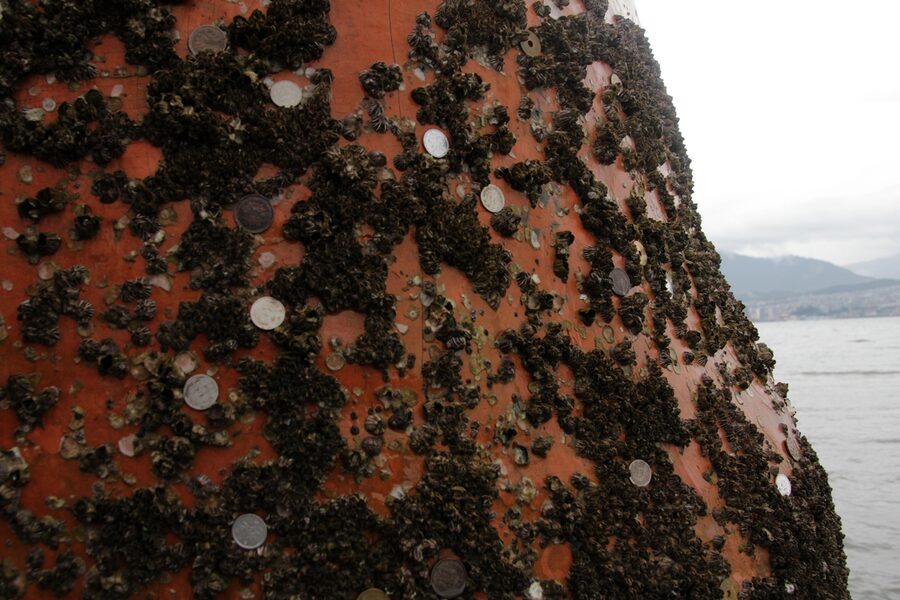
The great torii is the most photographed gate in Japan, and the least understood. The present one was raised in 1875 and stands 16.6 metres high, with about 10.9 metres between its main pillars and a total weight of about 60 tonnes. It is not buried in the seabed and it is not bolted to anything; it stands because it is heavy.
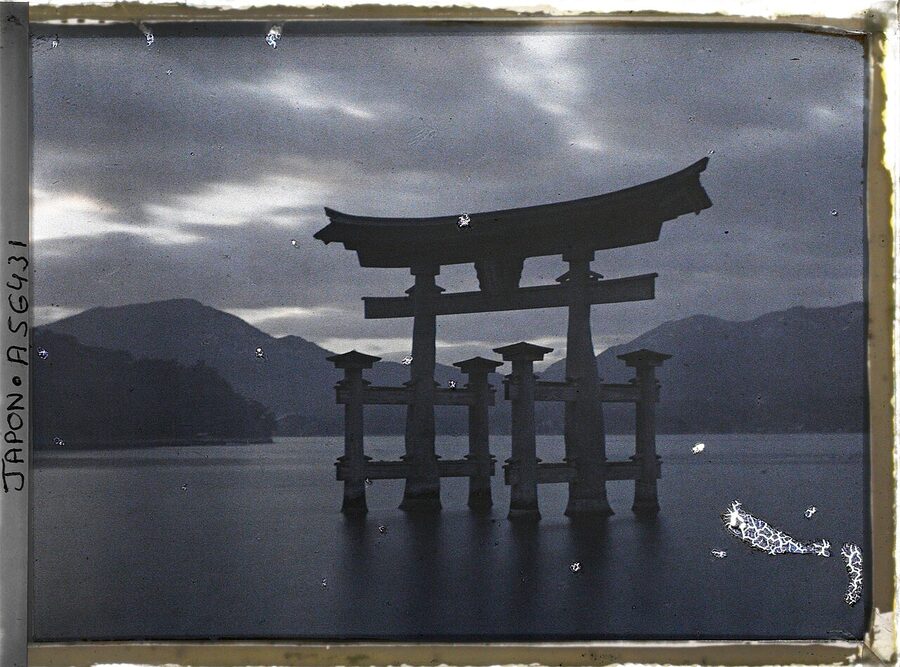
The tricks are simple and old. The main pillars stand on a bed of pine piles driven close together into the seabed, the senbon-gui or “thousand piles”, now capped with concrete and granite. The top beams are hollow boxes packed with fist-sized stones, whose weight locks the frame together against wind and waves, and each main pillar is braced front and back by two smaller ones, which makes it a ryōbu torii, a style associated with the medieval blending of Shinto and esoteric Buddhism.
The sources cannot agree on the details. Japanese reference works generally call the present gate the eighth since Kiyomori’s time, put the stones in the top at about seven tonnes and the gate about 200 metres out from the shrine; the guide published by the prefectural university’s Miyajima studies centre calls it the ninth, with four tonnes of stones and 160 metres. I would not bet on any of them, and neither, I suspect, would the carpenters.
Two trees and a coat of paint
The two main pillars came from opposite ends of western Japan: one from Okatomi in Hyūga, now part of Saito in Miyazaki prefecture, the other from Wadahama in Sanuki, now Kan’onji in Kagawa. In 1950 the rotting bases of both were cut away and new camphor spliced on, for the east pillar from Kurume in Fukuoka and for the west from a village now inside Saga city.
The colour is younger than the gate. The 1875 torii was left as bare wood, and only during a repair in 1909 was it painted vermilion to match the shrine. When every layer of paint was stripped in the spring of 2020, the shrine told visitors they were looking at a very rare sight.
The repair of 2019 to 2022
In June 2019 the torii disappeared. The shrine wrapped it in scaffolding for its first major repair since 1950, re-roofing its cypress-bark cap, stripping and repainting it and patching its timbers, and the scaffolding stayed up until December 2022. Visitors who had planned a once-in-a-lifetime trip spent three and a half years photographing a cube of steel poles.
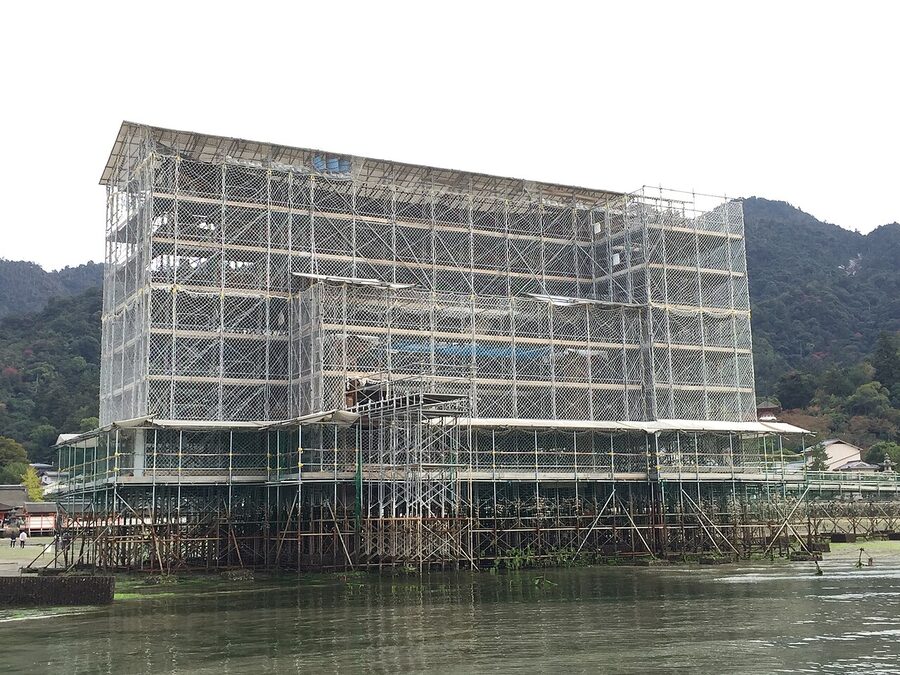
The inspection turned up one surprise: the east pillar has a hollow inside it, and the carpenters could tell it had been there since the tree was felled. It has stood in the sea for a century and a half with a hole in its middle, which tells you something about camphor, or about luck.
Typhoons, the Meiji axe and World Heritage
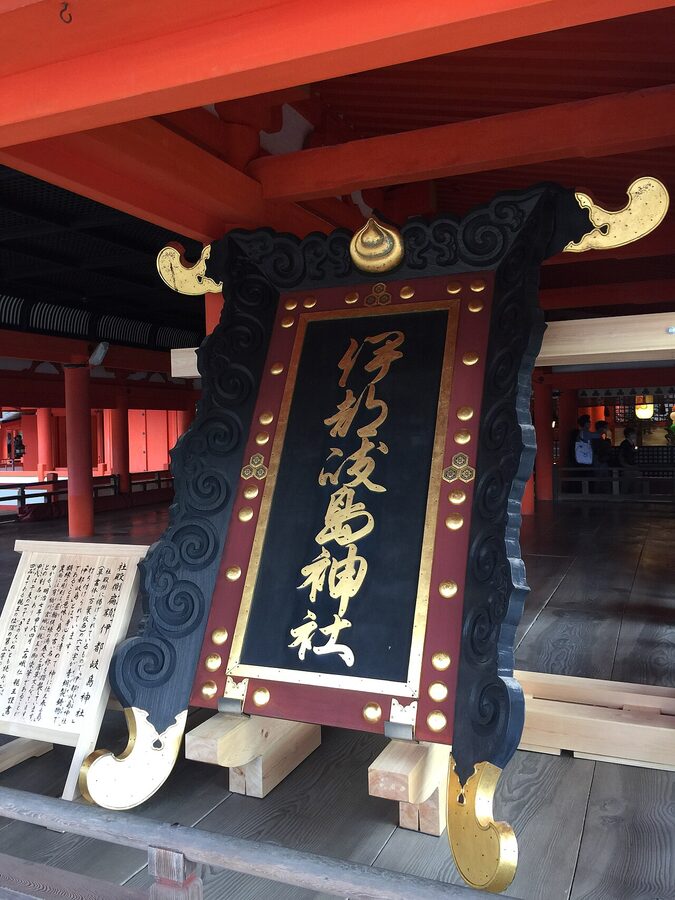
The worst threat the shrine faced in the 19th century came not from the sea but from Tokyo. In 1868 the new government ordered Shinto and Buddhism separated, and an official sent from the capital judged the shrine’s buildings Buddhist in style and ordered them burned. The shrine’s senior priest appealed to the government directly and saved them, at the price of a “restoration” to what someone thought a pure Shinto shrine should look like.
The paint was stripped, and the crossed finials and log weights of old Shinto architecture were added to the roofs. The Buddha images went to Daigan-ji and Daishō-in, the Senjōkaku became the Toyokuni Shrine, and most of the island’s temples were closed. The paint went back on in the repairs of the late Meiji era and the Taishō years and the finials came off again, which is why they appear only in Meiji-period photographs.
The sea has kept up the pressure. A debris flow on 17 September 1945 filled the space under the floors with silt, typhoons in 1950 and 1951 brought storm surges, and the typhoon of 1991 brought down the Noh stage. In September 2004 Typhoon Songda wrecked the left music room again and flooded the platforms and corridors, and some Japanese commentators now count the island, with Venice, among the places where rising sea levels show in the floodwater.
World Heritage, and a tax
In December 1996 the shrine was inscribed on UNESCO’s World Heritage list together with the sea in front of it and the primeval forest of Mount Misen behind, 431.2 hectares in all. The Atomic Bomb Dome in Hiroshima was inscribed at the same session; the island had felt the bomb too, when the blast of 6 August 1945 broke windows in the town. Shirakawa-go had joined the list the year before.
The crowds keep growing. In 2024 the island had a record 4.85 million visitors, against a resident population of under 1,500, and since 1 October 2023 the city of Hatsukaichi has charged a visitor tax on everyone arriving by boat. In 2021 the old streets around the shrine were designated a preservation district for traditional buildings, the same protection given to the warehouse streets of Kawagoe.
Where to visit Itsukushima Shrine today
I checked every hour, price and timetable below on the shrine’s, the temples’ and the operators’ own sites on 16 November 2026; they change, so look again before you go. The one thing that matters more than any of them is the tide.
Getting there
From Hiroshima Station the JR Sanyō Line takes about half an hour to Miyajimaguchi, and the ferry piers are a few minutes’ walk away. The Hiroden streetcar, line 2, is slower, and there are direct boats from the pier beside the Peace Memorial Park, which save you the train but cost more.
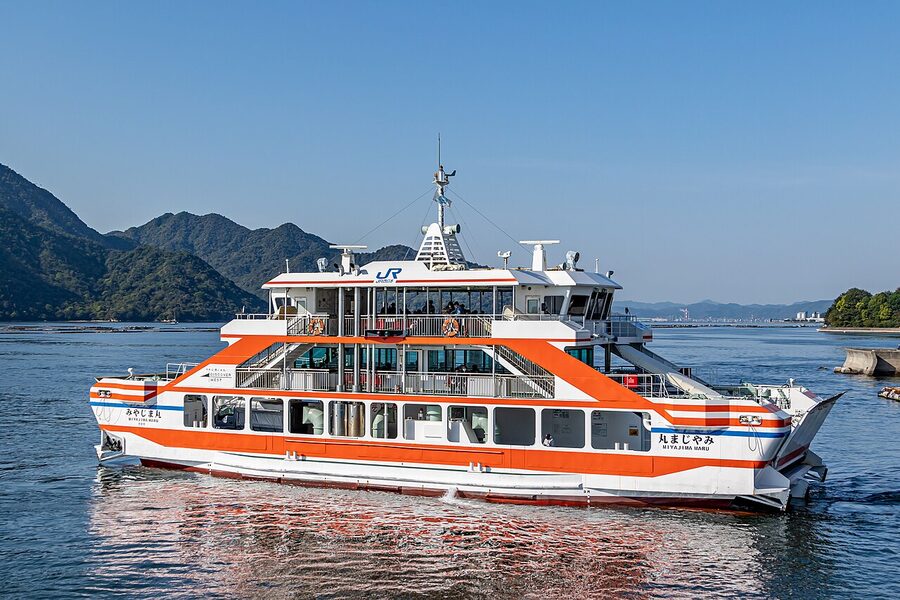
Both ferries charge ¥200 for an adult one way, plus the visitor tax of ¥100, collected with your outbound ticket; if you come often, ¥500 at the city offices covers a year. Children below school age are exempt. A Japan Rail Pass covers the JR fare, but some regional rail passes that include the crossing leave out the tax, which you then buy at the pier. There is no parking for visitors on the island, so if you drive, leave the car at Miyajimaguchi.
Reading the tide
The tourist association publishes the year’s tide table, and it comes with a rule worth memorising. The shrine looks as though it is floating only when the table shows more than 250 centimetres, and you can walk out to the torii only when it shows less than 100. “High tide” and “low tide” are not enough on their own, because on a neap day the water may never rise high enough to float the shrine or fall low enough to reach the gate.
The table is for Hiroshima port, and the tide at the island turns a little earlier. On the day I checked, 16 November 2026, it showed the shrine floating from noon to about half past four, and the walk to the torii possible only between six and eight in the morning; on a good spring-tide day you can have both in one afternoon. Plan the trip around the table, not the other way round.
The shrine and the treasure hall
The shrine is about ten minutes’ walk from the pier along the shore. It opens every day at 6:30 and closes at 18:00 from 1 March to 14 October, at 17:30 from 15 October to 30 November and from 4 January to the end of February, and at 17:00 in December; on New Year’s Day it opens at midnight. Admission is ¥300; the treasure hall is another ¥300, open 8:00 to 17:00, or ¥500 for both on a combined ticket sold only at the shrine entrance.
The route is one way. You enter by the east corridor past the Marōdo Shrine, walk out to the platform in front of the main hall, and leave by the west corridor past the Tenjin Shrine and the Noh stage. The gaps in the floorboards are there to let the sea through, and the shrine asks you not to wear high heels.
The exit, oddly, is the grander gate, with a curved Chinese-style gable, because it used to be the entrance: pilgrims landed on the beach by Daigan-ji, bathed and changed at the temple, and walked into the shrine from the west.
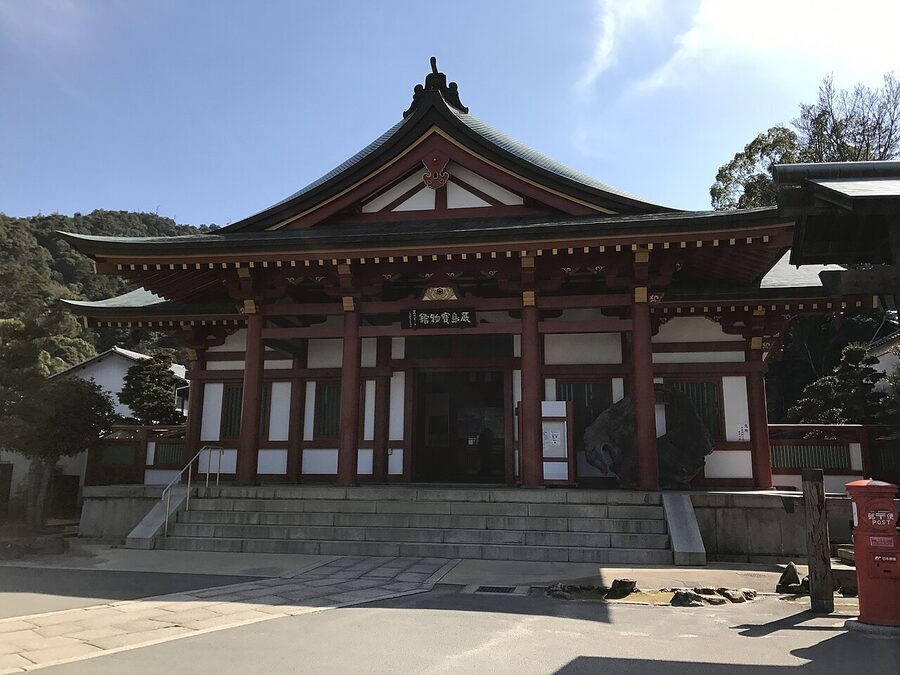
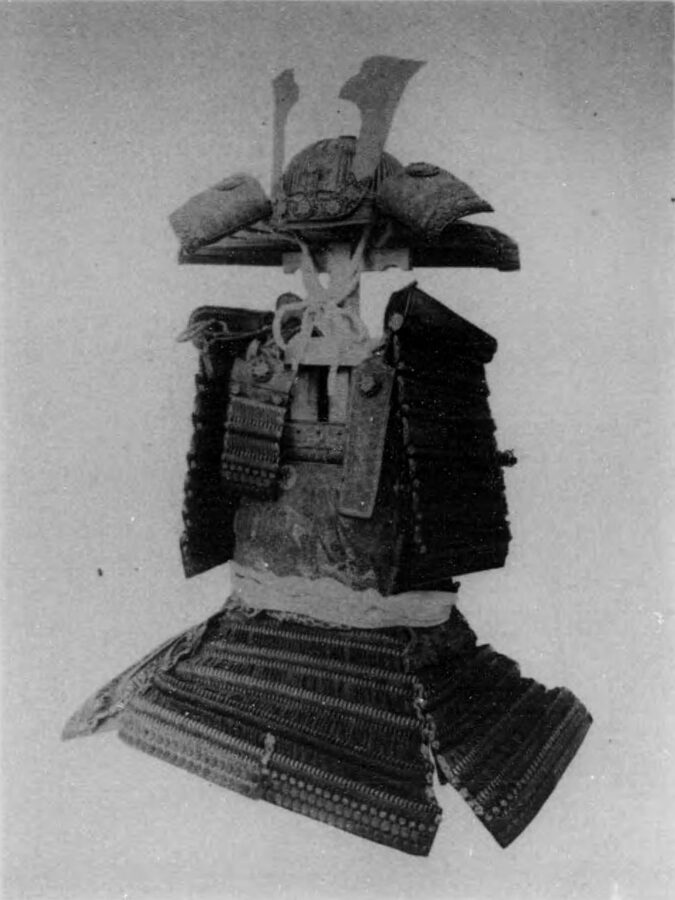
Give it half an hour. The shrine owns some of the finest early samurai armour in Japan, and there is no better place to see what the Taira and their successors offered a goddess they took seriously.
Senjōkaku, the pagoda and Daigan-ji
The Senjōkaku is on the hill above the shrine, open 8:30 to 16:30, ¥100. Sit on the boards and look out through the open side towards the sea; it still works as it did in 1842, as somewhere to catch the breeze. The pagoda beside it was under repair when I checked, with work scheduled to run until December 2026 and possibly beyond.
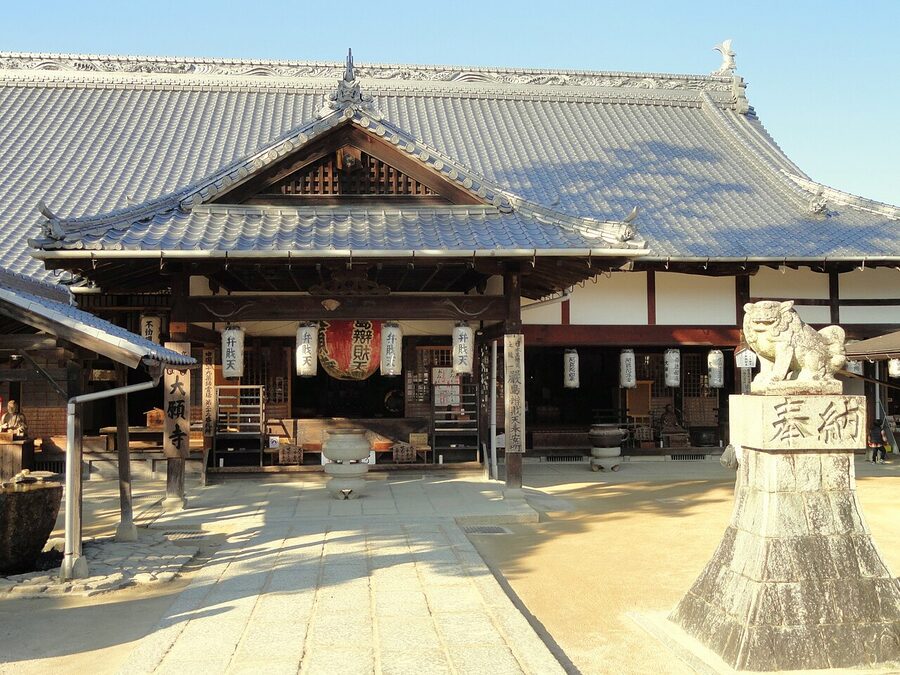
Daigan-ji, next to the treasure hall, is free and open 8:30 to 17:00. Its Benzaiten, counted among the three great Benzaiten of Japan with those of Enoshima and Chikubushima, sat in the shrine’s main hall until 1868 and is shown once a year, on 17 June. Look under the eaves for a 1:25 model of the Kintai Bridge at Iwakuni made for a Paris world’s fair.
Daishō-in and Mount Misen
Daishō-in, the island’s oldest temple, is about ten minutes’ walk uphill from the shrine and free, open 8:00 to 17:00. Tradition says Kūkai founded it in 806 on his way home from China; the first document mentioning it dates from 1177, and the link to Kūkai cannot be proved. It ran the shrine’s Buddhist rites until 1868, and the Meiji emperor stayed here in 1885.
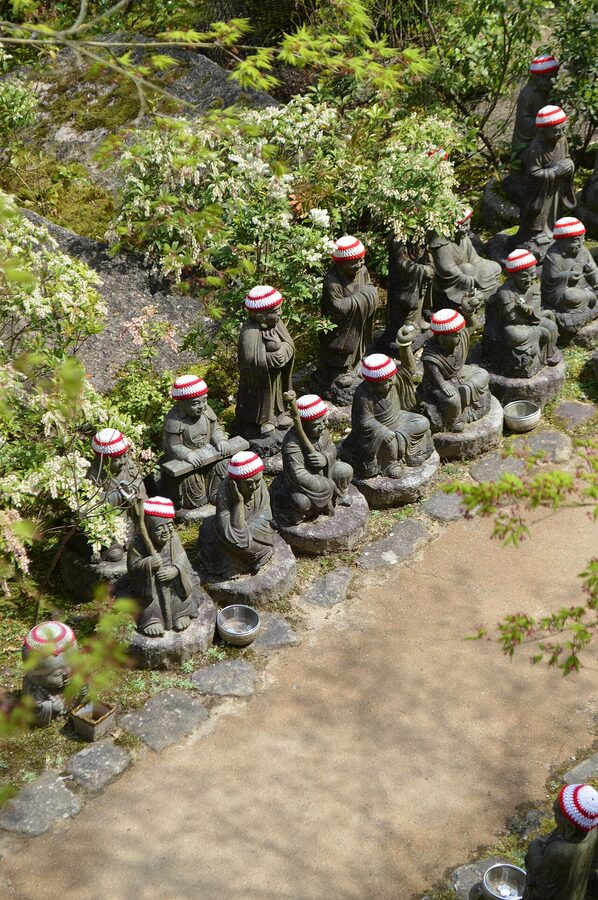
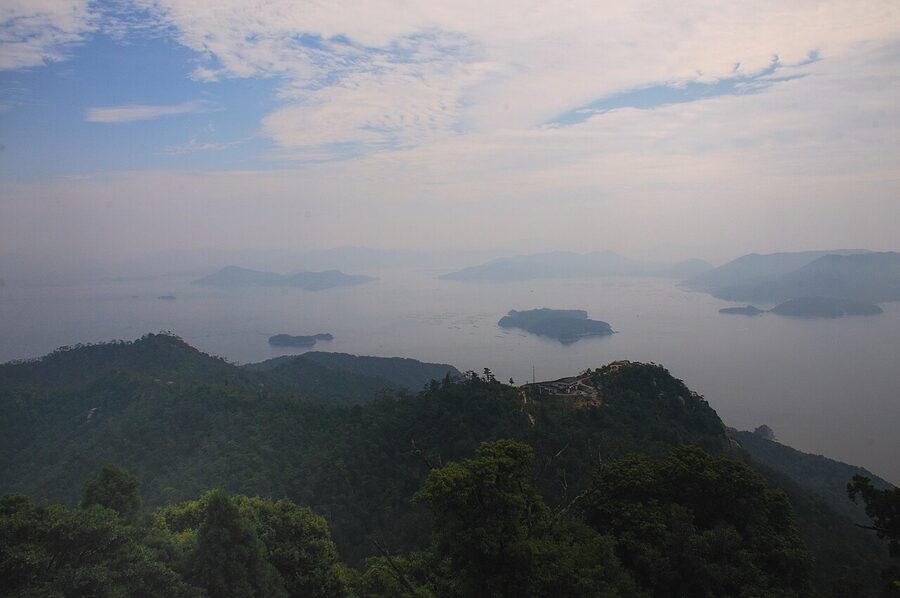
The temple is also the start of the best path up Mount Misen, the Daishō-in course, about one and a half to two hours on stone steps; the Momijidani course is a little shorter. The summit observatory, rebuilt in 2013, looks across the islands of the Inland Sea to the mountains of Shikoku on a clear day. Itō Hirobumi, who paid for the repair of the paths in 1906, said the true worth of one of the Three Views lay in the view from the top.
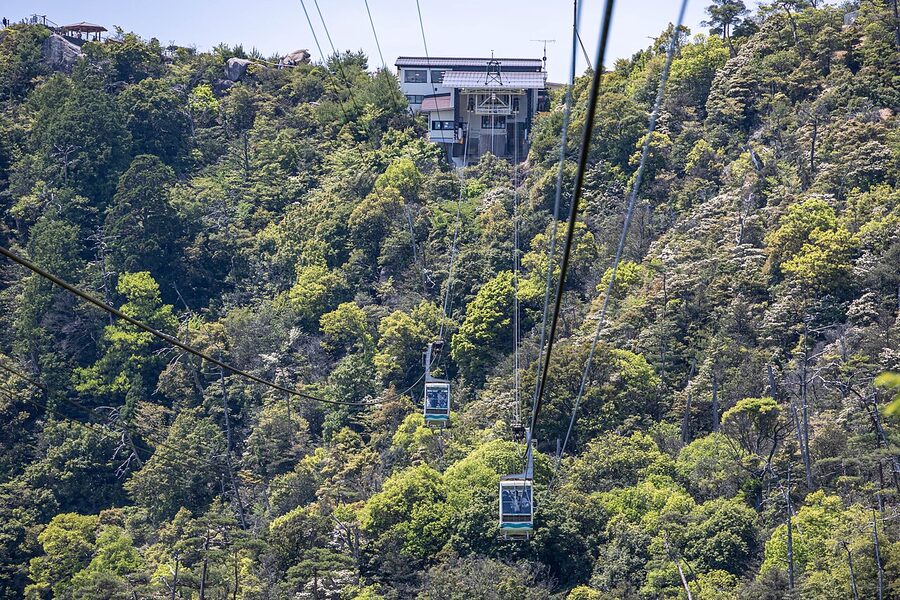
The ropeway starts from Momijidani Park behind the shrine, with a free shuttle bus to the lower station. Below the summit stood the Reikadō, the hall of the “fire that never goes out”, said to have burned since Kūkai’s practice on the mountain and one of the sources of the Peace Flame in Hiroshima. The hall burned down on 20 May 2026; the flame was saved, and the temple is raising money to rebuild.
The Miyajima History and Folklore Museum
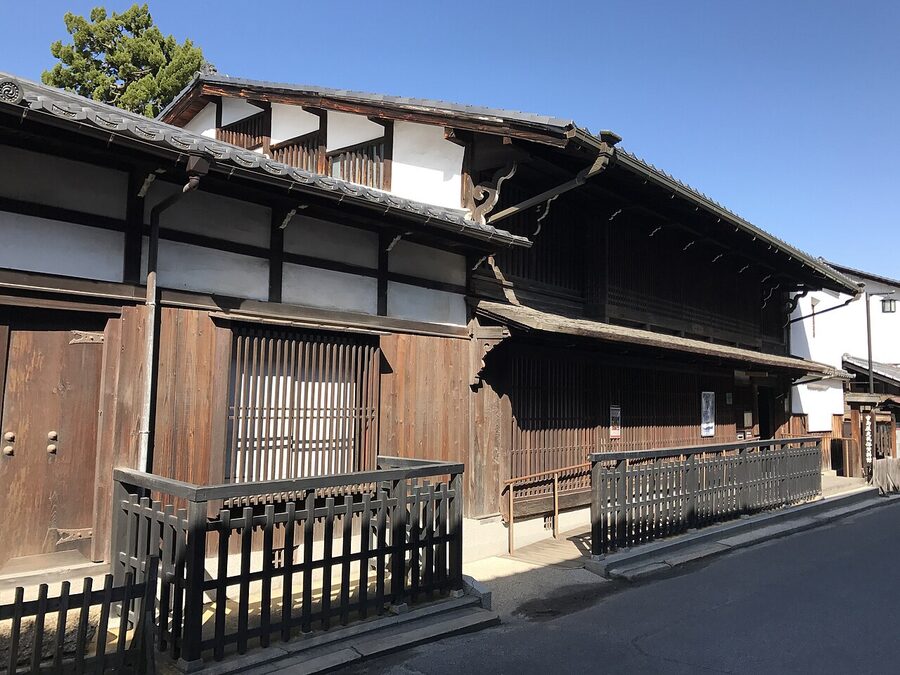
For the island’s ordinary life rather than its gods, go to the History and Folklore Museum, a few minutes’ walk west of the shrine, in the house and storehouses of the Egami family, merchants who did well from the island’s trade from the Edo period into Meiji. It is open 9:00 to 17:00 (last entry 16:30), closed on Mondays and from 26 to 31 December, and costs ¥300.
Deer, oysters and momiji manjū
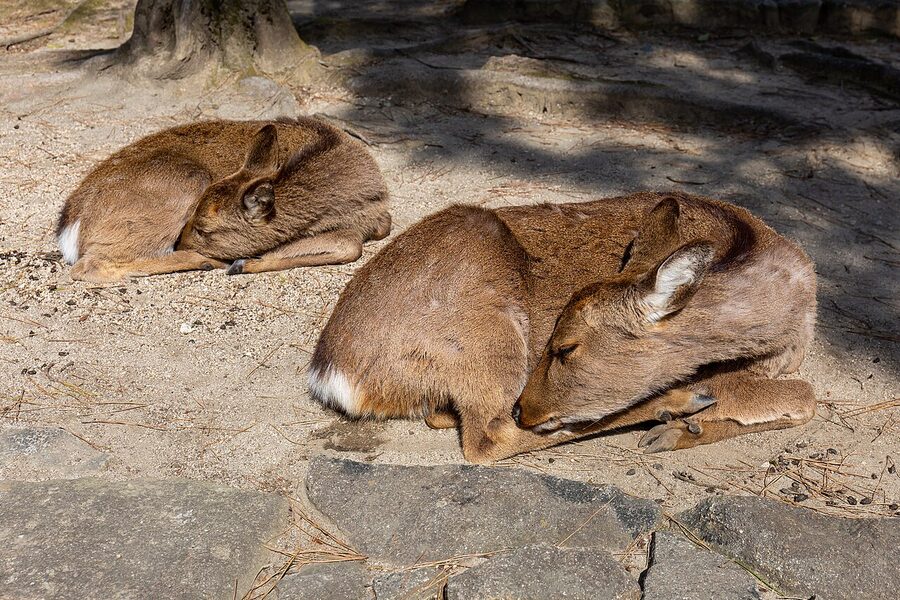
The deer are everywhere and used to be fed by everyone; since 2008 the city has banned feeding to send them back to the forest, and their numbers in town have fallen. They will still eat your map, your ticket and the corner of your guidebook, and in autumn they are wild animals with antlers.
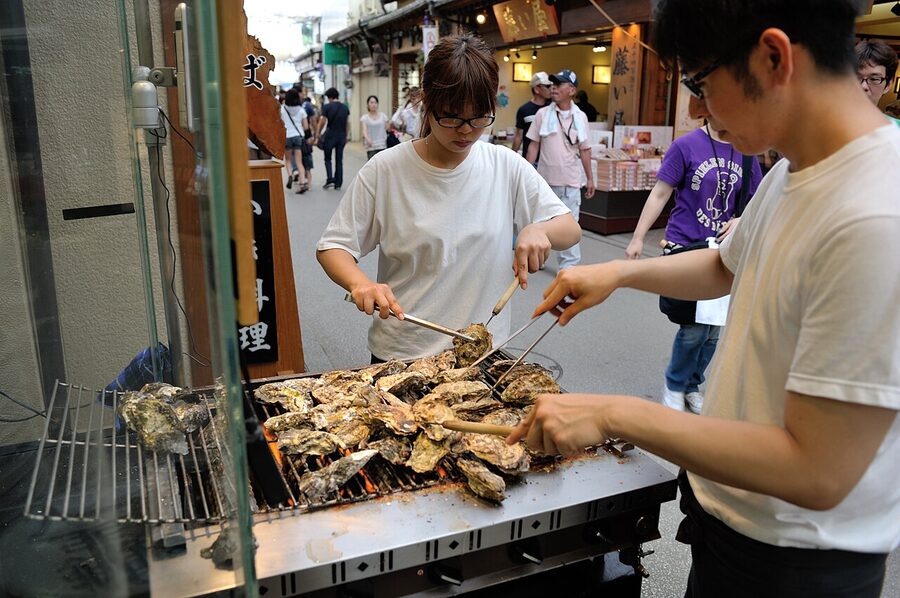
The bay is lined with oyster rafts, and grilled oysters are the island’s street food, best in winter. The town’s oyster festival falls on the second weekend of February, though in 2026 it was cancelled because the oysters had grown too poorly to supply it. For something more filling, look for anago-meshi, rice under grilled conger eel, a speciality on both sides of the strait.
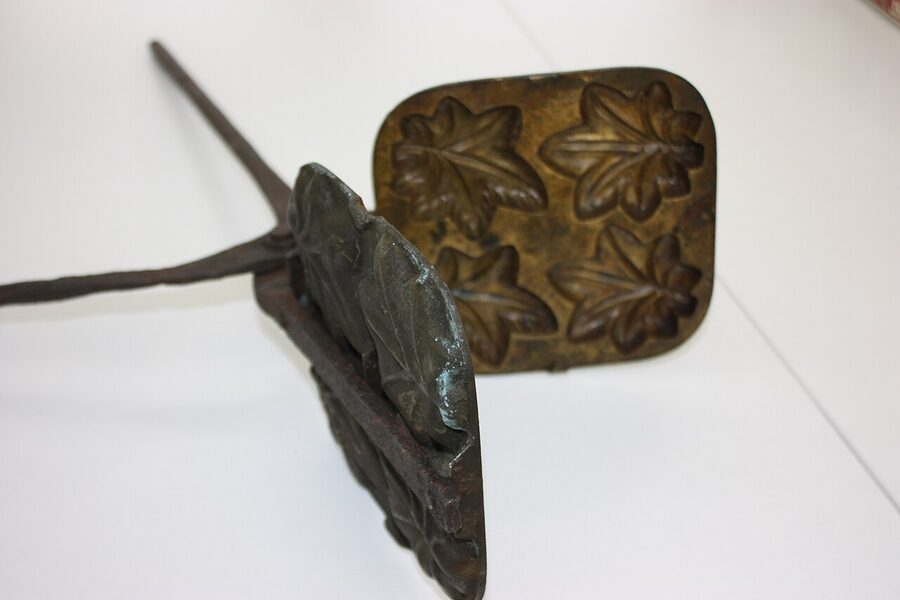
The other edible souvenir is the momiji manjū, a maple-leaf sponge cake around sweet bean paste. It was created in 1906 by a confectioner, Takatsu Tsunesuke, at the request of the proprietress of the Iwasō inn, who wanted something for her guests that they could get nowhere else. A popular story credits Itō Hirobumi, who supposedly told a teahouse girl her hands were as pretty as maple leaves; it is a nice story and there is no reason to believe it.
Staying the night
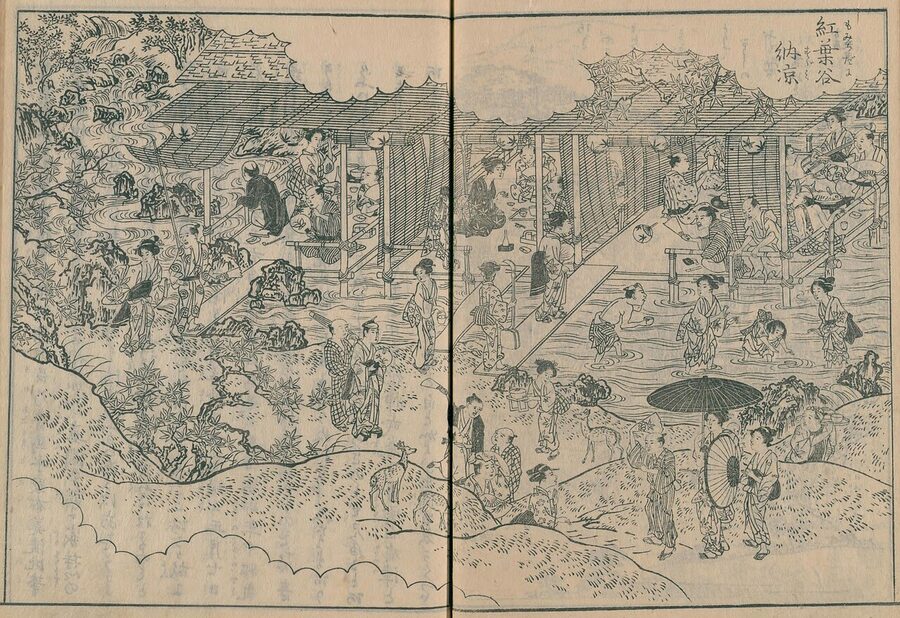
Stay on the island if you can. The day crowds leave on the late-afternoon ferries, the shrine is lit from thirty minutes after sunset until 23:00 (you cannot go in, but you can walk the shore), and the morning tide is yours. Iwasō, at the mouth of Momijidani, began as a teahouse in 1854; Emperor Shōwa stayed there in 1947, and the G7 leaders had a working dinner there in 2023.
Festivals
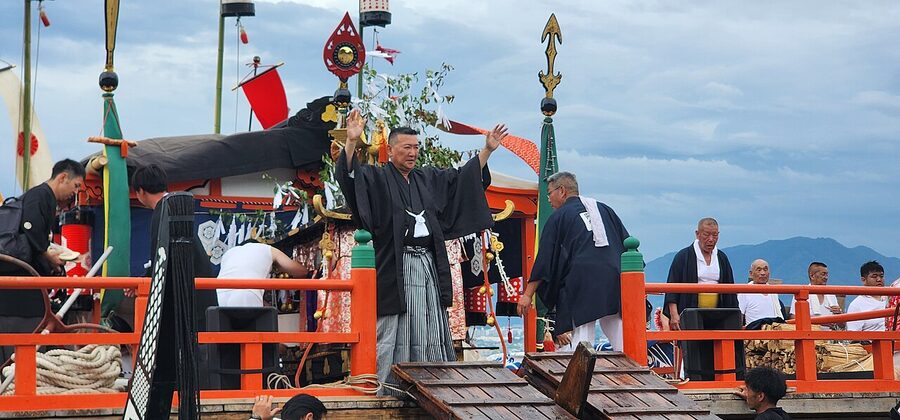
The great festival is the Kangensai, on the 17th day of the sixth lunar month, which in 2026 fell on 30 July. The goddesses are carried onto a boat of three hulls lashed together, and court musicians play as it circles the bay, crosses to Jigozen and comes back through the torii late at night. For other dates, see my guide to Japan’s greatest festivals.
In April, after the peach-blossom festival on the 15th, there are three days of Noh on the stage over the sea, from the 16th to the 18th. On New Year’s Eve the town carries huge torches along the shore in front of the torii for its fire festival, and bugaku is danced on the raised stage on several holidays a year.
Across the strait: Jigozen and Tōun-ji
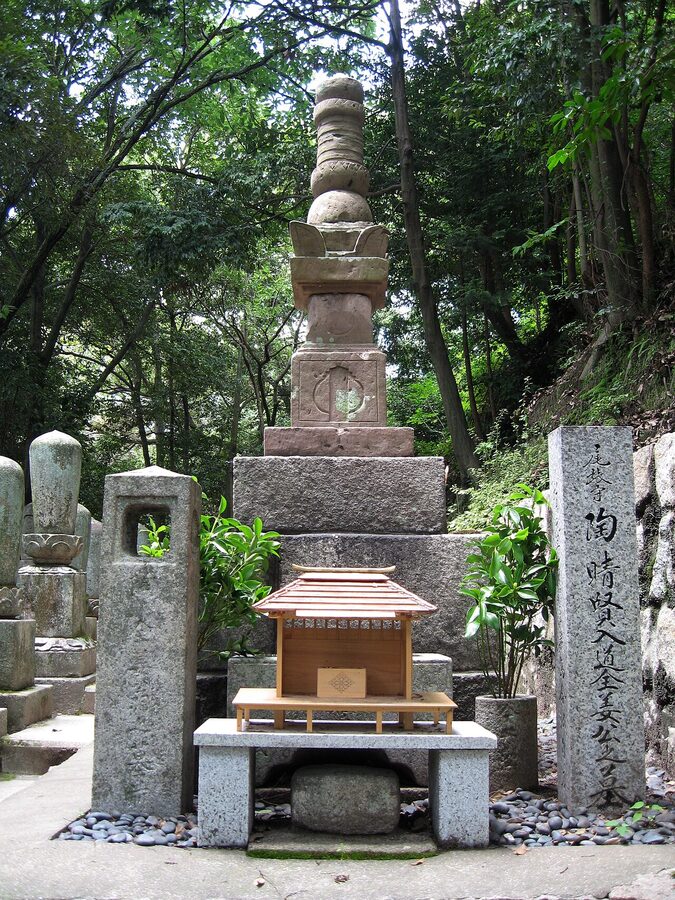
Two places on the mainland complete the story. Jigozen Shrine, where the rites were held while the island was too holy to live on, is a few minutes from Jigozen stop on the streetcar line, and Tōun-ji in Hatsukaichi is where Sue Harukata’s head was buried after Motonari had finished with it.
For how the Taira, the Mōri and Hideyoshi fit into the rest of Japanese history, start with my overview of Japan through the ages.
The island with no graves
Everything at Itsukushima comes back to the idea that the island is a body you must not hurt. The shrine stands on posts, the gate stands on its own weight, the dead went across the water, and a warlord who had just won the battle of his life spent a week washing the place. It turned out to be a practical idea too: the halls the old builders put where the goddess wanted them are still standing, and the ones added later keep floating away.
Go when the table says the water will be above 250 centimetres, take the ferry that swings past the torii, and walk the corridors with the sea under your feet. Then come back at dawn when it is below 100, walk out across the wet sand to the gate, and look back at the shore. There is not a grave in sight.