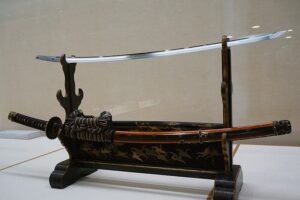
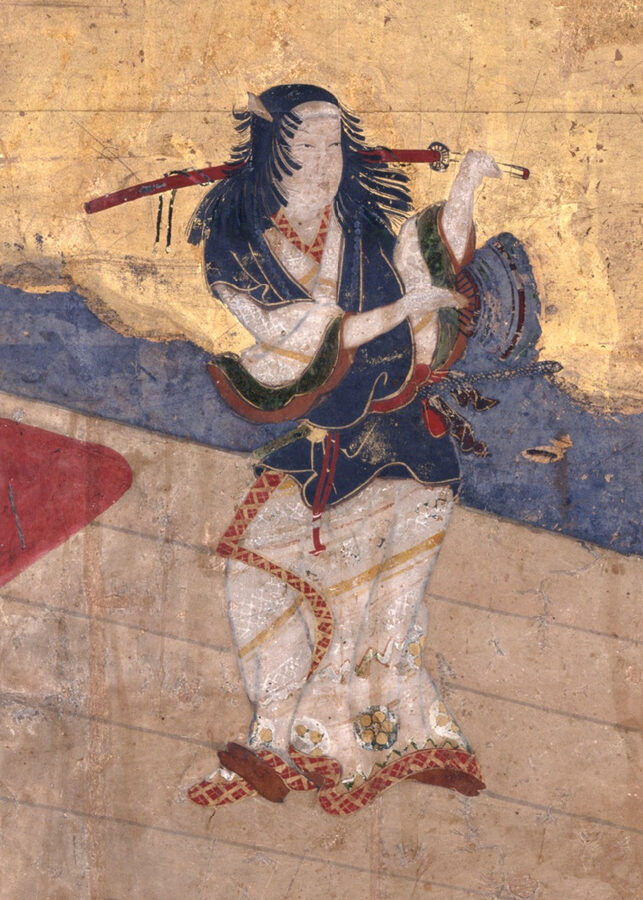
The earliest description of kabuki was written in the spring of 1603 by a chronicler who was not much taken with the star. A shrine maiden from Izumo called Kuni, says the Tōdaiki, “though not a beauty”, had come up to Kyoto with a new kind of dance: she dressed as an outlandish young man, with a long sword and a short one at her hip, and played a swaggerer flirting with a woman from a teahouse. High and low in the capital could not get enough of it. She was summoned to dance at Fushimi Castle again and again, and the chronicler adds, a little pointedly, that the shogun’s heir did not go and see her.
Japanese accounts of the dance say the teahouse woman in that scene was played by a man, Okuni’s partner Sankurō. So the first kabuki anyone wrote down had a woman playing a man and a man playing a woman, which is as neat a summary of four centuries of Japanese theatre as you will find. In 1629 the shogunate took the woman away. The man is still there, and every female role on the stage of the Kabukiza in Ginza tonight will be played by one of his successors, watched from the top gallery by people who paid ¥1,600 for a single act.
In This Article
- Leaning the wrong way: the kabukimono
- Okuni on the riverbed
- The women go, the boys go, the men stay
- Genroku: the rough and the soft
- The plays everybody already knew
- Chūshingura
- Yoshitsune Senbon Zakura
- Kanjinchō
- Sukeroku
- Ghosts
- The machine
- Censors, a move to the rice fields and an American major
- How to watch kabuki today
- The Kabukiza, Ginza
- Asakusa: Saruwaka-chō and the Shibaraku statue
- The Minamiza, Kyoto
- The Kanamaru-za, Kotohira
- Izumo
- Okuni’s bridge
Leaning the wrong way: the kabukimono
The word comes from a verb, kabuku (傾く), to lean or tilt. By the end of the Sengoku era a kabukimono, a “leaning one”, meant a young man who dressed and behaved as far off the vertical as he could manage: velvet collars, women’s kimono worn over armour, swords so long they dragged, hair shaved in odd places, and a fondness for picking fights. The characters now used to write kabuki, 歌舞伎, “song, dance, skill”, are a later and much more respectable spelling. Through the Edo era the usual form was 歌舞妓, with the character for a female entertainer, and the current version only became standard in modern times.
The type was older than the word. The teenage Oda Nobunaga walked the streets of Owari with his sleeves hanging off and a rope for a belt, and Maeda Toshiie was known in his youth for exactly this sort of showing off. By the 1600s, though, the kabukimono were mostly the men the wars had left behind: the servants and foot soldiers of samurai households, and the masterless rōnin of the defeated side, who formed sworn gangs, sealed their oaths in blood and treated the new peace as a personal insult. A Japanese historical dictionary describes them, without visible irony, as anti-establishment elements.
They also had the best clothes in Kyoto, and that was what Okuni stole. Her stage character was a kabukimono out on the town, and his costume included the rosaries and crucifixes that had become a fashion in the capital along with Portuguese pantaloons and tobacco. Most of the people who wore them had no more interest in Christianity than a teenager with a skull ring has in death.
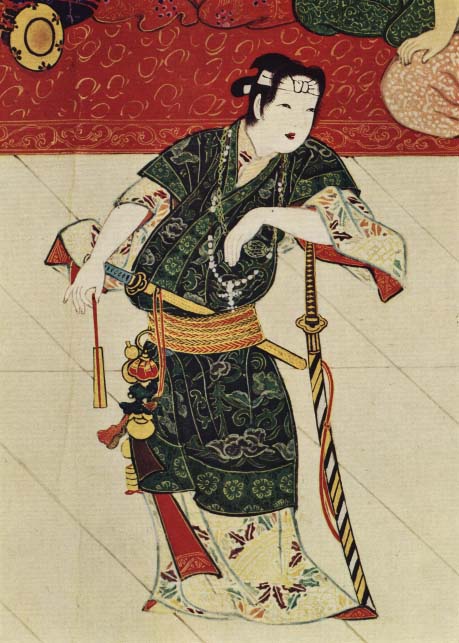
The man she most liked to play was real. Nagoya Sanzaburō had been a page of the warlord Gamō Ujisato, famous for his looks and his clothes, a dandy whom the street songs of Kyoto praised by name. In 1603, serving the Mori clan at their new domain of Tsuyama in Mimasaka, he got into a quarrel on a building site and was cut down. Okuni brought his ghost onto the stage almost at once, which is roughly as if a West End revue had put on a number about a celebrity who died last season.
Legend later made Sanzaburō Okuni’s lover, or her husband, or the man who taught her everything she knew. There is no evidence for any of it. What the record does show is a performer with a reporter’s instinct for the story everybody in town was talking about, and an audience happy to pay to see it.
Okuni on the riverbed
Almost everything about Okuni’s life is disputed, starting with when it began. The usual birth year of 1572 comes from a diary entry about two girls, aged eight and eleven, who danced at the Kasuga Shrine in Nara in 1582; the entry gives their names as Kaga and Kuni, or, read another way, says they came from Kaga province. English-language accounts often prefer “about 1578”, which rests on even less. Her father is said to have been a blacksmith attached to Izumo Taisha, and she presented herself as a shrine maiden raising money for its repairs, a claim Japanese reference works repeat with the careful word “said”.
The first entry that is definitely her is dated the first day of the seventh month of 1600, a few weeks before the battle of Sekigahara. A courtier recorded that “the yayako dance of Izumo, one called Kuni and one called Kiku”, with ten or so men and women in their company, performed until evening at the mansion of the Konoe family. Yayako odori was a little girls’ song-and-dance act, sweet and harmless, and nothing in that entry suggests anyone was about to invent a theatre.
Three years later the act had changed its name and its nature. On the sixth day of the fifth month of 1603 another court diary records a performance of kabuki odori at the palace of the retired empress, and the Tōdaiki entry for the fourth month describes the cross-dressing teahouse scene. It was the same spring that Tokugawa Ieyasu was made shogun, which is why 1603 is the conventional birth year of both the Tokugawa shogunate and kabuki. Neither party would have enjoyed the comparison.
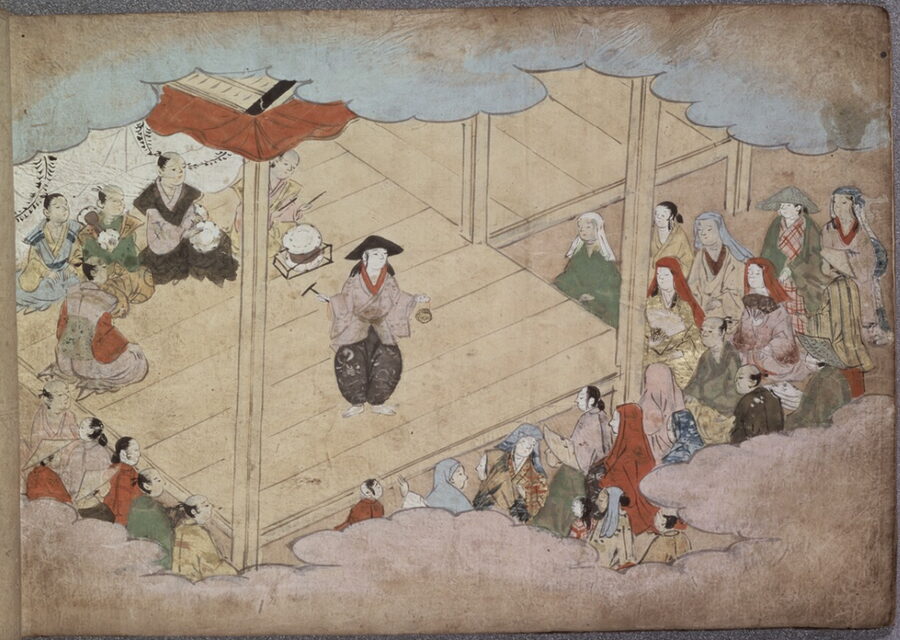
Where she first did it is less settled than the English story suggests. English-language accounts put her on the dry bed of the Kamo River at Shijō, in a makeshift enclosure among the sideshows, and she certainly played there. Several Japanese dictionaries say instead that she began at Kitano Shrine, where a priest of the shrine became her most useful patron and she later had a permanent stage. I suspect both are true and the order cannot be recovered.
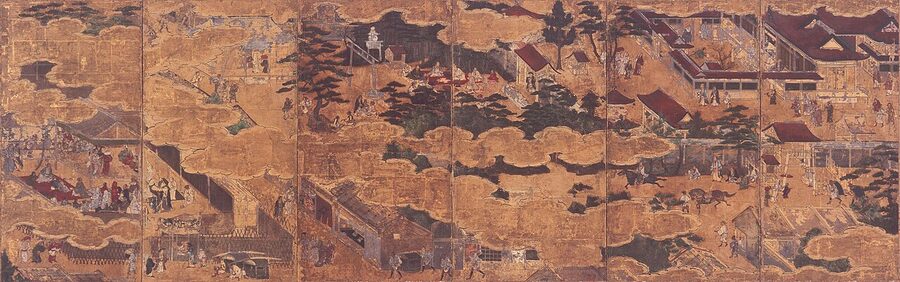
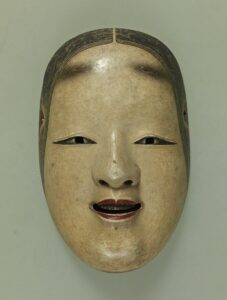
The performances were short and loose: songs of the moment, comic sketches with a male clown called Saruwaka, the teahouse flirtation, and a finale in which performers and audience danced together in a crush. The music was flute and drums, borrowed from noh, and the stage was a noh stage. Her company played Fushimi, toured the provinces, and in 1607 gave a fundraising performance at Edo Castle.
After that she vanishes. Sources variously give her death as 1613, 1644 or 1658, and some Japanese scholars think there was a second Okuni using the name. Her grave stands beside the graves of her family near Izumo Taisha, and a second grave said to be hers lies next to Nagoya Sanzaburō’s in a sub-temple of Daitoku-ji in Kyoto, which is the romance getting the last word.
The women go, the boys go, the men stay
Okuni’s act was copied within months, and the most enthusiastic copyists were the brothels. Yūjo kabuki, courtesan kabuki, spread to every castle town with a licensed quarter in a little over a decade. It was the first theatre to put the shamisen on stage, a three-stringed instrument that had arrived from the Ryūkyū kingdom a generation or two earlier, and the big troupes paraded fifty or sixty women at once in front of tiger and leopard skins. Customers went to the show to choose.
It also caused fights, mostly between samurai competing for the same performers, and the shogunate eventually banned women from the stage. The traditional date is 1629, under the third shogun, Iemitsu. Japanese historians now think the bans came in stages over a decade or more, since no single order could close down an industry that had spread across the country, but the result was absolute: from then until 1891 no woman, including the musicians, appeared on a licensed stage in Japan.
Boys had been there all along. Wakashu kabuki, performed by youths of twelve to about eighteen with their forelocks uncut, is recorded as early as 1603, and older books that make it a replacement for the women have the order wrong. It was every bit as erotic as the courtesans’ version, since the actors were also available after the show, and Iemitsu is said to have been an admirer. In 1652, the year after his death, the shogunate banned it too.
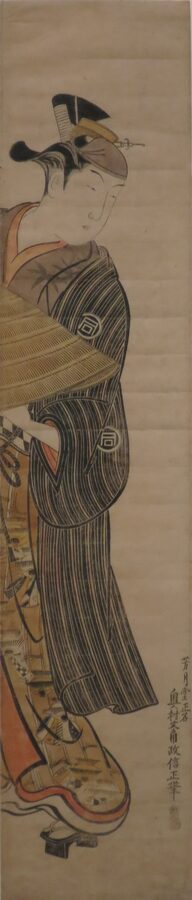
The theatres petitioned, and in 1653 they were allowed to reopen on conditions. The actors had to shave the front of the head like any adult man, and the older textbooks add that they had to present plays with plots rather than song-and-dance revues. Some modern scholars doubt that second condition was ever written down, but the shift happened anyway. With nothing left to sell but acting, the companies started to act.
This was the birth of yarō kabuki, “fellows’ kabuki”, and of the onnagata (女形), the man who specialises in women’s roles. The word first appears in print around 1660. Onnagata covered their shaved pates with a square of purple silk, and later with wigs, and they set about inventing a femininity that their audiences would accept from a grown man who, a generation earlier, could have watched the real thing.
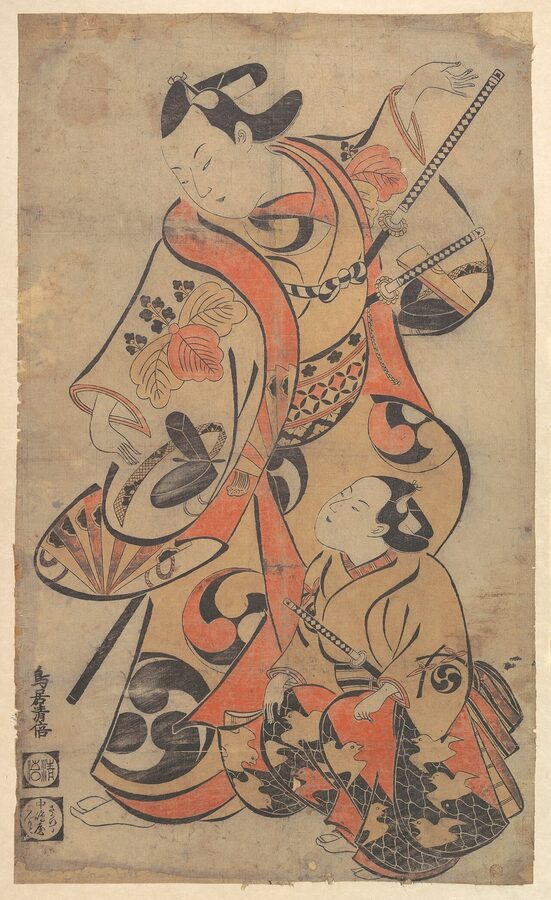
The man who wrote the rules was Yoshizawa Ayame I (1673–1729), who began as a boy entertainer in Ōsaka’s Dōtonbori and ended with ranking titles no actor had held before, including “first in Japan”. His sayings were collected as the Ayamegusa, and the advice that every onnagata still quotes is that an onnagata must live as a woman offstage too, down to how he eats in company, and should blush if anyone mentions that he has a wife. It is less a statement about gender than about craft: the illusion, he thought, began at breakfast.

That was the commercial secret of the onnagata. Women could not appear on stage, but the men who played them set the fashions women wore, from kimono colours to ways of tying the obi, and a hit role could sell a pattern across the country. If you have read the site’s guide to the kimono, a surprising amount of what it describes was first worn in public by a man.
Genroku: the rough and the soft
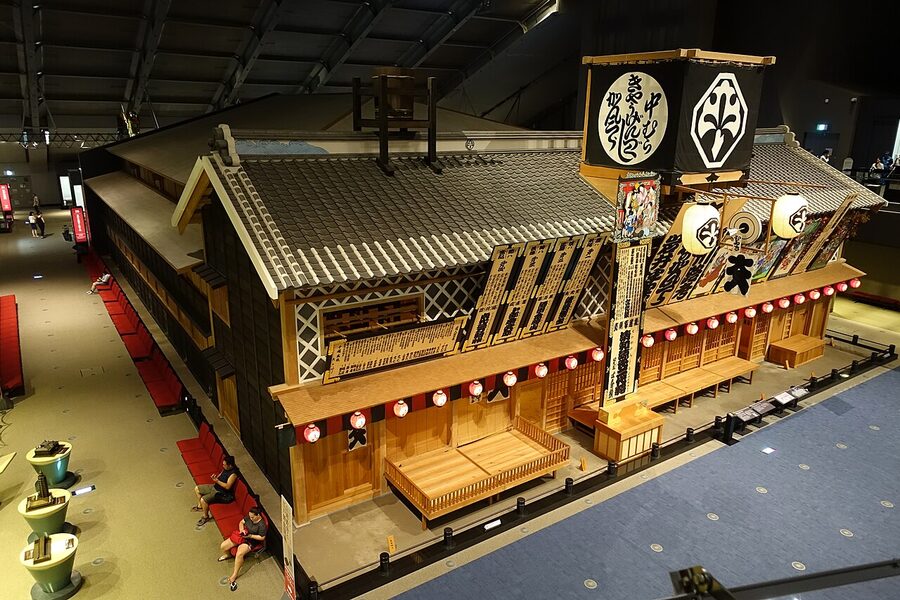
By the 1670s Edo had settled on four licensed theatres. The first had been raised in 1624 near today’s Kyōbashi by Saruwaka Kanzaburō, a comic performer from the Kyoto region, and became the Nakamura-za; the others were the Ichimura-za, the Morita-za and the Yamamura-za. Each flew a yagura, a drum tower wrapped in the theatre’s crest, as its licence, and a theatre without one could not legally use a draw curtain, a revolving stage or a runway.
The Yamamura-za did not last. In 1714 Ejima, a senior lady-in-waiting to the mother of the shogun, went to the theatre on an official errand, stayed for drinks with the star actor Ikushima Shingorō, and returned to the castle after the gates had closed. Ejima was exiled to the mountains of Shinano, Ikushima to the island of Miyake, the owner of the Yamamura-za to Izu Ōshima, and the theatre was abolished. Edo had three licensed theatres from then until the end of the shogunate.
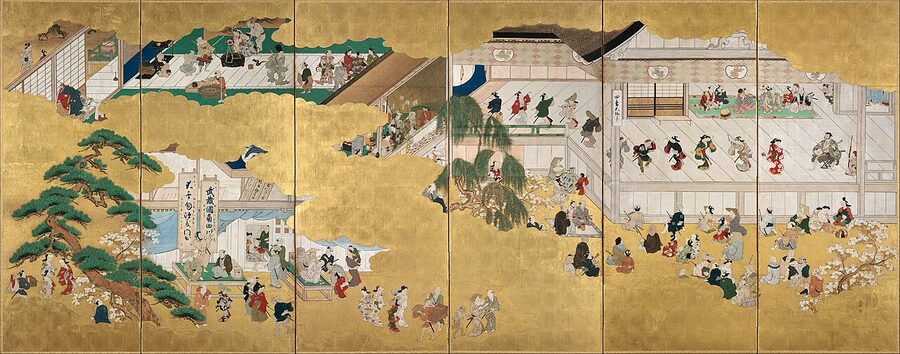
The decades either side of 1700, the Genroku era of Tokugawa Tsunayoshi, are where kabuki became a theatre that a modern audience would recognise, and two actors stand at the head of it. In Edo it was Ichikawa Danjūrō I (1660–1704), the son of a man remembered, perhaps unfairly, as Scarface Jūzō. In Kyoto it was Sakata Tōjūrō I (1647–1709), the son of a theatre manager.
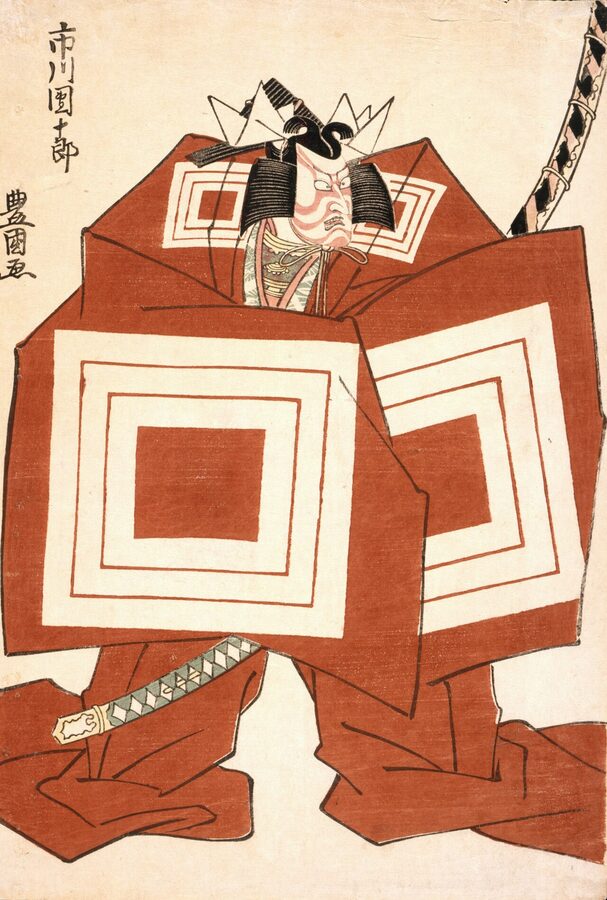
Danjūrō is credited with aragoto (荒事), “rough stuff”: superhuman heroes with painted faces, bulging limbs and voices that could stop a battle. The traditional account has him inventing it at fourteen, playing the strongman Sakata Kintoki in the ninth month of 1673 at the Nakamura-za, inspired by the violent puppet plays of the day. Japanese theatre historians now treat that story as legend; rough heroes, swaggering footmen and bombastic villains were all over the earlier stage. What he did was gather them into a style that became his family’s property.
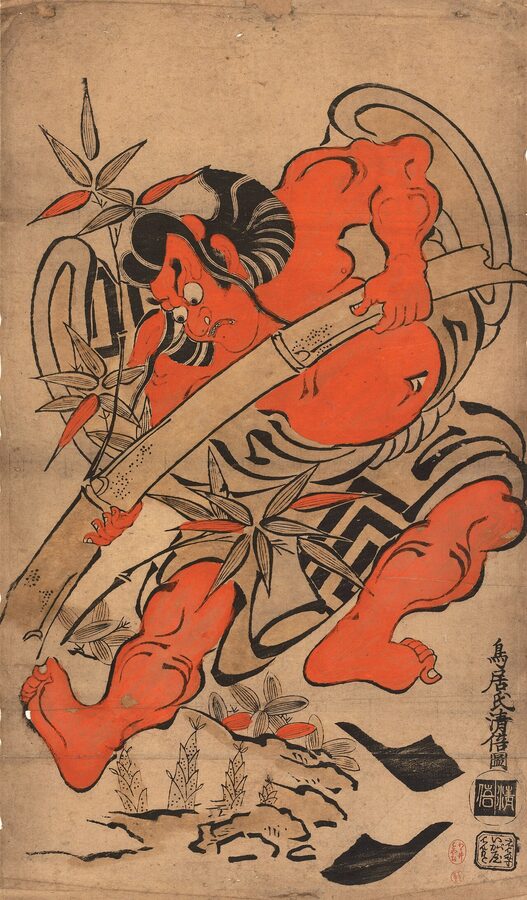
He also wrote plays, under the pen name Mimasuya Hyōgo, and took the name of his house, Naritaya, from his devotion to the Fudō of Naritasan Shinshō-ji east of Edo. The audience still shouts it. His end was as theatrical as his acting: on the 19th day of the second month of 1704, 24 March by the Western calendar, he was stabbed to death on stage at the Ichimura-za, in the middle of a performance, by a fellow actor called Ikushima Hanroku. Hanroku died in prison without explaining himself.
Tōjūrō was the opposite. His speciality was the young lover fallen on hard times, the rich man’s son disinherited for loving a courtesan, who turns up at her house in a paper kimono and talks his way back into her affections. His great role was Izaemon in Yūgiri Nagori no Shōgatsu, first played in Ōsaka in 1678 by most accounts (1679 in some), which he repeated four times that year alone. This soft, wry acting was later called wagoto (和事), and the Kyoto-Ōsaka stage has claimed him as its founder ever since.
Japanese historians are careful here too. No contemporary record says Tōjūrō played “wagoto”; the documents call his art yatsushi, the gentleman in disguise, and the clean pairing of Edo’s rough Danjūrō with Kyoto’s soft Tōjūrō is a later tidying of a messier stage. It is still a useful pairing. Go to a matinee in Tokyo and one in Kyoto in the same month and you can hear it in the voices.
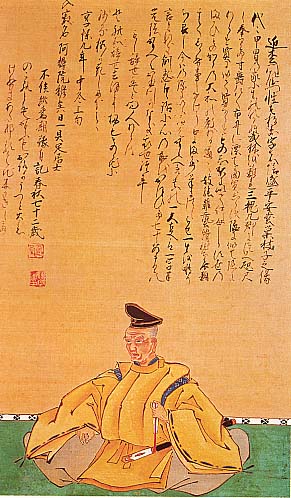
Tōjūrō’s playwright was Chikamatsu Monzaemon (1653–1725). From the early 1690s Chikamatsu wrote much of his work for kabuki, shaped around Tōjūrō’s talents, and as his star aged he committed himself to the puppet theatre of Ōsaka. His love-suicide plays for the puppets were so popular that real lovers copied them, and the shogunate banned the genre in 1723.
The money was serious. The phrase senryō yakusha, a thousand-ryō actor, still means a star in modern Japanese, and it was literal: Yoshizawa Ayame is said to have been the first to earn a thousand gold ryō a year, in the 1710s, and Danjūrō II matched it in 1721. Actors were still officially ranked among the riverbed outcasts, which gives you some idea how the samurai felt about paying them.
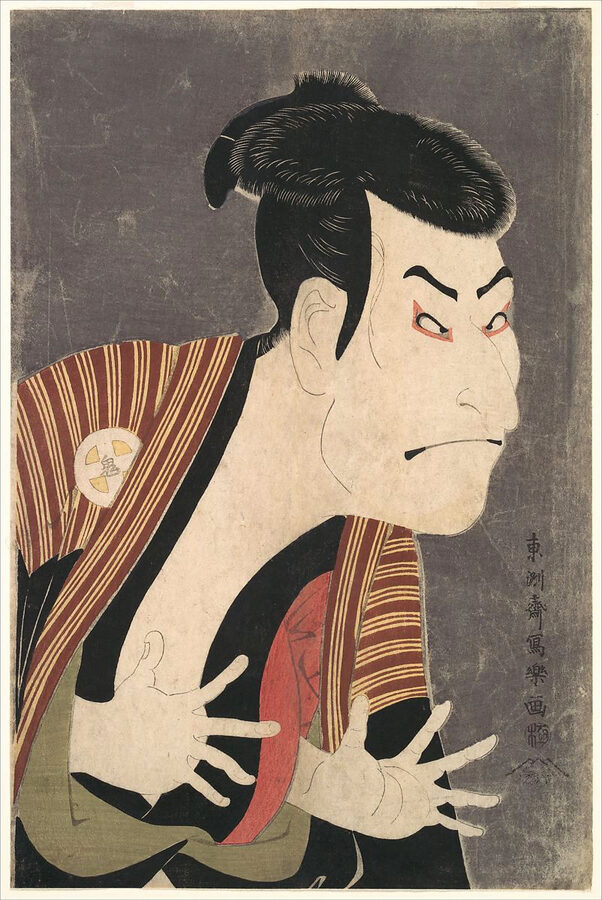
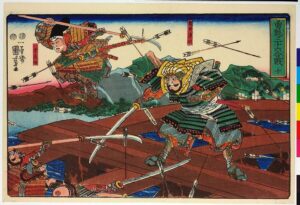
The print-makers lived off all this. Actor portraits were the poster trade of Edo, sold the week a play opened, and a large share of what the world now calls ukiyo-e was made to advertise kabuki. The publishers who sold Danjūrō’s face also sold landscapes and courtesans, and the same artists moved between them.
The plays everybody already knew
Kabuki plays were not written to surprise. Each was set in a sekai, a “world” every member of the audience already knew, the Soga brothers’ revenge, the fall of the Taira, the wars of the 14th century, and the novelty came from the shukō, the twist the playwright worked into it. A playwright writing around 1800 described the world as the warp and the twist as the weft, and gave as his example putting the thief Ishikawa Goemon into the world of Toyotomi Hideyoshi. That is exactly what happens in Sanmon Gosan no Kiri, where Goemon, a thief whom later legend turned into a ninja, sits on the gate of Nanzen-ji smoking a long pipe and admiring the cherry blossom until Hideyoshi, under a thin disguise, turns up on the ground below.
The disguises were the law’s doing. A ban of 1644 forbade the use of real living people’s names on stage, and in 1703, after the affair of the Akō rōnin, plays about current scandals were forbidden outright. From then on everything recent had to be moved back a few centuries and renamed. Hideyoshi became Mashiba Hisayoshi, and nobody in the audience was confused for a moment.
Many of the plays still performed today were written for puppets. The puppet theatre of Ōsaka was at its height in the 1740s, and Japanese histories quote a saying of the time that kabuki existed as though it did not. Three great puppet plays opened in three successive years, Sugawara Denju Tenarai Kagami in 1746, Yoshitsune Senbon Zakura in 1747 and Kanadehon Chūshingura in 1748, and kabuki took all three within months.
Chūshingura
Kanadehon Chūshingura is the stage version of the 47 Rōnin, moved back to the 14th century and the world of the Taiheiki to get round the ban. Asano becomes En’ya Hangan, Kira becomes Kō no Moronao, and Ōishi becomes Ōboshi Yuranosuke, a disguise a child could see through. The motive is changed to lust: Moronao attacks En’ya because En’ya’s wife, Kaoyo, has turned down his advances.
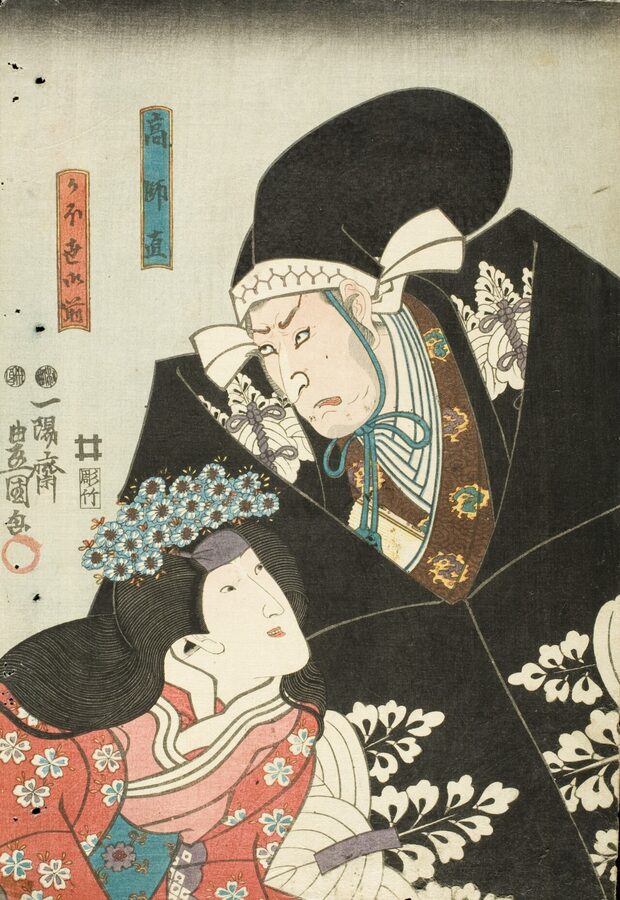
It became kabuki’s insurance policy. Theatre people called it dokujintō, a ginseng tonic for a sick box office: when a house was losing money it put on Chūshingura. During Act 4, in which En’ya commits seppuku and waits in vain for his chief retainer to arrive, the doors stayed shut and nobody was let in or out, a custom that survives at the Kabukiza as a polite note that latecomers may have to wait.
In November 2026, as it happens, the Kabukiza is staging the play almost complete, in five sections across a matinee and an evening show, from the helmet scene to the night attack. I would not start with it. It is the best way I know to understand why the play held Japan for three centuries, and also a ten-hour commitment in a language most visitors do not speak.
Yoshitsune Senbon Zakura
Yoshitsune and the Thousand Cherry Trees takes Minamoto no Yoshitsune in flight from his brother after the Genpei War and imagines that three Taira generals the chronicles say were dead are alive and hiding. Taira no Tomomori, son of Kiyomori, is running a shipping office at Daimotsu Bay and makes his final exit lashed to an anchor, dragging it into the sea. It is the most spectacular death in the repertoire and the actor has to climb a rock to do it.
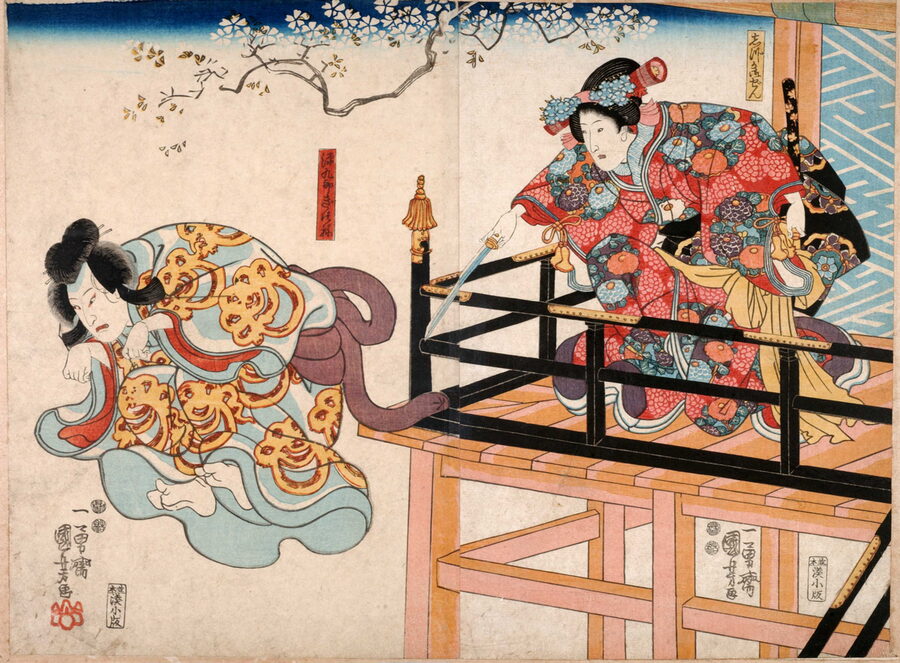
The role everybody comes for is the fox. A young fox, whose parents’ skins were used to make a drum Yoshitsune has given to his mistress Shizuka, takes the form of the warrior Tadanobu to stay close to it, and in the scene known as Shi no Kiri he is unmasked and explains himself. The actor appears through the floor, out of a staircase, through a wall and finally, in some productions, flies out over the audience on a wire. It is pure keren, stage trickery, and the purists who despised it for a century have mostly given up.
The cherry trees in the title are those of Yoshino, the mountain in Nara where Yoshitsune is supposed to have hidden, and the play’s dance scene on the road there is one of the most beautiful half-hours in the theatre. If you want to see it in the place, the site’s cherry blossom guide covers Yoshino.
Kanjinchō
Kanjinchō, “The Subscription List”, is the one play nearly every Japanese person can name. It is short, it is about Yoshitsune again, and it is the scene from the noh play Ataka, rewritten for kabuki by Namiki Gohei III for Ichikawa Danjūrō VII and first performed in the third month of 1840 at the Kawarazaki-za. Yoshitsune and his men, disguised as mountain priests collecting donations for the Tōdai-ji, reach a barrier where the guard, Togashi, has orders to stop them.
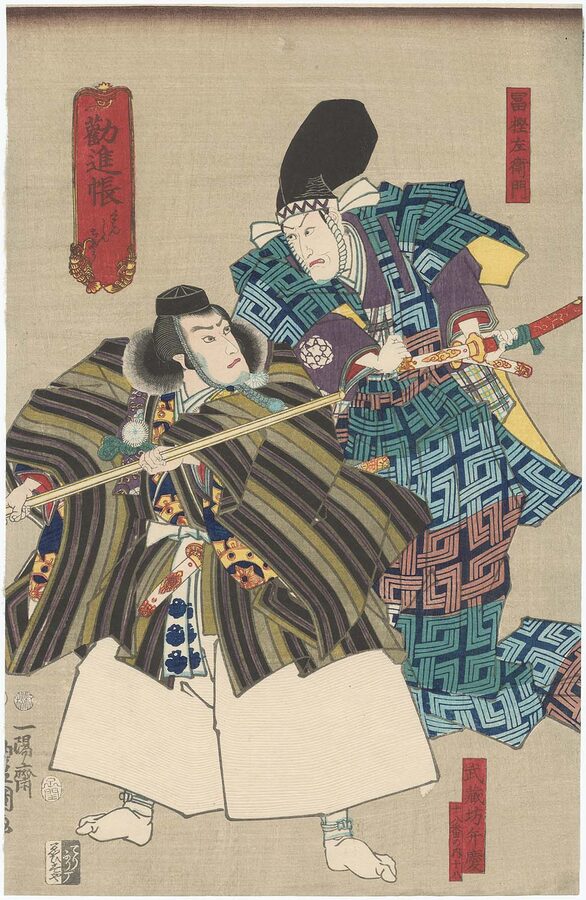
Togashi demands to hear the subscription list. Benkei, Yoshitsune’s giant monk retainer, unrolls a blank scroll and reads an entire fundraising appeal off it, from memory and invention, then beats his own master with a staff to prove that the porter who resembles Yoshitsune cannot possibly be him. Togashi lets them through, and the audience is left to decide whether he was fooled or simply moved. The phrase “to read a kanjinchō” still means, in Japanese, to make it up as you go along.
Danjūrō VII had it staged in imitation of noh, with a pine tree painted on the back wall, and it is one of the Kabuki Jūhachiban, the Eighteen Great Plays he declared his family’s own in 1832. The scripts were kept in boxes, which is why ohako, “the box”, now means anyone’s party piece. The play ends with Benkei alone on the runway, bounding off through the audience in a leaping exit called tobi roppō, and I have never heard a house stay quiet for it.
Sukeroku
Sukeroku is Edo’s idea of itself. He is a chivalrous dandy of the Yoshiwara pleasure quarter with a purple headband and a snake-eye umbrella, picking fights with every swaggerer he meets in the hope that one of them will draw a particular stolen sword, and his lover is Agemaki, the top courtesan of the house. The story came from a love suicide reported from Ōsaka, but Ichikawa Danjūrō II turned it into an Edo play in 1713, and by the second production Sukeroku had been revealed as one of the Soga brothers in disguise.
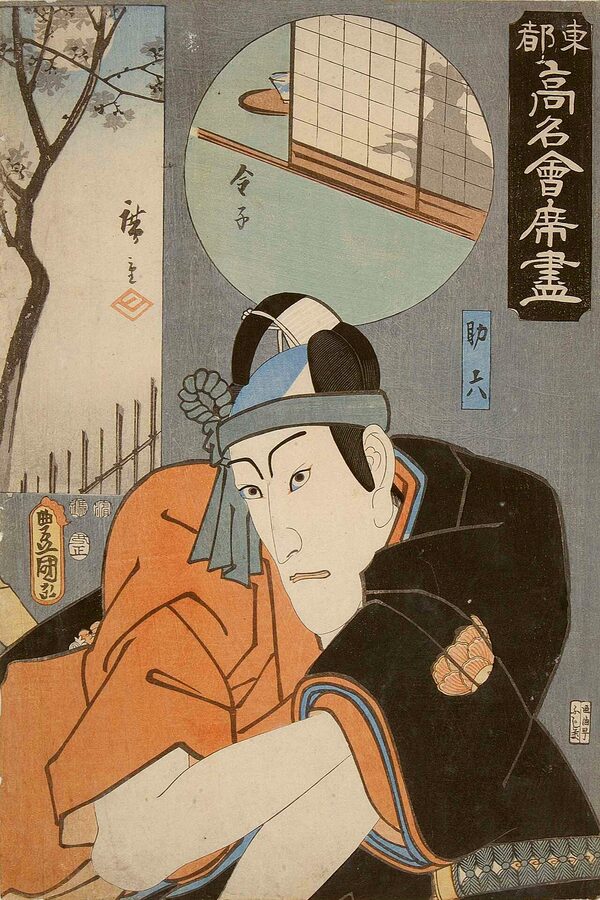
That disguise is the whole joke of Edo kabuki. A Yoshiwara townsman was not allowed to be the hero of a serious play, so he had to turn out to be a medieval samurai underneath. The audience knew perfectly well that the townsman was the point.
Ghosts
The ghost plays belong to the end of the Edo era, and to Tsuruya Nanboku IV. Tōkaidō Yotsuya Kaidan opened at the Nakamura-za in the seventh month of 1825, and it was performed over two days with Chūshingura, the two plays interleaved, because Nanboku had set his story in the same world. His villain, Iemon, is a rōnin of the En’ya house who, to marry a rich man’s granddaughter, lets her family poison his wife Oiwa.
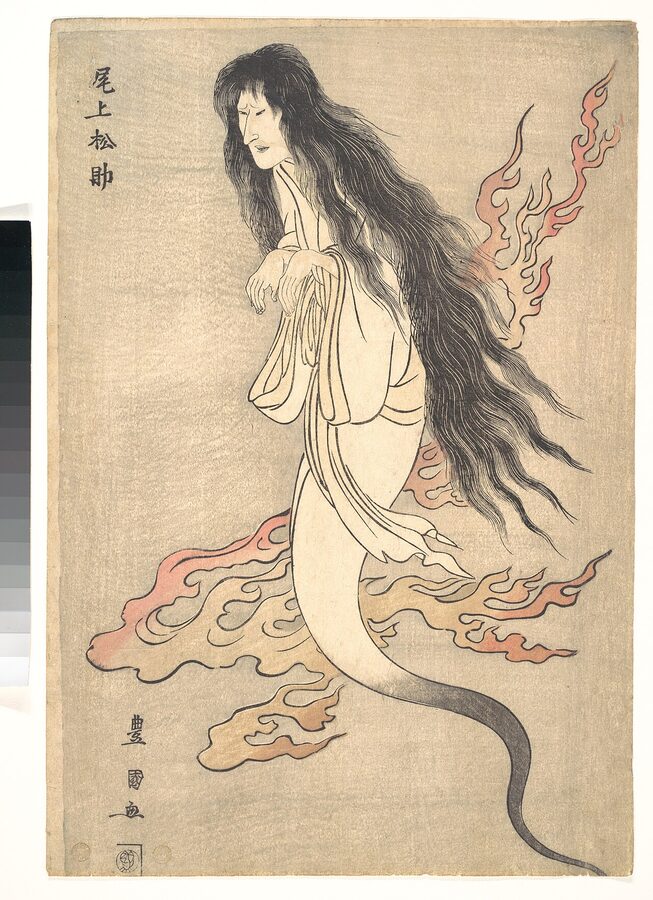
The poison disfigures her, and in the scene everybody waits for she combs her hair before a mirror and it comes out in handfuls. Her body is nailed to one side of a door and floated down a canal with a murdered servant on the other side, and when Iemon goes fishing the door drifts up to him and turns over. The trick was done with one actor playing both corpses. It still is.
The play is set in the same Edo of rōnin, debt and back alleys as everything else in this section, and the same print-makers drew it: Hokusai, in the same years as the Great Wave, made Oiwa’s face appear in a burst paper lantern, one of the most famous ghost pictures in Japan.
The machine
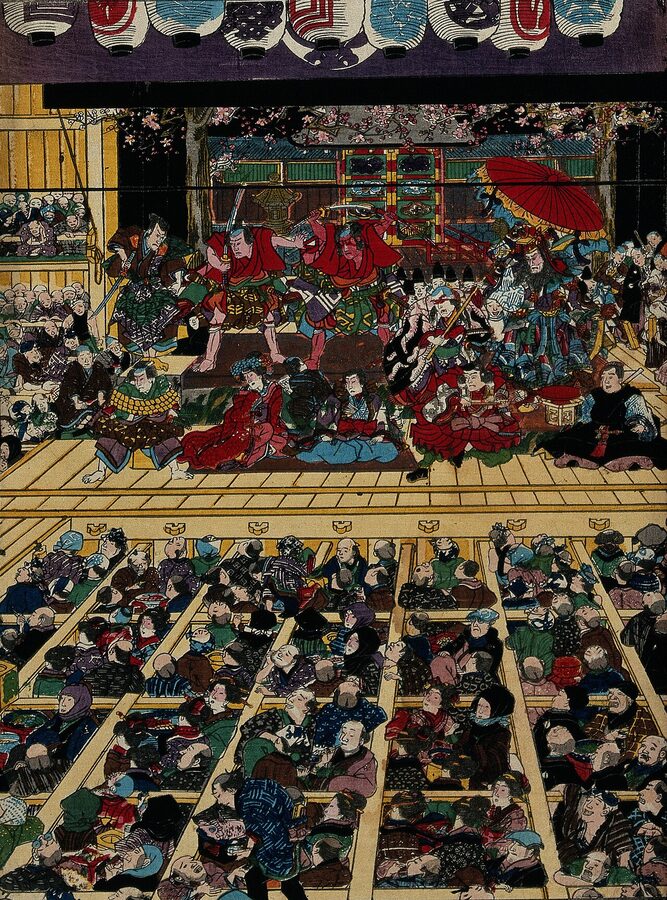
The stage itself was invented piece by piece, and much of it by kabuki. Theatres were roofed over completely in the Kyōhō era, in 1717 or 1718 depending on the source, which made it possible to darken the house and fly actors. The hanamichi (花道), the runway from the back of the auditorium to the stage, began as a plank laid through the crowd in the 1660s and was fully formed by the 1730s. The name is usually explained as the path along which fans once brought hana, gifts, to their favourites.
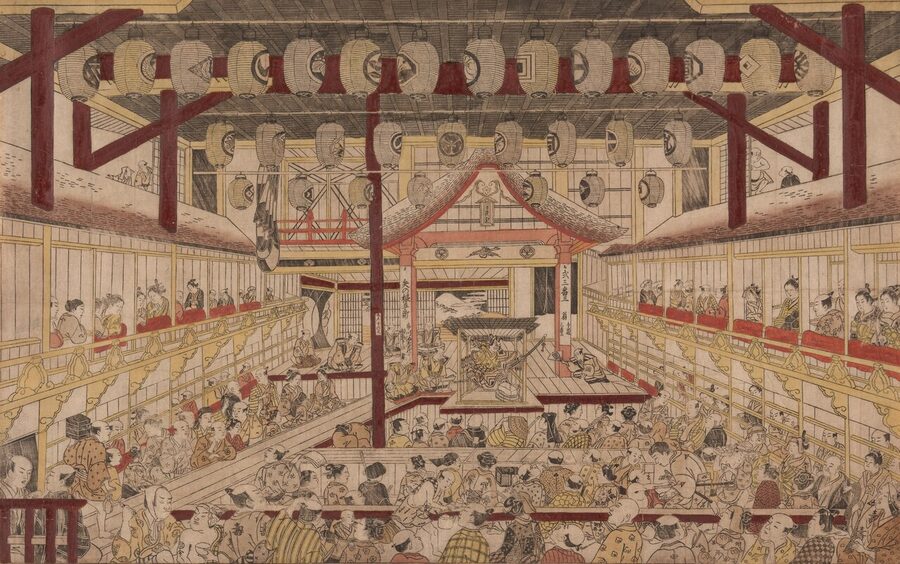
The most important moments in a play happen on the hanamichi, at the point about seven-tenths of the way to the stage called shichisan, and that is where the suppon is, a small trapdoor from which ghosts, foxes and magicians rise. The revolving stage was perfected in Ōsaka in the 1750s by the playwright Namiki Shōza, who moved the machinery underneath, joining the stage lifts that had come into use a generation earlier. At the Kabukiza today the revolve is 18 metres across, with four lifts set into it, and the pit beneath the stage goes down 11.4 metres.
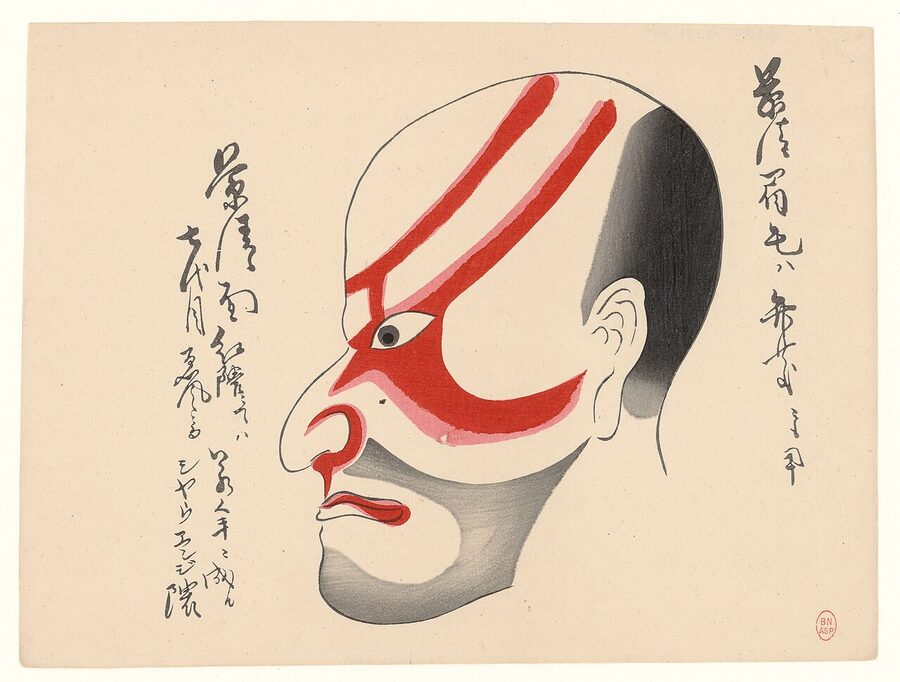
The actors make the rest. Kumadori (隈取), the painted lines of the aragoto roles, exaggerate veins and muscles: red for heroes and righteous anger, blue for villains and ghosts, brown for demons. A mie (見得) is the frozen pose at the height of a scene, the head rolling, one eye crossed, held like a still in a film while the stage assistant beats two wooden clappers on a board at the side of the stage, the sound called tsuke. Danjūrō I is credited with the oldest of them, still known as the Genroku mie.
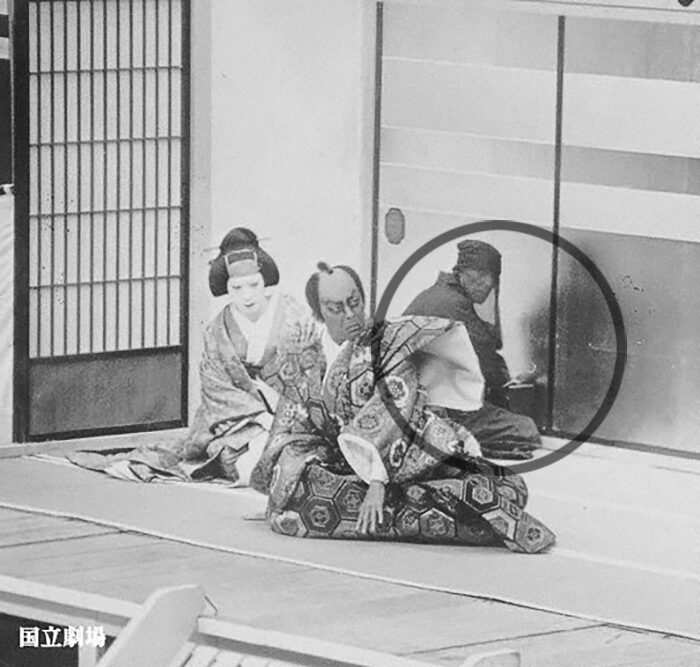
Then there are the people you are supposed not to see. The kurogo (黒衣), dressed and hooded in black, hand actors their props, remove their outer kimono in a quick change and hold up the rods from which butterflies and fireballs dangle. On a snow scene they dress in white and on a seashore in blue, and in Japanese a kuromaku, a black curtain, has come to mean a fixer who pulls strings from behind.
The audience has a part too. At the right moment someone at the back calls out the actor’s yagō, his house name, “Naritaya!” for a Danjūrō, “Otowaya!” for a Kikugorō, or “Matte imashita!”, “We’ve been waiting for you!”, as a star reaches shichisan.
These kakegoe shouts come mostly from the gods, the cheap top seats called the ōmukō, and are traditionally the preserve of a few long-established clubs of regulars whose timing is part of the show. Do not join in on your first visit. A shout half a beat early is the loudest sound in Tokyo.
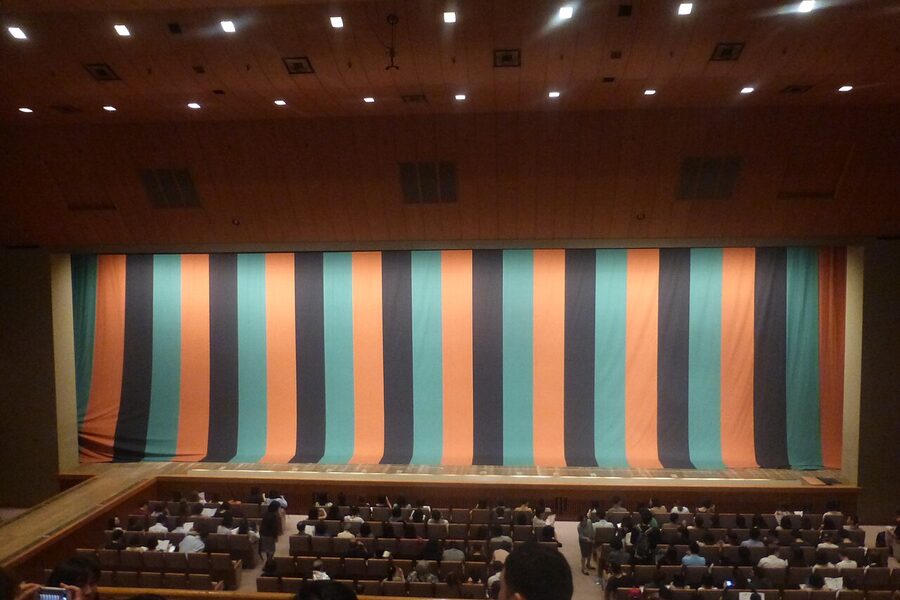
The names belong to families. An actor’s stage name, his myōseki, is inherited, usually by a son or an adopted son, and he climbs through a series of names over a career, each shūmei, the ceremony of taking a new one, a sell-out event. Ichikawa Ebizō XI became Ichikawa Danjūrō XIII Hakuen on 31 October 2022, after a two-year delay for the pandemic, and in 2025 Onoe Kikunosuke took his father’s name as Kikugorō VIII. There are routes in for outsiders, through the National Theatre’s training course, which has taken young people from ordinary families since 1970, but the leading roles still go to the sons of leading actors.
A few kabuki terms escaped into ordinary Japanese and stayed there. A nimaime, “second board”, is a handsome leading man because that is where the romantic lead’s name went on the theatre’s signboard, and a sanmaime, “third board”, is a comic. The two are used every day of people who have never been to a theatre.
Censors, a move to the rice fields and an American major
The shogunate never stopped worrying about the theatres, and in the Tenpō reforms of the early 1840s it finally acted. After a fire destroyed the Nakamura-za and the Ichimura-za late in 1841, the three licensed theatres were ordered out of the city centre to a former daimyo estate at Shōden-chō in Asakusa, then little more than rice fields, together with two puppet theatres. The new district was named Saruwaka-chō, after the founder of Edo kabuki, which must have seemed a fine joke to somebody.
The great Danjūrō VII was banished from Edo in 1842 for luxury: he had used real armour on stage and lived, the authorities said, above his station. Actors were told what they could wear in the street and whom they could talk to. Kabuki people had always been called kawara kojiki, riverbed beggars, in memory of Okuni’s stage, and now the theatre district joined the Yoshiwara, a short walk to the north, as one of Edo’s two official “bad places”.
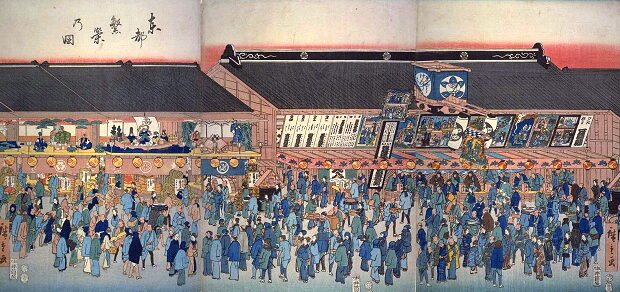
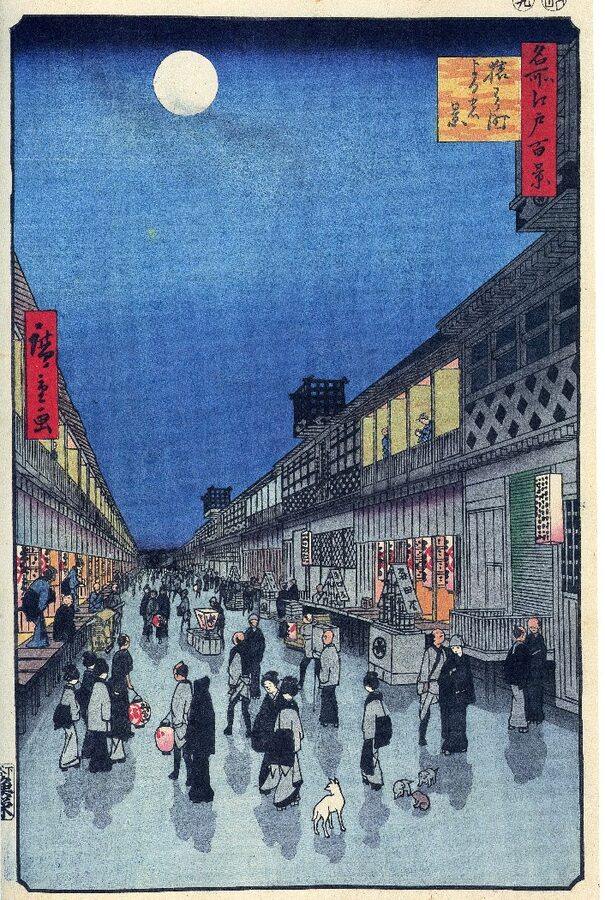
It backfired. With the three theatres in one street, actors could move between companies easily, fires were rarer, and Saruwaka-chō became the busiest entertainment district in Edo for thirty years. Hiroshige drew it twice, packed by day and by moonlight. Its playwright was Kawatake Mokuami, whose thieves and gamblers speak in a seven-and-five syllable rhythm so musical that it is halfway to song.
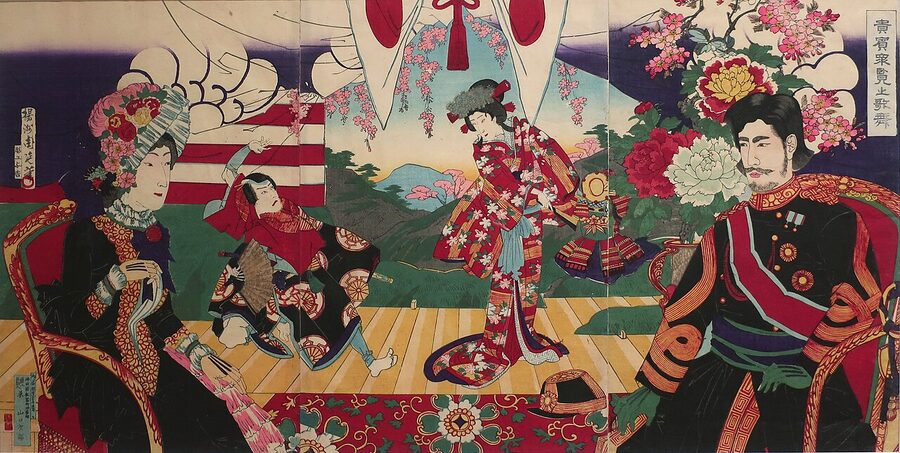
The government that came out of the Meiji Restoration wanted kabuki to grow up. From 1872 officials told the actors to drop the fantastical plots and present history fit for “people of rank and foreigners”, and Ichikawa Danjūrō IX tried: his katsureki, “living history” plays, had accurate costumes, real chronology and almost no audience. His lasting gift was a quieter style of acting, haragei, “belly art”, that played thought rather than gesture, and it changed how the classics were performed.
The prize for good behaviour came on 26 April 1887. At Inoue Kaoru’s mansion at Toriizaka in Tokyo, the Meiji Emperor watched kabuki, the first emperor ever to do so, and the first play was Kanjinchō. Some English-language accounts give the date as 21 April; Japanese sources agree on four days of performances starting on the 26th.
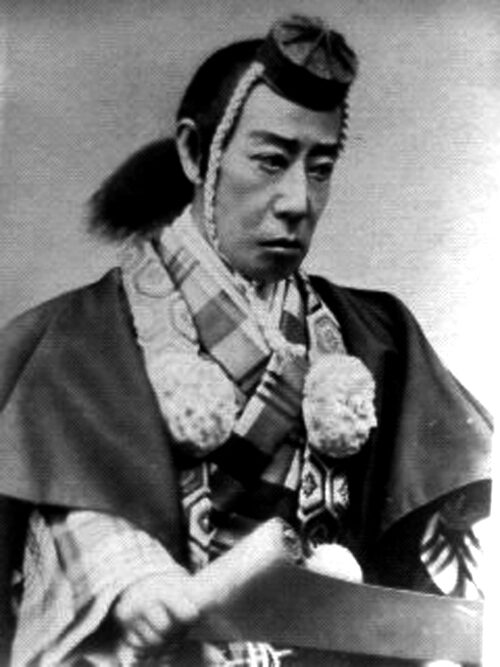
The Meiji era also gave kabuki its temple. The Kabukiza opened in 1889 in Kobiki-chō, the old theatre district of the Morita-za, with a Western exterior and a Japanese interior, and was rebuilt in 1911 in the style of a Momoyama palace. The Shōchiku company took it over in 1913 and still runs almost all professional kabuki in Japan.
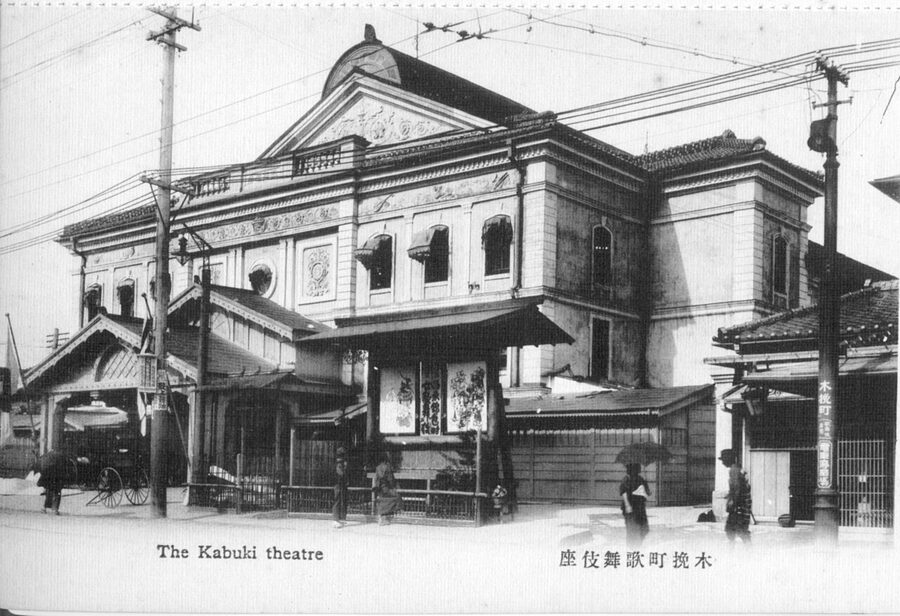
The building burned in 1921, was rebuilt in the Taishō era, and was gutted in the American air raids of May 1945. Then the occupation arrived. On 22 September 1945 the occupation authorities banned plays built on feudal loyalty and revenge, and in November they stopped a performance of the Terakoya scene from Sugawara, in which a retainer sacrifices his own son, in mid-run. Shōchiku withdrew Chūshingura and much of the classical repertoire itself.
The man who argued for the plays was Faubion Bowers, a young American major who had wandered into the Kabukiza in 1940 thinking it was a Buddhist temple, seen Chūshingura and never recovered. He became General MacArthur’s interpreter and then, of all things, the occupation’s theatre censor, and he used the job to protect what he was meant to suppress. In November 1947 a full Chūshingura, with stars from Tokyo and the Kansai together, opened at the Tōkyō Gekijō with official blessing.
The rest of the century was recovery and paperwork. The Kabukiza reopened in 1951, in the middle of the Shōwa era, and on 1 February 1953, the first day of Japanese television, one of the first programmes NHK broadcast was the dance from Yoshitsune Senbon Zakura. Kabuki was designated an Important Intangible Cultural Property in 1965 and the National Theatre opened in 1966. UNESCO proclaimed it a masterpiece of humanity’s heritage in 2005 and inscribed it on the Representative List in 2008, although Japanese sources usually give 2009, the year of the first formal registrations under the new convention.
How to watch kabuki today
There is professional kabuki in Tokyo almost every month of the year, in Kyoto for part of it, and in Ōsaka, Nagoya and Fukuoka for a few weeks at a time, and Shōchiku publishes the whole calendar in English. Programmes change monthly and run for about 25 days from early in the month, usually as a matinee and an evening show of three or four pieces each, sometimes in three parts. The National Theatre in Tokyo closed in 2023 for rebuilding, so for now the Kabukiza is the centre of everything.
My advice to a first-timer is to see one act, not a whole show, and to choose a dance piece or Kanjinchō over a long domestic drama. If you like it, come back for a full programme and sit downstairs on the left, near the hanamichi.
The Kabukiza, Ginza
The Kabukiza stands at Ginza 4-12-15, and Higashi-Ginza Station on the Hibiya and Toei Asakusa lines connects to it directly from Exit 3; from Ginza Station, Exit A6 is a five-minute walk. The present building, the fifth, opened in the spring of 2013, with a façade that copies the 1951 theatre in front and a 29-storey office tower behind. The auditorium has 1,964 seats and an 18-metre hanamichi. In November 2026 the matinee starts at 11:00 and the evening show at 16:30; December’s three parts start at 11:00, 14:30 and 18:00.
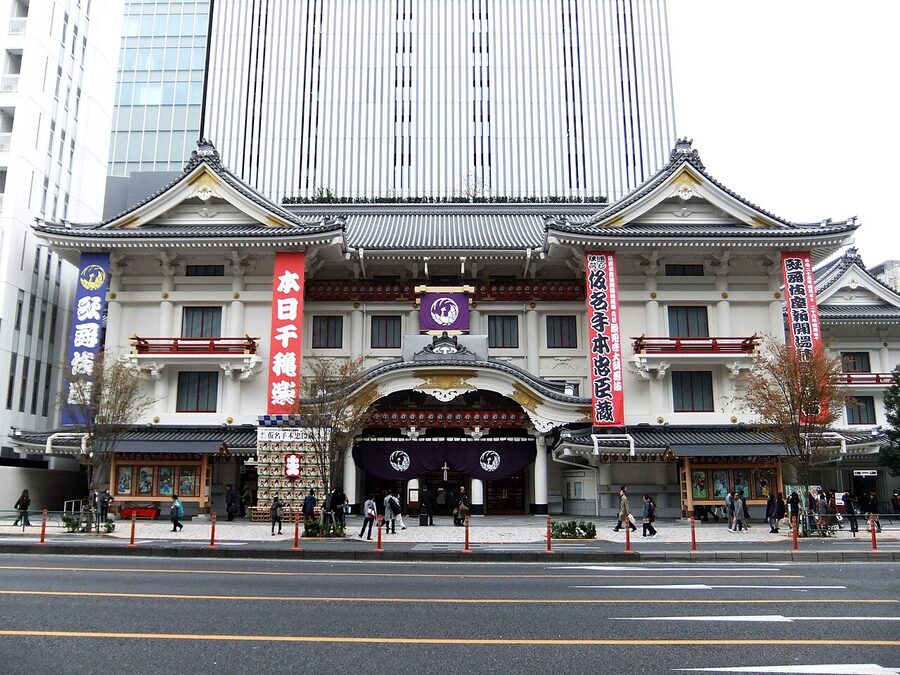
Full-show tickets go on sale about half a month before each programme on Shōchiku’s English booking site. For the November 2026 programme they run from ¥5,000 in the upper tier to ¥20,000 for the best seats, and for December, which is in three parts, from ¥4,500 to ¥17,000. If the website shows a date as sold out, the box office on the second basement floor sometimes has returns.
The single-act seats, hitomakumi (一幕見), are the best value in Tokyo theatre and the reason I keep sending friends here. About seventy seats on the fourth floor go on sale online from noon the day before each performance, and about twenty more are sold at the single-act box office to the left of the main entrance from 10:00 on the day. In November 2026 a single act cost between ¥1,600 and ¥3,000, depending on its length.
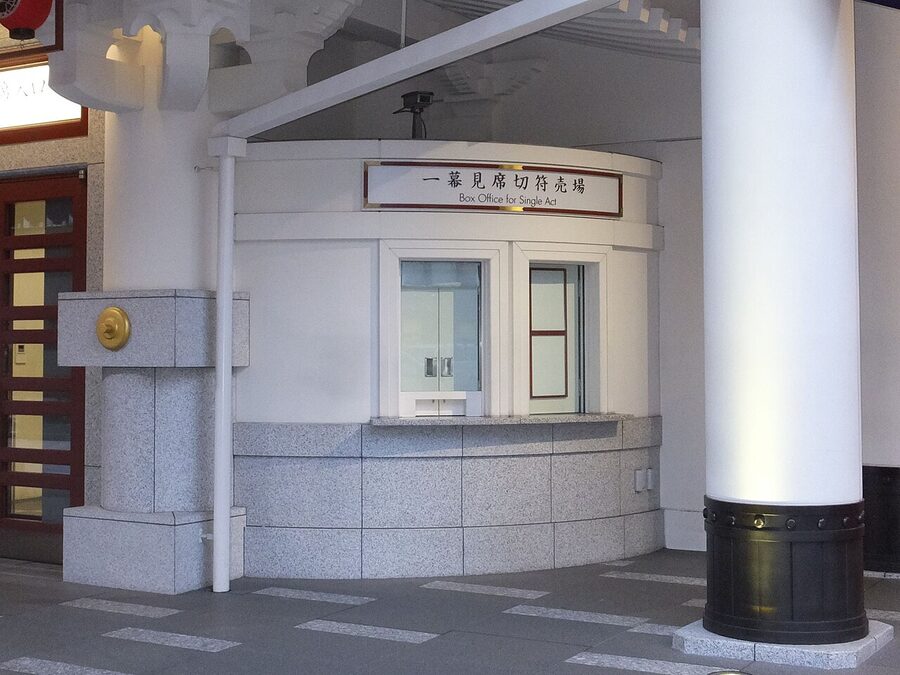
There are also “upgraded” single-act seats on the second floor, sold online for roughly three or four times the price, with a far better view of the stage. Doors open about thirty minutes before each performance.
The English earphone guide that generations of visitors remember was withdrawn in June 2024. In its place the theatre rents a small captioning device with English or simplified Chinese subtitles, translations of the dialogue and lyrics and notes on what is going on, for ¥1,000 per single act or ¥1,500 for a full show, cash only; you can also add it when you book. The Japanese earphone guide, introduced in 1975, is still running, and the programme sold at the theatre has detailed English synopses at the back.
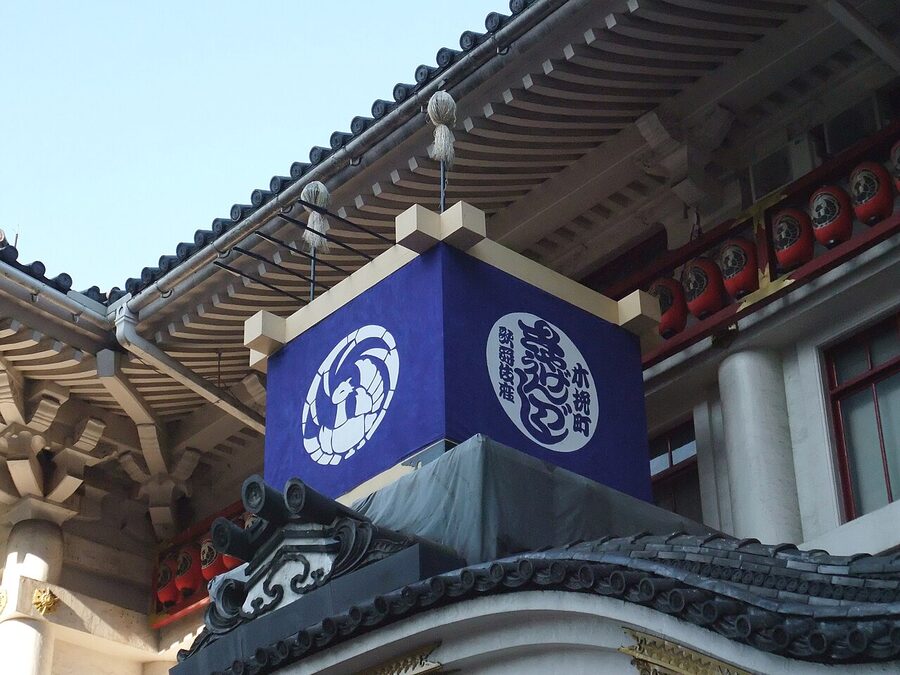
There is plenty to do without a ticket. Kobikichō Square on the second basement floor, reached straight from the subway, sells bentō, kabuki sweets and souvenirs, and the ground-floor shop beside the entrance sells ningyō-yaki, little bean-paste cakes shaped like the seven lucky gods. The Kabukiza Gallery on the fifth floor of the tower, open 10:30 to 18:00, has changing exhibits of costumes, props and stage machinery, and beside it is a rooftop garden with a vermilion staircase named after Ishikawa Goemon.
From the staircase you can look down on the roof tiles, each stamped with the Kabukiza’s phoenix crest. All the phoenixes face the same way except one, and finding it is said to bring luck. I have never found it, which may explain a great deal.
Asakusa: Saruwaka-chō and the Shibaraku statue
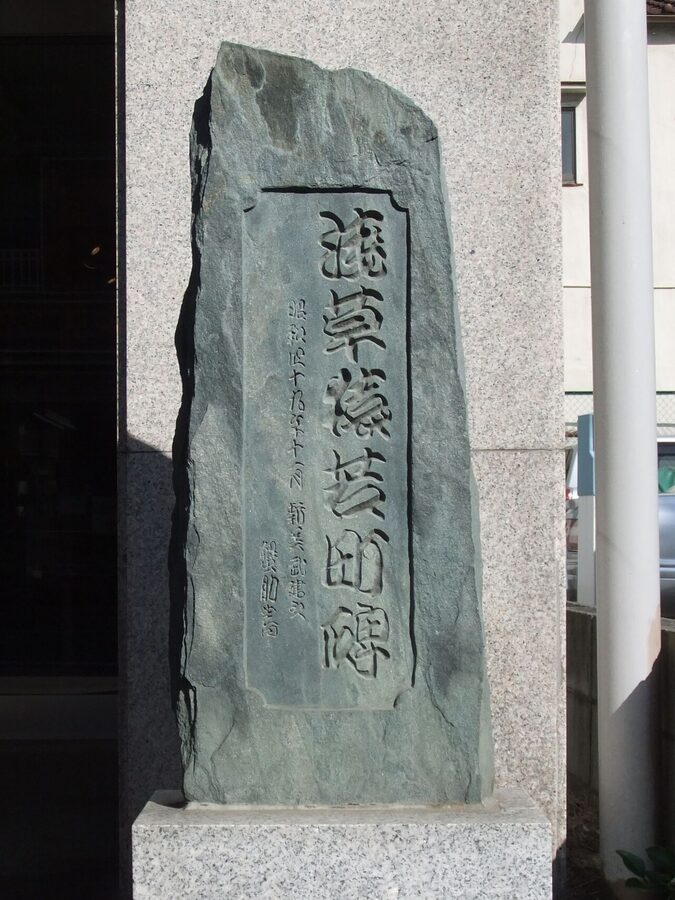
Nothing survives of the Saruwaka-chō theatres, but the district is easy to find: it is the eastern part of Asakusa 6-chōme, about ten minutes’ walk north-east of Sensō-ji. Stone markers stand at the sites of the Ichimura-za and the Morita-za, and a larger monument names the district. It is now a quiet residential neighbourhood, and the only theatrical thing about it is the sign.
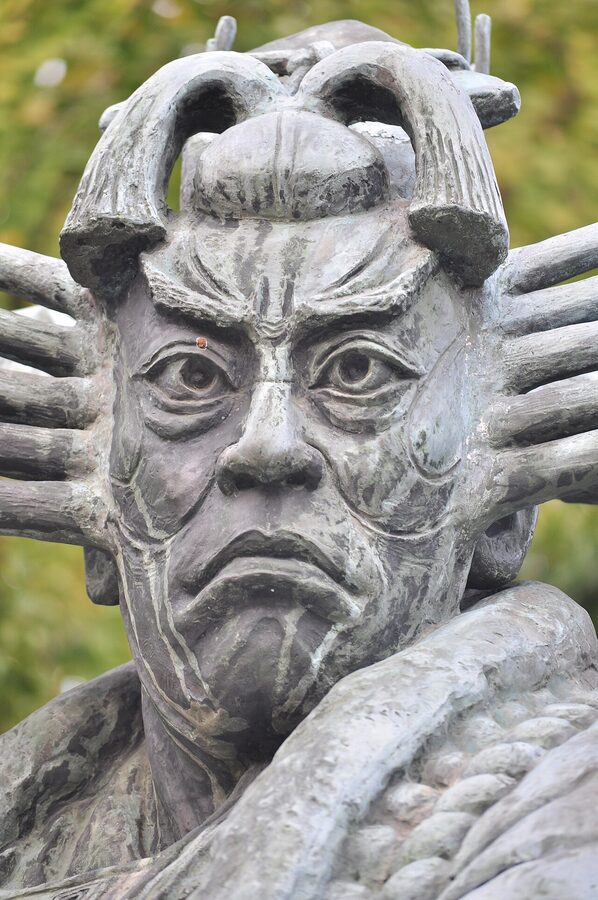
At Sensō-ji itself, behind the main hall, stands a bronze of Danjūrō IX in Shibaraku, put up in 1919, melted down for metal during the war and recast in 1986 at the instigation of Danjūrō XII. Each January young actors perform the New Year Asakusa kabuki at the Asakusa Kōkaidō a few minutes away, with cheaper tickets and casts that will be stars in twenty years. From time to time the Heisei Nakamura-za, a temporary wooden theatre in the style of the Edo playhouses, is put up in Asakusa, sometimes in the grounds of Sensō-ji itself.
The Edo-Tokyo Museum in Ryōgoku has a full-size replica of the front of the Nakamura-za, which is the best way to understand what Saruwaka-chō looked like. It spent several years closed for renovation, so check that it is open before you go.
The Minamiza, Kyoto
The Minamiza stands at the east end of the Shijō Ōhashi bridge in Kyoto, one minute from Exit 6 of Gion-Shijō Station on the Keihan line, or three minutes from Exit 1 of Kyoto-Kawaramachi on the Hankyū line. A theatre has occupied the site since the early 17th century, the last survivor of the seven licensed theatres that once lined the Shijō riverbank, and that is why it calls itself the oldest theatre in Japan. The present building dates from 1929, with a Momoyama-style front, and reopened in 2018 after three years of earthquake strengthening.
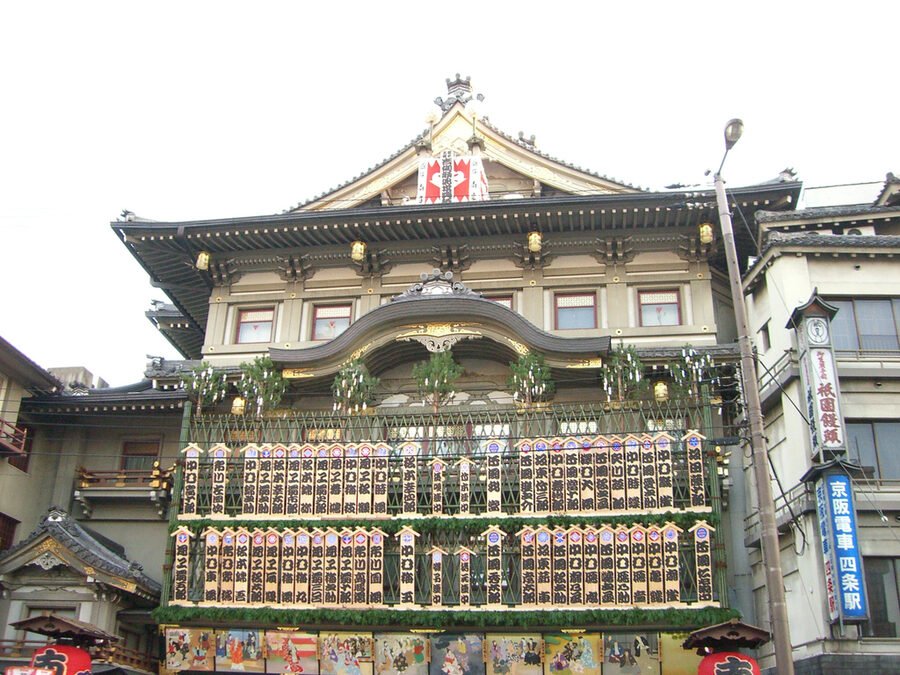
Its great event is the December kaomise, Kyoto’s annual face-showing, with an all-star company from Tokyo and the Kansai. In 2026 it runs from 1 to 24 December, with the matinee at 10:30 and the evening show at 16:00. Tickets run from ¥6,000 to ¥26,000, with ¥28,000 for the special seats, and English captioning devices are offered for the evening show only. In other months the theatre runs kabuki, musicals and the occasional maiko dance, and the geiko and maiko of Gion attend the kaomise in a group on certain days, which is worth timing your visit for.
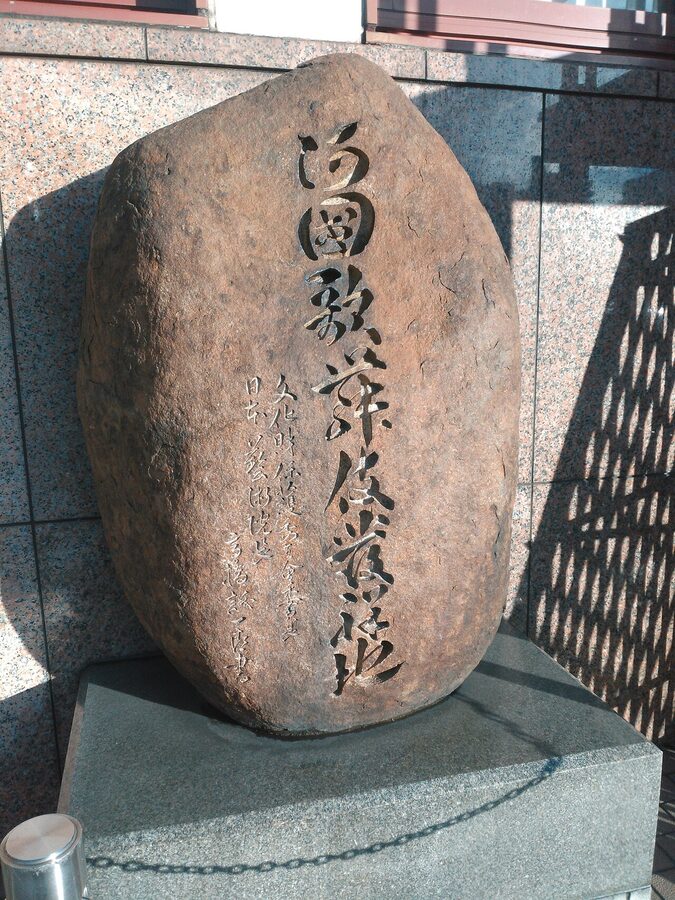
At the eastern end of the bridge, on the riverbank across Shijō-dōri from the theatre, stands a bronze of Okuni put up in 2002, ahead of kabuki’s four-hundredth anniversary. Five minutes up Shijō is the Yasaka Shrine of the Gion Matsuri, and the Ichiriki teahouse where the seventh act of Chūshingura is set stands on the corner of Hanamikōji. You can stand outside; you cannot go in.
The Kanamaru-za, Kotohira
The best place in Japan to understand the old theatre is not in Tokyo or Kyoto. The Kanamaru-za, formally the Kyū Konpira Ōshibai, the Old Konpira Grand Theatre, was built in 1835 in Kotohira in Kagawa, the pilgrim town below the Konpira shrine, to give the crowds of pilgrims something to do once they had climbed the steps. It is the oldest surviving kabuki theatre in Japan and an Important Cultural Property.
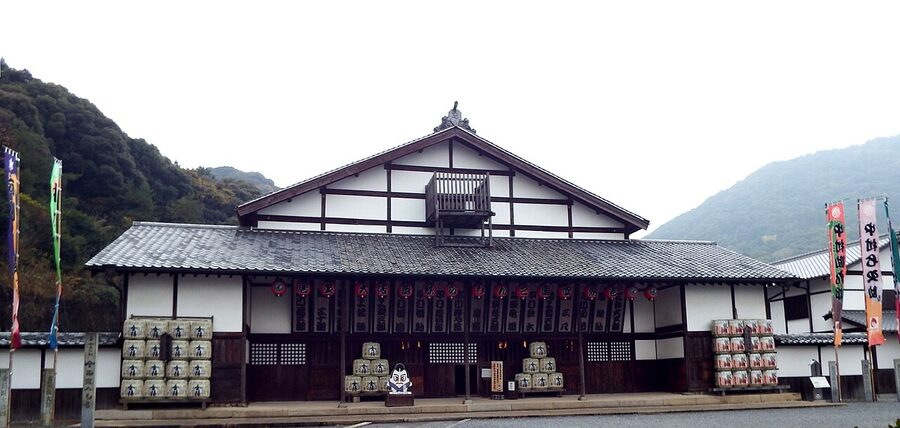
Its building costs were met partly by a levy on the town’s courtesans, and in the Meiji era it changed its name several times, became a cinema and then a ruin. Japanese sources variously date its rebuilding on the present site to 1975 or 1976. A restoration finished in 2004 removed four steel columns from the auditorium and put back two pieces of Edo machinery whose traces turned up in the survey: the bamboo grid over the pit from which paper snow is dropped, and the rope rig over the hanamichi along which actors could fly. A second round of work, mostly hidden earthquake bracing, was completed in time for the 2024 season.
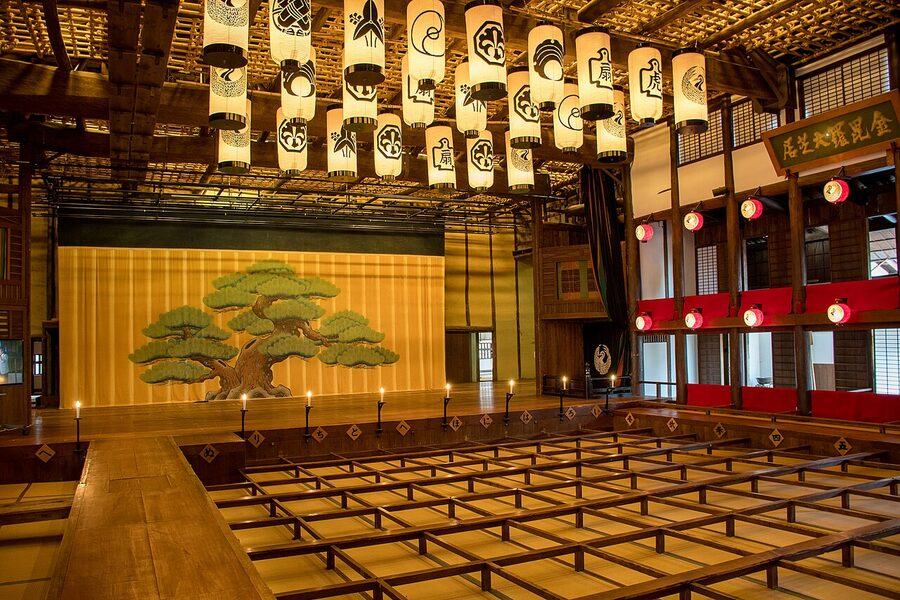
When there is no performance you can wander through most of it, from the boxes and galleries to the hand-turned revolve and the pit underneath, where you can see the stone footholds the crew pushed against to turn the stage. The theatre is open 9:00 to 17:00, last entry 16:30, and admission is ¥500 for adults, ¥300 for junior high and high school students and ¥200 for elementary school children; it closes during performances and events. There is no parking, and it is about a twenty-minute walk from JR Kotohira or Kotoden Kotohira stations.
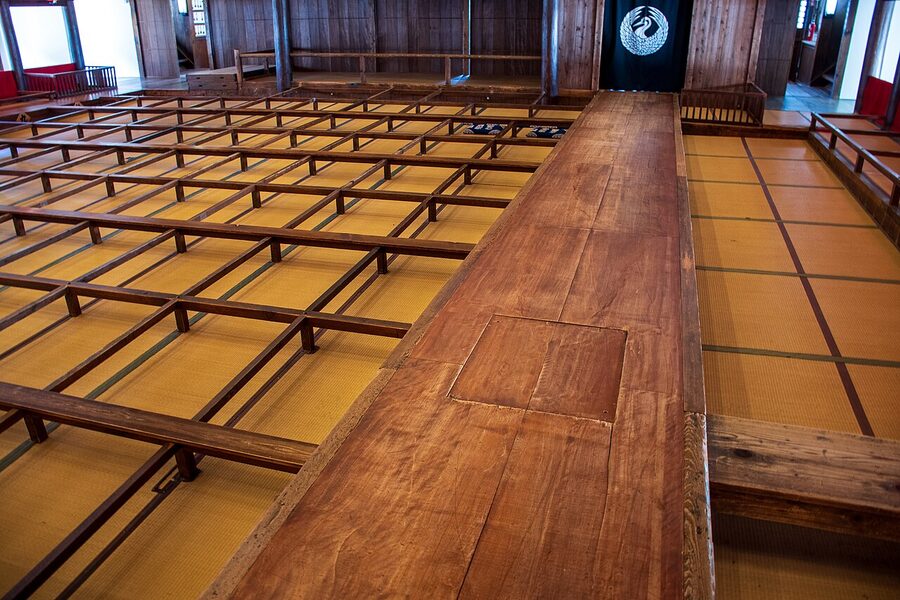
Once a year, in April, professional kabuki comes back. The Shikoku Konpira Kabuki Ōshibai, first held in 1985, is the most sought-after ticket in the calendar, partly because it is the only chance to see top actors in a real Edo theatre and partly because there are so few seats. The fortieth season runs from 9 to 25 April 2027, opening with an actors’ procession through the town on the 8th. The nearest original castle keep is at Marugame, about half an hour away by train, one of Japan’s twelve original castles.
Izumo
If you are going to Izumo Taisha anyway, Okuni’s grave is a short walk from the shrine, beside those of the Nakamura family who say she was one of theirs. It is a small stone with an explanatory signboard, and easy to miss.
Okuni’s bridge
Kabuki is often explained as an art of extraordinary refinement, and it is one, but I keep coming back to how much of it was made by accident.
The women were banned, so the men invented a woman. The real names were banned, so the playwrights invented a system of transparent disguises. The theatres were banished to the rice fields, and the rice fields became the liveliest street in Edo. Every time someone in authority tried to make kabuki behave, it found a way to do the same thing in costume.
That is also why it sits so comfortably among Japan’s great traditional crafts and so awkwardly in a timeline of Japanese history. It belongs to the townsmen of Edo more than to any shogun, and the samurai who appear in it, from Benkei to the forty-seven, are the ones the audience invented.
If you are in Kyoto, walk to the east end of the Shijō bridge in the evening, when the lights of the Minamiza come on. Okuni stands there in bronze, across the street from a theatre where every woman on stage is played by a man. The chronicler did not think she was a beauty. Four hundred years later she still has the best seat in the house.